Category Archives: deficit thinking

Thinking Beyond Bean Dad: A Reader

First, Bean Dad (as he would become known) posted a Twitter thread about teaching his daughter a lesson. The thread was flippant, snarky—and about a child not knowing how to use a can opener.

I was, frankly, surprised that Bean Dad took a beating on this because his approach to his child is essentially the foundational belief system in the U.S. about child rearing: The world is dangerous so I better pound on my kid before the world does so she/he is prepared for the Real World.

In far too much of the U.S., that pounding is literal—corporal punishment—but the pounding takes many forms such as grade retention and “no excuses” policies and practices in K-12 schooling.

Gradually, the clever thing to do about the Bean Dad trending on social media was to interrogate the phenomenon as an example of everything-that-is-wrong-with-Twitter. While a valid take, I think, it is also careless to set aside how this thread (whether it was hyperbole, as he claims, or not) is one small but ugly picture of how we mistreat children in the U.S., both in our families and in our institutions such as formal schools.

Let me offer an analogy.

One of the most important moments in the U.S. for the safety of children was recognizing the dangers of lead paint. This moment also is a powerful illustration of the need to target the external danger and not the child.

Instead of teaching children a lesson about lead paint—somehow toughening up those kids so that when they did consume lead paint, they would survive the experience—we used the power of public policy to remove lead from paint—to eradicate the danger, instead of pounding on the children.

Bean Dad quipped about his own compulsion to prepare his daughter for the apocalypse—some sort of version of The Road where the child is always alone?—but there seems never to be any consideration, as Maggie Smith concludes, for a better world: “This place could be beautiful,/right? You could make this place beautiful.”

A child is not an inherently flawed human that must be “fixed,” corrected, or improved. A child is a developing human that must be nurtured, and nurturing requires love, patience, and safe spaces.

If nothing else, we must all check our impulses to be Bean Dad so I offer here some reading to reconsider the many ways we fail that calling:

On Children and Childhood

Rethinking grade retention

Rethinking corporal punishment

Rethinking “grit”

Rethinking growth mindset

Resisting deficit ideologies

To “Be” or Not To “Be”: Moving Beyond Correctness and Stigmatized Language

ESPN radio has recently shaken up their on-air personalities across the daily schedule, notably replacing the morning slot held for many years by Mike & Mike (and a recent fractured version after Mike Greenberg left) with a clear signal toward diversity— as reported by Andrew Marchand:

And now, look who is moving into the predominantly white sports-radio neighborhood beginning Monday. It’s Keyshawn, Jay Williams & Zubin Mehenti….

How will it be different?

“First of all, we are three minorities,” Keyshawn said. “That is No. 1. There haven’t been three minorities that I know of on a morning national sports show.”

One of the traditional areas where radio and television in the U.S. has had a strict lack of diversity is the use of language; talking heads—even late-night talk show hosts—practice something of a radio voice (lacking distinct regional pronunciations) and so-called “standard English.”

While listening to the new and more diverse morning radio show on ESPN, I heard Keyshawn Johnson say about a river they were discussing that people “be jet-skiing” in it. The trio’s reactions made it clear this waterway was not safe for recreation.

Since it is early in my first-year writing seminars, I am still helping students re-orient their attitudes and assumptions about reading, writing, and language. A foundational re-orientation for my courses is moving away from seeing language use as “correct” or “incorrect” (as well as rejecting terms such as “standard English” and “non-standard dialect”) and cautioning students not to stigmatize language use as some distinct flag for intelligence or moral/ethical character.

Johnson’s use of “be” to capture a continuous “presentism” of an action along with the omission of “to be” verbs (“Keyshawn home all day”) are often markers for what some call “Black English” (I was taught about Black English through the work of Dillard in the 1970s, but “Ebonics” and “AAVE” have also been used to designate this language usage pattern).

Few people are likely to recognize that ESPN’s new line up is more than racial or cultural diversity; Johnson embodies the importance of language use diversity as well—and he also embodies my cautions to students about “correctness” and stigmatizing language.

While there are people who may have flinched and drawn unfair and racist conclusions about Johnson’s verb usage, I suspect that there will be no professional consequences for Johnson’s language usage.

As I noted to my class, everyone listening knew the meaning of Johnson’s usage, and thus, the primary value of language—clear and precise communication—was completely achieved.

Writing from France in 1979, James Baldwin explained: “The argument concerning the use, or the status, or the reality, of black English is rooted in American history and has absolutely nothing to do with the question the argument supposes itself to be posing. The argument has nothing to do with language itself but with the role of language.”

A few paragraphs later, Baldwin elaborated, focusing on French:

What joins all languages, and all men, is the necessity to confront life, in order, not inconceivably, to outwit death: The price for this is the acceptance, and achievement, of one’s temporal identity. So that, for example, thought it is not taught in the schools (and this has the potential of becoming a political issue) the south of France still clings to its ancient and musical Provençal, which resists being described as a “dialect.” And much of the tension in the Basque countries, and in Wales, is due to the Basque and Welsh determination not to allow their languages to be destroyed. This determination also feeds the flames in Ireland for many indignities the Irish have been forced to undergo at English hands is the English contempt for their language.

It goes without saying, then, that language is also a political instrument, means, and proof of power. It is the most vivid and crucial key to identify: It reveals the private identity, and connects one with, or divorces one from, the larger, public, or communal identity. There have been, and are, times, and places, when to speak a certain language could be dangerous, even fatal. Or, one may speak the same language, but in such a way that one’s antecedents are revealed, or (one hopes) hidden.

In her work to move teachers of English away from “correctness” and the “error hunt,” Connie Weaver has highlighted Baldwin’s point about language usage being about power and that some forms of language usage have social, economic, and political consequences (often grounded in inequity such as racism, classism, etc.).

Often the use of “status marking” in language usage is accompanied by an uncritical acceptance of “standard English” and the inherent context that some language usage (“She is home”) is more complete and “better” than other language usage (“She home”) (see Pullum).

And language usage as status marking (some threat of observable consequences) is used to justify teaching students about code switching instead of stigmatizing any form of language usage.

The code switching argument has stood for many years as a progressive way to teach language that avoids “correctness” and appears to avoid stigma (which it doesn’t).

Again, Baldwin’s key point—”People evolve a language in order to describe and thus control their circumstances, or in order not to be submerged by a reality that they cannot articulate”—is simply side-stepped when we teach disenfranchised and marginalized young people to code switch because that approach allows us to avoid discussing the larger issues of power and inequity that govern the status marking.

Johnson’s use of “be” comes in a time of high social unrest over race, but also intersects with another harsh reality about language and teaching language: Language use is always in a state of flux, and the loose conventions that structure different groups of language usage are tenuous at best.

“People evolve a language in order to describe and thus control their circumstances, or in order not to be submerged by a reality that they cannot articulate,” Baldwin acknowledges. Language change, then, is also about power, not necessarily who has power but the dormant or repressed power of marginalized humans (children and teens manufacturing slang to build a linguistic wall between them and adults or racial minorities reshaping and reappropriating language as defiance and to claim power denied).

Although language can be racist, homophobic, misogynistic, etc., language also can shift toward equity. For example, many publications have now embraced “they” as a gender-neutral singular pronoun. Although some people are pulling out their hair in protest, that usage of “they” is centuries old in the English language because it fills a need left vacant in so-called “standard English.”

This door opened to “they” as singular and gender-neutral is in part about diversity, of course, and we can imagine that some racialized usages of language will walk through a similar door.

Language change is often very slow; it seems to happen organically, and then those with power eventually and some times reluctantly acknowledge a thing that has existed for decades or even centuries.

If this were a case for communication and standardization in the name of that communication, we may find the reluctance more compelling.

But Baldwin’s 1979 confrontation of Black English remains true in 2020 when the world and our language usages are all tinted by racism.

Because all teaching is political, and the very best teaching is activism, re-orienting students’ understanding of language does not have to be slow or organic, as demonstrated by The Conference on College Composition and Communication (CCCC):

We DEMAND that:

  1. teachers stop using academic language and standard English as the accepted communicative norm, which reflects White Mainstream English!
  2. teachers stop teaching Black students to code-switch! Instead, we must teach Black students about anti-Black linguistic racism and white linguistic supremacy!
  3. political discussions and praxis center Black Language as teacher-researcher activism for classrooms and communities!
  4. teachers develop and teach Black Linguistic Consciousness that works to decolonize the mind (and/or) language, unlearn white supremacy, and unravel anti-Black linguistic racism!
  5. Black dispositions are centered in the research and teaching of Black Language!

In K-16 formal education, language usage still falls on a continuum from correctness/standard English at one end and encouraging code switching at the other; the radical dismantling of language usage as status marking is rare, but some evidence exists that culturally we are ready for it.

This demand by CCCC is not simply about equity and authentic diversity, however, because the 5 demands are more linguistically sound than traditional approaches to framing language usage as “correct” or “wrong.”

Once again, Baldwin remains painfully true as he ends his essay:

The brutal truth is that the bulk of white people in American never had any interest in educating black people, except as this could serve white purposes. It is not the black child’s language that is in question, it is not his language that is despised: It is his experience. A child cannot be taught by anyone who despises him, and a child cannot afford to be fooled. A child cannot be taught by anyone whose demand, essentially, is that the child repudiate his experience, and all that gives him sustenance, and enter a limbo in which he will no longer be black, and in which he knows that he can never become white. Black people have lost too many black children that way.

And, after all, finally, in a country with standards so untrustworthy, a country that makes heroes of so many criminal mediocrities, a country unable to face why so many of the nonwhite are in prison, or on the needle, or standing, futureless, in the streets–it may very well be that both the child, and his elder, have concluded that they have nothing whatever to learn from the people of a country that has managed to learn so little.

Those of us who teach language usage have a moral obligation to refuse the norm of “correctness” and to dismantle the stigmatizing of language usage. Otherwise we are abdicating our own agency in the service of inequity and at the expense of our students.

“Science of Reading” Advocacy Stumbles, Falls

First, the stumble.

Yet another education journalist (also identified as a novelist and historian), Natalie Wexler, has weighed in on the “science of reading” (SoR). Wexler isn’t an educator, and she seems to suffer from the Columbus Syndrome far too common among journalists covering education.

I am not linking to the article, but it has already been updated since Wexler has received strong challenges to her tactics in this over-stated and misleading article

Accompanying the standard misrepresentations about teaching reading in the U.S., Wexler attempts to cast an accusatory shadow—invoking racism—over teaching reading by joining the “science of reading” propaganda movement.

However, Zaretta Hammond set the record straight on Twitter. In brief, Hammond challenges Wexler’s jumbled attempts at calling out racism and misguided references to recent racist police violence as well as implicating Hammond’s work in Wexler’s claims.

As Hammond notes, Wexler’s failure exposes the problems with fanning a Reading War that, once again, keeps our gaze on so-called failed students and failing teachers instead of systemic inequity and racism.

Wexler is wrong about reading and racism, but the criticism her article prompted has only nudged her to retract the racism stumbles, whitewashing her mistakes by apologizing on Twitter and revising her article.

Now, the fall.

One of the most damaging aspects of the “science of reading” movement has been how swiftly advocates of SoR and dyslexia have translated their movement into state-level reading legislation.

While I have been helping literacy educators and activists resist these efforts to change state education laws, some of us saw at least a pause in the SoR momentum with the Covid-19 pandemic, an unfortunate consequence that now seems to have had unintended positive outcomes for education (flawed reading legislation not passing for financial stress prompted by the pandemic).

For example, “A bid to improve Louisiana’s dismal reading skills for its youngest students died near the legislative finish line, leaving backers baffled on just what happened,” writes Will Sentell.

The surprise at this defeat comes, as Sentell explains, because “[t]he proposal, House Bill 559, had led something of a charmed life until it wilted at the end.”

However, as with other state-level reading legislation agendas across the U.S., this bill was grounded in misinformation about reading achievement as well as claims about the “science” they claim is missing in reading instruction.

Advocacy for the SoR has a fatal flaw found in both Wexler’s article and the “charmed” but failed bill in Louisiana—a “rigid refusal” to address first and fully the systemic inequity that is at the root of all educational measurements, including reading achievement.

SoR advocacy is grounded in a deficit lens that sees only individuals (students, teachers) and measures them against very reduced and narrow ideas of what counts as “normal.”

This advocacy also falls victim to silver-bullet solutions, reducing teaching to “all students must” and suggesting that this program is better than that program (without recognizing that the problem is reducing reading instruction to any program).

SoR advocacy is a misuse of “science” and a misunderstanding of human nature and the teaching/learning dynamic.

There is a powerful relationship among measurable reading achievement by students, reading instruction provided students in formal schooling, and the corrosive persistence of racism and systemic inequity in U.S. society and schools—systemic racism and inequity.

Since the SoR playbook is wrong on all of that, as Hammond ends her Twitter thread, “Know the difference.”

See Also

NEW: How to End the Reading War and Serve the Literacy Needs of All Students: A Primer for Parents, Policy Makers, and People Who Care (IAP)

Policy Statement on the “Science of Reading”


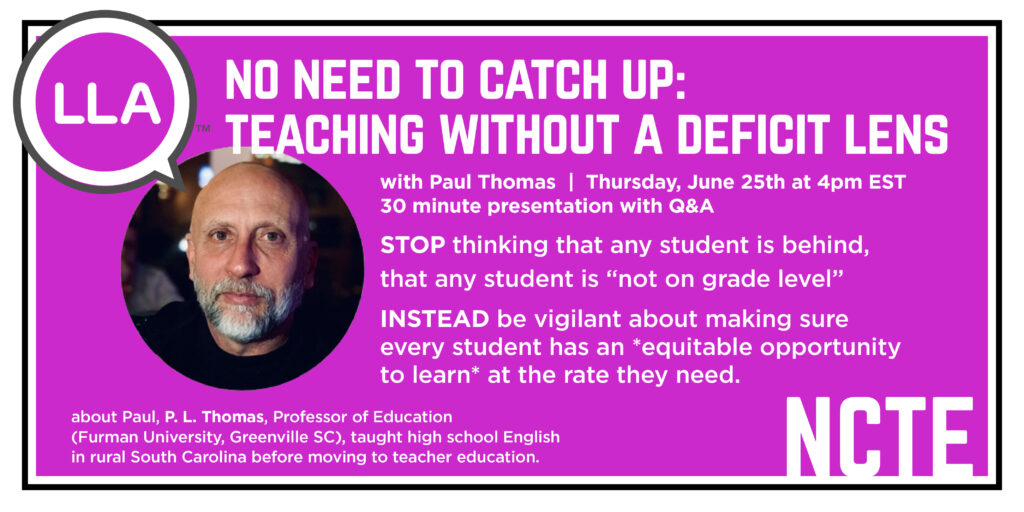
No Need to Catch Up: Teaching without a Deficit Lens

Some jokes work only when spoken aloud, and possibly especially when spoken aloud in certain regions of the country, but this one came to mind recently in the context of the impact of Covid-19 on schooling: “This is the worst use of ‘catch up’ in education since the Reagan administration allowed the condiment to count as a vegetable in school lunches.”

Heinz tomato ketchup bottle in shallow focus photography
Photo by Charisse Kenion on Unsplash

As I noted in a Twitter thread, a common response to schools closing during the spring of 2020 because of the pandemic is an editorial (The Post and Courier, Charleston, SC) declaring, Use summer to figure out how to catch up SC students; they’ll need it.

“How do schools help students catch up after the Covid-19 closures?” is the wrong question, grounded in a deficit lens for teaching and learning also found in concepts such as remediation and grade-level reading.

Traditional formal schooling functions under several inter-related ideologies, some of which are contradictory (consider assumptions about the bell-shaped curve and IQ v. the standards movement that seeks to have all students achieve above a normal standard).

Deficit ideologies depend on norms, bureaucratized metrics, against which identified populations (in education, grade levels linked to biological age) can be measured; the result is a formula that labels students in relationship to the norm. Many students, therefore, are positioned as deficient, labeled with what they lack.

The hand wringing about students falling behind with schools moving to remote teaching and learning during the spring exposes this deficit lens, but it has always been pervasive since the early twentieth century (at least) in U.S. education.

Consider the branding of federal education over the past couple decades—No Child Left Behind (George W. Bush) and Race to the Top (Barack Obama)—the first posing an image of falling behind (and thus the need for some to catch up) and the latter framing education as a race with necessary winners and losers (who, of course, were behind, need to catch up).

These deficit views of teaching and learning—and of teachers and students—are essential to the main structures of formal schooling, management and efficiency.

While it is a conservative mantra that all-things-government (such as public schools) are doomed to failure because it is government, the fundamental problem with public education is, in fact, bureaucracy (a weakness found in publicly funded institutions and the free market [read Franz Kafka, of Dilbert, and watch Office Space and The Office]).

Attempting to house and teach large numbers of students as efficiently as possible with constrained public funds is a guiding (if not the guiding) mechanism for how we teach students—students as widget monitored by quality control.

My father, Keith, worked in quality control his entire career. But his work involved machined parts, not human beings.

The manufactured “catch up” dilemma is a subset of that widget/quality control paradigm that can create a perception of efficiency but is antithetical to the complexity of human behaviors such as teaching and learning.

We teachers are tasked daily with a given set of students, traditionally arranged by grade levels that loosely conform to biological ages; however, our schools and our classes also vary significantly by out-of-school factors such as the socioeconomic levels of communities and racial as well as gender demographics that schools house but do not cause.

Putting efficiency and management first often ignores and even works against individual student needs and the corrosive impact of inequity that is embodied by individual and groups of students.

Putting 25-35 students in a classroom, building a highly structured and sequential curriculum, evaluating all students against those standards, and compelling teachers to maintain the same instruction and assessment across every grade level can address the priorities of efficiency and management.

But these deficit-based practices accomplish those goals at the expense of large segments of student populations.

It is counter-intuitive to admit that no such coherent and definable thing really exists as third-grade standards since we have spent forty years determined to create and recreate those standards, to test all students against those standards, and to ignore that “all students will” does not and cannot happen—in this system especially that ignores and perpetuates the inequities our students embody through no fault of their own.

Yet, no such thing as third-grade standards exist as we construct them and as we use them to label and manage students.

Eight- and nine-year-old children are biologically and environmentally incredibly diverse, especially in the ways they learn and respond to the world.

Despite our effort to limit or control human autonomy, even children are compelled to be autonomous; they have some limited ability to want to learn, to choose to comply or not with teacher expectations.

Teaching without a deficit lens is an option, however, possibly even within the system we have; although a new system would be much more preferable.

First, teaching can begin with individual students, focusing on the qualities, strengths, and knowledge they bring to any classroom.

Once a teacher knows the make-up of the abilities among any group of students, the teacher can design new and review material and experiences to provide for all students to incorporate their strengths and interests into acquiring new and better learning. Teachers can accomplish these strength-based lessons around whole-class, small-group, and individualized instruction—concessions to efficiency and management that come after putting students strengths and addressing inequity first.

As a final example of the problem of seeing the Covid-19 impact on education as somehow unique (instead of magnifying existing flaws in the system), consider the concerns raised about inequity in administering the SAT and Advanced Placement (A.P.) tests in modified forms for the remote necessities of the pandemic.

Online and modified SAT and A.P. tests have not created some new inequity; they are the mechanisms of inequity that have always existed and helped drive the deficit lens of public schooling.

Standardized testing has always measured inequity, but that testing has also always perpetuated that inequity by labeling many students as deficient as learners while the metric, in fact, mostly measures disparities in social class, gender, and race.

There is an ugly irony to calling for helping students catch up in the wake of the Covid-19 pandemic. The move to remote teaching and learning is one of the few common experiences among our students, who enjoy or suffer the consequences of privilege and disadvantage whether in school or at home despite a pandemic.

In other words, if we remain trapped in deficit language, students are sharing the same “behindness” of having moved to remote course and having reduced instruction.

Ultimately, trying to help students catch up keeps our judgmental gaze on the student, a deficit lens, in fact. The problem with the impact of the pandemic is the same as before Covid-19 changed our world—inequity.

Pathologizing students further because of the pandemic once again allows the systemic inequities in our communities and schools to be ignored, to remain.

Ketchup was never a valid vegetable in public school lunches, and trying to catch up students in the wake of Covid-19 is yet another way to further malnourish our students.

Clarifications: Greenville desegregation: Academic achievement gap slowly closing, but inequities persist

Ariel Gilreath offers a strong overview in her Greenville desegregation: Academic achievement gap slowly closing, but inequities persist. A key point in this look at desegregation confronts the disturbing consequences of South Carolina’s libertarian streak:

The public school district in Greenville County became the last major district in South Carolina to integrate in 1970. South Carolina was the second-to-last state in the nation. On Feb. 17, Greenville schools will mark 50 years since the district was integrated.

In those 50 years, though policies and tests have changed, the academic achievement gap has persisted, and so has inequity.

Desegregation of schools in SC spurred the growth of private schools (white racists fleeing public schools) and provided the foundation for what would become known as the Corridor of Shame, a label that captures the historical political negligence in the state that has failed black, brown, and poor students in weak economic communities across the state.

Academic achievement, usually test scores, is strongly correlated with socioeconomic statuses of students homes and communities as well as with race (as the article notes, so-called racial minorities tend to be over-represented in poverty, and poverty is a key marker of low test scores).

Three aspects of the article deserve a bit of clarification and resources for better understanding them.

First, a growing number of scholars and advocates for public schools are rejecting the term “achievement gap” (a foundational concepts in No Child Left Behind), as Gilreath reports:

Paul Thomas bristles when he hears “academic achievement gap.” The education professor at Furman University doesn’t like the connotation, and he’s not alone.

“It’s an equity gap,” Thomas said. “Children are not given the same opportunities. They’re not given the same resources, either in their lives or in their schools. So the outcomes are inequitable because the input is inequitable — not because the children are different.”

By focusing on equity and opportunity, the gaze of blame moves away from the student (the agent of achievement) and toward the systemic forces that create the inequity of academic outcomes for students.

[See: School Rankings as Racist, Classist Propaganda; The Lingering, and Powerful, Legacy of “Scientific Racism” in America; Kristof, How Much Inequity Is the Right Balance?; Achievement Gap Misnomer for Equity Gap, pt. 1; Achievement Gap Misnomer for Equity Gap, pt. 2]

And thus, we must not be mislead by Teach for America’s effort to rebrand the floundering organization:

Teach for America, a nonprofit organization that funds additional educators for low-income schools, refers to the achievement gap as an “opportunity gap” to describe the different test outcomes between subgroups of students.

One of the greatest mechanisms of inequity by race and socioeconomic status in the U.S. is teacher assignment: Poor, black, and brown students; English language learners; and students with special needs are disproportionately assigned year after year to under-/un-certified and inexperienced teachers—the exact teaching pool TFA is offering to those populations of students.

[See: Listen to Gary Rubinstein: “TFA…thrives on greed, deception, and fear”; REVIEW: Teach For America and the Struggle for Urban School Reform, Crawford-Garrett; Teacher Quality: On Hyperbole and Anecdotes]

Second, along with rejecting the term “achievement gap” for “equity” or “opportunity gap,” we must avoid both deficit ideology and deficit language when referring to students who are the targets of that inequity:

Students in poverty are ‘at a deficit from the beginning’

Schools alone cannot fix poverty or issues at a student’s home, said Jason McCreary, director of accountability and quality assurance with Greenville County Schools….

But schools do serve as a central hub and identifier of the issues that typically trail a student living in poverty. If a student comes into a classroom hungry or dealing with trauma, it’s often reflected in behavior and performance, and schools are expected to identify those issues and address them.

While the points here about the power of systemic inequity in the lives of students outside of school and the inability of school alone to overcome those forces is important and well supported by research, it places the focus on the students to describe those conditions as “deficits.”

Differences should not be framed in evaluative ways, and certainly we should avoid putting the deficit gaze on the students themselves.

[See: Quitting Grit, Ditching Deficit Ideology, and Embracing an Equity and Justice Approach to Poverty and Education: A Conversation; From Deficiency to Strength: Shifting the Mindset about Education Inequality; Poverty and the ideological imperative: a call to unhook from deficit and grit ideology and to strive for structural ideology in teacher education]

Finally, but more about language and ideology, we must be careful about “culture”:

“There’s cultural gaps, opportunity gaps, community gaps, economic gaps, access gaps — it all leads to achievement gaps. So that’s why this is one of the most complex issues that I know,” McCreary said. “So it takes complex solutions to really make a dent, make a change.”

Most sociologists would caution against overly simplistic uses of the term “culture,” but to suggest there are “cultural gaps” is again to blame not only the students but their communities and families for the systemic inequities that are reflected in their academic outcomes.

To suggest there is a cultural gap is to privilege whiteness as an unspoken and unacknowledged “norm” against which all other races are measured; this at its roots is racism and the driving force behind white nationalism.

As I note in the article, desegregating schools is the ethical process for a democracy, but the proximity of all students of many different races is not enough.

Our language must change, as noted above, but until our policies and behaviors change, the rhetorical shifts will be hollow gestures.

The Unbearable Lightness of Being a Practitioner in Education

In the final days of my Summer I graduate course, my department chair asked me to switch from the Summer II graduate course I was assigned (a new preparation I had worked on diligently to teach for the first time) to a literacy course in which the instructor could no longer teach the class.

This course was one I have never taught, and thus, would have to prepare in just a few days to take on—scrambling as I did to understand the other instructor’s syllabus and schedule while also facing the herculean task of teaching from four assigned books that I have never read.

This afternoon, then, when I face these graduate students, I will confess that I have never taught elementary literacy (the course is a graduate literacy methods class)—having all my experience and expertise in teaching high school and college literacy, primarily writing—and thus, I will be relying on their practitioner expertise (the students are mostly practicing elementary teachers) while performing the role myself of facilitator.

In my Summer I class, as well, one assignment required students to read a professional book on literacy, and share with the class. Part of our discussion revolved around professional books in education emphasizing classroom practice (over theory and philosophy) while being written by education personalities.

The credibility of these books are often grounded in the assumption these personalities are credible; issues of validity and reliability—and even thorough citation—are ignored or de-emphasized. So I cautioned them that professional books (and education personalities) are not to be viewed as scripture, not as sacred directives, but as opportunities to think along with these education personalities in order to develop and sharpen their own practitioner expertise.

My journey as an educator has included 18 years as a classroom high school English teacher followed by 16 years as a teacher educator, and concurrently, an education scholar and public intellectual.

I lived, then, nearly two decades of sitting in mandated workshops and presentations where education consultants spoke down to us practitioners while earning in a few hours what no practicing teacher earned. These consultants and speakers may have had some classroom experience, but it was vividly clear to us they had all eagerly jumped ship to talk to lowly practitioners because the hours and the pay were much better.

K-12 teachers tend to loath this traditional aspect of being a teacher—the torture of being treated unprofessionally and the waste of our precious time that we could all better use to do the stuff of teaching, planning and responding to student work.

The edu-guru market is an ugly beast that perpetuates the notion that K-12 teachers are not professional or experts themselves, that practice is somehow just a mechanical thing that can be imposed onto a passive and compliant workforce (let us hasten to add, a passive and compliant workforce in which 3 of 4 teachers are women with undergraduate and graduate degrees and years of experience).

So when I teach or provide in-service for teachers, I emphasize my own classroom experience above all else, and couch my scholarly expertise in that practice now edging toward 40 years.

The accountability era has ratcheted up this divide, in part perpetuated by authoritarian structures (prescriptive legislation and top-down managerial styles of administrators) and in part by the market.

This latter influence must not be ignored. Publishers depend heavily on the cult of personality to drive textbook and professional book sales as well as the related consultant appearances.

Too often, however, what is being mandated and sold proves to be mostly hokum beneath the shimmer and shine of well-formatted books and over-confident edu-gurus.

Paul Murphy’s Teachers Are Tired of Robert Marzano highlights nearly everything that is wrong with this cult of personality that de-professionalizes teachers while also blaming them for the outcomes driven by the practices they are mandated and coerced to implement.

Murphy stresses: “For years, teachers were asked (or, more often, told) to swallow a lot of crap. More and more of us are done eating it” (emphasis in original).

In a powerful and thorough interrogation of this dynamic, Benjamin Doxtdator challenges Doug Lemov and Dave Burgess:

Both Lemov and Burgess construct masculine, individualistic heroes. Champion teachers, according to Lemov, “routinely do what a thousand hand-wringing social programs have found impossible: close the achievement gap between rich and poor, transform students at risk of failure into achievers and believers, and rewrite the equation of opportunity.” For Burgess, Pirates are “entrepreneurs”, “daring, adventurous, and willing to set forth into uncharted territories with no guarantee of success. They reject the status quo and refuse to conform to any society that stifles creativity and independence.”

I have spent a great deal of my work as a scholar and public intellectual raising the same concerns about Angela Duckworth’s grit and Carol Dweck’s growth mindset.

Scholars of poverty and social class began lining up more than a decade ago to refute the popular but invalid training provided by Ruby Payne, who continues to profit greatly off the uncritical edu-guru poverty circuit funded mostly by tax dollars.

There are patterns to all this madness:

  • Practitioners are framed as or assumed to be unprofessional and inexpert.
  • Experts are, then, the consultants themselves, who are beyond reproach (criticize the work of Duckworth, or John Hattie, and expect to be accused of attacking the people themselves, to be shamed for the criticism).
  • Both educational research and teacher practices are trivialized as secondary to the gimmick (grit, teaching like a champion, visible learning, etc.) and the edu-guru who peddles the gimmick.
  • Teaching and learning are necessarily narrowed and over-simplified. Marzano and Hattie direct a laser focus on the impact of teachers; Duckworth and Dweck keep the accusatory eye on weaknesses and flaws in the children/students themselves.
  • Teacher and student voices are muted or entirely ignored.
  • Teachers are conditioned to behave in unprofessional ways that are used to justify treating them unprofessionally.
  • Divisions of labor and compensation for labor are disturbingly skewed so that practitioners are underpaid and under-appreciated while consultants and administrators (farthest from the day-to-day experiences of students) are overpaid and overvalued.

When I met with a colleague who designed the course I will be teaching for the first time this afternoon, she empathized with the abrupt change in course assignments and then helped me tremendously by noting that when she taught the course, she used elements of the National Writing Project (NWP) model for summer institutes.

I was co- and lead instructor of a writing project in South Carolina at the end of my high school teaching career just before entering higher education in 2002. Being a participant in and then facilitating for a NWP site were by far the greatest experiences for me as an educator and a professional.

Why? The sacred elements of these summer seminars were the professionalism of the teachers and the community of scholars that was fostered and developed.

One of the most important refrains of these communities was the call to check ourselves regularly against the allure of edu-gurus and gimmicks (we at first embraced the term “best practice” and then quickly felt it had become a mandate and not a healthy generalization for how any teacher works from a toolbox of practices with the needs of the learner guiding those fluid decisions).

K-12 practitioners remain trapped in a hellish contradiction created by the cult of personality driving edu-gurus and gimmicks: Teachers are simultaneously posed as the singular and most important factor in student learning (a verifiable lie) and then treated as incompetent technicians.

Teachers need to be relieved of edu-gurus and gimmicks; they deserve professional experiences that include the time, support, and conditions that are conducive to what is best for each student taking a seat in any of their classrooms.

Teachers must not be reduced to technocrats, must not be compelled to be martyrs and missionaries.

If we can resist the allure of celebrity and cashing in, we must ultimately acknowledge the humanity of teachers and their students, while admitting the ugly influences of sexism and consumerism that too often trump our stated goals of democracy and equity.

More on Rejecting Growth Mindset, Grit

When I posted a recent study on growth mindset—Study finds popular ‘growth mindset’ educational interventions aren’t very effective—on my blog Debunked!, growth mindset advocates quickly bristled at the blog title, notably this Tweet:

Several patterns in the subsequent Twitter discussion are worth addressing in a format more detailed than Tweets.

First, I have been a consistent critic of both growth mindset and grit best captured in the following posts:

I immediately shared these posts as part of the discussion—often guided by Wormeli’s thoughtful and welcomed concerns about my stances.

Next, however, many advocates (mostly for growth mindset) offered typical rebuttals, including (1) arguments that both growth mindset and grit in practice are often counter to the intent of Carol Dweck  (growth mindset) and Angela Duckworth (grit), noting that both have raised concerns about those misuses and misconceptions, (2) chastising me for “conflating” growth mindset and grit, and (3) requesting practical alternatives to growth mindset and grit practices.

To the first point, I want to be clear that I am strongly aware of the gender problems inherent in me, a white male academic, challenging Dweck and Duckworth, including critiques that can be and have been viewed as attacking them personally.

I do think it is fair to address the character of those scholars advocating character education for children (see this on Duckworth, for example), but I also have taken care to monitor gender biases inherent in how we police women scholars versus men scholars.

But, while I am aware that both Dweck and Duckworth have raised concerns about the misuses of growth mindset and grit, I contend that both scholars have reaped a great deal of financial and professional capital from that misuse, primarily, and haven’t refused those profits. I find their cautions hollow, then.

I reject the second point—that I conflate growth mindset and grit—and recognize that growth mindset advocates often seek ways to distance themselves from the grit movement and that research has begun to challenge both growth mindset and grit research by Dweck and Duckworth, although far more challenging claims have been made against Duckworth’s research.

In short, I absolutely recognize that growth mindset and grit are not the same, and may not even be on the same level of validity and credibility as research.

However, while I do not conflate the two, I do highlight in my critiques that both are grounded in deficit ideologies: Both growth mindset and grit, I contend, mistake growth mindset/grit as the dominant or even exclusive quality causing success in student learning (ignoring the power of systemic influences) and then create an environment in which some students (too often black, brown, and poor) are defined in deficit terms—that they lack growth mindset/grit.

Yes, growth mindset and grit are unique approaches, but they share the failure of being complicit in deficit practices. And while the science of growth mindset may be more solid than the science of grit, both are prone to the problem of scientific racism—the failure to unpack “high-quality research” for biases.

Now, to the final point, I would recommend Paul Gorski’s work on equity practices, specifically this second edition which directly confronts both growth mindset and grit: Reaching and Teaching Students in Poverty: Strategies for Erasing the Opportunity Gap. Here, also, are some starting points with Gorski’s work:

Ultimately, then, I do reject growth mindset and grit, both as programs that are misused and thus harmful to the students who need formal education the most. I also see little room to justify the research behind either, or to excuse Dweck or Duckworth even when they raise cautions about the misuses.

My concerns are driven by an equity lens that recognizes and confronts the problems masked by narrow views of research and science as well as the myopia inherent in accountability that demands in-school-only approaches to teaching, testing, and reform that tend to be driven by bootstrap ideologies.

Teaching and learning as well as success and failure are incredibly complex. Often in education, our rush to find the key to success and failure in order to improve teaching and learning is ruined by a missionary zeal corrupted by biases—both of which must be confronted and resisted.

Growth mindset and grit fail as overzealous programs, and students are better served by equity practices couched in efforts to alleviate the systemic forces that shape how they live and learn regardless of their character.

Education’s Fatal Flaw: “[T]he considerable gap”

In my upper-level writing and research course, Scholarly Reading and Writing in Education, students have been practicing critical discourse analysis of how media cover selected issues in education in order to compare that coverage to the research base on that topic.

They have recently submitted initial drafts of the major scholarly essay and are now drafting a public commentary drawn from the same analysis. One student in last evening’s seminar approached me with a question.

She was very concerned that her topic seemed to show a distinct disconnect between education policy and the research base, wondering if that was unique to her topic, and why that failure existed.

Her question came during the workshop time after we had read and discussed a recent public commentary of mine on school safety and the threat of gun violence as a model for their commentaries. I noted that her observation was accurate, and that it was not simply her topic, but common across all of public education—as I noted in my commentary that challenges popular school safety measures not supported by research

Coincidentally, I came across the next morning a Twitter thread about the broader failure in education to embrace progressivism:

While progressivism in education (often linked directly to John Dewey) has been routinely blamed for causing educational failure, as Alfie Kohn has addressed, the reality is that education has failed progressivism:

The rarity of this approach, while discouraging to some of us, is also rather significant with respect to the larger debate about education. If progressive schooling is actually quite uncommon, then it’s hard to blame our problems (real or alleged) on this model. Indeed, the facts have the effect of turning the argument on its head: If students aren’t learning effectively, it may be because of the persistence of traditional beliefs and practices in our nation’s schools.

Kohn’s analysis is a mere decade old, and if anything, his observations have intensified as the U.S. continues to double-down on traditional and technocratic practices such as standards and high-stakes testing.

However, if we look back to 1942, Lou LaBrant exposed the exact same dynamic grounded in a public outcry over low literacy among men enlisted in the military:

Within the past ten years we have made great strides in the teaching of purposeful reading, reading for understanding (the kind of reading, incidentally, which the army and navy want). Nevertheless, we hear many persons saying that the present group of near-illiterates are results of “new methods,” “progressive schools,” or any deviation from the old mechanical procedures. They say we must return to drill and formal reciting from a text book. (p. 240)

However, LaBrant completely discredits the blame:

1. Not many men in the army now have been taught by these newer methods. Those few come for the most part from private or highly privileged schools, are among those who have completed high school or college, and have no difficulty with reading.

2. While so-called “progressive” schools may have their limitations, and certainly do allow their pupils to progress at varied rates, above the second grade their pupils consistently show superior ability in reading. Indeed, the most eager critics have complained that these children read everything they can find, and consequently do not concentrate on a few facts. Abundant data now testify to the superior results of purposeful, individualized reading programs.

3. The reading skills required by the military leaders are relatively simple, and cause no problem for normal persons who have remained in school until they are fourteen or fifteen. Unfortunately the large group of non-readers are drop-outs, who have not completed elementary school, come from poorly taught and poorly equipped schools, and actually represent the most conservative and backward teaching in the United States. (pp. 240-241)

Just 5 years later, LaBrant penned what would become a refrain of her six-plus decades as an educator: “A brief consideration will indicate reasons for the considerable gap between the research currently available and the utilization of that research in school programs and methods” (p. 87).

“[T]he considerable gap” between policy/ practice and research has, then, defined public education throughout the twentieth and into the twenty-first centuries.

Again, as I confront about fortifying schools against gun violence and the research base on those so-called safety measures, practices such as grade retention and even corporal punishment [1] remain policy all across the U.S. despite decades of evidence overwhelmingly rejecting their use. Grade retention, for example, has been formally refuted by the National Council of Teachers of English (NCTE), yet states continue to adopt grade retention based on high-stakes tests for third graders.

As LaBrant challenged decades ago, literacy today is failing students because policy remains anchored to discredited practices and ideologies such as the “word gap,” reading programs, leveled texts, isolated phonics and grammar instruction, and test-prep.

Possibly one of the most troubling examples of this phenomenon is the relentless and bi-partisan obsession with charter schools, especially the abusive practices found in so-called “no excuses” charters. As this review details,

A report, Charter Schools and the Achievement Gap, finds that, though charter schools on average perform no better than traditional public schools, urban “no-excuses” charter schools—which often use intensive discipline to enforce order—demonstrate promising results. It recommends that these schools and their practices be widely replicated within and outside of the charter school sector. We find three major flaws with this conclusion.

This endorsement of “no excuses” charter schools, again, simply ignores the broader research base that cautions against charter schools broadly and “no excuses” practices more specifically.

So, as I answered my student’s insightful question, I noted a few important ways to understand “the considerable gap” between policy/practice and research.

First, educators—unlike doctors and lawyers, for example—have never controlled the field of education. Public education has always been hostage to partisan politics and mind-numbing bureaucracy.

Let me caution here that I am not making a narrow Libertarian swipe at “government” schooling—since we are government—but acknowledging that just as education has failed progressive and critical theory and practice, public institutions have mostly failed the promise of democratic government because of partisan politics and bureaucracy.

Next, and related, the evidence vacuum that exists in the dynamic between political leaders and the public, again, can be witnessed in the school safety debate. Politicians both speak to and perpetuate public misconceptions about fortifying school—the public’s irrational trust in armed police on campuses, surveillance cameras, and metal detectors (all of which have been shown to make schools more dangerous, not safer).

But that same evidence vacuum occurs throughout the adoption and implementation of education policy.

LaBrant’s 1947 unmasking of “the considerable gap” ends with her imploring English teachers and NCTE:

This is not the time for the teacher of any language to follow the line of least resistance, to teach without the fullest possible knowledge of the implications of his medium. Before we, either as individuals or as a Council, experiment with methods of doing specific things or block out a curriculum, let us spend some time with the best scholars in the various fields of language study to discover what they know, what they believe uncertain and in need of study. Let us go to the best sources, and study the answers thoughtfully. (p. 94)

As teachers strike across the U.S. in 2018, let’s us carry LaBrant’s message forward because the only hope that exists for our schools and the students they serve is to close the gap by allowing teachers as professionals to practice our field guided by the evidence too long ignored by the political bureaucracy that has defined public education for more than a century.


[1] The list of ideologies and practices that represent “the considerable gap” is far too long to include in the discussion above, but here are many of the key ones worth recognizing: “grit,” growth mindset, merit pay, VAM, standards, and high-stakes testing. Please refer to the Categories in the right menu for posts related to each of these.

Beware Adversity Porn

With the current high-profile coverage of Stormy Daniels in mainstream media, the public is bombarded with subtle (“adult-film star”) and not-so-subtle (“porn-star client”) attempts to slut-shame Daniels through her profession in the porn industry.

This obsession with Daniels, reducing her always to porn star in order to keep our eyes on here and not Trump, reveals much about the inherent sexism and Puritanical love-hate relationship with sex that characterize Americans.

While the evidence is not as clear as many think about the dangers of pornography, something else insidious confronts the U.S. in our media and pop culture—adversity porn.

ESPN’s E:60 episode, “Letterman,” offers but one example of what I mean by adversity porn:

As TJ Cotterill reported when the episode premiered in 2015:

The first-year Lincoln coach said the inner-city schools – one in Tacoma, the other Los Angeles – share similar issues with drug abuse, poor grades, low incomes and single-family homes. Only Lincoln has a support system that didn’t exit at Bernstein.

But his endeavor to change Bernstein’s culture – symbolized though emotional letters of love he asked parents to write to his team’s players that they were surprised with and read on their own before the team’s practice – will be featured at 5 p.m. PDT Wednesday on ESPN’s “E:60.”

Viewers meet and come to empathize with several boys and men of color who all share some highlighted characteristics—the absent father, socio-economic hardship, struggles to succeed in traditional settings such as school.

In one moment, a featured boy at half-time of a football game implores his teammates to play like inner-city players; he is shouting, much as the coach, who the episode stresses has a similar background to his players, does throughout footage of his coaching.

This is adversity porn, the romanticizing of people who find themselves in adversity and then demonstrate the nearly super-human will to scream at and fight their way above that adversity.

The Coach plays the role of “I have overcome” and proceeds to be the savior for the boys and their parents, who are framed as passively negligent or unaware until the coach asks them to write letters to their sons.

Designed to be inspiring, adversity porn such as this (and examples can be found almost daily across the U.S.) depends on and perpetuates some ugly messages about people of color and people trapped in poverty; they are flawed people who need to be changed, and that problem is cloaked in code (“culture”).

Adversity porn accomplishes what much of mainstream media and pop culture sell constantly by keeping the public gaze on individuals, those who bend to adversity and those who somehow rise above adversity.

But isn’t this just a feel-good story about these boys, their coach, and their families?

The “feel-good” part is the problem because it is the soma, the Novocaine that numbs us to the real problem that adversity porn helps avoid—the adversity itself.

Adversity porn is about flawed people, and it normalizes the outliers who seem to overcome adversity. Adversity porn matches well the urge to turn our schools into fortresses instead of addressing the larger gun culture that threatens our students’ safety.

This is our rugged individualism myth that is both a lie and a distraction.

Of course, heroic and exceptional people are compelling. We love the gods of our mythologies and the superheroes of our Marvel and DC universes.

But those expectations imposed onto all humans serves only to erase any recognition of our shared and individual humanity. To live in adversity is shamed, and then to fail at rising above that adversity is more shame.

Adversity porn’s focus on the individuals and not the adversity is its ultimate corrosive influence.

New stories that acknowledge and unmask the adversity and then create hero narratives about the people in privilege who use their privilege to end the adversity, not to shame and “fix” the people who are victims of adversity—this is what we need.

No white saviors or white-savior stand-ins, no finger wagging at parents who labor under the weight of poverty, no romanticizing abusive behavior (screaming, berating) and toxic masculinity masked as “tough love.”

“Porn,” broadly, represents that which we are in some compelling and possibly even obsessive way drawn to, attracted to. The porn content itself may not be the problem, but the obsession and the distorting impact that obsession produces are likely the real problems.

Adversity porn creates overly simplistic pictures of the people trapped in adversity; then it callously ignores the adversity itself, sending a deformed message about the fatalism of adversity and the lottery that is surviving or thriving.

Ultimately, adversity porn argues that we need to instill in people trapped in adversity the grit and tenacity to overcome, but a more humane goal would be to seek ways to end the adversity itself, a goal that may be less sexy because it would require the sort of grit we demand of the poor and oppressed in those with privilege who rest on the fact of adversity themselves.