Category Archives: deficit thinking

Changing the Odds So No Child Has to Overcome Them

[Header Photo by Library of Congress on Unsplash]

There are several challenging, and therefore uncomfortable, scenes in Little Rock Central: 50 Years Later (2007); however, when I show this documentary in my courses, few students recognize those scenes as either challenging or uncomfortable.

At one point, several black men from the Little Rock, Arkansas community are gathered outside the school, and they speak directly about the need for blacks to take care of their own, clean up their own communities. These men directly mention the damage of black-on-black crime (which is about the same as white-on-white crime, although the latter is almost never mentioned).

Throughout the documentary, as well, a number of black students confront how hard they work and how some of their fellow black students simply do not try—echoing a rugged individualism and personal responsibility narrative that a white teacher/coach and her white golf team members express.

I use these scenes as teachable moments about the negative impact of respectability politics on marginalized groups:

What started as a philosophy promulgated by black elites to “uplift the race” by correcting the “bad” traits of the black poor has now evolved into one of the hallmarks of black politics in the age of Obama, a governing philosophy that centers on managing the behavior of black people left behind in a society touted as being full of opportunity. In an era marked by rising inequality and declining economic mobility for most Americans—but particularly for black Americans—the twenty-first-century version of the politics of respectability works to accommodate neoliberalism. The virtues of self-care and self-correction are framed as strategies to lift the black poor out of their condition by preparing them for the market economy.

…Today’s politics of respectability, however, commands blacks left behind in post–civil rights America to “lift up thyself.” Moreover, the ideology of respectability, like most other strategies for black progress articulated within the spaces where blacks discussed the best courses of action for black freedom, once lurked for the most part beneath the gaze of white America. But now that black elites are part of the mainstream elite in media, entertainment, politics, and the academy, respectability talk operates within the official sphere, shaping the opinions, debates, and policy perspectives on what should—and should not—be done on the behalf of the black poor.

Respectability politics works in conjunction with seemingly innocuous narratives (rugged individualism, lifting yourself by your bootstraps, personal responsibility) to keep the accusatory gaze on individuals and away from systemic inequity. In other words, political and economic elites are more secure if the majority of people believe all success and failure are primarily determined by individual traits and not by privilege and disadvantage beyond most people’s control.

This semester that discussion has coincided with Laura Ingraham attempting to publicly shame LeBron James to “shut up and dribble,” a not-so-clever self-promotion for one of Ingraham’s vapid books.

Along with Kevin Durant’s heated response, James (see video in the link above) stressed, “We will definitely not shut up and dribble.”

Watching James, however, and listening carefully present us with the dangers of his “defeating the odds” motivation (listen to about minutes 1:50-2:15), his own powerful and impressive rise to being King James.

I am not criticizing James, however, and fully support his response, refusing to shut up and dribble.

But a message that suggests anyone can or should be able to achieve what an outlier, James, has achieved is ultimately harmful, speaking through and to the most corrosive aspects of respectability politics.

This call to teach children to beat the odds, in fact, is shared all along the political spectrum from right to left.

The ultimate flaw in a beat-the-odds mentality is, again, that it suggests success and failure lie mostly or solely in the individual, a matter of choice and effort—like having “grit,” a growth mindset, or a positive attitude (all ways to fix inadequate children).

This is a terrible message for children especially since success and failure are mostly determined by systemic forces—except for rare outliers—and the message allows those with the power to change the odds to escape accountability.

LeBron James, I believe, is right about his importance as a role model, as a stellar example of what black success looks like despite the odds being unfairly against him in the form of racism and economic inequity.

And as long as we as a society choose to ignore the odds, choose to allow racism, sexism, and classism to exist, I suppose we should find humane and supportive ways to encourage children to work so that a few of them may hit the life lottery and beat the odds.

But to be blunt, that’s a pretty shitty cop-out for the adults who could, in fact, change the odds so that no child has to overcome them.

It is ultimately a heartless and ugly thing to see children as lacking the drive to beat odds that shouldn’t exist in the first place.

It is political cowardice and public negligence to remain fatalistic about the odds as we watch those odds destroy the hopes and dreams of our children.

If anyone should shut up, that would be Ingraham and her entire cadre of right-wing know-nothings who shovel the very worst narratives that help guarantee those odds will remain in their favor.

And as we listen to James instead, let’s resist demanding that he or any so-called racial minorities somehow erase racism and then begin to demand that those who benefit the most from the odds use those privileges to dismantle those odds.

That, I know, is a powerful ask, but it is one that certainly holds more credence than asking children to be superhuman because we have James dribbling across our flatscreen TVs.

The Outlier Fallacy: Keeping Our Accusatory Gaze on Individuals, and Not Systemic Inequity

Neil deGrasse Tyson is an astrophysicist and a celebrity—both of which speak to his exceptional talents, especially in the context of being a black man in the U.S.

In many ways, Tyson is the anti-Sheldon (the fictional nerd genius of The Big Bang Theory), and his celebrity as a scientist serves as a powerful model against corrosive racist stereotypes.

I am but a redneck with a doctorate (EdD) that most in the hard sciences, like Tyson, would brush aside, and my scholarship and public work as a social scientist also land me squarely well below the credibility bar against Tyson’s stature as a hard scientist and celebrity.

None the less, I must offer a friendly rebuttal to Tyson on a recent Tweet:

To which I replied:

Despite his status as an astrophysicist, his wealth of knowledge as a scientist, Tyson’s celebrity, I fear (much as is the case with Oprah), has clouded his better sensibilities.

The celebrity class in the U.S. often uses that celebrity to hold forth well beyond their areas of expertise (see as the king of this practice, Bill Gates). And Tyson very well could have good intentions here, and I concede he may not deserve being held liable for the codes of his Tweet (How many read “broken childhoods” as code for “living in poverty” and/or “single-black-parent home”?)

Tyson’s public is rife with those who cling to successful blacks who reinforce their racism: OJ Simpson, Ben Carson, Bill Cosby, Clarence Thomas, Charles Barkley, to name a few.

And so Tyson is holding forth as a Great American Winner, and winners often believe that the primary cause of their success is in their own character and effort; winners, in other words, are apt not to consider the role of the rules in their winning—notably rarely considering that the rules could be unfairly tilted in their favor.

So there are two fundamental flaws in Tyson’s Tweet: First is the implication that in the U.S. we are not already focusing on “those who succeed in spite”; and second, “those who succeed in spite” are outliers, and thus, both in the hard sciences and the social sciences more problematic than the potential source of understanding human behavior.

Tyson’s suggestion is trapped within the rugged individualism/bootstrap myths of the U.S. and then speaks to the same—but coming from Tyson, his argument feeds some nasty racial and racist narratives as well (If only we could inculcate in all blacks the character and effort that the black winners [outliers] have…).

People who succeed have character traits that trump people who fail—goes the narrative. And thus, all we need to do is fix those people who do not succeed.

This outlier fallacy fails as science, but it also keeps the accusatory gaze on individuals. While Tyson suggests we focus on winners instead of losers, either option is flawed in that it allows systemic forces to be ignored even though systemic forces (not individual qualities) are often the primary cause of outcomes.

Let’s recalibrate Tyson’s Tweet just a bit to see the problem: Why don’t we study black men who do not find themselves in the criminal justice system instead of studying black men who are incarcerated to understand criminalization?

This proposal, of course, puts the gaze entirely on black men, and fails to recognize the first level problem—the criminal justice and policing systems in the U.S. are significantly inequitable for black Americans.

If our goal is equity and social justice for people trapped in poverty and for so-called racial minorities in the U.S., as well as seeking ways to support children better who are living broken childhoods, Tyson’s musing ignores how we already are failing both goals and promotes an outlier fallacy driven by the white gaze, something fostered among the winners who cannot allow themselves to question the rules that created their winning.

Especially in this time of Trump, seeking equity and justice cannot afford a celebrity class blinded by its celebrity. “Those who succeed” and “those who don’t succeed” are not the sources of where our gaze should be; those are outcomes driven by a game that is rigged.

Let’s reconsider the rules of that game and not the participants, whether they succeed or not.

Scholarship, “Lived Reality,” and “the Validity of a Thing”

In the beginning of my experiment as a public intellectual, I was a lowly high school English teacher who on occasion had a letter to the editor in the Herald-Journal (Spartanburg, SC).

These brief efforts at speaking to a general public as an informed voice taught me some valuable and enduring lessons—one of which included feedback from that general public.

My letters to the editor prompted long, rambling messages on my phone answering machine and incoherent typed letters mailed to my home and the high school where I taught.

Many of the phone messages were irate retired people who proved beyond a shadow of a doubt that they had no real understanding of Social Security or the workings of government and the free market. The typed letters (some on manual typewriters) were often single-spaced with almost no margins and punctuated with slurs and threats.

One frequent letter writer opened his diatribe with “Dear African American Homosexual”—all meant as slurs, and none accurately identifying me.

These early experiences with being misunderstood and ineffective were mostly interactions with anonymous and angry readers.

Eventually, mostly because I moved to higher education after earning my doctorate (although only a lowly EdD), I have been afforded a larger stage—Op-Eds in local, state, and national publications as well as a well-read personal blog, invited public and university-based talks, and a substantial collection of published work.

Responses to my public claims, now, are typically not as often public, but those responses continue to teach me valuable lessons—mostly how often and how easily words and claims can be misunderstood and even work in ways that are the opposite of my intent.

Here I want to examine two experiences, one from 2014 and another recent, that help shape who I seek to be as a person, a writer, a teacher, and a scholar.

First, some context.

As a redneck from rural South Carolina who had working-class parents, attended state universities, and has embraced critical pedagogy as my scholarly self, I am regularly marginalized in scholarly and academic contexts because of those identities; my writing is brushed aside as “polemics,” and my Southern drawl is noted with passive-aggressive disdain.

In personal spaces with family and friends as well as in my public writing and speaking, I am there marginalized as “just a scholar”—another pointed-headed intellectual with no real-world experience.

Let me stress here that as a white man with an advanced degree and a prestigious position at a universities, I am acknowledging these experiences but in no way suggesting they are nearly as consequential as simply being a woman, a person of color, or gay (for example). This is not a whine-fest, but I am trying to discuss the challenges of navigating public spaces as a perceived scholar.

Several years ago, I was invited to speak at the University of Arkansas by good friends who are professors there; I had written a book on poverty, and they were kind enough to ask me to speak at a week-long focus on poverty and education.

The University of Arkansas happens also to be home to a Walton-funded graduate department that is staffed by faculty who universally reject my scholarly perspective, and in some cases, me specifically.

Based on that talk, some of those antagonistic professors mentioned me in a piece for Education Next. In their defense of “no excuses” ideologies (specifically KIPP charter schools, both of which I reject), they openly mischaracterized me in order to discredit me:

Like all charter schools, KIPP schools are chosen by parents, but critics fear that disadvantaged parents do not know enough to choose wisely, or else do not have their children’s best interest at heart. Leaving aside whether the critics patronize the people of color KIPP schools serve, we propose that KIPP and similar schools are not nearly as militaristic as critics, who may have never been inside them, fear.

Recently, Andre Perry has confronted that charter advocates tend to smear critics of charter schools as “against parental choice,” something I have examined critically as well.

Even though I am skeptical of most charter and choice advocates, I learned an important lesson, and was confronted with a real dilemma: How do I challenge charter schools and “no excuses” ideologies in the context of black, brown, and poor families voluntarily choosing them?

Michelle Alexander offered me a solution in her confronting of The New Jim Crow:

This last point – that African Americans seem to support both the war on crime and “no excuses” charter schools – presents the most problematic aspect of charges that mass incarceration and education reform are ultimately racist, significant contributions to the New Jim Crow.

For example, Carr reports that African American parents not only choose “no excuses” charter schools in New Orleans, but also actively cheer and encourage the authoritarian policies voiced by the schools’ administrators. But Alexander states, “Given the dilemma facing poor black communities, it is inaccurate to say that black people ‘support’ mass incarceration or ‘get-tough’ policies” because “if the only choice that is offered blacks is rampant crime or more prisons, the predictable (and understandable) answer will be ‘more prisons.’ ” (p. 210)

New Orleans serves as a stark example of how this dynamic works in education reform: Given the choice between segregated, underfunded and deteriorating public schools and “no excuses” charters – and not the choice of the school environments and offerings found in many elite private schools – the predictable answer is “no excuses” charters. (Education Reform in the New Jim Crow Era)

As a result, I now try to frame my rejecting of charter schools and “no excuses” by clarifying that all parents regardless of social class or race deserve high-quality schools without need to choose or compete; I also confront directly how choice advocates tend to embrace a false choice (as exposed by Alexander).

My second example happened just yesterday on Twitter when Angela Dye and I interacted about the “word gap,” which I have often rejected.

I consider Dye a comrade, virtual colleague, and someone whose public voice informs my own; in those ways, this experience was not like the one above, but it forced me once again to confront how good intentions are not enough, especially when that intent is perceived as silencing or ignoring the exact people I seek to support.

Several of Dye’s comments are powerful checks on how I have examined the “word gap”:

You’re talking as a scholar. I respect that. I’m talking as a person living in a specific community with a specific lived reality. I’m hoping the respect can be mutual.

— Angela Dye, PhD (@ejuc8or) December 25, 2017

It pains me when we limit the validity of a thing to research–silencing or debating the voices of those living it.

— Angela Dye, PhD (@ejuc8or) December 25, 2017

So you have to excuse me if I am unwilling to invalidate an experience because “research” doesn’t prove it.

— Angela Dye, PhD (@ejuc8or) December 25, 2017

This Twitter moment also serves to prove John Warner’s point about the value of social media.

Dye’s challenges asked me to reconsider how my work perpetuated the voice of a scholar that uses research to “invalidate” “lived reality”—especially since I in no way sought to have that impact.

Just as I have afforded a fuller context to my rejecting charter schools and “no excuses,” I must seek ways to examine the “word gap” with Dye’s powerful concerns in mind.

Rejecting the “word gap,” I must clarify, is not rejecting the lived reality of significant and consequential differences among the social classes in terms of literacy. Yes, people living in poverty are denied access to and marginalized by privileged language.

Too often formal education works to perpetuate that equity gap resulting in the so-called “word gap” that works as a term and in reality similar to the “achievement gap.”

This lived reality in which some people due to race and social class are excluded from life, liberty, and the pursuit of happiness through formal gatekeeping of who has access to privileged language and who does not, I think, is what Dye is speaking for and through.

So as I navigate still how to express more clearly why I reject the “word gap” as a term and how it works against marginalized and vulnerable populations, I offer two contexts for what I am rejecting.

First, Virginia Eubanks confronts in The Digital Poorhouse:

The most marginalized in our society face higher levels of data collection when they access public benefits, walk through heavily policed neighborhoods, enter the health care system, or cross national borders. That data reinforces their marginality when it is used to target them for extra scrutiny. Groups seen as undeserving of social support and political inclusion are singled out for punitive public policy and more intense surveillance, and the cycle begins again. It is a feedback loop of injustice.

And, Annette Lareau unpacks in Unequal Childhoods: Class, Race, and Family Life (see online)

The differences are striking….

Neither the approach of concerted cultivation or the accomplishment of natural growth is without flaws. Both have strengths and weaknesses [emphasis added]. Middle-class children, for example, are often exhausted, have vicious fights with siblings, and do not have as much contact with their extended families as working-class and poor children. But when children enter institutions such as schools and health care settings, the strategy of middle-class child rearing of concerted cultivation is far more in compliance with the current standards of professionals than is the approach of the accomplishment of natural growth. There are signs that middle-class children gain advantages, including potentially in the world of work, from the experience of concerted cultivation. Working-class and poor children do not gain this benefit.

Therefore, I argue that the “word gap” fails for the following reasons:

  • Literacy is reduced and distorted to quantifying vocabulary (data collecting) as the sole proxy for literacy. Literacy is far more complex.
  • That use of data serves to frame poor children and their parents as having incomplete or inadequate literacy and idealizes middle-class and affluent literacy without acknowledging that this imbalance is an issue of power.
  • The “word gap” keeps the evaluative gaze on children and their parents (how to give the children more vocabulary and how to blame poor parents for literacy-deficient homes) and allows education and education reform to remain focused on “fixing” children and their parents and in-school reform only while ignoring the larger and more powerful social inequities reflected in schools and homes.
  • Research confirming the “word gap,” notably by Hart and Risley, is compelling not because of the quality of the research but because it confirms race and class biases in both conservative and liberal narratives. Media/journalists, pundits, and the public rush to cite Hart and Risley for reasons that must be unpacked—even as we acknowledge the inequities of literacy correlated with social class.

Because of an uncritical embracing of the “word gap” as a concept (not the acknowledging of the inequity of literacy among social classes), vulnerable populations of students have been mis-served through reductive vocabulary drill-and-kill, narrow high-stakes testing, and the lack of political will to address their access to rich literacy in their homes, communities, and schools (experiences afforded middle-class and affluent children that results in their identifiable vocabulary differences).

Because of an uncritical embracing of the “word gap” as a concept (not the acknowledging of the inequity of literacy among social classes), poor children and families are characterized primarily through deficit lenses that ignore their literacy strengths that simply do not match privileged literacy.

Because of an uncritical embracing of the “word gap” as a concept (not the acknowledging of the inequity of literacy among social classes), the barriers to literacy, academic, economic, and judicial equity remain mostly unexamined—out of sight, out of mind.

By confronting scholarly debates about the “word gap,” Dye has exposed the problematic relationship among scholarship, “lived reality,” and “the validity of a thing.”

I must do a better job with that dynamic if I want to be the sort of voice for social equity and justice that I seek to be.

UPDATE

Angela Dye has taken the exchange above and examined how our Twitter interaction confronts a tension around public discourse and elements of power and privilege; see Pissing on My Pee.


For Further Reading

What These Children Are Like, Ralph Ellison

If Black English Isn’t a Language, Then Tell Me, What Is?, James Baldwin

Rejecting Growth Mindset and Grit at Three Levels

[Header Photo by Dave Lowe on Unsplash]

As the academic year began at my university, I was confronted with how the very worst of K-12 public education reform continues to creep upward, engulfing higher education.

In this case, growth mindset was central to the faculty keynote address, prompting me to resist an outburst in front of my colleagues. I did, however, weigh in on social media, including Facebook—where a few faculty were intrigued and reached out by email.

Last week, then, we held a faculty discussion on growth mindset, and of the three panelist, I was the only one calling for at least a skeptical view if not an outright rejection of the concept (along with grit, which was mentioned in the keynote but not central to the presentation).

For simplicity and clarity, I want to outline here briefly (since I have written extensively about both growth mindset and grit; see the Categories here on the blog) why I call for skepticism and even rejecting the practices associated with the terms.

At the first level, I question the ideological motivation for doing research to find the source of success and failure within individuals—assuming that individual character and behaviors are primarily or solely the source of both success and failure.

As a colleague noted during comments after the keynote, this is a “very American” way of thinking; and I would add, a flawed view of the relationship between human behavior and social forces.

Here, I recommend Scarcity: Why Having Too Little Means So Much by Sendhil Mullainathan and Eldar Shafir, and argue that social forces are primary to human behaviors. I also call into question the rush to characterize what is success and failure—since a tremendous amount of both outcomes are more strongly correlated to a person’s environment of birth than any accomplishments by the person.

At the second level, I am cautious about the quality of growth mindset and grit research as valid, and that caution is grounded in the first level—both concepts fit well into American myths about rugged individualism and the Puritan work ethic; thus, even so-called dispassionate researchers are apt to see no reason to challenge the studies (although some have begun to unpack and question Angela Duckworth’s studies on grit).

Scarcity, mentioned about, is a compilation of powerful studies that make a case unlike what most Americans believe about success and failure: those living in scarcity struggle because of the scarcity (think poverty), and those living in slack are often successful because of the slack. This work has not been embraced or received the celebrity of growth mindset and grit because it works against our narratives.

Privileged researchers blinded by their own belief in American myths as well as trust in their own growth mindset and grit, I fear, are not apt to challenge research that appears even to a scholar to be obvious.

The third level is the most damning since growth mindset and grit speak to and reinforce powerful cultural ideologies and myths about meritocracies and individual character—ones that are contradicted by the evidence; and thus, growth mindset and grit contribute to lazy and biased thinking and assumptions about marginalized groups who suffer currently under great inequities.

K-12 applications of growth mindset and grit have disproportionately targeted racial minorities and impoverished students, reinforcing that most of the struggles within these groups academically are attributable to deficits in those students, deficits linked to race and social class.

All three levels, then, are born in, protected by, and prone to perpetuate race and class stereotypes, and as a result, work against inclusive pedagogy and culturally relevant pedagogy.

Finally, stepping back from these levels, I also remain skeptical of growth mindset and grit because they are very difficult to disentangle from deficit perspectives of students and from monolithic, thus reductive, views of identifiable groups by race, class, gender, or educational outcomes.

Instead I endorsed what Paul Gorski argues about equity literacy principles:

Equity literate educators recognize and draw upon the resiliencies and other funds of knowledge accumulated by poor and working class communities, reject deficit views that focus on fixing marginalized students rather than fixing the conditions that marginalize students, and understand the structural barriers that cheat some people out of the opportunities enjoyed by other people.

Please Support #FixInjusticeNotKids

Paul Gorski, currently preparing a revised edition of Reaching and Teaching Students in Poverty: Strategies for Erasing the Opportunity Gap, has initiated #FixInjusticeNotKids on social media, a hashtag that captures perfectly the primary fracture between mainstream education reformers and social justice education reformers.

As some examples, here are Tweets of mine addressing this powerful message:

Many elements of mainstream reform embrace a deficit view of children and students, specifically black and brown students as well as students living in poverty. This ideology blames the victims of social inequity, racism, classism, and sexism; it creates a laser focus on the individual and blinds us to systemic injustice.

Support #FixInjusticeNotKids in word and action to seek ways to reject deficit ideology and to end inequity and injustice so that the potential of all children can be achieved among a people who genuinely believe all children matter,

Hiding Behind Rhetoric in the Absence of Evidence

Having been extensively cited in recent news articles on education, I have received the typical responses, both by email and an Op-Ed (High expectations lead to achievement).

What is notable about these disgruntled responses can be seen directly in the headline above—a dependence on soaring and idealistic rhetoric to mask a complete failure to either discount my evidence or to provide any credible evidence for the counter arguments.

A recent email argued that I was causing more harm than good for emphasizing the impact of racism on literacy education and achievement by students; the rebuttal, however, was peppered with “I believe” and not a single effort to rebut the dozens of research studies I provided on both grade retention and racism/sexism.

While I pressed that point in a few replies, the offended person only ever produced as some sort of evidence a TED Talk, an unintended confession that his world-view depends on whiz-bang showmanship and seeing in any outlier example a confirmation of his biases—what Maia Szalavitz identifies as “’fundamental attribution error’. This is a natural tendency to see the behavior of others as being determined by their character – while excusing our own behavior based on circumstances.”

The emails were almost entirely rhetorical, like a TED Talk, and then divorced from any sort of empirical evidence.

The Op-Ed reflects in a more public way this same disturbing pattern. William W. Brown, founder and chairman of the board of Legacy Early College, holds forth in defense of the charter school’s “no excuses” approach to educating poor and mostly black/brown students, an ideology and set of policies that I have rejected for many years as inherently racist and classist.

While Brown quotes a few of my comments from a news article and then suggests he aims to rebut them, he merely slips each time into restating the ideology of the charter school, the rhetoric of high expectations.

Early in the commentary, Brown notes: “However, Thomas does not acknowledge that a college education is the single most reliable way to lessen the effect of systemic racism and end poverty.”

Here is the exact strategy employed by Arne Duncan throughout his tenure as Secretary of Education: make a grand rhetorical claim that most people in the U.S. believe (education is the “great equalizer”), and then offer no evidence it is true while hoping no one calls you on it.

The truth is hard to swallow, however, because education can be shown through ample evidence to have very little impact on erasing inequity driven by racism and sexism. For just a few of many examples, please consider the following:

Whites with only high school completion earn more than Blacks/Hispanics having completed 2 years of college. (Bruenig, 24 October 2014)

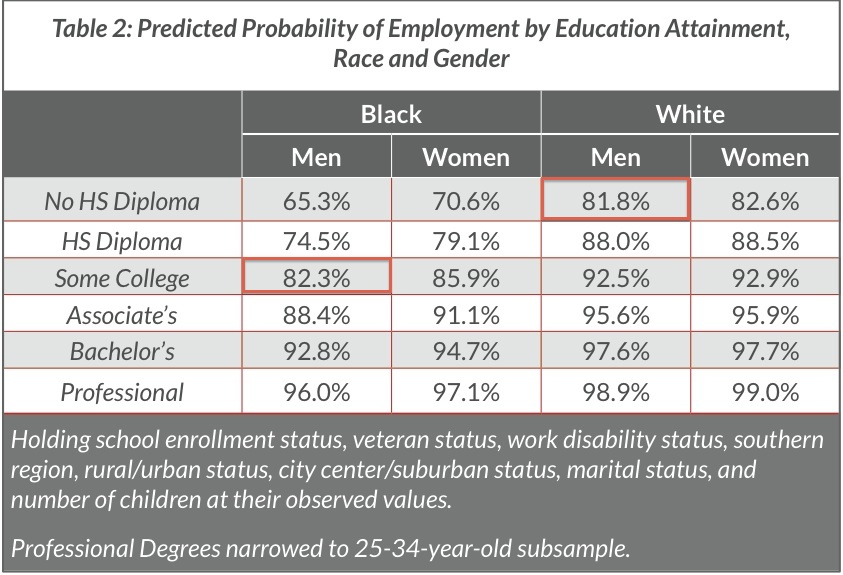
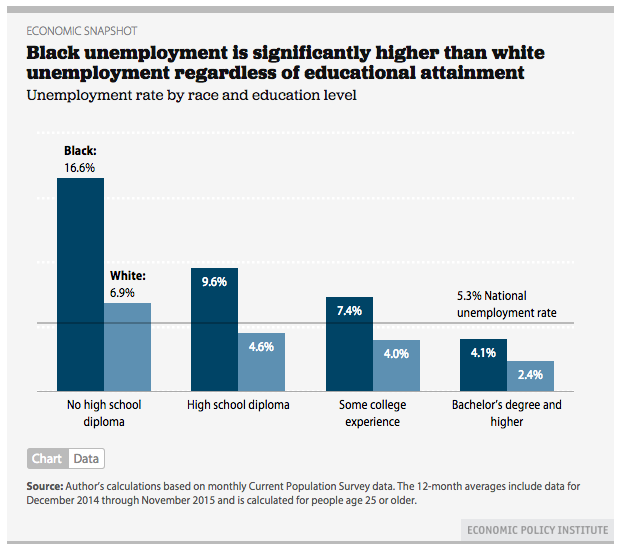
White men with no high school diploma have the same employment opportunities as black men with some college completion. (Closing the Race Gap)

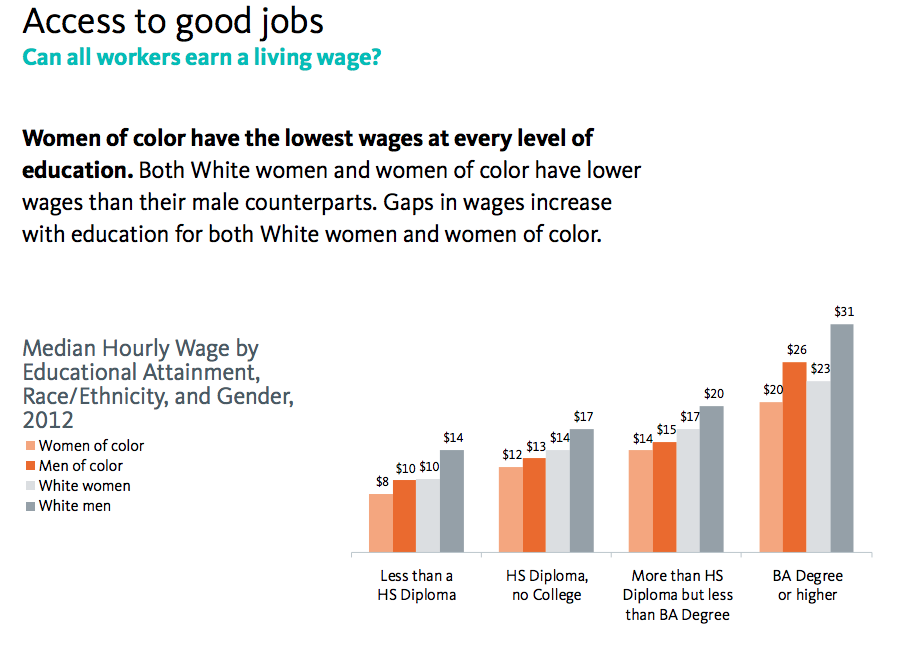
Race and gender remain powerful sources of inequity despite educational attainment. (Access to good jobs)

Brown also cites this: “He goes on to say, ‘Successful people in the United States tend to be white and come from privilege and they’re not necessarily working harder than anybody else but they have incredible advantages.'”

And then makes no effort to address why he believes my comment is “problematic.” Perhaps he could consider the following:

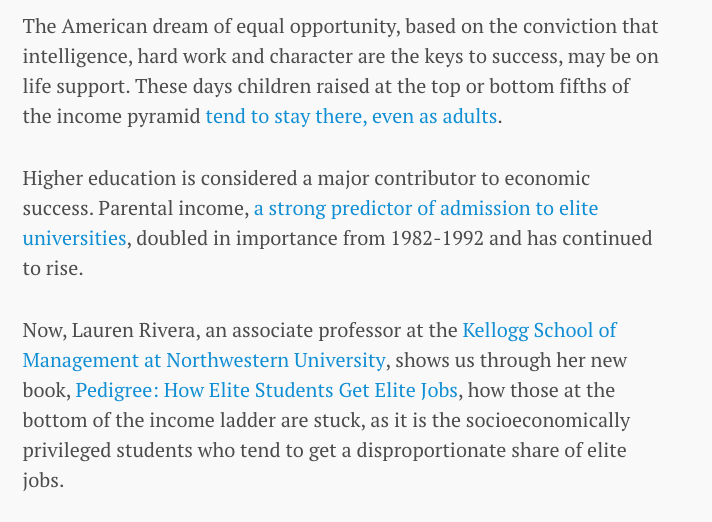
The best way to nab your dream job out of college? Be born rich

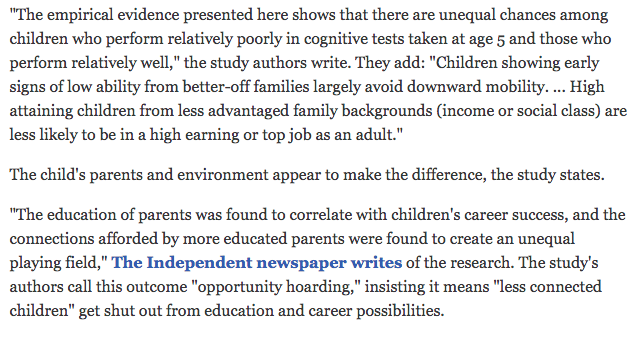
Why rich kids do better than smarter, less advantaged kids: ‘opportunity hoarding’

 Black unemployment is significantly higher than white unemployment regardless of educational attainment | Economic Policy Institute

Abstract

Racial discrimination in labor markets is a critical process through which organizations produce economic inequality in society. Though scholars have extensively examined the discriminatory decisions and practices of employers, the question of how job seekers try to adapt to anticipated discrimination is often overlooked. Using interviews, a laboratory experiment, and a résumé audit study, we examine racial minorities’ attempts to avoid discrimination by concealing or downplaying racial cues in job applications, a practice known as “résumé whitening.” While some minority job seekers reject this practice, others view it as essential and use a variety of whitening techniques. When targeting an employer that presents itself as valuing diversity, however, minority job applicants engage in relatively little résumé whitening and thus submit more racially transparent résumés. Yet, our audit study shows that organizational diversity statements are not actually associated with reduced discrimination against unwhitened résumés. Taken together, these findings suggest a paradox: Minorities may be particularly likely to experience disadvantage when they apply to ostensibly pro-diversity employers. These findings illuminate the role of racial concealment and transparency in modern labor markets and point to an important interplay between the self-presentation of employers and the self-presentation of job seekers in shaping economic inequality. (Whitened Résumés: Race and Self-Presentation in the Labor Market, Sonia Kang, Katy DeCelles, András Tilcsik, and Sora Jun)

One other tactic I experience is the subtle and not-so-subtle effort by the “no excuses” crowd to turn charges of racism toward those of us calling out the racism of “no excuses” practices: “If you believe the zip code where you were born should determine your educational outcome, you basically believe that some people aren’t built for success, which is — to put it bluntly — racist.”

Two aspects of this strategy are important to highlight. First, Brown here and others must misrepresent my claims (I have never and would never embrace or suggest that we ask less of any child or that some group of people have less ability than others because of inherent deficiencies; in fact, my scholarship and public work directly reject deficit ideologies).

Second, this rhetorical slight of hand is designed to point anywhere other than the person making the claim.

This second part of the move is important for charter advocates and the “no excuses” crowd because evidence is not on their side.

The Legacy Charter school endorsed by Brown has three consecutive years of “below average” state report cards (2012-2014, the most recent since report card assessments have been suspended in SC until this coming fall).

And my analysis of two years of data on SC charter schools has shown:

  • Using 2011 SC state repost cards and the metric “Schools with Students Like Ours,” charter schools performed as follows: 3/53 ABOVE Typical, 17/53 Typical, and 33/53 BELOW Typical.
  • Using 2013 SC state repost cards and the metric “Schools with Students Like Ours,” charter schools performed as follows: 2/52 ABOVE Typical, 20/52 Typical, 22/52 BELOW Typical.

The “high expectations” movement, again mostly aimed at black/brown and poor children, has some serious flaws because the rhetoric is discredited by the evidence.

In short, education is not the “great equalizer” in the U.S. And committing to “high expectations” for children living inequitable and overburdened lives suggests their struggles are mostly their fault because they simply are not working hard enough.

That is a calloused and racist/classist lie.

As I detailed above, success in the U.S. is mostly about advantages, not working hard.

Brown concludes with a flurry of rhetoric: “You could burn the world down as it is because it’s too hard to fix systemic injustices, or you could build it up to the sky because you know in your heart that’s where we belong. Keep your matches. I’m grabbing a hammer and a ladder.”

What should disturb us is how easily the winners (even those claiming good intentions) in the U.S. are willing to throw up their hands when challenged to address systemic racism, classism, and sexism.

In fact, this admission is awash in excuses and absent the exact resilience needed to address inequity that these adults demand of children, who must somehow set aside their lives each day they walk through the doors of school and behave in ways the adults refuse to do.

SC Fails Students Still: More on Grade Retention and Misreading Literacy

But their remedies do not cure the disease: they merely prolong it. Indeed, their remedies are part of the disease.

Oscar Wilde (1891), The Soul of Man under Socialism

Bells will certainly continue to signal class changes in public schools all across South Carolina this fall, but there is a much more serious (and unwarranted) bell of doom for many third-graders because of SC’s punitive Read to Succeed legislation.

Paul Hyde’s Furman professor: Read to Succeed retention policy ‘a disaster’ offers a primer on the politically and publicly popular move across the U.S. to retain students based in part or fully on third-grade high-stakes tests of reading.

Once again, literacy policy often fails to address valid literacy practices or to acknowledge that literacy proficiency is strongly correlated with systemic conditions beyond the walls of the school or the control of teachers.

Worksheets on literacy skills, test-prep for state assessments of reading and writing, linking teacher evaluations to students’ test scores, and retaining children are simply not only flawed literacy policies, but also negative influences on children’s literacy and academic achievement.

And decades of creating ever-new standards and then purchasing ever-new reading textbooks and programs have utterly failed children and literacy.

For about a century, in fact, we have known what is needed to help students develop literacy—but the political will remains lacking.

A robust literacy strategy for schools must include instead the following:

  • Addressing access to books in all children’s homes.
  • Insuring access to books in all children’s schools.
  • Providing all students ample and extended time in class to read by choice.
  • Guaranteeing every student balanced literacy instruction based on each student’s demonstrated literacy needs (not the prescriptions of literacy programs).
  • Discontinuing the standards and testing disaster dominating schools and classrooms by providing teachers the materials, time, and professional autonomy to teach literacy in evidence-based ways.

Just as education policy ignores a rich research base, political leaders and the public refuse to address how public policy directly and indirectly impacts student achievement; the following would create higher student achievement and literacy:

  • Eradicating food deserts and insuring food security.
  • Providing universal healthcare to children and families with children.
  • Creating job security for families with children.

Finally, we must acknowledge that grade retention fulfills a cultural negative attitude about children and people in poverty among the U.S. public—one grounded in individual blame and punishment.

But decades of research has shown (yes, even with the failed Florida policy that serves as a template for many states such as SC) that grade retention may raise test scores short term, but that gain disappears in a few years and the many negative consequences of retention remain.

As the National Council of Teachers of English detail in their position statement on grade retention and high-stakes testing, grade retention fails in the following ways:

  • retaining students who have not met proficiency levels with the intent of repeating instruction is punitive, socially inappropriate, and educationally ineffective;
  • basing retention on high-stakes tests will disproportionately and negatively impact children of color, impoverished children, English Language Learners, and special needs students; and
  • retaining students is strongly correlated with behavior problems and increased drop-out rates.

Of course all children need and deserve rich and rewarding literacy experiences and growth, but third grade literacy is both a manufactured metric (by textbook and testing companies) and a misleading emergency.

Grade retention and skills- and standards-based literacy instruction and testing have failed and continue to fail horribly the students who need authentic literacy instruction the most—black and brown children, English language learners (who may need a decade to acquire a second language), students in poverty, special needs students.

These populations are a significant portion of the students served in SC public schools; our hateful and misguided policies are created and tolerated by a more white and affluent political leadership and public who have racist and classist biases against “other people’s children.”

In fact, failed literacy policy in SC can be linked directly to how the U.S. demonizes and fails the impoverished:

It all starts with the psychology concept known as the “fundamental attribution error”. This is a natural tendency to see the behavior of others as being determined by their character – while excusing our own behavior based on circumstances.

For example, if an unexpected medical emergency bankrupts you, you view yourself as a victim of bad fortune – while seeing other bankruptcy court clients as spendthrifts who carelessly had too many lattes. Or, if you’re unemployed, you recognize the hard effort you put into seeking work – but view others in the same situation as useless slackers. Their history and circumstances are invisible from your perspective.

Struggling students in SC are viewed as lacking or broken, in need of repair and/or punishment to correct.

If you think this is harsh, compare how mostly white and more affluent students learn literacy in advanced and gifted classes in public schools (a dirty little secret about how we have maintained segregation) and most private schools.

Like No Child Left Behind and Every Student Succeeds Act, Read to Succeed is an Orwellian name for a horrible way to view, treat, and teach children.

SC continues to be a morally bankrupt state, calloused and driven to punish instead of offering our citizens, especially our children, the compassion and opportunities all people deserve.

For Further Reading

At Duke, I realized how badly many South Carolina schools are failing students like me, Ehime Ohue

Grade Retention Research

Executive Summary: THE EFFECTS OF MANDATED THIRD GRADE RETENTION ON STANDARD DIPLOMA ACQUISITION AND STUDENT OUTCOMES OVER TIME: A POLICY ANALYSIS OF FLORIDA’S A+ PLAN (9 January 2017)

THE EFFECTS OF MANDATED THIRD GRADE RETENTION ON STANDARD DIPLOMA ACQUISITION AND STUDENT OUTCOMES: A POLICY ANALYSIS OF FLORIDA’S A+ PLAN, Kathleen M. Jasper (2016)

NCTE: Resolution on Mandatory Grade Retention and High-Stakes Testing

Retain to Impede: When Reading Legislation Fails (Again)

Confirmed: SC Implementing Retain to Impede

Beware Grade-Level Reading and the Cult of Proficiency

Teaching Reading and Children: Reading Programs as “Costume Parties”

Florida Retention Policy a Blight on Literacy, Children across US


Easter 2017 Reader: Grit, Poetry, Educational Rankings, Poverty

Grit

Forget Grit. Focus on Inequality, Christine Yeh (Education Week)

Grit is an easy concept to fall in love with because it represents hope and perseverance, and conjures up images of working-class individuals living the “American dream.” However, treating grit as an appealing and simple fix detracts attention from the larger structural inequities in schools, while simultaneously romanticizing notions of poverty….

Perhaps this idea of grit resonates with so many people who believe in the popular American adage that if you work hard and pull yourself up by your bootstraps, then you can achieve anything. This belief unfortunately, assumes that individuals have the power, privilege, and access to craft their own futures, regardless of circumstance and systemic barriers.

Statistics on educational access consistently reveal vast differences in resources in affluent versus poor neighborhoods. Predominantly white, middle- and upper-income school districts tend to spend significantly more money per student than the districts with the highest percentages of marginalized students. Our poorest schools also tend to have large class sizes, unsafe school transportation, damaged and outdated facilities, and high staff turnover. All of these conditions directly contribute to low educational outcomes and underscore the link between access to school resources and improvements in students’ success. Schools that focus on grit shouldn’t ignore structural inequities because they assume that regardless of your race, class, or social context you can still triumph.

Telling children ‘hard work gets you to the top’ is simply a lie, Hashi Mohamed (The Guardian)

What I have learned in this short period of time is that the pervasive narrative of “if you work hard you will get on” is a complete myth. It’s not true and we need stop saying it. This is because “working hard, and doing the right thing” barely gets you to the starting line. Furthermore, it means something completely different depending on to which context you’re applying this particular notion. So much more is required.

I have come to understand that the systems that underpin the top professions in Britain are set up to serve only a certain section of society: they’re readily identifiable by privileged backgrounds, particular schools and accents. To some this may seem obvious, so writing it may be superfluous. But it wasn’t obvious to me growing up, and it isn’t obvious to many others. The unwritten rules are rarely shared and “diversity” and “open recruitment” have tried but made little if any difference.

Those inside the system then naturally recruit in their own image. This then entrenches the lack of any potential for upward mobility and means that the vast majority are excluded.

Check out Neoliberalism: A Concept Every Sociologist Should Understand, Peter Kaufman (Everyday Sociology)

The end result of neoliberal ideology, Monbiot continues, is that we are led to believe in the myth of the self-made person:

“The rich persuade themselves that they acquired their wealth through merit, ignoring the advantages – such as education, inheritance and class – that may have helped to secure it. The poor begin to blame themselves for their failures, even when they can do little to change their circumstances. Never mind structural unemployment: if you don’t have a job it’s because you are unenterprising. Never mind the impossible costs of housing: if your credit card is maxed out, you’re feckless and improvident. Never mind that your children no longer have a school playing field: if they get fat, it’s your fault. In a world governed by competition, those who fall behind become defined and self-defined as losers.”

See Also

Failing Still to Address Poverty Directly: Growth Mindset as Deficit Ideology

SchoolED Podcast: Paul Thomas on Grit, Slack, and the Effects of Poverty on Learning

UPDATED (Again): Grit, Education Narratives Veneer for White, Wealth Privilege

“Grit” Takes another Hit (with Caveats)

Rejecting “Grit” While Embracing Effort, Engagement

Poetry/ National Poetry Month 2017

Perspective | Poet: Why I would never tell a student what a poem means, Sara Holbrook (The Answer Sheet/ Washington Post)

A few months ago I wrote an essay, “I Can’t Answer These Texas Standardized Test Questions About My Own Poems,” in which I questioned those of unknown academic distinction who anonymously compose proficiency test questions. Many teachers wrote to tell me that they too are unable to answer these vaguely written test questions being used to evaluate their students. One teacher reported that her kids had to endure 17 days of testing this year. Considering there are only about 20 days of school in a month and that every test requires preparation on the devices and manner of testing, that’s a lot of lost instructional time.

Parents wrote. I did a few television interviews and radio programs. It was my 15 minutes. Additionally, I took some heat from a (very) few academics who jumped to inform me that authors do not own the meaning of a poem, it is up to literary critics to make this determination. Good grief.

It was not my intent to kick off an argument on of the relative merit of learned literary analysis. I’ll leave that to those with letters after their names. But friends, parents, educators, learned folks, please remember, middle-schoolers are not just short college sophomores. They are not lit majors. These are kids like Paul. Kids who are often grappling with a world of unseen and sometimes unspeakable challenges.

See Also

Investigating Poetry Because We Love It (and Our Students)

In Defense of Poetry: “Oh My Heart”

“So We must meet apart”: #NationalPoetryMonth 2017 and My Journey with Emily Dickinson

Educational Rankings

Are South Carolina schools really the worst in the nation?, Cindy Landrum (Greenville Journal)

Furman University education professor Paul Thomas said the education ranking is far less about education than socioeconomics.

“This ranking is a direct reflection of political negligence,” he said. “Our schools don’t legislate. It’s not like our schools are without any fault, but how schools function is a reflection of political leadership. South Carolina is failing our children, not our children are failing school.”

U.S. News & World Report used 11 metrics to measure a state’s education ranking, including college and high school graduation rates and standardized test scores. Three of the six pre-kindergarten-12 categories are test scores (ACT and National Assessment of Educational Progress), while the others are high school graduation rates, pre-K quality, and preschool enrollment. South Carolina ranked high in quality of its public pre-kindergarten program, but ranked low in test scores and college readiness.

“Schools in South Carolina and the U.S. reflect the inequities of communities, the failure of our policies, and as a result, they are ineffective as mechanisms of change,” Thomas said.

At least 60 percent of test scores are correlated with out-of-school factors such as parental education levels, poverty, hunger, mobility, lack of health care, safety, and community resources, he said. Only 10 percent to 15 percent of test scores can be traced to teacher quality.

Thomas said it has been known for decades that poverty and inequity are the greatest hurdles for children learning. But instead of addressing the problems, instead grade-by-grade standards are changed and students tested.

“Our states have social and educational pockets of poverty,” Thomas said. “Food and home insecurity directly contribute to low academic output, and once they get into school, we make horrible decisions. High-poverty children are sitting in larger classes with early-career and uncertified teachers. We do the exact opposite of what we should be doing.”

See Also

South Carolina Ranks First in Political Negligence

Poverty

America’s Shameful Poverty Stats, Sasha Abramsky (The Nation)

But there’s a deeper significance to the numbers: how they compare with the figures from recent decades. The percentage of people in poverty is roughly the same as in 1983, in the middle of the Reagan presidency, as well as in 1993, at the end of twelve years of Reagan/Bush trickle-down economics. A far higher portion of the population lives in poverty than was the case in the mid-1970s, after a decade of investment stemming from Lyndon Johnson’s War on Poverty; and far more live in poverty today than did at the end of Bill Clinton’s eight years in office—years in which the earned-income tax credit was expanded, unemployment was kept to near-historic lows, and poverty rates fell significantly.

That our poverty numbers have risen to such a high level exposes the fact that as a society, we are choosing to ignore the needs of tens of millions of Americans—as we have done for much of the period since the War on Poverty went out of fashion and the harsher politics of Reaganism set in. These ignored Americans include kids like the ones I interviewed in Los Angeles, forced to choose between applying to college or dropping out of school and getting dead-end jobs to support parents who had lost not only their jobs but their homes, too. They include the elderly lady I met outside Dallas, who was too poor to retire but too sick to take the bus to her work at Walmart. Her solution? She paid her neighbors gas money to drive her to a job that paid so little she routinely ate either 88-cent TV dinners or went to bed hungry. They include, too, the residents of New Orleans’s Lower Ninth Ward I met in 2011, who, six years after Hurricane Katrina, were still living in appalling conditions in a largely obliterated community.

See Also

the world


Dear People with Privilege: On Freeing the Pelican

The first men to deny sexism are sexists themselves; the first white people to deny racism are racists themselves.

One of the profound tensions of the U.S. is that the country founded on the ideals of individual liberty—life, liberty, and the pursuit of happiness—was in fact built by sexists and racists. This is no easy or comfortable contradiction.

We have settled into an ends justifying the means narcotic as a people to avoid that contradiction.

The great praise the U.S. does deserve (although not unique to the U.S.) is the concept of pursuit; a great many people have pursued and continue to pursue the elusive equity of our founding principles.

To identify, admit to, and then confront racism or sexism, we must reach to the people with the most power in the country—white men, who believe they have earned that power, their success.

Racism and sexism are not mere abstractions because some people must be complicit in the perpetuation of both.

Even among the victims of racism and sexism, we find people complicit, but the main people responsible for our failures in the pursuit of equity are the ones with the most power, power gained from privilege.

Most of us, then, when confronted with the ugliest truths of racism and sexism immediately tell our stories of struggle: “I cannot have privilege,” we proclaim, “because I have struggled!”

So consider the invisibility of privilege to those with privilege.

You buy a pair of Nike shoes, and if someone asks you if you are for child labor or slave wages for women forced to work in cramped factories as their homes, you are very likely to strongly reject being for those abstractions—while wearing the shoes made in horrifying conditions for women and children workers earning slave wages.

The problem of privilege is that most of us with privilege are complicit through negligence, not through conscious decisions to oppress.

Consequences, however, make those distinctions irrelevant.

As Roxane Gay navigates wonderfully in Peculiar Benefits, many people have contexts within which they have privilege, unearned advantages—even people for whom much of their life is spent as the victim of other people’s privileges.

And white heterosexual men can struggle mightily in life, even as we celebrate the apparent success of a black homosexual woman.

Outliers are some of the most powerful blinders for confronting privilege.

But I believe I can offer here a simple test.

First, to admit to having privilege is not opening yourself to scorn; the fact of having privilege is not justification for condemning anyone.

From there, then, we must move to the key question: What do you do with your privilege(s)? Perpetuate your own needs and desires? Or use your privilege(s) in the service of others who are oppressed, who are victims of other people’s privileges?

Some tests include whether or not you acknowledge your own and systemic privilege (racism and sexism, for example), and then if or not you develop an ability to feel compassion for anyone who is struggling, recognizing that human failure may often be the consequence of systemic forces and not individual flaws.

This last point is important. Racism, for example, persists because as a culture, people in the U.S. have made the default stance about human struggle and failure to be flawed individuals: People who succeed, we assume, worked hard, and people who struggle and fail, we assume, are lazy.

Each of us must come to acknowledge our privilege(s) and proceed with the understanding that systemic inequity is the root cause of individual struggle and failure.

To use your privilege in the service of others [1] even when that act creates risk for you and especially when that act works to dismantle the privilege that allows you to serve others.

A picture (or in this case, a video [2]) is worth a 1000 words, so let me end by suggesting, this is what it looks like to acknowledge your privilege, to identify those who suffer inequity, and then to act in the service of that other:


[1] To serve others, as well, must avoid paternalism. It is not substituting arrogance for your privilege in order to save those who are lesser than you; it is seeking out anyone without your privileges and then asking, How may I help you?

[2] Too often, when confronted with systemic inequity (racism, sexism, etc., represented by the fishing line on the pelican’s beak), people either refuse to acknowledge the fishing line, blame the pelican for being in the situation that caused the line tangle, or argue, “I didn’t put the fishing line around the beak.” Yet, we are complicit if we fish (even carefully), eat fish, or if we do nothing while aware of the dangers of fishing for pelicans and other animals—even if we believe we are compassionate to or hold no prejudice against pelicans.

See Also

Montclair SocioBlog: The Winds of Privilege

Rethinking “A monolithic and stereotypical understanding of rural identity” (Melissa Range, poet)

Separated by about a 2-3 hour drive on I-26 through South Carolina, North Carolina, and Tennessee, but also by about 10 years, Joe Kincheloe and I were born in the rural South, both destined to become aliens in our home land.

Joe proved to be a key person in my scholarly life quite by accident when a colleague at the university where I found myself after almost twenty years teaching high school English was working on a book for Joe and asked me to write a response for her to include.

From that, Joe offered me my first academic book contract, leading to co-authoring a volume with Joe as well as a now-long list of scholarly books and a career as a writer I was certain would never happen for me.

My relationship with Joe is bittersweet since we never crossed paths in person and had only a few phone calls, the first of which elicited from Joe when I spoke, “Why you are from the South, aren’t you!”

Laughing his words revealed a joy and kindness that were who Joe was in his soul, in his bones.

I recalled this phone call as I was reading On Poverty, Justice, and Writing Sonnets of the South, an interview with poet Melissa Range:

This sudden interest in so-called “rural identity” is amusing and frustrating to me, honestly, because I don’t think most of the country actually has much real interest in rural people. They just are horrified (as am I, as are more than a few rural people I know) about the election results. Had the election gone another way, would the non-rural parts of the country be seeking to know the “rural mind”—whatever that is? I don’t think so.

I say this as a card-carrying bleeding heart pacifist leftie socialist who comes from working class white rural people who didn’t have the opportunity to go to college, most of whom have always voted for Democrats, or not voted at all. Yes, my dad voted for Trump. He always votes Republican no matter how I try to convince him to do otherwise. My old aunts and my mom have been stumping for Clinton since 2008. My brother-in-law, another one of those “white males without a college degree,” is repulsed by Trump, is on disability, has PTSD from his time in Bosnia, is an accomplished cook, hunts and gardens, and reads the Qur’an in his free time. My sister, who is 41 years old, never went to college, and has lived in the same place her whole life, doesn’t understand what the big deal is about transgender bathrooms in North Carolina. We were driving around in Boone, NC, this past spring when I was visiting her, and I remember her exclaiming, “Why can’t those who make the law just let people do as they please? Who cares what bathroom anybody uses? They ought to be ashamed for passing that law.” You can find rural people with these beliefs, with sophisticated conspiracy theories about UFOs, with unexamined beliefs about race and gender, with a passionate commitment to union organizing and to environmental activism. You can find rural people who are passionately pro-life and just as passionately pro-choice, who love their guns and who don’t believe in guns. In other words, rural perspectives are diverse, like perspectives of people everywhere. There are so many kinds of rural people. And I would like to add that they’re not all white and not all poor and not all working-class and not all intolerant. Of course some are intolerant. Of course some are resistant to change—like people everywhere. There are a lot of rural spaces in America, and everyone who lives outside of cities isn’t the same. A monolithic and stereotypical understanding of rural identity is nothing new, but it’s as false now as it ever was.

I can’t and don’t want to speak for all rural people, but my people, at least, in East Tennessee, don’t expect the government to care about them and don’t expect the rest of the country to care about them, either. What they expect, and what they typically get, is either derision or dismissal. I’ve been hearing educated, liberal people throw around terms like “white trash” and “redneck” and “hillbilly” ever since I left East Tennessee. They say these words to my face as if they are not insulting my people and me. How can liberals and progressives forget that class exists? Maybe they just like having someone else to foist some blame on. I will say that my part of the country (I call it that even though I haven’t lived there in 25 years) has an inordinate number of people who are truly beaten down. In my hometown, there used to be textile factories that employed hundreds of people, and now there aren’t. One shut down in the 1970s, another in the 90s. Nothing much has come in to replace them except meth and other drugs, so there’s a lot of poverty and a lot of substance abuse and not much industry. Poverty and despair go hand in hand; it’s not hard to imagine this (and obviously this isn’t just a rural phenomenon). And when you see yourself on television and in movies being stereotyped and mocked, well, it doesn’t make you feel any better.

I can imagine Range joining in with Joe and me—aliens of academia and the literary world. Also reading Range’s comments, I thought about how often we Southerners are stereotyped as illiterate, in many ways because of how we sound (which is what tipped Joe off to my Southern roots).

The South is, from my lived experience, a heaping mess of social class, race, and god-awful mangling of the English language—all wrapped in the flag and lots of bible thumping.

But none of that is as simple as people want to believe, want to claim.

As Ralph Ellison confronted in 1963 when speaking to teachers:

Some of us look at the Negro community in the South and say that these kids have no capacity to manipulate language. Well, these are not the Negroes I know. Because I know that the wordplay of Negro kids in the South would make the experimental poets, the modern poets, green with envy. I don’t mean that these kids possess broad dictionary knowledge, but within the bounds of their familiar environment and within the bounds of their rich oral culture, they possess a great virtuosity with the music and poetry of words. The question is how can you get this skill into the mainstream of the language, because it is without doubt there. And much of it finds its way into the broader language. Now I know this just as William Faulkner knew it. This does not require a lot of testing; all you have to do is to walk into a Negro church.

But if you want to feel particularly out of place, out of kilter, academia can be that for you if you are working class or from the working poor. As Vitale and Hurst explain [1]:

Both academia and the DNC have a class problem. They don’t know anything about the working class because they have isolated themselves from working-class people. We have been struggling for years to change this within academia….

Discussion of social class has always been relegated to the margins of academia. In turn, public discourse about class is muted. By denying the opportunity for social class to be a valid academic subject in itself, or to be considered an authentic form of social identity, educated folks (academics, pundits, campaign managers, and journalists) didn’t just silence the voices of the poor and working-class, they also denied the possibility of critically engaging the problem of affluence.

Rurality, being working class or working poor—these have become another form of marginalization in many contexts, and with the rise of Trumplandia, the mischaracterization and fetishizing of working class/working poor whites have accelerated, as noted by Range and seen in the popularity of J.D. Vance’s Hillbilly Elegy.

However, the mainstream media’s misreading working class/working poor white angst is ironically reflected in Vance’s deeply flawed work, as noted by Sarah Jones:

Elegy is little more than a list of myths about welfare queens repackaged as a primer on the white working class. Vance’s central argument is that hillbillies themselves are to blame for their troubles. “Our religion has changed,” he laments, to a version “heavy on emotional rhetoric” and “light on the kind of social support” that he needed as a child. He also faults “a peculiar crisis of masculinity.” This brave new world, in sore need of that old time religion and manly men, is apparently to blame for everything from his mother’s drug addiction to the region’s economic crisis.

Vance’s thinly veiled conservatism and simplistic “aw shucks” cashing in on his background feels very similar to an experience I had years ago when my university chose Timothy B. Tyson’s Blood Done Sign My Name as the incoming first-year students’ common book, which faculty also read to discuss with those students.

From Tyson’s work to Vance’s and currently with all the bluster about working class whites across the rural U.S., I cringe at the ways in which many people treat any sort of Other as if they are visiting a zoo—oh-ing and ah-ing at the exotic, but keeping their distance all the while.

There is an insensitivity of distance that Henry Giroux, an academic from a working class background, has identified:

Being an academic from the working class is, of course, impacted by many registers, extending from ideology and cultural capital to politics….

My father had just died of a heart attack, and I had returned to the campus after attending his funeral. My Dean at the time was a guy named Bob Dentler, an Ivy-League educated scholar. I ran into him on the street shortly after my father’s death and he said to me, “I am sorry to hear about your father. It must have been difficult settling his estate?” Estate? My father left a hundred dollars in an envelope taped behind a mirror. That was his estate. I was immediately struck by how out of touch so many academics are with respect to those others who are not replicas of themselves. But as I began to understand how class was mapped onto academia, I was determined not to play the role of the subservient, aspiring-to-be-middle-class professional. I had no intention of letting myself morph into a golf-playing suburbanite living a politically irrelevant academic life. I viewed myself as being on the left, and my politics provided me with the tools to be not only self-reflective but also critical of the cultural capital that dominated the academy and passed itself off as entirely normalized. I had no interest in narrowly-defined, almost-choking specializations, stifling forms of professionalism, appeals to positivism or a politics that largely removed the university from the broader society.

But just as academia as well as mainstream media, politicians, and the public have garbled a romanticizing of working class whites, there are in these dynamics much uglier problems concerning stigmatizing and reducing any Other.

Political hand wringing about working class whites has, once again, ignored black and brown marginalization—including excluding working class black and brown people from that debate.

But the most corrosive aspect of the rush to appease working class whites is that the carelessness of this discussion has served only to further divide through race those among whom race is a commonality.

Recognizing that the poor, the working poor, and the working class have more interests in common than differences due to race is actively muted by those sharing class and race privilege.

We need ways to reject “monolithic and stereotypical understanding of rural identity,” as Range notes.

But that is a public and political conversation too often ignored in academia (increasingly as we seek ways not to upset students-as-customers) and possibly too complicated for the world beyond the walls of the Ivory Tower.

Yes, white working class and working poor angst is real, but those groups still benefit from white privilege—and many white working class/poor do not want to hear that while they are suffering.

And too often, among these groups of whites racism, sexism, and xenophobia remain too common, too powerful, and working class/poor whites certainly do not want to hear any of that.

Let us, then, not fetishize working class/poor whites, and not demonize black and brown people; let us not romanticize rurality or poverty, and not ignore the very real plight of rurality and poverty.

When Range writes about “our kind/of people,” I hear and see from my lived experience in an often self-defeating South.

It’s a complicated mix of love and embarrassment that Joe and I shared—one echoed in Range and Giroux.

I remain troubled, then, by how we can see and how we can listen, without the poisoned ways that have gotten us where we are now.


[1] See also A.L. Hurst & S.K. Nenga (Eds.), Working in class: recognizing how social class shapes our academic work.