As we have discussed both during class sessions, students have been drawn to witnessing and reading as well as thinking about how teachers view and respond to their students.
Although these students have virtually no background in formal education, they have been very perceptive about the inordinate, and distracting, pressures on teachers to cover the curriculum (standards) and prepare students for testing—notably while observing and tutoring at a local majority-minority elementary school.
High student/teacher ratios have also been identified as making good classroom practice nearly impossible.
Running through our discussions has been a concern about how teachers treat students (often more harshly than my students anticipated or endorsed) and about the pervasive deficit perspective throughout the school.
Observing and tutoring in special needs classes and among Latinx students needing to acquire English have intensified how my students have responded to their field placement and their recognition of the myriad factors that impact negatively formal education.
Often unspoken, but what teachers and students share in far too many schools is a “no excuses” imperative that demands teachers perform well (even miraculously) despite being placed in circumstances that work against their efforts and that demands students somehow leave the pressures and inequities of their lives in order to excel at academics being imposed on them.
Responding to that article, Stephen Krashen, Professor Emeritus at the University of Southern California, has identified the problem that my students have observed:
But there is no evidence that tougher standards lead to more learning, and no evidence showing that the Common Core standards are better at preparing children for college and career than other standards or than no standards….
Forcing young children to study flashcards in the car and spell words during family outings in order to “master” 100 words is turning kindergarten into kindergrind. Children who develop a love of reading will master thousands of words, without suffering.
Although political leaders and the public often view the authoritarian classroom where teachers are charged with keeping order and demanding that students learn standards and content about which they have no choice or input as the solution, it is now far past time to recognize that this is the problem with formal schooling.
Of course, what we teach is important at every level of education, and that what is becoming even more important for our democracy as we are confronted with a new post-truth media and politics.
That what needs to be the sort of truth that empowers a free people.
That what also needs to include a clear focus on the civility of learning and wrestling with ideas since our post-truth media and politics are increasing and justifying the demanding and nasty tone that is already a problem in many schools.
However, the what must remain secondary to the who—who we teach is what makes teaching an essential calling grounded in the dignity of both teachers and their students.
And the what can never be well taught or learned unless we attend to the conditions of teaching/learning and living among our teachers and students.
The authoritarian classroom, deficit thinking, “no excuses” ideologies and practices—these are corrosive elements for teaching, learning, and democracy as well as liberty.
The very long era of standardized testing and the more recent and relatively shorter era of accountability and standards have inflicted immeasurable harm on teachers and students.
And even as educator autonomy and professionalism become daily further eroded, we are morally obligated to call for and remain grounded in our role as teachers of students.
The who of teaching and learning must always come before the what.
Having a growth mindset may help buffer students from low-income families from the effects of poverty on academic achievement, researchers found in a first-of-its kind, large-scale study of 168,000 10th grade students in Chile.
But poor students in the study were also less likely to have a growth mindset than their higher-income peers, researchers found.
Similar to the popularity of “grit” and “no excuses” policies, growth mindset has gained a great deal of momentum as a school-based inoculation for the negative impact of poverty on children.
The binaries of growth and fixed mindsets are often grounded in the work of Carol Dwek, and others, who defines each as follows:
According to Dweck, “In a fixed mindset, people believe their basic qualities, like their intelligence or talent, are simply fixed traits. They spend their time documenting their intelligence or talent instead of developing them. They also believe that talent alone creates success—without effort.”…
Alternatively, “In a growth mindset, people believe that their most basic abilities can be developed through dedication and hard work—brains and talent are just the starting point. This view creates a love of learning and a resilience that is essential for great accomplishment,” writes Dweck.
However, the media, the public, and educators often fail to acknowledge two significant flaws with growth mindset: (1) the essential deficit ideology that focuses all of the blame (and thus the need for a cure) in the individual child, and (2) the larger failure to see the need to address poverty directly instead of indirectly through formal education.
Briefly, deficit ideology is a worldview that explains and justifies outcome inequalities— standardized test scores or levels of educational attainment, for example—by pointing to supposed deficiencies within disenfranchised individuals and communities (Brandon, 2003; Valencia, 1997a; Weiner, 2003; Yosso, 2005). Simultaneously, and of equal importance, deficit ideology discounts sociopolitical context, such as the systemic conditions (racism, economic injustice, and so on) that grant some people greater social, political, and economic access, such as that to high-quality schooling, than others (Brandon, 2003; Dudley-Marling, 2007; Gorski, 2008a; Hamovitch, 1996). The function of deficit ideology, as I will describe in greater detail later, is to justify existing social conditions by identifying the problem of inequality as located within, rather than as pressing upon, disenfranchised communities so that efforts to redress inequalities focus on “fixing” disenfranchised people rather than the conditions which disenfranchise them (Weiner, 2003; Yosso, 2005).
Any person’s success or failure can be traced to a number of factors, but in the U.S., our blind faith in the rugged individual defaults to ascribing credit and blame at least initially if not totally to the individual’s character traits such as “grit” and a growth mindset.
Student X is successful because of Quality A, and thus, Student Y’s failure is due to a lack (deficit) of Quality A; therefore, formal education must instill Quality A into Student Y.
This formula is compelling, again, because of our cultural myths, but also because the formula is manageable and seemingly efficient—and since efficiency is at the core of how we design and run schooling, the media, the pubic, and most educators fail to step back critically in order to reimagine how to deal with students holistically and generatively instead of through the traditional deficit model.
As a simple but representative example, most of us have taken a paper-and-pencil test in our schooling, one on which the teacher marks answers wrong with an X and then calculates our grade at the top of our papers—as in “100 – 30 = 70.”
This process is the deficit ideology that starts with every student having 100 and then defines that student’s learning on the test by what is missed, what is lacking.
One way to flip this ideology is to recognize that all students actually begin each assessment with 0 (no work has been done), and then the grade should be built on what learning and understanding the student demonstrates: simply checking the accurate responses and then giving credit for those positives.
The entire traditional approach to formal education in the U.S. is a deficit ideology, but the hyper-emphasis on children living in poverty, and black/brown students and English language learners, has increased the power of deficit approaches through growth mindset, “grit,” and “no excuses.”
Consequently, we routinely demand of children in the worst situations of life—through no fault of their own—that they somehow set aside those lives when they magically walk into school and behave in ways (growth mindset, “grit”) that few adults do who are also burdened by forces more powerful than they are.
But research also refutes the claims of growth mindset and “grit” that achievement is primarily the result of the character of the individual. The same person, in fact, behaves differently when experiencing slack (privilege) or scarcity (poverty).
As Sendhil Mullainathan and Eldar Shafir detail extensively, living in scarcity (poverty) drains a person of mental capacities the same as being sleep deprived; therefore, the solution to “buffer students from low-income families from the effects of poverty on academic achievement” is to address poverty directly instead of trying to “fix” the students who are victims of that poverty.
In other words, if we relieve children of food insecurity, home transience, etc., we are likely to find that those students in poverty who appeared to lack “grit” and growth mindset would then demonstrate those treasured qualities.
We are currently misdiagnosing growth mindset and “grit” (as deficit ideologies) as causal characteristics instead of recognizing them as outcomes of slack (privilege).
The deficit ideologies of formal schooling—particularly those (growth mindset, “grit”) targeting impoverished and black/brown students—are the entrenched indirect approaches to alleviating poverty criticized by Martin Luther King Jr. in 1967:
At no time has a total, coordinated and fully adequate program been conceived. As a consequence, fragmentary and spasmodic reforms have failed to reach down to the profoundest needs of the poor.
In addition to the absence of coordination and sufficiency, the programs of the past all have another common failing — they are indirect [emphasis added]. Each seeks to solve poverty by first solving something else.
I am now convinced that the simplest approach will prove to be the most effective — the solution to poverty is to abolish it directly [emphasis added] by a now widely discussed measure: the guaranteed income.
Ultimately, teaching disenfranchised and struggling students growth mindset and “grit” come from, mostly, good intentions that are tragically trapped in deficit ideologies.
The great and tragic irony of growth mindset advocates is that they are also victims of deficit ideologies—as they focus their “scornful gaze” on poor children and children of color.
And just as we have allowed coded racism such as “thug” to replace the now taboo racial slur “nigger,” we are embracing deficit ideology cloaked as scientism to label students as lacking growth mindset and “grit” to mask the very ugly suggestion that these children are simply lazy.
Let us embrace instead as educators a redirected focus—as Gorski implores:
Hegemony is a difficult thing to break. In order to break it, we must consider our own complicity with it and our socialization for compliance. We must avoid the quick fix and the easy answer. We must bare the price of refusing compliance, knowing that by looking up, by training our gaze toward the top of the power hierarchy, we might strain our necks, not to mention our institutional likeability, more so than we do when we train it downward, where we pose no threat to the myths that power the corporate-capitalist machine. But if we do not break hegemony, if we do not defeat deficit ideology, we have little chance of redressing, in any authentic way, its gross inequities. This, we must realize, is the very point of the redirected gaze: to ensure and justify the maintenance of inequity and to make us— educators—party to that justification and maintenance.
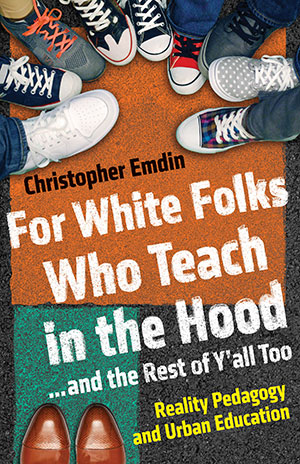
The social and educational inequities in the U.S. must be our targets for repair—not our students. And thus, we are left with a dilemma confronted by Chris Emdin: “The time will always come when teachers must ask themselves if they will follow the mold or blaze a new trail. There are serious risks that come with this decision. It essentially boils down to whether one chooses to do damage to the system or to the student.”
[1] See also Dudley-Marling, C. (2007). Return of the deficit. Journal of Educational Controversy, 2(1).
Beyond the obvious—that they are all joined by the field of education—what links the National Reading Panel (NRP) and No Child Left Behind, the edureform documentary propaganda Waiting for “Superman,” Teach For America, and edusavior Steve Perry?
Arrogance.
While I count myself among English language arts (ELA) teachers who are skeptical of the Great Books mindset—that we have essential books all children must read—I am moved today to endorse how many of those works remind we puny humans about the folly of pride. Not the “I am proud of you daughter/son” pride, but the arrogance pride.
The “‘My name is Ozymandias, King of Kings;/ Look on my Works, ye Mighty, and despair!'” kind of pride.
What on earth possessed politicians to form the NRP to find out what we know about teaching children to read? Did anyone point out that we have had a vibrant field of literacy in the U.S. for a good century? Isn’t it sort of obvious that we have dozens upon dozens of people across the U.S. who know exactly how to teach children to read (and have known for decades)?
But it isn’t just the teaching of reading.
Naive experts, often journalists, every week roll out yet another book in which she or he researches a field in which real experts in that field have been doing authentic work for decades—the history of teaching!, how to teach poor children!, the glory of 10,000 hours of practice!
Paternalistic, self-important, blowhard politicians daily puff up in front of the public to be that “Superman” at the center of the great lie documentary noted above that ironically serves as a perfect representation of everything that is wrong with education reform.
But one need not go back to that complete failure of film making. Try within the last week.
Educators and activists Andre Perry and Jose Vilson (see also) have assumed the mantle of speaking truth to the cult of personality that is Steve Perry.
I consider myself a student of Andre Perry and Vilson, as I work to navigate my own white male privilege in a way that serves others—specifically those marginalized by race and class.
I am a product of white privilege and colonialism, and therefore, must not serve those corrosive forces.
Here, I urge you to read Andre Perry and Vilson, but also to act upon their messages.
And I want to offer a tentative framing informed by their charges.
First, I am compelled by the new 30 for 30 series on O.J. Simpson to suggest that Simpson himself is a cautionary tale about the dangers of white privilege and the costs of whitewashing blacks in order for them to be allowed into mainstream society.
Next, I find troubling parallels in the work of Steve Perry with powerful blacks (Bill Cosby, Clarence Thomas, and Simpson) who negotiate the whitewashing in their favor at the expense of all other people of color.
The demonizing of dreadlocks, the finger-pointing at sagging pants, the judgmental finger-wagging at black English—yes, these are the tools of white privilege, but they also serve the cult of personality unmasked in Steve Perry, for example, by Andre Perry and Vilson.
Finally, although specific people have to be addressed when confronting the cult of personality, the problem is that those people are serving larger forces that are driving education reform, a movement that uses “civil rights” as a mask to implement policies that are perpetuating colonialism and whitewashing.
“No excuses” charter schools committed to “grit” are about “fixing” black, brown, and poor children.
Zero tolerance policies and grade retention policies disproportionately turn black, brown, and poor children into criminals and drop-outs.
High-stakes testing and accountability produce and perpetuate so-called achievement gaps among race and social class—as well as gate-keep in order to keep “other people’s children” in their place.
Whether the face of education reform is Bill Gates, Michelle Rhee, Arne Duncan, Geoffrey Canada, or Steve Perry (or the long list of celebrities who decide education is their hobby), and while we must necessarily confront each person as we confront what they represent, the ultimate challenge in rejecting edureform while also calling for building public education as a vehicle for equity and liberation is to call colonialism “colonialism,” to just say no to policies and practices designed to erase who children are so that they can be assimilated into society.
There are profound and significant differences in Andre Perry’s work, Vilson’s daily classroom teaching, and Steve Perry’s bloviating (think Donald Trump).
Andre Perry, Vilson, and Chris Emdin, for example, celebrate black students, their humanity as inseparable from their blackness—while Steve Perry celebrates Steve Perry as one who erases the black from children in the service of white privilege.
We are way past time to stop believing in and listening to these false idols, self-proclaimed “Super(wo)men.”
Ozymandias, please recall, was a fool in king’s clothing whose words mocked him:
Nothing beside remains. Round the decay
Of that colossal Wreck, boundless and bare
The lone and level sands stretch far away.
Let’s not form any more panels, let’s not crown any more edusaviors, let’s not print and/or buy any more bestselling books by educelebrities (who have never been teachers), let’s not worship at the altar of hollow Ted Talks.
Just as we didn’t need the NRP to “know how to teach children to read,” we have ample knowledge right now how to eradicate racism and classism in our society and our schools.
Edureformers, edusaviors, and educelebrities are in the service of keeping us from that vital work.
Let’s be clear: Belt wearing isn’t the reason white children are educated in wealthier schools. Haircuts and etiquette classes don’t lead to the technological innovations of Silicon Valley. Lower incarceration rates aren’t because whites use drugs less often. The wage gap isn’t caused by white men’s hard work ethic.
So I ask now that you listen to carefully and then act upon Chris Emdin‘s confrontation of edureform as colonialism and what choices lie before teachers:
What I am suggesting is that it is possible for people of all racial and ethnic backgrounds to take on approaches to teaching that hurt youth of color….
I argue that there must be a concerted effort…to challenge the “white folks’ pedagogy” that is being practiced by teachers of all ethnic and racial backgrounds….
The time will always come when teachers must ask themselves if they will follow the mold or blaze a new trail. There are serious risks that come with this decision. It essentially boils down to whether one chooses to do damage to the system or to the student [bold emphasis added]. (pp. viii-ix, 206)
Especially in our schools, and especially among our most vulnerable students, we need service, not saviors.
Let us hope we can resist the urge to trivialize and appropriate the wonderful history, traditions, and people of Mexico because of the silliness that is making a holiday another way to churn up crass commercialism (a redundant term). [Also, lost in the shuffle, today is the birthday of Karl Marx.]
So below, please read a gathering of important articles, somewhat loosely connected because they have crossed my path.
First, let me note that since I have relentlessly criticized edujournalism of late (and it is well deserved criticism), I start with an edujournalism unicorn—a very good piece on NAEP.
The simple truth is that NAEP is not designed to provide causal explanations. It’s a test given every two years to a representative sample of students who happen to be in fourth, eighth, or twelfth grade that particular year. It does not follow students over time, so it’s impossible to say that a policy or practice “caused” the results….
Put together, the findings paint a picture of unequal opportunities to learn challenging content. Low-performing students spend less time explaining their reading or doing projects, and more time on test prep. Once again, these are correlations: they do not suggest that these patterns caused the low performance. But why do they exist? What can be done about them? That’s the challenge for educators and policy makers.
Clinton has been a card-carrying feminist for decades, she started her career doing advocacy for children and women, she’s famous for her UN speech about women’s rights are human rights, she’s been reliably pro-choice and so on. So if that all fits into this sort of recognition side, she’s been there, and in a more explicit, and front-and-center way than Sanders. But, on the other hand, What kind of feminism is this? Clinton embodies a certain kind of neoliberal feminism that is focused on cracking the glass ceiling, leaning in. That means removing barriers that would prevent rather privileged, highly educated women who already have a high amount of cultural and other forms of capital to rise in the hierarchies of government and business. This is a feminism whose main beneficiaries are rather privileged women, whose ability to rise in a sense relies on this huge pool of very low-paid precarious, often racialized precarious service work, which is also very feminized that provide all the care work
I am participating as a discussion leader and speaker for a day on diversity at the University of South Carolina 14 April 2016. Below are my notes which may be of value to some addressing race and class in both social and educational contexts.
In his famous dissent in Plessy v. Ferguson, Justice John Marshall Harlan argued that in the United States, there was “no caste here.” Justice Harlan was rejecting the idea that American society operated to assign preordained outcomes to individuals based upon classifications, including racial classifications. This Article questions whether Justice Harlan’s aspirational assertion accurately reflects contemporary American education. Identifying: (1) multiple classification mechanisms, all of which have disproportionate racial effects, and (2) structural legal, political, and practical impediments to reform, the Article argues that the American education system does more to maintain the nation’s historical racial hierarchy than to disrupt it. This is so, the Article suggests, despite popular agreement with the casteless ideal and popular belief that education can provide the opportunity to transcend social class. By building the framework for a broad structural critique, the Article suggests that a failure to acknowledge and address structural flaws will preclude successful comprehensive reform with more equitable outcomes.
A a political refrain and mantra from the “no excuses” reform movement, the “soft bigotry of low expectations” has resonated among many stakeholders in education.
As Education Week has reported, a new report seems to confirm that among vulnerable populations there is a significant concern about low expectations for black and brown children (and likely among poor, English language learner, and special needs children as well).
The problem with the “low expectations” claim, however, is that the political and education reform use of the slogan is dishonest and misleading, while the new report offers an excellent reframing of how significant and important the concern is.
The “no excuses” movement has positioned the public against schools and teachers serving vulnerable populations as simply not trying hard enough, thus “low expectations.” Concurrently, vulnerable students themselves have been characterized as lacking “grit,” not trying hard enough.
In that vacuum created by politicians and reformers, education policy has increasingly demanded less and less of schools, teachers, and those vulnerable students by increasing the standards and testing focus of education.
The great and disturbing irony of the “no excuses” and “low expectations” movement is that test-prep is cheating black/brown students, poor students, ELL students, and special needs students of challenging educations—while mischaracterizing the ways in which traditional schooling has failed those students historically.
Is there a problem among progressives and white, middle-class teachers who view black/brown and poor students through paternalistic and reductive/deficit lenses?
Yes, there absolutely remains a failure among too many educators who lack a culturally responsive view of teaching, who remain trapped in deficit ideologies such as the “word gap” and a need for “other people’s children” to have basic skills (see the work of Lisa Delpit).
And even more troubling is that among many educators, there is a problem with distorted “high expectations” about discipline, resulting in the criminalization of black and brown children in our schools.
Therefore, I am in no way discounting that there exists a “soft bigotry of low expectations,” but I am rejecting the use of that slogan among “no excuses” reformers who push for racist and classist high-stakes testing as gate keepers and for the expansion of segregating charter schools that increase harsh and racist discipline policies also found in traditional public schools.
The reality of low expectations for vulnerable populations of students include the following:
Underfunding and inequitably funding schools serving vulnerable populations of students.
Failing to address teacher certification and years of experience for schools and courses serving vulnerable populations of students.
Continuing to allow gatekeeping to track “other people’s children” into test-prep while white and affluent students have inequitable access to Advanced Placement, International Baccalaureate, and gifted programs.
Masking student/teacher class ratios behind school averages while vulnerable populations of students sit in large classes in the same schools where white and affluent students benefit from low ratios (typically in those AP, IB, and gifted courses).
The problems we continue to ignore in society and education are anchored in race and class inequity: being white and affluent continues to heap tremendous benefits while being of color and poor is a stunning and often inescapable burden.
Those inequities, as well, cannot be overcome by school-only reform policies, particularly when the most popular reforms are themselves perpetuating race and class inequity.
If parental choice and the market place matter (more refrains you hear among the “no excuses” crowd), why do we ignore that the most affluent parents in the U.S. tend to choose private schools with rich curricular options (including a wide array of the arts), low student/teacher ratios, and a glaring absence of test-prep, standards-based coursework?
The answer isn’t pretty: the “no excuses” reform movement is not about the best interests of vulnerable populations of students or vulnerable communities, but about their own investments in education reform.
As I have noted before, we must not trust advocates invested in education reform at the expense of the children and communities those reforms claim to serve.
We must, instead, begin to listen to vulnerable populations who are suffering the negative consequences of race and class inequity, advocates of children and communities.
It is among the “we” who are privileged to listen and then act to create both social and educational policy from an equity of opportunity perspective and not an accountability perspective that further marginalizes children and communities who need our public institutions the most.
I think framing this hero teacher narrative, particularly for folks who are not from these communities, is problematic. The model of a hero going to save this savage other is a piece of a narrative that we can trace back to colonialism; it isn’t just relegated to teaching and learning. It’s a historical narrative and that’s why it still exists because, in many ways, it is part of the bones of America. It is part of the structure of this country. And unless we come to grips with the fact that even in our collective American history that’s problematic, we’re going to keep reinforcing it. Not only are we setting the kids up to fail and the educators up to fail, but most importantly, we are creating a societal model that positions young people as unable to be saved.
In some states, fewer than 90 percent of black boys are reading at grade level and dropout rates for males of color continue to be much higher than for other groups. We certainly need solutions, but we don’t need any more “gap closing” measures.
Gap closing implies a white male standard, which actually is the source of institutional racism that needs to be fixed. In this regard, the achievement gap is a process and product that we need to smash up in tiny little pieces.
No one should be surprised that while black males achieve in schools and colleges a gap remains or has even grown. Success won’t be declared when black men and boys catch up to white men; organizations need to catch up with justice.
“The fact is that, over the years, African American families and non-white families have come to understand that these private schools are not schools that are open to them, especially in light of their traditional role and history related to desegregation of public schools,” he said.
The report recalls how private-school enrollment grew a half-century ago as courts were ordering public schools to integrate. The pattern was particularly pronounced in the South, where massive resistance to integration led to rapid private-school enrollment growth. Even as private-school enrollment has fallen across much of the country in recent decades, it has continued to grow in the South.
I wish that people who are conventionally supposed to love each other would say to each other, when they fight, “Please—a little less love, and a little more common decency.”
I was a public high school English teacher for almost two decades in the rural upstate of South Carolina.
My first years were nearly overwhelming—as they are for most beginning teachers. And I would concede that much of that struggling could easily be categorized as classroom management challenges (although having five different preps, 15 different textbooks, and classes as large as 35 students certainly didn’t help).
Yet, then and now, as I approach the middle of my third decade teaching, I tend to reject the terms “discipline” and “classroom management” because they carry connotations I cannot endorse.
First, framing classroom management as something separate from pedagogy, I believe, is a mistake. In other words, effective and engaging pedagogy creates the environment that renders so-called (and generic) classroom management strategies unnecessary.
Next, most claims about “discipline” and “classroom management” remain trapped in reductive behavioristic ideology as well as authoritarian views of the teacher (in which authority is linked by default to the position).
As a critical educator, I seek to be authoritative, not authoritarian (see Paulo Freire). In other words, I forefront the human dignity and agency of my students, I seek always to model the person and learner I feel my students should emulate, and I work diligently to earn the respect of my students, in part, because of my expertise and credibility in terms of what content I am teaching.
But having taught public school, I know the real world is messy: students become confrontational with their peers and even teachers. School can be (and in some places often is) a physically and psychologically dangerous and uncomfortable place, rendering learning less important.
And I also recognize that each teacher is legally and morally the central figure of authority in any classroom. Yes, as a teacher, I must assert that authority any time the safety, health, or opportunity to learn of any students is threatened.
So when I am teaching pre-service teacher candidates, I urge them to take certain steps in their day-to-day interactions with students as well as in confrontational events.
I urge them always to speak to students with “please” and “thank you.” I stress that whenever students become loud, belligerent, or threatening, the teacher must lower her/his voice, mediate her/his language, increase her/his patience, and seek ways to give the student space and time in order to protect all innocent students and the upset student.
I say “yes, sir” and “no ma’am” to students because my father raised me that way. However, my father’s own authoritarian style (“do as I say, not as I do”) also imprinted on me my fear of hypocrisy; therefore, I seek always to have higher standards for my own behavior than for the behavior of my students.
The problems are almost too numerous to list, but I’ll try.
First, the so-called “unique teaching method”—”no-nonsense nurturing”—is a program (from “Center for Transformative Teacher Training, an education consulting company based in San Francisco”), and thus, NPR’s reporting proves to be little more than a PR campaign for that company.
Next, these harsh and dehumanizing methods are yet more of the larger “no excuses” ideology that targets primarily children in poverty and black/brown children. In other words, there is a general willingness to endorse authoritarian methods as long as the children are “other people’s children”—code for the poor and racial minorities.
And then, related, the direct justification for that authoritarianism is that parents choose this for their children.
Here, I want to stress again what I have examined before (see here and here):
Be skeptical of idealizing parental choice. Parents can and do make horrible choices for their children, and children should not be condemned only to the coincidences of their births.
Many scholars have addressed the self-defeating choices within racial minority communities that stem from unhealthy dynamics related to being a marginalized and oppressed people; see Michelle Alexander on black neighborhoods calling for greater police presence and Stacy Patton (here and here) on blacks disproportionately embracing corporal punishment. I have applied that same dynamic to blacks choosing “no excuses” charter schools.
While the NPR article notes that these practices “[make] some education specialists uncomfortable,” I must note this is not about being “uncomfortable.”
These practices are not providing “structure,” but are dehumanizing.
As well, these practices are racist and classist, and ultimately abusive. Period.
Our vulnerable populations of students already have unfair and harsh lives outside of school. Doubling down on indignity during the school day is not the answer.
If we cannot change the world (and I suspect we can’t), we can provide all children the sorts of environments all children deserve in their school day—environments of kindness, compassion, safety, and challenges.
To paraphrase Vonnegut, then, Please—a little less “no nonsense,” and a little more common decency.
Speaking in Savannah, Georgia, March 21, 1861, in his “Corner Stone” Speech, Alexander H. Stephens, Vice President of the Confederate States of America, carefully enumerated the justification for secession among Southern states.
At length, Stephens addressed slavery: “The new [Confederate] constitution has put at rest, forever, all the agitating questions relating to our peculiar institution African slavery as it exists amongst us the proper status of the negro in our form of civilization.”
The Confederacy, instead, embraced “the great truth that the negro is not equal to the white man; that slavery subordination to the superior race is his natural and normal condition.” Stephens chastised the North because “[t]hey assume that the negro is equal, and hence conclude that he is entitled to equal privileges and rights with the white man.”
Stephens called on the triple bedrocks of authority in his statement of the inequality of the races—science, law, and religion:
This, our new government, is the first, in the history of the world, based upon this great physical, philosophical, and moral truth. This truth has been slow in the process of its development, like all other truths in the various departments of science….
With us, all of the white race, however high or low, rich or poor, are equal in the eye of the law. Not so with the negro. Subordination is his place. He, by nature, or by the curse against Canaan, is fitted for that condition which he occupies in our system.
=
While apologists for Southern heritage remain unable or unwilling to confront the blatant racism of the Confederacy, many today remain nearly universal in our inability or unwillingness to recognize and then confront racism, classism, and sexism in the form of deficit thinking.
Deficit thinking, as Stephens represented, is imposing onto groups or individuals deficits as the primary characteristics of their humanity. In education, deficit thinking is pervasive and the foundational mechanism for formal schooling as an institution that reflects and perpetuates bigotry, inequity, and marginalization of people based on status instead of merit.
Some deficit thinking appears nearly harmless because of its common-place use—for example, the term and concept of “remediation.”
Remediation as a normalized deficit concept is at the heart of the third-grade retention movement masquerading as reading policy.
Remediation is built on several flawed assumptions: (i) learning is predictably linear and sequential, (ii) so-called skills such as reading can be accurately quantified (as in “grade level”), and (iii) some “types” of learning (associated with rates and/or biological ages of the students) are lesser than others (basic skills versus higher-order thinking skills, for example).
Remediation also fails a basic point of logic: If remediation is teaching a student something that student doesn’t know, isn’t all teaching remediation?
Remediation, then, is deficit thinking because we must first establish “third grade reading” and then test children in order to label them deficient—and thus the ultimate flaw of grade retention is allowing that seemingly scientific but biased quantifying to represent the entirety of any student.
=
Many key ideologies and practices in the education reform movement, as well, are masks for deficit thinking: culture of poverty, “grit,” the “word gap,” and “no excuses.”
As deficit thinking, all of these are driven by and contribute to unacknowledged racism and classism (often among those claiming to be fighting bias and inequity).
To say “poverty is not an excuse” or that student success depends on “grit” is to “blame the victim” since the focus of these slogans and the educational practices built on them highlight the students as deficient and thus needing to be “fixed.”
The lineage from the bald-faced racism of Stephens to the paternalistic and coded racism/classism of “grit,” “no excuses,” and the “word gap” is deficit thinking.
The racism of the Confederacy did not hide behind code, but more than 150 years later, we are faced with finding the will to decode and debunk the deficit thinking that is just as corrosive to individuals and society as corner-stone speeches.
Remediation, grade retention, lessons in “grit,” “no excuses” charter schools, strategies to end the “word gap”—these all disproportionately target black, brown, and poor children.
Those ideologies and practices, however, do not validate claims of deficient children, but expose a deficit of basic humanity among those in positions to honor the dignity of all children, but instead continue to choose otherwise.
=
About 100 years after Stephens’s racist declaration of secession, author Ralph Ellison concluded in “What These Children Are Like”: “I’m fascinated by this whole question of language.”
“The great body of Negro slang–that unorthodox language–exists,” Ellison explained:
precisely because Negroes need words which will communicate, which will designate the objects, processes, manners and subtleties of their urban experience with the least amount of distortion from the outside. So the problem is, once again, what do we choose and what do we reject of that which the greater society makes available? These kids with whom we’re concerned, these dropouts, are living critics of their environment, of our society and our educational system, and they are quite savage critics of some of their teachers.
Ellison’s lecture to teachers was an extended confrontation of deficit thinking, a powerful refuting of seeing black children and anyone’s language as deficient. His talk ended with a stirring plea:
I don’t know what intelligence is. But this I do know, both from life and from literature: whenever you reduce human life to two plus two equals four, the human element within the human animal says, “I don’t give a damn.” You can work on that basis, but the kids cannot. If you can show me how I can cling to that which is real to me, while teaching me a way into the larger society, then I will not only drop my defenses and my hostility, but I will sing your praises and help you to make the desert bear fruit.
Deficit thinking in its many forms is fruitless for its indignity.


 dr. p.l. (paul) thomas