Category Archives: Democracy

A Christian Nation that Honors All Free People

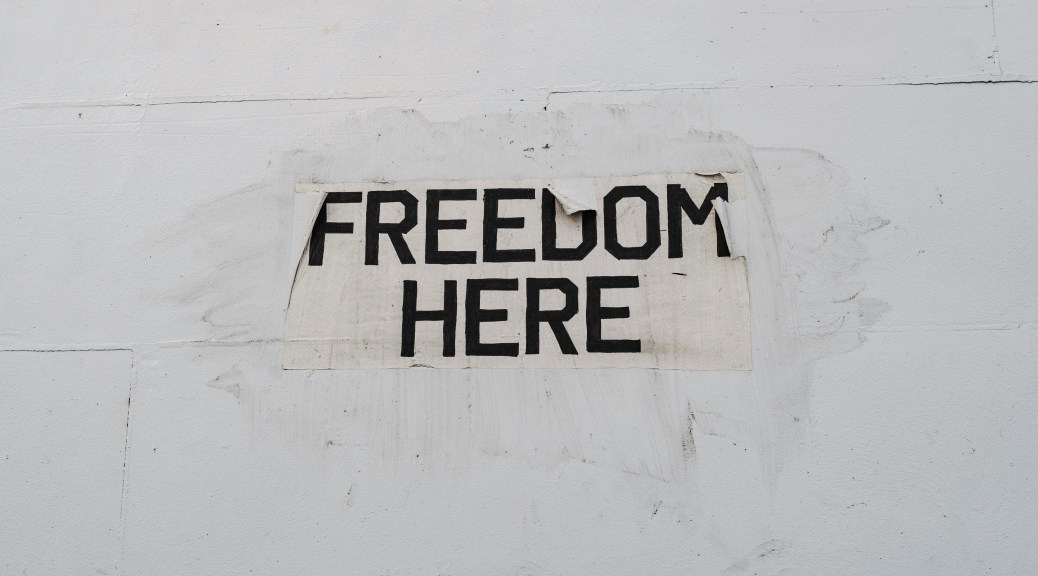
[Header Photo by Rob Coates on Unsplash]

“No one can be authentically human

while he prevents others from being so.”

Pedagogy of the Oppressed, Paulo Freire


I am not a Christian; I am not a religious person.

I have always held sacred the essential guarantees of the American Dream built on our individual liberties and the separation of church and state that is necessary for the integrity of both the church and the state.

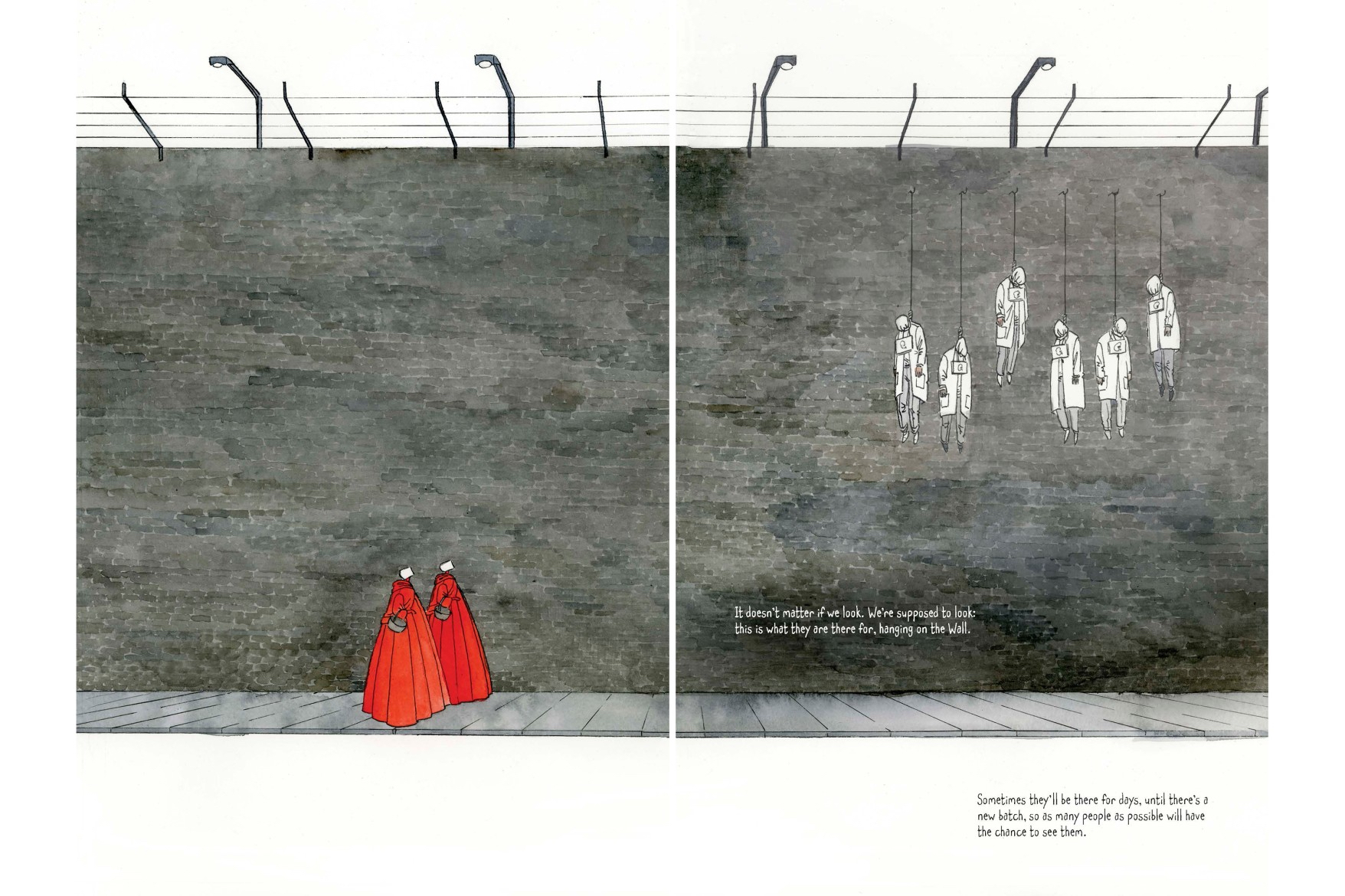
The current and intensified efforts by Christian conservatives and Christian nationalists have moved past making the misleading claim that the US is a Christian nation, created by Christian founders, and toward establishing the sort of Christian nation that erases our democratic principals and appears more like the dystopian theocracy found in The Handmaid’s Tale.

In this new reality, I am willing to support and advocate for the sort of Christian nation that I have not seen from any Christians claiming the US is a Christian nation or calling for the US to become.

It is a beautiful idea in its simplicity, built on the foundation of two principles—one Christian and one democratic.

First, the Christian principle: “So in everything, do to others what you would have them do to you, for this sums up the Law and the Prophets” (Matthew 7:12).

And the second, the democratic principle: “We hold these truths to be self-evident, that all men are created equal, that they are endowed by their Creator with certain unalienable Rights, that among these are Life, Liberty and the pursuit of Happiness” (The Declaration of Independence [1]).

I know that what I want is to be safe and also free to be the person I know I am; I also know that life and liberty are nothing if each of us is not also free to pursue what makes us happy.

And none of that should be infringed upon by others or the force of government.

That life, liberty, and happiness is for me, but I cannot seek ways to impose what I believe is right for me onto anyone else. Notably, I do not have the right to use the force of government to impose my beliefs onto anyone or everyone else.

The essential role of government by a free people is to insure that freedom for everyone even as it looks different from person to person.

Even though I strongly disagree with fundamentalist Christians and Christian nationalists, I believe they have and must maintain the right to pursue those beliefs among all consenting adults who agree with them.

Safely, freely, and without the imposition of others or the force of government.

They should not, again, seek the force of government to impose those beliefs on anyone else. To me, that is a perversion of “Christian nation” that is a democracy into Christian nationalism that become a theocracy.

“Do to others what you would have them do to you” is a beautiful and concise expression of Christian love that, for me, is fully compatible with the grounding democratic principles of “life, liberty, and the pursuit of happiness.”

Free people do not have to choose between being a Christian nation and being a free people—that is, if we genuinely believe in both.


[1] I find the passage in full after this key phrase significant also:

That to secure these rights, Governments are instituted among Men, deriving their just powers from the consent of the governed, –That whenever any Form of Government becomes destructive of these ends, it is the Right of the People to alter or to abolish it, and to institute new Government, laying its foundation on such principles and organizing its powers in such form, as to them shall seem most likely to effect their Safety and Happiness. Prudence, indeed, will dictate that Governments long established should not be changed for light and transient causes; and accordingly all experience hath shewn, that mankind are more disposed to suffer, while evils are sufferable, than to right themselves by abolishing the forms to which they are accustomed. But when a long train of abuses and usurpations, pursuing invariably the same Object evinces a design to reduce them under absolute Despotism, it is their right, it is their duty, to throw off such Government, and to provide new Guards for their future security.
The Fundamentalist Trap: Why We Should Be Losing Our Religion

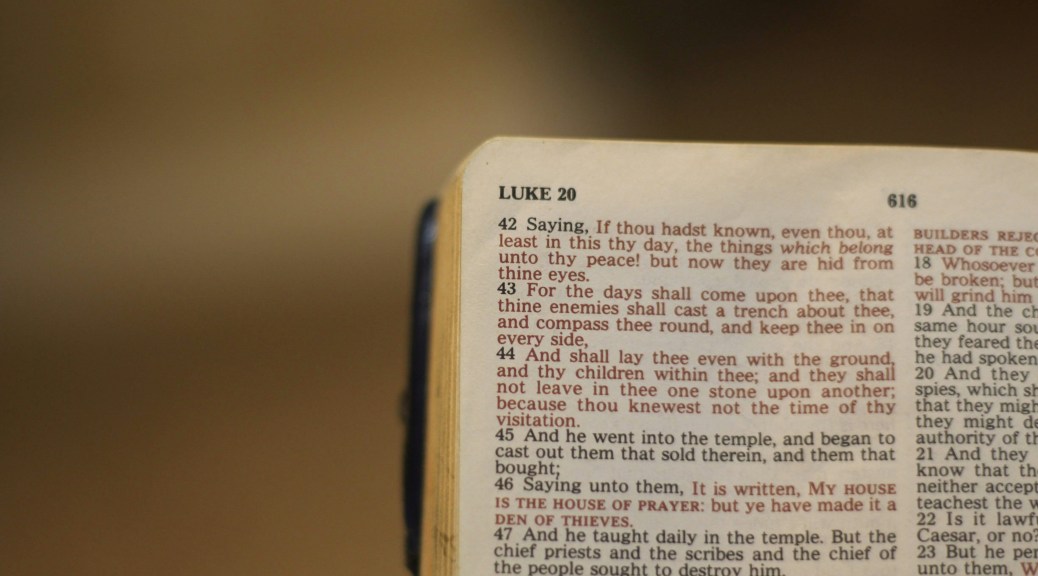
[Header Photo by Joshua Hoehne on Unsplash]

Having watched Shiny Happy People a second time, I cannot emphasize enough that the documentary is far more than an expose on the Duggar family, Bill Gothard, or the Institute in Basic Life Principles (IBLP).

This is a warning for people living in a free society, a warning about the essential threat that authoritarian movements pose for a democracy grounded in the rights of individuals.

And it is a horrifying portrayal of the ways in which children are indoctrinated and groomed by organized religion and parents, the ways women are reduced to serving the purposes of men (primarily by reproduction).

For fundamentalists, there is a fixed Truth and it is their sacred duty to impose that fixed Truth not only on those within their belief community but everyone.

I grew up in the fundamentalist South, and repeatedly was taught that to be Christian you must witness. That sacred duty to witness, in part because media has helped promote fundamentalists as shiny happy people, has exploded into an aggressive political machine poised for national indoctrination.

As the documentary explains, IBLP built a political movement as part of its mission, a mission that is inherent across the US in all sorts of fundamentalist denominations.

Several so-called mainstream Republicans have started openly saying that the separation of church and state isn’t really a founding principle in the US; the same group that treats the Second Amendment as sacred, by the way.

Imposing dogma is the goal of fundamentalism, the only goal, by any means necessary.

Nothing represents that ends-justify-the-means mentality more than the idolatry around Trump among fundamentalists. Trump the person is irrelevant as long as he remains an effective mechanism for imposing their dogma.

Two realities face Americans.

First, the separation of church and state, religious freedom, asserts that everyone has the right to embrace or reject whatever religious dogma they choose, but no one has the right to impose that dogma on others, notably not through the mechanism of government.

Therefore, the separation of church and state is a threat to the essential mandates of fundamentalism, witnessing and converting everyone to a singular way of thinking and living.

Second, fundamentalism is at the core of all organized religion at varying degrees of intensity; fundamentalism also by its nature is authoritarian.

And as the documentary on the Duggars dramatizes, authoritarianism is a mechanism of centering male authority—women and children must be subservient. (See also Sister Wives.)

Authoritarianism is a threat to democracy and individual freedom—especially in the form of religious fundamentalism that asserts dogma as the word and will of God.

These tensions now represent the primary core of politics in the US. We are no longer faced with choosing the best candidate (if we ever were), we are no longer faced with choosing between Democrats or Republicans, but we are faced with choosing between democracy and authoritarianism.

The parental rights movement built on charges of indoctrination and grooming has its roots in fundamentalism, but that political movement is not about actual indoctrination or grooming of children in the public sphere (specifically K-16 education).

The parental rights movement is projection because fundamentalists are indoctrinating and grooming; any alternative to a fundamentalist way of thinking and living, again, is a threat to fundamentalist goals for everyone conforming to that singular world view.

Like “Shiny Happy People,” “Losing My Religion” is associated with the alternative rock group R.E.M., who introduced the Southern saying to the world.

“Losing my religion” isn’t about religion, but a metaphorical statement of exasperation. “Son, you’re about to make me lose my religion” is a warning that someone is about to lose patience, to act in ways counter to how they believe they should act.

So let me be clear here: I am calling for a literal use of “losing our religion.”

Despite their numerous flaws, the so-called Founding Fathers were mostly secular men who valued human reason; many of them ascribed to a non-dogmatic view of “god” and belief that allowed for a free people to govern themselves.

In many ways, this is idealistic but a wonderful thing, I think. The problem is that granting fundamentalists religious free is a paradox since fundamentalists will not (cannot) honor the freedom for the rest of us to believe or not as we choose.

No child or woman in a fundamentalist church or home is given that freedom, and fundamentalists believe that their soul depends on them demanding compliance from the rest of us.

Between democracy and authoritarianism, only democracy allows everyone life, liberty, and the pursuit of happiness.

Everyone should watch Shiny Happy People.

Everyone should step back and recognize this documentary is not a narrow snapshot of an outlier family or some rare religious cult.

Authoritarianism is coming for us. All of us.

If fundamentalists get their way, there is no choice.

This is our future.


See Also

Reading Wars and Censorship Have a Long and Shared History

Christian Nationalists Can’t Wait for This School in Oklahoma to Open

For Boebert and Greene, faith — and Christian nationalism — sells

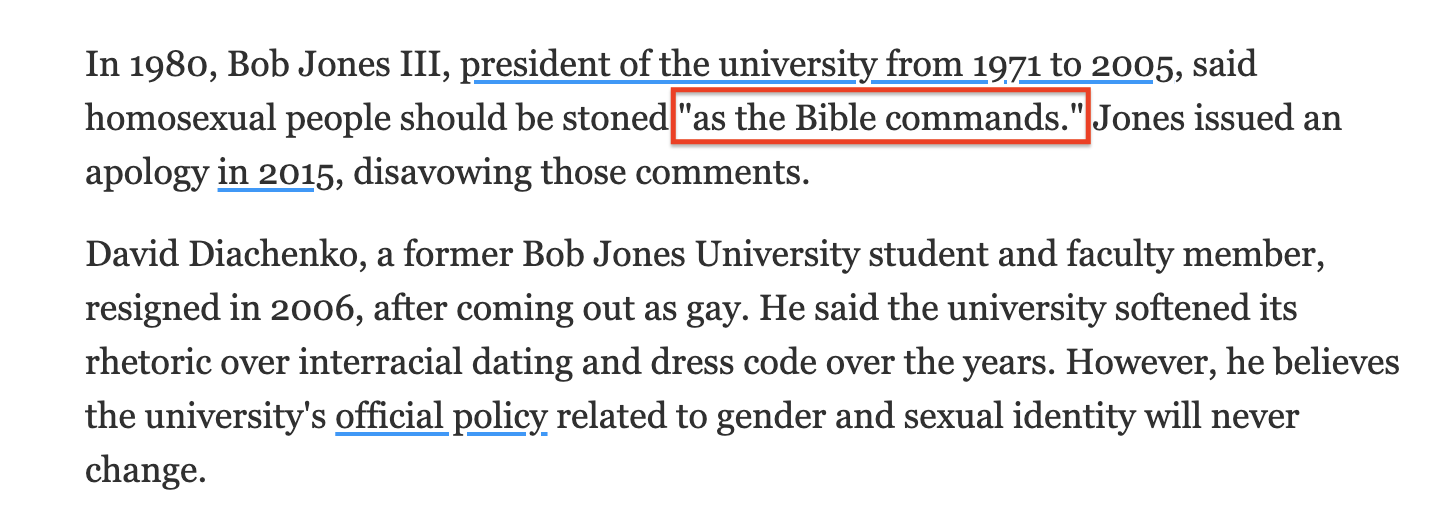
Former Bob Jones University students describe experience, exit from evangelical college


Gag Orders, Loyalty Oaths, and the New McCarthyism

Out of the rack and ruin of our gangster death,
The rape and rot of graft, and stealth, and lies,
We, the people, must redeem
The land, the mines, the plants, the rivers.

“Let America Be America Again,” Langston Hughes

An avalanche of gag order bills are being proposed in South Carolina—H.4325H.4343H.4392H.4605, and H.4799. While my home state of SC often likes to brag about being the first state to secede in order to maintain slavery (an uncomfortable fact many of these laws would ban from being taught), these bills represent the sort of crass copy-cat legislation that is also sweeping across other Republican-led states.

Not only is there nothing original in these bills (or even evidence-based or logical), but also there is a profoundly disturbing repetition of one of the lowest points in U.S. history—the New McCarthyism.

Let’s start with facts, which Republican legislation seeks to censor:

  • “Critical Race Theory” as it is mischaracterized by Republicans does not exist in K-12 schools.
  • CRT as properly defined (a scholarly theory created primarily by Black scholars for the the field of law and adapted in a few other fields such as education and sociology) does not exit in K-12 schools.
  • Systemic racism is a fact of the founding of the U.S. and a fact of the U.S. in 2022, supported by irrefutable evidence that defies simplistic explanations (such as individual racism).
  • Race is a social construct and not a matter of biology.
  • History is a living field for considering the facts of the past; there is no one true history.
  • Intellectual discomfort is often a necessary aspect of new learning when anyone must confront misconceptions or missing knowledge in order to better understand and navigate the world.

The gag orders such as those listed above in SC are blunt partisan politics driven by orchestrated lies that have nothing to do with protecting students or with teaching factual history or excellent literature/texts.

Curriculum and book censorship in 2022 is our New McCarthyism because the CRT veneer is being used to promote ideological agendas aimed at Black people and LGBTQ+ people.

The McCarthy Era, also known as the Red Scare, was confronted in The Crucible by Arthur Miller, who uses allegory to warn the U.S. at mid-twentieth century that McCarthy’s cries of “communism” were partisan lies similar to the Salem witch trials.

There were no witches.

There were no lists of communists.

There is no CRT poisoning U.S. schools.

Yet, in their extreme forms, some gag orders include requirements for loyalty oaths and mechanisms for withholding state funding for a decade. Even for private organizations.

The ultimate horror of these gag orders from Republicans is that by legislating censorship of what history and texts students are allowed to learn, we will be insuring the most damning of ideas about history itself—those who ignore history are doomed to repeat it, often the very worst of it.

Yesterday I saw the following Tweet about the Russia invasion of Ukraine:

While I endorse the sentiment, I have been watching for over a year while most of the U.S. fails to resist censorship right here in the so-called land of the free and home of the brave.

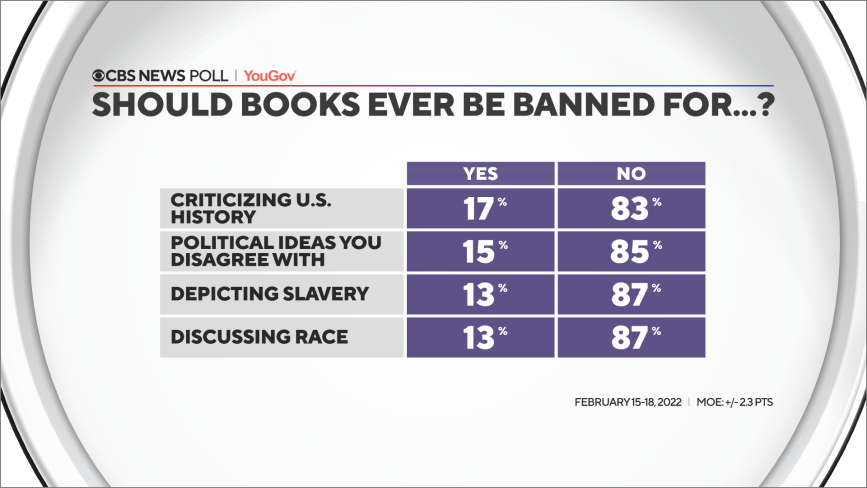
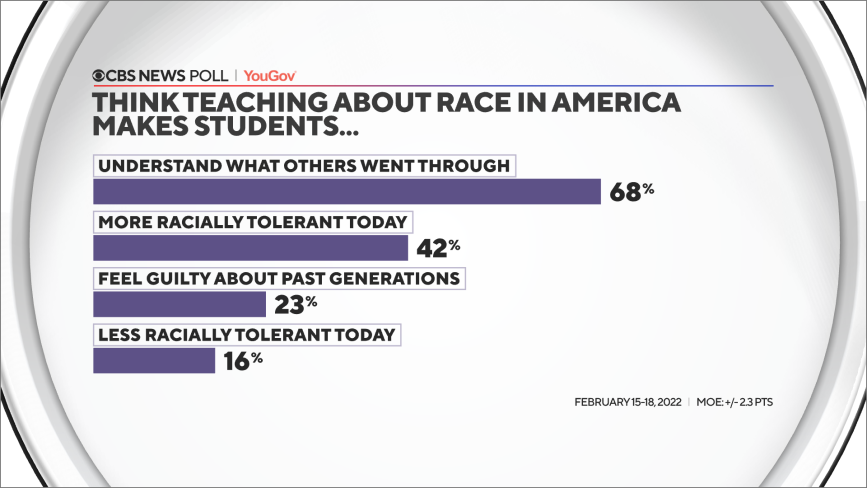
Republicans are running roughshod over freedom, pushing the U.S. toward banning abortion (despite a majority of Americans supporting maintaining Roe v. Wade) and enacting curriculum and book bans (despite large majorities of Americans rejecting censorship):

CBS news poll

Ultimately, gag orders, loyalty oaths, and censorship are un-American and anti-democratic, as ALAN notes in their Intellectual Freedom Statement:

We know that intellectual freedom is foundational to an educated citizenry and essential to the preservation and practice of democracy. We are dedicated to protecting this natural human right, and therefore, we insist on open access to all school reading materials for all students.

Intellectual Freedom Statement

The New McCarthyism exposes the Republican Party as a party of oppression, the exact sort of fact that should make everyone of us uncomfortable.


Conservatives are Wrong about Parental Rights

With public schools poised to reopen for the 2021-2022 academic year, South Carolina faces the challenges of dealing with another wave of a Covid variant, a challenge made more complicated because of political theater by Republicans.

Columbia (SC) Mayor Steve Benjamin issued a mask requirement for students in the city, and immediately Governor Henry McMaster responded: “’This is another attempt to force children to wear masks in schools without a bit of consideration for a parent’s right to make that decision,’” said Brian Symmes, McMaster’s spokesman.”

The political theater of invoking “parental rights” by Republicans and conservatives falls apart at several levels.

First, if parents do have the right to demand that their children not wear masks (see below), those parents do not have the right to endanger other people—and the mask mandate in schools is primarily about community safety.

“Freedom” in this case is once again not license; parents choosing to keep their children unmasked must also address the consequences of that decision. Those parents then are obligated to provide their children proper education since the unmasking means those children cannot attend K-12 public schooling.

Just as adults are free to drink alcohol, but restricted from driving while impaired (a mandate that addresses community safety), parents and their children may remain unmasked but that means there are restrictions on where they can go and what they can do.

Choice has consequences.

But, there is a much larger issue here about parental rights and how that impacts the rights of children.

Republicans such as McMaster either are unaware of the law or are intentionally dishonest with their “parental rights” rhetoric.

In The Parent as (Mere) Educational Trustee: Whose Education Is It, Anyway?, Jeffrey Shulman details that parental rights and the education of their children are in many ways “circumscribed,” restricted or limited.

Broadly, Shulman explains:

What role should the state play in the transmission of values? What values can the state successfully transmit? How can it do so? To approach these questions, this Article begins with principles laid down by the Supreme Court. It is the state’s duty to ensure that all schools, public or private, inculcate habits of critical reasoning and re- flection, a way of thinking that implies a tolerance of and respect for other points of views. In pursuit of this lofty goal, the state need not make public schooling compulsory. However, the state must see that all children are provided an education that is, in the fullest sense, public—a schooling that gives children the tools they will need to think for themselves, a schooling that exposes children to other points of view and to other sources of meaning and value than those they bring from home. This effort may well divide child from parent, not because socialist educators want to indoctrinate children, but because learning to think for oneself is what children do. It is one facet of the overall movement toward the individuation and autonomy that is “growing up” and is, perhaps, the most natural and vital part of healthy maturation.

The Parent as (Mere) Educational Trustee: Whose Education Is It, Anyway?

There is, then, a long legal history in the U.S. that simply doesn’t recognize parental rights as monolithic, or even sacred.

One way parental rights are limited is directly embedded in the commitment to universal public education:

The state as educator, then, is no ideologically neutral actor. The philosophical foundations supporting a truly public education are the liberal biases of our nation’s intellectual forbearers, biases in favor of a non-authoritarian approach to truth, of free argument and debate (what Jefferson called truth’s “natural weapons”), and of a healthy sense of human fallibility—the foundation, in other words, of our nation’s governmental blueprint. Unless children are to live under “a perpetual childhood of prescription,” they must be exposed—intellectually, morally, and spiritually—to the dust and heat of the race. Whether one considers the formation of moral commitments a matter of choice or duty, of reflective self-directedness or cultural embeddedness, the child must not be denied the type of education that will allow him, as an adult, to choose whether (and in what way and to what degree) to honor those commitments. A public education is the engine by which children are exposed to “the great sphere” that is their world and legacy. It is their means of escape from, or free commitment to, the social group in which they were born. It is their best guarantee of an open future.

The Parent as (Mere) Educational Trustee: Whose Education Is It, Anyway?

The great irony here is that the courts have recognized that public education, the state, has the obligation to protect the individual intellectually freedom of children, even when that conflicts with parental wants or demands that are framed in rugged individualism rhetoric.

That legal recognition creates a tension that is rarely voiced in public discussions:

We are cautioned by family law historian Barbara Bennett Woodhouse that “[s]tamped on the reverse side of this coinage of family privacy and parental rights are the child’s voicelessness, objectification, and isolation from the community.” It is often assumed that state control of education “disserve[s] the values of pluralism and experimentation,” but public education can bring its students a much needed respite from the ideological solipsism of the enclosed family. Public education can physically and intellectually transport the child across the boundaries of home and community. Of course, this transportation comes at a cost. It disrupts the intramural transmission of values from parent to child. It threatens to dismantle a familiar world by introducing the child to multiple sources of authority—and to the possibility that a choice must be made among them.

The Parent as (Mere) Educational Trustee: Whose Education Is It, Anyway?

And thus, the masking debate exposes a couple elements of legal obligations to the community, to children, and to parents since the requirement (or not) to mask impacts children’s opportunities to learn in contexts where academic freedom is protected and where all the people involved are safe as reasonably possible from infectious disease.

However, ultimately, the rights of children must be protected:

No one would suggest that parents may not introduce their children to personal sources of moral or religious meaning. However, to those parents who want their children untouched by other points of view, the state must say that the rights of parents, while profound, are circumscribed—contingent, as the Supreme Court has always noted, on preparing the young for the additional obligations they will take on as members of a pluralistic society. “In a democracy,” political theorist William Galston writes, “parents are entitled to introduce their children to what they regard as vital sources of meaning and value, and to hope that their children will come to share this orientation.” Yet, children have freestanding intellectual and moral claims of their own, claims that Galston goes on to remind us, “imply enforce- able rights of exit from the boundaries of community defined by their parents.” If children are granted this right of exit, they must be able to exercise it freely. They must not be disempowered from making their own intellectual and moral claims in the first place. The state has a duty to make sure they are not disempowered, and one of its best resources to that end is public schooling.

The Parent as (Mere) Educational Trustee: Whose Education Is It, Anyway?

The state is charged with protecting children intellectually and physically when parents do not share that goal (risking the child’s health by refusing to mask, indoctrinating the child in singular beliefs by restricting that child’s access to knowledge and critical thinking):

The full capacity for individual choice is the presupposition of First Amendment freedoms. It is for this reason that the state has a strong obligation to see that free choice is not strangled at its source. The state may not sponsor particular religious or political beliefs, but that is not enough; it must protect children from being forced to adopt particular religious or political beliefs. The state must work to protect the moral and intellectual autonomy of all children. Further, if the state has the obligation to ensure the child’s opportunity to become autonomous, that obligation, as educational theorist Harry Brighouse has pointed out, “cuts against the differential regulation of public and private schools with respect to religious instruction.” Children are owed this obligation “regardless of whether it is the state, their parents, or a religious foundation that pays for their education, and regardless of whether they attend privately-run or government-run schools.” The constitutional freedom to choose is not guaranteed only to be so circumscribed that it exists in principle but not in fact.

The Parent as (Mere) Educational Trustee: Whose Education Is It, Anyway?

The Republican political theater of “parental rights” rhetoric exposes that conservatives are intellectually and legally bankrupt, but it also exposes the essential need for the state to protect children, who have essentially no political power.

McMaster and other Republican governors are clearly speaking to the adults who are likely to vote for them, and not in any way addressing the education and health of children.

The continuing political theater surrounding Covid and public schooling is too often ignoring the children at the center of that storm.

Since children have no political authority or autonomy, the state must function in ways that support parents who honor their children’s intellectual freedom and personal health and safety but also protect children when their parents have motives not in the interest of their children’s ability to think critically and live safely.

Who’s Indoctrinating Whom?

The best way I can express it, I think, is that I have always wanted to be smart.

“Always” in the sense of whenever I first had something like independent awareness, which I assume occurred gradually as my autonomous self slowly and painfully separated myself from the powerful urge to remain at the center of my mother’s universe.

I idealized being “smart,” and thus “knowing stuff,” as essential for that autonomy.

I have never wanted to be smart to lord it over others (although I am still accused of being arrogant, a misreading of passion, I think), but I have always sought out and consumed knowledge as my lifelong quest to be my own person.

This urge has put me in a sort of Emerson/Thoreau camp that cherishes the individual mind and rejects organizations and group-think—a sort of libertarian intellectualism that now sits uncomfortably where that intellectual individuality has led me.

Over my first couple years of college—spent at a junior college where more of my energy was dedicated to playing pick-up basketball and drinking beer than my studies—I was eagerly reading and studying on my own existential philosophy and literature.

On the day Ronald Reagan was shot, I sat in the college library reading Sartre.

My mind and soul teetered on a dangerous edge during my teen years and into early adulthood; I was a perfect candidate for the sort of adolescent Ayn Rand know-it-all-ism many young white men fall into—and never escape.

Something, maybe just dumb luck, never allowed me to stop learning and thinking; something never allowed me to think I was “finished” learning or to assume that my current state of knowing was finished.

This is where my story includes Karl Marx. This is where the story of my mind looks absolutely nothing like what conservative Americans think Marxism and “critical” look like.

I found a copy of Marx’s non-economic writing that included a section on education. Having grown up in the rural South in the 1960s and 1970s, I picked up Marx with all the misconceptions you can imagine about communism, socialism, and such.

That paperback still sits on my shelf in my office and is heavily underlined with (mostly embarrassing) comments scribbled in the margins.

Just as I self-taught about existentialism, I was becoming a Marxist educator on my own time while I went through my final 2.5 years of college, majoring in secondary English education.

My certification program was extremely moderate even though my education professors were uniformly white progressives who tip-toed around being confrontational or in any way revolutionary.

These experiences were steeped in idealism and painful naivety.

I entered the K-12 classroom as a high school English teacher in 1984, none the less, with the belief that I could help change the lives of my students and even change the world. This ambition was based on my own experiences since my life was profoundly changed by formal education, teachers and professors, and my own relentless self-education.

That belief was grounded in wanting not to shape what my students thought but in helping them develop the tools needed for how to think independently, including how to step back from beliefs and assumptions about the world in order to make their knowledge their own.

As an English teacher, I knew those tools were mostly literacy—reading and writing as essential for human autonomy and dignity.

Over about a decade, I did this work often badly but with a great deal of earnestness. College had humbled me so I was determined to help my students avoid skipping off to college with the sort of redneck provincialism that had shot out of my mouth in several college classes.

Again, contrary to what conservatives often claim, the only places I was indoctrinated had been in my home, my community, and my church. The students in my hometown had also experienced mostly authoritarian homes, authoritarian schools and classes, and authoritarian churches.

They had lived unexamined lives because that had been demanded of them.

At times, then, I was a very unpopular redneck among rednecks.

Things changed dramatically for me as a person, an educator, and a scholar when I entered my doctoral program in 1995.

Dots were connected from those naive days reading the non-economic writings of Marx and discovering that a complex and vibrant world of Marxist education scholars existed.

Reading Paulo Freire was switching on a light in my brain and my soul. Freire had thought through all the lazy and careless ideas that had led me to the classroom. But Freire also confirmed that my intentions were valid even as they needed a great deal of development and rethinking.

Another decade passed before one of my scholarly mentors, Joe Kincheloe, wrote exactly what it means to be a critical educator, an explanation that expresses almost perfectly the critical educator I had become:

Thus, proponents of critical pedagogy understand that every dimension of schooling and every form of educational practice are politically contested spaces. Shaped by history and challenged by a wide range of interest groups, educational practice is a fuzzy concept as it takes place in numerous settings, is shaped by a plethora of often-invisible forces, and can operate even in the name of democracy and justice to be totalitarian and oppressive.

Joe Kincheloe, Critical Pedagogy Primer

Critical pedagogy was, then, a body of thought that aggressively rejected indoctrination and recognized that traditional approaches to education were in fact mostly indoctrination, as Kincheloe adds:

Recognition of these educational politics suggests that teachers take a position and make it understandable to their students. They do not, however, have the right to impose these positions on their students [emphasis in original]….

In this context it is not the advocates of critical pedagogy who are most often guilty of impositional teaching but many of the mainstream critics themselves. When mainstream opponents of critical pedagogy promote the notion that all language and political behavior that oppose the dominant ideology are forms of indoctrination, they forget how experience is shaped by unequal forms of power. To refuse to name the forces that produce human suffering and exploitation is to take a position that supports oppression and powers that perpetuate it. The argument that any position opposing the actions of dominant power wielders is problematic. It is tantamount to saying that one who admits her oppositional political sentiments and makes them known to students is guilty of indoctrination, while one who hides her consent to dominant power and the status quo it has produced from her students is operating in an objective and neutral manner.

Joe Kincheloe, Critical Pedagogy Primer

In the most succinct expression of what it means to be a critical educator, Kincheloe concludes, ““Critical pedagogy wants to know who’s indoctrinating whom.”

As a critical educator whose teaching and scholarship are informed by Marxist ideology (although not exclusively), I enter my 40th year watching conservatives and Republicans present a cartoon version of what I actually practice in order to institutionalize further the indoctrination they seek.

Who’s indoctrinating whom?

If Republicans and conservatives have it their way, it will be conservatives indoctrinating everyone.

So here are the commitments of my work as a critical educator and scholar, commitments that refute the many and ugly lies coming from Republicans and conservative talking heads:

  • The most sacred thing is the autonomy of the human mind and life, especially when a person with power has authority over children and young adults.
  • The work of being “critical” must interrogate the role of power in all human action—who has power over whom and why.
  • Any idea or system that has become “normal” or dominant must be challenged regularly in order to protect the sacred nature of human autonomy.
  • All human interaction is political and no human action is “objective.”
  • The needs and interests of all and the needs and interests of one are not mutually exclusive, but interrelated realities that must be openly and freely negotiated by humans with protected autonomy (life, liberty, and the pursuit of happiness).
  • Love and kindness are the very best qualities of humans.

And the ultimately irony, I think, is that we critical educators are the ones most dedicated to the pursuit of democracy, as Freire expains:

To the extent that I become clearer about my choices and my dreams, which are substantively political and attributively pedagogical, and to the extent that I recognize that though an educator I am also a political agent, I can better understand why I fear and realize how far we still have to go to improve our democracy. I also understand that as we put into practice an education that critically provokes the learner’s consciousness, we are necessarily working against the myths that deform us. As we confront such myths, we also face the dominant power because those myths are nothing but the expression of this power, of its ideology. (p. 41)

Teachers As Cultural Workers, Paulo Freire

Today in the U.S. we have a choice to make between “the myths that deform us” and the possibility of a democracy yet realized.

But without critical education, there will only be those myths.

MLK and “the Guaranteed Income”

[Header Photo by Katie Harp on Unsplash]

“President-elect Joe Biden will seek to increase the federal minimum wage to $15 an hour as part of his relief bill,” reported Alina Selyukh for NPR.

Across social media, people began doing calculations of what $15/hour translates into for annual salaries, and here are a couple responses from white Christian conservatives:

McChristian, personifying the relationship between a McNugget and real chicken, seems to be aware that teachers are underpaid, but lacks any Christian compassion for other workers also being underpaid (such as minimum-wage workers often constituting the working poor and living without healthcare or retirement—or job security).

Rachel, hollow mouthpiece for the equally vapid TPUSA, doesn’t just lack compassion; she also lacks any grasp of basic facts, embodying not only the hypocrisy of the Christian conservative movement but also the complete misunderstanding of how the free market works.

Note that “[r]aising wages for fast-food workers to $15 an hour would lead to a noticeable but not substantial increase in food prices, according to a new study by Purdue University’s School of Hospitality and Tourism Management,” as reported by Sally French at Market Watch.

Social media, as well, was quick to point out that in areas such as DC and the San Francisco Bay, where the minimum wage is already $15 and above, Taco Bell burritos remain below $4 at the most expensive.

In the U.S., we are well beyond the point of needing to acknowledge that there is nothing Christian or honest about the conservative movement in the U.S.

And few times a year are more likely to expose that than Martin Luther King Jr. Day—when those on the Right scramble to cherry-pick one or two quotes from MLK to wave in front of their hypocrisy and lies.

The debate about the $15/hour minimum wage (as well as college debt relief and universal healthcare) is an ideal opportunity to examine the MLK that almost everyone in mainstream America chooses to ignore.

brown concrete statue during daytime
Photo by Clay Banks on Unsplash

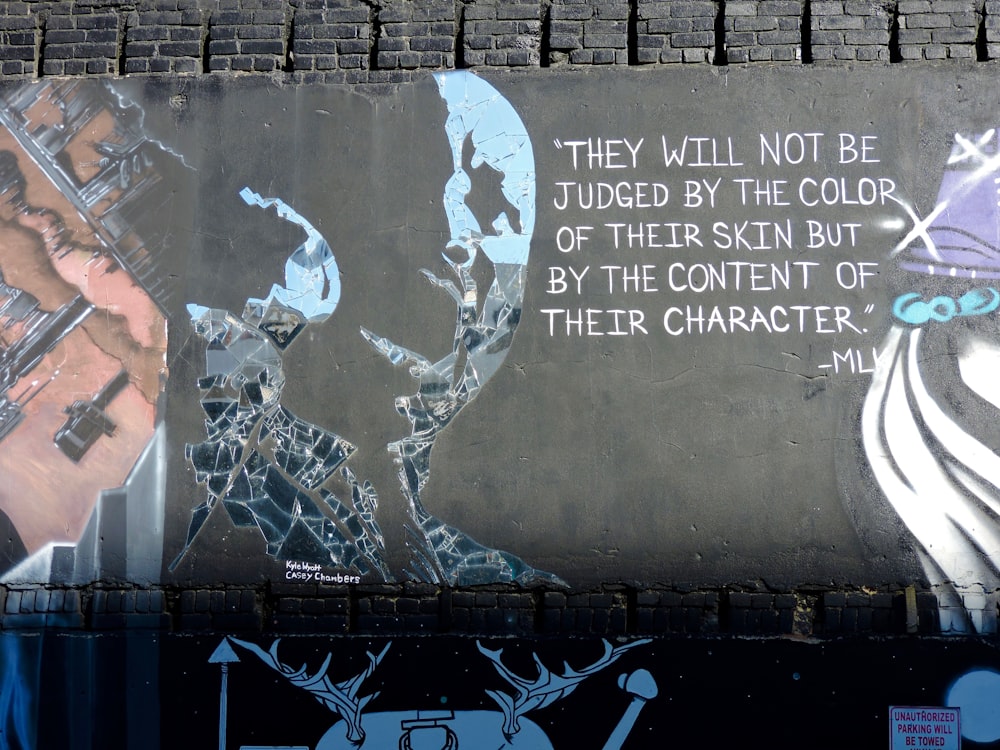
A couple favorite mis-uses and distortions of appropriating MLK is, first, characterizing King as a “passive radical” in order to violence-shame groups or paint a distorted “both sides” false equivalency between right-wing white nationalism and social justice advocates focusing on race and racism, and second, plastering the “content of their character” quotes everywhere to perpetuate the colorblind argument that, in fact, is itself racist.

text
Photo by LeeAnn Cline on Unsplash

Rare is the reference to King who strongly rejected the Vietnam War, but almost entirely absent from the public consciousness in the U.S. is King’s 1967 work, Where Do We Go from Here: Chaos or Community?

Here, King offers his criticism of the standard approach to eradicating poverty (approaches that persist in 2021):

Up to recently we have proceeded from a premise that poverty is a consequence of multiple evils:

• lack of education restricting job opportunities;

• poor housing which stultified home life and suppressed initiatives;

• fragile relationships which distorted personality development.

The logic of this approach suggested that each of these causes be attacked one by one. Hence a housing program to transform living conditions, improved educational facilities to furnish tools for better job opportunities, and family counseling to create better personal adjustments were designed. In combination these measure were intended to remove the causes of poverty.

Wealth and Want

King was confronting that U.S. political will could only admit indirect ways to address poverty—despite, as King pointed out, that more whites than Black people suffered under the weight of economic inequity.

“In addition to the absence of coordination and sufficiency, the programs of the past all have another common failing — they are indirect. Each seeks to solve poverty by first solving something else,” King noted, adding: “I am now convinced that the simplest approach will prove to be the most effective — the solution to poverty is to abolish it directly by a now widely discussed measure: the guaranteed income.”

Not only did King call for a guaranteed income, he asserted the essential need to be direct:

We are likely to find that the problems of housing and education, instead of preceding the elimination of poverty, will themselves be affected if poverty is first abolished. The poor transformed into purchasers will do a great deal on their own to alter housing decay. Negroes, who have a double disability, will have a greater effect on discrimination when they have the additional weapon of cash to use in their struggle.

Wealth and Want

Unlike McChristian and Rachel above, MLK as a progressive, as a Leftist (often slurred as a “communist”), understood the foundational need in a capitalist society that all people have capital:

Beyond these advantages, a host of positive psychological changes inevitably will result from widespread economic security. The dignity of the individual will flourish when the decisions concerning his life and in his own hands, when he has the assurance that his income is stable and certain, and when he know that he has the means to seek self-improvement. Personal conflicts between husband, wife and children will diminish when the unjust measurement of human worth on a scale of dollars is eliminated.

Wealth and Want

But King was profoundly aware of the problems with “minimum” wages, arguing about the guaranteed income:

Two conditions are indispensable if we are to ensure that the guaranteed income operates as a consistently progressive measure.

• First, it must be pegged to the median income of society, not the lowest levels of income. To guarantee an income at the floor would simply perpetuate welfare standards and freeze into the society poverty conditions.

• Second, the guaranteed income must be dynamic; it must automatically increase as the total social income grows. Were it permitted to remain static under growth conditions, the recipients would suffer a relative decline. If periodic reviews disclose that the whole national income has risen, then the guaranteed income would have to be adjusted upward by the same percentage. Without these safeguards a creeping retrogression would occur, nullifying the gains of security and stability.

Wealth and Want

King makes a purely Christian argument about economic policy in a capitalist democracy that should and could center human dignity and equity over greed:

The curse of poverty has no justification in our age. It is socially as cruel and blind as the practice of cannibalism at the dawn of civilization, when men ate each other because they had not yet learned to take food from the soil or to consume the abundant animal life around them. The time has come for us to civilize ourselves by the total, direct and immediate abolition of poverty.

Wealth and Want

The Right is wrong about what it means to be Christian.

The Right is wrong about what makes democracy and capitalism work for people and not against human dignity.

And the Right over the next few days will once again be offensively wrong about MLK.

Republicans Usher in the Land Free from the Truth: Free Speech v. Free Markets

We know of course there’s really no such thing as the “voiceless.” There are only the deliberately silenced, or the preferably unheard.

Arundhati Roy: The 2004 Sydney Peace Prize lecture

Labeled as “surreal” by Emilia Petrarca, Marjorie Taylor Greene (R – Georgia) wore as “censored” face mask while speaking from the floor on Congress.

First, we must recognize that statistically no one in the U.S. has the sort of access to a bully pulpit that a member of Congress has (535 out of 330 million people), and then, we must consider whether Greene is incredibly dishonest, spectacularly ignorant, or both.

After the insurrection at the Capitol by rightwing domestic terrorists supporting Trump—and emboldened by Trump and many Republicans in office—conservatives and Republicans across the U.S. have evoked “censorship,” “First Amendment,” and “freedom of speech” tirades in response to Trump being banned from several social media platforms as well as many Republicans losing followers on those platforms.

Here is the disturbing thing that Greene represents among conservatives and Republicans: There appears to be the same sort of dishonesty/ignorance running rampant because there is essentially no relationship between private businesses and free speech guaranteed in the Constitution since the First Amendment is about the role of government in protected speech.

Let’s not forget very recent history when Republicans and conservatives scrambled to support the right of companies not to serve or even hire LGBTQ+ individuals (recall the wedding cake).

Private companies banning anyone is not an issue of free speech grounded in the First Amendment since government plays no role in that, and (ironically), anyone losing Twitter followers is a consequence of market forces, how the free market works.

In the jumbled surreal-reality of Republicans, it seems they want some entity (the government?) to monitor the free market so that all voices are heard—regardless of truth and irrespective of inciting violence (seemingly now, conservatives support yelling “Fire!” in a crowded theater).

As a writer, I have been submitting letters to the editor and Op-Eds to local, state, and national media for decades; most of those submissions are rejected. Is that censorship? A denial of freedom of speech? A breech of my First Amendment rights?

Of course not.

It is the free market—as right-wingers would say, the marketplace of ideas.

There are some really important and likely disorienting elements to this jumbled message created by Republicans and conservatives.

One seems to be why does Greene (and Trump, et al.) lie and misrepresent to the American public as agents of the government with impunity? In other words, what is the role of truth in governing?

Free speech and the First Amendment have continued to be areas of debate in the U.S. in terms of inciting violence and pornography, and we must admit that free speech is not a clear-cut or absolute thing even when recognizing only the role of government.

The level of lies and disinformation under Trump, I think, now calls for a serious interrogation of what free speech allows in those contexts—especially in terms of elected and appointed members of the government.

It seems obvious that agents of government must not incite violence or promote false information.

When people with power (from the wealthy to police to elected officials, including the president) function above truth and the law, it is unlikely that free speech matters for anyone.

A second element that is being almost entirely ignored because of the lies and ignorance on the Right is the question of free speech and the free market; in other words, we are not confronting the role played by private companies in whose voice is amplified and whose voice is muted or ignored.

Twitter bans and people losing followers on Twitter are not the purview of government, and both exist in the mechanics of the free market—which many of us on the Left have warned are amoral dynamics.

Supply and demand left unchecked has nothing to do with ethical or moral concerns. There is a demand for child sex trafficking, for example, and without government intervention (a moral/ethical imperative), it would flourish within the parameters of those consumers.

Many aspects of the U.S. function this way without being so immediately disgusting and inhuman—and thus, remain unchecked.

Those of us on the Left, as well, recognize the amoral aspect of the market and therefore call for universal healthcare, for example, since market forces are inappropriate for determining who does and does not receive medical care.

Trump sycophants such as Greene are backing themselves into some complicated ideological and political corners since their outrage over social media is challenging the efficacy of the free market (misidentified as free speech because of their dishonesty/ignorance).

While I see no hope that Republicans have any interest in the truth—or freedom of speech—I think that this nonsense from the Right offers yet another opportunity for people in the U.S. to reconsider the relationship between government/democracy and capitalism.

Despite a related lie from the Right, we Leftists are rarely calling for full-blown socialism or communism; we are, however, arguing that far too much of human dignity and freedom is left to the free market—such as healthcare—and the whims of the states—such as women’s reproductive rights.

Should we be concerned that Twitter and Facebook banned Trump, and that Parler was de-platformed?

I suspect we should, but not because these events have violated the First Amendment.

The problem is us and the lack of political will in the U.S. to reconsider our overblown commitments to the free market at the expense of democracy and truth as well as life, liberty, and the pursuit of happiness.

Equity Politics: Life, Liberty, and the Pursuit of Happiness

I am not free while any woman is unfree, even when her shackles are very different from my own. And I am not free s long as one person of Color remains chained. Nor is any of you.

“The Uses of Anger,” Audre Lorde

The U.S. has elected Joe Biden president, ending the presidency of Donald Trump.

This is a return to the standard failure of the democratic process in a country that is primarily committed to the free market, rugged individualism, and guns.

Biden is the normal but truly awful presidential candidate, replacing the uniquely horrible election of Trump.

As many people have noted, changing presidents typically means only small differences in the daily lives of people. Those with some affluence and privilege continue to have really good lives, lives that allow them to focus on trivial matters that seem huge because of that affluence or privilege.

People in poverty, working class people, and the many different categories of people living in what we have euphemized as “diverse” identities, however, will mostly continue to live barely in the margins of the American dream—even when these people also attain some level of wealth or privilege in their accomplishments.

The American democracy is a failed and failing experiment because it has allowed inequity to flourish, and those living with the most privilege, white Americans, refuse still even to acknowledge that inequity because they are so enamored with their own pettiness and convinced that they too face disenfranchisement and disadvantage.

It is the “war on Christmas” rhetoric that arrives every holiday season by people who benefit from being in a majority and Christian-centric nation; there is no rational basis for such nonsense, but white America is still a majority of delusion, clinging to the one thing they will not relinquish—their white privilege.

Having never been a Republican or Democrat, and having never drunk the Kool Aid of idealism about the founding of the U.S. or the American Dream, I have always none the less found one possibility of the U.S. not only beautiful but also worth believing in—life, liberty, and the pursuit of happiness.

There is a poetic brilliance to that phrase that genuinely can and should be a map for the country the U.S. could become.

Even as I acknowledge Biden is a horrible candidate, I have found that his willingness to admit the U.S. has not yet reached our ideals and his charge to be the president for all Americans and not just those who elected him to be some of the better political rhetoric we can hear.

Those of us, especially those of us on the authentic Left, who embrace the possibility of human equity guaranteed by and for a free people have no real political party for our allegiance, but I do think we can use this moment in history to commit to a politics of equity built around the ideals of life, liberty, and the pursuit of happiness.

A first step to making equity a reality in the U.S. is an education campaign, one specifically targeting the demonizing and fear-mongering around “socialism.”

First, there must be an honest distinction made between regimes that are identified as socialism or communism—regimes rules by dictators or de facto dictators—and democratic socialism.

Fear-mongering around the former U.S.S.R., China, and Castro’s Cuba is purposefully distracting the voting public from democracies that embrace first publicly funded and democratically chosen institutions that make the free market and personal freedom possible in equitable ways for all citizens.

Pure socialism and communism would mean the end of private business and private property, and frankly, I see no avenue to that sort of shift under either Republicans or Democrats. I also see no Leftist movement in the U.S. that calls for rule by a dictator; only the Trump movement and his followers (all occurring on the Right, not the Left) appear eager for a dictator.

The sort of totalitarian “socialism” that the Right is using to fear-monger voters would be equally rejected by the Left, including the seemingly growing belief among young Americans that democratic socialism is preferable to the Social Darwinism of the unfettered free market in the U.S.

“Socialism” as a concept, then, is quite different than how that term has been folded into dishonest political rhetoric or even claimed improperly (or misleadingly) by political movements more concerned about totalitarian control.

I do support democratic socialism; I also embrace the idea that a robust publicly funded network of institutions must be established in order for the free market and individual freedom to be equitable and accessible to all people regardless of their identity or status.

I am essential public institutions first, and then free market and individual liberty.

And thus, equity politics must be policy first, and not partisan politics first.

Life?

Universal healthcare.

Women’s reproductive rights.

De-militarizing and reforming policing and the judicial system.

Liberty?

Fully publicly funded K-16 education (student loan debt relief).

De-criminalizing, legalizing marijuana (releasing prisoners trapped in the war on drugs).

Removing the Electoral College and reforming representation across the U.S. that is equitable for rural and urban Americans.

Expanding access to voting and guaranteeing all Americans can vote without threat.

The pursuit of happiness?

Full rights to LGBTQ+ Americans.

De-coupling healthcare and retirement from employment.

Increasing the minimum wage and reducing the work week as well as expanding guaranteed paid vacation and family leave policies.

I cast a (worthless) vote for Biden/Harris in South Carolina (a self-defeating conservative state) as a symbolic gesture to end the reign of Trump. There is little hope in the Democratic Party, but the Republican Party is aggressively against all of the policies above that would move the U.S. closer to the ideal of human equity for all.

If the Senate remains in Republican hands, there will be little Democrats can do to move the moral arc toward equity.

But unless we have the political will as a people to form a new and stronger party built on principles of equity, we have only one option, transforming the Democratic Party into a genuine movement for change that serves all people.

And this cannot be achieved by compromising with Trump Republicans who do not value equity, human agency, or human dignity (except for themselves and those who look like them).

Biden as a person and a politician is only marginally preferable to Trump; this election should be seen as a mandate rejecting Trump, but it cannot be seen as an endorsement of returning to the normal that allowed the killing of George Floyd and Breanna Taylor.

White men and women in a majority and over 70,000,000 Americans voted for Trump, angrily and with a middle finger voted against equity for all because they belong to the cult of individuality and wealth that Trump represents.

This is a disturbing cancer on the American way of life; this is why the American Dream remains a nightmare for many and a fantasy for most.

Equity politics is a moral imperative, one driven by this proclamation by one of the most famous socialists in U.S. history, Eugene V. Debs:

Your Honor, years ago I recognized my kinship with all living beings, and I made up my mind that I was not one bit better than the meanest on earth. I said then, and I say now, that while there is a lower class, I am in it, and while there is a criminal element I am of it, and while there is a soul in prison, I am not free.

Without equity for all, there is equity for none.

Without the American Dream for all, there is no dream for anyone.

Life, liberty, and the pursuit of happiness must be extended to each and every American or we are failing our charge as humans.

Patriotic Education and the Politics of Lies

Not long after my daughter started losing baby teeth and going to bed excited about visits from the Tooth Fairy, she confronted me in our upstairs bonus room while I sat working at my computer.

“You and Mom are the Tooth Fairy,” she asserted, with no hint of asking.

When I admitted such, she replied, “Why did y’all lie to me?”

I can still recall that moment vividly—just as I can one of my moments of having to face the disconnect between mythology and reality concerning my father.

During my first year of marriage, we lived in the converted garage of my parents’ house, and one night we were awaked by my sister yelling and pulling the screen door off the hinges to our room. My mother had found my father collapsed and covered in blood in their bathroom.

I rushed to help him. In the next few hours, our roles shifted and would continue to transform until he died a couple years ago, very frail and worn down by both the myth and reality of his invincibility and job as provider.

As a parent and grandparent, coach, and career-long educator, I have had to wrestle with the role of myths in how adults interact with children and teenagers. Explaining to my daughter that stories such as the Tooth Fairy (like Santa Claus and the Easter Bunny) aren’t lies, but metaphors fell on deaf ears, closed off by a loss of innocence, an awareness of a harsh world that was being hidden from her because she was a child.

My father, of course, was never superhuman, invincible, or even uniquely capable of being the ideal manufactured in a son’s mind.

That tension between harsh, uncomfortable reality and the intoxicating allure of myth and the Ideal has now confronted the U.S. in vivid and disturbing ways; the Trump administration has launched an assault on harsh, uncomfortable reality and called for a return to the soma of the Ideal concerning America.

Ironically, a call for patriotic education is embracing the very indoctrination that many conservatives claim to be refuting.

I was a high school English teacher throughout most of the 1980s and 1990s. The first quarter of my American literature course was devoted to nonfiction, and one of the first texts we examined was the Christopher Columbus chapter of Howard Zinn’s A People’s History of the United States.

For my very provincial students in rural upstate South Carolina, this was the beginning of a disorienting nine weeks that included works by Ralph Waldo Emerson, Henry David Thoreau, Margaret Fuller, Martin Luther King Jr., and Malcolm X.

Many of these students responded as my daughter did, feeling as if they had been lied to, deceived, disrespected for being young.

An interesting part of conservatives demonizing much of formal education as liberal propaganda is that they completely misread how young people respond to adults and ignore that institutionalized education has always been overwhelmingly conservative itself.

I watched as my daughter was fed a deeply distorted and incomplete version of Hellen Keller during her third grade; the Hellen Keller students meet is a myth of rugged individualism that erases Keller’s leftwing political activism.

For most K-12 students in the U.S., the education they receive in social studies and history is primarily idealized, incomplete, and patriotic education.

For fifty or sixty years, some have been chipping away at that distortion of history—the “I cannot tell a lie” George Washington of my education in the 1960s was mostly gone by my teaching career in the 1980s-1990s—and there has been a slow process of including the stories and voices traditionally omitted, women and Black Americans, for example.

The Trump administration first attacked critical race theory and then Zinn directly, so a few days ago, I asked my foundations in education students to consider why we in the U.S. have formal schooling. We had briefly examined Thomas Jefferson’s commitments and framing of why a free people and a democracy needed universal public schooling, but my students were keenly aware that K-16 schooling in practice is primarily focused on preparing young people to enter the workforce.

In another twist of irony, saying public schooling is for fostering citizens and to fertilize the soil of democracy is itself an idealized myth that is refuted by how the country actually works.

And here is an important point: I became and continue to be a teacher because I believe in the promise of equity, liberty, and democracy that the U.S. and public education aspire to; and therefore, as James Baldwin implored, “I love America more than any other country in this world, and, exactly for this reason, I insist on the right to criticize her perpetually” (Notes of a Native Son).

I am not sure I primarily aspire to patriotism or loving my country, however, since I think those are steps away from the ideals I do embrace. A country should not be loved until it deserves that love.

I am sure that the many young people I have taught did not immediately believe anything I taught them; I am certain that my students did not respect me or the implication of my authority simply because I had the title of “teacher” and stood before them with that power every day.

Respect, like love, and the gift of knowledge and facts cannot be demanded—must not be demanded—but certainly can be attained when humans are free to recognize and embrace them.

And now the final irony: Conservatives reinvigorated by Trump have long resented critical educators, who continue to be marginalized and discredited as the purveyors of indoctrination, yet critical educators, scholars, and activists (see those who practice critical race theory as well as Howard Zinn) “[want] to know who’s indoctrinating whom” (Joe Kincheloe, Critical Pedagogy Primer).

I often see my daughter standing there beside me in a moment when I had to confront that what seemed like a harmless myth had denied her basic human dignity; she deserved reality, the truth, simply by being a human being trying to navigate a reality that often seems determined to erase us.

The daily tally of lies trafficked by Trump and his enablers has reached a logical conclusion, a demand that the entire country double-down on the delusions of myths, white-washed history, and plain and simple lies.

Conservatives have long buckled under the weight of genuinely not trusting children and young people, of believing so deeply in Original Sin and flawed humanity that they cannot see the paradox of yielding to authoritarianism that must eradicate their liberty, their humanity.

Calling for patriotic education is the next step in the politics of lies.

If we truly believe in individual freedom, we are now faced with the choice of who we will be as people, whether or not we deserve that freedom.

You don’t have to teach people to love their country if that country deserves to be loved.

Words Matter: Pandemic Edition

As the U.S. stumbles toward addressing COVID-19 concurrent with economic concerns connected to the pandemic as well as unrelated international events, such as oil futures, Henry David Thoreau’s “Civil Disobedience,” with its focus on slavery and 1840s America, may seem even less relevant than when many of us were assigned the essay in high school.

But Thoreau’s first few paragraphs capture well the problems with public discourse, notably on social media, about the role of government during a time of national emergency spurred by a pandemic.

Immediately, Thoreau lays out the libertarian grounding of his argument:

I heartily accept the motto,—“That government is best which governs least;” and I should like to see it acted up to more rapidly and systematically. Carried out, it finally amounts to this, which also I believe,—“That government is best which governs not at all;” and when men are prepared for it, that will be the kind of government which they will have.

It is important to recognize here the essential idealism in libertarian thought (and to admit this idealism is little different than the idealism of Marxism/communism that libertarians and other conservatives point to in order to discredit the Left).

In the U.S.—and emphatic on social media—there remains a powerful urge to shout “Damn government!” at every turn. The American narrative includes a blanket demonizing of government (always the Bad Guy) and an uncritical and idealized view of the free market (always the Good Guy).

This is lazy and cartoonish, but an enduring way to navigate the world in this country.

Yet, just a couple paragraphs later, Thoreau makes a key clarification that drives the rest of his essay:

But, to speak practically and as a citizen, unlike those who call themselves no-government men, I ask for, not at once no government, but at once a better government. Let every man make known what kind of government would command his respect, and that will be one step toward obtaining it.

While I have little patience for “no-government men [sic],” Thoreau’s practical call here is compelling across larger political and economic ideologies. I suspect that most of us recognize that humans have yet to reach the level of enlightenment that would allow no government and that since the free market unchecked proves time and again to be at least amoral if not guaranteed to be immoral (tending toward Social Darwinism), we can admit the necessity of government.

The history of the U.S. has also shown that neither local control nor federal control in the workings of government is uniquely effective; for government to be that “better government” a free people likely need tension between local and federal control as well as tension between government and the free market.

As Thoreau demonstrates, we would all be better served with some nuance in how we discuss our expectations not only for better government but also better market dynamics.

In this time of COVID-19, two sets of choices about wording seem particularly important: preferring “publicly funded” to “free” and clarifying criticisms of “this administration” instead of “government.”

Here is one example of how word choices misrepresent the sort of ideological and political choices a free people should make to attain “better government” directly and then a better quality of life for all people: South Korea’s Drive-Through Testing For Coronavirus Is Fast — And Free.

Many experts believe South Korea has responded well to COVID-19, and that response is the work of government. But there is nothing free about the response.

What this situation in South Korea highlights is that publicly funded government can (and should) work well in the service of the people who are providing the public funds.

In democratic countries that draw tax revenue from labor and commerce, the choice for those people is how that public funding is allocated, in whose interest that public money is dedicated.

For the U.S., we as a people generate a tremendous amount of public funding, but political leadership tends toward cavalier spending on the military and the economy (banks, the stock market) while mostly balking at serving the public directly (health care for all, basic income). This is a choice, an ideological one that is countered by the South Korean example above.

One of the lessons of the 2016 election is that voting has consequences; the COVID-19 national emergency exposed Trump’s dismantling public agencies as well as how political leadership is willing to allocate public money.

But the pandemic has also exposed the consequences of not having health care for all, not protecting hourly workers who must work to be paid (even when sick), of not having robust infrastructures that can survive when stressed.

These lessons are about administrations since they are about how government works as a consequence of these administrations.

For 8 years, I criticized almost daily the education policy and discourse during the Obama administration, practically speaking little different and even often worse than the George W. Bush administration.

That criticism was never about “government schools,” but I was often acknowledging that political and public policy has mostly failed public education—not that public education is itself an inevitable failure.

I would resist a Thoreau version about public education writ large: that when people are ready we will have no public education. But I am in the camp of this version: I ask for, not at once no public education, but at once a better better public education.

Scholars and academics are often seen as “merely academic,” pointy-headed intellectuals who serve no practical purpose. Often, this may be a valid criticism.

But we do have one practical and valuable skill—taking care with the words we use to make nuanced and complex examinations of the world around us.

Especially in the early stages of a pandemic, and then once we reach the other side and begin to reflect on how to build not just a better government but a better world, we must be more precise with our words.

Say “publicly funded” and not “free” to describe the workings of government.

Say “this administration” and not “government” when the criticism is focused on policy changes directly controlled by a specific administration.

We must resist being simplistic, but this is a simple truth: Words matter.