Category Archives: Disaster capitalism

Questions for the P&C about School Closure, Takeover

The Post and Courier (Charleston, SC) has taken an editorial stand in favor of closing a high-poverty, majority-minority school and a private takeover of public schools in Charleston (see a history of the debate here).

Now, a P&C editorial asks more questions:

How many classes of children should come up through the school’s failing system before the district makes some big changes?

Another question: Don’t those children deserve to try an educational approach that has proven to be far more successful?

Since turn about is fair play, let’s investigate those questions and ask a few in return.

At the very least, these questions are loaded, and as a result, misleading.

Burns Elementary (to be closed) is framed again as “failing,” and the Meeting Street Academy, “successful.”

As I have documented, many problems exist with the “good”/”bad” school labeling.

But in this case, we must be extra skeptical because all of the praise for the “successful” and the promises of even more success in “closing the achievement gap” for poor and mostly black students rest on the claims of the private entities invested in this process.

So there are actually some very important questions that the editors at the P&C are failing to ask:

  • Why have some students been allowed ever to languish in school conditions that are subpar when compared to vibrant schools and opportunities for other students in the same city? Burns Elementary with a poverty index of 96 is but one school that represents a long history in SC of how negligent we have been as a state in terms of providing anything close to equity in the opportunities poor and racial minority children are afforded.
  • Why does any public school board need a private partnership to do what is needed to offer these students the sort of school all children deserve? If what is needed is so obvious, and so easy to do (which is a subtext of the editorial), the truth is that the school board simply does not have the political will to do what is right for some children.
  • And this is very important: What third party, not invested in the Meeting Street Academy, has examined the claims of academic success in the so-called “successful” schools that are being promised as fixes for Burns? I cannot find any data on test scores (setting aside that test scores aren’t even that good for making these claims), but I have analyzed claims of “miracle” charter schools in SC—finding that these claims are always false. Always. I do not trust that Meeting Street is going to prove to be the first actual miracle school in a long line of those that have been unmasked before.

This last question cannot be overemphasized because the political process has proven time and again that political leadership can be easily bamboozled by glitzy claims but routinely fail to examine the evidence that would guide well our educational policy, as Christopher Lubienski, Elizabeth Debray, and Janelle Scott have revealed:

But what was perhaps most interesting was the degree to which research played virtually no part in decision making for policymakers, despite their frequent rhetorical embrace of the value of research. While many interviewees spoke of the importance of research evidence, nearly all were unable to point to an instance where research evidence shaped their position on an instrumentalist issue.

SC political leaders have pushed for school choice, charter schools, VAM evaluations of teachers, ever-new standards and high-stakes testing, exit exams, third-grade retention, and now takeover policies for so-called “failing schools”—yet all of these have no basis for policy in the body of research refuting the effectiveness of each one.

For the editors of the P&C, as well as our political leaders and the public, the real questions are why do we persist in ignoring the stark realities of our inequitable society, why do we then continue to play politics with our schools that are just as inequitable as our society, and then why do we refuse to consider the evidence about addressing social and educational inequity directly in our policies?

Again, as I have stated many times, the answer is that the people with the power to change things simply do not really care about change because any change can threaten their perches of power.

Closing schools, renaming schools, shuffling students—these are the practices of those who are invested in the status quo regardless of the consequences for “other people’s children.”

U.S. Offers Only Soft or Hard Commitments to Ravages of Consumerism

Many people have commented on the rise of Trump as the leader in the Republican quest for president—noting it is like a bad reality show or some life-imitates-art version of Idiocracy.

However, the truth of what Trump represents is much, much uglier than any of those speculations because Trump represents almost perfectly exactly who the U.S. is, and essentially always has been.

The U.S. has always bloviated on sweeping and grand ideologies about Freedom, Liberty, and so much horse manure, but the very beginnings of that were while white males owned human slaves and white females were human only in relationship to some white man.

The U.S. has always been about someone’s freedom at the expense of other people’s human dignity; and that fact remains today in 2016.

And when people say the the U.S. is a conservative nation, mostly right of center (especially in relationship to Europe and Canada), the reality of that is “conservative” is a code for a blind and nearly rabid commitment to consumerism—a consumerism grounded in Social Darwinism that breeds a lust for financial wealth regardless of the consequences to others.

Sure, Trump is profoundly unqualified to be a national leader and is spewing vile and inexcusable hatred, but the space between Trump and mainstream Republicans and Democrats is minuscule once you set aside the rhetoric.

From Trump to Cruz, a slight step back and to the side; from Cruz to Hillary, yet another slight step back and to the side. Republicans bark a hard commitment and Democrats skirt a soft commitment to the ravages of consumerism, but the consequences are the same.

Except for Sanders in the 2016 election cycle, team politics between Republicans and Democrats is splitting hairs and turning a blind eye to your candidate while eviscerating the other side’s candidate for the same behavior.

Mainstream politics in the U.S. creates the delusion of choice and keeps the public frantic so that no one notices there really is no difference because everything is about the winners maintaining their edge.

Never-ending war, mass incarceration, staggering income and wealth inequity, underfunded public institutions, refusals to acknowledge lingering racism—these are the qualities among every candidate on both sides of the so-called aisle.

The Nixon/Reagan contributions to mass incarceration of black and brown populations are nearly indistinguishable from the Clinton era gutting of the social safety net devastating the same people.

And all the while, the only thing that matters is the economy. The sacred economy doomed George W. Bush’s presidency and ushered in Obama—not any ethical matters of war or failures to secure human dignity or the lip service we give Democracy.

There could be few indignities worse than electing Trump as president of the U.S., but to be perfectly honest, Trump is in the course of the history of the country, the most perfect representative of who we are and have always been: A cartoon character spewing bromides to hide our dark and soulless greed.

And then, nearly as bad, if we elect someone from the remaining mainstream candidates, that indignity will be only slightly less than choosing Trump because what she or he represents is so close to being the same that it really doesn’t matter.

A Crack in the Dam of Disaster Capitalism Education Reform?

“Disaster capitalism” may at first blush appear to be hyperbole, ideological manipulation, or so much academic jargon; however, after Hurricane Katrina devastated New Orleans, the education reform that disaster unintentionally created now represents the various components of how those market-based policies both reflect and perpetuate the very educational problems reformers claim to be addressing.

For this post, I am targeted as elements of disaster capitalism education reform the following: dismantling teachers’ unions/tenure, hiring Teach For America (TFA) cadets, converting traditional public schools to charter schools, and creating takeover districts (often called “achievement” or “opportunity” districts).

Before addressing how these disaster capitalism reforms are failing, I want to emphasize that very real and clear problems exist in traditional public schools (TPS), for example:

  • TPS are increasingly segregated by race and social class.
  • Vulnerable student populations (poor, black/brown, English Language Learners [ELL], special needs students) are disproportionately attending underfunded schools and school buildings in disrepair; they are funneled into low-tracked courses that are test-prep and/or unchallenging (basic); they are assigned inexperienced and un-/under-certified teachers while also sitting in high teacher-student ratios courses; and they are disproportionately subjected to inequitable disciplinary policies and outcomes.

When the education reform movement kicked into high gear, the promises were grand and the evidence was thin, but now we are beginning to have evidence of how the grand claims have wilted on the vine, and the fruit is rotting all around us.

The blunt truth is disaster capitalism reform commitments failed to admit the real problems facing our TPS (societal inequity as well as in-school inequity), offered market-based solutions that could only address problems indirectly (the Invisible Hand), and have refused to admit the growing research base showing that these so-called reforms create and perpetuate the problems reformers ignored at the outset (the whole “no excuses” charade that trivialized addressing societal inequity as making excuses).

Charter schools are not raising test scores, but they are segregating children by race and class. Charter schools are also intensifying the already inequitable disciplinary practices vulnerable students face in formal schooling (notably for black and brown children).

Takeover school districts (such as the Recovery School District in New orleans) have been unmasked as failures.

But possibly the best example of how disaster capitalism education reform is failing is now being exposed by former TFA participants, specifically the research of Terrenda C. White.

White’s analysis reveals that while TFA makes big claims about addressing diversity (and may have done so within TFA), the consequences of districts and states committing to TFA have had the opposite effect. In an interview, White strikes at this paradox:

What happened in New Orleans, for example, is a microcosm of this larger issue where you have a blunt policy that we know resulted in the displacement of teachers of color, followed by TFA’s expansion in that region. I’ve never heard TFA talk about or address that issue. Or take Chicago, where the number of Black teachers has been cut in half as schools have been closed or turned around. In the lawsuits that teachers filed against the Chicago Board of Education, they used a lot of social science research and tracked that if a school was low performing and was located on the north or the west side and had a higher percentage of white teachers, that school was less likely to be closed. As the teachers pointed out, this wasn’t just about closing low-performing schools, but closing low-performing schools in communities of color, and particularly those schools that had a higher percentage of teachers of color. What bothers me is that we have a national rhetoric about wanting diversity when at the same time we’re actually manufacturing the lack of diversity in the way in which we craft our policies. And we mete them out in a racially discriminatory way. So in many ways we’re creating the problem we say we want to fix (emphasis added).

The evidence is clear, across the elements of disaster capitalism education reform, that these policies are suffering from the same inequities that are at the root of TPS failures.

I have been making this plea for some time now, but the evidence has grown in my favor, and even those from within the disaster capitalism education reform movement, such as White, have begun to admit the crack:

Accordingly, with admirable, though misdirected intentions, they very seriously and very sentimentally set themselves to the task of remedying the evils that they see. But their remedies do not cure the disease: they merely prolong it. Indeed, their remedies are part of the disease (emphasis added). (Oscar Wilde [1891], The Soul of Man under Socialism)

Let us now admit the larger problems, confront the failures of TPS, and then create policies that address directly and openly the problems, many of which are related to race and social class inequity.

8 January 2016: “Quite an experience to live in fear isn’t it? That’s what it is to be a slave”

Blade Runner is a film adaptation of Philip K. Dick’s Do Androids Dream of Electric Sheep?

51ehnnnppdl-_sx359_bo1204203200_

The film is my favorite film, although the adaptation is quite distinct from the novel—also a wonderful work itself.

Today, 8 January 2016, marks the birth of replicant Roy:

Roy

Roy’s final monologue is a powerful and currently relevant statement, notably— “Quite an experience to live in fear isn’t it? That’s what it is to be a slave”:

The use of androids-as-slaves as a metaphor for the human condition is also in the science fiction section of Cloud Atlas by David Mitchell.

51-ctfmpbcl-_sx316_bo1204203200_
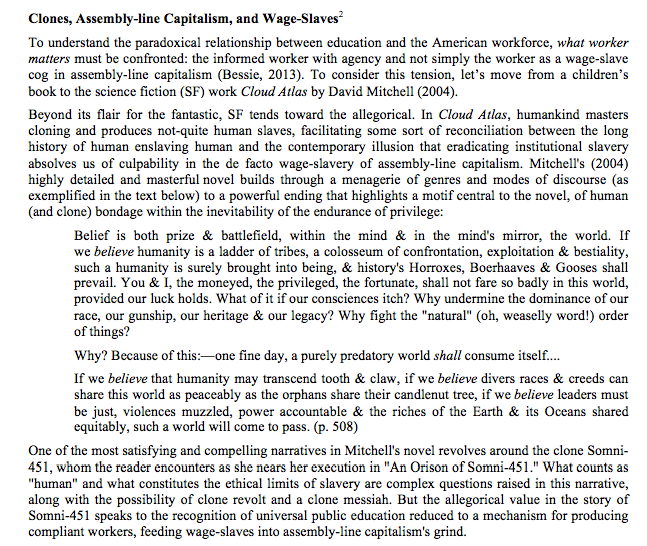
wage slaves

(from Academia and the American Worker: Right to Work in an Era of Disaster Capitalism?)

Another brilliant, but ignored, science fiction examination of our slavery to time is Andrew Niccol’s In Time (2011), a powerful confrontation of how capitalism turns most people frantic so that a few can live in luxury.

When science fiction is set in the future relative to the publication or release of the original work, rarely is the work intended to be predictive—but often, the work is intended to tell us important things about the human condition and any now by taking us to places that seem unlike our now.

Roy as an enlightened android—more enlightened than the humans who created him to be a slave—ends his haunting monologue with “Time to die.”

I think this is intended so that we seek ways to live better, freer.


Enjoy the four-disc collector’s edition of Blade Runner.

Do Androids Dream of Electric Sheep? also is available as a graphic novel series.

From Crenshaw to Hartsville: Race, Poverty, and Education Reform

In order to avoid the existential hell known as I-85 where morning commuters creep along bug-like in a daily Kafkan nightmare, I take winding backroads through the Upstate of South Carolina to my university.

Recently, I noticed a real estate sign advertising a new neighborhood with an added bright yellow sign above signaling, “RIVERSIDE SCHOOLS.”

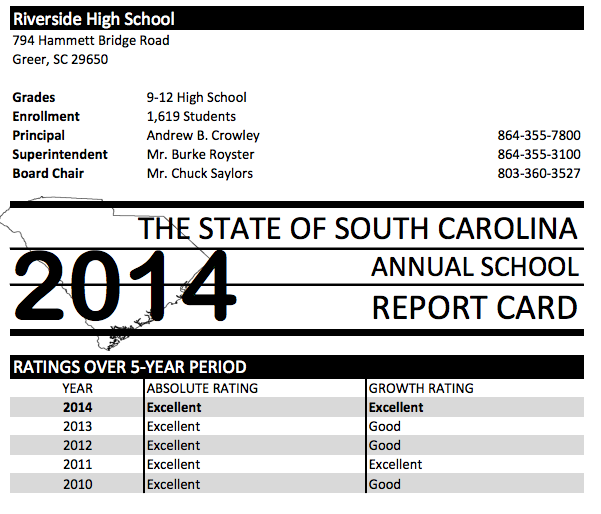
Children in this housing development will attend, eventually, Riverside High, which is ranked 13th lowest of 237 SC high schools in the 2014 Poverty Index, has Excellent/Excellent ratings on the 2014 SC report card, and tests only 51/341 students on subsidized meals and 25/341 with limited English proficiency:
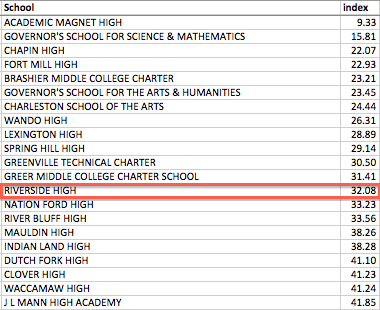
Riverside HS PI 2014

Riverside HS 2014 report card 1Among four other comparable high schools in the state, they all are rated Excellent:

Riverside HS schools like ours 2014Having placed student teachers at Riverside High, and knowing faculty there, I can attest that this is a wonderful school, and students are both supported and challenged.

The real estate sign struck me especially since I had viewed two new educational documentaries: Crenshaw, a film by activist Lena Jackson on the Los Angeles school, and 180 Days: Hartsville, focusing on two schools—Thornwell School for the Arts and West Hartsville Elementary School—along the infamous I-95 Corridor of Shame in my home state of SC.

While nearly 2500 miles apart and politically/culturally worlds apart, Los Angeles and Hartsville reflect powerful narratives about the intersections of race, poverty, and education reform. As well, they offer nuance to those intersections since Creshaw High is high-poverty, majority-minority in an urban setting while Hartsville’s elementary schools are high-poverty, majority-minorty in the rural South.

Before discussing each documentary separately, let me highlight what they share as entry points into reconsidering race, poverty, and education reform:

  • Public schools both serve and reflect the communities within which they sit.
  • Race and poverty significantly impact academic achievement, and thus, when schools, teachers, and students are labeled, ranked, and judged by test scores, high-poverty and majority-minority schools are disproportionately identified as “failing.”
  • Political leadership often expresses support for education and public schools, but implements policies that appear tone deaf to the communities they represent.
  • Education reform advocates ignore the failure of popular policies.
  • Demands of effort and not embracing excuses dominate political and educational rhetoric (despite ample evidence that effort is trumped by racism/classism).
  • Parents, students, and teachers are often passionate about education, regardless of economic status or race.

Crenshaw: Disenfranchising through Take Over Strategies

Crenshaw is, as David B. Cohen explains, a “cautionary tale” about school take overs narrowly and education reform built on accountability broadly.

Jackson does a wonderful job in 20 minutes introducing viewers to the students, parents, and teachers whose lives and learning/teaching are dramatically disrupted by converting Crenshaw High into a magnet school as part of a take over plan.

This film is an excellent introduction to how so-called good intentions of political education reform is not only insufficient, but also harmful.

The take over of Crenshaw disenfranchises the students, parents, and teachers highlighted in the documentary and exposes that political leadership (school board and Superintendent John Deasy) often fails to be culturally sensitive or appropriately responsive to the needs of the people they serve.

Ultimately, as in New Orleans, Crenshaw and the take over represent a failure to identify the sources of entrenched problems, to listen to the people whose lives are being impacted by policy, and to be open to alternative views of both problems and solutions.

Crenshaw High is now and has been for decades a reflection of deep and serious social inequity fueled by racism, classism, and an unresponsive political establishment.

Changing a school’s name, firing the adults who have dedicated their lives to students, and ignoring the parents of those students—these appear to be the worst possible actions available, and regretfully, what more and more political leaders seem determined to do.

Hartsville: It’s All about the Tests (I Mean, Children)

As a life-long resident of and career-long educator in SC, I have lived and witnessed the historical and lingering racism and poverty that scar our state and our schools.

In my education foundations and educational documentary courses, I show Corridor of Shame, and we examine issues related to pockets of poverty across SC and school funding.

I also highlight how problematic Corridor is as a documentary since it depends on maudlin music and slow-motion shots of children looking forlorn. The inequity along I-95 in SC needs no emotional appeal; the conditions are inexcusable, and any reasonable person can see that.

In that context, I was nervous about 180 Days: Hartsville—although I do trust and respect co-producer Sam Chaltain and feel that the documentary does offer a much more complex portrayal of education reform, race, and poverty in SC than Corridor.

Broadly, depending on how audiences interpret the narratives of the film, 180 Days: Hartsville challenges the effectiveness of accountability-based reform that focuses on in-school policies only.

That “depending,” however, is huge.

Yes, the two schools and the central family highlighted are wonderful and accurate representations of the huge challenges of public schools in a high-poverty community.

I find the educators, parents, and students extremely compelling and genuine—a tribute to the care taken with the film.

There are also moments that need to be paused, digested carefully: the burdens of working minimum-wage jobs, the pressures of being a child living in poverty and trying to succeed in school, the passion and compassion of educators, and the determination of a parent working two jobs and raising two children alone.

Statistics flashed on the screen and audio/video snippets of political rhetoric against cuts to education funding—these also demand greater critical consideration.

But I am left deeply concerned that too many viewers will not respond as I did to the relentless influence of testing the film captures throughout—because the film is also punctuated with adults expressing a “no excuses” mentality, again with the best intentions.

These educators are supportive and positive, but those qualities cannot temper the weight of testing that has become the end-all, be-all of public schooling—especially for our high-poverty, majority-minority schools.

Viewers watch a highly dedicated principal at Thornwell School for the Arts giving pep talks to entire grade levels of students as well as students preparing to take MAP tests, computerized commercial programs that give detailed and nearly immediate feedback and claim to be strongly correlated with high-stakes state testing.

Viewers also watch as students’ names are moved on a board in front of those students so that each child is listed under her/his status according to the tests.

The money and time spent on MAP and the public labeling of students—not to mention, Where are the arts?—should prompt us all to end the madness that is high-stakes accountability. But, again, I fear many viewers found the story compelling because the educators and students were working so hard, and are characterized as being uniquely successful.

And it is at that last point we must pause.

First, schools that are outliers are not evidence of any need for policy, or for any standard by which to judge all schools. Outliers are outliers for a reason.

But, as well, consider Thornwell School for the Arts 2014 school report card:

Thornwell 2014 report card

And how does Thornwell School for the Arts look against comparable schools across SC?:

Thornwell schools like ours 2014

While the film suggests nearly “miracle” outcomes, the school, in fact, continues to struggle under the burdens of poverty and race; as the classifications above show, the school is typical of schools with similar students.

The film highlights only one of the two ways in which SC evaluates schools—the annual state report card that has been in use for most of SC’s decades of accountability and the federal accountability report (in 2014, Thornwell School for the Arts received a B/86.7 and West Hartsville Elementary, a B/81.1).

Without context, and careful analysis of what data are being portrayed along with why and how (former Superintendent Mick Zais [R] manipulated the federal accountability reports in order to criss-cross the state to “prove” poverty doesn’t matter, for example), viewers are apt to fall under the impression that schools struggling against poverty just need to demand more from educators and children.

However, for me, the key scene is when the principal at West Hartsville Elementary must confront the tremendously complex issues surrounding Rashon, ones that are often outside the ability of the school or even his mother to control.

180 Days: Hartsville is a story of place. It is, like Crenshaw, a cautionary tale, but I suspect one easily misinterpreted.

I think the intent behind this film is to offer Hartsville as a model for education reform addressing race and poverty because the efforts of the educators and students are remarkable and community business has committed to addressing the complex elements of poverty in the area and schools.

However, the film actually reveals that accountability has failed SC and the entire U.S.

How?

The relentless and dehumanizing focus on data—as if people are somehow not involved.

Ultimately what connects Crenshaw in Los Angeles to two elementary schools in SC is this mostly ignored fact: political rhetoric and tone-deaf education policy are not curative but part of the disease.

Once again, there are no miracles—but there are very real and very harmful consequences to demanding the impossible from schools, educators, parents, and children who are ultimately the victims of the racism and poverty political leaders refuse to acknowledge or erase.

For Additional Reading

What If Education Reform Got It All Wrong in the First Place?, Bill Raden

If there is a lesson in evidence-based research for California policymakers, say Orfield and Gandara, it is that there are limitations to what even the most inspired teachers alone can achieve in a society plagued with inequities.

“I studied a really rich district in Massachusetts,” Orfield noted, “and the kids from the housing projects in the city were just hugely behind when they arrived at school. The schools actually made as much progress each year as the [wealthier] kids did, but the gap never closed at all. So the schools were doing their job, but society wasn’t.”

“I always say, if money doesn’t matter, then why is it that people who have money send their kids to schools that have many, many more resources?” Gandara adds. “I think fundamentally the problem is that other developed nations have social systems that support families and children in a variety of ways: with childcare, with good health care, with recreational opportunities—with lots of things that support healthy development. We have dumped it all on the schools and said, ‘We’re really not going to provide any of these services. You deal with it, schools.’”

No Child Left Behind fails to work ‘miracles,’ spurs cheating

Conservative Talking Points Wrong for SC Education

South Carolina and Education Reform: A Reader

2014 NCUEA Fall Conference: Thirty Years of Accountability Deserves an F

Unpacking Education and Teacher Impact

Disaster Capitalism and Charter Schools: Revisiting New Orleans Post-Katrina

Endgame: Disaster Capitalism, New Orleans, and the Charter Scam

NPR Whitewashes Charter Schools and Disaster Capitalism in New Orleans

The State (Columbia, SC): Hartsville documentary reminds us of failures of SC education ‘reform’ efforts

[UPDATED] Disaster Capitalism (almost) Comes to Little Rock

UPDATE: BREAKING: School privatization bill pulled for this session

***

The next phase in education reform appears to be take over legislation and policy (in other words, disaster capitalism).

Next in the bull’s eye is Little Rock, Arkansas:

The problem is that take over strategies have been destructive, not helpful—as I have detailed:

Finally, Nelsen builds to the most troubling conservative option: closing, as Nelsen’s curious word choice identifies, “[p]oor schools” and adopting state take-over practices such as the Tennessee Achievement School District (ASD). Setting aside that Nelsen is associating state government take-over as conservative while opening with a nod toward “small government,” endorsing the ASD is deeply flawed. Nelsen claims inaccurately: “The results in Tennessee are impressive so far. Students have posted double-digit gains in math, science and literacy — outpacing improvements in other public schools”—when actually, like charter schools in general, the ASD has not performed much different than public schools, according to a 2014 analysis:

“My analysis suggests that ASD schools aren’t doing significantly better in terms of student growth than they were before state takeover. In fact, in many cases the schools’ pre-takeover growth outperformed the ASD. These findings have significant implications for the future of the ASD, how we should move forward with continued takeovers, and for future turn-around efforts in general.”

From Tennessee to New Orleans to Los Angeles, claims of successful take-over strategies have been discredited, but those take-overs have resulted mostly in disenfranchised children and communities while providing political capital for advocates.

For Further Reading

NPR Whitewashes Charter Schools and Disaster Capitalism in New Orleans

Endgame: Disaster Capitalism, New Orleans, and the Charter Scam

Disaster Capitalism and Charter Schools: Revisiting New Orleans Post-Katrina

Post-Katrina New Orleans: Disatser Capitalism Feeds on Poverty and Racism

Recommended: Educational Documentaries

Little Rock Central: 50 Years Later

These documentaries often soar because of the people allowed to speak for themselves. This excellent HBO film opens with Minnijean Brown Trickey returning to Little Rock Central High, and then it never fails to deliver throughout. I would rate this a must-see among the selections in this course. The film confronts Brown v. Board, separate and unequal, schools within schools, the return of segregation (especially in the South), and the lingering tensions between the ideal and reality of racial harmony. Related pieces on the rise of the segregated South and education reform in the New Jim Crow Era are recommended. Alexander’s The New Jim Crow is also an excellent connection.

Current Education Reform Perpetuating, Not Curbing, Inequity

Manufactured Austerity, Disaster Capitalism, and Education Reform

aus·ter·i·ty /ôˈsterədē/ noun

  • sternness or severity of manner or attitude.

“he was noted for his austerity and his authoritarianism”

  • extreme plainness and simplicity of style or appearance.

“the room was decorated with a restraint bordering on austerity”

  • conditions characterized by severity, sternness, or asceticism.

plural noun: austerities

“a simple life of prayer and personal austerity”

synonyms: severity, strictness, seriousness, solemnity, gravity; frugality, thrift, economy, asceticism; self-discipline, abstinence, sobriety, restraint, chastity; starkness

#

In the second half of AMC’s The Walking Dead Season 5, the main characters and viewers discover Alexandria, introducing into the dystopian landscape a utopian [1] possibility.

This new setting raises, as Erik Kain explains, a different set of dangers, expressed openly by several characters: “The first danger will be the invitation of a warm bed and a warmer meal. Rick, Carol, Daryl, Michonne, Glenn and the rest all risk becoming as soft and weak and fat as their new hosts.”

Rick and his crew, then, are determined to remain vigilant against the creeping allure of becoming soft—having spent years now hardening themselves against the Social Darwinism of the zombie apocalypse.

In this dystopia, zombies are pervasive, and the possibility of any return to so-called normalcy appears gone. Rick, Carol, and Daryl, at least, seem certain that the relief of Alexandria is short-lived, if not entirely illusion.

#

Other than being key elements in education reform over the last 10-30 years, what do all of the following have in common?:

  • School choice formats: vouchers, tuition tax credits, public school choice, charter schools.
  • “No excuses” ideologies and policies.
  • “Grit” narratives and research.
  • No Child Left Behind, Race to the Top, Opting out of NCLB.
  • Value-added methods (VAM) of teacher evaluation and pay; calls to fire “bad” teachers (such as the bottom 5%, reminiscent of stack ranking).
  • Standards and standardized tests as part of high-stakes accountability.
  • School report cards.
  • Exit exams.
  • 3rd-grade retention based on high-stakes tests.
  • School and district take-over policies such as the RSD in New Orleans and ASD in Tennessee.

A common set of threads run through the accountability era: Assumptions that educational outcomes are the result of low effort by schools, teachers, and students; and thus, the need for incentives, competition, and overall accountability.

So my answer to my question above is that education reform is essentially manufactured austerity, resulting in educators, parents, and students being conditioned—like the main characters in The Walking Dead—to be hard in order to survive a dystopian world (a world that functions like New Orleans in a state of disaster capitalism).

The problem? The dystopia of the zombie apocalypse is fiction, and although humans are never going to achieve utopia, we in the more so-called advanced countries in the world (notably the U.S.) are coming very close to being able (if anyone had the political will) to create a world in which austerity is nearly absent.

That would be a world of community and collaboration, equity and trust—essentially nothing like the dystopias being created in our public school system by education reform.

And let me highlight once again the most disturbing element that represents my generalization: using VAM to evaluate, retain/dismiss, and pay teachers creates a system in which each teacher must seeks ways in which her/his students can beat other children in other teachers’ classroom in order to survive and thrive in the zombie apocalypse of education reform.

#

There is a stark reason zombie narratives are popular in the Western world, cultures in practice dedicated not to democracy and equity, but to Social Darwinism and consumerism—a dog-eat-dog existence that we at least unconsciously recognize in the zombie, the living dead trapped in a constant state of consuming simply to be consuming, not as nourishment.

Manufactured austerity feeds disaster bureaucracy, and as such, education reform is not about reforming education, but feeding disaster bureaucracy, as DeLeuze details:

We are in a generalized crisis in relation to all the environments of enclosure—prison, hospital, factory, school, family….The administrations in charge never cease announcing supposedly necessary reforms: to reform schools….But everyone knows that these institutions are finished….These are the societies of control, which are in the process of replacing the disciplinary societies….In the disciplinary societies one was always starting again (from school to the barracks, from the barracks to the factory), while in the societies of control one is never finished with anything [emphasis added]. (pp. 3, 5)

“[N]ever finished with anything”—like a new set of standards and new high-stakes tests every few years?

For Further Reading

Time as Capital: The Rise of the Frantic Class

Post-apocalyptic Mindset in a Civilized World

Endgame: Disaster Capitalism, New Orleans, and the Charter Scam

Education Accountability as Disaster Bureaucracy

Why Sending Your Child to a Charter School Hurts Other Children

Gates’s Cannibalistic Culture: Coming to a School Near You!

Death to Common Core! Long Live Failed Education Policy!

[1] See Margaret Atwood: the road to Ustopia for an excellent discussion of genre and the intersection of dystopia/utopia. Also, Margaret Atwood on Science Fiction, Dystopias, and Intestinal Parasites.

South Carolina and Education Reform: A Reader

Hartsville, South Carolina sits just north of I-20 and north-west of I-95 about a 30-minute drive from Florence.

Geography matters in SC when discussing education because the state has a long and tarnished history of pockets of poverty and educational inequity now commonly known as the Corridor of Shame [1], a name coined in a documentary addressing that inequity as it correlates with the I-95 corridor running mostly north and south paralleling the SC coast.

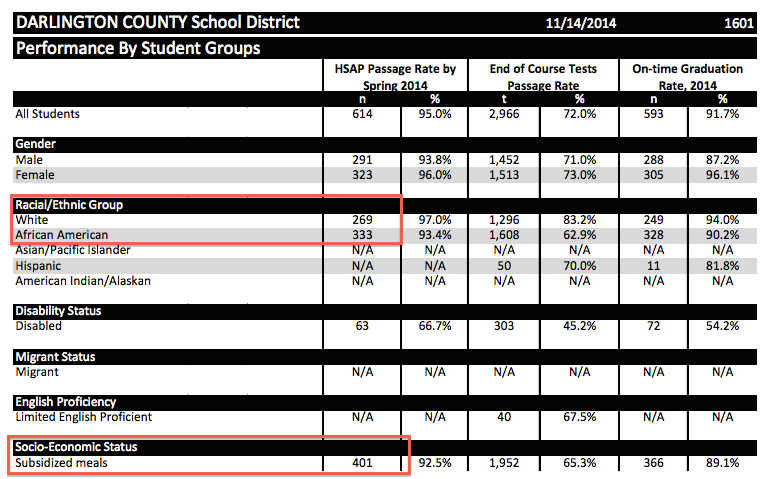
The town’s schools are part of Darlington County School District that serves approximately equal numbers of white and black students, although significantly skewed by poverty as reflected in the district’s 2014 report card detailing tested students:

Darlington 2014

Hartsville is the focus of an upcoming PBS documentary co-produced by Sam Chaltain, who writes about the community:

Take Hartsville. Until recently, no one there had ever asked Thompson or her colleagues what they noticed about their child passengers on the bus, or thought to connect their observations to the behavior teachers might witness in the classroom. Moreover, while Hartsville’s teachers were expected to be knowledgeable about their students’ academic standing, they were not expected to be attuned to their psychological states.

That began to change in 2011, when the community announced a five-year plan to transform its elementary schools. It partnered with Yale University’s School Development Program, which helps schools identify and meet the developmental needs of children. It began to evaluate its schools by a broader set of measurements – including the number of disciplinary referrals a bus driver had to write each morning. And it started to coordinate its social services to ensure a more equitable set of support structures for Hartsville’s poorest families.

This focus on Hartsville specifically and SC more broadly is important for understanding the entire education reform movement in the U.S. for several reasons.

The standards/testing issues in SC are complex (the anti-Common Core movement in SC is mostly ill-informed and falls along libertarian lines, for example) and represent well patterns found across the country during the mostly state-based accountability era (see below).

SC was one of the first accountability states, and we have had about 5-6 sets of standards and new tests over 30-plus years (see below). Throughout those years, almost no one in political leadership has acknowledged SC being in the bottom quartile of poverty in the U.S.—huge pockets of poverty and affluence—is the real educational crisis.

Like New Orleans, I think, SC is a perfect model of all that is wrong with the education reform debate.

I recommend viewing the 180 Days focus on Hartsville through the complicated and often jumbled politics and education reform over the past three decades in SC, much of which I have addressed in the reader offered below, organized by major accountability issues and policies:

Value-Added Methods of Teacher Evaluation:

South Carolina Officially Vamboozled

Review [UPDATED]: “How to Evaluate and Retain Effective Teachers” (League of Women Voters of SC)

SC and Common Core:

South Carolina and Common Core: A Next Step?

Death to Common Core! Long Live Failed Education Policy!

Should SC Ditch Common Core?

SC, Reading Policy, and Grade Retention:

Just Say No to Just Read, Florida, South Carolina

Retain to Impede: When Reading Legislation Fails (Again)

SC and Opt-Out:

SC Parents Warned: “no state provision…to opt-out of state-or district-wide testing”

SC, Oklahoma, and Florida:

GreenvilleOnline: SC should choose Oklahoma, not Florida

SC’s Former Superintendent Zais:

SC’s Zais Mistake

SC and Accountability:

Welcome to SC: A Heaping Stumbling-Bumbling Mess of Ineptitude

SC and Charter Schools:

Should SC Increase Charter School Investment?

Public School, Charter Choice: More Segregation by Design

SC and Exit Exams:

Ending Exit Exams a Start, But Not Enough

SC’s Conservative Leadership:

Conservative Leadership Poor Stewardship of Public Funds

[1] This documentary focuses on a court case in South Carolina initiated by high-poverty school districts surrounding primarily the I-95 corridor of the state, paralleling the east coast and stretching from the NE to the SE region. The documentary suffers from melodramatic production values (music, slow-motion panning of sad children’s faces), but the essential claim of the film is important for confronting the social inequity that is reflected in educational inequity, particularly in the South. Issues included in the film are school funding, community-based schools, access to high-quality educational opportunities and facilities, teacher assignments related to student characteristics, and state education accountability mechanisms. Some related resources (SC school report cards, poverty indices, related blog posts) to the documentary support examining the film in my educational documentary May experience course.

Government Fails When It Fails to Be Government

Let’s start with a little game.

Fill in the blanks:

Government interventions over the past four decades have yielded a cascade of perverse incentives, bureaucratic diktats, and economic pressures that together are forcing [_____] to sacrifice their independent professional [_____] judgment, and their integrity. The consequence is clear: Many [_____] from my generation are exiting the field. … Governments and [_____] administrators hold all the power, while [_____]—and worse still, [_____]—hold none.

Now take a look at the original:

Government interventions over the past four decades have yielded a cascade of perverse incentives, bureaucratic diktats, and economic pressures that together are forcing doctors to sacrifice their independent professional medical judgment, and their integrity. The consequence is clear: Many doctors from my generation are exiting the field. Others are seeing their private practices threatened with bankruptcy, or are giving up their autonomy for the life of a shift-working hospital employee. Governments and hospital administrators hold all the power, while doctors—and worse still, patients—hold none.

I am a 30-plus-year educator, therefore, this paragraph jumped out at me since many of my professional complaints match this almost perfectly, leading to my version:

Government interventions over the past four decades have yielded a cascade of perverse incentives, bureaucratic diktats, and economic pressures that together are forcing [teachers] to sacrifice their independent professional [education] judgment, and their integrity. The consequence is clear: Many [teachers] from my generation are exiting the field. … Governments and [school] administrators hold all the power, while [teachers]—and worse still, [students]—hold none.

But there is an irony to all this: The paragraph is in a piece at The Cato Institute and the doctor penning the complaint cites Ayn Rand toward the end; thus, it is intended to be a slam against Big Bad Guv’ment.

The flaw is that in the piece itself, the real problem is not government, but that government fails to be government—”perverse incentives, bureaucratic diktats, and economic pressures.”

In the U.S., we have a quasi-Libertarian but mostly flawed idealism toward wealth, capitalism, and the misleading free market that has twisted “government” to mean something akin to totalitarianism (in the 12-year-old sort of way Rand fumbles in her garbled attempt at fiction writing and populist philosophy).

As a stark comparison facing us now, police are meant to protect and serve, but when a policeman shoots and kills a 12-year-old or a policeman strangles to death an unarmed man selling cigarettes, we do not have evidence that justice is a flawed pursuit, but that the current system fails justice.

Government as a hand of the market and government as bureaucracy—that dynamic is crippling medicine and education in the U.S. However, the reality is that government in the U.S. is mostly a servant of the rich and powerful, and not a mechanism of the public good—the potential purpose of democratic government because we are the government, not some dictatorial tyrant.

Public funding should be a pooling of resources by a people in order to insure the life, liberty, and pursuit of happiness of each individual; it is not a competition between society and each individual (the Romanticism of Emerson and Thoreau) but a symbiotic relationship between the two (John Dewey): by contributing to the public good, I also contribute to my own individual liberty.

The free market (“perverse incentives,” “economic pressures”) and bureaucracy (“bureaucratic diktats”) have never and will never achieve equity. The market creates inequity, and bureaucracy paralyses most everything, notably the pursuit of equity.

Government rightly functioning would insure that experts (such as doctors and teachers) who serve the public good are free to practice that expertise—not bound to the whims of the market, not fettered by bureaucratic mandates.

Publicly funded must precede (not supplant) all other commitments of a free people—public education, universal health care, highway system, just legal system, etc. Demonizing government (we the people), idealizing the market—both are insuring that the U.S. will never achieve equity, never reach the promise of democracy and freedom.

Government fails when it fails to be government, and people governed fail that government when they fail to understand that government is their collective will.

Testing the Education Market, Cashing In, and Failing Social Justice Again

On Black Friday 2014—when the U.S. officially begins the Christmas holiday season, revealing that we mostly worship consumerism (all else is mere decoration)—we are poised to be distracted once again from those things that really matter. Shopping feeding frenzies will allow Ferguson and Tamir Rice to fade away for the privileged—while those most directly impacted by racism and classism, poverty and austerity remain trapped in those realities.

History is proof that these failures have lingered, and that they fade. Listen to James Baldwin. Listen to Martin Luther King Jr.

But in the narrower education reform debate, we have also allowed ourselves to be distracted, mostly by the Common Core debate itself. As I have stated more times that I care to note, that Common Core advocates have sustained the debate is both a waste of our precious time and proof that Common Core has won.

As well, we are misguided whenever we argue that Common Core uniquely is the problem—instead of recognizing that Common Core is but a current form of a continual failure in education, accountability built on standards and high-stakes testing.

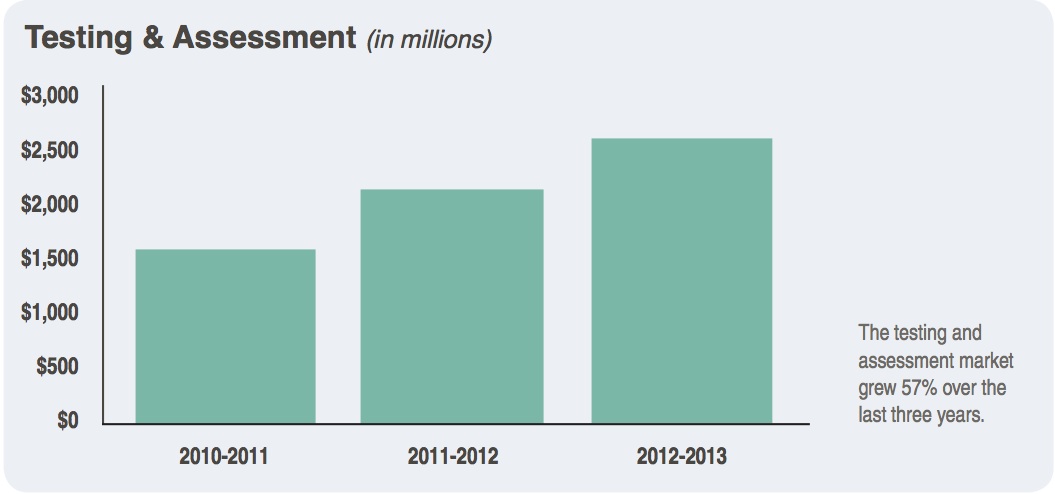
With the release of Behind the Data: Testing and Assessment—A PreK-12 U.S. Education Technology Market Report*, we have yet another opportunity to confront that Common Core is the problem, not the solution, because it is the source of a powerful drain on public resources in education that are not now invested in conditions related to racial and class inequity in our public schools.

Richards and Stebbins (2014) explain:

The PreK-12 testing and assessment market segment has experienced remarkable growth over the last several years. This growth has occurred in difficult economic times during an overall PreK-12 budget and spending decline….

Participants almost universally identified four key factors affecting the recent growth of the digital testing and assessment market segment:

1) The Common Core State Standards are Changing Curricula

2) The Rollout of Common Core Assessments are Galvanizing Activity….

(Executive Summary, pp. 1, 2)

testing and assessment 57 percent
(Richards & Stebbins 2014).

So as I have argued before, Common Core advocacy is market-driven, benefiting those invested in its adoption. But we must also acknowledge that that market success is at the expense of the very students who most need our public schools.

And there is the problem—not the end of cursive, not how we teach math, not whether the standards are age-appropriate.

Common Core is a continuation of failing social justice, draining public resources from needed actions that confront directly the inexcusable inequities of our schools, inequities often reflecting the tragic inequities of our society:

As the absence or presence of rigorous or national standards says nothing about equity, educational quality, or the provision of adequate educational services, there is no reason to expect CCSS or any other standards initiative to be an effective educational reform by itself. (Mathis, 2012, 2 of 5)

Who will be held accountable for the cost of feeding the education market while starving our marginalized children’s hope?

Reference

Richards, J., & Stebbins, L. (2014). Behind the Data: Testing and Assessment—A PreK-12 U.S. Education Technology Market Report. Washington, D.C.: Software & Information Industry Association.

* Thanks to Schools Matter for posting, and thus, drawing my attention to the study.