Category Archives: Disaster capitalism

Post-Katrina New Orleans: Disatser Capitalism Feeds on Poverty and Racism

Drawing from her Hope Against Hope, Sarah Carr asks, Can school reform hurt communities?—focusing on New Orleans:

New Orleans may be the extreme test case, but reforms like these are reshaping public education across the country. The movement is rooted in the notion that “fixing” schools is the strongest lever for lifting communities out of poverty. The criminal justice and health care systems may be broken, living-wage jobs in short supply, and families forced to live in unstable or unsafe conditions. But the buck supposedly stops in the classroom. Thus teachers can find themselves charged with remedying an impossibly broad set of challenges that go far beyond reading at grade level.

Post-Katrina New Orleans represents a crucible for both disaster capitalism and the neoliberal (privatization) agenda driving education reform. After the hurricane devastated New Orleans, the city was swept clean of its teacher workforce (overwhelmingly African Americans constituting a significant percentage of the black middle class), its public schools, and its teachers union so that Paul Vallas could rebuild the school system with charter schools and Teach for American recruits, inexperienced and uncertified teachers who are often white, affluent, and transplants to New Orleans from all across the US. Carr highlights the tensions in this human-made flood of the city:

But most explanations have focused on the radical overhaul of the city’s education system: the expansion of independent charter schools (which more than 80 percent of New Orleans public school children now attend); a greater reliance on alternative teacher training programs like Teach for America; and the increased use of test scores to determine whether educators should keep their jobs and schools should stay open….

This mentality has attracted ambitious, talented young teachers from across the country. But it has also risked turning teaching into a missionary pursuit. At a few of the charter schools I have reported on over the last six years, less than 10 percent of the teachers came from New Orleans or were older than 35. “I think a lot of people who come to New Orleans want to change New Orleanians,” said Mary Laurie, a veteran school administrator and principal of O. Perry Walker High School….

This disconnect can manifest itself in ways both small (as when a teacher fails to recognize a popular New Orleans term, like “beaucoup” for “a lot”) and large (as when a teacher can’t grasp what students are going through at home).

Yet, while New Orleans has become a feast for disaster capitalism (see Archer and Bessie’s graphic journalism here, here, and here), political and public concern for the city and for the greater assault on public education, children and families living in poverty, and teachers remains essentially absent.

In her critical analysis of education reform in New Orleans, Kristen Buras concludes: “Critical research and ongoing activism in multiple spaces are crucial. What is currently happening in New Orleans is not socially conscious capitalism. It is simply unconscionable” (p. 324).

That New Orleans, public schools across the US, teachers, teachers unions, and families in poverty remain under assault while political leadership, advocacy representatives, and the public remain focused on baseless calls for Common Core and next generation testing as well as equally baseless attacks of teacher education exposes some harsh realities about the US: profit and the privilege of wealth matter, but workers, children, and the impoverished do not.

There is simply no other lesson one can draw from New Orleans today.

“Eager to Recreate the Same Old Nightmare”: Revisiting Vonnegut’s Player Piano

Few people could have imagined the acceleration of corporate influence that has occurred in the last two years despite the economic downturn associated with those corporations and the election of Barak Obama, who was repeatedly demonized as a socialist. *

More shocking, possibly, has been the corporate influence on the public discourse about universal public education, driven by Secretary of Education Arne Duncan and promoted through celebrity tours by billionaire Bill Gates, ex-chancellor Michelle Rhee, and “Superman” Geoffrey Canada.

Adam Bessie has speculated about the logical progression of the current accountability era built on tests and destined to hold teachers accountable for their students’ test scores (despite the evidence that teachers account for only about 10-20% of achievement)—hologram teachers. And Krashen believes that the corporate takeover of schools is at the center of the new reformers’ misinformation tour. For Anthony Cody, the future is a disturbing dystopia.

While Bessie’s, Krashen’s, and Cody’s commentaries may sound like alarmist stances–possibly even the stuff of fiction—I believe we all should have been seeing this coming for decades.

The science fiction (SF) genre has always been one of my favorites, and within that genre, I am particularly found of dystopian fiction, such as Margaret Atwood’s brilliant The Handmaid’s TaleOryx and Crake, and The Year of the Flood. Like Atwood, Kurt Vonnegut spoke and wrote often about rejecting the SF label for his work (See Chapter 1 of Wampeters, Foma & Granfalloons), but Vonnegut’s genius includes his gift for delivering social commentary and satire wrapped in narratives that seemed to be set in the future, seemed to be a distorted world that we could never possibly experience.

In 1952, Kurt Vonnegut published Player Piano, offering what most believed was a biting satire of corporate American from his own experience working at GE. A review of the novel describes Vonnegut’s vision of our brave new world:

The important difference lies in the fact that Mr. Vonnegut’s oligarchs are not capitalists but engineers. In the future as he envisages it, the machines have completed their triumph, dispossessing not only the manual laborers but the white collar workers as well. Consequently the carefully selected, highly trained individuals who design and control the machines are the only people who have anything to do. Other people, the great majority, can either go into the Reconstruction and Reclamation Corps, which is devoted to boondoggling, or join the army, which has no real function in a machine-dominated world-society.

Yes, in Vonnegut’s dystopia, computers are at the center of a society run itself like a machine, with everyone labeled with his or her IQ and designated for what career he or she can pursue (although we should note that women’s roles were even more constrained than men’s, reflecting the mid-twentieth century sexism in the U.S.). Where corporations end and the government begins is difficult in this society that is simply a slightly exaggerated of the life Vonnegut had witnessed while working at GE before abandoning corporate America to be a full-time writer.

For me, however, Vonnegut’s Player Piano is as much a warning about the role of testing and labeling people in our education system as it is a red flag about the dangers of the oligarchy that we have become.

Today, with billionaire Bill Gates speaking for not only corporate America but also for reforming public education, how far off was Vonnegut’s vision?

In the first decade of the twenty-first century, how different is Vonnegut’s world to what we have today, as income inequity and the pooling of wealth accelerates?

We have witnessed where political loyalty lies during the bailouts as corporate America collapsed at the end of George W. Bush’s presidency. With corporate America saved, and most Americans ignored, the next logical step is to transform public education by increasing the corporate model that has been crippling the system since the misinformation out of Ronald Reagan’s presidency grabbed headlines with the release of A Nation at Risk.

If Vonnegut had written this storyline, at least we could have been guaranteed some laughter. But this brave new world of public education is more grim—like George Orwell’s 1984.

Our artists can see and understand when many of the rest of us are simply overwhelmed by our lives. In Player Piano, we see how successfully corporate life disorients and overwhelms workers in order to keep those workers under control. And in the relationship between the main character Paul and his wife Anita, we watch the power of corporate life—and the weight of testing and reducing humans to numbers—being magnified by the rise of computers when Paul makes a plea to his wife:

“No, no. You’ve got something the tests and machines will never be able to measure: you’re artistic. That’s one of the tragedies of our times, that no machine has ever been built that can recognize that quality, appreciate it, foster it, sympathize with it.” (p. 178)

In the novel, Paul’s quest and the momentary rise of a few rebels appear to be no match for corporate control. Today, I have to say I am no more optimistic than Vonnegut.

When Secretary Duncan offers misleading claims about international test scores and bemoans the state of public schools for failing to provide us with a world-class workforce, and almost no one raises a voice in protest (except those of us within the field of education, only to be demonized for protesting), I am tempted to think that we are simply getting what we deserve—like Paul at the end of Player Piano: “And that left Paul. ‘To a better world,’ he started to say, but he cut the toast short, thinking of the people of Ilium, already eager to recreate the same old nightmare” (p. 340).

* Slightly revised reposting from OpEdNews (1/3/2011)

See Also

Engineers Own The Future, And Maybe Even Us, Jamie Condliffe


“We Are Entering the Age of Infinite Examination”

In 2011, Jim Taylor entered the poverty and education debate, asking U.S. Secretary of Education Arne Duncan and billionaire/education entrepreneur Bill Gates a direct question*:

I really don’t understand you two, the U.S. Secretary of Education and the world’s second richest man and noted philanthropist. How can you possibly say that public education can be reformed without eliminating poverty?

Taylor’s discussion comes to an important element in the debate when he addresses Gates: “Because without understanding the causes of problems, we can’t find solutions,” explains Taylor, adding. “You’re obviously trying to solve public education’s version of the classic ‘chicken or egg’ conundrum.”

Here, recognizing the education/poverty debate as a chick-or-egg problem is the crux of how this debate is missing the most important questions about poverty—and as a result, insuring that Duncan, Gates, Michelle Rhee, Paul Vallas, and other corporate reformers are winning the argument by perpetuating the argument.

The essential questions about poverty and education should not focus on whether we should address poverty to improve education (where I stand, based on the evidence and the words of Martin Luther King, Jr.) or whether we should reform education as the sole mechanism to alleviate poverty (the tenant of the “no excuses” ideology found at Knowledge Is Power Program [KIPP] charters); the essential question about poverty is: Who creates and allows poverty to exist in the wealthiest and most powerful country in recorded history?

The Conservative Nature of Power

As a basic point of logic, any organized entity—a society, a business, a school—has characteristics that are either created or tolerated by those in power controlling that organization. All entities are by their nature conservative—functioning to maintain the entity itself. In other words, institutions and their norms resist change, particularly radical change that threatens the hierarchy of power.

In the U.S., then, poverty exists in the wider society and performs a corrosive influence in the education system (among all of our social institutions, our Commons) because the ruling elite—political and corporate leaders—need poverty to maintain their elite status at the top of the hierarchy of power.

While the perpetual narratives promoted by the political and corporate elite through the media elite have allowed this point of logic to be masked and ignored in American society, we must face the reality that people with power drive the realities of those without power. Yes, the cultural narratives driven by the elite suggest that people trapped in poverty are somehow in control of that poverty—either creating it themselves due to their own sloth, that they somehow deserve their station in life, or failing to rise above that poverty (and this suggestion allows the source of poverty to be ignored) from their own failure to lift themselves up by their own bootstraps.

But that narrative has no basis in evidence—since those without power have control of that which creates the conditions benefiting the elite. The powerful allow those without power to have some token or artificial autonomy—as parents with children—in order to create the illusion of autonomy to keep revolt at bay; this is why the political and corporate elite use the word “choice” and perpetuate the myth that all classes in America have the same access to choice.

Poverty as Necessary for Current Hierarchies of Power

How does poverty benefit the powerful in the U.S.?

  • U.S. cultural narratives depend on the Utopian elements of democracy, meritocracy, and individual freedom. Those ideals form the basis for most of the cultural narratives expressed by the political and corporate elite in the U.S. Poverty works as the Other in those narratives—that which we must all reject, that which we must strive to avoid. If the Utopian goals, including eliminating poverty, is ever achieved, however, the tension between the working-/middle- class and those in poverty would be eliminated as well, exposing the artificial perch upon which the ruling elite sit. The necessity of poverty works both to keep us from attaining the Utopian goals and to make the Utopian goals attractive.
  • Poverty contributes to the crisis motif that keeps the majority of any society distracted from the minority elite benefiting disproportionately from the labor of the majority. Crises large and small—from Nazis, Communists, and Terrorists to the War on Drugs to teen pregnancy to the achievement gap and the drop-out crisis—create the perception that the average person cannot possibly keep these crises under control (crises that would plunge otherwise decent people into the abyss of poverty) and, thus, needs the leadership and protection of the elite. The majority of average people can only be carried to the promised land of Utopian peace and equality by the sheer force of personality held by only a few; these ruling elite are the only defense against the perpetual crises threatening the ideals we hold sacred (see below for how we identify those elite).
  • Along with Utopian promises and the refrain of crisis, the ruling elite need the pervasive atmosphere of fear—whether real or fabricated—in order to occupy the time and energy of the majority. [1] Poverty becomes not just a condition to be feared, but also those people to be feared. The cultural narratives—in contrast to the evidence—about poverty and people living in poverty connect poverty and crime, poverty and drug abuse, poverty and domestic violence, poverty and unattractiveness, and most of all, poverty and the failure of the individual to grasp the golden gift of personal freedom afforded by the United States.

Just as we rarely consider the sources of poverty—who controls the conditions of our society—we rarely examine the conditions we are conditioned to associate with poverty and people living in poverty. Are the wealthy without crime? Without drug abuse? Without deceptions of all kinds? Of course not, but the consequences for these behaviors by someone living in privilege are dramatically different than the consequences for those trapped in poverty.

The ruling elite have created a culture where we see the consequences of poverty, but mask the realities of privilege.

Winners always believe the rules of the game to be fair, and winners need losers in order to maintain the status of “winner.” The U.S., then, is a democracy only as a masking narrative that maintains the necessary tension among classes—the majority working-/middle-class ever fearful of slipping into poverty, and so consumed by that fear that they are too busy and fearful to consider who controls their lives: “those who are stuck at a machine and supervised for the rest of their lives.” [2]

In the narrow debate about poverty and education, we are being manipulated once again by the ruling elite, within which Duncan and Gates function, to focus on the chicken-and-egg problem of poverty/education so that we fail to examine the ruling elite creating and tolerating poverty for their own benefit. By creating the debate they want, they are winning once again.

And that success derives in large part from their successful propaganda campaign about the value of testing.

The Meritocracy Myth, Science, and the Rise of New Gods

Now that I have argued for shifting the discourse about poverty and education away from the chick-and-egg problem to the role of sustaining and tolerating poverty for the benefit of the ruing elite, let’s look at the central role testing plays in maintaining the status quo of power in the U.S. And let’s build that consideration on a couple pillars of evidence.

First, despite decades committed to the science of objective, valid, and reliable standardized testing, outcomes from standardized tests remain most strongly correlated with the socio-economic status of the students. As well, standardized tests also remain biased instruments.

Next, more recently during the thirty-year accountability era, the overwhelming evidence shows that standards, testing, and accountability do not produce the outcomes that political proponents have claimed.

Thus, just as the poverty/education question should address who creates and allows poverty and why, the current and historical testing obsession should be challenged in terms of who is benefiting from our faith in testing and why.

The history of power, who sits at the top and how power is achieved, is one of creating leverage for the few at the expense of the many. To achieve that, often those at the top have resorted to explicit and wide-scale violence as well as fostering the perception that those at the top have been chosen, often by the gods or God, to lead—power is taken and/or deserved.

“God chose me” and “God told me” remain powerful in many cultures, but in a secular culture with an ambiguous attitude toward violence (keep the streets of certain neighborhoods here crime-free, but war in other countries is freedom fighting) such as the U.S., the ruling elite needed a secular god—thus, the rise of science, objectivity, and testing:

[A] correlative history of the modern soul and of a new power to judge; a genealogy of the present scientifico-legal complex from which the power to punish derives its bases, justifications, and rules; from which it extends it effects and by which it masks its exorbitant singularity. [3]

As I noted above, testing remains a reflection of the inequity gap in society and the high-stakes testing movement has not reformed education or society, so the rising call for even more testing of students, testing based on nationalized standards and used to control teachers, must have a purpose other than the Utopian claims by the political and corporate elite who are most invested in the rising testing-culture in the U.S.

That purpose, as with the necessity of poverty, is to maintain the status quo of a hierarchy of power and to give that hierarchy the appearance of objectivity, of science.

Standards, testing, and accountability are the new gods of the political and corporate elite.

Schools in the U.S. are designed primarily to coerce children to be compliant, to be docile; much of what we say and consider about education is related to discipline—classroom management is often central to teacher preparation and much of what happens during any school day:

The exercise of discipline presupposes a mechanism that coerces by means of observation; an apparatus in which the techniques that make it possible to see induce effects of power in which, conversely, the means of coercion make those on whom they are applied clearly visible. [4]

In education reform, the surveillance of students, and now the surveillance of teachers, is not covert, but in plain view in the form of tests (and even Gates calling for cameras in all classrooms) allowing that surveillance to be disembodied from those students and teachers—and thus appearing to be impersonal—and examined as if objective and a reflection of merit.

Testing as surveillance in order to create compliance is central to maintaining hierarchies of power both within schools (where a premium is placed on docility of students and teachers) and society, where well-trained and compliant voters and workers sustain the positions of those in power:

[T]he art of punishing, in the regime of disciplinary power, is aimed neither at expiation, nor precisely at repression….It differentiates individuals from one another, in terms of the following overall rule: that the rule be made to function as a minimal threshold, as an average to be respected, or as an optimum toward which one must move. It measures in quantitative terms and hierarchizes in terms of value the abilities, the level, the “nature” of individuals….The perpetual penalty that traverses all points and supervises every instant in the disciplinary institution compares, differentiates, hierachizes, homogenizes, excludes. In short, it normalizes. [5]

The political and corporate elite in the U.S. have risen to their status of privilege within the “scientifico-legal complex” that both created that elite and is then perpetuated by that elite. As I noted above, the winners always believe the rules of the game to be fair and will work to maintain the rules that have produced their privilege.

The Expanded Test Culture—“The Age of Infinite Examination”

Foucault has recognized the central place for testing within the power dynamic that produces a hierarchy of authority:

The examination combines the techniques of an observing hierarchy and those of normalizing judgment. It is a normalizing gaze, a surveillance that makes possible to qualify, to classify, and to punish. [6]

Thus, as the rise of corporate paradigms to replace democratic paradigms has occurred in the U.S. over the last century, we can observe a rise in the prominence of testing along with how those tests are used. From the early decades of the twentieth century, testing in the U.S. has gradually increased and expanded in its role for labeling, sorting, and controlling students. In the twenty-first century, testing is now being wedged into a parallel use to control teachers.

Those in power persist in both cases—testing to control students and testing to control teachers—to claim that tests are a mechanism for achieving Utopian goals of democracy, meritocracy, and individual freedom, but in both cases, those claims are masks for implementing tests as the agent of powerful gods (science, objectivity, accountability) to justify the current hierarchy of power—not to change society or education: “[T]he age of the ‘examining’ school marked the beginnings of a pedagogy that functions as science.” [7]

Foucault, in fact, identifies three ways that testing works to reinforce power dynamics, as opposed to providing data for education reform driven by a pursuit of social justice.

First, testing of individual students and using test data to identify individual teacher quality create a focus on the individual that reinforces discipline:

In discipline, it is the subjects who have to be seen. Their visibility assures the hold of the power that is exercised over them. It is the fact of their being constantly seen…that maintains the disciplined individual in his subjection. And the examination is the technique by which power…holds them in a mechanism of objectification. [8]

This use of testing resonated in President Obama’s first term as Secretary Duncan simultaneously criticized the misuse of testing in No Child Left Behind and called for an expansion of testing (more years of a student’s education, more areas of content, and more directly tied to individual teachers), resulting in: “We are entering the age of infinite examination and of compulsory objectification.” [9]

As Giles Deleuze confirms in “Postscript on the Societies of Control”:

We are in a generalized crisis in relation to all the environments of enclosure—prison, hospital, factory, school, family….The administrations in charge never cease announcing supposedly necessary reforms: to reform schools, to reform industries, hospitals, the armed forces, prisons….In disciplinary societies one was always starting again (from school to the barracks, from the barracks to the factory), while in the societies of control one is never finished with anything—the corporation, the educational system, the armed services being metastable states coexisting in one and the same modulation, like a universal system of deformation. (pp. 3-4, 5)

Next, testing has provided a central goal of sustaining the hierarchy of power—“the calculation of gaps between individuals, their distribution in a given ‘population.’” [10] Testing, in effect, does not provide data for addressing the equity/achievement gap, testing has created those gaps, labeled those gaps, and marginalized those below the codified level of standard.

What tends to be ignored in the testing debate is that some people with authority determine what is taught, how that content is taught, what is tested, and how that testing is conducted. In short, all testing is biased and ultimately arbitrary in the context of who has authority.

And finally, once the gaps are created and labeled through the stratifying of students and teachers:

[I]t is the individual as he[/she] may be described, judged, measured, compared with others, in his[/her] very individuality; and it is also the individual who has to be trained or corrected, classified, normalized, excluded, etc. [11]

Poverty and Testing—Tools of the Privileged

Within the perpetual education and education reform debates, the topics of poverty and testing are central themes (poverty is no excuse, and better tests are always being promised), but we too often are missing the key elements that should be addressed in the dynamic that exists between poverty and testing.

Yes, standardized tests remain primarily reflections of social inequity that those tests make possible, labeled as “achievement gaps.”

But the central evidence we should acknowledge is that the increased focus on testing coming from the political and corporate elite is proof that those in privilege are dedicated to maintaining poverty as central to their hierarchy of authority.

Standards, testing, accountability, science, and objectivity are the new gods that the ruling class uses to keep the working-/middle-class in a state of “perpetual anxiety,” fearing the crisis of the moment and the specter of slipping into poverty—realities that insure the momentum of the status quo.

* Reposted and revised/updated from earlier publication at Truthout.

References

[1] Foucault, M. (1984). The Foucault reader. Ed. P. Rabinow. New York: Pantheon Books. See Foucault’s discussion of “perpetual anxiety” (p. 144) in “The Birth of the Asylum” from Madness and Civilization.

[2] Ibid., p. 177.

[3] Ibid., p. 170.

[4] Ibid., p. 189.

[5] Ibid., p. 195.

[6] Ibid., p. 197.

[7] Ibid., p. 198.

[8] Ibid., p. 199.

[9] Ibid., p. 200.

[10] Ibid., p. 202.

[11] Ibid., p. 203.

Consumed by Manufactured Demons: The “-ism’s” that Blind

Science fiction and horror are two genres that often find themselves intersecting where some form of power reduces humans to mere cogs in the machine. Technology, the future, aliens, and the like, it seems, can be terribly frightening.

George Orwell’s Nineteen Eighty-Four stands as one of the most comprehensive and enduring examinations of when that power abuse is in the hands of a totalitarian government. Dystopian SF that explores the dangers of “big government” resonates with the Libertarian thread running through the American public, but SF also aims its detailed satire and allegory at the nuances of just how governments become totalitarian.

Ridley Scotts’ Alien and more recent Prometheus share more than a director and some sort of lineage in their narratives: Both SF films are horrifying tales of oppressive corporations. [Scott’s Blade Runner can be included here are these films also include the dangers of megalomaniacs, especially corporatists and industrialists who use their ill-got billions for something other than the common good.]

While the mid-1950s spawned SF/horror films as thinly disguised propaganda matching the public hysteria about the Red Scare—the immediate and insidious threat of Communism (see Invasion of the Body Snatchers for a tour de force of such)—the Cold War eventually proved that the creeping cancer of Communism wasn’t as powerful as political leadership and pop culture claimed.

What, then, does SF say about more credible fears facing humanity?

In Cat’s Cradle, Kurt Vonnegut (1963) introduces into his fictional world Bokononism, a religion in which its messiah through the sacred text, The Books of Bokonon, confesses: “‘All of the true things I am about to tell you are shameless lies'” (p. 5).

The government of San Lorenzo finds its stability built on a fabricated conflict between General McCabe and the founder of Bokononism, Bokonon:

“‘Well, when it became evident that no governmental or economic reform was going to make the people much less miserable, the religion became the one real instrument of hope. Truth was the enemy of the people, because the truth was so terrible, so Bokonon made it his business to provide the people with better and better lies.'” (p. 172)

The charade driven by McCabe outlawing Bokononism and declaring Bokonon a fugitive continues at the expense of McCabe and Bokonon as men until their manufactured war between the righteous McCabe and renegade holy man Bokonon becomes essential itself:

“‘McCabe was always sane enough to realize that without the holy man to war against, he himself would become meaningless.'” (p. 175)

Cat’s Cradle examines the power of creating a demon for the public in order to keep that public distracted while the privileged remain privileged. Yet, Vonnegut’s often slapstick and always raucous narrative could just as easily be about the U.S. at almost any point in the past century.

What should be feared about the U.S. government and society is better captured, in fact, by Cat’s Cradle, Alien, and Prometheus than Invasion of the Body Snatchers. In other words, Communism and Socialism remain much invoked demons, but the dangers lie somewhere else entirely.

In 2013, two ideologies are intersecting—not unlike SF and horror—the progressive and often liberal education community and the libertarian and populist rightwing commentators and public. The common demon?

Common Core State Standards (CCSS).

While the progressive education community tends to reject CCSS as yet more of the failed accountability, standards, and high-stakes testing paradigm (the insanity of doing the same thing over and over while expecting different results) as well as a distraction from the need to address poverty and inequity, the libertarian/populist rejections of CCSS tend toward a fear of an Orwellian Big Brother or subversive curriculum as pods placed beside the beds of our children; thus, all over Facebook, CCSS are being linked to the Great Evils—Communism and Socialism.

While there is much to be feared about CCSS, that fear need not be grounded on its use to instill communism and/or socialism in America’s youth.

“Communism” and “Socialism” are terms tossed about without much regard for what they mean, but like Bokononism in San Lorenzo, the terms are “ism’s” that blind; they are manufactured demons that allow genuine threats to exist and prosper.

In both Alien and Prometheus, main characters and the audience soon discover that under the guise of science and exploration, the evils of corporate greed—controlling government and its military—are far more horrifying and real than any Red Scare or any form of government, in fact.

Ironically, while I contend we don’t need CCSS, the ability of corporate America to so easily and persistently manipulate the public’s lack of understanding of “-ism’s” seems to beg for a close inspection of just what is being taught in our schools. And if I were going to implement a core curriculum in the U.S., it would include a careful and extensive consideration of some foundational terms:

  • Communism
  • Socialism
  • Capitalism
  • Fascism
  • Oligarchy
  • Indoctrination
  • Consumerism

Condemning CCSS as a government plot to brainwash America’s children with Communism or Socialism ignores some basic points of fact:

  1. Socialists and communists have no power and almost no voice in the U.S.; for at least sixty years, both terms have been used in public discourse to demonize and marginalize (even as both terms are almost always misused in that discourse).
  2. The CCSS were created by and are overwhelming endorsed by the power and corporate elite—who benefit from a consumer culture, not a communist or socialist society.

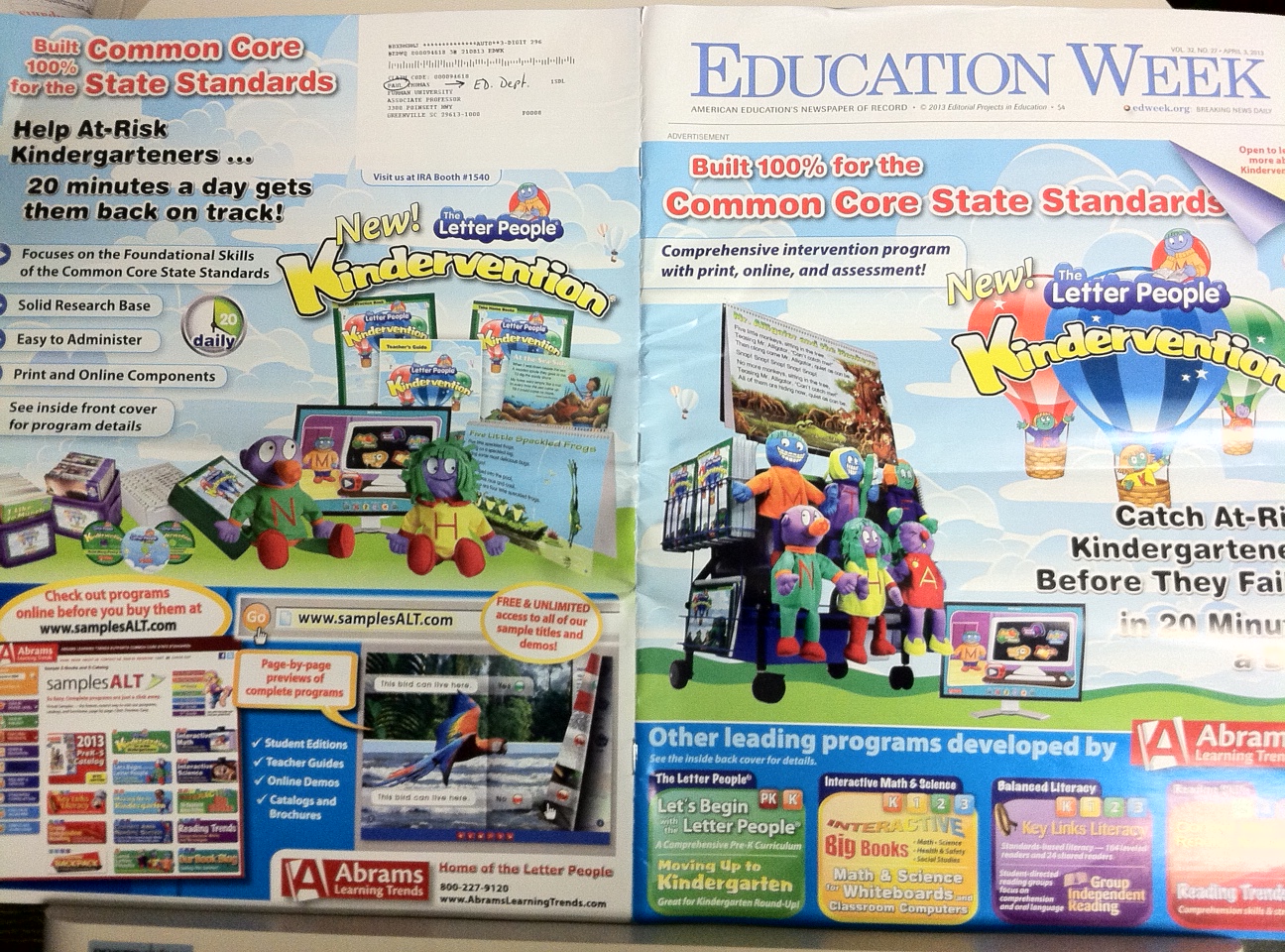
For those who fear the CCSS, I want to remind you once again: Look carefully at this entire cover of Education Week exposing that CCSS is consumerism and commodification—not communism and socialism:

EW.CCSS

The crass commercialism covering a major education publication reads like an infomercial:

“Catch At-Risk Kindergarteners Before They Fail…in 20 Minutes a Day!”

“Help At-Risk Kindergarteners…20 minutes a day gets them back on track!”

But a letter from the company vice president doesn’t inspire much confidence about high standards: “Kindervention is the most unique program in our history…,” it opens.

Most unique? Maybe words that can’t be qualified aren’t in the CCSS.

Ultimately, CCSS are a distraction.

And cries that CCSS are a communist, socialist, or government plot are distractions.

So the odd intersection of progressives and libertarians rejecting the CCSS fails ultimately since the reasons are deeply divided, but there is a reason that we all—every citizen of the U.S. regardless of ideology—should unite against CCSS and most other corporate manipulations of our Commons:

Being consumed by manufactured demons is a self-defeating American tradition that needs to be set aside.

Like the crews in both Alien and Prometheus, Americans are blinded, and often asking the wrong questions (“Why is Common Core not requiring cursive writing instruction?”)—or worse yet, not asking any questions at all about the power of corporate America over the government we fail to see as “we the people.”

Middle-Class Fear: Disaster Capitalism and the Threat of Poverty

Toward the end of HBO’s documentary American Winter, Brandon is finally offered a job after viewers have watched him and his wife Pam struggle against Brandon losing his job, resulting in their being unable to pay their rent and having to live with Pam’s mother.

When Brandon is told he has the job, his new boss notes Brandon is overqualified, but Brandon eagerly explains that he is thankful for the work and committed to do whatever he can to be a good worker—despite the cut in pay and drop in job status not in his plans as a young man and husband seeking the American Dream.

In a May Experience course (a three-week mini-semester after the traditional academic calendar at my university) built on education documentaries and confronting the connection between education and poverty, two of the most powerful films include HBO documentaries—Hard Times at Douglass High and Little Rock Central: 50 Years Later. Just as these works rise above the generally poor examinations of education found among education documentaries, American Winter is another HBO success, a thoughtful and confrontational exploration of poverty against the backdrop of the American Dream as it is being tarnished by disaster capitalism [1].

The scene above with Brandon and a few other aspects of the documentary give me pause, but first, I want to highlight how the film overwhelmingly succeeds.

The place of American Winter is Portland, Oregon, and the  situation, the wake of the 2008 economic downturn that swept across the U.S. and the world. But the single greatest achievement of the film is the focus on eight families (ironically also the most troubling aspect as I will discuss below) who put “people just like us” faces on the consequences of disaster capitalism and force the audience to reconsider stereotypes of people trapped in the clutches of poverty.

The people of these narratives are overwhelmingly white and entirely from the middle and working classes—simultaneously, literally not “people just like us” (considering the increasing racial diversity of the country) but also the characteristics historically associated with the idealized middle class of the American Dream myth. It is both important and problematic that the families in this film are not victims of generational poverty, but real-world models of people who have embraced and achieved, although momentarily, some elements of that American Dream—education, careers, homes or the promise of home ownership, marriage, children, and, not to be ignored in the background throughout the video, an abundance of assorted material possessions that can be found in living rooms, kitchens, and bedrooms across America.

Punctuating these stories are job loss, eviction, homelessness, hunger, sickness, and the frail as well as dwindling safety nets of government, church, and private organizations.

Documentaries, like all forms of nonfiction texts, are never unbiased, and always some political and ideological lens for observing a phenomenon. Too often documentaries are shoddy, careless, and misleading. American Winter wears its ideology on its sleeve, but does so effectively and with a level of integrity that lends it credibility even for those who don’t share its social justice politics.

The families are allowed primarily to speak for themselves, literally and through a patient camera following them as they wilt beneath the weight of joblessness and homelessness—especially when the children speak, cry, and personify the incredible inequity of how burdensome healthcare can be through no fault of those who find themselves sick (for example, Chelsea’s battle with bleeding ulcers leaves her mother Shanon facing $49,000 in medical bills while the family is otherwise destitute).

The film also weaves clear and confrontational statistics throughout the stories of the families. The blunt facts and harsh experiences in this documentary present a different picture than political leaders, the media, and the public tend to embrace and perpetuate: Poverty, joblessness, homelessness, foreclosure, bankruptcy, and seeking out social services are not the consequences of flawed individuals, but the result of systemic inequity in America’s government and economy.

The idealized American Dream may never have been a credible cultural foundation, but American Winter convincingly forces viewers to recognize that democracy and capitalism have been consumed by disaster capitalism. And here are some of the questions the film does raise as well as some of the problems embedded in an otherwise ambitious and even radical project.

“Disaster capitalism” [2] is a term associated with Noami Klein, as she explains:

People spontaneously started using “disaster capitalism” to describe what was happening with what they were seeing around them because it was so clear that this disaster was being harnessed to push through a radical vision of totally unrestricted markets. And Bush didn’t make too much of a secret of it when he announced that his idea of reconstructing the Gulf Coast was to turn it into a tax-free, free-enterprise zone.

What the book is doing that’s new is it is connecting these contemporary capitalisms, which I think most of us can easily see in Iraq and in New Orleans, and saying actually this isn’t just some twisted invention of the Bush White House. That actually there is a history. Every time there has been a major leap forward for this fundamentalist version of capitalism that really doesn’t see a role for the state, the ground has been prepared by some kind of shock.

In American Winter, the disaster is the economic downturn, but in New Orleans, the disaster was natural, Hurricane Katrina. Portland and New Orleans [3] also share a central mechanism of disaster capitalism: A disaster creates the opportunity for a workforce to be erased, the job market then contracts, and a workforce is rebuilt in reduced circumstances for the workers—lower wages, part-time positions instead of full-time employment, an absence of benefits, service positions replacing skill and managerial positions.

The events in Portland and New Orleans are stark examples that the workforce problem in the U.S. is not a lack of skilled and eager workers, but an artificially contracting business model that benefits the 1% with American workers as interchangeable widgets.

While the focus on the plight of the American worker is needed and vivid in American Winter, one consequence of the choice to examine American workers dropping into poverty is that poverty is regrettable and something to be addressed only because it can (and did) happen to the working and middle class—in other words, generational poverty is left at the side of this film and the corrosive myth that generational poverty is the fault of those in poverty remains untouched.

In fact, as the viewers’ sympathy for the eight families increases, it seems entirely likely that people in generational poverty may be viewed even more harshly than before because poverty sits as a middle-class fear in the film. The deficit and demonizing perspectives of poverty are not challenged in the film and may be unintentionally strengthened.

In its purest form, capitalism may be viewed as needing all  citizens having access to some relatively balanced reserve of capital for that consumer market to thrive, but disaster capitalism is a corruption of the distribution of capital, thriving in fact on the threat of poverty as motivation for low-wage, mind-numbing and soul-draining work. Disaster capitalism is hurt less by some having no or little capital than by the absence of poverty, an absence that would lift the necessary threat that maintains a culture of fear and a frantic pace that distracts the 99% while the 1% play.

Many scenes in American Winter haunt me, but few as much as Brandon, reduced and broken, at the end in a scene that likely was intended as one glimmer of light in a truly dark winter for these families.

But Brandon—like many of the children in these families—personifies how disaster capitalism and consumerism have created an existence whereby our humanity is almost entirely anchored to who we are as workers. Our worker self is not a subset of who we are as humans; our worker self is our self.

Ultimately, that is the greatest disaster in disaster capitalism.

[1] Listen to Steve Hargadon interview Adam Bessie and see Bessie/Archer graphic journalism series on disaster capitalism and education reform (G.E.R.M.):

[3] See Sarah Carr’s Hope against Hope, which examines how charter schools replaced the public school system in New Orleans post-Katrina.