On the first day of spring classes, I mentioned to one of my first-year writing seminar classes that I now live just a few minutes from my first college, Spartanburg Methodist College (SMC).
I currently live in a converted mill, one among many empty mills or mills transformed into apartments in the area around SMC, which began as a mill college.
It was in the beautiful rock building, the first-year dorm for young men, on the third floor where I recall vividly writing my first real poem; it was prompted by a combination of having read e.e. cummings in my speech class with Mr. Brannon and watching students throw a Frisbee on the lawn in front of my dorm.
That was spring of 1980, some 46 years ago. I have been a poet and writer since.
At SMC, also, I was invited by a literature professor, Dean Carter, to tutor for the course, and so, there I also discovered that I am a teacher.
Teacher and writer have been wonderful twin avocations for a redneck who grew up in the South, lived through the 1960s and 1970s as a child and teen.
College saved my life, or more specifically, saved my soul.
It is in college where I started becoming a better person. Shedding the racism and other bigotries I was raised in, both my home and my community.
I have not ventured very far physically, but I have traveled a great distance in my mind and my heart.
I recently saw a post on social media asking teacher if students should be allowed to redo assignments. This question has always bothered me since I have spent 42 years grounding my teaching in requiring and allowing students to revise their work.
My courses are structured as workshop environments and the assignments (including the major assignments that are always essays) are designed as teaching/learning experiences and not as assessments.
I have also spent the great majority of my career not grading assignments and not giving tests.
These commitments seek to increase student engagement with learning and to reduce the stress often associated with students completing assignments.
Those goals, however, have remained elusive.
In the last few years, I have begun experimenting with grade contracts to help students better navigate the atypical aspects of my courses and grading approach. Here are some sample contracts:
Of course, I still must assign students grades in the courses, but I continue not to grade the assignments.
Especially in the context of the current renewed cycle of concern about grade inflation, notably in higher education and at selective universities, I have always been confronted with having too many As, or the assumption that students being allowed to revise work increases (inflates?) the likelihood of As.
Critics of revision also argue students will not try when submitting assignments the first time (and thus, I have a strict minimum requirement policy that allows me not to accept inferior or incomplete work).
To be blunt, students earn grades; teachers do not give grades.
Further, if and when my students earn As, I see that as success; when students fail or earn lowers grades, I typically feel as if I have also underachieved.
This past fall, I taught 3 courses with 53 students receiving grades; as you suspect, almost all of them contracted for an A. However, as the semester drew to a close, many students were on the precipice of failing (not meeting the minimum requirements of the course), and as a result, I offered two extensions during the week of exams (the contract specifies that students must meet the grade contract/course minimum requirements by the last day of the course in order to be allowed to submit their final portfolio/exam).
Here is the grade distribution from fall (please note that I teach in a selective university and these students were high achieving in high school):
A = 30
B = 8
C = 13
F = 2
Notable is that the first-year students were outliers in terms of being able to achieve As:
A = 4
B = 1
C = 7
The grades for fall were particularly frustrating for me since I think the most recent iterations of my contracts and assignments are far superior to earlier versions, and since I am in years 42 as a teacher, I do think I am a better teacher.
Here are a few thoughts about grades and contracts as well as how current students are struggling as a result of having been in school during the Covid era.
First, I must stress that not grading assignments and using grade contracts asks more of students, not less. The key is that I have minimum expectations for submitted work and then minimum expectations for the additional work required to meet the A-range.
For example, I had a student submit their major essay in one course without any citations in the essay. I responded that the work could not be accepted and provided support material for resubmitting the work.
That submission, in effect, did not count. Students tend to recognize that making their best effort upfront benefits them. [Note the minimum requirements in this discourse analysis assignment used in two courses.]
In a traditional graded course, the student could have just received an F (and never really engage in the learning experience), had success on the other assignments and tests, and then maybe received a B or C in the course.
What is lost in that traditional scenario is learning.
Requiring and allowing revised work is an individualized teaching/learning process.
Although students often become frustrated by the expectations and my strictness, here is one student’s response to a course this fall (a student who had several submissions not accepted):
I just wanted to reach out and thank you for all of your help and keen attention with my paper. I think I learned more from that assignment than I did in my FYW. But, I know it took a lot of time and effort on the back end and I just wanted to reach out and thank you for all of your edits and feedback! I don’t think I have a paper from my college experience that is so technically detailed and I cannot even begin to express how much I learned when it came to APA. I see it everywhere now and am very grateful for the APA skills this assignment pushed me to gain.
A few semesters ago, a former student from my upper-level writing/research course (see the assignment here) contacted me and thanked me, expressing their frustration during the course but noting that they realized the value then because they were in a doctoral program where the experience was bearing fruit (my course required annotated bibliographies and APA citation).
Using assignments as teaching/learning experiences and not assessments in the context of grade contracts allows me to be more rigorous while also raising expectations for student engagement.
However, Covid-era students have been taught in traditional courses and by traditional grading that any work submitted must receive some credit, and because of the many disruptions to schooling, they have also been taught that their perception of trying hard also deserves credit (in the form of grades).
I believe these dynamics are particularly true for high-achieving students.
Students have directly told me that traditional tests and grades are easier for them to navigate and easier for them to achieve the grades they want (even when they admit that the learning is increased in the expectations I implement).
Frankly, the struggles I witness represent one of the most ignored flaws with education in the US—the tension between grades and learning.
Grading doesn’t reflects well learning and grading often inhibits learning.
My commitment to ungrading, requiring/allowing students to revise, and grade contracts is a commitment to learning (and teaching).
It remains discouraging that this commitment, however, often creates stress and even failure for some students who are the product of grade-centered traditional schooling.
If trending matters on social media, a consensus is building that Bari Weiss has ushered in the death of CBS, a nail in the coffin of mainstream media:
Farewell to CBS News and "60 Minutes." It just went the way of the Washington Post's editorial page
Once you begin surrendering to Trump, he always wants more. You can’t appease a tyrant. Some thoughts… pic.twitter.com/g8JBxfkCHk
Many things can be true at once even when they seem to be somewhat contradictory, and here is such a case.
First, Weiss being hired by and then allowed to shape one of the original major networks in the US—associated with Walter Cronkite and Dan Rather—does deserve the criticism being leveled at both Weiss and CBS.
However, lurking beneath this hand wringing about the death of the mainstream media are interrelated realities—media and journalists have a long tradition of seeking to remain unbiased and nonpartisan, but they are both perceived by the public as liberal.
Over my 40+-year career, I have worked in two professions that share reputations for being liberal (education and journalism) even though both professions demand that teachers and journalists remain unbiased and nonpartisan, essentially not political.
Here is what many people miss about the Weiss/CBS controversy: Journalists/media represent a body of workers who are often disproportionately progressives or moderates but who have historically in the US (mostly because of standards around remaining unbiased and not political) perpetuated conservative and traditional values, often to the exclusion of pursuing truth and accuracy.
Yes, Weiss pulling (or delaying) the 60 Minutes episode is a grossly extreme example, but this action isn’t substantially different than how mainstream media has always worked. And that includes the nostalgia often associated with Cronkite and the Golden Era of broadcast television.
Journalists and media performing their work in unbiased and objective ways is not possible (all human endeavors are biased) but that standard also works as a veneer for maintaining social and political norms—which is a conservative bias.
Mainstream media has never really disrupted the political and economic status quo of the US; media has mostly served that status quo and those profiting from it.
My work as a public scholar keeps me in constant contact with mainstream media. This past summer, I had a commentary in The Washington Post, and while I found the journalists and experience very professional and supportive, the very long process tended toward softening my analysis of the reading crisis and shifting the discourse toward normative beliefs instead of critical evidence.
But I also had an experience with 60 Minutes in the spring of 2024.
A producer at 60 Minutes had read some of my public work on the current reading crisis movement, the “science of reading,” and he found my perspective unique, surprising. He emailed, and we set up a phone conversation.
We talked for over an hour and a half, and while the producer was engaged and interested, the discussion was mostly punctuated with him asking me to repeat key points that contradicted the norms of what people believe about reading and teaching reading.
He seemed most disoriented by my explaining what NAEP reading scores and achievement levels mean and how that tends to distort how reading proficiency and reading at grade level are understood.
By the end of the conversation, the producer concluded that everything I shared was important and even fascinating, but as he explained, there was no story there for a 60 Minutes segment.
Not long after this, however, 60 Minutes ran a segment on Moms for Liberty, an extremist right-wing group that also happens to perpetuate the exact reading misinformation that does provide the sort of story that media loves (compelling even though it is misleading or even false).
Frustrated and angry, I emailed the producer who responded by stating he had not been aware of the M4L segment, but that producers didn’t interfere in each other’s projects. You see, a compelling story trumps an accurate story.
Again, the Weiss/CBS controversy is a valid concern, but David Brooks—often considered not just a credibly journalist but an elite one—was a lower-key version of Weiss’s nonsense well before anyone knew her name. And Brooks enjoys a mostly uncritical acceptance and even celebration of his conservative ideology thinly wrapped in astute public commentary.
And The New York Times as well as Education Week have long been viewed as high-quality journalism that the public believes to be liberal while routinely producing conservative journalism and traditional stories.
Yes, many journalists (and educators, especially in higher ed) self-identify as progressives and moderates. But mainstream media is ultimately a business, and as the Trump era has shown, the public can be self-defeating in its retreat from anything critical, accurate, or counter to what most people believe.
Before Weiss, CBS was not liberal mainstream media or a Gold Standard of journalism; it was corporate media, often negligent while maintaining a veneer of being unbiased.
After Weiss, who has completely perverted the already problematic both-sides approach to journalism, CBS seems to believe that dropping the mask of objectivity will be the sort of story that sells—even when brazenly eradicating truth and accuracy.
You see, Weiss didn’t murder a robust and mature media; she just nudged it into the grave from Hospice.
Having just re-watched 28 Days Later last night, I am prone to suggest that while we mourn the death of CBS, let’s not rush to raise the dead.
In corporate America, there has never been either a liberal or unbiased mainstream media.
The Weiss dumpster fire is razing the garbage that most Americans pretended not to smell rotting right under their noses.
I attended public schools in the rural South from 1967 to 1979, including three years in junior high school from 1973 to 1976 (punctuated by the US Bicentennial).
Junior high included grades 7 through 9; some of those ninth graders could drive so mornings a few students would roll into the parking lot and smoke would billow out of the car, students emerging like rock stars through the cloud of the cigarettes and pot they were smoking.
The bathrooms at that school were also filled constantly with a gray and yellow fog, the smell of marijuana strong throughout the school and on most of our clothes simply from going to the bathroom between classes.
I was always a good student, and frankly, school was easy for me even in the top classes. I was on the basketball team and had many friends who were not in those top classes.
And, as almost everyone has experienced, we were mostly told by the adults that we were dumb and lazy as a box of rocks—not like in their day as young people.
I entered the classroom as a teacher of high school students in 1984 right out of college so I have been directly in the formal education system across seven decades.
My doctoral work was grounded in the history of education, that work reaching back into the beginning of the twentieth century.
And here is the problem: “Kids today” at every point that I can find (not across just decades but centuries) are always considered at any point of now to be dumb and lazy as a box of rocks.
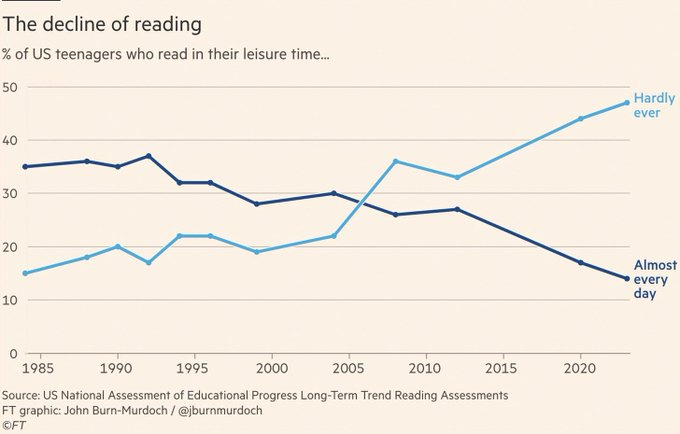
This graphic is causing a stir on social media:
We are in a high point as well of adults shouting that “kids today” cannot do math, cannot read, and of course, “kids today” don’t read.
I currently teach at a selective liberal arts college. The students are among the top high school students, having come out of elite private schools and many have been in Advanced Placement and International Baccalaureate programs.
Since the “kids today” mantra has included a current wave of bashing college students (another tired mantra)—they don’t read, and they can’t read extended texts, like complete books—I have asked my students about those charges (and of course, I assign a great deal of reading, including books, as well as all of my students write essays).
As much or maybe even more so than my students over 42 years of teaching, these students have, in fact, been assigned many books in high school, often in their college classes, and even read by choice, many eagerly sharing their favorite writers and series.
I can attest without hesitation that “kids today” over my teaching career have been mostly about the same as you’d expect teens and young adults to be, but if anything, they are smarter and have more challenging K-12 educations year after year.
I do think that the Covid era has had some unique negative consequences for current cohorts of students, and some of that is reflected in the reductive ways we determine if students are learning, mostly test scores.
And that leads back to the chart above; I don’t see anyone noting this is data from NAEP (a national random-selected population of students) and it is self-reported by the students (who are not held accountable in any way for their test scores or the data they provide).
I have never been convinced that NAEP scores are that valuable in terms of what and how student learning is measured, but I can assure you that self-reported data by those students is likely even weaker evidence of anything.
NAEP scores, in fact, like all standardized testing is a far greater reflection of the lives students are living outside of schools than of the quality of their learning in formal schooling.
Children and teens living without food or housing security as well as with little or no access to healthcare are likely finding little time or motivation to read for pleasure, and their intellectual batteries are drained by the lives resulting in not being able to fully engage with the few hours a day for about half the year when they are in classes that may be overcrowded or taught by an un- or under-certified teacher being paid poorly and attacked as a groomer and an indoctrinator by the current political climate.
Most of my college students have had much more privileged lives than the average child or teen in the US so it is worth nothing, as well, that they invariably say they want to read more but the main reason they don’t is schooling. They simply do not have time to read while they are taking courses, and they add that the assigned reading tends to also discourage them from reading (the pervasive obsession with assigning novels and focusing on the canon has never worked to motivate students).
There seems to be something futile and hollow about “adults today” perpetually criticizing “kids today,” particularly when adults today were themselves kids at some point in their lives also then accused of being dumb and lazy as a bag of rocks.
The “kids today” crisis rhetoric, I believe, is much more a reflection of adults, the cynicism of aging and the loss we all feel as we move further and further away from our childhood and teens years.
Kids today are not dumb and lazy as a bag of rocks, but they do have something we adults can never recover—youth.
But I can assure you that finding children and young people fascinating, fun, and surprising is a far better way to navigate growing older.
I am very lucky as a teacher of young people, and equally blessed by young grandchildren, who I assure you are not dumb and lazy as a bag of rocks.
I will always resist the crisis rhetoric around education and “kids today” because it defies logic that “kids today” have always been dumb and lazy as a box of rocks.
However, if anyone would like to launch into a criticism of adults today, I may be willing to join in.
I began my career as an educator in 1984, an ominous year for a teacher of English.
During my college years as I was taking education and English courses, culminating in student teaching split between a middle and high school, and then over my first few years of teaching several different course and levels of English as well as journalism, I was vividly aware that I was better prepared to teach literature than writing.
This was especially frustrating for me because I viewed myself as a writer and a teacher of writing.
I worked hard to teach myself how to teach writing better, but much of that effort was beating my head against a wall. The only saving grace was my students wrote often, received a huge amount of feedback, and rewrote probably more than most students in the 1980s.
I was implementing a crude, self-taught writing workshop approach that had roots in Lucy Calkins’s and Nancy Atwell’s early work.
Then, somewhat arrogant and very naive, I was gifted the opportunity to attend the summer 6-week Spartanburg Writing Project, a local version of the National Writing Project. Many years later, as one of the highlights of my career, I was a co-instructor in that very same project.
Something reorienting happened that summer early in my career. The co-director, Brenda Davenport (who taught first-year writing at the university where SWP was housed), essentially took me aside and very sternly told me almost everything I was doing was wrong.
This was one of my early lessons in good intentions and hard work are not enough.
I had been teaching as an uncritical prescriptivist, and Brenda forced me to shift toward a more authentic descriptivist approach to teaching language, one that matched my own linguistics understanding of language.
The irony was that contradiction between who I was a writer/scholar and how I behaved as a teacher.
Mind you, this was just a turning point, but also that experience awakened me to the tremendous gap between what high school students learned about writing in K-12 schooling versus what they needed to be college-level writers.
I have to admit that I wasn’t helping my students be prepared for college writing in the ways they needed.
I was a high school English teacher for 18 years, focusing primarily on teaching my students to write, but I taught a wide range of literature (although significantly focusing on American literature) as well as Advanced Placement Literature and Composition.
Now I am in year 24 as a college professor, and my courses are primarily first-year and upper-level writing.
I am not seeking to judge or blame high school ELA teachers here, but what I am about to share is grounded in my dual careers in high school and higher ed as well as a recognition that high school teachers are put in impossible conditions (teaching literature and writing is too much) and that much of what students learn K-12 is the result of a flawed system, not misguided teachers.
Here, then, are ways college students struggle as writers and how to better prepare them:
Essay form and the thesis. I recently saw a question on a Facebook page for teachers of AP Language about the thesis (can a thesis be more than one sentence), prompting me to write this post. Some of the earliest lessons we consider in my first-year writing course is that students come to college with narrow and mechanical views of the essay and thesis, often some version of the 5-paragraph essay with a one-paragraph introduction ending with a one-sentence thesis. I work very hard to help students shift to a more authentic view of the essay (there are many kinds and none are the 5-paragraph model) that is grounded in the opening (multiple-paragraphs with the beginning focused on engaging the reader and including a thesis/focus paragraph), the fully developed body that is far more than 3 paragraphs and includes the use of subheads, and the closing (multiple paragraphs and not restating the introduction/opening). Throughout the semester we read published essays and mine them for essay and thesis/focus concepts while also exploring how essays tend to be written by academics and scholars (much of what is expected at the college level). [Here is my first-year writing seminar syllabus/schedule that may be helpful for understanding how we examine the essay as an authentic form.]
Paragraphing. Another mechanical and inauthentic understanding by students is the paragraph. I usually ask them what they have been required to do in term of paragraphing, and most students have (different) rules for length—from 5-6 sentences to more. The problem I notice is that students write huge paragraphs, and they have no sense of the feel for breaking them in terms of considering the reader. Oddly, these same students admit hating long paragraphs as readers but persist with writing them. One of the most effective essay assignments in my FYW is the hyperlink-cited essay written in online format, using journalism as a guide. Journalism tends toward very short sentences (1-3 per paragraph), helping students develop a better sense of writing for a real audience of readers.
Chromebooks and Google docs v. Word. While recent and current high school and college students have in fact lived most of their lives as technology natives, that reality hasn’t resulted in their being adept at fully using technology, notably Word. My students have spent K-12 on Chromebooks and working in Google docs, but they seem to know very few of the formatting features and tools a word processor offers a writer. And simply managing and formatting documents is a nearly insurmountable task for my college students. I spend a great deal of time teaching students to use Word, to name and store files, and to navigate features such as spell and grammar check (they don’t use that), track changes, and comments. The Chromebook/Google doc experiences have infantilized students in many ways. Students need the empowering aspects of technology for young writers much earlier, and many of the features in Word support effective writing instruction.
Submitting essays for feedback. The last point leads to this pet peeve of mine: Students submitting writing in PDFs. In my role as a journal column editor, I have had adults submit writing in PDFs instead of Word files. As noted above, the process of submitting writing, receiving feedback, and submitting revised writing is essential not only to writing instruction but also to the real-world of submitting for publication. That students have been required or allowed to submit work in PDFs has erased for them the recognition that they are sharing a living document that provides an opportunity for teaching and learning (which I discuss in a later point below). For me, the PDF represents the misunderstanding by students that they submit writing that is finished (hence, perfect) instead of the much healthier realization that all writing will and should be revised and improved. In short, in writing, there is no finished line.
Citation (MLA, APA) and evidence/quoting. I have written at length about quoting here and here, and citations here, here, and here. But I recently received an email from APA that has prompted me to stress this point even further; APA now is the citation format of choice for 80% of college majors (and even English Journal recently switched from MLA to APA). However, most students enter college having had mostly or only experiences with MLA, which often is the citation choice in literature and the field of English. I want to caution that I am not advocating for changing from teaching students MLA to APA in high school. What students need is a broader and conceptual understanding of citation and style guides (experiences with MLA, APA, and Chicago, for example) that help them recognize citation/style is discipline-based and that they should be using the manuals/guides, not trying to memorize any specific format. Included in that more conceptual approach is helping students understand that these guides are not just about how to cite, but also about writing style. For example, students often enter college almost exclusively quoting from their sources, which they dutifully walk the reader through one at a time; this is what I call the “research paper problem.” I have added to my students’ citation resources an in-text checklist from APA; the first two checks prompt students to prefer paraphrasing (a significant stylistic difference from MLA). APA also recommends parenthetical over narrative citation (which I call “writing about your sources instead of your topic” with my students). Similar to the need to address citation at the broader and conceptual level, students need a much more nuanced understanding of providing evidence and incorporating sources in their writing. I stress to students that quoting a source should be reserved for textual analysis only; when using sources to add authority or credibility to their writing, they should use paraphrasing, parenthetical citation, and synthesize multiple sources when possible. For example, “Another prominent discourse on AI in schools argues that AI should be used to prepare students for an AI-dominated workforce, framing AI as an essential skill for success (Anderson, 2025; Boles, 2025; McDowell, 2025; Ta & West, 2024).”
Writing process, feedback, and revision. What K-12 students need more than anything in terms of learning to write is being given as many opportunities to write by choice as possible and to have that writing disentangled as much as possible from grading while also being embedded in the writing process. My college students are often paralyzed as writers because they want their submissions to be perfect the first submission and they often see all feedback as “mean” or personal attacks. Many high-achieving students come out of Advanced Placement culture where their writing instruction has been heavily focused on one-draft writing for the AP tests as well as bound to prompts and rubrics (my next point). Students need to become comfortable with drafting their writing, receiving feedback, and not see the writing process as something to “finish.” One way I help them see this is by sharing my own experiences as a published scholar; for example, this folder of the “Scholarly Essay Process” that shows my own submission and feedback for a chapter in an edited volume (still in process).
Prompts and rubrics v. choice and writer’s decisions. And since I mentioned AP testing, another way students have been infantilized in K-12 writing experiences is that nearly all of their writing has been to other people’s prompts and then guided/assessed by other people’s rubrics. I have also written at length against the use of rubrics (here, here, and here). In short, writing prompts and rubrics often serve the needs of testing and assessment, but these mechanisms are also doing the work for a writer that students need to be doing themselves. The realities of testing will not leave K-12 education any time soon so teachers would be negligent not to continue some use of prompts and rubrics; however, students as emerging writers need far more experiences with writing in authentic ways and by making the choices themselves that prompts and rubrics provide.
Essay assignment as teaching/learning experiences v. assessment. I have been a non-grader most of my teaching career over 5 decades; I also do not give tests. Recently, because having a non-graded classroom is very disorienting for students, I have moved to grade contracts to separate student writing and assignments from the tyranny of grades. The FYW contract now includes this key statement: “Assignments serve as teaching/learning experiences and not as forms of assessment.” I want my students to see their essays and the submission/writing process for what they are—mechanisms for individualized teaching and learning. I continue to see this tension (seeing writing submissions as ways to be graded versus ways to learn) as the most difficult hurdle in my courses. Students routinely become angry or even disconnect because they are required (and allowed) to revise and resubmit their writing. While I am closer to the end of my career than the beginning, this remains my central goal as a teacher of writing, to help students embrace the writing process as a teaching/learning experience and not a way for me to grade them.
Recently on social media, I acknowledged that K-12 teaching is far more demanding than teaching in higher ed so this post isn’t offered as a criticism of K-12 teachers or yet another way to ask more of K-12 teachers.
I recognize in teachers at all levels, however, a desire to serve our students better, and I think some of what I am sharing here may give context to what teaching to adjust, discontinue, or revise in that pursuit of fostering in our students a goal I believe is essential—becoming eager and more effective writers and thinkers.





 dr. p.l. (paul) thomas