Category Archives: Education

The Politics of Teaching Grammar

The pronoun/antecedent debate about “they” has continued at the NCTE Connected Community’s Teaching and Learning forum—mostly by advocates of prescriptive grammar.

That many English teachers continue to beat the drum for prescriptive rules is troubling—as I noted earlier when calling for descriptive grammar and conventional awareness. Troubling on one level since prescriptive grammar is solidly refuted by linguistics and the history of the English language [1]; troubling on another level since one staunch defense of the rules posted at the forum by an English teacher included a dangling modifier—highlighting that prescriptive grammarians often by necessity are themselves picking and choosing which “rules” to emphasize (an ironic type of descriptive grammar).

Another post called for ELA teachers to “hold the line with pronoun – antecedent agreement” because “[w]hile I think that grammar is a reflection of society, this is really about singular vs. plural.  It is not a political platform.”

And that last claim, I think, is an important place to consider further why a rules-based approach to language is failing both the language and our students.

First, critical pedagogy and critical literacy begin with the recognition that all human interaction, including language and teaching, is political. As Joe Kincheloe explains about teaching:

[P]roponents of critical pedagogy understand that every dimension of schooling and every form of educational practice are politically contested spaces. Shaped by history and challenged by a wide range of interest groups, educational practice is a fuzzy concept as it takes place in numerous settings, is shaped by a plethora of often-invisible forces, and can operate even in the name of democracy and justice to be totalitarian and oppressive. (p. 2)

And thus, making the claim that students must conform to prescriptive rules of language usage because those rules are not political is both a political act itself and a false claim that language can somehow be politically neutral. Endorsing prescriptive grammar instruction cannot be divorced from the historical fact that standard grammar has been used to perpetuate racism, sexism, and classism

As well, the literature we teachers of ELA often assign—from George Orwell’s 1984 and essays to Margaret Atwood’s The Handmaid’s Tale—illustrates that who controls language controls people; these works also highlight how that imbalance of power is unfair.

As linguists show, all identifiable types of language usage (standard English, AAVE, etc.) are simply somewhat cohesive versions, none any superior to the other except that some group in power creates that status of standard or “correct.”

Therefore, again, all language usage and the teaching of language are inevitably about power, always political.

With that context, then, the teaching of ELA should prefer an authoritative stance instead of an authoritarian one (see the writings of Paulo Freire).

Authoritative teaching of language generates teacher authority based on that teacher’s knowledge and experience with language (in terms of grammar, I would argue that includes essentially linguistics and the history of the English language). Authoritative teaching seeks to foster the student’s authority through that students’ understanding conventional usages as well as the biases associated with those usages.

Authoritarian teaching of language is the rules approach, in which teacher authority is grounded in the status of being the teacher, and the authoritarian stance necessarily asserts the authority’s (teacher’s) politics and mutes the politics of the subservient (student). Authoritarian teaching simply demands compliance—applying rules because they are rules.

As teachers of ELA, we are serving our students and the language well if we see language usage as something to be investigated and interrogated—not as a mechanism for imposing our authority on the student.

Those students can and should be guided in investigating and interrogating why we have standard English—who it benefits and why so that their own awareness about the power of language serves them and not those who use it to deny other people their political voices.

[1] Both in the false notion that some language use is inherently superior to others (as opposed to the arbitrary nature of standard forms based on who has political power), and against the reality that all language usage evolves, changes (and thus, trying to stop that change is misunderstanding the basic nature of language).

See Also

Revisiting James Baldwin’s “Black English”

A Tale of Two Teachers: The Politics of Personal Teaching, Nat Hentoff

Megalomaniacs and the Assault on the Humanities

I exist in two marginalized disciplines—English of the “impractical” humanities and education of the soft (and “too practical”) social sciences.

In the so-called real world outside of academia, the disciplines that matter tend to be economics, political science, psychology, and the sacred “hard” sciences. Currently, I teach at a small liberal arts university, which is of a type that is increasingly being marginalized as a continuation of the larger and longer assault on the humanities, such as history, English, and the classics.

One may wonder just how the humanities have come under such relentless assault. I think I have an answer.

Daedalus earned the status of master craftsman, goes the myth, including the ability to build wings for humans to fly. But once he constructed these wings, Daedalus warned his son, Icarus, not to fly too close to the sun, less those wings would melt.

Myth, you see, defies the strictures of the hard sciences, such as physics, which would render this narrative with so many holes that no one would pay attention to the message; yet, the Daedalus/Icarus myth has endured, even replicated in the visual arts:

Landscape with the Fall of Icarus, Pieter Bruegel

And poetry, “Musee des Beaux Arts,” W.H. Auden.

At the center of the Icarus myth—defying his father, his fall—is the recurring message of the humanities: beware human pride (hubris). It can be found again and again in classic literature/art, modern literature/art, and history.

Like the people and the world in Bruegel’s painting and Auden’s acknowledgement, we seem determined to turn away from this warning—and not without prompting from those who are filled with pride, the megalomaniacs who run the U.S.

Since the race for president now confronts us, just watch and listen carefully—megalomaniacs flying too close to the sun and demanding that we should follow.

The same megalomaniacs who assault and discredit the Humanities, where their kind litter the real and virtual landscapes.

Trump had it rough, you see, starting with a little million dollar loan and living off the fruits of how kind bankruptcy is to the Icaruses of the business world; you see he gets to fly too close again and again, nearly unscathed, and uses that to demand that we should follow, we should trust him to lead us.

And while Trump is a bit extreme, a bit cartoonish, he is the megalomaniac class that runs the U.S.—and his popularity proves how blind the average person is to this charade.

And while the megalomaniacs call for more mice to trot through the sacred disciplines—economic, political science, psychology, and the “hard” sciences—the way out of this mess lies forever there in the humanities, where the megalomaniacs are tragic, where their own voices are used to expose their folly.

Auden notes “how everything turns away/Quite leisurely from the disaster,” but the disaster is not someone else’s; the disaster is ours.

Rejecting Police in the Hallways: A Reader (Updated)

UPDATE

Arrested Learning: A survey of youth experiences of police and security at school

School Police Don’t Make These Students Feel Safe. Here’s Why.


Reporting at NPR:

Authorities are investigating a classroom incident between a white sheriff’s deputy and a black high school student in Columbia, S.C., where the deputy, a school resource officer, flipped the female student’s desk backward and dragged her to the ground.

This violent response to being a black girl in school continues the pattern that proves in the U.S. “other people’s children” (read black, brown, poor) do not matter. Parallel to evidence of police violence that black lives do not matter, this abuse of power in a SC school must raise a voice against what Kathleen Nolan documents in Police in the Hallways; see:

Journal of Educational Controversy – Review: Police in the Hallways: Confronting the “Culture of Control” [journal abstract link]

My review ends:

Broadly, then, Nolan’s Police in the Hallways forces the reader to consider how the line between the police state in and out of school has become blurred in some children’s lives. It is a harsh lesson about how middle-class norms mask a cultural willingness to subject other people’s children (Delpit, 2006) to institutional policies and messages that no middle-class or affluent parents would accept for their own children:

In a grossly inequitable school system and stratified society, punitive urban school disciplinary policies serve the interests of the white middle and wealthy classes, as poor youth of color are demonized through the discourses of zero tolerance and subjected to heavy policing. (Kindle Locations 2391-2392)

See Also

Resource Officer’s Violence Toward Student Raises Fundamental Question That Most Miss

#AssaultAtSpringValleyHigh: Deputy Ben Fields Sued Twice In Federal Court

Student Who Videotaped Incident Speaks Out

Racism affects black girls as much as boys. So why are girls being ignored?

FBI investigation sought in S.C. school incident caught on video

South Carolina sheriff’s deputy on leave after dragging student from her desk

Another Black Girl Assaulted by White Cop: Do We Matter Yet?

White America will ignore this video: The hideous & predictable violence of our schools, our legal system, our society

Greenville News: COMMENTARY: Are black children criminalized in schools?

Why Do the Privileged View Equity as “Hard Work”?

Let’s start with this: Privileged people in the U.S. embrace what amounts to a lie—that success is mostly the result of effort, notably that education is the key to success.

However, the evidence is overwhelming that being born wealthy trumps effort (including educational attainment) by people born into poverty and especially by black and brown people regardless of socioeconomic status.

White, wealth, and male privilege remains the most powerful combination in the U.S.

Let’s also note that formal education, instead of eradicating inequity, often works to reflect and even expand the equity gap for impoverished, black, and brown children [1]. And “other people’s children” experience much harsher disciplinary policies in those schools, such as zero tolerance, that reflect and perpetuate race and class inequity as well.

And it may be that the root of this disturbing gap between what the privileged claim and the reality of being born and living in the U.S. is that those in power argue that taking action for equity is “hard work,” and thus themselves lack the grit or growth mindset (qualities being used—projected onto as deficits—to further demonize poor, black, and brown children) to actually do what is necessary to close the equity gap.

For example, although mind-numbingly late, some are beginning to recognize the racially inequitable discriminatory practices among many so-called “no excuses” charter schools, such as Success Academy. Yet, when those practices are confronted, we read these caveats:

The challenge posed to Success Academy and similar charter schools by the U.S. Department of Justice and U.S. Department of Education’s guidance on student discipline is serious. To be in conformance with civil rights law, these schools will need to make radical reforms to their “no excuses” school culture and practices. Now that Moskowitz has laid down the gauntlet on this issue, many eyes will be on the Obama administration for its response. Changing policies, practices and cultures to make schools into safe and welcoming places that do not resort to the excessive and discriminatory use of suspensions and expulsions is hard, challenging work.

Ending discriminatory practices that disproportionately impact black and brown children living in poverty is “hard, challenging work”? Really?

In my home state of South Carolina, we discover, that despite decades of gross negligence of high-poverty, majority-black public schools in pockets mostly throughout the lower part of the state, the response is much the same:

It is difficult to know how to do that — although it would be much less difficult if we stopped worrying about turf protection and job protections and making sure the right people get lucrative contracts and pursuing our ideological goals.

It is difficult to get our legislators and our governor to ignore those distractions. But it is their job to do that….

The sad thing is that as difficult as it will be for our leaders to develop a plan and our teachers to implement it, the hardest part could be convincing ourselves that it’s worth doing.

In case we missed it, educational equity for all children in SC (read “poor,” read “black”) is “difficult.” Again, really?

The racist and classist stereotyping at the end of privileged finger-pointing is disgusting—calls for some children simply to work harder, blaming impoverished parents for not caring about education or their children, and making cavalier and rash arguments about either the great failure of schools and teachers or idealistic promises about schools and teachers.

No, it is neither hard nor difficult to do the right thing. It is simply that those with privilege in the U.S. do not care about equity, do not care about marginalized people or children. While the words say “hard” and “difficult,” the actions speak much louder: We do not care.

“There is never time in the future in which we will work out our salvation,” James Baldwin warned at mid-twentieth century. “The challenge is in the moment, the time is always now.”

Let’s end with this: The challenge is not for the poor, not for black and brown people; the challenge is for those who have the power to change things but remain impotent because that challenge is “hard,” that challenge is “difficult.”

[1] Poor, black, and brown children disproportionately are subjected to larger class sizes, un-/under-certified teachers, underfunded schools, and reduced curriculums (test prep).

Margaret Atwood’s The Heart Goes Last: “Comedy is so cold and heartless”

Kurt Vonnegut often confessed that he wrote to a basic pattern, the joke. And while Margaret Atwood‘s voluminous and diverse canon of work is often punctuated with wordplay, the humor is often dark and the overall weight of her fiction is relatively heavy.

About one-fourth of the way into Atwood’s The Heart Goes Last, we encounter that wordplay at the center of the novel when a main character, Charmaine, muses about her work euthanizing undesirables inside the speculative near-future where the economically desperate choose to spend half their lives in prison: “Then he’s unconscious. Then he stops breathing. The heart goes last” (p. 70).

The Heart Goes Last, Margaret Atwood (Bloomsbury Publishing)

The joke (“the heart goes last” is death, not love) is that this novel filled with a great deal of sex—including sex robots, infidelity, and brain surgery designed to turn people into little more than sex slaves to one individual or object (think The Stepford Wives)—is rarely sexy and certainly void of genuine gestures of love, at least until the twist at the very end.

Atwood’s novels demonstrate a brilliant awareness of and contentious relationship with genre; Atwood is often simultaneously conforming to and resisting the conventions of genre.

Science fiction, speculative fiction, dystopian fiction—these have become touchstones for the later Atwood (since 2003), who has written extensively about genre distinctions as well as having a public debate with Ursula K. Le Guin about science fiction.

For many people, Atwood is defined by her The Handmaid’s Tale, a speculative, dystopian work that she echoed later in her brilliant MaddAddam trilogyOryx and Crake, The Year of the Flood, and MaddAddam.

In these works, Atwood channels her inner-George Orwell, and argues that she is not creating science fiction (in other words, making things up), but speculating about much that already exists, or has occurred in human history.

These speculative works exhibit her masterful wordplay, but the motifs as well as the plots are dark and heavy.

I would add for context that Atwood also creates characters who are often compelling, complex and worthy of our compassion. In her speculative works, we have someone, or several characters, to pull for, to love.

While many will call The Heart Goes Last science fiction or speculative fiction, this novel is not in the Atwood tradition noted above. Instead of Orwellian, Heart is something of a comic hybrid—Aldous Huxley’s Brave New World meets Idiocracy.

Yes, we meet Charmaine and Stan, a stereotypical hard-working, middle-class couple who has been reduced to living in their car because of an eerily familiar economic downturn that devastates the middle-class and poor; as in our current real world, the wealthy appear mostly unscathed, if not benefitting from this apocalypse that comes upon people like going broke does for Mike in The Sun Also Rises—gradually and then all at once.

The central tricks of the novel also feel like SF—desperate people being coerced to spend half their lives as prisoners to regain economic stability, genetic manipulation of animals for food, sex robots, secretive and mysterious euthanasia, and brain surgery that creates permanent (and perverse) sexual bonds (even between a woman and a knitted doll).

However, readers reaching for Heart and expecting MaddAdam are warned early by Atwood as the narration, a shifting limited omniscient, reveals Charmaine’s thoughts on watching TV while doing her waitressing job:

She can watch TV on the flatscreens, old Elvis Presley movies from the sixties, so consoling; or daytime sitcoms, though they aren’t that funny and anyway comedy is so cold and heartless, it makes fun of people’s sadness. She prefers the more dramatic shows where everyone’s getting kidnapped or raped or shut up in a dark hole, and you aren’t supposed to laugh at it. You’re supposed to be upset, the way you’d be if it was happening to you. Being upset is a warmer, close-up feeling, not a chilly distant feeling like laughing at people. (p. 17)

Expecting Atwood’s manipulation of genre and her laser attention to detail, I see the “comedy is so cold and heartless” as an author’s hint of what is to follow—a work of nearly slapstick comedy exposing that the joke is essential human nature, a shallowness, a heartlessness.

While in The Handmaid’s Tale the wordplay and jokes were embedded in a much darker and serious work, Heart reverses this pattern so that the broadly comedic—sex robots in Elvis and Marilyn Monroe models, the Green Man group—is the main narrative with the dark and serious playing smaller, punctuated roles. [This, I think, makes Atwood’s novel more like Vonnegut than her other speculative fiction.]

About halfway through the novel, for example, again through Charmaine’s perspective, readers are presented with the guiding motif of the speculative story: “Because citizens were always a bit like inmates and inmates were always a bit like citizens, so Consilience and Positron have only made it official” (p. 145).

Free will, sexual attraction/love, fidelity, pop culture, social class inequity, gender roles and sexuality—these issues are examined by Atwood with the same sort of insight and thoughtfulness she brings to all her work. Atwood, for me, is always meticulously well-informed and then capable of seeing and re-seeing the world in ways that are both unexpected and incisive.

Heart is accessible and funny, although it isn’t the sort of speculative, dystopian fiction I most enjoy by her. Ultimately, my main criticism is that Heart never offers any characters for whom I care, leaving me, like Charmaine (sort of), needing a bit of brain surgery so that when I face them again, I can fall in love with their not-so-funny inadequacies of simply being human.

Dismantling an Unstable Discipline: Education without Foundation

“Whether we are willing to admit the role or not,” Lou LaBrant wrote in 1943, “schools cannot escape responsibility for some share in determining whether the peace which comes will last” (p. 225).

As the U.S. approached the mid-twentieth century—after decades of vibrant debate about the purposes of schools, the promise of universal public education—LaBrant and many progressive educators remained optimistic, if not idealistic, about the power of formal education to create broad social change.

LaBrant mused about the teacher as scholar, demanding from herself and other educators very high expectations for content knowledge and pedagogy among teachers. And she also “advocate[d]…that we attempt to develop the kind of students who can themselves make a world of peace even though we do not give them the pattern” (p. 228).

Over seven decades ago, LaBrant called for embracing authentic critical thinking over basic transmission of knowledge:

What I started to say was that we must not depend upon presenting a body of facts, useful as facts are, but that we must in our classrooms constantly remember that it is thinking about facts which is the important thing, and that this is as true in science and English and mathematics as it is in history or economics or the arts….(p. 229)

But she added:

Thinking is not sufficient. We must also have people who are accustomed to work with others (not against them), and who know that regardless of color, religion, clothing, occupation, or skills, people can work together….Teachers who are themselves striving to find answers will lead children toward those answers. (p. 229)

My career as an educator has spanned from the early 1980s until today, but my classroom practice and educational scholarship have much deeper roots, ones richly grounded in the history of U.S. education that was made real to me by the life and career of LaBrant.

Having taught from 1906 until 1971, LaBrant wrote her memoir as she approached 100 years of age, brushing aside the back-to-basics movement under Ronald Reagan as something she had witnessed herself twice before throughout her career as an English teacher and university scholar.

LaBrant’s last decade was spent in the first decade of the current accountability era, but even as her eyesight faded, LaBrant saw through the facile political and bureaucratic rhetoric and policies that now define the field of education, a discipline that was never very robust but which is now nearly completely dismantled.

Education, A Discipline Denied

During a video-taped interview of LaBrant for Missing Chapters, LaBrant claimed that despite having been born in the 1880s she had never experienced any sexism.

Of course, she was an exceptional woman in many ways, and had achieved many accomplishments that during the early twentieth century were stereotypically male endeavors. But primarily, LaBrant was always a teacher, and being a teacher has been historically and continues to be a profession and discipline of women.

Currently, as John Warner writes, education remains plagued by sexism—as demonstrated in the low pay and dependency on adjuncts to teach composition, about which Warner highlights while attending a composition conference: “The attendees were also overwhelmingly female.”

There was no Golden Age of education as a profession or discipline, by the way; once again, something the study of the history of education reveals. But since the progressive era of the early to mid-1900s, when LaBrant published frequently, the steady bureaucratization of education has eroded any chance that education as a discipline could rise above teacher training and sit among the core disciplines in the academy.

Published years after Joe Kincheloe’s death by co-editor with Randy Hewitt, Regenerating the Philosophy of Education examines the disappearance of educational philosophy in education degrees and certification programs.

Standards, standards everywhere—it seems—but not a spot to think.

And now, Stephen Sawchuck in Education Week reports:

Once an ubiquitous course requirement that nearly all aspiring teachers took, the history of education seems to be going the way of land-line phones, floppy disks, and shorthand.

Crowded out by an ever-expanding teacher-preparation curriculum in the latter half of the 20th century, such courses are now almost exclusively electives reserved for graduate education students, according to scholars who have documented the decline.

To put it simply: Is the history of education, well, history? And more to the point, does that matter?

Increasingly, then, education practitioners and scholars are watching our profession and our field being bled of all the essential elements of either a profession or a field.

Education without philosophy is education without a mind.

Education without history is education without a past.

While there is much hand wringing (and little action) about the so-called corporatization of public education, there is little being done to save education as a discipline. And soon it will be too late.

Absent philosophy and history, education will in fact be mere technocracy and will be easily managed by temp workers (TFA, adjuncts) and technology (on-line education).

Absent philosophy and history, no one will be asking if that should happen, no one will be demanding the big demands that LaBrant and other progressives yearned for in the quickly dimming 1930s and 1940s.

Yes, I am here to fight to create the sort of universal public schools we have so far failed to produce, but I also am here to fight for education as the discipline it has never become.

“Throughout our country today we have great pressure to improve our schools,” LaBrant wrote in 1961, but could write the same today, continuing:

By far too much of that pressure tends toward a uniformity, a conformity, a lock-step which precludes the very excellence we claim to desire. Many are talking as though teachers with sufficient training would become good teachers. There is little consideration of the teacher as a catalyst, a changing, growing personality. Only a teacher who thinks about his work can think in class; only a thinking teacher can stimulate as they should be stimulated the minds with which he works. Freedom of any sort is a precious thing; but freedom to be our best, in the sense of our highest, is not only our right but our moral responsibility. (p. 390)

Finally, LaBrant built to—and speaks to us now:

“They”—the public, the administrators, the critics—have no right to take freedom from us, the teachers; but freedom is not something one wins and then possesses; freedom is something we rewin every day, as much a quality of ourselves as it is a concession from others. (p. 291)

School choice lessons for Charleston – Post and Courier

School choice lessons for Charleston – Post and Courier

Expanded version, early post: Ten Years After Katrina: Lessons from Charleston, SC

And at Truthout: Ten Years After Katrina: Lessons From Charleston, South Carolina

[included below with hyperlinks]

Mention a coastal city notable for its diverse cultural history and the twin scars of natural disasters and human-made racism and generational poverty, and most people will think New Orleans, especially during the ten-year anniversary of Hurricane Katrina.

However, Charleston fits that same complicated profile and shares with New Orleans the historical failure of public schools to serve equitably poor and black, resulting in both cities being targets of wide-scale and often reckless education reform driven by political ideology.

While I have criticized mainstream media for covering education reform uncritically, I was impressed with the detailed examination of education reform in the large school district serving the city: Left Behind: The unintended consequences of school choice.

This coverage and related data are not new to those of us having taught in SC for decades. It takes very little effort to recognize that both traditional public schools (funding, teacher assignment, student tracking, etc.) and education reform driven by accountability and market forces over the past three decades have not served well vulnerable populations of students.

Nonetheless, the Left Behind series is a rare and fertile opportunity to address that because the coverage does, despite some flaws, present the complicated challenges that face both public education and society, ones that are inextricable from racism and poverty.

One response to this series, a South Carolina Policy Council (SCPC) Op-Ed titled School choice is a solution, not a problem, fails that opportunity because reducing the lessons of Charleston public schools to a debate about school choice is a distraction that will never serve students, families, and the community well.

As I have examined on far too many occasions, free market think tanks do not represent accurately school choice because they have committed entirely to one ideological focus that trumps goals such as educational equity for black and poor children.

The Op-Ed response to Left Behind is primarily advocacy, without credible claims about either the results or promise of school choice (vouchers, tuition tax credits, public school choice, charter schools).

Having written a book-length examination of school choice, I regret the choice debate remains trapped in ideological and political squabbles while children are in fact left behind.

So what do we know about school choice? (See Bruce BakerThe Shanker Blog, and the National Education Policy Center for extensive reviews of the research.)

  • Private, public, and charter schools have about the same range of measurable student outcomes, regardless of the school type and strongly correlated with the socioeconomic status of the child’s home.
  • Research on school choice has shown mixed results at best, but even when some choice has shown promise of, for example, raising test scores for black, brown, and poor students, those increases are linked to selectivity, attrition, greater funding, and extended school days/years—not choice.
  • School choice, notably charter schools, has increased racial and socioeconomic inequity: segregationinequitable disciplinary policies and outcomes.
  • SC advocacy for charter schools as the newest school choice commitment fails to acknowledge that charter schools in the state are overwhelmingly about the same and often worse than comparable public schools, and the South Carolina Public Charter School District is among the top four worst districts in the state for racially inequitable discipline with blacks constituting about 19% of the enrollment but over 50% of suspensions/expulsions.

But don’t poor children deserve the same choices that rich children enjoy? Several problems exist within this seemingly logical assertion.

First, suggesting that affluent and mostly white affluent children are thriving because of choice is a mask for the reality that the key to their success is their wealth and privilegeBeing born into a wealthy family trumps educational attainment, and white privilege trumps educational attainment by blacks.

Further, no one should have to wait for market forces might accomplish to have access to health care, justice, safety, or education. The great irony is that for the free market to work, a people must first insure equitable public institutions.

As Martin Luther King Jr. stressed in 1967: “We are likely to find that the problems of housing and education, instead of preceding the elimination of poverty, will themselves be affected if poverty is first abolished.”

A full and robust commitment to public education is essential to the concurrent commitment to the free market. The paradox is that in order for choice of most kinds to work in a free society, some essential institutions must render choice unnecessary.

As we can witness in New Orleans, the lessons of education and education reform in Charleston are two-fold: (1) historically and currently, traditional public schools have failed/do fail vulnerable populations, specifically black and poor children, and (2) accountability-based and free-market education reform has also not alleviated the burdens of racism and poverty, but too often has exacerbated the devastating consequences of both.

Postscript

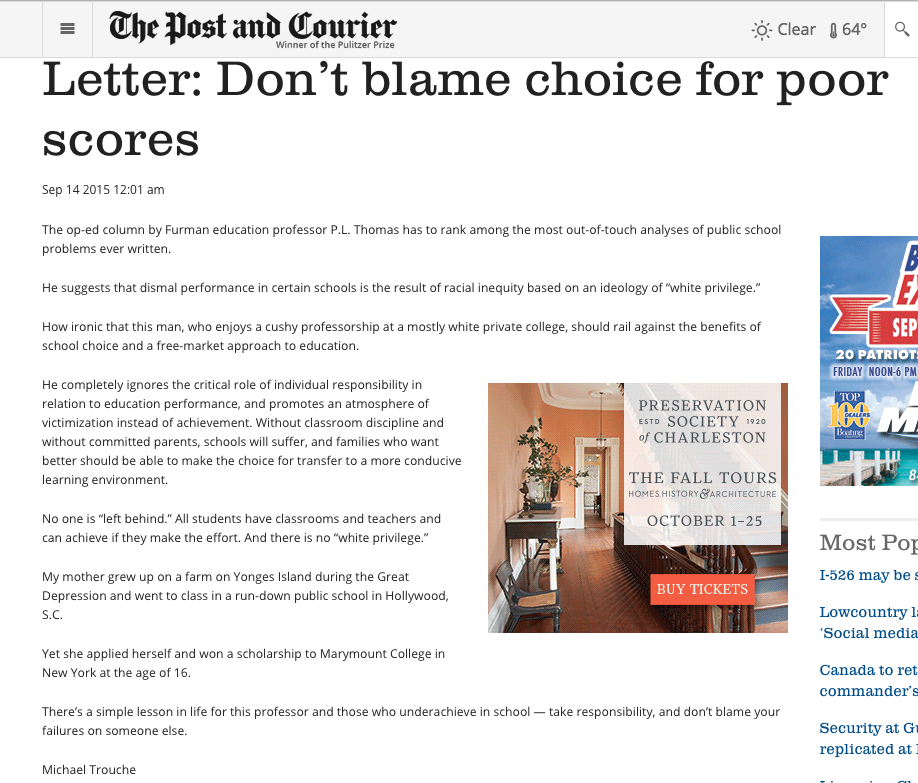
After my Op-Ed on school choice ran in the Post and Courier, the P&C ran a letter that literally states, “And there is no ‘white privilege.'” Also great and disturbing evidence of the fight we face since the writer uses every tactic imaginable except addressing the evidence—attacking me, using one example to claim a generalization:

white denial PandC

Greenville News: COMMENTARY: Are black children criminalized in schools?

COMMENTARY: Are black children criminalized in schools?

Following the Annie E. Casey Foundation’s 2015 Kids Count report showing South Carolina children are facing even greater challenges, research from the Center for the Study of Race and Equity in Education (University of Pennsylvania) reveals that in SC and Greenville County black children are being disproportionately disciplined in our schools.

Just as the Kids Count data show racial inequity at the root of childhood challenges in our state, suspension and expulsion rates fall along racial lines between white and black students.

Across SC, “Blacks were 36% of students in school districts across the state, but comprised 60% of suspensions and 62% of expulsions,” including the SC Public Charter School having one of the highest ratios, 2.7 times disproportional. And in Greenville County, composed of 23.4% black students, the suspension rate for black students was double that enrollment at 47.4%.

However, the statistics themselves are not the whole story since research also shows that black children are targeted more often and treated differently than white children for the same behaviors. Reporting on the study in ColorLines, Kenrya Rankin Naasel explains:

When black students exhibit behavioral problems at school, administrators are more likely to call the police than to secure medical interventions. In fact, the study found that the more black students who attend a school, the more likely the people in charge are to call the police, rather than a doctor.

David Ramey, assistant professor of sociology and criminology (Penn State), in a press release notes that these finding match a larger body of research:

The bulk of my earlier research looked at how, for the same minor levels of misbehaviors—for example, classroom disruptions, talking back—white kids tend to get viewed as having ADHD, or having some sort of behavioral problem, while black kids are viewed as being unruly and unwilling to learn.

Further, beyond school, black children are viewed by police and others as being much older than their biological ages, and thus, Stacey Patton, a senior enterprise reporter at the Chronicle of Higher Education, argues, “Black America has again been reminded that its children are not seen as worthy of being alive—in part because they are not seen as children at all, but as menacing threats to white lives.”

From Emmett Till to Tamir Rice, Patton notes, the criminalization of black children in schools is amplified in the loss of young black life in streets.

Michelle Alexander’s The New Jim Crow has exposed that the U.S. judicial system, in fact, targets and punishes blacks differently for the same behaviors as whites. For example, Alexander notes that police units sweep high-poverty black neighborhoods for illegal recreation drugs but do not sweep college campuses, where drugs are just as likely but the population tends to be white and affluent.

In SC and Greenville County, then, we must begin to examine in our schools how our policies are criminalizing black students at a great cost to their lives as well as to the welfare of the state and area.

A first step is to acknowledge racial bias in perceptions about black children and then to examine not only the data on racial disparities in discipline outcomes but also the actual policies and practices in our schools.

Particularly in schools and when dealing with children of any race, punishments such as suspension and expulsion are likely harmful options that should not occur until interventions are implemented that address the needs of all children living in challenging environments.

Child behaviors identified as “bad” are often the consequences of life experiences not of any child’s making. In other words, school discipline policies may too often be punishing children for conditions not in their or even their parents’ control.

Disproportionate school discipline along racial lines reflects and perpetuates racial inequity in society and in our criminal justice system. Increasingly, research suggests that schools are creating a criminal class of black children instead of providing those children the support and guidance every child deserves to have a full and rich life.

SC and Greenville County schools face tremendous challenges because of pockets of poverty, but to neglect the lingering racism that compounds the weight of poverty guarantees failure for our schools and some children we are choosing to condemn instead of cherish.

See

Mass Incarceration, Visualized

The Enduring Myth of Black Criminality

12-Year-Old Black Student Suspended for Staring at White Classmate Indicates a Bigger Problem With Unequal Discipline – Atlanta Blackstar 

Criminalizing Blackness: A Mississippi Community College’s School-to-Jail Pipeline

The Moment: More Anxiety Chronicles

The worst thing about anxiety is that everything about being anxious is the worst thing.

#

At the first faculty meeting preceding the new academic year this fall, our university president, Elizabeth Davis, about to start her second year, spoke in part about focusing on the Furman experience instead of always reducing one year of college or college entirely to what comes next. As I listened I thought about talking with my students about the Furman Moment.

This call for appreciating the moment resonates with me because I have no capacity for it. As someone who has always struggled under the weight of intense anxiety, I am forever plagued by what comes next, and I am captive to an overactive brain that not only perpetually cycles through what comes next, but also manufactures always the worst case scenarios for what comes next.

For those of us who wrestle with this irrational anxiety, worrying, and senseless anticipation of doom, we develop outward appearances of stoicism to mask our frantic brains and simultaneously tightening and exploding chests (one of several bodily torture spots where anxiety nests—including shoulders, necks, hips, and hands).

We also are prone to self-medicate, seeking ways to dial us back toward normal. For the anxious, relaxation, even briefly, even if a delusion, is a cherished holiday, a relief. Let us step just for a moment off the merry-go-round, feet firmly on the ground, and we are forever grateful.

And for me, along with the rare oasis of pausing the relentlessness of anxiety and the incessant internal monologue of my Self talking to my Self, the Holy Grail is to be with another person (usually only one for those of us who are also introverts) who has some either shared understanding or graceful empathy for this anxiousness that is irrational and ultimately embarrassing.

Yes, the worst thing about anxiety is that everything about being anxious is the worst thing, but the very worst thing about anxiety is explaining it every time you have to confess to it because you cannot view the world as most others do, because what is pleasure for many people is torture for you.

We learn to confess because naming a demon helps slay a demon, or at least hold that demon at bay.

But we anxious have a language that others do not understand, cannot understand.

And so we are often drawn to the wordless (a tragic paradox for the anxious who are writers)—a hand taken without comment, a hug or cuddling just to, these simple intimacies between two people who know each other, who know that sometimes everything is just beyond words. No expectations, no caveats, but the moment.

The great irony here, of course, is we anxious may dread physical contact or even being close to people virtually 99% of the time—the stress of casual proximity; the torture of ritualistic touching—handshakes, hugs—close talking, and crowds at social events. Let’s not even trudge into formal gatherings.

Anxiety, you see, is being overfull as a human too aware of everything. I mean Every Thing.

So full of recognition and sensation that we are spontaneous criers—more embarrassment—so we clench our entire bodies to try to hold everything in that is near to bursting through our eyes.

It is exhausting.

So as a late teen and young adult, I was immediately drawn to existentialism’s claim that our passions are our suffering, to the yin-yang concept of the impossibility of separating the light from the dark.

This was well before I recognized the anxiety, but I was quite aware that caring deeply was inseparable from feeling deeply anxious.

Relationships—marriage, a child—intensified these responses to the world exponentially, and then as I was more and more unable to manage all that overload of feeling this world, another response was to detach.

The hardest was my daughter’s teen and then young adult years when I had to set aside the urge to carry her around in my arms 24 hours a day. This is a universal issue for parenting, but for the anxious, it is the iceberg that sank the Titanic—others witness only the tip.

So now I am just a little over a year into being reminded of those wonderful and teeth-clenching years of parenting my daughter because she has gifted me a granddaughter.

A granddaughter just beginning her second year is a mostly wordless wonderment who when I am holding her in my arms while she naps is the most precious gift of relaxation an anxious human can enjoy.

A toddler, you see, often shuffles up next to you, a glorious proximity of closeness, raising her arms, longing to be picked up and held. These wonderful and precious years before she will quite literally beg to be left alone.

In the moment, she is wordless and affectionate with all the possibilities a child embodies.

There is more than a little guilt because of my need from this tiny child, to sit there and not worry in the moment because it is easy to believe everything is all right when a child is sleeping on your chest—a chest that is most of the day an artificial shield between the world and all the anxieties expanding there below the breastbone.

For me, my granddaughter sleeping on my chest is the moment I can live in, the evidence that for my students I must make the plea that they work on the very human skill of enjoying the moment instead of being always captive to the past or the unknowable future.

What I owe this granddaughter, what I owe my students—these are the things that make me whole because holding her and that wonderful time teaching, each is the moment that gives me pause and rebalances all the world.

#

The worst part of anxiety is believing that you are not good enough, believing that you are a fraud and that at any moment other people will discover your secret, at any moment you will be unmasked and all that you care about will be taken away—because that is the dirty little secret about anxiety that is the everything about anxiety that is the worst thing.