Category Archives: Education

Debunking “Heritage Not Hate”: A Reader

Documentarian Ken Burns—noted for his work on the Civil War—explains that the shift in attitudes concerning the Confederate battle flag across the South and the U.S. parallels another watershed moment in the nation, support for gay marriage (I would add the legalization of marijuana is another similar shift).

Many are rightfully concerned that the massacre of the #Charleston9 is being reduced if not trivialized by the political rush to remove the battle flag from state grounds, license plates, and flags, just as some believe the flag debate allows political leaders and the public once again to avoid a real discussion and then action on gun control.

Let us, then, embrace the flag debate as not a symbolic moment, but a symbolic movement—lowering and removing are actions—that both works with and builds on the momentum of those political and public shifts.

Removing the Confederate battle flag from government display, however, is not banning that flag; individuals continue to have the right in the U.S. to flaunt symbolically their beliefs, however misguided or even hateful, regardless of the mechanism—as long as that free speech does not cross a line into denying others their free speech or threaten harm.

Thus, part of that movement must be personal and public education.

And that education must address the “Heritage Not Hate” mantra that has for too long allowed both the Confederate battle flag and the concurrent racism to survive behind slogans without basis in the facts of history.

The Confederate battle flag has not suffered a change in meaning; its meaning has always been corrupt from its original creation within the larger acts of secession and war.

The “heritage” and “state’s rights” claims are cultural lies by omission: The heritage was one of racism and slavery, and the state’s right was to maintain slavery as the primary mechanism of economic power in the South (an economic dynamic that made a very few incredibly wealthy, but also a system of human bondage that benefitted those who didn’t own slaves, rendering nearly all free people complicit during the institution of slavery).

Many have offered the evidence for that personal and public education, and I offer them below as an opportunity for folding “Heritage Not Hate” into the movement that will embrace those willing to say they have also changed their minds and hearts because they are now willing to face the uncomfortable facts that contradict long-held beliefs.

Debunking “Heritage Not Hate”: A Reader

Take Down the Confederate Flag—Now, Ta-Nehisi Coates

Coates 1“Corner Stone” Speech, Alexander H. Stephens,Vice President of the Confederate States of America, Savannah, Georgia, March 21, 1861
What This Cruel War Was Over, Ta-Nehisi Coates

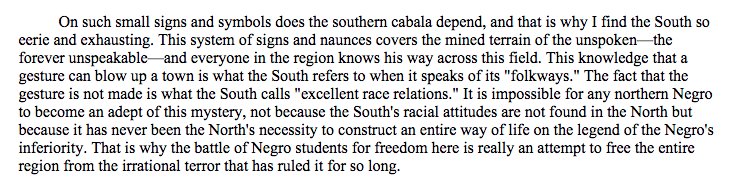
“They Can’t Turn Back,” James Baldwin

signs and symbols Baldwin

The Declaration of Causes of Seceding States (Georgia, Mississippi, South Carolina, Texas, Virginia)

MississippiKen Burns: Flag issue is not about heritage

The “meaning” of the Confederate flag, Bryan Bibb

How people convince themselves that the Confederate flag represents freedom, not slavery, Carlos Lazada

[Quoted from John M. Coski, the historian at the Museum of the Confederacy in Richmond]

raison detreHey white southerners, let’s talk about our Confederate heritage, Matt Comer

How The South Lost The War But Won The Narrative, Tony Horwitz

benign“The face of racism today is not a slaveowner”: Eric Foner on the past and present of white supremacy, Elias Isquith

deplorable

Why do people believe myths about the Confederacy? Because our textbooks and monuments are wrong, James W. Loewen

states rightsWhite support for the Confederate flag really is about racism, not Southern heritage, Spencer Piston and Logan Strother
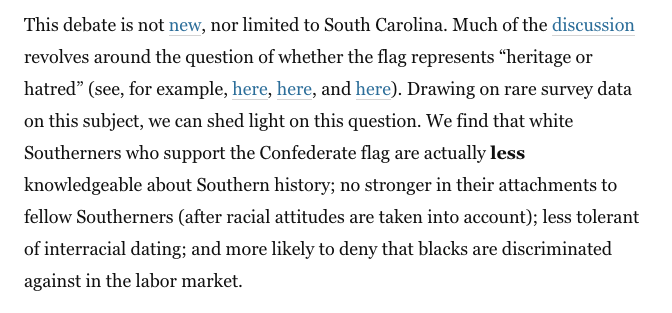
less knowledgableEditorial: Remove Confederate flag this week [Greenville News]

SC slaveryThe South’s Heritage Is So Much More Than a Flag, Patterson Hood

myths and legendsCommemorating North Carolina’s anti-Confederate heritage, too, Timothy B. Tyson
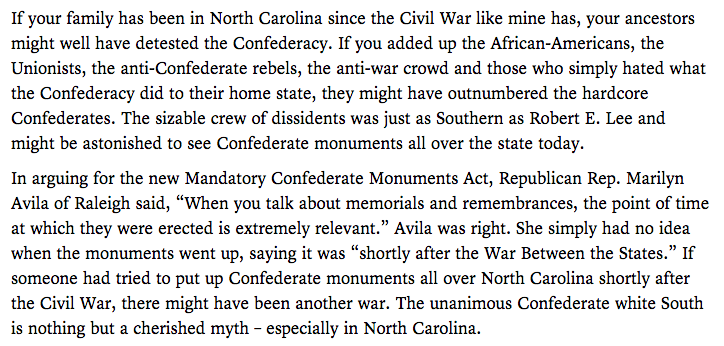
cherished myth

“People know next to nothing about Reconstruction,” Eric Foner

states rights

English Journal — Call for Manuscripts: Submission Deadline: March 15, 2016

English Journal — Call for Manuscripts

Visible Teaching: Open Doors as Resistance
Editors: Julie Gorlewski, David Gorlewski, P. L. Thomas, and Sean P. Connors
Submission Deadline: March 15, 2016
Publication Date: November 2016

Under pressure to adhere to a scripted curriculum or to conform to standardized instructional practices, educators might choose to adhere to a popular adage that recommends that they “close the door and teach,” presumably as an act of resistance. This advice is problematic, however, because it denies the agency of teachers, as professionals, to effect change in their schools. It willfully conceals alternative instructional practices that might otherwise benefit students, and it ignores the role that shared knowledge can play in sustaining a community.

Alternatively, teaching with our doors open establishes agency where the system has denied it; offers direct alternatives to the practices we reject, especially those that are not supported by the evidence of our field; and models for students how professionals behave.

This issue of English Journal explores how a decision to “teach with our doors open” can be interpreted as a form of empowerment and an act of resistance. It acknowledges teachers as agentive, and aims to understand how making one’s practices visible to others can disrupt standardizing forces and disciplinary mechanisms that are intended to promote conformity and compliance.

Contributors might consider questions such as: What conditions prompt teachers to teach behind closed doors, and how can they productively be addressed? How do you negotiate space to teach with your door open, and what advice would you offer others interested in doing so? How have you engaged with colleagues who respond differently to mandated and prescribed practices that you feel are not valid or effective? If you have experienced a transformative moment—moving from teaching with your door closed to teaching with your door open—how did that look and what advice can you offer those interested in making the same transition? How can teachers work with school leaders to create a school culture that values the open exchange of ideas and embraces evidence-based practices that push against mandates? We welcome educators to share experiences that investigate this important topic in the context of scholarly literature.

We invite manuscripts of 2,500-3,750 words, written to an audience of educators in grades 7-12 English classrooms.

More on Solidarity: “Speak to Shared Goals,” Not “Speak with One Voice”

Responding to my musing about the lack of solidarity among new media resistance to education reform, Sherri Spelic cautioned:

Solidarity, yes. However, in movements in which the aim is to “speak with one voice” whose voices are most likely to be quieted or softened or pushed to the edges? I fear it is often women’s voices which are sacrificed more often than not.

Certainly the number of voices in the ed reform push back camp is growing and we have to realize that new readers, writers, lurkers are finding their way into social media daily. The edu blogosphere is expanding as educators attempt to keep up with what appears to be a runaway train. They are told they must blog and pin and tweet in order to call themselves “connected.” And that’s when folks who were here earliest and built those initial cults of edu personalities began to talk about how shallow and repetitive twitter was becoming and asking whether they shouldn’t move on….

We can add to the solidarity not by limiting our use of voice but by lending it where it may be needed: to uplift one or more of our colleagues in need, in support of the policies and movements which align with our common cause.

My initial response was appreciation for the ideal and thoughtful framing, and then, because of Spelic’s challenge, I was pushed to think better about what I was asking, to state better what I envision.

Solidarity, for me, does not require speaking with one voice, but speaking to shared goals.

Here, then, possibly to continue the conversation, I want to explore what those shared goals may be, keeping in mind we need them to be clear, attainable, and few:

  • Seeking an end to one (preferred) educational experience for privileged children and another (worse) educational experience for “other people’s children.”
  • Seeking a greater appreciation and realization of teaching as an autonomous profession.
  • Confronting and ending inequitable punitive policies (academic and disciplinary) for marginalized populations of students along race, class, gender, and other status categories (English language learners, special needs students).
  • Ending high-stakes accountability focusing on outcomes and implementing a structure that addresses equity of opportunity metrics.
  • Calling for social reform that guarantees for all children that the coincidence of birth is not the dominant factor in their opportunities in life and education.

Among educators, researchers, political leaders, and the public, we will likely disagree about how to achieve these goals—that disagreement is likely important, in fact—but I believe we can and should be in solidarity for achieving these goals.

Divided, Conquered: “Everybody blogs. Nobody reads.”

In her 14 June 2015 email update about her blog, Susan Ohanian offered an opening statement:

When I started this website of resistance 13 years ago, I posted a lot of outrage, outrage I tried to buttress with research. Of late, I’ve cut way back because I feel there’s far too much jabber filling the air–too much rage and not enough explanation. Everybody blogs. Nobody reads. I figure whatever I might say just gets lost in the cacophony so I’ve turned my efforts elsewhere. Right now I’m working on a big project that I hope will startle you with originality. At the very least, it won’t be part of the chorus.  

I’m not abandoning the site–just cutting back on its size.

Well before the education reform debate blossomed on social media, Ohanian was dissecting and challenging the most recent cycle of high-stakes accountability—from the perspective of a classroom teacher.

I very much feel compassion for Ohanian’s concerns, having begun writing against accountability and specifically high-stakes testing in the 1990s, also as a classroom teacher. Once I moved to higher education in 2002, my access to public work was significantly expanded so my public commentaries reach back about as long as Ohanian’s (although my move to blogging is about half that span).

The powerful refrain—”Everybody blogs. Nobody reads”—resonates, I think, because it touches on how social media has in many ways had the opposite effect than its great promise: Instead of building solidarity, blogging, Facebook, Twitter, and all the rest have allowed factions to develop and has reduced much of the vibrant and important discourse to be subsumed by the great failure of social media—the cult of personality.

The online world of public debate about education and education reform has included the ugliest part of social media—anonymous vitriol—but it has also, for me, created a much more troubling dynamic. On more than one occasion, I have been refuted and attacked (based on false assumptions) by those with whom I share solidarity.

It is all too easy, then, for those of us who share the same mission to turn on each other while those who are running the education reform machine sit by mostly untouched.

In fact, that is what the minority in power thrive on—divide and conquer.

Part of my advocacy includes making a case for the importance of workers so I often ask people to consider if all service workers in the U.S. (mostly poorly paid and many part-time without benefits including the horribly under-paid wait staff) simply did not work tomorrow, how would that compare in impact to if all the CEOs did not go to work tomorrow?

And how does that impact expose real value to society versus how we compensate work in the U.S.?

One wait staff compared to one billionaire is a tale of supreme inequity.

Without solidarity, without a moral grounding among those who still may disagree, each of us is ripe for the sort of resignation that happens in isolation and powerlessness.

Each time I post on Common Core and the views increase and then I post on race and the views drop, I contemplate simply walking away from trying to make a difference.

The reason I have shifted from traditional scholarship and toward public work stems from the echo chamber that is scholarship where, to paraphrase Ohanian, everybody publishes, but nobody reads.

Social justice and educational equity are, simply put, the defining goals of a free people, and it seems these are the anchors for a solidarity that could bring about change.

Partisan politics, the cult of personality, building a brand, blogging and not reading/talking but not listening—these, however, are the antidotes to solidarity, and the fuel of the status quo of inequity that poisons our society and our schools.

Without solidarity, each of us is destined to resignation, failing to hold hands and realize our collective power against the few who can afford simply to wait us out.

We are a people, I fear, tragically trapped in individual ownership and competition, denying the essential communal nature of being fully human.

Dedicating the self to the public good is the ultimate act of selfishness. Solidarity is not, then, self-sacrifice, but self-preservation.

We have passion (Ohanian’s “rage”) and we have explanations, but we are doomed by a poverty of solidarity in our pursuit of social and educational equity.

CFM: Unheard Learners: Children and Youth Experiences in Neoliberal Schools

Unheard Learners: Children and Youth Experiences in Neoliberal Schools

Call for Manuscripts

The Journal of Critical Education Policy Studies 
Special Issue: December 2015

Guest Editors: Debbie Sonu, Hunter College, City University of New York & Julie Gorlewski, State University of New York at New Paltz

Chief and Managing Editor: Professor Dave Hill, Research Professor of Education at Anglia Ruskin University, Chelmsford, England

The Journal of Critical Education Policy Studies (JCEPS) and guest editors Debbie Sonu and Julie Gorlewski are seeking manuscripts for a special issue that is scheduled for publication in December 2015.

This special issue, entitled “Unheard Learners: Children and Youth Experiences in Neoliberal Schools,” aims to feature the work of established and emerging scholars from a variety of disciplines who explore school reform and schooling experiences from the standpoint of children and youth in public and private K-12 institutions from any socio-economic, cultural, or geographic location within the United States.

We invite research articles that draw from empirical work, as well as conceptual or theoretical papers that use in some form the direct perspectives of children and youth as learners in the current context of neoliberal school cultures, including but not limited to issues of testing, discipline, relationships, authority, states of being, curriculum, and pedagogy. Contributors may take up a wide range of theoretical frameworks, including feminist, Marxist, postcolonial, poststructural, psychoanalytic, critical, and historical lenses to present divergent perspectives that link children and youth with the urgent and immediate changes that are impacting schools today.

Full manuscripts of 6000-8000 words are expected for submission.

Timeline:

Submission Deadline: October 1, 2015

Notification by October 15

Reviews returned by October 15

Final Revisions due November 1

Publication date December 7

All submissions must strictly adhere to JCEPS style guidelines: www.jceps.com/submissions. Manuscripts must have a title, name of author(s), university/institutional affiliation including city, state (if USA), country, abstract (150 words), key words (5-7), main document, references, and at the end of the manuscript, author/writer details, and correspondence information.

All inquiries can be made to either dsonu@hunter.cuny.edu or gorlewsj@newpaltz.edu

Public Schools Provide Market Pressure for Charter, Private Schools to Improve

Decades of research now reveal that charter and private schools do not produce student achievement superior to existing public schools.

Since politicians and education reformers are fully committed to charter and private schools, we have reason to be optimistic that existing public schools now provide the market pressure necessary for charter and private schools to improve:

  • Public school provide community-based education guaranteed to all students in that community, rendering the need to choose or wait for that choice to create the sort of education children deserve unnecessary.
  • Public schools by law fully serve English language learners, high-poverty students, minority students, and special needs students—those students under-served and even denied access to charter and private schools.
  • Public schools seek and foster experienced and certified teachers.
  • Public schools respond to local control and directly to tax-payers those schools serve.
  • Public schools are committed for decades to the communities they serve.
  • Despite often being underfunded and demonized in the mainstream media, public school students’ achievement is about the same as charter and private school students who attend better funded and highly praised schools.
  • Exceptional public schools should serve as models for the performance of all charter and private schools—without regard for students served and without any review of the data supporting that exceptional status.

In the coming years, we must call for adequate and robust research on the market pressure public schools are creating for improving our stagnant charter and private schools.

Quality of So-Called “Education” Journalism Actually Low

In both my May Experience course on education documentaries and my foundations in education course, we view and discuss the 2008 HBO documentary Hard Times at Douglass High:

Shot in classic cinema verité style, the film captures the complex realities of life at Douglass, and provides a context for the national debate over the controversial No Child Left Behind Act, focusing on the brutal inequalities of American minority education, considered an American tragedy by many.

Although many scenes are powerful, one in particular remains disturbingly relevant in 2015: The camera captures with a voice-over students taking the standardized test that is being field-tested for students (no stakes), but will be high-stakes for the school and teachers; many of the students are shown with their heads down, essentially making no effort on the test.

Hard Times ends by noting that the administration has been replaced and Douglass High (Baltimore, MD) joins one of many narratives that too often we read about in the on-going era of high-stakes accountability: failed schools, schools “taken over” by the state, closed schools.

A few years ago, I was working on an Op-Ed for The State (Columbia, SC), but I was challenged about my outline of the accountability movement in South Carolina by the editor. Just for context, I began teaching in SC in 1984, when the first implementation of accountability began, linked to higher teacher pay, greater educational funding, and the start of the standards/high-stakes testing movement.

The editor insisted that accountability was a child of the late 1990s, but I was able to send her links to the first SC laws in the late 1970s and explained my own life as a teacher at a school where we were actively teaching to the exit exam in the early and mid-1980s (including double-tracking students in math and ELA courses as tenth graders to help them pass the tests to graduate).

What do these two topics above have to do with each other?

For thirty years, journalism addressing education and more specifically education reform has been inadequate to the point of being a huge part of the education reform problem.

Take for yet another example this piece from The Hechinger Report (and a repost in Education Week): Stakes for “high-stakes” tests are actually pretty low.

The maps, data, and serious tone are likely to have masked the flippant headline as well as terse “gotcha” lede: “It turns out that the stakes for this spring’s Common Core-aligned tests are not quite as high as they might seem.”

Seems all that opt-out nonsense and teacher caterwauling has been for naught, right?

Just as I suspected. As the article clarifies early, “both sides” are truly out-of-bounds:

“I think the stakes are either overstated or understated depending on which side of the argument you’re on,” said Chris Minnich, executive director of the Council of Chief State School Officers. “Both sides need to take a step back and just take a look at this map.”

As one point of concern, however, let’s consider another piece in the same publication: More than 5,000 Mississippi third-graders could be held back this year for low reading scores:

Results of the new third-grade reading test announced Thursday that aimed to make it tougher for students to advance if they don’t read at grade level could mean 15 percent of the test-takers will repeat third grade.

Some 38,000 public school students took the Third-Grade Reading Summative Assessment, widely known as the “third-grade gate,” created under state law to address lagging reading skills and prevent the practice of “social promotions.”

I wonder how these children being mis-served by callous legislation refuted by decades of research on grade retention and rejected by the National Council of Teachers of English feel about flippant and misleading journalism? [1]

Where has the mainstream press examined that grade retention doesn’t have “two sides,” but one very clear position supported by evidence?

Where has the mainstream press examined that standardized testing remains biased against racial minorities, the impoverished, English language learners, special needs students, and females?

Where has the mainstream press exposed that the entire accountability era has failed?

Don’t bother looking, the mainstream media is too busy being snarking, inadequate, and lead by the nose in the era of press-release journalism that has coincided with educational accountability.

The press is a willing participant in the “miracle” school lies, as long as they are about charter schools [2], but quick to vilify teachers who cheat.

Journalists serve as bridges between a more technical and complex world (political, academic, etc.) and the general public, many of whom spend little time beyond the headlines and a few sentences at the beginning and maybe the handy-dandy charts, graphs, and maps.

So let me return to the claim that “both sides” are misrepresenting the stakes surrounding the on-going accountability/standards/testing game that has now lingered for thirty years in the U.S.

Please, mainstream media, identify for me and your audience any states in which accountability/standards/testing are not ultimately geared toward high-stakes for students, teachers, and schools? (Note: That data point, by the way, would be 0).

And since all aspects of accountability are linked ultimately to high-stakes, in what way is this incomplete, misleading, and snarking “report” helping anyone—especially the children who have been and are now having their lives irrevocably changed due to inexcusable legislation with no basis in solid research?

The original breezy piece now includes an UPDATE, but even so, the essential problem remains that most people will see only the headline, maybe the lede, and then the maps. The conversation has been established by this piece even to its shoddy conclusion that includes a convenient Oliver North passive voice evasion:

All of which is to say, yes, the tests are important. Decisions will be made based on how students perform on them [emphasis added]. But the vast majority of states will use the scores only as one measure in a web of other factors when making staffing decisions. And most states have no plans to use the scores to make student advancement decisions.

Although the process would probably be pointless since journalists are trained to chase “both sides” (which tends to be one side that is credible and then another that is not), this piece could have been saved to some degree by talking with educators and assessment experts who could share that in the evidence around exit exams, grade retention, and teacher evaluations linked to test scores, a clear pattern has emerged: even when test scores are “one measure in a web of other factors,” those scores either distort that “web” or ultimately become the determining factor in that “web.”

As I have detailed before, at universities that use a “web” of factors to determine college admission, the SAT, even when weighted low, serves as a gatekeeper as those “other factors” cancel each other out. In other words, “one measure in a web of other factors” is a political scam being perpetuated by a non-critical press.

In the accountability game, this reality is even uglier since there is only one constant in the standards/testing movement: the standards and tests are constantly changing.

If anyone wants to begin to understand the dual disasters which are the accountability movement of recent history and the historical failure of providing children of color and impoverished children the educational opportunities they deserve, I suggest avoiding the mainstream press and simply spending some time with Hard Times at Douglass High.

The documentary is a hard watch, but its stark and complex examination rises above simplistic and breezy claims that trivialize children and educators in ways that occur daily in mainstream education journalism.

[1] See Retaining 3rd Graders: Child Abuse, Mississippi Style and Mississippi Reader.

[2] See Bruce Baker’s excellent The Willful Ignorance of the NJ Star Ledger.
