
Spring 2015 Issue–Volume 11(1): Embodied & Participatory Literacies
Category Archives: Education
Yes, To Be Clear, I Am Anti-Testing, Anti-Grading
[See You Are Invited to Participate in the #HowMuchTesting Debate!]
Since the early to mid-1990s, I have actively practiced and preached de-testing and de-grading as an educator.
So, to be clear and not as some ploy to be provocative or to slip into hyperbole, I am solidly anti-testing as well as anti-grading.
That stance is based on a very simple point of logic: Tests and grades have been central to formal education for over a century, and the stakes of those tests and grades have dramatically increased over the last three decades; yet, virtually no one is satisfied with our system or so-called “student achievement.”
In the colloquial parlance of my South, we cannot admit that weighing a pig doesn’t make it fatter.
However, virtually every time I speak publicly, write a public piece, or am interviewed by the media about testing and grades, I come against something like this from Jordan Shapiro:
If we consider standardized testing in schools, it is clear to me that many folks get caught up in the fire of the debate and lose the ability to see both sides of the story clearly. Those who take an extreme anti-testing position are well meaning. They want to protect children’s individuality. They want to shield them from unnecessary anxiety. They want to protect valuable learning time. They want to spare children the indignity of punching chads and filling in circles. And they want to empower young people by providing them with life-long experiential learning skills.
But some of these critics also seem to forget that those who advocate for measured accountability are also well meaning….
Ultimately, there’s no way for the Federal Department of Education to equitably serve the 50 million students who attend public schools in the United States without some sort of assessment data. But do the current tests provide meaningful data? The critics say no. The advocates point out that all data is ultimately incomplete, but that doesn’t make it worthless.
Typically, the reasonable position is that both sides have good and bad; as well, the final point always swing back to “OK, standardized tests (and even grades) are misleading, flawed, and all that, but we have to have something (which means just plowing ahead with flawed tests and grades).”
This sort of common sense journalistic approach (everything is reduced to “both sides” and then each side is treated as if equal) coupled with fatalism fueled by a refusal to back up far enough to reconsider norms is a false objectivity that can only reinforce the status quo.
Therefore, along with my appeal to logic and confronting a very long history of how tests and grades have failed our students and our formal education system, we have, ironically I think, a tremendous body of data: Standardized test data are overwhelmingly and persistently correlated to social class of students’ families and remain linked to race and gender biases. Those ugly roots of standardized testing (IQ, etc.) are not mere historical artifacts since all standardized testing continues to exhibit the worst elements of inequity exposed in those roots.
And if we genuinely investigate our commitment to data, the College Board’s own research on the predictive value of the SAT when compared to simple GPA is a powerful argument against standardized testing and common sense proposals like Shapiro’s above because GPA trumps the SAT as a valuable metric.
Even though I reject traditional classroom-based grading, hundreds of grades assigned among dozens of teachers over many years (logically again) serve our need to address accountability far better than a one-shot standardized test.
This leads me to suspect that advocates of standardized tests are not as enamored with tests as much as they simply distrust teachers, but again, the data refute that distrust.
And my additional recognition is that standardized test advocates do not love the tests as much as they love how standardized testing reinforces and perpetuates their privilege: high-stakes exit exams do not gatekeep the wealthy, college entrance exams do not gatekeep the wealthy, third-grade retention based on standardized tests do not hold back the wealthy.
Standardized tests have a false allure of objectivity, a bureaucratic allure of efficiency, and a traditional allure since they have always been central to formal schooling. But most significantly, standardized testing serves the interests of the privileged—at the expense of minority and disadvantaged populations.
In the context of equity and education, standardized tests have failed, repeatedly; they are a tragic drain on school funding and instructional time, and to what end?
Instead of tests or even grades, students need rich and engaging learning experiences that include high-quality feedback from their teachers and ample time to revisit those students’ demonstrations of learning.
One teacher or even one artifact of learning doesn’t mean much at any fixed point in time.
Education occurs in fits and starts over many, many years and within a complex matrix of influences (some “bad” experiences are “good” in terms of learning).
Tests and grades are inadequate for teaching and learning, and they simply do far more harm than good.
The evidence is overwhelming for that claim, and to argue otherwise is not simply “the other side,” and it is not reasonable or justifiable because test and grade advocates also want what is best for students.
Continuing to cling to tests and grades is clinging to very negative views of human nature (especially in children) and of teachers.
I am anti-testing and anti-grading because I have committed my life to children and young people, to the complicated and unpredictable art of teaching as an act of social justice, a pursuit of equity.
Testing and grading have not built an equitable system of formal education in the U.S. (in fact, testing and grading have labeled and then perpetuated inequity); therefore, to argue that we must continue both in order to reach that goal is a grand failure of understanding the very evidence advocates claim to understand.
What opportunities and experiences are we guaranteeing all students?—this is the thing to which we must be accountable, not simplistic metrics that serve only to quantify the very inequities we refuse to acknowledge or change.
For Further Reading
Email to My Students: “the luxury of being thankful”
To My Students at the End of the Semester
Grades Fail Student Engagement with Learning
Tests don’t improve learning. And PARCC will be no different
Co-authored with Schmidt, R. (2009). 21st century literacy: If we are scripted, are we literate? Heidelberg, Germany: Springer.
A Weekend Reader: Revisiting Johnny, Accountability, Test Prep, Debunking “Factory Model” Narrative
The key element of critical pedagogy and critical literacy, for me, is the concept of investigating—investigating the text, investigating the claim, investigating the norm.
Below is a collection of what may seem unconnected (except all address education) pieces that represent, I think, a shared modeling of investigating.
Please take the time to read, and do so carefully.
Solving the School Crisis in Popular Culture: Why Johnny Can’t Read Turns 60, Adam Golub
 Why it’s so scary that test prep works so well, Sarah Blaine
 The Invented History of ‘The Factory Model of Education,’ Audrey Watters

Why High Stakes Accountability Sounds Good But Doesn’t Work—And Why We Keep on Doing It Anyway, Heinrich Mintrop and Gail L. Sunderman
Parental Choice, Magical Thinking, and the Paralysis of Indirect Solutions
Parental choice #1: Seeking a school for their white children so they will not have to attend classes with black or brown children.
Parental choice #2: Seeking a school where their wealthy children will not have to attend classes with poor children.
Parental choice #3: Seeking a school where children will be taught Intelligent Design, but not evolutionary biology.
Parental choice #4: Not allowing their children to be vaccinated.
Parental choice #5: Smoking in the house and car while children are present.
I could continue for quite some time with the hypotheticals, but let’s turn to what we know about parental choice and education.
A 2007 study by a pro-school choice organization in Wisconsin reached the following conclusions:
Taken as a whole, these numbers indicate significant limits on the capacity of public school choice and parental involvement to improve school quality and student performance within MPS. Parents simply do not appear sufficiently engaged in available choice opportunities or their children’s educational activities to ensure the desired outcomes.
This may be just as well. Relying on public school choice and parental involvement to reclaim MPS may be a distraction from the hard work of fixing the district’s schools. Recognizing this, the question is whether the district, its schools, and its supporters in Madison are prepared to embrace more radical reforms. Given the high stakes involved, district parents should insist on nothing less.
More recently, in School Choice Versus A Public System of Education: The Big Picture, Jan Resseger explains:
Promoters of school choice tout the idea that competition through choice will make everybody try harder and improve traditional and charter schools alike. But large studies conducted in the past year in Chicago and New Orleans show that parents aren’t always looking for academic quality when they choose schools. Instead they prize schools that are close to home or work, schools near child care, schools with good after-school programs, and high schools with strong extracurricular offerings. Margaret Raymond of the conservative Hoover Institution, shocked a Cleveland audience in December when she declared that she does not believe that competition through school choice is driving the school improvement its defenders predicted: “This is one of the big insights for me because I actually am a kind of pro-market kind of girl, but the marketplace doesn’t seem to work in a choice environment for education… I’ve studied competitive markets for much of my career… Education is the only industry/sector where the market mechanism just doesn’t work… I think it’s not helpful to expect parents to be the agents of quality assurance throughout the state.” (You can watch the video of Raymond’s Cleveland speech here, with the comment quoted beginning approximately 50 minutes into the video.)
In the hypothetical and real contexts above, then, I am struck by Jack Markell’s assertion: School Choice Works, Privatization Won’t—notably after rejecting vouchers, his proposal: “That means using parent choice among traditional, charter, and magnet schools to foster innovative instruction, and hold public schools accountable for giving students the best opportunities possible.” [1]
I think we must acknowledge the final point—”best opportunities possible”—while adding “all” before “students” above; however, we cannot allow the essential magical thinking about choice and idealistic framing of parental choice to go unchallenged.
Let me offer next a much broader context.
In 1967, Martin Luther King Jr. addressed “the treatment of poverty nationally” by arguing:
At no time has a total, coordinated and fully adequate program been conceived. As a consequence, fragmentary and spasmodic reforms have failed to reach down to the profoundest needs of the poor.
In addition to the absence of coordination and sufficiency, the programs of the past all have another common failing — they are indirect [emphasis added]. Each seeks to solve poverty by first solving something else.
I am now convinced that the simplest approach will prove to be the most effective — the solution to poverty is to abolish it directly [emphasis added] by a now widely discussed measure: the guaranteed income.
Choice, market forces, the Invisible Hand—these are always indirect methods, and in many cases, magical thinking. The market might accomplish goals that benefit a people, and if so, that process is slow, characterized by fits and starts, and entirely dependent on the consumers—their wants, needs, and abilities to exercise choice.
So let’s return to parental choice #4 above.
What happens to public health if vaccinations are left to the choice of parents, the market?
In other words, the sloppy and chaotic nature of the market to address the quality of cable TV or Internet providers seems something we can tolerate.
But public health?
And this question, I think, is the same for public education.
Promoting the indirect impact of parental choice to accomplish the clear and obvious responsibilities that a public institution not only can but also must fulfill [2] is a tragic failure of a people, an ethical failure.
If we genuinely as a people viewed any child as everyone’s child, we could in the course of public funding and public schooling create the sort of educational opportunities that every child deserves, but currently only the elite are guaranteed because of the dynamics of choice trumping the assurances of the Commons and the stratifying policies driving traditional schooling [3].
And thus Markell’s final bi-partisan wink-wink-nod-nod to Jeb Bush to assert “policymakers should be ‘more daring’ when it comes to education policy” rings hollow since political leaders embracing choice are in fact shirking their responsibility and obligation to act in the service of all people.
—
[1] Of course, there is always the nasty implication among choice/market advocates and the “no excuses” crowd that teachers and children are just not trying hard enough. And as I detail above, those exact people are supporting letting the market “work” instead of them actually working. So once again, I invoke: “I guess irony can be pretty ironic sometimes.” Commander Buck Murdock (William Shatner), Airplane 2: The Sequel.
[2] See note above, ironically, exposed by parental choice and the market: Just what are the characteristics of the elite private schools wealthy parents choose for their children—the exact political leaders who say class size doesn’t matter but their children’s school has 155 teachers for 1150 students (a 1:7.4 ratio)? And it is here that we have the “best opportunities possible” before us while political leaders remain paralyzed, unwilling to guarantee for “other people’s children” what they cede to the market since, of course, the market favors them.
[3] And let’s ponder how the system benefits the wealthy: Would the SAT and all standardized tests be so entrenched in the U.S. educational system if their gatekeeping effects denied wealthy children grade promotion, graduation, and college entrance? Hint: No.
The Conversation: Tests don’t improve learning. And PARCC will be no different
The Conversation US: Tests don’t improve learning. And PARCC will be no different
[Some edits and expanded below]
About 15 years ago, education writer Alfie Kohn made an impassioned case against standardized testing. But despite the wealth of evidence supporting his argument, standardized testing has dramatically increased in the last few years.
From being linked only to high school exit exams and school report cards in the 1980s and 1990s, standardized tests are now part of national standards as well as test-based teacher evaluations.
The latest to be added to the list has been developed by the Partnership for Assessment of Readiness for College and Careers (PARCC) that claims to assess whether students are ready or not for college and careers.
As a 30-plus years educator who has examined how high-stakes testing in the US perpetuates privilege, I do not see how this round of testing will be any different.
I believe PARCC, a move toward national standardized tests of college and career readiness, is another attempt to chase “better tests.” It does not offer anything more to prove that these standardized tests rise above the flaws in testing we have witnessed for decades.
The appeal being made in the case of PARCC is that these tests evaluate the college and career readiness of students. If we recall, similar grand claims were made as part of testing being central to No Child Left Behind (NCLB).
PARCC items found to be grade inappropriate
NCLB was driven, at least in part, by promises of closing the achievement gap and bringing greater equity to public education. But that promise has not been fulfilled, a fact likely linked to the flaws of standardized tests.
Common Core standards and PARCC tests fit into the same pattern of chasing “better tests” to achieve idealistic goals, the only difference being these tests are national instead of being state-based.
From what we know about PARCC so far, the difficulty with tests is that many of the questions are developmentally inappropriate. For instance, during the implementation of English Language Arts elementary tests in New York, questions were not properly matched to the age group.
Principal of South Side High School in New York State Carol Burris, who was named an outstanding educator, explains:
[A] passage on the third-grade test from ‘Drag Racer’…has a grade level of 5.9 and an interest level of ninth – 12th grade.
Bitter lessons of chasing better tests
As we know, across the US, high-stakes standardized testing has had many detrimental consequences: students have been denied graduation, children have been retained in third grade teachers have been dismissed and convicted of cheating.
Despite the grand claims about the tests, there is a growing opt-out movement. In addition, there have been technology failures during testing, controversies over the assessment services company Pearson “spying” on students and concerns about student data security.
However, in the wake of the cheating scandal and conviction of teachers in Atlanta, Angelika Pohl, founder and president of the Atlanta-based Better Testing & Evaluations, remains convinced that the problem is not with the tests themselves but with the inability to create “better tests”:
Tests are not inherently bad. It is quite possible to write test questions and answer choices that most people would agree are fair measures of what a student has learned. It is possible to write questions that do not have any of the flaws mentioned nor other flaws. But it costs money. And expertise.
Tests don’t lead to better performance
Instead of chasing “better tests,” we must admit standardized tests are flawed mechanisms for creating equity.
Evidence suggests that neither Common Core nor the related high-stakes “next generation” tests (such as those developed by PARCC) will achieve that ever-elusive goal of “better tests.”
A 2011 comprehensive review of the accountability movement built on standards and high-stakes testing has shown the degree to which testing has negatively affected student graduation rates, an important indicator of equity.
In addition, testing has often had a greater and negative impact on learning than curriculum or standards. Managing director of the National Education Policy Center, William Mathis has shown that high-stakes testing “resulted in the ‘dumbing down’ and narrowing of the curriculum.”
Nothing about these “next generation” of tests suggests they will be any more effective than state-based accountability systems introduced almost 30 years ago, since the format and grading of these tests remain essentially the same.
In fact, continuing to depend on standardized testing will neither increase student achievement nor achieve equity goals.
Many factors go into test scores
That tests do not create equity, but do reflect inequity, is also clear from the example of college entrance exams such as the SAT.
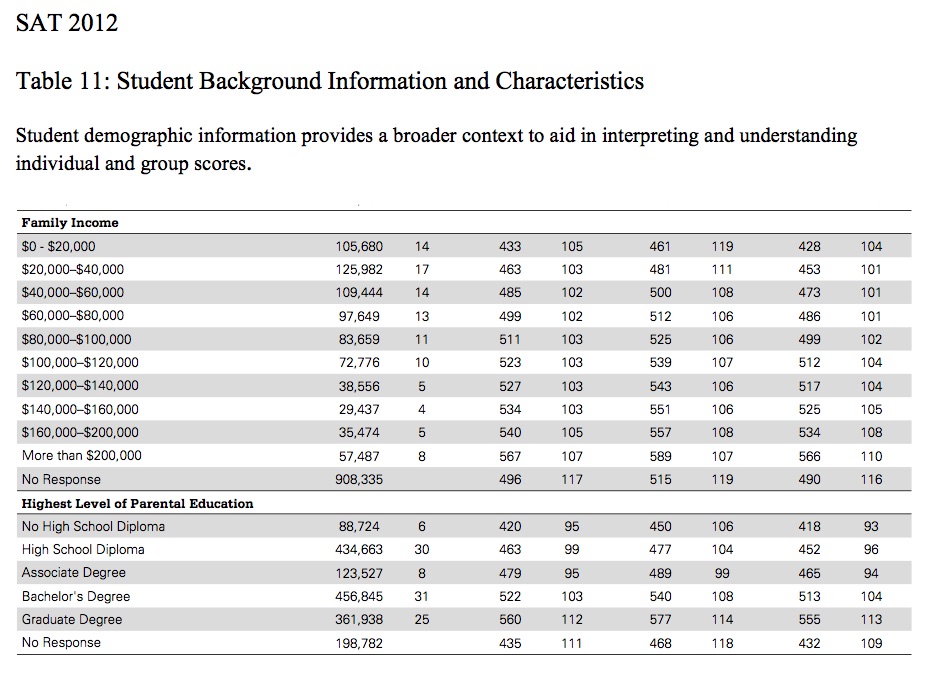
Results of standardized tests directly reflect students’ socio-economic status and their parents’ level of education. As data from the SAT show, student scores increase directly in line with parental wealth and education, thus misrepresenting college-preparedness, which is better represented by simple GPA:
Standardized tests reflect more out-of-school than in-school influences:
But in the big picture, roughly 60 percent of achievement outcomes is explained by student and family background characteristics (most are unobserved, but likely pertain to income/poverty). Observable and unobservable schooling factors explain roughly 20 percent, most of this (10-15 percent) being teacher effects. The rest of the variation (about 20 percent) is unexplained (error). In other words, though precise estimates vary, the preponderance of evidence shows that achievement differences between students are overwhelmingly attributable to factors outside of schools and classrooms (see Hanushek et al. 1998; Rockoff 2003; Goldhaber et al. 1999; Rowan et al. 2002; Nye et al. 2004).
Standardized test scores are also biased by gender and race, with whites and males scoring higher. However, test data are misinterpreted as exclusively student achievement.
In short, from the SAT and ACT to PARCC, I would argue, high-stakes tests perpetuate and even create inequity.
Education historian Herb Kliebard explains that US formal education embraced standardized testing in the early 20th century mostly because those tests were inexpensive and easy to implement.
In the process, a system has been set up that tolerates the many and more corrosive consequences of those tests.
We currently have no evidence, however, that PARCC has solved these historical and lingering problems with the inherently flawed and limited system of standardized testing.
Using standardized tests such as PARCC for high-stakes decisions about individual students or teachers will only continue to fail students but not to achieve goals of social and educational equity.
Education Needs a Collaboration (Non-Competitive) Pact
“The propagandist’s purpose is to make one set of people forget
that certain other sets of people are human.”
Huxley, Aldous. The Olive Tree. 1936.
While watching a documentary on schools recently, I felt that same uncomfortable feeling I do whenever I watch or read about this or that school “excelling”—notably the principal, but teachers as well, expressing how they have something different that is driving the school’s success.
Of course that claim caries the implication that other schools, teachers, and students are not doing that something different (hint: trying hard enough, demanding enough).
In this particular documentary, that something different included publicly identifying, labeling, and displaying students by test scores.
And while I have a great deal of compassion and collegial support for educators fighting the standardized testing craze corrupting U.S. public education, I feel compelled to note that many of those same educators turn right around and practice the same sort of tyranny with students—or quickly wave the testing data flag when their school seems to look good (although these claims of “miracles” are almost always mirages).
So here is a test we should all take.
Check all that apply: As a teacher or administrator in a school, do you …
[ ] use test scores to rank, compare, motivate, and/or shame students into working “harder”?
[ ] use test scores to rank, compare, motivate, and/or shame teachers within a department, grade level, or school into working “harder”?
[ ] use test scores to brag about your department, grade level, or school to parents or the media?
If any of these are checked, you have a decision: either stop complaining about high-stakes uses of test scores or stop doing all of the above.
If test scores are a flawed way to evaluate teachers and schools, they are a flawed way to evaluate teachers, schools, and students—and even when they work in your favor.
Thus, I recommend the latter choice above because education needs a collaboration (non-competitive) pact if we are to save the soul of our profession.
Recommended
Why competitive model fails schools. No one should lose in education, Alfredo Gaete and Stephanie Jones
De-Testing and De-Grading Schools: Authentic Alternatives to Accountability and Standardization, Bower and Thomas, eds.
Competition: A Multidisciplinary Analysis, Worthen, Henderson, Rasmussen, and Benson, eds.
Educators (Still) Have No Political Party
NOTE: Below is a repost from 23 August 2012 with small edits. With great regret, I see no reason to write something new since the Chicago mayoral election and the announcement of Hillary Clinton entering the presidential election have offered clear proof educators still have no political party. I do, however, offer some important additions after the repost from W.E.B. Du Bois and George Carlin. I recommend them highly.
$$$
Educators (Still) Have No Political Party
For about thirty years now, public education as well as its teachers and students have been the focus of an accountability era driven by recurring calls for and the implementation of so-called higher standards and incessant (and now “next generation”) testing. At two points during this era, educators could blame Ronald Reagan’s administration for feeding the media frenzy around the misleading A Nation at Risk and George W. Bush’s administration for federalizing the accountability era with No Child Left Behind (NCLB)—both under Republican administrations.
For those who argued that Republicans and Democrats were different sides of the same political coin beholden to corporate interests, education advocates could point to Republicans with an accusatory finger and claim the GOP was anti-public education while also endorsing Democrats as unwavering supporters of public education. To claim Republicans and Democrats were essentially the same was left to extremists and radicals, it seemed.
As we approach the fall of 2015 and the next presidential election, however, educators and advocates for public education have found that the position of the extremists—Republicans and Democrats are the same—has come true under the Barack Obama administration.
Educators have no political party to support because no political party supports educators, public education, or teachers unions.
Democrats and Republicans: Our Orwellian Future Is Now
“If you want a picture of the future, imagine a boot stamping on a human face—forever.”
1984, George Orwell
Behind the historical mask that Democrats support strongly public education and even teachers specifically and workers broadly, the Obama administration has presented a powerful and misleading education campaign that is driven by Obama as the good cop and Secretary of Education Arne Duncan as the bad cop. Obama Good Cop handles the discourse that appeals to educators by denouncing the rising test culture in 2011:
What is true, though, is, is that we have piled on a lot of standardized tests on our kids. Now, there’s nothing wrong with a standardized test being given occasionally just to give a baseline of where kids are at. Malia and Sasha, my two daughters, they just recently took a standardized test. But it wasn’t a high-stakes test. It wasn’t a test where they had to panic.
Yet, simultaneously, Secretary Duncan Bad Cop was endorsing and the USDOE was implementing Race to the Top, creating provisions for states to opt out of NCLB, and endorsing Common Core—each of which increases both the amount of standardized testing and the high-stakes associated with those tests by expanding the accountability from schools and students to teachers.
Under Obama, Democratic education policy and agendas, embodied by Duncan, have created a consistently inconsistent message. During his campaign mode for a second term, Obama once again offered conflicting claims about education—endorsing a focus on reducing class size (despite huge cuts for years in state budgets that have eliminated teachers and increased class size, which many education reformers endorse) and making a pitch to support teachers unions and even increasing spending on education, leading Diane Ravitch to ponder:
Well, it is good to hear the rhetoric. That’s a change. We can always hope that he means it. But that, of course, would mean ditching Race to the Top and all that absurd rightwing rhetoric about how schools can fix poverty, all by themselves.
Throughout his presidency, Obama’s discourse has been almost directly contradicted by Duncan’s discourse and the USDOE’s policies. Obama tended to state that teachers were the most important in-school influence on student learning while Duncan tends to continue omitting the “in-school” qualifier, but these nuances of language are of little value since the USDOE under Obama has an agenda nearly indistinguishable from Republican agendas:
- Incentivizing all states to adopt CC and the necessary increase in testing and textbook support (and thus, profit) to follow.
- Endorsing market dynamics and school choice by embracing the charter school movement, specifically charters such as Knowledge Is Power Program (KIPP) that practice “no excuses” ideologies for school reform and school cultures.
- Criticizing directly and indirectly public school teachers and perpetuating the “bad” teacher myth by calling for changes in teacher evaluations and compensation, disproportionately based on student test scores.
- Funding and endorsing the spread of test-based accountability to departments and colleges of education involved in teacher certification.
- Funding and endorsing the de-professionalization of teaching through support for Teach for America.
- Appealing to the populist message about choice by failing to confront the rise of “parent trigger” laws driven by corporate interests posing as concerned parents.
If my claim that Republicans and Democrats are different sides of the same misguided education reform coin still appears to be the claim of an extremist, the last point above should be examined carefully.
Note, for example, the connection between the issues endorsed by Democrats for Education Reform (DFER) and the anti-union sentiment joined with endorsing the next misleading Waiting for “Superman”—Won’t Back Down.
The Democratic National Convention was home to DFER, Parent Revolution, and Students First to promote Won’t Back Down as if this garbled film is a documentary—including a platform for Michelle Rhee.
There is nothing progressive about the education reform agenda under the Obama administration, nothing progressive about the realities behind Obama’s or Duncan’s discourse, nothing progressive about Rhee, Gates, or the growing legions of celebrity education reformers.
If the Democratic Party were committed to a progressive education platform, we would hear and see policy seeking ways to fund fully public schools, rejecting market solutions to social problems, supporting the professionalization of teachers, embracing the power and necessity of collective bargaining and tenure, protecting students from the negative impact of testing and textbook corporations, distancing themselves from Rhee-like conservatives in progressive clothing, and championing above everything else democratic ideals.
Instead, the merging of the education agenda between Democrats and Republicans is Orwellian, but it real, as Ravitch warned early in Obama’s administration:
This rhetoric represented a remarkable turn of events. It showed how the politics of education had been transformed. . . .Slogans long advocated by policy wonks on the right had migrated to and been embraced by policy wonks on the left. When Democrat think tanks say their party should support accountability and school choice, while rebuffing the teachers’ unions, you can bet that something has fundamentally changed in the political scene. (p. 22)
Still today in 2015, educators have no political party to support because no political party supports educators—and this is but one symptom of a larger disease killing the hope and promise of democracy in the U.S.
This tragic fact is the inevitable result of the historical call for teachers not to be political. Now that educators have no major party to support, the failure of that call is more palpable than ever.
Both the faux “not political” pose and playing the partisan political game fail educators, public education, and the democratic hope of the U.S.
—
Why I Won’t Vote, W.E.B. Dubois, The Nation, 20 October 1956
Confirmed: SC Implementing Retain to Impede
Residents of South Carolina have yet more evidence of the state’s inept history with education reform: The rush to model SC’s reading legislation on Florida’s failed policies has begun to fulfill my warning that Read to Succeed is better labeled Retain to Impede.
Nathaniel Clary, reporting for The Greenville News, has detailed, Read to Succeed fails its 1st test. What are the failures?
Clary ticks off the list:
And while communication lapses, missing training programs and a flubbed statewide test marked the first few months of the statewide Read to Succeed program championed by Gov. Nikki Haley last year, the threat still looms that third-graders could be held back starting in the 2017-2018 school year if they don’t measure up to the state’s reading standards.
These first failures include flawed implementation on top of the essential failures of replicating the discredited Florida model as well as ignoring a powerful body of research refuting grade retention.
Since SC passed reading legislation built on grade retention, the National Council of Teachers of English (NCTE), the largest organization of English teachers in the U.S., has taken a strong policy stand against the use of retention and high-stake testing in reading legislation:
Resolved, that the National Council of Teachers of English strongly oppose legislation mandating that children, in any grade level, who do not meet criteria in reading be retained.
And be it further resolved that NCTE strongly oppose the use of high-stakes test performance in reading as the criterion for student retention.
The evidence, then, is mounting that Read to Succeed is being implemented badly, but that does not justify this nod to optimism about the intent of the legislation and the election of a new state superintendent of education, Molly Spearman:
The intent of Read to Succeed is good, said Burke Royster, Greenville County Schools superintendent.
The tenor of Read to Succeed has changed significantly since Molly Spearman replaced Mick Zais as state superintendent of education, Royster said.
“I feel very positive that they’re going to address many of those issues,” he said.
We should all know the wise warning about good intentions, and at best, Spearman can oversee doing the wrong thing the right way—and that does not serve students or the state well.
Here, we are facing watershed moments, lessons that must be heeded if we are to shift directions in education policy. Those lessons include:
- Education policy must be divorced from political compromise (a compromise between partisan political ideology and evidence-based policy is corrupted policy). Reading legislation built on grade retention and high-stakes tests is a testament to the failure of partisan politics in forming education policy, but SC’s legislation (as well as Florida’s) is also a story of how compromise cannot work since many sincerely supporting good literacy practice in the state simply relinquished on the grade retention element in order to secure more funding for reading. We must ask: How many children’s lives are we willing to ruin to gain more state funding of programs?
- Intent behind education policy and even the details of education policy are irrelevant when that policy is actually implemented. This debacle with Read to Succeed is just a small version of the larger Common Core train wreck. To ask Superintendent Spearmen to right the implementation ship of this policy is falling well short of the need to scrap it, and then draft genuinely effective and credible reading policy for the state of SC.
- Professional educators must stop sitting on the sidelines, stop hiding behind resisting being political, and then start flexing our professional muscle. There is no excuse for professionals to implement harmful policy that is not supported by research. Literacy educators need to stand up for best practice in literacy and their students.
Retaining children impedes their possibilities.
Decades of research on literacy and grade retention have shown us that fact, but partisan politics trumps evidence in education policy.
With these facts before us, what will we do?
Police Officers and Teachers: Confronting Corrupt Cultures, Avoiding “Bad Police/Teacher” Narratives
Officer Michael Slager shooting and killing Walter Scott in North Charleston, South Carolina—with a video discrediting Slager’s version of the events (and exposing what Frank Serpico calls “testi-lying”)—has cast another dark cloud over justice in the U.S.
More recent revelations of Slager laughing after the shooting add, if possible, even more incredible to an already horrifying series of events. The context of that laughter, however, must not be ignored:
In the recording, a man the paper identified as Slager can be heard asking an unnamed senior officer what would happen next.
“They’re gonna tell you you’re gonna be out for a couple of days and we’ll come back and interview you then,” the senior officer is heard saying in the clip. “They’re not going to ask you any kind of questions right now. They’ll take your weapon and we’ll go from there. That’s pretty much it.”
The senior officer also urged Slager to write down his recollections of the incident.
“The last one we had, they waited a couple of days to interview officially, like, sit down and tell what happened. By the time you get home, it would probably be a good idea to kind of jot down your thoughts on what happened,” he advised. “You know, once the adrenaline quits pumping.”
“It’s pumping,” Slager said, laughing as he spoke.
This exchange appears to be a specific example of yet another norm of policing in the U.S.—one different but related to the inequity of criminal justice for black males—in that using deadly force requires officers simply to wait a few days until it all passes over. Deadly force seems all too common place, and essentially poses almost no consequences for the officer, who nervous, pumped up, and deeply calloused by his work, simply laughs.
I think we will make a terrible mistake if we simply conclude Slager is either a “bad apple” or inherently (although isolated) soulless. Dehumanizing police officer will not address the great failure of policing that dehumanizes black males.
Instead, we should be asking, what could possibly have led to Slager’s shooting, dishonesty, and laughter? Just as we should be asking, why would so many Atlanta teachers change test answers?
•
My wife and I combined have over 50 years as educators, and her father was a highway patrolman in SC. So is our nephew. I have several close friends who are police officers.
In other words, I am deeply sympathetic to the difficulties of serving as either a teacher or a police officer. But I am simultaneously, because of my intimate knowledge of both fields, highly protective of the necessity for teachers and police officers to serve and protect—not breech the dignity of those they serve.
I have the highest standards for teachers and police officers, and I fear the U.S. is increasingly moving to a careless demonizing of both professions.
The “bad” teacher myth had already begun when the spectacle of police officer shootings of black men reached a critical mass in the media, demanding the U.S. pay attention (despite racial inequity in the justice system being a historical reality in this country).
The current intense focus, then, on police officers and teachers requires careful consideration.
First, we must admit that all professions have a range of quality among the members of any profession; as well, we must admit that some professions have necessarily less tolerance for low quality within the profession—such as airline pilots, surgeons, pharmacists, and I would argue, teachers and police officers.
Next, even within those professions requiring high standards for members and low tolerance for weak members, we cannot discount how the working environment and norms of the profession are reflected in professionals’ behavior.
A pharmacist required to fill prescriptions at too high a rate is more likely to make mistakes. A pilot required to fly too many hours in a short span of time is more likely to make life-threatening errors.
Policing and teaching as service fields are certainly not exempt from those realities. Policing and teaching, in fact, share the consequence of both professions being much harder under the weight of impoverished communities, especially in urban settings, that are disproportionately racially majority minority.
As many have noted, the teacher cheating scandal in Atlanta may reflect more significantly the corrupt culture of high-stakes accountability than the individual faults of those teachers convicted.
Also being recognized is that police shootings of black men are equally powerful reflections of a racially inequitable criminal justice culture that also seems in the U.S. to have too low a bar for the use of deadly force—at least for some (black and male) suspects.
In the U.S., I believe, we do not know if we have a police officer and teacher quality problem because the cultures within which both work are so corrupted that police officer and teacher behavior can be misread as “bad apples” (or an “isolated incident”) instead of agents or consequences of the “burden of the impossible.”
If we care about teacher quality, we must significantly change the culture of teaching and learning by ending high-stakes accountability and competition within our schools.
If we care about police officer quality, we must significantly change the culture of deadly force (which many other countries have accomplished) and racially biased criminal justice.
Our schools and criminal justice system are too often ugly reflections of the worst aspects of our society—despite political and popular claims that both public institutions are designed to support and even build the life, liberty, and pursuit of happiness we claim to embrace for everyone.
As such, we must start by avoiding the urge to blame “bad” police and “bad” teachers and instead by confronting how the norms of policing and teaching too often produce police and teacher behavior that is harmful to our entire way of living, especially for the impoverished and racial minorities who most need public institutions to serve and protect them.
Bicycling and Education: More on the Burden of the Impossible
I have been both a serious educator and cyclist for around 30 years, and I am often struck how competitive group cycling offers us important lessons about how we tend to fail the promise of universal public education.
Competitive cycling—many people probably do not realize—is a team sport, and even recreational cyclists (as my friends and I are) often ride within the same principles of team competitive cycling.
As well, professional cycling (which has several layers similar to Major League baseball in the U.S.) has a long history of corruption—doping (performance-enhancing drugs, or PEDs).
Both the principles of group cycling and the culture of doping help explain some of the failures of how we do schooling in the U.S.
Collaboration Trumps Competition
I have been cycling in the Greenville-Spartanburg area of Upstate South Carolina for three decades—as a part of a very organized cycling community (we post group rides 6-days a week throughout the entire year) and several different bicycle clubs and teams (currently globalbike Spartanburg).
Over those years, we have maintained a nucleus of cyclists and a revolving door of new riders, often runners and other elite athletes looking for a different challenge.
One of the recurring problems of integrating new riders into cycling is the complex culture of the sport (road cycling is tradition-rich, and also a bit insular) as well as the principles guiding riding in an organized pack, specifically participating in a paceline:
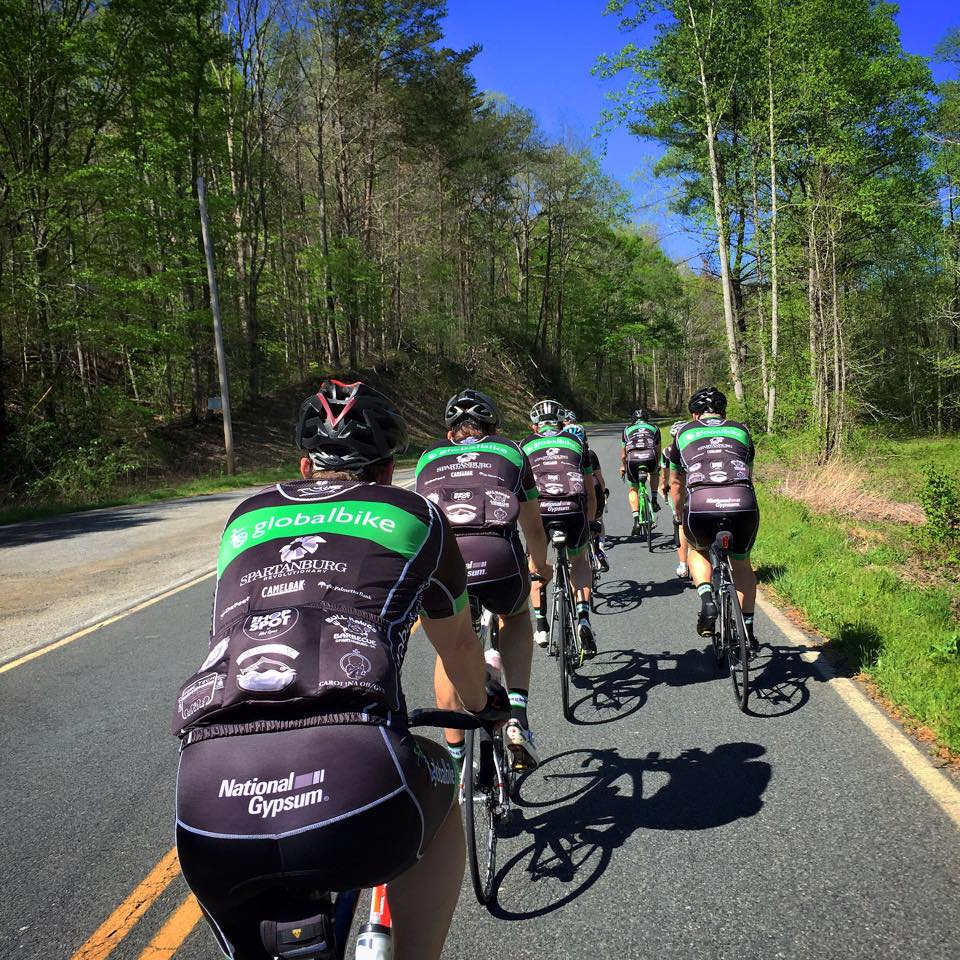
A group of organized cyclists (a paceline or eschelon) can ride faster and longer than a cyclist on her/his own. The key to that group advantage is that the principles governing a paceline are built on cooperation and not competition.
Cyclists in a paceline work in ways that consider the impact of the wind, the abilities of the cyclists (strong riders taking longer pulls with weaker riders sitting on, or not participating in the pulls), and the advantages/disadvantages of drafting.
For example, a paceline is constructed of two lines of riders, one driving the pace forward and another receding (to allow riders to rest and to block sidewind from the advancing riders who are pulling). If there is sidewind, the receding line should be on the side that blocks that sidewind from the advancing line, but always, the advancing line must create a pace that is consistent (riders must not surge when pulling through, and as well, after taking a pull, the rider pulling through to the receding line must ease off the pace slightly):
A paceline with a group of committed riders is an amazing thing to watch. A paceline with riders trying to disrupt the group (attacking or flicking [purposefully creating gaps for weaker riders in order to drop her/him from the group]) or without any regard for the principles of cooperation is a nightmare.
And that is the central problem with education and education reform in the U.S. over the last thirty years—a culture of competition instead of cooperation.
Demanding that each group of students surpass the group of students coming before is the same sort of disruption, the same sort of failure to understand key principles that we witness as cyclists when “that guy” surges through each time he rotates to the front in a paceline.
Group cycling is beautiful, efficient, and effective when everyone works collaboratively, but falls apart even when one or two riders decide to compete, choose to ignore the common good of the group. The best cyclists are always aware of both their own cycling as well as the entire pack of cyclists—a supple balance of the individual and the community.
Each fall, a group of 15 or so of my cycling community does a 220-240-mile ride in one day (11-12 hours of cycling and a 14+-hour day) from the Upstate of SC to the coast. This ride seems impossible for regular people who have jobs and ride bicycles for a hobby, but it is a testament to collaboration since the riders have a wide range of ability and fitness, but our goal is always having everyone arrive safely and together.
We all ride with both our own success and the success of the entire group guiding how we ride.
The single greatest reform we need in public education in the U.S. is to adopt a culture of cooperation (reject merit pay; reject VAM; reject testing students to label, rank, and sort; reject labeling and ranking schools and states by test scores; reject international rankings by test scores; reject school choice—vouchers, charter schools, etc.) and not competition.
“The Burden of the Impossible” and the Inevitable Allure of Cheating
Beyond the abundant evidence that collaboration is more powerful in most ways than competition, collaboration trumps competition since competition has many negative consequences.
Few examples are more powerful for those negative consequences than professional cycling and recently the cheating scandals in education.
Human athletic achievements are plagued by the pursuit of the amazing—less often are we willing to marvel in the essential. The U.S. sporting public struggles to understand the “beautiful game,” football/soccer matches that end nil-nil, because of the lust for scoring without an appreciation for the artistry of playing the sport.
Professional cycling has suffered—and failed to address—the direct relationship between creating “the burden of the impossible” and the inevitable cheating that has followed, over and over for decades.
Spring classics—one-day races often over cobbled roads, undulating terrain, and hellish spring weather—can cover 150-180 miles, and the grand tours (Tour de France, Giro d’Italia) last three weeks, averaging 100 miles a day and including the highest mountains of Europe. In fact, professional cycling seeks conditions (cobbles, mountains) that insure natural selection will separate cyclists despite the efforts of teams to work collaboratively.
The most recent, and possibly the most publicized, example of doping in professional cycling is personified by Lance Armstrong; two aspects of the Armstrong doping scandal are underemphasized, I think.
First, Armstrong and dozens of the best cyclists of his era (1990s and through the first decade of the 2000s) all have confessed to organized doping, noting that the decision to use PEDs was strongly influenced by a culture of competition that essentially required doping.
Cyclists who chose to ride clean tended to ride in obscurity, or eventually simply quit the sport.
Next, the revelation of doping by Armstrong and most elite cyclists of his era has resulted in demonizing and punishing individual cyclists—with Armstrong the most vilified.
Hundreds of race organizers, corporations, cycling team owners and leaders, and media outlets raked in millions and millions of dollars during the peak of Armstrong’s career because of the amazing and record-breaking (and PED-fueled) exploits of Armstrong—but essentially none of them have been asked to return that money, none held culpable for the culture within which those cyclists felt compelled to dope.
Especially in the U.S., the accusatory gaze focuses on failed individuals but refuses to consider the cultural or social norms that shape individual behavior.
It takes little imagination, then, to see how the culture of doping in professional cycling informs the rise of test cheating in U.S. public education under the “burden of the impossible”—the accountability mandates of education reform.
Prosecute and imprison educators who cheated, but ask not what led these people to such extremes, consider not that humans faced with the “burden of the impossible” are being completely rational to behave in ways that would not be reasonable if the rules were fair.
•
Serious recreational cyclists have much different reasons for cycling than professional cyclists, and for the most part, we create and maintain a culture of collaboration and cooperation so that everyone can excel, everyone can enjoy the beauty that is cycling.
Spaces dedicated to formal education are best served by that spirit of collaboration and cooperation, but are corrupted by a culture of competition.
While professional cycling (and all huge-money professional sport) may be beyond repair, education could be otherwise.
In order to end the rise of cheating in education (among educators or students), in order to close the so-called achievement gap, in order to end the inequity of opportunity and outcomes that characterize our public schools—end competition in education in all forms and begin a new era of collaboration and cooperation.
 dr. p.l. (paul) thomas