Category Archives: Education

Good Intentions, Political Realities, Privileged Cluelessness: On Education Reform and Poverty

Education and education reform are vibrant examples of the wide spectrum of good people with good intentions and then all the way to the other extreme, spurious people with dubious intentions.

When my home state of South Carolina began sliding down that slippery slope of adopting (flawed and misrepresented) reading policy modeled on Florida, I came face to face (actually, voice to voice) with the harsh realization that good people with good intentions can be as harmful as spurious people with dubious intentions: Good people with whom I had been talking suddenly brushed me off, citing political expediency—better to get the money for reading and swallow the horrible grade retention element than to get no money at all, I was told.

I thought of this when I saw associate editor at The State Cindi Scoppe’s To fix SC schools, start with governance. Scoppe, for full disclosure, has published a number of my Op-Eds in The State, notable is that my positions are decidedly not in line with the politics or ideology of my home state.

Also, I am certain Scoppe is a good person with good intentions; she genuinely wants equitable and effective schools for all children in SC.

However, I also know good intentions (even mine) are not enough.

Scoppe opens with admitting she isn’t an expert on educating students, and then offers a relatively modest plan for education reform—ones she characterizes as “commonsense reforms that come from across the political spectrum.” Scoppe endorses the “best ideas from the right and left,” including:

  • Making it easier to fire bad teachers (right);
  • increasing teacher pay to teach impoverished students, and freeing teachers from non-teaching tasks (left);
  • increasing charter schools, magnet schools, and parental choice, and giving schools more freedom in spending (right);
  • implementing a better school funding formula, with more equity, and pursuing, possibly, district/school consolidation (left).

My immediate response was to share on Twitter my argument that we need not simply appease the political right and left, or the public, but instead should endorse evidence-based reform addressing equity.

So that leaves these questions:

  • Are bad teachers, and the difficulty firing them, major (or even minor) hurdles to high-quality education for all children in SC? I have never seen anyone making this claim show evidence that this is true. I am deeply skeptical of these claims, also, in a right-to-work state where teachers’ unions have no legal power and very limited buy-in by K-12 teachers in the state. The real teacher quality problem in SC (and across the U.S.) is a tremendous inequity of teacher assignment: affluent and white students disproportionately have experienced and certified/qualified teachers while impoverished, minority, ELL, and special needs students disproportionately have beginning/inexperienced and un-/under-certified/qualified teachers.
  • Would targeted merit pay for teaching high-needs students and relief from non-teaching tasks help improve education for high-poverty, majority-minority schools (notably along the Corridor of Shame)? Unlikely, since legislation in the past in SC has included both, unsuccessfully. Merit pay has been discredited for education (as well as all professions) in general, in fact (see the work of Daniel PinkAlfie Kohn, and Joe Bower). What we do know is that teachers are more motivated by teaching and learning conditions as well as support from administration and parents than by merit pay schemes. Step one for encouraging teachers to work with high-needs students is addressing directly teaching/learning conditions in high-poverty schools. Step two is to reject teacher evaluation plans that are predicted to discourage high-quality teachers from working with the students having the greatest needs.
  • Are investments in charter schools, magnet schools, and parental choice effective reform measures for achieving educational equity? No. Charters schools in SC have shown that 95% of charters perform about the same and worse than public schools while also being highly segregated and often underserving ELL and special needs students. And the sloganism of “parental choice” hasn’t proven to be effective either; many efforts to increase parental choice have shown parents rarely choose based on academic quality, but tend to seek social or ideological goals.
  • Does SC need a better school funding formula, one that is more equitable, and one that likely will require consolidation of schools/districts? Yes, with caveats. Here, evidence is key. While there is a “common sense” argument that “money doesn’t matter” or “you can’t just throw money at schools,” solid and long-standing research refutes both; see the work of Bruce Baker. SC needs a new funding formula, but it must not be a partisan political event, and it must be based on research and not talking points. And as a powerful example, school/district consolidation is exactly one of those common sense ideas that research challenges: “While state-level consolidation proposals may serve a public relations purpose in times of crisis, they are unlikely to be a reliable way to obtain substantive fiscal or educational improvement.”

Good intentions and political expediency, then, simply are not enough—and are likely to keep SC mired in bad education reform piled on top of the historical and lingering cancers of racism and concentrated poverty.

Which brings us to the other side of the spectrum—spurious people with dubious intentions, in this case the grand whitesplainer employed by The New York Times.

I refuse to mention he-who-shall-not-be-named, and gross stereotyping of people in poverty deserves as little attention as possible, but for balance here, I offer a wonderful refuting by Elizabeth Stoker Bruenig, Poor People Don’t Need Better Social Norms. They Need Better Social Policies.

And also, Emmitt Rensin offers a thorough unpacking and discrediting of “blame the poor” mentalities:

It would be one thing if we didn’t recognize the problem of American poverty. It would be easy if the moral scolding of our poor were confined to one section of our polity. Then we might pursue the many avenues of fiscal and monetary policy available to us. But among even those whose rhetoric suggests an awareness of the situation, even those who know that to be born monied in America is to be heir to a self-fulfilling prophesy of the kind of “good” behavior Brooks is crying out for, are so easily seduced by a reversal of effect and cause.

But out here, poor parents, poor kids and poor schools don’t have the luxury of indulging Brook’s harmful, costly relativism. They live by the most inflexible “code” of our national life: If you’re poor, you’re on your own. Good luck. Oh, and we’ll be watching. Future pay will reflect performance….

We aren’t bereft of ideals. Rather, we are plagued with bad ones—that discipline is proved by wealth, that the ideas of middle class luxury help children more than material wealth.

A better set might be the kind that makes the elected, empowered, ostensible advocates of America’s poor ask “tough questions” about their culpability in the condition of “our kids.” The kind that recognizes that there is a moral failure at the bottom of American poverty—but this failure does not belong to its own victims.

I will end with this: U.S. public education, notably in SC, is a disturbing reflection of the inexcusable inequity in our country not the result of anyone’s effort or character, but the consequences of privilege and inequity.

Until we make political, media, and public efforts to eradicate inequity and poverty—including that we rise above the hatred aimed at impoverished people, racial minorities, and women—from our society and our schools, whether we fire bad teachers, add more charter schools, or not will make little difference.
Middle-Class Assumptions Fail Literacy Instruction

My doctoral work was anchored significantly in John Dewey—highlighted, I recall, by discovering that Dewey had claimed we need not teach children to read because reading was something that naturally developed in children (and since he could not recall being taught explicitly to read).

I was struck by such a tremendous failure in a great thinker, one that exposes the dangers of assuming “my” experiences prove a generalization, especially when “my” experiences are ones of privilege.

When I posted Encouraging Students to Read: A Reader, this odd fact about Dewey came back to me when Peter Smagorinsky called me out, appropriately, for failing to acknowledge the middle-class assumptions beneath endorsing holistic approaches to teaching reading, ones that far too often have failed students who struggle to develop literacy due to class, race, gender, and other challenges.

I have noted before that progressivism, whole language, and balanced literacy have been misunderstood by politicians, the media, and the public, but we must also confront that practitioners have misunderstood and then implemented progressive and holistic approaches to literacy instruction in ways that have been extremely harmful to the exact students most in need of formal schooling.

The Dewey Paradox

Two aspects of Dewey’s progressive education philosophy are key in that context: (i) Dewey’s progressivism is steeped in idealism, leaning precariously on the edge of naturalistic views of children and learning (one that may be true if a child lives in privilege), and thus (ii) Dewey’s progressivism has mostly been misinterpreted and implemented in ways that do not reflect Dewey’s foundational commitments or serve many students well.

Not to be an apologist for Dewey, but to help clarify what many of us who stand on Dewey’s shoulders embrace (noting that I am a critical educator, and not a progressive), I recommend Dewey’s Experience and Education as well as Alan Ryan’s biography of Dewey (specifically his Chapter Four: The Pedagogue as Prophet).

For me, Dewey provided the seed for critical pedagogy to grow out of the soil of progressivism:

It is not too much to say that an educational philosophy which professes to be based on the idea of freedom may become as dogmatic as ever was the traditional education which is reacted against. For any theory and set of practices is dogmatic which is not based upon critical examination of its own underlying principles. (Experience and Education, p. 22)

In the reading wars, then, dogmatic commitments to either whole language or isolated phonics instruction instead of addressing the needs of each individual student to become a reader is the great failure Dewey himself would have acknowledged.

Misreading Dewey, however, has a long tradition itself. Lou LaBrant, a fervent Dewey progressive, wrote in 1931 a scathing attack on the project method, which claimed to be in the Dewey tradition:

The cause for my wrath is not new or single. It is of slow growth and has many characteristics. It is known to many as a variation of the project method; to me, as the soap performance. With the project, neatly defined by theorizing educators as “a purposeful activity carried to a successful conclusion,” I know better than to be at war. With what passes for purposeful activity and is unfortunately carried to a conclusion because it will kill time, I have much to complain. To be, for a moment, coherent: I am disturbed by the practice, much more common than our publications would indicate, of using the carving of little toy boats and castles, the dressing of quaint dolls, the pasting of advertising pictures, and the manipulation of clay and soap as the teaching of English literature. (p. 245)

Ryan’s biography achieves a manageable and complex picture of Dewey—one that Dewey failed to express clearly. But in that picture, we see the idealism noted above as well as a level of sophistication (for example, seeking to honor both the individual and community, instead of bowing to either/or thinking) that made Dewey hard for a general public and often inaccessible for practitioners who want the practical and not his pragmatic [1].

However, “Dewey himself argued that it was not enough to repudiate traditional education,” Ryan explains, adding:

It was not enough for progressive teachers to throw out everything the old schools had done, to replace discipline by chaos, a rigid syllabus with no syllabus. And Dewey was inclined to think that many schools had done exactly that and had used his name to justify it. The difficulty was to give an account of the educational experience that would elicit a kind of discipline, an approach to the syllabus and to the authority of the teacher in the classroom that would grow out of experience itself. (p. 282)

And it is here that I can speak directly to the great paradox of progressive and critical commitments in education, especially in terms of teaching literacy, as expressed by Dewey himself:

What avail is it to win prescribed amounts of information about geography and history, to win ability to read and write, if in the process the individual loses his own soul: loses his appreciation of things worth while, of the values to which these things are relative; if he loses desire to apply what he has learned and, above all, loses the ability to extract meaning from his future experiences as they occur? (Experience and Education, p. 49)

Teaching for over thirty years while attempting to avoid prescription and indoctrination, to foster joy and pleasure in learning, and to provide all students with the content they deserve and need has often lead to paralysis since those commitments are overwhelming in their contradictions. I have never settled for decoding or even comprehension in any student—always demanding we rise to include critical literacy that requires that students have the decoding and comprehension as well.

Despite Dewey’s warning, dogmatism is easier, and as Ryan warned, Dewey’s progressivism demands more of teachers than traditional approaches. And thus, when faced with the most challenging populations of students, we too often take the path of least resistance, mis-serving those students along the way.

Enter Delpit: Middle-Class Assumptions Fail Literacy Instruction

What appears to have happened in formal education throughout the U.S. is that literacy education has increased the gaps among social classes and racial subgroups because too often than not we have failed to honor the balance between fostering a love and joy for language with the necessary skills to read and write—and the students who suffer the most in that failure have been racial minorities and impoverished children.

Affluent students are allowed to relish in the joy of language (reaping the advantages of their privilege, which includes a literacy growth that seems transparent to them, as it did to Dewey) in formal schooling, while struggling students (disproportionately children of color and impoverished) are sentenced to drudgery masquerading as literacy instruction, further disadvantaging them.

Middle-class norms drive a great deal of practice in formal schooling since the wider U.S. society is trapped in those middle-class norms (ones that include not only socioeconomic but also racial [read “white”] expectations) and since the teacher workforce in the U.S. is itself a middle-class profession dominated by white females.

These middle-class blinders can be observed in the misguided embracing of Ruby Payne’s stereotypes about poverty, the nearly universal acceptance of the “word gap,” and the “grit” narrative as a veneer for white privilege.

Just as Dewey’s progressivism needed a critical re-imagining from Paulo Freire and others, Freire’s critical pedagogy needed bell hooks and others to confront Freire’s paternalism.

Then, enter Lisa Delpit, who provides the confrontation of the failures of misunderstood progressivism and holistic approaches to literacy instruction—the failures that often misrepresent whole language but exist under that terminology (see Ryan’s point about Dewey’s complaints above).

Writing in 1996 about Delpit, Debora Viadero explains:

But Delpit is best-known for the bombs she has lobbed at some of contemporary education’s most sacred cows.

A decade ago, Delpit started penning a series of eloquent, plain-spoken essays in the Harvard Educational Review that questioned the validity of some popular teaching strategies for African-American students. The essays were spun off into a book, Other People’s Children: Cultural Conflict in the Classroom, that was published last year by The New Press.

The problem, Delpit says in those writings, is not that whole-language reading instruction techniques or the process-writing approach to teaching writing are inherently bad. They work for some students–possibly most. They just do not work for everybody. And often the people they do not work for are children who, like Delpit herself, were born black and disenfranchised. What is more, these strategies might not work for children of any group that has strong, distinctive cultural roots and that stands on society’s perimeter peering in.

And while some continue to misrepresent Delpit in similar ways to how Dewey was/is misrepresented, Delpit offers to me the best understanding of achieving the balance Dewey sought.

The powerful phrase “other people’s children” comes from the work of Delpit, who confronts the inequity of educational opportunities for minority and impoverished children. Delpit highlights that marginalized students receive disproportionately test-prep and worksheet-driven instruction, unlike their white and affluent peers. While some have claimed her as a champion of traditional practice because her criticisms have included failures by progressives, Delpit counters:

I do not advocate a simplistic “basic skills” approach for children outside of the culture of power. It would be (and has been) tragic to operate as if these children were incapable of critical and higher-order thinking and reasoning. Rather, I suggest that schools must provide these children the content that other families from a different cultural orientation provide at home. This does not mean separating children according to family background [emphasis added], but instead, ensuring that each classroom incorporate strategies appropriate for all the children in its confines.

And I do not advocate that it is the school’s job to attempt to change the homes of poor and nonwhite children to match the homes of those in the culture of power [emphasis added]. That may indeed be a form of cultural genocide. I have frequently heard schools call poor parents “uncaring” when parents respond to the school’s urging, saying, “But that’s the school’s job.” What the school personnel fail to understand is that if the parents were members of the culture of power and lived by its rules and codes, then they would transmit those codes to their children. In fact, they transmit another culture that children must learn at home in order to survive in their communities.

And Monique Redeaux clarifies:

When Delpit began her work on “other people’s children” she predicted that her purpose would be misunderstood. People criticized her for “vindicating” teachers who subjected students of color to isolated, meaningless, sub-skills day after day. However, what she was actually advocating when she referred to “skills-based instruction” was the “useful and usable knowledge that contributes to a student’s ability to communicate effectively in standard, generally acceptable literary forms” and she proposed that this was best learned in meaningful contexts. In other words, Delpit argued that both technical skills and critical thinking are essential: a person of color who has no critical thinking skills becomes the “trainable, low-level functionary of the dominant society, simply the grease that keeps the institutions which orchestrate his or her oppression running smoothly.” At the same time, those who lack the technical skills demanded by colleges, universities, and employers will be denied entry into these institutions. Consequently, they will attain financial and social success only within the “disenfranchised underworld.”

Like my progressive muse LaBrant, I remain convinced that reading programs—including prescriptive, systematic phonics programs—are “costume parties” that fail our students—and waste a tremendous amount of funding and instructional time, money and time better spent with authentic texts.

But when I endorse choice, independent reading, and access to books, like Delpit, I am not excusing those who idealize those commitments (through middle-class lenses) and then fail to teach reading (or writing) based on the needs of each student, some of whom will flourish with little guidance and some of whom need intensive and direct instruction.

It is no petty thing to acknowledge that a hungry or abused or frightened child will not find joy in reading when allowed choice, independent reading, and access to books because those do not address the burdens denying them that joy and learning opportunity. It is no petty thing either to note that taking struggling students and simply demanding they ignore their life’s inequities and complete phonics worksheets will not work as well.

As Dewey would stress, either/or thinking and dogmatism serve no one well when we are teaching children to read and write. Too often, that dogmatism has its roots in our middle-class privilege that, as with Dewey, blinds us to what our students need most from our teaching.

[1] As Ryan explains: “Dewey spent a great deal of his adult life explaining that ‘pragmatic’ did not mean ‘practical’ in a merely utilitarian and down-to-earth sense” (p. 225).

Conservative Talking Points Wrong for SC Education

Political science professor Brent Nelsen argues Conservatives should support public school reform. However, this commentary proves to be not credible commitments for needed education reform in South Carolina but a series of unsubstantiated conservative talking points.

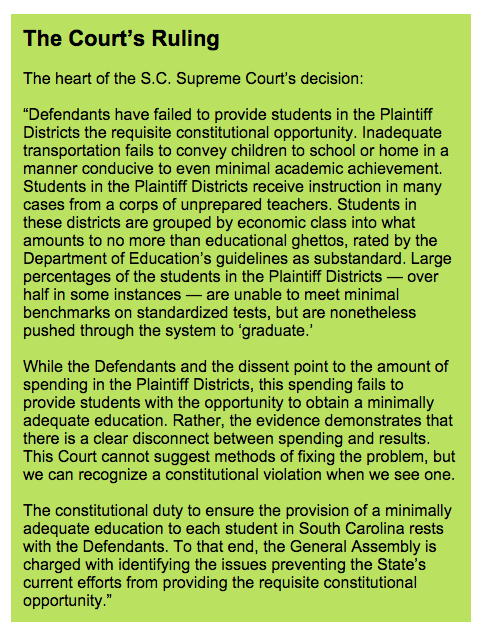
After opening by defining conservatism and establishing that conservatives recognize the need for education reform, Nelsen misrepresents significantly a foundational issue facing SC: “The recent Supreme Court decision highlighting the failure of many public schools puts education at the top of the policy agenda.”

The Supreme Court in SC, in fact, finally ruled on a court case made infamous by the documentary Corridor of Shame [1], true, but the ruling addresses inadequate state support for high-poverty communities and their schools:

SC SC Corridor ruling

As Eva Moore reports:

In a narrow 3-2 decision, the court said South Carolina needs to fix the way it funds education….

“As the court pointed out, it’s a fragmented, inefficient, ineffective method of funding,” Epps says. “Historically the General Assembly has played shell games with the funding. It’s inconsistent and extremely inefficient.”…

The school districts themselves bear some blame, according to the court. They’re administration-heavy and should explore consolidation.

But the bulk of the blame lies with the state of South Carolina.

All parties must work together to create a fairer funding model “within a reasonable amount of time,” the court ruled. In the meantime, the court retains jurisdiction in the case.

A fair but complex representation of SC’s need for education reform, then, must address a historical failure by the conservative political leadership of the state to support adequately both high-poverty communities and the schools that serve those children.

Immediately following this glossing of a major issue facing the state, Nelsen makes a disturbing claim:

But conservatives have allowed liberals to monopolize the public education conversation, promoting private and home school options while leaving the debate over public schools to less conservative voices. Not only does this lead to bad policy, it is also bad politics.

SC’s political and cultural history is solidly conservative, leaning toward a Tea Party conservatism that clings to state’s rights. Even when the South was voting Democrat, SC was conservative, and in the recent years, SC politics is dominated by Republicans.

There are in fact no issues in the state of SC “monopolized” by liberals because progressive and liberal voices are nearly absent from politics, the media, or public debate.

However, Nelsen’s opening shot at “liberals” is solid evidence that this commentary is mostly conservative talking points designed to trigger a targeted political base—the tried-and-true straw men of political discourse in SC linked with the more recent straw men of conservative education reform: liberals and unions along with “bad” teachers, “status quo,” “trap[ped] students in failing schools,” and “throw[ing] tax dollars at problems.”

In SC and across the U.S., these are both common refrains and mostly without merit. For example, the union bashing in SC seems misplaced since we are a right-to-work state. Striking out at liberals and unions in SC is boxing with ghosts.

How about, then, the policy recommendations tagged as “conservative”?

High-stakes uses of teacher VAM scores could easily have additional negative consequences for children’s education. These include increased pressure to teach to the test, more competition and less cooperation among the teachers within a school, and resentment or avoidance of students who do not score well. In the most successful schools, teachers work together effectively (Atteberry & Bryk, 2010). If teachers are placed in competition with one another for bonuses or even future employment, their collaborative arrangements for the benefit of individual students as well as the supportive peer and mentoring relationships that help beginning teachers learn to teach better may suffer. (p. 24)

  • Nelsen also endorses increasing support for public charter schools and “expanding the ability of low-income students to attend private schools” (which appears to avoid the how, vouchers, because vouchers are unpopular and discredited). Charter schools are the new school-choice-light for conservatives and market-committed Democrats, but there is a problem with that advocacy, highlighted by SC. Of the 50+ charter schools each year in SC, about 95% of charter schools have student outcomes the same or worse than comparable public schools. As well, in SC and across the U.S., charter schools avoid mandates public schools cannot; charter schools underserve English language learners and special needs students; and charter schools tend to be highly segregated by race and social class. Charter school advocacy is the hollow politics of waving the “parental choice” flag without doing the hard work called for by SC’s Supreme Court—fully funding and supporting the existing public school system that SC has failed.
  • Finally, Nelsen builds to the most troubling conservative option: closing, as Nelsen’s curious word choice identifies, “[p]oor schools” and adopting state take-over practices such as the Tennessee Achievement School District (ASD). Setting aside that Nelsen is associating state government take-over as conservative while opening with a nod toward “small government,” endorsing the ASD is deeply flawed. Nelsen claims inaccurately: “The results in Tennessee are impressive so far. Students have posted double-digit gains in math, science and literacy — outpacing improvements in other public schools”—when actually, like charter schools in general, the ASD has not performed much different than public schools, according to a 2014 analysis:

My analysis suggests that ASD schools aren’t doing significantly better in terms of student growth than they were before state takeover. In fact, in many cases the schools’ pre-takeover growth outperformed the ASD. These findings have significant implications for the future of the ASD, how we should move forward with continued takeovers, and for future turn-around efforts in general.

From Tennessee to New Orleans to Los Angeles, claims of successful take-over strategies have been discredited, but those take-overs have resulted mostly in disenfranchised children and communities while providing political capital for advocates.

SC education reform doesn’t need conservative talking points, then. Although as I have argued, fiscally conservative principles do support SC changing course in education reform, but that commitment requires acknowledging the accountability movement has not worked and then taking the Supreme Court’s ruling seriously.

SC has an entrenched poverty problem linked to lingering racial and economic inequity that destroys communities and overburdens the schools designed to serve those communities. Partisan conservative political leadership has created and maintained that status quo, and conservative doubling-down would be yet more remedies as part of the disease.

See Also

The Sad History of State Takeovers of Schools and School Districts, Jan Resseger

Opinion: New Orleans takeover is a model — of what not to do with Georgia schools, J. Celeste Lay

VAM Remedy Part of Inequity Disease

Review [UPDATED]: “How to Evaluate and Retain Effective Teachers” (League of Women Voters of SC)

‘Race to the Top’ for education a flop, report finds, Nirvi Shah

The Fatal Flaw Of Education Reform, Matthew Di Carlo

Value-Added, For The Record, Matthew Di Carlo

Time to End the ASD Fiasco

South Carolina and Education Reform: A Reader

Sorry, Kirp’s Fix Another Flawed Discourse on Ed Reform

What We Know Now (and How It Doesn’t Matter)

NPR Whitewashes Charter Schools and Disaster Capitalism in New Orleans

Preventing Arson Instead of Putting Out Fires

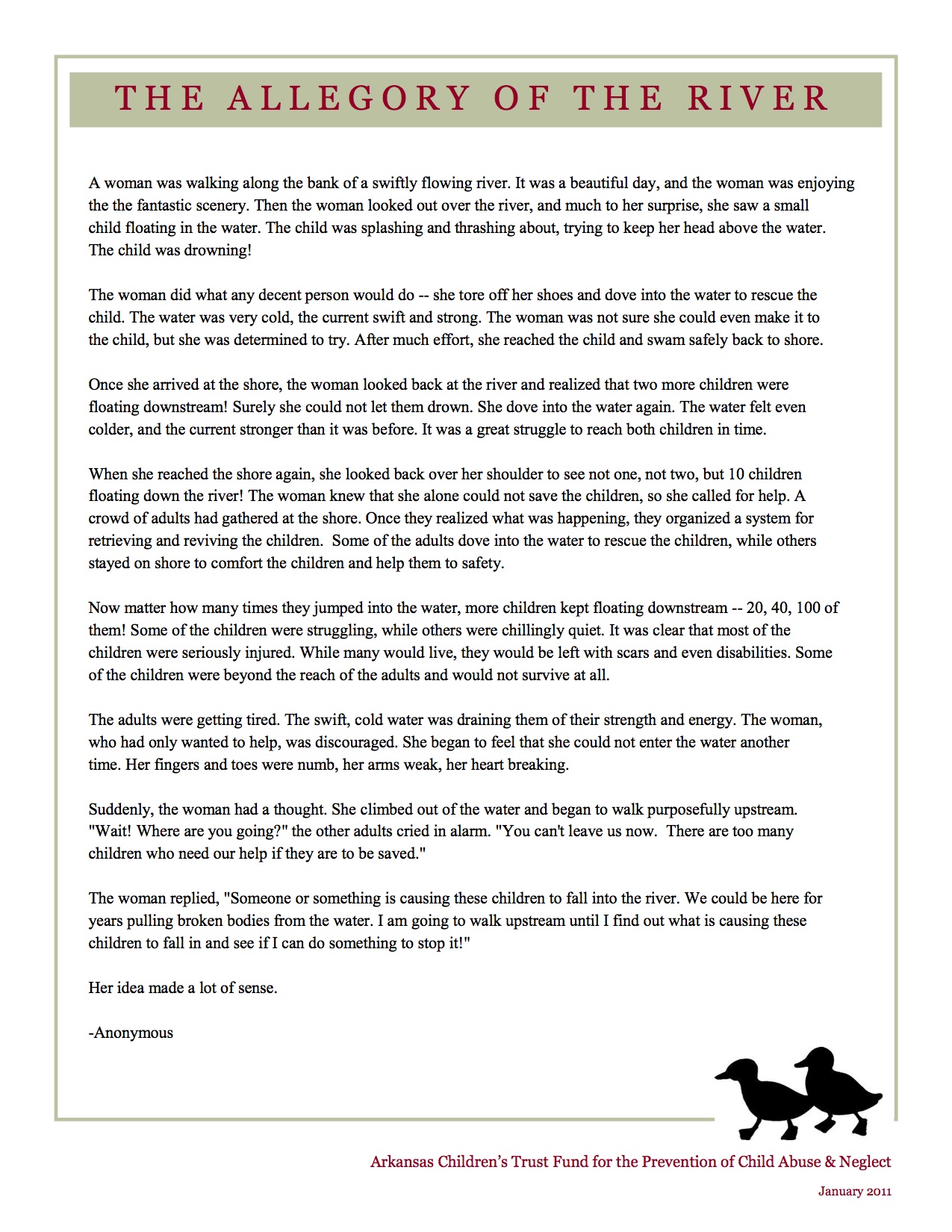
[1] In the original trial, a lawyer for the underfunded school districts used the “Allegory of the River” to confront the state’s failure to address root causes of failing schools; I recommend that allegory and believe the Op-Ed above calls for policies that continue those failures:

_allegory_of_the_river copy

NEW: Beware the Roadbuilders (Garn Press)

Thomas, P.L. (2015). Beware the roadbuilders: Literature as resistance. New York: Garn Press.

Beware the Roadbuilders: Literature as Resistance was born out of blogging as an act of social justice. Over a period of about two years, many posts built the case against market-based education reform and for a critical re-imagining of public education. This book presents a coordinated series of essays based on that work, using a wide range of written and visual texts to call for the universal public education we have failed to achieve. The central image and warning of the book—“beware the roadbuilders”—is drawn from Alice Walker’s The Color Purple. The book presents a compelling argument that billionaires, politicians, and self-professed education reformers are doing more harm than good—despite their public messages. The public and our students are being crushed beneath their reforms. In the wake of Ferguson and the growing list of sacrificed young black men—Trayvon Martin, Jordan Davis, Tamir Rice, Eric Garner—the essays in this book gain an even wider resonance, seeking to examine both the larger world of inequity as well as the continued failure of educational inequity. While each chapter stands as a separate reading, the book as a whole produces a cohesive theme and argument about the power of critical literacy to read and re-read the world, and to write and re-write the world (Paulo Freire).

Supporting that larger message are several key ideas and questions:

  • What are the confrontational texts we should be inviting students to read, that anyone should read?
  • Instead of reducing texts to the narrow expectations of New Criticism or “close reading,” how do we expand those texts into how they inform living in a free society and engaging in activism?
  • How do traditional assumptions about what texts matter and what texts reveal support the status quo of power?
  • And how can texts of all types assist in the ongoing pursuit of equity among free people?

The (Macabre) South: A Reader

necrophilia [nek-ruh-fil-ee-uh] – noun, Psychiatry.
1. an erotic attraction to corpses.

There is a perverse irony to this I cling to: My homeland, The South, is best represented by William Faulkner’s “A Rose from Emily”—a story that builds to a Town discovering that dear old Emily has been sleeping with the corpse of a lover, who everyone assumed had left her just before marriage.

To this day in 2015, as I post this, Emily remains the fictional personification of The South.

Case in point: Georgia bill would protect Civil War, other monuments despite any local objections:

Proposed Georgia legislation would prohibit the removal of monuments despite any future objections to them.

Rep. Tommy Benton introduced House Bill 50 to avoid changing fashions from sweeping away memories, he said. It was approved by a Georgia House committee on Wednesday.

“I think history is history,” said Benton, R-Jefferson.

Having been born and then lived my entire life in The South, I am deeply skeptical of the first two words of Rep. Benton’s quote—thinking is not something common among the wink-wink-nod-nod populist politics in The South, but pandering is—and that pandering is often to the lowest possible denominator, I fear.

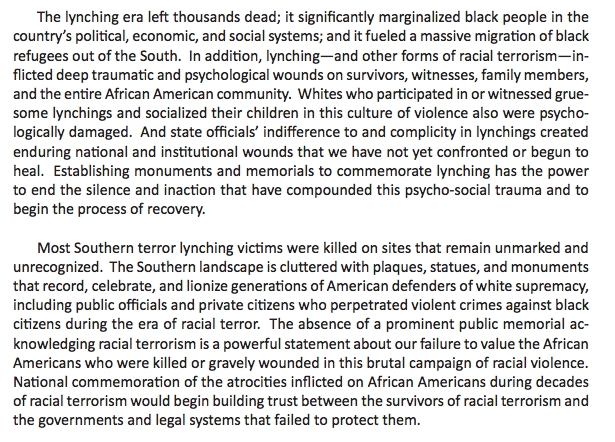
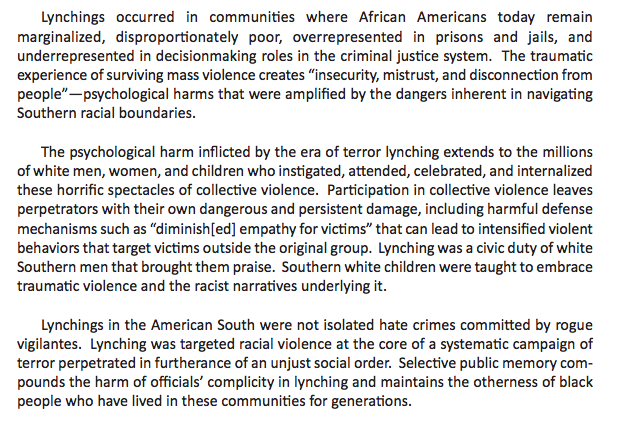
This legislation would once again codify what Lynching in America: Confronting the Legacy of Racial Terror (pp. 22-23) vividly details:

lynching 1

lynchings 2

I imagine that some political leaders in Georgia have heard the rising voices at nearby Clemson University in South Carolina, where students and faculty have called for the renaming of Tillman Hall; see two posts addressing that debate:

Ultimately, The South’s contemporary and historical Selves are almost indistinguishable; we never let go.

Segregation, corporal punishment, self-defeating political allegiances, racism, sexism, inadequate commitments to public institutions (notably education), “right to work” anti-unionism, a contradictory reputation for great literature and “deficient” literacy, a fundamentalist religious fervor—these are The South, and I invite you to read further:

Dear NYT, Better Teachers? How About Better Journalism?

The New York Times has posed at Room for Debate: How to Ensure and Improve Teacher Quality. As an opinion blog designed to offer debate, and thus differing perspectives, we should expect a spectrum of voices—at least that is the appearance.

So let’s start with a broader perspective: Voices in the media addressing education are inversely proportional to the expertise in the field:

Across MSNBC, CNN, And Fox, Only 9 Percent Of Guests In Education Segments Were Educators. On segments in which there was a substantial discussion of domestic education policy between January 1, 2014, and October 31, 2014, there were 185 guests total on CNN, MSNBC, and Fox, only 16 of whom were educators, or 9 percent. Media Matters

Therefore, I think it is fair—and not ad hominem—to clarify the background and experiences of the five debaters selected by the NYT to frame the national debate about teacher quality:

  • Amanda Ripley, journalist, who gained a great deal of national acclaim for her Time cover-story of Michelle Rhee (who eventually left her role in DC under a cloud of suspicion for testing fraud). Ripley has no K-12 classroom experience.
  • Eric Hanushek, economist. Hanushek has no K-12 classroom experience.
  • Mercedes Schneider, 20+-year K-12 classroom teacher who is also an active blogger about education reform.
  • Jal Mehta, Associate Professor in Education at the Harvard Graduate School of Education (with a PhD in sociology). I can find no information on any K-12 teaching experience, but he has written several books on education.
  • Kaya Henderson, Chancellor DCPS with degrees in international relations and leadership (not education). Henderson has K-12 teaching experience.

Any fair person can see this line up is skewed in much the same way that most mainstream journalism distorts the narrative about teacher quality and education.

But let’s add just a couple more details.

Henderson’s background, like Ripley’s, significantly overlaps with Rhee (Henderson served under Rhee at DCPS, although her bio linked above conveniently doesn’t include Rhee’s name) as well as Teach for America and The New Teacher Project, “a spin-off of TFA…originally led by Michelle Rhee.”

And if all this seems to some to be more about the people than the substance of their claims, let’s add a closer look at Hanushek’s first paragraph:

Despite decades of study and enormous effort, we know little about how to train or select high quality teachers. We do know, however, that there are huge differences in the effectiveness of classroom teachers and that these differences can be observed.

Without even a hyperlink or any evidence, Hanushek discounts the entire field of teacher education in the first sentence (which is factually untrue), and then characterizes teacher quality with “huge,” although the research base shows teacher quality’s impact on measurable student outcome is quite small (and note whose work is included in the synthesis of teacher quality research below):

But in the big picture, roughly 60 percent of achievement outcomes is explained by student and family background characteristics (most are unobserved, but likely pertain to income/poverty). Observable and unobservable schooling factors explain roughly 20 percent, most of this (10-15 percent) being teacher effects [emphasis added]. The rest of the variation (about 20 percent) is unexplained (error). In other words, though precise estimates vary, the preponderance of evidence shows that achievement differences between students are overwhelmingly attributable to factors outside of schools and classrooms (see Hanushek et al. 1998;Rockoff 2003; Goldhaber et al. 1999; Rowan et al. 2002; Nye et al. 2004).

At best, Hanushek’s opinion opens with inaccurate, unsubstantiated, and misleading claims.

More of the claims in the five opinions included are factually unsupported than supported, but the focus and the rhetoric maintain a false argument about teacher quality as well as the need for mostly ineffective reform strategies that do not serve the interests of students, communities, teachers, or public education.

Politicians, self-serving organizations (such as TFA), and think tanks promoting bunkum benefit from the inordinate misinformation included, but not genuine education reform aimed at the single greatest problem facing our society and our schools: inequity.

This version of Room for Debate is yet another tired example of an ironic fact: In the debate over teacher quality, there is little room for the truth or the voices of life-long teachers who have served their students and their communities.

Avoiding Patricia Arquette Moments in Education Reform

When Patricia Arquette called for equal pay for women after being awarded the Best Supporting Actress Oscar in late February 2015, Meryl Streep stood, cheering, and Hillary Clinton voiced her support as well.

However, social media began to catalog a much different response, notably by black Haitian writer of Bad Feminist Roxane Gay and Imani Gandy, attorney and political journalist advocating for women’s rights, who explained:

With those words—whether intentional or not (and personally, I believe it was unintentional)—Patricia Arquette gave voice to a system of structural erasure that has been the gold standard in the feminist movement since well before Sojourner Truth stood up and declared “Ain’t I A Woman?”

That erasure assumes that all men are white men and all people of color are men. And that erasure leaves women of color wondering where they fit into all of this.

In a follow up blog, Gandy adds:

My conversation with [Nicole Sandler] got me thinking about the conversations that I have with white women about privilege and why it tends to devolve into shenanigans and feelings of ill-will (as it unfortunately has with Nicole).

Oftentimes when I have these conversations with white women, they’ve never heard the term white privilege before, or if they have, they dismiss it as inapplicable to them.

Arquette represents the dangers of good intentions in the context of unexamined privilege, as Gandy confronts above and then emphasizes:

Here’s the thing about privilege: There are all kinds. There’s privilege based on race, gender, sexual orientation, gender identity, religion, citizenship status, and on and on. (A great primer on the concept is Peggy McIntosh’s “White Privilege: Unpacking the Privilege Knapsack.”)

And you know what? Almost every single person on the planet has privilege in some form or another.

Me? I have class privilege. I make a decent living now and I grew up upper-middle class. I never wanted for anything. And I rarely want for anything now. (Certainly the things that Iwant are luxury items that I really don’t need. I mean, I’ve got my eye on a Michael Kors purse, but do I need it? Hardly.)

Additionally, Arquette as a white woman offers an important moment for the education reform debate, notably since education has its own Arquette in the form of Ruby Payne.

“The current teaching population in the U.S. comprises mostly white, middle-class women,” explain Sato and Lensmire in their analysis of Payne’s claims about poverty and why those discredited stereotypes are nonetheless embraced:

Osei-Kofi (2005) thinks that Payne’s stereotypes provide the well-meaning educator with a certain “guilty voyeuristic pleasure” as they get to affirm their own normalcy against the “comfortably familiar” image of the poor as pathological. Payne plays on our sense of ourselves as normal, the norm, as well as on our sense of the poor as different, other.

Sato and Lensmire then quote Osei-Kofi:

“Based on this depiction of the poor, educators become perfectly situated to take on the role of middle-class, primarily white, saviors of children in poverty by being ‘good’ role models, and teaching these children the so-called hidden rules of middle-class. Through the objectification of the poor, educators are implicitly positioned as the true histor- ical subjects with ability to act in creating social change.” (Osei-Kofi 2005, p. 370; emphasis added)

Bomer, and others, have exposed the same dynamic, including how Payne misrepresents poverty and race in her frameworks:

Racializing the representations of poverty means that Payne is portraying poor people as people of color, rather than acknowledging the fact that most poor people in the US are white (Roberts, 2004). By doing so, Payne is perpetuating negative stereotypes by equating poverty with people of color. Although there is a correlation between race and class, this does not justify her use of racialized “case studies.”

Payne’s audience of teachers is primarily white, female, and middle class, so their probable shared perspective makes it likely that such signals will be understood as racial. Given that the truth claims do not explicitly address the relationships between poverty, race, ethnicity, and gender, we are merely pointing out the absence of such considerations from Payne’s work.

And despite a growing body of research refuting Payne’s claims about class and race, Payne continues to prosper on her self-published books and workshops and has often been defiant—a cycle not unlike Arquette’s defense of her comments and advocacy—as Gorski notes:

For example, in response to a critique of A Framework published by Teachers College Record (Gorski, 2006b), Payne (2006a) writes: “Gorski states that his lens is critical social theory. My theoretical lens is economic pragmatism. The two theoretical frames are almost polar opposites.”

Indeed.

Well-intentioned people, then, unwilling to examine their own privilege and then defiant against the voices of others who speak from marginalized perspectives are as apt to derail the call for equity in education reform as the so-called corporate reformers.

As I have detailed in literacy education, uncritical embracing of the “word gap” reveals the blinders of privilege and then leads directly to policy distorted by racism, classism, and sexism—policy, then, that perpetuates inequity while claiming to be reform.

As Gandy explains above, everyone must be open to examining her/his own privilege, even when she/he feels primarily to be in a marginalized status (such as white women), but that self-examination is often hard since the factors are so close and familiar.

While watching an HBO’s Real Sports episode on Death on Everest recently, I was struck how the relationship between Shirpas and mostly affluent and often white mountain climbers is a stark but real example of the danger and power of privilege: White wealth pays to defer great risk and even death from the climbers to the Shirpas.

A context such as that—also examined in Death and Anger on Everest by Jon Krakauer—may offer the distance needed to understand privilege before turning the mirror on ourselves and those near us.

Nonetheless, as much as the Arquette controversy is important for a national examination of privilege, it is also a key moment for committing to avoiding more Arquette moments within education, where there is no room for privilege or the status quo of racism, classism, and sexism.

South Carolina and Education Reform: A Reader

Hartsville, South Carolina sits just north of I-20 and north-west of I-95 about a 30-minute drive from Florence.

Geography matters in SC when discussing education because the state has a long and tarnished history of pockets of poverty and educational inequity now commonly known as the Corridor of Shame [1], a name coined in a documentary addressing that inequity as it correlates with the I-95 corridor running mostly north and south paralleling the SC coast.

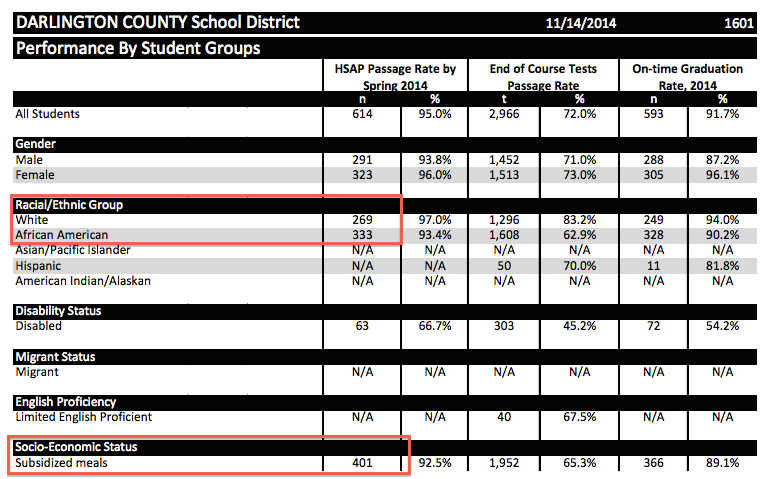
The town’s schools are part of Darlington County School District that serves approximately equal numbers of white and black students, although significantly skewed by poverty as reflected in the district’s 2014 report card detailing tested students:

Darlington 2014

Hartsville is the focus of an upcoming PBS documentary co-produced by Sam Chaltain, who writes about the community:

Take Hartsville. Until recently, no one there had ever asked Thompson or her colleagues what they noticed about their child passengers on the bus, or thought to connect their observations to the behavior teachers might witness in the classroom. Moreover, while Hartsville’s teachers were expected to be knowledgeable about their students’ academic standing, they were not expected to be attuned to their psychological states.

That began to change in 2011, when the community announced a five-year plan to transform its elementary schools. It partnered with Yale University’s School Development Program, which helps schools identify and meet the developmental needs of children. It began to evaluate its schools by a broader set of measurements – including the number of disciplinary referrals a bus driver had to write each morning. And it started to coordinate its social services to ensure a more equitable set of support structures for Hartsville’s poorest families.

This focus on Hartsville specifically and SC more broadly is important for understanding the entire education reform movement in the U.S. for several reasons.

The standards/testing issues in SC are complex (the anti-Common Core movement in SC is mostly ill-informed and falls along libertarian lines, for example) and represent well patterns found across the country during the mostly state-based accountability era (see below).

SC was one of the first accountability states, and we have had about 5-6 sets of standards and new tests over 30-plus years (see below). Throughout those years, almost no one in political leadership has acknowledged SC being in the bottom quartile of poverty in the U.S.—huge pockets of poverty and affluence—is the real educational crisis.

Like New Orleans, I think, SC is a perfect model of all that is wrong with the education reform debate.

I recommend viewing the 180 Days focus on Hartsville through the complicated and often jumbled politics and education reform over the past three decades in SC, much of which I have addressed in the reader offered below, organized by major accountability issues and policies:

Value-Added Methods of Teacher Evaluation:

South Carolina Officially Vamboozled

Review [UPDATED]: “How to Evaluate and Retain Effective Teachers” (League of Women Voters of SC)

SC and Common Core:

South Carolina and Common Core: A Next Step?

Death to Common Core! Long Live Failed Education Policy!

Should SC Ditch Common Core?

SC, Reading Policy, and Grade Retention:

Just Say No to Just Read, Florida, South Carolina

Retain to Impede: When Reading Legislation Fails (Again)

SC and Opt-Out:

SC Parents Warned: “no state provision…to opt-out of state-or district-wide testing”

SC, Oklahoma, and Florida:

GreenvilleOnline: SC should choose Oklahoma, not Florida

SC’s Former Superintendent Zais:

SC’s Zais Mistake

SC and Accountability:

Welcome to SC: A Heaping Stumbling-Bumbling Mess of Ineptitude

SC and Charter Schools:

Should SC Increase Charter School Investment?

Public School, Charter Choice: More Segregation by Design

SC and Exit Exams:

Ending Exit Exams a Start, But Not Enough

SC’s Conservative Leadership:

Conservative Leadership Poor Stewardship of Public Funds

[1] This documentary focuses on a court case in South Carolina initiated by high-poverty school districts surrounding primarily the I-95 corridor of the state, paralleling the east coast and stretching from the NE to the SE region. The documentary suffers from melodramatic production values (music, slow-motion panning of sad children’s faces), but the essential claim of the film is important for confronting the social inequity that is reflected in educational inequity, particularly in the South. Issues included in the film are school funding, community-based schools, access to high-quality educational opportunities and facilities, teacher assignments related to student characteristics, and state education accountability mechanisms. Some related resources (SC school report cards, poverty indices, related blog posts) to the documentary support examining the film in my educational documentary May experience course.

De-professionalization for Profit: “Leery of teachers”

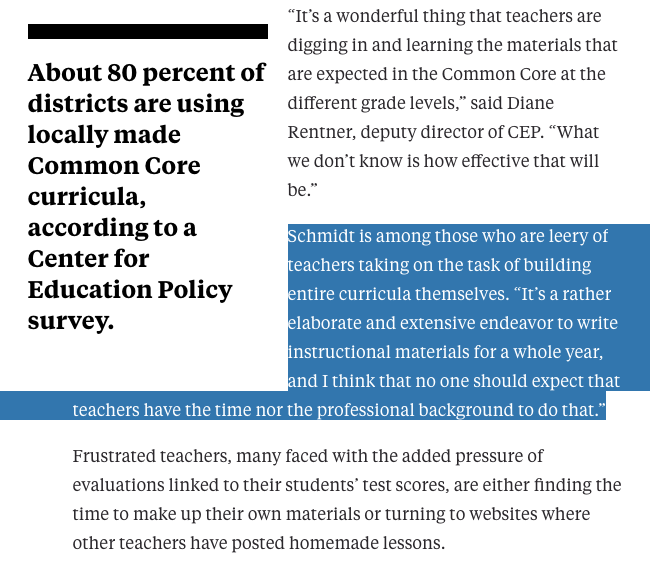
In Common Core’s unintended consequence?, Jonathan Sapers examines a report from the Center for Education Policy (CEP), self-described as “a national, independent advocate for public education and for more effective public schools.”

CEP has discovered “that in roughly two-thirds of districts in Common Core states, teachers have developed or are developing their own curricular materials in math (66 percent) and English Language Arts (65 percent). In more than 80 percent of districts, the CEP found that at least one source for curriculum materials was local — from teachers, the district itself or other districts in the state.”

As has been the pattern throughout roughly thirty years of public school accountability—one characterized by a revolving door of state standards and high-stakes testing—new standards and tests mean profit opportunities for education-focused businesses.

Sapers reports:

However, Jay Diskey, executive director of the PreK-12 Learning Group of the Association of American Publishers, said publishers are pulling their weight. “We have more than 150 members in our PreK-12 Learning Group. And the ones I’ve seen over the past several years or more have tried very hard to align with Common Core standards in reading and math.”…

Some teachers and districts are viewing the dearth of materials as an opportunity, but experts and even some educators say putting the job of creating curriculum materials into the hands of teachers may not necessarily be a good thing [emphasis added].

And this is where the article takes a troubling turn, as highlighted here:

leery of teachers

“Leery of Teachers”

My career as an educator includes 18 years teaching English in a SC public high school throughout the 1980s and 1990s, followed by the most recent 13 years as a teacher educator in higher education.

Those experiences and in my work teaching future teachers, I note that a powerful and problematic difference between a K-12 teacher and a college professor is the locus of authority in terms of the content of any course.

Historically and currently, the authority over content for K-12 teachers has too often been textbooks, curriculum guides, standards, and high-stakes tests.

For college professors, the single most important element of teaching authority is that professors are the locus of authority of the content they teach; in fact, many if not most college professors have little or no formal training in pedagogy, how to teach.

The great irony of this distinction is that between K-12 teachers and professors, K-12 teachers have the greater expertise in teaching, but a far reduced status as a professional when compared to professors.

Along with the locus of authority over the content, the status of professional is strongly related to autonomy and respect—which brings me back to the “unintended consequence” above.

The attitude toward K-12 teachers not having time to create curriculum is valid, but the reason they do not have time includes the incessant changing of bureaucratic mandates that consume their time and that K-12 teachers do not have professional schedules (which professors do) in which to conduct research and create curriculum (which are often related at the university level).

However, the “leery” as well as the unsubstantiated claim that teachers do not have the “professional background” to create curriculum is a genuinely ugly example of the de-professionalization of teaching—a process aided by a historical marginalizing of teaching (significantly as an element of professional sexism), the bureaucratizing of teaching, and the union-busting momentum in recent years.

We should be exploring the real intended consequence of Common Core: billions are to be made off the standards and testing charade, and teachers creating their own curriculum and materials infringes on that profit.

Teaching at all levels includes curriculum, instruction, and assessment, but central to those elements are the unique set of students each teacher faces every day.

Curriculum, instruction, and assessment mean almost nothing without the context of students, and the only person qualified to make those decisions is the teacher.

If we must be leery, let’s be leery about think tanks, publishing companies, and mainstream media who all seem to have little respect for the professionalism of teaching.

See Also

Teaching: Too Hard for Teachers, Peter Greene

Passive Progressivism

Hamlet:
A man may fish with the worm that hath eat of a
king, and eat of the fish that hath fed of that worm.

King:
What dost thou mean by this?

Hamlet:
Nothing but to show you how a king may go a
progress through the guts of a beggar.

Hamlet (Act 4, Scene 3)

The phrase “bleeding heart liberal” has always created in me some tension between skepticism about those who use it as a baseless slur against left-wing ideology and recognition that those calling themselves “liberal,” “progressive,” and/or “Democrat” are as likely to disappoint me as right-wingers (although for different reasons).

A Twitter conversation today with Camika Royal prompted by my Are We (Finally) Ready to Face Teacher Education’s Race Problem? led to this:

I have previously examined how the status quo of power in the U.S. seeks to acknowledge Martin Luther King Jr. only as a distorted passive radical, and I have recently called out my own field of teacher education for the tendency of education professors to complain and then comply.

Passivity and compliance, I note, are both necessary for maintaining the status quo of inequity in the U.S. and the central qualities among so-called progressives.

Progressivism rightly viewed is the antithesis of conservatism—although in the U.S. both terms are rarely understood, expressed correctly, or embodied in their original meanings.

Progressivism is inherently about not only recognizing the inevitability of change, but also embracing change for often idealistic ends (and thus, when taken to an extreme, the “bleeding heart liberal” paralyzed by that idealism).

Conservatism is about maintaining (conserving) conditions within a framework of traditional (enduring) values.

Neither term or ideology is understood or practiced with much faith in the U.S., but with great regret, I must note that the negative connotation of “bleeding heart liberal” rings all too true when we examine the behavior of many on the left, including self-professed progressives.

U.S. progressivism as liberalism is mostly about symbolism and lip-service.

Liberal Hollywood talks a great game, but never gets off the bench.

The liberal academy, much the same—ironically clinging to traditional norms of the aloof ivory tower that discourages public intellectualism as base, beneath the scholar.

And the liberal media? The greatest disappointment of all as the mainstream media in the U.S. is trapped in the objective pose of recognizing both sides of every issue—as if the world is a ninth-grade debate team contest.

Passive progressivism is more powerful in the U.S. than the conservative center that keeps the U.S. moving forward at a glacial creep anchored by racism, sexism, bigotry, homophobia, and widespread inequity.

Progressivism is nothing without the radicalism of action, as expressed by Howard Zinn:

From that moment on, I was no longer a liberal, a believer in the self-correcting character of American democracy. I was a radical….The situation required not just a new president or new laws, but an uprooting of the old order, the introduction of a new kind of society—cooperative, peaceful, egalitarian.

Much as Democrat and Republican are different sides of the same partisan-politics coin, progressive and conservative are different sides of the same static coin in the U.S.

And thus action in the U.S. is marginalized as radicalism, serving only to benefit the world as we now have it.

To have a world otherwise, we must all embrace radicalism.

See also here and below: