Category Archives: Education

Public School, Charter Choice: More Segregation by Design

Academic Magnet High School serves the Charleston school district on the coast of South Carolina. The school functions under a choice umbrella, but requires students to submit to an admissions process.

SC is relatively more diverse than the U.S. on average in terms of white (+/- 70%)/black (+/- 30%) demographics, while less diverse in Hispanic/Latino (although those groups are growing significantly). Charleston certainly is even more diverse racially and culturally than the state.

Those realities have now prompted students at Academic Magnet to challenge the lack of diversity at their school:

Calls for a change in the admissions process at Academic Magnet High School continued Monday, with students urging the Charleston County School Board to tackle diversity issues at their school.

“Is the system that has produced an overwhelmingly white, upper-middle-class school in place of an equal opportunity magnet school for all Charleston County students fair?” asked Academic Magnet student Natalie Davidson….

Davidson said that although the school’s admissions process is “in a vacuum unbiased,” it has produced a “homogeneous” student body that is only 2 percent black in a school district that is 42 percent black.

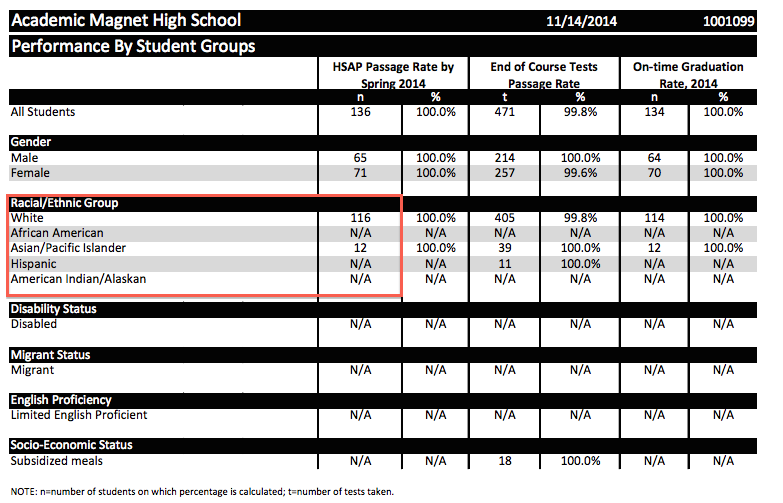
The 2014 SC school report card for Academic Magnet shows absolute and growth ratings of excellent, but tested students included no African American or Hispanic/Latino students:

AMHS test 2014

Magnet and charter schools, however, are not the only choice mechanisms in SC since Greenville County school district offers (and aggressively markets) public school choice:

GCSD choice market

What has public school choice and charter choice produced in Greenville County?

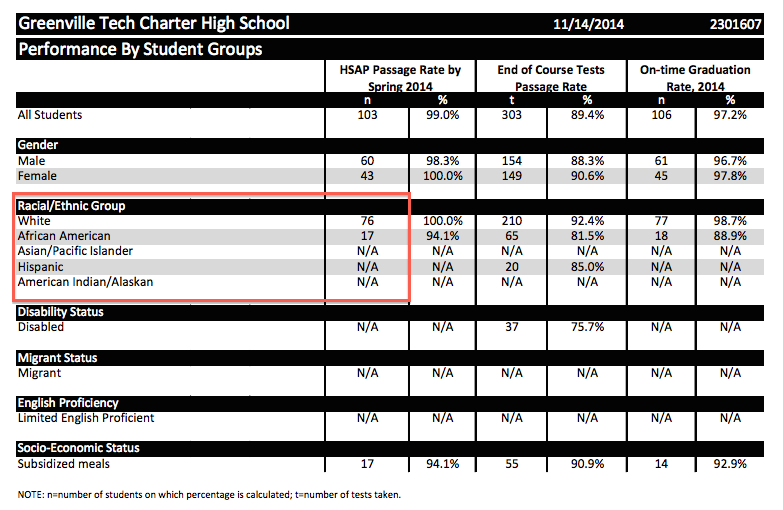
Greenville Tech Charter High School, like Academic Magnet, has 2014 school report card ratings of excellent/excellent, but just over 80% of the students tested are white with no limit English proficiency students included:

GTCHS tested 2014 race

Public school choice has also resulted in highly segregated schools within the same district.

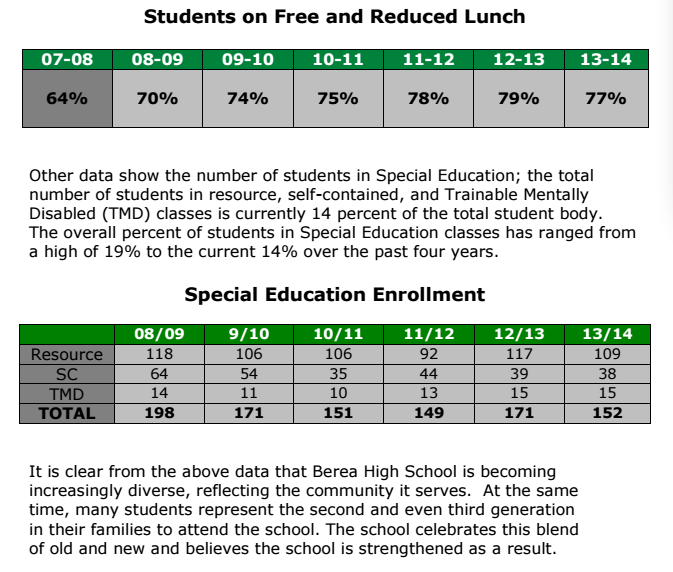
Berea High School has a consistent record of being a majority-minority school and also serves a diverse population of students by poverty and special needs:

BHS race

BHS poverty special needs

As a result, Berea High’s 2014 school report card looks quite different when compared to Academic Magnet or Greenville Tech Charter—good (absolute) and below average (growth) ratings, and a much different tested demographic of students:

BHS tested 2014

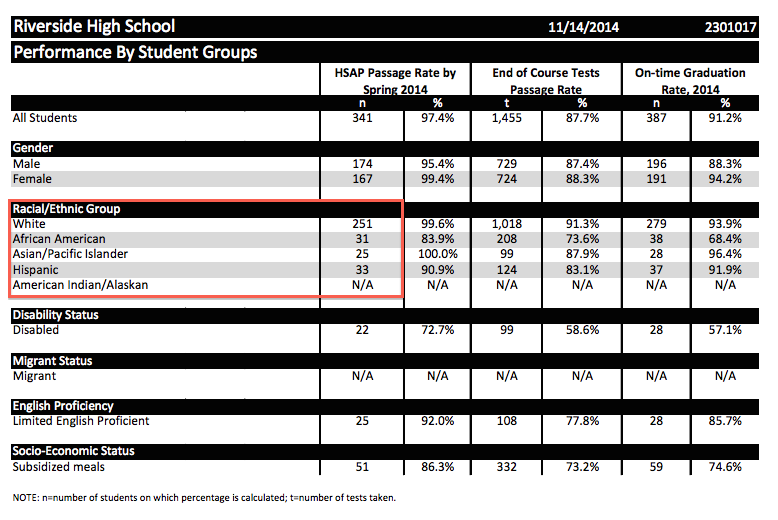
However, Riverside High School looks much more like Academic Magnet or Greenville Tech Charter—an excellent/excellent rating in 2014 and serving/testing a population 73% white:

RHS race

RHS tested 2014

Choice, then, in a variety of forms such as public school choice, charter schools, and magnet schools/academies are isolating students by race and class within highly diverse regions of a highly diverse state.

No longer vouchers or tuition tax credits, choice is now masked behind the allure of misleading labels—public, charter, magnet, academy—but ultimately resulting in one disturbing fact: choice segregates by design.

More choice will result in greater segregation and more shuffling, but market forces will never address equity and will always create winners and losers instead of establishing opportunities for all—as Academic Magnet demonstrates.

The call for fairness and diversity by students at Academic Magnet should be a call among all in SC and across the U.S.

See Also

Why Sending Your Child to a Charter School Hurts Other Children

Beware the Technocrats: More on the Reading Wars

Since it is Academy Awards season, let me start with film as context.

Whiplash has received a great deal of Oscars buzz with five significant nominations. But that film praise is interesting to frame against a review that considers how the film’s topic, jazz, is portrayed:

The mediocre jazz in Damien Chazelle’s new film, “Whiplash,” the story (set in the present day) of a young drummer (Miles Teller) under the brutal tutelage of a conservatory professor (J. K. Simmons), isn’t itself a problem. The problem is with the underlying idea. The movie’s very idea of jazz is a grotesque and ludicrous caricature.

“Mediocre,” “grotesque,” and “ludicrous caricature” are certainly not the stuff of Oscars, one would think, but this contrast of responses to the film represents well my problem with the Mt. Rushmore of technocrats who are cited with missionary zeal whenever you spend much time in the reading wars (see the comments here): Daniel Willingham, John Hattie, E.D. Hirsch, and Grant Wiggins.

With some qualifications for Wiggins (who taught high school and coached for 14 years, but has focused primarily on assessment since then), these often cited men are primarily quantitative researchers who are not within the field of literacy (Hirsch’s background is literature, not literacy) and have created cottage industries out of their names/work: Willingham as a psychologist, Hattie as a researcher/consultant, Hirsch as a core knowledge advocate, and Wiggins as proponent of understanding by design and consultant.

As I have noted before, most of my concern here is how certain advocates for phonics and direct instruction in literacy use the Mt. Rushmore of technocrats to close the door on the reading wars—not with any of these men or their work specifically (except Hattie [1]).

Therefore, I must offer, Beware the technocrats, because of the following:

  • Beware the seductive allure of statistics, numbers, and “scientific” research. As I have detailed more often than I would have liked, a perfect example of this concern is the prevalence of the Hart and Risley research on the “word gap,” which persists despite many concerns being raised about not only the research itself, but also the deficit ideology that drives the conclusions. Of course, high-quality experimental and quasi-experimental research matters, but many aspects of teaching and learning require and lend themselves to other research paradigms—notably qualitative action research conducted by classroom teachers with the real populations they teach.
  • Beware the momentum of cottage industry gurus. Hattie, Hirsch, and Wiggins have created entire careers for themselves—books, workshops, consultations. I remain deeply skeptical of such ventures (see also Nancie Atwell and a whole host of gurus on the “softer” side of research and within literacy as well). Even the best people with the best intentions can find themselves victims of “‘filthy lucre,'” but just as the higher the quality of scientific research, the more likely it means less to real-world teaching, the urge to reduce an evidence base or best practice to a program means that evidence and practice are mostly ruined.

In the reading wars, then, I witness time and again that the advocates for intensive phonics, phonics programs, and direct instruction grounded in prescribed content are either not within the field of literacy [2] or themselves invested in programs that benefit from those positions (the Common Core debate represents the same issue since most advocates stand to benefit from Common Core being implemented, some politically and some financially).

Which brings me back to Whiplash. If you know little or nothing about jazz, the film likely appears more wonderful than if you do.

I have a thirty-plus year career in literacy, including teaching literacy (mostly writing) and scholarship addressing literacy. That context for me renders the Mt. Rushmore of technocrats not insignificant, but certainly less credible than a century of research and practice by literacy practitioners and researchers that informs my practice.

There is a tyranny to certainty among those who wield the work of Willingham, Hattie, Hirsch, and Wiggins in ways that end the conversation, that shut the door on a broader basis of evidence to inform, not mandate, practice. There is a greater tyranny of commerce lurking here also, using “scientific” as a mask for commercialization.

Both serve to further de-professionalize teachers, and both often result in classroom practices that may raise test scores but create nonreaders.

And thus, when Hattie is cited (yet again) during the reading wars, for example:

I posted a question in Pamela and Alison’s article last week, but didn’t get a response from anyone. My question is: if the “effect size” of synthetic phonics (according to Hattie’s research) is 0.54, and that of whole language learning is 0.06, does that mean:

  1. That whole language actually does have an effect; and
  2. Should we therefore use the two approaches in the ratio of 1:9 (i.e. the difference in their effect sizes)? (scroll to the comment from John Perry, who, I must add, is being reasonable here)

I share the exasperation Richard Brody expresses at the end of his review of a jazz film that uses Buddy Rich as the icon for the film’s protagonist: John Hattie. John Visible Learning Hattie.

In terms of evidence, that has the opposite effect intended.

See Also

Education ‘experts’ may lack expertise, study finds

Taming the Wild West of Educational Research, Simon P. Walker

[1] Those who rush to use Hattie are proof of solid research fail to note that his work has been challenged for quality, even within the quantitative paradigm; see:

[2] Since many people continue to refer to the National Reading Panel report, please examine Joanne Yatvin’s minority view, starting about page 444, including:

In the end, the work of the NRP is not of poor quality; it is just unbalanced and, to some extent, irrelevant. But because of these deficiencies, bad things will happen. Summaries of, and sound bites about, the Panel’s findings will be used to make policy decisions at the national, state, and local levels. Topics that were never investigated will be misconstrued as failed practices. Unanswered questions will be assumed to have been answered negatively. Unfortunately, most policymakers and ordinary citizens will not read the full reviews. They will not see the Panel’s explanations about why so few topics were investigated or its judgments that the results of research on some of the topics are inconclusive. They will not hear the Panel’s calls for more and more fine-tuned research. Ironically, the report that Congress intended to be a boon to the teaching of reading will turn out to be a further detriment.

As an educator with more than 40 years of experience and as the only member of the NRP who has lived a career in elementary schools [emphasis added], I call upon Congress to recognize that the Panel’s majority report does not respond to its charge nor meet the needs of America’s schools.

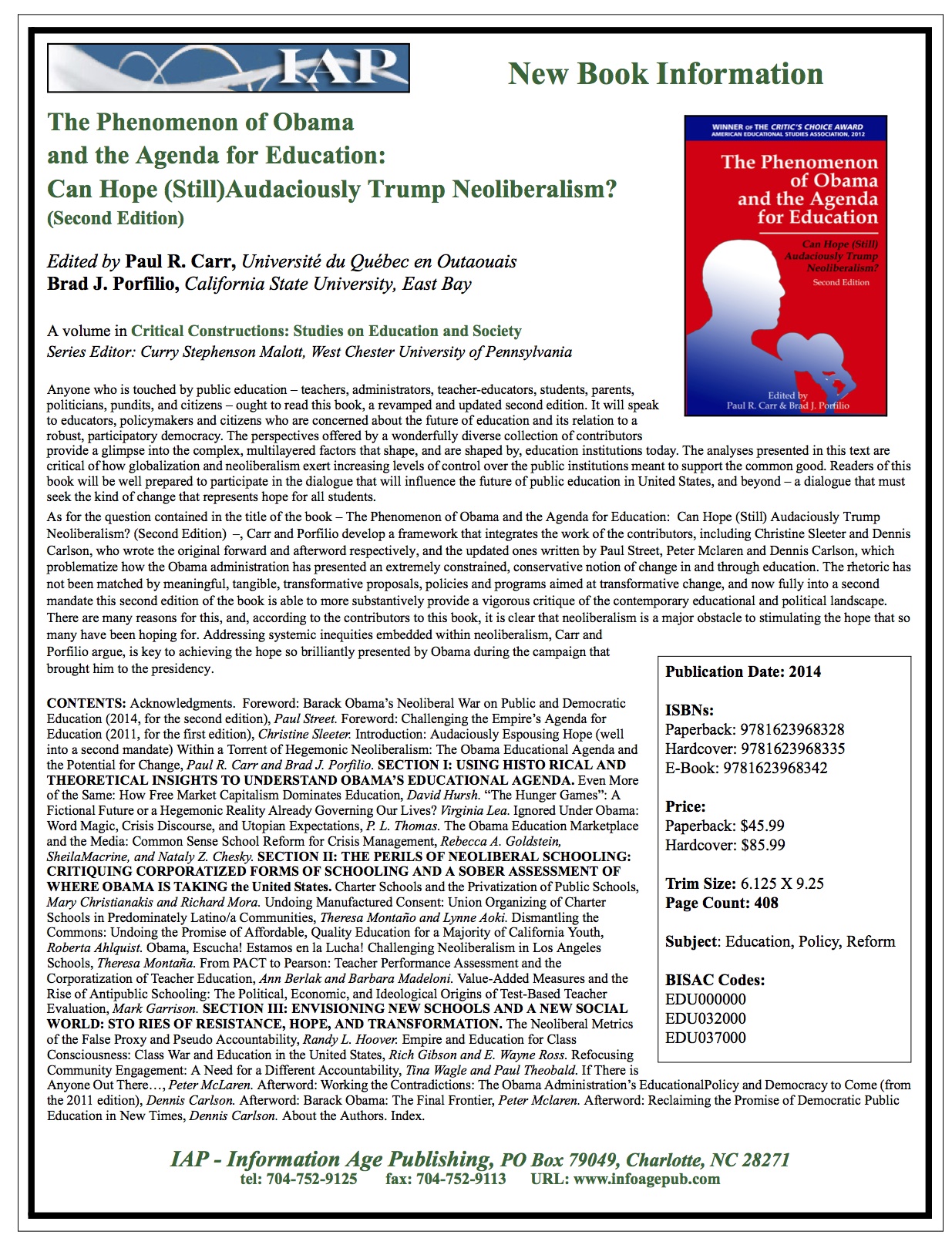
IAP: The Phenomenon of Obama and the Agenda for Education – 2nd Edition

The Phenomenon of Obama and the Agenda for Education – 2nd Edition

CONTENTS

Acknowledgments. Foreword: Barack Obama’s Neoliberal War on Public and Democratic Education (2014, for the second edition), Paul Street. Foreword: Challenging the Empire’s Agenda for Education (2011, for the first edition),Christine Sleeter. Introduction: Audaciously Espousing Hope (well into a second mandate) Within a Torrent of Hegemonic Neoliberalism: The Obama Educational Agenda and the Potential for Change, Paul R. Carr and Brad J. Porfilio.

SECTION I: USING HISTO RICAL AND THEORETICAL INSIGHTS TO UNDERSTAND OBAMA’S EDUCATIONAL AGENDA.

Even More of the Same: How Free Market Capitalism Dominates Education, David Hursh. “The Hunger Games”: A Fictional Future or a Hegemonic Reality Already Governing Our Lives? Virginia Lea. Ignored Under Obama: Word Magic, Crisis Discourse, and Utopian Expectations, P. L. Thomas. The Obama Education Marketplace and the Media: Common Sense School Reform for Crisis Management, Rebecca A. Goldstein, SheilaMacrine, and Nataly Z. Chesky.

SECTION II: THE PERILS OF NEOLIBERAL SCHOOLING: CRITIQUING CORPORATIZED FORMS OF SCHOOLING AND A SOBER ASSESSMENT OF WHERE OBAMA IS TAKING THE UNITED STATES.

Charter Schools and the Privatization of Public Schools, Mary Christianakis and Richard Mora. Undoing Manufactured Consent: Union Organizing of Charter Schools in Predominately Latino/a Communities,Theresa Montaño and Lynne Aoki. Dismantling the Commons: Undoing the Promise of Affordable, Quality Education for a Majority of California Youth,Roberta Ahlquist. Obama, Escucha! Estamos en la Lucha! Challenging Neoliberalism in Los Angeles Schools, Theresa Montaña. From PACT to Pearson: Teacher Performance Assessment and the Corporatization of Teacher Education, Ann Berlak and Barbara Madeloni. Value-Added Measures and the Rise of Antipublic Schooling: The Political, Economic, and Ideological Origins of Test-Based Teacher Evaluation, Mark Garrison.

SECTION III: ENVISIONING NEW SCHOOLS AND A NEW SOCIAL WORLD: STO RIES OF RESISTANCE, HOPE, AND TRANSFORMATION.

The Neoliberal Metrics of the False Proxy and Pseudo Accountability, Randy L. Hoover. Empire and Education for Class Consciousness: Class War and Education in the United States, Rich Gibson and E. Wayne Ross. Refocusing Community Engagement: A Need for a Different Accountability, Tina Wagle and Paul Theobald. If There is Anyone Out There…, Peter McLaren. Afterword: Working the Contradictions: The Obama Administration’s EducationalPolicy and Democracy to Come (from the 2011 edition), Dennis Carlson. Afterword: Barack Obama: The Final Frontier, Peter Mclaren. Afterword: Reclaiming the Promise of Democratic Public Education in New Times, Dennis Carlson. About the Authors. Index.

Obama 1


Obama 2

Collateral Damage from the Never-Ending Reading Wars

Education is an admirable thing, but it is well to remember from time to time that nothing that is worth knowing can be taught.

Oscar Wilde

Let’s start broadly with literacy by acknowledging that speaking and listening are essentially natural while writing and reading are artificial (and thus benefit greatly from direct, formal instruction).

Now let’s consider some aspects of literacy and the assumptions many (including educators) hold about writing and reading.

One of the traditional/essential elements of reading is vocabulary. As I have noted, educators, the media, and the public tend to mis-associate the quantity of words a child knows or uses with the literacy of the child.

In part, that process is efficient, albeit misguided.

Therefore, remaining within that paradigm, a typical high school graduate knows/uses about 60,000 words. If direct vocabulary instruction (a traditional instructional strategy) successfully teaches students about 10 words a week for the entire 12 years of formal schooling (an unlikely feat), teaching vocabulary to increase reading has contributed only about 4000 words.

As an effective strategy, then, direct vocabulary instruction fails against the mostly non-instructional ways in which children acquire about 90% of their words.

This also highlights a significant problem with confusing cause and effect: Increasing vocabulary does not cause good readers, but being an avid reader results in an extensive vocabulary.

Something I learned as a high school English teacher: Dump the inordinate amount of time spent assigning vocabulary, covering vocabulary homework, and testing vocabulary while replacing that time with free and frequent reading.

In the professional and public debates about teaching literacy, along with this cause/effect issue related to confusing discrete literacy skills for the holistic acts of literacy (vocabulary = literacy, grammar = writing, phonics = reading) is the issue of direct and formal instruction.

Linguists often examine children acquiring language [1], often before formal schooling, and have noted that virtually all English speaking children utter “goed” at some point, although no adults use that construction (language acquisition appears not to be mimicry) and that children (and adults) tend to construct “might not have been seen” in this grammatically correct order of wording, having never been taught the rule (which is nearly incomprehensible) and never being able to explain the rule.

Before I move on to the reading wars, I want to emphasize that I am not endorsing a “natural” theory of language or of teaching language in which children are left alone by adults and expected simply to acquire writing and reading abilities—the sort of (false) charge typically leveled at whole language scholars and practitioners.

But I do want to emphasize that the narrow reading war and the larger, varied literacy wars (including teaching grammar as part of writing, for example) have some fundamental areas of tension that must be confronted before the substantive debate(s) itself/themselves can be understood. Those tensions are between:

  • Incrementalists who hold fast to building discrete literacy skills in sequential and formulaic order versus those honoring the holistic nature of literacy.
  • Technocrats and quantitative researchers versus qualitative researchers and practitioners.
  • Missionary zeal (all students must have phonics!) versus inspiration (modeling a love for reading).

In that context, the reading war itself, I believe, results in collateral damage that is the real problem: children who are non-readers (some left without the ability to read, but even more left without the desire to read).

My life as a student included Dick and Jane readers; direct phonics instruction; year after year of vocabulary books, homework, and tests; and years of diagramming sentences. To this day I am a terrible speller (thanks phonics), and a highly literate adult who came to that despite my formal and highly structured and traditional literacy instruction (isolated and discrete phonics, isolated and intensive grammar).

My life of literacy was spurred by late adolescent comic book collecting, which led to science fiction novel reading.

That life story proves nothing, but it has made me skeptical of ways in which formal schooling will steamroll over students in order to implement this or that program.

That life story is why I am deeply skeptical of the phonics and grammar crowds, filled with missionary zeal and all too often bound to programs and structure at the expense of their students.

No credible person in literacy is against phonics or grammar instruction, by the way. That is a heinous straw man.

And all literacy ideologies or strategies are immediately ruined once they are codified (see California or New York) or reduced to a publisher’s program (see 4-block, reading/writing workshop programs, or literature circles).

“[L]anguage behavior can not be reduced to formula,” Lou LaBrant (1947) argued (p. 20)—emphasizing that literacy growth was complicated but flourished when it was child-centered and practical (for example, in the ways many privileged children experience in their homes because one or more of the parents are afforded the conditions within which to foster their children’s literacy).

By mid-twentieth century, LaBrant (1949) had identified the central failure of teaching reading: “Our language programs have been set up as costume parties and not anything more basic than that” (p. 16).

Writing and reading acquisition is always messy and unpredictable at the individual person level. Always.

That is why whole language and balanced literacy, for example, are philosophical constructs that create a space for the professional decision making of the teacher in the context of her class, a teaching and learning context that is always in flux.

All instructional strategies are on the table as long as the ultimate goals of literacy are being addressed for each student. And this is much more demanding of teachers as literacy professionals than scripted programs of any ideology.

Similarly, teaching and testing phonics and grammar, for example, ask less of students as well—including that acquiring discrete phonics and grammar knowledge (knowing the rules) is essentially merely academic, unlike being able and willing to read and write.

As early as the 1940s, hundreds of studies had revealed that isolated and direct grammar instruction failed to transfer to students’ original writing—a research base oddly ignored by the technocratic crowd.

However, the missionary zeal for Version X of phonics instruction is often built on a circular claim about “research”—failing to note that discrete phonemic instruction lends itself to multiple choice testing and measurement in a way that means a narrow view of research will always show phonics to be “better” than messier (and more authentic) literacy strategies that are not easily quantified or isolated at any point in time.

Our goals as literacy teachers include fostering children who are both capable and willing writers and readers.

Being an evangelist for phonics likely will not accomplish either of those—just as being an evangelist for whole language will not either.

Vocabulary books, homework, and tests are all very manageable, and continuing them all will likely cause not a ripple in your life as a teacher. But that process has mistaken “vocabulary” for literacy, and thus, does not achieve the larger goals of literacy while often insuring students will come to hate ELA class, reading, and writing.

The reading wars as a subset of the larger literacy wars are petty, I think, but that isn’t the real problem—the real problem being the collateral damage: children who are non-readers (some left without the ability to read, but even more left without the desire to read).

[1] Acknowledging the controversies around linguistic theories, I highly recommend Steven Pinker’s The Language Instinct and Words and Rules—not to endorse Pinker/Chomsky linguistics, but as rich avenues to understanding better language and the debates about language acquisition.

References

LaBrant, L. (1949). A genetic approach to language. Unpublished manuscript, Institute of General Semantics, Lakeville, CT.

LaBrant, L. (1947). Um-brel-la has syllables three. The Packet, 2(1), 20-25.

See Also

Teaching Reading and Children: Reading Programs as “Costume Parties”

More on Evidence-Based Practice: The Tyranny of Technocrats

Depending on your historical and literary preferences, spend a bit of time with Franz Kafka or Dilbert and you should understand the great failure of the standards movement in both how we teach and how we certify teachers—bureaucracy.

Bureaucracy tends to be inadequate because bureaucrats themselves are often lacking professional or disciplinary credibility or experience, depending, however, on the status of their authority to impose mandates. For education, Arne Duncan serves well as the face of the bureaucrat, an appointee who has only the bully pulpit of his appointment to hold forth on policy.

However, as corrosive to education—and ultimately to evidence-based practice—is the technocrat.

Technocrats, unlike bureaucrats, are themselves credible, although narrowly so. For technocrats, “evidence” is only that which can be measured, and data serve to draw generalizations from randomized samples.

In short, technocrats have no interest in the real world, but in the powerful narcotic of the bell-shaped curve.

As a result, a technocrat’s view often fails human decency (think Charles Murray and Richard Herrnstein) and certainly erases the very human reality of individual outliers.

The face of the technocrat—in fact, the technocrat’s technocrat—is Daniel Willingham, whose work is often invoked as if handed down by the hand on God, chiseled on tablets. [1] [Note: If you sense snark here, I am not suggesting Willingham’s work is flawed or unimportant (I would say important but narrow), but am being snarky about how others wield the technocratic hammer in his name.]

And it is here I want to return to a few points I have made recently:

  • Even the gold standard of experimental research fails the teacher in her day-to-day work because her classroom is not a random sampling of students, because her work is mostly with outliers.
  • And in the teaching moment, what counts as evidence becomes that teacher’s experience couched in that teacher’s content and teaching knowledge as all of that happens against the on-going evidence of the act of teaching.

Stewart Riddle, offering yet another effort in the reading war, is essentially speaking for evidence-based practice while raising a red flag against the tyranny of the technocrat, embodied by the systematic phonics crowd (those who wave the Willingham flag, for example).

On Twitter, in response to my piece on evidence-based policy and practice, Nick Kilstein raised a great point:

My ultimate response (prompting this blog):

My thoughts here, building on the bullet points above, are that having our practice informed by a wide range of evidence (including important evidence from technocrats, but also from other types of evidence, especially qualitative research [2] that can account for outliers, nuance, and the unexpected) is much different than having our practice mandated by evidence (think intensive, systematic phonics for all children regardless of needs or fluency because that is the program the school has adopted).

For day-to-day teaching, the tensions of the disciplines remain important: what we can measure against what measuring cannot address.

When Willingham proclaims that a certain type of research does not support the existence of learning styles, for example, teachers should use that to be very skeptical of the huge amount of oversimplified and misguided “teacher guides” and programs that espouse learning styles templates, practices, and models. [3]

But day-to-day teaching certainly reveals that each of our students is different, demanding from us some recognition of those differences in both what and how we teach them.

It is in the face of a single child that technocrats fail us—as Simon P. Walker notes:

Some educational researchers retreat to empiricist methods. Quantitative studies are commissioned on huge sample sizes. Claims are made, but how valid are those claims to the real-life of the classroom? For example, what if one study examines 5,000 students to see if they turn right rather than left after being shown more red left signs. Yes, we now with confidence know students turn left when shown red signs. But so what?  What can we extrapolate from that?  How much weight can that finding bear when predicting human behaviour in complex real world situations where students make hundreds of decisions to turn left and right moment by moment? The finding is valid but is it useful?

If that child needs direct phonics or grammar instruction, then I must offer them. If that child is beyond direct phonics and grammar instruction or if that direct instruction inhibits her/his learning to read and write, then I must know other strategies (again, this is essentially what whole language supports).

The tyranny of the bureaucrats is easy to refute, but the tyranny of the technocrat is much more complicated since that evidence is important, it does matter—but again, evidence of all sorts must inform the daily work of teaching, not mandate it.

Professional and scholarly teachers are obligated to resist the mandates by being fully informed; neither compliance nor ignorance serves us well as a profession.

[1] For more on worshipping technocrats, explore this, notably the cult of John Hattie and that those who cite his work never acknowledge the serious concerns raised about that work (see the bottom of the post).

[2] Full disclosure, I wrote a biography for my EdD dissertation (published here), and also have written a critical consideration of quantitative data.

[3] See, for example, how evidence (Hart and Risley) functions to limit and distort practice in the context of the “word gap.” The incessant drumbeat of the “Hart and Risley” refrain is the poster child of the tyranny of technocrats.

The “Word Gap”: A Reader [Updated]

[Header Photo by Leonhard Niederwimmer on Unsplash}

The AMC series, based on the iconic graphic series The Walking Dead, has finally included Rick admitting, “We are the walking dead” (Season 5, Episode 10).

Viewers witness the inevitable lethargy of living always under the threat of zombies, a reduced existence in which even stabbing a zombie in the brain is executed with a resignation that borders on macabre camp:

Maggie is confronted with death—and the walking dead—throughout the episode. We open to her weeping, as a walker shambles up behind her. She casually stands, and knifes the zombie in the skull. Later she finds a walker tied up and gagged in the trunk of a car. She must have been tied that way when she was alive, and starved to death before turning. It’s a horrible thought. Glenn kills that one for her. At the barn, she finds a third walker, this one apparently camped out there before she died.


I have explored the power of zombie narratives to examine the weight of living in poverty and the paralysis of anxiety, but here I want to add that one study and the term “word gap” are also yet more proof of the zombie apocalypse.

The “Word Gap” That Will Not Die

Like Maggie, I am nearly numb, having spent over thirty years in education mostly having to refute constantly misguided policy and misinformed media.

The most resilient and disturbing among those experiences is the term “word gap” and the single study that will not die—this time from Elizabeth Gilbert:

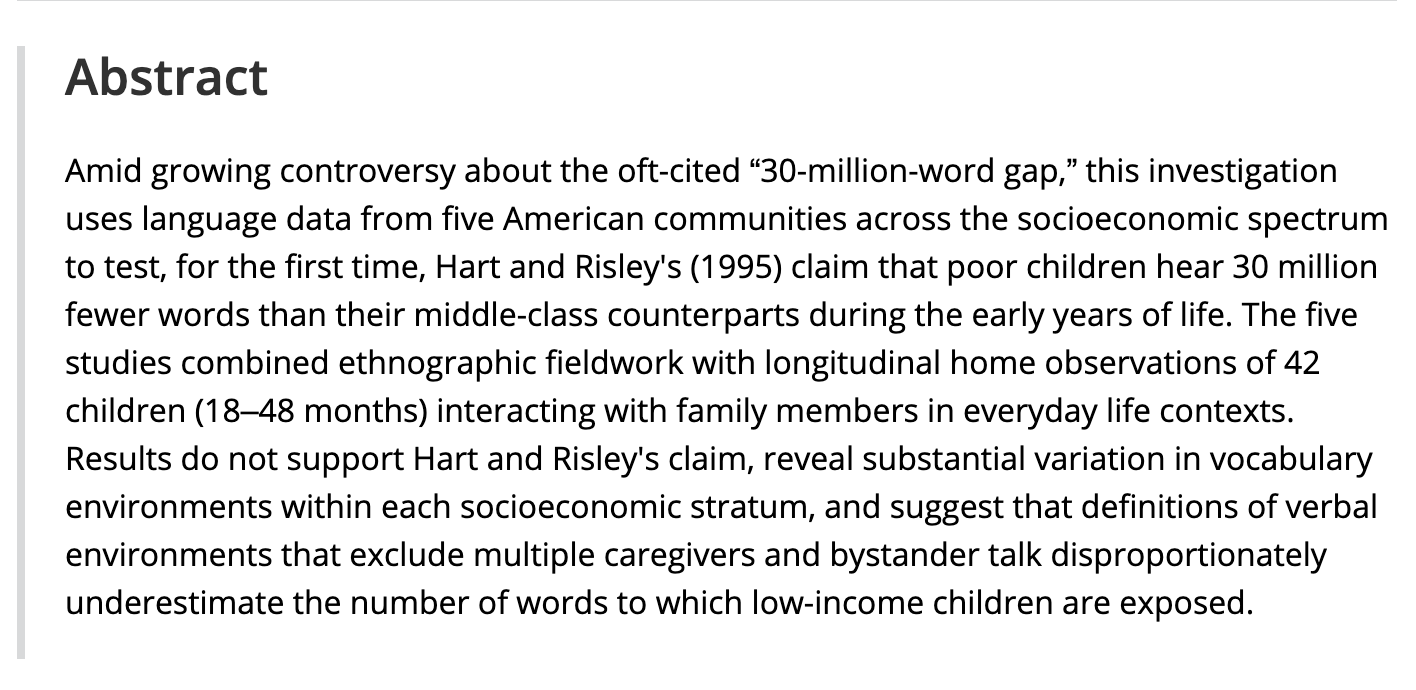
The term “word gap” was first coined in the 1995 Hart/Risley study that found low-income children are exposed to 30 million fewer words than their higher-income peers before age 3. This study and others have linked poor early literacy skills to lifelong academic, social and income disparities. Word gap initiatives primarily target low-income parents to help them understand the effect they have on their children’s cognitive development. Unfortunately, this misses another important part of the problem.


The deficit view perpetuated by Hart and Risley (not the credibility of the study or its claims) is as contagious as the zombie virus infecting everyone in The Walking Dead universe.

And while it would be easier just to lie down, give in, I remain steadfast against the “word gap” throng; thus, please take the time to consider the following reader:

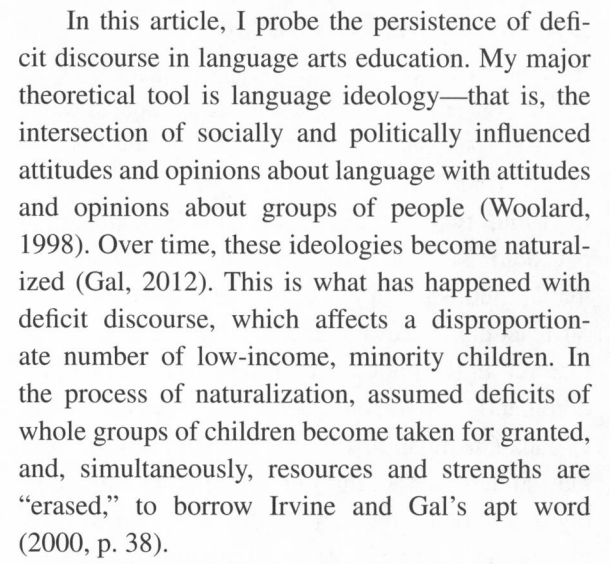
In this article, we argue that strong claims about language deficiencies in poor children and their families based on the Hart and Risley study are unwarranted. Further, we argue that the uncritical acceptance of Hart and Risley’s findings is emblematic of a trend among some educators, educational policy makers, and educational researchers to readily embrace a deficit stance that pathologizes the language and culture of poor students and their families (Dudley-Marling, 2007; Foley, 1997). We hope that this critique will help teachers resist “research-based” policies that aim to fi x the language and culture of poor and minority students with whom they work.

  • Dyson, A. H. (2015). Research and Policy: The Search for Inclusion: Deficit Discourse and the Erasure of Childhoods. Language Arts92(3), 199-207. http://www.jstor.org/stable/24575568

Hart and Risley, Meaningful Differences in the Everyday Experience of Young American Children—Google it and in .15 seconds you get over 100,000 hits. Hart and Risley’s book Meaningful Differences (1995) is the most-cited piece of academic work that attempts to explain what goes wrong with poor kids, with grand extrapolations and claims (which you’ll see that I argue are totally unsubstantiated) about how poor children will fare in school and later life—based on their early home experiences with language. The book purports to demonstrate (with what I will call pseudo-scientific elegance) that poor children (in their study six families, all black, all on welfare) are doomed before they enter school because 1) their parents don’t talk to them as much as upper middle class parents (13 upper SES, “professional” families—where the parents were predominantly professors, all white except one); and 2) poor children don’t experience as many “quality” features in the talk with their parents.

Because of the severe methodological flaws in the study, these conclusions are unwarranted. To truly investigate the relationship between quantity of interaction and vocabulary growth, we need at least two completely independent measures — (1) a measure of quantity of interaction such as that used by Hart and Risley, and (2) a measure of vocabulary size such as a vocabulary size test.

The differences are striking….

Neither the approach of concerted cultivation or the accomplishment of natural growth is without flaws. Both have strengths and weaknesses [emphasis added]. Middle-class children, for example, are often exhausted, have vicious fights with siblings, and do not have as much contact with their extended families as working-class and poor children. But when children enter institutions such as schools and health care settings, the strategy of middle-class child rearing of concerted cultivation is far more in compliance with the current standards of professionals than is the approach of the accomplishment of natural growth. There are signs that middle-class children gain advantages, including potentially in the world of work, from the experience of concerted cultivation. Working-class and poor children do not gain this benefit.

Update

Unlike fatalism in The Walking Dead, World War Z is a zombie narrative offered after the apocalypse, a tale told with a dark optimism since humans have survived the rise of the living dead.

There are lessons in this version as well, particularly about the possibility of an antidote—about choosing to see the world differently in order to make a different world.

Let us put the term “word gap” to rest, permanently, along with the nearly compulsive urge to cite Hart and Risley.

Related and Recommended

Why we need to smash up the concept of the achievement gap in tiny little pieces, Andre Perry

What Are Evidence-Based Practices and Policies in Education?

The best laid schemes o’ Mice an’ Men
Gang aft agley,
An’ lea’e us nought but grief an’ pain,
For promis’d joy!

“To a Mouse,” Robert Burns

If John Steinbeck’s Of Mice and Men offers a fictional dramatization of Scottish poet Robert Burn’s dire warning in poetry, above, then the mangled federal education policy popularly known as No Child Left Behind (NCLB) may be a top candidate for real-world proof of Burns continuing to be right 230 years later.

Heralded as bi-partisan and bold, NCLB has been unable to manage its central directive: scientifically based policy and practice in education.

The wider accountability paradigm of education reform driven by standards and high-stakes tests and NCLB have proven to be failures, but with the reauthorization of ESEA (NCLB) now on the table, those failures provide ample evidence for how to move forward with education reform and policy.

A policy memo from NEPC now stresses the importance of making evidence-based decisions during reauthorization:

Kevin Welner and William Mathis discuss the broad research consensus that standardized tests are ineffective and even counterproductive when used to drive educational reform. Yet the debates in Washington over the reauthorization of the Elementary and Secondary Education Act largely ignore the harm and misdirection of these test-focused reforms. As a result, the proposals now on the table simply gild a demonstrably ineffective strategy, while crowding out policies with proven effectiveness. Deep-rooted trends of ever-increasing social and educational needs, as well as fewer or stagnant resources, will inevitably lead to larger opportunity gaps and achievement gaps. Testing will document this, but it will do nothing to change it. Instead, the gaps will only close with sustained investment and improvement based on proven strategies that directly increase children’s opportunities to learn.

First, to heal the damage done, we must admit those clear failures. Next, we must change course away from accountability, standards, and high-stakes tests. Finally, we must clearly identify the reasons for educational struggles and failures in order to embrace the best policies and practices to prompt genuine and effective reform.

That reauthorization process, the new reform agenda, and then the daily practice of running schools and teaching students must re-embrace evidence-based policies and practices, but not without clarifying exactly what that means.

Two powerful lessons about creating evidence-based policy and practice can be drawn from the NCLB era: (1) simply codifying and mandating policy and practice must be evidence-based do not make that occur, and (2) the National Reading Panel’s procedures and outcomes highlight that “evidenced-based” when politicized is just as subject to human whims and corruption as anything else.

The inevitable train wreck of the Common Core (doing the same thing over and over while expecting different results) can be avoided now if we learn from NCLB; otherwise, we continue a long history identified by Lou LaBrant, former president of NCTE, in 1947: “A brief consideration will indicate reasons for the considerable gap between the research currently available and the utilization of that research in school programs and methods.”

What Are Evidence-Based Practices and Policies in Education?

What counts as evidence has been the basis of stringent debate within the disciplines throughout the history of organized disciplines. In fact, that tension is how disciplines continue to seek knowledge, define themselves, and thus crawl closer and closer to the ultimate goal of Truth.

The two lessons noted above, however, show that once partisan politics are the process for mandating what counts as evidence, the credibility of that evidence is essentially destroyed.

Along with the National Reading Panel (NRP), A Nation at Risk demonstrated as a process how partisan political goals corrupt evidenced-based conclusions. The panel creating A Nation at Risk and the NRP had conclusions dictated first and then selected the evidence to reach those conclusions. Codifying what counts as evidence through a political process corrupts knowledge (and thus policy and practice) while forcing disciplinary debate about what counts as evidence to remain on the sidelines (and thus ineffective).

Briefly (and at the risk of oversimplification), the debates within fields over what counts as evidence tend to be between those embracing quantification and generalizability and those who who embrace qualitative data in order to raise and pursue essential questions.

In most disciplines, experimental and quasi-experimental (and thus quantitative) research has historically (and still currently) dominated those debates. The rise of qualitative research, however, has both expanded the disciplines and forced quantitative analysis of the world to address that reducing phenomena to numbers is both limited and limiting.

So the first problem with codifying what counts as evidence through the political process is that mandates (through legislation and funding) narrow and render static a process that must remain vibrant and organic in order to be effective.

For education as a discipline, then, the added political layer (again, think A Nation at Risk, NRP, or the USDOE) is the problem that mutes the already existing and rich professional organizations that have the needed knowledge base and guidelines for both how to teach students the disciplines and what to teach students within the disciplines.

Since it is difficult to clearly separate policy and practice in education, let me end with some concrete examples in order to give the bones of the question what counts as evidence flesh: corporal punishment, grade retention, and teaching reading.

Corporal punishment remains relatively common in parenting in the U.S., but it also lingers in schools in about a third of states. The American Psychological Association (APA), however, has a clear stand against corporal punishment based on over 60 years of evidence.

This represents one level of the needed relationship between government mandates and the disciplines as that informs education: When a professional field has a clear understanding of an issue, policy should reflect that stance. In other words, corporal punishment should be banned in public schools—not because some partisan political committee has studied the issue, but because the APA has done so and over a long period of time, while taking into consideration a wide and varied body of evidence.

A second level of the needed relationship between government mandates and the disciplines as that informs education is grade retention. Like corporal punishment research, grade retention research is robust and suggests that grade retention is mostly harmful. But at this second level, how the political process fails is strongly highlighted. Currently, states are mandating the opposite of what the research reveals (embracing high-stakes testing as a trigger for grade retention).

At this second level, based on the disciplinary evidence over a long period of time and built on a wide and varied body of evidence, grade retention must not be mandated, but not banned either. In cases such as grade retention, policy should caution against the practice, but allow that, as the research shows, some children may benefit from the practice, but professionals closest to those case are best for making that decision.

A third level involves daily classroom teaching of the disciplines; I’ll focus here on reading by highlighting whole language and balanced literacy.

Reading policy and practice are possibly the most debated areas of partisan political agendas. Everyone believes children need to learn to read—and almost everyone thinks s/he knows how that should happen.

Whole language has been codified (see California) and banned (see NRP), and balanced literacy has also been codified (see New York).

Complicating this third level is that politicians, the media, parents and the public, and even practitioners often misunderstand practices such as whole language and balanced literacy. In the cases of California and New York, whole language and balanced literacy did not fail; the political and implementation processes failed them.

Whole language commercialized (textbooks, programs), tested in high-stakes contexts, and prescribed (standards, curriculum and pacing guides) ultimately is not whole language (or best practice).

The lesson at this third level is that political policy always corrupts classroom practice because classroom practice is never as simplistic as policy. Even the gold standard of experimental research fails the teacher in her day-to-day work because her classroom is not a random sampling of students, because her work is mostly with outliers.

At this third level, the political mandate must address only that teachers are provided the opportunity to decide for each student and during each teaching moment what counts as evidence. And in the teaching moment, what counts as evidence becomes that teacher’s experience couched in that teacher’s content and teaching knowledge as all of that happens against the on-going evidence of the act of teaching—which is exactly what balanced literacy is:
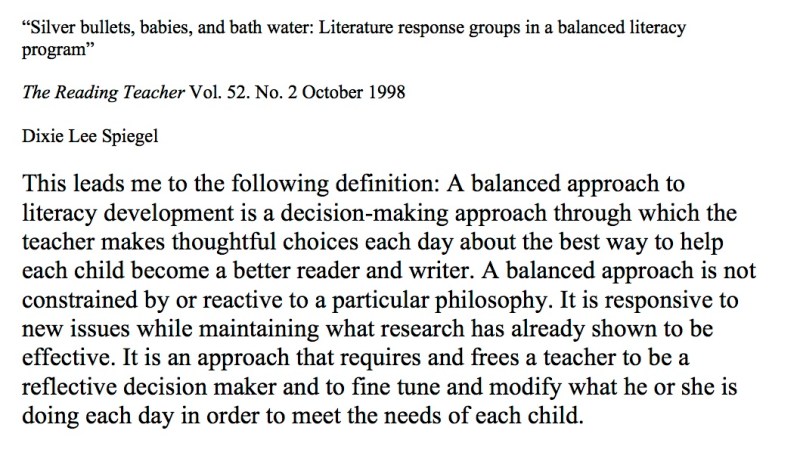
Spiegel 3

The third level, then, is the arena of professionalism. A reading teacher must come to class equipped with the knowledge of her field of literacy (one powerfully informed by whole language and balanced literacy, for example, but also a field in constant tension due to the debates about what literacy is and how to teach it), and then, capable of providing different students different approaches in order to provide the learning needed in the pursuit of each child’s literacy.

The evidenced-based real world of teaching reading is messy, chaotic, and cumulative over a period of time that cannot be predicted for any individual child.

Simply put, no politician or political committee in DC or any state house has any business or ability to mandate the daily teaching of children. The political job is to ensure professionals have the opportunity to be professionals—and to create a process of transparency so that tax payers know that professionals are provided for children and doing their work as experts in the disciplines.

Federal and state policies are misguided when they are prescriptions that supersede the complex and on-going knowledge of the disciplines.

As the NEPC memo above notes, what counts as evidence now in education reform is the political disaster that is NCLB. The grand lesson of that evidence is that political mandates in education—detailed in three levels above—are creating problems, not solving them—and at tremendous expense.

In education reform, we need political humility and a new era of recognizing both the existing power of the disciplines and the the professional possibilities of teaching.

We do not need a commission of a wide range of stakeholders to fumble badly again what, for example, the field of literacy has been carefully examining for decades, what the field of literacy could easily and quickly provide every teacher in the U.S.—the wide range of strategies for ensuring each child becomes an eager and empowered reader.

If our goal is truly evidence-based practices and policies in education, the evidence suggests we must first have partisan politics step aside.

Leaning Think Tanks or (More) Flawed Education Journalism?

In the spirit of good journalism, let me start with full disclosure.

I am on the Editorial Board of NEPC (you’ll see why this matters in a few paragraphs), and that means I occasionally provide blind peer review of research reviews conducted by scholars for NEPC. That entails my receiving a couple very small stipends, but I have never been directly or indirectly asked to hold any position except to base my reviews on the weight of the available evidence.

Further, since this appears important, I am not now and have never been a member of any teacher or professor union. Recently, I spoke to a local union-based conference, but charged no fee (my travel from SC to TN was covered).

Finally, I have been confronting the repeatedly poor journalism covering education and education reform for several years, notably see my recent piece, Education Journalism Deserves an F: A Reader.

My key points about the failures of journalism covering education include (i) journalists assuming objective poses, that are in fact biased, (ii) the lack of expertise among journalists about the history and research base in education, and (iii) the larger tradition in journalism to dispassionately (again a pose, but not real) present “both sides” of every issue regardless of the credibility of those sides or regardless of whether or not the issue is really binary (let’s highlight also that virtually no issue is binary).

So I remain deeply disappointed when major outlets, here Education Week, and experienced journalists, specifically Stephen Sawchuk, contribute to the worst of education reform by remaining trapped in the worst aspects of covering education.

Sawchuk’s U.S. Teacher-Prep Rules Face Heavy Criticism in Public Comments includes a common framing of “both sides” in order to address the USDOE’s new proposal to reform teacher education.

That framing pits NEPC against the Thomas B. Fordham Institute—although a number of others with stakes in the debate are listed. What is notable here is how Sawchuk chooses to characterize each; for example:

Still other commenters drew on a brief prepared by the National Education Policy Center, a left-leaning think tank at the University of Colorado at Boulder that is partly funded by teachers’ unions and generally opposes market-based education policies….

Thomas B. Fordham Institute, which generally backs stronger accountability mechanisms in education….

Only a handful of commenters were outright supportive of the rules. At press time, a coalition of groups were preparing to submit a comment backing the proposal. The coalition’s members included: Democrats for Education Reform, a political action committee; Teach Plus, a nonprofit organization that supports teacher-leadership efforts; the National Council on Teacher Quality, an advocacy group; and the alternative-certification programs Teach For America and TNTP, formerly known as The New Teacher Project.

In the U.S., labeling NEPC “left-leaning” and highlighting union affiliation is just as coded as calling Richard Sherman a thug. We all know that wink-wink-nudge-nudge is dismissive, prompting Audrey Amrein-Beardsley to ask, “Why such (biased) reporting, Sawchuk?”

Yet, Fordham supports “stronger accountability” and not a single group in the third listing has a “nudge” despite, for example, NCTQ entirely lacking credibility.

Also, NEPC has a hyperlink, but none of the others? And where is the link to the actual report from NEPC, and is there any credible evidence the report on the USDOE’s proposal is biased or flawed?

Since traditional faux-fair-and-balanced journalism continues to mislead, since we are unlikely to see a critical free press any time soon, let me, a mere blogger with 31 years of teaching experience (18 in a rural public SC high school, and the remainder in teacher education) and about twenty years of educational scholarship offer some critical clarifications.

First, here is the abstract for Kevin K. Kumashiro‘s review of Proposed 2015 Federal Teacher Preparation Regulations by the USDOE:

On December 3, 2014, the U.S. Department of Education released a draft of proposed new Teacher Preparation Regulations under Title II of the Higher Education Act with a call for public comments within 60 days. The proposal enumerates federally mandated but state-enforced regulations of all teacher preparation programs. Specifically, it requires states to assess and rate every teacher preparation program every year with four Performance Assessment Levels (exceptional, effective, at-risk, and low-performing), and states must provide technical assistance to “low-performing” programs. “Low-performing” institutions and programs that do not show improvement may lose state approval, state funding, and federal student financial aid. This review considers the evidentiary support for the proposed regulations and identifies seven concerns: (1) an underestimation of what could be a quite high and unnecessary cost and burden; (2) an unfounded attribution of educational inequities to individual teachers rather than to root systemic causes; (3) an improperly narrow definition of teacher classroom readiness; (4) a reliance on scientifically discredited processes of test-based accountability and value-added measures for data analysis; (5) inaccurate causal explanations that will put into place a disincentive for teachers to work in high-needs schools; (6) a restriction on the accessibility of federal student financial aid and thus a limiting of pathways into the teaching profession; and (7) an unwarranted, narrow, and harmful view of the very purposes of education.

If there is anything “left-leaning” or any evidence that union money has skewed this review, I strongly urge Sawchuk or anyone else to provide such evidence—instead of innuendo masked as balanced journalism.

And let’s unpack “left-leaning” by looking at NEPC’s mission:

The mission of the National Education Policy Center is to produce and disseminate high-quality, peer-reviewed research to inform education policy discussions. We are guided by the belief that the democratic governance of public education is strengthened when policies are based on sound evidence.

A revision appears in order so I can help there also:

Still other commenters drew on a brief prepared by the National Education Policy Center, a left-leaning think tank committed to democratic and evidence-based policy at the University of Colorado at Boulder that is partly funded by teachers’ unions and generally opposes market-based education policies not supported by the current research base….

Since NEPC is balanced against Fordham, it seems important to note that NEPC has three times awarded Fordham its Bunkum Award (2010, 2008, 2006) for shoddy and biased reports; thus, another revision:

Thomas B. Fordham Institute, a free-market think tank which generally backs stronger accountability mechanisms in education regardless of evidence to the contrary.

I added the hyperlink to the Fordham mission statement, which uses code also (“options for families,” “efficient,” “innovation,” “entrepreneurship”) to mask their unwavering support not for “stronger” accountability but for market-based policy.

What does all this teach us, then?

All people and organizations—including Education Week, NEPC, and Fordham—are biased. To pretend some are and some aren’t is naive at best and dishonest at worst.

NEPC, I believe, freely admits there is a bias to what reports are selected for review (just as EdWeek chooses what issues to cover and where to place and how to emphasize those pieces), but the reviews implement the most widely accepted practices for transparency and accuracy, blind peer-review. Further, the reviews are freely available online for anyone to examine carefully and critically.

The real story that mainstream media are refusing to cover is that the USDOE (and the so-called reformers such as TFA, NCTQ, DFER, TNTP, etc.) lacks the experience and expertise to form education policy, but the actual researchers and practitioners of the field of education remain marginalized.

Yes, the real story is that those rejecting the USDOE’s proposed teacher education regulations are credible and that the proposal itself (as Kumashiro details) lacks credibility (notably in its use of value-added methods, which has been rejected for use in high-stakes ways by researchers left-leaning, right-leaning, and moderate; see HERE, HERE, HERE, HERE, and HERE).

The greatest failure among the mainstream media is the inability of journalists to recognize and then address that their narrative about “reformers v. anti-reformers” is a straw man argument and that the real battle is between those seeking reform built on the research base (researchers and educators consistently marginalized and demonized) and the rich and powerful without credibility committed to accountability, standards, and high-stakes testing as a mask for market ideologies—despite three decades of research showing that has not worked.

And since I opened with transparency, let me end with a solid clarification that I am on record as a teacher educator that teacher education desperately needs reforming, as does public education broadly, professional education organizations, and teacher unions. And thus, I recommend the following:

Open Letter to Teachers Unions, Professional Organizations, and Teacher Education

Are We (Finally) Ready to Face Teacher Education’s Race Problem?

What’s Wrong with Teacher Education?

Conditions v. Outcomes: More on What’s Wrong with Teacher Education (and Accountability)? pt. 2

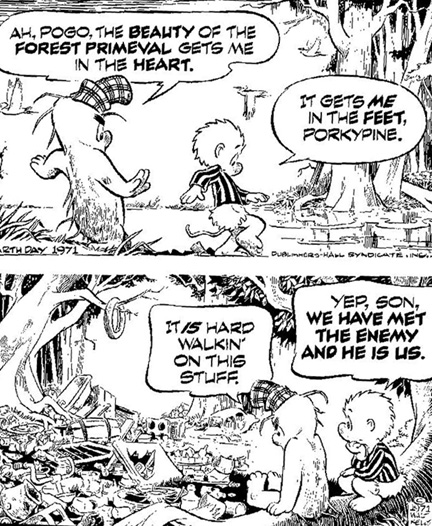
The Fatal Flaw of Teacher Education: “We have met the enemy and he is us.”

Since the fall of 1984, I have been a teacher—the first 18 years as a high school English teacher in a rural public school in South Carolina, and then as a teacher educator at a private liberal arts university only about an hour’s drive from that high school and my hometown.

SC adds important layers to viewing the professions of K-12 teacher and college professor because SC is a so-called “right-to-work” state (non-union) and the South clings to a tradition of respecting authority (notably as a mask for lingering sexism, racism, and harsh attitudes about children).

Throughout my three-plus decades as an educator, I have worked within and against the accountability movement that has now reached a fever pitch, aiming the political, media, and public accusatory fingers at both teachers and teacher educators. I believe my public record as a strong public education, student, and teacher advocate is solid so it is incredibly difficult to turn my accusatory finger toward those colleagues I genuinely admire, have sought to defend against the misguided and dishonest attacks from the eduction reform movement.

As I have detailed repeatedly, claims that education is itself a powerful mechanism for social change and individual success and that teachers are the most important aspect of that formula are factually untrue.

Historically and currently, educators at all levels have little influence over or voice in public policy, and the norms of teaching have always dictated that teachers and professors remain objective, and thus not political, in the classroom.

All of these factors have combined for the perfect storm, specifically in the South but nationally as well, for further de-professionalizing teaching as federal and state policy continues to increase accountability based on prescriptive standards and high-stakes testing despite the growing evidence that those policies do not work.

Teacher education stands at the intersection of that disturbing trend.

“We have met the enemy and he is us.”

While I continue to seek ways to support K-12 teachers in raising and asserting their professional voices, I am deeply aware that public school teachers (especially in non-union states) must consider the job insecurity related to any political efforts.

Yes, I want K-12 public school teachers to embrace their empowerment, but I appreciate that call from a tenured university professor rings hollow.

That is not the case, however, among my university-based teacher educators, many of whom are themselves tenured and all of whom are directly culpable for the policies being imposed on both public education and teacher education.

Yet, in the same tradition of public school teachers, teacher educators remain mostly inert, passive, and compliant. In fact, as I have noted, many in teacher education rush to out-do the exact reformers poised to destroy public education and teacher education.

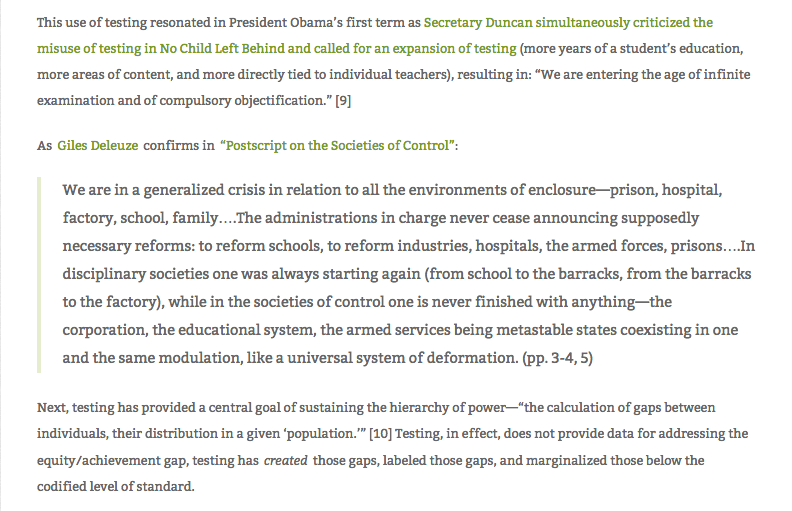
Education reform at all levels and in all contexts is designed so that everyone is constantly starting over, never able to finish because the bureaucracy needs that paralysis of infinite compliance:

testing 2

Having now been in higher education for well over a decade, I have watched how other departments and disciplines function. Most disciplines are not only self-determining, but also self-policing.

Biologists are not scrambling to comply with political demands, and they certainly are not abdicating their field to political, media, or public expectations. Consider that biology remains firm on evolutionary biology and climate change despite the tremendous political, media, and public misunderstanding and misinformation about as well as resistant to significant bodies of research and credible evidence.

Teacher education, on the other hand, simultaneously notes that value-added methods (VAM) for evaluating teachers and teacher education are not supported by the research base while also rushing to implement policies that require VAM in teacher evaluation as well as certification and accreditation.

Such professional schizophrenia for K-12 teachers is unhealthy and dehumanizing, but often understandable in the larger context of job security.

In higher education, that professional schizophrenia is inexcusable.

To my fellow teacher educators, then, I must stress that we are the possible line in the sand about failed accountability, about the complete failure to implement evidence-based policy and practice.

When we lament the lack of respect for education by the other disciplines, when we lament that teaching is not a prestigious profession in the U.S., when we read yet another media trashing of teachers and teacher certification and degrees, when we listen to politicians and self-proclaimed reformers with no background in education make repeated claims that are untrue, how do we simply complain and then turn right around and comply?

Or possibly more important: Why do we simply complain and then turn right around and comply?

As long as we continue such schizophrenia, we are contributing to education as the punch line in a not-so-funny cartoon:

Pogo_-_Earth_Day_1971_poster

For Further Reading

Maxine Greene and the “Frozen Sea Inside of Us”

Lessons from the Zombie Apocalypse

“A generalized crisis in relation to all the environments of enclosure”: Deleuze

Re-framing teacher evaluation discourse in the media: an analysis and narrative-based proposal, Jasmine B. Ulmer