Category Archives: Education

A Brief Meditation on What Has Failed

What has failed in the U.S.?

Democracy? No. We have failed democracy.

Public education ? No. We have failed public education.

The free press? No. We have failed the free press.

Capitalism? No. This is exactly how capitalism works–consuming all and laying waste to democracy, human dignity, and equity.

Of all that is the U.S., capitalism is working as it is designed to work.

And that is our greatest failure.

O, Free Press, Where Art Thou?

As I have noted, a common thread running through my blogs is the carelessness among the media covering education.

Case in point, yet another tone-deaf and completely unsupportable piece has appeared in the The Post and Courier (Charleston, SC): Duncan deserves high marks.

With just a modicum of effort, almost every claim made in this piece is easily refuted by something the mainstream press seems determined to ignore, evidence.

I have called for the “Oliver Ruler” and  a critical free press as well as posting an open letter to journalists, but many journalists remain committed to “balance” and thus are unwilling to evaluate the quality of claims or the credibility of people or positions.

But there appears to be some hope across the pond (it seems Oliver’s land can see what we cannot):

Stop giving airtime to crackpots, Phil Plait

BBC staff told to stop inviting cranks on to science programmes

So once again, not all issues have “both sides” and thus do not require seeking out balance for the sake of balance. As well, not all people or claims are credible; therefore, that those people or claims exist does not justify their being acknowledged. It is essentially malpractice to treat unequal claims as equal.

While the BBC is directly addressing science, in the U.S. the education reform agenda is currently being crippled by inexpert and incompetent leadership that is being reinforced by a media blinded by their pursuit of balance at the expense of credibility and evidence.

Leaving me still pining, O, free press, where art thou?

GUEST POST: Denny Taylor, Garn Press

GUEST POST: Denny Taylor, Garn Press

 Dear Friends and Colleagues,

I am writing to urgently request your help. If you find the political circumstance and the research base for the four propositions that I have outlined in this letter are compelling, and you support the course of action suggested here please send this letter to friends and colleagues. Use your websites, Facebook, and any other means to get the message out. Given that I rarely enter the public sphere my friends will know that the situation of which I write is pressing. Time is of the essence, I fear.

Some of you will have read books I have written based on forty years of longitudinal research in family, community, and schools settings with children, families, and teachers who live and work in challenging social and physical environments. Except for my doctoral dissertation, all my research has taken place in sites of urban and rural poverty.

About fifteen years ago I became more focused on catastrophic events, including extreme weather events, industrial disasters, war and armed conflict, and acts of mass violence that occur with little warning and in a matter of a few seconds change the lives of children, teachers, and their families forever.

I haven’t published during this fifteen year time period, but I have been working as a researcher and writing on a daily basis. Much of the time I have spent studying the research on trauma and mass trauma with a mentor in the field. Still more time has been spent studying Earth system science, and eventually writing qualitative research papers that were peer reviewed by researchers in the physical sciences. Based on the reviews, I have participated in research conferences and meetings with Earth system scientists whose research focuses on quantitative studies on the anthropogenic changes that are taking place to the planet.

My own research has evolved, and I have found my place between scientists, policy makers, and the public. The mix of social and physical sciences is making it possible for me to share the findings of these fifteen years of daily study, which are firmly grounded in scientific evidence, and in the lived knowledge that has come from living and working in places where catastrophic events have taken place.

There are eight book length manuscripts on my bookshelf and the first three books based on them are being published this summer. These books are very different from each other, but they all focus on the interconnections between two of the greatest threats to our children’s future:

  1. The dismantling of the US public education system; and
  2. The acceleration of anthropogenic change to the planet.

The Earth system scientists from the global scientific community who participated in the IPCC 5th Assessment Report categorized climate change as “unequivocal”, and 195 countries signed documents in agreement with these scientists. In addition, the US Government Accountability Office (GAO) has produced 40 reports, the first in 2005, raising concerns about climate change and in the 2014 report the GAO has elevated the impacts of climate change to “high risk” status. The Department of Defense (DOD) has issued similar reports and warnings and is preparing for catastrophic events that might occur because of climate change.

But the US Congress still refuses to act. Many members of Congress are still denying that climate change is unequivocal, and they refuse to acknowledge that both the people of the United States and the entire global community are at “high risk”.

Even more inexplicable is the fact that there is now one political party in the US Congress that is not only denying climate change, but has powerful members on Congressional sub-committees convened to focus on climate change who are also outspoken in denying basic science.

The three books connect the dots between the dismantling of the US public education system and the denial of climate change, and they present four propositions:

First Proposition: By defunding public education the federal government is selling the future of children in the US to private corporations, creating huge revenues for companies and a bonanza for shareholders, while at the same time undermining and destabilizing the neighborhoods and communities in which schools are privatized.

Second Proposition: By profligating denial of climate change, defunding and limiting expenditures on mitigating climate and environmental problems, the US Congress is actively engaged in protecting the corporate interests that have supported their political campaigns, while willfully ignoring the very real and very grave threat that exists to the American people, especially children, and to all human life on the planet.

Third proposition: By defunding public education and selling the children in the US to private corporations that are in large part responsible for climate change and the destruction of the environment, the federal government is ensuring the indoctrination of America’s children into the State-Corporate Complex that is threatening their future, while at the same time actively interfering with their capacity to develop the problem-solving capabilities they will need to tackle the potentially life-threatening anthropogenic changes to the planet that they will experience in their lifetime.

Fourth proposition:If we are serious about preparing our children for an uncertain future, in which they will be confronted by many perils, then we must stop the corporate education revolution immediately and recreate the public school system based on democratic principles, ensuring equality and opportunity for all children to participate in projects and activities that will ensure their active engagement in re-visioning and re-imagining human life on Earth.

For our children and the planet, the third and fourth propositions are far reaching in their implications. The three books unpackage the political propaganda, and focus on the scientific research that is being obfuscated for political power, and corporate revenues and profits. Each book explores the relationships that exist between what Noam Chomsky calls “the State-Corporate Complex” and the acceleration of climate change, and the defunding and corporatization of public education. Together they provide compelling evidence why the Common Core should be abandoned and Pearson’s “global education revolution” immediately ended.

Here are the titles of the three books:

Nineteen Clues: Great Transformation Can Be Achieved Through Collective (just published in paper and also available in electronic formats for Amazon, B&N, Kobo, and iBooks).

Save Our Children, Save Our School, Pearson Broke the Golden Rule (proof copies of this political satire have arrived and the actual book should be available in two weeks with eBooks to follow).

Keys to the Future: A Parent-Teacher Guide to Saving the Planet (is in the final edit stage and will be available in paper by September, again with eBooks to follow).

Together, based on the evidence, these books make the case that there are three things we know for sure:

  1. What happens to the future lives of our children and grandchildren depends on us;
  2. We should not expect the powerbrokers of the State-Corporate Complex to come to our aid or rescue our children;
  3. Extreme inequality is not only bad for people it is bad for the planet – the poor are at greater peril than the rich.

Many teachers and parents are already leading the way in the struggle for equality and more humane learning environments for children. Their courageous activism is the struggle not only for the re-establishment of the public education system, but also for the future of humanity.

The dangers to our children are real, and at Garn we volunteering our time to work for the Press, because we regard ourselves as first responders in an emergency situation. Our mission is to publish books with actionable knowledge that can be of use to educators and the public. We are hopeful for the future and we put our trust in the people, especially parents and teachers, who are working to make the planet a child safe zone.

Please consider supporting Garn Press by sharing this letter with everyone in your social networks and encouraging your friends and colleagues to read the books. Reviews are welcome!

Our hope at Garn is that when our children and grandchildren ask us what we did to respond to climate change we will be able to tell them that:

  1. We saved their schools and made them sites of equity and justice;
  2. We made their schools places where every child developed the capacity to be resourceful and resilient;
  3. We insisted that they had the opportunity to participate in great projects about the Earth and about the Universe;
  4. We made sure their education included both the scientific and the literary so they could see the deep connections between these ways of thinking and ways of being;
  5. We were adamant that they learned together in classrooms that valued the ways in which they could support one another;
  6. We insisted that their classes included the arts, dance, music, drama, painting and drawing in seamless lessons that encouraged joyfulness and a sense of belonging to a community.

We will be able to tell them that because of the ways in which we insisted they were educated the ethos of the nation changed. Because of their children the public began to regard the Earth differently. People began to reassess what was important to them. They acted on what they already knew, that liberty cannot exist without justice, and that the price of great wealth for a few was too high for the public to pay and would no longer be tolerated.

We will tell them we stood strong, and we used these newfound beliefs in our re-Imagining of the ways we live on the planet. We will tell them because we love our children so much the world changed.

We must do whatever we can to make this happen, so we can tell our children, “We worked together and we made the Earth a child-safe zone.”

Denny Taylor

New York

July 15, 2014

Racism not Below the Surface in U.S., Still

Since it is just sports, that LeBron James and Carmelo Anthony are wielding a significant amount of power during the NBA off-season could easily go unnoticed except for sports fans and those enthralled by ESPN and sports media.

But how James and Anthony are framed should be placed in context, notably the recent confrontation and arrest of an African American female professor at Arizona State University and this post, It’s Not Race, It’s Class…And Other Stories Folks Now Tell.

The U.S. is not post-racial, and claims that the country is may be that most powerful evidence that racism is not even below the surface, that denying racism has an evidence problem. It seems important—much like the “thug” labeling of Richard Sherman—that James is being accused of holding the NBA hostage.

Shouldn’t we investigate how often powerful and wealthy white men are framed in such language? (Never.)

In that context, I think we should revisit, then, the NBA finals from 2011, one in which the framing of James and Nowitzki reveal how professional sports in the U.S. expose the enduring power of racism as well as illuminate the pervasive influence of racism throughout education reform.

NBA Finals and “No Excuses” Charters

After game one of the 2011 NBA Finals, pundits began to clamor to reappraise the status of the Miami Heat, a team nearly equally loved and despised for the same reason—the acquisition of LeBron James. But in the closing seconds of game two, Dirk Nowitzki made a spinning, driving lay up with his splinted left hand to seal a huge fourth-quarter comeback, spurring Gregg Doyel at CBSSports.com to write a column titled “Heat return to their smug ways and Mavs make them pay.”

Consider some of Doyel’s comments. Frame this about the Heat—”Ultimately, this was everything we have come to expect from these fascinating, infuriating Miami Heat: Hollywood as hell. Damn good. But a bit too full of themselves”—with this comment about Nowitzki:

Dirk Nowitzki is the anti-Heat—a quiet, humble, mentally tough SOB. He played with a splint on the middle finger of his left hand, and for more than 45 minutes he didn’t play well. But he scored Dallas’ final nine points, seven in the last minute, four with his left hand. That game-winning layup? He created it, then finished it, with his left hand. It probably hurt, but Nowitzki had more important things to worry about than pain. He had a game to win.

When I read this column, I immediately thought about a recent column by Dana Goldstein,“Integration and the ‘No Excuses’ Charter School Movement.” In her piece, she examines “no excuses” ideologies connected with the new charter school movement:

That said, there are some troubling questions about whether the most politically popular charter school model—the “No Excuses” model popularized by KIPP and embraced by Moskowitz’s Success Charter Network—is palatable to middle-class and affluent parents.

Later in her essay, Goldstein makes one comment that continues to trouble me: “What seems clear is that the ‘No Excuses’ model is not for everyone, and presents particular challenges to parents who are accustomed to the schedules and social routines of high-quality neighborhood public schools.”

It is the intersection of the column about game two of the NBA finals and Goldstein’s article on “no excuses” charter schools that reveals for us the powerful influence of middle-class norms (a code for “white”) on every aspect of American society.

Throughout the NBA playoffs this year, the story no one is talking about has been the narratives following Nowitzki and LeBron James.

The NBA in Black and White

Nowitzki, a German-born centerpiece of the Dallas Mavericks, has been repeatedly compared to Larry Bird, one of the NBA all-time greats who shares with Nowitzki an important quality—race—which appears to translate into a default assessment—working-class ethos, the ability to rise above limitations through hard work (the personification of middle-class myths).

James, while often championed as the “next” Michael Jordan, has increasingly been compared to Magic Johnson, the arch-rival of Bird from an era decades in the past. Also like the Magic comparison, James now carries the “Hollywood” label—and that means too much talent and not enough humility, not enough effort.

And as the narrative about the Heat and the Mavericks (let’s not ignore the coincidental symbolism in the team names and the geographical significance of Miami beach against Texas) continues to play out, we read the subtext of class and race that drives not what happens on the court but how the media and public craft those narratives as a response to the players.

Culturally, we want Nowitzki and the Mavericks to win because that proves us right [1], the triumph of the middle-class norm. And we hope that a Nowitzki/Maverick win will go one step further by putting James and the Heat in their place, creating the ultimate personification of the middle-class norm—James’s talent plus Nowitzki’s humble working-class persona.

And this is what troubles me about Goldstein’s sentence from above: “What seems clear is that the ‘No Excuses’ model is not for everyone.” This leaves open an endorsement for continuing to champion “no excuses” schools as long as they target children of color, children trapped in poverty, and children struggling against being English language learners.

Middle-class and affluent children don’t need “no excuses” schools, the unspoken message goes, because they are already on board; they are a part of the normalization of middle-class (white) myths of who people should be, what people should say, and how people should behave.

We should not be contemplating for whom “no excuses” schools are appropriate because “no excuses” schools are not appropriate for any children in a free society. “No excuses” schools are the worst type of classism and racism, and they are the ultimate reduction of education to enculturation.

“No excuses” ideology denies human agency, human dignity, perpetuating a Western caste system of knowing ones place.

Yes, as a society, we want LeBron James, Dwayne Wade, and Chris Bosh to sit down and shut up, but we also want some children to learn this as well. The elite remain elite as long as the rest remain compliant.

Adrienne Rich (2001) fears that what is “rendered unspeakable, [is] thus unthinkable” (p. 150). [2]

And Bill Ayers (2001) recognizes the silencing purposes of schools:

In school, a high value is placed on quiet: “Is everything quiet?” the superintendent asks the principal, and the principal the teacher, and the teacher the child. If everything is quiet, it is assumed that all is well. This is why many normal children—considering what kind of intelligence is expected and what will be rewarded here—become passive, quiet, obedient, dull. The environment practically demands it. (p. 51) [3]

The “no excuses” miracle schools are no miracles at all. They are mirages carefully crafted to reinforce cultural myths. They are nightmares for childhood and the basic rights of life, liberty, and the pursuit of happiness. They are tragic examples of allowing the ends to justify the means.

If we are a people who embrace human freedom and agency, if we are a people who believe all people are created equal, if we are a people who trust the power of education as central to that freedom and equality, then there simply is no excuse for perpetuating “no excuses” charter schools that are designed to squelch the possibility of LeBron James-type agency among more people and throughout our society, and not just safely within the confines of a basketball court.

For Further Reading

Other People’s Racism: Race, Rednecks, and Riots in a Southern High School

[1] Consider the same dynamic in the 2014 finals in terms of the San Antonio Spurs as a hard-working franchise, not a star franchise.

[2] Rich, A. (2001). Arts of the possible: Essays and conversations. New York: W. W. Norton and Company.

[3] Ayers, W. (2001). To teach: The journey of a teacher. 2nd ed. New York: Teachers College Press.

Teaching Students, Not Standards or Programs

If you believe shoddy commentary at The New York Times (and you shouldn’t), we have more to fear from balanced literacy than the zombie apocalypse.

The central problem with the sudden surge in assaults on balanced literacy is that–like almost all of the “sky is falling” rants against progressivism, whole language, etc.–this round of “beware balance literacy” is not about teaching reading (or students) at all, but tired and ill-informed ideological misinformation.

However, these partisan political shots masked as education reform are illustrative, nonetheless. And like the mostly garbled public debates about Common Core (also usually misinformed and about politics but not students, teaching, or education), we must look beyond the terminology.

First, public and media uses of any terms such as “balanced literacy” or “whole language” are problematic because what a term means within a field is often quite distinct from how those terms are used in practice–especially once a guiding philosophy or theory (such as whole language, balanced literacy, or literature circles) becomes a program.

So with the current media assaults on balance literacy, we are likely faced with a real difficult paradox: the media rants are insincere and misguided, but it is also likely that far too often programs called “balance literacy” have been deeply flawed (but because the programs failed balance literacy and not because balance literacy is a flawed guiding principle for teaching).

Next, then, we must recognize that our media and public debates about balanced literacy and Common Core are missing just what is wrong with the historical and current contexts for how to teach students: Our job as teachers is to teach students, not standards, not programs.

All the time, energy, and funding spent training teachers in this or that program, this or that new set of standards is time, energy, and funds misspent because the reality of teaching day-to-day is that regardless of the set of standards or the required program, we teachers are charged with starting where each student is and then to take each student where she/he is capable of going.

To demand that we meet or hold us accountable for meeting some general standard of where all children should be or to hold us accountable for meeting the dictates of a program–that is educational malpractice.

And that is why the specific attacks on balanced literacy are potentially powerful lessons in all that is wrong with education reform. If balanced literacy were the grounding principle of literacy education, teachers would have the professional autonomy to identify student needs and then provide whatever instructional practices serve those student needs–instead of being bound to meet standards, raise test scores, or implement programs in uniform and bureaucratic ways.

But teacher autonomy (while serving the needs of students) does not serve the needs of political leaders or the monetizing zeal of corporate America. Bluntly stated, teacher autonomy does not elect politicians or line the pockets of Pearson or the legions of corporatists feeding on the public dime.

U.S. public education has never had a standards problem; it has never lacked an ample array of ready-made programs. Teachers have never had the sort of professional space that supports what students need and deserve, however.

U.S. public education has always been bogged down in the pursuit of both the “right” standards and the “right” programs–both inexcusable distractions.

It is counter-intuitive, but Henry David Thoreau’s dictum–“Simplify, simplify, simplify!”–may be our best new guiding principle for education reform.

The in-school key to fulfilling the promise of universal public education is teacher autonomy in an environment of community and support–not bureaucratic accountability in an environment of blame, punishment, and coercion.

Balanced literacy as a mandated program may not be as horrifying as the zombie apocalypse, but it is more evidence that we are failing balanced literacy, and thus students, not that balanced literacy is failing students.

We teachers must teach students, not standards or programs. But we teachers need the space required to do the job we have chosen and the job that is central to a free people.

“About Time” about Looking Hard Enough

[Header Photo by Aron Visuals on Unsplash]

I don’t get many things right the first time
In fact, I am told that a lot
Now I know all the wrong turns, the stumbles and falls
Brought me here

“The Luckiest,” Ben Folds

The second time around Dad says about his son Tim at Tim’s wedding:

I’d only give one piece of advice to anyone marrying. We’re all quite similar in the end. We all get old and tell the same tales too many times. But try and marry someone kind. And this is a kind man with a good heart.

I’m not particularly proud of many things in my life, but I am very proud to be the father of my son.

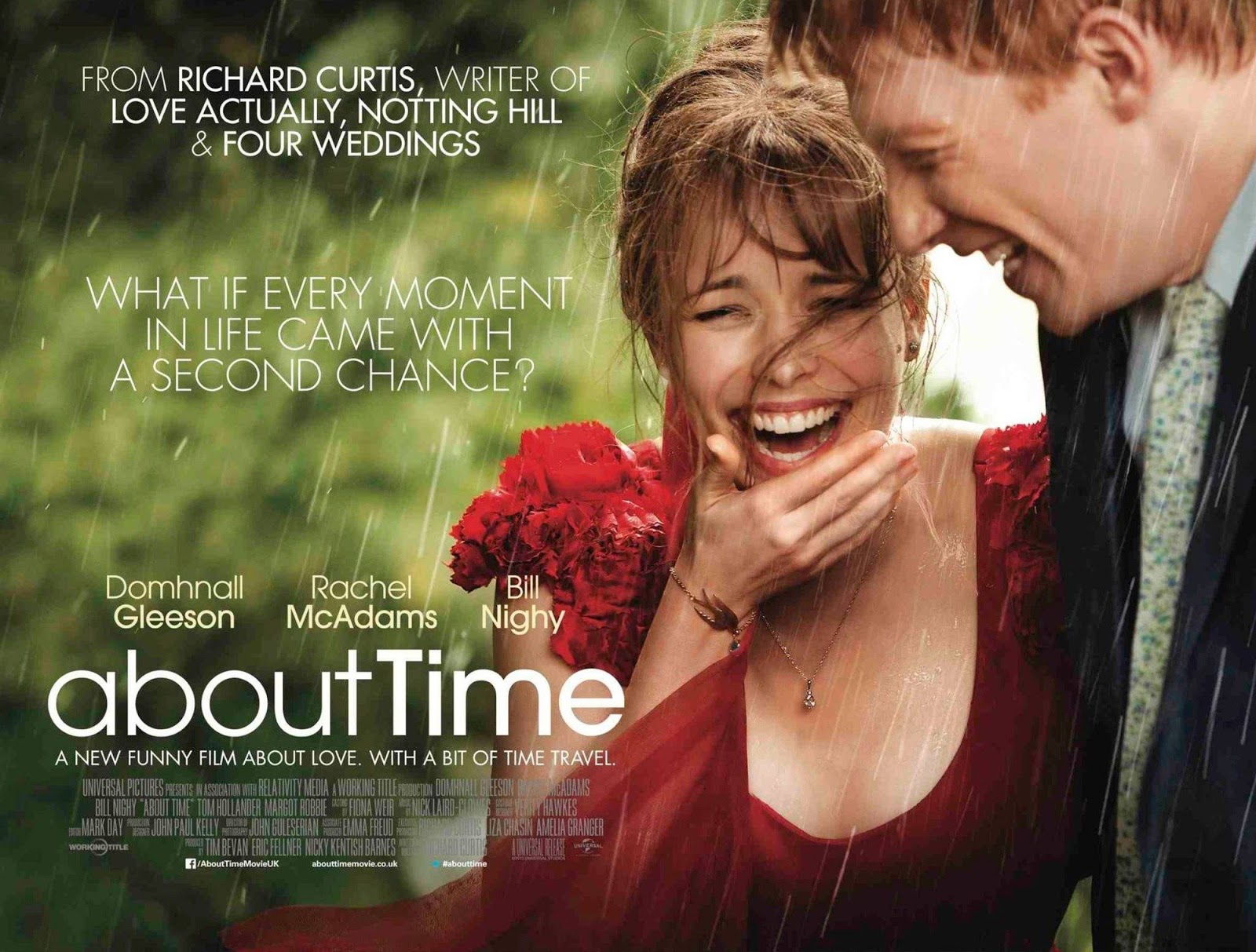
It is easy to be tricked into believing that Richard Curtis’s About Time is yet another derivative British romantic/comedy from the director/writer responsible for Notting Hill, Love Actually, and The Girl in the Cafe—especially with Rachel McAdams in the rain on the film poster:

About Time

Yes, this film has more than echoes of lines and characters from Curtis’s filmography (which I must confess is among my favorite), and the film is both romantic and funny, the sort of charming British funny I find perfect in Curtis’s movie along with his ability to walk that thin line between cheesy and genuinely sweet, always remaining on the right side.

But the opening scene quoted above between Dad (Bill Nighy) and Tim (Domhnall Gleeson) captures that About Time is about the human condition and the human heart—and ultimately about looking hard enough.

The major difference in this Curtis production is that Tim discovers on his twenty-first birthday that he is part of a lineage of men who can time travel. Like romance, time travel in films is ripe for bungling, but Curtis has joined for me a small group of works that allow the time travel trope to enhance a much greater purpose: Kurt Vonnegut’s rip-roaring Slaughterhouse-Five and David Lynch’s time wrap-around metamorphosis Lost Highways, just to name two in which time travel is central but dwarfed by larger elements.

In About Time, time travel allows the bumbling and lonely Tim to sharpen that kindness that his father loves; without his ability to re-do, Tim would have been nothing more than a sad butt of his own jokes for the length of a film.

Instead, Tim finds, loses, and finds again Mary (Rachel McAdams)—and that happens very early and quickly in the film. That is our first hint that this film is not mainly about Tim and Mary (although their story is quite sweet, quirky, and endearing).

As Tim becomes a husband and father himself, the narrative returns again and again to Dad and Tim—men bound by a private gift (or curse) and by the very human frailty most men share, the inability to engage emotionally with the world and other people in ways that are full and healthy. Even when most things are good and should be easy to manage on an emotional level.

The plot has ample moments of tension, of the very real possibility of disaster, and Tim discovers that his time traveling has incredibly difficult limitations along with quite a few opportunities for Tim to set things right (the first sex scene is predictable, but still quite good, mostly because we come to like Tim and Mary).

About Time is a beautiful and bittersweet film, and time travel gradually reveals itself to Tim and the audience as merely a device for the central argument of the film—one that Tim explains in voice-over through lessons from Dad:

And so he told me his secret formula for happiness. Part one of the two part plan was that I should just get on with ordinary life, living it day by day, like anyone else.

But then came part two of Dad’s plan. He told me to live every day again almost exactly the same. The first time with all the tensions and worries that stop us noticing how sweet the world can be, but the second time noticing. Okay, Dad. Let’s give it a go.

As Tim comes to understand his father’s secret formula, About Time reveals that it belongs in another lineage along with well done time travel works—those works that return to the scene between Emily and the Stage Director in Thornton Wilder’s Our Town, as I examined in relationship with Tom Perrotta’s The Leftovers:

In Wilder’s play, Emily grows from childhood to falling in love to marriage and to her own too-early death. By the final act, Emily views her life in replay from beyond and exclaims: “I can’t look at everything hard enough.”

She then turns to the Stage Manager and asks, distraught: “Do any human beings ever realize life while they live it—every, every minute?” And the Stage Manager replies, “No—Saints and poets maybe—they do some.”

We can now add because of About Time, it seems, time travelers also:

And in the end I think I’ve learned the final lesson from my travels in time; and I’ve even gone one step further than my father did: The truth is I now don’t travel back at all, not even for the day, I just try to live every day as if I’ve deliberately come back to this one day, to enjoy it, as if it was the full final day of my extraordinary, ordinary life.

The human condition is fraught with difficulties, and often the greatest truths sound simple while they continue to elude us. I’m not optimistic this latest cry for each of us to “look at everything hard enough” will work, and I’m also not even sure we’d do it right if we all could travel back in time for another shot—as Dad and Tim do so well in the film.

But I am sure that About Time speaks about and to the human heart in a way that reminds us of the most wonderful moments of being fully human. It is the sort of film that makes me want to lie close to the one I love watching the film, maybe for the 16th time—like a scene from Christopher Isherwood’s A Single Man: “What is left out of the picture is Jim, lying opposite him at the other end of the couch, also, reading; the two of them absorbed in their books yet so completely aware of each other’s presence.”

Life is but one chance, and nothing is guaranteed. Being human is only bittersweet and we are always better for having looked hard enough, for reaching out and holding on.

It is ours to kiss that first time, to say “I love you,” or course, without needing a second chance:

Tim: I used to think my phone was old and shit, but it’s suddenly my most valuable possession.
Mary: You really like me? Even my frock?
Tim: I love your frock.
Mary: And, um, my hair. It’s not too brown?
Tim: I love brown.
Mary: My fringe is new.
Tim: Your fringe is perfect. Fringe is the best fit.


Attack on “Balanced Literacy” Is Attack on Professional Teachers, Research

The allusion in Robert Pondiscio’s Why Johnny won’t learn to read accomplishes something different than intended. Pondiscio’s uninformed swipe at balanced literacy actually reveals that, once again, ideology trumps teacher professionalism and literacy research.

The reading wars are about almost everything except reading, but the most important lesson from this newest version of the same old thing is that if we start with what balanced literacy is, we begin to see just what those who attack balanced literacy believe:

Spiegel 3

Spiegel’s definition shows that the term “balanced literacy” is about the professional autonomy of the teacher, the wide range of research on how children acquire literacy, and honoring individual student needs (those who need direct instruction and those who do not).

Like “whole language,” balanced literacy does not reject any practice that is needed or effective, and does not prescribe practices either.

When Pondiscio and others, then, reject balanced literacy, they reject teacher autonomy and professionalism, research-based practices in literacy, and student needs.

For Further Reading

Teaching Reading and Children: Reading Programs as “Costume Parties”

Schneider’s Ten Reform Claims: A Reader

Jack Schneider’s Ten Reform Claims That Teachers Should Know How to Challenge provides a powerful framework for educators to mobilize our much needed roles as teachers for the wider public.

In this post, I repeat his ten claims as a basis for including evidence that supports teachers (or anyone) anticipating and then challenging the flawed claims and policies coming from the reform movement, primarily driven by political leadership and advocacy without experience or expertise in education. [Each claim is posted below verbatim from Schneider.]

Claim 1: American teachers need more incentive to work hard.

Claim 2: Schools need disruptive innovation. The status quo is unacceptable.

Claim 3: The public schools are in crisis.

Claim 4: It should be easier to fire bad teachers. Tenure is a problem.

Claim 5: Schools need to teach more technology.

Claim 6: Teachers should be paid for results.

Claim 7: We need more charter schools.

Claim 8: We’re falling behind the rest of the world.

Claim 9: Teacher preparation is a sham.

Claim 10: Teachers only work nine months a year.

Welcome to the Oligarchy: The U.S. Needs a New Mythology

An oligarchy exists when power rests with a very few. The U.S. was founded as a rejection of the sort of oligarchy in which royalty (the accident of birth) determined power—although that movement was driven mostly by a potential privileged class that sought ways in which they could become the elite with power.

In 2014, the U.S. is but another sort of oligarchy, the logical and inevitable development from those elitist roots, royalty having been replaced by wealth and that wealth mostly the consequence of birth and not the result of merit (as the myth claims).

And thus, today we are left with a situation not unlike that confronted by Hamlet:

KING CLAUDIUS: Now, Hamlet, where’s Polonius?

HAMLET: At supper.

KING CLAUDIUS: At supper! where?

HAMLET: Not where he eats, but where he is eaten: a certain
convocation of politic worms are e’en at him. Your
worm is your only emperor for diet: we fat all
creatures else to fat us, and we fat ourselves for
maggots: your fat king and your lean beggar is but
variable service, two dishes, but to one table:
that’s the end.

KING CLAUDIUS: Alas, alas!

HAMLET: A man may fish with the worm that hath eat of a
king, and cat of the fish that hath fed of that worm.

KING CLAUDIUS: What dost you mean by this?

HAMLET: Nothing but to show you how a king may go a
progress through the guts of a beggar.

Hamlet offers here a counter-narrative, one that can be viewed today in the context of the class markers (“king” and “beggar” could serve today as “billionaire” and “worker”) used by Hamlet to jab King Claudius. Something was certainly rotten in Hamlet’s Denmark, but that “something” remains with us today in the form of the public in the U.S. remaining trapped within the myth of the rugged individual and thus maintaining that public gaze on the possibility of a Savior, resulting in failing to recognize that the Savior is us.

The U.S. Needs a New Mythology

Humans are equipped to be powerful causation machines: Touching a glowing red-hot coil on an old-school oven re-programs our brains to be wary of the color red, and although the color didn’t burn us, that mechanism is powerful in a dog-eat-dog world.

Our aptitude for making snap causational judgments is problematic against our ability to reason, our scientific minds that form hypotheses, gather evidence, and then form in the cool and calm of deliberation theories of how the world works.

When those two capacities (the causation machine and the scientific reasoning machine) overlapp, however, something important is revealed: Humans have made some terrible causational decisions, historically, for example, about people being sick because they deserved to be sick—some moral flaw brought on the illness was the muddled reasoning of the earliest years of medicine.

Those tragic conclusions can be traced to a paradigm failure: The initial gaze focused on the individual and misreading the conditions found in the individual because the wider context is ignored.

Contemporary humans have made great strides in medicine, although we remain overly concerned about curing diseases, instead of preventing those diseases. In fact, our manufactured dog-eat-dog existence (the Social Darwinism of capitalism) actually encourages treating the disease over curing it (there is more wealth generated by pharmaceuticals and doctors’ visits).

The cultural myths in the U.S. center on the rugged individual, a mythology that both reflects and feeds the central mistakes noted above: If a person is sick, that person must be the source of that illness becomes if a person is poor, that person must deserve that poverty.

Most troubling about this rugged individual myth is the overwhelming evidence (sadly, our scientific reasoning machine tends to lose to our causation and belief machines) that systemic conditions are more influential in the conditions observed in individuals than our individual qualities (such as determination or resilience, popularly called “grit” as a code to mask the inherent racism and classism in these ideological claims).

Class status and race as well as how society views and treats both class and race determine opportunities for most people (yes, outliers exist, but do not change the generalization); individual people themselves do not necessarily deserve or earn their status such as impoverished or affluent.

Like beggars and kings in Hamlet’s Denmark, we are day-to-day mostly what we are born into.

You are better off being born wealthy and not completing college than to be born poor and complete college (see here).

You are better off being white and having less education than to be born black and have more education than your white peers (see here).

The U.S. has does not now reflect the cultural myths that we cling to (education is the key to overcoming poverty, we live in a post-racial society, poverty is not destiny, etc.), and it is reasonable to argue that part of the reason that those myths haven’t materialized is that we remain trapped in those myths, unable to confront reality, unwilling to change course. We are no longer a people pursuing should but a people falsely clinging to is.

But change course we must, as The Allegory of the River shows:

A woman was walking along the bank of a swiftly flowing river. It was a beautiful day, and the woman was enjoying the the fantastic scenery. Then the woman looked out over the river, and much to her surprise, she saw a small child floating in the water. The child was splashing and thrashing about, trying to keep her head above the water. The child was drowning!

The woman did what any decent person would do — she tore off her shoes and dove into the water to rescue the child. The water was very cold, the current swift and strong. The woman was not sure she could even make it to the child, but she was determined to try. After much effort, she reached the child and swam safely back to shore.

Once she arrived at the shore, the woman looked back at the river and realized that two more children were floating downstream! Surely she could not let them drown. She dove into the water again. The water felt even colder, and the current stronger than it was before. It was a great struggle to reach both children in time.

When she reached the shore again, she looked back over her shoulder to see not one, not two, but 10 children floating down the river! The woman knew that she alone could not save the children, so she called for help. A crowd of adults had gathered at the shore. Once they realized what was happening, they organized a system for retrieving and reviving the children. Some of the adults dove into the water to rescue the children, while others stayed on shore to comfort the children and help them to safety.

Now matter how many times they jumped into the water, more children kept floating downstream — 20, 40, 100 of them! Some of the children were struggling, while others were chillingly quiet. It was clear that most of the children were seriously injured. While many would live, they would be left with scars and even disabilities. Some of the children were beyond the reach of the adults and would not survive at all.

The adults were getting tired. The swift, cold water was draining them of their strength and energy. The woman, who had only wanted to help, was discouraged. She began to feel that she could not enter the water another time. Her fingers and toes were numb, her arms weak, her heart breaking.

Suddenly, the woman had a thought. She climbed out of the water and began to walk purposefully upstream. “Wait! Where are you going?” the other adults cried in alarm. “You can’t leave us now. There are too many children who need our help if they are to be saved.”

The woman replied, “Someone or something is causing these children to fall into the river. We could be here for years pulling broken bodies from the water. I am going to walk upstream until I find out what is causing these children to fall in and see if I can do something to stop it!”

Her idea made a lot of sense.

-Anonymous

This allegory has two important messages for the U.S.

First, like the main woman in the allegory, many in the U.S. are both sincerely trying to help and misguided in the help they offer; thus, we as a culture need to change how we view our problems and then change how we try to address the source of those problems, no longer simply dealing with the crisis at hand.

Second, if we change the allegory slightly and replace “babies” with “students” while also viewing the woman and others trying to save the babies as “teachers,” we can re-envision how we are failing the education reform debate.

As long as we focus mostly on saving the babies and refuse to address why babies are being thrown in the river (and directly blame the babies and those trying to save them for the babies being in the river), we can never truly reform education. Yes, we must attend to those babies already in the river, but many of us need to confront the larger social dynamic that is creating those emergencies to begin with.

The Allegory of the River, in fact, represents what I have called the “No Excuses” Reform movement (those only concerned about saving babies already in the river and refusing to acknowledge that we can stop that at the source) and the Social Context Reform resistance that calls for us to take the brave and necessary change of mind found in the woman who realizes, “‘Someone or something is causing these children to fall into the river. We could be here for years pulling broken bodies from the water. I am going to walk upstream until I find out what is causing these children to fall in and see if I can do something to stop it!'”

The U.S. is trapped in our false myths—the rugged individual, pulling ones self up by the bootstraps—and as a result, we persist in blaming the poor for being poor, women for being the victims of sexism and rape, African Americans for being subject to racism. Our pervasive cultural ethos is that all failures lie within each person’s own moral frailties, and thus within each person’s ability to overcome. We misread the success of the privileged as effort and the struggles of the impoverished as sloth—and then shame those in poverty by demanding that they behave in ways that the privilege are never required to assume.

We refuse to step away from the gaze on the conditions and actions of the individual in order to confront the failures of our society: the Social Darwinism of our capitalist commitments to competition and materialism.

To place this in pop culture terms, the U.S. has too long been a Superman culture, the most rugged of rugged individuals, and it is time to replace that myth with a commitment to the X-Men (while not perfect, the X-Men mythology is grounded in community and a moral imperative about the sacred humanity in every person regardless of his/her status at birth, an imperative that rejects the tyranny of the norm).

Once we recognize that community and solidarity are powerful, we will collectively change the paradigm, and like Hamlet, we will tear away false promises of the oligarchs, recognizing that the privileged ruling class in the U.S. (like kings in Hamlet’s Denmark) are substantially one level below excrement (“how a king may go a progress through the guts of a beggar”); and thus, the promise of a free people, the promise of democracy can be served only if we recognize our shared interests as workers, as humans, as the majority, and ultimately as the moral grounding too long ignored by the billionaire class we now serve.


educator, public scholar, poet&writer – academic freedom isn't free