It appears that Raj Chetty, of the very famous and mostly hypothetical Chetty et al. study addressing teacher quality’s impact on students’ lifetime earning potential, had a big influence on the Vergara case in California:
Testimony in Vergara by Harvard profs. Does anybody–other than Judge Treu–really believe these guys?! Amazing! pic.twitter.com/MvHVCEiUuj
But one has to wonder how much impact that testimony would have had if the judge had considered that most reviews of the study find it to be poppy-cock (see Baker on the Chetty et al. molehill and Di Carlo) or if we simply displayed the numbers differently.
A 40-year “lifetime earnings” of $50,000 is only about $1250 a year, or about, after taxes, $75-80 per month, or about 1.5 to 2 tanks of gas a month.
Hmmmm. Compared to the $50,000 of hypothetical life-time earning or that insane $1.4 million for a class of 28, 1.5-2 tanks of gas a month appears to be much ado about nothing.
Chetty also fails to make a very important point about the economics of investing in measuring teacher quality: It will cost billions of dollars in public funding to create and implement a significant increase in high-stakes testing in order to hypothetically raise the monthly earning income of students enough for them to buy 1.5-2 tanks a gas each month.
A much more effective strategy would be to take those billions of dollars needed to create and implement VAM and give every worker in the U.S. $75 per month tax free. Simple, direct, and guaranteed.
Setting aside that this is all hypothetical, seems a ridiculously inefficient cost/benefit analysis of addressing a teacher quality issue that already is only about 10-15% of measurable student learning.
As a high school English teacher for nearly two decades, I came to embrace a need to offer students a wide range of lenses for interacting with and learning from many different texts, but I also learned that coming to read and re-read, to write and re-write the world is both a powerful and disorienting experience for young people. So a strategy I now use and encourage other teachers to implement is reading and discussing children’s literature, picture books, while expanding the critical lenses readers have in their toolbox.
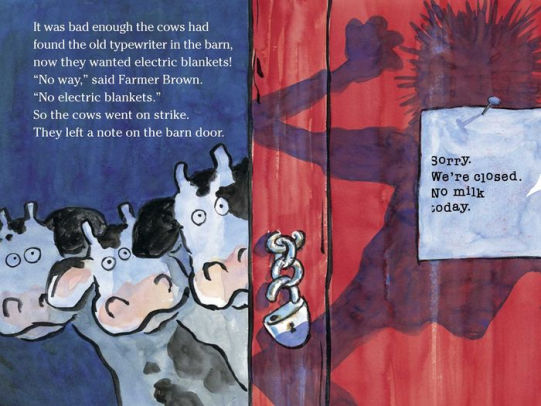
My favorite book for this activity is Click, Clack, Moo: Cows that Type. This work by Doreen Cronin with art by Betsy Lewin (view a read-aloud here) presents a clever and humorous narrative about Farmer Brown and his suddenly recalcitrant cows who, having acquired a rickety typewriter, establish a strike that inspires the chickens to join and ends with the neutral ducks aiding the revolt.
Click, Clack, Moo: Cows that Type
This story is ideal for asking teachers to consider the traditional approach to text in schools, New Criticism (a focus on text in isolation and on the craft in any story, such as characterization, plot, and theme), against Feminist and Marxist criticism, for example.
One fall, while doing the activity with a young adult literature class, I came against yet a new reading of Cronin and Lewin’s work: Why the 1% always wins.
The U.S. Public Likes Farmer Brown
As we explored Click, Clack, Moo recently, the adult members of the class told me they like Farmer Brown, with one student characterizing the striking farm animals as “mean.” And here is where I felt the need to consider how this children’s book helps us all confront the Occupy Wall Street movement or the rise in antagonism toward teachers, tenure, and unions as well as why the 1% continues to own the 99%.
One important element of the story is that the cows and chickens are female workers under the authority of the male Farmer Brown. These female workers produce for the farmer and remain compliant until the cows acquire the typewriter—both a powerful tool of literacy (the cows and chickens cannot effectively strike until they gain access to language) and a representation of access to technology (readers should note that the cows and chickens produce typewritten notes that show they find an old manual typewriter unlike the cleaner type produced by Farmer Brown on an electric typewriter, a representation of the inequity of access to technology among classes).
The cows and chickens, in effect, unionize and strike. Here, members of my classes often fail to notice the unionization, but tend to side with the farmer even when we acknowledge the protest as unionizing—particularly bristling at the duck, as a neutral party, using its access to the negotiation to acquire a diving board for the duck pond.
Like the 1%, Farmer Brown is incensed that the cows and chickens demand basic necessities for comfort, electric blankets, but he eventually secures a compromise, agreeing to give the barn animals the requested electric blankets for the return of the typewriter (the story ends with the obvious next step that the duck uses the typewriter to trade for the diving board).
The 1% have the 99% right where Farmer Brown has the barn animals—mesmerized by the pursuit of materialism and entertainment. Consider the eager hordes of consumers lined up to buy the then-new iPhone 4S, released on the cusp of the passing of Steve Jobs, heralded as a genius for his contribution to our consumer culture.
Just give us our iPhones and we’ll be quiet, we’ll work longer and harder for the opportunity to buy what the 1% tells us we want.
And when the 1% and their compliant media inform us that the top 20% pays 64% of taxes, we slip back to our barns with our tails between our legs, shamed.
We, the 99% who tend to remain silent and compliant, wait patiently for the next generation of technology to occupy our time, our lives reduced to work and amassing the ever-changing and out-dated things that become passe as the next-thing lures us further and further into our sheep lives.
Yes, if we remain eager to trade our voices for things, the 1% will always be the winners.
When we learn to treasure voice over things, however, the chickens may come home to roost.
The stories themselves, literally, are powerful and engaging or George Orwell’s 1984 and Arthur Miller’s The Crucible would not have endured as they have as literature people read again and again—and possibly should read again and again.
However, ultimately, 1984 is not about the future (especially since we have long since passed the future Orwell may have envisioned), and The Crucible is not about the past (although Miller built his play on the very real and troubling history of Puritan witchcraft hysteria). These works are about the complicated present of both authors’ worlds as that speaks to the enduring realities of the human condition.
All of that may seem weighty stuff to step into a look at what appears to be a children’s book, but the paragraphs above should be more than a hint that looks can be deceiving—and enlightening.
“Ever had a burr in your sock?” sets the story in motion—one sentence centered on the page over a giant question mark. It is an opening worthy of a child and all of us who cling to the wonder of childhood.
While Le Guin is often described as a science fiction writer, in her work I recognize the blurring of genres that joins science fiction, speculative fiction, and fantasy; it is that “other world” about which Le Guin and Margaret Atwood appear to argue, and it a stark but rich other world Saunders conjures and Lane pictures.
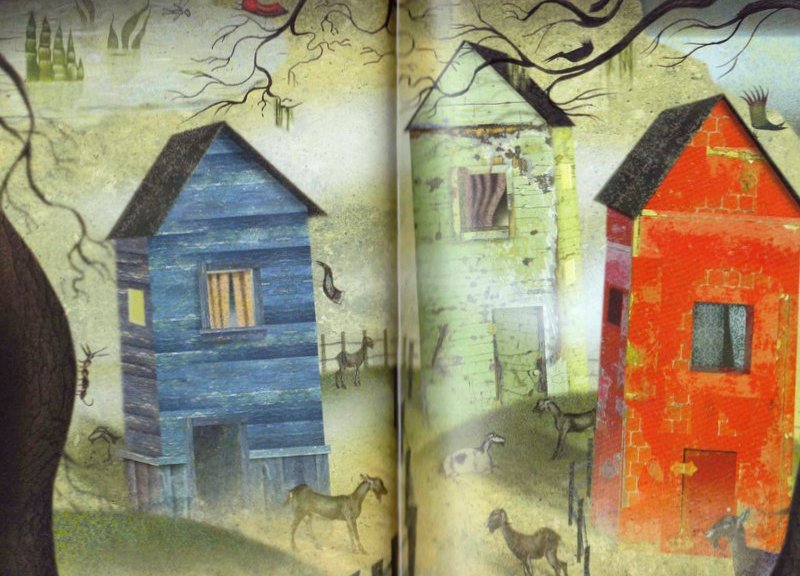
The story of Frip involves three houses for three families, all with children at the center. The houses are distinguished with primary colors—child-like blue, green, and red—but Lane’s artwork adds the ominous to Saunders’ seemingly simple narrative tinged with more than a bite of satire. The illustrations echo the haunting works about and for children found in Neil Gaiman and Tim Burton.
“Frip was three leaning shacks by the sea.” (p. 6) Artwork by Lane Smith
A child standing precariously close to the end of a slanted cliff over an angry ocean catches the eye on page 7 and then the crux of the story pulls you back to the text on page 6:
Frip was three leaning shacks by the sea. Frip was three tiny goat-yards into which eight times a day the children of the shacks would trudge with gapper-brushes and cloth gapper-sacks that tied at the top. After brushing the gappers off the goats, the children would walk to the cliff at the edge of town and empty their gapper-sacks into the sea. (p. 6)
Gappers, orange burr-like creatures with many eyes and the size of a baseball, come to represent throughout the story the power of the systemic inevitable: The presence of the gappers determines the lot of the families (and their goats), but most of the people in the tale remain unable to see beyond their own fixed and mostly misguided worldviews.
“A gapper’s like that, only bigger, about the size of a baseball, bright orange, with multiple eyes like the eyes of a potato.” (p. 2) Artwork by Lane Smith
When the gappers cling to the goats of all three families, there is an ironic appearance of equality among them. But when the fortune of one family shifts, the gappers fulfill their name by creating the gap:
So that night, instead of splitting into three groups, the gappers moved into one very large and impressive shrieking group directly into Capable’s yard. (p. 12)
Before this shift in how the gappers behave, of course, the three families are not equal because Capable is an only child living with her father and who has lost her mother. Capable works as all the children are expected to work (removing gappers in a daily Sisyphean nightmare of chores) and seeks to serve the needs of her grieving father, who along with his grief is a prisoner of nostalgia:
“I myself was once an exhausted child brushing off gappers. It was lovely! The best years of my life. The way they fell to the sea from our bags! And anyway, what would you do with your time if there were no gappers?” (p. 11)
This nostalgia masking an unnecessarily burdensome childhood, however, is but one ideology weighing on Capable because as soon as the other two families are relieved of gappers on their goats, those families reveal themselves to be very much like the people of Le Guin’s Omelas:
“It’s a miracle!” Mrs. Romo shouted next morning, when she came out and discovered that her yard was free of gappers. “This is wonderful! Capable, dear, you poor thing. The miracle didn’t happen to you, did it? I feel so sorry for you. God has been good to us, by taking our gappers away. Why? I can’t say. God knows what God is doing, I guess! I suppose we must somehow deserve it!” (p. 17)
Capable becomes the sacrificed child, and despite her misfortune, the relieved families read the events as their merit (and of course the ugly implication that Capable and her father deserve the burden of the gappers).
What follows from this shift in fate is the central story of Frip with Capable as our main character. The message becomes clear, and Saunders and Lane make the ride one you’ll want to visit again and again. If you are lucky, the book could become one of those read alouds requested by son or daughter, or by a classroom of children.
And while I will leave the rest of the story to you, I think it is necessary to note here that this allegory is both a cautionary tale about how we view children and childhood as well as a brilliant call to reconsider how we view education and education reform.
George Saunders’s Allegory of Scarcity and Slack
The U.S., like the characters (except for Capable) in Saunders’s story, is tragically blinded by a belief in cultural myths that have little basis in evidence: That we live and work in a meritocracy, that competition creates equity, that children need to be “taught a lesson” about the cold cruel world lest they become soft, and such.
As a result of these beliefs, schools often reflect and perpetuate rather harsh environments for children—or to be more accurate, schools often reflect and perpetuate rather harsh environments for other people’s children, as Capable personifies.
Here, then, I want to make the case that The Very Persistent Gappers of Frip is a powerful allegory of scarcity and slack as examined by Sendhil Mullainathan and Eldar Shafir in their Scarcity: Why Having Too Little Means So Much.
Mullainathan and Shafir detail that the conditions of poverty, scarcity, so overburden people psychologically, mentally, and physically that their behavior is often misread (poor people are lazy, poor people make bad decisions, etc.). In Saunders’s story, scarcity and its burden are portrayed by the gappers, and readers witness how the coincidence of the onslaught of the gappers changes the families involved. In other words, the behavior of people is determined by the environment, and not by the inherent goodness or deficiencies of any individual.
The Very Persistent Gappers of Frip goes further, however, by showing that one person’s scarcity (Capable) allows other person slack: privilege is built on the back of others, and those conditions are mostly arbitrary. While Mullainathan and Shafir argue that the slack enjoyed by those living in relative privilege provides the sort of cognitive space needed to excel, Saunders speaks to more than the slack enjoyed by the two families relieved of gappers and the compounding scarcity suffered by Capable (her lot in life and the addition of the gappers):
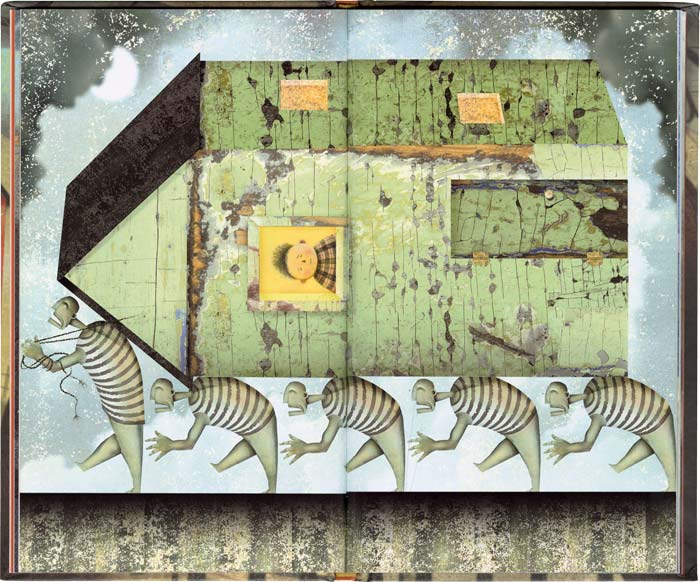
“And the men succeeded in lifting the house and moving it very very close to the third and final house in Frip, which belonged to Sid and Carol Ronsen, who stood in their yard with looks of dismay on their nearly identical frowning faces.” (p. 23) Artwork by Lane Smith
Capable represents a counter-narrative to claims that impoverished children lack “grit.” As her name suggests, this child is more than capable, but the world appears determined to defeat her.
Capable also embodies Lisa Delpit’s confrontation of “other people’s children”—that those with privilege (slack) are willing to allow one set of standards for other people’s children (often living and learning in scarcity), standards they will not tolerate for their own.
As I stated in the opening, allegory seeks to open our eyes by diversion, creating an other world that helps us see both the flaws with our now and the enduring failures of humans to embrace our basic humanity, a failure Capable teeters on the edge of making herself but cannot:
And [Capable] soon found that it was not all that much fun being the sort of person who eats a big dinner in a warm house while others shiver on their roofs in the dark.
That is, it was fun at first, but then got gradually less fun, until it was really no fun at all. (p. 70).
While I highly recommend a careful reading of Oscar Wilde’s The Soul of Man under Socialism, I also urge you to consider that this examination of the consequences of private property and how that perpetuates poverty is stunningly similar to the current education reform movement, notably: “But their remedies do not cure the disease: they merely prolong it. Indeed, their remedies are part of the disease.”
Two of the best teachers and education advocates I respect and listen to carefully, Nancy Flanagan and Susan Ohanian, had an important exchange on Twitter recently:
“Vergara ruling rhetoric stern & memorable stuff, directly frm playbook of deep-pocket advocacy groups bankrolling it” http://t.co/apY9PRKXD8
@nancyflanagan I don’t like Goldstein’s embrace of truthy that “best” teachers don’t work in poverty schools. How is “best” determined? — Susan Ohanian (@susanoha) June 12, 2014
@susanoha Don’t like it, either–contrary to my experience working w/ Detroit teachers. Still, appreciate MSM journo mentioning bankrolling.
Before examining the issue of teacher quality raised above, please take note of a Big Picture problem at the heart of the Vergara ruling: All professions, including teaching, have elite, solid, and weak practitioners, but to suggest that teacher quality is the or one of the primary causes of educational problems is simply false, a manufactured scapegoat to keep the public view off the real problems facing us—mostly social and educational inequity.
Let’s look carefully, now, at how the complex issue of teacher quality is further complicated by high-poverty schools:
Teacher quality represents only about 10-15% of measurable student outcomes (test scores); thus, since high-poverty students are disproportionately likely to produce low test scores, it is a mistake to read raw tests scores as a reflection of teacher quality (or even student learning) since those test scores are primarily a reflection of out-of-school influences. (Also note that outliers to that dynamic do not disprove a generalization and do not suggest what the norm should be; as well, all claims of such “miracle” schools have been discredited.)
High-poverty students and their parents value education as much as more affluent students and parents, but living in poverty is existing in a state of scarcity that taxes adults and children physically, psychologically, and mentally—often leaving them less capable of advocating for education and benefitting for learning opportunities. Conversely, students and parents from relative affluence are afforded the slack necessary to advocate for education and fully engage with learning experiences. The important point here is that teaching, parenting, and learning in conditions influenced by poverty negatively impact nearly everyone involved, but by changing those conditions (and not the people), those same people would perform differently. (This contradicts claims that we need to rid schools of “bad” teachers and instill poor students with “grit”—both of which focus the problems in the people and not the system.)
Flanagan and Ohanian, then, are right that high-poverty schools are not overburdened by “bad” teachers; many wonderful teachers work in high-poverty schools (but some genuinely weak teachers are protected by the mask of affluent students, affluent schools, and affluent communities)—and high-poverty students are potentially as capable of learning as their more affluent peers (impoverished students don’t need to be “fixed” and don’t need to be taught “grit”).
What do the data show, then, when we look at teacher characteristics (interpreted as “quality”) in high-poverty schools along with student test scores as that contrasts with teacher characteristics and student test scores in affluent public and private schools?
As a society, we tolerate the worst possible conditions for the students with the most need (teacher characteristics, school conditions and funding, and high percentage of children living in poverty are the failure of adequate public response and policy) while students living in relative affluence have the advocacy of their parents demanding that they do not suffer the same conditions experienced by children in poverty (disproportionately children of color): high student-teacher ratios, inexperienced and un-/under-certified teachers, underfunded schools, facilities in disrepair, and worksheet and rote instructional practices aimed at test-prep.
The cruel reality is that high-poverty and high-minority schools are not staffed by “bad” teachers forced to teach “bad” students, but that those teachers and students have the most challenging conditions in their lives and schools to overcome while affluent students have slack in their lives and the best conditions in their schools.
No child should be taught by un-/under-certified teachers.
No child should have new or early career teachers for several years in a row.
Teacher quality must be re-imagined as an effective matching of teachers with students and not reduced to measurable outcomes.
Student achievement must no longer be reduced to measurable outcomes.
As with much of the flawed education reform agenda, the teacher quality issue reflects the overuse and misuse of test scores.
Until we address the scarcity in children’s lives and schools, addressing teacher quality is a futile distraction, just as continuing to change standards and tests is a futile distraction.
Instead of labeling, ranking, and then firing teachers, our first best step would be to end the cult of high-stakes testing because the problems of education are mostly systemic (social and educational) and not the adults who choose to teach or the children we seek to serve.
Howard Zinn would have turned 90 a couple of days ago [24 August 2012]. I have to imagine after reading and re-reading most of Zinn’s works that if Zinn were alive today, he would remain baffled at how America is a country antagonistic to unions and tenure, especially teachers unions and tenure.
Zinn was a radical historian, activist, and in my opinion, most of all a teacher. And it is at the overlap of Zinn as historian/activist/teacher I find his People’s History of the United States an invaluable place to ask, Why tenure and unions?
On Democracy and Equity in the U.S.
The unique and powerful quality Zinn brought to history is that his volume is a people’s history. Zinn confronts directly that the truth embedded in any history is shaped by perspective.
Traditionally, the so-called objective history students have been and are fed in formal schooling is from the point of view of the winners, but Zinn chose to examine the rise and growth of the U.S. from the point of view of the common person—what I will characterize as primarily the viewpoint of the worker. I am most concerned about the contrast between the political and public message that the U.S. has somehow left behind the oppressive corporate world of the robber barons (see Zinn’s Chapter 11) and have left behind the horrors fictionalized in Upton Sinclair’s The Jungle. These idealistic beliefs are similar to Americans claiming we have achieved a meritocracy instead of the fact that Americans should still be working toward a meritocracy.
Still in 2014, Americans appear to be anti-union and anti-tenure, again notably in terms of how that impacts teachers. This sentiment is disturbing to me as it signals an anti-worker sentiment in the U.S.—a country that claims to embrace ideals such as equity, democracy, and hard work.
This contradiction is connected, I believe, to the exact problem confronted by Zinn as a historian: Americans’ anti-worker sentiments (expressed in anti-union and anti-tenure discourse and policy) can be traced to who controls the public narrative—the CEO elite.
If the American public considers for a moment why unions and tenure exist (as well as what tenure means), most Americans would reject the CEO-skewed messages about both.
The American worker (unlike many workers in other comparable countries throughout the world) remains shackled to working in ways that dictate any worker’s essential humanity; work in the U.S. is not a matter of just pay, but of health insurance and retirement—essential for basic human dignity. The dramatic abuses of the meat packing industry in The Jungle may appear more extreme than working conditions in 2014, but bosses and management hold a powerful upper-hand over the American worker still.
Unionization as a concept, then, came out of and remains an act against the inherent inequity and tyranny in the workplace when the powerful few control the working many. Unionization is an act of democracy, an act of equity.
To reject unions is to reject democracy and equity.
These foundational facts of why unions do not reject that specific union policies have failed. It is certainly legitimate to confront individual union policies and outcomes (I have and continue to do that myself), but this discussion is about the broad anti-union sentiment in the U.S. that reveals anti-worker sentiments.
Tenure is more complicated, but certainly grows out of the same commitment to democracy and equity—especially for teachers.
The tenure argument is often distorted because the term itself, “tenure,” is misrepresented as “a job for life” and rarely distinguished between tenure at the K-12 level and the college/university level.
Tenure is an act of democracy and equity, as well, because it creates power for workers as a guarantee of due process and, for teachers, it secures a promise of academic freedom.
Are there failures in how unions and tenure have been and are implemented in America today? Yes.
Should those failures be addressed? Yes.
But the broad anti-union and anti-tenure agenda being promoted by the CEO elite and embraced by the American public is a corrosive rejection of equity and democracy.
When unions and tenure are not fulfilling their obligations to equity and democracy, they both must be confronted.
But unions and tenure remain needed and even necessary mechanisms in America’s search for equity and democracy—both of which are being eroded by the American elite indebted to and dependent on the inequity that drives American capitalism.
We are penned in by the arrogant idea that this country is the center of the universe, exceptionally virtuous, admirable, superior.
If we don’t know history, then we are ready meat for carnivorous politicians and the intellectuals and journalists who supply the carving knives. I am not speaking of the history we learned in school, a history subservient to our political leaders, from the much-admired Founding Fathers to the Presidents of recent years. I mean a history which is honest about the past. If we don’t know that history, then any President can stand up to the battery of microphones, declare that we must go to war, and we will have no basis for challenging him. He will say that the nation is in danger, that democracy and liberty are at stake, and that we must therefore send ships and planes to destroy our new enemy, and we will have no reason to disbelieve him.
Without, then, the democratic and equity-based purposes of unions and tenure, the American public remains “ready meat for carnivorous politicians and the intellectuals and journalists who supply the carving knives.”
Zinn also personified a message of rejecting neutral poses, of democracy as activism. Writing about Sacco and Vanzetti, Zinn shares questions raised by Vanzetti, questions still relevant today against the knee-jerk and self-defeating anti-union and anti-tenure sentiments persistent in the U.S.:
Yes, it was their anarchism, their love for humanity, which doomed them. When Vanzetti was arrested, he had a leaflet in his pocket advertising a meeting to take place in five days. It is a leaflet that could be distributed today, all over the world, as appropriate now as it was the day of their arrest. It read:
“You have fought all the wars. You have worked for all the capitalists. You have wandered over all the countries. Have you harvested the fruits of your labors, the price of your victories? Does the past comfort you? Does the present smile on you? Does the future promise you anything? Have you found a piece of land where you can live like a human being and die like a human being? On these questions, on this argument, and on this theme, the struggle for existence, Bartolomeo Vanzetti will speak.” (A Power Governments Cannot Suppress, Howard Zinn)
[1] As a life-long resident and worker in South Carolina, a right-to-work state, I want to clarify here that I am not now and have never been a member of a union, I never had my pay or any sort of public school tenure negotiated for me by a union, but I have been awarded tenure by my private university during my most recent decade-plus as a professor.
But, instead, let’s look at Secretary of Education Arne Duncan who has held forth on the Vergaras ruling in California:
The ruling was hailed by the nation’s top education chief as bringing to California — and possibly the nation — an opportunity to build “a new framework for the teaching profession.” The decision represented “a mandate” to fix a broken teaching system, U.S. Education Secretary Arne Duncan said….
Duncan, a former schools chief in Chicago, said he hoped the ruling will spark a national dialogue on a teacher tenure process “that is fair, thoughtful, practical and swift.”
At a minimum, Duncan said the court decision, if upheld, will bring to California “a new framework for the teaching profession that protects students’ rights to equal educational opportunities while providing teachers the support, respect and rewarding careers they deserve.”
“The students who brought this lawsuit are, unfortunately, just nine out of millions of young people in America who are disadvantaged by laws, practices and systems that fail to identify and support our best teachers and match them with our neediest students. Today’s court decision is a mandate to fix these problems,” Duncan said. (as reported by Michael Martinez)
In 1992, childhood friend and investment banker John W. Rogers, Jr., appointed Duncan director of the Ariel Education Initiative, a program mentoring children at one of the city’s worst-performing elementary schools and then assisting them as they proceeded further in the education system. After the school closed in 1996, Duncan and Rogers were instrumental in re-opening it as a charter school, Ariel Community Academy. In 1999, Duncan was appointed Deputy Chief of Staff for former Chicago Public Schools CEO Paul Vallas.
CEO of Chicago Public Schools Mayor Richard M. Daley appointed Duncan to serve as Chief Executive Officer of the Chicago Public Schools on June 26, 2001….
Duncan was appointed U.S. Secretary of Education by President Barack Obama and confirmed by the Senate on January 20, 2009. [all emphasis added]
For the record, having no background as a teacher and then having spent his entire professional career as a political appointee depending on his privileged connections, Duncan has no appreciation for teaching or for workers’ rights.
And thus, this week, we must implore: Arne Duncan, please shut up.
The road to hell is not paved with good intentions. [1]
The road to hell in the U.S. of the 21st century is paved with the appearance of good intentions fostered by billionaires.
Billionaires are our roadbuilders, and in education reform the main roadbuilder is Bill Gates.
Gates is a billionaire education hobbyist who started a road to small schools, only to bail, but has since shifted his roadbuilding to value-added methods (VAM) for evaluating teachers and his tour de force superhighway, Common Core.
Now that Gates has issued a call for a moratorium on the intersecting roads to hell (VAM linked to next-generations high-stakes tests of the Common Core), we must return to two important points:
To the first point, Gates has never had and does not now have any credibility as an authority on education or education reform. Zero. His commentaries linked to his huge bribes should be ignored when he advocates for policy, and his call for a moratorium should be ignored as well.
Delaying a road to hell still means we will have a road to hell.
To the second point, as Nettie and the Olinka learn in the Color Purple, the roadbuilders have an agenda to be done to those in their way and to benefit the roadbuilders. Words such as moratorium, philanthropy, and entrepreneur are thinly veiled code for not good intentions but the self-interests of the roadbuilders.
The roadbuilders are powerful because money speaks louder than words; however, the option before us is not a moratorium but a collective non-cooperation to end their roadbuilding.
—
[1] The best version of this cliche is in Ernest Hemingway’s The Sun Also Rises when Bill responds to Jake with the wonderfully ambiguous nod to the corrosive power of materialism: “‘Road to hell paved with unbought stuffed dogs'” (p. 78). In a capitalist society, the consumer’s hell is all the fake crap that consumer does not or cannot buy. The consumer doesn’t need the fake crap, of course, and there is never an end to the fake crap dangled before the consumer.
And while we have garnered a sort of unwanted but fully warranted 15 minutes of fame by being the repeated source of ridicule for The Daily Show, SC has now achieved what I am calling Twitter Truth through the actions of Governor Nikki Haley, as reported at The Huffington Post:
South Carolina Gov. Nikki Haley (R) wanted to tout her state’s education reform plan Monday — but it all went horribly wrong.
Here’s what Haley tweeted about the plan:
Haley, or whichever member of her staff posted the tweet, was the victim of Twitter’s 140 character limit. An Instagram photo caption longer than 140 characters in length is cut off mid-sentence, followed by a link to the original post. The full caption makes much more sense than the above tweet:
The tweet was deleted a few hours after it was posted.
If we put Tweet 1 (clipped by Twitter Truth) together with Tweet 2, we find that Tweet 1 actually makes an accurate commentary on how SC continues to plow the wrong road in our claimed quest for educating the children of SC, a large percentage of whom are living in poverty and suffering the burdens of their racial and language minority statuses.
For the record, “reading coaches” masks that SC has adopted 3rd-grade retention policy based on high-stakes testing, “technology investments” ignores SC’s high poverty rate and that the state needs to invest in hundreds of areas other than making technology vendors wealthy, and “charter schools” fails to note that SC charter schools, as is the case across the U.S., perform about the same and worse than public schools while contributing to the rise in re-segregation.
NEW YORK—Introducing key changes to the lottery system that governs the admissions process, the New York City Charter School Center notified potential students this week that openings will now be filled by randomly distributing white pills to applicants and enrolling those left standing.
In place of the existing electronic lottery system conducted in the spring, education officials explained that applicants would receive identical white pills, among them a small number of innocuous placebos corresponding to the amount of open spots, and then wait approximately 30 minutes to determine the survivors and new charter school enrollees.
“With so many deserving students competing for so few spots in the city’s network of high-performing, tuition-free charter schools, our new lottery system ensures that each student is provided with an equal opportunity,” said Eva Moskowitz, the head of the Success Academy chain of 22 charter schools, while mixing up a tub of 118 sugar pills and 2,376 pentobarbital capsules to be blindly administered in an upcoming lottery. “Between small class sizes, longer school days, individualized instruction, and superior college admission rates, charters provide amazing opportunities for students who don’t enter a convulsive state, fall into a coma, stop breathing, and cease all bodily functions during the admissions process.” (emphasis added)
“Of course it’s heartbreaking for the families of children who aren’t accepted,” Moskowitz continued, “But seeing the look on parents’ faces when their child is still standing in a room littered with rejected applicants is priceless. They know their child is going to get the best possible education.” [1]
Administrators told reporters that the new quick and relatively painless lottery system is a welcome alternative to the notoriously long and emotional computerized drawings of past years, where all applicants received a random number and were subjected to waiting for many hours before learning whether they would attend a charter school or return to an inferior public school.
Officials confirmed that the innovative selection process has already proved a success, though not without its minor setbacks, in areas of the country where it has already been implemented.
“This year we’re making the pills a little stronger because not all the candidates were weeded out right away,” said Tim Bernard of Thrive Academy in Washington, D.C., a public charter that had 200 elementary school students apply for eight open spots last year. “Some kids would seem fine, we’d extend them an official offer of admission, and then a few days later they’d start hallucinating or slurring their speech. Meanwhile parents are scared sick we’re going to rescind their kids’ offers because too many applicants survived.”
“Luckily, we worked out all the kinks for this year,” Bernard added. “The body removal crews are already assembled outside the auditoriums and ready to go.”
Though charter school officials maintained that the new admissions process is designed fairly, critics claimed many affluent parents have already found ways to exploit the system. For example, after a lottery in Los Angeles ended with a high number of living students, officials discovered that parents had been building up their children’s immunity to the pills by giving them small doses of poison each day, or had hired tutors to help them train their bodies to overcome the effects of the pills. (emphasis added) [2]
Despite these flaws, many parents said they have no doubts about trying to get their child into a charter.
“I went through charter school admissions with my oldest son last year, but after he died I wondered whether it was even worth it to try again with my other kids,” Hoboken, NJ mother Jane Schaal told reporters. “But then my younger daughter got into Achievement First and I knew we made the right decision. There was no way she was going to succeed in public school.”
“Next year we’ll try to get my youngest son into a good elementary school,” Schaal added. “He’s not in kindergarten yet, but even if he’s not accepted to a top-notch charter, it’s a relief knowing that his future will be set.”
This should be really funny, but as with many of their other satires, this piece comes disturbingly close to everything that is wrong with charter schools driven by market forces—a commitment done to children and their families, a process that sacrifices children in very real ways.
“White students disproportionately attend the best charter schools, while the worst are almost exclusively populated by African American students. Activists in New Orleans joined with others in Detroit and Newark last month to file a federal civil rights complaint, alleging that the city’s best-performing schools have admissions policies that exclude African American children. Those schools are overseen by the separate Orleans Parish School Board, and they don’t participate in OneApp, the city’s centralized school enrollment lottery.”






 dr. p.l. (paul) thomas