
SC’s Low Self-Esteem, Florida Addiction, and Education Policy.
Category Archives: Education
The Answer Sheet: Justifying Richard Sherman by his GPA at Stanford
The Words They Know (1944)
An Open Apology, with Explanations: Math, Behaviorism, and “Grit”
A Child’s Story: “Because she’s older and the teacher, she’s right and I’m not”
A child’s birthday should be a ritual of joy, a celebration of living as well as of being a child.
Rachel sits in class on her eleventh birthday in Sandra Cisneros‘s “Eleven,” however, feeling many things except joy:
Only today I wish I didn’t have only eleven years rattling inside me like pennies in a tin Band-Aid box. Today I wish I was one hundred and two instead of eleven because if I was one hundred and two I’d have known what to say when Mrs. Price put the red sweater on my desk. I would’ve known how to tell her it wasn’t min instead of just sitting there with that look on my face and nothing coming out of my mouth. (p. 7)
Even before her day turns against her, Rachel has offered a glimpse of her world, the life she brings with her each day to school:
And maybe one day when you’re all grown up maybe you will need to cry like if you’re three, and that’s okay. That’s what I tell Mama when she’s sad and needs to cry. Maybe she’s feeling three. (p. 6)
On this day of her turning eleven, Mrs. Price, her math teacher, discovers a red sweater, and when the teacher asks for its owner, Sylvia Saldivar says the sweater is Rachel’s. The teacher adds she has seen it on Rachel so she “takes the sweater and puts it right on [Rachel’s] desk” (p. 7).
In a voice that almost isn’t a voice, Rachel tries to explain that the sweater isn’t hers, but to no avail “[b]ecause she’s older and the teacher, she’s right and I’m not,” Rachel recognizes (p. 7).
Rachel struggles with her rising powerlessness and anger, crying and prompting the teacher to reprimand her:
“Now, Rachel, that’s enough,” because she sees I’ve shoved the red sweater to the tippy-tip corner of my desk and it’s hanging all over the edge like a waterfall, but I don’t’ care.
“Rachel,” Mrs. Price says. She says it like she’s getting mad. “You put that sweater on right now and no more nonsense.”
“But it’s not—”
“Now!” Mrs. Price says. (p. 8)
The sweater stinks. It itches. Rachel soon crumbles for everyone to see, a nightmare in the world of childhood:
That’s when everything I’ve been holding in since this morning, since when Mrs. Price put the sweater on my desk, finally lets go, and all of a sudden I’m crying in front of everybody. I wish I was invisible but I’m not. I’m eleven and it’s my birthday today and I’m crying like I’m three in front of everybody. I put my head down on the desk and bury my face in my stupid clown-sweater arms. My face all hot and spit coming out of my mouth because I can’t stop the little animal noises from coming out of me, until there aren’t any more tears left in my eyes, and it’s just my body shaking like when you have the hiccups, and my whole head hurts like when you drink milk too fast. (p. 9)
And then, Phyllis Lopez claims the sweater—adding insult to Rachel’s embarrassment. But “Mrs. Price pretends like everything’s okay” even though, for Rachel, “it’s too late,” her birthday has been ruined (p. 9).
While it may be compelling to read “Eleven” as a powerful narrative of a child’s ruined birthday, it is important not to ignore how Cisneros offers us all important messages about how schools and teachers impact the children they are intended to serve, how teachers often become calloused and hurtful especially as they fail to recognize the frailty and humanity of each child.
Here, then, are some lessons from the story:
- Children do not and cannot leave their lives behind when they walk through the doors of a school or a classroom. To pretend that they can is dehumanizing and hurtful.
- How a child feels about the world and her/himself is at least as important if not more important than what a child thinks about the world. Emotions should not be ignored or marginalized as “childish.” A child’s affective and cognitive selves are dialogic and inseparable.
- The authoritarian teacher is the failed teacher.
- “We know of course there’s really no such thing as the ‘voiceless’. There are only the deliberately silenced, or the preferably unheard,” cautions Arundhati Roy in her 2004 Sydney Peace Prize lecture.
- All education should begin with the child, and then always hold the dignity of each child sacred.
Rachel knows a certain sadness in her home, and on her eleventh birthday, her teacher, her peers, and her school make her want to disappear, force her deny herself and her childhood:
I’m eleven today. I’m eleven, ten, nine, eight, seven, six, five, four, three, two, and one, but I wish I was one hundred and two. I wish I was anything but eleven, because I want today to be far away already, far away like a runaway balloon, like a tiny o in the sky, so tiny-tiny you have to close your eyes to see it. (p. 9)
Every child that we teach needs our relentless love and patience because childhood is a frail becoming that leads to this thing we call adulthood, which we fail each time we allow ourselves to be callous to the laughter or tears of a child—especially when we do so in the name of education.

SOTU 2014: Orwellian Educational Change under Obama Continues
Paul L. Thomas
Furman University
“It is rather the same thing that is happening to the English language. . . .[T]he slovenliness of our language makes it easier for us to have foolish thoughts,” Orwell (1946) warns in “Politics and the English Language.” Few examples are better for proving Orwell right than political language addressing the education of children in the U.S. But, as Orwell adds, “If one gets rid of these habits one can think more clearly, and to think clearly is a necessary first step towards political regeneration.”
Barack Obama personifies the power of personality in politics and the value of articulating a compelling vision that resonates with many voters in the US and other global citizens. For Obama’s presidential campaign, the refrain that worked was driven by two words and concepts, “hope” and “change.” From healthcare, to war, to education reform, however, the Obama administration is proving that political discourse is more likely to mask intent—just as Orwell warned through his essays and most influential novel 1984, the source of the term “doublespeak” that characterizes well Obama’s and Secretary of Education Arne Duncan’s public comments on education reform. They mask the programs promoted and implemented by the Department of Education.
Beginning with the Reagan administration and perpetuated by Obama’s presidency are patterns of public speeches—crisis discourse and Utopian expectations—and educational policy that began with 1983’s “A Nation at Risk,” accelerated through Goals 2000, and codified without much critical concern as No Child Left Behind (NCLB) under George W. Bush and Secretary of Education Paige (Schmidt & Thomas, 2009).
Here, I will explore the neoliberal assumptions driving the language and policies related to education that came from the Obama administration and guided by Duncan. The examination will unpack Duncan’s speeches and the realities of the ideologies the administration supports through policy and public messages. The dynamic established through crisis discourse about the public education system, combined with Utopian expectations for those schools, helps mask the neoliberal assumptions embedded in what Freire (1998) calls “the bureaucratizing of the mind”: “The freedom that moves us, that makes us take risks, is being subjugated to a process of standardization of formulas, models against which we are evaluated” (p. 111).
See also (which is being re-issued as an updated edition soon):
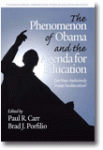
Thomas, P.L. (2011). The educational hope ignored under Obama: The persistent failure of crisis discourse and utopian expectations. In P. R. Carr & B. J. Porfilio (Eds.), The phenomenon of Obama and the agenda for education: Can hope audaciously trump neoliberalism? (pp. 49-72). Charlotte, NC: Information Age Publishing.
Thomas, P.L. (2011). Orwellian educational change under Obama: Crisis discourse, Utopian expectations, and accountability failures. Journal of Inquiry & Action in Education, 4(1), 68-92. http://digitalcommons.buffalostate.edu/cgi/viewcontent.cgi?article=1034&context=jiae
 dr. p.l. (paul) thomas