
Category Archives: Education
Author Neil Gaiman for U.S. education secretary?
Who Should Listen to Melinda Gates about Education?
Ignoring the New Majority: Education Reform behind Blinders
Consider three maps—one using data from the 1860 Census, one focusing on public schools in 2011, and one detailing the remaining states allowing corporal punishment in schools:

[1860; click to enlarge]

[2011; click to enlarge]

[2005-2006; click to enlarge]
“A majority of students in public schools throughout the American South and West are low-income for the first time in at least four decades, according to a new study that details a demographic shift with broad implications for the country,” explains Lyndsey Layton, based on the report from the Southern Education Foundation (SEF).
The data in the SEF report parallel in many ways the documenting of in-school segregation lingering in the South as portrayed in the HBO film Little Rock Central: Fifty Years Later and reported by Felicia Lee:
On a recent visit to Central High, Ms. Trickey spoke to a self-segregated classroom: whites on one side, blacks on the other. An African-American student apparently dozed as she spoke. Students and teachers alike spoke blithely or painfully of the low educational aspirations and achievements of too many black students. Central, many said, is now two schools in one: a poor, demoralized black majority and a high achieving, affluent white minority.
And five years after the documentary, The Civil Rights Project detailed the extent of re-segregated schools across the South:
- Since 1991, black students in the South have become increasingly concentrated in intensely segregated minority schools (defined as 90-100% minority students). This represents a significant setback. Though for decades Southern black students were more integrated than their peers in other parts of the country, by 2009-10 the share of Southern black students enrolled in intensely segregated minority schools (33.4%) was fast closing in on the national figure (38.1%). By comparison, in 1980, just 23% of black students in the South attended intensely segregated schools.
- For the last four decades, contact between black and white students has declined in virtually all Southern states. In schools across the region, white students make up 30% or less of the enrollment in the school of the typical black student for the first time since racial statistics pertaining to schools were collected by the federal government.
- Most of the largest Southern metro areas also report declining black-white exposure. The Raleigh, NC metro had the highest black-white contact although this too has fallen in recent years. In 2009, the typical black student in the metro went to a school where whites accounted for about 45% of their peers, compared to about 54% in 2002).
- In 2009, black-white exposure in the metropolitan area of Raleigh was relatively similar to the overall white percentage in the metro (54%)–indicating fairly stable levels of desegregation. Future enrollment data for the Raleigh metro should be closely monitored to ascertain the impact of recent policy changes to the district’s voluntary integration policy.
- Two metros, Memphis, TN and Miami, FL, had the lowest exposure of black students to white students in 2009, under 15%. (Siegel-Hawley & Frankenberg, 2012, September 19)
In Western states with high Latino/a populations, race and poverty patterns constitute double segregation:
- The typical black or Latino today attends school with almost double the share of low-income students in their schools than the typical white or Asian student.
- In the early 1990s, the average Latino and black student attended a school where roughly a third of students were low income (as measured by free and reduced price lunch eligibility), but now attend schools where low income students account for nearly two-thirds of their classmates.
- There is a very strong relationship between the percent of Latino students in a school and the percent of low income students. On a scale in which 1.0 would be a perfect relationship, the correlation is a high .71. The same figure is lower, but still high, for black students (.53). Many minority-segregated schools serve both black and Latino students. The correlation between the combined percentages of these underserved two groups and the percent of poor children is a dismaying .85. (Orfield, Kucsera, & Siegel-Hawley, 2012, September 19)
Combined with the growing trends in the U.S. related to increased inequity, rising child poverty, and re-segregating of schools by class and race, the 2013 SEF report on low-income students being the new majority in public schools should be a wake-up call to the current in-school only focus of education reform. While race and class segregation has proven to be entrenched in U.S. society, education reformers must admit that social institutions such as public schools do not lift children out of poverty but play two roles reformers prefer to ignore—they reflect social inequity and they tend to perpetuate that inequity:
A majority of public school children in 17 states, one-third of the 50 states across the nation, were low income students – eligible for free or reduced lunches – in the school year that ended in 2011. Thirteen of the 17 states were in the South, and the remaining four were in the West. Since 2005, half or more of the South’s children in public schools have been from low income households. During the last two school years, 2010 and public schools. (SEF 2013)
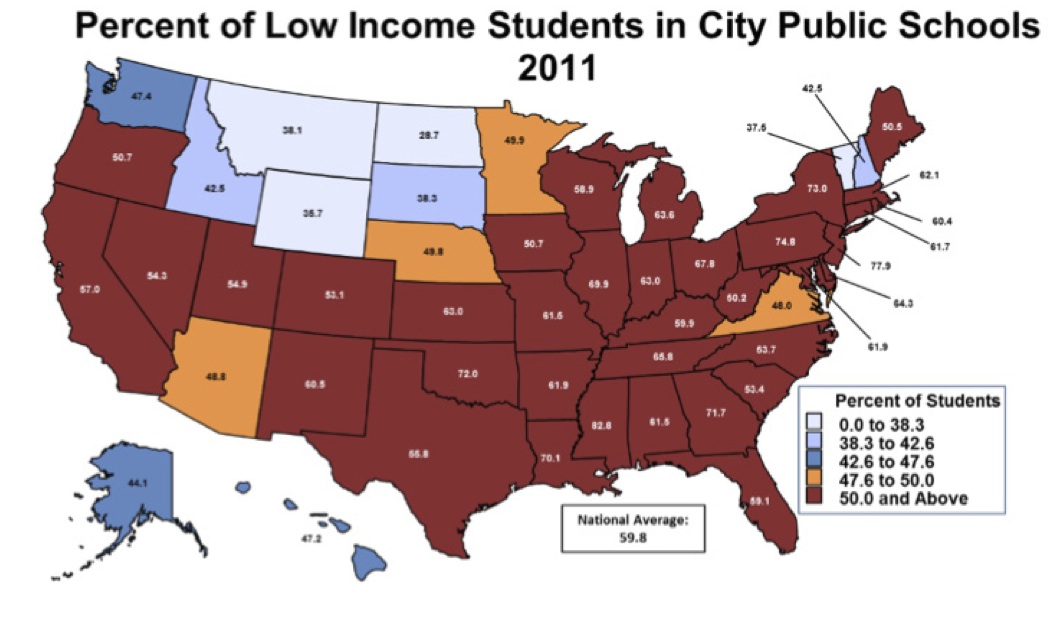
Also hard hit by these social and academic realities are urban public schools:
[click to enlarge]
In other words, while the South and West are crucibles for historical and current negative consequences associated with racial and class inequity and segregation, urban areas of the U.S. show that these same problems infect essentially the entire country:
In each of the nation’s four regions, a majority of students attending public schools in the cities were eligible for free or reduced lunch last year. The Northeast had the highest rates for low income school children in cities: 71 percent. The next highest rate, 62 percent, was found in Midwestern cities. The South had the third highest percentage of low income students in the cities – 59 percent.
The SEF report ends with the dilemma facing education reformers who promote a “no excuses” ideology grounded in market-based policies:
There is no real evidence that any scheme or policy of transferring large numbers of low income students from public schools to private schools will have a positive impact on this problem. The trends of the last decade strongly suggest that little or nothing will change for the better if schools and communities continue to postpone addressing the primary question of education in America today: what does it take and what will be done to provide low income students with a good chance to succeed in public schools? It is a question of how, not where, to improve the education of a new majority of students.
The lingering legacy of segregation as well as the rise of impoverished students constituting the new majority in public schools is evidence that ignoring poverty does not make it go away.
Arguing that in-school reform alone can eradicate the scars of slavery that remain vivid in the two maps included above is beyond idealism and approaches inexcusable irresponsibility of a type that is exposed by the data presented by SEF’s report.
With impoverished students now the new majority in public schools, a new era of education reform is unavoidable—one that begins with social reform addressing racial and class inequity and then continues by redesigning a public school system that itself is dedicated to equity of opportunity.
First In-School Reform? Teacher Autonomy
remnant 36: “I believe…”
Neil Gaiman Should Be U.S. Secretary of Education: “Things can be different”
Some people view the world differently than others.
Some people view education and schools differently than others.
Some people view children, books, and libraries differently than others.
And then there is Neil Gaiman.
I have been a staunch defender of public education, writing often against the negative consequences of Common Core (especially as related to literacy instruction) and doggedly resisting non-educators as leaders of the education reform movement.
Despite my resistance to what I consider misguided reform as well as my skepticism about innovation and market forces, I have conceded a compromise on Common Core, along with a clarification about that compromise. The response to that compromise has been underwhelming.
However, I am now willing to offer another compromise; this time about the qualifications for who should be our leaders in education reform. While I still call for the removal of Arne Duncan as Secretary of Education, I am offering Neil Gaiman as the next Secretary of Education in the U.S.—and suggesting that this office be his for life.
I am basing this new compromise on a speech presented by Gaiman for the Reading Agency in London.
First, I must admit that it isn’t entirely fair to judge Gaiman on a speech he wrote himself as that compares to the speeches written for him Duncan delivers. It also isn’t quite fair to judge the positions of a beloved author against the panderings of a life-long political appointee. Certainly, Duncan is beholden to different constituencies than Gaiman.
But judge I have, and here are my conclusions.
Gaiman’s qualifications for Secretary of Education must begin with what his speech does not include: no discussion of “grit,” no chants of “no excuses,” no praising of innovation or bowing to the brave new world of technology, no calls for new standards, no urgency about new high-stakes tests.
Instead, Gaiman offers a genuine and compelling argument for the essential value in books, the power of fiction, and the sacred nature of libraries.
Unlike typical political discourse, Gaiman confesses upfront his prejudices:
And I am biased, obviously and enormously: I’m an author, often an author of fiction. I write for children and for adults. For about 30 years I have been earning my living though my words, mostly by making things up and writing them down. It is obviously in my interest for people to read, for them to read fiction, for libraries and librarians to exist and help foster a love of reading and places in which reading can occur.
So I’m biased as a writer. But I am much, much more biased as a reader. And I am even more biased as a British citizen*.
Immediately, Gaiman shows his political acuity by noting the importance of investing in literacy as one strategy for decreasing the rise in prisons in the U.S.:
I was once in New York, and I listened to a talk about the building of private prisons – a huge growth industry in America. The prison industry needs to plan its future growth – how many cells are they going to need? How many prisoners are there going to be, 15 years from now? And they found they could predict it very easily, using a pretty simple algorithm, based on asking what percentage of 10 and 11-year-olds couldn’t read. [1] And certainly couldn’t read for pleasure.
It’s not one to one: you can’t say that a literate society has no criminality. But there are very real correlations.
Gaiman even understands the difference between causation and correlation—a dramatic advantage over Secretaries of Education in the past two administrations.
But Gaiman shines best when he speaks about and to the essential value in reading, recognizing what the field of literacy has know for a century, at least—children are drawn to reading by being offered an abundance of books and allowed to read by choice:
The simplest way to make sure that we raise literate children is to teach them to read, and to show them that reading is a pleasurable activity. And that means, at its simplest, finding books that they enjoy, giving them access to those books, and letting them read them.
I don’t think there is such a thing as a bad book for children. Every now and again it becomes fashionable among some adults to point at a subset of children’s books, a genre, perhaps, or an author, and to declare them bad books, books that children should be stopped from reading. I’ve seen it happen over and over; Enid Blyton was declared a bad author, so was RL Stine, so were dozens of others. Comics have been decried as fostering illiteracy.
It’s tosh**. It’s snobbery and it’s foolishness. There are no bad authors for children, that children like and want to read and seek out, because every child is different.
We may be able to imagine, also, how Gaiman would react to Common Core and their “architect,” David Coleman:
And not everyone has the same taste as you.
Well-meaning adults can easily destroy a child’s love of reading: stop them reading what they enjoy, or give them worthy-but-dull books that you like, the 21st-century equivalents of Victorian “improving” literature. You’ll wind up with a generation convinced that reading is uncool and worse, unpleasant.
After an impassioned and thoughtful argument about science fiction (SF)—even China is on board with SF!—Gaiman turns to the power of libraries:
Another way to destroy a child’s love of reading, of course, is to make sure there are no books of any kind around. And to give them nowhere to read those books. I was lucky….
They were good librarians. They liked books and they liked the books being read. They taught me how to order books from other libraries on inter-library loans. They had no snobbery about anything I read. They just seemed to like that there was this wide-eyed little boy who loved to read, and would talk to me about the books I was reading, they would find me other books in a series, they would help. They treated me as another reader – nothing less or more – which meant they treated me with respect. I was not used to being treated with respect as an eight-year-old.
But libraries are about freedom. Freedom to read, freedom of ideas, freedom of communication. They are about education (which is not a process that finishes the day we leave school or university), about entertainment, about making safe spaces, and about access to information.
No, it seems, education reform should not be about new standards or new high-stakes tests—but about preserving and expanding children’s access to books. Education reform, it seems, isn’t buried inside the promise of new technology either:
I do not believe that all books will or should migrate onto screens: as Douglas Adams once pointed out to me, more than 20 years before the Kindle turned up, a physical book is like a shark. Sharks are old: there were sharks in the ocean before the dinosaurs. And the reason there are still sharks around is that sharks are better at being sharks than anything else is. Physical books are tough, hard to destroy, bath-resistant, solar-operated, feel good in your hand: they are good at being books, and there will always be a place for them. They belong in libraries, just as libraries have already become places you can go to get access to ebooks, and audiobooks and DVDs and web content.
Gaiman, we must note, is not being merely fanciful; he acknowledges the role of literacy in the world economy and the value in preparing younger generations for that world economy. But his commitments are distinct from the current calls for market forces and innovation.
In fact, Gaiman celebrates a different “I” word:
We all – adults and children, writers and readers – have an obligation to daydream. We have an obligation to imagine. It is easy to pretend that nobody can change anything, that we are in a world in which society is huge and the individual is less than nothing: an atom in a wall, a grain of rice in a rice field. But the truth is, individuals change their world over and over, individuals make the future, and they do it by imagining that things can be different.
Look around you: I mean it. Pause, for a moment and look around the room that you are in. I’m going to point out something so obvious that it tends to be forgotten. It’s this: that everything you can see, including the walls, was, at some point, imagined. Someone decided it was easier to sit on a chair than on the ground and imagined the chair. Someone had to imagine a way that I could talk to you in London right now without us all getting rained on.This room and the things in it, and all the other things in this building, this city, exist because, over and over and over, people imagined things.
Along with “imagination,” Gaiman also speaks about our commitment to beauty and our shared democratic responsibilities. Fostering literacy in our children, he argues, is an obligation: “This is not a matter of party politics. This is a matter of common humanity.”
Ultimately, Gaiman’s speech has inspired me to move outside my previous commitments to demanding that education reform be led by educators only. He has inspired me to imagine, and now I can join him in this belief:
You’re also finding out something as you read vitally important for making your way in the world. And it’s this:
The world doesn’t have to be like this. Things can be different.
* Keep in mind, Gaiman lives in Minnesota and one of his best novels is American Gods. I think we could expect Gaiman to be as passionate about the good ol’ U.S. of A. if given the opportunity.
** As a side note, the U.S. would benefit greatly from having an appointed official who would occasionally say “tosh.”
[1] Please see this clarification of Gaiman’s claim and the point of this blog.
 dr. p.l. (paul) thomas