Category Archives: Education

America Dishonors MLK By Refusing to Act on Call for Direct Action (pt. 2)

[Header Photo Public Domain]

[NOTE: See part 1 HERE]

The USA is a country built on cultural mythology—rugged individualism, boot strapping, just to name a couple.

But the American Dream works both as a touch stone for Americans and a veneer covering over the realities that represent us as people and country.

In most ways, the American Dream is a lie in practice, but a beautiful idea that could be.

What better represents America is this from James Baldwin:
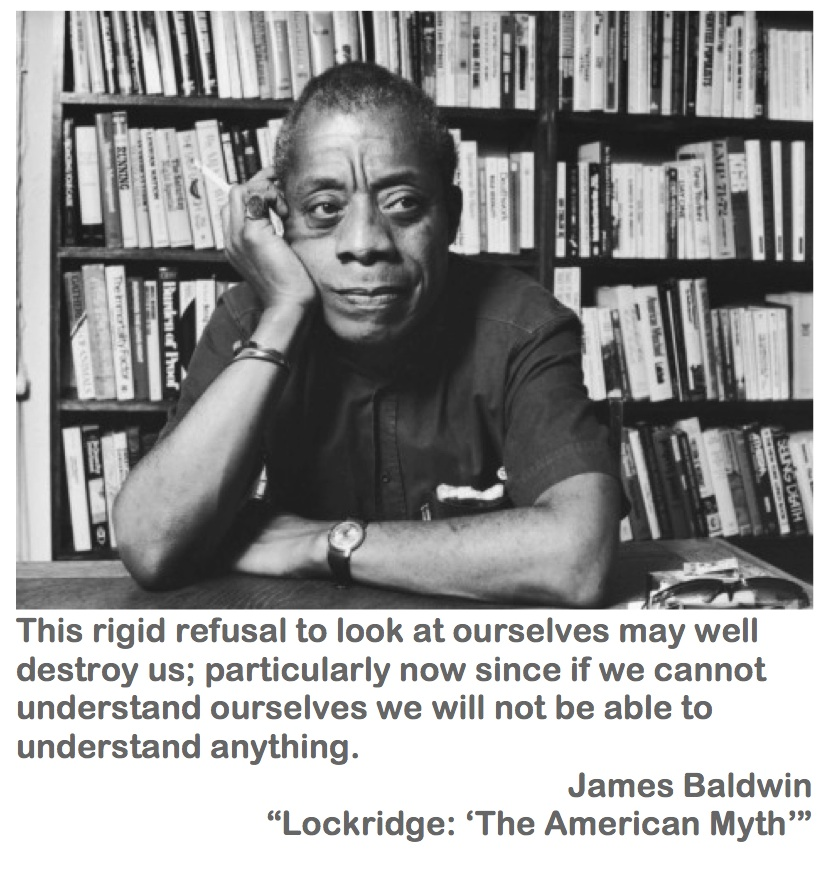
Included in that “rigid refusal to look at ourselves” is an insidious pattern of creating mythologies that conform to our foundational myths even when those manufactured myths prove to be distortions, or even lies.

That is the legacy of Martin Luther King Jr. who Americans begrudgingly allowed into the pantheon of Great Americans but only as a reductive caricature as a passive radical.

The Right and conservatives in the US have repeatedly shaped MLK into a soundbite endorsing color blindness, a false representation of MLK and the ideal in terms of how race should matter among humans.

MLK was clear that racism was the plague on the US, but he didn’t call for not seeing race; he urged humans to see race and not impose hatred and bigotry onto race, not allow privilege/oppression for some based on race.

But one of the single most important aspects of MLK’s ignored legacy is his call for direct action, which conservatives refuse to see and even cloak by stressing “passive” action (again, an important misrepresentation of “non-violent” since MLK himself stated he never urged people to be passive about anything).

Here is the King many in the US want to ignore: King’s 1967 work, Where Do We Go from Here: Chaos or Community?:

Up to recently we have proceeded from a premise that poverty is a consequence of multiple evils:

• lack of education restricting job opportunities;

• poor housing which stultified home life and suppressed initiatives;

• fragile relationships which distorted personality development.

The logic of this approach suggested that each of these causes be attacked one by one. Hence a housing program to transform living conditions, improved educational facilities to furnish tools for better job opportunities, and family counseling to create better personal adjustments were designed. In combination these measure were intended to remove the causes of poverty.

Wealth and Want

“In addition to the absence of coordination and sufficiency, the programs of the past all have another common failing — they are indirect. Each seeks to solve poverty by first solving something else,” King noted, adding: “I am now convinced that the simplest approach will prove to be the most effective — the solution to poverty is to abolish it directly by a now widely discussed measure: the guaranteed income.”

Not only did King call for a guaranteed income, he asserted the essential need to be direct:

We are likely to find that the problems of housing and education, instead of preceding the elimination of poverty, will themselves be affected if poverty is first abolished. The poor transformed into purchasers will do a great deal on their own to alter housing decay. Negroes, who have a double disability, will have a greater effect on discrimination when they have the additional weapon of cash to use in their struggle.

Wealth and Want

It is here that I have grounded my work in education addressing education policy, practice, and reform.

The reason political leaders focus on education is that it is the perfect mechanism for keeping the public focused on indirect action.

The US is committed to capitalism, not democracy, and capitalism depends on poverty and therefore will never eradicate it.

To perpetually address the consequences of inequity projects the veneer of action without actually committing to action, direct action, that would eradicate what causes the harm to begin with.

The history of education reform in the US since the 1980s has been on in-school only reform. Many key reformers and often cited scholars (such as John Hattie) beat an incessant drum that there is nothing we can do about systemic inequity—poverty, racism, etc.—so we must target school reform and then over time that will somehow eradicate inequity.

There are numerous problems with this, including that it fits into our rugged individualism myth by claiming that we must “fix” students and “fix” teachers.

But the essential problem with indirect action is well dramatized in the parable of the river:

Many Americans and most education reformers have decided that addressing directly root causes is too hard, or impossible, a fatalistic view of the world that Paulo Freire cautions against: “I have always rejected fatalism. I prefer rebelliousness because it affirms my status as a person who has never given in to the manipulations and strategies designed to reduce the human person to nothing.”

Targeted in-school reform only, addressing inequity indirectly—these approaches “reduce the human person to nothing.”

Education reform is constantly scrambling to pull babies form the river but will not dedicate any resources to stop those babies form being thrown in that river.

For two decades now, every time I call for addressing inequity directly, I am characterized as calling for doing nothing about the consequences; those who have embraced fatalism project that onto me and my work.

This is a false dichotomy.

The in-school only reformers have made their decision to focus only on indirect action.

I have argued and detailed carefully that we are morally obligated to do both: Reform social inequity and reform education by focusing on equity not accountability.

It is no accident that the students we pretend to be reforming education to serve are the vulnerable and marginalized children and teens who are the victims of the very inequity we refuse to address, and increasingly refuse to even acknowledge.

Black students, poor students, special needs students, and multi-language learners are all viewed through deficit lenses that emphasize all that they lack while arguing that students who excel are hard working, gifted, and bright.

Disadvantage and privilege are ignored, and again, increasingly discounted.

The rich and complex MLK, his commitment to eradicating inequity by direct action, is both the answer America needs and the solution America refuses to see.

Occasionally we are acknowledging that we have broken people in our society and our schools; yet, we continue to dishonor MLK by refusing to see what forces are breaking these people and children in the first place.


See Also
Does the “Science of Reading” Fulfill Social Justice, Equity Goals in Education? (pt. 1)

[Header Photo by LOGAN WEAVER | @LGNWVR on Unsplash]

[NOTE: See part 2 HERE]

Two things are important to consider.

First, simply stating something (or posting on Twitter) doesn’t make it true.

And, second, good intentions are not enough—especially in education.

Before considering whether or not the “science of reading” movement is fulfilling social justice and equity goals in education, let’s acknowledge how two relatively recent movements in education help inform a credible answer to that question.

For many years now, educators have been embracing both grit and growth mindset uncritically, promoting these concepts and practices as both scientific and especially necessary for marginalized and vulnerable populations of student (Black students, poor students, multi-language learners, and special needs students). [See HERE and HERE for research and examinations of grit and growth mindset.]

However, two important aspects of these movements must be considered: the science and research base is increasingly challenging the initial claims of both grit and growth mindset, and the appeal of both are grounded in deficit ideologies that are essentially racist and classist.

Grit and growth mindset prove to be cautionary tales, in fact, because education is often victim of faddism that spreads before the full science is understood and that is embraced without critical analysis of how well the concepts and practices actually accomplish what advocates claim.

Grit and growth mindset speak to a cultural belief that struggling students (disproportionately minoritized racial groups, speakers of languages other than English, impoverished students, and special needs students) lacks experiences and qualities existing in students who excel (disproportionately students who are white and affluent).

These beliefs are a subset of the rugged individualism mythology of the U.S. that needs success and failure to be centered in who people are and whether or not people work hard, even in the face of substantial challenges not of their making (and even when we are dealing with children).

This is why faddism in education is often driven by sloganism also—“no excuses” charter schools thrived even as they harmed the vulnerable and marginalized populations that they were disproportionately marketed to.

That belief system either carelessly ignores or brazenly rejects the power of systemic forces such as racism and classism.

Again, the science is gradually catching up with these claims and proving them to be false: A Reckoning for the Inexcusable?: “No Excuses” and the Collapse of Misguided Educational Reform.

Over the past few years, the “science of reading” movement has ridden a similar wave of claiming “scientific” paired with advocates associating the movement with social justice and equity goals. As a result, the “science of reading” movement is still in the uncritical phase of fadism.

What complicates this dynamic is that we have a century of evidence that the students who struggle the most as learners and as readers are the very vulnerable and marginalized groups that these fads’ advocates target, and justifiably so.

This brings us to the opening points: Saying the “science of reading” movement is a social justice and equity movement doesn’t make it true, and those very real and justifiable good intentions simply are not enough to ignore that the “science of reading” movement, in fact, is harming the students who need reading reform the most (see, for example, HERE).

Over the course of a 65-year career, educator Lou LaBrant lived and worked through multiple back-to-basic movements, lamenting those cycles in her memoir.

In the U.S., we seem fatally attracted to viewing children and students in the most harsh and deficit perspectives, determined to prove that those who succeed and those who fail somehow deserve those outcomes.

The “no excuses” movement has been one of the worst examples of demanding that children/students and their teachers somehow ignore the realities of their lives when they enter schools and just suck it up and learn.

Like grit and growth mindset, the “science of reading” is a reductive and deficit belief system that diagnoses students struggling to read as lacking structure and basics (the exact same claim that has been made without success for a century, LaBrant lived and documented).

The result is reading policy that promotes scripted curriculum that erases teacher autonomy and student individual needs and then reduces reading in the early grades to pronouncing nonsense words.

The social justice and equity reckoning hasn’t quite taken hold yet with the “science of reading” [1], as it has with grit and growth mindset, and the “science of reading” movement has successfully deflected that the practices and policies actually are not supported by science (see HERE).

But the evidence is starting to build as critics have warned.

First, the education miracle machine is being unmasked. Florida, for example, represents how political marketing can use early test-based achievement mirages to mask that the entire system still fails to meet the needs of all students (see also Mississippi where celebrating 2019 NAEP grade 4 reading scores masked their persistent achievement gap and struggling students at later grades).

And, reading programs marketed as meeting the “science of reading” mandate are being exposed as failing to meet social justice and equity goals.

Consider for example two reading programs heavily marketed as “science of reading” endorsed: Wonders and HMH Into Reading [1].

An analysis from NYU of three programs, including these two, found the following:

1. All three curricula were Culturally Destructive or Culturally Insufficient.

2. All three curricula used superficial visual representations to signify diversity, especially skin tone and bodily presentation, without including meaningful cultural context, practices or traditions.

3. All three curricula were dominated by one-sided storytelling that provided a single, ahistorical narrative. 

4. All three curricula used language, tone and syntax that demeaned and dehumanized Black, Indigenous and characters of color, while encouraging empathy and connection with White characters.

5. All three curricula provided little to no guidance for teachers on engaging students’ prior knowledge, backgrounds and cultures; or reflecting on their own bias, beliefs and experiences.

We found that these three curricula, which collectively reach millions of students across the country, have deficits that are mostly not being raised in the current public debate about curriculum. Their texts, language, tone and guidance communicate harmful messages to students of all backgrounds, especially Black, Indigenous, students of color, LGBTQIA+ students, and students with disabilities. 

Lessons in (In)Equity: An Evaluation of Cultural Responsiveness in Elementary ELA Curriculum

The “science of reading” movement is often championed for legitimate concerns about learning and students and by people with good intentions. But that movement is also another example of faddism and marketing boondoggles at the expense of the vulnerable and marginalized students who need and deserve a reckoning for reductive mythologies and deficit ideologies.

Ultimately, the “science of reading” movement is not fulfilling social justice and equity goals in education, and like grit and growth mindset, the reckoning is one the horizon, but our students and teachers deserve better and now.


Recommended

Poverty and the ideological imperative: a call to unhook from
deficit and grit ideology and to strive for structural ideology
in teacher education
, Paul C. Gorski

Grit and Growth Mindset: Deficit Thinking? Rick Wormeli

[1] See A Private Equity Firm, The Makers of the MAP Test, and an Ed Tech Publisher Join Forces, Steven Singer


[1] See

Burns, M. K., Duke, N. K., & Cartwright, K. B. (2023). Evaluating components of the active view of reading as intervention targets: Implications for social justice. School Psychology, 38(1), 30–41. https://doi.org/10.1037/spq0000519


Test-Based Achievement Mirages: Florida Edition

One of the key flaws of education reform since the 1980s is that education policy tends to be more about political and popular fads resulting in copy-cat state education policy than about addressing provable educational need.

For example, as Cummings, Stunk, and De Voto show about state reading policy:

Florida, which passed it’s Just Read, Florida! retention-based third-grade literacy policy in 2002, is largely considered the trailblazer of such policies (CCSSO, 2019). Florida’s policy includes several provisions designed to improve students’ literacy in grades K-3, including early identification of students who need additional supports, ongoing monitoring and communication with families, a range of literacy interventions, and third-grade retention for students who do not meet a certain score on the state assessment. By 2021, 19 states had adopted retention-based third-grade literacy policies that contained several elements of Florida’s policy.

Cummings, A., Strunk, K.O., & De Voto, C. (2021). “A lot of states were doing it”: The development of Michigan’s Read by Grade Three law. Journal of Educational Change. https:// link.springer.com/article/10.1007/s10833-021-09438-y

However, with the release of the 2019 NAEP reading scores, Mississippi supplanted Florida as the miracle-du-jour.

These copy-cat urges have been grounded in almost exclusively grade 4 standardized test scores.

As I have documented about the over-reaction to Mississippi, the 2019 grade 4 scores were in line with decades of steady progress (thus no miracle), but most people failed to put the grade 4 scores in broader contexts that showed Mississippi grade 8 scores remained low and the racial gap remained steady even as Mississippi improved average scores.

Mississippi, in fact, was benefitting from the Florida model, mostly driven by grade retention.

New for 2023 is a moment of reckoning for Florida: “a Stanford University study of state-level standardized tests showed that Florida’s ‘learning rate’ was the worst in the country — by a wide margin.”

This analysis is taking into account longitudinal test scores instead of focusing only on early grades:

· Florida kids regress dramatically as they age in the system. Since 2003, Florida’s eighth grade rank as a state has never come close to its fourth grade rank on any NAEP test in any subject.

· The size of Florida’s regression is dramatic and growing, especially in math. Florida’s overall average NAEP state rank regression between fourth and eighth grade since 2003 is 17 spots (math) and 18 spots (reading). But since 2015, the averages are 27 spots (math) and 19 spots (reading).

Florida’s education system is vastly underperforming

Therefore, political leaders have tried to keep the focus on grade 4: “Tellingly, DeSantis ignored the eighth grade results, which came out far worse than fourth grade — just as they have in every NAEP cycle since 2003.”

So here is the dirty little secret about education reform and education policy.

First, test data are weak reflections of learning, and how we measure learning significantly impacts those scores.

Next, at the earlier grades, testing tends to reflect reductive versions of skills. For example, many states test pronunciation of nonsense words (thus, there is no meaning or comprehension) and call that “reading.”

Research for decades has shown that systematic phonics instruction can raise those scores, especially for young students, but that increase in pronunciation is not correlated with comprehension and that advantage disappears by middle school.

There is a similar pattern to how grade retention can raise test scores in the short term but those retained students fall behind again in a few years and are more likely to drop out.

In short, increased test scores in the early grades are often test-based achievement mirages, not increased learning.

As students and assessments become more sophisticated, these early increases are much harder to maintain for a number of reasons—some related to brain and overall development, and some related to teaching and learning conditions as well as instructional challenges.

This reckoning for Florida is a clarion call for all education reform across the U.S.

We must stop playing partisan politics with our schools, and we must resist copy-cat fadism when it comes to education reform.


Recommended Resources

A Critical Examination of Grade Retention as Reading Policy (OEA)

Reading Science Resources for Educators (and Journalists): Science of Reading Edition [UPDATED]

Thomas, P.L. (2022). The Science of Reading movement: The never-ending debate and the need for a different approach to reading instruction. Boulder, CO: National Education Policy Center. http://nepc.colorado.edu/publication/science-of-reading

The Empty Politics of Teacher Attrition: SC Edition

Former South Carolina Governor Richard Riley, who would go on to be Secretary of Education, remains, for me, the gold standard of education governors.

Riley established education as a central agenda of a governor by launching SC’s commitment to the accountability movement linked to increasing teacher pay. My first year teaching in SC was the fall after Riley helped pass a significant teacher pay raise, in fact.

Over the next several decades, for example, George W. Bush parlayed education reform in Texas (the now discredited “Texas miracle”) into the White House and the historic No Child Left Behind (NCLB) era.

My entire career as a teacher has been in the hyper-accountability era of K-12 education grounded in accountability, standards, and high-stakes testing. I have offered critiques and advocated for finding a different way to do education because the accountability merry-go-round hasn’t served anyone well except politicians and the education market place.

Those good intentions and politically thoughtful strategies used by Riley in the early 1980s have, regretfully, devolved through W. Bush’s failed NCLB, Obama’s doubling down on accountability (focusing harsh accountability and bad science on teacher accountability and reform), and finally to today’s even more hostile environment toward teachers, who are routinely characterized as indoctrinators and groomers by Republican governors and other elected officials.

Only 14 years ago, this was the national antagonism toward teachers and teaching:

How to Fix America’s Schools, Time (8 December 2008)

The Bill Gates/Michelle Rhee era of stack ranking and value-added methods of evaluating teachers not only failed but also it further eroded the value of teaching and being a teacher.

While many of us in education felt that this had to be the low point of teacher bashing and education reform designed to dismantle education, we could not have envisioned the last few years, anchored in the final months of the Trump administration’s attack on the 1619 Project and diversity, equity, and inclusion initiatives in education.

Along with Covid, curriculum bans targeting (falsely) Critical Race Theory (CRT), book bans and attacks on libraries, and charging educators with being indoctrinators and groomers have now resulted in historic teacher shortages and likely one of the national low points for being a teacher in a country founded in part on a commitment to universal public education as a corner stone of being a vibrant democracy.

One of the more virulent anti-teacher and anti-education governors in the nation (likely just behind Gov. Abbott in Texas and the worst, Gov. DeSantis in Florida) is right here in my home state of SC, Governor Henry McMaster.

Yet, Gov. McMaster wants to have his cake and eat it to—but this will prove to be mere rhetoric and a disturbing example of how far the governorship has fallen since Riley:

Calling for a pay raise and a bonus to address the abysmal conditions of being a teacher in 2023 is yet another example of the empty politics of teacher attrition.

Should teachers be paid more?

Of course.

Is pay the root cause or even a major cause of teacher attrition?

No.

For many decades, research has shown that teachers value far above pay how they are treated professionally within the building and by parents and the public, the teaching and learning conditions within which they work, and a whole host of issues that speak to their professional autonomy and authority.

For the sake of the field of education and teaching as a profession, we must stop taking politicians seriously who are unserious about education and teaching.

McMaster followed Abbott’s playbook early on by calling for book bans and suggesting teachers and schools use literature to groom children

McMaster speaks into the ugly and false narrative that teachers are “woke” indoctrinators who have infiltrated K-12 schools with CRT.

Waving a few dollars in one hand while stabbing people in the back with the other isn’t political leadership, and it certainly is not a solution for teacher attrition.

Beleaguered Speaker of the House Kevin McCarthy didn’t take even a few breaths before declaring that his Congress will end woke indoctrination in schools; McMaster and most Republicans have committed entirely to that playbook filled with lies and distortions.

I do hope teachers receive significant pay raises, but that will not save teaching or education.

Political assaults on curriculum, libraries and books, and teacher professionalism must stop immediately.

Political and public narratives accusing falsely teachers of being indoctrinators and groomers must stop immediately.

Teachers deserve first and foremost in 2023 a huge public apology by the Republican Party, and then, teachers deserve a commitment to teacher professionalism and autonomy as well as a different approach not grounded in accountability but in reforming teaching and learning conditions so teachers can teach better and students can learn more.

Political leaders must

  • address poverty and inequity in our children’s lives,
  • fully fund public education,
  • reject school choice and other schemes that divert from public schools,
  • address in-school inequities such as class size and access to courses and programs,
  • and start education reform with teachers, not political fads and boondoggles.

There is a bit more than irony to Republicans who have historically been politically negligent with the refrain “You can’t just throw money at it” but who can’t imagine anything past a meager pay raise and a bonus to address teaching and education—especially when they have been the key architects in their destruction.

We can do better. We should do better. We must do better.

How we treat and support teachers is how we treat and support students; teaching conditions are learning conditions.

Maxine Greene has implored us in her Releasing the Imagination: “Community cannot be produced simply through rational formulation nor through edict,” Greene recognizes (p. 39), adding:

Community is not a question of which social contracts are the most reasonable for individuals to enter. It is a question of what might contribute to the pursuit of shared goods: what ways of being together, of attaining mutuality, of reaching toward some common world. (p. 39)

Releasing the Imagination

Yes, teachers are the key to public education, which is the key to democracy and freedom. But Greene’s call now stands as the opposite of the education system being created by Republicans

This brings me back to my argument that we teachers must make an intensified effort to break through the frames of custom and to touch the consciousness of those we teach. It is an argument stemming from a concern about noxious invisible clouds and cover-ups and false consciousness and helplessness. It has to do as well with our need to empower the young to deal with the threat and fear of holocaust, to know and understand enough to make significant choices as they grow. Surely, education today must be conceived as a model of opening the world to critical judgments by the young and their imaginative projections and, in time, to their transformative actions. (p. 56)

Releasing the Imagination

Republicans are unserious about teaching, teachers, and education. We cannot afford to continue to take them seriously.

What Reading Program Should Schools Adopt?

[Header Photo by Thought Catalog on Unsplash]

The TL;DR answer is “none.”

The conventional wisdom answer of the day is “one that is proven effective by independent scientific research.”

The reason the first answer is correct is that this is the wrong question, and wrong approach that has plagued the teaching of reading for most of modern education.

Yes, the conventional wisdom answer sounds compelling, but it is fool’s gold because there can never be a program “proven effective” since teaching and learning to read are quite complex and dependent on individual student strengths and challenges (as well as a whole host of contexts in any student’s home or school).

The reading program adoption merry-go-round is doing the same thing over and over while expecting different results.

Every reading program replaced was promised effective in the same ways as the one replacing it. (See also the constant changing of standards.)

Schools should take at least one long step backward and start with having teachers identify what is working, what isn’t working, and how typical populations of students being taught in that school present identifiable needs that teachers must address.

The source of decisions about teaching reading materials must begin with populations of students being served and teacher expertise on both reading and that unique population.

Reading material needs in the rural South are never going to be the same as reading material needs in the urban Midwest.

Keeping reading programs central to teaching reading creates several key flaws that are insurmountable:

  • Adopting reading programs results in focusing teaching accountability on how well the program is being implemented and not on student progress and struggles.
  • Reading programs feed a silver-bullet, one-size-fits-all mentality.
  • Reading programs shift the locus of authority to the program and not the teacher.
  • Reading programs are driven by market propaganda that distorts the evidence about effectiveness.

While I remain committed to the “none” answer, that genuinely is not a practical answer at the moment.

Schools will in all likelihood continue to adopt reading programs (or continue using the currently adopted program); therefore, here are some practical guidelines that merges my ideal (“none”) and the reality of day-to-day teaching:

  • As noted above, schools must do an assessment of their current student population, their current status of programs/materials, and their practical goals for improving student progress as readers.
  • That assessment must then guide analysis of the current program (how well and poorly it is meeting needs) or provide the framework for selecting a new program.
  • Schools must critically and even skeptically address that adopting new programs often always incurs excessive costs that may not be effective use of funding since teachers with autonomy may be able to make almost any program or set of materials work.
  • Reading program adoption must not be seen as all-inclusive of the school’s reading program, but as part of the entire reading materials package and as resources for teacher implementation.
  • Schools must resist scripted programs, period.

Ultimately, schools must shift their focus away from programs-based reading instruction and toward student-need-based reading instruction.

That shift would create space to maintain the teaching/learning of reading as the goal of accountability and move reading program fidelity out of the equation since programs and materials serve the expertise of the teacher guided by student needs.

As I have noted before, historically and currently, reading programs put reading last.

If we are genuinely dedicated to teaching all students to read better, we have to (finally) do things differently.

A good start would be recognizing that “What reading program should schools adopt?” is the wrong question and then stepping back to ask bigger and better questions grounded in the students being taught and the teachers charged with a better reading program.


See Also

Lessons in (In)Equity: An Evaluation of Cultural Responsiveness in Elementary ELA Curriculum

The Unnecessary Collateral Damage in the Misguided Reading Programs War

Reading Programs Put Reading Last

Teaching Reading and Children: Reading Programs as “Costume Parties”

Money: “don’t give me that do-goody-good bullshit”

Money, it’s a crime
Share it fairly, but don’t take a slice of my pie
Money, so they say
Is the root of all evil today
But if you ask for a rise, it’s no surprise
That they’re giving none away

“Money,” Pink Floyd

I prefer to keep my personal life personal, not exactly private but I am not apt to volunteer my personal life since it involves other people. It is impossible to share my personal life without making a decision for those people.

I don’t like decisions being made for me so I try hard to respect that with others.

However, about my life—five or so years ago I started a journey toward a new life, a journey that involved a few years of therapy.

That previous life spanned about four decades, the vast majority of my adult life. The therapy focused on my coming to terms with living with extreme anxiety, depression, and isolation for most of two decades.

And the root of that anxiety, depression, and isolation was money.

I felt—with a great deal of evidence to support my feelings—that I had become primarily my income for my family; and yet, despite having a very comfortable income, I was constantly putting out financial fires I didn’t start.

I was, as is the expectation in the good ol’ U.S. of A., making a living by giving up my life.

Cars, cell phones, home ownership, college, income taxes, etc.—these things became essential to our lives and constant sources of financial burdens laid at my feet despite my best and careful efforts to manage all the bills and expenses.

Since this was my family, I felt responsible, guilty, and increasingly resentful.

As an English teacher, I came to understand this scene in The Glass Menagerie in vivid and painful ways:

TOM: Look !- I’ve got no thing, no single thing !

AMANDA: Lower Your Voice !

TOM: In my life here that I can call my OWN ! Everything is –

AMANDA: Stop that shouting !

TOM: Yesterday you confiscated my books ! You had the nerve to –

AMANDA: I took that horrible novel back to the library- yes ! That hideous book by that insane Mr. Lawrence. [Tom laughs wildly.] I cannot control the output of diseased minds or people who cater to them – [Tom laughs still more wildly.] BUT I WON’T ALLOW SUCH FILTH BROUGHT INTO MY HOUSE ! NO, no, no, no, no !

TOM: House, house ! Who pays rent on it, who makes a slave of himself to –

The Glass Menagerie, Tennessee Williams

To have ones life turned almost entirely into being the responsible one, the one who makes the money, and then to recognize that the people for whom you dedicate your life-as-work are repeatedly careless with those efforts—this is among the many dehumanizing consequences of living in a culture that worships and centers money.

There was never enough money.

There was no way for there to be enough money.

Because disaster after disaster was perpetually burning it up even faster than I could make it.

I was always working 2 or 3 jobs (even while in a doctoral program, and as a full-time school teacher, I worked during Christmas at Sears), and there was no option to quit even one of those. I couldn’t even die, I thought, because I owe money, perpetually.

But here is the paradox.

Of course there was always more than enough money, and to be perfectly clear, this was never really about the money.

This is about basic human autonomy: Who has a right to how you spend your life and for what?

“Spend your life.”

This is the rhetoric we have chosen because we cannot, no, we refuse to exist in any other way not anchored to money.

My world became a struggle to be the careful one in a building storm of carelessness. Sisyphus had his rock; mine was money and debt.

“I still owe money to the money to the money I owe/ I never thought about love when I thought about home” (“Bloodbuzz Ohio,” The National).

I had lost (abdicated?) my humanity, my basic human dignity, and all I could feel was guilt and resentment.

This also is not about other people, the people of my family over those 40 years. In my very early 20s, I eagerly built that life—although in hindsight I did so in small increments that were not true to who I am (or was) as a human.

We allow and encourage people to build their lives in their 20s and 30s without really helping anyone recognize that they are making life decisions before they are even remotely fully formed (if any of us can ever be fully formed).

This is, of course, about me and my relationships with people and (regretfully) with money.

My transition to a new life included using the small amount of money we received from selling my parents’ house after they died to pay off my car and vowing never again to have a car payment. I believe in my bones that this decision would have made my parents happy.

My parents, you see, quite literally worked themselves into early graves, bound to money as the primary mechanism of love and family; these were working-class people tragically enamored with the American Dream and playing the part of Making It, of being upper-middle-class folk.

And I inherited mostly that dysfunction because they exhausted almost all of the material world they had sacrificed their lives to (see HERE and HERE).

Again, that isn’t their fault. My parents didn’t invent this rat race, this treadmill to nowhere with a few dollars waved in front of our faces to keep us stumbling along.

So this new life, or this next stage of life.

I want no longer to be resentful. I try also not to be angry or to blame anyone else for my station in life because I am at a place where most of that is well within my control.

“I don’t care what you say anymore, this is my life/Go ahead with your own life, leave me alone” (“My Life,” Billy Joel) plays in my young man’s memory, a young man who failed to listen to himself above the Ka-ching! of making a living..

And yet money still hovers there, blanketing everything.

Money is a ghost haunting the relationships I have lost with the family of those first 40 years.

Money is not the root of all evil.

Conceding our lives, our souls, to money—that is evil, a carelessness that can consume anyone who isn’t diligent about listening to their own heartbeat and not the rattling allure of a few coins.


Does Instruction Matter?

[Header Photo by Seema Miah on Unsplash]

For me, the pandemic era (and semi-post-pandemic era) of teaching has included some of the longest periods in my 39-year career as an educator when I have not been teaching.

The first half of my career as a high school English teacher for 18 years included also teaching adjunct at local colleges during the academic year along with always teaching summer courses (even while in my doctoral program).

Currently in my twenty-first year as a college professor, in addition to my required teaching load, I have always taught overloads during the main academic year, our optional MayX session, and (again) summer courses.

Teaching has been a major part of who I am as a professional and person since my first day at Woodruff High (South Carolina) in August of 1984.

However, during pandemic teaching, I have experienced several different disruptions to that teaching routine—shifting to remote, courses being canceled or not making (especially in MayX and summer), and then coincidentally, my first ever sabbatical during this fall of 2022 (in year 21 at my university).

One aspect of sabbatical often includes the opportunity to reset yourself as a scholar and of course as a teacher. As I was preparing my Moodle courses for Spring 2023, I certainly felt an unusually heightened awareness around rethinking my courses—an introductory education course, a first-year writing seminar, and our department upper-level writing and research course.

Here is an important caveat: I always rethink my courses both during the course and before starting new courses. Yes, the extended time and space afforded by sabbatical makes that reflection deeper, I think, but rethinking what and how I teach is simply an integral part of what it means for me to be a teacher.

For two decades now, I have simultaneously been both a teacher and teacher educator; in that latter role, I have been dedicated to practicing what I preach to teacher candidates.

I am adamant that teacher practice must always reflect the philosophies and theories that the teacher espouses, but I am often dismayed that instructional practices in education courses contradict the lessons being taught on best practice in instruction.

Not the first day, but a moment from my teaching career at WHS.

In both my K-12 and higher education positions, for example, I have practiced de-grading and de-testing the classroom because I teach pre-service teachers about the inherent counter-educational problems with traditional grades and tests.

Now, here is the paradox: As both a teacher and teacher educator my answer to “Does instruction matter?” is complicated because I genuinely believe (1) teacher instructional practices are not reflected in measures of student achievement as strongly (or singularly) as people believe and therefore, (2) yes and no.

The two dominant education reform movements over the past five decades I have experienced are the accountability movement (standards and high-stakes testing) and the current “science of reading” movement.

The essential fatal flaw of both movements has been a hyper-focus on in-school education reform only, primarily addressing what is being taught (curriculum and standards) and how (instruction).

I was nudged once again to the question about instruction because of this Tweet:

I am deeply skeptical of “The research is clear: PBL works” because it is a clear example of hyper-focusing on instructional practices and, more importantly, it is easily misinterpreted by lay people (media, parents, and politicians) to mean that PBL is universally effective (which is not true of any instructional practice).

Project-based learning (PBL) is a perfect example of the problem with hyper-focusing on instruction; see for example Lou LaBrant confronting that in 1931:

The cause for my wrath is not new or single. It is of slow growth and has many characteristics. It is known to many as a variation of the project method; to me, as the soap performance. With the project, neatly defined by theorizing educators as “a purposeful activity carried to a successful conclusion,” I know better than to be at war. With what passes for purposeful activity and is unfortunately carried to a conclusion because it will kill time, I have much to complain. To be, for a moment, coherent: I am disturbed by the practice, much more common than our publications would indicate, of using the carving of little toy boats and castles, the dressing of quaint dolls, the pasting of advertising pictures, and the manipulation of clay and soap as the teaching of English literature. (p. 245)

LaBrant, L. (1931, March). Masquerading. The English Journal, 20(3), 244-246. http://www.jstor.org/stable/803664

LaBrant and I both are deeply influenced by John Dewey’s progressive philosophy of teaching (noted as the source for PBL), but we are also both concerned with how the complexities of progressivism are often reduced to simplistic templates and framed as silver-bullet solutions to enormous and complex problems.

As LaBrant notes, the problem with PBL is not the concept of teaching through projects (which I do endorse as one major instructional approach), but failing to align the project in authentic ways with instructional goals. You see, reading a text or writing an essay is itself a project that can be authentic and then can be very effective for instruction.

My classrooms are driven, for example, by two instructional approaches—class discussions and workshop formats.

However, I practice dozens of instructional approaches, many planned but also many spontaneously implemented when the class session warrants (see Dewey’s often ignored concept of “warranted assertion”).

This is why Deweyan progressivism is considered “scientific”—not because we must use settled science to mandate scripted instructional practices but because teaching is an ongoing experiment in terms of monitoring the evidence (student artifacts of learning) and implementing instruction that is warranted to address that situation and those students.

So this leads to a very odd conclusion about whether or not instruction matters.

There are unlikely any instructional practices that are universally “good” or universally “bad” (note that I as a critical educator have explained the value of direct instruction even as I ground my teaching in workshop formats).

The accountability era wandered through several different cycles of blame and proposed solutions, eventually putting all its marbles in teacher quality and practice (the value-added methods era under Obama). This eventually crashed and burned because as I have noted here, measurable impact of teaching practice in student achievement data is very small—only about 10-15% with out-of-school factors contributing about 60-80+%.

The “science of reading” movement is making the exact same mistake—damning “balanced literacy” (BL) as an instructional failure by misrepresenting BL and demonizing “three cueing” (see the second consequence HERE, bias error 3 HERE, and error 2 HERE).

Here is a point of logic and history to understand why blaming poor reading achievement on BL and three cueing: Over the past 80 years, reading achievement has never been sufficient despite dozens of different dominant instructional practices (and we must acknowledge also that at no period in history or today is instructional practice monolithic or that teachers in their classrooms are practicing what is officially designated as their practice).

In short, no instructional practice is the cause of low student achievement and no instructional practice is a silver-bullet solution.

Therefore, does instruction matter? No, if that means hyper-focusing on singular instructional templates for blame or solutions.

But of course, yes, if we mean what Dewey and LaBrant argued—which is an ongoing and complicated matrix of practices that have cumulative impact over long periods of time and in chaotic and unpredictable ways.

From PBL to three cueing—no instructional practice is inherently right or wrong; the key is whether or not teachers base instructional practices on demonstrated student need and whether or not teachers have the background, resources, teaching and learning conditions, and autonomy to make the right instructional decisions.

Finally, hyper-focusing on instruction also contributes to the corrosive impact of marketing in education, an unproductive cycle of fadism and boondoggles.

In the end, we are trapped in a reform paradigm that is never going to work because hyper-focusing on instruction while ignoring larger and more impactful elements in the teaching/learning dynamic (out-of-school factors, teaching and learning conditions, etc.) creates a situation in which all instruction will appear to be failing.

Reforming, banning, and mandating instruction, then, is fool’s gold unless we first address societal/community and school inequities.

A Call for a New (and Honest) Reading Story for 2023

The 2010s into the 2020s has been another decade of high-intensity concern for reading achievement by students, resulting in several rounds of reading policy reform.

Maren Aukerman (University of Calgary) has recently joined a growing number of literacy scholars [1] who are documenting how that high-intensity concern for reading is significantly misleading and misguided.

In her third and final post, Aukerman makes an important plea:

Kick the polarization monster to the curb whenever writers practice divisive reporting: refuse to accept flawed premises and call media outlets out on it, whether you are drawn more toward balanced literacy or more toward what gets called “the science of reading” – or if neither term adequately describes your approach.

My exhortation to education journalists is simpler still. Acknowledge that reading teaching and research are complex; follow best practices for journalism to avoid the aforementioned errors; read a range of high-quality research that takes different perspectives; don’t use the phrase “science of reading” unless you acknowledge it as multi-faceted, evolving, and the domain of all serious reading researchers; and remain curious and open-minded. And finally, stop feeding the polarization monster with what you write. Reading educators and other stakeholders all want children to read well, after all, and we need each other’s voices, perspectives, and research in conversation rather than in battle in order to best make that happen.

The Science of Reading and the Media: How Do Current Reporting Patterns Cause Damage?

I strongly agree with Aukerman not only in the analysis of media coverage of the “science of reading,” but also for this plea.

What we need is a new (and honest) reading story for 2023.

The essential problem is that the current reading story is driven by oversimplification and sensationalistic anecdotes that are being leveraged to attack and blame singular causes for another reading “crisis.”

Let’s start the new story by admitting the following:

  • Reading achievement today is little different than at any point in the past century. Marginalized and vulnerable students today are and have always been underserved, mis-served, and ignored. In short, we have no “crisis,” but are still confronted with not teaching students to read as well as they deserve and with political negligence to address the complicated factors impacting negatively student achievement.
  • No one or two programs or teacher practices are solely (or dominantly) to blame for “failing to teach students to read.” This is an oversimplification that ignores the first point above.
  • Research for decades has shown that measurable student reading achievement is linked (causation) to out-of-school (OOS) factors, and the remaining causal links (in-school factors) show that teacher quality/practice is only about 10-15% of that measurable achievement. And thus, hyper-focusing on reading programs and classroom practices is doomed to failure since it is a distraction from larger causal factors in reading achievement.
  • Teacher education continues to need reform, but (again) over-emphasizing the role of teacher education in teacher practice and student achievement is another distraction from the complex story and the many factors impacting student achievement.

We need, then, a new (and honest) reading story that “[k]ick[s] the polarization monster to the curb,” calls for a different approach to reading policy reform, and includes the following:

Out-of-School Policy

  • Well paying, stable work = reading policy
  • Universal healthcare = reading policy
  • Stable housing = reading policy

In-School Policy

  • Address teaching/learning conditions—class size, teacher expertise/experience, and education funding.
  • Eliminate punitive reading policies (for example, grade retention) and inequitable reading policies (for example, tracking).
  • Stop adopting lock-step reading programs, and provide teachers all resources they identify as needed to serve the individual reading needs of all students.
  • Resist narrow definitions of “science” and evidence, and honor the day-to-day evidence used by classroom teachers.
  • End the blame game, “miracle” schools narrative, and high-stakes deficit practices (testing and remediation).
  • Separate education materials and programs from the free market; the profit urge of the market distorts reading practices and creates fadism and boondoggles that waste tax funds.

A new (and honest) reading story is not as sexy as the tired reading war story that depends on crisis rhetoric and simplistic good v. bad characters.

A new (and honest) reading story also isn’t simple, and complexity as well as nuance can be frustrating and even counter-intuitive (see the OOS list above).

And a new (and honest) reading story is quite frankly hard to swallow: The reality is that human behavior (including student learning) will always fall along a spectrum at any identified point. We can never achieve “all third graders will be proficient readers.”

Yes, grade 3 is important, but we would all do better to acknowledge that grades 3 through 8 are key years over which we must be diligent about purposefully monitoring student progress and providing the instruction each student needs regardless of where that student falls on the spectrum of achievement.

We have a recent example of the inherent failure of 100% proficiency goals (NCLB), and students will be much better served if our new (and honest) reading story includes patience and realistic goals.

Frankly, I do not believe in compromise or taking a middle-of-the-road approach. I do believe that we need a community effort to address individual student needs that is grounded in honesty and accuracy, which is often messy and still in a state of becoming.

I strongly advocate for addressing OOS factors first or concurrently with establishing equity goals for in-school reform, but I also advocate for starting our reading reform with classroom teachers and literacy scholarsacknowledging that these key stakeholders will not universally agree.

“It is essential that translational research include, rather than blame and devalue, teachers and teacher educators,” as MacPhee, Handsfield, and Paugh conclude.

The current state of reading “science” and evidence is actually a powerful debate with strong elements of agreement and several key areas of evolving understanding rooted in disagreement.

Demanding lock-step adherence to “settled” science is a fatal flaw of the “science of reading” story.

A new (and honest) reading story admits that classroom practice is (and will always be) in a constant state of becoming, just as all science and research are.

Finally, we cannot persist in allowing mainstream media and social media to create the reading story that results in reading policy.

That’s an old and failed story.

We need and deserve instead a new (and honest) reading story in 2023.


[1] Media Coverage of SOR [access materials HERE]

Hoffman, J.V., Hikida, M., & Sailors, M. (2020). Contesting science that silences: Amplifying equity, agency, and design research in literacy teacher preparation. Reading Research Quarterly, 55(S1), S255–S266. Retrieved July 26, 2022, from https://doi.org/10.1002/rrq.353

MacPhee, D., Handsfield, L.J., & Paugh, P. (2021). Conflict or conversation? Media portrayals of the science of reading. Reading Research Quarterly, 55(S1), S145-S155. Retrieved July 26, 2022, from https://doi.org/10.1002/rrq.384

Cryonics Phonics: Inequality’s Little Helper – New Politics

[UPDATE]

The Science of Reading and the Media: Is Reporting Biased?, Maren Aukerman, The University of Calgary

The Science of Reading and the Media: Does the Media Draw on High-Quality Reading Research?, Maren Aukerman

The Science of Reading and the Media: How Do Current Reporting Patterns Cause Damage?, Maren Aukerman

[Aukerman three posts as PDF]

Making sense of reading’s forever wars, Leah Durán and Michiko Hikida