Category Archives: Education

Media and Political Misreading of Reading (Again): NYC Edition [UPDATE]

NYC Mayor Eric Adams is proving to be an unreliable source on just about anything he mentions. Adams seems more interested in crying false “crisis” for political gain than doing the hard work of political leadership.

First, crime:

With context and data, Adams’s claim is more than “a very strange thing”; it is simply false, political fearmongering:

Next, reading and dyslexia:

Mayor Eric Adams announced Thursday the details of a plan to turn around a literacy crisis in New York City and, in particular, to serve thousands of children in public schools who may have dyslexia, an issue deeply personal to the mayor, who has said his own undiagnosed dyslexia hurt his academic career.

Mayor Adams Unveils Program to Address Dyslexia in N.Y.C. Schools

Unfortunately, neither Adams nor the NYT will receive the sort of public correcting for the nonsense in this article, but Lola Fadulu’s coverage of Adams’s dyslexia program is just as much political fearmongering as Adams’s misrepresentation of crime.

In fact, media, parents, and political leaders have been following a similar and misleading playbook for several years now—one that Fadulu and Adams demonstrate so perfectly it could read as parody:

Currently, there is a well-organized and active contingent of concerned parents and educators (and others) who argue that dyslexia is a frequent cause of reading difficulties, affecting approximately 20% of the population, and that there is a widely accepted treatment for such difficulties: an instructional approach relying almost exclusively on intensive phonics instruction. Proponents argue that it is based on “settled science,” which they refer to as “the science of reading” (SOR). The approach is based on a narrow view of science and a restricted range of research focused on word learning and, more recently, neurobiology, but pays little attention to aspects of literacy like comprehension and writing or dimensions of classroom learning and teacher preparation.

An Examination of Dyslexia Research and Instruction With Policy Implications, Peter Johnston and Donna Scanlon

That misleading playbook includes the following:

  • “School officials plan to screen nearly all students for dyslexia.” Universal screening for dyslexia is a crisis response to a false crisis. Johnston and Scanlon explain: “Good first instruction and early intervention for children with a slow start in the word reading aspect of literacy reduces the likelihood they will encounter serious difficulty. Thus, early screening with assessments that can inform instruction is important. Screening for dyslexia, particularly with instructionally irrelevant assessments, offers no additional advantage [emphasis added].”
  • “School leaders are requiring school principals to pivot to a phonics-based literacy curriculum, which literacy experts say is the most effective way to teach reading to most children.” Systematic phonics for all students, and specifically for students identified with dyslexia, is an old and false solution for students struggling with reading, per Johnston and Scanlon: “Evidence does not justify the use of a heavy and near-exclusive focus on phonics instruction, either in regular classrooms or for children experiencing difficulty learning to read (including those classified as dyslexic [emphasis in original].”
  • “New York is facing a literacy crisis: Fewer than half of all third to eighth graders and just 36 percent of Black and Latino students were proficient on the state reading exams administered in 2019, the most recent year for which there is data.” The NYT helped fuel the newest round of “reading crisis” in the U.S. with an over-reaction to 2019 NAEP reading scores, but the cold hard truth is that marginalized students have never been equitably served in NYC schools or anywhere in the U.S. as any point in history. (See how the reading crisis around NAEP is misrepresented HERE.)
  • “It is difficult to say how many children have dyslexia in the city because the department hasn’t been able to systematically identify them, said Carolyne Quintana, the deputy chancellor for teaching and learning. But she noted that national figures estimate that one in five children have dyslexia.” Dyslexia advocacy and political responses to dyslexia are misrepresenting dyslexia by overstating how common dyslexia is (some credible experts suggest dyslexia isn’t even a credible label for reading, in fact), and are ignoring that no common definition for dyslexia exists. “Definitions of dyslexia vary widely, and none offer a clear foundation—biological, cognitive, behavioral, or academic—for determining whether an individual experiencing difficulty with developing word reading skill should be classified as dyslexic,” Johnston and Scanlon conclude.
  • “Naomi Peña said she has four children with dyslexia, and is one of several parents who helped launch the Literacy Academy Collective, an advocacy group.” Parental advocacy groups addressing dyslexia have had direct impact on reading and dyslexia policy across the U.S.; however, that impact has overwhelmingly prompted misguided legislation and policy. Writing about similar political responses to dyslexia in Tennessee, Allington raises a key concern: “What I find most disturbing about the recent Tennessee dyslexia law is the absence of any input from the Literacy Association of Tennessee (LAT) as well as the absence of members of the Dyslexia Advisory Council drawn from the membership of LAT.”
  • “The additional support includes more intensive instruction steeped in the Orton-Gillingham approach [1], which teaches reading with more hands-on methods that break down words into smaller, more digestible parts.” While the larger push for systematic phonics instruction for all students is misguided, advocates for dyslexia often focus on Orton-Gillingham specifically. Yet, as the International Literacy Association (ILA) shows: “As yet, there is no certifiably best method for teaching children who experience reading difficulty (Mathes et al., 2005). For instance, research does not support the common belief that Orton-Gillingham–based approaches are necessary for students classified as dyslexic (Ritchey & Goeke, 2007; Turner, 2008; Vaughn & Linan-Thompson, 2003).”
  • “Under the new plan, school officials will require principals, who can choose their curriculums, shift toward a reading program that is based in reading science. Many currently use one developed by Lucy Calkins, an academic at Teachers College, Columbia University, that has repeatedly come under fire.” The dyslexia movement is part of a larger “science of reading” movement that overemphasizes the role of systematic phonics but also attacks popular reading programs across the U.S. See How to Navigate Social Media Debates about the “Science of Reading” [UPDATED] for a thorough examination of the flaws with misusing the term “science.” See also A Response to EdReports’ Assessment of Units of Study for Teaching Reading, Writing and Phonics.

Media and political leaders as well as parent advocates are trapped in a false belief about reading and dyslexia—paralleling the public misunderstanding about crime rates.

Do students struggling to read, especially marginalized students, deserve to be better served in our schools? Absolutely, whether they are diagnosed with dyslexia or not.

But NYC’s plan is political fearmongering, not good policy or practice.

Political leaders would be well served to heed Johnston and Scanlon’s guidelines, including these:

Although there are likely heritable dimensions to reading and language difficulties, there is no way to translate them into implications for instructional practice….

Legislation (and district policies) aligned with the SOR perspectives on dyslexia will necessarily require tradeoffs in the allocation of resources for teacher development and among children having literacy learning difficulties. These tradeoffs have the potential to privilege students experiencing some types of literacy learning difficulties while limiting instructional resources for and attention available to students whose literacy difficulties are not due (exclusively) to word reading difficulties.

An Examination of Dyslexia Research and Instruction With Policy Implications, Peter Johnston and Donna Scanlon

[1] Current research does not support O-G as more effective than other, and less expensive, methods; see here and these recent studies/overviews:

Johnston, P., & Scanlon, D. (2021). An examination of dyslexia research and instruction with policy implications. Literacy Research: Theory, Method, and Practice70(1), 107. Retrieved July 26, 2022, from https://doi.org/10.1177/23813377211024625

International Literacy Association. (2016). Research advisory: Dyslexia. Retrieved July 26, 2022, from https://www.literacyworldwide.org/docs/default-source/where-we-stand/ila-dyslexia-research-advisory.pdf

Hall, C., et al. (2022, September 13). Forty years of reading intervention research for elementary students with or at risk for dyslexia: A systematic review and meta-analysis. Reading Research Quarterly. Retrieved October 17, 2022, from https://doi.org/10.1002/rrq.477

Stevens, E. A., Austin, C., Moore, C., Scammacca, N., Boucher, A. N., & Vaughn, S. (2021). Current state of the evidence: Examining the effects of Orton-Gillingham reading interventions for students with or at risk for word-level reading disabilities. Exceptional Children87(4), 397–417. https://doi.org/10.1177/0014402921993406

Recommended

Policy Statement on the “Science of Reading” (NEPC)

Fact Checking the “Science of Reading”: A Quick Guide for Teachers

Thomas, P.L. (2020). How to end the Reading War and serve the literacy needs of all students: A primer for parents, policy makers, and people who careCharlotte, NC: Information Age Publishing.
“Science of Reading” Media Advocacy Continues to Mislead

Here is something you will never see:

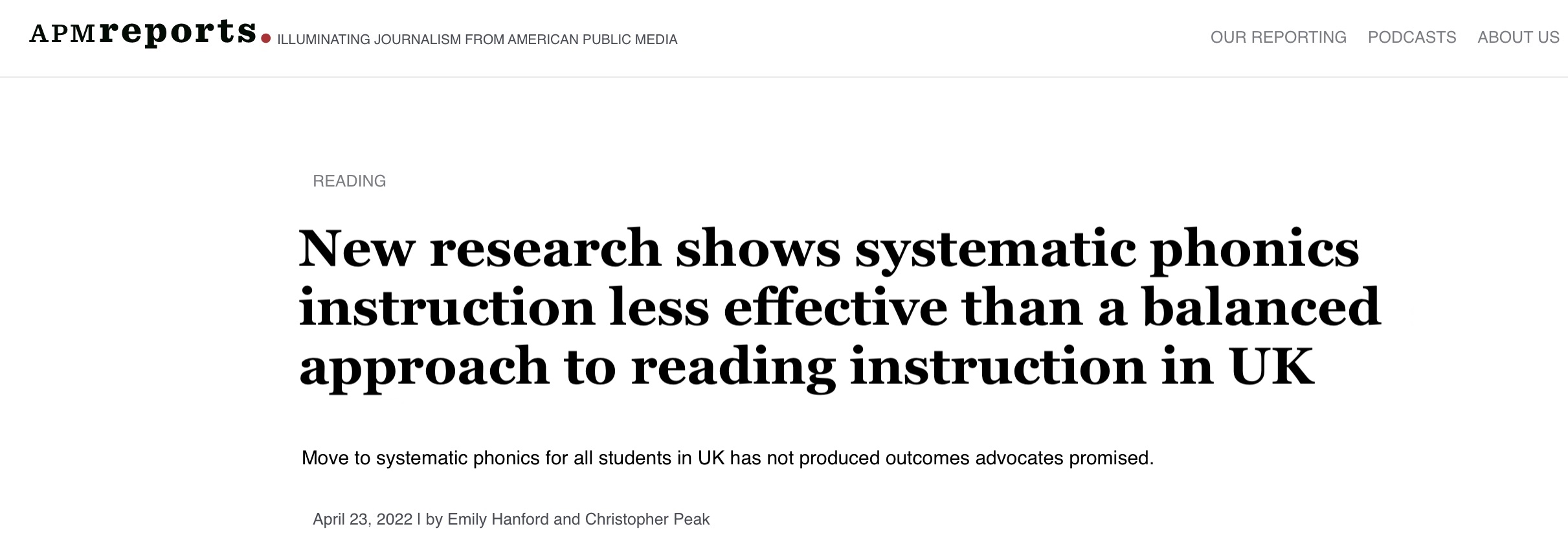
But here is an actual headline:

Both studies (not-yet peer reviewed reading recovery study here, and peer-reviewed UK study here), by the way, are extremely important to anyone genuinely concerned about reading instruction. As a matter of fact, Reading Recovery has issued a thoughtful response to the research in the second, real, headline.

Since Emily Hanford established herself as the “science of reading” journalist in 2018, one would imagine that she would be fully invested in the full story of research on teaching reading. And of course, one would be wrong.

The “science of reading” movement is an ideological movement, not concerned about evidence or even reading achievement by students. There are phonics programs to sell and careers to boost.

When people complain about bias, one aspect of bias often ignored is that all media determine what to cover and what not to cover (Hanford covers anything that seems to further the “science of reading” propaganda, and ignores anything that challenges it). In the case above, the research on reading recovery is easy to twist into the “science of reading” agenda, but the research from the UK is a whole different matter.

To be fair, both studies raise some important questions, but probably do not prove any agenda conclusively. Why is reading achievement in the UK stagnant despite mandating systematic phonics for all students since 2006? Why do students receiving reading recovery intervention seem to score lower than other students over time (in similar ways to grade retention outcomes) in longitudinal studies?

These are damn good questions. And simply asking them is a step in the right direction—recognizing there are no simple answers to teaching or learning how to read.

Yet, they are questions that media and political leaders are unlikely to ask much less answer. Because too many people are invested in the “science of reading” propaganda machine, including Hanford.

Her recent co-authored piece, New research shows controversial Reading Recovery program eventually had a negative impact on children, follows a predictable pattern found in her New York Times mis-reporting on Mississippi’s 2019 NAEP scores: Make an overstated implication about the “science of reading” while including a slight hedge in the article after the Big Claim. See my unmasking here.

We can learn a few lessons from all this.

One is that if you have to lie or distort, you may not have a credible argument (see Hanford’s “science of reading” propaganda).

But a more valuable lesson is that we must have a much more nuanced and complex awareness about what it means to teach and learn reading. While I think many reading recovery teachers are doing important and effective work, we cannot have a simplistic faith that something with the “reading recovering” stamp is universally perfect.

As much as we would hope otherwise, there is no silver bullet.

That realization, however, should temper our understanding of the “science of reading” movement, an agenda that is paralyzed by its missionary zeal—and its persistent misinformation campaign that puts its agenda ahead of real concerns about effective teaching and learning.

Media advocates for the “science of reading,” Hanford and Natalie Wexler, for example, are doing far more harm than good because of their blind advocacy.

Journalists and politicians should not be determining how children learn to read. However, the public is often mislead by sensationalistic media coverage, such as that by Hanford—Mississippi Miracle! (well, “There’s no way to know for sure”), and Reading Recovery is a failure! (but … who knows?).

Here is a lesson: Don’t believe everything you read.

Here is a much harder lesson: Worry about what you don’t get to read.

Resisting Efficiency in Literacy Instruction

“Third grade reading proficiency matters—enormously,” declares Mike Schmoker in How to Make Reading Instruction Much, Much More Efficient for Education Week.

When I saw this piece from 2019 pop up on my social media feed this week, I immediately noticed the subheading: “Scaling back small-group instruction would have dramatic improvements in literacy.”

Since Schmoker’s article fell solidly in the current “science of reading” crisis rhetoric and misguided reading policy being passed across the U.S., it certainly was poised to create even more harmful classroom level decisions for students and teachers.

Two aspects of this argument are compelling and misguided—the standard but false appeal to “third grade reading proficiency” and the prioritizing of “efficiency” for making instructional decisions.

Of course there are well documented correlations between third grade reading achievement and later negative educational outcomes for students (low reading achievement correlated with dropping out and low overall academic achievement, for example), but the traditional response to those correlations has resulted in over-reactions that do far more harm than good.

One of the worst over-reactions has been states adopting grade retention based on third grade reading assessments—despite grade retention having a causal relationship with students dropping out.

Doubling down on practices that increase students dropping out to address misunderstanding the research on third grade reading achievement is a profound failure in logic.

Some of the motivation for making these policy mistakes is that U.S. cultural norms are too often grounded in punishment. Many affluent and privileged people embrace the concept of grade retention as a way to insure that children are taught lessons about achievement and effort, but they also embrace punitive measures because they suspect grade retention, for example, will only impact “other people’s children.”

There is more than a little bit of racism and classism in the urge to embrace punitive schools and aggressive policing and legal systems.

But another source of making terrible policy decisions, especially about reading, is the core of Schmoker’s argument—determining instructional practices by prioritizing efficiency.

Although an enduring Urban Legend criticizes U.S. public education as essentially progressive (which it isn’t, and has never been), scholar Herb Kliebard detailed that by the early twentieth century U.S. public education had become driven by efficiency.*

One powerful example of that commitment is the use of standardized testing, primarily multiple choice tests that can be quickly scored, such as the SAT and most state-level accountability testing.

Despite decades of research showing that standardized testing is often a weak measure of learning, is most strongly correlated with status (socioeconomic, racial, gender), and creates inequity, standardized testing has persisted in the U.S. because it is more efficient than what we tend to call authentic assessment—essays, performances, projects, etc.

In fact, our blind commitment to efficiency is so strong that when we do use authentic assessment we now demand highly structured rubrics to insure that the grading is efficient (which erases the authentic nature of the assignment).

Formal education in the U.S. has structures that, of course, create the need for “efficiency”—grade levels around biological age and courses provided through a format that requires one teacher to serve the largest number of students possible (in K-12, typically 1 to 25-35, but university-level ratios can be 1 to hundreds of students).

Although universal education is a public good, we are bound by market forces when providing education for all children.

I do recognize that efficiency must be one concern for instructional practices, but I have witnessed across five decades of teaching since the 1980s that we overemphasize efficiency, especially in literacy instruction.

For 18 years as a high school English teacher, I struggled within a system demanding efficiency while attempting to teach writing authentically—a workshop method requiring students to write multiple drafts that I provided ample feedback on throughout the process.

This experience was physically and mentally exhausting; I left K-12 education with my right wrist in a brace from writing on about 4000+ essays per year for almost two decades.

Could I have implemented something identified as writing instruction more efficiently (and less taxing for me)? Of course.

But that would have been a lie (many efficient approaches, such as direct grammar instruction, is simply not writing instruction) and would have cheated my students.

Teaching first-year writing at the college level has further cemented my awareness that efficiency is extremely harmful for writing instruction effectiveness.

For example, teaching 100-125 students at a time (more efficient and the reality of high school English teaching) is far less effective than my current obligation to classes as small as 5 students and semester loads including no more than 3 or 4 dozen students (less efficient, more effective).

So this brings me back to the misguided “scaling back small-group instruction.”

As long as we are committed to current teacher/student ratios (one-on-one tutoring/mentoring is, of course, the ideal teaching/learning context), the best instructional approach to managing effectiveness and efficiency is balancing the whole-class, small-group, and individual instructional practices.

If anything, most K-12 teachers need to reduce whole-class instruction and increase small-group and individual instruction.

Why? Whole-class instruction is often the least effective of the three, particularly with writing instruction. For example, my first-year writing students continue to struggle with whole-class assignments and instruction but thrive in our face-to-face conferencing (even in comparison to the individualized instruction they receive from my comments on their essays).

But also, small-group and individualized instruction can often be, ironically, more efficient because that instruction is targeting identified need and allows student choice (instead of the teacher making all decisions for students).

Even the best whole-class instruction is addressing only some students’ needs. And another irony of whole-class instruction is that it tends to more effective after students have submitted authentic artifacts of learning that they are then required to revise (as opposed to giving great deal of instruction up front before students perform).

The ugly truth about prioritizing efficiency is that we are valuing coverage of prescribed instruction over student need or student learning.

Finally, we must acknowledge that teaching conditions are learning conditions. Current teacher/student ratios of 1/25-35 are cheating teachers and students. Yes, we should address those teaching/learning conditions.

But until that political commitment occurs, we must support teachers managing well the tension between effective and efficient. The trick, despite Schmoker’s claim, is maintaining our commitments to small-group and individualized instruction that targets identified student needs.

In fact, we we pull aside the curtain of efficiency, we discover that whole-class instruction as effective is a mirage.


Recommended

Callahan, R. E. (1962). Education and the cult of efficiency: A study of the social forces that have shaped the administration of the public schools. Chicago: The University of Chicago Press.

Was There Really a Social Efficiency Doctrine? The Uses and Abuses of an Idea in Educational History, Thomas Fallace and Victoria Fantozzi (2013) (H/T Jennifer Binis)

*NOTE: From Fallace and Fantozzi: “For Callahan (1962) and Kliebard (1995), social efficiency educators diverted progressive education away from the democratic ideas of John Dewey and Harold Rugg” (p. 145). As a critical scholar of the history of education (curriculum and instruction), I think we must make distinctions between the scholarly world (philosophy and theory) and the “real world” of day-to-day education. While I agree with the claim above, I also understand that nuanced and complex philosophy/theory often finds its way into practice in reductive and distorted ways (consider “behaviorism,” “whole language,” “progressivism,” etc.). My argument here is not about the actual social efficiency movement, but that some of the elements of that movement have manifested themselves in powerful and enduring ways (consciously and unconsciously) in how we “do” education in the U.S., one of which is prioritizing “efficiency” in harmful ways. My best example, again, is standardized, multiple-choice testing.

Wonder Woman Historia: The Amazons (Book Two): Women and Children, Goddesses/Gods and Mortals

Stories matter.

Throughout my childhood, my father told the stories of him growing up, and life before my sister and me, so many times, with so much detail, I can retell them myself today—several years past his death, many decades since I was a child.

Not a literary person, my father returned again and again to telling us about his courtship with my mother. They married in secret during her lunch break from her job working at a Winn-Dixie checkout counter.

We tell stories, often over and over, in an effort to understand better our lives, understand better what it means to be human. But I think, especially for my father, we tell stories of our lives to hold onto those moments and years that slip farther and farther into our past, fading.

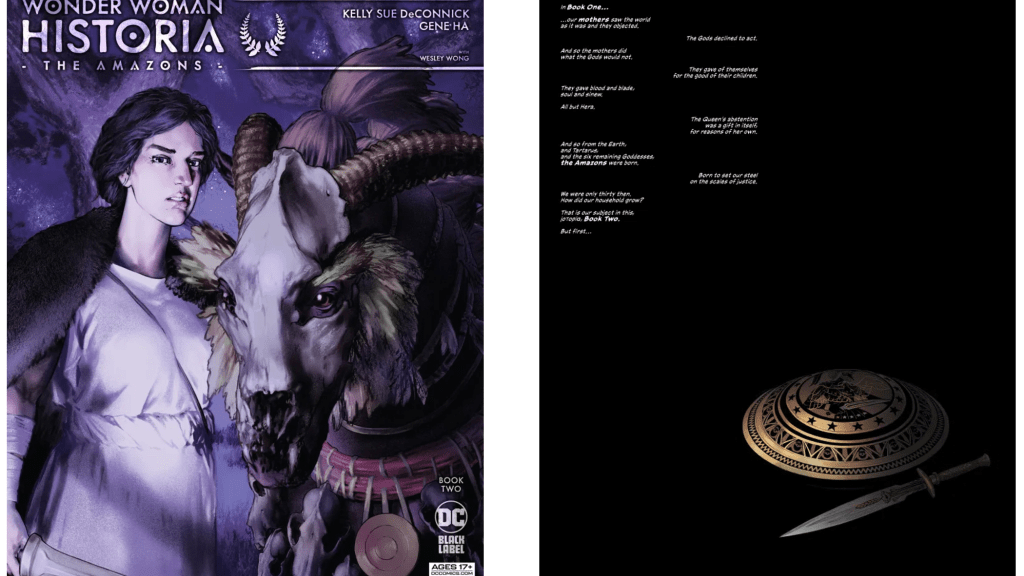
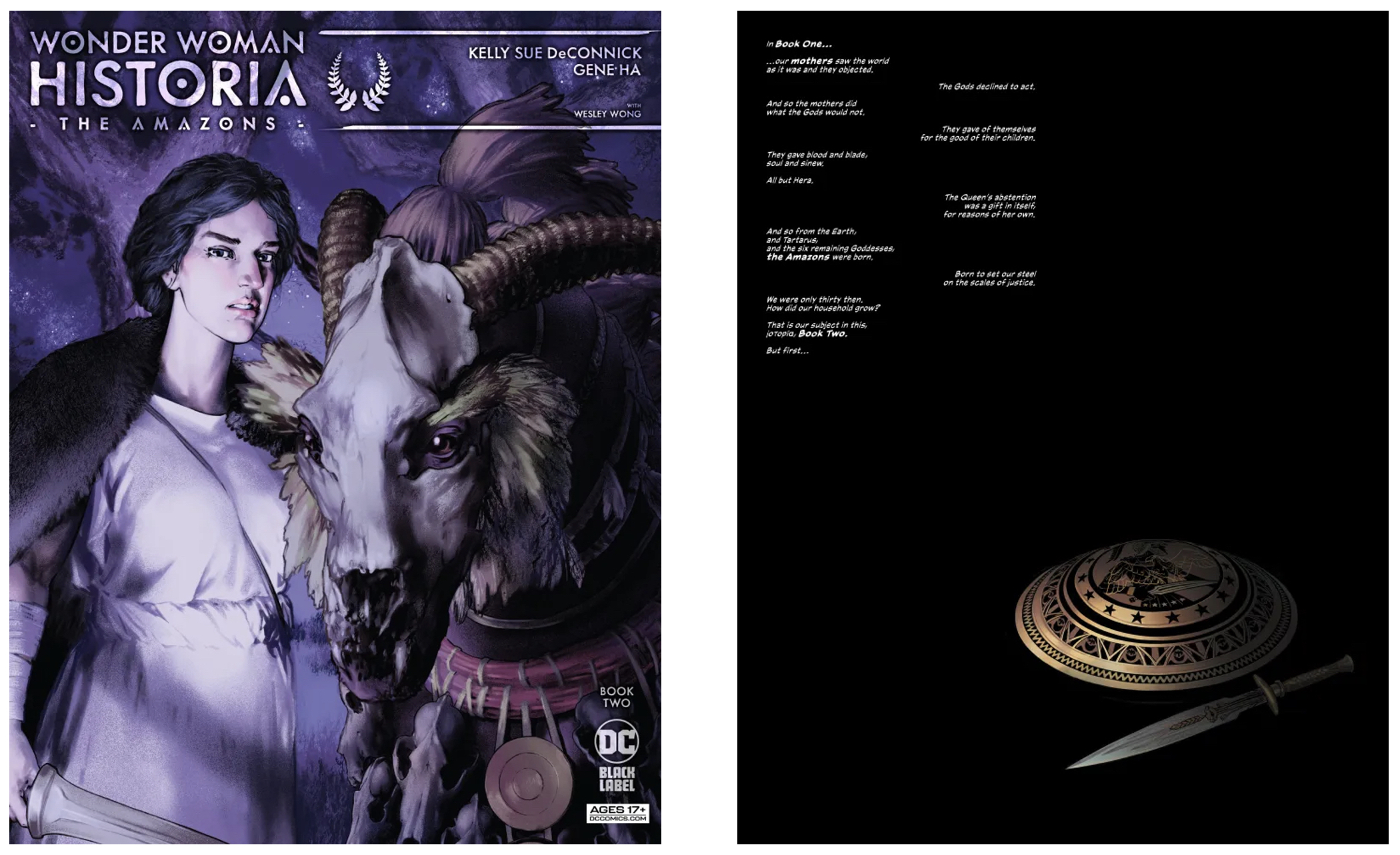
As I read Wonder Woman Historia: The Amazons (Book Two), Kelly Sue DeConnick’s telling and retelling of mythology grounded in the Wonder Woman universe, I thought about my father’s storytelling as well as why we have myths. I explained that Book One, with artist Phil Jimenez, offers not just a beautiful and compelling superhero narrative, but also vivid and urgent messages for our lives today.

DeConnick joins artist Gene Ha in Book Two. Ha’s “Behind the Panels” shares DeConnick’s charge for Ha and her as co-creators of Book Two: “The scripts that follow should be considered more of a roadmap than a set of blueprints.”

Cover: Gene Ha.

DeConnick continues: “I’ve beaten this metaphor into the ground but my point is this: this is a collaborative process.”

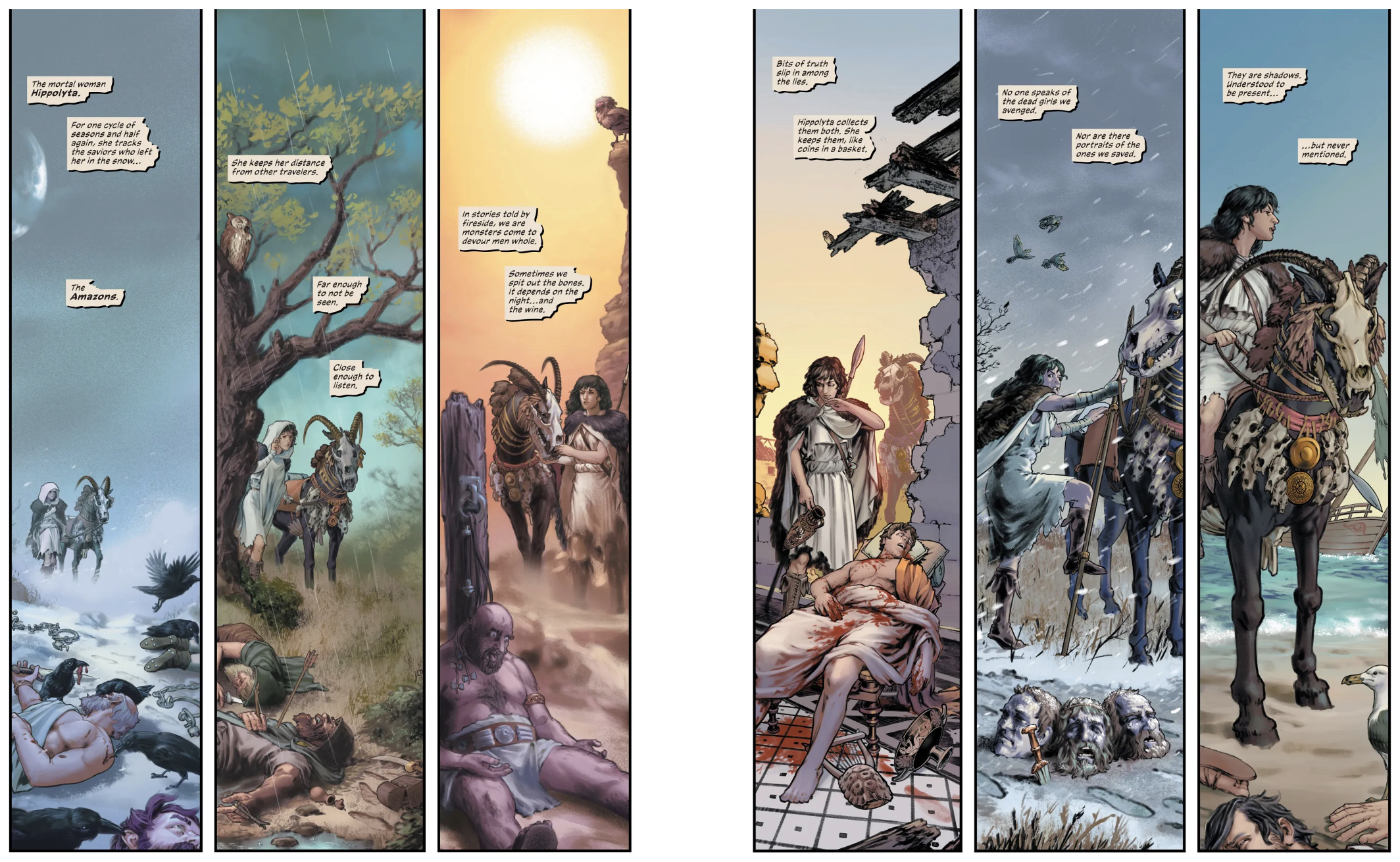
This continuing story of Hippolyta and the Amazons, then, begins with the tensions of stories told (lies) and stories not told (truths).

Book Two: DeConnick, writer; Ha, artist; Wesley Wong, colorist; Clayton Cowles, letterer.

Amazons demonized as monsters overshadows Amazons as savior-warriors: “No one speaks of the dead girls we avenged. Nor are there portraits of the ones we saved.”

Representation matters also.

This narrative tension speaks, of course, to the cultural tensions in the U.S. in 2022—an aggressive political Right running roughshod across the country decrying manufactured threats (Critical Race Theory) and demonizing educators as “groomers” in their Holy War against LGBTQ+ humanity.

Stories matter. But power matters more.

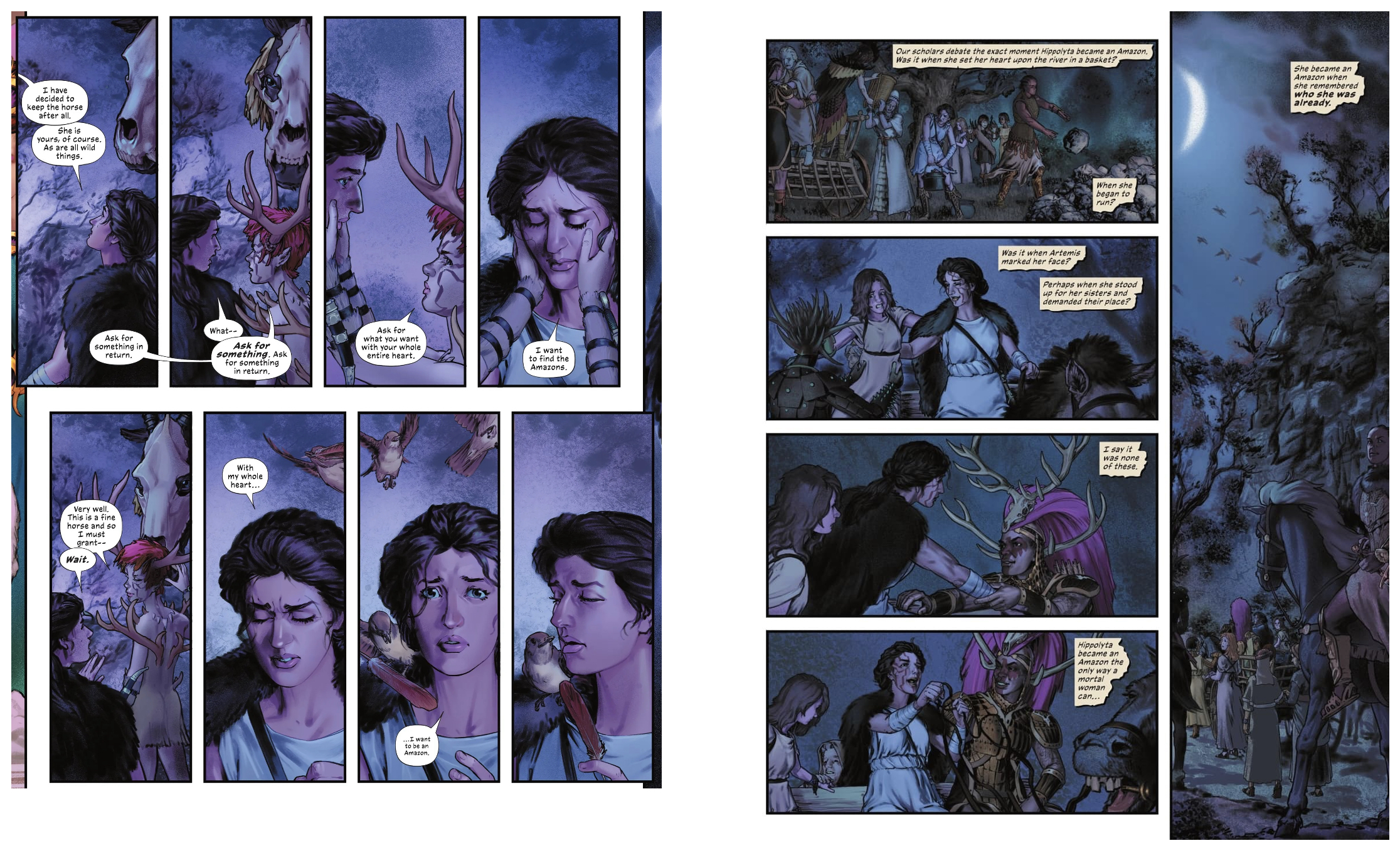
Hippolyta’s story is a story about stories, but it also is a story about another tension between Goddesses/Gods and mortals. When she comes upon Artemis, Hippolyta confesses her ultimate goal: “I need to be an Amazon.”

Book Two: DeConnick, writer; Ha, artist; Wesley Wong, colorist; Clayton Cowles, letterer.

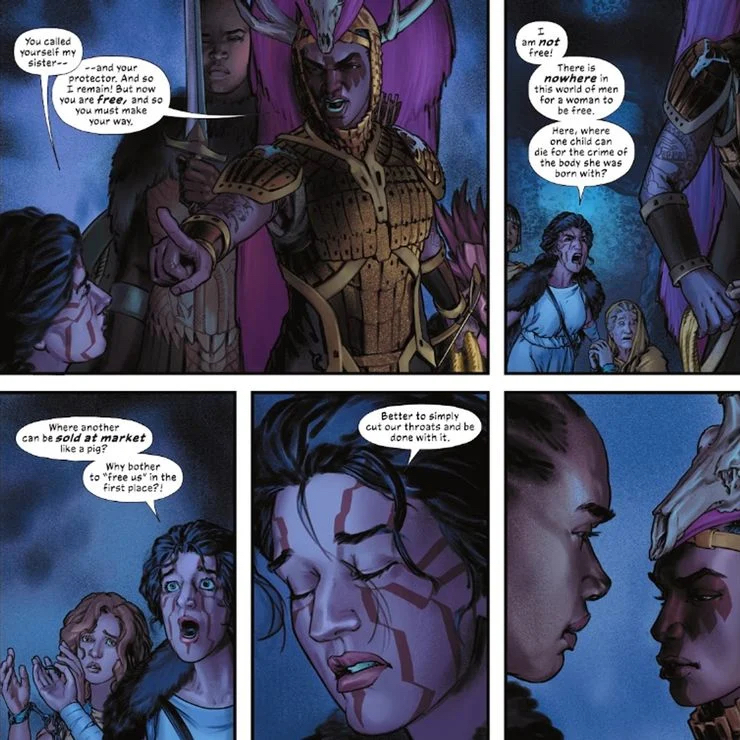
Marked by Artemis, Hippolyta is left to confront enslavers, introducing central themes of Book Two—the conditions of being women and children. Saved by Amazons, the enslaved children and Hippolyta are set free. However, Hippolyta challenges that freedom—not just for this moment, but “There is nowhere in this world of men for a woman to be free.”

Book Two: DeConnick, writer; Ha, artist; Wesley Wong, colorist; Clayton Cowles, letterer.

Hippolyta’s outburst echoes Queen Hera’s anger earlier in Book Two: “There will be no justice for women. Not now. Not a hundred years from now. Not a thousand!”

Book Two: DeConnick, writer; Ha, artist; Wesley Wong, colorist; Clayton Cowles, letterer.

Goddesses and mortal women, women and children—for them, Book Two establishes elements of shared existential realities around justice and freedom.

The plot of Book Two builds to a new Seventh Tribe of Amazons with Hippolyta as the leader, chosen by “consensus,” fitting seamlessly into the “collaboration” commitment from DeConnick in Ha’s “Behind the Panels.”

The new tribe, mortals, train and then experience their own mission against enslavers. Those who were freed now free others, but also confront the weight of “great power,” the ability to take life. Tarpeia, however, is restrained from killing a boy. “But he is one of them. He would have killed me!” she argues.

The Amazonian response is powerful and haunting: “He’s just a boy. He shouldn’t die for the sins of his father.”

In terms of contemporary relevance, I find this focus one of the key moments of Book Two.

Book Two: DeConnick, writer; Ha, artist; Wesley Wong, colorist; Clayton Cowles, letterer.

A cultural and political narrative in the U.S. in 2022 involves centering parental rights over their children, an idealized view of parenting paired with denying the autonomy and humanity of children. States are passing legislation directly pronouncing that parents have primary authority over their children’s education.

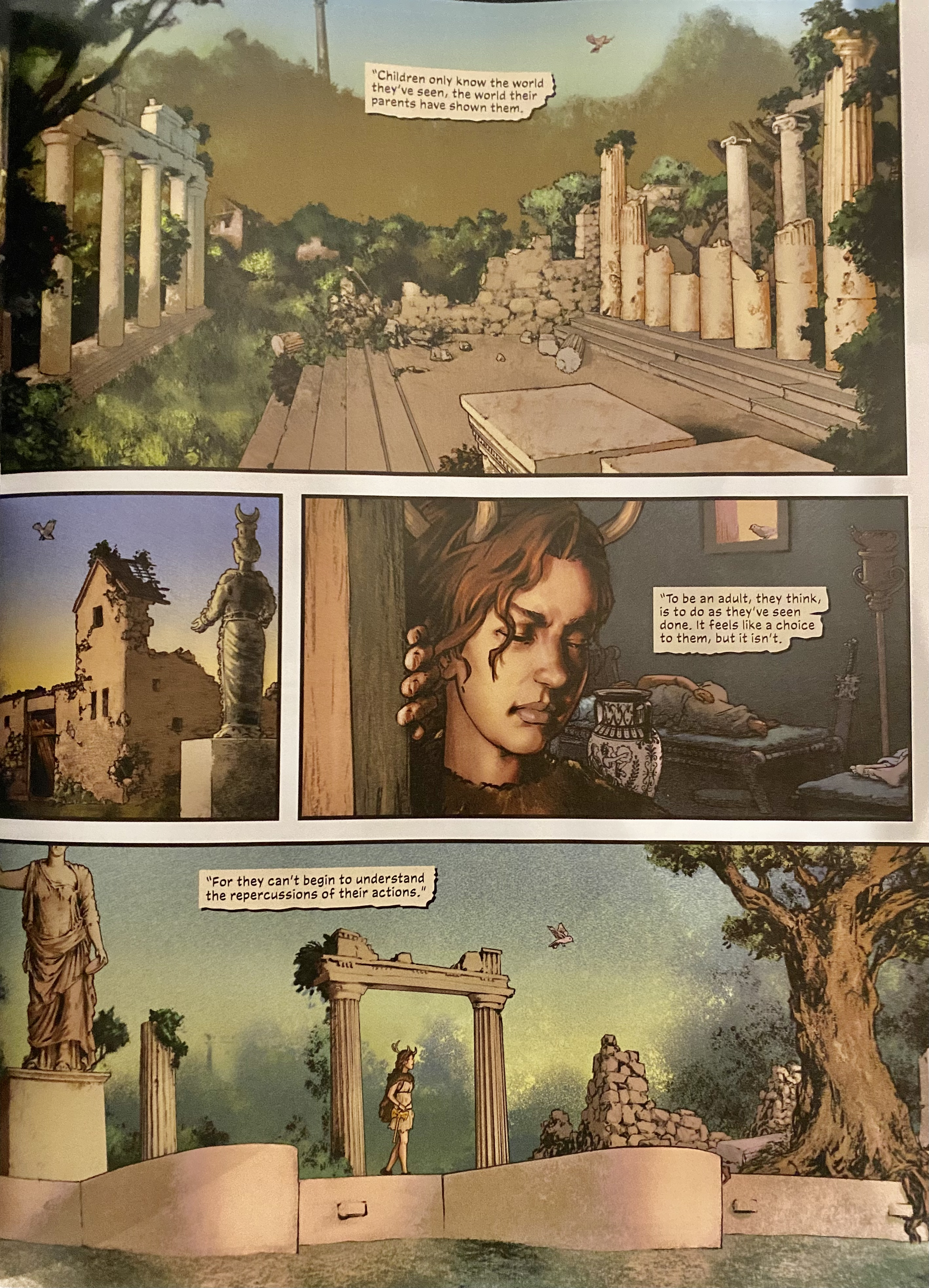
However, as Book Two dramatizes, “Children only know the world they’ve seen, the world their parents have shown them. To be an adult, they think, is to do as they’ve seen done. It feels like a choice to them, but it isn’t.”

The fate of the boy becomes the ominous final conflict of Book Two, harkening Book Three with “Unleash hell upon them.”

Here, I come back to my father, and mother, and the “world” they showed me. As I have written about often, I was told many wrong stories, corrupting stories, and I could have been trapped in those narratives of racism and ignorance.

Until I learned otherwise—in science fiction and comic books, in comedy albums, and in classrooms where teachers were free to teach.

Again, stories matter.

But who controls them often matters more.

Academic Freedom Isn’t Free

My poem The 451 App (22 August 2022) is a science fiction/dystopian musing about the possibility of technology providing a comforting veneer to the creeping rise of totalitarianism—a simple App appearing on everyone’s smartphone before erasing all our books.

The point of the poem is less about technology and a dystopian future (alluding of course to Fahrenheit 451) and more about another work of literature: “The best lack all conviction, while the worst/Are full of passionate intensity” (“The Second Coming,” William Butler Yeats).

For me, this unmasking of the human condition has always been haunting; it also has become disturbingly relevant in the Trump/post-Trump present in which we live.

Real life is always far more mundane than speculative fiction—and far more shocking.

The “worst,” “full of passionate intensity,” launched an assault on academic freedom in the final months of the Trump administration. The initial wave seemed poised at The 1619 Project and a manufactured Critical Race Theory scare.

By January of 2022, a report found that educational gag orders passed in states across the U.S. were having a significant and chilling effect:

We found that at least 894 school districts, enrolling 17,743,850 students, or 35% of all K–12 students in the United States, have been impacted by local anti “CRT” efforts. Our survey and interviews demonstrate how such restriction efforts have been experienced inside schools as well as districts. We found that both state action and local activity have left many educators afraid to do their work.

The Conflict Campaign (January 2022)

As bills have increased since this report, the number of teachers and students impacted are certainly higher.

Concurrent with educational gag order legislation, book banning has increased dramatically, as reported by PEN America:

• In total, for the nine-month period represented, the Index lists 1,586 instances of individual books being banned, affecting 1,145 unique book titles. This encompasses different types of bans, including removals of books from school libraries, prohibitions in classrooms, or both, as well as books banned from circulation during investigations resulting from challenges from parents, educators, administrators, board members, or responses to laws passed by legislatures. These numbers represent a count of cases either reported directly to PEN America and/or covered in the media; there may be other cases of bans that have not been reported and are thus not included in this count.

• The Index lists bans on 1,145 titles by 874 different authors, 198 illustrators, and 9 translators, impacting the literary, scholarly, and creative work of 1,081 people altogether.

• The Index lists book bans that have occurred in 86 school districts in 26 states. These districts represent 2,899 schools with a combined enrollment of over 2 million students.

Banned in the USA: Rising School Book Bans Threaten Free Expression and Students’ First Amendment Rights

Republicans and conservatives have steadily created an environment of fear around teaching and learning, which is being detailed now by teachers experiencing that fear (with many leaving the field):

Last year, I was quoted in an article in the School Library Journal about how I discussed toxic masculinity with my high school students when we read Shakespeare’s “Romeo and Juliet”togetherWithin days, far-right publications twisted my words to denounce “woke liberal indoctrination in schools.”

Strangers sent me messages on social media accusing me of indoctrinating students, of being unprofessional and unintelligent. I received a handwritten letter addressed to me at school. The letter accused me of being a “low-life, pseudo-intellectual, swallow-the-lib/woke/b—s— koolaid a — h—-.” [The hyphens were added to replace letters because of Washington Post style and not in the original].

‘Educators are afraid,’ says teacher attacked for ‘Romeo and Juliet’ unit, Sarah Mulhern Gross

This movement is driven by lies and fear mongering, but it depends on the missionary zeal of the liars and fear mongers as well as the passivity of “the best” among us.

My childhood and adolescence were profoundly shaped by books and movies—often the science fiction loved by my mother.

Along with The Andromeda Strain (film adapted from Michael Crichton’s novel), two films based on Ray Bradbury’s work remain with me today—The Illustrated Man and Fahrenheit 451.

There is a profound darkness and fatalism in these works, but in Fahrenheit 451, I was struck by the optimism and power of the individuals who walked around repeating the books they had become.

These people, the best among us, seem to suggest Bradbury held on to some sliver of hope.

It seems overwhelming to consider that as sentient creatures we are doomed to not recognize that things matter until they have been taken from us—taken from us with almost no resistance, with almost no recognition of the book being gently slipped from our hands and then our minds.

Academic freedom isn’t free, but without free minds—freedom to teach, freedom to learn, freedom to read and consider—we are no longer fully human.


Recommended

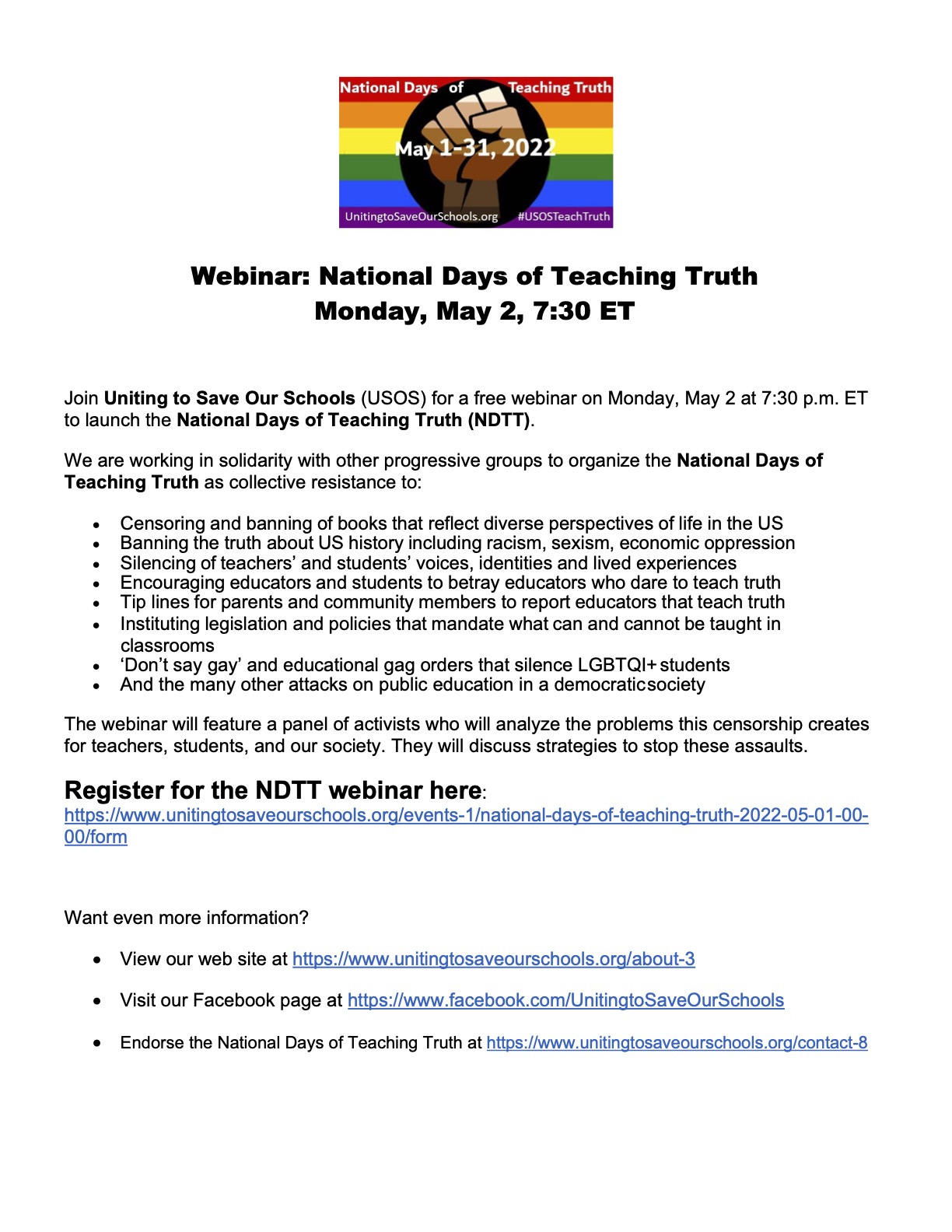
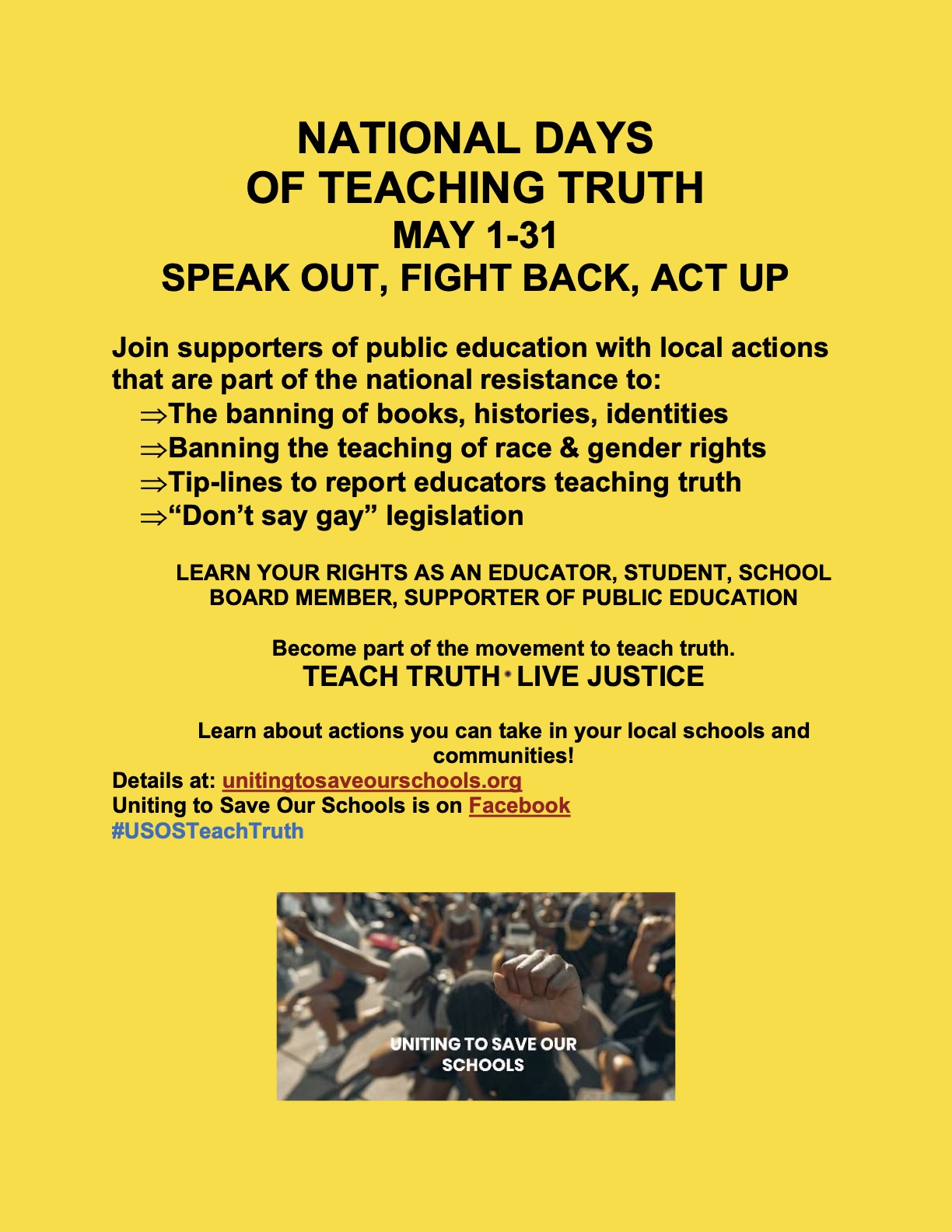
National Days of Teaching Truth

My 31 texts for 31 days in May

Freedom to Teach: Statement against Banning Books (NCTE)

Banning Books Is Un-American

Banned in the U.S.A. Redux 2021: “[T]o behave as educated persons would”

Censorship and Book Burning: A Reader [Updated]

Furman faculty pass resolution rejecting pending state legislation aimed at academic freedom

Educators’ Right and Responsibilities to Engage in Antiracist Teaching (NCTE)

Lehre Ist Tot

This past week an early career teacher, highly regarded in the classroom and very accomplished in the field of education, received a parental request that a student not be required to read The Great Gatsby. That parent, however, had signed a consent agreement with all texts, including that novel, identified as required reading at the beginning of the course.

The parent then reached out to the administration, who confirmed that the teacher had to assign a different work. This, of course, undermines the teacher and the process established, but it also creates more work for teachers already under incredible strain.

While parental oversight of assigned reading has been common in education for decades, this situation comes as states are increasingly passing parental trigger legislation, which moves the parental power from each parent’s own children to parents being able to ban works for all teachers or students to explore in classes.

That same teacher, frustrated and disillusioned, later that day read aloud their resignation letter to me in the context of telling me that much that they had taught in the first three years of teaching could no longer be taught in the last couple years—and increasingly will be directly banned in the coming year (as my home state is poised to pass its own educational gag order this spring).

The teacher cried while reading the letter aloud, and added that the resignation was depressing; this, you see, was a career they had been working toward since high school—and within 6 years, teaching is dead.

The current anti-teacher climate in the U.S. is incredibly harsh and driven by orchestrated false narratives:

Right-wing media are creating parental trigger structures even without the concurrent legislation:

While teacher and school bashing (notably as “liberal indoctrination”) has a long history in the U.S., reaching back to Catholic schools fighting for market space as public schooling increased in the 19th century, the current anti-teacher climate has its roots not in Republican politics but in the Obama administration’s education agenda.

Obama’s appointment of Arne Duncan as Secretary of Education heralded an era of education reform that actually doubled-down on the worst aspects under George W. Bush, and that doubling down feed into a growing media attack on “bad teachers.”

Instead of rejecting the standard approaches to education reform begun under Reagan and federalized under W. Bush, the Obama administration turned their blame to teachers and teacher quality. During the Obama years, the great experiment in value-added methods (VAM) devastated the teaching profession.

The perennial paradox of education has always been that teacher quality matters but it remains a very small part of measurable student achievement (only about 10-15%). Therefore, the Holy Grail of the VAM experiment—identifying “good” and “bad” teachers through standardized test scores of students—was always doomed to fail.

But it did accomplish planting the seeds of today’s multi-pronged attack on teachers—the “science of reading” movement blaming teachers and teacher educators for student reading achievement and the anti-CRT/educational gag order movements being linked to parent trigger laws.

Throughout the education reform era over the past 40 years, many of us in education have argued that education reform initiatives are less about improving education and more about killing public education and the teaching profession—charter schools and voucher schemes, Teach For America, VAM and merit pay, demonizing and dismantling unions and tenure, etc., to name a few.

From Fox News lies to parental trigger laws and education gag orders, the evidence is very clear now that this current wave of teacher bashing is definitely about killing the profession, and not about student discomfort.

Let me return to the opening teacher story.

When the parent was asked for reasons why they wanted their child not to read The Great Gatsby—so the teacher had context for choosing an alternate text—the parent responded that they did not want the child (a high school student) to read about inappropriate relationships and sexual content. So here is a point of fact about the insincerity of these challenges; that student had already read and studied The Crucible, without any complaint, a play grounded in adultery.

I am certain some parents challenging what their children are being taught are sincere, but I am also certain the larger political motivation among conservatives is to completely dismantle public education.

Just as I have explained that there simply is no CRT propaganda agenda in K-12 schools, there is no liberal indoctrination/grooming occurring in K-12 (or K-16) education either.

The Ingraham rants are simply political lies.

And these lies are not improving education.

They have one goal and it seems to have been effective: Teaching is dead.

WandaVision: Pastiche, Past, and Present (A Course)

Below I am sharing my MayX (2 credit undergraduate) course I will be offering in about a month.

The course grew out of the following post based on the series WandaVision: Teaching WandaVision: A Textset on Pastiche.

See Also

A Vision of Being Human: “Am I normal?”


EDU 116 – WandaVision: Pastiche, Past, and Present

“The law is meant to be my servant and not my master, still less my torturer and my murderer.” — James Baldwin. The Nation. July 11, 1966.

Equity, Anti-Racism, and Anti-Bias Statement

#BlackLivesMatter

In my teaching, scholarship, public writing, and life, I am fully committed to racial, gender, and all forms of equity not yet realized throughout the U.S. and world. While academic spaces are often intellectually challenging and even uncomfortable, I will not tolerate in any aspect of this course language, ideas, or behavior/symbolism that are hostile to marginalized/oppressed groups (racism, sexism/misogyny, homophobia, transphobia, xenophobia, etc.).

Academic freedom for students and professors is tethered to consequences, and is not license. (See Free Speech and Diversity of Thought?

Students uncertain about what language and ideas are not acceptable because they are hostile or offensive are invited to discuss those questions with me privately and are guaranteed those exchanges will be treated confidentially and respectfully. I am eager to share evidence, research, and reading to help anyone better understand goals of equity, anti-racism, and anti-bias (see materials in Box, Race and Racism).

If you witness or experience any form of bias, please report here:

Bias Incident Report

Title IX syllabus statement

Course Overview

Catalogue Description

This MayX will explore reconsidering the past through the present by viewing the 9-episode series WandaVision (and other texts), which incorporates pastiche as a technique to reflect and challenge the sit-com genre. Students will apply critical media literacy strategies to explore pop culture and apply those strategies to understanding public and popular controversies in K-12 education. An active subscription to Disney+ during MayX is required.

Course Topics

Critical media literacy/ K-12 educational controversies

Pastiche

History/teaching history

Pop culture/Marvel Cinematic Universe/sitcoms

Race/gender

Course Texts

Vision: The Complete Collection (graphic novel)

WandaVision (series)

Pleasantville (film)

Sitcom episodes (TBD)

Brief readings (TBD; see schedule)

The 1619 Project

Course Objectives

  • Understanding and application of the concept of “pastiche” in media and pop culture
  • Understanding and application critical media literacy strategies
  • Awareness of educational controversies (for example, Critical Race Theory, the 1619 Project)
  • Understanding of the field of history (relationship of past and present) and the teaching of history
  • Understanding of the essential aspects of liberal arts education
  • Reconsideration of race and gender in history and pop culture

Assignments

  • Read Vision (before class sessions) and submit reflections* per schedule below
  • View WandaVision episodes (before class sessions) and submit reflections* focusing on pastiche technique in each episode
  • Independent Project – critical analysis of one episode of a classic sit-com referenced in WandaVision after series viewing (PP and class presentation)
  • Group Activity – viewing Pleasantville (film) for in-class critical analysis in groups
  • Final Portfolio Submission (all assignments resubmitted in Box folder)

* Written reflections should be submitted per the daily schedule below. Submit each reflection pasted into email (not attached) and include the reflection number (see schedule) in the “subject” line of the email. Due before each class session by schedule.

Schedule (Meeting 9 am -12 pm)

Week 1

May 11

Course Overview and Assignments

Read Vision (before class sessions) and submit reflections per schedule below

View WandaVision episodes (before class sessions) and submit reflections focusing on pastiche technique in each episode

Independent project – critical analysis of one episode of a classic sit-com referenced in WandaVision after series viewing (PP and class presentation)

Group activity – viewing Pleasantville (film) for in-class critical analysis in groups

May 12

Intro – Marvel Cinematic Universe (MCU); Sitcoms; Pastiche (Postmodern Use of Parody and Pastiche, Nasrullah Mambrol)

Critical Media Literacy – Teachable Moment: Fake News and Critical Media Literacy

Rethinking the past through the present? – Dismantling Monuments: History as a Living Document

May 13

Intro – Wanda and Vision

Teaching WandaVision: A Textset on Pastiche

Week 2

May 16

Vision 1-3 (reading and reflection DUE before class) discussion

May 17

Vision 4-6 (reading and reflection DUE before class) discussion

May 18

Vision 7-9 (reading and reflection DUE before class) discussion

May 19

Vision 10-12 (reading and reflection DUE before class) discussion

May 20

NO CLASS SESSION

Week 3

May 23

WandaVision E1 – Filmed Before a Live Studio Audience

WandaVision E2 – Don’t Touch That Dial

(Viewing and reflection DUE before class)

May 24

WandaVision E3 – Now in Color

WandaVision E4 – We Interrupt This Program

WandaVision E5 – On a Very Special Episode…

(Viewing and reflection DUE before class)

May 25

WandaVision E6 – All-New Halloween Spooktacular!

WandaVision E7 – Breaking the Fourth Wall

WandaVision E8 – Previously On

(Viewing and reflection DUE before class)

May 26

WandaVision E9 – The Series Finale

(Viewing and reflection DUE before class)

May 27

NO CLASS SESSION

Week 4

May 30 Memorial Day Holiday

May 31

Pleasantville (DVD Collection PN1995.9.C55 P63 1999) in-class viewing/discussion

June 1

Last class – final portfolio/exam DUE (submit in Box)

Presentations shared in class

The Good Student Trap: Research Paper Edition

I teach good students.

I write that with no sarcasm, or cynicism.

For the past 20 years, I have been teaching at a selective liberal arts university, and the students are mostly high-achieving young adults who graduated high school as A or B students.

Like me, my students also have a tendency toward the often ignored consequences of being gifted or smart—anxiety, depression, imposter’s syndrome, perfectionism.

While “good student” is a compliment, I remain convinced that performing as a good student is also, as Adele Scheele argued, a trap. Scheele posed that students learn good student habits in high school that they then apply in college, but often find those behaviors no longer are successful—or even valued by professors:

We were learning the Formula.
• Find out what’s expected.
• Do it.
• Wait for a response.

And it worked.

The Good Student Trap (excerpt), Adele Scheele

But more powerful that acknowledging that good student behavior doesn’t translate into college, Scheele also confronts how the good student trap creates irrational fear:

So what’s the problem? The problem is the danger. The danger lies in thinking about life as a test that we’ll pass or fail, one or the other, tested and branded by an Authority. So, we slide into feeling afraid we’ll fail even before we do—if we do. Mostly we don’t even fail; we’re just mortally afraid that we’re going to. We get used to labeling ourselves failures even when we’re not failing. If we don’t do as well as we wish, we don’t get a second chance to improve ourselves, or raise our grades. If we do perform well, we think that we got away with something this time. But wait until next time, we think; then they’ll find out what frauds we are. We let this fear ruin our lives. And it does.

The Good Student Trap (excerpt), Adele Scheele

I often watch these dynamics with my first-year students, which I anticipate. But the most dramatic example of this tension is in my upper-level writing/research course, notably when students submit this assignment:

Assignment

Students will conduct a research project in which they critically analyze how the above chosen issue is presented in the mainstream media, and write in a workshop format (multiple drafts, conferencing) an 8-10 page essay using APA format (see link above and student resources provided) detailing how well or not the media has presented the research. See Sample APA 7e with comments. NOTE: This cited essays is primarily a critical analysis of media coverage, and not simply an essay on your chosen education topic. The essay should include the following major sections: opening, literature review, media coverage, relationship between research and media, and closing/conclusion.

For 8-10 pages, a proposed structure:

Opening – about 1 page (2-4 paragraphs); be sure to include essay focus on media

literature review – 2 pages; focus on *patterns* in the sources (write about your topics, not the sources)

media coverage – 2 pages; focus on *patterns* in the media and include several examples

relationship between research and media – 2 pages; this is the most important goal of the essay so connect research and media examples

closing/conclusion – about 1 page (2-4 paragraphs); must emphasize essay focus, media analysis

Assignment for EDU 250, Paul Thomas, Furman University

Despite the highly structured details in the assignment, and despite students having several class sessions devoted to workshopping the assignment (and two scaffolded assignments—submitting a working references list and submitting annotated bibliographies for their sources), they struggle with completing the assignment as assigned, resulting in intense and negative responses to the feedback I provide on the first full submission.

The good student trap experienced by students here is that instead of conducting, writing, and submitting a media analysis project, students fall back to writing a high school research paper.

The reductive and inauthentic research paper students learn in high school is essentially behaving and writing like a student—collecting and writing an overview of “sources,” typically plowing through those sources one at a time and heavily quoting from each source.

The assignment I ask students to engage in requires that they move away from student behaviors and toward writing as scholars; that shift means that they gather and student scholarly sources in order to provide themselves a lens for writing an original essay (in this case, becoming expert on an educational topic in order to analyze the quality of media coverage of that topic).

For example, students tend to write “research papers” that explicitly state “my sources” and “my media articles” in order to detail “what I learned about X topic” instead of analyzing how media covers that topic.

My feedback includes nudging them (again) not to write like students, stressing that they are not doing the assignment (I refer them to the outline provided and the need to focus on “media analysis”), and warning them about citation concerns (including carelessness that rises to technical plagiarism).

With my feedback, the fear and negative response cycle kicks in. Students seem unable to trust a workshop environment in which draft submission, feedback, and revision are not only expected but required.

The good student trap has also trained students to see all feedback as evaluation, judgment, and to fear that not being immediately perfect is a signal that they have failed, or that they are going to fail.

Anticipating their fear and expecting they received my feedback negatively, I emailed them and assured them that revision was expected and that everyone was still capable of making an A in the course regardless of how well their initial submission had fulfilled the assignment.

In the first class after returning their essays with comments, however, they were mostly frantic; many of their comments were dramatic distortions of the feedback they received.

None the less, once they had their draft in front of them, they admitted seeing the gap between the assignment and what they submitted was much clearer to them.

So here is what my good students teach me over and over.

First, they confirm that prescriptions and templates are not nearly as effective as many people believe; I have always rejected prescriptions, templates, rubrics, and prompts for teaching writing—despite their all being common in traditional classrooms.

Students respond better to direct instruction once they have an artifact in front of them for context.

Next, they demonstrate for me the negative power of prior behavior that is successful, regardless of the credibility of that behavior. In this case, students struggle mightily to let go of the research paper.

And finally, they embody the paralysis of fear of not being good enough, not being perfect.

Unless traditional schooling changes—and I suspect it will not—I am faced with this reality continuing, and ultimately, I regret that the ones who suffer most in the good student trap are students themselves.