Category Archives: Education

The Lower Realities of Higher Education

I posted a fairly tame Tweet about the Wall Street Journal‘s recent Op-Ed attacking Jill Biden using “Dr.” and editorial doubling-down on negative responses to the Op-Ed (none of which I will link here):

The Tweet attracted conservatives with ten’s of followers, most of them misreading the Tweet and many of them attacking me for being an academic/professor (the typical snarky references to Marx, etc.) as well as being in the field of education (my university affiliation and doctorate, an EdD, are part of my Twitter bio and handle—although several Twits thought they were outing me in some way for these public facts).

While I am enormously privileged, I share with Jill Biden the paradox of holding a doctorate in an often marginalized field, education; when I attained my EdD in the mid-1990s, it was still a much lesser degree than a PhD—and remains well down the hierarchy of academic credentials since education is often discounted as a pre-professional field.

Over 37 years as an educators, I spent the first 18 as a public high school English teacher. K-12 teachers are disproportionately women, and being a K-12 teacher is a profession rarely recognized as such—mostly, I contend, because it is perceived as mere women’s work.

Like babysitting.

Now in the middle of my nineteenth year as a professor, having moved through the ranks to full professor and received tenure, I am part of a male-dominated field (especially at the higher ranks) that often warrants far more prestige than K-12 teachers but also receives a fair amount of public shaming and ridicule (notably from conservatives, as my Twitter experience illustrates).

That ridicule is based in large part on cartoonish stereotypes of the Ivory Tower (academic knowledge not being realistic or practical) and a mischaracterization of professors as radical Leftists.

What popular and conservative attacks of higher education often miss is that academia is incredibly traditional, especially in terms of policies and practices that are sexist, racist, classist, and (often) petty.

Higher education, like K-12 education, more often reflects society—the good, the bad, and the ugly—than not.

The Jill Biden debate prompted by the conservative WSJ is an opportunity to confront the gendered inequity of academia that is replicated in the racism, classism, and other inequities that permeate disciplinary hierarchies, the tenure and promotion process (along with faculty evaluation such as student evaluations of teaching [SET]), and numerous unspoken norms.

That higher education fails to be the Ivory Tower of equity is not the only paradox of academia. Many would assume, for example, that academics practice research-based policies and procedures, but one of the greatest inequities of being a professor is the use of SETs for annual evaluations and the tenure/promotion process (see here).

From 2019, Kristen Doerer reported:

“Having a female instructor is correlated with higher student achievement,” Wu said, but female instructors received systematically lower course evaluations. In looking at prerequisite courses, the two researchers found a negative correlation between students’ evaluations and learning. “If you took the prerequisite class from a professor with high student teaching evaluations,” Harbaugh said, “you were likely, everything else equal, to do worse in the second class.”…

Studies since the 1980s have found gender bias in student evaluations and, since the early 2000s, have found racial bias as well. A 2016 study of data from the United States and France found that students’ teaching evaluations “measure students’ gender biases better than they measure the instructor’s teaching effectiveness,” and that more-effective instructors got lower ratings than others did….

Despite the data, at many colleges, particularly research-based institutions, student evaluations are still the main measure, if not the only one, of teaching effectiveness in promotion-and-tenure decisions.

Just as the WSJ editorial staff doubled down on a grossly incompetent and even laughably weak Op-Ed by a classic mediocre white man, academia repeatedly doubles down on SETs, arguing that colleges must have something to evaluate teaching and casually flaunting the research base.

But even the college classroom remains inequitable for women; Lee and McCabe have found that gender inequity in the college classroom hasn’t improved over the past 40 years, as they observed:

Men students are more likely to take the floor to talk while women students are more likely to wait for their turns. Across all nine courses observed, men students talk 1.6 times as often as women. In addition, men are also more likely to speak out without raising their hands, interrupt other speakers in the classroom, and engage in prolonged conversations with the professor during class….

Despite great gains in women’s access to and achievements in higher education, contemporary college classrooms seem to have remained “chilly.” Our observations suggest that men students continue to occupy advantaged positions while women students are largely hesitant to take up space in classrooms. These differences occur regardless of students’ or professors’ awareness of these inequalities. 

A key point here is that women for many years have surpassed men in attending and achieving success in higher education. And the nonsensical WSJ Op-Ed seems to reflect anther disturbing finding about gender and higher education by Levanon, England, and Allison:

Occupations with a greater share of females pay less than those with a lower share, controlling for education and skill. This association is explained by two dominant views: devaluation and queuing. The former views the pay offered in an occupation to affect its female proportion, due to employers’ preference for men—a gendered labor queue. The latter argues that the proportion of females in an occupation affects pay, owing to devaluation of work done by women. Only a few past studies used longitudinal data, which is needed to test the theories. We use fixed-effects models, thus controlling for stable characteristics of occupations, and U.S. Census data from 1950 through 2000. We find substantial evidence for the devaluation view, but only scant evidence for the queuing view.

As women surpass men in doctorates, the prestige of that credential has diminished.

Once again, however, we need only to listen to women themselves, of course, to recognize the lower realities of higher education that have nothing to do with cancel culture, Marxism/socialism, or diversity/equity/inclusion initiatives.

Those lower realities are mostly good old American sexism.

“Contrary to what one might have expected,” Allison Miller explains while unpacking the Jill Biden controversy, “I have found that the further away from higher education I’ve gotten, the more respect for my degree colleagues have shown.”

Miller continues:

Where I have encountered most disrespect for my doctorate is actually from academics. It’s not just that all Ph.D.s are not created equal — some schools still dominate hiring and will continue to do so as the academic-job market shrinks….

[T]he fetishization of hazing hasn’t disappeared from inside academe….

Once you have a Ph.D. … you learn the lessons of academic hierarchy all over again. What’s called “collegiality” is actually deference, a willingness to get along by going along, to put up with corridor microaggressions, to smile through Professor X’s department-meeting BS — but like a whack-a-mole, there’s always another Professor X. The rules of deference are unwritten because most of them would probably be illegal. “Wait until you get tenure” is not in the faculty handbook….

The demands for deference speak to gatekeeping and a general clubbiness that is hard to penetrate without a background that includes close proximity to upper-middle-class white people. 

Three key points must be acknowledged here in order to recognize the lower realities of higher education: “hazing,” “gatekeeping,” and “clubbiness” all confront that higher education is a highly insular and sexist system that, like most formal organizations, is more concerned with conserving its structure than changing for the good of all.

Higher education is often a good ol’ boys club with more credentialing and a more arcane vocabulary.

Attaining a doctorate—PhD or EdD (JD or MD)—is a relatively rare achievement, but those credentials do not guarantee that people are better humans after they earn the opportunity to be called “Dr.”

Dr. X and Dr. Y are no less likely to be selfish and arrogant, and we have no guarantee that anyone in any field, academic or medical, wasn’t last in their class—or isn’t a charlatan, a hack.

But when medical doctors gained the label of “Dr.” (after academics) and when academic doctors were mostly men, society rarely balked at the possibility that “Dr.” didn’t make any of those guarantees.

If anyone is ready for a reckoning in the U.S. (and I doubt many are), we would be better served to question the outsized role of mediocre white men, like the recent scribe of a WSJ Op-Ed, both inside and outside the academy.

In the mean time, it’s Dr. Jill Biden who will be the next FLOTUS, and along with Kamal Harris being the vice president, there is much to celebrate about women and simply no room for adolescent Op-Eds in the WSJ that can’t rise above Ayn Rand basement level pseudo-thinking.

Grades Tarnish Teaching as well as Learning

Recently on social media, a professor asked if others used rubrics with graduate students. Since rejecting rubrics has been a central component of my career-long efforts to de-grade and de-test teaching and learning, I chimed in.

My posts in the comments explaining why I don’t use rubrics were significant outliers because the thread of comments was overwhelmingly endorsing rubrics, almost entirely in terms of making grading easier or more transparent as well as providing teachers/professors protection against (hypothetical) students challenging their grades.

One immediate response to my comments is also worth highlighting since a person who doesn’t know me made fairly nasty assumptions about me being like the professors they had in grad school, the “gotcha” professors who use grades to ambush and punish students.

While most of my public (see here and here, for example) and scholarly work rejecting the use of rubrics—especially when teaching writing—has focused on their negative impact, along with grades, on students and learning (see this example), the recent social media thread highlights that grades also tarnish teaching.

Early into my first 18 years as a high school English teacher, I stopped giving tests; a bit later in that position, I also stopped grading assignments (although I had to assign students quarter and course grades). Over my on-going 19 years as a college professor, I have always delayed grades (feedback but not grades on assignments but course grades assigned) and never given traditional tests (midterms are often class discussions, projects, or reflections; and final exams are always portfolios of the work over the entire course).

My syllabi have no grade scales or policies, no weights for calculating grades, and no late policy even; I do have an explanation of my no grades/no tests approach to teaching, and I do share with students some broad patterns often correlated with course grades. [1]

While reading the thread on social media, I recognized a pattern of fear and a need among teachers/professors to justify grades but also to guard against a hypothetical complaining student.

This pattern struck me as a non-grader because over the 19 years I have been teaching in higher education full time, I have zero official complaints by students about grades. And only one student has ever confronted me about a course grade, a student who failed their FYW seminar for not participating in the minimum requirements (the student submitted all four essays once at the end of the course without submitting them throughout the semester and fulfilling the drafting and conferencing requirements).

That student left our meeting with the understanding that they in fact earned the F by not meeting the minimum requirements and expectations listed on our syllabus, and never pursued any official complaint.

While I remain deeply concerned about the negative consequences of grades, tests, and prescriptive structures such as rubrics on students and learning, I am also convinced more than ever that grades, tests, and rubrics detract significantly from effective teaching and actually create the problems many teachers/professors seem to be inordinately worried can occur in the hypothetical.

Rubrics as a subset of the traditional grading culture are often justified in terms of transparency as well—a very compelling argument.

As I have examined before in terms of the backwards design movement associated with Wiggins and McTighe, I have taught for almost 40 years while the focus on teachers and students has shifted from learning objectives to student assessment, and I do recognize that the shift to backwards design was in part an acknowledgement that students deserve transparency in expectations and goals for learning and student behaviors (artifacts of learning such as essays, projects, or performances).

Grade policies, rubrics, and templates are one type of transparency, prescriptive and authoritarian, but they all prove to be teacher/authoritarian-centered and to be mechanisms that reduce student autonomy and engagement in their own learning. Codified transparency is demanding compliance over student agency.

Despite the assumptions of at least one person commenting on social media, I am not a “gotcha” professor, and I am transparent about learning goals and student behaviors. However, I see transparency as a conversation in a learning community and an evolving, not static, state of any course bound by the limits of the academic calendar. That transparency must support my authoritative role as a teacher (as opposed to authoritarian).

I have posted many times that my transparency is in the form of minimum requirements (see below) and providing for students a wealth of resources that include detailed models of their assignments with instructional comments and checklists for preparing and revising their work.

By not grading assignments, I provide students low-risk environments that remove the “gotcha” element entirely since students are required and allowed to revise their work as well as engage with me in an ongoing conversation (conferences, feedback provided on the assignments) that helps them construct their own learning (individualized rubrics, in other words).

And since course grades are linked to a final portfolio of their work, assigning a grade occurs after students have had the entire course to learn, and considering the amount of feedback and conferences students have experienced along with class sessions grounded in their artifacts of learning (I teach based on the strengths and needs their assignments reveal), neither students nor I are surprised by the final course grade assigned.

I must emphasize again that I have been de-grading and de-testing my teaching since 1984 (the first year) and that these practices have been implemented in a rural public high school as well as a selective university. I developed and practiced not grading assignments and not giving traditional tests while teaching public school in a right-to-work (non-union) state and during my non-tenure years as I began my career in higher education.

I fully acknowledge and have worked in the so-called “real world” of traditional schooling that requires grades. Therefore, I have conceded that at best I am delaying grades, but I must emphasize that I also forefront significantly student learning and my teaching while complying with assessment, evaluation, and grades last, as a mandate that must not negatively impede student learning or my teaching.

Many justifications of rubrics are placing grades first, sacrificing learning and teaching.

Once we prioritize student learning/agency and teacher professionalism as well as teaching, structures such as rubrics can be recognized as traps that center the authority for a course in those structures (rubrics, templates, grading policies) instead of in the teacher/professor.

A syllabus is a legal contract, and once we codify how grades are determined, we as teachers/professors are bound to those codes regardless of how valid they prove to be for each student.

Well designed rubrics must be highly prescriptive (see Popham, Chapter 7), and thus, they do much of the work for students, choices and experiments that would better serve the students as learners; poorly designed rubrics (open-ended, vague, etc.) are neither fulfilling the goals of using a rubric or satisfying the standard justifications for using rubrics.

In rejecting rubrics, I am not rejecting transparency or fairness.

I am advocating for teachers and professors to step outside those traps and to make commitments to transparency and fairness grounded in student learning and teaching, not assessment, evaluation, and grades.


Notes

[1] [First-year writing seminar example; detail vary by course]

Student Participation in a Course without Grades or Tests

While you will receive a grade for this course per university policy, I do not grade individual assignments, and I do not administer traditional tests in any course I teach. We will comply with university expectations for midterm and final exams (see the assignments in the course overview), and I will submit either an S (satisfactory) or I (incomplete) for the midterm grade to designate whether or not you have fulfilled assignments as required through midterm.

Instead of traditional grades, I expect students to meet minimum requirements; in this course minimum requirements include completing all assignments (see the final portfolio sheet) fully and on time, and submitting, conferencing, and resubmitting all four required essays (a first full submission and a revision after receiving feedback and/or conferencing).

Assignments in my courses are not designed primarily for assessment (grading), but are designed as learning experiences. By completing and revising assignments, you are learning, and thus, you should expect to receive challenging feedback, and should also embrace the opportunity to revise work when allowed.

If you could complete an assignment perfectly the first time submitted, then there would be no reason for me assigning the work. All academic work can (and should) be improved through multiple efforts and feedback.

Since I require all work must be completed, and even though the expectation is that students meet due date deadlines, I must accept late work if and when students are unable to turn in work when due (see More Thoughts on Feedback, Grades, and Late Work). However, students should strive to be punctual with work unless circumstances beyond their control interfere (note that there are reasonable excuses for work being late, and I appreciate honest and upfront communication when students are unable to meet deadlines, even if the excuse isn’t urgent).

All four required essays must be revised at least once, but you are allowed and encouraged to revise as often as you wish to produce a high-quality essay.

At the end of the course, once you have been given ample opportunities to learn and can do so while taking risks and not worrying about your grade, I evaluate the entire portfolio of course work to assign a grade for the course.

Completing all work and submitting that work in the portfolio are mandatory (incomplete portfolios will be assigned an “F” for the course) and your course grade will be impacted by completing work fully and on time as well as the quality of the assignments (notably the four required essays). Proper citation (APA), quality of references, diligence in revising, and the sophistication of the writing and thinking in your assignments ultimately inform that final grade.

I recommend you read some or all of the following to understand my approach to grades and tests:

Minus 5: How a Culture of Grades Degrades Learning

Delaying Grades, Increasing Feedback: Adventures from the Real-World Classroom

More Thoughts on Feedback, Grades, and Late Work

Grades Fail Student Engagement with Learning

Note:

When I think about final grades, here are some guiding principles:

  • A work: Participating by choice in multiple drafts and conferences beyond the minimum requirements; essay form and content that is nuanced, sophisticated, and well developed (typically more narrow than broad); a high level demonstrated for selecting and incorporating source material in a wide variety of citation formats; submitting work as assigned and meeting due dates (except for illness, etc.); attending and participating in class-based discussion, lessons, and workshops; completing assigned and choice reading of course texts and mentor texts in ways that contribute to class discussions and original writing.
  • B work: Submitting drafts and attending conferences as detailed by the minimum requirements; essay form and content that is solid and distinct from high school writing (typically more narrow than broad); a basic college level demonstrated for selecting and incorporating source material in a wide variety of citation formats; submitting work as assigned and meeting most due dates; attending and participating in class-based discussion, lessons, and workshops; completing assigned and choice reading of texts and mentor texts in ways that contribute to class discussions and original writing.

Who Is Doing the Work in the Teaching/Learning Dynamic?

The end of a course often challenges my fundamental beliefs as a teacher.

Once again, in the final days of my courses when students are allowed and encouraged to revise their major essays as often as possible, I have returned several without responding because the resubmitted essays are mostly the same as the last draft I marked or the student is merely dutifully addressing only what I have marked.

Many years ago when I was teaching high school English, my classroom was directly across the courtyard from a math teacher. We could see each other’s desks through our windows.

Part joking and part shade, that math teacher occasionally prodded me with “I wish I could teach while sitting at my desk.”

Some of the tension here is the essential nature of teaching math versus teaching writing as an English teacher, but there is also the more pronounced tension of what it means to teach. [1]

This math teacher ran a very quiet classroom with students focused on the teacher’s instruction—what I would call a teacher-centered environment. I see this often when I walk the hallways of my university where professors are apt to be lecturing from notes.

As a teacher of reading and writing, I organized my classes as workshops, a commitment to student-centered learning in which (to address the question titling this post) students were tasked with doing most of the work in the teaching/learning dynamic.

My instruction, often conducted at my desk, in fact, was individualized and in the form of providing students feedback on their essay drafts. Each of my 100+ students each year produced 30-40-plus full drafts of essays, about four essays per quarter which they were required to revise at least once.

At the college level, my first-year writing students submit and must revise at least once four major essays, and they also must conference with me at least once per essay after the first submission and before they can submit their required revision.

One of the significant problems with the workshop approach to teaching writing that is grounded in student revision prompted with teacher feedback is how to shift the burden of revising and editing from the teacher to the student.

The primary reason I reject writing rubrics, writing prompts, and template writing (five-paragraph essays) is that these approaches are centering the work of the writing in the teacher and not in the student-writer.

Requiring a four-sentence introduction is relieving (denying) students the needed experience of coming to understand paragraphing as a skill that reinforces meaning, instead of a number to fulfill, for example.

A tradition of teaching writing among English teachers that is incredibly flawed teaching and at the core of why so many teachers dread or even avoid teaching writing is meticulously marking every “error” on every student essay—a time-consuming act of futility.

In my life as a student, we received heavily marked essays (on the rare occasion that we wrote essays) in red ink and a grade—but there was no revising or rewriting. What that teacher had done is sheer martyrdom, marking for hours and hours to prove some sort of monk-like dedication to laboring as a teacher.

You can imagine (and you likely have done this) that almost all of us looked at the grade and promptly discarded the essays (never interacting in any way with all that read ink).

A more recent and slightly different version of this is the heavily marked essay that students are required to “fix”; however, in this scenario, once again, teachers are actually doing all the work and the students are simply working at the lowest levels of addressing those marks.

Teacher martyrdom and student compliance are not the only options, however. To combat these flaws with teaching students to write in a workshop setting, I have implemented the following:

  • Replacing grades with minimum requirements. In a writing-intensive course, students must submit a first full draft of each essay (with proof of their own drafting and in a final form as if they are not allowed to revise), must participate in a conference with their peers and the teacher, and must submit at least one acceptable revise essay (“acceptable” includes the student addressing all feedback and submitting a clean file copy).
  • Marking student drafts as little as possible, typically marking the first third (using highlighting and copy editing) while also prompting students to “revise/edit this throughout the essay” so that they are applying the revision instead of me prompting them to all areas needing attention. Highlighting is particularly effective for addressing surface features (grammar, mechanics, and usage) so that students begin to read their own work more carefully. I also use highlighting to address careless sentence formation (starting many sentences with “it” constructions, using “thing” or “get” verbs repeatedly) and careless paragraphing (starting consecutive or several paragraphs with the same words, phrasing).
  • Not accepting or proving feedback on drafts that students either submit with track changes, etc., still active or with most of my feedback left unrevised or unedited. When teaching high school I marked these submissions with “N/G” for “no grade,” but at the college level, I simply return the draft submitted and the last draft I marked, noting that I cannot provide further feedback until the student addresses what I have already marked before.

At the end of the course, however, many of these practices grounded in my beliefs about how to teach well so that students do the work instead of me are challenged.

Two patterns frustrate me—(1) students resubmitting and not addressing what I have already marked, and (2) that overzealous student who simply resubmits over and over while only addressing what I have marked.

Students are provided extensive support material so that they can come to revise and edit their own work; therefore, especially toward the end of the semester, I return essays without marking them yet again and nudge students to those materials, stressing that they need to do the work and not me.

While I haven’t yet found the magic formula for shifting the work from me to my students in a way that feels satisfying, I am resolute in practicing my craft as a teacher that honors the need for students to do the work of learning and to resist substituting instead what many people would perceive as teaching (marking, marking, marking essays) but is mere martyrdom that does more to inhibit than encourage student learning.


Note

[1] As a teacher educator, I also have confronted this tension when conducting teaching observations of teacher candidates. Certification rubrics and traditional practices tend to focus on teacher candidate behaviors as proxies for student learning. Teacher candidates, then, see teaching observations as a time for them to perform. I caution my candidates, however, that I mostly observe their students for evidence of learning being fostered and not simply that the teacher is “teaching” in a way that conforms to the rubric.

How to Assign Writing When You Don’t Teach Writing

Over a decade ago, my university transitioned from an English Department-based composition sequence (often designated as ENG 101 and ENG 102 in many universities) to a first-year seminar format that would be staffed across all departments. This change, of course, meant that many professors with no background or training in how to teach writing were now teaching first-year writing.

The university fumbled this move quite a bit, but gradually the significance of that hurdle was recognized. We continue to find ways to support professors new and still learning to teaching writing.

Two of the foundational concepts repeated by those of us helping support these professors have been that teaching writing is not an inoculation (one course, or even a few courses, cannot produce students who need no more writing instruction) and that assigning writing is not teaching writing.

For many years, I have been posting my thoughts and strategies for anyone who is tasked with teaching writing or who must teach a writing-intensive course, even though they have no experience or background in formal writing instruction (much of that became this book).

But I received an email from Heather Thiessen recently who framed her contacting me this way: “I don’t teach writing; I teach religious studies. However, I also ask students to write. Sometimes that feels like a bad idea.”

What she is confronting, I think, is incredibly important because students develop beliefs and practices about writing from all of their schooling experiences, regardless of whether or not the teacher/professor is actively teaching writing.

Heather ended her email by gently requesting that I examine “how teachers who are in the ‘writing across the curriculum’ position can, could, should use writing assignments in a helpful, as opposed to harmful, way I would be grateful.”

Here, then, I want to discuss how to assign writing when you do not teach writing—while adhering to the dictum “First, do no harm.” I also include some suggestions for how to make assigning writing and managing the paper load more efficient and manageable when you aren’t a writing teacher/professor.

This discussion and principles, I think, are applicable K-16, but I do tend to target in my examinations of teaching writing high school and undergraduate student writing.

In the do no harm category, I strongly recommend not requiring students follow a five-paragraph essay [1] or any template/essay rubric that does much of the work for the student.

The five-paragraph essay is equally weak writing and overly simplistic thinking (few topics fit neatly into a central thesis/argument that needs only three supporting points, especially at the college level). Templates and essay rubrics also place most of the writing decision making (organization, paragraphing, etc.) on the teacher/professor instead of the student.

Instead, I suggest finding authentic published examples of essays that model the qualities you want students to include in their essays; here, as I will stress often for teachers who assign but do not teach writing, less is more. What are a handful of elements important for you, your learning objective(s), and the reason you are assigning as essay?

One of the greatest gifts you can provide your students and teachers of writing is to use your role as a content teacher to expose students to the wide variety of ways writing exists across disciplines [2]. If you teach history, help students explore and mimic how historians write, for example.

One of the more harmful cycles in formal schooling is that teachers have mostly themselves written when they were students only school essays (formulaic and for the teacher), and then as teachers, ask the same of their students. Students need and deserve authentic writing experiences throughout their schooling.

Also in the do no harm category is an opportunity to reconsider your own attitudes toward writing, essays, and surface features of language (grammar, mechanics, and usage) as well as what messages you are sending to students about each of these.

At the core of this is making a shift from demanding correctness to encouraging students to have healthy and positive attitudes toward expression. A few strategies to follow include:

  • Require and allow students to submit essays in a drafting process, providing them opportunities to receive feedback (targeted) from you and their peers.
  • Stress that all writing is improved by drafting, but do not ask students to “correct” their essays and avoid framing the use of language as right or wrong. Instead, ask student to revise their writing (focusing on content, organization, and style) and to edit surface features (grammar, citation, formatting). A simple change is the language you use has an important positive impact on students.

This second point is certainly challenging, even for veterans of writing instruction, but students are better served when they are invited to understand language in descriptive (how language is used in different contexts) and not prescriptive ways (punitive approaches that perpetuate inequity) [3].

Related, a third do no harm category is not announcing to students “I won’t grade this like your English teacher” or “This isn’t English class.” Students need to understand that essay writing is common across disciplines, especially as they move to college and beyond.

Avoid framing your assignment and grading (better yet, your feedback [4]) in the negative, and instead, provide students narrow (less is more) but detailed guidelines for what you will be assessing (and then allow yourself to provide feedback on aspects of the writing that will not impact their grades).

In other words, you are doing everyone a service if you provide an assessment rubric that identifies specific content, organization, and a few key surface features that will be assessed since it relieves you of “marking everything” (never do that) and provides accountability if a student or parent raises questions about grades on essays.

Once teachers/professors who are not writing teachers move past some of the suggestions noted above what tends to remain is an existential dread about grammar [5], the urge to correct student writing.

Anyone offering feedback on or assessing student writing should target first and weigh most significantly content, organization, and style (sentence and paragraph formation). To be blunt here, if a piece of writing isn’t making valid and compelling points in cohesive ways, matters of spelling, commas, and such are of no relevance [6].

A sexist claim, a lie, or a baseless claim gains no credibility from the words being spelled or the grammar being in a so-called standard form.

If you have the time, respond to the elements students need to revise (content, organization, and style) on the first submission, and then, highlight areas needing editing (grammar, mechanics, usage) when a final submission is warranted.

Especially as a content teacher, and not a writing teacher, you must narrow significantly your concerns about surface features so that you address only a few status marking concerns; typically, for example, in the real world, there are consequences for carelessly shifting verb tense, subject/verb agreement issues, and verb forms.

Since there is a great deal here to digest, several don’t’s and then do instead’s, let me end by stressing that assigning writing well when you do not teach writing can be implemented by doing no harm as well as not overburdening your workload as a teacher of content; in fact, assigning writing should reinforce your content instruction and tour students’ content learning.

You are, I am sure, shaking your head about the paper load.

When you assign writing as a content teacher, your job is not to do everything, but to do some targeted things well (to paraphrase Thoreau); consider the following:

  • Design writing assignments that have only a few clearly detailed learning goals; provide those for students in an assessment rubric.
  • Read and respond to those essays only focusing on those few goals (again, do not read for or mark everything). I recommend sending home a statement to parents explaining that when you assign grades to student writing that you are purposefully not assessing everything, but that each assignment has clearly stated elements that will impact the essay/assignment grade.
  • If students are not going to be allowed or required to revise and resubmit, do not spend time marking the essay; instead have a brief checklist identifying what aspects of the essay impact the grade assigned. (Marking essays extensively that students do not have to address is a form of martyrdom that no teacher can afford.)
  • Seek out a technology platform (as simple as Word, or any word processor, or something similar to Google docs) that supports quicker feedback from you and easier revision/editing by students.
  • Find and use (when there is consent) materials already created by teachers of writing (I typically make my support materials for students accessible to anyone, such as these).

Assigning essays across all content areas, I think, is not only essential but one the best ways to teach and foster learning in students. Students, however, as well as teaching and learning are best served if teachers send and students receive consistent and authentic messages about writing, essays, and language.


Recommended

RECOMMENDED: John Warner’s “The Writer’s Practice”

Making the Transition from Writing in High School to Writing in College


Notes

[1] See John Warner’s Why They Can’t Write and the following:

How the 5-Paragraph Essay Fails as Warranted Practice

Adventures in Nonsense: Teaching Writing in the Accountability Era

John Warner Swears Off Essays, and Students? (Yes, And So Should Everyone)

[2] See the following:

Writing as a Discipline and in the Disciplines

Reading Like a Writer (Scholar): Kingsolver’s “Making Peace”

Intersections and Disjunctures: Scholars, Teachers, and Writers

Helping Students Navigate Disciplinary Writing: The Quote Problem

[3] See To “Be” or Not To “Be”: Moving Beyond Correctness and Stigmatized Language

[4] See the following:

Rethinking Grading as Instruction: Rejecting the Error Hunt and Deficit Practices

Not How to Enjoy Grading But Why to Stop Grading

Reformed to Death: Discipline and Control Eclipse Education

The Nearly Impossible: Teaching Writing in a Culture of Grades, Averages

Delaying Grades, Increasing Feedback: Adventures from the Real-World Classroom

More Thoughts on Feedback, Grades, and Late Work

[5] See the following:

Lost in Translation: More from a Stranger in Academia

Teaching Literacy, Not Literacy Skills

Fostering Convention Awareness in Students: Eschewing a Rules-Based View of Language

Diagramming Sentences and the Art of Misguided Nostalgia

Not If, But When: The Role of Direct Instruction in Teaching Writing

Teaching Literacy in Pursuit of “a Wholesome Use of Language”

On Common Terminology and Teaching Writing: Once Again, the Grammar Debate

[6] See Rethinking Grading as Instruction: Rejecting the Error Hunt and Deficit Practices

Making the Transition from Writing in High School to Writing in College

Three behaviors have over the course of about 40 years come to constitute a significant percentage of who I am—writing, teaching, and cycling.

Of those three, I have received the most formal education in teaching, completing all three of my degrees (BA, MEd, EdD) in education; in many ways, I am self-taught as a writer and a cyclist even though I would argue that I have developed a level of expertise in all three that are comparable.

Recently, I bought my first gravel bicycle and have been making the small but noticeable transition to gravel riding that has forced me to experiment with decades of cycling knowledge built on road and mountain bicycling in order to ride gravel at a level comparable to road cycling (my first and deepest cycling love).

This, I think, is at the core of all of my personas as writer, teacher, and cycling—behaviors that are all journeys and not aspects of my life that I can (or should) finish.

Even though, as I noted above, teaching is my primary career and what I have the most education in, I am perpetually learning to teach; and I count on my students to guide me along that path.

My teacher Self is grounded and guided by critical pedagogy; Paulo Freire‘s concepts of the teacher/student and student/teacher have always resonated with me since I started as a tinkerer in my first days as a high school English teacher and continue to depend on my students by inquiring at regular intervals “Is this working?” and “What can I do better?”

While the primary focus of all my teaching is the student, of all the content I teach, I remain most enamored with and frustrated by teaching writing.

I have now spent about equal amounts of time teaching high school students and first-year college student to write.

During the pandemic, I have also shifted one of my assignments slightly (from their final portfolio to their final essay)—requiring first-year writing students to submit as their final essay a reflection on what they have learned as writers as well as what they think they need to continue to address moving forward in their college careers.

I have read the first submissions of those reflections (and will blog about those in a week or so), but I also use the last class session to brainstorm on what worked for students in the seminars and what I can do differently (in this case, for spring 2021).

Several students during the brainstorming session requested that I provide some of the key elements of the course—those addressing their transition from high school writing to college writing—earlier.

One of the foundational lessons I learned about teaching, during my years as a high school English teacher, was the need to reduce upfront teacher-led instruction and replace that with students producing authentic artifacts of learning (essays, for example) combined with direct instruction grounded in their writing after the first submission of their work.

The feedback I received this fall suggests I have moderated too far, and thus, I am including below the first draft of a checklist I will provide students on the first day of class this spring, encouraging them to keep this throughout the semester as a focal point as they revisit these lessons and come to understand them better.

Here, then, is my Checklist: Making the Transition from Writing in High School to Writing in College:

Writing Process and Drafting

  • Writing a couple quick drafts the night before an essay is due is not genuinely engaging in the drafting process, and likely will not be effective in college (even if you received high grades in high school for this practice). Last-minute essay writing is behaving as a student (dutifully preparing an assignment as the teacher as required), and not as a writer or scholar.
  • Drafting from an approved, direct thesis (common in high school) may be a less effective writing strategy than other drafting approaches, such as the following: (1) “vomit” drafting (free writing as much as you can to create text you can reorganize and revise) or (2) discovery drafting (writing with a general idea of your topic and focus, but allowing yourself to discover and evolve your topic and focus). One commitment to the drafting process that may be different than when in high school is making the decision to abandon large sections of drafting, or even entire essays. Starting over after a discovery draft is not wasting a draft, but coming to see that writing is a way to better understand even if the text you created is not directly included in the submitted draft.
  • Committing to several days for drafting is necessary, and establishing a routine for revising that focuses on one revision strategy at a time (diction and tone, paragraphing, etc.) is often effective.
  • Reading and using as models published academic and scholarly essays along with public and creative nonfiction essays increases your toolbox as a writer. The symbiotic relationship between reading and writing should become more purposeful during college—notably that the reading and writing are for you and your learning, and not simply to complete an assignment.

Essay Writing

  • A five-paragraph essay with a one-paragraph introduction (and direct thesis), three body paragraphs, and a one-paragraph conclusion that restates the introduction is inadequate in college; the form is simplistic thinking (most topics do not have only 3 points) and writing, and guarantees you will under-develop your discussion. The essay form is far more complex that a template, and your thinking as a college student needs also to rise above reducing all arguments and explanations to a direct statement (thesis) supported by three points.
  • Write to a clear audience (not your teacher or professor), recognizing that academic writing often has a well-informed (expert), specialized audience and that a public audience can range from being poorly informed or misinformed to being highly experienced and knowledgeable (public writing, then, may require you to navigate a much more complex audience than your academic writing).
  • Avoid overstatements, especially in the first sentences of the essay and in the last few sentences. Overstatements include “since the beginning of time” (or suggesting long periods of time such as “throughout history”), “many/most people argue/debate,” and “[topic x] is important [or unique or a hot topic].” See this brilliant parody from The OnionSince The Beginning Of Time, Mankind Has Discussed What It Did On Summer Vacation.
  • Your word choice (diction) creates the tone of your essay; many scholarly/academic topics are serious so take great care that your diction/tone matches the seriousness of your topic. The relationship between your tone and your topic impacts your credibility as a writer. Focus on vivid, active, concrete verbs (instead of forms of “get” and “be”), and take care not to write as you talk, avoiding slang and flippant phrases when examining a serious topic.
  • Always prefer active, vivid, and specific/concrete over vague or general. “Anger” instead of “how he felt”; for example: “John was upset that he couldn’t control his anger” is more effective than “John was upset that he couldn’t control how he felt.”
  • Rethink the essay form and paragraphing not as a set number of sentences but as important and purposeful parts of engaging your reader/audience while establishing your credibility. Your essays should have a multiple-paragraph opening the engages and focuses your reader by being specific and vivid, several body paragraphs with purposeful paragraph lengths (sentence and paragraph length variety are effective), and a multiple-paragraph closing that leaves the reader with specific and vivid language that parallels the opening (framing) but doesn’t simply repeat your initial thoughts.
  • Learn to use the tools available in Word (or other word processors): formatting using menus (and not simply inserting spaces, returns, and tabs to manipulate text), running your essay through the grammar and spell check (be careful not to leave your essay with the colored underlinings when submitting an assignment), and saving your text files purposefully (include your last name and assignment type in the file name) and in an organized way on your computer system (making sure you have a back-up process for all files).
  • Most academic essay writing is built from claims, evidence, and elaboration; however, the types of evidence required varies a great deal in writing among the many disciplines of the academy (history, sociology, economics, physics, etc.). For example, direct quotes are often necessary as evidence when writing a text-based analysis (analyzing a poem or an essay in philosophy), but many disciplines (social sciences and hard sciences) expect evidence that is data or paraphrasing/synthesis of concepts and conclusions from multiple sources at a time (synthesis). When writing a text analysis, quotes are necessary, but your own claims and elaboration should be the majority of the essay, and take great care to integrate quotes with your own words (avoid stand-alone sentences that are quotes only and be careful to limit block quoting).; when writing about topics (not specific texts) or making arguments, you should limit quoting.
  • Academic citation (MLA, APA, etc.) is different among the disciplines (you may not use MLA again after entering college, for example), and expectations for high-quality sources also vary among disciplines. Some fields such as literature and history require older sources, yet social (sociology, psychology, education) and hard (physics, biology, chemistry) sciences tend to prefer only peer-reviewed journal articles from within 5-10 years. Across most of academia, however, journal articles and peer-reviewed publications are preferred to books and public writing.
  • Text formatting impacts your credibility as a writer; set your font preferences to one standard font and size (Times New Roman, 12 pt.) and maintain that formatting throughout a document (only using bold or italics as appropriate for subheads or emphasis), including headers/footers.
  • Always submit essays with vivid and specific titles and your name where required on the document itself.

Another aspect of my class that requires students to thing and behave differently is that I do not grade assignments even though I do assign grades for the course (per university requirements)—what I have characterized as de-grading and delaying grades.

On the last day of class, we discussed what would eventually shape their course grades, and below is something I share to help think about grades assigned in a class where assignments are not graded.

When I think about final grades in a writing-intensive course, here are some guiding principles:

  • A work: Participating by choice in multiple drafts and conferences beyond the minimum requirements; essay form and content that is nuanced, sophisticated, and well developed (typically more narrow than broad); a high level demonstrated for selecting and incorporating source material in a wide variety of citation formats; submitting work as assigned and meeting due dates (except for illness, etc.); attending and participating in class-based discussion, lessons, and workshops; completing assigned and choice reading of course texts and mentor texts in ways that contribute to class discussions and original writing.
  • B work: Submitting drafts and attending conferences as detailed by the minimum requirements; essay form and content that is solid and distinct from high school writing (typically more narrow than broad); a basic college level demonstrated for selecting and incorporating source material in a wide variety of citation formats; submitting work as assigned and meeting most due dates; attending and participating in class-based discussion, lessons, and workshops; completing assigned and choice reading of texts and mentor texts in ways that contribute to class discussions and original writing.

This spring, with the guidance of my fall students, I am going to re-think and experiment with some of my core beliefs as a teacher—when to offer direct instruction and how to navigate the tension between my de-graded courses and the reality of grades in formal schooling.

Recommended

Advice on Writing, Trish Roberts-Miller

Being White Is a Handout

My 4.5 year journey as an undergraduate and the first five years teaching high school English were spent mostly in the Reagan era.

While this was many decades before terminology such as “fake news” or “post-truth,” I literally lived during those years a painful and now embarrassing conversion from white denial and ignorance (believing in reverse discrimination, for example) to racial awareness and seeking a life dedicated to racial equity grounded in my own awareness of white privilege.

I had been raised in racism and white denial that pervaded my home and community so when I returned to my hometown high school to teach, I felt compelled to help my students make a similar conversion as mine but not have to endure the stress of experiencing that growth as late as I did.

Reagan in part depended on bogus American Myths (such as bootstrapping and a rising tide lifting all boats) and thinly veiled racist stereotypes, such as the infamous welfare queen myth evoked by Reagan and Republicans with great effect.

No one called this fake news then, but I invited my students to investigate and interrogate these overstated and unfounded claims as we examined race through nonfiction in the first quarter of my American literature course.

That unit began with canonical American thinkers—Ralph Waldo Emerson, Henry David Thoreau, and Margaret Fuller—contextualized with Howard Zinn’s confrontation of the Christopher Columbus myth of discovering America. From there, we moved to race in the U.S. by reading and discussing texts by Martin Luther King Jr., Malcolm X, W.E.B. DuBois, Marcus Garvey, and Booker T. Washington in order to emphasize the diversity of thought among Black leaders throughout the early and mid-twentieth century.

The culmination of the unit was anchored by a consideration of the life of Gandhi (linked to Thoreau and King).

What was my agenda in this unit?

The writing goal was to explore nonfiction writing, specifically argumentation. But I also asked my students to begin to form their beliefs about the world based on credible evidence and not cultural myths and stereotypes.

One brief activity I used, and continue to use, is to have students brainstorm what percentage of the U.S. they believed to be classified as white before asking them to identify what percentage of the world was classified as white.

In the 1980s, students living in rural upstate South Carolina tended to wildly miss these statistics in their guesses; then, about 70% of the U.S. was white, with about 12% constituting Black Americans. The world statistic really forced them to rethink race, and whiteness, since I had found a chart that portrayed about 1 in 10 people in the world being white.

These statistics created a great deal of disorientation for students even as I helped them recognize that about 4-5 out of 10 people in the world were Chinese or Indian (a context they had never considered).

One of the most memorable moments of these lessons over the years was a Black student who grew livid with me, calling me racist, because she entirely rejected that only 12% of the U.S. was Black.

Her anger was grounded in a similar experience I was highlighting for students in general; for many people, the U.S. looked then very white ( a gaze that allows people not to see that the world is not as white), but this Black student believed that the U.S. was fare more Black than it was because she was hyper-focused on SC, where 25-30% of the citizens were Black (significantly disproportionate to the entire country).

The anger and disorientation grew for my students as I asked them to research data on welfare; they discovered that the average person on welfare was white and that people on welfare tended to have fewer children than the general population—all of which contradicted the myths they had lived by, heard from their parents, and witnessed in the political propaganda of the Reagan era.

These teaching experiences with mostly rural white and Black students very much like me are now about three decades behind me, but I think about this teaching often—and it is discouraging.

It is discouraging because I watched and listened as Lindsey Graham and others refused to extend jobless benefits during the pandemic because he framed that as a handout, a disincentive for working.

It is discouraging because I am watching the move to forgive student loans begin to crumble against a similar mantra about fairness and the usual “handout” rhetoric.

There are two ways that people (mostly white) need to investigate the handout myth, just as my students confronted race and racism in the 1980s.

First, the arguments against student debt relief are grounded in misinformation and racism in similar ways that arguments against welfare have been since Reagan (and including the Bill Clinton era).

Just as antagonism against welfare by white people was rooted in false perceptions that it was a handout to Black people with lots of children, the specter of student loan relief being a handout to Black people cannot be ignored in white rhetoric against that relief:

According to the Department of Education, Black college graduates have nearly twice as much student loan debt as the typical white grad. The National Center for Education Statistics reports that the typical Black borrower owes 114 percent of their original student loan debt 12 years after graduating with a bachelor’s degree. White students, on the other hand, usually owe 47 percent of their original debt.

Not only is this crisis exacerbated by higher Black unemploymentwage disparities and the racial wealth gap, but loan companies charge Black students higher interest rates. So, Black grads have less money before they attend college; earn less money after college and have to pay back loans at higher interest rates.

Second, as Harriot adds, “There’s no such thing as a ‘government handout.'”

Student debt relief would address a failure of public funding, a lack of political will that decides how tax money is spent.

There is no shortage of money in the U.S. for social programs such as fully publicly funding K-16 education for all, but there is a lack of political will to allocate money for the common good as opposed, for example, more military spending or militarizing the police forces across the country.

Allocated tax money is not a handout since it is the pooled money of all Americans that then must be designated in ways that serve those Americans.

A final point that cannot be emphasized enough, however, is that those most enraged by anything they deem as a “handout” are mostly White conservatives who like my students before our lessons on race and racism have failed to interrogate the truth about their white privilege: Being white is a handout.

The white handout looks like this:

And these:

Closing the Race Gap
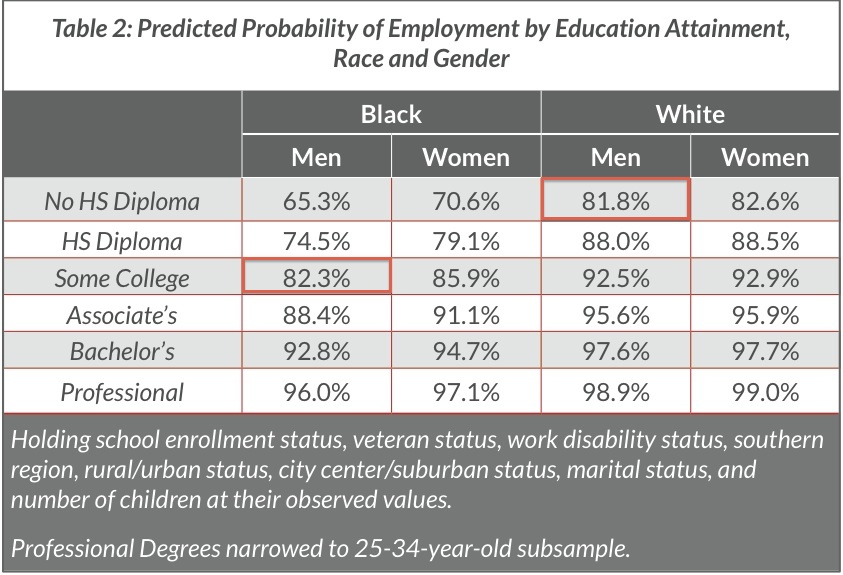
black unemployment
Black unemployment is significantly higher than white unemployment regardless of educational attainment | Economic Policy Institute
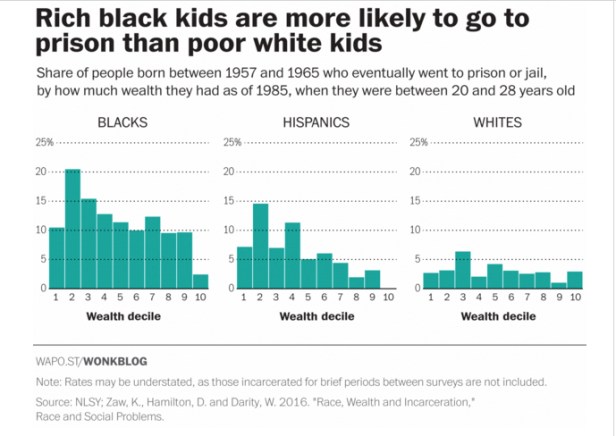
rich black poor white prison
Poor white kids are less likely to go to prison than rich black kids
racial-wealth-gap
The Asset Value of Whiteness: Understanding the Racial Wealth Gap

The anti-handout beliefs and rhetoric from white Americans is a painful paradox exposing the lack of awareness and active denial among white people.

Privilege is an unearned advantage, starkly displayed in the data above. But for many white Americans that handout of being white is invisible since they cannot experience life in any way other than white.

White privilege, the handout, is no guarantee of success or a perfect shield against pain and suffering (or even inequity), but struggling while white is almost always less severe than struggling while Black.

This discussion here, however, is not white bashing; I understand that white people have not asked for that advantage, but I also recognize that a great deal of white anger is grounded in an unexamined fear of losing the handout, of having to live in a world of racial equity—ultimately a fear of achieving the meritocracy many whites falsely believe exists.

If in fact handouts erode people’s work ethic, the ultimate paradox is that for the white people who believe that their white privilege, that handout, must be eradicated.

I, again, think about the hard lessons my white and Black students wrestled with in rural SC throughout the 1980s and 1990s; they often grew into smarter and kinder people. They always gave me hope.

That hope is weakening for me however under the weight of 70-plus million Americans choosing the myths, the lies, and refusing to investigate the evidence.

If handouts aren’t good or fair for America, then it is well past time to end the greatest handout of all, white privilege.

Looking Back: On Raising the Academic Quality of Student Writing

My first-year writing seminars are grounded in two concepts—workshop structure (multiple drafts of essays combined with conferencing over long periods of time) and portfolio assessment (a portfolio of all course work is submitted for the final exam).

In that final portfolio, students submit final versions of all four essays, rank those essays in order of quality according to them, and submit a reflection that details the key lessons they have learned about writing as well as a few areas they need to continue improving.

This pandemic semester has added a significant and noticeable layer of stress to first-semester first-year students so I have adjusted the final weeks of the seminars this fall, ending in just a few days. One change has been to replace the usual Essay 4 assignment (an open assignment in which students submit a proposal for the type of essay and topic before submitting a first full draft) with the end-of-course reflection usually required in the final portfolio.

In class yesterday, we began brainstorming what key lessons my students have learned and what they see as areas still needing improvement. Over this past weekend, as well, I sent out an email that framed the organization of the semester, outlining how the essay assignments have been scaffolded in order to prepare these students to be academic writers (student writers) in the remainder of their college experience.

Included in those goals, I explain to them, is seeking ways to increase their agency as students/writers and their academic authority in courses when they are required to submit essays that will be graded (again, I do not grade assignments in my courses) and when students will not be allowed to revise (in effect, having to be their own editors before turning in any essay).

Here is the structure and scaffolding of essay assignments for first-year seminars, focusing on essay types, audience, and the role of the writer:

Essay 1: A personal narrative, what some people would call “creative nonfiction,” and the audience is the general public.

Essay 2: A public essay written for an online platform (using hyperlinks as citation); that audience is also a general public, but for some of the students (depending on topics) that is also a specialized public audience (readers who share interest in or experience with the topic, such as gaming systems).

Essay 3: A scholarly/academic essay in which the students are writing to an academic audience (readers/experts with high-quality knowledge of the topic). This is often what students will be asked to write throughout college, especially when required to cite formally (APA, MLA, Chicago Manual of Style, etc.).

Throughout the drafting of these three essays, we have focused on some common strategies across essay writing: crafting engaging and vivid openings and closings, matching diction and tone with the essay topic and intended impact on the audience, purposeful paragraphing and sentence formation, and nuanced approaches to choosing and including appropriate and effective evidence (in terms of disciplinary conventions for citation).

For students, even with the scaffolding and direct instruction (including two very effective textbooks—Style: Lessons in Clarity and Grace, 12th Edition, Joseph M. Williams, Joseph Bizup and The Writer’s Practice: Building Confidence in Your Nonfiction Writing, John Warner), writing an academic and formally cited essay was a significant challenge.

Since several students are still working on their first revised draft of the academic essay and since one of the foundational goals of our first-year writing seminars is students demonstrating proper citation (and the harsher negative goal, not plagiarizing), I included in my weekend email some tips for raising the academic/scholarly quality of their writing (especially as that applies to APA style guidelines).

One of the most significant hurdles for first-year students moving from primarily writing in English courses, often writing text-based analysis and conforming to MLA style and citation, is how to integrate evidence (sources).

For many students, providing proof in an essay for school is always including quotes, but we examine that quoting as evidence is primarily a convention of text-based writing (analyzing a poem or an essay in philosophy or the writings of a past president) common in the humanities. Evidence in the hard and social sciences, however, often includes incorporating a much more nuanced and complex body of research findings, challenging students to synthesis data and conclusions from multiple sources (and rarely quoting).

Quoting as evidence tends to be incorporating one source at a time while many disciplines synthesize multiple sources to give a sense of a body of research.

Here, then, are the strategies I provided in my weekend email for raising the academic/scholarly quality of their writing:

  • In academic writing, avoid writing like you talk (as contrasted with conversational language appropriate in creative nonfiction and public writing) and a flippant/light tone about serious topics. Do not say your topic is a “hot topic” or use “well” as a sentence starter, for example.
  • Focus your discussion on your topic and not your sources. Do not frame your claims around your source: “Johnson (2014) conducted research on grade retention and found that grade retention correlates with dropping out of high school, but not with higher achievement.” Instead address the content of your sources: “Grade retention correlates with dropping out of high school, but not with higher achievement” (Johnson, 2014; Van Pelt, 2017).”
  • Keep your claims at a scholarly/academic level. Stating that something has “been debated for decades” or “recently this has become a controversy” is not a scholarly or academic purpose for examining a topic; scholars typically do not consider (or care) if or not something is a debate or controversial. Related, avoid in academic/scholarly writing making claims of “throughout history” or “has recently become a debate/controversial” because these both are overly simplistic claims that make you look not credible or nuanced in understanding complex topics.

As the semester is winding down (or this year, grinding over us), I left my students with two important reminders.

First, no one learns to write spontaneously, and certainly first-year college students cannot attain advanced academic skills in a three-month semester. I cautioned them to be patient with themselves and see their learning to write well as a journey.

Second, and connected, I stressed that they should find a few key areas of their writing to address at a time; trying to revise and edit everything in any essay draft is likely counter-productive for students. I suggested doing read-throughs of drafts for one revision element at a time (and related to the issues they are identifying in their final essay of the semester).

In-school academic essay writing becomes more specialized and nuanced as students move through undergraduate and possibly into graduate education. First-year writing is the smallest of steps so we must be sure we are both demanding and encouraging—a nearly impossible goal to achieve as teachers of writing.

Confronting the Tension between Being a Student and a Writer

Titian: Sisyphus
Titian: Sisyphus
Sisyphus, oil on canvas by Titian, 1548–49; in the Prado Museum, Madrid.
Heritage Image Partnership Ltd./Alamy

I worry about my students.

I worry, I think, well past the line of being too demanding in the same way being a parent can (will?) become overbearing.

Good intentions and so-called tough love are not valid justifications, I recognize, but there is a powerful paradox to being the sort of kind and attentive teacher I want to be and the inherent flaws in believing that learning comes directly from my purposeful teaching and high demands.

After 37 years of teaching—and primarily focusing throughout my career on teaching students to write—I have witnessed that one of the greatest tensions of formal education is the contradiction of being a student versus being a writer.

That recognition is grounded in my own experiences; I entered K-12 teaching, my doctoral program, and my current career in higher education all as a writer first.

My primary adult Self has always been Writer, but being a writer has remained secondary to my status as either student or teacher/professor-and-scholar.

The tension between being a student and a writer has been vividly displayed for me during my more recent decade-plus teaching first-year writing at the university level. To state it bluntly, many of the behaviors that are effective for being a good student are behaviors that must be set aside in order to be an effective and compelling writer.

I began addressing this tension early in my career as a high school English teacher by de-grading and de-testing my classes. The writing process, I found, had to be de-graded so that students could focus on substantive feedback and commit to drafting free of concern for losing credit.

But by the time students reach college, they have been trained in a graded system; that graded system implies that students enter each assignment with a given 100, and thus, students learn to avoid the risk of losing points (see my discussion of minus 5).

But equally harmful is that college students have also been fairly and even extremely successful in a grading culture driven by rubrics, class rank, and extra credit—each of which shifts their focus to the grades (and not the quality of their work) and centers most of the decision making in their teachers.

For example, I currently teach at a selective university. Most of my students have been A students in high school.

Yet, they seem paralyzed when confronted with decision making and genuinely terrified to attempt anything not prescribed for them.

In my first year seminars now, students are revising their cited essays, and one student emailed, asking if they needed to cite a YouTube video (of course) and how to do so.

At this last question (although the first is really concerning) is where I find myself often answering: “Just Google, ‘How to cite a YouTube video in APA?'”

A reasonable person of moderate affluence in 2020 with access to the Internet (often on a smart phone) would search anything they didn’t know using a browser. I am convinced that being a student tends to create helpless people out of very capable young adults.

And despite several direct lessons on and multiple comments and examples provided in materials and on submitted drafts, many of my students continue to submit revised drafts with the first few sentences, as they did in high school, overstating nothing; these are from revised essays after I once again addressed overstating nothing in the opening sentences:

Some questions that have been floating around for a while are, is college worth it?

Day to day interactions between different people form the bonds for different relationships in our lives. People have acquaintances, friendships, romantic relationships, familial relationships, and more.

While I want to share some of my strategies below detailing how I confront the tension between being a student and a writer for my students, I must stress that my uniquely different classroom creates an entirely new tension because I must recognize that most of my students’ academic careers will remain in traditional classrooms tethered to traditional grading.

Therefore, I seek strategies that address simultaneously how students can present themselves as careful and diligent students as well as credible, engaging, and compelling writers.

Those strategies include the following:

  • Teaching students how to prepare and submit work (often with Word) that reflects them in a positive way for anyone evaluating them. While I discuss with students that document formatting is trivial, a careless submission will likely negatively impact how any teacher/professor views them as students. I encourage them to learn how to format with Word (using page breaks and hanging indents, for example); to navigate track changes and comments (creating clean documents to resubmit); to set their font to a standard size and font (to avoid submitting work with multiple fonts or font sizes, which they often do), including how to paste text so that it matches the document settings; and to address the Spelling and Grammar function in Word so that they do not submit documents with the jagged underlining noting issues they should have edited before submitting. Students also struggle with naming document files, attaching their work to emails, and emailing professors in ways that represent them well—so I am diligent about not accepting work until they meet those expectations. Important to note here is that in my class, these experiences come with no loss in grades, but I stress to them that in other courses, they likely could receive lower grades and probably will create a negative perception of them as students.
  • Instead of rubrics and writing prompts, we work from models of writing, and I provide for students checklists and examples that are designed so that they become the agents of their learning (and this is particularly frustrating since students still function with fear and thus avoid risk or making their own decisions). Drafting through all the stages of writing, then, are spaces where students are decision makers like real-world writer, but I provide them a somewhat risk-free experience that is unlike being a student.
  • In some respects, students seeking to present themselves well and writers seeking ways to be credible and engaging have some overlap. Therefore, many of my key points of emphasis as a teacher of writing will, in fact, raise their status as students. Some of these include attending to appropriate diction (word choice) and tone that matches the level of the topic being addressed, focusing on effective and specific (vivid) openings and closings (key skills for writers, but students establish themselves when being graded with their first sentences and then leave the person evaluating them with an impression linked to their final sentences), and selecting high-quality sources (typically peer-reviewed journal articles) and then integrating sources in sophisticated ways when writing (avoiding the high school strategy of over-quoting and walking the reader through one source at a time [see the discussion of synthesis in the link above and here]).
  • Students also leave high school feeling the need to make grand claims, grounded in simplistic approaches to the thesis sentence and standard practices by teachers that require students to have their thesis approved before they can draft an essay (see this on discovery drafts). I encourage students to focus narrowly and specifically throughout their essays while leaning toward raising questions (a more valid pose for students) instead of grand claims.

While I struggle, as I admitted above, with my tendency to be too demanding (my tough-love streak), I also recognize that providing only about 3 months in my unique teaching and learning environment faces a monumental hill to crest against more than a decade of experiences as students and student-writers.

More often than not, I do not crest, but descend a bit defeated like Sisyphus to roll that rock yet again.

The tension between being a student and a writer is not insurmountable, I hope, but it certainly must be confronted openly and directly in our classes, especially our writing-intensive classes.

In the world beyond formal schooling, many of the qualities of a good student will prove to be ineffective in the same way they are for young people learning to write well.

The best strategies for being an effective writing teacher include recognizing and helping our students navigate their roles as students—even as we seek to help them to move beyond those artificial restrictions.

Equity Politics: Life, Liberty, and the Pursuit of Happiness

I am not free while any woman is unfree, even when her shackles are very different from my own. And I am not free s long as one person of Color remains chained. Nor is any of you.

“The Uses of Anger,” Audre Lorde

The U.S. has elected Joe Biden president, ending the presidency of Donald Trump.

This is a return to the standard failure of the democratic process in a country that is primarily committed to the free market, rugged individualism, and guns.

Biden is the normal but truly awful presidential candidate, replacing the uniquely horrible election of Trump.

As many people have noted, changing presidents typically means only small differences in the daily lives of people. Those with some affluence and privilege continue to have really good lives, lives that allow them to focus on trivial matters that seem huge because of that affluence or privilege.

People in poverty, working class people, and the many different categories of people living in what we have euphemized as “diverse” identities, however, will mostly continue to live barely in the margins of the American dream—even when these people also attain some level of wealth or privilege in their accomplishments.

The American democracy is a failed and failing experiment because it has allowed inequity to flourish, and those living with the most privilege, white Americans, refuse still even to acknowledge that inequity because they are so enamored with their own pettiness and convinced that they too face disenfranchisement and disadvantage.

It is the “war on Christmas” rhetoric that arrives every holiday season by people who benefit from being in a majority and Christian-centric nation; there is no rational basis for such nonsense, but white America is still a majority of delusion, clinging to the one thing they will not relinquish—their white privilege.

Having never been a Republican or Democrat, and having never drunk the Kool Aid of idealism about the founding of the U.S. or the American Dream, I have always none the less found one possibility of the U.S. not only beautiful but also worth believing in—life, liberty, and the pursuit of happiness.

There is a poetic brilliance to that phrase that genuinely can and should be a map for the country the U.S. could become.

Even as I acknowledge Biden is a horrible candidate, I have found that his willingness to admit the U.S. has not yet reached our ideals and his charge to be the president for all Americans and not just those who elected him to be some of the better political rhetoric we can hear.

Those of us, especially those of us on the authentic Left, who embrace the possibility of human equity guaranteed by and for a free people have no real political party for our allegiance, but I do think we can use this moment in history to commit to a politics of equity built around the ideals of life, liberty, and the pursuit of happiness.

A first step to making equity a reality in the U.S. is an education campaign, one specifically targeting the demonizing and fear-mongering around “socialism.”

First, there must be an honest distinction made between regimes that are identified as socialism or communism—regimes rules by dictators or de facto dictators—and democratic socialism.

Fear-mongering around the former U.S.S.R., China, and Castro’s Cuba is purposefully distracting the voting public from democracies that embrace first publicly funded and democratically chosen institutions that make the free market and personal freedom possible in equitable ways for all citizens.

Pure socialism and communism would mean the end of private business and private property, and frankly, I see no avenue to that sort of shift under either Republicans or Democrats. I also see no Leftist movement in the U.S. that calls for rule by a dictator; only the Trump movement and his followers (all occurring on the Right, not the Left) appear eager for a dictator.

The sort of totalitarian “socialism” that the Right is using to fear-monger voters would be equally rejected by the Left, including the seemingly growing belief among young Americans that democratic socialism is preferable to the Social Darwinism of the unfettered free market in the U.S.

“Socialism” as a concept, then, is quite different than how that term has been folded into dishonest political rhetoric or even claimed improperly (or misleadingly) by political movements more concerned about totalitarian control.

I do support democratic socialism; I also embrace the idea that a robust publicly funded network of institutions must be established in order for the free market and individual freedom to be equitable and accessible to all people regardless of their identity or status.

I am essential public institutions first, and then free market and individual liberty.

And thus, equity politics must be policy first, and not partisan politics first.

Life?

Universal healthcare.

Women’s reproductive rights.

De-militarizing and reforming policing and the judicial system.

Liberty?

Fully publicly funded K-16 education (student loan debt relief).

De-criminalizing, legalizing marijuana (releasing prisoners trapped in the war on drugs).

Removing the Electoral College and reforming representation across the U.S. that is equitable for rural and urban Americans.

Expanding access to voting and guaranteeing all Americans can vote without threat.

The pursuit of happiness?

Full rights to LGBTQ+ Americans.

De-coupling healthcare and retirement from employment.

Increasing the minimum wage and reducing the work week as well as expanding guaranteed paid vacation and family leave policies.

I cast a (worthless) vote for Biden/Harris in South Carolina (a self-defeating conservative state) as a symbolic gesture to end the reign of Trump. There is little hope in the Democratic Party, but the Republican Party is aggressively against all of the policies above that would move the U.S. closer to the ideal of human equity for all.

If the Senate remains in Republican hands, there will be little Democrats can do to move the moral arc toward equity.

But unless we have the political will as a people to form a new and stronger party built on principles of equity, we have only one option, transforming the Democratic Party into a genuine movement for change that serves all people.

And this cannot be achieved by compromising with Trump Republicans who do not value equity, human agency, or human dignity (except for themselves and those who look like them).

Biden as a person and a politician is only marginally preferable to Trump; this election should be seen as a mandate rejecting Trump, but it cannot be seen as an endorsement of returning to the normal that allowed the killing of George Floyd and Breanna Taylor.

White men and women in a majority and over 70,000,000 Americans voted for Trump, angrily and with a middle finger voted against equity for all because they belong to the cult of individuality and wealth that Trump represents.

This is a disturbing cancer on the American way of life; this is why the American Dream remains a nightmare for many and a fantasy for most.

Equity politics is a moral imperative, one driven by this proclamation by one of the most famous socialists in U.S. history, Eugene V. Debs:

Your Honor, years ago I recognized my kinship with all living beings, and I made up my mind that I was not one bit better than the meanest on earth. I said then, and I say now, that while there is a lower class, I am in it, and while there is a criminal element I am of it, and while there is a soul in prison, I am not free.

Without equity for all, there is equity for none.

Without the American Dream for all, there is no dream for anyone.

Life, liberty, and the pursuit of happiness must be extended to each and every American or we are failing our charge as humans.

Overstating Nothing: Why Students Often Write their Worst Sentences First (and Last)

I may have just read the worst essay I have ever read submitted by a student—since the beginning of time.

And that occurs in this context: I have been teaching adolescents and young adults to write for 37 years.

Of the tens of thousands of student submissions I have read, of course, this essay cannot really be the worst.* But that sort of dramatic overstatement is exactly what brings me to discussing that essay and many just like it submitted recently as we near the end of the semester.

Again, as context, many of these essays have been submitted after more than two months of first-year writing seminar where I have explicitly focused on vivid and engaging openings and closings.

These essays were submitted by students working on their third essay of the semester. With the first essay of the semester, as well, class instruction and the drafting process heavily focused on writing specific openings that have concrete and vivid narratives to both focus the reader and engage the reader.

Students have had multiple class sessions and several authentic models of writing in order to interrogate their concepts about introductory paragraphs (6-8 sentences with a declarative thesis sentence as the last sentence), and have repeatedly been confronted with this brilliant parody from The Onion: Since The Beginning Of Time, Mankind Has Discussed What It Did On Summer Vacation.

Young Jeremy Ryan offers this peach of an opening (indistinguishable from many I just received from very bright college students):

For as far back as historians can go, summer vacations have been celebrated by people everywhere as a time for rest and relaxation. Many advancements have been made in summer breaks since these early times, but it is also true that many different traditions have lived on and continue to remain with us today. This is why, since the beginning of time, mankind has discussed what it did on its summer vacation.

What students remain trapped within, despite my repeated direct instruction and feedback on their writing, are many years of powerfully misguided writing lessons that have created students who feel compelled in the first sentences of their essays to overstate nothing.

The opening sentences from my students are remarkably paradoxical in that they make grand overstatements that are somehow accurate and completely devoid of any concrete meaning.

Such magically empty writing depends on magically empty diction such as “disparities,” “variety,” “points,” “how,” “many forms,” “effects,” “changed,” “common,” and “standard.”

Students have been taught directly and indirectly to string words into a sentence while also tip-toeing around making mistakes; meeting the word count by forming sentences and paragraphs that seem to say something that is nearly impossible to identify as incorrect (but also impossible to validate) is the Holy Grail of being a student writer.

Writing within a graded system and being taught by teachers not trained as writers have created students who write relentlessly to overstate nothing.

I have been struggling against the five-paragraph essay and template writing for all of my 37 years, but over the last decade and a half, I have been working mainly with first-year students who teach me over and over that my three or so months of writing instruction have little impact on their learned (and well graded) behavior from the previous 12 years of school writing.

And this fall is particularly different in the context of the pandemic and the very real negative consequences of multiple layers of unusual stress on my students—their reduced bandwidth to focus on challenging work, especially if the expectations are different than what they have been successful doing in the past.

But even without the stress of Covid-19 and our brave new world of formal education, my students are reverting to really weak but comfortable ways of writing because this is their first cited essay with all sorts of new and difficult demands. Some of the students simply didn’t have the bandwidth to focus on writing well and citing properly (considering the arcane world of APA for students mistaught MLA throughout high school).

I am convinced that my approaches to helping students write better aren’t the problem here; what students need is the same sort of guidance throughout K-12 education so that writing well (clearly, vividly, concretely, and directly) isn’t a new demand once they head off to the new world of college.

What, then, are better ways to serve our students on their journey to writing well?

  • Remove the writing process as much as possible from grading so that students are allowed to take risks during that process, are encouraged to revise with purpose, and can focus on substantive feedback from their teachers, feedback that is instructional instead of evaluative.
  • Reject fully the five-paragraph essay and template writing; including reimagining the introduction/thesis>body>conclusion structure of the essay by focusing on engaging and focusing the reader in a multi-paragraph opening, acknowledging that the body of an essay (and paragraphing itself) may be many different lengths (but three certainly isn’t adequate at the college level), and urging students to see the ending (also multi-paragraph) as a way to present their best writing and most vivid and concrete details in order to advocate for themselves as writers (and students).
  • Explain to students that vivid and specific are qualities of writing that should be throughout their writing, never suggesting that students start broad and then narrow. Students read “broad” as “vague,” which never serves them or their readers well.
  • Provide students with explicit examples and strategies for writing vividly and specifically in the context of openings, bodies, and endings. As I did above, literally provide students with lists of words that overstate nothing (I also highlight these words when providing feedback for students on their writing).
  • Refrain from demanding that students propose definitive claims (having their introductions and thesis sentences approved before they can write), and shift to encouraging students to write in order to discover as well as address their readers with questions instead of grand pronouncement.
  • Focus on the key concepts that are valid across almost all types of writing, and then work within those concepts while providing more targeted lessons. Coherence and concision are two of those concepts that my students respond well to when reading Style, for example.
  • Acknowledge that ultimately students will receive grades based on the quality of their writing, and therefore, it is in their best interest as students to engage positively their primary reader (their teacher/professor) and to insure that this reader has a positive view of the essay and the writer as they finish reading the essay (students routinely write some of the worst sentences at the ends of their essays, significantly eroding what credibility they have built in their essay).

This is not intended as a “kids today” post or a harsh criticism of students.

My primary concern here is that students have often learned all too well lessons that are not serving them well and that my teaching them for three months has less of a positive impact than I’d like.

Since the beginning of time, students have learned to write badly; isn’t it time to allow them to be the vivid and specific writers and thinkers they are capable of being?


*Note: This post has been edited from its original posting. Regretfully, some have misread this post as a criticism of my students; part of the problem is the satirical opening (although I do note it isn’t intended as a true statement but as a satire of what students often do in their first sentences). I also note late in the post that this is not student bashing. In fact, my criticism is how my students have been taught to write. None the less, good intentions aren’t really worth much when people read something differently than intended. This is not a criticism or public shaming of my students (something I would not do), but I find that in writing about teaching writing, concrete (anonymous) examples are helpful—and a common practice in this sort of writing. I hope the original effectiveness of this post remains, but I think it best to leave the student examples omitted.