Category Archives: Education

Reading as a First-Mile Problem: Recognizing the Role of Poverty and Inequity in Literacy Development

Literacy scholar Tim Shanahan answers the question Why Is It So Hard to Improve Reading Achievement? with the following: “Classroom implementation is the last mile in reading reform.” He eventually adds, “The last mile rhetoric shouldn’t be a hair-on-fire message, but one that acknowledges both the current successes and the need to do better.”

Shanahan’s consideration of the persistent public and political concern over low reading achievement appears to offer a balanced admission that many approaches to reading instruction can be successful, but framing reading as a last-mile problem is finding yourself in a hole and deciding you just need to dig a little deeper.

Shanahan seems to accept a number of different “levers” as valid approaches to improving student reading, including a somewhat veiled endorsement of Common Core standards; in fact, he concedes: “Let’s face it. Our problem in reading isn’t that nothing works. It’s that everything does.”

In 2020, what Shanahan’s last-mile argument reveals, however, is that there is a mistake in teaching reading that can be addressed, but as a society, we refuse to acknowledge that reading is a first-mile problem.

That first mile is much larger than formal schooling, and what we refuse to recognize is that measurable reading achievement is a marker for the disadvantages of poverty and inequity in both the lives and schooling of vulnerable populations of students (students in poverty, black and brown students, English language learners, special needs students).

The accountability movement driven by ever-new standards and ever-new tests has been paralyzed by in-school only reform. That movement is both an example of last-mile reform and why last-mile reform has failed.

First, let’s acknowledge that Shanahan does make a key argument about how reading is taught; for example, a recent review of meta-analyses of systematic intensive phonics has shown that most approaches to teaching reading are about equally effective, as Shanahan suggests.

However, the current “science of reading” version of the Reading War argues that systematic intensive phonics must be required for all students; this phonics-first claim has been concurrent with pathologizing most struggling readers as probably dyslexic.

If we shift from last-mile reform to first-mile reform, then, we must avoid both “all students must” and “everything works,” choosing instead to admit that every student deserves the reading instruction they need (regardless of what programs or standards mandate), and we must acknowledge that students living in relative privilege often acquire reading rather easily, suggesting that the conditions within which students live and learn need to be reformed—not the students or the teaching methods.

First-mile reform in reading must start with addressing poverty and inequity in every child’s life. Alleviating poverty, addressing food security, improving work opportunities and security, adopting universal health care—these are issues of equity that would allow all students to acquire reading in ways that are now common for affluent students (often before entering formal schooling).

Stable communities and homes not overburdened by poverty and inequity would have the opportunities to provide children with language-rich environments that send children to formal schooling already highly literate, often reading before direct instruction.

First-mile reform of reading, however, is not a narrow commitment to out-of-school only, but it makes primary equity-focused out-of-school reform while also including equity-focused in-school reform as secondary but essential.

Instead of digging the accountability hole deeper by seeing reading reform as a last-mile challenge, we must climb out of that silo and think differently about in-school reform.

Equity-focused reading reform starts with the conditions of teaching and learning—guaranteeing students small student/teacher ratios in early literacy classes, insuring all students have experienced and highly-qualified teachers, and funding fully the materials needed for rich literacy experiences (authentic texts for all students and robust libraries in the schools and in children’s homes and communities).

This new approach to reform would also avoid tracking students and then would monitor more directly equitable learning opportunities as opposed to narrow measurable outcomes. For example, all students should be in rich and challenging courses—and not in test-prep classes or highly prescriptive programs (reading programs or systematic phonics for all).

Last-mile reading reform continues to focus on students as inherently flawed humans who need to be fixed; first-mile reading reform recognizes that systems are flawed, and that all students can flourish if their living and learning environments are equitable and conducive to learning.

Ultimately, continuing down the current road to reading reform as if we just need to be more demanding of teachers and students in the crucial last mile is continuing to recognize the negative impact of poverty and inequity on children’s ability to read and teachers’ effectiveness in teaching reading.

We mustn’t keep our heads down, we mustn’t keep digging.

We need finally to acknowledge that reading is a first-mile problem.

Fact-checking Phonics, NRP, and NCTQ

The “science of reading” movement often claims that a systematic intensive phonics-first approach to teaching reading is endorsed by science that is settled, that the National Reading Panel (NRP) is a key element of that settled science, and that teacher education is mostly absent of that “science of reading” (a message that has been central to NCTQ for many years).

These claims, however, misrepresent what evidence actually shows. Here, then, are some evidence-based fact-checks of phonics, NRP, and NCTQ.

Phonics

Reconsidering the Evidence That Systematic Phonics Is More Effective Than Alternative Methods of Reading Instruction, Jeffrey S. Bowers (2020)

Abstract

There is a widespread consensus in the research community that reading instruction in English should first focus on teaching letter (grapheme) to sound (phoneme) correspondences rather than adopt meaning-based reading approaches such as whole language instruction. That is, initial reading instruction should emphasize systematic phonics. In this systematic review, I show that this conclusion is not justified based on (a) an exhaustive review of 12 meta-analyses that have assessed the efficacy of systematic phonics and (b) summarizing the outcomes of teaching systematic phonics in all state schools in England since 2007. The failure to obtain evidence in support of systematic phonics should not be taken as an argument in support of whole language and related methods, but rather, it highlights the need to explore alternative approaches to reading instruction.

[For context, note some of the problems remaining in how whole language is addressed in this post.]

National Reading Panel

The Federal Government Wants Me to Teach What?: A Teacher’s Guide to the National Reading Panel Report, Diane Stephens (NCTE, 2008)

An Ever-So-Brief Summary with Book Recommendations

1. Phonemic Awareness. According to the studies cited in the NRP report, this is best taught to very young children (K–1) using letters, and when letters are used, PA instruction is considered to be phonics. Therefore, it is not necessary to have a separate instructional time for PA. Rather, children should have opportunities to learn about how language is made up of parts (e.g., onsets and rimes, or word families) as part of phonics instruction. An effective way to do this in the classroom? Provide time for students to write using invented spelling (pp. 2-1 through 2-86). (See Strickland, 1998, for further information about invented spelling.)

2. Phonics. According to the studies cited in the NRP report, there is no evidence that phonics instruction helps in kindergarten or in grades 2 to 9. It does help first graders learn the alphabetic principle—that there is a relationship between letters and sounds. No one method is better than any other. For example, for at-risk first graders, a modified whole language approach and one-on-one Reading Recovery–like instruction both helped children with comprehension (pp. 2-89 through 2-176). This phonics instruction should be conducted in the context of whole, meaningful text. (See Moustafa, 1997, for information on embedded, whole-part-whole instruction.)

3. Fluency. According to the authors of the Fluency report, the practice of round robin (at any age) does not help children and can indeed hurt them. However, according to the studies cited in the Fluency report, repeated oral reading (K–12) helps with comprehension because reading to readers fluidly instead of word-by-word reading helps them better understand the text. Ways to help with this? Try such things as readers theater (pp. 3-1 through 3-43). (See Opitz and Rasinski’s Good-bye Round Robin: 25 Effective Oral Reading Strategies [1998] for additional instructional suggestions.)

4. Vocabulary (grades 3 to 8). One method is not better than another. Children learn most of their vocabulary incidentally (pp. 4-15 through 4-35). (For further information about vocabulary learning, see Nagy, 1988.)

5. Comprehension (grades 3 to 6). Children need to learn that print makes sense and to develop a variety of strategies for making sense of print (pp. 4-39 through 4-168). (For further information on teaching for comprehension, see the references listed in Chapter 8: Beers, 2002; Sibberson & Szymusiak, 2003; Taberski, 2000; Tovani, 2000; see also Harvey & Goudvis, 2000.)

Across all of these recommendations? According to the studies cited in the NRP report, if we want children to learn something, we need to teach them that something. Want great readers? Then teach children what great readers do.

NCTQ (Teacher Education)

NOTE: This is more complicated, but first I am posting an older (2006) and new (2020) report from NCTQ both making essentially the same claims that teacher education fails to teach the “science of reading.” Then, I include a link to several reviews that show that NCTQ’s “reports” are methodologically flawed and essentially propaganda, not “science.”

What Education Schools Aren’t Teaching (2006)

2020 Teacher Prep Review: Program Performance in Early Reading Instruction

NEPC reviews of NCTQ reports

NCTQ on States’ Teacher Evaluation Systems’ Failures, Again

If Teacher Education Is Failing Reading, Where Is the Blame?

The current “science of reading” climate surrounding public education in the U.S. has its roots, ironically, in misreading (or at least reading uncritically) A Nation at Risk, a report during the Ronald Reagan administration that was widely reported by mainstream media. The politically driven and deeply flawed report also prompted the accountability movement in the U.S.—state standards and high-stakes testing—that eventually enveloped the entire country by the 1990s.

The report established a false but compelling cultural truism that is too rarely interrogated: Public schools in the U.S. are failing. Since the early 1980s, political leadership has decided that the failure is due to a lack of accountability, but accountability of whom or what has shifted over the past 40 years.

The first blame narrative focused on students and schools, ushering in high-stakes testing at 3rd grade, 8th grade, and high school (exit exams) as well as school and district report cards. Eventually high-stakes accountability of students and schools seemed not to change the measurable outcomes that advocates had promised; there were also unintended consequences such as exit exams increasing drop-out rates.

Gradually after No Child Left Behind, the blame narrative moved to teachers, in part driven by George W. Bush’s popularizing the slogan “soft bigotry of low expectations,” the rise of charter schools embracing “no excuses,” and the same messages and buy-in for Bush era education policy by Barack Obama’s administration and Department of Education.

For about a decade the blame narrative focused on teachers, and political leaders rushed to intensify teacher evaluation, notably the use of value-added methods (VAM). Once again, the outcomes promised by advocates did not come to fruition. Recently, in fact, the tide is turning hard against the use of VAM and other types of punitive teacher evaluations.

The vacuum left in the blame narrative did not remain long. Concurrent with the “science of reading” movement that claims public school teachers are not teaching reading guided by the “science of reading” is the next round of blame—teacher education [1].

The blame narrative makes for strange bedfellows. While mainstream media have begun to pound the drum of blame about teacher education fairly consistently, the leading literacy professional organization, the International Literacy Association (ILA), has join the story as well.

Education Week has led this charge; for example, Madeline Will writes in Preservice Teachers Are Getting Mixed Messages on How to Teach Reading:

Decades of research have shown that teaching explicit, systematic phonics is the most reliable way to make sure that young students learn how to read words. Yet an Education Week analysis of nationally representative survey results found that professors who teach early-reading courses are introducing the work of researchers and authors whose findings and theories often conflict with one another, including some that may not be aligned with the greater body of scientific research.

EdWeek‘s survey data are being confirmed, it seems, by ILA’s survey data: 60% of respondents claim their teacher education programs did not prepare them well to teach reading.

First, we should pause at media and professional organizations citing survey data while also embracing a very rigid and narrow demand for the “science of reading.” Survey data have many problems, and in this case, we may want to know if disgruntled teachers were disproportionately motivated to reply.

None the less it is quite a different thing to say “60% of respondents claimed X” than “60% of teachers claimed X.” Are these survey data representative of all teachers of reading?

Let’s assume this is true, that more than half of teachers charged with reading instruction are not properly prepared to teach reading. But let’s also unpack how that came to be, and ultimately answer in a fair way, where is the blame?

For the past 30-40 years, teachers and teacher educators have had less and less professional autonomy; or stated a different way, the professional autonomy of teachers and teacher educators has been reduced to how well they can implement mandated standards and produce measurable outcomes that prove those standards were implemented and effective.

In the high-stakes accountability era, then, if we are going to accept that 60% of teachers were not well prepared in their teacher education programs, we must be willing to acknowledge that those programs were governed most often by the accreditation process. Organizations such as NCATE and CAEP have been holding teacher education accountable along with the coordination of professional organizations.

How teacher education approached literacy broadly and reading specifically was grounded in standards designed by ILA (elementary) and the National Council of Teachers of English (NCTE) (secondary), and those programs were periodically monitored by ILA and NCTE for if or how well the programs met those standards.

If we currently believe that the teaching of reading in our public schools is failing our students, we must also acknowledge that teachers are implementing state standards of reading and preparing students for state tests of reading; those teachers were also taught how to teach in teacher education programs implementing national standards determined by ILA and NCTE.

Accepting the survey data as valid, then, the blame for these failures lie in the accountability and accreditation process, of which teachers and teacher educators are mere agents.

After being a classroom teacher of ELA for 18 years and then a teacher educator for the last 18 years, I believe I have a strong and well informed view of what is really happening. This is a better explanation, but not a simple one that the media would prefer or a politically expedient one that politicians would prefer.

Education was never the type of failure determined by A Nation at Risk, and a lack of accountability was never the cause of what the true failures in education were then and are today.

Formal education is a reflection of and a perpetuating force for inequity in the U.S. Public schools are not game changers.

Therefore, it is true that far too many students are not being taught to read well enough, and that on balance, public education is failing far too many students.

Those failures are about inequity—inequity of opportunities both outside and inside schools that disproportionately impacts poor students, black and brown students, English language learners, and special needs students (the “science of reading” movement has correctly identified these vulnerable student populations, in fact).

And as jumbled as the journey has been, the logic experiment I offer above reaches a credible conclusion: the accountability era has failed. Miserably. Once again disproportionately impacting vulnerable populations of students.

But accreditation has failed just as much. Accountability grounded in standards and high-stakes assessment are not conducive to teaching, learning, or scholarship.

As a former classroom teacher, I can attest to that fact; as a current teacher educator, I can confirm that complying with accreditation mandates dilute my courses and overburden my professional work to the exclusion of scholarship and research.

Accountability structures are mostly bureaucracy, mostly a distraction from real teaching, learning, or professional behavior.

While I am frustrated with mainstream media misrepresenting reading and reading instruction, I am baffled that ILA would enter a fray that turns the blame narrative back on the organization itself. Maybe they didn’t think this through, but it is really almost impossible not to blame professional organizations who govern teacher education if we determine teacher education has failed.

Here, then, is a larger lesson of this entire four-decades mess: Let’s stop looking for people to scapegoat in the blame narrative, and recognize instead that the accountability/accreditation systems are failing us, especially when we are complying well to them.

Professional autonomy for K-12 teachers and teacher educators is a process we have not tried, but one far more likely to give our schools and our students a better chance if we also acknowledge that social and educational equity need the same financial and administrative focus we have given accountability since the early 1980s.


[1] See: Contesting Science That Silences: Amplifying Equity, Agency, and Design Research in Literacy Teacher Preparation

In contrast to the claims made by the SOR community, research in literacy teacher preparation has been exten- sive, scientific, and useful for guiding reform efforts. CITE-ITEL, an online database (https://cite.edb.utexas. edu/) of published research articles on literacy teacher preparation, offers a window into contemporary scholar- ship on the same.3 CITE-ITEL is updated regularly and is freely accessible. There are currently 677 research studies in the database, published between 1999 and 2019 in over 90 scholarly journals. These include journals sponsored by professional organizations in literacy (see Table 1) and other highly respected, independent journals (e.g., Teaching and Teacher Education, Reading Psychology).

The term science of reading appears in only four of the 677 research reports, and none of the studies examined the reliability or validity of the assessment tools used to mea- sure the knowledge that preservice teachers hold about the SOR. Despite the political and media attention given to the SOR and the tools on which the SOR community relies, there is no body of evidence that reflects the SOR perspective on literacy teacher preparation by members of the literacy teacher preparation research community

Hoffman, J.V., Hikida, M., & Sailors, M. (2020). Contesting science that silences: Amplifying equity, agency, and design research in literacy teacher preparation. Reading Research Quarterly, 55(S1), S255–S266. Retrieved July 26, 2022, from https://doi.org/10.1002/rrq.353

See Also

Of Rocks and Hard Places—The Challenge of Maxine Greene’s Mystification in Teacher Education, P. L. Thomas

The Fatal Flaw of Teacher Education: “We have met the enemy and he is us.”

How Diverse Is Your Syllabus?

During an impromptu pre-department meeting chat with literacy colleagues, we began to think about examining our syllabi for diversity of required and recommended texts. We noted that often people examine reading lists for K-12 students in terms of diversity, such as children’s literature, adolescent literature, and the secondary canon.

Below are the texts listed on my course syllabi for all courses I currently teach on a regular basis. I have put white male authors in red text for a quick glance at diversity.

Assigned and Recommended Texts in Taught Courses

[In many courses, students choose among these texts, and in some courses, students have choice outside this list. These are texts offered on course syllabi as limited choice but required in courses.]

White male author

Why We Teach Now, Sonia Nieto

White Fragility: Why It’s So Hard for White People to Talk about Racism, Robin DiAngelo

For White Folks Who Teach in the Hood…and the Rest of Y’all Too, Chris Emdin

The Poverty and Education Reader edited by Paul C. Gorski and Julie Landsman

Hope Against Hope: Three Schools, One City, and the Struggle to Educate America’s Children, Sarah Carr

Police in the Hallways: Discipline in an Urban High School, Kathleen Nolan

Scarcity, Sendhil Mullainathan and Eldar Shafir

Beware the Roadbuilders: Literature as Resistance, P.L. Thomas

Me-Search and Re-Search: A Guide for Writing Scholarly Personal Narrative ManuscriptsRobert Nash and  DeMethra LaSha Bradley

Reading Educational Research: How to Avoid Getting Statistically Snookered, Gerald Bracey

Bad Feminist, Roxane Gay

Style: Lessons in Clarity and Grace, 12th Edition, Joseph M. Williams and Joseph Bizup

The Writer’s Practice: Building Confidence in Your Nonfiction Writing, John Warner

James Baldwin: The Last Interview: And other Conversations

Notes of a Native Son, James Baldwin

Nobody Knows My Name, James Baldwin

The Fire Next Time, James Baldwin

No Name in the Street, James Baldwin

I Am Not Your Negro, James Baldwin and Raoul Peck

Between the World and Me, Ta-Nehisi Coates

Invisible Man, Got the Whole World Watching: A Young Black Man’s Education, Mychal Denzel Smith

A House of My Own, Sandra Cisneros

Known and Strange Things: Essays, Teju Cole

The Argonauts, Maggie Nelson

The End of Imagination, Arundhati Roy

Sex Object, Jessica Valenti

We Should All Be Feminists, Chimamanda Ngozi Adichie

Men Explain Things To Me, Rebecca Solnit

Best Practice: Bringing Standards to Life in America’s Classrooms, Zemelman, Daniels, and Hyde

Classrooms that Work: They Can All Read and Write, Cunningham and Allington

Girls, Social Class and Literacy: What Teachers Can Do to Make a Difference, Stephanie Jones

Writing and Teaching to Change the World: Connecting with Our Most Vulnerable Students, Stephanie Jones

When Kids Can’t Read—What Teachers Can Do, Kylene Beers

Reading Don’t Fix No Chevys: Literacy in the Lives of Young Men, Michael Smith and Jeffrey D. Wilhelm

Finding Joy in Teaching Students of Diverse Backgrounds: Culturally Responsive and Socially Just Practices in U.S. Classrooms, Sonia Nieto

Teaching English by design, Peter Smagorinsky

Writing Instruction That Works: Proven Methods for Middle and High School ClassroomsArthur N. Applebee and Judith A. Langer

Critical Foundations in Young Adult Literature: Challenging Genres, Antero Garcia

Critical Media Literacy and Fake News in Post-truth America, Chris Goering and P.L. Thomas, eds.

Comic Connections: Reflecting on Women in Popular Culture, Susan Eckard, ed.

Course Syllabi

EDU 111: Perspectives on American Education

EDU 115 (MAYX): The Reel World: The Depiction of Schools on Film

EDU 250/ EDRD 750: Scholarly Reading and Writing in Education

FYW 1259: Reconsidering James Baldwin in the Era of #BLACKLIVESMATTER

EDU 452: Teaching English in Grades 7-12

EDU 451: Literature for Young Adults; EDRD 748: Adolescent Literature Survey

EDU 350: Curriculum and Methods of Teaching in Grades 7-12

School Choice Fails Students and Parents

Photo by Jon Tyson on Unsplash

It has been a decade since I raised this question, Parental Choice?, after spending about a year examining all the research available as well as the public and political debate about school choice.

Now, Education Week seems to have finally recognized some of the conclusions I presented in that book: Why Don’t Parents Always Choose the Best Schools? I think it is important that this article does not ask “if” parents choose the best schools, but concedes that parental choice is a flawed part of the school choice as an avenue to educational reform argument.

In short, my research and analysis show that parental choice and school choice fail because they suffer from the same problem concerning all choice driven by America’s idealized perception of individual freedom and market economies. If school choice were a powerful and effective lever for positive educational reform (and it isn’t), market forces remain indirect ways to create the sort of equity of opportunity that a democracy could accomplish directly.

Choice, at best, is slow and erratic, depending on the quality and expertise of the consumers to eventually shape the outcomes desired all along. Pop music is exactly what consumers have created through supply and demand, but we are under no illusion that pop music success equals the highest quality of music possible. High-quality music may have a better chance of being produced by musicians fully publicly funded by NEA grants and left free of corrupting market dynamics.

The consumer choice/quality dynamic in school choice is the problem that Arianna Prothero is acknowledging and confronting in EdWeek.

The research and outcomes related to school choice have always been mixed at best, and the school choice debate has been marred by shifting talking points (different types of choice schemes and different outcomes promised). Since support from school choice is often ideological or driven by the inequity experienced in public education, however, the following patterns continue to characterize the debate:

  • Parents participating in school choice focus more often on cultural and ideological commitments rather than academic quality. School choice, then, is more likely to create stratified schools and not work as a lever for motivating higher academic quality across all schooling. School choice is not proof that a rising tide lifts all boats, but proof that given the opportunity, people will segregate themselves in a lot of different boats while disregarding the threat of drowning facing some of them.
  • School choice unintentionally feeds into the tyranny of parents at the exclusion of children’s autonomy and human rights. Secular public schools should be an opportunity for all children to experience a democracy of ideas and become the humans those children choose to be. Students shepherded into academic settings that perpetuate narrow ideals and ideas dictated by the parents are denied their choices and opportunities.
  • Marginalized and underserved populations (impoverished, Black communities, English language learners, etc.) do often welcome school choice as a possible avenue to greater equity of opportunity; that promise has also proven to be empty, but underserved populations’ support for school choice is also misread. School choice and charter schools have driven school re-segregation (clearly not a positive outcome for Black parents and students) and has not guaranteed that all students have the opportunities found in elite private schools (the choice of wealthy and mostly white parents). If public schools simply served all students well and fully, then the support for school choice found among marginalized groups would disappear.
  • Rarely do any advocates for school choice acknowledge that the qualities commonly found among expensive private schools—what the wealthy choose—are aspects of school reform that could be implemented in all public schools if there was the political will to do so. However, low student-teacher ratios, challenging course work (such as Advanced Placement and International Baccalaureate), and expansive fine arts programs somehow are not on the education reform agenda for all students.
  • The school choice debate ultimately fails because it doesn’t pull back far enough and acknowledge that public schools should be of a universally high quality that makes choice unnecessary. As a culture, we do not allow the market to determine which bridges we drive across are safe or not; all of us driving expect a minimum high quality of bridges on all public roads and highways. As I have concluded before:

People in poverty deserve essential Commons—such as a police force and judicial system, a military, a highway system, a healthcare system, and universal public education—that make choice unnecessary. In short, among the essentials of a free people, choice shouldn’t be needed by anyone.

No child should have to wait for good schools while the market sorts some out, no human should have to wait for quality medical care while the market sorts some out, no African American teen gunned down in the street should have to wait for the market to sort out justice—the Commons must be the promise of the essential equity and justice that both make freedom possible and free people embrace.

  • School choice advocates fail to consider the indirect and haphazard mechanisms of market forces. School choice not only re-segregates schools, but also creates a huge amount of wasteful churn—students moving among schools along with teachers and even the shifting of school building. The great charter overthrow experienced in New Orleans post-Katrina, for example, has replaced all the public schools with charter schools—with essentially the exact same educational problems remaining for the students, parents, and community.
  • School choice research has been negatively impacted by common problems with educational research (comparing similar populations, confronting problems of scaling up, etc.) as well as the corrupting influence of advocacy. Too much of what is presented in the media as “research” is actually advocacy masquerading as scholarship. Pro-school choice think tanks have been very aggressive and depended on a non-critical media and public, both of which are highly susceptible to press-release and both-sides journalism.

Ultimately, the school choice debate is a distraction from a sobering fact: the U.S. has failed public education by never completely committing to high-quality education for every child in the country regardless of their ZIP code.

There is no mystery to what constitutes a great school, high academic quality, or challenging education, but there is solid proof that almost no one in the U.S. has the political will to choose to guarantee that for every child so that no one has to hope an Invisible Hand might offer a few crumbs here and there.


See Also

The Zombie Politics of School Choice: A Reader

Reading Programs Put Reading Last

girl reading book
Photo by Jerry Wang on Unsplash

While rewatching Zombieland recently, I noticed that this version of the zombie genre was not only a blend of horror and comedy but also a slightly different take on the zombie mythology; a central character, Columbus (played by Jesse Eisenberg), embodies a motif focusing not on the zombies but on the survivors, and their survival techniques often grounded in anxiety and other compulsions that are often a burden in the so-called normal world.

Zombie narratives are enduring in popular culture throughout history because reanimation of life and the near impossibility of killing the reanimated are truly horrifying elements. But zombie narratives are also highly adaptable to many cultural perspectives.

Currently the Reading War has been reanimated around the branding of the “science of reading,” and this version seems even harder to kill than previous iterations; the effectiveness of the double tap perfected by Columbus in the film would be deeply appreciated in this circumstance.

As we wander into 2020, the “science of reading” movement has developed a few new approaches grounded in the foundational arguments that have made “science of reading” as compelling as a zombie story: discrediting popular reading programs as not scientific and reanimating Reading First (the program built on the National Reading Panel).

Central to these developments in the “science of reading” onslaught on reading are two key names: Timothy Shanahan and Lucy Calkins.

In many ways, Shanahan (a member of NRP) has emerged as a key voice in rewriting the history of both the NRP and Reading First. Calkins, as the name on a widely adopted reading program, now represents the so-called failed balanced literacy movement.

Here we have names and people superimposed onto the false war between phonics (Shanahan) and balanced literacy/whole language (Calkins).

Calkins has posted a defense of her programs, and Shanahan has recently posted a somewhat garbled defense of Reading First.

However, there is no value in mainstream media pointing fingers at Calkins, charging her with a self-serving agenda, while supporting Shanahan, who is conducting his own PR campaign for his role in the NRP. Let them without agendas cast the first stone. (Hint: There are plenty of agendas to go around on this.)

Yet, it is a negative review of Calkins’s program that has found a home in the mainstream media:

A new player has moved into the curriculum review market: Nonprofit consulting group Student Achievement Partners announced this week that it is going to start evaluating literacy curricula against reading research.

The group released its first report on Thursday: an evaluation of the Units of Study for Teaching Reading in grades K-5, a workshop style program designed by Lucy Calkins and published through the Teachers College Reading and Writing Project.

The seven literacy researchers who reviewed the program gave it a negative evaluation, writing that it was “unlikely to lead to literacy success for all of America’s public schoolchildren.”

This last point quoted from the review is incredibly important to unpack, as is the urgency with which the mainstream media reports this review mostly uncritically.

First, there is a serious contradiction and hypocrisy when the mainstream media commit to a term such as the “science of reading,” demanding that reading instruction is always grounded in a narrow concept of “scientific” (the so-called gold standard of cognitive psychology, specifically), but participate in press release journalism.

We must ask about the review endorsed by EdWeek: Is it scientific? Has it been blind peer-reviewed? Do the authors have any agendas that would skew the findings?

And then we must argue: If mainstream journalists are now demanding that educators implement only practices supported by high-quality scientific studies, those journalists should not report on any reviews or studies that themselves are not also high-quality scientific studies.

This contradiction in which the media have lower standards for their reporting than for the agenda they are promoting is a window, however, into what is really going on, bringing us back to the conclusion about Calkins’s reading program.

All reading programs can and should be viewed through that conclusion: “unlikely to lead to literacy success for all of America’s public schoolchildren.”

In fact, like the Orwellian named Reading First, reading programs always put reading last because reading programs are inevitably linked over the past 40 years to the accountability movement; teachers and students have been disproportionately held accountable for implementing and following the programs and not for authentic reading.

Reading First did in fact fail, despite arguments to the contrary, because the bureaucracy allowed the natural corruption inherent in the market; funding for reading became inappropriately tied to specific reading programs and textbook companies using the label of “scientifically based” (a central element of No Child Left Behind and the NRP almost twenty years ago).

Reading was last in the Reading First scandal because the focus became adopting and implementing Open Court.

The real irony here is that the market/accountability dynamic is at the heart of why it makes perfect sense to conclude that Calkins’s program is “unlikely to lead to literacy success for all of America’s public schoolchildren.”

And the bigger irony is that whole language and balanced literacy were attempts to pull back from scripted and prescriptive program approaches to teaching reading and to provide philosophical and theoretical frameworks within which teachers could use their professional autonomy to shape reading instruction to the needs of “all of America’s public schoolchildren.”

This is a much ignored truism found in John Dewey: In education, we must resist reducing philosophical and theoretical truths to fixed templates that then become not guiding principles but simplistic mandates to be fulfilled.

Children reading eagerly and critically—this is the real goal of teaching reading in our public schools; that is putting reading first, not any commercial program whether it be systematic intensive phonics or one promoted as balanced literacy.

Reanimating NRP and Reading First is, I concede, on its second round so I can hold out hope that a vigilant double tap may put these zombies back in the ground permanently.

None the less, I will remain anxious like Columbus, skeptical that we are safe.

See Also

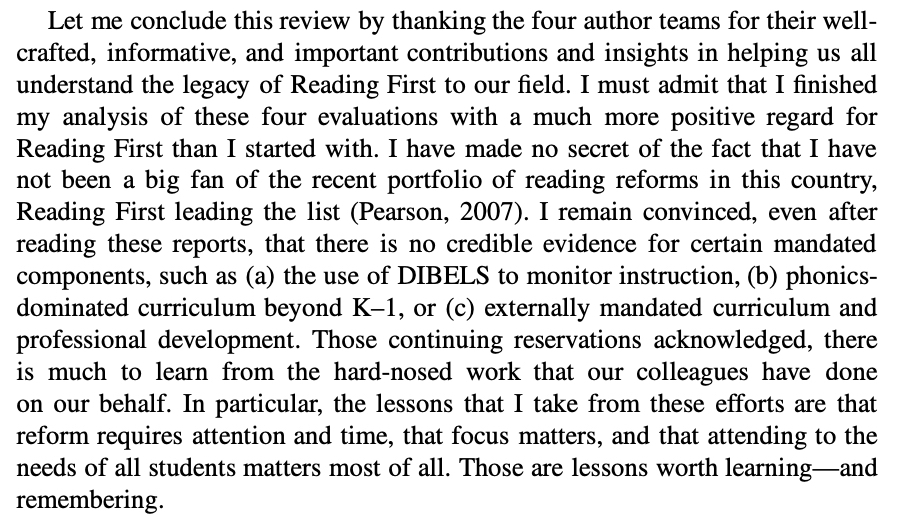
Reading First: Hard to Live With—or Without, P. David Pearson

Pearson Reading First

Misunderstanding Prayer, Religion, and Public Education Again and Again

[Header Photo by Chris Liverani on Unsplash]

Poet e.e. cummings understood a foundational combination of approaches common in U.S. politicians; his satirical political speech as poem begins: “‘next to of course god america i/ love you.’”

Patriotism and religiosity are effective political rhetorical strategies, but they also should be red flags to anyone concerned about their nation or their religion (or lack there of).

Current POTUS Trump has matched the buffoonery of cummings’ cartoonish politician, and in keeping with that theater, Trump has grabbed some low-hanging fruit by once again igniting the prayer in public school debate.

The tension between prayer/religion and public spaces such as schools has a long and complicated history. But since the early 1960s, one fact has existed that almost everyone who joins this debate misunderstands or misrepresents: All adults and students in public schools are free to pray, or not, and all types of religious texts can be read and assigned as literature (but not to proselytize).

Here is what people misunderstand: The Supreme Court ruled against coercion by the state in terms of religious practices. The ruling is not about anyone being religious or not, anyone practicing religion or not, but about the role of the state in coercion of religious belief and practice.

In other words, anyone who is religious should welcome this clarification because it protects religious freedom from the potential of anyone in authority abusing that role for religious purposes.

Students, for example, are free to pray at breakfast or lunch each day in school; but also free from any school authorities forcing that behavior or denying those practices.

Also, when I was a public high school English department chair, we purchased a class set of Bibles to use during literature study; for example, students used those Bibles in activities designed to identify Biblical allusions in Nathaniel Hawthorne’s The Scarlet Letter. This is a secular and academic activity in which a religious text is perfectly appropriate.

Sections of the King James version of the Bible were also in the British literature survey textbook as an example of British literature.

Beyond understanding what the current legal status of prayer and religious texts are in the U.S., we should also consider that private spaces can be religiously hostile, legally demanding or denying religious practice. It is our public spaces that must remain vigilant about preserving religious liberty.

Public education is not simply lessons about reading, writing, and arithmetic; every policy and every practice in daily schooling teaches students not only who they are but how the world works, what is valued and what is mere rhetoric.

As another example from my public school teaching career, I was also a coach for many of the years I taught. Since prayer is a common part of the sports ritual, I had to confront my role as an agent of the state while coaching.

Traditionally, coaches gather teams for prayer and then some sort of pre-game chant; however, just as I would never (and should never by law) call a class of students to prayer, I did not ask my players to gather for prayer before matches.

Instead, I gave the team space before the game to gather if they wished (and not to do so if they did not) and pray as a team (I was not involved) before we then gathered as a team and did our pre-game chant.

While this was unusual and caused some concern among parents (most of whom wanted me to follow tradition and lead a team prayer), I was modeling proper professional behavior for a public school employee and honoring all of my players’ diverse religious and non-religious beliefs and practices.

Several players over the years who were not formally religious thanked me for the respect this process showed.

No one forced or coerced to be religious, no one denied their religious identities—this is the current law governing all public spaces in the U.S., including public schools, and it is the law that the deeply religious and the non-religious should vigorously support and protect as one.

Just as the Supreme Court ruling was more about coercion than about religion, political rhetoric about patriotism and religion are likely (as cummings’ first line shows—ending as it does with “i,” “god america i”) more about the interests of the politician than any commitment to a people or a faith.

Regardless of your religious affiliation, however, be wary of voting for anyone who cannot accurately describe the concept they claim to be defending.

Politics as Sport: The Naive Democracy of the U.S.

Social media provide one easily accessible version of the marketplace of ideas in the U.S. While still gated by some levels of privilege, social media platforms include a fairly wide range of people participating by both posting who they are and what they believe or viewing those posts.

Claimed political affiliations and support for political parties and candidates are often expressed through social media, but even more revealing are posts that people seem to believe are somehow not political but in fact expose the real politics beneath the rhetoric.

One of the most revealing and disturbing is the pattern of conservatives posting about socialism, communism, and (more rarely) Marxism—proving that they have no real idea what the terms mean but have embraced them as broad and clumsy slurs of an imagined (and oppressive) Left.

As I have explained several times, there is no real Left of consequences in the U.S., even in academia (where I have worked for almost two decades).

After posting The Market Fails Education yesterday, I followed up a discussion on Facebook with this: Republicans in the U.S. are market fundamentalists who are averse to publicly funded institutions, and Democrats are market-first, public tolerant.

A genuine political Left with power in the U.S. would be public-first and market tolerant, but this simply doesn’t exist within any real power structure in the country.

Market fundamentalism or market idealism drives a great deal of political discourse, ideology, and then policy in the U.S. In almost all real ways, the U.S. is a right-center country without a viable Left—even though many people beneath their market fundamentalism probably hold beliefs that would be better served by Left policies.

Although I mentioned it briefly in my discussion of education, I want to emphasize healthcare in the U.S. here.

Few people function in their market fundamentalism with a clear awareness that capitalism is an amoral system; in other words, the morality of capitalism is its internal consistency, fairly expressed as supply and demand.

A market exists and flourishes if it can maintain demand from the supply; if the demand disappears, so does that market. In both cases, capitalism morality is fulfilled as right or good.

Ideologies on the Left, however, are moral systems that reject waiting for the Invisible Hand to work, or not, to address fundamental human needs; for the Left, then, the collective power of government (best created through the will of the people, such as in a democracy) can and should make certain outcomes happen directly—such as provide universal public education, create and maintain a transportation infrastructure (roads and highways in the U.S., but public transportation as well), maintain a judicial system and a military, etc.

For the Left, foundational publicly funded institutions must be created and maintained so that the less urgent and less dependable market can function as well as possible. A robust foundation of public institutions makes the struggle between Playstation and Xbox not only possible but robust as well.

Sick and overworked (or destitute) people are not free to participate in the consumerism of leisure time.

Here is the great irony of the naive democracy that is the U.S.; the right-leaning social media postings are by people who equate individual freedom with their conservative ideology, misreading the Left as oppressive (the slur of “communism”) while ignoring their own lack of freedom due to the demands of the workforce that denies workers power and has reduced the worker to a mere interchangeable and disposable cog.

Right-to-work laws have been expanding, with unions decreasing, as the workspace becomes more part-time gigs than careers.

Market fundamentalism has created the necessity that all people work by linking both healthcare and retirement to that employment in reduced and barely sustainable ways to further shackle every worker to their employment, stripping those workers of freedom.

People in the U.S. must work to have healthcare, must pay an insurance premium (deducted from their checks in a sort of invisible way) and then fund deductibles for initial care, and often avoid using their sick days or medical care due to fear of losing those jobs.

And all of this works inside a market system of healthcare that is incredibly inefficient but also amoral. For example, the U.S. system has been compared in terms of administrative cost to single-payer in Canada:

Measurements: Insurance overhead; administrative expenditures of hospitals, physicians, nursing homes, home care agencies, and hospices.

Results: U.S. insurers and providers spent $812 billion on administration, amounting to $2497 per capita (34.2% of national health expenditures) versus $551 per capita (17.0%) in Canada: $844 versus $146 on insurers’ overhead; $933 versus $196 for hospital administration; $255 versus $123 for nursing home, home care, and hospice administration; and $465 versus $87 for physicians’ insurance-related costs. Of the 3.2–percentage point increase in administration’s share of U.S. health expenditures since 1999, 2.4 percentage points was due to growth in private insurers’ overhead, mostly because of high overhead in their Medicare and Medicaid managed-care plans.

Limitations: Estimates exclude dentists, pharmacies, and some other providers; accounting categories for the 2 countries differ somewhat; and methodological changes probably resulted in an underestimate of administrative cost growth since 1999.

Conclusion: The gap in health administrative spending between the United States and Canada is large and widening, and it apparently reflects the inefficiencies of the U.S. private insurance–based, multipayer system [emphasis added]. The prices that U.S. medical providers charge incorporate a hidden surcharge to cover their costly administrative burden.

The healthcare system in the U.S. is not designed to provide healthcare to all U.S. citizens but to maintain control over U.S. workers and to feed the healthcare market.

Ironically, the U.S. market economy and workforce would likely function better and be more robust if all citizens were guaranteed healthcare through a publicly funded single-payer system and if workers were afforded greater autonomy and freedom (not held hostage in their jobs just to have healthcare) that would create a more robust open market in the workforce. In this version, however, owners and managers would be forced to participate in a more open marketplace of jobs where workers have the power of choice, both not to work or to work in better, more humane conditions.

The Left is not the cartoon version of oppression that many in the U.S. maintain. The Left seeks a democracy whereby fundamental needs are fully publicly funded (public schools, healthcare, judicial system, infrastructure, military, etc.) so that the market can function better and more ethically with the help of public support and oversight.

Public-first, market tolerant.

Market fundamentalism and market idealism in the U.S. are mostly rhetorical and dishonest because there is little effort to hold the media, political leaders, or social media posting to some sort of accuracy or internal logic.

As I have argued before, the U.S. electing and being represented by Trump is exactly what the ruling elites and this naive democracy deserve. The incoherent rhetoric and bombast combined with the relentless lies that characterize Trump are not such exaggerations of this country in many respects, a center-right people clutching a garbled ideology that doesn’t serve their own interests.

Recall the Trump voters who supported Trump to dismantle Obamacare and then being upset when the Affordable Care Act (ACA) was pulled out from under them.

These are the victims of not understanding rhetoric; it isn’t a far walk from not understanding that Obamacare and the ACA are the same thing, and not being able to define “socialism” even as you publicly reject it as evil.

This is the U.S. This is our naive democracy.

Today, the U.S. is trapped in politics as sport, a naive democracy lined up to make a false choice between Democrats and Republicans who are nearly holding hands on how they view the market and only slightly at odds over tolerating or rejecting public institutions.

We are the people worked into a lather about making the life-altering choice between a Camry or an Accord, a Coke or a Pepsi, but completely ignoring of the choice not to drive or not to consume soft drinks.

Where’s the freedom in that?


The Market Fails Education

One of the intended consequences of the federal legislation known as No Child Left Behind (NCLB) was to force public schools in the U.S. to disclose and then address differences among demographics of students. Two of the key demographics targeted were race and socioeconomic status.

While the outcome of this part of NCLB was not a surprise—exposing significant and persistent “gaps” correlated strongly with poverty and so-called racial minorities—there were unintended consequences, including the creation of the achievement gap market.

NCLB mandated that districts and schools not only report disaggregated data on race, gender, and socioeconomic categories, but also document how those gaps and demographics of students were being addressed in order to close the gap.

Within just a few years, then, Ruby Payne boosted her own career by monetizing how to address the poverty gap in education, as detailed by Ng and Rury in 2009:

Measures of Payne’s influence are remarkable to consider.  Her aforementioned [self-published] book[, A Framework for Understanding Poverty,] has sold over one million copies and been translated into other languages such as Spanish since its publication in 2005.  Payne has also launched a speaking career by conducting professional development workshops in 38 American states and internationally.  She trains approximately 40,000 educators a year and reports having worked with 70 to 80 percent of the nation’s districts over the last decade with the assistance of her staff and consultants (Shapira, 2007).

However, while Payne provided a product that met the demands of the market created by NCLB, scholars of poverty, race, and education eventually exposed significant problems with Payne’s book and workshops:

While Payne’s popularity cannot be disputed, her work has generated great controversy and criticism.  For example, questions have been raised about the methodological validity of her work and subsequent self­-proclaimed “expertise” (Baker, Ng & Rury, 2006).  Others have criticized the deficiency­-oriented nature of her views on poor people that results not only in blaming the victim for being poor in the first place, but also blaming the victim for not exercising the power to alleviate his/her poor condition (Bohn, 2006; Osei­Kofi, 2005; Gorski, 2006a & 2006b).  Reviews of Payne’s published materials also indicate her inaccurate characterization of existing social science research and reliance upon stereotypes that poor people are disproportionately more immoral, lazy, and promiscuous than middle­-class or wealthy individuals (Ng & Rury, 2006).  And lastly, a careful analysis of the 607 “truth claims” she makes in her text reveals that the majority of her assertions actually contradict the findings of empirical work in fields such as education, anthropology, and sociology (Bomer, Dorin, May & Semingson, 2008). (Ng & Rury, 2009)

While scholarship continued to grow debunking Payne as an authority on poverty and education, Adrienne van der Valk reported on the Payne debate, and enduring career funded by K-12 education, in 2016:

Writer and educator Ruby Payne has been offering strategies for teaching students in poverty for almost 20 years. Since 1996, when she founded her business, aha! Process, to train educators on “the critical role schools can play in helping children and teens exit poverty,” Payne and her affiliates have, according to her website, “trained hundreds of thousands of professionals.” Her self-published book, A Framework for Understanding Poverty, has sold more than 1.5 million copies. Chances are, if you’re a K-12 educator who has received professional development on working with students in poverty, the training was associated with Ruby Payne.

It has now been several years more than a decade since a number of scholars warned that Payne has no credible expertise in poverty, and more disturbingly, that Payne’s central claims perpetuate stereotypes, deficit thinking, and victim-blaming, as van der Valk details:

In our conversations with scholars, educators and other stakeholders, five main criticisms of Payne’s K-12 materials emerged:

  1. They focus on individual interventions and ignore the systems that cause, worsen and perpetuate poverty.
  2. They overgeneralize about people living in poverty and rely upon stereotypes.
  3. They focus on perceived weaknesses (or deficits) of children and families living in poverty.
  4. They are theoretically ungrounded and offer little evidence that they work.
  5. aha! Process workshops—and their price tags—capitalize on the needs of children in poverty.

The ability of Payne to grow her business absent credible expertise or even valid products can also be seen in her newest branding, an Emotional Poverty Workshop offered in February 2020.

Image

Using the belief systems in Payne’s work as well as the belief systems of the education administration and faculty who choose Payne and continue to support her work, it would be easy to blame those school personnel and Payne herself for the Payne phenomenon. But that would be as misguided as Payne’s books and workshops themselves.

The problem here is systemic—reducing a foundational public institution to the whims of the free market. If the system within which Payne is thriving were a different system, we could imagine school personnel and even Payne herself behaving differently.

The systemic problem is distinctly American since it involves the false either/or beliefs in the U.S. concerning socialism (as a reductive and misused term for “publicly funded”) and capitalism. While many in the U.S. claim the country is more devoted to democracy than its economic system, a strong case can be made that the U.S. is capitalism first if not working toward capitalism exclusively.

Public discourse and policy tend to represent anything publicly funded as inefficient, corrupt, and/or failing. Think the narratives around public schools throughout at least the last 170 years.

To understand better how the market necessarily fails education, please consider the road and highway system in the U.S. Roads and highways are primarily publicly funded, and even when roads are funded directly by the users (toll roads), many motorists dislike that version of transportation, and toll roads often fail, then converted into public roads.

Fully publicly funded and well maintained roads and highways are an excellent example of the systemic problem driving the Payne phenomenon. Publicly funded and the market are not antagonistic systems that any public must choose between, but potentially symbiotic forces that allow each system to function better together than in isolation.

Publicly funded roads and highways are essential to the market economy in the U.S., facilitating worker mobility and the near ubiquity of goods and services across the country. As the market thrives, as well, tax dollars are generated at higher and stronger rates, providing even more and better roads and highways.

Symbiotic.

Many in the U.S., notably political leadership, fail to recognize or acknowledge that symbiotic relationship, speaking instead idealistically about the market and demonizing about publicly funded. Public education, then, in some ways like the medical field, is forced into a hybrid system that feeds and depends on the market.

The problem, however, is a bit more complicated than simply blaming the market. In education, the failure of the hybrid nature of education funding (mostly public) and education spending (participating in the market, some of which is created or fueled by public policy) is in part bureaucracy, a failure found in both public institutions and private business.

Payne’s poverty prosperity was made possible by policy in NCLB but also because funds were earmarked and set to a deadline (spend it or lose it) within an accountability system that demanded that districts and schools document that the achievement gap was being addressed. This process occurred far too often (and occurs far too often still) in a purely administrative way.

NCLB also created administrative positions and duties; some people were charged (among dozens of other responsibilities) with complying with NCLB. Those education personnel likely did not have the expertise to evaluate the “who” and “how” of complying with NCLB achievement gap mandates, but was charged with making whatever could fulfill the mandate happen.

While NCLB has been replaced by the Every Student Succeeds Act, the legacy of NCLB remains, a hyper-focus on the achievement gap that sustains the race and poverty market in education consulting and materials.

Public education would better serve students and democracy as well as the economy if it were removed from the market (similar to arguments being made about the health care system now) so that bureaucracy is replaced by professionalism and expertise (education decisions made based on research and experience, not policy mandates driven by accountability) and all education materials and professional development are completely funded by public dollars but also created exclusively within the public education system (not purchased from private vendors).

The Payne phenomenon and mistake would never have occurred and would not be lingering if race and poverty experts were employed throughout education and if all necessary materials and professional development were provided by those experts within the education system. The quality of this process would be much higher and the outcomes would likely be far more substantial.

Education, educators, and students are being mis-served by Payne and others who continue to monetize poverty, racism, and inequity, but this problem is likely a symptom of a much larger disease, the hybrid nature of public education funding and depending on a free market that is too often free of credibility or scholarly oversight.

The U.S. needs and deserves a robust and autonomous public education system free of bureaucracy and outside the market that invariably fails education and our students.

Recommended: Literacy Crises: False Claims and Real Solutions, Jeff McQuillan [Update 2 February 2023]

[UPDATE]

After posting this in 2019 while working on the first edition of How to End the Reading War and Serve the Literacy Needs of All Students: A Primer for Parents, Policy Makers, and People Who Care, I have published the second edition and continued to work on the “science of reading” movement.

Regretfully, McQuillan’s work is even more relevant in 2023 because the media and political response to the SOR movement has gained momentum despite the evidence that it is mostly misinformation and another round of the exact reading war McQuillan debunked in the 1990s.

I highly recommend accessing this (which I will cite/quote below in the update of the original post):

McQuillan, Jeff (1998) “Seven Myths about Literacy in the United States,” Practical Assessment, Research, and Evaluation: Vol. 6 , Article 1.
DOI: https://doi.org/10.7275/em9c-0h59
Available at: https://scholarworks.umass.edu/pare/vol6/iss1/1 [1]


Recently, I have been (frantically but carefully) drafting a new book for IAP about the current “science of reading” version of the Reading War: How to End the Reading War and Serve the Literacy Needs of All Students: A Primer for Parents, Policy Makers, and People Who Care.

Those familiar with this blog and my scholarly work should be aware that I often ground my examinations of education in a historical context, drawing heavily on the subject of my dissertation, Lou LaBrant. The book I am writing begins in earnest, in fact, with “Chapter 1: A Historical Perspective of the Reading War: 1940s and 1990s Editions.”

As I have posted here, the “science of reading” over-reaction to reading and dyslexia across mainstream media as well as in state-level reading legislation has a number of disturbing parallels with the claims of a reading crisis in the 1980s and 1990s. Few people, I explained, are aware of the 1997 report authored by Linda Darling-Hammond on NAEP, reading achievement in the U.S., and the positive correlations with whole language (WL) practices and test scores.

I imagine even fewer  education journalists and political leaders have read a powerful and important work about that literacy crisis in the 1990s, Literacy Crises: False Claims and Real Solutions by Jeff McQuillan.

In his Chapter 1, “What Isn’t Wrong with Reading: Seven Myths about Literacy in the United States,” McQuillan admits, “Serious problems exist with reading achievement in many United States schools,” adding, “Yet in the midst of media coverage of our (latest) ‘literary crisis,’ we should be very clear about what is and is not failing in our schools” (p. 1).

This leads to his list of myths ([1] updated with material from McQuillan’s article noted above), which are again being recycled in the “science of reading” version of the Reading War:

Myth 1: Reading Achievement in the United States Has Declined in the Past Twenty-Five Years.

Myth 2: Forty Percent of United States Children Can’t Read at a Basic Level.

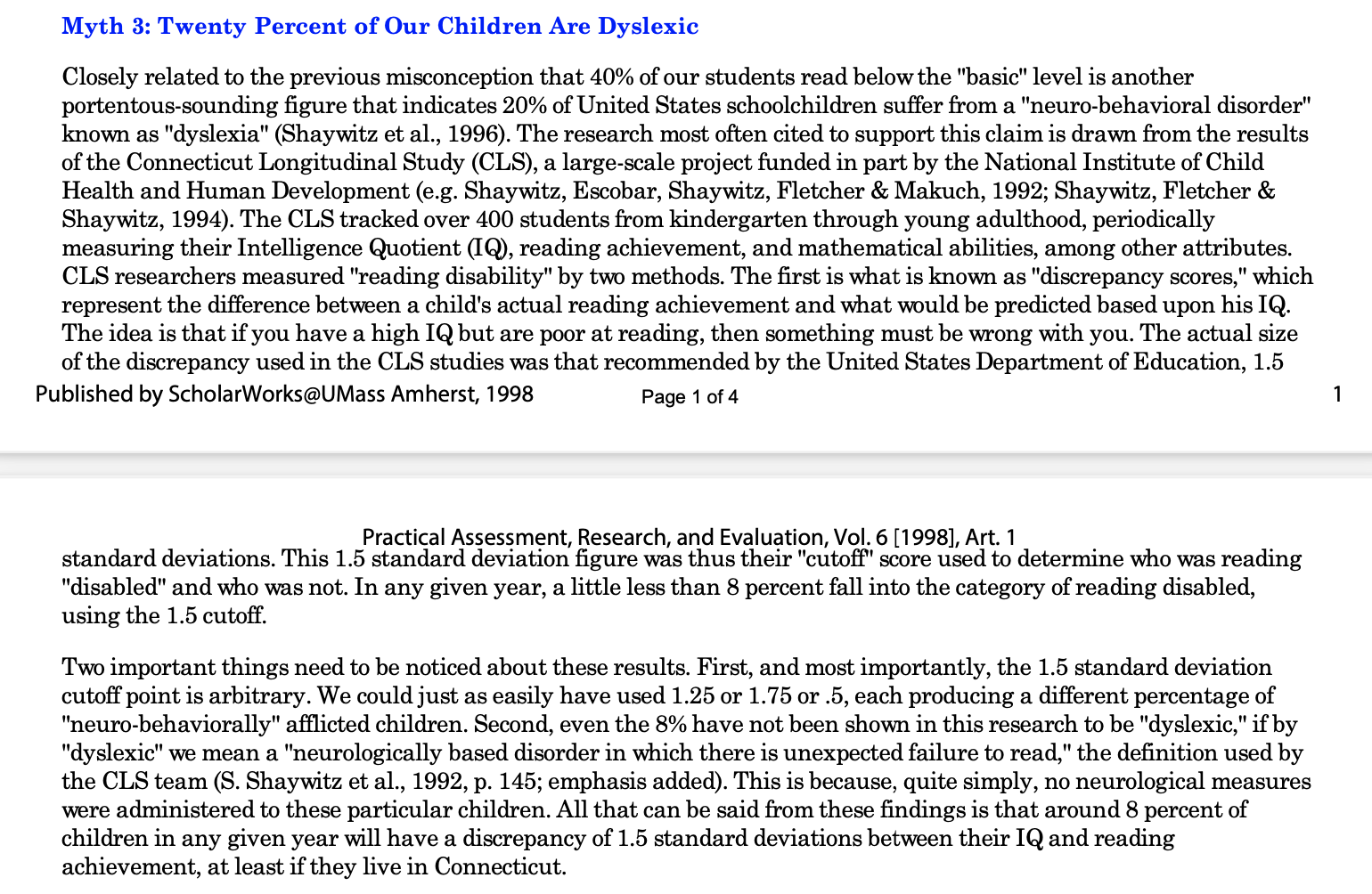
Myth 3: Twenty Percent of Our Children Are Dyslexic.

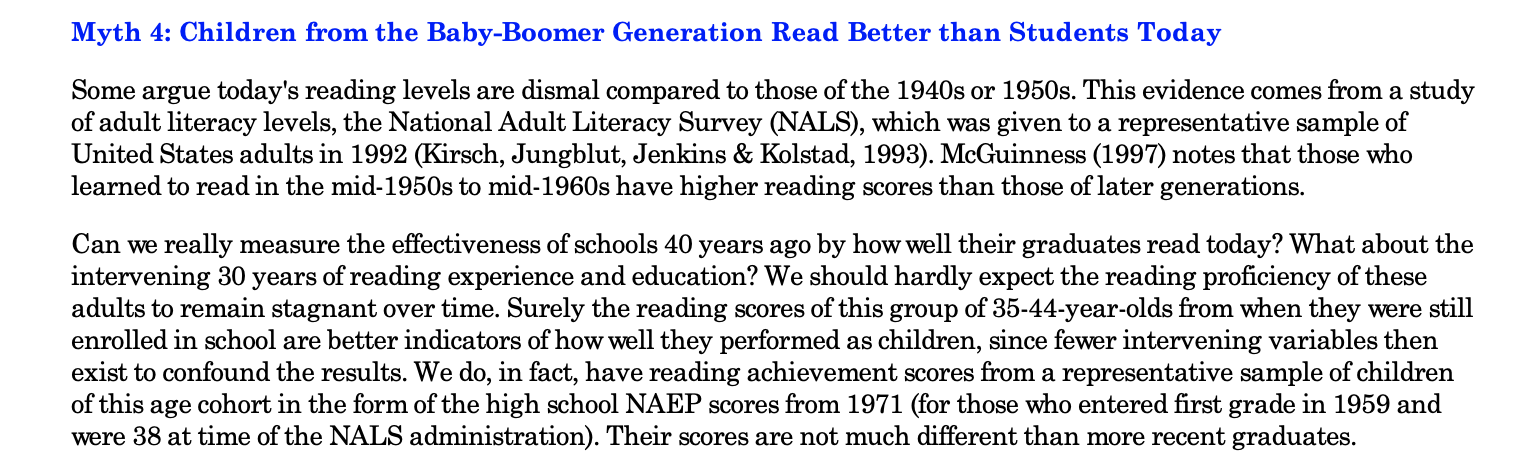
Myth 4: Children from the Baby Boomer Generation Read Better than Students Today.

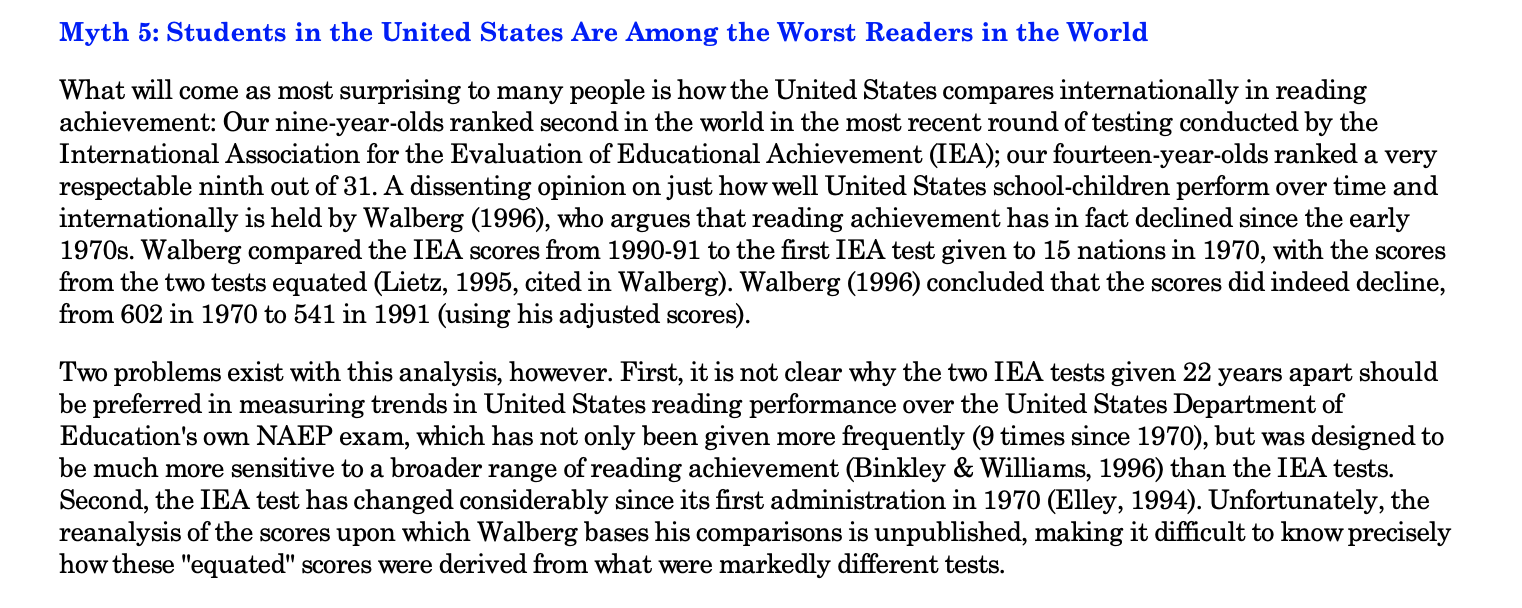
Myth 5: Students in the United States Are Among the Worst Readers in the World.

Myth 6: The Number of Good Readers Has Been Declining, While the Number of Poor Readers Has been Increasing.

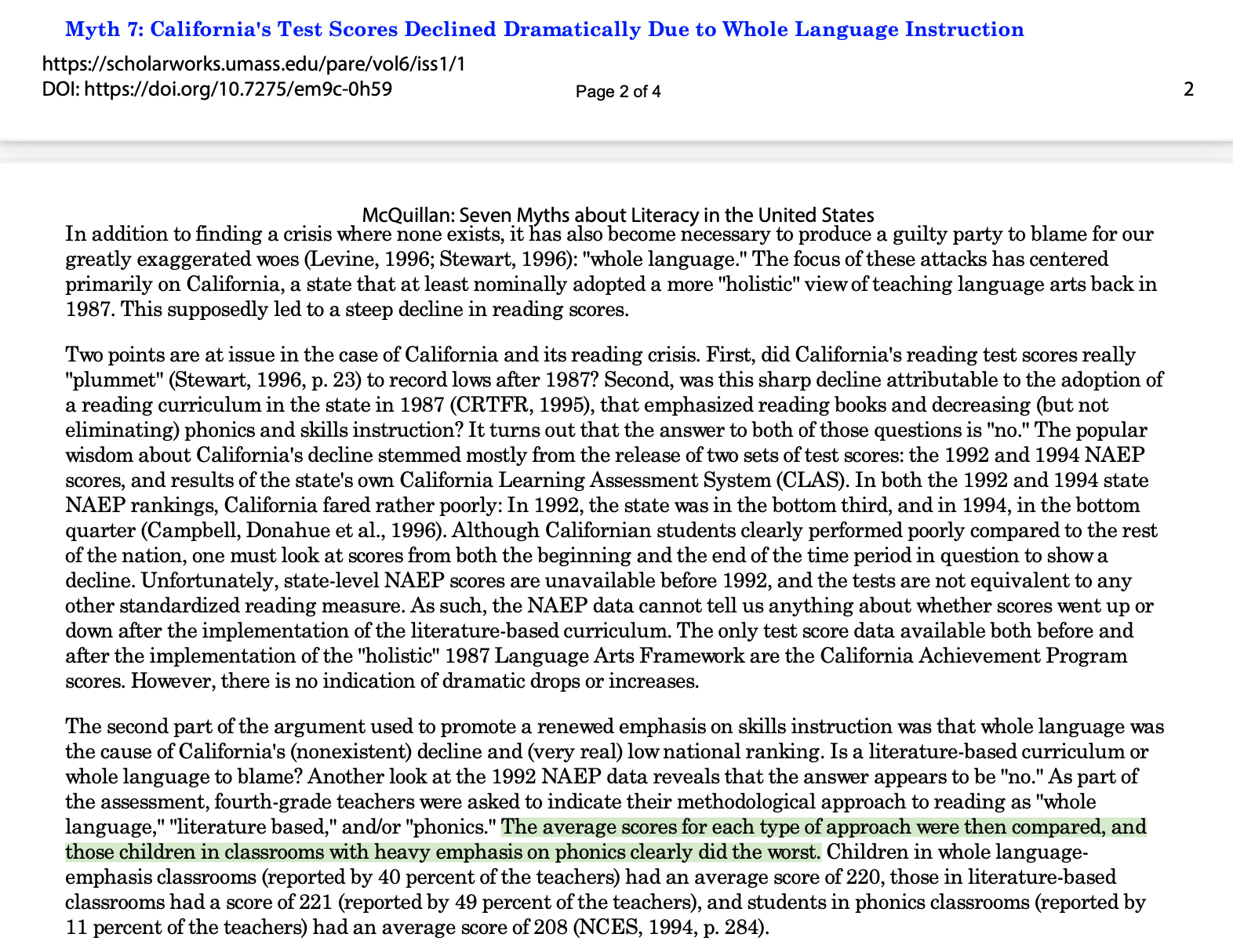
Myth 7: California’s Test Scores Declined Dramatically Due to Whole Language Instruction.

DOI: https://doi.org/10.7275/em9c-0h59

McQuillan carefully dismantles each of these, with evidence, but many today continue to make the same misguided and unsupported claims.

In 2019 (and 2023), McQuillan’s work remains important, and relevant, both for understanding how we should teach better our students to read and how the current version of the Reading War is wandering once again down very worn dead-end roads.