Category Archives: Education

School Rankings as Racist, Classist Propaganda

On 20 May 2019, the Charleston Post and Courier offered this: Here’s what it takes for a SC school to be the No. 1 public high school in the US. And here is what is newsworthy:

The news was out before the sound of the school announcement system crackled through the halls: Academic Magnet High, long regarded as the top-performing high school in South Carolina, had climbed to No. 1 in a national ranking of public high schools.

Just three days later, The State (Columbia, SC) reported: Richland 1’s elite elementary school is also its whitest and least impoverished. This coverage explains:

Like all parents, Sara McBride just wanted her son to get the best possible education.

That’s why she tried to get her son into Richland 1’s highest-ranked school: Brockman Elementary. A school where class sizes are small and teachers’ advanced degrees and experience nets them a higher average salary.

The South Carolina Department of Education provides for 1270 public schools in the state a Poverty Index; for 2018, Academic Magnet High is the #1 least impoverished school in the entire state, and Brockman Elementary is #57, placing these two celebrated schools in the top 4.5% of all schools in the state in terms of extremely low poverty as well as disproportionate racial imbalances (Brockman is 75% white and AMH has only 3.5% black enrollment).

SC as a state ranks in the bottom ten of high-poverty states (about an 18% poverty rate) and has a relatively high percentage of black citizens (28%) as well as about 5-6% Hispanic/Latinx.

Across the U.S., there are some harsh facts about measurable student outcomes and demographics of students being served. Race, socioeconomic status, first language, and special needs are all highly correlated with those measurable outcomes.

High poverty, majority-minority schools with high percentages of ELL and special needs students have historically low test scores.

Therefore, these rankings and labels such as “elite” are gross misrepresentations of school quality.

Imagine if we had some hospitals that admitted only well patients and then ranked those against the hospitals serving curably sick patients as well as hospitals only admitting the terminally ill.

Can you guess how they would rank if we used health of the patients as the data for ranking?

This is more than just a problem of semantics, but to be blunt, these schools are not elite; they are selective—one overtly (AMHS) and one indirectly (BE).

These rankings and then the media coverage that perpetuates the rankings mask some powerful and essential facts that if confronted could help drive substantial social and educational reform that would serve students in SC much more directly.

First, public schools are primarily a reflection of the communities they serve; high-poverty communities have high-poverty schools, and both the communities and those schools suffer under enormous burdens related to a wide array of inequities linked to racism and poverty.

Second, schools almost never change the burdens of those communities. In fact, formal schooling has structures that tend to perpetuate and even intensify the inequities of high-poverty and racial minority communities—inequitable discipline policies, tracking, inequitable teacher assignment, inability to attract and retain experienced and certified teachers.

Magnet (AMHS) and choice (BE) mechanisms work to increase inequity because affluent and privileged students are over-served while poor students, racial minorities, ELL, and special needs students are systematically excluded through direct and invisible structures (choice, for example, often requires parents who can provide transportation and the time needed for transportation).

Conversely, poor students and racial minorities are over-identified as having special needs while also being under-identified in other sorting structures such as gifted and talented.

In-school inequities also include that wealthy and white student are more often served by experienced and certified teachers while sitting in classes with lower student/teacher ratios (typically correlated with being in Advanced Placement or International Baccalaureate tracks). High-poverty students and racial minority students experience just the opposite—inexperienced and un-/under-certified teachers and high student/teacher ratios as well as more remedial and test-prep courses.

Continuing to rank schools while also maintaining a disproportionate concern for narrow data (test scores) serves only to misrepresent how well students are learning, how well schools are serving their students, and how our policies and practices are in fact guaranteeing success and failure for children born into privilege or disadvantage through no effort or fault of their own.

The real news in the two articles above is that SC has a long history of political malfeasance—a lack of political will—and a compliant media that simply refuse to label racism and classism for what they are.

A Meditation on Stringing Words Together: The National’s “Roman Holiday”

I’m still standing in the same place where you left me standing

“I Am Easy to Find,” The National

For those of us who love words and fall deeply in love with authors and pop music performers, few things are as exciting as new works. I listened for the first time to The National’s I Am Easy to Find on the release day during a long drive.

The first song, “You Had Your Soul with You,” had already been released so my rush happened on the second song, “Quiet Light,” when I felt the urge to cry before the lyrics even began.

And by the seventh song, the titular “I Am Easy to Find,” I could hold back no longer, crying steadily as I drove. There is something uniquely powerful about the combination of beautiful music and beautiful words strung together in a way that make your heart ache.

As an English teacher for about two decades during the first half of my career, I was always searching for an effective way to teach poetry well. Students tended not to like poetry but also had very narrow and mistaken associations with poetry—poetry rhymes, for example, and being overly concerned with what poems mean.

It probably seems trite, but I did find that investigating poetry—asking, what makes poetry, poetry?—combined with starting with pop music song lyrics helped allay student antagonism toward what I consider a beautiful and powerful form of human expression.

Throughout the 1980s and 1990s, I grounded my poetry unit in the music of R.E.M. Although I now mainly teach education and writing courses, I continue to think as an English teacher—especially in terms of applying reading like a writer to text such as song lyrics to inform how we read and write well.

Especially with the rise of close reading, driven by the mostly now defunct Common Core, many formal lessons focusing on analyzing text remains trapped in false notions that meaning is restricted to the parameters of the text, words strung together on the page.

“I’m your hospital, I’m your silver cross,” opens The National’s “Roman Holiday,” preparing the listener for how to unpack these metaphors, but also confronting the arguments of close reading that meaning is a mechanical process bound to text only.

In the opening verse as well, “Patti wasn’t lonely, Robert wasn’t lost” establishes the factual basis of the song, explained by the primary lyricist, Matt Berninger:

I am a huge fan of that book [Patti Smith’s memoir Just Kids], but I was actually looking at Judy Linn’s book of Patti Smith photos. A lot of the imagery in it is of Patti Smith and Robert Mapplethorpe when they were really young, just hanging out in their apartment: dressing up, taking pictures of each other, looking cool. It’s such a beautiful portrait of pals, such a romance. And then there’s also a line I took from Patti Smith’s Instagram, a comment she sent to somebody who had just lost someone to suicide: “Please think the best of him.” I found it incredibly moving. I was just obsessed with her kindness and her wisdom in the face of so many sad things.

Carin Besser, Berninger’s wife and co-lyricist on The National lyrics for several of the recent albums, adds how being a lyricist is similar to poetry in an interview:

You have a background in poetry and as a writer and editor. How is lyric writing similar or different than what you’ve done in the past?

I think I probably like the same thing about poems and song lyrics. When I read poems or listen to a song I love, I get very hung up on certain lines, especially lines I both don’t and do understand. I love that. But it’s not that impressive. It’s like being attracted to sequins. I don’t really understand story or plot well, but I love a way of finding that compressed or cock-eyed way of saying the thing, so that you can kind of re-hear the thing, or so that you can hear the feeling of thought on its way.

Any kind of language on the way to an idea, I tend to like. It’s mysterious enough to me that I stay interested. I also love songs where the singer is rambling on and almost doesn’t seem to hear what the song is doing. Or when a vocal melody slides around in order to make a point. I also sometimes feel like with song-making, there are all these bags of fireworks laying around, so many ways in a song with a singer and against the backdrop of all the musical ideas, so many ways to try to make an impression.

As a foundational text to investigate poetry—genre, mode, form—”Roman Holiday” is a powerful experience for students. Typically, using pop music, I ask students to listen to the song once without any lyrics; I then do a second listening with the lyric before the students.

Without context, “Roman Holiday” may be read a number of valid ways, focusing on unpacking the technique (metaphor, rhyme/half-rhyme, sound devices, imagery, motifs) in a traditional process (think New Criticism and close reading).

The half-rhymes are engaging (cross/lost, rains/shame, him/museum) and sounds help give the lyrics cohesion (please/police). But analyzing “Roman Holiday” decontextualized ultimately fails the song and the reading; better is to place the song in a text set including:

Technique and craft of the lyrics and the entire song are effective and powerful, but they are vehicles for the much larger discourse between a variety of texts and modes of expression, including photography, memoir, and social media.

If close reading guides coming to understand “Roman Holiday,” we are having an incomplete experience. This song depends on history, controversy, and two influential artists, Patti Smith and Robert Mapplethorpe.

How Smith, specifically, has resonated as an artist and thinker while Mapplethorpe died much younger builds along with Smith’s response to suicide (“Please, think the best of him”) to something both grounded in these two lives and the greater and more complex human condition.

While reading and interpreting text remains concepts misunderstood and misrepresented in the media and by the public, this sort of rich and complex unpacking of “Roman Holiday” speaks to how NCTE defines reading:

Reading is a complex and purposeful sociocultural, cognitive, and linguistic process in which readers simultaneously use their knowledge of spoken and written language, their knowledge of the topic of the text, and their knowledge of their culture to construct meaning with text. Each of these types of knowledge impacts the sense that readers construct through print. Readers easily comprehend text with familiar language but are less successful at comprehending text with unfamiliar language. Readers easily comprehend text on familiar topics but are less successful at comprehending texts on unfamiliar topics. At the same time, the interpretations readers construct with texts as well as the types of texts they read are influenced by their life experiences.

Without a knowledge of the topic of this song (Smith and Mapplethorpe’s relationship), a close reading misses a great deal. Yes, there is really compelling craft here, but there is also history and deep emotion.

Pop songs, like poetry, lend them selves to re-listening/rereading. Meaning grows, even blossoms with each experience because we are always a different person each time we re-listen/reread.

The meaning of any text is never fixed, never simply trapped in the stringing together of words.

For me, “There are police in the museum/She said please” stays with me after hearing the song; the use of “police/please” haunts me.

I am uncertain I can articulate why, but it certainly has meaning—and that meaning is more than intellect, enriched by emotion.


See Also

Florence Welch on Sobriety, Embracing Loneliness and Loving Patti Smith

Florence + The Machine – Patricia

Banned in the U.S.A.: The Right’s Assault on Other Women

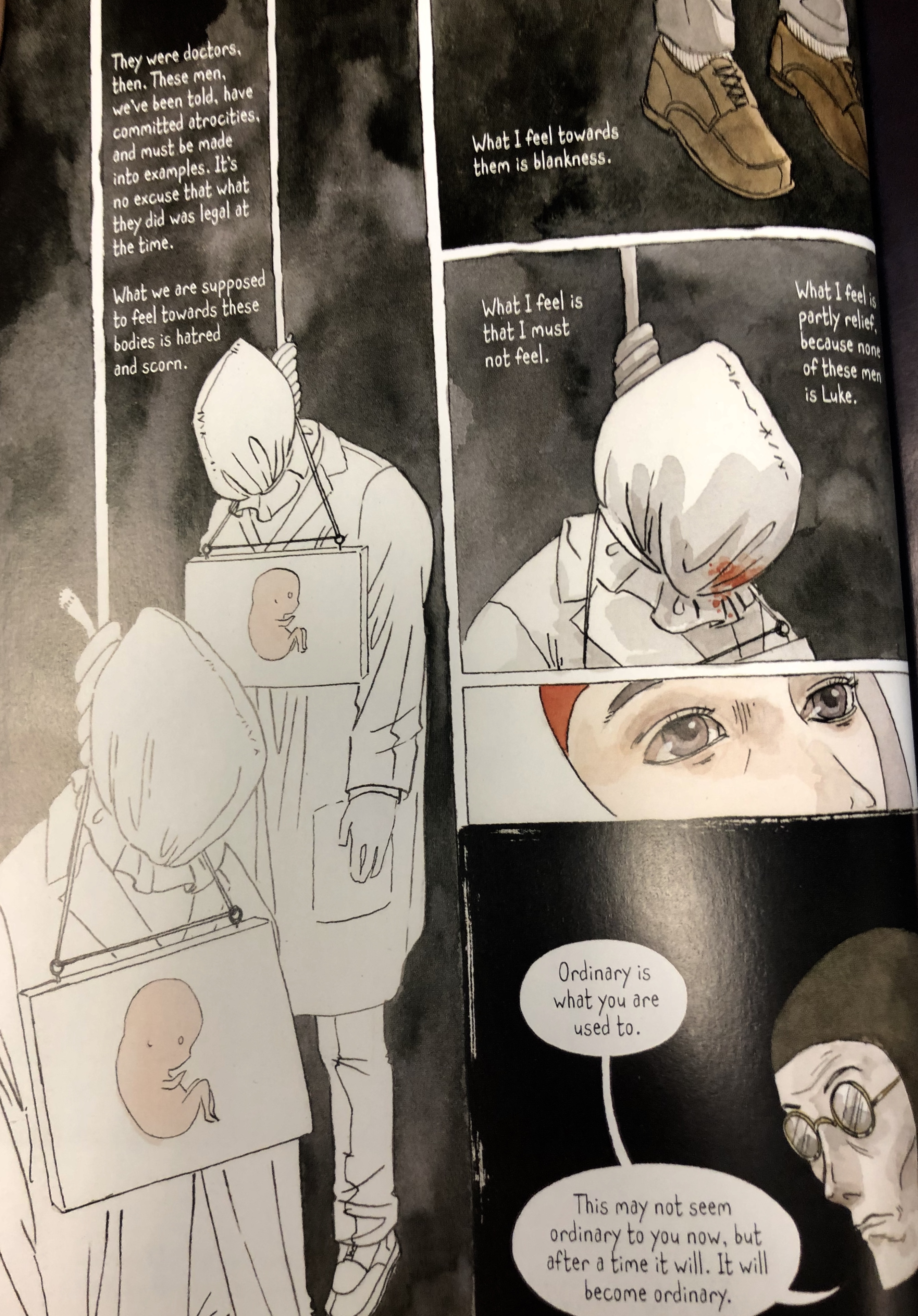
“Ordinary, said Aunt Lydia, is what you are used to,” retells Offred in Part II, Chapter 6, of Margaret Atwood’s The Handmaid’s Tale. “This may not seem ordinary to you now, but after a time it will. It will become ordinary” (p. 33).

Readers have just been introduced to public executions in Gilead: “Now we turn our backs on the church and there is the thing we’ve in truth come to see: the Wall” (p. 31). On this day,

The men [hangin from…hooks] wear white coats …. Each has a placard hung around his neck to show why he has been executed: a drawing of a human fetus. They were doctors, then, in the time before, when such things were legal. … They’ve been turned up now by the searches through hospital records, or — more likely, since most hospitals destroyed such records once it became clear what was going to happen — by informants: ex-nurses perhaps, or a pair of them, since evidence from a single woman is no longer admissible. (pp. 32-33)

Atwood’s speculative theocracy is heavily grounded in a perverse worshipping of some women as possible vessels of childbirth since the birthrates of whites were in steep decline due to environmental toxins.

With a conservative shift in the Supreme Court in the United States under Trump, Georgia and Alabama have passed extreme anti-abortion laws, openly admitting they are designed to overturn Roe v. Wade—to make abortion once again illegal in the country.

Several aspects of these moves to deny women autonomy over their bodies are obscured by Orwellian language (“heartbeat legislation”) and rhetorical bows to protecting life. First, in countries where abortion is legal and safe, abortion rates are often lower than in countries banning abortion, but there are strong correlations also between legal abortion and overall health, safety, and autonomy of women.

In short, access to legal and safe abortion is a subset of overall healthcare for women.

Second, and this may be one of the more troubling realities of moves to ban abortion, these bans on abortion and the possible criminalizing of women and medical professionals (see the novel excerpts above) are never going to be realities for the wives, daughters, and mistresses of the wealthy white men passing the laws.

Throughout history in the U.S., as with all laws, wealthy women will always have access to abortions as well as overall healthcare for themselves and their children.

The current move to ban abortion in the U.S. is about other women—those women marginalized by their social class and race.

These laws may also criminalize miscarriages and birth control; they are designed to strike fear into the medical field and other women.

These first moves serve the same purpose as the Wall:

It’s the bags over the heads that are the worst, worse than the faces themselves would be. It makes the men like dolls on which the faces have not yet been painted; like scarecrows, which in a way is what they are, since they are meant to scare. (p. 32)

Aunt Lydia’s reassurance—”It will become ordinary”—echoes a chilling tenet from Albert Camus’s The Stranger expressed by Meursault in prison:

Afterwards my only thoughts were those of a prisoner….At the time, I often thought that if I had had to live in the trunk of a dead tree, with nothing to do but look up at the sky flowering overhead, little by little I would have gotten used to it. I would have waited for birds to fly by or clouds to mingle, just as here I waited to see my lawyer’s ties, and just as, in another world, I used to wait patiently until Saturday to hold Marie’s body in my arms. Now, as I think back on it, I wasn’t in a hollow tree trunk. There were others worse off than me. Anyway, it was one of Maman’s ideas, and she often repeated it, that after a while you could get used to anything. (p. 77)

Much of Atwood’s novel is about retelling the story of Offred’s life before and during Gilead—about how easily human dignity and human agency can be erased, slowly like a lobster in a boiling pot of water, or like a scene from Ernest Hemingway’s  The Sun Also Rises when Bill asks Mike Campbell how Mike goes bankrupt, and Mike answers: “‘Two ways….Gradually and then suddenly'” (p. 141).

In Trumplandia, as rightwing politicians pass anti-abortion laws, assaults on other women, we are now in the gradually.

Will this become ordinary—suddenly?

The Enduring Influence of the National Reading Panel (and the “D” Word)

What do the National Reading Panel (NRP) report (2000), A Nation at Risk (1983), and the seminal “word gap” study by Hart and Risley (1992/1995) have in common?

First, each of these has become a recurring citation in mainstream media when addressing reading (NRP), school accountability (A Nation at Risk), and literacy (“word gap”).

Next, and quite troubling to those of us in education and literacy, all of these have been debunked.

A wide array of scholars have called into question Hart and Risley’s methods, conclusions, and assumptions. Gerald Bracey and Gerald Holton have unmasked A Nation at Risk as a false political crisis. And NRP panelist Joanne Yatvin as well as Stephen Krashen have significantly refuted the validity of the NRP report and process.

Recently, the reading wars have been rebooted across mainstream media; concurrent with that has been a rash of new reading legislation in several states.

In both cases, a common phrase is “the science of reading,” a thin veil for renewed emphasis on systematic phonics—in part driven by advocates for children with dyslexia.

News articles across Education Week, NPR, PBS, and other outlets have praised this so-called need for the science of reading while almost uniformly referring to the NRP as the primary research base for that “science.”

One journalist, Emily Hanford, who won an EWA award for her “science of reading” article, discounted my charged the NRP had been debunked with “One member expressing a minority view does not equal ‘debunked.'”

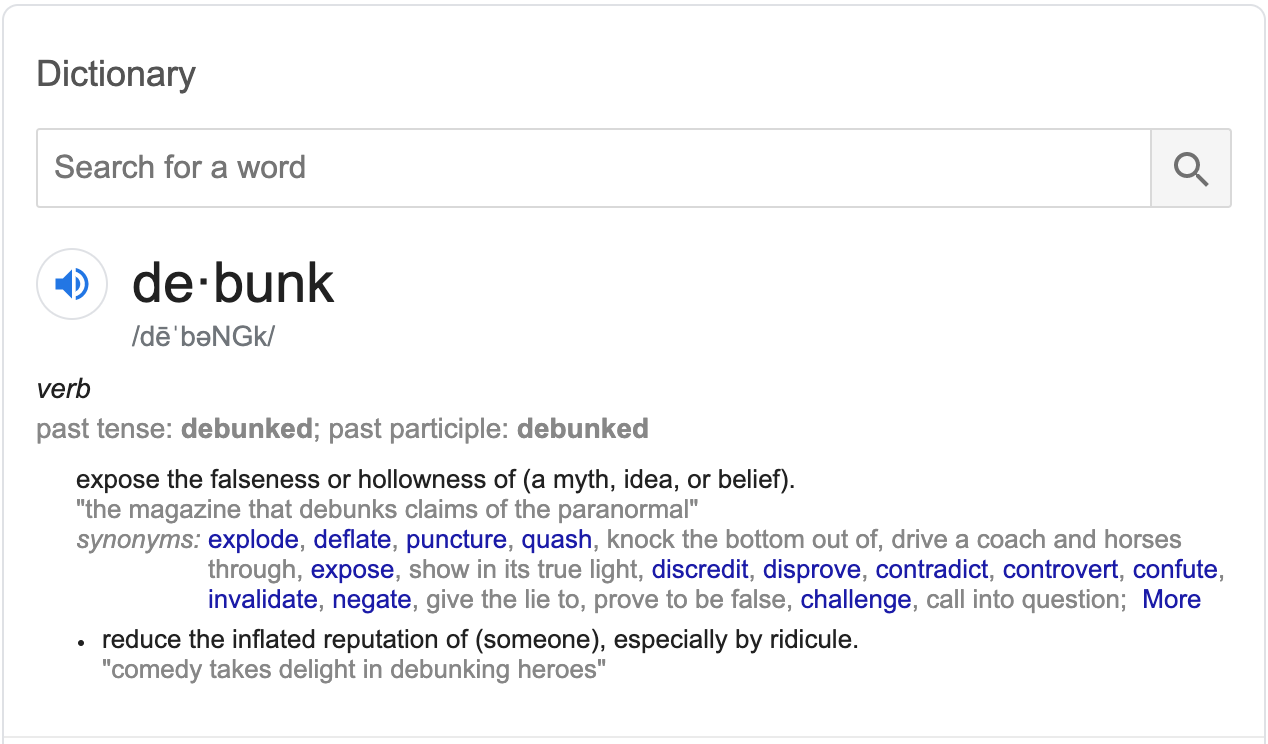
Here, I want to note that I have discovered many people react strongly to the term “debunk,” seemingly because they interpret its meaning simplistically; however, note the nuance of the term:

debunk

In the case of the NRP report, I contend it has been debunked because, specifically, a member of the committee who protested that the panel included no genuine teacher of reading has carefully shown that the report is inadequate and also predicted it would be misused in the following ways:

FALSE: The National Reading Panel was a diverse and balanced group of reading experts.

TRUE: Congress asked for a balanced panel, but that’s not what it got….

FALSE: The panel carried out a comprehensive analysis of the entire field of reading research.

TRUE: Only a small fraction of the field was considered, and only a few hundred studies were actually analyzed….

FALSE: The panel determined that there are five essentials of reading instruction.

TRUE: Although the NRP reported positive results for five of the six instructional strategies it investigated, it never claimed that these five were the essential components of reading….

FALSE: The panel endorsed only explicit, systematic instruction. [a]

TRUE: Only in the phonics subgroup report is “explicit, systematic” instruction called essential….

FALSE: The panel identified certain comprehensive commercial reading programs as being research-based, and concluded that teachers need one of these programs, or a comparable program, to teach children effectively.

TRUE: No comprehensive reading programs were investigated by the panel. The panel had nothing to say about whether teachers need a commercial program or can develop their own….

FALSE: The panel identified phonics as the most important component of reading instruction throughout the elementary grades. [a]

TRUE: The panel made no such determination….

FALSE: The panel found that phonics should be taught to all students throughout the elementary grades. [a]

TRUE: The panel found no evidence to justify teaching phonics to normally progressing readers past 1st grade….

FALSE: The panel’s findings repudiate whole language as an approach to teaching reading.

TRUE: The panel did not investigate whole language as a topic and did not draw any conclusions about it as an approach to teaching reading….

ALSE: The panel found research evidence indicating how teachers should be trained to teach reading. [a]

TRUE: The panel found no such evidence….

I stand fast that even though Yatvin technically is a minority opinion, she has the greatest expertise of the panel and her clarifications have proven accurate.

Yatvin’s skeptical first-hand account has also been reinforced by Elaine M. Garan’s critique of the phonics report. Anyone citing the NRP must keep in mind Garan’s (2001) conclusion:

If Teaching Children to Read were a typical research study, published in an education journal and destined to be read only by other researchers, then I could simply end my analysis by saying that the panel’s own words have established that the research base in its report on phonics is so flawed that the results do not even matter. However, as we have seen, this study has clout. It has a public relations machine behind it that has already promulgated the results throughout a very wide, very public arena as representing unbiased scientific “truth.” (p. 506)

Almost 20 years ago, Garan had the same cocnerns as Yatvin, both of which have come disturbingly true:

The conclusions of this study as reported in the Summary have generated headlines not only in education publications, such as Education Week and Reading Today, but also in such newspapers as USA Today, the Cleveland Plain Dealer, and the Indianapolis Star. It is, perhaps, too late to mitigate the effects of this widely distributed, widely publicized project. However, I can hope that this analysis will provide a tool for others who will want to delve more deeply into the findings of the NRP report before accepting or rejecting it on the basis of the philosophical hot topics that the research addresses. If our instructional methods are to be dictated by research, then shouldn’t that research be sound? (p. 506)

Now, we should be answering that question with a definitive “yes” even as that resists the misguided call of the “science of reading.”

But there is more reason to reject the NRP report as sacrosanct guidance for how to teach reading; it was at the center of the politically corrupt Reading First scandal that exposed relationships between government officials and Open Court textbooks.

It is not mere speculation that there is a problematic relationship between phonics advocacy and for-profit organizations serving education.

The short version about the fact of the NRP being debunked is that it was a politically skewed panel from the beginning, and then its process was also deeply flawed, manipulating what research was considered in order to favor a systematic phonics message that wasn’t supported by the actual science of reading available then, and now.

To reference the NRP report as credible is to overstate its value, to misrepresent not only the report but the field of teaching reading.

Yet, journalists with no expertise in literacy and no background in the history of reading or teaching reading are falling prey to alluring language, “the science of reading,” and fulfilling the warnings offered by Yatvin and Garan nearly two decades ago.


[a] Note that in the current media coverage of “the science of reading,” this is exactly how references to the NRP are being misused.

Navigating Writing-Intensive Courses as a Student

Teaching writing as part of a course, or the primary focus of a course, is especially challenging for teachers. Managing a workshop approach and surviving the paper load are demanding elements when teaching writing and not simply assigning writing as part of the course assessment.

However, we less often acknowledge that writing-intensive courses that require students to participate in workshop environments, submit multiple drafts of major writing assignments, and navigate different expectations for student behavior and assessment are also challenging and even paralyzing for students.

Both assessment elements grounded in process and product as well as the structures of the workshop approach present students with expectations unlike traditional courses driven by tests and transmissional classroom structures (lecture, discussion).

Writing-intensive courses tend to approach assessment differently than traditional class-based one-session testing. Writing assessment includes, then, feedback on products (essays), meaning that the assessment is integral during the learning not simply something that occurs after the learning.

In writing-intensive courses, instruction and assessment are integrated, but students may also experience multiple rounds of assessment (feedback) and even multiple grades on the same product since several drafts are being submitted for teacher response and/or grades.

Along with the holistic nature of instruction and assessment, writing-intensive courses tend to require that students meet deadlines, submit work fully, and participate in the process—not just produce a product, especially in one sitting.

And that leads to the unique expectations of the workshop approach. The broad components of workshop tend to include time, ownership, and response.

For students, this means that their student behavior must include participation—such as drafting and submitting multiple drafts—over the entire course (time), must include students making their own decisions (ownership) in terms of drafting and revising their essays, and must include submitting work for multiple rounds of feedback (response) from the teacher and peers.

A course grade in writing-intensive courses is grounded in how well a student fulfills all of these dynamics, not just the singular quality of the final essays.

Ultimately, then, writing-intensive courses that require and allow students to submit multiple drafts have different expectations for student behavior throughout the course but also in terms of how that student is graded. Those different expectations (and thus different student behavior) include the following:

  • Understanding the writing process in terms of submitting work and meeting deadlines. Two aspects of this are important for students to rethink their participation in writing-intensive courses: first, essay submissions should all be good-faith attempts at the draft (not a “rough” but a first or second, etc., full submission, as if the student will not revise); second, submitting work fully and on time (meeting deadlines) is about fully engaging in the learning process, not a way to avoid having points deducted for being late.
  • Major essay assignments and multiple essay assignments as the primary evidence of learning. Since students tend to think about courses as “how do I earn X grade,” writing-intensive courses require students to rethink grades since the writing assignments tend to be the most important or the only evidence for those grades. Students must understand, then, how each draft will (or won’t) be graded, and then how a final grade will be determined for the course (portfolio assessment, for example, as a final and cumulative process versus averaging a list of grades over an entire course).
  • The role of process in learning and receiving a grade. In some courses, students are explicitly told effort (such as class participation) factor into grades, although often as a very small percentage. However, writing-intensive courses forefront effort in the form of participating as a writer: students brainstorming and drafting during class session, students peer conferencing, students conferencing with the teacher, and students submitting multiple drafts for feedback and then revising guided by that feedback. This means that course grades require this type of participation, rendering participation a minimum requirement, not optional.
  • Revising and editing instead of correcting. Submitting drafts, receiving feedback, and then revising to resubmit—this process is fundamental to writing-intensive course, but students who remain trapped in traditional ways of thinking about doing school also fail to understand the distinctions between revising/editing and correcting. Teacher feedback is both instruction and guidance for students to become their own agents of revision and editing. In other words, students should rethink and re-examine each draft fully, guided by the feedback but not simply walking through what is marked to “fix” that only.
  • Novice learner vulnerability and growing as a writer. One of the most crippling aspects of traditional grading and classroom dynamics is the deficit perspective that students enter a grading situation will 100% and must work not to lose credit or points. Oddly, this creates in students the compulsion to be perfect in the eyes of the teacher as the agent of their grade. Learning to write, however, require student vulnerability and transparency. To navigate a writing-intensive course, students must make good-faith efforts early and often throughout the course, fully realizing they are exposing their weaknesses and trusting that the process and growth will be honored over those initial struggles.
  • There is no finish line. Many students view learning as two fixed points: at the beginning is the learner who knows nothing (empty vessel) and then at the end is the finished (filled) learner. Writing, however, is not an all-or-nothing proposition since all writers and all writing can be improved by the process. This means that any time designated for learning to write is a valuable span, but it is the time frame that is fixed or set—not the status of the learner or the quality of the product (essay).

Writing-intensive courses where students are learning to write and not just being assigned essays are also demanding because many times students must rethink their behaviors, less like traditional students and more like writers. These are challenging and overlapping conditions that often inhibit students navigating these courses successfully.

A key to making the transition from traditional student to engaged student-writer includes a better understanding of participation over a long period of time. In other words, while the final product of any essay is important, in a course designed to teach a student to write (or write better), the process itself is equally important; therefore, students need to be engaged in drafting, submitting, and revising throughout the course—and not simply trying to turn in a “great” essay in one shot.

Traditional courses that are transmissional and focus on the acquisition of content (disciplinary knowledge) tend to establish for students how they best can behave in order to succeed (or survive) as students. Writing instruction may often overwhelm these students in high school and college since writing-intensive classes are seeking a complex behavior (not factual knowledge but process) as well as asking students to behave in many new ways.

Here, then, I have circled back to why writing-intensive courses are so challenging for teachers since to be effective we must address all of the challenges facing students.


Parent Advocacy and the New (But Still Misguided) Phonics Assault on Reading

“School days were eagerly anticipated by Francie,” a central character in Betty Smith’s A Tree Grows in Brooklyn (p. 143). The novel often is a powerful fictional account of poverty among white working class people at the turn of the twentieth century.

But Francie Nolan is also a girl who loves books, libraries, and an idealized view of what formal schooling will be. Yet, “[b]efore school, there had to be vaccination,” the narrator explains. “That was the law”:

When the health authorities tried to explain to the poor and illiterate that vaccination was  a giving of the harmless form of smallpox to work up immunity against the deadly form, the parents didn’t believe it. … Some foreign-born parents refused to permit their children to be vaccinated. They were not allowed to enter school. Then the law got after them for keeping the children out of school. A free country? they asked. (pp. 143-144)

Left alone by their working mother, Francie and her brother, Neeley, must go for their vaccinations, prodded only by a neighbor who rouses them from playing in the dirt and mud. Francie suffers through not only the shot itself, but also the doctor’s insensitive and classist criticism: “‘Filth, filth, filth, from morning to night. I know they’re poor but they could wash. Water is free and soap is cheap. Just look at that arm nurse'” (p. 146).

Despite the trauma of the vaccinations and the class-shaming by the doctor, “Francie expected great things from school” (p. 151). However, “Brutalizing is the only adjective for the public schools of that district around 1908 and ’09. Child psychology had not been heard of in Williamsburg in those days” (p. 153).

That “brutalizing” included:

The cruelest teachers were those who had come from homes similar to those of the poor children. It seemed that in their bitterness towards those unfortunate little ones, they were somehow exorcizing their own fearful backgrounds. (p. 153)

A decade past a century since this novel, and I must acknowledge there is a disturbing series of patterns that remain, including the anti-vaccination movement as well as a significant portion of parents who find public schools unresponsive to the needs of specific populations of students.

Since I am currently reading Smith’s novel, I was drawn to some comparisons when I encountered, once again, the media’s misguided fascination with the “science of reading”: What parents of dyslexic children are teaching schools about literacy from PBS News Hour.

I cannot help asking if mainstream media would ever run this story: What anti-vaccination parents are teaching doctors about disease.

And then, while the new (but still misguided) phonics assault on reading has been spreading for a few years now, Education Week once again piles onto the bandwagon driven by parents advocating for their children with dyslexia: Stephen Sawchuk’s Battle Over Reading: Parents of Children With Dyslexia Wage Curriculum War and College of Education Now Prepares Teachers in the Science of Reading.

Sawchuk’s piece recycles both misinformation about dyslexia (1 in 10 children are diagnosed, according to Dyslexia International, but many sources suggest the exact percentage ranges from 5% to 17%) and resorts once again to citing the National Reading Panel as a credible report on reading (it has been thoroughly debunked). In fact, intensive, systematic phonics for all students has also been discredited.

Yet as Andrew Davis acknowledges: “The zeal with which synthetic phonics is championed by its advocates has been remarkably effective in pushing it to the top of the educational agenda; but we should not mistake zeal for warrant.”

As I examined and unpacked concerning school choice, we must resist idealizing parental choice, even in regard to those parents’ children. The anti-vaccination movement occurring now is grounded in both those parents wanting what is best (in their view) for their children’s health and a garbled misunderstanding of vaccinations driven by one deeply flawed study that makes those parents believe they have science on their side:

Lacking the scientific background, in an attempt to protect their children, parents contemplating the risk of vaccine are vulnerable to omission biases by which they are more likely to take the risk of inaction than the risk of action….

The anti-vaccine movement appears to be part of a larger trend of discontent and distrust in the established preeminence of scientific evidence over impressions and opinions. A corollary to the discontent is the democratization of health-related decision making, by which stakeholders have an increasingly stronger voice over experts, as well as the dethroning of the Expert. While democratization of health care decision making is cheered by liberals and conservatives alike, its benefits are still to be proven. Decisions in the area of disease prevention require knowledge of the medical field involved and an understanding of statistics, in the absence of which no amount of communication skills and efforts would do any good.

This, I think, is a powerful harbinger of how the new (but still misguided) phonics assault on reading is being perpetuated by rhetoric (“the science of reading”) and zeal among parents who seek to democratize the teaching of reading, and as a result, the expertise of literacy educators is erased and replaced by parent will and political caveat.

Here are some essential facts being ignored by the avalanche of zeal among mostly parents of children with dyslexia:

  • No student, regardless of special needs such as dyslexia, should be mis-served by our public education system. Parents of children advocating for best practices in the service of their children must be heard, and public schools must respond, attended to, however, by special needs educators and scholars, not the policy demands of the parents or political leaders. “My child must be served” is different than “This is how you will serve my child.”
  • Reading needs of the general population of students must not be held hostage to the needs of unique subsets of students—especially when the zeal of a few is allowed to overwhelm the expertise of educators and literacy scholars.
  • Historically, reading instruction has been a victim of false crisis rhetoric, and current calls for “the science of reading” is yet another round of phonic-only propaganda that cannot serve students well.
  • The research base on reading instruction (the actual science of reading) has never rejected phonics instruction (including whole language and balanced literacy), but each student needs varying degrees of direct phonics instruction, only enough so that the student begins reading and develops as a reader through holistic experiences such as reading by choice and being read to.
  • There has never been a time in the history of formal education in the U.S. that some have not claimed we have a reading crisis. Never. That crisis rhetoric has always been misguided and driven by those with some ulterior agenda or no expertise in literacy.
  • Most of the ways that formal schooling now fails students in terms of reading instruction can be connected to the accountability movement—focusing on ever-changing standards and high-stakes testing as well as imposing prescriptive reading programs onto teachers and students.

Parental zeal in the anti-vaccination movement has spurred measles outbreaks, proving that parental zeal must not be allowed to trump medical expertise.

Parental zeal for public schools properly serving students with dyslexia must not be allowed to drive reading policy for all children; this is just as unwarranted even as the consequences may not be so easily exposed.


Student Agency, Authority, and Credibility as Writers

Each semester I teach, I become even more convinced that teaching writing is a journey, not a destination. And this semester has once again pushed me in that direction.

While it was just the second time I have taught the new upper-level writing/research course now part of our general education requirements (GER), it was in my 100-level GER course that struck me hardest, notably when a senior student sent the following message with a revised submission of the course major cited essay:

Attached is an updated copy. I don’t know if I have already said this, but thank you for being so helpful in all of these drafts! Also please let me know if it is going in the right direction or if I need to consider larger changes as opposed to these smaller edits.

This was the fifth submission of the essay, and the student has also met with me to conference about needed revisions.

What stands out here is the not-so-subtle message I have been receiving from this student and others—the “smaller edits” comment. Another student, exasperated, came very close to stating directly that I am being arbitrary and nit-picky.

My 100-level students are perfect examples of the problems associated with how a culture of grades degrades learning—and especially inhibits students from writing with agency, authority, and credibility.

Often, I am the first—and only—teacher who holds students accountable for foundational obligations related to formatting submissions and applying essential aspects of citation and scholarship.

Students have either had points deducted for formatting and citation or have simply been told they have “mistakes,” but that these are mere surface elements and thus not really important. Here, I think, is the seed of the student quoted above seeing my feedback as mostly addressing “smaller edits” even though my feedback was, in fact, substantive.

First, teaching any student to write, for me, is grounded in fostering some important foundational concepts about them as student-writers and developing scholars—how to represent themselves as purposeful writers and thinkers while establishing their authority and credibility.

Purposefulness is a difficult transition for students who have mostly been inculcated into a culture of rules about language and writing.

For example, I want students to set aside seeing their work as either correct or mistakes so that they focus on revision and editing their work—not merely correcting what I mark.

Instead of thinking “fragments are mistakes writers must avoid,” students are encouraged to think “what sentence formation am I using and what purposes do these purposeful sentence-level decisions serve in conveying meaning to my readers.” (The problem in student writing is not that fragments are “wrong,” but whether or not the student is aware of using a fragment and then if that use has effective purpose.)

Purposefulness in sentence and paragraph formation as well as choosing either to conform to conventions of grammar and mechanics or not is an essential element in establishing authority and credibility for student-writers and developing scholars.

This is key, I think, because the culture of grades creates a false dynamic in which some aspects of student performances of learning (writing) are deemed trivial and thus the holistic nature of demonstrating learning, or of expression, is corrupted for an analytic view of student behavior—the separate parts matter more than the whole while simultaneously some parts are rendered irrelevant since they simply cost the student a few points.

My approach to minimum requirements while requiring and allowing students to revise their work guided by feedback and conferencing seeks to honor the holistic nature of writers establishing their authority and credibility.

Especially in my 100-level courses and first-year writing, here is the structure I implement that helps students (ideally) move away from seeing some of their revision and editing being about “smaller edits” and toward viewing their work as a student-writer and developing scholar as a coherent whole:

  • Document formatting matters. I both teach and then require students to submit Word documents that show purposefulness and control over fonts (consistent throughout the document, including the header/footer) and font size, word processor formatting (margins, justification, hanging indents, spacing, page breaks, etc.), and file management (naming files with purpose and labeling subsequent drafts during the process). I explain to students that while these elements of submitting writing may seem “small” (and even trivial), these formatting elements establish in the reader’s (professor’s) mind an initial message about purposefulness and control—thus the student-writer’s authority and credibility.
  • Citation matters. I both teach and then require students to submit cited writing that meets basic expectations for citation format. Since I am in education, students in my courses primarily use APA so I focus on header format, title page, reference page, parenthetical citation, and subheads. These mechanical elements of citation, combined with document formatting above, are strictly addressed in the first submission, often meaning I do not accept the first or first few attempts made by students to submit work. I explain that these are all very easy to do, and failing to address these mechanical elements suggests, again, a lack of purpose, authority, and credibility. (Students are provided direct instruction in class and samples with notes along with being required or encouraged to conference with me.)
  • Sources matter. Despite detailed university guidelines about teaching first-year writing students how to search for high-quality sources, my students routinely demonstrate that they continue not to understand source quality (peer-reviewed journal articles tend to be more highly regarded in academia than books, for example; print sources, more than online; newer, more than older, etc.). Students also seem to lack the skills to search for those sources, relying on Google Scholar instead of searching through the library system that allows them to target searches. I work hard to scaffold experiences for students so that source quality and variety are addressed before they begin their writing; this still doesn’t work across the board, however. Students, for example, in the 100-level course mentioned above do a group project requiring high-quality sources, which can serve as a foundation for their individual essays. Yet, students will submit their essays without any of those sources and only online newspapers and magazines cited.
  • Using what seems “small” to foster substantive revision. When I focus on titles, subheads, and the need to synthesize sources, these tend to be elements of revision that students such as the one quoted above views as “smaller edits.” Yet, titles and subheads are about whether or not the student understands the primary and supporting focus of the essay (titles) as well as demonstrating a purposeful and compelling structure and organizational pattern (subheads) to the discussion or argument. Probably even more stressful for students is my emphasis on synthesizing sources. Typically, students paraphrase and quote extensively from one source at a time, plowing through their list of sources without regard for patterns found in the research or creating any sort of hierarchy for the importance of ideas related to their topic. Here, I am fostering disciplinary awareness by exposing them to the disciplinary differences between writing literary analysis and using MLA in high school and then transitioning to a social science course in college.
  • Openings and closings matter. Students have mechanical and not very compelling approaches to introductions (and clunky thesis sentences) and conclusions. They are drawn to making grand overstatements without offering any evidence for those claims—as The Onion brilliantly demonstrated: “For as far back as historians can go, summer vacations have been celebrated by people everywhere as a time for rest and relaxation.” And they mostly feel compelled to open with vague statements that they then repeat in a final paragraph. Therefore, I work on students creating multi-paragraph openings and closings that depend on framing (establishing something concrete, such as a narrative, in the opening that the student returns to in the end) and that introduce and then extend a focus (broader and more complex than a clunky thesis statement, allowing questions as well as allowing the essays to work toward an idea or call to action).

In 1957, Lou LaBrant wrote:

But I hope that I have hit upon enough of the important factors which go into writing to make it clear that it is not taught by considering the subject-predicate nature of modern English, the rules for punctuation, the parts of speech, or the placement of modifiers. Nor is writing taught when the formal outline with its A’s and B’s, its l’s, 2’s, and 3’s has been considered….Writing remains the final, most difficult of the language arts….Knowing about writing and its parts does not bring it about, just as owning a blueprint does not give you a house.

I have been guided by this metaphor—building a house versus the blueprint—for many years, and I have also extended that into how houses are built from the rough work leading to the finishing work.

Above, I have made a case that the rough work (“smaller edits” often to students) and the finishing work (“larger changes,” or the substance, I think, to students) are impossible to separate from each other because it is a holistic venture to craft an essay from a blank page.


Related

Shifting Disciplinary Gears as Student Writers

Helping Students Navigate Disciplinary Writing: The Quote Problem

Minus 5: How a Culture of Grades Degrades Learning

LaBrant, L. (1957). Writing is more than structureEnglish Journal, 46(5), 252–256, 293.

Thomas, P.L. (2011, September). Revisiting LaBrant’s “Writing is more than structure” (English Journal, May 1957). English Journal, 101(1), 103-104.

Thomas, P.L. (2000, January). Blueprints or houses?—Looking back at Lou LaBrant and the writing debate. English Journal, 89(3), pp. 85-89.

Thomas, P.L. (2019). Teaching writing as journey, not destination: Essays exploring what “teaching writing” means. Charlotte, NC: Information Age Publishing.

Teacher Protests Are Student, Worker Advocacy

Throughout the 1980s and 1990s, I was a public school English teacher, and for part of that time, I was also a coach.

I taught more than 100 students each year, meaning I responded to about 4000 essays and 6000 journal entries every academic year along with thousands of other assignments and mountains of paperwork. I was responsible for preparing students for state testing, Advanced Placement testing, and the SAT.

While coaching, and during the soccer season, I would run to the gym between classes to wash and dry the soccer uniforms. Most days, I had to find time to go to the bathroom, and rarely had moments alone even during lunch.

I have never loved more deeply anything than teaching, and I so deeply loved all my students that is often overwhelming to think about no longer being a high school teacher. Facebook has provided me some connection with those students, but I miss intensely being that teacher and that coach.

When I left high school teaching for higher education, I was wearing a wrist brace because I could barely move my right hand from almost two decades of marking essays and trying my damnedest to teach young people to write well.

If you have never taught, you cannot appreciate the psychological and physical toll of being on throughout the day and in the service of dozens of young people, children and teens who depend on you. It isn’t the same as roofing or pouring concrete; it isn’t being an ER doctor or nurse. But teaching is tremendously stressful, exhausting, and often seemingly fruitless work.

And here are two facts I think you should read carefully and take seriously: Teachers are workers, and teaching conditions are learning conditions.

Following a pattern across the nation from West Virginia to Colorado and Los Angeles, including non-union states, South Carolina teachers are poised to march for their teaching conditions May 1, 2019, organized by SC for Ed.

South Carolina historically and currently represents some disturbing realities: SC is a politically and religiously conservative state (straight-block Democratic and then straight-block Republican when the parties shifted their conservative cores in the 1960s); SC is a high-poverty state with significant stratification and concentrations of poverty and affluence (resulting in the infamous Corridor of Shame identifying a stretch of high-poverty schools running diagonally along the coast); SC is a right-to-work state (the Orwellian misnomer for being non-union, thus anti-worker); SC is a high racial minority state when compared to the national percentages.

The state, in fact, is a poster child for the self-defeating South.

Once the teacher march gained momentum, with thousands of teachers poised to march and several districts closing, the governor and superintendent of education, both Republicans, have verbally slapped in the face the teaching profession and students once again, reinforcing the hard truth that Republicans in the state are anti-education, anti-teacher, anti-student, anti-worker, and anti-woman.

Nationally, teachers are significantly underpaid when compared to professions with comparable education. A recent analysis has found:

  • Average weekly wages of public school teachers (adjusted for inflation) decreased $21 from 1996 to 2018, from $1,216 to $1,195 (in 2018 dollars). In contrast, weekly wages of other college graduates rose by $323, from $1,454 to $1,777, over this period.
  • For all public-sector teachers, the relative wage penalty (controlling for education, experience, and other factors known to affect earnings) has grown substantially since the mid-1990s. The teacher weekly wage penalty was 5.3 percent in 1993, grew to 12.0 percent in 2004, and reached a record 21.4 percent in 2018.

The wage penalty for teachers in SC is -18%. And SC teacher pay is in the bottom 10 of the U.S.:

SC teacher salary rank.jpg

While salary and benefits are essential aspects of what makes any profession gain respect and thrive, teachers have called primarily for the type of teaching and learning conditions that allow them to be the best they can be for their students.

Teaching conditions include student/teacher ratios, the amount of bureaucratic obligations imposed on teachers, adequate time and space to plan and respond to student work, reasonable opportunities to eat and go to the restroom during the work day, administrative and parental support, and professional respect and autonomy.

We are approaching forty years of high-stakes accountability in education since SC committed to the accountability movement in the late 1970s and 1980s. And with No Child Left Behind in the early 2000s, the pressure and blame on teachers as failures has steadily increased, peaking under the Obama administration that doubled-down on teacher accountability and scapegoating teachers.

And, yes, the economic downturn during the bridge between George W. Bush and Obama profoundly impacted all public services and institutions. But as the report above explains, the decrease in funding, the lowering of respect for teachers, and the eroding of teaching conditions across the U.S. are not simply a reflection of a bad economy over a decade ago.

In SC and the U.S., we must finally admit that our schools are mostly reflections of our society and communities. Schools cannot alone change the gross inequities that impact our children and their families.

And we must also stop demanding that teachers be martyrs and missionaries. School teachers are mostly women, and these demands that teachers sacrifice themselves for their work while remaining passive and quiet are driven in significant part by sexism.

Teachers are great American workers. Most of us will spend our entire lives as workers.

Being a worker, especially in the service of others, is not only noble, but also worthy of the highest rewards and the greatest opportunities to excel.

Teachers are the only profession that serves all other professions.

That teachers in SC and all across the country have begun to stand up for their profession is a harbinger of our societal need to shift our allegiance away from the rich and the privileged and toward the working class, the working poor, and the poor.

If all the CEOs in the U.S. did not go to work tomorrow, how would that affect any of us?

If all the service workers in the U.S. did not go to work tomorrow, how would that affect the entire nation?

The latter would be devastating so service workers are trapped not only in hourly wages, but also slave wages linked to tips. Most workers in the U.S. cannot afford to advocate for themselves while the wealthy enjoy salaries and the freedom to work as they please and advocate for themselves when needed.

Teachers are increasingly in non-union states where they have the same sort of obligations to work regardless of conditions.

Hourly wages and non-union laws are designed to control workers and benefit the wealthy.

The U.S. has long ago abandoned the worker; the working class, middle class, and working poor have been reduced to fodder for the wealthy.

Our political leader class comes from and serves the wealthy at the expense of the rest of us.

When political leadership fails us, we have a moral obligation to organize and to demand that we matter.

In SC, the governor and superintendent of education speak for the ruling class, the wealthy, and are effectively spitting in the faces of our teachers and our students. It is unconscionable and inexcusable.

Teachers marching in Columbia, SC are advocating for students and workers.

How are our students supposed to respect and learn from professionals who refuse to take a moral stand for those students?

How can we continue to pretend our public schools are in the service of our democracy if our political leaders deny teachers and students their rights and freedoms as citizens?

It is a cynical lie to accuse teachers of selfishness and “being political” when those making those claims are the ones being selfish and political.

To call for anyone else to not be political is an act of being political—the worst kind of political that silences democracy and freedom.

SC teachers by the thousands are joining a rich tradition of free people and reinvigorating a deteriorating foundational value in the U.S.—what many used to claim was part of American being great—honoring and valuing the American worker.

We cannot emphasize this enough, then: Teaching conditions are learning conditions, and the work of the teacher must be honored because that is also honoring the right of our children to learn.


See Also

In anti-union South Carolina, May 1 teacher protest could make history, Paul Bowers

“Click, Clack, Moo”: Why the 1% Always Wins

Education Reform: Warnings Confirmed, But Lessons Learned?

Soon after I began my career as an educator in 1984, I became a serious cyclist. An unexpected hobby sprang from that newfound activity—being my own bicycle mechanic. In fact, over the past three-plus decades, I have built up dozens of road bicycles from the parts for myself and my friends.

In the last 1990s, I bought my first titanium road frameset made by Litespeed. Not long after I began riding it, I noticed an irritating creaking sound and soon learned that the different metals involved in the various parts often created such problems, notably mating aluminum bottom bracket cups with the threaded titanium bottom bracket.

Several times, I rebuilt that bottom bracket fitting, cleaning, changing greases, and even using thread tape. I worked on the bicycle while mounted on my indoor trainer, and each time, when I tested the bicycle there, the noise was gone.

However, once on the open road, the same creaking returned.

Frustrated, I resigned myself to taking the bicycle to a shop mechanic. Like I did, he rebuilt the bottom bracket, multiple time, but each time he went out to test the bicycle, the creaking noise persisted.

After spending an inordinate amount of time fruitlessly working on the bottom bracket, the mechanic called me to report that he eventually discovered the noise was coming from the quick releases on the wheels. In fact, he also shared in exasperation that the mating of aluminum quick releases to titanium dropouts was a common noise problem.

The moral of this story? The mechanic and I were so focusing on a solution that we failed to properly evaluate the problem in the beginning. For the professional mechanic, this was particularly disturbing because he obsession with one solution clouded his ability to properly diagnose the situation.

For me, there is an added lesson: My process also failed because the bicycle was mounted on my trainer, which clamped the quick releases and created a false environment for testing the problem and the solution.

Overlapping my career as an educator and avocation as a cyclist have been nearly four decades of education reform in the U.S.

Recently, an interesting phenomenon has occurred, well reflected in this commentary from Education Week, Education Reform as We Know It Is Over. What Have We Learned?, that proclaims:

The education reform movement as we have known it is over. Top-down federal and state reforms along with big-city reforms have stalled. The political winds for education change have shifted dramatically. Something has ended, and we must learn the lessons of what the movement got right—and wrong.

Contemporary education reform in the U.S. has followed a pattern typified by those driving the reform wearing blinders and ear plugs. Around the early 1980s, with the publication of A Nation at Risk, the accountability era began, grounded in standards, high-stakes testing, and a laser focus on holding students and their schools accountable.

In the 1980s and 1990s, when I was a public school English teacher, that accountability movement marched forward, driven mostly by state political initiatives that seemed more committed to the next-generation standards and tests than to any sort of goals (which changed perpetually also).

Despite the disconnect between the promises and outcomes of accountability-based education reform, there were huge political benefits to accountability, best represented by George W. Bush translating the “Texas miracle” (which was thoroughly debunked as no “miracle”) during his tenure as governor of Texas into No Child Left behind as a signature feature of his two-term presidency.

Education reform shifted from a state initiative to a federal one with NCLB—but the outcomes remained quite underwhelming when compared to the promises associated with ever-new standards and tests as well as market-based solutions such as school choice, charter schools, and teacher evaluations linked to testing.

The presidency of Barack Obama may have best captured the failure that is education reform committed to accountability since Obama and Secretary of Education Arne Duncan embraced and expanded the policies and ideologies begun under Bush—Common Core as the next-generation standards and concurrent next-generation testing, teacher evaluations linked to those tests and the Brave New World of value-added methods to identify the best teachers and remove the worst, and the rampant expansion of charter schools (although research repeatedly shows that type of schools—private, public, or charter—is not correlated with outcomes).

Throughout these four decades, political leaders and the media have pounded the same drum none the less—schools are failing in the U.S., teachers and administrators practice the “soft bigotry of low expectations,” and ratcheting up accountability with better standards and more testing will create schools that are “game changers,” proving finally that “ZIP codes are not destiny” in the U.S.

Education reform in this accountability era became mostly hollow sloganism—”no excuses” and “zero tolerance” as a couple more examples.

Yet, all along the way, educational scholars/researchers and classroom teachers firmly and consistently refuted nearly all of the claims of crisis as well as warned political solutions would not bear fruit.

And we were right.

In 2019, the crisis rhetoric of the Reagan era is no different than the complaints about U.S. public schools today.

Four decades of in-school only reform focusing on accountability have accomplished very little except to insure that children are left behind and to drive away legions of professional educators who can simply no longer labor under false narratives and impossible teaching and learning conditions.

The history of public education combined with the current accountability era of schooling in the U.S. has offered, in fact, some sobering realities about universal public education in the service of democracy.

Those sobering realities are simply so harsh against the myths that many in the U.S. embrace that we refuse to start our education reform by carefully identifying the problems and the causes of those problems—much as the bicycle mechanic and I wasted our time and energy on my bicycle creaking, much as I worked in a false environment to try find a solution.

Here’s one slogan you won’t hear too often: Public education has not failed its promise to U.S. democracy; we have failed public education.

And here’s another slogan you won’t hear, maybe at all: Public schools do not change society; public schools reflect and perpetuate all aspects of the communities and societies they serve.

Tax-funded community schools reflect in almost every way the challenges, flaws, and advantages found the communities they serve. Schools, regardless of the idealistic rhetoric, do not change their communities, or the children who walk their halls.

For just one example, my foundations in education students tutor in a nearby high-poverty majority-minority middle school. As we debriefed today on the last day of class, several students noted that they felt frustrated in the classes they were assigned because those students have had a revolving door of substitute teachers and spend many days without lesson plans or a clear focus on what they are doing.

I noted that high-poverty students often experience a great deal of transience and instability in their lives outside of schools, and were then having the same sort of unstable experiences at school.

That is not a game changer—but a game perpetuator.

In my 35th year as an educator, with over twenty-five as a scholar/researcher, I am deeply skeptical that anyone with the power to reform education or to reform the education reform movement has in fact learn the lessons I lay out above, or the ones addressed by Van Schoales in EdWeek.

The accountability paradigm was destined to fail because the problems with our schools had little to do with a lack of accountability. But this current era of reform has also done immeasurable harm to students, teachers, and public education.

Not only must we finally admit that education problems are a subset of social inequity, but also we must find ways to address that unnecessary harm done during decades of misguided reform—including billions of tax dollars wasted.

Those of us ignored during these times had the problems identified all along—gross inequities grounded in systemic poverty, racism, and sexism.

The education reform needed, then, is a herculean task that involves policies addressing social inequities along with educational inequities, and frankly, I doubt we have the political courage in the U.S. to acknowledge this or to do anything substantive about it.

I envision education reform 2.0 with blinders and ear plugs still firmly in place—and an annoying creaking providing the soundtrack.


See Also

An Alternative to Accountability-Based Education Reform

Thomas, P. L., Porfilio, B.J., Gorlewski, J., & Carr, P.R. (eds.). (2014). Social context reform: A pedagogy of equity and opportunity. New York, NY: Routledge.

Lost in Translation: English Learners, One Study, and the Dangers of Translating Research into Practice

Minus 5: How a Culture of Grades Degrades Learning

About midway through my first 18 years in education as a high school English teacher, I had mostly de-graded and de-tested my courses except, of course, for having to comply with mandates such as midterm/final exams and course grades.

At some point, my students and I began to openly parody grade culture in a sort of wink-wink-nod-nod way that included my saying “Minus 5!” any time a student offered an incorrect answer during a class discussion.

We all smiled and laughed.

As I approach the same amount of time in the second wave of my career as an educator, now a university professor at a selective college, I continue to use that skit, adding at times a “Plus 10!” with exuberance when someone offers something really thoughtful.

My college students are hyper-students, having been very successful in school for many years while receiving as well as expecting high grades because of the student-skills they have developed.

Despite my careful and detailed explanations upfront that I do not grade and do not give tests, these college students struggle, some times mightily, in a de-graded classroom. Once, for example, a student emailed me about how to make up the “minus 5” I had taken away in the class discussion.

This semester in my educational foundations course and an upper-level writing/research course, many of the greatest flaws with grading culture have sprung up once again.

Even as we approach the end of the semester, I have had several students email me asking for extensions on submitting their major essay. I have to carefully reply that the concept of an extension isn’t relevant in a course that doesn’t grade and is grounded in the requirement that all assignments must be completed fully (and ideally on time) and resubmitted in a final portfolio.

In all of my courses, essays must also be submitted in multiple drafts or I cap the final course grade.

I explain repeatedly to my students that we are here to learn and that if I focus on artifacts of their learning while requiring that all work be completed fully, I have no option other than accepting late work, and they have no real option except to submit work late if they cannot meet deadlines.

Yet, my college students often cannot fathom any other system except the culture of grading that they have navigated quite well for many years.

Broadly, as an educator, I am daily disturbed by witnessing my students trapped in a grade mentality and not a learning mentality. As I have explored many times, the rewards/punishments elements of grading discourages risk and even effort in students and thus weakens the learning process that often requires a series of flawed efforts by students combined with mentoring from a teacher who requires and encourages informed revised efforts.

School at all levels, however, is just a statistical wrestling match between students and grade culture in which some students persist, hoping to excel, and many students simply try to survive in order to find some sort of freedom at the end.

Over the past couple of weeks, my educational foundations students have been submitting their major essay. I purposefully scaffold this assignment by having students present in groups earlier in the semester; those group presentations include focusing on students finding high-quality research for their topics and (for many) learning some basics of APA citation (the preferred style sheet in education).

I refuse to provide groups feedback on the group presentations until the group submits a correct and adequate references list for their sources used. This strategy lays the groundwork for each member having a start on sources for their individual essay and for my students to become somewhat acclimated to my minimum requirements approach to assignments (contrasted with grading).

Major cited essays are powerful windows into how a culture of grades degrades learning.

Students are provided a sample APA cited essay with notes and several checklists for preparing and revising an essay using APA citation; much of this is meticulously covered in class as well.

I also schedule some workshop time in class to help students with both trivial and significant elements of preparing a document in Word (headers can be a nightmare using APA). Then, as the first submission due date approaches, I stress that I will not provide feedback unless students submit a full first draft that includes some fundamental elements of formatting and citation [1].

However, as I experience every semester, several students submitted essays that were unacceptable (let me emphasize here, that when I reject these essays, the only recourse is that students address this problem by submitting a minimally acceptable draft as soon as possible, and I will meet with them if they are unsure how to do that despite the ample support I have already provided).

This included essays submitted without adequate sources (I stress the need to use peer-reviewed journal articles as the foundation of their sources, but also encourage a variety of sources), without a references list on the document, with a reference list but no citations in the essay, with some jumbled hybrid of MLA (usually the references list labeled “Works Cited” and then the bibliographies a wild Frankenstein’s monster of formatting), or as a document clearly in an early stage of brainstorming—what they would consider drafting—such as huge gaps between paragraphs, different colored fonts, and their own comments to themselves scattered throughout.

I have this happen despite stressing repeatedly they should submit the first draft of the essay as if they can never revise.

These dynamics in a degraded class that emphasizes authentic artifacts of learning and provides students ample opportunities to revise their work with my feedback in the form of comments on their work and conferences highlight that many students are unable to break free from a culture of grading, even when provided the opportunity.

Most students simply have their grades lowered when they fail to format and cite properly; that process tells them that these things really do not matter.

Yet, in my work as a scholar, I know that part of the authority a writer gains if from the trivial (formatting documents) and the essential (finding, understanding, and incorporating high-quality sources).

A culture of grading allows both students and teachers to be lazy about the things we claim to care about the most, such as authentic learning that translates into the so-called real world.

Once again, I have watched as several students have become angry at me and deeply frustrated by a process that is both requiring and supporting them to learn, in some cases for the first time, aspects of being a scholar that benefits them across their work as students and then in their lives after that.

What some are framing as “mean,” however, is a tenacity on my part that often results in students coming to understand and then apply the very things we sought to learn. But that process is unnecessarily painful because of the culture of grades that, in fact, asks less of students and teachers.

The culture of grades remains incredibly powerful in formal schooling, and as I discover time and time again, it makes the work of teaching and learning nearly impossible.

In the wake of this essay assignment and many of my formerly happy students struggling, my “Minus 5” rings a bit hollow these days among the tense faces of really bright young people more concerned about their grades than anything class has to offer.


[1] From my checklist, for example:

Checklist for Revising Cited Essay

Format in APA

[ ] Entire Word document (including header) is in Times New Roman, 12 pt. font, and double-spaced

[ ] Cover page has “Different First Page” checked, and running head formatted as follows:

Running head: RUNNING HEAD IN ALL CAPS                                                                1

[ ] Page 2 and beyond has running head only, as in:

RUNNING HEAD IN ALL CAPS                                                                                        2

[ ] Except for new paragraphs, do NOT format page breaks (cover page to page 2 and final page to references) with returns and do NOT format hanging indents or block quotes with return>tab.

[ ] Include a few subheads to organize the essay, but a subhead should be several paragraphs (not one), and avoid “Conclusion” as your final subhead (be interesting and specific).

Style and Citation in APA

[ ] Do not announce sources (avoid referring to the author[s] and titles of your sources when citing research) in your discussion.

[ ] Prefer synthesis of multiple sources and discussing the conclusions (patterns) from those sources—and thus, avoid quoting and simply cataloging one source at a time.

[ ] Take care with proper APA parenthetic citation; note the use of commas, page numbers with quotes only, and the placement of periods, for example:

Ironically, of course, we almost never hear a word of protest about the abundant misinformation found in our U. S. history textbooks (Loewen, 1996; Zinn, 1995), primarily because the misinformation better supports the meritocracy myth our schools are obligated to promote for the good of the society.

While Greene (1978) argues that “democracy is and has been an open possibility, not an actuality”—thus requiring “the kinds of action [by teachers] that make a difference in the public space” (pp. 58, 59)—the reality of school’s focus on socialization is that we are committed to capitalism above all else, even at the expense of democracy (Engel, 2000).

Recent scholarship on this concern for diversity and the achievement gap among races and socioeconomic groups has shown that when we attempt institutional approaches to “critical issues,” the result is corrupted by the system itself, resulting in a widespread acceptance of the work of Ruby Payne (1996), work that has no research supporting the “framework” and work that reinforces the assumptions (deficit thinking) about race and diversity that are common in our society (Bomer, Dworin, May, & Semingson, 2008; Bomer, Dworin, May, & Semingson, 2009; Dudley-Marling, 2007; Gorski, 2006a; Gorski, 2006b; Gorski, 2008; Thomas, 2009).

[ ] Parenthetical citation of paraphrased or synthesized sources require including the author(s) last name and publication year the FIRST time in each new paragraph, but multiple uses after that include ONLY the last name. Do not have several in-text citations over multiple paragraphs if all of the citations are paraphrasing. For example:

Greene (1978) is exploring the central dilemma offered by John Dewey, a dilemma that has been misunderstood at best and ignored at worst: Dewey “knew that optimism, demands for conformity, and ‘riotous glorification of things “as they are”’ discouraged critical thought” (p. 62). In U.S. society, and thus schools, critical challenges are popularly viewed as outright rejections. Within critical pedagogy, the challenges to assumptions are seen as fruitful, an essential part of process toward emancipatory practice, toward the ideal of democracy as “an open possibility” (Greene, p. 58).

[ ] Do NOT include hyperlinks in bibliographies in your references lists from your library searches (ebsco, galegroup links) or from jstor for hard-copy sources (includes page numbers).