Category Archives: Education

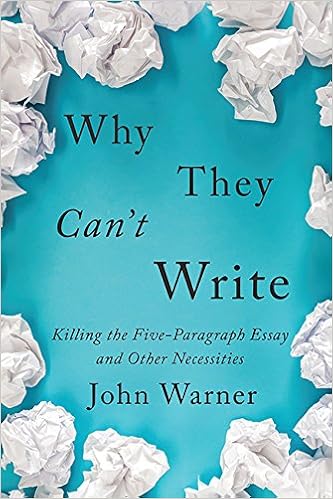
RECOMMENDED: John Warner’s “Why They Can’t Write”

For my 35 years as an educator, I have taught writing and fought a seemingly fruitless battle against know-nothings who either pontificate about or make policy for education.

If I weren’t already an eager fan of John Warner’s blogging at Inside Higher Ed, I feel sure I would have immediately blown a gasket over his newest book’s title: Why They Can’t Write. Although almost immediately the subtitle would have definitely given me hope: Killing the Five-Paragraph Essay and Other Necessities.

I can assure you right off that this is not the sort of drivel the title echoes—Why Johnny Still Can’t Read — And What To Do About It—and instead is a very powerful call for teaching writing well from Warner who is both an accomplished writer and a seasoned writing teacher.

In fact, my strongest recommendation for this book is based on Warner’s expertise across writing and teaching combined with his commitment to remaining himself a student of both. Warner embodies my argument that teaching writing and writing are journeys, not destinations.

The opening, “Our Writing ‘Crisis,'” makes a really important and contrarian argument that, I think, guides the entire book. To the title’s assertion/question, Warner explains: “‘They’re doing exactly what we’ve trained them to do; that’s the problem.'”

As a first-year writing teacher at the college level, Warner has witnessed much of the same dynamics I have experienced over about the same time period; if students struggle with writing in ways that are expected at the college level, much of that disconnect can be seen in those students having been taught what is essentially bad practice—focusing on correctness and correcting, conforming to prompts and templates, having over-simplified concepts of evidence and citation, performing very limited writing capabilities that parallel very weak thinking (linked to the five-paragraph essay that Warner rejects).

An excellent evidence-based companion to Warner’s book, in fact, is Applebee and Langer’s research on the teaching of writing at the middle and high school levels. They detail that while most teachers in all disciplines know more than ever about how to teach writing well (in ways Warner outlines in his book), students write less often and shorter pieces in English as well as their other courses.

The culprit? High-stakes accountability in the form of standards and, most of all, testing.

All teachers who have some responsibilities teaching writing should read this book, but those engaged with first-year writing may be most compelled by Warner’s messages.

Another strong aspect of this work is that Warner’s writing is always engaging while remaining very practical—something practitioners tend to demand.

I think his Part II really shines by highlighting problems: atmosphere (“‘School sucks'”), surveillance, assessment and standardization, education fads, technology hype, folklore, and precarity. Many of these are recurring concerns I have experienced teaching high school English throughout the 1980s and 1990s as well as college-level writing since 2002.

Stylistically, Warner has chosen to be conversational, so this volume is not heavily cited with current research on composition. While some may bristle at this choice, I am very comfortable noting that Warner’s critiques and recommendations match well with that research base (again, consider Applebee and Langer, but also Peter Smagorinsky and a long list of K-12 researchers and practitioners advocating writing workshop).

What teachers find in Warner is a confession that writing and teaching writing are damned challenging. But he also offers foundational concepts and practices if our goal is to foster developing writers who think and compose by choice and with purpose.

This is not about test-prep. This is not about inauthentic compliance masquerading as writing.

Being a writer and teaching writing are mostly about problems. Warner recognizes the problems (and if you teach writing, so will you), and the challenges, but also provides some important reassurances that we can teach writing better, probably well, and then, our students? Well, they can write if offered the opportunity.

Navigating the Trivial in Writing Instruction

Most teachers charged with writing instruction at all levels from K-12 through graduate education have far too little time and almost impossible learning conditions in order to teach writing well, much less completely.

After decades of teaching writing, I have far more questions, and goals, than I have answers.

But I do have two guiding principles that I believe help my writing instruction to be more effective, if still lacking: (1) no writing-intensive course is an inoculation (writing and students are not diseased things to be cured), and (2) to invoke Thoreau, it is not any writing teacher’s duty to do everything, but to do something well.

With those in mind, this Twitter exchange provides an excellent entry point to how we should navigate the trivial in our very challenging work teaching writing:

Drezner’s original Tweet and Warner’s reply provide an important tension that all writing teachers face, the tension between the trivial (elements such as format, grammar, mechanics, and usage) and the substantive (expression, credibility of claims and evidence, audience awareness, purposefulness, etc.).

Broadly, this debate sits within the prescriptivist versus descriptivist approaches to language. For teachers of writing, I think we must acknowledge that prescriptivism remains the norm in both formal education and social norms. In other words, many people are prone to see (or hear) “errors” and then to draw some evaluative conclusions from those “errors” regardless of the credibility or effectiveness of the whole text or expression.

Drezner is typical of those who cannot look past the trivial (confusing “it’s” and “its”) in order to recognize the ultimate whole of the text.

Like Warner, I rest in the camp that rejects prescriptivism and seek ways to focus my instruction, and student drafting, on the substance of their writing as well as their journey to being writers and scholars.

But this is no new tension, as Lou LaBrant (1946) expresses, many decades before Warner’s retort: “As a teacher of English, I am not willing to teach the polishing and adornment of irresponsible, unimportant writing.”

With limited time and reduced teaching and learning conditions, teachers of writing must focus on priorities—fostering purposeful, thoughtful, and risk-taking young writers who have an awareness of prescriptivism and the consequences of so-called “errors” in their writing.

As a first-year writing teacher, I can attest that most of my students enter my writing-intensive classes mostly viewing their work as students to be about correctness and then when prompted to revise or rewrite, to be about correcting.

Their priorities learned in formal schooling about writing are the inverse of LaBrant’s mantra above; students believe correctness trumps content because they have often submitted “irresponsible, unimportant writing,” driven by the teacher’s prompts, and received high grades simply for having conventional surface features.

One example of how I try to navigate the trivial in writing instruction is the current debates about “they” as a singular gender neutral pronoun.

I offer students a mini-lesson on how language changes, a short overview of the history of the English language with some examples (grain/corn, the demonizing of “ain’t” and the tortured construction “Aren’t I?” that grew out of that), and then I introduce them to the “they” debate.

We examine pronoun/antecedent agreement and concerns about sexist language (the use of “he” as gender neutral, for example) before I detail for them that they are living in a time of language flux; many formal publications and organizations now have standardized “they” as a singular gender neutral pronoun (see especially NCTE).

However, I also address with them that many people remain trapped in the fading prescriptive view of pronoun/antecedent agreement. I caution students that they may (likely will) encounter professors and others who will, as Drezner’s Tweet in the opening shows, make conscious or unconscious decisions about their credibility as writers based on the developing convention of “they” as a singular gender neutral pronoun.

I often follow this with a discussion of my own experiences as a student in the 1970s and 1980s that included drills and workbook exercises on “shall” and “will”—noting that poor “shall” is now deceased. This leads me to the certain impending demise of “whom” coming, I think, in my students’ lifetime.

As their writing teacher, I am committed to fostering purposefulness in my students, and to help them rise above the paralysis of correctness. I want them to have healthy attitudes about language and writing, much as linguists and writers do.

Yet, this effort to raise their awareness about the specter of the language police while prioritizing their content, organization, style, and such as purposeful writers is no easy task.

It is nearly impossible to break them from habits formed over years—viewing their job as being correct or correcting their drafts—and my own practice, I fear still seems to them to prioritize the trivial.

One of my strategies embedded in my requirement that students draft and conference with me during each essay is that I use highlighting in Word to draw their eyes to the trivial (issues of grammar, mechanics, usage, and format) and reserve comments and the conferences for what I consider to be substance.

I will still highlight, for example, a singular gender neutral use of “they,” and may add a comment asking if they have used this with purpose and with awareness, but I have no policy about their grades based on that use (I do not grade writing at all in fact).

Since many of the elements I highlight are what most teachers would call “errors,” students tend to ask me why I highlight, leading to a mini-lesson. Occasionally, the highlighting works, and students self-edit, if needed.

My work as a teacher of writing, then, is defined in many ways by the tension in the Tweet exchange above. I feel mostly compelled to foster my students as purposeful writers and scholars with healthy attitudes about language and writing.

But I also feel an ethical obligation to make my students aware that language use is political, that language use (often the trivial) has real consequences for them as students and in their lives beyond formal schooling.

I do invite them to join me is changing the norm of prescriptivism, to challenge the language police, but I also am deeply aware that is a tall task to ask of any of us.

LaBrant (1952) lamented that “thousands of teachers seem to resent or refuse to recognize change.” This, I think, is a grand failure when we are teaching writing and ultimately thinking.

Language is in constant flux, and our students are both agents and victims of that change.

Navigating the trivial in writing instruction is ultimately about honoring the human dignity of our students because language is an essential part of that humanity.

The Case of White Male Privilege and Identity (Ep45)

ejuc8or's avatarEmpowerment Starts Here

Empowerment Starts Here with Chris Thinnes, Peter Anderson, Dr. Paul Thomas and Justin Schleider (click here to listen).

Scroll down to access links and other resources mentioned in Episode 45- “The Case of White Male Privilege and Identity.”

Slide1

In this episode, four ESH returns come back to the show to talk about being white, male and privileged: Chris Thinnes from Ep03 (The Case of Allyship in Context); Peter Anderson from Ep09 (The Case of Gradelessness); Dr. Paul Thomas from Ep10 (The Case of Critical Literacy) and Justin Schleider from Ep24 (The Case of Learning and Moving).

These four individuals give us an update on what they have been up to since recording their previously published episodes and they tell us how their thoughts have (have not) changed regarding the standard life, liberty and pursuit of happiness question (Question 2).  They also talk about their recognition of…

View original post 275 more words

Free Speech and Diversity of Thought?

Andy Smarick has joined a growing sub-genre of Trojan Horse commentary across mainstream media with his Why Schools Must Safeguard Free Speech at Education Week.

Certainly, a plea for free speech and diversity of thought in education is something everyone can stand behind regardless of ideologies or partisan politics?

And that’s the Trojan Horse here because the veneer of calling for diversity of thought as a free speech concern thinly masks that this sub-genre of commentary is primarily a blitzkrieg by conservative pundits to further erode the public’s trust in education, especially higher education, and to dismantle what is left of evidence-based discourse.

I entered the classroom as a teacher in the fall of 1984, standing in the same classroom where I had taken sophomore and junior English taught by the person who would become my professional mentor, Lynn Harrill.

Growing up in this rural South Carolina town in the 1960s and 1970s, I was duly indoctrinated into a conservative ideology that emphasized tradition and a strict compliance to authority. Looking back, I can recognize that “tradition” was also a veneer for the less delicate realities that my hometown was deeply racist and sexist, as was my home.

Entering college, I was a recent convert to the reverse racism mantra that was growing just as Ronald Reagan was elected president after the relentless shaming of Jimmy Carter that allowed a country to seemingly forget the deep pit that was the Richard Nixon lesson then ignored.

By my junior and senior years of college, majoring in secondary English education, I had shaken off the embarrassing ignorances of my adolescence, mostly saved, I think, by my English professors, notably Nancy Moore, who introduced me to the works of Langston Hughes, Alice Walker, Toni Morrison, and a list far too long including voices unlike the conservative bigotry of my upbringing.

I returned to my hometown to teach as a changed young man, not fully formed yet, but deeply changed. Often I had to check myself against Alice Walker’s warning against missionary zeal in her powerful The Color Purple, but I did have a mission.

With freedom of speech and diversity of thought in mind, I invite you to consider two moments from my high school English teaching career, both involved white male students and their parents—young men who in many ways reflected the person I was not so many years before I stood there as their teacher.

Early in my career, during the mid-1980s, one student submitted his argumentative essay on interracial marriage. He launched into a vigorous rejecting of marriage between blacks and whites (a recurring problem in my hometown throughout my youth and while I was a teacher there).

In those early years, I was developing my use of minimum standards for student work—as an alternative to grading—and this assignment allowed students to write on any topic they chose, but they were required to support their arguments with credible evidence.

This student’s essay was very brief, and he included not one sliver of support for any claim in the essay. I refused to accept the essay, prompting the student to resubmit with the required evidence.

The next submission, the student had essentially copied the earlier essay and added a perfunctory “it’s in the Bible” as his evidence. I rejected the essay again while explaining to him that if in fact he had evidence in the Bible to support his argument, he was required to quote and cite that evidence.

One aspect of my minimum requirement approach included that all work had to be submitted to pass the grading quarter; thus, this student knew that if the essay was not accepted, he would fail.

This stalemate resulted in a parent-teacher conference that included me, the student, the student’s father, and my principal (who had been my principal when I was a student). The father was a measured but red-faced man barely able to withhold his anger at me.

The principal had me explain the situation, which I did, and then the man interrupted, his anger slipping out some; he explained that he and his son had met with their preacher, who assured them the Bible did in fact reject interracial marriage. Although the three of them scoured the Bible for hours, he explained, they were never able to find the proof.

My principal brought the meeting to an end with “Well, I believe your son needs to find another topic.”

Several years later, probably around 1990, my American literature classes were starting a unit I taught most if not all of my high school teaching career, anchored in Martin Luther King Jr.’s “Letter from Birmingham City Jail.” As I was handing out the essay copies, one male student backhanded the photocopy I placed on his desk onto the floor with an abrupt, “I ain’t reading that [racial slur].”

I picked up the essay, placed it on his desk with my hand firmly on the papers, and calmly explained to him he would never utter a comment like that again in my class and he would in fact read MLK. The class included black and white students, but these students also, as some shared with me, had been handed KKK propaganda smearing MLK in their churches.

A few brought me the crude pamphlets that represented about three decades ago that fake news is not a recent invention.

By holding the student to the same standard I held all students concerning the use of evidence in argumentation, by silencing a student who believed he was justified to reduce MLK to a racial slur and to refuse the curriculum I had provided—were these classrooms hostile to free speech, classrooms shutting the door on diversity of thought?

So let me return to Smarick’s disingenuous and frankly lazy argument. So many of these think pieces have sprung up lately, they suffer from circular reasoning because they tend to cite each other—Smarick leaps onto the easily discredited long-read on this same topic, The Coddling of the American Mind.

This commentary is a bit more ambitious than my student’s baseless and racist screed against interracial marriage, but it fails the credibility test in its use of evidence. Even more damning, these calls for free speech and diversity of thought seem to entirely misunderstand the concepts they claim to support.

These commentaries expose that conservatives think “free speech” and “diversity of thought” guarantee that people who have no evidence for their “opinions” should be afforded equal space to those with grounded and evidence-based positions. Their cries for both are cover for racist/sexist language without consequences.

Certainly as an educator, I strongly support academic freedom, but the classroom and scholarship are specifically seeking ways to navigate “thought” with discernment. To teach means to guide students toward credible and ethical thought, not to a lazy marketplace of ideas in which all speech carries the same intellectual weight.

Some ideas are simply not in debate. Typically in formal education, for example, the Holocaust is not taught as a debate that has equal sides between Holocaust scholars and Holocaust deniers. Some students are never exposed to those denials.

Some ideas remain in debate, but for education, even ideas in debate require credibility among all the positions expressed.

Conservative hand wringing about a lack of diversity of thought in classrooms are simply partisan pandering to ideologies bereft of ethical or empirical evidence—sexism, racism, homophobia, nationalism, and more.

Finally, another way to understand these commentaries are insincere is to note conservative pundits will not, however, have an honest and open discussion about the reality that free speech and diversity of thought are not about license, not freedom from accountability. They rarely discuss that some ideas have no place in discourse, that “let’s agree to disagree” is simply a way to maintain a status quo of inequity.

Some thought need not be aired, but it does need to be confronted and eradicated. When have you read those pleas from the right?

Conservatives cannot afford to support classrooms and academic settings that are about evidence-based, grounded discourse, but are not spaces for people just to say whatever they think, believe, or want.

Like my hometown, conservative ideology in the U.S. remains inextricably tied to ideologies the pundits dare not utter, bigotry of many kinds usually masked as “tradition” or “nationalism.”

Vapid arguments that education is some sort of liberal indoctrination are, ironically, jumbled efforts to indoctrinate, desperate efforts to maintain power by erasing the power of careful and evidence-based thinking, the very thing teaching and education must remain grounded in if we genuinely believe in freedom of thought.

Dark Histories Cast Shadows over Diversity Initiatives in Higher Education

Sitting 30 miles apart, two upstate South Carolina universities seem to have mostly proximity in common. Furman University is a small, selective, and private liberal arts college while nearby public, land-grant Clemson University is the second largest research university in the state, touting a high-profile football program.

Yet, these universities represent higher education’s struggles with dark histories and a stubborn gap between faculty and student demographics compared to the communities and states they serve.

Private colleges with restrictive admission guidelines and higher costs have long struggled with diversity, but “[a] growing number of public universities are becoming less affordable and accessible for low-income students and people of color,” reports Ashley A. Smith for Inside Higher Ed.

In one ranking from 2016, Clemson (HHI 0.707) sat 98 among the top 100 universities, even less diverse than Furman (HHI 0.662), ranking 85 among the top 100 liberal arts colleges*. Both schools serve, notably, South Carolina with a black population of 26% (national rate 12%).

While many universities have begun reckoning with their histories as well as committing to diversity initiatives, diversity goals for faculty and student populations mirroring the general public remain elusive.

Reckoning with, Not Erasing, the Past

One permanent shadow appears to be Tillman Hall on the campus of Clemson University, the source of a contentious 2015 debate among students, faculty, administration, and the community.

Tillman Hall is named for former SC governor and senator Benjamin Tillman, who also founded Winthrop University (Rock Hill, SC). Will Moredock explains, “Modern historians generally regard Tillman as a fire-breathing racist, opportunist, and demagogue who played on the worst of human nature to promote himself to the highest levels of state government.”

The lack of action by administration concerning Tillman Hall spurred a student organization formed about a year earlier, See the Stripes, to continue urging Clemson toward greater diversity and inclusion:

The central idea of See The Stripes is an acknowledgement that The Tiger has stripes, which are an integral part of its existence and survival. While The Tiger could be seen as “Solid Orange” a solid orange tiger could not survive without its stripes. Similarly, Clemson University’s history has its dark parts that should be acknowledged—particularly the histories of laborers who contributed significantly to its development: slaves, sharecroppers and convict laborers.

The Tillman Hall stalemate represents one powerful hurdle for diversity goals at a university when the past remains an unaddressed stain on the present.

Furman’s reckoning has come in the form of a Task Force on Slavery and Justice, prompted by a new provost, and a diversity and inclusion committee charged by the university president.

The Task Force report, Seeking Abraham, confronts slavery and  racism in the founding of the university, but also details a roadmap of actions for moving forward as an essential part of creating a university community that is more inclusive.

Good Intentions, Rhetoric Not Enough

None the less, Furman student Juhee Bhatt blogged that good intentions of diversity initiatives are not enough:

Inclusiveness is much more than portraying students of color in news articles or acknowledging Furman’s role in slavery. Inclusiveness is an unfolding process of action that affirms the humanity of each minority on campus, it is not only displaying a headshot…or working to strengthen diversity statistics. Inclusivity is not a one-step process, rather it demands individuality and intentionality.

Across the U.S., college and universities employ faculty that are disproportionately white and male (especially at the higher ranks) and serve students channeled through narrowing admission processes and limited by increasing costs.

Further, diversity initiatives are often dulled by external forces, such as undermatching, and suffer from student and faculty skepticism about programs that seem to be more rhetoric than action, as Bhatt expresses.

Another challenge for diversity and inclusion programs is implementation, too often targeting diverse populations instead of acknowledging that diversity and inclusion awareness must be for all stakeholders—especially majority populations.

“Inclusivity Is Not a One-step Process”

A 2016 U.S. Department of Education report outlines the complex ways that colleges and universities can better attain diversity goals. These steps include more than diversity and inclusion programs, but include the following:

  • Creating mission statements to provide a context and foundation for action and policy.
  • Recognizing diversity must pervade the entire campus—faculty, administration, staff, and students—in ways reflecting the rhetoric of those mission statements.
  • Prioritizing diversity through admissions and hiring practices.
  • Providing diverse populations with on-campus support.
  • Establishing and maintaining inclusive climates as a precursor to increasing quantifiable diversity throughout the institution.
  • Resisting silver bullets, and dedicating funds and policy to a “multi-pronged commitment to diversity,” as the USDOE report concludes.

The U.S. must have colleges and universities where faculty, staff, and students represent the entire spectrum of diversity within the communities they serve, but commitments to diversity and inclusion must be more than banners, rhetoric, and public relations if those goals are to be met.


* The ranking index used (HHI): “A student body that is entirely White would have an HHI of 1. A student body that is equally made up of people from five different racial groups would have an HHI of 0.2.”

Halloween Reader: Everything You Know Is Wrong

Scientific Racism And Black Sexual Pathology

Ending the practice of pathologizing Black sexuality will not be easy because the assumptions that enable it to flourish are part of the fabric of American culture. As noted, some researchers have recognized the problems associated with pathologizing Black sexuality and are advocating different approaches, perhaps illustrating that tenaciously adhering to the old tradition can prevent true resolution.

Johnson: Women’s voices are judged more harshly than men’s

There is no escaping the fact that some voices sound more pleasing than others. And there is no quick way around society’s belief that deep voices convey authority; men have been more powerful than women for all of known history. It may be good practical advice to tell women who want to get into the voice-over industry—or indeed others that have been historically dominated by men—to use firm and deep voices if they want to impress. They might also take care to avoid the distraction of vocal fry, while simultaneously ensuring that they don’t sound too mannish. Women, in other words, are required to walk a thin line when they speak in public, a no-room-for-error performance never expected of men.

The myth of meritocracy: who really gets what they deserve?

Inspired by the meritocratic ideal, many people these days are committed to a view of how the hierarchies of money and status in our world should be organised. We think that jobs should go not to people who have connections or pedigree, but to those best qualified for them, regardless of their background. Occasionally, we will allow for exceptions – for positive discrimination, say, to help undo the effects of previous discrimination. But such exceptions are provisional: when the bigotries of sex, race, class and caste are gone, the exceptions will cease to be warranted. We have rejected the old class society. In moving toward the meritocratic ideal, we have imagined that we have retired the old encrustations of inherited hierarchies. As Young knew, that is not the real story.

Dear Media, Stop Misrepresenting Reading Instruction, Please

From Education Week to the Hechinger Report to The Answer Sheet (the latter two typically good sources for education journalism), the media simply cannot resist publishing misguided takes on how we do and should teach reading.

Citing the National Reading Panel as credible (it isn’t), misrepresenting whole language and balanced literacy (as somehow anti-phonics), hand-wringing about third-grade reading ability, and taking broad uneven swipes at teacher education—these are the hallmarks of bad journalism and garbled takes (usually with ulterior motives) on the reading wars.

Since I simply cannot continue to make the same points over and over, I suggest below a bit of actual reading to clarify why the media continually misrepresents the reading wars:

Here is a final note worth emphasizing: Phonics-intense and phonics-only reading instruction is a gold mine for textbook publishers, reading program shills, and the testing industry.

Consider carefully the who and why of public commentaries screeching about reading instruction, especially when the arguments are full of easily identifiable holes in their credibility and logic.

Liberal Higher Education Intimidating Students, and Other Baseless Nonsense

My lesson plans for my five courses on Monday changed in the wake of the synagogue massacre in Pittsburgh and this headline in the WSJ: Most U.S. College Students Afraid to Disagree with Professors.

Yet another mass shooting provided a disturbing but effective entry into discussing, as the survey referenced in the WSJ addresses, the nature of political speech in classroom settings and what constitutes “opinion.”

Apparently a survey to be released soon shows:

More than half of those students (52 percent) said that their professors or course instructors express their own unrelated social or political beliefs “often” in class, according to the poll results that are due to be released next week, but were seen in advance by The Wall Street Journal found.

But unlike their professors, the young people find it more difficult to speak up. The survey found that 53 percent of the students polled often feel “intimidated” in sharing their ideas, opinions, or beliefs if they differ from their professor’s. That’s an increase of four percentage points from three years ago.

As a college professor for nearly 20 years (with another almost two decades prior to that as a high school teacher), I found this data pretty misleading.

I embrace critical pedagogy, which argues all teaching is political; and thus, I practice being transparent with students about my informed positions but reject that I or any teacher/professor can be objective, neutral.

My students all know this, and I think, respond quite well.

At my university, for example, students are solidly right of center, many quite conservative, in general, and the faculty is moderate, with many openly Republican and most taking the traditional view that professors remain objective and neutral about “politics.”

To interrogate this survey from the WSJ, I began classes by sharing a poem, “America Is a Gun,” and exploring the research on the extreme outlier statistics on mass shootings and gun violence when the U.S. is compared internationally.

From there, I asked students to consider the consequences of having guns in the home—the tension between the belief in gun ownership for self-defense and the contradictory data: “For every time a gun in the home was used in a self-defense or legally justifiable shooting, there were four unintentional shootings, seven criminal assaults or homicides, and 11 attempted or completed suicides.”

To step outside of the gun debate, I also discussed my own experiences advocating against corporal punishment while working and living in the South, the Bible Belt where spanking remains very common.

What these issues serve to illuminate, I think, is why the conservative versus liberal framing is deeply flawed, and often misrepresents what happens at all levels of education.

Support for gun ownership and spanking are primarily traditional values, and thus conservative, norms of American culture.

The research base (what primarily drives professor teaching and scholarship) run counter to those conservative values because the data encourage change, what is fairly seen as progressive.

As I have discussed recently, we are in an era when being well informed prompts charges of being liberal, a slur that is meant to discredit.

Many if not most people who attend college, then, will experience some levels of intellectual discomfort (my experience was pretty traumatic, in fact) as they move from provincialism to being well informed, or educated.

This process is one of change, not stasis (to be conservative), and thus, it is a sort of natural tension between traditional beliefs and progressive intellectualism.

None of us enjoy coming face-to-face with the fact that what we have always believed turns out to be wrong. In an extreme case, I was raised in racist ideology, but I had to come to terms with how all of that was baseless, and inhumane.

In a much different way than people express in popular discourse, all education is very much about moving from being conservative to liberal.

This WSJ-reported survey, however, is not that examination, I suspect, but more fodder for people who confuse “political” with “partisan” and pretend that everything is just “opinion.”

When I share with students that corporal punishment is ineffective and often harmful, that grade retention is also ineffective and harmful, and that the U.S. patterns of gun violence are rooted in quantities of guns and gun access (not mental illness, for example), I am not merely spewing my liberal opinions to brainwash America’s youth.

I am being scholarly and encouraging those students to also be well informed.

Those topics are no different than teaching the Holocaust without giving time or credence to Holocaust deniers, no different than teaching evolution as overwhelmingly established science without reducing it to a “both sides” false debate infused with religion.

Being partisan (endorsing candidates or political parties) is not a line educators should never cross, but all teaching is political and all educators have ethical obligations to be well informed—even or especially when the evidence refutes traditional beliefs that are harmful (from racism and sexism to corporal punishment and grade retention).

To be informed in ways that change your positions is progressive, and thus, a rejection of being conservative.

I am hard pressed to see our colleges and universities as “liberal” as the popular slur, especially if we place them in a wider context including Canada and Europe. And I also find the effort to suggest that a rising tide of partisan professors are “intimidating” students.

Class after class as we discussed these issues exposed what students have told me for many years: Students refrain from talking in class, mostly, to avoid appearing to be wrong in front of professors and to avoid tension among their peers.

More broadly and again having almost nothing to do with partisan politics, students seem overwhelmingly convinced that their grades are linked in some ways to how much a teacher/professor likes a student.

This, I think, is not an indictment of too much partisan politics by teachers/professors but of the culture of grading that does more harm than good for teaching and learning and a cultural distrust of teaching as a profession.

Current efforts to paint higher education and college professors “liberal,” as a slur, sit in a long tradition of conservatives seeking ways to maintain the status quo—which is of course what “conservative” means, as in to conserve, keep the same (traditional).

My bias, as a professor and a scholar, is projected in my classes, my writings, and my public pronouncements, and that bias is very clear, not something I hide or pretend doesn’t exist. That bias is toward the weight of evidence, even when that evidence refutes those beliefs and ideologies that people cling to in desperation.

In the current climate, I will repeat, to be informed, to express evidence-based positions is to be labeled a “liberal.” To me, this simply means “educated.”