Category Archives: Education

Dare the School Build a New Social Order?: A Reckoning 86 Years Later

The candidacy seemed at the time nothing more than sideshow, perverse reality TV, and then Donald Trump secured the Republican nomination for president, prompting many pundits to note that as a death knoll for the Republican Party.

Yet, Trump was elected president.

During the primaries and throughout his run against Hillary Clinton, Trump proved to be relentlessly dishonest, a liar. However, mainstream media avoided calling a lie “a lie,” including major media outlets directly arguing against such language. President Trump hasn’t budged from overstatement, misleading statements, and outright lies.

Notably, major media publish Trump’s lies as if they are credible, despite fact-checking exposing lie upon lie upon lie.

Early on, many opposing Trump called for media simply to call out the lies. Here is the truly bad news, however.

During my Tuesday role as caregiver for my 2-year-old grandson, I flipped through my cable channels during his nap for a brief reprieve from NickJr. I paused on CNN, even though I loath all of the 24-hour news shows.

What caught my ear was that the newscaster was repeatedly calling Trump our for lies, using the word “lie”—over and over. This, I felt, was a real new normal I had called for, but never expected.

Next, the newscaster replayed a segment from the day before focusing on a fact checker of Trump’s many, many lies. The fact checker noted a truly disturbing fact: Trump’s supporters, he explained, recognize that Trump lies, but doesn’t mind the lies; in fact, Trump’s supporters revel in those lies because, as the fact checker emphasized, this drives liberals crazy.

It is here that I must stress two points: (1) It appears those of us believing that exposing Trump as a liar would somehow derail his presidency were sorely mistaken, and (2) we are now entering a phase of U.S. history in which the long-standing slur of “liberal” is code for taking evidence-based stances, especially if those evidence-based stances swim against the current of American ideology and mythology.

Let me offer a couple example.

In my own public and scholarly work, contexts that prompt responses that discount me as a “liberal” (with false implications that I am a partisan Democrat), I have made repeated and compelling cases against corporal punishment and school-only safety measures.

Neither of these issues is both-sides debates since the research base is overwhelmingly one-sided.

Corporal punishment is not an effective discipline technique, and it creates violent youth and adults. A powerful body research prompted by the school shooting at Columbine and including studies by the Secret Service reject school-only safety measure such as security guards, surveillance cameras, active-shooter drills, and metal detectors, all of which are not deterrents and may even create violence.

Therefore, to embrace evidence-based positions on corporal punishment and school safety is the liberal or progressive (seeking change) stance, while the traditional or conservative (maintaining established practices) positions (ignoring the evidence) cling to corporal punishment and fortifying schools while refusing to address the wider influences of communities and our national mania for guns.

Let’s consider that last point more fully next.

There is an unpopular and upsetting fact driving why school-only safety measures are futile: K-12 and higher education are essentially conservative.

Despite political and popular scapegoating of all formal education as liberal, the evidence of nearly a century reveals that all forms of school more often than not reflect the communities and society they serve. In no real ways, then, do schools meet the former Secretary of Education Arne Duncan’s hollow mantra that education is the great equalizer, some sort of silver bullet for change.

Evidence shows that at different levels of educational attainment, significant gaps persist among racial categories and those gaps are even more pronounced once race and gender are included (see p. 34).

In the 1930s, a golden era for idealism about communism and socialism in the U.S. after the stock market crash, major educational thinkers such as John Dewey (a socialist) and George Counts championed the potential for progressive education (Dewey) to shape U.S. democracy, and then for social reconstruction (Counts) to reshape the nation, as Counts detailed in his Dare the School Build a New Social Order? (1932).

As an early critical voice, Counts spoke to the educational goals that appealed to me as I eventually found critical pedagogy in my doctoral program and doubled down on my early commitment to be the sort of educator who fostered change with and through my students.

Yet, here I sit in 2018, 86 years after Counts’s manifesto. And the U.S. is being led by a pathological liar supported by more and more people who directly say they don’t care about lies or evidence because it makes liberal mad.

This is the pettiness our country has wrought, despite more people today being formally educated than at any time in U.S. history.

My 35 years and counting as an educator, part as a high school teacher and now in higher education, have been a disappointing lesson that answers Counts’s titular question with a resounding “no.”

I shared with my foundations education class the proofs of a chapter I have prepared for a volume now in-press, Contending with Gun Violence in the English Language Classroom. I then briefly reviewed the evidence against in-school safety measures, prompting a student to ask what, then, should we do in schools.

Address our larger gun culture and violent communities, I explained, reminding the class that I have stressed again and again that they need to understand at least one essential lesson from our course: Schools mostly reflect communities and society, but they simply do very little to change anything.

I don’t like this message, but it is evidence-based, and I suppose, a liberal claim.

For many years, I have quickly refuted those who assume I am a partisan Democrat (I am not, never have been). I also have rejected labels of “liberal” and “progressive” for “critical” and “radical.”

But I feel the time is ripe for re-appropriating “liberal” when it is hurled as a slur.

In Trumplandia, to be fact-free is to be conservative, traditional, and to acknowledge evidence is to be liberal, progressive.

This is what the evidence reveals to those of us willing to see. Everything else is a lie.

There’s both sides for those who want it.


Recommended

College campuses are far from radical

Chicken-Little Politics and the Curse of Testing (and Standards) in South Carolina

I entered education as a high school teacher in South Carolina in the 1984-1985 academic year, the first year of a significant teacher pay raise and a pivotal ground zero in the state’s accountability era established in late 1970s legislation.

Over about four decades, SC has revised or changed educational standards six or seven times and implemented about the same number of different state and national tests.

And what hath this curse of testing and standards wrought for SC?

South Carolina students bomb the ACT, falling behind Mississippi, announces an article by Paul Bowers explaining:

South Carolina’s graduating class of 2018 came close to dead-last in the nation on the ACT college readiness test, painting a grim picture of a state that has languished near the bottom of education rankings for decades.

This year’s graduates placed 50th among the states and Washington, D.C., on the ACT, according to composite scores based on the test’s English, Reading, Math and Science sections.

Only Nevada’s students did worse.

The chicken-little politics of accountability has been fulfilled in ways that assure politicians, the public, and the media will declare schools, teachers, and students a failure. Yet again, and again, ad nauseam.

Let’s try something different here, ways to interpret better this data from the ACT.

The first key point about these scores is that SC is experiencing bureaucratic insanity—doing the same thing over and over while expecting different results.

The problem with eduction in SC has little to do with test scores, which overwhelmingly reflect what the problem is: Poverty and inequities grounded in that poverty as well as racism.

In fact, this response to the article exposes how misguided the entire process is:

While political and popular gazes remain fixed on test scores and standards (curriculum), we have failed to acknowledge that the quality—or even presence—of standards (and the concurrent curriculum) have no clear impact on measurable student outcomes.

The accountability era has not worked in SC, and it never will.

Ever-new standards and ever-new tests are simply rearranging deck chairs on the Titanic.

Here, then, are a couple more ways we can and should respond to the ACT scores.

Why is SC requiring all students to take a test to measure college readiness when a much smaller percentage of those students plan to enter college? And why this rush to prepare all students for college when it remains unaffordable for many, if not most, SC residents?

What assures that test scores on the ACT are mostly about teaching and learning, instead of poverty, racism, or even student effort (in other words, what assurance do we have that students have taken this test seriously)?

And finally, a significant failure of the chicken-little politics of test scores in SC is the misguided urge to rank (see the problems here).

What if we consider that SC is in the bottom quartile of states by poverty, and then, what if we concede that standardized tests are at least 60% and possibly over 80% linked to out-of-school factors (not any quality of schools, standards, or teaching) such as poverty and affluence? SC should be near or at the bottom of any rankings because of the state’s abysmal record of class and rank inequity as well as a very long history of underfunding and ignoring public education—especially in the most vulnerable communities.

This most recent sky-is-falling media report is our own hellish Groundhog Day experience; this article has been written dozens of times over the past four decades, and it can be recycled dozens of more times in the future.

Unlike the befuddled Phil (Bill Murray) in the movie, we actually can bring this nightmare to a stop.

If we have the political and public will, the media will be able to give this dark fairy tale a rest.

NCTE 2018 – Houston, TX

Find all the PowerPoints for the presentations below HERE.

Please consider attending the following sessions if you are attending NCTE 2018 in Houston TX this November:

(C.28) The Intersection of Literacy, Sport, Culture, and Society

Date: Friday, November 16, 2018
Time: 9:30 a.m.-10:45 a.m.
Location: 340 AB

Running and Non-Fiction: Haruki Murakami’s What I Talk about When I Talk about Running

P.L. Thomas, Furman University (Greenville, SC)

Strecher, M.C., & Thomas, P.L. (Eds.) (2016). Haruki Murakami: Challenging authors. Netherlands: Sense Publishers.


(E.24) Navigating the Similarities and Differences of Writing at the Secondary and College Levels

Date: Friday, November 16, 2018
Time: 12:30 p.m.-1:45 p.m.
Location: 351 D

Bridging the Writing Gap: Centering Student Voices in High School and College Writing

P.L. Thomas, Furman University (Greenville, SC)

Kristen Marakoff, Travelers Rest High School (Travelers Rest, SC)

Writing and Teaching Writing: By Topics


(F.32) Raising Voices through Critical Media Literacy in a Fake News, Post Truth America

Date: Friday, November 16, 2018
Time: 2:00 p.m.-3:15 p.m.
Location: 340 AB

An Educator’s Primer: Fake News, Post-Truth, and a Critical Free Press

P.L. Thomas, Furman University (Greenville, SC)

Goering, C., & Thomas, P.L., eds. (2018). Critical media literacy and fake news in post-truth America. Boston, MA: Brill.


(H.11) Teaching the Canon in 21st Century Classrooms

Date: Saturday, November 17, 2018
Time: 8:00 a.m.-9:15 a.m.
Location: Grand Ballroom B

Teaching the Canon in 21st Century Classrooms 

Investigating Purposeful Writing: From Poetry to Essay

One of the first activities I share with my first-year writing students is a writing exercise based on Sandra Cisneros’s “A House of My Own,” a chapter from her The House on Mango Street.

A key lesson I am reaching for involves recognizing that each sentence in this chapter is a grammatical fragment. It is here that I introduce my students to the problems they have faced in being taught rules (that fragments are errors and should be avoided in their writing) instead of being guided into purposeful language.

The difference, I explain, between Cisneros’s fragments and most of the ones they have included in their writing for school is that Cisneros constructed these with purpose—and the students likely were completely unaware of the fragments, and thus had no real purpose for them in the writing.

Purposeful writing is an overarching goal in my writing instruction—notably focusing on the craft of word choice and sentence formation as they drive tone. Most novice writers are composing carelessly. The result is that the reader couldn’t care less about the product.

As I have examined before, poetry is an ideal text for helping students grow as essayists.

Here I want to walk through January Gill O’Neil’s “The Blower of Leaves” as a model of purposeful writing.

For poets, the economy of language often required by poetry drives well the need to labor with purpose over word choice and sentence formation (although I often have to stress to misinformed students that poetry is almost entirely driven by complete sentences, even as they carry over for more than one line).

As I anticipated, discussing O’Neil’s poem spurred students to notice a variety of effective examples of purposeful writing.

We highlighted the powerful use of “fall”—signaling both the season and the motion. Here I stress that writers often look for layers of meaning carried in the fewest words possible (the power of concision) as well as reaching for ambiguity (this contrasts with most students believing writing is mostly about making grand certain statements).

The poem draws together simple yard work (and we also noted the effectiveness of the accessibility of language throughout the poem) with a grounded but ambiguous condition: “the hard work/of yard work made harder without you.”

Readers know someone is missing—but not the who, why, or how. That phrasing (repeating “work”) emphasizes a key element of the poem (possibly what we would call its meaning) through repetition, which in this case is a bit clunky, possibly jarring the reader.

I emphasize here that students often come to first-year writing having been cautioned against repetition. But the lesson they have learned is mechanical and works against purposeful writing that seeks key works to repeat for effect. “Hard work”/”yard work” comes not from a careless and lazy writer, but embraces the sound devices common in poetry in order to make the central message cohesive with the literal scene.

Here we may be drawn to discuss emotional labor, in fact, but not because it is explicitly stated—the emotional labor of loss.

Sound, I note moving them back to the beginning, gives the poem cohesion throughout—sound as that is combined with the visual:

A million brilliant ambers twisting into

the thinning October sun, flooding my eyes
in a curtain of color.

The rhyme of “million/brilliant” that is not end rhyme, and then the series of words with double letters—”million,” “brilliant,” “thinning,” and “flooding.”

In some ways, poets play word games, but rarely are they games for games’ sake; in other words, these games lend cohesion through patterns. Patterns, we must recognize, create meaning.

O’Neil’s poem is also driven by imagery, concrete language and details. Augmenting the concrete nature of the discourse is the use of analogy (and personification), a powerful but dangerous strategy in purposeful writing.

“My yard is their landing strip,” “the stiff kiss of acorns puckers the ground,” “the gaping mouths of lawn bags/with their remains,” and the final line, “Dependable as a season”—the comparisons, we examine, help emphasize the concrete—becoming more vivid—but those comparisons must also resonate accurately. In other words, purposeful writing does not make analogies simply to make comparisons; they must be true and then must elevate the ideas being addressed as well as working with the tone established.

This poem raises a complicated aspect of purposeful writing, however, since it demonstrates the effectiveness of specific and concrete details along with craft (comparison, personification, rhyme, etc.) in order to create an ambiguous message.

Readers are compelled to believe the speaker of the poem has experienced loss, and that speaker’s hurt over the loss is somehow triggered by doing lawn work. Yet, we cannot be certain of the who, why, and how—although those details help nudge us in some credible directions.

Maybe the speaker has been left by a lover, or maybe someone close has died?

“Forgive” and “forgiveness” sit near “refuse,” “dying clover,” and “weeds.” Readers may be drawn to reading “leaves” darkly (a double meaning as with “fall”), yet the reader is also left with only informed speculation.

“Nothing is ever easy or true” may serve as a ironic line against the poem’s ambiguity, but the poem becomes effective and compelling because of the power of purposeful writing—moves students can make their own as they grow in the writing of essays.

Teaching English Is Teaching English?: Not Really

In the mid-1980s, I was offered a position teaching high school Advanced Placement English after my first year teaching English in the school where I had graduated only about 6 years earlier.

I called my principal, who had been principal there when I was a student, and explained I was tempted by the offer since I wanted to teach AP but also because my first year had been overwhelming; my load was four different preparations of English and journalism, saddling me with five different curriculums and 13 different textbooks (as well as supervising the student newspaper and literary magazine).

The principal, who always called me by my first name since I had been friends and teammates with his two sons (one a year older and the other a year younger), simply replied: “Paul, English is English.”

No effort to address my early-career struggles, no words suggesting the school wanted me to stay, or even respected my work—just a very bored statement brushing aside my concerns for asking way too much of me as an English teacher charged with teaching both British and American literature as well as writing (my student load was about 125 at that time).

I hung up discouraged, and conflicted about my career. Fortunately, I called my former high school English teacher and mentor, who worked at the district office. He talked me off the ledge, and I stayed at the school, hoping something would change about this misguided understanding of what it means to teach English, and writing.

Almost two decades later, however, I sat as a new faculty member and listened as my university changed its curriculum, including a debate and eventual decision to practice a similar misguided belief—teaching writing is teaching writing, and anyone can teach writing.

Teaching some combination of high school English, writing, and teacher education courses for over three and a half decades now, I faced with a great deal of trepidation Special Report: Literacy in the Workplace (Education Week).

While there is lots here to challenge, I think it is worthwhile to focus on a passage from Is Professional Writing the Missing Link in High School English Classes?:

“The assumption is typically that writing is a single skill, and that’s not really a correct assumption. I might be good at writing scientific articles, but God help me if I had to write a novel or poetry,” said Steve Graham, a writing education expert and an education leadership and innovation professor at Teachers College, Columbia University. “It’s pretty clear there is not a strong match between what businesses are looking for and what schools are doing. [Writing in school] really has more of an emphasis on what might happen in college than in the workplace.”

Exactly—writing itself is not a single skill, and literacy is not that simple either.

What we fail to do often, however, is to pull back and admit that teaching literacy (English) and writing, as the principal I mention above believed, is not monolithic endeavors either.

High school English is too often tasked with being both survey literature courses and writing courses. As the EdWeek article muddles, high school English must prepare all students to read and write in the discipline of literature, in preparation for the workplace (another oversimplified domain), and in preparation for college (yet another oversimplification).

We have overstuffed high school English—especially in this never-ending era of standards and high-stakes testing—and as a result we do way too much way too badly.

Let me note a few alternative reforms that may serve us better than yet more hand wringing about all the failures of teaching literacy:

  • Create robust programs and degrees in education that provide all teachers of literacy with holistic experiences as students developing their own literacy skills. My primary concern is that even today, most teachers of literacy—notably high school English teachers—have very weak grounding as students in the best practices we expect them to somehow cram into their bloated obligations as English teachers. How many teachers of English have come through courses rich in writing workshop and drafting original essays in a wide variety of genres and for a diverse range of purposes?
  • Re-imagine the curriculum so that literature and composition/writing have their own dedicated spaces that can allow us to better prepare and assign teachers. Of course, this new curriculum is not about artificially separating reading and writing since students will continue to write (and learn to write) in literature courses, and read in composition/writing courses. This new way of organizing curriculum allows composition/writing to be better addressed as a nuanced set of skills across different disciplines and for many different purposes in school and beyond.
  • Reject the culture of standards and especially high-stakes testing since both feed into simultaneously overstuffing expectations for English teachers and students as well as reducing literacy to what can be measured efficiently—a key culprit in assuring students will not be prepared for anything, much less college or careers.
  • Rethink teaching students for the Next-Thing by allowing teachers of literacy, including high school English teachers, a more clear and manageable purpose for whatever course is being taught and a more nuanced and accurate perception of exactly what the Next-Thing is. As one example, traditional high school English over-emphasizes literary (fiction, poetry) analysis and discipline-specific content such as MLA citation. As a result, students acquire a warped perception of literacy that impedes their transition into college and careers.
  • Admit and then address the very real need for any teachers tasked with teaching literacy to have reasonable student loads. Currently, best practices in literacy are often not implemented because teachers cannot manage them with so many standards and testing obligations combined with excessive student loads. As a high school English teacher, I was teaching literature and writing to 100-125 students a year for five periods a day all week; as a college professor of writing, I teach only writing to 24 students (two courses) over a semester, meeting 3 days a week. Guess which context better serves my students? Teaching conditions are learning conditions.
  • Place literacy acquisition, and especially writing, in a healthy relationship to technology. First, I offer this as a practical skeptic about technology. Next, however, in 2018, I witness daily college students who have virtually no real skills with word processing. Literacy has a symbiotic relationship with technology that too often is either blurred by a careless pursuit of technology-for-technology’s sake or failed because we make baseless assumptions that contemporary students are somehow tech savvy.

Teaching English is no simple task but there is much we can and should do to remedy that problem.

As I approach 60 and the end of my fourth decade teaching, I still cringe at my principal’s “Paul, English is English,” and shudder at the realization that little has changed for my field, my colleagues, and most students in the intervening years.

Misreading the Reading Wars Again (and Again)

Here is some incredibly bad edujournalism: Hard Words: Why aren’t kids being taught to read?

And the summary blurb beneath the title takes that to truly awful:

Scientific research has shown how children learn to read and how they should be taught. But many educators don’t know the science and, in some cases, actively resist it. As a result, millions of kids are being set up to fail.

Now, let me offer a brief rebuttal.

First, the claim that we are not teaching reading as we should is well into its twelfth decade of crisis rhetoric. But the classic example rests at mid-twentieth century: Why Johnny Can’t Read.

That blather was a lie then and it remains a lie today.

I invite you to peruse the work of a literacy educator who taught from the 1920s into the 1970s and left behind decades of scholarship: Lou LaBrant. But the short version is the reading war claim that we are failing reading instruction is a long history of false claims grounded in selling reading programs.

Now let’s be more direct about the bad journalism.

This article cites thoroughly debunked sources—the National Reading Panel (NRP) and a report from NCTQ.

The NRP was a political sham, but it also was not an endorsement of heavy phonics. Please read this unmasking by an actual literacy expert and member of the NRP, Joanne Yatvin: I Told You So! The Misinterpretation and Misuse of The National Reading Panel Report.

NCTQ is a partisan think tank exclusively committed to discrediting teacher education. Their reports, when reviewed, are deeply flawed in methodology and typically misread or misrepresent research in order to reach the only conclusion they ever reach—teacher education is a failure! (Like reading instruction, apparently, has always been.)

I offer here one example of why no NCTQ report should be cited as credible: Review of Learning about Learning: What Every New Teacher Needs to Know. (See also GUEST POST by Peter Smagorinsky: Response to the new NCTQ Teacher Prep Review.)

NCTQ lacks credibility, but the organization has learned how to manipulate the current state of press-release journalism that simply publishes whatever aggressive organizations are willing to feed journalists desperate for click bait.

As well, the article plays the usual game of misrepresenting whole language and balanced literacy. A more accurate explanation of whole language and balanced literacy exposes a really ugly reason some are so eager to trash both and endorse phonics: the former are not tied to (lucrative) reading programs, but phonics is a veritable cash cow for textbook companies and the testing industry. (Note the NRP and NCLB directly led to a textbook scandal under the Bush administration.)

Although I tire making this point, no one in literacy recommends skipping direct phonics instruction. WL and BL both stress the need for the right amount and right time for direct phonics instruction (depending on student needs) and recognize that most students eventually need rich and authentic whole reading experiences to grow as readers (not phonics rules, not phonics worksheets, not phonics tests).

Finally, however, is the real paradox.

Formal schooling has likely never taught reading well. Little of that has to do with teacher education or teacher buy in. Again, see LaBrant’s work from the 1920s into the 1960s and 1970s; she laments the gap between good research and practice over and over.

Of course, the key point is why are we failing our students and everything we know about teaching reading?

One powerful reason is the accountability movement grounded in standards and high-stakes tests. Reading instruction (like writing instruction) has been corrupted by the all-mighty tests.

Test reading is reductive (and lends itself to direct phonics instruction, hint-hint), but it is a pale measure of deep and authentic reading, much less any student’s eagerness to read.

Because of the accountability movement, then, and because of high-pressure textbook reading programs, we have for decades ignored a simple fact of research: the strongest indicator of reading growth in students is access to books in the home (not phonics programs).

I want to end by addressing the real scapegoat in all this—teacher education.

Full disclosure: I have been working in teacher education for 17 years, after 18 years teaching high school English in public school.

But, I am the first to admit teacher education is quite bad, technocratic, bureaucratic, and mostly mind-numbing.

Teacher education, however, is not the problem because whether or not we are teaching reading research and practices correctly is irrelevant; teacher candidates overwhelmingly report that once they are in the classroom, they are told what to do and how—what they know from teacher education is tossed out the window.

The article is not a powerful call, then, for teaching students to read. It is a standard example of really bad edujournalism.

Ironically, a bit of Googling and reading could have alleviated much of that, but I guess we are asking for too much and may want to blame teacher education and teachers for those journalists’ inability to read.

Recommended

Whatever Happened to Scientifically Based Research in Education Policy?

Corporations Are Behind The Common Core State Standards — And That’s Why They’ll Never Work

A New School Year But the Same Concerns about Safety

Over the summer, a post on social media complained about President Trump not receiving credit for the sudden pause in school shootings. Of course, as one response noted, school violence tends to be absent when schools are no longer in session.

This virtual exchange exposes the dangers of both partisan sniping and uninformed public debates.

As K-12 schools and colleges begin new academic years, we are all once again concerned about the safety of students, faculty, and staff.

However, actual policies and practices that would better insure that safety face many hurdles. One problem with implementing effective strategies for safer schools is a lack of credible data.

Anya Kamenetz reports for NPR: “Our reporting highlights just how difficult it can be to track school-related shootings and how researchers, educators and policymakers are hindered by a lack of data on gun violence.”

This confusion over how often school shootings occur is made even more complicated since high-profile mass shootings at schools tend to create a false and distorted picture of schools. Despite what political, media, and public debates suggest, numerous studies reveal that students are safer in schools than in their communities.

And here is where we must face a powerful but often ignored fact about how to make our schools safer: School safety initiatives must begin by making our communities and wider society safer, including addressing access to and the sheer amount of guns in the U.S.

School safety measures have proven time and again not to be effective. More troubling, some safety measures have been shown to create less safe environments in our schools.

Metal detectors, surveillance cameras, and resource officers are all widely supported by politicians and the public, yet they do not create safer schools. And as a study released by the National Association of School Psychologists reveals,

There is no clear research evidence that the use of metal detectors, security cameras, or guards in schools is effective in preventing school violence (Addington, 2009; Borum, Cornell, Modzeleski, & Jimerson, 2010; Casella, 2006; Garcia, 2003). In fact, research has shown that their presence negatively impacts students’ perceptions of safety and even increases fear among some students (Bachman, Randolph, & Brown, 2011; Schreck & Miller, 2003). In addition, studies suggest that restrictive school security measures have the potential to harm school learning environments (Beger, 2003; Phaneuf, 2009).

After intense media coverage of shootings at schools in the 2017-2018 school year, many have been compelled to call for more people being armed, even arguing for increased armed officer presence in schools and arming teachers.

Yet, the evidence is overwhelming, as Melinda Wenner Moyer reports, “guns are associated with an increased risk for violence and homicide”—but not with greater safety.

If we can set aside partisan agendas and popular support for policies that lack credibility, we must confront that security cameras were present at Sandy Hook and Virginia Tech, that arm resource officers were present at Columbine and Parkland, and that turning schools into fortresses surrounded by barbed wire and gated with metal detectors is more likely to criminalize our students than protect them.

Ultimately, however, our choice is not between fatalism—throwing up our hands and doing nothing—and grasping at misleading and even harmful policies that give the appearance of making schools safer.

First, the U.S. is well overdue on a reckoning with our gun-lust. We have too many guns in the U.S., and we allow far too much access to those guns. Internationally, we are an obscene outlier in gun violence and access.

If school and community safety is a real concern in our country, we will find the political and public will to change our laws and our behavior. Without that will, our schools will remain ground zero for tragedies that could be avoided.

Next, of course, school policies and practices can have positive consequences for safety.

After Columbine, in fact, the Secret Service and U.S. Department of Education cautioned against safety structures (officers, metal detectors, cameras, etc.) and stressed:

Specifically, Initiative findings suggest that [school] officials may wish to consider focusing their efforts to formulate strategies for preventing these attacks in two principal areas:

  • developing the capacity to pick up on and evaluate available or knowable information that might indicate that there is a risk of a targeted school attack; and,
  • employing the results of these risk evaluations or “threat assessments” in developing strategies to prevent potential school attacks from occurring.

In other words, school safety is about paying close attention to our students, their needs and their struggles. School safety is a human issue, not something that can be barricaded or watched over closed circuit.

Ill-informed “gotcha” social media exchanges reveal the essential problems with our political and public responses to school violence: We are too often driven by our hearts and our guts while refusing to see and listen to the often hard answers for genuinely dangerous realities.

The Often Ignored Consequences of Being Gifted: On Misunderstanding Being Smart

Although routinely misunderstood as well, many people do acknowledge that standardized test scores by students are more strongly a marker for socioeconomic conditions of students and their parents than for student achievement or effort.

Despite efforts to create unbiased tests and to control for factors not related to achievement, standardized tests and similar measure of IQ remain weak indicators of what they claim to measure.

Giftedness, however, receives far less scrutiny for what it represents and how it is identified.

In both cases, we tend to jumble what we consider “smart.” For example, when students are tested for beginning algebra early, those students identified are usually directly and indirectly considered the smart group in a class.

These students are not necessarily smarter (whatever that is), but have developed abstract reasoning (brain development) sooner than some peers (see this as a consideration of being ready to do algebra, abstract mathematical reasoning). Biological age corresponds loosely with abstract reasoning development, but some people do not reach that level until late adolescence or even early adulthood.

While a teacher, I received training in gifted and talented education, but I really didn’t understand the label in a critical way until I was introduced through social media to Webb’s Dabrowski’s Theory and Existential Depression in Gifted Children and Adults.

What is very important here is that this discovery was a key step of my own struggles with anxiety.

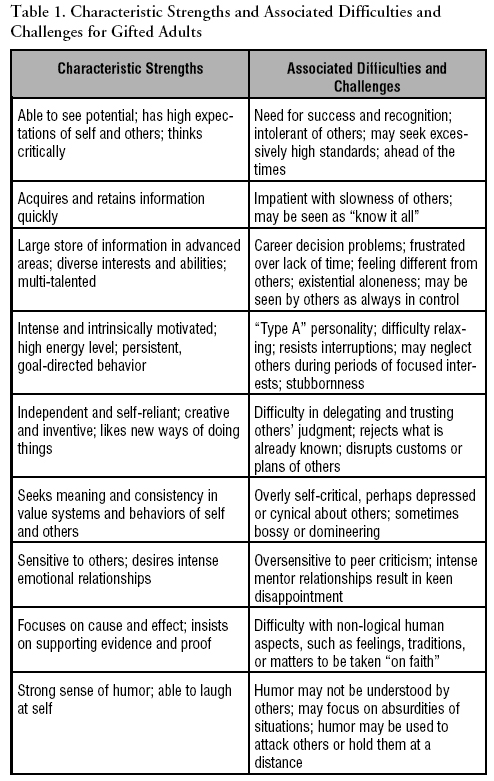
Reading Webb’s analysis was a moment I will never forget. I cried throughout the article, tears of relief prompted by a recognition I had never experienced before. One of the most profound elements of that reading is this chart:

dabrowskis 1.jpg

I returned to this article and chart recently because my virtual colleague and fellow critical pedagogue Angela Dye raised a question about giftedness:

This time working back through Webb’s examination of Dabrowski has coincided with my own renewed journey to address my anxiety and life-long struggle with chronic pain.

The chart above, I think, is incredibly important since it balances and complicates identifying students and adults as “gifted.”

As I replied to Dye’s question, I am not necessarily against the label of “gifted” (although I do balk at most labeling), but:

I have noted above that many measures claiming to identify student achievement and intelligence (being “smart”) are misleading so I want to spend some time here unpacking the negative consequences.

First, giftedness in formal education often feeds into tracking. While tracking is popular, it is overwhelmingly not effective for any students, even those who receive the boost of being advanced. As the analysis of algebra readiness explains, students identified as “advanced” are biologically advanced; this is not about merit but an accident of human development.

Therefore, when giftedness is used for tracking, it is harmful and should be avoided—especially since it often signals incorrectly that some students are smarter (better, more deserving) than other students.

Next, identifying students as gifted has a great deal of potential if it is used for counseling instead of primarily for academics. I have often joked that OCD and ADHD helped me achieved a doctorate (and most of my successes in life, actually), but the really unfunny part of that is my life-long anxiety has robbed me of a great deal of pleasure that every person deserves.

Anxious people rarely live in the moment and even when successful are unable to enjoy that success, or even see it is as success.

Tracking children and teens as gifted in their academics often works to further mask the negative consequences outlined in the right-hand column above—intolerance of others, self-loathing, social awkwardness and isolation.

Since I teach at a highly selective university, my students tend to respond strongly when I discuss these dynamics. By misunderstanding and mislabeling “gifted” and “smart,” formal education perpetuates deeply unhealthy behaviors in young people who would be better served if they recognized early and began to address the profound struggles associated with crisis thinking, anxiety, and depression.

To some, recognizing giftedness as a positive (“smart,” “advanced”) may seem a welcomed alternative to deficit ideology and our cultural urge to pathologize and medicate; however, in this case, I am calling for expanding our recognition and response to giftedness to include the negative consequences so that children, teens, and adults can accentuate their strengths while also addressing the mental and physical toll of anxiety and depression—especially when those conditions are ignored, repressed in the sufferer.

For me, recognition and awareness have been liberating, an important first step to finding ways to heal. Most of my life, I have repressed my anxiety since it has caused me a great deal of physical pain as well as social stress since I am routinely misunderstood (my behavior is misinterpreted as negative personality traits instead of anxiety responses).

Since I did not have any real understanding of these mental challenges until I was 38, and then I didn’t discover Webb’s analysis of Dabrowski until a few years ago when I was in my early 50s, I have a tremendous mountain to climb—decades of self-harming habits that feel normal even as they cause me physical pain and diminish the quality of my life.

All of that, of course, exists in a professional and social context whereby people view me as highly successful, extremely smart, and profoundly overachieving—while also viewing me as impatient, bossy, domineering, arrogant, aloof, etc.

In the early 2000s during my first (and mostly failed) effort at therapy, I declared that I would gladly give up the positives from my anxiety for some relief. My therapist argued that the positives were a gift, although I was hard pressed to see that.

Now I recognize this was a nuanced conversation about giftedness that I was simply uninformed about. I also recognize that no one has to choose as I was willing to do because with awareness and help, those of us who suffer because we have qualities some see as gifts can alleviate the negative consequences if and when we come to recognize the full picture of who we are.