Category Archives: Education

Beware Adversity Porn

With the current high-profile coverage of Stormy Daniels in mainstream media, the public is bombarded with subtle (“adult-film star”) and not-so-subtle (“porn-star client”) attempts to slut-shame Daniels through her profession in the porn industry.

This obsession with Daniels, reducing her always to porn star in order to keep our eyes on here and not Trump, reveals much about the inherent sexism and Puritanical love-hate relationship with sex that characterize Americans.

While the evidence is not as clear as many think about the dangers of pornography, something else insidious confronts the U.S. in our media and pop culture—adversity porn.

ESPN’s E:60 episode, “Letterman,” offers but one example of what I mean by adversity porn:

As TJ Cotterill reported when the episode premiered in 2015:

The first-year Lincoln coach said the inner-city schools – one in Tacoma, the other Los Angeles – share similar issues with drug abuse, poor grades, low incomes and single-family homes. Only Lincoln has a support system that didn’t exit at Bernstein.

But his endeavor to change Bernstein’s culture – symbolized though emotional letters of love he asked parents to write to his team’s players that they were surprised with and read on their own before the team’s practice – will be featured at 5 p.m. PDT Wednesday on ESPN’s “E:60.”

Viewers meet and come to empathize with several boys and men of color who all share some highlighted characteristics—the absent father, socio-economic hardship, struggles to succeed in traditional settings such as school.

In one moment, a featured boy at half-time of a football game implores his teammates to play like inner-city players; he is shouting, much as the coach, who the episode stresses has a similar background to his players, does throughout footage of his coaching.

This is adversity porn, the romanticizing of people who find themselves in adversity and then demonstrate the nearly super-human will to scream at and fight their way above that adversity.

The Coach plays the role of “I have overcome” and proceeds to be the savior for the boys and their parents, who are framed as passively negligent or unaware until the coach asks them to write letters to their sons.

Designed to be inspiring, adversity porn such as this (and examples can be found almost daily across the U.S.) depends on and perpetuates some ugly messages about people of color and people trapped in poverty; they are flawed people who need to be changed, and that problem is cloaked in code (“culture”).

Adversity porn accomplishes what much of mainstream media and pop culture sell constantly by keeping the public gaze on individuals, those who bend to adversity and those who somehow rise above adversity.

But isn’t this just a feel-good story about these boys, their coach, and their families?

The “feel-good” part is the problem because it is the soma, the Novocaine that numbs us to the real problem that adversity porn helps avoid—the adversity itself.

Adversity porn is about flawed people, and it normalizes the outliers who seem to overcome adversity. Adversity porn matches well the urge to turn our schools into fortresses instead of addressing the larger gun culture that threatens our students’ safety.

This is our rugged individualism myth that is both a lie and a distraction.

Of course, heroic and exceptional people are compelling. We love the gods of our mythologies and the superheroes of our Marvel and DC universes.

But those expectations imposed onto all humans serves only to erase any recognition of our shared and individual humanity. To live in adversity is shamed, and then to fail at rising above that adversity is more shame.

Adversity porn’s focus on the individuals and not the adversity is its ultimate corrosive influence.

New stories that acknowledge and unmask the adversity and then create hero narratives about the people in privilege who use their privilege to end the adversity, not to shame and “fix” the people who are victims of adversity—this is what we need.

No white saviors or white-savior stand-ins, no finger wagging at parents who labor under the weight of poverty, no romanticizing abusive behavior (screaming, berating) and toxic masculinity masked as “tough love.”

“Porn,” broadly, represents that which we are in some compelling and possibly even obsessive way drawn to, attracted to. The porn content itself may not be the problem, but the obsession and the distorting impact that obsession produces are likely the real problems.

Adversity porn creates overly simplistic pictures of the people trapped in adversity; then it callously ignores the adversity itself, sending a deformed message about the fatalism of adversity and the lottery that is surviving or thriving.

Ultimately, adversity porn argues that we need to instill in people trapped in adversity the grit and tenacity to overcome, but a more humane goal would be to seek ways to end the adversity itself, a goal that may be less sexy because it would require the sort of grit we demand of the poor and oppressed in those with privilege who rest on the fact of adversity themselves.
GUEST POST: In Defense of Civic Engagement in Schools

Brian Charest, PhD
Assistant Professor
University of Redlands
School of Education
Department of Teaching and Learning

Last week, we saw firsthand the incredible democratic potential and power of civic engagement. Hundreds of thousands of students across the country, in places like Los Angeles and Chicago, from New York to Parkland, and many small towns and cities in between, peacefully walked out of their schools and universities to protest gun violence in the US.

We heard the impassioned voices of students speaking out and urging legislators not only to look carefully at the research that supports gun safety regulations, but also to act on this research by passing sensible public safety legislation that protects our young people. These students (who some are calling activists), with their earnest, inspired, and eloquent speeches, are not only an amazing antidote to the cynicism infecting so much of our national politics (they even convinced our president to reverse his positions on gun safety—if only temporarily), they are also an example to us all of what civic engagement can look like when we make it a priority in schools.

Yet, there are still some who have openly criticized and tried to intimidate these students. Make no mistake, the people making these threats to these students are attempting to undermine our democracy. We should all be vigilant when we see these types of smear campaigns aimed at silencing or intimidating our fellow citizens. When people are silenced, debate ends and democracy ceases to function. We have an ethical obligation, as educators, to engage in debate with our students and to ask questions with them about how to change the world for the better.

Let’s remember this: it was a group of high school students in Parkland who stood up and spoke out against some of the most powerful and well-funded special interests in our country and started a national movement. We might begin by asking why would such powerful groups need to threaten and intimidate a group of young adults exercising their rights to participate? The answer, of course, is that these students are engaging in the public sphere and making powerful arguments to change our society for the better. What’s more, because of who they are and where they come from, they’re being heard. Why these students have the power and privilege to be heard is also worth examining. The point here, of course, is that all of these questions are worth asking and asking them now is part of what it means to be civically engaged. And, the lesson here is that people can often out organize the big money and special interests. Who wouldn’t want students to learn this lesson?

If we believe that our democracy requires citizen participation, then all of us no matter what side of the debate we find ourselves, should be supporting school walkouts, rather than discouraging them. Why? Because civic engagement is necessary for our democracy to function. This is also an opportunity to for educators to redefine what civic engagement means in schools.

So, while I understand the urge to call these students activists, doing so undermines the core responsibilities that fall to all ordinary citizens. In other words, citizenship includes both rights and responsibilities. Each of us is both responsible for participating and also exercising our rights in our democracy. When we call citizen participation activism, though, we turn it into something that’s viewed as outside the norm, when, in fact, citizen participation is a requirement for a healthy democracy.

Too often, civic participation in our schools and communities is reduced to following the laws, voting, contributing to a political campaign, or volunteering. All of these forms of civic participation are important, no doubt, but citizenship doesn’t end there. Our country has a long history of civic participation and civil disobedience. This is something that we should teach our students about civic engagement. A healthy democracy requires that all of us get involved in public debates, participate in marches, speak out, protest, go on strike, or invent some new way to engage in the public sphere when necessary and appropriate.

One of the stated purposes of the current walkouts is to galvanize public support as a way to pressure lawmakers to enact effective gun safety legislation so that students will never again have to hide in fear or run for their lives from school. These students have had enough, and they are sending a clear message: listen to us, or we will vote you out of office.

What these students have discovered is that a majority of Americans support them and their stated goal of more and better gun safety legislation. But, that’s not all that these students have learned. They’ve also realized that money and special interests have undermined our democracy and that it’s up to ordinary citizens to fight back. Our elected officials are no longer supporting or enacting legislation that’s supported by a majority of Americans. What better reason than this could there be for a national call for civic participation?

Two more nationwide protests are scheduled to take place on March 24 and on April 20, the anniversary of the Columbine shooting. As educators (including teachers, university faculty, researchers, and administrators), we should be publicly supporting, participating in, and helping to organize with our students, teachers, and principals in our schools and universities, who wish to participate in the upcoming protest against gun violence.

Our schools, for better or for worse, reflect our priorities as a society and should be spaces where students and teachers discuss what those priorities should be. In other words, even if we disagree about what to do about our culture of violence in the US, we should still support the rights of all citizens to participate in peaceful protests. There are many ways to respectfully include those who choose not to march or walkout. We can begin by engaging with them in dialogue about civic participation as well as debates about the root causes of gun violence and what to do about it.

In fact, those of us who work in schools and universities need to carve out time in our classes to research and discuss the root causes that have created a culture of violence in the US. Doing so would allow students to participate in an informed discussion about how to address the root causes of gun violence in our society. Such a conversation would examine the larger issues of public safety, the culture of violence in the US that equates masculinity with guns, bullying in schools and on campuses, violence against women in our society, the increase in militarism in schools that serve our most vulnerable youth (e.g, ROTC programs, military-run schools, junior police academies, etc.), state sanctioned violence through policing, and, perhaps, most importantly, the systemic racism that blinds us to the effects of gun violence in poor communities of color.

These national protests are the first step toward a public conversation about these root causes—a step that can help lead to the enactment of a public safety plan to reduce gun violence in the US. Such a plan would emerge from what we currently know about gun safety and gun violence prevention. Such a plan would also align with the views of a majority of Americans who believe in things like background checks for all gun buyers (93%), a ban on the sale of guns to anyone convicted of a violent crime (88%), and for waiting periods for all gun purchases (72%).

I urge all educators and advocates to take this moment to not only voice your support for civic engagement (no matter which side of the debate you’re on), but also take concrete steps to engage in the public gun safety debate. There are many ways to get involved, and we shouldn’t let this moment pass in silence.

This is an important moment for our nation, and students and teachers have an opportunity to not only debate the issue of public safety, but also get involved in a process of democratic policy making. Doing so would not only encourage teachers to teach about the power of civic engagement, but also provide an opportunity for students to see firsthand the importance of civic action in a democracy.

We need look no further than our own national history to know the power and promise of civic engagement. It has always been through a combination of careful study and vigorous debate combined with direct civic action that citizens have worked to shape their world for the better. If we don’t teach our students how to be citizens now, when will they learn to do it?

The Death of Teaching and Learning in America

“We’re the mass shooting generation. I was born months after Columbine. I’m 17 years old and we’ve had 17 years of mass shootings,” Kasky said.

Parkland Students: ‘We’re The Mass Shooting Generation’

As a teacher educator, I am fortunate to maintain professional and personal relationships with wonderful early-career educators. But here are a couple stories from one young teacher I’d rather not tell.

First, this early-career teacher has distinguished herself already; in many ways, she represents the very best of who we all want to be teaching students. But at a recent meeting about pay and benefits next year, she was informed that the slight raise she was anticipating would be negated by new retirement deductions.

Her response: “I love to teach, but I know a day is coming when the negatives outweigh the benefits, and I just won’t be able to do this any more.” She added that this moment seemed to be coming sooner rather than later, that she wasn’t going to be a martyr.

As an English teacher, she also has been struggling with her canon: the steady drip, drip, drip of male authors exposed for sexual harassment and abuse—Garrison Keillor, J.D. Salinger, Sherman Alexie.

As she has confronted these issues, and stopped assigning those writers, she has witnessed students come against a very troubling reality; one student noted in class, “Everybody we read has committed sexual harassment.”

These two moments represent the professional weight of being a teacher—issues about pay and benefits as well as pedagogy.

Now, let’s mix in something that may prove even more daunting.

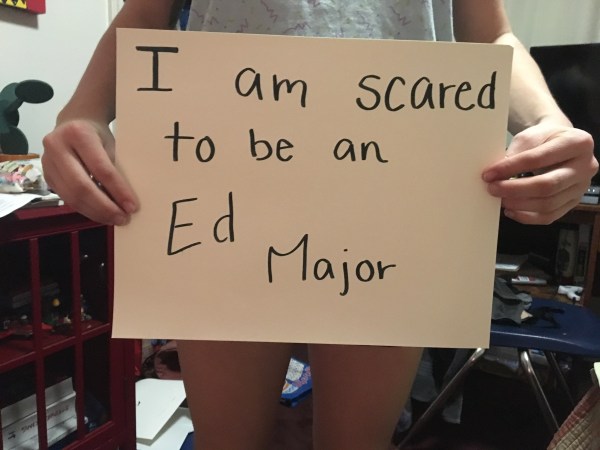
At the sparsely attended walk out on my campus, one student showed up with a sign: “I am scared to be an Ed Major.”

IMG_9701

The very real specter of schooling as a place in which students and teachers must be vigilant about safety, about the possibility of being shot; the very real specter of calls for turning schools into fortresses, with teachers armed like prison guards.

As David Edwards reports, students increasingly see attending school not as a place of learning, but a place to survive:

“It’s really scary,” the organizer added. “This is a turning point. Things really have to change. We won’t tolerate it. We won’t tolerate being scared to come into school. We won’t tolerate having to stay out of school because we’re scared. It has to change. We can’t be hunted.”

[MSNBC’s Ron] Allen observed that “hunted” was a “powerful word” to use in this context.

“I think that it’s become obvious that we’re the victims,” the girl insisted. “That we are the ones that are going to die if this continues. So I think that we have to fight to at least say that we don’t want to die.”

For decades now, many of us in education who believe in the possibility of universal public education have feared the death of teaching and learning, but we have imagined that coming from policy, free market and accountability approaches to so-called reform.

But something more sinister is happening: Schools have always labored under the weight of the communities they serve, and teaching and learning is now dying a slow and horrible death because of America’s gun culture combined with those bureaucratic monsters many of us were mostly pointing to.

In America, our students and teachers have become martyrs for our misguided politics and ideology—from abdicating teaching and learning to the standards and testing industry, to literally sacrificing lives in the name of gun lust.

Some of us have feared the death of public schools, the death of teaching and learning. Our outcry for decades now may have seemed like hyperbole—or to some, self-interested whining.

But now we are watching both the literal and figurative death of teaching and learning, and too many think the best recourse is doubling down on all the ways this death has come about.

As more and more teachers and students declare that they will not be martyrs, what role will the rest of us take—in their defense or to their demise?

The Betsy DeVos Dilemma: 14 March 2018

After the election of Donald Trump, I witnessed a response on social media I did not anticipate, but have since committed to honor when I comment on Trump’s administration: Black scholars and journalists contested claims that Trump is somehow uniquely awful and asserted their own voices about the historical and lingering consequences of white privilege in their lives.

Not always as harsh as this, but these perspectives were expressing a “Welcome to our world” response to hand wringing about Trump and his policies, rhetoric, and administration.

This racialized awareness has tempered my own urge to identify Trump as uniquely awful; instead, while I do argue he is an extreme and crass political leader, I recognize that many of the policies and the ideology he courts and expresses are often not distinct from mainstream Republican practices for decades (see Newt Gingrich).

When Secretary of Education Betsy DeVos appeared on 60 Minutes [1], then, and the media as well as public response was overwhelmingly negative, I checked myself and offered a measured argument that DeVos is, like Trump, crass and cartoonish, but she fits into the twenty-first century series of SOEs from Paige and Spellings through Duncan and King.

That sparked pushback as follows:

Since both Watters and Perry are informed voices I respect, I was then trapped between what I believed was a credible argument and their challenges—even as I found support for my stance among others who I also greatly respect:

So DeVos is a subset of the larger Trump problem that confronts us with people who have attained excessive power mostly because of their ill-got wealth and not because of their expertise or credibility.

DeVos, I maintain, represents an unmasking, however, of what has been happening with the SOE post for nearly 20 years since each SOE throughout the  administrations of W. Bush, Obama, and now Trump has been supremely unqualified and nearly uniform in market-based and flawed commitments driven by ideology and not credible educational research.

From NCLB’s facade of “scientifically-based” to Arne Duncan’s “Civil Rights issue of our time,” education policy at the federal level has been mostly, as I noted about Obama and Duncan, an Orwellian adventure in rhetoric.

This leads to Watter’s concern about DeVos being unlike, for example, John King, who did lend a voice to one aspect of the Obama administration that I believe deserves credit—the elevating of the Office of Civil Rights and shining an authoritative light on racist disciplinary policies in schools.

I remain deeply skeptical of King, who as I note in a Tweet above built his reputation in a “no excuses” charter school that practiced and perpetuated inequitable discipline, and have trouble separating King from Duncan in terms of both being mostly rhetoric to provide a veneer for policies that often produced outcomes opposite of that rhetoric.

The dilemma becomes how to accurately express outrage with DeVos, and Trump, while maintaining our awareness that while they are more overt, even cartoonish, they both fit well within an existing political structure—both Democratic and Republican—that fails to acknowledge race privilege and perpetuates race privilege.

In other words, to suddenly be outraged by DeVos is to admit you have not been rightfully sensitive to how the SOE post has been a train wreck for at least two decades; to suddenly be outraged by Trump is to admit you have not been rightfully sensitive to how the US has functioned since it inception.

That said, we must not become fatalistic, must not allow DeVos and Trump a pass since their entire lives have been passes facilitated by wealth and privilege.

And we must not allow DeVos and Trump to become the singular targets of change; in other words, replacing DeVos or Trump is a goal, but not an end goal because they are markers for larger problems, for larger norms that must be confronted and eradicated.

Yes, DeVos in all her Amway, faux-Christian, Libertarian awfulness is to be rejected and then replaced. And, yes, we certainly can identify ways in which she is exceptionally awful even against a crop of awful SOE appointees. In fact, I struggle to view DeVos as worse than Spellings since Spellings, like Duncan, has social capital and a veneer of decency that makes her even more dangerous, I think.

Despite her incompetence as SOE, Spellings has become president of UNC.

DeVos was wreaking havoc for years as a billionaire activist with almost no one outside Michigan taking notice [2], and she will likely slink right back to that sort of life once she eventually fades from her political perch.

All of this highlights the dilemma of institutionalized incompetence that confronts us in the persons of DeVos and Trump, but not only because of their personal flaws.

Today is March 14, 2018, a national day of protest by the youth of America.

The adults who elected Donald Trump, facilitated DeVos, are shouting that we in the US must not listen to children and teens.

Adults who elected Trump are afraid children and teens aren’t credible, aren’t qualified.

Watch the DeVos interview; watch any clip of Trump.

Then watch a clip of some of the teens from Parkland, Florida.

The choice is quite obvious, and no dilemma at all.


[1]

[2] Evidence-based thread on DeVos:

See Also

Betsy DeVos Wants to Reverse Efforts to Bring Some Degree of Racial Justice to School Discipline

DeVos and the limits of the education reform movement

Betsy DeVos Calls “60 Minutes” a Waste of a Half Hour

The Worst Government Possible, on Purpose

CURMUDGUCATION: DeVos: Made Up of Individuals

CURMUDGUCATION: DeVos In This World

Shifting Disciplinary Gears as Student Writers

These may have seemed petty or just pet peeves to my students, but I would not tolerate this sort of framing in student essays about literature:

Emily Dickinson says, “Because I could not stop for Death – /He kindly stopped for me –.”

William Shakespeare is often quoted as saying “brevity is the soul of wit.”

In the first example, I would note that poems have speakers, some personae that may or may not be the poet. I encouraged students to take great care to identify “speaker” if a specific voice isn’t identified in the poem along with nudging them to avoid the lazy “say” verb choice.

The second example is far more vexing since it makes the same error (the line is spoken by Polonius in Hamlet, and is not Shakespeare expressing a pithy idea); however, it is far more flawed since the phrase absent the context of the character speaking and the play itself allows people to completely misrepresent the line as a truism—instead of acknowledging that it is a hollow claim of a blowhard.

What I was teaching students included a couple of broad and narrow lessons about writing: one, broad, captures the need for precision in writing that is far more nuanced than what many expect in speaking, for example, and two, narrow, teaches some of the nuances of writing in the discipline of literary analysis.

It is at that second and narrow lesson I want to focus on some of the strategies connected with helping students develop a toolbox as writers that supports them shifting gears among different disciplines.

For example, let’s think about how students must navigate (too often without explicit instruction) the conventions of the humanities (writing in English or history courses) and the conventions of the social sciences (writing in psychology, sociology, education).

Two ways we fail students in those contexts include laying almost all of writing instruction at the feet of English teachers (K-12) and first-year writing instructors (as a one-shot inoculation), and then focusing too narrowly on the mechanics of citation style sheets (MLA, APA, Chicago, etc.) instead of the broader approaches to writing in the disciplines that those styles support.

In all of my courses—first-year writing, foundations education, upper-level writing/research, graduate—I require extensive writing assignments, and students consistently demonstrate a lack of awareness about disciplinary expectations for writing. Primarily, they come to writing assignments with literary analysis and MLA “rules” that they impose on all types of writing.

Therefore, some of the nuances I must address include the following:

  • In the humanities, source-based writing tends to focus on textual analysis of a primary source supported by secondary sources. Writing in the social sciences rarely involves textual analysis (except when including critical discourse analysis), but asks the writer to synthesize bodies of research to address key topics or questions.
  • Therefore, writing in the humanities often explicitly identifies authors and titles directly in the flow of sentence and discussions: “In her ‘Vesuvius at Home,’ poet Adrienne Rich explains, ‘But of course Dickinson’s relationships with women were more than intellectual.'” As well, writers in the humanities may explore one source at a time (both primary and secondary) to make a larger case about the primary source being addressed (for example, Rich examining the poetry of Dickinson).
  • However, writing in the social sciences synthesizes patterns of claims and conclusions across several sources, and thus, authors and titles rarely appear in the flow of sentences with attributions mostly parenthetical or in end/footnotes: “For this volume on comic books, then, interrogating the medium in the context of race is extremely complex because comic books are a significant subset of popular culture (increasingly so with the rise of superhero films based on comic books throughout the late twentieth and into the early twenty-first centuries), which necessarily both reflects and perpetuates all aspects of the culture it serves—including bigotries such as sexism, racism, classism, jingoism, and homophobia (McWilliams, 2009; Rhoades, 2008a, 2008b; Singer, 2002; Thomas, 2010; Wright, 2001).”
  • In the context of the second and third bullet, then, students must confront that writing in the humanities often requires direct quoting, but writing in the social sciences prefers synthesis (often oversimplified as paraphrasing*). Here, there are disciplinary contexts for how a writer supports claims that contradicts most students’ belief that all writing requires quoting.

These problems for students as writers and for teachers of writing also complicate my argument against templates and my commitment to students choosing their type of essays and topics.

Since writing and teaching writing are extremely complicated, then, I want to end here with how I have organized my upper-level writing/research course around commitments to scaffolding assignments, student topic choices, and supporting students as writers confronted with a variety of writing modes and disciplinary expectations.

Students have three major writing assignments—annotated bibliographies (sources that serve as the foundation for their scholarly essay), a major scholarly essay on an educational topic of their choice, and a public commentary incorporating hyperlinks for support and addressing the same topic as their scholarly essay but for a lay audience.

After students gather evidence that an educational topic has been covered often in the mainstream media, they choose that topic to investigate the research base, producing 8-10 annotated bibliographies of high-quality sources. In this process, students practice evaluating sources and also refine their skills in APA formatting (focusing on the bibliographies).

After they submit the first draft of the annotated bibliographies, we discuss how social scientists write, contrasting that to their humanities/MLA assumptions (addressed above). In a class workshop format, I then ask them to revise the annotations (and edit the bibliographies) by focusing on discussing the content of the research, and not announcing authors and titles. For example, a first draft includes: “DeLeon suggests that the archetype of the “urban” criminal stems from colonial portrayals of African Americans, which sought to paint a picture of savage, uncivilized peoples.” Then revised as: “The archetype of the ‘urban’ criminal stems from colonial portrayals of African Americans, which sought to paint a picture of savage, uncivilized peoples.”

The major scholarly essay challenges them next in several ways. The recommended structure includes the following: a personal narrative or narrative opening (supported by Robert Nash’s Liberating Scholarly Writing: The Power of Personal Narrative), a section applying critical discourse analysis to several media reports on an educational topic (requiring them to analyze text and quote, similar to their humanities background), a section that is a mini-literature review of the research on the topic of choice (requiring them to write as a social scientist, synthesizing their annotated bibliographies, and practice the nuances of APA citation), and a closing (introducing them to the concept of framing, in which they return to their opening narrative in order to frame their essay focus—either that the media misrepresent or credibly represent the topic they chose).

The scholarly essay demands that students shift modes and investigate purpose as writers; the assignment is not prescriptive or narrowly prompted, but it is structured while also being demanding (although each student and I discuss how to revise that initial plan if the topic demands a different approach).

After drafting a scholarly essay using formal citation, students then condense what they have discovered into a much briefer (750-1250 words) commentary that incorporates hyperlink support and addresses a lay audience. Here, students must reconsider diction and sentence formation while also being more selective about using evidence. On that last point, we discuss the need to use individual examples that are accurate reflections of generalizations; in other words, focusing on one source but being careful that it fairly represents the body of research they have examined in their scholarly work.

This process, I think, helps represent how complex both writing and teaching writing are. Further, it shows that we serve our students best by avoiding writing assignments and instruction that oversimplifies the writing process and products (not asking students to write a narrative, but inviting them to integrate the narrative mode in service of a larger cohesive essay, genre, and discipline).

Where templates and prescription fail, we must seek ways to provide structure and scaffolding so that students can have multiple experiences shifting disciplinary gears as writers.


* Students admit that they have tended to use a passage from one source at a time and paraphrased by looking up synonyms one word at a time in that passage.

They Were Born for This Moment: How the student activists of Marjory Stoneman Douglas High demonstrate the power of privilege.

Dahlia Lithwick’s take on the impact of teenagers from Parkland, Florida after yet another mass school shooting is a flawed Bob Dole read on the power of education. The most telling moment that this misreading of why America seems to embrace these teenagers comes here:

Despite the gradual erosion of the arts and physical education in America’s public schools, the students of Stoneman Douglas have been the beneficiaries of the kind of 1950s-style public education that has all but vanished in America and that is being dismantled with great deliberation as funding for things like the arts, civics, and enrichment are zeroed out. In no small part because the school is more affluent than its counterparts across the country (fewer than 23 percent of its students received free or reduced-price lunches in 2015–16, compared to about 64 percent across Broward County Public Schools) these kids have managed to score the kind of extracurricular education we’ve been eviscerating for decades in the United States. These kids aren’t prodigiously gifted. They’ve just had the gift of the kind of education we no longer value.

Political analysis of Dole’s last failed run for president often includes that Dole’s narrative focused on going back to an idealized and whitewashed past, while Bill Clinton focused on the future.

To suggest a “1950s-style public education” is a major element of the good ol’ days is an incomplete and ultimately offensive view of history.

Public schools reflected and perpetuated in mid-twentieth century all of the very worst aspects of American society, including segregation and corrosive inequity along race, social class, and gender lines.

The disturbing irony of the flawed central thesis of this argument is that the student activists from Stoneman Douglas High do in fact represent the realities of 1950s-style public education: Privileged children in the U.S. also benefit from privileged schooling—a fact of the 1950s and of the 2010s.

There are, however, two lessons from the activism of these Parkland, Florida teens:

  1. It provides another entry point into debunking that education is the great equalizer, and
  2. it represents in contrast to how America has responded to #BlackLivesMatter activism the lingering racial divide about whose voices, and thus lives, matter.

To the first lesson, consider the following:

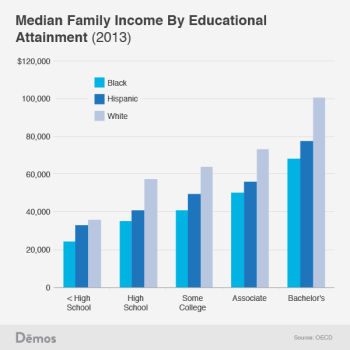
And as a powerful visual for understanding that educational attainment does not level racial inequity, consider this (as well as a wealth of research contradicting education as the great equalizer):

fig_2
Source: Bruenig, 24 October 2014

Yet, Lithwick maintains:

Part of the reason the Stoneman Douglas students have become stars in recent weeks is in no small part due to the fact that they are in a school system that boasts, for example, of a “system-wide debate program that teaches extemporaneous speaking from an early age.”

The mistake here is that educational opportunities are a marker for the accident of birth most children enjoy or suffer; highlighting the rich schooling experiences of the Parkland, Florida students receive is a veneer for confronting that they mostly are the beneficiaries of privilege, first in their homes and communities, and then in their schools, which reflect and perpetuate their privilege.

To be clear, this is no condemnation of these teen activists, but their access to widespread national recognition is driven mostly by their privilege in many of the same ways that the Bush family and the Trumps have parlayed generational wealth into more (often ill-got) power, regardless of their merit.

This misreading of the reasons why the Parkland, Florida teens are being heard provides cover for the more damning and problematic second lesson, as Sarah Ruiz-Grossman confronts:

For some black activists who have long been mobilizing around gun violence, the current wave of public attention and outrage over the issue is welcome. But it also invites the question of why there’s been comparatively little attention and outrage focused on the even more common reality of routine gun homicides in the country, which disproportionately affect communities of color, and specifically black Americans.

Prominent black organizers and public figures have also noted the largely positive public response to the student activists from Parkland ― most of whom are not black and who attended school in a largely white, relatively affluent Florida suburb ― compared to the frequent vilification of young black activists protesting gun violence, particularly police shootings.

The Stoneman Douglas High teens are no more credible in their activism than the many black teen activists who have responded to the equally disturbing normal of police shootings that disproportionately kill blacks.

When affluent and a certain kind of articulate young people confront mass gun violence, their privilege sparks responses that are distinct from the responses to a differently racialized and classed protest against gun violence perpetually killing one person at a time.

Kurt Vonnegut, who died of lung cancer, confessed in the preface to a collection of short stories: “The public health authorities never mention the main reason many Americans have for smoking heavily, which is that smoking is a fairly sure, fairly honorable form of suicide.”

Beyond the macabre humor and stark reality of Vonnegut’s admission, we must see that he is deconstructing the power of normal; once something become normal, it projects the impression that is also right.

In the U.S., the messengers and the messaging are more powerful than the message. And this is the large scale lesson of the Parkland, Florida activism: Privileged voices and lives matter.

Public schools in the U.S. are not game changers, not great equalizers. Further, as the Parkland, Florida teens argue, no public school should be tasked with defending children against a negligent political class bought and owned by the NRA.

1950s nostalgia also ignores the celebrity class, often movie stars, doing the dirty work for Big Tobacco, ruining the health of America’s youth for the sake of commerce, and this too fits in an ironic and ugly way with misreading why privileged Stoneman Douglas High teens are now waging a battle with the NRA controlling negligent political leaders.

Simply saying something is true doesn’t make it true, and just because it is normal doesn’t mean it is right.

The Stoneman Douglas High teen activists were born for this moment. They demonstrate the power of privilege.


Please see these Twitter exchanges as well:


Naive Expert Greater Threat than Fake News

Writer, occasional visiting professor, and “renowned public scholar,” John Warner takes to social media regularly to opine about the failures of pundits and high-profile Op-Ed commentators, notably the ever-dreadful David Brooks. This Tweet strikes at what I have labeled the “naive expert”:

My response was something like “Welcome to my world!” since educators, practitioners and scholars, have worked through the high-stakes accountability era under that exact environment: Politicians, the public, and pundits holding forth on teaching and learning as if no practice or research has ever existed, and then, policy being adopted that seems at times purposefully endorsing what practice and research explicitly reject.

For just one glimpse into “my world,” consider that a couple years ago a journalist at a newspaper reached out to me through social media. When we talked by phone, the journalist immediately confessed that they had taken the education reporter position to get in the door; the journalist has no background in education, or even in covering education as a journalist.

This is a routine fact I witness constantly—journalists have training in journalism (itself a serious problem, as I have confronted often) and then are expected to navigate topics and fields simply by seeking out both sides of the issue, despite having no expertise for determining the credibility of any claims about the topic.

The result is that most media coverage of education is at best misleading, and often in ways that contribute to flawed public perceptions and decades of misguided policy.

Concurrent to Warner’s confronting naive experts—who pose far greater threats to our democracy than fake news—one of the poster boys for the arrogance of public commentary absent any real expertise or experience in the field, Jonathan Chait, held forth about the Obama education legacy, arguing that this legacy is positive but ignored.

Chait suffers from the Columbus effect—”Look! I found this thing!”—and appears completely clueless that throughout the Obama administration, scholars and educators mostly rejected Obama’s education reform agenda that was almost indistinguishable from the equally flawed education agenda under George W. Bush (see this edited volume and my essay).

While Chait benefits from his bully pulpit as a christened public intellectual, most people will fail to read the far more credible and evidence-based responses from Peter Greene and Jersey Jazzman.

Greene dismantles Chait through a series of 9 powerful points, and I want to note that #5 (“Chait doesn’t know what the “sides” are”) serves as an excellent entry point into my own post from 2013 that frames the education reform “sides” in ways that Chait cannot fathom. Chait is trapped in making everything about partisan politics, instead of having experience and expertise in education, which would help him see that ideology is more powerful than crass partisan politics.

Jersey Jazzman builds on Greene’s post and offers a very important framing; naive experts fumble fields in which they have no credibility, but scholars in one discipline often tread into other disciplines in the same sort of ham-fisted ways [1]:

Chait’s piece here is an excellent example of this problem [“naive expert”]. So allow me to take a pointed stick and poke it into the econometric beehive; here are some things everyone should understand about recent research on things like charter schools and teacher evaluation that too many economists never seem to get around to mentioning.

And while Warner laments the damage done to teaching writing, and I have fretted for decades about how naive experts have caused us never to fulfill the promise of universal public education, a far more troubling example of this threat is now playing out in the U.S. where we are in a perpetual state of moving past the most recent mass or school shooting.

From school safety to gun control debates, most in the media are allowing commentary based on the person’s status, and almost no media are requiring an evidence-based discussion. Just as mainstream media have been complicit in the failures of education reform since the early 1980s, mainstream media are complicit in the political and public paralysis that continues to allow mass and school shootings in the U.S.

While politicians and the media toss around “the marketplace of ideas” to justify the “both sides” and “all voices matter” approaches for public discourse, failing to address the credibility of voices ultimately fails that marketplace.

Expertise and experience matter, in fact, in ways that naive experts fail miserably.

So let me end by returning to Columbus, mentioned briefly above.

The Columbus myth—that he discovered America—endured and continues to endure because of the Columbus effect, those without real and nuanced historical knowledge or sensitivity to native people both created and then perpetuated a provably false narrative about Columbus and his often inhumane as well as incompetent reign as a so-called explorer.

Even as historians unpacked the Columbus myth, however, the punditry and public have continued to frame the facts of history as political correctness or some sort of misguided social justice over-reach (see also the chasm between historical facts about and the myth of the Founding Fathers).

The naive position combined with power, like Columbus, works in ways that harm everyone.

Expertise and experience are not perfect, but they do offer the better opportunity for creating a more perfect union.

Yes, let’s discredit fake news, but let’s also admit that the naive expert punditry poses the greatest threat to our democracy and humanity.


[1] See Well, It’s Complicated: How to Stop Living by What You Think and Start Living by What You Know

School Safety and Security: Research and Evidence

Update: KEEPING OUR SCHOOLS SAFE: A PLAN TO STOP MASS SHOOTINGS AND END GUN VIOLENCE IN AMERICAN SCHOOLS

Update: Enhancing School Safety Using a Threat Assessment Model, United States Secret Service (2018)

If You Want to Know How to Stop School Shootings, Ask the Secret Service, Jeff Daniels, Professor of Counseling, West Virginia University

The Final Report and Findings of the Safe School Initiative, United States Secret Service and U.S. Department of Education (2002)

Overview of Safe School Initiative Findings

The findings of the Safe School Initiative suggest that there are productive actions that educators, law enforcement officials and others can pursue in response to the problem of targeted school violence. Specifically, Initiative findings suggest that these officials may wish to consider focusing their efforts to formulate strategies for preventing these attacks in two principal areas:

  • developing the capacity to pick up on and evaluate available or knowable information that might indicate that there is a risk of a targeted school attack; and,
  • employing the results of these risk evaluations or “threat assessments” in developing strategies to prevent potential school attacks from occurring.

Support for these suggestions is found in 10 key findings of the Safe School Initiative study. These findings are as follows:

  • Incidents of targeted violence at school rarely were sudden, impulsive acts.
  • Prior to most incidents, other people knew about the attacker’s idea and/or plan to attack.
  • Most attackers did not threaten their targets directly prior to advancing the attack.
  • There is no accurate or useful “profile” of students who engaged in targeted school violence.
  • Most attackers engaged in some behavior prior to the incident that caused others concern or indicated a need for help.
  • Most attackers had difficulty coping with significant losses or personal failures. Moreover, many had considered or attempted suicide.
  • Many attackers felt bullied, persecuted or injured by others prior to the attack.
  • Most attackers had access to and had used weapons prior to the attack.
  • In many cases, other students were involved in some capacity.
  • Despite prompt law enforcement responses, most shooting incidents were stopped by means other than law enforcement intervention.

Why security measures won’t stop school shootings, Bryan Warnick, Benjamin A. Johnson, and Sam Rocha

If anything, the response of the Kentucky lawmakers represents what has been called the “target-hardening” approach to school shootings. This approach attempts to fortify schools against gun violence through increased security measures. These measures may include metal detectors, lock-down policies, “run, hide, fight” training and surveillance cameras.

While some of these measures seem sensible, overall there is little empirical evidence that such security measures decrease the likelihood of school shootings. Surveillance cameras were powerless to stop the carnage in Columbine and school lock-down policies did not save the children at Sandy Hook.

Preventing School Shootings: The Effectiveness of Safety MeasuresCheryl Lero Jonson

Abstract

The tragedies at Columbine High School, Virginia Tech, and Sandy Hook Elementary School catapulted concern about school shootings into the national spotlight. Calls for something to be done to protect our students, faculty, and staff became a salient concern for school administrators, with many schools hiring armed security officers, restricting access to campus buildings, installing metal detectors, and training individuals how to respond when a shooter enters school grounds. However, many of these security measures were implemented with little to no consultation of the empirical literature. This failure to enact evidence-based responses has had fiscal and latent consequences that are only now being discovered. This essay seeks to fill that void by examining the empirical evidence surrounding common security measures enacted in response to well-publicized school shootings and calling for the use of an evidence-based approach to school safety.

School Security Measures and Their Impact on Students, National Association of School Psychologists

Impact of Security Measures on Violence

  • There is no clear evidence that the use of metal detectors, security cameras, or guards in schools is effective in preventing school violence, 8,9,10,11 and little is known about the potential for unintended consequences that may accompany their adoption.12
  • There has not been sufficient research to determine if the presence of metal detectors in schools reduces the risk of violent behavior among students. 13
  • Some researchers have expressed concern about the widespread use of guards, cameras, and other security technologies, given that so little is known about their effectiveness. 14,15
  • Research has found security strategies, such as the use of security guards and metal detectors, to be consistently ineffective in protecting students16 and to be associated with more incidents of school crime and disruption17 and higher levels of disorder in schools. 18
  • Evidence from a school–police partnership implemented in New York City reveals that students in these schools continue to experience higher than average problems linked directly to future criminality, compared to students in other New York City schools not involved in the partnership. 19
  • Surveillance cameras in schools may have the effect of simply moving misbehavior to places in schools or outside of schools that lack surveillance. Even more troubling, it’s possible that cameras may function as enticement to large-scale violence, such as in the case of the Virginia Tech shooter who mailed video images of himself to news outlets.20
  • Research suggests that the presence of security guards and metal detectors in schools may actually increase levels of violence in schools by strengthening the influence of youth “street” culture with its emphasis on self-protection.21

More Guns Do Not Stop More Crimes, Evidence Shows, Melinda Wenner Moyer (Scientific American)

More than 30 peer-reviewed studies, focusing on individuals as well as populations, have been published that confirm what Kellermann’s studies suggested: that guns are associated with an increased risk for violence and homicide. “There is really uniform data to support the statement that access to firearms is associated with an increased risk of firearm-related death and injury,” Wintemute concludes. Gun advocates argue the causes are reversed: surges in violent crime lead people to buy guns, and weapons do not create the surge. But if that were true, gun purchases would increase in tandem with all kinds of violence. In reality, they do not.

Student Surveillance, Racial Inequalities, and Implicit Racial Bias, Jason P. Nance

Abstract

In the wake of high-profile incidents of school violence, school officials have increased their reliance on a host of surveillance measures to maintain order and control in their schools. Paradoxically, such practices can foster hostile environments that may lead to even more disorder and dysfunction. These practices may also contribute to the so-called “school-to-prison pipeline” by pushing more students out of school and into the juvenile justice system. However, not all students experience the same level of surveillance. This Article presents data on school surveillance practices, including an original empirical analysis of restricted data recently released by the U.S. Department of Education after the shootings at Sandy Hook Elementary School. Paralleling other disturbing trends of inequality in our public school system, these results and other empirical analyses reveal that schools serving primarily students of color are more likely to rely on more intense surveillance measures than other schools. Further, the empirical evidence suggests that these racial disparities may not be justified by legitimate safety concerns. This Article then turns to a discussion of the role that implicit racial bias may have in school officials’ decisions to rely on intense surveillance methods. Finally, it proposes legislation and strategies that federal lawmakers, state lawmakers, and school officials should adopt to counteract the effect of implicit racial bias on school officials’ decisions to implement strict security measures (and other decisions school officials make). Implementing these recommendations will help create better learning environments that benefit students of all races.

Latino/a Student Threat and School Disciplinary Policies and PracticesKelly Welch and Allison Ann Payne

Abstract

Using a nationally representative sample of approximately 3,500 public schools, this study builds on and extends our knowledge of how ‘‘minority threat’’ manifests within schools. We test whether various disciplinary policies and practices are mobilized in accordance with Latino/a student composition, presumably the result of a group response to perceptions that white racial dominance is jeopardized. We gauge how schools’ Latino/a student populations are associated with the availability and use of several specific types of discipline. We further explore possible moderating influences of school crime and economic disadvantage on punishment. We find that schools with larger percentages of Latino/a students are more likely to favor certain punitive responses and less likely to favor certain mild responses, as predicted by minority threat. The percentage of Latino/a students is also related to greater use of certain disciplinary responses in schools with less crime.

Mental Illness Didn’t Make Him Do It, Jonathan Foiles (Psychology Today)

The supposed link between mental illness and violence is so ingrained in our culture that stories like the above need only suggest that the perpetrator was depressed to satisfy a need for an explanation. Research reveals a far different story, however. People with mental illnesses are actually far more likely to be victims rather than perpetrators of violence (Appleby et. al., 2001). Those with severe mental illnesses (schizophreniabipolar disorderpsychosis) are actually 2.5 times more likely to be victims of a violent crime than the general population (Hiday, 2006). A 2011 study found that to prevent one violent homicide by a person with schizophrenia, 35,000 patients deemed to be at a high risk of violence would need to be detained (Large et. al., 2011). And yet the link persists. A 2013 survey conducted after the Newtown shooting found that 46 percent of Americans believe that persons with a serious mental illness are “far more dangerous than the general population” (Barry et. al., 2013).

The MacArthur Violence Risk Assessment Study Revisited: Two Views Ten Years After Its Initial PublicationE. Fuller Torrey , M.D., Jonathan Stanley , J.D., John Monahan , Ph.D., and Henry J. Steadman , Ph.D.

The lessons to be learned from the MacArthur Study are those that we have identified in our various publications. Among the more salient findings, violence risk attributed to people with mental disorders vastly exceeds the actual risk presented. Indeed, for people who do not abuse alcohol and drugs, there is no reason to anticipate that they present greater risk than their neighbors. The predictors of violence by people with mental disorders are more similar to than different from the predictors for the population as a whole, including alcohol and drug abuse. Violence in this population only rarely results in serious injury or death and generally does not involve the use of weapons. People with mental disorders are less likely than people without such disorders to assault strangers and to commit assaults in public places. Although there is suggestive evidence that remaining in treatment may reduce rates of violence among some persons with mental disorders, better data are needed; it is unlikely that treatment alone will eliminate violence risk.

Most Mass Shooters Are Not Mentally Ill, Carmela Epright

Sociologists explain why American men turn to gun violence, Tristan Bridges and Tara Leigh Tober

A great deal of commentary attempts to tie mass shootings to a single issue. Often, that seems like the easiest way to make sense of atrocities. That’s why we get sound bites that lean on mental health (when shooters are white), terrorist ties and affiliations (when shooters are brown), gang violence and “urban decay” (when shooters are black), bullying (when it happens in a school), and overwork (when it happens in a workplace).

The truth cannot be boiled down to any single issue. As sociologists, we can look to the bigger picture, point out patterns, and identify common denominators. Our research suggests that gun control is, indeed, an important piece of the problem. But in order to understand the factors behind America’s mass shootings, it is also critical to consider the relationship between masculinity and violence.

Scholars who study masculinity and mass shootings have consistently drawn attention to the fact that mass shootings are not only a uniquely American social problem; they are a problem with American men. We’ve argued before that there are two questions that require explanation related to gender and mass shootings. First, why is it that men commit virtually all mass shootings? And second, why do American men commit mass shootings more than men anywhere else in the world?

The psychological effects of ‘active-shooter drills’ on kids could do more harm than good, James Hamblin

Studies of whether active-shooter drills actually prevent harm are all but impossible. Case studies are difficult to parse. In Parkland, for example, the site of the recent shooting, Marjory Stoneman Douglas High School, had an active-shooter drill just last month. The shooter had been through such drills. Purposely countering them may have been a reason that, as he was beginning his rampage, the shooter pulled a fire alarm.

In any case, preparedness drills always change the baseline level of risk that people perceive. This heightening can manifest as stress and anxiety, not to mention changing the way kids understand how people treat one another—to even consider violence an option, not in some abstract way.

Colleen Derkatch, an associate professor at Ryerson University in Toronto, studies how we assess risk when it comes to our health. “The more prepared we are, the more heightened our sense of risk,” she told me. “And one potential effect we haven’t considered is how these kinds of preparedness activities affect kids psychologically, and could increase a sense of feeling at risk. They really expand the ways in which we feel increasingly under siege.”

POLICY RECOMMENDATIONS FOR GUN VIOLENCE PREVENTION USING A RACIAL, DISABILITY, AND LGBTQ JUSTICE FRAMEWORK

The National LGBTQ Task Force is a progressive social justice organization that works toward a society that values and respects the diversity of human expression and identity, and achieves equity for all. As the progressive voice of the LGBTQ movement, the Task Force approaches gun violence prevention from an intersectional framework conscious of issues such as racial justice, disability justice, and reproductive justice. These policy recommendations are meant to provide a guide for policy makers and advocates alike on advocacy for gun violence prevention from a progressive, intersectional perspective. In this policy brief, we have identified 10 recommendations for addressing our nation’s gun violence epidemic.

Let’s Not Fail School Safety as We Have School Reform

[NOTE: This was submitted to and rejected by The State. I find that the articles and commentaries on gun control and school safety are mainly absent evidence/research, and too often the media allows unsupported claims to some because of status, not credibility. See this horrible commentary, for example.]

Political and public responses to the school shooting in Parkland, Florida are poised to make the same mistakes we have witnessed concerning school reform for four decades: focusing on in-school policies and practices only while ignoring the social impact on schools as well as the research base on those policies and practices.

As one example, Will Britt argued (The State):

My recommendations are all achievable and avoid the most controversial ideas, so that they have a chance of happening…: Install metal detectors, restrict campus and building access and connect 360-degree interior and exterior video monitoring for every public school.

And a letter to editor a couple days later suggested: “The only answer is to secure the schools like other government buildings. The shooters know schools are largely gun-free zones that have no immediate defense.”

However, the research base on security measures offers chilling facts about these solutions:

There is no clear evidence that the use of metal detectors, security cameras, or guards in schools is effective in preventing school violence, and little is known about the potential for unintended consequences that may accompany their adoption.

In fact,

Research has found security strategies, such as the use of security guards and metal detectors, to be consistently ineffective in protecting students and to be associated with more incidents of school crime and disruption and higher levels of disorder in schools.

For example,

Surveillance cameras in schools may have the effect of simply moving misbehavior to places in schools or outside of schools that lack surveillance. Even more troubling, it’s possible that cameras may function as enticement to large-scale violence, such as in the case of the Virginia Tech shooter who mailed video images of himself to news outlets.

While adding security measures is a compelling emotional (and politically effective) argument, those measures may create a false sense of security and even increase the likelihood of violence. This parallels the abundance of evidence that more guns do not make us safe, but create more gun violence.

Equally important but often unmentioned, increased school security measures are typically racially biased and unfairly target black and Latinx students, even when these populations are not more violent.

US crime rates are below normal in international comparisons, but mass shootings, school shootings, and gun violence are all extreme outliers when compared to those counties. The US also has a much higher rate of police shooting and killing citizens (see Germany).

We once again face the harsh reality that, yes, the amount of guns and easy gun access are at the source of why mass and school shootings have become common place in our country, but not in other countries.

Consider that other countries have mental illness and all the complications associated with formal schooling, suggesting that these factors cannot be blamed for our gun violence. Notably, people with mental illness are less violent than the rest of the population but are far more prone to being victims of violence.

Yet, mass shootings and school shootings have more than guns in common; most of these tragedies can also be linked to angry white males who feel a sense of privilege, once combined with easy access to guns results in the loss of innocent lives.

The Parkland, Florida shooter’s violent outburst also confronts us with a truly disturbing message since the shooter himself had gone through active shooter training and knew better how to stalk his victims. Again, implementing safety measures are unlikely to make students safer and can even put them in worse danger.

Ultimately, we must resist the fatalism that gun control will not work, or that there is nothing we can do. I cannot stress enough that other countries have effectively curbed gun violence and school shootings.

As Bryan Warnick, Benjamin A. Johnson, and Sam Rocha conclude, “instead of trying to find solutions to school shootings in the dubious arms of security technologies, or even solely through more promising public policy, society should ask deeper questions about the nature of education and schooling in American society.”

More guns mean more violence, in society and schools. Gun-free zones are one approach worth considering for in-school solutions, but that simply will not be enough.

Each mass and school shooting in the US is a damning lesson we seem to refuse to learn, and as long as we focus on school policies and practices while ignoring the cancer of our larger gun culture as well as the research on what works and what doesn’t, we are doomed to mourning more needlessly lost lives.

Political, public, and media negligence is complicit in those tragedies.