Over a couple of days, I interacted with two journalists considering or working on articles about education (one about arming teachers and the other about a major charter chain in the Midwest).
One journalist was soliciting through Facebook teachers’ opinions on arming teachers, asking specifically for both teachers for and against*. The other journalist arranged a phone interview with me about “no excuses” approaches to discipline in schools, a conversation that ended with requesting if I knew other scholars/professors who were for “no excuses” practices (since I had spoken conclusive against).
In my course on scholarly reading and writing in education, students are applying critical discourse analysis to how media cover key education issues, and then framing that against the high-quality research base on those issues. Two of the concerns we are confronting about media include “both sides” journalism [1] (providing both sides of an issue as a foundational approach to all issues) and crossing the Bigfoot line [2] (reporting on the fact of something being claimed—as in writing a story about someone claiming to see Bigfoot—with no context of whether the claim is credible).
If an article on arming teachers flatly states that arming teachers is currently a debate (which crosses the Bigfoot line) and then includes 2-3 teachers for and 2-3 teachers against, most readers will conclude that the debate is a simple for/against issue with both sides equally credible and equally supported by teachers.
John Warner, however, confronts that simplistic approach:
Obviously, Trump will never issue an actual proposal to arm teachers because it is an absurd idea which shouldn’t even be considered. But because of the structural biases of how the media treats the “presidency” he can get away with launching a non-debate “debate.”
The gravity of the position of president contributes to the media crossing the Bigfoot line and shirking their critical obligations by, as Warner notes, promoting a non-debate debate.
When the other journalist inquired about scholars/professors supporting “no excuses” practices, I warned about the need to consider the credibility of those scholars (since the ones I could identify have clear conflicts of interest because of the funding for their endowed chairs and department).
“Both sides” journalism and crossing the Bigfoot line, then, fail public discourse and likely public policy because they misrepresent the proportion of support for issues (some issues are fairly equally supported, but many issues are well established on one side and have almost no credibility on the so-called “other” side—think Holocaust denial) and fail to address the credibility of that support**.
Here, we also confront the problem with polling. Polls after the Parkland, Florida school shooting show the general public supports gun control and are about split on arming teachers:
Nearly two-thirds of Americans support stricter laws on gun sales, including an increasing number of Republicans, but the public divides on the idea of allowing more teachers and school officials to carry guns. Arming teachers draws partisan splits, with Republicans in favor and Democrats opposed, a CBS News poll reveals.
Therefore, crossing the Bigfoot line illustrates that reporting the fact of this data fails to address whether or not those opinions are informed.
A “both sides” media are not making the critical step of investigating if public opinion matches research and evidence.
That people think something is accurate is dangerous if those beliefs aren’t supported by evidence—and if the democratic process allows public belief to drive public policy.
A critical media would frame that calling for arming teachers is deeply flawed and not supported by evidence on guns, active shooter events, and research on safety policies for schools—regardless of political and public support.
A country with school shootings, mass shootings, and gun violence as common place tragedies cannot afford a misinformed political leadership and public, and without a critical media, we have little chance of rising above and then moving beyond being a negligent country that fiddles while children die regularly in a spray of gunfire.
In a recent class, as we discussed my exchanges with journalists and the problems with “both sides” journalism, one student asked what journalists should do, specifically raising concerns about not including alternative viewpoints.
This critical and important question leads to recognizing that “both sides” journalism ultimately is overly simplistic and that covering issues is far more complex—requiring journalists to evaluate the topic and the credibility of viewpoints before deciding how to present the topic in a way that reflects the proportion and credibility of so-called “sides.”
Once we acknowledge that we make this choice all the time—for example, media covering domestic abuse never seek out those who endorse hitting spouses/women—we then can seek media standards that are critical and informative instead of striking a faux and harmful pose of neutrality.
That neutrality is always a lie since covering a topic, crossing the Bigfoot line, is a political act in itself and one that does far more harm than good—especially in moments of great violence and the urgency required to make better choices as a free people.
THREAD: UK Parliament launching an inquiry into the effect of smartphones on young people: here is why this is fiasco for science and science communication (1/16)https://t.co/1QFMkuu9PJ
Although I am sure more people have blocked me on social media, I remain aware of and concerned about two of those—both women, one black and one white.
The reason for my concern is that I would count them both members of the communities I support, ideologically and practically. Also, since I am blocked, I remain mostly uncertain of why, although with one I did have an exchange on an email forum about her perceptions of me (what I view as unwarranted assumptions).
Being blocked, I recognize however, was the result of both these women functioning in much narrower margins than I do because of my privileges of gender, race, and economics. In other words, regardless of my good intentions, regardless of whether or not I behaved in any way that warranted being blocked, these women do not have the margins to risk examining whether I am part of the toxic masculinity, toxic whiteness, or toxic affluence that threatens them moment by moment.
Sendhil Mullainathan and Eldar Shafir in their Scarcity: Why Having Too Little Means So Much label the margins of economic privilege and disadvantage as “slack” (privilege and thus huge margins) and “scarcity” (disadvantage and thus very thin margins). I think those terms apply equally as well to gender and race.
In retrospect, I am reminded of a moment from my teaching high school English when a white boy brushed a copy of Martin Luther King Jr.’s “Letter from Birmingham City Jail” from his desk when I handed them out, announcing that he wasn’t reading that “[racial slur].” The student was adamant that King was an adulterer, having a pamphlet that excoriated King; the pamphlet, if one bothered to look carefully, had been created by the KKK, which had a vibrant following in the small town just south of the high school.
The margins (scarcity) for MLK—using “adultery” as a veneer for racism—must be placed against, for example, the social slack afforded John F. Kennedy, who is allowed his claimed accomplishments despite his personal indiscretions, unlike how any small failure by MLK is used to discredit all of his work.
More recently, the US has witnessed eight years of unrelenting discrediting of Barack Obama as president through unfounded claims about his birthplace; Obama as the first black president had to be perfect or completely discredited.
Immediately succeeding Obama is Donald Trump, who survived video/audio evidence of language and attitudes toward women most people would not tolerate in children; in other words, Trump’s gender, race, and economic privilege (slack) is so powerful, he appears nearly capable of doing anything with impunity.
Trump himself declared this himself during his campaign:
This is the most vivid and gross example of the power of slack grounded in race, gender, and economic privilege.
Black Film/ White Film: More on Slack and Scarcity
Since I am a comic book advocate, having collected Marvel comics throughout the 1970s and more recently published scholarship on the intersections of race and gender in superhero comics, I have watched and listened carefully to the public responses to Black Panther, the most recent Marvel Universe film.
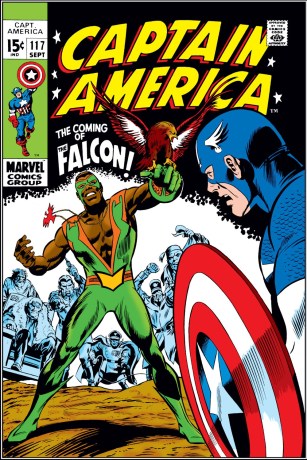
While I have not yet seen the film, I have followed the sputtering path of the character Black Panther since he was introduced in the 1960s; as a teenager collecting comics, I was a fan of Black Panther as well as The Falcon, who was cover-billed along with Captain America throughout much of the 1970s.
I lacked critical discernment as a teen, but can recognize that these two characters laid a foundation for my discovering black authors and thinkers in college as I struggled to cast off the worst aspects of my upbringing in the racist and intolerant South.
Most have responded to Black Panther the film with enthusiasm and even glee, and the box office has reflected some powerfully positive messages about black films and actors. But a few have begun to unpack problems with nationalism and the white savior trope in the narrative.
Here we may be inclined to argue that the highest form of equity, the absence of racism, would require that the film receive something akin to objective analyses—not unduly criticized (veneers for racism) and not sheltered from criticism as a sort of inverse racism.
There, however, this claim is not as simple as it may seem—especially if we ground how we respond to the film in terms of slack and scarcity, in terms of the King/Kennedy inequity.
Certainly, the film cannot be above credible criticism, but in that pursuit, we must guard against the perfection bar often manifested as scarcity when applied to disadvantages associated with race, class, and gender.
White films, for example, are not called “white,” but simply films. Adam Sandler and Kevin James, for example, have long resumes of films that certainly have been allowed an incredible amount of slack—forgiven the nearly unforgivable (think Trump) for hopes of some glimmer of humor nestled among the truly cliche, offensive, and just plain lazy.
Black Panther, even in the praise, is rendered into scarcity as a black film, and by implication must carry the weight of all black films, all black actors, all black writers (although the character was spawned by white creators in a very white, often racist industry).
Since Kevin James was allowed Paul Blart: Mall Cop 2, just how close to perfect does Black Panther need to be?
The truest test of equity may be that all films have the same degree of slack.
School Safety: Slack and Scarcity as a Matter of Life and Death
While many in the US are reveling in the pop culture frenzy around Black Panther, the ugliest aspects of American culture once again expose how our on-screen violences pale against our gun culture and the ever-present threat of mass shootings, especially at the expense of students in school.
Although most mass shooters are white men, gun violence tends to prompt concerns about gangs and black-on-black crime, yet another demonstration of inequitable margins: White male mass shooters never prompt outcries about all white men (since the shooters are often framed as mentally ill) even though simply the threat of terrorism evokes blanket narratives and even policies about Muslims.
The paradox of gun violence and mass shootings in the US is that Americans have experienced increasingly less crime over the past four or so decades, even as the rate of mass shootings and gun violence remains disturbingly high when compared to other countries.
Debates about gun violence become yet more evidence of slack and scarcity linked to race.
Why has the country responded so positively to the teens speaking out after the shooting in Parkland, Florida but tended to reject or ignore the outcries from teens surrounding the all-to-frequent police shootings of young blacks, the #BlackLivesMatter movement?
Simply stated, when anything appears to encroach on the huge slack whites perceive (safety in this case), mainstream responses flair, but the margins for safety are so thin for blacks, for example, that to live in danger as a black person has become normalized beneath the implication that blacks themselves are the ones perpetuating violence.*
Whites as victims (slack), and blacks as violent (scarcity).
Taking care about whether or not we criticize Black Panther holds some important symbolic value, but in terms of how we respond to a school shootings, we are now making decisions that are life and death.
Responses to the Parkland, Florida shooting have focused on how to make schools safer—in part, to avoid the larger gun control debate that is muted by the NRA.
Arming teachers is one extreme, but in an Op-Ed for The State (Columbia, SC), Will Britt argues:
My recommendations are all achievable and avoid the most controversial ideas, so that they have a chance of happening. Still, they will require unified and emphatic parental endorsement:Install metal detectors, restrict campus and building access and connect 360-degree interior and exterior video monitoring for every public school.
This is a compelling argument to those living in the slack of race privilege, but is a red flag to those living in slack, in very thin margins.
There is no clear evidence that the use of metal detectors, security cameras, or guards in schools is effective in preventing school violence, 8,9,10,11 and little is known about the potential for unintended consequences that may accompany their adoption.12
There has not been sufficient research to determine if the presence of metal detectors in schools reduces the risk of violent behavior among students. 13
Some researchers have expressed concern about the widespread use of guards, cameras, and other security technologies, given that so little is known about their effectiveness. 14,15
Research has found security strategies, such as the use of security guards and metal detectors, to be consistently ineffective in protecting students16 and to be associated with more incidents of school crime and disruption17 and higher levels of disorder in schools. 18
Evidence from a school–police partnership implemented in New York City reveals that students in these schools continue to experience higher than average problems linked directly to future criminality, compared to students in other New York City schools not involved in the partnership. 19
Surveillance cameras in schools may have the effect of simply moving misbehavior to places in schools or outside of schools that lack surveillance. Even more troubling, it’s possible that cameras may function as enticement to large-scale violence, such as in the case of the Virginia Tech shooter who mailed video images of himself to news outlets.20
Research suggests that the presence of security guards and metal detectors in schools may actually increase levels of violence in schools by strengthening the influence of youth “street” culture with its emphasis on self-protection.21
If these measures do not work, why are they compelling?
White slack dictates that white safety must be protected at all costs; black/brown scarcity dictates that there is no margin of error for protecting against black/brown violence.
American culture is today awash in a triumphant celebration of Black Panther jammed against a national scramble to confront our daily violences in the form of guns.
Turning our schools into fortresses if not prisons, and even arming teachers, presents those with race, gender, and economic slack a much different picture (more safety) than those with race, gender, and economic scarcity (more violence).
Margins still define us, and margins left unchecked are apt to destroy us in the end.
* The mainstream media and political focus on black-on-black crime allows whites to ignore that all crime is mostly same-race since white-on-white crime rates are nearly identical to black-on-black crime rates.
Research excerpt sources:
8 Garcia, C. A. (2003). School safety technology in America: Current use and perceived effectiveness. Criminal Justice Policy Review, 14, 30-54.
9 Addington, L. A. (2009). Cops and cameras: Public school security as a policy response to Columbine. American Behavioral Scientist, 52, 1424-1446.
10 Borum, R., Cornell, D. G., Modzeleski, W., & Jimerson, S. R. (2010). What can be done about school shootings? A review of the evidence. Educational Researcher, 39, 27-37.
11 Casella, R. (2006). Selling us the fortress: The promotion of techno-security equipment in schools. New York: Routledge.
12 Addington, L. A. (2009). Cops and cameras: Public school security as a policy response to Columbine. American Behavioral Scientist, 52, 1424-1446.
13 Hankin, A., Hertz, M., & Simon, T. (2011). Impacts of metal detector use in schools: Insights from 15 years of research. Journal of School Health, 81, 100-106.
14 Birkland, T. A., & Lawrence, R. G. (2009). Media framing and policy change after Columbine. American Behavioral Scientist, 52, 1405-1425.
15 Green, M. B. (2005). Reducing violence and aggression in schools. Trauma, Violence and Abuse, 6, 236-253.
16 Schreck, C. J., & Miller, J. M., & Gibson, C. L. (2003). Trouble in the school yard: A study of the risk factors of victimization at school. Crime & Delinquency, 49, 460-484.
17 Nickerson, A. B., & Martens, M. R. (2008). School violence: Associations with control, security/enforcement, educational/therapeutic approaches, and demographic factors. School Psychology Review, 37, 228-243.
18 Mayer, M. J., & Leaone, P. E. (1999). A structural analysis of school violence and disruption: Implications for creating safer schools. Education and Treatment of Children, 22, 333-356.
19 Brady, K. P., Balmer, S., & Phenix, D. (2007). School-police partnership effectiveness in urban schools: An analysis of New York City’s Impact Schools Initiative. Education and Urban Society, 39, 455-478.
20 Warnick, B. R. (2007). Surveillance cameras in schools: An ethical analysis. Harvard Educational Review, 77, 317- 343.
21 Phaneuf, S. W. (2009). Security in schools: Its effect on students. El Paso, TX: LFB Scholarly Publishing LLC.
I have used Pinker’s work in linguistics for many years, especially as I teach future English teachers and try to combat prescriptive approaches to grammar, mechanics, and usage.
Among my colleagues and friends in linguistics and English, however, we are apt to use Pinker’s theories of language—framing language as biological and building on the work of Noam Chomsky—as a point of debate. In other words, even though Pinker is regarded as a leading figure in his primary field, many credible arguments remain about his claims.
Steven Pinker is at it again. Several years ago, the Harvard-based cognitive psychologist took time off regular duties to offer some gratuitous advice to humanities scholars about how to “fix” their discipline….
The Enlightenment may seem an ambitious topic for a cognitive psychologist to take up from scratch. Numerous historians have dedicated entire careers to it, and there remains a considerable diversity of opinion about what it was and what its impact has been. But from this and previous work we get intimations of why Pinker thinks he is the person for the job. Historians have laboured under the misapprehension that the key figures of the Enlightenment were mostly philosophers of one stripe or another. Pinker has made the anachronistic determination that, in fact, they were all really scientists – indeed, “cognitive neuroscientists” and “evolutionary psychologists.”
In short, he thinks that they are people like him and that he is thus possessed of privileged insights into their thought denied to mere historians. The latter must resort to careful reading and fraught interpretation in lieu of being able directly to channel what Enlightenment thinkers really thought.
Despite his recognized brilliance and accomplishments, Pinker—like a cognitive scientist and psychologist writing entire books on teaching reading—has fallen victim to reaching beyond ones area of expertise and treating an entire field as if those experts do not exist. Further, as the review unpacks, Pinker appears to suffer from a narcissism that spurs projection: I am great, therefore, let me find myself in the greatness that has come before me.
Pinker, then, represents a serious problem that confronts all of us: How to stop living by what you think and start living by what you know.
From the White House to the New York Times Opinion page to friends on Facebook, we are under constant assault by stuff people think are facts, although too often they are ultimately false.
In some cases, sharing and then living by misinformation are mostly just annoying, but the gun debate represents how this tension has real life-and-death consequences—too often for children, who have almost no political power.
For example, we must consider how fearmongering has kept the US focused on only one type of the slippery-slope argument—gun control = all guns will be taken away—while forcing us to live in another unexpressed slippery-slope reality—gun culture = inordinate mass shootings and perpetual gun violence.
My primary areas of expertise—in terms of my educational background, teaching experiences, and scholarship—are literacy, poverty, and race, the latter two mostly as related to education; although, much of that expertise has come from intense study built on my formal degrees. Since mass shootings have been all-too-common in schools, I have spent some of my scholarly and public work addressing gun control—recognizing that I, like Pinker, am stepping outside my field in some respects.
The shooting in Parkland, Florida has spurred another round of my public work calling for evidence-based approaches to ending our self-defeating gun culture in the US.
Debating gun control for me is doubly dangerous because it is outside my field and I am very passionate about the topic.
Since I engage in the gun debate on social media, I have been confronted by some very frustrating pro-gun or anti-gun control arguments that simply are not credible: pointing a finger at mental illness, arguing that gangs and black-on-black crime explain the gun violence problem in the U.S., imposing the mainstream slippery-slope argument that gun control means taking away all guns from everyone, refusing to acknowledge international comparisons that highlight the unique problems with guns and gun violence in the US, invoking the lack of God in school or society, blaming violence on violent pop culture (movies, video games, music), etc.
Although I am aware that evidence is not as effective as I would hope when debating topics with people who are more committed to what they think (and believe) than to what they know, I work diligently (and like a scholar, seeking bodies of research) to find the argument and evidence that will help others move to informed positions.
I want to share here just one part of that journey recently for me, a moment when I really could have made a serious mistake if I hadn’t checked myself when I had an idea, checked myself by realizing, well, it’s complicated.
Most arguments about violence are lazy and rushed, typically overstating the amount and threat of violence in the now of the debate, lacking as many debates do some historical context (a real go-to for me).
To combat the “violence today” arguments (violent pop culture, gangs, black-on-black crime, lack of God), I considered making a Wild West analogy, which on its surface seemed very compelling and obvious in terms of how violent I assumed the Wild West to have been.
The irony about how badly Hollywood misrepresents the Wild West is that characters popularized by Clint Eastwood may in fact give us insight into the tragic relationship between guns and toxic masculinity.
Until I checked myself with “well, it’s complicated.”
Luckily, I first did a quick google search and found a 2014 article by Glenn Kessler on Rick Santorum bumbling, yep, a Wild West analogy:
The Hollywood version of the Wild West is at the core of this exchange on Face the Nation, so perhaps it’s time for a history lesson. One-time presidential candidate Rick Santorum asserted that gun crimes were low back then because people had the right to carry guns. But he actually has the story backward.
The Wild West as a matter of history doesn’t square with the Wild West of Hollywood:
“Carrying of guns within the city limits of a frontier town was generally prohibited. Laws barring people from carrying weapons were commonplace, from Dodge City to Tombstone,” said Adam Winkler, a professor at UCLA’s School of Law and author ofGunfight: The Battle over the Right to Bear Arms in America. “When Dodge City residents first formed their municipal government, one of the very first laws enacted was a ban on concealed carry. The ban was soon after expanded to open carry, too. The Hollywood image of the gunslinger marching through town with two Colts on his hips is just that — a Hollywood image, created for its dramatic effect.”
And just how violent the Wild West was, it turns out, is much like the debates my colleagues and I have about Pinker’s linguistics; it’s complicated, as Kessler explains in the Santorum article:
…“Gun homicides were far more rare than Americans have been led to believe,” [UCLA School of Law professor, Winkler] said. “Most frontier towns had fewer than two homicides a year during the heyday of the Old West. Yet that is not inconsistent with Roth’s research. The homicide rate was high in these towns because the population was very small. Even one murder in a town with only a few dozen residents leads to a high homicide rate. These towns were violent, but not nearly as violent as some imagine.”
In other words, no matter how one looks at the research, Santorum has his history incorrect. People did not walk around town carrying guns—but the homicide rate was unusually high.
When we take our time and consider the history of gun violence and gun control, we discover, well, it’s complicated.
What I discovered is not a new or powerful analogy* (thanks to Santorum’s very public bumbling), but a way to check ourselves when we are not sure if we are debating or living by what we think instead of what we know.
The amount of guns and access to guns in the U.S. are essential elements in why the U.S. sits below average for crime rates but is a extreme outlier in gun homicides and violence (see #2 here).
A great deal of commentary attempts to tie mass shootings to a single issue. Often, that seems like the easiest way to make sense of atrocities. That’s why we get sound bites that lean on mental health (when shooters are white), terrorist ties and affiliations (when shooters are brown), gang violence and “urban decay” (when shooters are black), bullying (when it happens in a school), and overwork (when it happens in a workplace).
The truth cannot be boiled down to any single issue. As sociologists, we can look to the bigger picture, point out patterns, and identify common denominators. Our research suggests that gun control is, indeed, an important piece of the problem. But in order to understand the factors behind America’s mass shootings, it is also critical to consider the relationship between masculinity and violence.
And thus:
Scholars who study masculinity and mass shootings have consistently drawn attention to the fact that mass shootings are not only a uniquely American social problem; they are a problem with American men. We’ve argued before that there are two questions that require explanation related to gender and mass shootings. First, why is it that men commit virtually all mass shootings? And second, why do American men commit mass shootings more than men anywhere else in the world?
In many of these mass shootings, the desire to kill seems to be driven by a catastrophic sense of male entitlement. In some cases, the perpetrators seemed to feel that if people did not give them precisely what they wanted, then those people did not deserve to live. The only just world, in their minds, was a world they were the center of….
A great many mass murderers have a history of domestic violence. They range from Omar Mateen, who killed 49 people at the Pulse nightclub shooting, whose ex-wife claimed he took her paychecks, forbade her from leaving the house and beat her if she did not live up to what he perceived as being her duties; to Robert Lewis Dear, who killed three people at a Planned Parenthood Clinic and had been accused of domestic violence by two of his three ex-wives.
With a historical, and checked, perspective, and a bit more care than most public and political debate allow, then, we can begin to construct a vivid and accurate picture of why the U.S. suffers so much gun violence and so many mass shootings.
And while, well, it’s complicated, we can safely say that the amount of guns, access to guns, a climate of toxic masculinity, and identifiable behaviors such as domestic violence provide a nearly complete puzzle that can provide a context for not only a productive debate, but also actions that a free people can take in the name of human safety.
The gun debate itself is complicated, but that sits against the simple fact that children slaughtered at school or dozens mowed down at an outdoor concert is not complicated but inexcusable in a free society.
The gun debate and innocent lives implore us to stop living by what we think and start living by what we know.
There are several challenging, and therefore uncomfortable, scenes in Little Rock Central: 50 Years Later (2007); however, when I show this documentary in my courses, few students recognize those scenes as either challenging or uncomfortable.
At one point, several black men from the Little Rock, Arkansas community are gathered outside the school, and they speak directly about the need for blacks to take care of their own, clean up their own communities. These men directly mention the damage of black-on-black crime (which is about the same as white-on-white crime, although the latter is almost never mentioned).
Throughout the documentary, as well, a number of black students confront how hard they work and how some of their fellow black students simply do not try—echoing a rugged individualism and personal responsibility narrative that a white teacher/coach and her white golf team members express.
I use these scenes as teachable moments about the negative impact of respectability politics on marginalized groups:
What started as a philosophy promulgated by black elites to “uplift the race” by correcting the “bad” traits of the black poor has now evolved into one of the hallmarks of black politics in the age of Obama, a governing philosophy that centers on managing the behavior of black people left behind in a society touted as being full of opportunity. In an era marked by rising inequality and declining economic mobility for most Americans—but particularly for black Americans—the twenty-first-century version of the politics of respectability works to accommodate neoliberalism. The virtues of self-care and self-correction are framed as strategies to lift the black poor out of their condition by preparing them for the market economy.
…Today’s politics of respectability, however, commands blacks left behind in post–civil rights America to “lift up thyself.” Moreover, the ideology of respectability, like most other strategies for black progress articulated within the spaces where blacks discussed the best courses of action for black freedom, once lurked for the most part beneath the gaze of white America. But now that black elites are part of the mainstream elite in media, entertainment, politics, and the academy, respectability talk operates within the official sphere, shaping the opinions, debates, and policy perspectives on what should—and should not—be done on the behalf of the black poor.
Respectability politics works in conjunction with seemingly innocuous narratives (rugged individualism, lifting yourself by your bootstraps, personal responsibility) to keep the accusatory gaze on individuals and away from systemic inequity. In other words, political and economic elites are more secure if the majority of people believe all success and failure are primarily determined by individual traits and not by privilege and disadvantage beyond most people’s control.
This semester that discussion has coincided with Laura Ingraham attempting to publicly shame LeBron James to “shut up and dribble,” a not-so-clever self-promotion for one of Ingraham’s vapid books.
Along with Kevin Durant’s heated response, James (see video in the link above) stressed, “We will definitely not shut up and dribble.”
Watching James, however, and listening carefully present us with the dangers of his “defeating the odds” motivation (listen to about minutes 1:50-2:15), his own powerful and impressive rise to being King James.
I am not criticizing James, however, and fully support his response, refusing to shut up and dribble.
But a message that suggests anyone can or should be able to achieve what an outlier, James, has achieved is ultimately harmful, speaking through and to the most corrosive aspects of respectability politics.
This call to teach children to beat the odds, in fact, is shared all along the political spectrum from right to left.
The ultimate flaw in a beat-the-odds mentality is, again, that it suggests success and failure lie mostly or solely in the individual, a matter of choice and effort—like having “grit,” a growth mindset, or a positive attitude (all ways to fix inadequate children).
LeBron James, I believe, is right about his importance as a role model, as a stellar example of what black success looks like despite the odds being unfairly against him in the form of racism and economic inequity.
And as long as we as a society choose to ignore the odds, choose to allow racism, sexism, and classism to exist, I suppose we should find humane and supportive ways to encourage children to work so that a few of them may hit the life lottery and beat the odds.
But to be blunt, that’s a pretty shitty cop-out for the adults who could, in fact, change the odds so that no child has to overcome them.
It is ultimately a heartless and ugly thing to see children as lacking the drive to beat odds that shouldn’t exist in the first place.
It is political cowardice and public negligence to remain fatalistic about the odds as we watch those odds destroy the hopes and dreams of our children.
If anyone should shut up, that would be Ingraham and her entire cadre of right-wing know-nothings who shovel the very worst narratives that help guarantee those odds will remain in their favor.
And as we listen to James instead, let’s resist demanding that he or any so-called racial minorities somehow erase racism and then begin to demand that those who benefit the most from the odds use those privileges to dismantle those odds.
That, I know, is a powerful ask, but it is one that certainly holds more credence than asking children to be superhuman because we have James dribbling across our flatscreen TVs.
My foundations of education class and I discussed the Parkland, Florida shooting a few days after the tragedy. My students tended to echo some of the most common and least credible arguments about the issue of mass shootings and gun violence. However, they were both willing to share and then eager to discuss and look at evidence.
One student, for example, noted that he is a hunter and gun control makes him uncomfortable. Others mentioned mental illness and made analogies such as access to alcohol.
So during the discussion we reached some key points I think are valuable to avoid the effort by the NRA and politicians to derail a reasonable discussion and real action:
Other countries have mental illness, and the US sits about in the middle of comparable countries in terms of crime rates (we are not an extreme country in terms of crime). But the US is an extreme outlier in terms of fatal crime and gun violence.
Other countries with almost no mass shootings and very little gun violence have people who hunt and people who have handguns in their home to protect their personal property. Making a country more safe with gun control is not about taking away all guns. That is a straw man argument.
The US is an extreme outlier in police fatally shooting and killing citizens (see the US compared to Germany for example). Our gun culture impacts every aspect of our society, even law enforcement.
Gun possession does in fact make people less safe, and the mostly wild-west approach to guns in the US is the biggest part of the gun violence problem.
Monitoring dangerous products is common in many aspects of our culture. That monitoring and care are not about taking away freedom, and we must keep in mind that freedom is not license. In other words, human freedom includes accountability for that freedom.
That people under 21 can buy assault-style weapons but not alcohol, or marijuana, is a serious commentary on a people with priorities out of line.
The best way to protect children in schools and US citizens in their daily lives is to end our gun culture—not to increase security; that is addressing the symptoms and refusing to cure the disease.
The larger point here is that everyone lives with irrational and uninformed beliefs, often living in ways that contradict what we embrace as our foundational ideals as individuals and as a society.
In order to check those contradictions, we must step back and begin again with evidence. I tend to be more cynical than even skeptical, but this discussion with my students confronted me with possibility that people can and will listen even in contexts that are difficult.
As I urged my students, I want no one to take the claims above as fact simply because I posted them here. The key is to study, investigate, explore our own assumptions and biases. And thus, start with some of these links below that reinforce the points above:
In the wake of the 2016 presidential election and the unexpected win by Donald Trump, “fake news” has become a rallying cry for many, including Trump and even mainstream media.
Struggling to survive, for example, The New York Times launched an aggressive campaign for subscribers by setting the incredibly low bar of not being fake news. Like the NYT, NPR sits among the much maligned mainstream media also discounted as “liberal media.”
But here is the most disturbing fact of all: Mainstream media may in fact not be fake news, and there is abundant evidence they are not agents of progressivism or liberalism either; however, as can be witnessed on the NYT’s Op-Ed page almost daily, the truth is that mainstream media is:
Mark Seidenberg is not the first researcher to reach the stunning conclusion that only a third of the nation’s schoolchildren read at grade level. The reasons are numerous, but one that Seidenberg cites over and over again is this: The way kids are taught to read in school is disconnected from the latest research, namely how language and speech actually develop in a child’s brain.
Problem 1: The piece immediately bows to NAEP data because, as has become common, everyone including politicians, the media, and the public simply accepts that test scores are accurate reflections of learning. This assumption fails because high-stakes testing mostly reflects two things: (1) the socio-economic status of the students, their families, and their communities (not learning, not student quality, not teacher quality, not school quality), and (2) a reduced and inauthentic version of the so-called skill (such as reading) we claim to be measuring.
Standardized testing of reading is, to be blunt, horrible—both in terms of how it ruins reading for children and how it is actually one of the key sources for the problem Seidenberg misdiagnoses.
Problem 2: “Seidenberg is a cognitive scientist and professor at the University of Wisconsin, Madison. In his latest book, Language at the Speed of Sight, he points out that the “science of reading” can be a difficult concept for educatorsto grasp.”
Seidenberg joins a long and disturbing tradition of know-it-alls from outside education (typically from psychology, economics, or political science) who, like Columbus, discover a field and weigh in as if that field’s scholars and practitioners never existed; just recall the NYT itself ogling in awe at Daniel Willingham’s book on reading.
Problem 3: Seidenberg claims: “I’ve reviewed the science of reading and documented how little impact it has had on educational practice, and I think this is bad.”
One of the most significant failures of journalism and scholars in one field leaping into another field is the lack of historical and practical understanding of the field. What if I told you that Lou LaBrant, former president of the National Council of Teachers of English and a prominent scholar and practitioner in literacy from the 1920s until the 1970s, wrote in 1947: “A brief consideration will indicate reasons for the considerable gap between the research currently available and the utilization of that research in school programs and methods” (p. 87).
The great irony of Seidenberg’s claims is that he stumbled onto a valid premise, but in his rush to know everything, he has badly jumbled the explanation.
Problem 4: Seidenberg also joins a long list of people who have no credible understanding of the field of literacy and mangle definitions in order to have something to argue about. Here, Seidenberg simply doesn’t know the field, as he demonstrates: “The political solution was called ‘balanced literacy,’ which called on teachers to use the best of both approaches. But it left it up to teachers who had been trained to dismiss phonics and brush off the science.”
In fact, once again, he initially is onto something and then falls flat. Balanced literacy, like its cousin whole language, fully embraces phonics instruction, but recognizes that professional educators must know each student in order to balance what instruction any student needs in order to become an eager and proficient independent reader; for example:
Problem 5: Along with the arrogance of their non-education fields, Seidenberg and Willingham represent an ugly dynamic whereby men suggest (or even directly claim) that an entire field simply isn’t capable of handling the science of their own profession—and since the field of literacy is mostly women, this problem smacks of mansplaining.
So let’s end with the valid problem Seidenberg thinks he has discovered—the gap between the research on teaching reading and how reading is taught in schools.
I can offer two related better explanations.
First, I taught high school English for 18 years throughout the 1980s and 1990s, the foundational decades of the current education reform accountability era. Since 2002, I have been a teacher educator, primarily working with future teachers of English.
As a teacher educator, my candidates share with me a fact of moving from teacher education courses into the real world of teaching that Seidenberg and NPR may find interesting; it goes something like this: “Dr. Thomas, I agree with all the things you taught us about teaching reading and writing, but I am not allowed to do any of that at my school.”
“Not allowed”? Hmmm. Let’s investigate that.
Applebee and Langer conducted several expansive studies of how writing is taught in secondary schools, and their 2013 volume Writing Instruction That Works: Proven Methods for Middle and High School Classrooms included one incredibly powerful finding: Teachers of English know more than ever about the science and research on teaching writing, but those teachers revealed to Applebee and Langer that the expectations of standards and high-stakes testing prevented them from implementing that best practice.
In other words, that gap between research and practice can easily be traced to the negative impact of accountability—not to shoddy education programs, not to literacy teachers who are unable to grasp the heady science of teaching reading.
Mainstream media share with fields such as psychology (economics and political science as well) a not-so-subtle disrespect for education as a field and K-12 teachers. NPR’s article and Seidenberg’s research are condescending and incomplete because of that lack of respect.
As a educator, I must stress that their eagerness to wag their fingers at teachers and teacher education programs may be distracting us from their own shoddiness, especially dumpster fires like mainstream media that can see no better goal for themselves than not being fake news.
Yes, fake news is a problem, but lazy, irresponsible journalism may be a much bigger threat to our democracy and our schools.
* The “again” in the title refers in part to the Twitter exchange I had with an NPR journalist (at the time) and the problem with journalists claiming objectivity or neutrality:
@plthomasEdD I’m not sure it’s my place to say whether the study is credible, but we both note the significant criticism of the methods.
The great and urgent paradox of twenty-first century America is trying to discover the truth about fake news, a phenomenon spurred by the 2016 presidential election.
Fortunately, Andrew Guess, Brendan Nyhan, and Jason Reifler have analyzed how often people viewed fake news to help us understand that elusive truth:
[W]e find that approximately one in four Americans visited a fake news website, but that consumption was disproportionately observed among Trump supporters for whom its largely pro-Trump content was attitude-consistent. However, this pattern of selective exposure was heavily concentrated among a small subset of people — almost six in ten visits to fake news websites came from the 10% of Americans with the most conservative information diets. Finally, we specifically identify Facebook as the most important mechanism facilitating the spread of fake news and show that fact-checking largely failed to selectively reach consumers of fake news.
Since these researchers identified that about 65 million Americans consumed fake news during the study period and that fake news constituted about “2.6% of all the articles Americans read on sites focusing on hard news topics during this period,” everyone interested in facts and truth are justified in considering ways in which we all can combat the negative impact of fake news, not only on our democracy but also on all ways of life in a free society.
This urgency is especially relevant to educators, andGuess, Nyhan, and Reifler’s study speaks directly to the need for teachers at every grade level to incorporate critical media literacy into the education of all students.
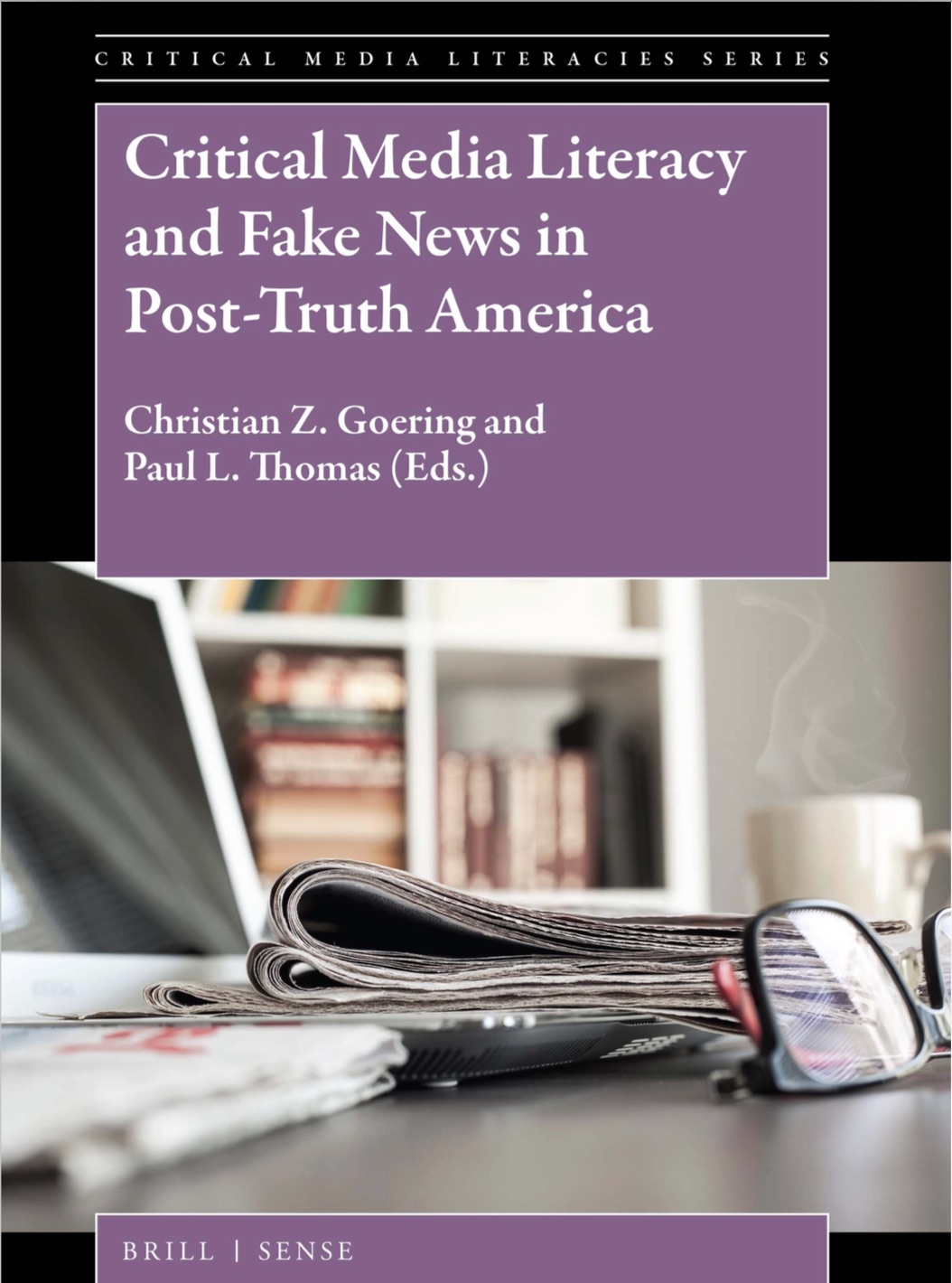
In Chapter 1: An Introduction, Chris and I explain:
Turning … to Kellner and Share (2007), we define critical media literacy for the purposes of this volume as “an educational response that expands the notion of media literacy to include different forms of mass communication, popular culture, and new technologies” (p. 59) and “focuses on the ideology critique and analyzing the politics of representation of crucial dimensions of gender, race, class, and sexuality” (p. 60). It is the goal of this volume to build the aptitude and skill set of students and their teachers for critical media literacy in hopes for a better tomorrow. (p. 3)
And then, in Chapter 2: An Educator’s Primer, I offer some foundational concepts as well (excerpted next).
Being an educator at any level—K-12 through undergraduate and graduate education—has always been a challenge in the U.S. since formal education in theory is linked to preserving our democracy. Being a critical educator at any level in the U.S. has always been and remains nearly impossible because formal education in practice is more about enculturation and maintaining the status quo than seeking the social equity that remains elusive despite our claimed ideals as a people.
With the election of Donald Trump as president in 2016, the media punditry has become obsessed, as has Trump, with fake news and post-truth public discourse. In this volume committed to investigating and interrogating fake news and post-truth discourse in the context of curriculum and instruction grounded in critical media literacy goals, we offer the foundational opportunity for educators to consider and reconsider the nature of truth/Truth, knowledge, and facts both in the teaching/learning dynamic and throughout mainstream media and all sorts of public discourse, notably by and about political discourse.
First, let’s establish the terms and contexts essential to understanding and then teaching critical media literacy:
“Fake news” is a technical term (although most public discourse fails to adhere to this technical distinction) that identifies mostly on-line information that is intentionally false and provocative, designed to be click-bait and drive internet traffic and thus revenue.
“Satire” is purposefully distorted information that assumes readers/viewers recognize the information is not factual, but intended to make larger points. The Onion, Saturday Night Live’s Weekend Update, The Daily Show, and John Oliver’s Last Week Tonight are examples of satire packaged in seemingly credible formats, parodies of traditional news media.
“Post-truth” is a relatively newer term for the popular and often right-wing embracing of (and misunderstanding) post-modernism’s challenge to the objective nature of truth/Truth. Not to oversimplify, but post-modernism argues that truth/Truth is defined by whoever is in power (not an objective reality), while the contemporary popular and right-leaning political embracing of “post-truth” is more akin to “the truth is whatever I say it is regardless of any evidence or the credibility of evidence.”
Mainstream journalism functions under two important and corrupting norms: (1) journalists (just as educators are implored to be) maintain a stance of objectivity and neutrality, an apolitical pose, and thus (2) most mainstream examinations of topics, debates, and events are framed as “both sides” journalism, rendering all positions as equally credible and valid. For example, the mainstream media, as John Oliver has exposed, gives the general public the false notion that climate change has as many scientists for as against the “theory,” a term read by the public as “hypothesis.”
As noted parenthetically above, to embrace teaching critical media literacy (in conjunction with critical pedagogy and critical literacy) is disrupting the traditional norm that educators remain apolitical. This volume’s authors recognize that educators face tremendous hurdles for teaching critical media literacy: eroding job security with the dismantling of unions (and absence historically of unions in many regions of the U.S.), increasing accountability for student test scores on exams that are reductive and demand of students far less in their literacy than critical media literacy (in other words, our efforts to teach critical media literacy can be disregarded with “that isn’t on the test”), and deteriorating teaching and learning conditions such as overcrowded classrooms and more teachers inadequately prepared to teach (such as Teach For America candidates).
None the less, if we genuinely believe in universal public education as a key mechanism for democracy and individual liberty then we educators must be well versed in critical media literacy, and then we must make that central to our classrooms. Throughout this chapter, the intersections of media and education are examined in order to highlight the power and dangers inherent in fake news, post-truth discourse, and traditional calls for educators and journalists to be objective, apolitical.
Reference
Kellner, D., & Share, J. (2007). Critical media literacy is not an option. Learning Inquiry, 1(1), 59-69.
Imagine a world where being a runner is held in high regard, well above students’ aptitude in reading, ‘riting, and ‘rithmetic.
Teacher A at XYZ Elementary School takes her third-grade class out to the school track, lining them up to run the 100-meter dash to set a baseline of data for determining the fastest runners in the class.
Across town at ABC Elementary School, Teacher Z ushers her third-graders to the high school to establish her baseline data, sending off these children on 2 laps of the 5K cross country trails.
Mid-year, Student J transfers from XYZ Elementary School, where J had placed 1st in the initial 100-meter dash, to ABC Elementary School just in time for the year-end 10K to assign final grades.
J had excelled all year in the 40-yard dash, but floundered at the 10K, not able to finish the run and receiving an I for third grade, thus was retained.
•
In this brief allegory, we should confront the realities about high-stakes testing that are often muted by our blind faith in the perennial existence of tests such as IQ testing, state standards-based testing, and college entrance exams such as the SAT and ACT:
Regardless of standards, curriculum, textbooks, or even what teachers teach in the classroom, as Gerald Bracey has warned: What you test is what you get (WYTIWYG).
The testing format and context (see above the 100-meter dash v. a 10K) have a significant impact on the outcomes; in the thought experiment, which student is labeled a “fast runner” changes because of the type of test, not necessarily the abilities or even effort by the teachers and the students.
Pre- and post-testing are not as effective or fair as we tend to assume—notably since the real world includes a great deal of transient students. (Caution: A universal set of standards, curriculum, and tests may solve this problem, but cannot address the first two bullets above.)
What is tested and how are always political decisions by some authority in power. This confirms that all testing is political and that no testing is objective or neutral.
Testing is always reductive (giving evaluative power to a limited but claimed representative set of acts over behaviors that require more time and greater nuance) and serves mostly goals of efficiency, not goals of authenticity.
•
Now let’s turn to the soap opera that is education reform, fatally committed to the accountability paradigm (ever-new standards and ever-new high-stakes tests—all promised to be better than those before, even as those before were declared the best ever)
Math and reading exams known as PARCC spawned angst and outright rebellion when the tests launched in 2015, ushering in a new era of state testing in Illinois public schools.
But that new era appears to be short-lived, with this spring’s PARCC exams possibly the last for the state’s third- to eighth-grade students, educators say.
Here is yet one more brick removed from the crumbling wall of Common Core—a standards revolution that guaranteed world-class standards and tests that would usher in a new era of education reform across the U.S.
Next, and related, while the Common Core wall crumbles, and the concurrent rush to hold teachers accountable for student test scores on those Common Core tests flounders, one of the primary advocates and funders of the Common Core disaster has been Bill Gates and his foundation.
Interesting to note, then, that once again, as Nancy Flanagan details, Gates has changed his tune in the wake of his most recent promises failing:
“Our goal is to work with the field to make sure that five years from now, teachers at every level in secondary school have high-quality aligned curriculum in English, math, and science,” Bill Gates said in a speech last fall, describing curriculum as “an area where we feel like we’ve underinvested.”
In fact, educators for well over three decades have warned that accountability driven by standards and high-stakes testing has never been the appropriate reform mechanism for the core problems facing universal public education: crippling inequity in both the lives and formal education of the most vulnerable students.
Tests, then, are the problem and not the solution.
Tests are a distraction, keeping our gaze on students and teachers and away from the inherent inequity of the tests themselves—instruments of those in power who decide what matters and how by what is tested and how.
In education, the problem has never been about the quality of tests (or standards, or curriculum, or textbooks) but about the presence of those tests and the power they wield.
I was surprised and humbled to discover through social media two excellent blogs that included some of my blogging in order to extend the conversation about peer review when teaching writing and teaching The Great Gatsby.
In What’s Wrong with Writing Centers, Rose Jacobs reports on Lori Salem’s “quantitative analysis of Temple University’s writing center, which she has directed since 1999. The assistant vice provost wanted to understand its role by investigating who doesn’t visit as well as who does.” Salem discovered:
[T]hat practices that are near-orthodoxy in writing centers — such as nondirective instruction, in which tutors prompt students to come up with the right answers themselves; and a resistance to focusing on grammatical errors — cater to individuals who already have a strong grounding in grammar and composition, the sort of students who never turn up. That leaves the most frequent visitors underserved: female students, minority students, and those who grew up speaking a language other than English at home.
Salem admits her study is just a beginning since it focuses on one center at one university, but as someone who has been teaching writing for almost four decades, both as a high school English teacher and a college professor of first-year and upper-level writing courses, I can confirm that many of the dilemmas uncovered by Salem ring disturbingly true.
Those two distinctly different teaching experiences have shaped me within a broader unifying way: I have mostly taught myself how to teach writing, having only one real formal experience with learning how to teach writing through the National Writing Project’s summer institute. I don’t have any degree in composition, and didn’t formally study composition in any undergraduate or graduate courses.
As a high school teacher for almost twenty years, I learned mostly by trial-and-error, and then was saved by my regional NWP affiliate, the Spartanburg Writing Project, where I also was a co-lead instructor for a few summers before heading to higher education full time.
But the last decade has been an incredibly fertile and difficult journey with how writing is taught in higher education. I have been teaching first-year writing, along with an upper-level writing course, and I briefly held a small administrative role in guiding our first-year seminars.
Over that time, my university has (finally) formalized a writing program by naming a Director of Writing Programs and seeking ways to make the writing and media lab and program more cohesive (adding the upper-level writing/research requirement to the curriculum, for example). The teaching of writing is also being more directly addressed by creating Faculty Writing Fellows, faculty who participate in a year-long seminar addressing writing instruction.
As I have participated in and witnessed these recent growing pains at my university, I can offer some anecdotal, but I think credible, observations that match well with Salem’s research:
Writing instruction at the course/class/individual faculty level suffers from a lack of purpose and cohesion without a school/college unifying mission and set of shared goals. In other words, how does any class/course contribute to some set of outcomes related to writing all students should have experiences in as integral to graduating?
Class-level writing instruction and writing centers/labs must guard against two corrosive but alluring perspectives: (1) viewing writing instruction as remediation, and (2) seeing any course or session on “how to write” as some sort of one-shot inoculation against “errors” (a deficit view).
Both learning to writing and teaching writing are journeys, and must remain grounded in clearly defined contexts. Disciplinary writing in high school and college is much different than becoming a writer of fiction or poetry. For example, composition faculty and K-12 English teachers define “writing workshop” differently than creative writing faculty (think MFA).
Teaching writing always involves tension among concerns about craft, content, and correctness. A writing program, and writing center practices, must address how these elements will be taught as well as how each is weighted (not if, but when, how, and why). Many who come to teaching writing from disciplines outside English or composition are over-concerned with correctness (teaching writing is correcting grammar, mechanics, and usage) and significantly focused on disciplinary content and the logic of student claims, evidence, and elaboration in writing.
Teaching writing is enhanced by those teachers being writers themselves, but this expectation must be navigated carefully since few faculty are writers and some may write mostly out of necessity, not out of a drive to be writers.
The inequity unmasked by Salem’s study often presents itself in the teaching of writing through which students receive what instruction. So-called reluctant or remedial students (disproportionately black, brown, and/or poor) receive instruction on correctness (grammar, mechanics, usage) often in isolation (worksheets on skills) and are allowed or required to compose very little or not at all. The so-called advanced or gifted students (disproportionately white and affluent) compose more often and are allowed to venture into “creative” writing, experimentation, and choice. These instructional choices perpetuate inequity.
Writing centers and programs, then, are necessarily integral parts of equity and academic goals in any school, college, or university. Students must be better served at the class/course level as well as over the entire school/college experience through a cohesive writing program that rejects seeing the teaching of writing as remediation or an inoculation, but embraces authentic purposeful instruction.
Just as Salem’s data show that students view writing centers as ineffectual, thus unimportant, faculty often marginalize the status of teaching writing—something to be done by someone else or not relevant to their discipline.
Writing, however, is an essential tool of not only students and academics, but also being fully human.
Learning to write and teaching writing are both being mis-served in formal education, with the shortcomings of writing centers as one example, and as a consequence, so are our students and those charged to teach them.







 dr. p.l. (paul) thomas