The article below appears in Rethinking Schools and brings together several problems with and connections between the “science of reading” and book banning/censorship movements that I have been address since 2018.
Although the “culture war” and “reading war” have been described as separate causes promoted by disparate organizations, their stories are more connected than they appear. Both book banning and SoR dogmatism limit what teachers can teach and what students can read, narrowing the ability of public schools to address children’s diverse needs. We see this most explicitly in conservative parent groups, including Moms for Liberty, who have made it clear they endorse both. This should be a wake-up call to critically examine the potential impact of phonics-based policies on public school students and teachers.
Thomas, P.L. (2024, May). Teaching English in the “science of reading” era: We teach English in times of perpetual crisis: Selling a story of reading. English Journal, 113(5), 16-22. https://publicationsncte.org/content/journals/10.58680/ej2024113516 [Access HERE until open access at EJ]
Thomas, P.L. (2023). The “science of reading,” education faddism, and the failure to honor the intellectual lives of all children: On deficit lenses and ignoring class and race stereotyping. Voices in the Middle, 30(3), 17-21. https://publicationsncte.org/content/journals/10.58680/vm202332439
Education reform, however, was never about improving learning or teaching, but about ideological agendas, conservative agendas.
The crisis/miracle cycles started with that Texas “miracle,” but included the Chicago “miracle” (to bolster Arne Duncan), the DC “miracle” (to promote Michelle Rhee’s grift), and the Harlem “miracle” (that solidly merged education reform as bi-partisan under Obama with the help of grifter Duncan).
What may prove to be the most successful (and harmful) “miracle,” however, is the media manufactured Mississippi “miracle,” grounded in 2019 NAEP scores.
Six years later, the real end game of these manufactured and false “miracles” are merging with an initial effort by W. Bush—de-professionalizing teachers with scripted curriculum. Note the connection in a recent misleading but recurring endorsement by Patrinos (from the Department of Education Reform, funded by Walton money in Arkansas) of that Mississippi “miracle”:
After taking a swipe at NCTE, Korbey makes the same but false connection as Patrinos above:
Nearly all the states that have seen reading scores improve recently – including Mississippi, Louisiana, Tennessee and Alabama – have changed state law to encourage districts to choose from approved lists of HQIM.
Conveniently omitted in public advocacy and endorsements of scripted curriculum, is that this is a correlation; however, research has shown that curriculum, instruction, and teacher training are not the keys to increased test scores. Grade retention is:
[S]tates whose policies mandate third-grade retention see significant and persistent increases in high-stakes reading scores in all cohorts…. [T]here is no consistent evidence that high-stakes reading scores increase in states without a retention component.
And another omission is that research has shown scripted reading programs de-professionalize teachers, fail to serve the individual needs of students, and have “whitewashed” the curriculum, alienating the most under-served students in our schools [see Recommended below].
And thus, the end game:
Musk: If you have a classroom of 25 or 30 kids, it is literally impossible to spend time with every kid individually or you can spend to little time.. But what you can do is set them up with ai.. pic.twitter.com/tAcySW2zTE
Education reform is dedicated to perpetual education crisis for market and political goal.
Scripted curriculum, then, is not designed to improve reading proficiency, but to create one more step toward AI replacing teachers the same way self-checkout replaced cashiers in our grocery stores.
Mainstream media loves a compelling story. And, regretfully, media tends to care very little how accurate or complete that story is.
Media coverage of education is almost entirely a series of misleading stories grounded in either crisis or miracle rhetoric.
One of the darlings of the media is the charter school, the one aspect of the school choice movement that has garnered bipartisan support.
However, as a type of school choice, charter schools must market themselves and recruit. So when media and school marketing combine, I urge “Buyer Beware”:
Here, The State (Columbia, SC) has platformed the principal of a charter school, who makes a couple important (but misleading) claims: the charter school is exceptional and that is because the school practices separating boys and girls for instruction.
“Exemplary High Performing School” is causally connected by Wooten to the boy/girl instructional segregation; however, rarely can a school conduct the sort of scientific research in-house to determine causation, and more importantly, student achievement (test scores) remain overwhelmingly a reflection of the students’ socioeconomic status (60+%), not the school, instruction, or teacher quality.
Here is the missing parts to this story:
Note that Langston Charter Middle has the third lowest poverty index (PI) in the state (12.9), and for comparison, in the same district, the Washington Center has one of the highest PI (96) in the state. [Note that Greenville has a incredibly wide range of low and high poverty schools because the district is large and covers an area of the state with significant pockets of poverty and affluence; and thus, neighborhood schools tend to reflect that socioeconomic reality.]
Further, if we look at Langston Charter Middle’s state report card, the “exceptional” seems to be missing:
Yes, the academic achievement is “excellent,” but again, this data point reflects mostly the very low PI for the students being served.
Note that when Langston Charter Middle is compared to schools with similar student demographics (Daniel Island School, 8.2PI, and Gold Hill Middle, 11.5 PI), the “exceptional” appears to be typical among similar schools:
Media and marketing do more harm than good for public education. When the media is fixated on incomplete and misleading stories and schools feel compelled to market themselves for customers, we all lose.
The OpEd run by The State is not about an exceptional school or the success of separating girls and boys for instruction (although that does speak into a current political ideology that wants this to be true).
The story, as usual, is incomplete, and the marketing is at best misleading.
Once again, many in the US do not want to hear or see the full story: Our schools and student achievement mostly reflect the socioeconomic status of the students’ parents, homes, and communities.
When it comes to media coverage of our schools, I must emphasize: Don’t buy the story being sold.
It seems not just a different time, a naive time, but an entirely different world—the conservative backlash against “Black Lives Matter” spawning the “All Lives Matter” response.
Even the “Blue Lives Matter” companion backlash now feels far less sinister than at the time.
But many of us always knew these conservative slogans were insincere, masking a much more insidious intent.
Now that we have allowed Trump 2.0 and the full rise of the MAGA movement (recall when people believed that Project 2025 wasn’t part of the Trump 2.0 plan?), the veneer has been dropped.
A teacher in Idaho has been told to take down her “Everyone Is Welcome Here” signs. But the most disturbing aspect of this event is the explanation:
In emails shared by the district with the Idaho Statesman, Marcus Myers, the district’s chief academic officer, told Inama to remove the signs because they violated Idaho’s Dignity and Nondiscrimination in Public Education Act, as well as school policy, which requires signs to be “content neutral and conducive to a positive learning environment.”
The district also mentioned to the Statesman that, if it is enacted into law this legislative term, House Bill 41 will force schools to comply with a measure that bans “flags or banners that present political, religious, or ideological views, including but not limited to political parties, race, gender, sexual orientation, or political ideologies.”…
When discussing the “Everyone is welcome here” sign, the district told the Statesman that it was not the message that was at issue, but rather the hands of different skin tones on the poster.”
While ‘Everyone is welcome here’ is a general statement of being welcoming, concerns arose around the specific visual presentation of the signs in question and whether they aligned with district policies on classroom displays,” Scheppers said in an email.
A visual representation of different races now breaks the law in public schools serving the children of this country.
Public schools serving a population of students who themselves are different races.
Those of us warning about the racism and the rise of white Christian nationalism in the Republican party have been rejected, marginalized, and even attacked for decades now.
Not Reagan.
Not Bush One.
Not W. Bush.
And Trump 1.0 was just a buffoon, a clown.
The veneer mostly worked across mainstream America, and anyone seeing behind the facade was the enemy. The problem with this country.
At the end of Trump 1.0, the veil was pulled back as the attacks on CRT ramped up in his last months in office.
Regretfully, the Biden respite allowed mainstream apathy to win out. Again.
Statistically, almost no one in the US is trans, and certainly, almost no athletes are trans in high school and college sports.
But the outsized rage over a minority group tells a story that we cannot ignore. Or we can ignore, but it will be to the peril of everyone.
Because everyone is not welcome here.
MAGA is a people obsessed with other people’s lives and not their own. MAGA is driven by hate, fear, and spite for other people’s happiness because MAGA believe they are safely the “normal” people and they are simply demanding everyone else be normal too.
This is the essential problem with “normal,” since it almost always becomes “right” and then a way to weaponize political power.
History and diversity are being attacked and erased to create a white nationalist state in the US.
Anyone now seeing that claim as extreme is simply being willfully ignorant of the gears of history grinding over a nation that never achieved the freedom it espoused, but until recently seemed mostly committed to that aspiration.
Denying rights and deporting human beings are now the American values replacing life, liberty, and the pursuit of happiness.
“Black Lives Matter” was never an offensive or divisive slogan.
“Give me your tired, your poor, Your huddled masses yearning to breathe free, The wretched refuse of your teeming shore. Send these, the homeless, tempest-tost to me, I lift my lamp beside the golden door!”
My cynical self believes this was always a lie, an aspiration for humans that was beyond our capacity as a species.
My cynical self comes back to this again and again, an eerily relevant warning about our current second coming:
Turning and turning in the widening gyre The falcon cannot hear the falconer; Things fall apart; the centre cannot hold; Mere anarchy is loosed upon the world, The blood-dimmed tide is loosed, and everywhere The ceremony of innocence is drowned; The best lack all conviction, while the worst Are full of passionate intensity.
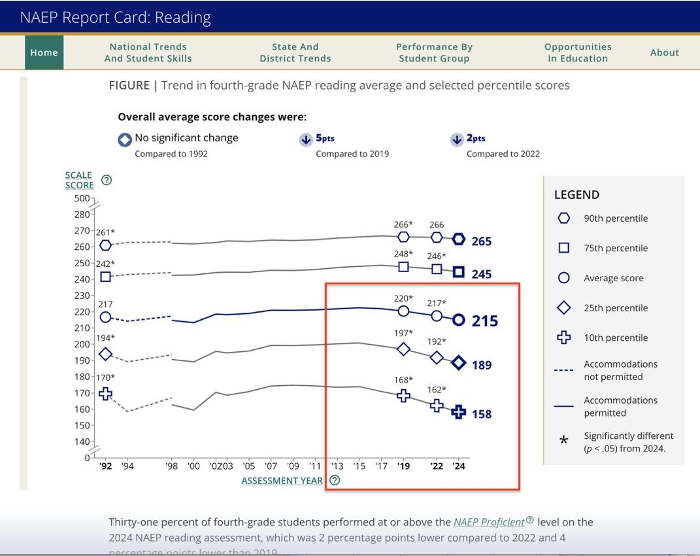
Every two years reading scores make headlines. And this year, as has been the case since COVID, the news is not good. Scores are down (again), and the causes being pointed to for the drop are also wrong (again).
National Assessment of Educational Progress (NAEP) is the national program mandated with tracking student achievement. The 2024 results reveal that reading scores have hit their lowest point in 32 years. This decline is notable because in recent years many states have passed aggressive reading legislation, often labeled as the “science of reading” (SOR).
The SOR movement makes a few key claims: the US has a reading crisis, teachers fail to use “scientific” evidence for instruction, and educators and policymakers are making excuses by acknowledging poverty when addressing low reading proficiency.
However, the Mississippi “miracle” story was an incomplete misreading of reading proficiency and policy.
With the average 2024 NAEP reading scores in further decline, the SOR era in reading reform appears to be failing. This is especially true for vulnerable students whose scores have dropped the most. Interpreting these scores correctly is key to forging a better path forward.
Thus, we must seek a more credible story about 2024 NAEP reading scores.
Let’s consider three sets of data from the Department of Defense schools (DoDEA), Florida, and Mississippi. These student populations include significant racial and socioeconomic diversity as well as multilingual learners and other vulnerable populations of students.
Florida and Mississippi have long been applauded for aggressive education and reading reform, and in 2024, their grade 4 reading scores remained in the top 25% of states, seemingly defying the odds. But Florida and Mississippi scored again well below top-scoring DoDEA schools.
Although many rush to ascribe this success to SOR policies, we should really be looking at a different (ultimately harmful) policy: third-grade retention based on state testing.
As education analysts John Westall and Amy Cummings concluded in a report on reading policy: “[S]tates whose policies mandate third-grade retention see significant and persistent increases in high-stakes reading scores in all cohorts…. [T]here is no consistent evidence that high-stakes reading scores increase in states without a retention component.”
Inflated scores are not learning; by eighth grade NAEP reading scores for Florida and Mississippi drop into the bottom 25% of states. The widely applauded “gains” in grade 4 are, in fact, a mirage.
Here is a different story: DoDEA schools are the top-scoring schools on NAEP tests and tell a story we’ve resisted admitting in the US. Maroun and Tieken found in 2024, replicating decades of similar research, that 60+% of student test scores are not linked to teacher quality, instruction, or programs but to out-of-school factors like socioeconomic background, home environment, and parental involvement to name a few.
While DoDEA schools have significant populations from poor and working-class backgrounds and serve diverse as well as vulnerable populations of children, these students have healthcare, food security, stable housing, and parents with stable work—and consistently high reading scores.
NAEP reading scores, again, are not a story about teacher and reading program failure or even student reading proficiency. These scores tell a complex story about a long history in the US of negligence, the lack of political will to address not only the education of all our children, but also their lives outside of school.
I almost feel sorry for Louisiana. (See Update 2 below)
When the 2024 reading scores for NAEP were released, LA seemed poised to be the education “miracle” of the moment for the media and political leaders.
Since mainstream media seems to know only a few stories when covering education—outliers, crises, and miracles—the outlier gains by LA compared to the rest of the nation, reportedly still trapped in the post-Covid “learning loss,” was ripe for yet another round of manufacturing educational “miracles.”
To maintain the MS “miracle” message, journalists must work incredibly hard to report selectively, and badly.
For example, Aldeman celebrates, again, MS as a outlier for for the achievement of the bottom 10% of students (carelessly disregarding that outlier data is statistically meaningless when making broad general claims):
But one state is bucking this trend: Mississippi. Indeed, there’s been a fair amount of coverage of Mississippi’s reading progress in recent years, but its gains are so impressive that they merit another look.
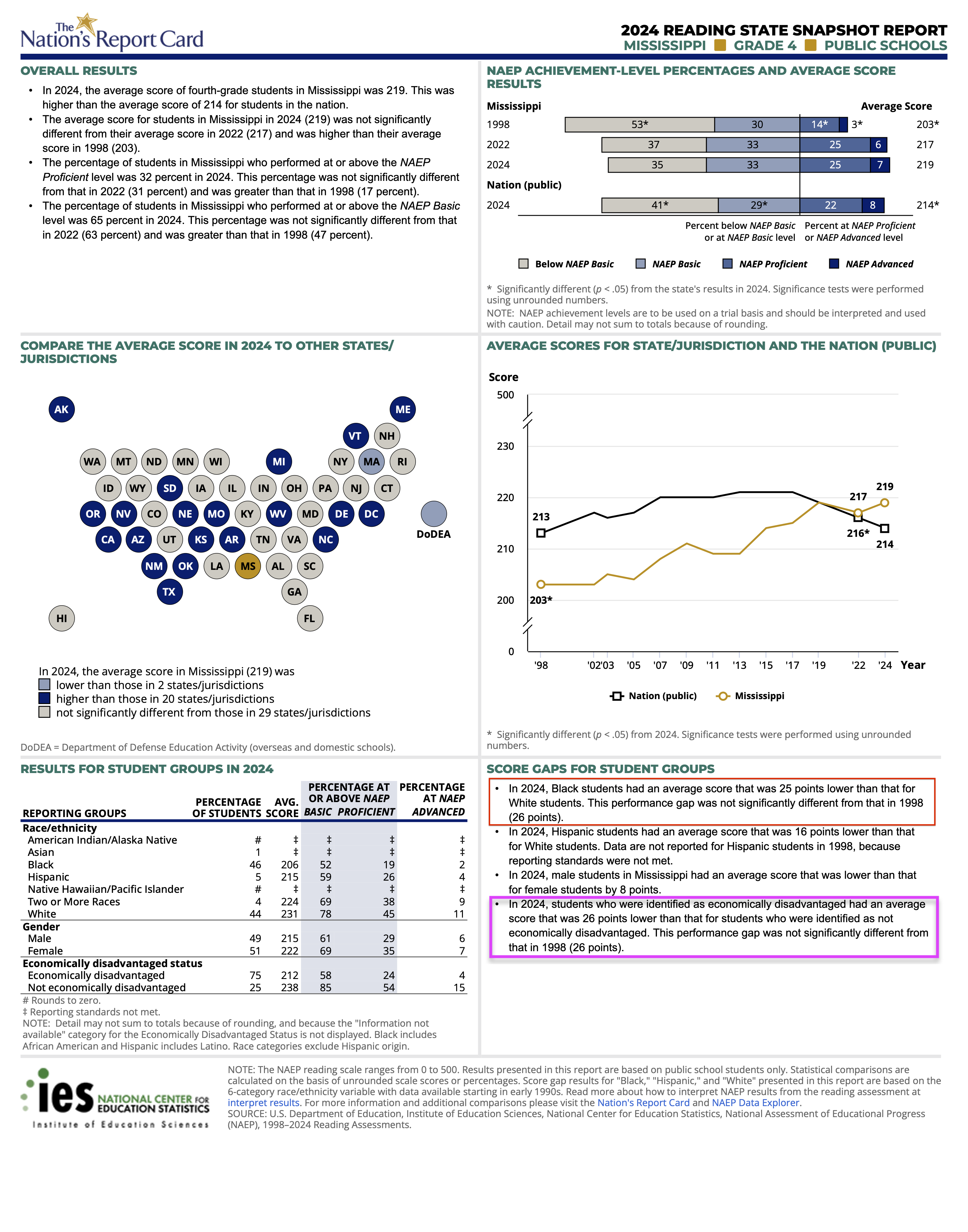
Next, Aldeman highlights reading gains by Black students in MS, omitting a damning fact about the achievement of Black (and poor) students in MS (which mirrors the entire nation):
That’s right, MS has the same racial and socio-economic achievement gaps since 1998, discrediting anything like a “miracle.”
But the likely most egregious misrepresentation of MS as a reading “miracle” is Aldeman “debunking” claims that MS gains are primarily grounded in grade retention, not the “science of reading.”
Notably, Aldeman seems to think linking to the Fordham Institute constitutes credible evidence; it isn’t.
So let’s look at the full picture about grade retention and MS’s reading scores on NAEP.
First, the research on increased reading achievement has found that only states with retention have seen score increases. Westall and Cummings concluded in a report on reading policy: “[S]tates whose policies mandate third-grade retention see significant and persistent increases in high-stakes reading scores in all cohorts…. [T]here is no consistent evidence that high-stakes reading scores increase in states without a retention component [emphasis added].” [Note that Aldeman selective refers to this study late in the article, but omits this conclusion.]
The positive impact of retention on test scores has not been debunked, but confirmed. What hasn’t been confirmed is that test score gains are actual achievement gains in reading acquisition.
Next, MS (like FL and SC, for example) has risen into the top 25% of states in grade 4 reading on NAEP, but then plummets into the bottom 25% of states by grade 8 (despite their reading reform having been implemented for over a decade), suggesting those grade 4 scores are a mirage and not a miracle:
A final point is that media always omits the most important story, what research has shown for decades about student achievement:
Almost 63% of the variance in test performance was explained by social capital family income variables…. The influence of family social capital variables manifests itself in standardized test results. Policy makers and education leaders should rethink the current reliance on standardized test results as the deciding factor to make decisions about student achievement, teacher quality, school effectiveness, and school leader quality. In effect, policies that use standardized test results to evaluate, reward, and sanction students and school personnel are doing nothing more than rewarding schools that serve advantaged students and punishing schools that serve disadvantaged students.
High-poverty states and states with high percentages of so-called racial minorities are not, in fact, beating the odds—again, note that states have not closed the racial achievement gap or the socio-economic achievement gap.
Yes, too often our schools are failing our most vulnerable students. But the greater failures are the lack of political will to address the inequity in the lives of children and the lazy and misleading journalism of the mainstream media covering education.
The goal is de-professionalizing teachers and teaching, not improving student reading proficiency.
Updated 2
The political, market, and media hype over both MS and LA are harmful because that misrepresentation and exaggeration drive the fruitless crisis/reform cycles in education and distracts reform from the larger and more impactful causes of student achievement.
Funded and maintained by the National Center for Youth Law (NCYL) and The Schott Foundation for Public Education, the Opportunity to Learn Dashboard tracks 18 indicators across 16 states. The project seeks to provide information about factors impacting the degree to which children of different ethnicities and races are exposed to environments conducive to learning.
However, indicators directly related to schools explain only a minority of the variation in achievement-related outcomes. Therefore, the dashboard includes out-of-school factors such as access to health insurance and affordable housing, as well as within-school factors such as exposure to challenging curricula and special education spending.
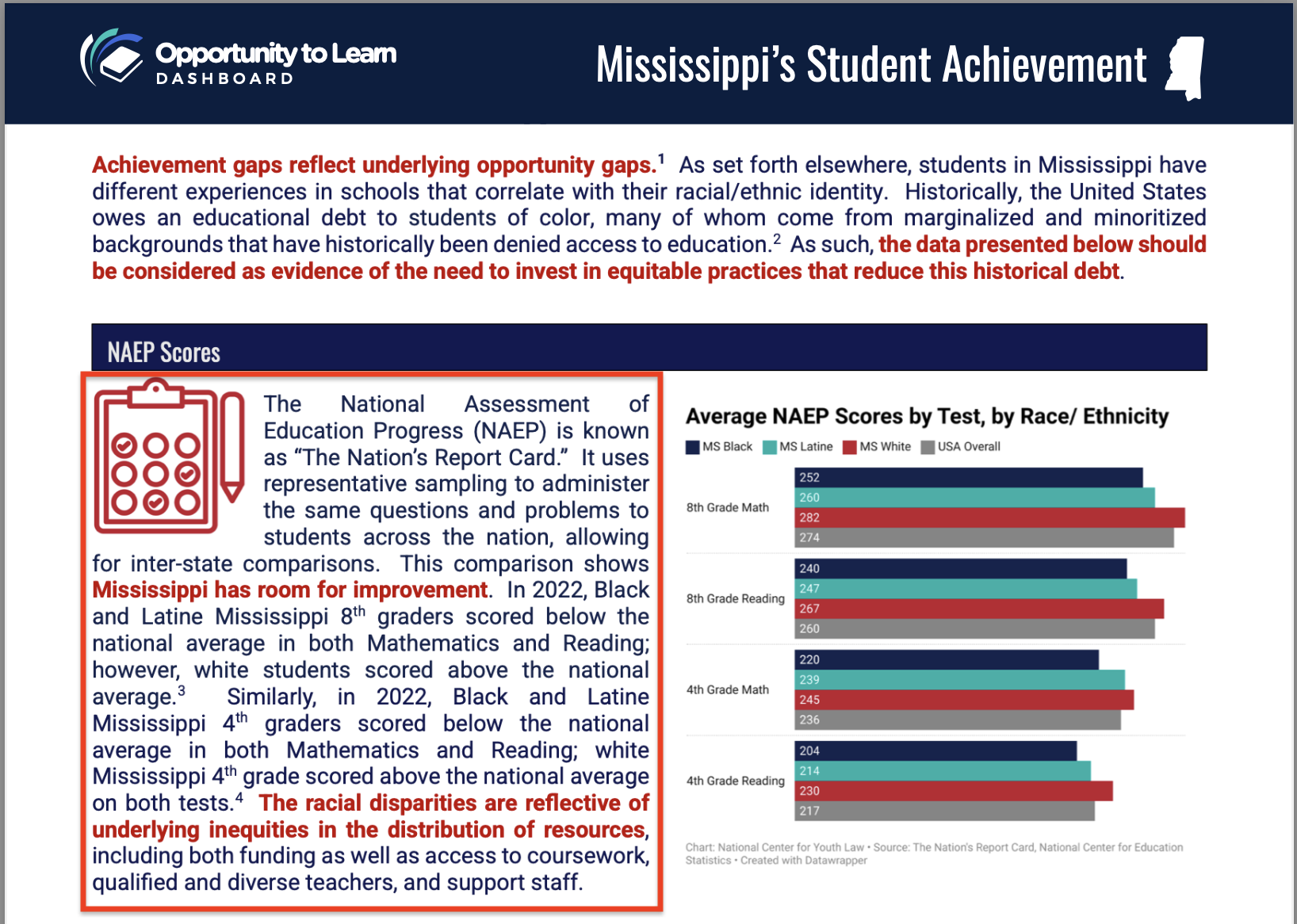
For both MS and LA, we must acknowledge the significant and robust systemic (out-of-school) disadvantages minoritized and impoverished students continue to face in both states:
Note here my points raised about lingering opportunity/achievement gaps exposed by NAEP scores in both states:
To emphasize again, NAEP scores do not reveal education “miracles” in either MS or LA. In fact, NAEP scores continue to show that education reform as usual is a failure.
Arthur Young graduated from high school with honors. However, as an adult, he was illiterate.
Literacy expert Helen Lowe featured Young and concluded:
Arthur could not read, even at a primer level. He could not drive a car, because he could not pass the test for a driver’s license; he could not read the street signs or traffic directions. He was unable to order from the menu in a restaurant. He could not read letters from his family and he could not write to them. He could not read the mixing directions on a can of paint or the label on a shipment of sheet rock. He had been cheated.
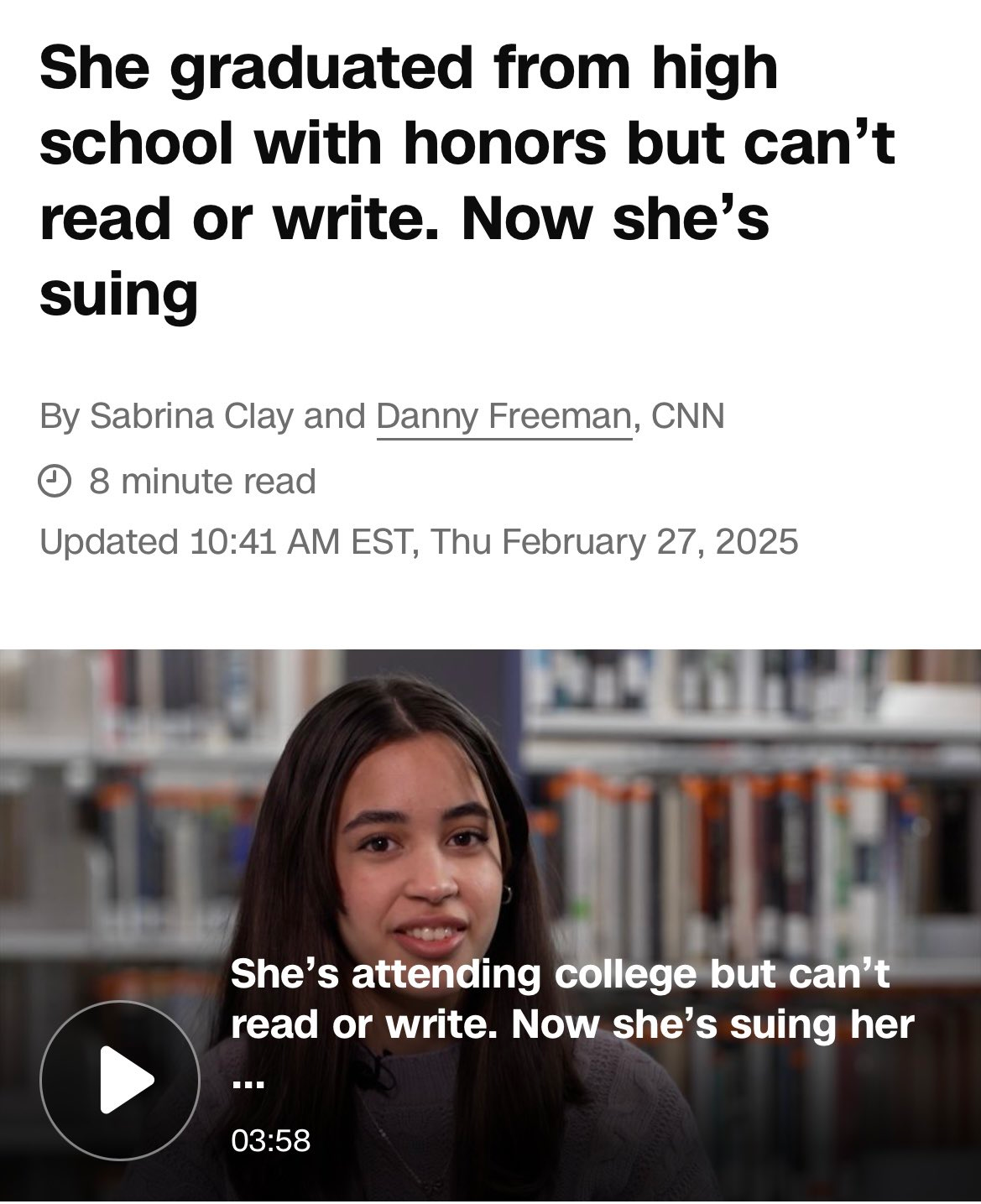
This story may be shocking but also sounds disturbingly familiar to a recent story on CNN:
This young woman, of course, has also been “cheated.”
Both problematic stories seven decades apart are outlier narratives that are both inexcusable failures but are not evidence of any generalizations about education, teaching, or literacy.
Stated bluntly, outliers can never lead to any sort of generalizations.
One of the great failures of public discourse and policy around reading and literacy in the US has been perpetual crisis rhetoric used to drive ideological agendas about what counts as literacy and how best to teach children and young adults to read and write.
If you had a time machine, you could visit any year over the past century in the US and discover that “kids today” can’t and don’t read because the education system is failing them.
These histrionic stories are compelling because they often include real children and adults whose lives have been reduced because of their illiteracy or inadequate literacy.
Ideally, of course, no person in the richest and most powerful country in the world should ever be cheated like that.
But here is the paradox: These outlier stories are distractions from doing the reform and work needed to approach all children and adults being literate.
Once again, reading test data for decades has shown exactly the same reality as all other forms of tests of student learning (math, science, civics, etc.): Over 60% of test scores are causally linked to factors beyond the walls of schools—access to healthcare, food security, housing security, access to books in the homes and communities, and thousands of factors impacting the lives and learning of children.
At best, teacher impact on measurable student literacy is only about 1-14%.
Yet, year after year, decade after decade, the US focuses on teacher quality, curriculum and standards, reading programs, and reading test scores without acknowledging or addressing the overwhelming impact of out-of-school factors on people acquiring the literacy they need and deserve to live their full humanity.
The two stories seven decades apart from above are likely far more complicated than any coverage could detail; the are both compelling and upsetting human stories that deserve our attention, in order to address their individual tragedies as well as taking greater care that others do not suffer the same fate.
However, misreading outlier distractions is not the way to honor that these people have been cheated.
Two things can be true at once: Outlier stories are heartbreaking and inexcusable; however, they prove nothing beyond the experiences they detail.
CNN uses outlier stories for traffic and profit.
Literacy ideologues use outlier stories to drive their agendas as well as to feed the education market.
We are all cheated, once again, when we play the outlier distraction game and refuse to acknowledge and address the crushing realities of inequity in the lives and learning of children.
Each child matters, and all children matter.
Yet, only the adults have the political and economic power to make that a reality.
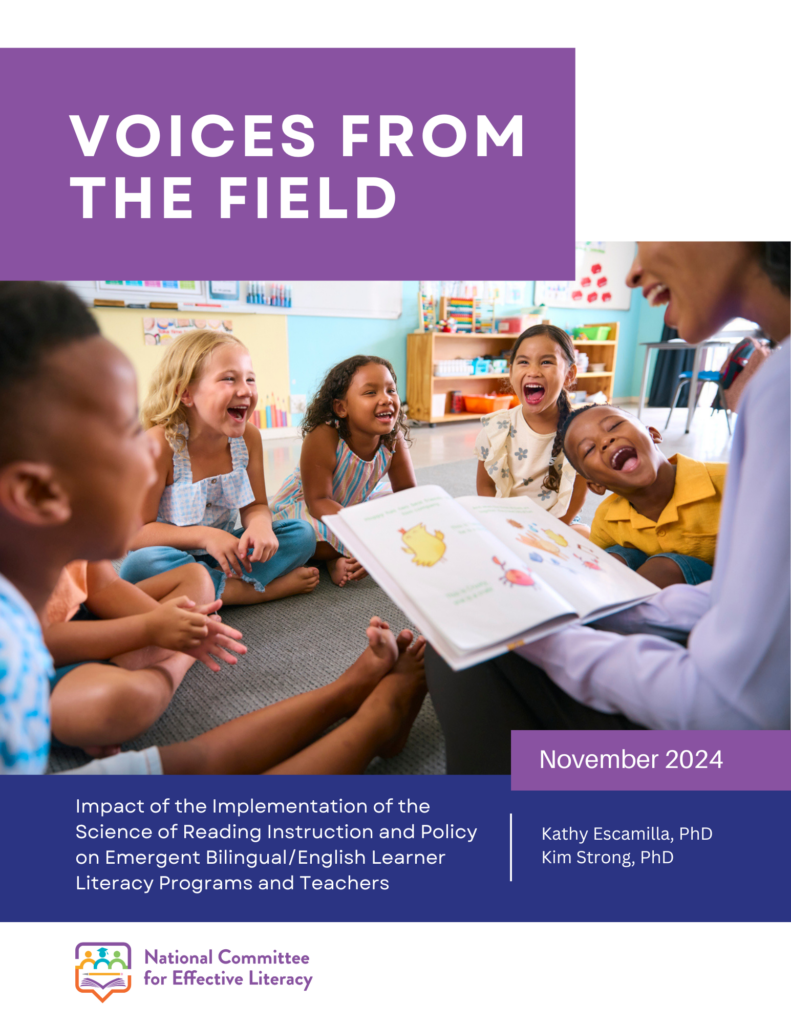
This new groundbreaking report from the National Committee for Effective Literacy (NCEL), Voices from the Field: The Impact of the Implementation of Science of Reading Instruction and Policy on Emergent Bilingual/English Learner Literacy Programs and Teachers, dives deep into the real-world implementation of Science of Reading (SoR) policies. Through interviews with nearly 80 educators who work directly with emergent bilinguals and English learners (EB/EL) in schools implementing state and district SoR policies, we uncover critical insights into the challenges and opportunities for supporting EB/ELs. This study points to the need for more comprehensive understanding of the SoR and for implementation supports that directly address the needs of EB/EL students and the contexts in which they are taught.
Some people have recognized that Elon Musk has willfully or ignorantly misread and misrepresented data on social security to create a story to support an ideological agenda—cutting social programs in the US government.
Note this thread on X/Twitter, notably Wolfer’s final post: “When everything they say is designed to mislead, you’re left to wonder why.”
And here's the number of RECIPIENTS of social security in each age bucket with the death field set to false (and recipient set to true). A mere 89,106 are aged 99+, not the tens of millions suggested by @elonmusk. https://t.co/PdCtdCIlsGpic.twitter.com/ljs3wls5Yp
Manufacturing crises to perpetuate stories for ideological agendas is very effective (and nothing new).
Why?
“A lie can travel halfway around the world while the truth is still putting on its shoes” (a quote misattributed to Mark Twain, somewhat ironically).
Certainly, the Trump/Musk era of this strategy is an extreme moment in history; however, this is exactly how education reform has been conducted since the 1980s and how the current “science of reading” (SOR) movement is being orchestrated.
The entire education reform movement was grounded in a data lie manufactured by a political report, A Nation at Risk, to create a story of public school failure in the US in order to perpetuate Reagan’s ideological agendas (school prayer, school choice, etc.).
Now, as a subset of the manufactured education crisis, the SOR movement has misread and misrepresented NAEP data to manufacture a reading crisis in order to perpetuate a story of student literacy and “bad” teachers in order to perpetuate ideological and market agendas for teaching reading.
If evidence is being ignored, then it isn’t really about evidence.
It’s about ideology.
If you see through the manufactured crises of the Trump/Elon answer, you have a template for seeing through the manufactured education and reading crises.
Returning Pencil Buster Dr. Paul Thomas joins us to help us break down the “science of reading.” This is a topic we’ve covered frequently, most recently with Dr. Nancy Carlsson-Paige this week. But Dr. Paul brings a uniquely nuanced and deep knowledge of the marketing scheme/regressive conservative political tool masquerading as a curriculum set to the show. Because Dr. Paul’s dug deep, and with his 40+ year career as a literacy educator, writer, and speaker he is one educated educator on the topic. Don’t be fooled by their talk of “science”, Dr. Paul urges us. It is a method for censorship and limiting of educators. We can do so much better. And our students deserve so much better. Yet conservative lawamakers have written laws literally banning the teaching of anything except the so-called “science of reading.” Come on, let’s not remove tools from our educators’ literacy teaching kits. That’s just foolish.
BustED Pencils: Fully Leaded Education Talk is part of Civic Media. Subscribe to the podcast to be sure not to miss out on a single episode! To learn more about the show and all of the programming across the Civic Media network, head over to https://civicmedia.us/shows. Join the conversation by calling or texting us at 608-557-8577 to leave a message!
educator, public scholar, poet&writer – academic freedom isn't free


















 dr. p.l. (paul) thomas