
Category Archives: Education

NEW: Comic Connections: Reflecting on Women in Popular Culture

Comic Connections: Reflecting on Women in Popular Culture

Sandra Eckard, editor

Eckard_Comic Connections_Women[1] copy

See my chapter:

Wonder Woman: Reading and Teaching Feminism with an Amazonian Princess in an Era of Jessica Jones, P. L. Thomas

[Sample excerpt from Classroom Connections section]

Women Superhero Costumes and Sexism in Student Dress Codes

“The original Wonder Woman comics included page after page of bondage imagery, scads of cross-dressing villains, and really remarkably unrepressed lesbian eroticism[i],” explains Noah Berlatsky, examining The New 52 reboot of Wonder Woman, adding: “The best Azzarello/Chiang can do, in contrast, is to have their Amazons pose like Playboy models while Eros makes sophomoric cracks about the quest for seminal mortal vessels.”[ii] The tension between the potential for a woman superhero to confront and change corrosive social norms such as sexism, misogyny, toxic masculinity, and objectifying/sexualizing women and the too-often reality of pop culture to reflect and reinforce those norms is throughout Wonder Woman, including how she is physically depicted as a superhero.

While comic books and graphic novels can be effective in classes as ways to reach beyond traditional texts, using Wonder Woman to lead into topics directly relevant to students is also recommended. Consider the controversial issue of dress codes for students as that is dramatized in depictions of Diana Prince and Wonder Woman.

In The New 52 rebooting of Wonder Woman, many have confronted the sexualizing of Wonder Woman in her costume and poses.[iii] These debates about objectification of females as well as slut shaming and body shaming can be introduced through Wonder Woman (Wonder Woman: Blood and the Meredith and David Finch runs before Rebirth), and then, students can research and debate the gender bias often found in school dress codes. Some resources for the latter include:

  • Shame: A Documentary on School Dress Code[iv]. This is a documentary by a 17-year-old student, available on YouTube. This could be a text in this unit or a model for documentaries created by students.
  • “Why School Dress Codes Are Sexist,” Li Zhou (The Atlantic).[v] This is a well-written work of journalism that covers the topic of sexism in dress codes well and serves as a strong model for public writing that uses hyperlinks as citation.
  • “Sexualization, Sex Discrimination, and Public School Dress Codes,” Meredith J. Harbach.[vi] Here, students can examine a scholarly approach to the issues of sexism and dress codes.
  • “The Unspoken Messages of Dress Codes: Uncovering Bias and Power,” Rosalind Wiseman (Anti-Defamation League).[vii] A curriculum resource and excellent overview, this can serve as a guideline for students lobbying for changes to dress codes and/or writing alternative codes that avoid bias.
  • “Baby Woman,” Emily Ratajkowski (Lenny).[viii] Ratajkowski is a contemporary celebrity, model and actress, who takes a strong public position as a feminist, despite her association with provocative and sexualized media (controversial music videos and TV commercials). Her personal narrative is a strong model of the genre, but it also complicates views of feminism and female sexuality as well as objectification.

Using the texts above, students can write persuasive essays, cited essays, and new dress codes; they can participate in formal or informal debates; and they can develop projects around identifying how popular media and culture objectify and shame women based on physical appearance and clothing. A unit on dress code linked to Wonder Woman is a provocative and rich unit that challenges students on many levels.

Finally, in this section on teaching through Wonder Woman, I am listing some additional resources for other units of study:

  • Robert Jones Jr., “Bumbling: DC Super Hero Girls and the White Racial Imagination,” The Middle Spaces.[ix]
  • Eliana Dockterman, “Wonder Woman Breaks Through,” Time.[x]
  • Christopher J. Hayton, “Evolving Sub-Texts in the Visual Exploitation of the Female Form: Good Girl and Bad Girl Comic Art Pre- and Post-Second Wave Feminism,” ImageTexT: Interdisciplinary Comics Studies 4 (2014), www.english.ufl.edu/imagetext/archives/v7_4/hayton/
  • Charlotte E. Howell, “‘Tricky’ Connotations: Wonder Woman as DC’s Brand Disruptor,” Cinema Journal.[xi]
  • Mitra C. Emad, “Reading Wonder Woman’s Body: Mythologies of Gender and Nation,” The Journal of Popular Culture.[xii]

Kelli E. Stanley, “‘Suffering Sappho!’: Wonder Woman and the (Re)Invention of the Feminine Ideal,” Helios.[xiii]

[i] Noah Berlatsky, “Comic Books Have Always Been Gay,” Slate, June 1, 2012, accessed February 10, 2017, http://www.slate.com/blogs/xx_factor/2012/06/01/gay_comic_books_have_been_around_since_the_birth_of_wonder_woman.html

[ii] Berlatsky, “Wonder Woman’s Violent, Man-Pandering Second Act.”

[iii] Ryan, “Wonder Woman Takes a Big Step Back” and Berlatsky, “Wonder Woman’s Violent, Man-Pandering Second Act.”

[iv] Maggie Sunseri, Shame: A Documentary on School Dress Codes, YouTube, may 29, 2015, accessed February 10, 2017, https://www.youtube.com/watch?v=XDgAZO_5U_U

[v] Li Zhou, “Why School Dress Codes Are Sexist,” The Atlantic, October 20, 2015, accessed February 10, 2017, https://www.theatlantic.com/education/archive/2015/10/school-dress-codes-are-problematic/410962/

[vi] Meredith Johnson Harbach, “Sexualization, Sex Discrimination, and Public School Dress Codes,” 50 U. Rich. L. Rev. 1039 (2016), access February 10, 2017, http://scholarship.richmond.edu/cgi/viewcontent.cgi?article=2275&context=law-faculty-publications

[vii] Rosalind Wiseman, “The Unspoken Messages of Dress Codes: Uncovering Bias and Power,” Anti-Defamation League, September 2014, accessed February 10, 2017, http://www.adl.org/education-outreach/curriculum-resources/c/the-unspoken-language-of-bias-and-power.html

[viii] Emily Ratajkowski, “Baby Woman,” Lenny, February 16, 2016, accessed February 2, 2017, http://www.lennyletter.com/life/a265/baby-woman-emily-ratajkowski/

[ix] Robert Jones Jr., “Bumbling: DC Super Hero Girls and the White Racial Imagination,” The Middle Spaces, May 10, 2016, accessed February 2, 2017, https://themiddlespaces.com/2016/05/10/bumbling-dc-super-hero-girls/

[x] Eliana Dockterman, “Wonder Woman Breaks Through,” Time, December 26, 2016–January 2, 2017.

[xi] Charlotte E. Howell, “‘Tricky’ Connotations: Wonder Woman as DC’s Brand Disruptor,” Cinema Journal 55.1 (2015, Fall), DOI: 10.1353/cj.2015.0072.

[xii] Mitra C. Emad, “Reading Wonder Woman’s Body: Mythologies of Gender and Nation,” The Journal of Popular Culture 39.6 (2006).

[xiii] Kelli E. Stanley, “‘Suffering Sappho!’: Wonder Woman and the (Re)Invention of the Feminine Ideal,” Helios 32.2 (2005).
Models, Mentor Texts, and (More) Resisting Rubrics

In the discussion spurred by Ken Lindblom’s adding “interesting to read” to his writing rubrics, Tim Ogburn posed on the soon-to-be retired Teaching and Learning forum at NCTE’s Connected Community: “So, along with rubrics (or not), I wonder how folks use models (or not)?”

Ogburn’s question coincided with my first offering of an upper-level writing/research course at my university: Scholarly Reading and Writing in Education. After the first class meeting, I have been revising and adding to the course guidelines and materials.

Part of that work has been looking carefully at how I can use and expand my materials from my first-year writing seminar, which I have taught in various forms for about a decade now.

To answer Ogburn directly, I want to admit that my teaching writing practices are significantly grounded in using models and mentor texts. But here’s the caveat: My experience and the research base both show that using models is only a weak strategy when teaching writing.

For one example of research, Writing Next ranks using models as the tenth out of eleven effective strategies:

Study of Models (Effect Size = 0.25)

The study of models provides adolescents with good models for each type of writing that is the focus of instruction. Students are encouraged to analyze these examples and to emulate the critical elements, patterns, and forms embodied in the models in their own writing.The effects for all six studies reviewed were positive, though small. It was not possible to draw separate conclusions for low-achieving writers, as none of the studies specifically addressed this population.

None the less, I incorporate models and mentor texts while always seeking ways to increase their effectiveness.

Here, then, is how I use models for my four essay assignments in my first year writing seminar:

Essay Requirements

Essay 1: See our shared prompt HERE.

Examples of personal narratives:

Everybody’s Somebody’s Baby, Barbara Kingsolver

Letter to My Son, Ta-Nehisi Coates

The Secret Lives of Inner-City Black Males, Ta-Nehisi Coates

They Can’t Turn Back, James Baldwin

Essay 2: Compose and draft an essay of about 1250-1500 words in blog/online format (see examples below) that offers an expository or argumentative mode for a general public audience from the perspective of expertise. Incorporate images, video, or other media.

SAMPLE submission format.

Examples:

Should We Marvel at a Black Captain America?

[See scholarly version: Can Superhero Comics Defeat Racism?]

There is no debate about hitting children – it’s just wrong

Corporations Are Behind The Common Core State Standards — And That’s Why They’ll Never Work

Gaiman’s Mythical Folding of Childhood into Adulthood

Essay 3: Compose and draft a substantially cited essay of about 4-6 double-spaced pages that presents a discipline-based examination of a topic or poses a discipline-based argument. Citations must conform to APA style guidelines. [See “Writing for Specific Fields.”]

Examples:

Properly formatted APA sample essay

Universal Public Education—Our (Contradictory) Missions

Of Rocks and Hard Places—The Challenge of Maxine Greene ’s Mystification in Teacher Education

Essay 4: TBD in a conference

And then, how I have adapted that approach in an upper-level writing/research course (as embedded, noted bellow in red, in submission guidelines):

Annotated bibliographies: Submit annotated bibliographies in both the initial and final submissions (all drafts should be complete and in proper format, even when submitting “rough” or initial drafts) as Word files and attach to email with “annotated bibliographies” in the subject line. See some guidelines and a sample annotated bibliography here (note APA version). Submit each annotated bibliography as a separate Word file, and format in Times New Roman font, 12 pt., double space, with 1″ margins. Each file should be named “lastname AB#.docx” (each file numbered from 1 through 8 or 10).

Research project essay: Submit research project cited essay in both the initial and final submissions (all drafts should be complete and in proper format, even when submitting “rough” or initial drafts) as Word files and attach to email with “research project essay” in the subject line. See APA guidelines here and a sample APA essay here. Submit essay as a Word file, and format in Times New Roman font, 12 pt., double space, with 1″ margins. Each file should be named “lastname essay.docx” (as you revise and resubmit, add RW, RW2, RW3, etc., to the file name to designate multiple drafts).

Public commentary: Submit your public commentary in both the initial and final submissions (all drafts should be complete and in proper format, even when submitting “rough” or initial drafts) as Word files and attach to email with “public commentary” in the subject line. See a sample public commentary here. Submit essay as a Word file, and format in Times New Roman font, 12 pt., single space, with 1″ margins. Each file should be named “lastname OpEd.docx” (as you revise and resubmit, add RW, RW2, RW3, etc., to the file name to designate multiple drafts).

Finally, what, then, is the case for models and mentor texts—especially as ways to resist rubrics?

  • Authentic (published) models and mentor texts are powerful alternatives to templates and artificial writing forms such as five-paragraph essays and anchor texts for standardized testing.
  • Models and mentor texts are rich and engaging materials for reading like a writer and other critical reading activities, and thus, offer far more than simply teaching writing.
  • If resisting and not outright rejecting rubrics, teachers and students can mine models and mentor texts in order to develop rubrics and/or guiding questions for composing together.
  • Models and mentor texts are essential for developing genre awareness in students as well as fostering in students a greater understanding of writer purpose, audience, writing forms, conventional expectations (grammar, mechanics, and usage), etc.

As I continue to witness, teaching writing is a journey, and with that concession, using models and mentor texts to teach writing is an excellent example of how we must be neither a slave to nor ignorant of the research base and our own practiced experiences with methods. Grounding the teaching of writing in models and mentor texts proves to be both essential and in some ways inadequate, leaving us with “miles to go before [we] sleep.”

The Oprah Problem (Nothing New)

As is common in the U.S., there has been much ado about Oprah and all the black-clothed solidarity at the Golden Globes.

Many are all atwitter at celebrity finger wagging at long-entrenched sexism and racism among, well, celebrities. You see, that’s all we have anymore in the U.S. since we have formally elected a reality-hack as president (trace this back to an entire country acting as if Ronald Reagan, hack actor, was a credible political leader, some sort of conservative messiah).

This sort of nonsense is not anything new, and I would note the fawning over Princess Diana as at least a typical example of how we canonize the glamorous in hollow and misguided ways.

Oprah Winfrey’s award and speech have fueled the smoldering notion that she should run for president.

In the context of who has dominated political leadership in the U.S. throughout history (almost entirely constituted by average but privileged white men who have avoided being held accountable for their moral and ethical flaws as well as outright horrible behavior as human beings), let’s note upfront that Oprah as a highly successful black woman exceeds the ridiculously low standards for who can be a political leader—even president—in the U.S.

On a very basic level, the U.S. has elected to high and even the highest political offices Reagan, Al Franken, Jesse Ventura, Donald Trump, and Arnold Schwarzenegger; therefore, anyone who wants to make a sweeping claim that Oprah somehow falls below that line cannot stand on anything other than the thinnest (and possibly racist and/or sexist) ice.

Period.

Oprah could be the Democrats’ Reagan, and to be honest, in terms of being president, would likely do a better job than Reagan.

But a related issue is the claim that Oprah is somehow a progressive savior, and that is also different but incredibly thin ice.

In the tradition of Barack Obama (but not Clarence Thomas, for example), Oprah has benefitted from and then perpetuated some really corrosive ideologies in the U.S. that ultimately hurt our pursuit (let’s call it a progressive pursuit for lack of a better word) of equity for women and racial (so-called) minorities.

Oprah has also used her celebrity to create and bolster some truly awful spin-off celebrities—Dr. Oz and Dr. Phil. I mean truly awful hucksters.

In short, while as I note above, Oprah is qualified for all political offices in the U.S. in terms of who we have routinely elected, the Oprah problem is then not about her qualifications but how progressives embrace, or not, her.

Again, although some very credible progressive gains were made under Obama, he is not “leftist,” and is only marginally progressive (using the deeply skewed parameters of the significantly right-leaning U.S. scale for ideology), and Oprah also fits that description.

I have no doubt she would be a powerful symbolic candidate for women and people of color, and she would, like Obama, very possibly drive some progressive policies and offer an occasional bully pulpit for progressive and equitable public discourse.

But Oprah as progressive? Oprah as radical? Those are not her selling points.

Let me offer a few counter-arguments along those lines:

The Oprah problem is a subset of the exact issues the rich and famous were wagging their fingers at during the Golden Globes—in other words, what are progressives and the authentic left to do in a country that has historically and continually elevated the average white man to excessive wealth, celebrity, and power even as those average white men have behaved as abusive and rapacious cowards and monsters?

My thoughts for now are that we on the left must temper our rush to discredit Oprah while making our case for genuine progressive policies (and progressive leaders who practice) and promote equity and justice for all.

If the arc of the moral universe does in fact bend toward justice, as Martin Luther King Jr. implored, at the very least, Oprah as president would provide a recalibration needed after the Trump-led assault on the tepid Obama progressive agenda, and gains.

I see no hope that mainstream politics in the U.S. has the capacity for anything truly revolutionary (I mean we actually touted Bernie Sanders as a socialist) so we must be careful about how we respond to Oprah as presidential candidate—careful that we all on the left do not become as shallow and hypocritical as the celebrities peacocking at the Golden Globes, in fact.

Ken Lindblom’s “Is Interesting to Read” and the Rubric Dilemma Redux

At the 2003 National Council of Teachers of English annual conference in San Francisco, I met Ken Lindblom, then a column editor for English Journal and later an outstanding editor for the same.

Ken is among an important nucleus of NCTE colleagues and friends who have enriched my professional life in ways I can never repay; I have served as a column editor for EJ under two different tenures of editors and as the Council Historian just after the centennial along with being awarded the 2013 George Orwell Award—just to name some of the personal accomplishments that I cherish as examples of the collegiality and kindness found in the NCTE community of teachers and scholars.

So Ken’s The Rubric Criterion That Changed Everything has put me in a predicament since I value Ken as one of my go-to thinkers on teaching writing but I also have a long and firm stance against grades, tests, and rubrics (see my chapter on de-grading writing instruction).

The central point addressed by Ken captures exactly why his post inspires me and gives me pause:

Once I was reading a stack of papers, and I remember thinking, “Man, I wish these papers were more interesting!” Then it hit me: Students will work on what’s listed on a rubric. In my next paper assignment, I added this to the rubric: “Is Interesting to Read.”

Rubrics—as Maja Wilson and Alfie Kohn deconstruct—often become the chore to fulfill when students write, and while they can provide structure and clarity in grading for both students and teachers, rubrics can often be nightmares for those same teachers when student writing flounders but fulfills the rubric or soars in ways that the rubric never addresses.

Instead of rubrics, then, I offer students guiding questions, and do agree that students need structure (see these concepts and questions [1] grounded in developing genre awareness).

Regardless of using rubrics or guiding question, I want to stress that raising student awareness of being interesting is both powerful and essential. That awareness, however, must be fostered by examining with students the many ways in which writers accomplish being interesting.

First, we must highlight that embedded in “Is Interesting to Read” is a focus on audience. In my first-year writing seminars, I stress that I want students to stop writing for me, and to develop essays with clear and real audiences in mind. This is part of my on-going goal of encouraging students to stop thinking as students and to start thinking as writers.

Some of the concrete strategies that we focus on that contribute to being interesting as a writer include the following:

  • Creating openings, instead of writing mechanistic introductions, that are compelling first and then focus the reader on the central purpose of the essay. We do several reading like a writer activities (here and here) throughout the semester, but focus on openings in the first few weeks.
  • Expanding tone beyond the faux academic pose of objectivity, and acknowledging the power of humor. Notably in our reading of Kingsolver, for example, students notice that essays are often humorous (especially in the opening), and thus, more interesting.
  • Emphasizing the power of narrative (and description) as a mode that creates interest. Drawing on Style, we think about nonfiction essays in terms of fiction—character, plot, and setting. Inherent in narrative, as well, is the importance of details (see Flannery O’Connor).
  • Allowing drafting to be an act of discovery, brainstorming. Another key aspect of resisting the traditional introduction/thesis approach is helping students recognize that the act of drafting often leads writers to their purpose; in other words, drafting as discovery opens the door to finding the interesting instead of trying to fulfill the obligation of a predetermined thesis.
  • Reimagining the essay form not as an introduction/thesis, body, and conclusion but as a cohesive form better served by framing—developing a few opening and closing paragraphs that share a story, detail, or compelling element that both engages and compels the reader (thus, interesting).

I remain less optimistic than Ken that rubrics can serve our goal to foster students as writers who are aware of their audience and committed to being interesting. I do believe, however, seeking ways to encourage specific strategies for being interesting as a writer is achievable, but it is also essential, as Ken argues, not simply something extra.


[1] Prompt Analysis for Genre Awareness*

To the students: As you prepare to write, revise, and edit, consider these questions, particularly if you are given a writing task in your academic classroom:

[Note: If you cannot answer these questions from the task you have been given, how do you find out the answers?]

  1. GENRE NAME: What is this text called (its genre name)? What do you already think you know about what a text from this genre looks and ‘sounds’ like? For example, how should the text be organized? What kind of language do you need to use?
  1. PURPOSE: What are you supposed to DO as a writer when completing this task? Are you asked to make an argument? To inform? To describe or list?
  1. CONTEXT: If you are writing this task in, or for, a classroom, what do you know about the context? What does the discipline require for a text? Under what conditions will you be writing? For example, are you writing a timed, in-class response?
  1. WRITER’S ROLE: Who are you supposed to BE in this prompt? A knowledgeable student? Someone else?
  1. AUDIENCE: Is your audience specified? If it is your instructor, what are his or her expectations and interests? What goals for students does the instructor have?
  1. CONTENT: What are you supposed to write about? Where do you find this content? In your textbook? In lectures? Are you supposed to relate what you have heard or read in some way?
  1. SOURCES: What, and how many, sources are you supposed to draw from to write your text? Have the sources been provided in the class? Are you supposed to look elsewhere? Are the sources primary or secondary?
  1. OTHER SPECIFICATIONS: What else do you know about the requirements for this text? How long should it be? What referencing style (MLA, APA) should you use? What font type?
  1. ASSESSMENT: How will your paper be graded? What does the instructor believe is central to a good response? How do you know? If you don’t know, how can you find out?
  1. MAKING THE TEXT YOUR OWN: What about the paper you write can be negotiated with the instructor? Can you negotiate the topic? The types of sources used? The text structure? If you can negotiate your assignment, it might be much more interesting to you.

* Created and published in Johns, A. M. (2008). Genre awareness for the novice academic student: An on-going questLanguage Teaching, 41(2), 237-252.

Research and Miscellaneous Roundup

Selective Exposure to Misinformation: Evidence from the consumption of fake news during the 2016 U.S. presidential campaign, Andrew Guess, Brendan Nyhan, and Jason Reifler

Abstract

Though some warnings about online “echo chambers” have been hyperbolic, tendencies toward selective exposure to politically congenial content are likely to extend to misinformation and to be exacerbated by social media platforms. We test this prediction using data on the factually dubious articles known as “fake news.” Using unique data combining survey responses with individual-level web traffic histories, we estimate that approximately 1 in 4 Americans visited a fake news website from October 7-November 14, 2016. Trump supporters visited the most fake news websites, which were overwhelmingly pro-Trump. However, fake news consumption was heavily concentrated among a small group — almost 6 in 10 visits to fake news websites came from the 10% of people with the most conservative online information diets. We also find that Facebook was a key vector of exposure to fake news and that fact-checks of fake news almost never reached its consumers.

Educational opportunity in early and middle childhood: Variation by place and age, Sean F. Reardon

Abstract

I use standardized test scores from roughly 45 million students to describe the temporal structure of educational opportunity in over 11,000 school districts—almost every district in the US. For each school district, I construct two measures: the average academic performance of students in grade 3 and the within-cohort growth in test scores from grade 3 to 8. I argue that third grade average test scores can be thought of as measures of the average extent of educational opportunities available to students in a community prior to age 9. Growth rates in average scores from grade 3 to 8 can be thought of as reflecting educational opportunities available to children in a school district between the ages of 9 and 14.

I document considerable variation among school districts in both average third grade scores and test score growth rates. Importantly, the two measures are uncorrelated, indicating that the characteristics of communities that provide high levels of early childhood educational opportunity are not the same as those that provide high opportunities for growth from third to eighth grade. This suggests that the role of schools in shaping educational opportunity varies across school districts. Moreover, the variation among districts in the two temporal opportunity dimensions implies that strategies to improve educational opportunity may need to target different age groups in different places. One additional implication of the low correlation between growth rates and average third grade scores is that measures of average test scores are likely very poor measures of school effectiveness. The growth measure I construct does not isolate the contribution of schools to children’s academic skills, but is likely closer to a measure of school effectiveness than are measures of average test scores.

Tax Bill Would Increase Abuse of Charitable Giving Deduction, with Private K-12 Schools as the Biggest Winners, Carl Davis

From Executive Summary

In its rush to pass a major rewrite of the tax code before year’s end, Congress appears likely to enact a “tax reform” that creates, or expands, a significant number of tax loopholes. One such loophole would reward some of the nation’s wealthiest individuals with a strategy for padding their own bank accounts by “donating” to support private K-12 schools. While a similar loophole exists under current law, its size and scope would be dramatically expanded by the legislation working its way through Congress.2 This report details how, as an indirect result of capping the deduction for state income taxes paid, the bill expected to emerge from the House-Senate Conference Committee would enlarge a loophole being abused by taxpayers who steer money into private K-12 school voucher funds. This loophole is available in 10 states: Alabama, Arizona, Georgia, Kansas, Montana, Oklahoma, Pennsylvania, Rhode Island, South Carolina, and Virginia.

The Sound of White Silence, @michaelharriot

White is a blank space.

It is the unwritten adjective that filled the infinite and simultaneously minuscule void between “all” and “men” when our founding fathers so eloquently declared their independence. The word “white” is not included in the Constitution, but it is understood by all to be the unmentioned modifier in “we the people.” It is our national equivalent to the aphonic letter “e.” We could always see it, but as a country we agreed to adhere to the first rule of American phonetics:

The “white” is silent.

The Nature and Aim of Fiction, Flannery O’Connor

People have a habit of saying, “What is the theme of your story?” and they expect you to give them a statement: “The theme of my story is the economic pressure of the machine on the middle class”—or some such absurdity. And when they’ve got a statement like that, they go off happy and feel it is no longer necessary to read the story.

Some people have the notion that you read the story and then climb out of it into the meaning, but for the fiction writer himself the whole story is the meaning, because it is an experience, not an abstraction.


The Stuff of Poetry: My First Good Cry of 2018

Poet Tara Skuru, The Amoeba Game, posted her “Morning Love Poem” as a gift for the new year:

I responded that it brought my first good cry of 2018, and she shared a nugget about how the poem came to be:

The poem and exchange prompted more from me:

Teaching poetry can include focusing on poem analysis, using the poem as a model text for understanding poetry (what makes a poem, a poem?), or fostering poetry composing (how to write poetry).

In all of those contexts as a teacher and poet, I strive to help students unlearn their misconceptions about poetry while helping them become comfortable with the far more nuanced elements of understanding form, genre, and mode that contribute to being able to read or write well any writing form.

Skurtu’s “Morning Love Poem” is both a lovely poem and an ideal model for teaching poetry because it demonstrates the stuff of poetry that students often miss.

In an interview, Jason Reynolds confronts some of the essential aspects of that stuff of poetry:

One of my favorite poets is Countee Cullen, and he only wrote in tight form. But it’s powerful stuff. It hits you, every single one. And I think of Lucille Clifton who wrote these really short poems. She was the master of brevity. You may get five or six lines but it’s a gut punch. It may not be a particular structure like a sonnet or a sestina, but that also doesn’t mean that when structure doesn’t have a name it’s not structure. The danger in talking about free verse the way we normally do, we typically don’t complicate the structure of free verse. What it does is it strips the poet of agency and decision-making. There is a structure. That poet chose to break a line here or add a stanza. To punctuate or not punctuate. And that constitutes the structure of that piece.

About the common “fear (or intimidation) of poetry,” Reynolds explains “[i]t comes from the over-intellectualization of poetry from the classics,” adding:

It’s all over-intellectualized. But I think that the poet has always been seen as the intellect of the literary community. The poets were supposed to be the scribes of all the things. The poets were the leaders of the literary community for a very, very long time. And so, I think it just comes from the echelon this BS caste system that’s carried over. I think it’s that nonsense on top of racism, which is always there, on top of the undervaluing or de-valuing of diverse voices. The truth is Gwendolyn Brooks’ “We Real Cool” should be considered a classic. “We Real Cool” is familiar, it’s accessible. It’s interesting.

Skurtu’s poem as a model for the stuff detailed by Reynolds is a powerful way to help students as readers or writers of poetry—coming to understand and embrace that poetry comes from poet purpose and not from some mechanical analysis, the over-intellectualizing too often common in English courses.

For students, “Morning Love Poem” upon first glance probably triggers their awareness of what a poem looks like (lines and stanzas), but their student-urge likely soon hits a wall against the mechanistic ways they have been taught—looking for narrow sorts of patterns in line/stanza formation, meter, rhyme, etc.

Yes, poetry tends to be grounded in purposeful line/stanza formation, and it depends heavily on pattern. But some of the most compelling poetry is driven by voice, concision, and a poet’s craft to render the language in a way that appears simple (as if anyone could have written it). Think Lucille CliftonGwendolyn Brooks, and Maggie Smith. Or even William Carlos Williams.

In just 14 lines, Skurtu creates a layered story (a couple and both a dream and their reality) and powerfully explores a bittersweet and enduring thing of being human: “It’s hard to say I need you enough.”

Students are well served to contemplate that this could just as easily have been a short story, or even a short film. But Skurtu chose poem, and that makes all the difference.

The line formation and stanzas guide the reader, influence the reading, and then, her diction (word choice) drives the concision: “cracked,” “nose-dived,” “poison,” and as she noted herself “get wet” (two simple three-letter words that rhyme)

And here, I think, is where over-intellectualizing, as Reynolds argues, raises its ugly head. Students become mired in mechanical and simplistic technique-hunts, but they also have (mis)learned that poetry is hard, inaccessible, something to be solved like an arcane puzzle (5000 pieces all blue).

But even when poetry is challenging, possibly inaccessible—think Wallace Stevens—the reductive ways students have come to think about poetry fails them; consider “[if seventy were young]” by e.e. cummings (yes, challenging).

Students can begin to play with how cummings uses pattern in unexpected ways—the dashes, the teasing with rhyme (see also Emily Dickinson), space and colons, wordplay and sound.

cummings becomes more accessible, in fact, if we resist over-intellectualizing, and choose instead to play along with him as readers.

Ultimately, I want students to recognize that, for example, Skurtu’s poem is rich with story (plot, setting, and character) and that it works because of concrete details, the triggering of the senses that Flannery O’Connor called for in the writing of fiction.

In other words, we read poetry not to calculate what the poem means but to share with the poet, often, what we feel, what we intuit possibly in ways that cannot be articulated beyond recognizing that the words shaped on a page are so beautifully bittersweet (“All the moments/we stop ourselves”) that we are looking at them through spontaneous tears.

2017 in Review

if seventy were young
and death uncommon

e.e. cummings

This adventure in blogging at WordPress began in 2013, and since a huge peak in 2014 (almost 150,000 visitors and 423 posts), my posting and traffic have dwindled slightly each of the last three years with 2017 having approximately 90,500 visitors and my posting 185 new pieces.

Not completely sure what the data trends mean—or that I care to figure that out. But this blog now has over 10,000 followers and I think 2017 represented a year in which I allowed myself to be an essayist and a writer more often than something like a public intellectual or education reform analyst/critic.

I think this will be continued in 2018, but how can anybody know …

2017 was the first time in over three decades I could not call myself a road cyclist because of an accident on Xmas Eve 2016, and the last half of the year was a turbulent and painful loss of my father in June and mother in December. All of that weaves through the blog posts, of course.

My most viewed posts of 2017 are two enduring pieces not written last year—likely because they are about authors often searched online:

  1. Le Guin’s “The Ones Who Walk Away from Omelas”: Allegory of Privilege
  2. “Fahrenheit 451” 60 Years Later: “Why do we need the things in books?”

But here are the top 10 posts original to 2017:

  1. Why Journalists Shouldn’t Write about Education
  2. Rejecting Growth Mindset and Grit at Three Levels
  3. First Days of Class: Who We Are, Why We Are Here
  4. Welcome to College!: How High School Fails Students
  5. To Kill a Mockingbird, White Saviors, and the Paradox of Obama and Race
  6. Navigating Choice Reading with High-Stakes Accountability in Mind
  7. Teaching Students to Dislike Poetry: “What is the most boring subject/possible?”
  8. Post and Courier (Charleston, SC): CCSD plan for teachers won’t work
  9. Seeing the Essay Again for the First Time
  10. The Tribalism that Divides: “the victims of the Us v. Them years/Wrecking all things virtuous and true”

And I’d like also to acknowledge my most-viewed original poems of 2017:

  1. ‘Merica (Charles Manson is dead)
  2. mirrors (we are monsters)
  3. functioning (falling)
  4. we rape the bees (because we can)
  5. the politics of lumber
  6. white folk (switchblade)
  7. Conversation 17 (equal parts unhappy and sad)
  8. fragility (and then i realize)
  9. broken (little private terrors)
  10. if god were a capitalist and created the world by playing Scrabble ®

If you read my blog regularly or simply come across it once in a while, I am deeply appreciative of you taking my words seriously. It is the thing a writer wants …

“if seventy were young/ and death uncommon…to say would be to sing”—may we say, may we sing into this new year.

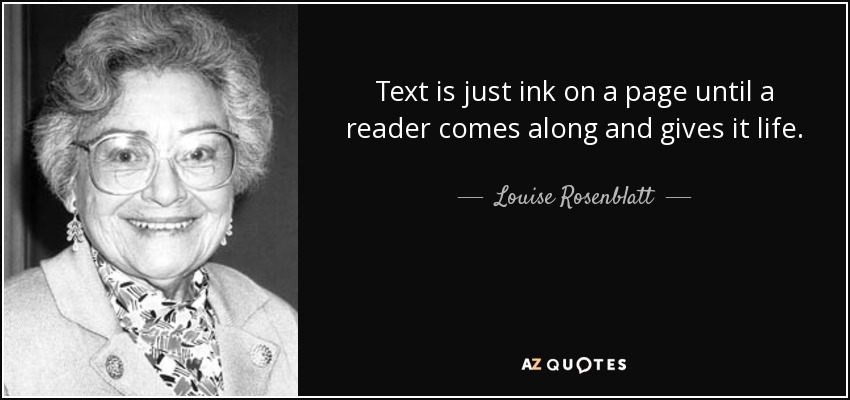
On New Criticism and Louise Rosenblatt: A Clarification and Dialogue

In an ambitious and contrarian essay, Reconciling Rosenblatt and the New Critics: The Quest for an “Experienced Understanding” of Literature, Andrew Rejan asserts:

Without diminishing the significance of Rosenblatt’s contributions, I wish to reexamine and reimagine the familiar history of Rosenblatt’s rebellion against New Criticism: I will propose that Rosenblatt and the New Critics, particularly Cleanth Brooks, might be viewed as pioneers of parallel, rather than opposing, pedagogical traditions, shaped by the shared influence of I. A. Richards.

As a former Council Historian of NCTE and the biographer of Lou LaBrant, whose career overlapped significantly with Rosenblatt’s, I was immediately drawn to Rejan’s unpacking of both New Criticism and Rosenblatt—but was also intrigued by his citing my “A Richer, Not a Narrower, Aesthetic”: The Rise of New Criticism in En­glish Journal.

Rejan incorporates my analysis of the historical relationship between EJ and New Criticism to offer an example of what he calls the “the folly of defining and critiquing the New Critics without directly citing any of the New Critics’ actual writing.” While I find much of Rejan’s analysis important and nuanced, here he rushes to support his thesis without taking into account the purpose of my piece and he fails to note key final points I raise that fit more closely with his thesis than providing evidence of “folly”:

On one level, we owe our field of English language arts pedagogy the opportunity to reexamine the unspoken power of New Criticism as well as the reduced ways in which New Criticism has been implemented in our classes. We must consider the role reader response has played as the most frequent challenge to New Criticism in our classrooms—including the misunderstanding and misuse of Rosenblatt’s perspective as well. But we must rise above the narrow tensions among critical perspectives.

Literary analysis, then, becomes about agency—the agency in the work/text itself and the agency of the reader reading and rereading the world (Freire). The call for critical literacy does not deny or silence the potential power of New Criticism or reader response or any critical stance. Instead it calls for confronting efficiency and objectivity as questionable stances:

“We can help students read the word and the world in deeper and more profound ways. We can help students investigate the ways in which they are manipulated. They can become critically literate consumers of the media. They can engage with and focus on current issues. We can help them problematize the world so they think about their role in it and what they can do to shape its future directions.” (Michell 45) 

Before highlighting how Rejan offers some very important contributions to both literary theory and how that manifests in traditional English and literature classrooms, I want to clarify a couple points about my own work cited.

First, my article is a historical overview of the relationship between teaching English in high school or college and New Criticism; and in that overview, I note that there is a gap between the pure theory in its founding and how teachers practice a reduced (and often bastardized) version best represented, I think, by the Advanced Placement English Literature and Composition [1] test.

In other words, while not as developed or explicit as Rejan’s thorough essay, I very much recognize that what passes as New Criticism in the teaching of English is not solidly grounded in the seminal work of the New Critics. In fact, I will address this more fully below, high school English teachers may have never read the New Critics and, like our students, often navigate within New Criticism without it being named or acknowledged in any way.

The commonly implemented (distorted) version of New Criticism is mostly a consequence of the goal of appearing to be objective that is driven by the primacy of assessment in teaching; in other words, literary interpretation grounded in analysis and “right/wrong” answers helped reduce New Criticism to a practical shadow of its original self—as I teased out when rejecting “close reading”:

Like the mechanistic and reductive ways in which New Criticism has been implemented in formal schooling in order to control and measure objectively how students respond to text, CC and the focus on close reading are poised to serve efficiency models of high-stakes testing while also failing students who need and deserve the complex and challenging tools afforded with critical literacy.

And to the “folly” Rejan sees my essay modeling, I would note that I spend a significant subsection of the essay, “New Criticism: Defined and Embraced, Narrowly,” arguing a similar point as Rejan’s, the reductive application of New Criticism, citing heavily from a major literary scholar, David Daiches.

Finally, as the passage from my essay highlighted above demonstrates, I was documenting the exact dynamic—the tension between New Criticism and Rosenblatt—Rejan teases out far more explicitly, and also suggesting that tension is too often reductive and fails ultimately to be sufficiently critical, in that students are rarely afforded agency in the process whether they are navigating text through New Criticism or reader response.

Setting aside that Rejan was a bit hasty in one paragraph citing my work, I want to note that Rejan offers some important take aways for how English teachers are prepared and then how we practice our crafts of literary analysis with our students.

One foundational commitment I have implemented as a college professor since my doctoral program in the mid 1990s is assigning seminal texts, not secondary texts, addressing the most prominent ideas in education and literacy. As one example, my undergraduate and graduate students read Rosenblatt’s Literature as Exploration.

And during our discussion, we address that Rosenblatt’s work is often mischaracterized and over-simplified; I typically add that a careful reading of Rosenblatt uncovers a thinker far more conservative and traditional that often acknowledged.

So, yes, Rejan’s call for reading the original work of the New Critics to understand New Criticism is a worthy call for all aspects of education, the teaching of English, and preparing teachers of English.

Rejan’s broad message about understanding literary theory also shows the importance of the “considerable gap” (LaBrant, 1947) between theory and practice too often common in English classrooms.

A former graduate student of mine and current doctoral student has been discussing by email with me Rejan’s piece as she investigates Rosenblatt. She has confessed, in fact, that she knows little about literary theory because that topic wasn’t covered well in her undergraduate English courses, leaving her with a “superficial” understanding—all of which reinforces Rejan’s central concerns.

When I have taught young adult literature, where I assign Rosenblatt, practicing teachers in the graduate section often share a similar lack of understanding when we practice literary theory with a picture book.

Ultimately, as I shared with Rejan, we are offering a similar message, although our pieces are distinct in purpose and thoroughness (EJ articles tend to be brief, and EE essays, dense and extended). I could not agree more with Rejan’s last paragraph and sentence: “I suspect that Brooks and Rosenblatt both would appreciate a closer reading of the past that might bring us closer together in the future.”

Although I must offer yet one more caveat, the central thrust of my essay—any literary theory lens is a way to investigate text, and if any becomes the way to investigate text, we have failed the ultimate goal of fostering critical literacy in our students.

That is a folly we cannot afford.


[1] I Taught AP Lit and Comp for most of my 18 years as a high school English teacher.

See Also

“A Respect for the Past, a Knowledge of the Present, and a Concern for the Future”: The Role of History in English Education, P.L. Thomas (English Education, January 2011)

Scholarship, “Lived Reality,” and “the Validity of a Thing”

In the beginning of my experiment as a public intellectual, I was a lowly high school English teacher who on occasion had a letter to the editor in the Herald-Journal (Spartanburg, SC).

These brief efforts at speaking to a general public as an informed voice taught me some valuable and enduring lessons—one of which included feedback from that general public.

My letters to the editor prompted long, rambling messages on my phone answering machine and incoherent typed letters mailed to my home and the high school where I taught.

Many of the phone messages were irate retired people who proved beyond a shadow of a doubt that they had no real understanding of Social Security or the workings of government and the free market. The typed letters (some on manual typewriters) were often single-spaced with almost no margins and punctuated with slurs and threats.

One frequent letter writer opened his diatribe with “Dear African American Homosexual”—all meant as slurs, and none accurately identifying me.

These early experiences with being misunderstood and ineffective were mostly interactions with anonymous and angry readers.

Eventually, mostly because I moved to higher education after earning my doctorate (although only a lowly EdD), I have been afforded a larger stage—Op-Eds in local, state, and national publications as well as a well-read personal blog, invited public and university-based talks, and a substantial collection of published work.

Responses to my public claims, now, are typically not as often public, but those responses continue to teach me valuable lessons—mostly how often and how easily words and claims can be misunderstood and even work in ways that are the opposite of my intent.

Here I want to examine two experiences, one from 2014 and another recent, that help shape who I seek to be as a person, a writer, a teacher, and a scholar.

First, some context.

As a redneck from rural South Carolina who had working-class parents, attended state universities, and has embraced critical pedagogy as my scholarly self, I am regularly marginalized in scholarly and academic contexts because of those identities; my writing is brushed aside as “polemics,” and my Southern drawl is noted with passive-aggressive disdain.

In personal spaces with family and friends as well as in my public writing and speaking, I am there marginalized as “just a scholar”—another pointed-headed intellectual with no real-world experience.

Let me stress here that as a white man with an advanced degree and a prestigious position at a universities, I am acknowledging these experiences but in no way suggesting they are nearly as consequential as simply being a woman, a person of color, or gay (for example). This is not a whine-fest, but I am trying to discuss the challenges of navigating public spaces as a perceived scholar.

Several years ago, I was invited to speak at the University of Arkansas by good friends who are professors there; I had written a book on poverty, and they were kind enough to ask me to speak at a week-long focus on poverty and education.

The University of Arkansas happens also to be home to a Walton-funded graduate department that is staffed by faculty who universally reject my scholarly perspective, and in some cases, me specifically.

Based on that talk, some of those antagonistic professors mentioned me in a piece for Education Next. In their defense of “no excuses” ideologies (specifically KIPP charter schools, both of which I reject), they openly mischaracterized me in order to discredit me:

Like all charter schools, KIPP schools are chosen by parents, but critics fear that disadvantaged parents do not know enough to choose wisely, or else do not have their children’s best interest at heart. Leaving aside whether the critics patronize the people of color KIPP schools serve, we propose that KIPP and similar schools are not nearly as militaristic as critics, who may have never been inside them, fear.

Recently, Andre Perry has confronted that charter advocates tend to smear critics of charter schools as “against parental choice,” something I have examined critically as well.

Even though I am skeptical of most charter and choice advocates, I learned an important lesson, and was confronted with a real dilemma: How do I challenge charter schools and “no excuses” ideologies in the context of black, brown, and poor families voluntarily choosing them?

Michelle Alexander offered me a solution in her confronting of The New Jim Crow:

This last point – that African Americans seem to support both the war on crime and “no excuses” charter schools – presents the most problematic aspect of charges that mass incarceration and education reform are ultimately racist, significant contributions to the New Jim Crow.

For example, Carr reports that African American parents not only choose “no excuses” charter schools in New Orleans, but also actively cheer and encourage the authoritarian policies voiced by the schools’ administrators. But Alexander states, “Given the dilemma facing poor black communities, it is inaccurate to say that black people ‘support’ mass incarceration or ‘get-tough’ policies” because “if the only choice that is offered blacks is rampant crime or more prisons, the predictable (and understandable) answer will be ‘more prisons.’ ” (p. 210)

New Orleans serves as a stark example of how this dynamic works in education reform: Given the choice between segregated, underfunded and deteriorating public schools and “no excuses” charters – and not the choice of the school environments and offerings found in many elite private schools – the predictable answer is “no excuses” charters. (Education Reform in the New Jim Crow Era)

As a result, I now try to frame my rejecting of charter schools and “no excuses” by clarifying that all parents regardless of social class or race deserve high-quality schools without need to choose or compete; I also confront directly how choice advocates tend to embrace a false choice (as exposed by Alexander).

My second example happened just yesterday on Twitter when Angela Dye and I interacted about the “word gap,” which I have often rejected.

I consider Dye a comrade, virtual colleague, and someone whose public voice informs my own; in those ways, this experience was not like the one above, but it forced me once again to confront how good intentions are not enough, especially when that intent is perceived as silencing or ignoring the exact people I seek to support.

Several of Dye’s comments are powerful checks on how I have examined the “word gap”:

You’re talking as a scholar. I respect that. I’m talking as a person living in a specific community with a specific lived reality. I’m hoping the respect can be mutual.

— Angela Dye, PhD (@ejuc8or) December 25, 2017

It pains me when we limit the validity of a thing to research–silencing or debating the voices of those living it.

— Angela Dye, PhD (@ejuc8or) December 25, 2017

So you have to excuse me if I am unwilling to invalidate an experience because “research” doesn’t prove it.

— Angela Dye, PhD (@ejuc8or) December 25, 2017

This Twitter moment also serves to prove John Warner’s point about the value of social media.

Dye’s challenges asked me to reconsider how my work perpetuated the voice of a scholar that uses research to “invalidate” “lived reality”—especially since I in no way sought to have that impact.

Just as I have afforded a fuller context to my rejecting charter schools and “no excuses,” I must seek ways to examine the “word gap” with Dye’s powerful concerns in mind.

Rejecting the “word gap,” I must clarify, is not rejecting the lived reality of significant and consequential differences among the social classes in terms of literacy. Yes, people living in poverty are denied access to and marginalized by privileged language.

Too often formal education works to perpetuate that equity gap resulting in the so-called “word gap” that works as a term and in reality similar to the “achievement gap.”

This lived reality in which some people due to race and social class are excluded from life, liberty, and the pursuit of happiness through formal gatekeeping of who has access to privileged language and who does not, I think, is what Dye is speaking for and through.

So as I navigate still how to express more clearly why I reject the “word gap” as a term and how it works against marginalized and vulnerable populations, I offer two contexts for what I am rejecting.

First, Virginia Eubanks confronts in The Digital Poorhouse:

The most marginalized in our society face higher levels of data collection when they access public benefits, walk through heavily policed neighborhoods, enter the health care system, or cross national borders. That data reinforces their marginality when it is used to target them for extra scrutiny. Groups seen as undeserving of social support and political inclusion are singled out for punitive public policy and more intense surveillance, and the cycle begins again. It is a feedback loop of injustice.

And, Annette Lareau unpacks in Unequal Childhoods: Class, Race, and Family Life (see online)

The differences are striking….

Neither the approach of concerted cultivation or the accomplishment of natural growth is without flaws. Both have strengths and weaknesses [emphasis added]. Middle-class children, for example, are often exhausted, have vicious fights with siblings, and do not have as much contact with their extended families as working-class and poor children. But when children enter institutions such as schools and health care settings, the strategy of middle-class child rearing of concerted cultivation is far more in compliance with the current standards of professionals than is the approach of the accomplishment of natural growth. There are signs that middle-class children gain advantages, including potentially in the world of work, from the experience of concerted cultivation. Working-class and poor children do not gain this benefit.

Therefore, I argue that the “word gap” fails for the following reasons:

  • Literacy is reduced and distorted to quantifying vocabulary (data collecting) as the sole proxy for literacy. Literacy is far more complex.
  • That use of data serves to frame poor children and their parents as having incomplete or inadequate literacy and idealizes middle-class and affluent literacy without acknowledging that this imbalance is an issue of power.
  • The “word gap” keeps the evaluative gaze on children and their parents (how to give the children more vocabulary and how to blame poor parents for literacy-deficient homes) and allows education and education reform to remain focused on “fixing” children and their parents and in-school reform only while ignoring the larger and more powerful social inequities reflected in schools and homes.
  • Research confirming the “word gap,” notably by Hart and Risley, is compelling not because of the quality of the research but because it confirms race and class biases in both conservative and liberal narratives. Media/journalists, pundits, and the public rush to cite Hart and Risley for reasons that must be unpacked—even as we acknowledge the inequities of literacy correlated with social class.

Because of an uncritical embracing of the “word gap” as a concept (not the acknowledging of the inequity of literacy among social classes), vulnerable populations of students have been mis-served through reductive vocabulary drill-and-kill, narrow high-stakes testing, and the lack of political will to address their access to rich literacy in their homes, communities, and schools (experiences afforded middle-class and affluent children that results in their identifiable vocabulary differences).

Because of an uncritical embracing of the “word gap” as a concept (not the acknowledging of the inequity of literacy among social classes), poor children and families are characterized primarily through deficit lenses that ignore their literacy strengths that simply do not match privileged literacy.

Because of an uncritical embracing of the “word gap” as a concept (not the acknowledging of the inequity of literacy among social classes), the barriers to literacy, academic, economic, and judicial equity remain mostly unexamined—out of sight, out of mind.

By confronting scholarly debates about the “word gap,” Dye has exposed the problematic relationship among scholarship, “lived reality,” and “the validity of a thing.”

I must do a better job with that dynamic if I want to be the sort of voice for social equity and justice that I seek to be.

UPDATE

Angela Dye has taken the exchange above and examined how our Twitter interaction confronts a tension around public discourse and elements of power and privilege; see Pissing on My Pee.


For Further Reading

What These Children Are Like, Ralph Ellison

If Black English Isn’t a Language, Then Tell Me, What Is?, James Baldwin