Category Archives: Education

This Is Not My Opinion

“Many people call for an end to politics in the classroom, as this is seen as the source of the problem,” writes Nicole Truesdell, concluding: “Now is not the time to side with neutrality.”

Mainstream and rightwing pundits have long promoted the idea that K-12 and higher education in the US are rife with liberal indoctrination. One of my long-time colleagues often told the story of his own father periodically lamenting that he had allowed my colleague to go to college because the experience had turned him into a liberal.

Evidence, however, is another thing when framed against these standard railings against a Left in the US that simply does not exist.

As the country stumbles toward its first year in Trumplandia, a new but also misleading mantra is lamenting fake news in post-truth America. The misleading part is that these phenomena are somehow new or spawned by Trump and his serial lies as well as his ability to avoiding any consequences for his outlandish racism, sexism, and xenophobia.

The US has a long and disappointing history with choosing ideology over evidence, and public discourse has often been grounded in framing opinion in a cloak of false equivalence.

The term “opinion” itself has worked throughout modern history to suggest that no person has any more credibility than another since “both sides” are simply sharing their opinion. How often do we listen as debate is resolved with “Let’s just agree to disagree”?

So as 2017 comes to an end, and the Trumplandia nightmare of the unreasonable continues, I want to take this opportunity to state clearly: This is not my opinion.

While socializing with good friends just yesterday, I was reminded once again that to be informed places anyone in a stressful situation throughout our day-to-day life since the vast majority of people are uninformed about the many things they none the less feel compelled and justified to weigh in on.

I, on the other hand, have the annoying habit of reserving comments unless I am well informed and being disturbingly honest and blunt when I do weigh in myself.

Yes, I do hold my tongue often in social situations—but that is quite challenging since most people spend their lives in the actual realm of “opinion” as it is commonly used to suggest that no evidence exists to confirm if that “opinion” is valid or not.

Formal schooling traditionally reinforces this lazy approach to how we explore ideas by plodding students through overly simplistic “fact v. opinion” worksheets.

What we should be teaching instead is that all of us make claims (not that everyone has an opinion) and that we are all ethically responsible for making claims that are credible, supported by evidence or solid logic.

As two examples, I often contribute to public discussions about the so-called “word gap” and corporal punishment—both of which are illustrative of the problems inherent with seeing the world as awash in “opinion.”

The “word gap” represents an interesting phenomenon since those who appeal to the term and the idea that social class is strongly correlated to literacy (wealthy children are exposed to and know more words than poor children) do take the initiative to cite evidence, almost always one study by Hart and Risley.

This appeal to the “word gap,” however, has two critical flaws: it is driven by a social class and racist bias hiding beneath a flawed view of literacy (number of words in any person’s vocabulary is not a valid single proxy for literacy), and since the “word gap” appeals to a common-sense view of how to support better children in poverty, the average person and journalist have failed to investigate Hart and Risley, whose study has itself been discredited.

Understanding the complex relationship between social class/race and literacy and then how to educate better vulnerable populations of students are not served well by a culture of “opinions.” Here is an important context for why expertise (making claims grounded in evidence) is important—and how all discourse is political.

Journalists perpetuating the “word gap” without critically unpacking the concept or confronting Hart and Risley are themselves being political—even as they hide behind the veneer of “just reporting” and “both sides” journalism.

As a literacy professor, I cannot avoid being political—there is no neutral pose—when I teach literacy courses. But I have an ethical obligation to be well informed on the topics I teach. And thus, just as when I blog or weigh in on topics in public spaces, when I teach, this is not my opinion.

While the “word gap” continually is reanimated as a fact that isn’t true, the corporal punishment debate is a disturbing example of how “both sides” discourse and “just an opinion” have real and negative consequences—especially for the powerless (such as children).

As I have explained before, public debate about domestic violence is quite distinct from public debate about corporal punishment—the former is always examined as something no one can support or defend, but the latter is always framed as a “both sides” argument.

If we consider the rush to cite Hart and Risley when promoting the “word gap,” we must wonder how domestic violence is universally rejected in mainstream discussions (and with no need to cite research[1]) but corporal punishment remains a debate—despite decades of research and virtually all medical and psychological professional organizations clearly showing there is no acceptable amount of physical punishment.

This often ignored distinction between how we frame domestic violence and corporal punishment again highlights that all human discourse is political.

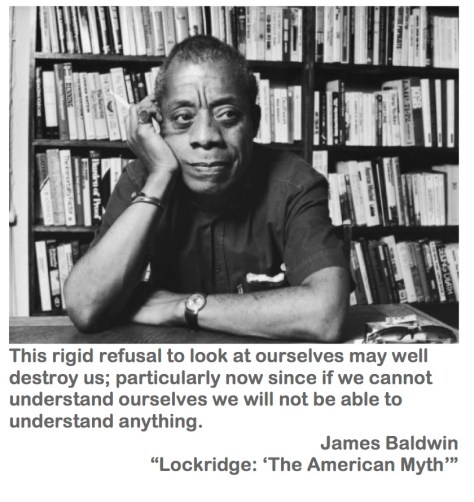
In her rejecting calls for classrooms that are somehow not political, Truedell offers the words of James Baldwin so here I want to make my case by merging their ideas myself:

While Truesdell argues, “Now is not the time to side with neutrality,” Baldwin admonished us: “The challenge is in the moment, the time is always now.”

A democracy cannot afford teachers, professors, journalists, or public intellectuals who choose the veneer of neutrality as long as inequity and injustice rule the day.

This is not my opinion.


[1] Note that discussions of domestic violence often do include statistics about who is involved and how many women suffer domestic violence, corporal punishment debates may note how may states allow it in schools, but rarely identify the number of actual children impacted; thus, domestic violence is more humanized than corporal punishment even in the numbers. This is political; this is about power.

The Nearly Impossible: Teaching Writing in a Culture of Grades, Averages

A former student and second-year English teacher and I (having taught high school English 18 years and then in higher education another on-going 16 years) have something in common when teaching students to write: A nearly paralyzing frustration with students’ resistance to draft and revise their essays.

While discussing this problem with the early-career teacher, I was once again reminded of how the traditional culture of grades and averaging makes the teaching of writing nearly impossible, especially for beginning teachers.

I have wrestled with the problems with grades and averaging before (here and here) and co-edited a volume on de-testing and de-grading education. But the essential problem remains: When teachers of writing are denied professional autonomy in their assessment and feedback practices, their writing pedagogy and the learning of their students are inevitably eroded.

As long as students are allowed to play the averaging game (completing assignments rendered irrelevant as long as the math produces a passing grade in the end), authentic learning and holistic outcomes are moot.

To offer an example outside of literacy and the teaching of writing, I noticed while teaching high school that many students in math courses never passed a single math test, but passed the course because they accumulated enough extra credit to have a passing final grade (through averaging) for the course.

I also had students tell me directly that they had simply taken zeroes for all their essay assignments the year before my class, but passed by making high enough grades on vocabulary, grammar, and literature tests.

This second-year teacher—as many of my former students have done once they entered the classroom—has implemented many of my strategies for encouraging students to draft: setting deadlines for drafts, linking participating in drafting to possible final grades on essays, etc.

Still, she admitted that students could skip the drafting, or even completing essays at all, and still because of school and district policies pass the course—without ever really engaging in the learning processes that the course was intended to address.

As is common with young and excellent teachers, she has taken on the bulk of the blame for this problem. “What can I do?” has become her refrain.

First, I want to stress that if and when I have been an effective teacher of writing, much of that success has been grounded in my assessment autonomy at both the secondary and university levels. While teaching high school and as a college professor, I have been afforded the professional support to require that students complete all essays and fulfill the obligation of drafting and revising those essays; if and when students do not meet those minimum requirements, they have failed.

I have always made the analogy that a sick patient must follow a doctor’s orders, including taking prescribed medicines, in order to heal. If that patient refuses to follow orders, the doctor is not responsible. (The doctor, of course, is responsible for a valid diagnosis.)

Since I cannot magically afford most teachers the sort of autonomy I have enjoyed, I want to consider below some real-world strategies for making the teaching of writing more authentic in the counter-productive culture of grades and averaging:

  • Seek colleague (and department) support for assessment and feedback policies that model the importance of drafting and writing essays. One aspect of the negative impact of grades and averaging is that students receive a powerful and consistent message across all their teachers and courses that playing the average game is not only all right, but what education is. Good writing pedagogy among teachers and within a department is more powerful than when any teacher works on an island.
  • Identify clearly for students, parents, and administrators that drafting is a primary instructional goal within the larger writing unit. This is a Sisyphean battle, but teachers of writing must create a culture in which drafting is embraced as an essential part of writing—not that drafting is some sort of option or busy work assigned by the teacher.
  • Design grading scales, assessment weights, rubrics, and assignments so that they all accurately reflect the primary importance of essay writing and drafting in the course. Yes, I abhor all of those traditional structures, but I also recognize they are often not negotiable for most teachers; and thus, we must manage traditional grading in a way that is least corrosive. The number of grades and the weight of grades in averaging can and should be shifted so that drafting and completing essays is essential for students to pass, or to do well.
  • Resist evaluating good assessment and writing practices by the “100% compliance or failure” formula. Throughout my career, I have routinely been confronted with the teacher who rejects my proposals for teaching with “Not all of my students will….” No practice need be 100% effective to be the right practice, but what is also puzzling with this argument is that traditional approaches can be dismissed with the same argument.
  • Periodically review teaching and assessment practices against specific writing goals. Here is a common question I pose to teachers struggling: What is your main instructional goal? Then I ask them to evaluate what they are doing against that goal—and to determine what their threshold is for standing firm on those practices and goals. If drafting is an essential student practice and instructional goal, lessons and assessment practices and policies must reflect that fact.
  • Ultimately all educators must have reasonable expectations for themselves, their students, and their instructional goals. It is not ours to do everything for every student, and it profits no one for any teacher to be a martyr. While I recognize the power of holistic behaviors and artifacts of learning (and am skeptical of the analysis bias of traditional schooling), I do urge a baby-steps approach to teaching and learning. Patience for the teacher and the student. Literacy broadly and writing more narrowly are journeys, not to be fixed with inoculations.
  • Spend as little psychological energy as possible on policies that are not negotiable. District and school policies for grading—usually entrenched traditional approaches to testing, assessment, averaging, and grades—certainly deserve critique by teachers of conscience. But that advocacy for change cannot become a constant source of fretting and self-flagellation. I wish more educators would advocate for de-testing and degrading the classroom, for rejecting averaging grades in favor of portfolios, revision, and effective teacher feedback. But day-to-day teaching must focus on the autonomy that teachers have, not what they are denied. Teaching is necessarily a tremendous psychological drain; we need not spend our energy on that over which we have no immediate control.

While teaching English and seeking to foster our students as writers, we must be concerned when students can pass or make Bs/ Cs in our courses while avoiding or refusing to draft or submit essays.

But when faced with that dilemma, we must first carefully identify the source of that possibility. A culture of grades and averaging works against us in many schools, and thus, we must then work within the autonomy we do have to make our writing pedagogy and assessment practices more closely aligned—even when we cannot achieve perfect.

“Minimally Adequate” in SC: Funding and Understanding Public Education

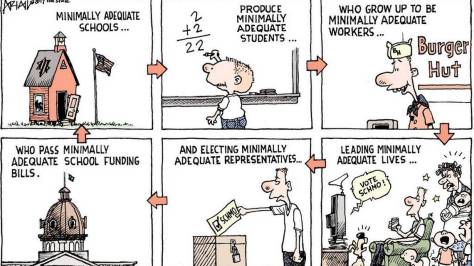
At first blush, Robert Ariail’s political cartoon in The State (15 December 2017) warrants praise for unpacking South Carolina’s historical political and judicial negligence in terms of public education:

aria171215_cmykx

Taken at the most basic level, a case for equitably funding all public schools in the state so that all students receive what has become the bar—”minimally adequate”—seems beyond reproach.

However, looking panel-by-panel at the implications and assumptions in Ariail’s cartoon exposes that too often the media and public argument for public school funding are also “minimally adequate.”

First, I want to acknowledge that the political cartoon as a form is a challenge that depends on concision, like poetry and Op-Eds. That concision in visual form works through representation and symbolism.

My concerns here are not with Ariail’s skills as a political cartoonist or his broad intentions (advocacy for equitable school funding), but my recurring criticism is that even the best and most ardent in the media have fundamental misunderstandings about education that mars their efforts to support public education, reform, and funding.

The first panel captures the essential flaw with “minimally adequate” through showing a school house in disrepair. This triggers another sincere but deeply flawed effort to support public schools in SC—The Corridor of Shame documentary that proves to be mostly emotional pandering and itself a vehicle for perpetuating horrible stereotypes and misinformation about public education, children and families in poverty, and the role of teachers in high-quality education.

None the less, panel 1 confronts the current and historical problems with “minimally adequate” funding as that approach remains inequitable across the state, primarily for children of color and the poor. But while fully funding school buildings is neglected in the state, the greatest funding issues remain hiring and retaining high-quality teachers and then insuring that all students have access to small class sizes as well as veteran certified teachers.

Panels 2, 3, and 4 offer a much more complicated and flawed case for funding schools.

First, panel 2 suggests that schools alone produce student quality. The truth is far more complicated since measurable student quality is driven mostly (60%) by out-of-school (OOS) factors—the home and community—with teacher (10-15%) and school quality (20%) constituting a much smaller role that cannot counter the greater OOS influences.

Panel 3 is a popular, but misguided belief that formal schooling and worker quality are directly and causally related; they are not. Gerald Bracey and others have documented for years the myth that so-called educational quality, workforce quality, and the economy are strongly inter-related. Here, the problem is seeing formal education as mostly about preparing workers (instead of the larger call for schools contributing to our democracy) and failing to recognize that worker quality and the economy are much more influenced by public policy than schools.

While SC is negligent about equitable funding of schools, the state is horribly negligent about workers’ rights, creating high-quality and stable jobs, and sustaining a stable economy for all levels of workers—regardless of the education they receive in the first 18-22 years of their lives.

So by panel 4, our entire gaze is on the impact of schools on the lives of everyone; the myth of education as the “great equalizer” is perpetuated by the cartoon—a belief that is fully discredited by the evidence that being white and relatively affluent trump effort (educational attainment) and that the US remains significantly inequitable by race, social class, and gender (again, regardless of education attained).

Ariail is being clever in panels 5 and 6, and the cyclic message of the entire cartoon. I am, however, ultimately troubled by how often even sincere advocates for public education and equitable funding of our schools tend to depend on false and misleading arguments in their advocacy.

The media, especially edujournalism, in fact, are too often both willing and unaware accomplices in the political and judicial negligence in SC and across the US in terms of failing to acknowledge the foundational purpose of universal public education (to create and preserve the democracy) and to advocate for human agency and the broader need for social equity in the state and the country.

It is simultaneously true that states and the country as a whole have failed public education (it has not failed us) and that education will never be the great equalizer or a silver bullet for the entrenched social and political failures of America.

The time is far past due to focus on equitable funding and support for all schools as a social contract with every family and child in every state of the US. But with that, we must also begin to be honest and clear with our advocacy—schools are not now and have never been an institution we can treat as separate from all of society or one that drives the entire society.

Our schools both reflect and perpetuate what matters to the political leadership of the state, but formal education is rarely revolutionary or a change agent since it is a mechanism of the political system.

Schools are being neglected, and then some children are being neglected in SC as they have been for decades; those children and their families are the most vulnerable among us because of racism and extreme poverty, and it is unconscionable that we persist in that negligence.

Sentiment without accuracy ultimately is part of the problem and not a path to the solution.

A Town that Starts with “L” in North Carolina

My mother’s death coming about five months after my father’s led my nephews and me to believe this second time would be better informed than the first. But we were wrong.

Issues such as power of attorney and of course money took turns we didn’t know about, one of which included my sister and I had to sign for my mother’s cremation. I arrived at the mortuary the morning after her death and completed a barrage of paperwork.

Grandparents’ names gave me pause, but I knew everything—or so I thought.

When the obituary appeared online, my sister challenged what I had offered as my mother’s town of birth: Lumberton, NC.

I immediately texted my mother’s oldest sister who shared the story I knew: My mother being born in her grandparents’ house—but that was Lexington, NC, my aunt explained, and the family moved to Lumberton many years later.

I knew about my mother’s childhood in Lexington; we were told stories of her bicycling down steep hills many times as children. But I still feel like she spoke of Lumberton as where she was born.

And then my middle nephew had reached out to my mother’s only brother, who shared the same story but added the home was in Linwood, NC.

I was sitting in the floor of my bedroom about to stretch when the flurry of texts exposed my error about my mother’s birth—and the obituary set to be in print in a couple of days.

I thought of how this is what we come to, after almost 8 decades of life—four brief paragraphs in a newspaper and loved ones who have your town of birth narrowed down to a town that starts with “L” in NC.

While I am not certain this is universal, I have struggled through many layers of guilt during the deaths of my parents. My entire adulthood as their son has been a constant wave of guilt for not being a better son (my feelings; not theirs), and then as they both slipped at the end, I cannot shake the sense of being powerless in their dying.

Having been a mama’s boy, the angst and guilt that accompanied my struggles with being by her side and maintaining my life along with my not being there the night she died have been exponential when compared to my father’s death.

And so, as  literary person, I have been haunted by one of the most notable (and jumbled) opening lines of a novel dealing with a mother’s death—Albert Camus’s The Stranger:

The Stranger opening
The Stranger, Albert Camus

The novel’s main character, Meursault, embodies a dramatization of existentialism as expressed by Camus—and the reader witnesses Meursault’s eventual execution by the State, which appears to ground his guilt in his antisocial nature and negligence as a son (by social standards) as much as in his actual crime.

Like Meursault, I too have felt the tensions between my nature and the expectations of society—two contexts that for me are mostly out of kilter.

The hyperawareness and insecurity that accompany not being religious becomes amplified during dying and death since virtually everyone approaches both through their faith.

Ministers darted into her room at the hospital, one touching and praying loudly over her before I could even speak.

For those of us who view death as biological and chemical—not spiritual—we risk appearing to be cold and harsh. But we still cry, and ache, and catch ourself worrying about people who are now dead and need no longer for us to worry.

Last night I came home to a card of condolence and a framed picture of my granddaughter sitting on the bed at the feet of my mother when she was in assisted living. I cried so hard I had to rush by my granddaughter—who I was eager to see—to sit in the bathroom behind a closed door until the wave of sorrow passed.

Sky Mom

But I am also emotionally and psychologically drained. The living must continue living.

I know my maternal grandmother’s maiden name was Mize and my maternal grandfather—who went by Tu-Daddy and Slick—was named Harold Graham. But somehow the details of my mother’s birth had become jumbled in my mind.

As I wrestle with setting aside the urge to call my parents, no longer at the other end of any phone, I sense that fumbling my mother’s obituary will linger as well—this woman who gave me life and was born, we think, in a town that starts with “L” in NC.


Postscript

This post was scheduled for 13 December, my mother’s birthday. She was often celebrating her birth on Friday the 13th, an omen to her, I think, that fed her anxiety.

Today, I will visit the mortuary for her ashes, which I will leave on the counter in her home.

Ashes to ashes …

Segregation Surprise?: How Public and Charter Schools Have (Always) Failed

On social media, I witnessed charter advocates try to justify the exact failures Andre Perry unmasks in his Charter school leaders are complicit with segregation, and it’s hurting their movement, where he concludes:

Make no mistake, segregated schools of the past and present are a result of horrible policy choices that most people are willing to accept. There is a reason that after more than 20 years, the research is mixed on charter schools. Schools in black and brown communities were built on broken foundations — i.e., segregation. By not addressing segregation, reformers are turning off the stove when the house is going up in flames.

Perry was having none of it, the apologists’ dissembling, but was far more patient and willing to engage this nonsense than I.

I also have no energy left to revisit this again, except to point out that finding it surprising that both traditional public schools and charter schools are failing the most vulnerable populations of students—often black, brown, poor, speakers of home languages other than English, and having special needs—requires being willfully ignorant of decades of evidence.

And thus, what the rabid edureformers have willfully ignored for quite some time:

Made in America: Segregation by Design

Segregation and Charter Schools: A Reader

Public School, Charter Choice: More Segregation by Design

Endgame: Disaster Capitalism, New Orleans, and the Charter Scam

Racial segregation returns to US schools, 60 years after the Supreme Court banned it

Education Reform in the New Jim Crow Era

As Perry confronts, edureformers are embodiments of one of the most powerful warnings from James Baldwin:

Teaching Writing as Journey, Not Destination

You’d think after thirty-four years of teaching writing at both the high school and college levels, I would have a pretty firm handle on everything.

You’d think that, maybe, but not me.

On the last class session of my first-year writing seminars this semester, I asked my students what has worked and not worked over the course of four or so months. They were amazing in what they shared, and as a result, I am now redesigning significantly both my schedule and the time spent on many of my practices.

Their feedback, thankfully, was mostly positive—as this student shared in her final reflection that is colored with a bit of hyperbole:

I will never use any of the writing techniques that I was taught all four years of high school. My high school teachers failed me as a college writer. I am grateful that I got Dr. Thomas as a teacher considering that he was very willing to help you and was understanding that we are freshman and will make many mistakes. Talking to my friends outside of my class who have writing seminars this semester their professors expected them to know everything that needed to make them a strong college writer.

Confirming the gap between how students view writing after high school and the expectations of academic writing for undergraduates and scholars, her feedback also speaks to a truism about learning to write and learning to teach writing: both are journeys, and not destinations.

Here, I want to discuss the patterns expressed by my two seminars, and consider briefly how that will impact my practice in future first-year writing and other writing-intensive courses. Their feedback included the following:

  • Students emphasized the effectiveness of professor/student essay conferencing. I have at the college level greatly adjusted how I respond to essays compared to my previous career teaching high school English (note that now I have about 24 first-year students over two courses that meet M, W, F, and my high school load was 100-125 students over five classes that met M-F). I have all essays submitted as electronic Word files, and I then offer some track change edits/revisions and include comments. However, I now provide very brief, and never exhaustive, feedback on these drafts, and instead require students to conference (at least once after the first final draft submitted and my feedback returned) so we can discuss the essay and create a revision plan. I have always felt this is more effective so when these two seminars overwhelming confirmed the power of conferences, I am now planning more class time dedicated to conferencing since requiring additional out-of-class conferences, they said, would be burdensome (scheduling these now are a bit of a challenge).
  • However, students noted peer-conferencing was less effective as currently implemented. My standard process has been to have students bring hard copies of their first final essay submission on the due date (the electronic version is due by email attachment before that class session) in order to have peer-conferencing in class. These students felt this process was not effective, and instead, want peer feedback after my feedback. I have always struggled with peer conferencing, and this means I have work left to do.
  • Students recognized the value of writing teachers sharing their own writing as models for student writing. One of the most conscientious students shared quickly in our debrief that she appreciated my sharing my writing and talking through what and how I write in order to model for them how to draft their essays. The other students were enthusiastic in agreement, and I feel this was a strong endorsement of the power of teaching writing as a writer. While I am happy with this part of my teaching, I think I can increase the intentionality of this approach—sharing an ongoing draft of a piece, for example, instead of all final pieces.
  • Students valued writing workshop time in class because they could interact immediately with the professor while drafting. My course daily schedule and overarching course pattern tend toward the first half of the course being more traditional (class lessons and discussion, especially reading like a writer with mentor texts), and then the second half includes quite a few class sessions devoted to workshop time for students to draft, research, read, conference, etc., during the class hour. Although I have always valued workshop time for students, the expectations, especially at the college level, that class is about professor-oriented and content-based instruction still weigh on my own consideration about effective use of class time. These students confirmed the value of workshop time in class, noting especially having me there to help.
  • Students appreciated a composition course remaining primarily focused on learning to write and not on content acquisition and traditional practices such as taking tests. A problem for the first-year writing seminars at my university, since switching away from more traditional composition courses anchored in the English department, has been professors outside of English teaching the writing seminar as an introductory disciplinary content course. When talking with their first-year peers in other first-year writing seminars, my students came to appreciate the writing focus of my courses—mentioning, for example, that other students have been taking tests and involved in other activities (such as very narrowly prompted essays) more common in disciplinary content courses.
  • Students asked for more class sessions dedicated to brainstorming for every essay assigned. One definite improvement I will incorporate is providing a more structured class session for brainstorming of all four essays. This set of students noted they very much benefitted from the one intense brainstorm session for the cited scholarly essay, and added that they felt this process would have been effective for all of the assignments.
  • Students both appreciated and struggled with choice in types of essays and topics. I have been a strong proponent and practitioner of allowing students choice in both the kinds of essays they write and their topics. The problem I have encountered teaching college students at an academically selective college is that these students prefer prompt-driven writing, and most of their experiences have been absent any choice. An on-going goal for my practice remains how to help students build the writer’s toolbox necessary for being capable of the choice they deserve as scholars and writers.
  • Students admitted that drafting, and required drafts, were helpful for improving the quality of their essays and thinking. One of the most shocking lessons I have learned with my current university students is their resistance to drafting. But that resistance is grounded not in any sort of laziness or even procrastination (although they bring the procrastination-still-allows-A’s habit from high school); it is mostly their fear of turning in work, in their words, “that isn’t perfect yet.” Because I employ a minimum requirements approach (instead of traditional grades) that emphasizes drafting, most of my students do comply with those minimum expectations; however, far fewer students embrace the unlimited opportunity for drafting essays that would certainly improve their grades and improve them as writers. While I have been fairly successful with students drafting as required, I must continue to find strategies for helping them appreciate drafting more fully (I will touch on this below).
  • Students viewed feedback on their drafts positively and appreciated prompt replies and thorough feedback. The same student I quoted above also embraced one of the foundational jokes of all the classes I teach: I tell students if I do not respond immediately to an email (or text) or if they do not have their essays returned in less than one day of submission, I didn’t receive the email, text, or essay—or I am dead. There is a scene in the film version of Mosquito Coast in which the Harrison Ford character is whipping up the locals in the land he has bought, noting that he wants them to work hard but he will always be working harder. That is a teacher commitment I have always worked by. While I have learned to temper the amount of feedback I offer (but still have some tone problems), I remain prompt in how I respond to students and their work. Students respond well to my standards for myself by embodying higher standards for themselves.

Not directly addressed by my students’ feedback, I have an additional broad concern that I plan to address as I revise these seminars. My minimum requirement technique meets some of my instructional goals, but it fails at helping students develop their own sense of the quality of their work and their deserved grades (which I must assign despite not grading throughout the semester).

I have long rejected rubrics, but I also do appreciate the need for teachers at all levels to make expectations clear for students—both in how the teacher states explicit expectations and how students identify their own expectations.

“Minimum” seems to be less effective for the population of students I teach (the “do all this or fail” is a a deficit approach and does not really match the aspiration of high-achieving students who are mostly in courses for the A).

This is quite tentative, but here are some initial thoughts on how to help students understand the A/B divide in the quality of their essays and their overall course grade:

  • A work: Participating by choice in multiple drafts and conferences beyond the minimum requirements; essay form and content that is nuanced, sophisticated, and well developed (typically more narrow than broad); a high level demonstrated for selecting and incorporating source material in a wide variety of citation formats; submitting work as assigned and meeting due dates (except for illness, etc.); attending and participating in class-based discussion, lessons, and workshops; completing assigned and choice reading of course texts and mentor texts in ways that contribute to class discussions and original writing.
  • B work: Submitting drafts and attending conferences as detailed by the minimum requirements; essay form and content that is solid and distinct from high school writing (typically more narrow than broad); a basic college level demonstrated for selecting and incorporating source material in a wide variety of citation formats; submitting work as assigned and meeting most due dates; attending and participating in class-based discussion, lessons, and workshops; completing assigned and choice reading of texts and mentor texts in ways that contribute to class discussions and original writing.

Just as my students should come to embrace writing as a journey, I discover every time I teach writing that, yes, teaching writing is also a journey and not a destination.

I have much left to do.

Yes, We Teach English, But What Is It? (Or Better Yet, What Should It Be?)

Throughout her long career, Lou LaBrant consistently confronted and defined the profession and field often simply called “English.”

Her work appeared regularly in major journals for the National Council of Teachers of English (NCTE), where she was president in the 1950s. But her tour-de-force volume on teaching English appeared in 1951, We Teach English, which I reconsider in the November 2017 English Journal.

Having taught high school English for 18 years and now preparing future English teachers as well as teaching first-year writing for an on-going 16 years, I am often guided by one moment in the early years of teaching high school when a student had reached her limit of frustration with my English class.

In mid-class, this student blurted out: “When are we going to do English? All we do is read and write!”

This sophomore had been through junior high a straight-A student in English, grades primarily built on traditional aspects of English classes—vocabulary tests and grammar tests.

While that moment was three decades ago, I see little evidence that her definition of what counts as “English” remains robust among many people, including English teachers.

In 2017, defining English, I believe, remains a problem that should be resolved by re-imagining the course itself.

Let me note here, however, that the greatest burden on the teaching of English is that the course too often carries disproportionate demands when compared to other courses; English tends to be a core course at all levels, but it also is expected to teach (primarily or even exclusively) literacy skills needed in all courses and disciplines.

With that caveat, I also believe we too often fail to examine the nuanced differences among teaching literacy (reading, writing, speaking, listening), teaching literature (as a field), and teaching composition/writing (possibly the most marginalized field among the disciplines).

Any and all three of these can be and often are simply lumped under “English,” and these courses are routinely taught by “English teachers/professors” as if the expertise to teach each is somehow generic or simply of the same kind.

In K-12 education, this broad demand is excessive, and unfair to both teachers and their students. Higher education remains careless about just who has the expertise to teach composition/writing, but is hyper-attentive to the field of literature (consider the narrowness of expertise among English faculty, and thus, what courses they feel qualified to teach).

On the last class of my first-year writing seminars this semester, I asked students to consider what has worked and not worked during the course in the context of understanding that the course was a composition/writing seminar. Much of the semester had been devoted to deprogramming these students from thinking the class was English and from the narrow, and often misleading, habits they had formed by learning to write (and analyze text) almost exclusively in high school English courses (such as Advanced Placement).

One notable comment from a student was that she appreciated my using my own writing to model for them how to write their essays, adding she had never had any teacher do this before.

The point here is that teaching composition/writing requires both the expertise of being a writer and the expertise of pedagogy (teaching)—and this is not lost on students.

My own career is certainly eclectic and multi-disciplinary, but that is a cumulative and on-going effort that is often itself overwhelming. At my core, though, I am a teacher of composition/writing, and after the two class discussions about my first-year seminar, I plan to redesign significantly my daily schedule for the course next fall.

It is in that spirit of reconsidering and redesigning, that I want here to suggest a few ways in which we should likely rethink what it means to teach English:

  • Acknowledge, support, and better appreciate, early literacy educators. Teaching beginning and emerging literacy is complex, and those teaching early literacy need to be better prepared, solely burdened with addressing literacy with much fewer students than is traditionally expected, and better rewarded and appreciated as professionals.
  • Expect all teacher/professors at every level to continue literacy instruction grounded in their disciplines. Literacy is a journey, and not a goal, but as literacy becomes more sophisticated, it also becomes more nuanced and more grounded in the context of that literacy. Reading and writing in history or literature are quite distinct from reading and writing in chemistry and economics. As a colleague has perfectly noted, we must rise above believing that any literacy instruction at any age is somehow an inoculation, and thus, students can take Course X and then no other teacher/professor has to address A, B, or C.
  • At the secondary level and in higher education, clarify the distinction between literature courses and composition/writing courses as well as teachers/professors of both. Of all the inane things about formal education, among the most for me is that high school English teachers are routinely asked to teach American literature along with a hundred other standards related to literacy, but I once took an upper-level English course in college on William Butler Yeats—one author, and we really only read a few works by one author. Similarly, my university about a decade ago decided any and all professors can teach first-year writing. All of this is nonsense. We must become more careful and purposeful about the teaching of literature and composition/writing—both of which are important fields that require specialized preparation and then the sort of professional support, conditions, and appreciation that other disciplines receive.

Among friends and acquaintances, I am often still introduced as an English teacher, although I haven’t been once since 2002.

People often cringe and mumble something about needing to watch how they speak.

I clarify that I am no longer an English teacher, and that they need not fret over their grammar—but I also want people to know I will always first and foremost consider proudly myself to be an English teacher.

But I also feel just as strongly that there is much work to be done about exactly what that means, and what that should mean for teachers/professors and our students.

Beware the Average White Man

Looking back on my youth, I lived through and enjoyed in pop culture both the Average White Band and The White Shadow—as a teen, without an ounce of critical awareness, and as an average white boy, without a clue of my own blinding privilege.

As I entered college, the Reagan revolution occurred, and I recall vividly being drawn to the allure of reverse racism, the vapid claim that white men were somehow then the victims of a multicultural and gender revolution.

Rapidly approaching 60, I am both ashamed and more fully aware of who I was in my youth—a person I reject entirely but witness daily in teenaged and early adult white guys that I teach. One first-year student just wrote an essay—one I could have written myself at his age—passionately arguing he is not privileged even though every single example he offered (white, male, affluent parents) confirmed his privilege. His argument also bemoaned the “new” definition of privilege, a garbled argument at best, and railed against his belief that those with privilege today are being “criminalized.”

Juxtaposing my youthful ignorance in the cocoon of privilege with this student’s same delusion more than three decades later while the US watches as a parade of powerful and famous (often white) men are exposed for truly inexcusable behavior toward women and girls speaks to a disturbing warning: beware average white men.

Next, I’d like to juxtapose Garrison Keillor to a truism that almost every black person has been told repeatedly in their youth:

For decades, black parents have told their children that in order to succeed despite racial discrimination, they need to be “twice as good”: twice as smart, twice as dependable, twice as talented. (Gillian B. White)

There’s one mantra many black parents drill into their children’s heads throughout their life: be twice as good. It goes that as black folks in America, we’ve got to work twice as hard to get half as far as our white counterparts. (Britni Danielle)

Work twice as hard to attain half as much—what a horrible way to navigate the world, so pervasive that entire communities teach this to their children.

Keillor is among the newly fallen—though his sin tempered as “improper behavior”—and like Al Franken, Richard Dreyfuss, and Matt Lauer, Keillor’s response is itself a hedge: “The story of his alleged misdeeds is ‘more interesting and more complicated than the version MPR heard,’ Keillor wrote.”

Among this new normal, these partial admissions among the Left stand in stark contrast to a Republican president elected in the wake of his own profane bragging about being a sexual predator and a Republican senate candidate receiving a standing ovation while visiting a church after being exposed for his own open secret—his predatory habits including girls as young as 14.

Myself white, male, and affluent/privileged in many ways grounded in those first two accidents of my birth—I am deeply burdened by the question that lies before us about the essential nature of men, of whiteness: Can these revelations about how many powerful men are monsters be traced to predispositions of being born a male, to some code engrained in whiteness (even as we know race is a social, not a biological, construct)?

I am afraid of the truth about being male, about the flawed consequences of being a creature driven by testosterone even with the capacity for reason, compassion, and ethical awareness.

I am terrified about the inability to determine cause and effect among the dynamics of being male, white, and powerful—that white men have disproportionate power may allow being white and male to be absolved, may allow us all to decry the corrosive impact of power.

It is that terror that brings me back to Keillor as much more illustrative of the converse of how blacks raise their children—twice as good, half as much: the average white man is allowed to be half as good to attain twice as much.

“I am disappointed in both reviews of Garrison Keillor’s anthology Good Poems (April 2004)—nearly as much as in the anthology itself,” wrote poet Rita Dove in 2005, explaining:

Keillor dedicates his compilation to “all the English Teachers (especially the great ones),” and yet he neglects one of the cardinal guidelines for today’s English curricula—to select material that reflects the multi-faceted fabric of our society. Lake Wobegon’s Norwegian bachelor farmers may have in their youth been deprived of the smorgasbord American culture has become, but I would hope that nowadays even kids from the tiniest hamlets in rural Minnesota are a bit more informed about Walt Whitman’s multitudes than Mr. Keillor’s selection would have us believe. Young minds—hell, all minds—are impressionable, and an anthology overwhelmingly populated by white poets is likely to send the message that only white folks deserve and/or are capable of writing “good poems.”

Dove’s last charge reminds me of religious traditions that suggest God created man in His own image— the sexist language and the arrogance.

Dove’s last charge reminds me of the much smaller scale but none the less arrogant self-aggrandizing of the New Criticism movement—white men with literary power who manufactured standards of great literature both to match the sort of work they created but also to keep the evaluative gaze on the text (and thus, not on the white-male-only club they were creating, and that Keillor shamelessly perpetuated).

Could anyone be more mediocre than Matt Lauer, who earned $25,000,000 a year? Maybe Keillor, the grand patron of mediocrity.

And how does a country elect Barack Obama (twice as hard, half as much) and then Donald Trump—a man who can only aspire to Lauer’s and Keillor’s mediocrity, a man buoyed by his father’s ill-gotten wealth and a culture that allows wealthy white men to excel despite their mediocrity and moral decadence.

Keillor may too easily be swept aside as a mostly harmless minor celebrity, a victim himself of his era when men’s behavior toward women was seen as part of a normal “consensual seduction ritual,” Dreyfuss’s own effort to excuse himself as simply being “the kind of performative masculine man my father had modeled for me to be.”

Sin’s of the father and all that.

But Keillor represents more than the existential fear all women and girls must fear from all men as potential physical and sexual threats; Keillor is the quintessential average white man who is half as much but reaps twice the benefits on the wave of his privileges.

And yet as the veneer is being peeled back from men as predatory monsters, average white men themselves are desperately asking what if things are going too far, what if all the men guilty of sexual assault and intimidation are held accountable.

Yes, what if? Reckoning is a frightening thing for the guilty, and each time I read about another man hedging for the accused and punished, I am reminded, with some due gender irony, “The lady protests too much, methinks.”

Today the white male student who wrote the ham-fisted essay about privilege conferenced with me about his essay, and I was struck by how even though he is identified as privileged, he is confronted with a different world than I was. In another first-year class, a black young woman came into class upset about Lauer; she immediately said she was disappointed.

Both of those students share a naive view of the world, one shaped by the very average white men afraid of an overdue purging.

Both of those students, I worry, are not really being offered the promises they deserve, and thus, what if all the average white men face their reckoning?

We can hope, I think, and we should.

Helping Students Navigate Disciplinary Writing: The Quote Problem

As the semester winds down, I have been leading classroom discussions with my first-year writing and education foundations students about the elements of writing we have explored over the past few months. Most, if not all, academic writing at the college level requires students to ground their claims in credible evidence.

This last point is something I allow my students to discover over the semester in first-year writing, but as the final drafts of essays loom in their not-so-distant futures with the submission of their final writing portfolio, I stress to them some guiding concepts to carry throughout their undergraduate and graduate experiences: Identify and check all claims made in writing, and then provide strong evidence those claims are valid.

Since satire is often more incisive than the drudgery of writing or grammar texts, I have shared with students two pieces, one from McSweeney’s one from The Onion: Student Essay Checklist and Since The Beginning Of Time, Mankind Has Discussed What It Did On Summer Vacation.

The former includes two brilliant—and accurate—jokes about student writing:

Misattribution of quotation: “As Abraham Lincoln said, ‘Do unto others as you would have them do unto you.’”

Broad declaration about the characteristics of all people: “Everyone loves pizza!” “No one likes Minnesota!”

And the latter, broadly, parodies that second habit above in the introduction:

For as far back as historians can go, summer vacations have been celebrated by people everywhere as a time for rest and relaxation. Many advancements have been made in summer breaks since these early times, but it is also true that many different traditions have lived on and continue to remain with us today. This is why, since the beginning of time, mankind has discussed what it did on its summer vacation.

Despite my best efforts, college students are drawn to making huge indefensible claims, and then they fail those claims in two ways—the absence of any proof (I assume they believe these claims are so obvious, no proof is needed), or the most rudimentary and inadequate efforts at providing proof (almost always providing one quote from one source).

Here I want to focus on the quote problem and how we can better foster the use of evidence in student writing.

The Quote Problem

It’s 2017, and the president of the United States has spurred a national concern for fake news, often directly stirring that debate through his reckless use of Twitter. After the president Tweeted a discredited video slurring Muslims, White House press secretary Sarah Sanders offered this response:

“It’s important to talk about national security and national security threats,” Sanders said. “The president sees different things to be a national security threat and he sees having strong borders as being one of the things that helps protect people in this country from some real threats we face.”

“Whether it’s a real video, the threat is real and that is what the president is talking about, that’s what the president is focused on, is dealing with those real threats and those are real no matter how you’re looking at it,” she said.

For those of us who teach students to write in ethical and credible ways, we witness in this exchange many of the elements parodied above: overstated claims and the careless use of evidence.

While it seems fruitless to confront this habit with our Tweeter in Chief and his staff, I believe there are some important ways we can better address the use of evidence, and the quote problem, with out students at all grade levels.

Similar to the example about the bogus video used to push a baseless ideology, students are in fact often driven to a similar strategy through what they are taught directly and by implication. Simply put, students learn to quote simply to quote.

Consider as one example, Thomas Newkirk in 2005 confronting the problems with the writing section in the SAT:

When I first read this essay, I imagined some free spirit, some rebel, flaunting the ethics of composition and inventing evidence to the point of parody. But when I shared this letter with a teacher from Texas, she assured me that students were coached to invent evidence  [bold added] if they were stuck. In my most cynical moment, I hadn’t expected that cause. And what is to stop these coached students from doing the same on the SAT writing prompt? Who would know?

This corruption of writing linked to high-stakes testing is extreme, but students also are routinely taught in more subtle ways that quoting is somehow the goal itself when writing in school. It is that dynamic I want to confront, and suggest ways around.

The problem is that students tend to write throughout K-12 schooling in English, and by middle and high school, they are mostly writing text-based (literary or historical analysis) essays that require them to quote extensively from the primary text(s) being examined.

As a result, students extrapolate narrow disciplinary conventions of English and history to generic rules for all school-based writing.

Disciplinary Writing: The Solution

I teach first-year writing as a transition from high school to the more complex and demanding expectations of the disciplines.

One technique for that transition is helping students come to see citation and style sheets (MLA, APA, Chicago, etc.) as discipline-based systems that serve the different and purposeful conventions of the disciplines; in other words, none of those guidelines is universally sacred, and thus, not to be memorized, but applied as appropriate.

But a more powerful technique is helping students step back from their quote problem (Just quote it!) in order to reconsider both the claims they make and how they support those claims with evidence.

First, we discuss why they are so obsessed with quoting by unpacking the conventions of text-based analysis common in the fields of English and history. In those contexts, the exact wording and the content of those passages are often equally important to the analysis in writing.

Literary analysis tends to address writer technique and message, how they interact. And when a historian claims Thomas Jefferson held certain beliefs in private, quoting extensively from his letters is not only effective but also essential to the credibility of the claims.

Concurrent with students becoming fixated on quotes, students also learn the importance of paraphrasing when many are required to write cited essays using MLA and then grounding their work primarily in published literary analysis, secondary sources.

In both student experiences with literary analysis on the Advanced Placement Literature exam and then writing research papers on literary texts, students have extremely narrow views of evidence as either quoting or paraphrasing one source at a time.

Again, these conventions of writing may often serve students well in English, history or philosophy at the college level, but the same strategies are ineffective in the hard and social sciences.

Since my field is education, I ask my students in first-year writing to use APA citation and style while also guiding them through disciplinary writing outside of the humanities because students as scholars are likely throughout college not ever again to write a literary analysis—are likely to write mostly in disciplines with conventions unlike English and history.

Throughout the semester, I take care to emphasize that any conventions we use must be appropriate to the purpose of the writing, the audience, and the discipline within which the work is framed. We eschew seeing anything as a universal rule.

Our students, then, would be better served at all grade levels in K-12 and then in college if we grounded our teaching of writing in disciplinary conventions beyond the humanities and, for English teachers, beyond literary analysis and MLA citation and style. Here, then, are some ways to do just that:

  • Foster in students a nuanced awareness of making claims in writing. As the parodies above suggest, we must purposefully help students avoid making grand and often unsupportable claims based on what they  believe is true—and seek to make claims based on studying and researching before developing their claims in writing. (Having students draft as discovery instead of requiring students provide introductions with a thesis statement before drafting is also recommended.)
  • Expand student awareness of evidence to include three levels that are driven by disciplinary conventions: quoting, paraphrasing, and synthesizing. Quotes are important if the how (craft) is as important as the what (content) of the passage, but quoting also must be credible and a valid representation of the generalization being made (in other words, students must evaluate the source quality and insure the passage is not an outlier). Paraphrasing serves as evidence in disciplines that value the use of individual secondary sources (when the what is important but the craft of passage isn’t relevant), such as published literary analysis. However, a tremendous array of disciplinary writing in the hard and social sciences prefers synthesis over quoting or paraphrasing; synthesis requires that students express ideas found in several sources that are credible and valid.*
  • Guide students through the different discipline-based expectations for incorporating sources in original writing. Direct references to authors and titles in the flow of discussion are common in literary analysis, but a synthesis of ideas from multiple peer-reviewed studies in psychology places references in parentheses or foot/endnotes, without announcing any author names or titles of those published studies.*

Teachers of writing, then, will serve our students better if we pull back from literary analysis, MLA, and demanding students quote in order to foster in them a more sophisticated sense of making claims and providing evidence within the conventions appropriate to the topic and discipline.

Especially high school English teachers must acknowledge that the majority of our students who attend college will never write another literary analysis and will likely use a citation style other than MLA.

Grounding writing instruction in disciplinary conventions helps our students avoid the quote problem, and  if we are effective, become better equipped to make credible claims and over valid evidence in ways that our political leaders seem unable to accomplish.


* In both cases, two sections from a scholarly essay using APA serve as good examples of synthesis versus paraphrasing:

For this volume on comic books, then, interrogating the medium in the context of race is extremely complex because comic books are a significant subset of popular culture (increasingly so with the rise of superhero films based on comic books throughout the late twentieth and into the early twenty-first centuries), which necessarily both reflects and perpetuates all aspects of the culture it serves—including bigotries such as sexism, racism, classism, jingoism, and homophobia (McWilliams, 2009; Rhoades, 2008a, 2008b; Singer, 2002; Thomas, 2010; Wright, 2001).

And:

From the 1980s (a hot decade for rebooting origins, highlighted by Frank Miller’s Batman) and into the early 2000s, Captain America’s origin continued to be reshaped. Notable for a consideration of race is Truth: Red, White and Black from 2003, which details a remarkable alternate origin as a medical experiment on black men (echoing Tuskegee), resulting in Isaiah Bradley ascension as the actual first Captain America (Connors, 2013; Hack, 2009; McWilliams, 2009; Nama, 2011).

Resources for Integrating Evidence in Writing

(44) Integrate Source Support Smoothly

Using Source Materials Effectively

Purdue OWL: Quoting, Paraphrasing, and Summarizing