Category Archives: Education

The Universal Lie

Education and journalism often are similar windows into the power of bias in the U.S.

Consider first a somewhat innocuous media report about sports:

BREAKING: United States misses first World Cup since 1986.

— The Associated Press (@AP) October 11, 2017

Much more disturbing, also consider the media coverage of the Las Vegas mass shooting:

As the news broke, major outlets across the country wrote headlines that humanized [Stephen] Paddock…

Past mass shooters who were nonwhite or Muslim have been depicted quite differently ― and so have people of color who were victims of gun violence.

“There’s a clear difference in the way this kind of incident is treated and the way it would be treated if it were actually associated with Islam or Muslims,” Ibrahim Hooper, spokesperson at the Council on American-Islamic Relations, told HuffPost. “It would be instantly called an act of domestic or even international terrorism; it wouldn’t be individualized, but collectivized to the entire Muslim community or faith of Islam.”

The seemingly harmless report about U.S. soccer and the mainstream coverage of Paddock expose how the media works in ways that establish men and whiteness as the norms, the given, and thus somehow the most important (or only) statuses.

As many noted, U.S. soccer has had tremendous success in the women’s team—essentially rendered invisible by the coverage of the failure of the men’s squad this year. Paddock, as white man, floats above corrosive myths about Muslim terrorists and violent black men—both of which are statistically far more rare than violent and abusive white men, who constitute the largest percentage of mass shooters.

Now, let’s consider education.

Sarah Donovan, who blogs at Ethical ELA, posted a question on social media: “Teachers, scholars, authors, please weigh in. What is the value of the plot diagram in literature instruction? Is the language of rising action, etc. relevant, important?”

My first response to Donovan’s question was to point to Kurt Vonnegut’s mostly satirical but also illuminating “Shapes of Stories”[1]:

Vonnegut is an interesting and contradictory steward of both the modernist and post-modernist periods of so-called “Great Literature”:

Instead, the female characters [in his short fiction] are furniture or bouncing, pink operators. Of course you can’t blame Vonnegut for society’s sexism (in the 1950s, or now) but if these are indeed moral stories, it’s a male, white, affluent morality. Vonnegut himself, as Wakefield writes, puzzled over his inability to “do women well.”

Similarly, the dialects of some black waiters and soldiers and the poor will induce groans. As for the five stories from the archives, “City” has a lovely back-and-forth alternating point of view between a boy and a girl meeting on a bus, but the rest might have stayed lost.

As a white male, Vonnegut was afforded gender and race privileges that likely allowed him to be a somewhat rebellious writer who flaunted and broke the rules handed down by the New Criticism gods, blurring fiction and non-fiction as well as making himself a primary character of his genre-defying narratives.

Since I have examined before the power of mechanical evaluations of literature, often about New Criticism, and how the canon is mostly a white, male mythology, I next turned to a recent examination of the Nobel Prize in literature, awarded in 2017 to Kazuo Ishiguro:

The Nobel is the premier institution of elite literary prestige, conferring authority on what is already taken to be worthy of acclaim within the literary field….Conferring the Nobel also solidifies Euro-American cultural power (members of the adjudication committee often have American graduate degrees), as the Nobel institution positions itself as naturally authorizing and emboldening, in its own dispassionate assessment, what is inherently worthy of commendation. It’s a classic case: an institution of elite cultural power that hides its biases in claims to universality.

So if we consider plot diagrams as “dispassionate assessment,” we can begin to unpack how the concurrent concept of universality is, in fact, a lie—a sort of god creating “man” in “his” own image.

Like the flawed five-paragraph essay template that induces both bad writing and bad thinking in students, mechanical scripts for how fiction (or poetry, or any form) works are misleading but also perpetuate the inherent biases of the formulas.

The fathers of New Criticism were in many ways self-serving—arguing for prescriptions and structures that they themselves then followed in order to create the circular reasoning of “Great Literature.” Along the way, of course, mechanistic traditional education—mostly in English courses—provided a powerful ally in that process.

From plot diagrams to the literary technique hunt, mechanical approaches to texts are reductive and thus fail the critical literacy test: How is this text positioning the reader and in whose interest is the text working?

Let me close by nudging a bit beyond the narrow question about plot diagrams for fiction (usually the short story), and ask that we consider how the universal functions to mask and distort through W.B. Yeats “Leda and the Swan” and Adrienne Rich’s “Rape.”

In most traditional English/literature courses, Yeats likely is taught far more often than Rich, and then, his poem retelling a classic myth carries the heft of being a praised structured form (sonnet) and by an oft-anthologized white male Great Poet.

Rich, however, tends to be swept aside as a free verse poet who is too political, often code for “just a woman” (see Anne Sexton).

Yeats’s poem uses rape as a plot element, seemingly “dispassionate,” while rape in Rich’s poem is a confrontation about the physical terror women face in a man’s world (is that not universal?) and the concurrent metaphorical assault women must suffer to seek justice for the actual rape.

Ultimately, there is something insidious about allowing the normalization of the powerful to sit beside the marginalization of the powerless—calling the experiences of one (white men) “universal” and the experiences of the other (women), “political.”

So what do we do with Donovan’s question?

Critical literacy guides us here as we must be diligent in making our students aware of traditional structures and approaches to literature and writing, but also we must go beyond that awareness and invite them to unpack critically why those structures exist—again, in whose interest do they work?


[1] See also Vonnegut’s essay included in Chapter 3 (“Here is a lesson in creative writing”) of A Man without a Country.
Gun-Lust: This Is America. This Is Who We Are. Pt. II


I was neither surprised or even disappointed when comments on my Facebook page were shallow, insensitive, and simply ridiculous in response to my post against the gun-lust that defines the U.S.: Know guns, know violence; no guns, no violence.

The most ridiculous was the counter argument that if we had no guns people would still be violent with ball bats.

Not kidding. That was a rebuttal.

For the record, I am in full support for a complete exchange in the U.S.—all gun owners swapping those weapons for bats.

I shouldn’t have been surprised, and I was disappointed, however, when I waded into the Las Vegas shooting with my college students. My university population is skewed socially and politically conservative as well as traditionally Christian. Although the college was once affiliated with the Southern Baptist church, that ended decades ago and the school was never a religious college.

I always die a little on the inside when I share the research base solidly refuting corporal punishment, prompting several students to respond angrily in favor of spanking: “I was spanked and I turned out fine,” the typical rebuttal as hollow as the bat argument above.

Three first year students were more than bothered and eager to challenge the concerns I raised in our first-year seminar about access to guns in the U.S. and the uniquely violent culture of our country when compared internationally.

Their arguments fell into three categories: adamant commitments to owning guns for self defense (with the undercurrent that home invasions are somehow an ever-present danger), a belief that the Second Amendment was in part designed to allow U.S. citizens to defend themselves against a rogue U.S. government (and that remains relevant in 2017), and the recognition that many in the U.S. cling to gun ownership as a symbol for individual freedom (one student noted that his family owns several guns but they never use them in any way).

One similarity to my students’ arguments and the push-back on Facebook has been the sense of fatalism—there simply is no way to end all gun violence or all violence so let’s not restrict our freedom, again represented by merely owning a gun.

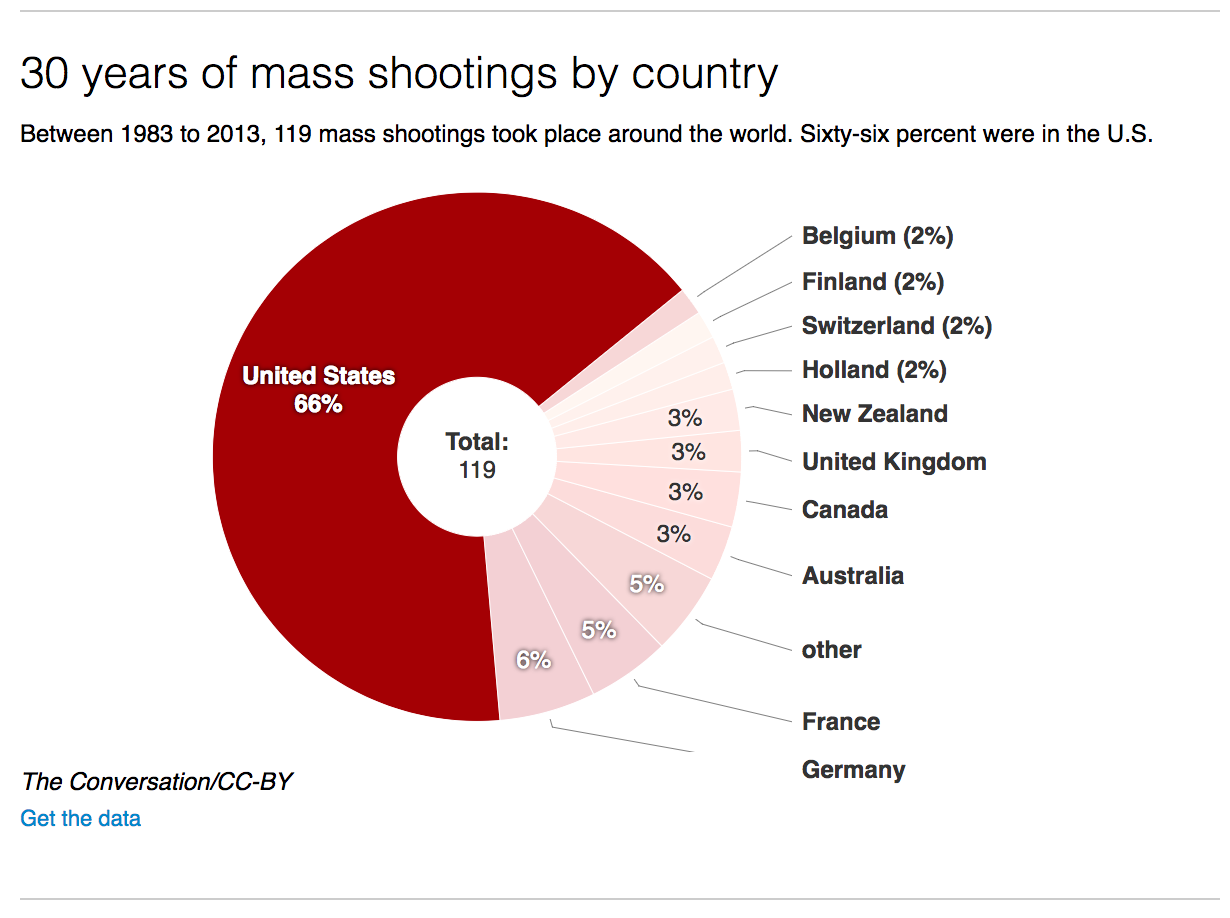
In class, I found data on international comparisons showing that the U.S. is an extreme outlier for rates of gun violence, and I posed the idea that wouldn’t we all take the rates of next highest nation (a much lower rate) if that were possible through policy change.

30 yrs mass shootings.png
Six things to know about mass shootings in America (The Conversation)

And with that, I argued that we are all complicit in our violent nation, our gun-lust: This is America. This is who we are.

My students who defended gun rights immediately balked at the carnage of LasVegas is something the citizens of the U.S. have chosen.

Facebook ignorance has become nearly as commonplace as mass shootings in the U.S. But I have tried to remain hopeful about young people, that the future can hold a better us: “This place could be beautiful,/right? You could make this place beautiful.”

As my students demonstrate, young people have been engrained with irrational but compelling beliefs that are not supported by evidence; entrenched symbolism remains powerful in the U.S. well beyond the origins of those symbols.

The practical and very real importance of guns in the founding and expansion of the U.S. certainly contrasts significantly with today—but the symbolism (guns equal freedom) endures.

Symbolism and the resulting fatalism are the death of us as a people—unless somehow we are able to make facts matter. Otherwise, our future is as dim as our past and our present.

Suggested Readings

How dangerous people get their weapons in America

Six things to know about mass shootings in America

When gun control makes a difference: 4 essential reads

1,516 mass shootings in 1,735 days: America’s gun crisis – in one chart

America’s unique gun violence problem, explained in 17 maps and charts

Visualizing gun deaths: Comparing the U.S. to rest of the world

@JamesFallows offers two dark American truths from Las Vegas

In the U.S., Where the Female Nipple Is More Dangerous Than a Gun

The Lingering, and Powerful, Legacy of “Scientific Racism” in America

Writing about the class of 2017’s performance on the newly redesigned SAT, Catherine Gewertz notes, “The number of students taking the SAT has hit an all-time high,” and adds cautiously:

What appear to be big scoring increases should be understood not as sudden jumps in achievement, but as reflections of the differences in the test and the score scale, psychometricians said.

More test takers and higher scores, albeit misleading ones, are the opening discussion about one of the most enduring fixtures of U.S. education—standardized testing as gatekeeping for college entrance, scholarships, and scholastic eligibility.

However, buried about in the middle of Gewertz’s article, we discover another enduring reality:

The 2017 SAT scores show inequities similar to those of earlier years. Asian (1181), white (1118), and multiracial (1103) students score far above the average composite score of 1060, while Hispanic (990) and African-American (941) students score significantly below it.

Throughout its long history, the SAT, like all standardized testing, has reflected tremendous gaps along race, social class, and gender lines; notable, for example, is the powerful correlation between SAT scores and takers’ parental income and level of education as well as the fact that males have had higher average scores than females for the math and verbal sections every year of SAT testing (the only glitch in that being the years the SAT included a writing section).

The SAT is but one example of the lingering and powerful legacy of “scientific racism” in the U.S. Tom Buchanan, in F. Scott Fitzgerald’s The Great Gatsby, punctuates his racist outbursts with “‘It’s all scientific stuff; it’s been proved.'”

Buchanan represents the ugly and rarely confronted relationship between “scientific” and “objective” with race, social class, and gender bigotry. In short, science has often been and continues to be tainted by bias that serves the dominant white and wealthy patriarchy.

Experimental and quasi-experimental research along with so-called standardized testing tends to avoid being implicated in not only identifying racism, classism, and sexism, but also perpetuating social inequity.

As I noted recently, since Carol Dweck and Angela Duckworth have produced mainstream scientific studies and published in reputable peer-reviewed journals, their inherently biased work has been nearly universally embraced—among the exact elites who tend to ignore or outright reject the realities of inequity and injustice.

As just one example, Duckworth grounded her work in and continues to cite a Eugenicist, Francis Galton, with little or no consequences.

Racism, classism, and sexism are themselves built on identifying deficits within identifiable populations. Science allows these corrupt ideologies to appear factual, instead of simple bigotry.

“Scientific” and “objective” are convenient Teflon for bias and bigotry; they provide cover for elites who want evidence they have earned their success, despite incredible evidence that success and failure are more strongly correlated with the coincidences of birth—race, social class, gender.

It takes little effort to imagine a contemporary Tom pointing to the 2017 SAT data and arguing, “‘It’s all scientific stuff; it’s been proved.'”

Such ham-fisted scientism, however, mutes the deeper message that SAT data is a marker for all sorts of inequity in the U.S. And then when that data have the power to determine college entrance and scholarships, the SAT also perpetuates the exact inequities it measures.

The SAT sits in a long tradition including IQ testing that speaks to a jumbled faith in the U.S. for certain kinds of numbers and so-called science; when the data and the science reinforce our basest beliefs, we embrace, but when data and science go against out sacred gods, we refute (think climate change and evolution).

Science that is skeptical and critical, questioning and interrogating, has much to offer humanity. But science continues to be plagued by human frailties such as bias.

Science, like history, is too often written by the winners, the oppressors. As a result, Foucault details, “[I]t is the individual as he[/she] may be described, judged, measured, compared with others, in his[/her] very individuality; and it is also the individual who has to be trained or corrected, classified, normalized, excluded, etc.” [1]

“Scientific racism,” as a subset of science that normalizes bigotry, allows the accusatory white gaze to remain on groups that are proclaimed inherently flawed, deficient, in need of correction. “Scientific racism” distracts us from realizing that the tests and science themselves are the problem.

And thus, we must abandon seeking ever-new tests, such as revising the SAT, and begin the hard work of addressing why the gaps reflected in the tests exist—a “why” that is not nested in any group but our society and its powerful elite.


[1] Foucault, M. (1984). The Foucault reader. Ed. P. Rabinow. New York: Pantheon Books, p. 203.

See this thread:


The Very Seriously Humorless Education of Students

I am a junior in college during the early 1980s, sitting attentively in Dr. Richard Predmore’s upper-level English course; I am an English education major, and the sort of mama’s-boy-student-suck-up that professors appreciated and fellow students wanted to throat punch.

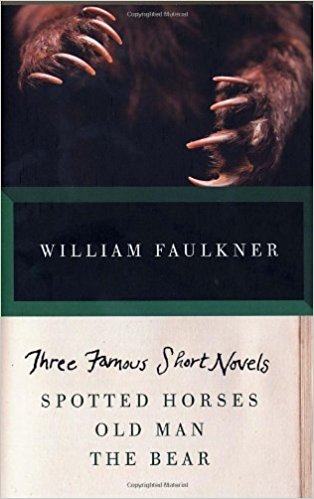
Per the syllabus (a code I cracked with some embarrassment as a first-year student), we are in class that day to discuss William Faulkner’s “Spotted Horses,” a novella that Faulkner later integrated into the novel The Hamlet.

spotted horses

Dr. Predmore begins class by reading an extended passage, during which he can hardly restrain the grin on his face. He punctuates the reading with, “Isn’t that hilarious.”

That was almost 40 years ago, but I can still feel the blood running out of my head as I realized I had absolutely no idea what Dr. Predmore was talking about.

Funny? William Faulkner? The William Faulkner of “The Bear” from high school? The William Faulkner of the Nobel Prize acceptance speech?

Uncharacteristically, I said nothing the entire class period; I was mortified at my ignorance, and in typical nerd fashion, committed myself to re-reading “Spotted Horses” in a whole new light.

This embarrassing moment in my formal education came rushing back to me when a colleague posted on social media an interesting incident from one of her classes:

Second day of discussing Rape of the Lock, three minutes before the end of class, a student says, out of nowhere, in the voice of a person who has had a major revelation, “Wait, is this supposed to be funny?”

Not long before this posting, I had conducted my essay openings activity with first-year writing students using several openings from essays by Barbara Kingsolver.

As we unpacked those first paragraphs through reading like a writer activities (here and here), students struggled, as always, with identifying that Kingsolver in many of the essays incorporated craft creating humor to engage the reader.

And thus, my response to my colleague’s post offered these points:

(1) I was that student in college and it was about a Faulkner work, (2) I used to show Monty Python to my AP class early as a sort of starting point for which ones had developed linguistic sophistication, and (3) students have spent most of their formal education being incredibly serious about incredibly serious texts and topics, thus, we must help them over this hump.

Since my colleague’s post, I have walked through with my students Adrienne Rich’s “The Baldwin Stamp.” As we discussed Rich’s “We’ve come a long way from 1960; democracy, it seems, marches on,” followed by two extended passages from Baldwin, students again struggled with Rich’s tone, many thinking she made the statement in ernest, ignoring that her juxtaposing Baldwin’s sharp criticisms exposes her sarcasm.

As developing readers and writers, our students have been mostly underprepared in terms of reading and expressing tone, the delicate use of diction and a whole host of craft elements to guide readers through ideas.

Just as students are best served as emerging writers by writing, our students are best served as emerging sophisticated readers and thinkers by being allowed to experience and wrestle with a wide range of texts—not simply the seriously humorless texts that tend to be the bulk of what we read, and thus what we say in formal schooling.

More humor, then, is likely to benefit our students too often trapped in academic seriousness known as school.

About that, make no mistake, I am being entirely serious.

Rejecting Growth Mindset and Grit at Three Levels

[Header Photo by Dave Lowe on Unsplash]

As the academic year began at my university, I was confronted with how the very worst of K-12 public education reform continues to creep upward, engulfing higher education.

In this case, growth mindset was central to the faculty keynote address, prompting me to resist an outburst in front of my colleagues. I did, however, weigh in on social media, including Facebook—where a few faculty were intrigued and reached out by email.

Last week, then, we held a faculty discussion on growth mindset, and of the three panelist, I was the only one calling for at least a skeptical view if not an outright rejection of the concept (along with grit, which was mentioned in the keynote but not central to the presentation).

For simplicity and clarity, I want to outline here briefly (since I have written extensively about both growth mindset and grit; see the Categories here on the blog) why I call for skepticism and even rejecting the practices associated with the terms.

At the first level, I question the ideological motivation for doing research to find the source of success and failure within individuals—assuming that individual character and behaviors are primarily or solely the source of both success and failure.

As a colleague noted during comments after the keynote, this is a “very American” way of thinking; and I would add, a flawed view of the relationship between human behavior and social forces.

Here, I recommend Scarcity: Why Having Too Little Means So Much by Sendhil Mullainathan and Eldar Shafir, and argue that social forces are primary to human behaviors. I also call into question the rush to characterize what is success and failure—since a tremendous amount of both outcomes are more strongly correlated to a person’s environment of birth than any accomplishments by the person.

At the second level, I am cautious about the quality of growth mindset and grit research as valid, and that caution is grounded in the first level—both concepts fit well into American myths about rugged individualism and the Puritan work ethic; thus, even so-called dispassionate researchers are apt to see no reason to challenge the studies (although some have begun to unpack and question Angela Duckworth’s studies on grit).

Scarcity, mentioned about, is a compilation of powerful studies that make a case unlike what most Americans believe about success and failure: those living in scarcity struggle because of the scarcity (think poverty), and those living in slack are often successful because of the slack. This work has not been embraced or received the celebrity of growth mindset and grit because it works against our narratives.

Privileged researchers blinded by their own belief in American myths as well as trust in their own growth mindset and grit, I fear, are not apt to challenge research that appears even to a scholar to be obvious.

The third level is the most damning since growth mindset and grit speak to and reinforce powerful cultural ideologies and myths about meritocracies and individual character—ones that are contradicted by the evidence; and thus, growth mindset and grit contribute to lazy and biased thinking and assumptions about marginalized groups who suffer currently under great inequities.

K-12 applications of growth mindset and grit have disproportionately targeted racial minorities and impoverished students, reinforcing that most of the struggles within these groups academically are attributable to deficits in those students, deficits linked to race and social class.

All three levels, then, are born in, protected by, and prone to perpetuate race and class stereotypes, and as a result, work against inclusive pedagogy and culturally relevant pedagogy.

Finally, stepping back from these levels, I also remain skeptical of growth mindset and grit because they are very difficult to disentangle from deficit perspectives of students and from monolithic, thus reductive, views of identifiable groups by race, class, gender, or educational outcomes.

Instead I endorsed what Paul Gorski argues about equity literacy principles:

Equity literate educators recognize and draw upon the resiliencies and other funds of knowledge accumulated by poor and working class communities, reject deficit views that focus on fixing marginalized students rather than fixing the conditions that marginalize students, and understand the structural barriers that cheat some people out of the opportunities enjoyed by other people.

Welcome to College!: How High School Fails Students

From 1984 until 2002, I worked as a high school English teacher in rural upstate South Carolina, a relatively impoverished small town where I was born and also attended schools. For many of those years, I also coached (girls volleyball, boys golf, girls and boys soccer) and taught journalism along with sponsoring the school’s newspaper and literary magazine.

Teaching often meant long days from about 7:30 in the morning until 10:30 or 11 at night when I had away soccer matches and had to wait outside the school for every player to be picked up by their parents.

Over my career as a high school English teacher, I kept a record of my work assigning and responding to writing by my students; I averaged reading and responding to about 4000 formal essays (multiple-draft, extended writing) and 6000 journals (one-draft, shorter pieces) per year. Regardless of their level or year in high school, my students completed about 16 essays per year with all of them rewritten at least once (most did many more than one revision), and I typically had a total of about 100-125 students per academic year.

Most K-12 teachers could share something similar to the above, but since this post (as the title suggests) offers a critical look at how high school fails students entering college, I want to start with a clear caveat that K-12 teaching is extremely demanding, and most teachers are asked to do way too much with way too little support or time—and possibly more damning, over the last three decades, most teachers are being held accountable for truly awful teaching and testing.

None the less, I want here to examine what I have witnessed, and continue to witness, in the college students I have been teaching for 16 years now, students in a selective university, and thus ones who can easily be described as extremely successful students.

My fall courses, as is typical, include first-year writing seminars and an introductory education course. From those classes, here are a few examples of why I regularly have to discuss with college students that high school has failed them:

  • In my writing seminar, I start by having students complete a writing exercise in which they mimic the form of a chapter from Sandra Cisneros’s The House on Mango Street. When I give the assignment, I clearly identify the passage as a chapter from a novel, but many students submitting their passage identify the text as a poem.
  • My foundations education course includes as a supplemental text The Poverty and Education Reader, edited by Paul C. Gorski and Julie Landsman. Students are required to choose 2-3 chapters from every section of the volume and to write brief reflections for each. A student sent me her reflections; throughout, she began each entry with “in this short story, the narrator”—although the volume is a collection of non-fiction (and scholarly) essays.
  • An early class session with the first-year students examines academic writing at the college level and how the disciplines (often arranged as departments in colleges and separate colleges in universities) have a wide variety of expectations and forms for writing. When I put up a list of disciplines, I ask which of them do the students assume use MLA for the stylesheet and citations—prompting most students to admit they think MLA is the only citation guide that exists.
  • I introduce my foundations education students to critical pedagogy and Marxist scholarly lenses, which leads often to students admitting that they have no real idea what the differences are among socialism and communism (and Marxism) as terms. As we examine these ideas, we also confront that students typically have only a shallow understanding of capitalism and democracy.
  • A few of us teaching first-year writing seminars this semester are sharing an assignment for essay one. To help students try to navigate the complex terms at the center of the assignment, we are using Roxane Gay’s “Peculiar Benefits” as a model. I also had my students complete diversity awareness quizzes created by Paul Gorski. As I discussed the assignment, I cautioned my students about making sweeping claims such as “most people think” by noting that a significant percentage of the world population (about half) includes Chinese and Indian people who have beliefs and experiences quite unlike what my students know. In one of Gorski’s questions, he notes that only 5% of the world population is in the U.S. (who has 25% of the world’s prisoners). One student, barely able to hold back that she was incredulous about that data, asked how I knew that information.

I want to return now to a point I made quickly above: these examples are from college students who have been extremely successful students. Early and often, then, I ask my students to unpack what being a student means, and then to weigh that against the expectations of college academic behavior.

One way I do that is assigning The Transition to College Writing, by Keith Hjortshoj, and I also have student read Adele Scheele’s “The Good Student Trap.”

Among the examples above, I believe the most significant way that high school fails students is grounded in that teachers and students are far too overwhelmed with accountability and coverage.

One of the odd patterns of advanced education is that we often expose students early to huge and sweeping bodies of knowledge (world history, American literature) and then as they go farther in their education, the course material becomes narrower, and thus deeper. For the English part of my undergraduate degree, I took a British literature survey course in the first two years, but a senior college English course explored only one author, William Butler Yeats.

Both teachers and students in high school, then, are victims of covering far too much way too superficially.

And thus, when I ask my first-year students what novels they read in high school, several often reply with The Crucible or Hamlet, both, of course, are plays, not novels. The blur of assigned books have left them without nuance or clarity in what they have or have not learned.

Yet at the college level, and then in the disciplines, slow and careful are far more important; a successful college student like an effective scholar will confront all material with skepticism, stepping back from assumptions and seeking ways to define and clarify terms before gathering credible evidence in order to make claims.

Being a good student too often is mostly about being dutiful, compliant, and superficial.

Another way to think about the inadequacy of high school is that it fails to help students overcome provincialism (rejecting provincialism is central to progressivism espoused by John Dewey and Lou LaBrant, and then critical pedagogy—all of which argued the foundational importance of literacy in that journey).

Provincialism is sort of an uninformed arrogance—determining Truth and the World based on one’s experiences absent the evidence of history and thought or the variety of experiences beyond one’s immediate geography and tribe.

College and the disciplines value people starting with intellectual humility and skepticism, and then requires behaviors that are slow, purposeful, and careful.

Let me conclude with a couple thoughts.

First, this tension between high school and college, I believe, can be solved by embracing critical pedagogy at all levels of education, inviting and mentoring students to read and then re-read the world, to write and then re-write the world.

These moves require that students have some greater degree of autonomy than they currently do, but it also requires a reimagining of what we think our content entails (not prescribed standards that are codified by the state)—a move away from content as fixed knowledge and toward a greater emphasis on how and why students engage with knowledge.

Finally, as an educator with over thirty years teaching from 9th grade through graduate courses, I readily acknowledge that some of what I am addressing is up for debate in terms of a wide range of mental, psychological, and emotional developments from childhood into adulthood. With that in mind, I am certain that students need and deserve the sorts of experiences and expectations common in college much earlier, at least by 9th grade.

A few falls ago, one of my first-year writing students eventually couldn’t hold back her exasperation any longer and held forth in class about how she was misled by being trained to memorize and use only MLA. Her frustration was warranted, but can and should be avoided.

What continues to guide me as a teacher of any level is that to teach English or any content is to teach students, first and foremost.

In 1961, Lou LaBrant observed: “Throughout our country today we have great pressure to improve our schools. By far too much of that pressure tends toward a uniformity, a conformity, a lock-step which precludes the very excellence we claim to desire.”

Too often in 2017, this rings true—failing our students moving from high into college and then beyond.

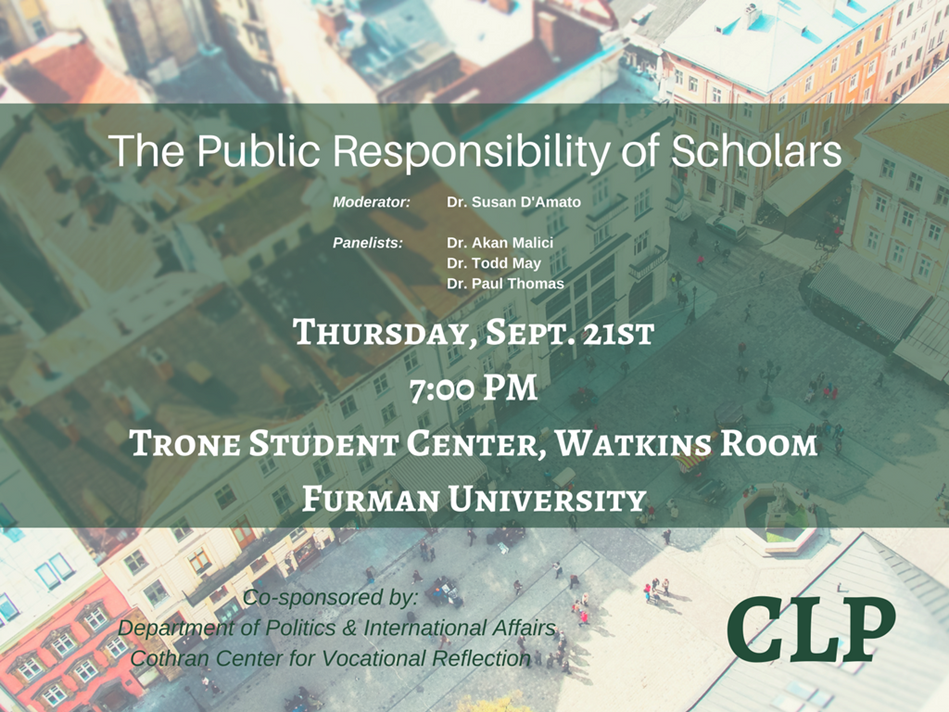
The Public Responsibilities of Scholars: Furman University, 21 September 2017, 7 pm

I write because I am a writer, and writing, in the course of my life, has come to be more natural to me than speaking.

Madness, Rack, and Honey, Mary Ruefle

image001

My comments will draw on the following:

The Politics of Calling for No Politics

Fair and Balanced Education and Journalism: On the Death of Democracy

Howard Zinn: “education cannot be neutral on the critical issues of our time”

My PowerPoint

See Also

Teaching English in the Age of Trump, Kara Voght

This Is America. This Is Who We Are.

In the U.S., politicians, pundits, and the public have a verb problem: using “is,” a false claim that masks ugly truths, when “should” expresses an aspiration worth embracing.

There are millions of examples, but former vice president Joe Biden’s comments about Trump’s seeking to end DACA serves as a representative example:

“These people are all Americans. So let’s be clear: throwing them out is cruel. It is inhumane. And it is not America,” [Biden] added. “Congress and the American people now have an obligation to step up and show our neighbors that they’re welcome here, in the only place they’ve ever called home.”

Mantras that the U.S. is a land of opportunity, that ZIP code is not destiny—these are ideological lies that would be better expressed as the U.S. should be a land of opportunity, that ZIP code should not be destiny.

The U.S. was founded in war, but freedom, equity, and justice for all did not spring forth from the blood-soaked soil of that revolution.

Life, liberty, and the pursuit of happiness applied only to white males—black slaves were not human and then only 3/5ths human, women had rights only indirectly by association with men, and children were nearly invisible as full humans.

Since 1776, in fact, the slow march toward freedom, equity, and justice for all has been a fight, not some benevolent gift by those who had all those from the beginning.

It is 2017, and partisan politics continues to ignore freedom, equity, and justice for all because the Trump administration seeks to erase former president Obama from the record—simply as crass partisan politics not so subtly awash in racism: efforts to end ACA, the so-called Obamacare, and now announcements that DACA will be suspended.

The list is long, ugly, and ongoing that despite what many, including Biden, claim this is America; this is who we are:

Now, in the U.S., millions of dollars, a Reagan hairdo, a suit that costs more than many people make in weeks, and simply being white, male, and somewhat articulate all allow you to lie with a smile, an apparently a clear conscience:

This is America. This is who we are.

But to be black is another reality all together:

This is America. This is who we are.

Rising Tides and the Ignored Plight of Being Boatless in the U.S.

[Header Photo by Caspian Dahlström on Unsplash]

While dystopian post-Apocalyptic literature, such as Margaret Atwood’s The Handmaid’s Tale, has gained renewed popularity recently, William Faulkner approached those essential elements differently in his dark and comic As I Lay Dying.

We may be able to imagine now the Bundren family, as ancestors to Trump-supporters, suffering fire and flood as a metaphor for the human condition magnified by poverty and ignorance.

Faulkner offers a double dose of complications through his own garbled and tone-deaf ideology as well as his experimental and multi-layered prose.

As the coast of Texas and the greater Houston area continue to be battered and flooded by Harvey, a re-reading of the flood scene in As I Lay Dying, when the family loses control of Addie Bundren’s coffin and horse-drawn wagon in the flood waters of a river, suggests that Faulkner is not dealing merely with allegory—but with how Nature often intervenes with lessons that should caution humans about the maxims they live by.

Along with traditional commitments to rugged individualism and chastising those who struggle to simply pull themselves up by the bootstrap, “a rising tide lifts all boats” stands as a common refrain in our uncritical hymn to capitalism and the so-called free market.

Harvey is today an ongoing human tragedy—one that could not be avoided but likely could have been lessened by a people less committed to “the myths that deform us.”

The bootstrap and rising tide myths render invisible and willfully ignore those without boots and the boatless.

As Harvey has shown, the media and mainstream responses to the flood are blinded by privilege and assumptions about human agency: How do poor individuals and families evacuate who have no transportation, no emergency funds, nowhere to go?

For the poor in the path of Harvey, the storm and the flood are exponential versions of their daily lives already stressed by a calloused American faith in deforming myths; poverty is the fault of the poor rests just beneath the bootstrap and rising tide myths.

The able-bodied but lazy poor, however, is worse than a myth because it is a lie: “more than 80% of the officially poor are either children, elderly, disabled, students, or the involuntarily unemployed (while the majority of the remaining officially poor are carers or working people who didn’t face an unemployment spell)” [Who Are the Poor? (1987-2013)].

Between the election of Trump and the landfall of Harvey, pundits and the media have spent a great deal of time wrestling with the so-called Trump voter who is white and working class or poor, and often rural.

That debate and myopic focus teach an unintended lesson about how the only the things that matter in the U.S. are those that impact white people (“working class” has become code for “white” as if black and Latinx aren’t working class). This same pattern has developed lately about opioid addiction.

But there is much we can and should learn from the white working-class/poor voters who remain in Trump’s camp despite many having those commitments checked by, for example, realizing that Obamacare is the ACA—and its repeal would have cost them healthcare.

Like the Bundren family, they are self-defeating in their stubbornness and ignorance, but to observe them still raises questions about how much they deserve compassion.

And here is the irony: these “Make America Great Again” legions, driven by white nationalism and racism, deserve the exact compassion and community that they deny the poor because of their indoctrination into the deforming bootstrap and rising tide myths.

When there are rising tides, the boatless always suffer—but in the U.S. we have decided to live as if that is the fault of the boatless.

Harvey’s devastation of Houston exposes once again the fragility of humans against the enormity of Nature, but it also unmasks the emptiness of the American character, unwilling to put community first because the dollar matters more than any person, even a child.

The Great Deforming Myth is the Invisible Hand that may or may not provide for you—unless you hit the birth lottery.

Like the Bundren family—mostly a clan of deeply selfish and bitter humans—standing on the river bank and watching Addie’s coffin tumble and bob in the churn of the flooded river, Americans watch Houston drown on smart phones, tablets, and 24-hour news channels.

The ugly subtext of As I Lay Dying is that Addie’s family members are using her death and burial to cash in on something they have been otherwise denied. Their journey through fire and flood seeks the cover of a grieving family to mask their pettiness, their emptiness.

In the receding waters of Harvey, we should consider that Faulkner, not Fitzgerald, has crafted the Great American Novel, and the characterization is not pretty.