Category Archives: Education

School Zones: A Meditation

I am a humanist, which means, in part, that I have tried to behave decently without any expectation of rewards or punishment after I’m dead.

Kurt Vonnegut, God Bless You, Dr. Kevorkian

No good route exists for my drive from my house to my university; my commute is a Groundhog Day of the Southernism “Can’t get there form here.”

To avoid the daily morning ritual of accidents on the interstate I could use to make that drive quicker, I tend to snake my way along back roads, and on that journey, I typically pass through two school zones—a high school near my house and then an elementary school closer to the university.

Both school zones bring traffic to a crawl, and then often, to a stop as crossing guards shepherd teens and children across the road to their schools.

These crossing guards are armed only with day-glo vests and matching wands to protect students from 4000-pound automobiles and the increasing reality that drivers are distracted by their smart phones.

The paradox of this cavalier optimism, this nod to the greater decency of people confronted with the frailty of children, is that schools have increasingly become more and more prison-like—police in the hallways, doors locked, intercoms to screen any who try to enter the building, and discipline codes and practices that parallel and even intertwine with law enforcement.

School zones and barricaded schools contrast sharply, however, with the broader disdain for and disregard for the conditions of children’s lives in the U.S. The largest group of people suffering in poverty are children, and this reality is far worse in the U.S. than many other countries.

And despite efforts to control students as well as protect them from the gun violence that the U.S. views as normal beyond the walls of schools, the U.S. also has more school shootings than almost four dozen other countries combined.

Our daily behaviors also reveal that too often our care for our own children, and children who look like us, exposes our disregard for “other people’s children”—in the cruel tolerance for corporal punishment as somehow just parenting and the rush to punishment in grade retention that negatively impacts poor children of color.

In our caustic and calloused political debates about healthcare, school choice, public monuments, and more, the absent voice is always that of children, and they are also rendered invisible as if our policies are not ultimately the world in which these children live.

No child chooses their parents or their places of their birth and living.

It may seem cliche, but there is no doubt that a people should be judged by how they treat their children.

The U.S. is the wealthiest and most powerful country in history. How we spend public funds and the laws as well as policies we implement are who we are.

Crossing guards in day-glo vests raise their orange wands to oncoming traffic all across the U.S. throughout the academic year, and drivers stop their cars while children laugh and even skip across the road to their schools.

It is in those moments mornings and afternoons that who we could be passes right by us.

Who we are remains in the tragedy of Tamir Rice, mostly ignored, mostly forgotten. Just a child who may himself have been shepherded across a road by a crossing guard in a school zone.

Who we are remains to be a truly negligent people unable to put grand ideals into our daily behavior, driven by a nastiness and callousness that in the future will be an ugly monument that tells a story of how we failed despite all the opportunities before us for being good and kind.

Essential Logic Fail of the Right in the US: 9 Seconds of Deadpool

As one example that can be extrapolated to most of the arguments on the Right (think the recent monuments and flags debate), consider the complaints that NFL players are being “political” by protesting peacefully during the national anthem. To wit:

  • Standing for national anthem = POLITICAL ACT
  • NFL playing the national anthem = POLITICAL ACT
  • Telling people not to protest = POLITICAL ACT

The logic flaw is grounded in this: People call “political” anything they dislike, don’t agree with; their own views appear “right” and thus “not political.” This is lazy thinking, and self-contradictory.

And thus, 9 seconds from Deadpool:

First Days of Class: Who We Are, Why We Are Here

At least the first half of my career as a high school English teacher for 18 years was spent learning to be the sort of teacher I wanted to be. I often feel I should apologize to those early-career students, many of whom remain kind and even praising.

Along that journey, I came to realize that the first days of any class or course must be a clear and inviting message to my students about who we are and why we are here.

A watershed moment for me was somewhat an accident. My administration ended the long and tedious tradition of spending the first day or two issuing textbooks by having all students’ texts placed in their locker before they began the year.

With that freedom, I stopped the equally tedious roll call and dedicated myself to conducting class on that very first day in a way that told students what the class/course was going to be about.

As I start my 34th year as a teacher, now a professor teaching two first-year writing seminars as well as a couple eduction courses, I also dedicate the first days of class to practicing what I preach: incorporating one or two different strategies or changes each new course (what I call taking baby steps since no teacher should feel compelled to overhaul entirely their teaching when they feel the need to change).

Here I want examine some first-days texts and activities, not as prescriptions but as models for how any teacher may take this same larger concept of how those first days establish who you are, who your students are, and why you all are on this class journey.

First, some of my new commitments are grounded in being more intentional about inclusive pedagogy, much of which will draw on the guidance of Dr. Anita Davis, Director of Diversity and Inclusion, Associated Colleges of the South, who is helping facilitate a year-long seminar for a group of faculty at my university this academic year.

These new commitments allow me to incorporate existing activities and texts in order to improve the inclusive environment of my classes as well as establishing the disciplinary grounding of the courses I teach.

Regardless of the course, I use several of these activities on the first days, but I also will include a writing-specific opening days activity toward the end.

A central message for my students in the first days is that we will be bound to texts, important texts, and then we will also be using those texts for our own discussions and to write. The key texts I currently use for the first days include the following, all of which also model for my students that we are going to explore diverse voices and writers in order to challenge and interrogate our own ideas and assumptions:

Who We Are

Anita Davis opened her first seminar by explaining that she includes full name citations on her PowerPoint slides, even though most citation styles require last names only and APA hides first and middle names in initials. Davis stressed that names matter, especially if we are seeking to be inclusive.

Over the course of the seminar we also examined that roll calls can be intrusive and even stressful for students who are struggling with gender identification, establishing on that first day a hostile environment counter to our efforts of inclusion.

Part of our goal to be inclusive, we must all be better equipped when our students must name and identify themselves—issues about gender identity and pronoun preferences.

“My Name” (Cisneros) and “Naming Myself” (Kingsolver) are powerful texts for helping students think about how to introduce themselves in the context of a new learning community. I read these short texts aloud to emphasize there will be a common activity in my classes, read alouds.

Then we discuss how the speakers in the novel chapter and the poem emphasize the importance of names and of being named; both texts ask readers to consider sex/gender and race.

As well, “My Name” includes a recognition of how children/young people come to understand themselves in their names while “Naming Myself” challenges social norms of women being erased through re-naming during marriage.

These texts and activities establish that our names matter, but that naming ourselves is more complicated than some students have considered. I also want students to know that I appreciate texts, the read alouds, but that texts are not simply fodder for the sort of narrow analysis they have done in their English classes.

Finally, we introduce ourselves, first in small groups and then as a full class. This semester, I will invite students to talk about their names, and their pronoun preferences if and when this is important to them. I will also stress that our learning community must be a place where we honor confidentiality; we are free to share outside of class the topics we explore, but we should avoid naming our classmates in ways outside of class that breaks confidentiality, that fails to honor each person’s right to speak for themselves.

On the first day, we have avoided the drudgery of calling roll—and engaged in the sort of class dynamic that characterizes my classes throughout the semester. But I now will also establish an environment that honors inclusion more intentionally than I have in the past.

Why We Are Here

While the naming texts and activities are entry points for introductions and creating an inclusive learning environment, that first day also begins a journey into disciplinary expectations—why we are here.

Another first days activity I use is based on Hughes’s “Theme for English B,” but I will now include an activity, “Save the Last Word,” Davis used in our seminar.

“Theme for English B” lends itself well to any class because it investigates the power relationship between teachers and students; like the Cisneros and Kingsolver texts, Hughes also confronts the role of race in that power dynamic.

When I have used Hughes’s poem in the past, I have struggled with students shifting immediately into the literary analysis mode, eager to analyze the poem’s structure and technique to the exclusion of engaging with what the poem’s speaker is saying about power as that intersects teaching/learning, race, and age.

“Save the Last Word” is a wonderful strategy for keeping students focused on what a texts says (not the how of literary analysis) and encourages student voice in the context of that text.

My slight adaptation of the activity includes the following: (1) my read aloud of the poem, (2) asking students to read the poem again silently to themselves, (3) placing students in small groups (preferably of 3), (4) having students copy what they consider a key or challenging stanza on the front of an index card, (5) having students reflect on that stanza in writing on the back of that card, (6) after all students have done this each student shares out to the small group the key stanza so that the other two can respond to that stanza first, and finally (7) each person shares their reflection last for that stanza.

Through a whole-class discussion of “Theme for English B” following the “Last Word” activity, I will share with students why we are here: to take words, each other, and ideas seriously and carefully in the pursuit of our own growth through disciplinary moves as well as our developing literacy.

The course, like the activities around Hughes’s poem, will be both individual and collaborative as well as interrogating and investigating key ideas and concepts.

Why We Are Here (Writing Specific)

Finally, I want to touch on a first writing activity I use in order to highlight how to use the first days to stress the narrow goals of any course or class.

The first writing activity I do with students involves Cisneros’s “A House of My Own”:

  • I read the passage aloud.
  • Students are instructed to write their own versions of the passage, changing “house” to an object of their choice and then mimicking the passage exactly except for the content. I refuse to give more directions and urge students to trust themselves and complete a draft.
  • After most of the students have a full first draft, I ask for volunteers to share their versions aloud. During the sharing I ask the others to compare their drafts to the one being shared.
  • Next I ask other students to share or discuss how their version does something different in terms of mimicking Cisneros exactly.
  • Always students begin to re-think their mimicking as well as how carefully they read any text for the how (technique) and the what (content).
  • Finally, I invite students to revise their versions and send them to me by email for the next class meeting.

This activity stresses the importance of completing a full first draft (especially as a discovery draft not as a process to fulfill a set thesis), the value of peer conferencing and sharing drafts, and the necessity of revising all writing with purpose.

We also begin to look at the craft of language—sentence formation (the entire passage is a series of fragments), rhetorical and literacy techniques, vivid and specific details, grammatical and syntactic awareness.

One unexpected but consistent consequence of this activity is that students often email their revision to me and call the text a poem—even though Cisneros’s mentor text is a prose fiction passage from a novel.

This means the following class allows me to begin a conversation about genre awareness, how we determine the form any text takes (poetry v. prose, fiction v. non-fiction, etc.).

In short, an opening activity models why we are here and how we are going to proceed.

Throughout my career, I have rejected traditional views of the first days of any class or course needing to be about establishing teacher authority (don’t smile until Christmas) and classroom rules or management.

Instead, I am committed to making the first days of class about who we are and why we are here while remaining true to my larger critical philosophical and ethical commitments as an educator and a human.

See Also

Inclusive Teaching Resources and Strategies (University of Michigan)

The Vulgar Academic Pose of President Trump

Criticism of Donald Trump as a presidential candidate and then president has been intense among university-based academics and scholars across the U.S.

However, the great irony of that fact lies in how President Trump’s “both sides” approach to addressing the Charlottesville, VA, violence is merely a vulgar version of the academic pose found among those academics and scholars—the traditional call for professors and researchers to be politically neutral and objective.


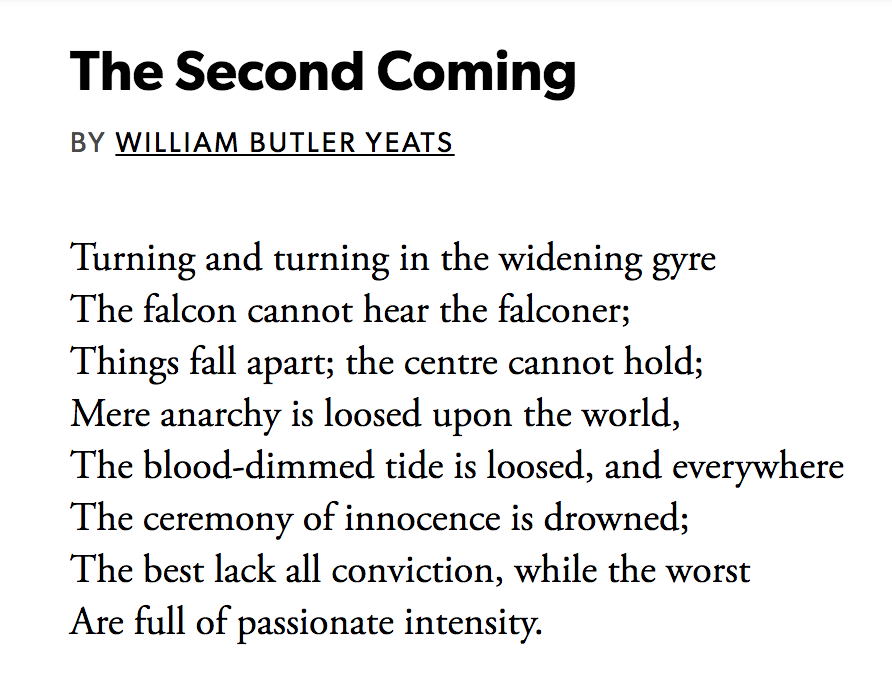
second coming yeats


Having been a public school teacher for almost two decades in the rural South and now a university professor for 15 years and counting, I have lived the tyranny daily of being chastised as “too political,” as tarnishing my credibility as a teacher and professor by my writing-as-activism.

I stumbled through a bit more than a decade of teaching before I discovered an organized body of thought that defined for me what I had been practicing, although quite badly—critical pedagogy.

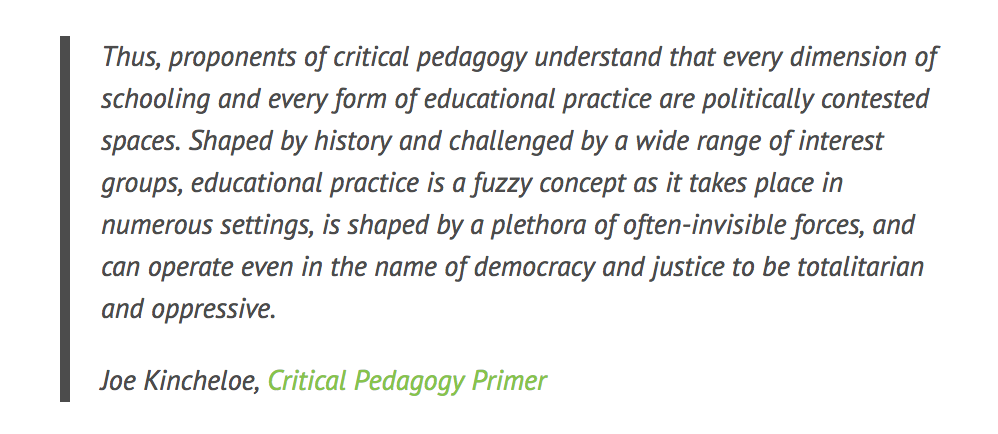
Critical pedagogy acknowledges two powerful and seemingly contradictory realities: (1) all human behavior, including teaching, is inherently political, and thus, the neutral/objective pose is itself a political stance, and (2) indoctrination must be avoided and rejected.


crit ped kincheloe


K-12 public education and higher education remain resistant to these concepts, continuing to demand apolitical teaching (or, actually, the appearance of apolitical teaching) and to bristle at teachers and academics as activists.

In fact, teachers and professors take great risk to their careers when stepping beyond the neutral/objective pose, even outside the walls of the classrooms where they teach.

That the norm of formal education remains entrenched in the same sort of “both sides” mentality shared by mainstream journalism is made more disturbing by the dishonesty of that expectation because educators at all levels of schooling do in fact take stances.

For example, history taught through a patriotic lens is a political choice that is allowed to appear neutral, although it is clearly not.

And there are topics, such as the Holocaust and Nazi Germany, that are taught with a clear moral imperative—no “both sides” false equivalence afforded those who believed in exterminating the Jews.

No classes ever treating as equal “both sides” of pedophilia, child abuse, misogyny, rape.

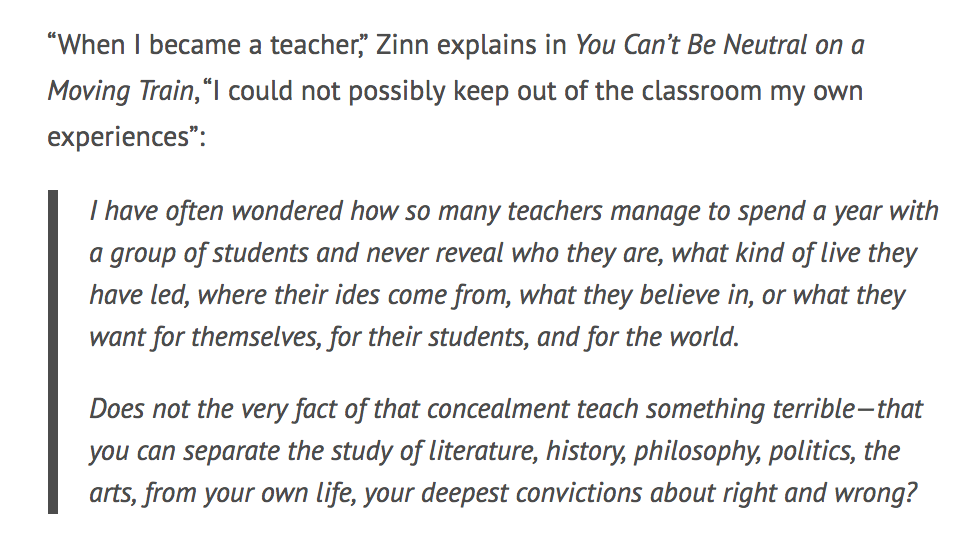
None the less, activist-academics such as Howard Zinn have been and continue to be marginalized as merely activists.


neutral zinn


Particularly in higher education, many go about their work as if the real world does not exist, and thus, the ivory tower myth and scathing phrases such as “merely academic.”

But to borrow Zinn’s metaphor, to remain in a neutral/objective pose in the classroom as an inequitable and unjust world charges on is to endorse that inequity and injustice.

President Trump’s “both sides” pose in the face of white nationalism and emboldened racism is inexcusable, but to pretend that Trump somehow sprang out of thin air is an ugly lie, a delusion.

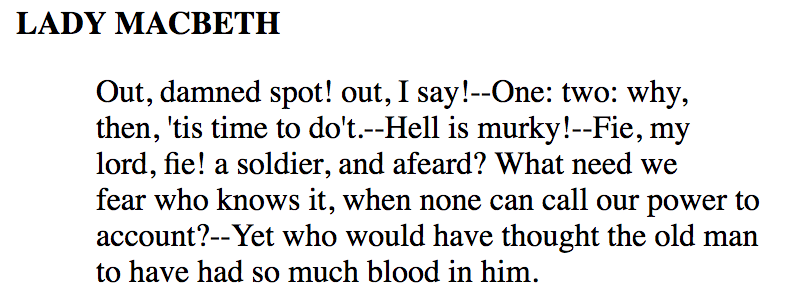
The rise of Trumplandia confirms there is blood on the hands of neutral academics and scholars, just as there is blood on the hands of “both sides” mainstream journalists.


lady macbeth


Trump is capitalizing on a vulgar academic pose that must be refuted, but it is equally inexcusable that traditional academic neutrality remains entrenched as if it has no consequences beyond the walls of schools and universities.

The U.S. needs Trump’s vapid logic repudiated: Good causes will always have some flawed and even bad people, as well as bad decisions, but causes dedicated to hatred and racism never include good people.

If educators, academics, and scholars are somehow excluded from taking ethical stands, we have little room to point fingers at Trump and his reign of white nationalism.


See Also

white folk (switchblade)

The Invisible Politics of White Wealth

The study of silence has long engrossed me. The matrix of a poet’s work consists not only of what is there to be absorbed and worked on, but also of what is missing, desaparecido, rendered unspeakable, thus unthinkable.

Adrienne Rich, Arts of the Possible

I am invisible, understand, simply because people refuse to see me.

Ralph Ellison, Invisible Man

Those who control wealth, politics, and the media have the ability to maintain public attention on where the power elites point their finger.

Trumplandia now has decided that colleges are biased against white students despite college attendance and especially graduation remaining relatively skewed in favor of whites.

The Trump administration has resurrected the affirmative action mantra we witnessed under George W. Bush, who attended an elite university as a legacy and then somehow enrolled in graduate school after being only a C student as an undergrad.

Beware, then, of what the wealthy white elites want us to worry about.

And worry instead about what they are not pointing to, the invisible politics of white wealth.

Is a blank canvas blank? Or white? Or even art?

Consider the examples below.

White males on average score higher than anyone on the SAT, both the math and verbal sections. College admissions remains powerfully influenced by the bias of college admission exams, which are racially biased and greater reflections of privilege than merit.

Testing is a tool to render white wealth privilege invisible.

As noted about W. Bush, when white wealthy men attack affirmative action, they are trying to divert attention away from white wealth affirmative action, such as legacy admissions and the good-old-boy system.

Legacy admissions is a policy to render white wealth privilege invisible.

The current controversy over Colin Kaepernick being too political for a position on any NFL team parallels the affirmative action distraction under Trump. Kaepernick’s silent protests are labeled “political” while the wealthy white owners’ actual political donations and endorsements (and let’s not ignore Tom Brady’s cozying up to Trump) somehow are not discounting politics.

Isolating Kaepernick’s protests as “political” is a strategy to render actual political financing by wealthy whites invisible.

But possibly the ugliest version of this lies in how we find ourselves with Trump as president and the specter of Mark Zuckerberg as a future president.

In recent history, one example is Bill Gates, who masterminded how to mask wealth and privilege as innovation, entrepreneurship, and merit. While there are problems with his work, Malcolm Gladwell offered an unmasking of wealth and success mainly coming from effort and genius that speaks to the Gates-Trump-Zuckerberg effect.

Just a bit of critical unpacking exposes the myth of Gates and Trump being brilliant businessmen; in fact, they have squandered wealth and corporate success often.

It has been the invisible power of white wealth that has buoyed them, and thus, especially with Trump, it is essential for them to maintain that privilege by keeping it invisible.

Fanning the flames of white resentment over the false narrative that racial minorities have any sort of advantage in the U.S. justifies the label “deplorables.”

This is the most corrosive sort of politics, a daily politics of of lies and hatred grounded in whiteness—the invisible thing in the U.S. that defines us.


See Also

America Has Never Had A Merit-Based System For College Attendance, Andre Perry

Some Colleges Have More Students From the Top 1 Percent Than the Bottom 60

Pre-Service Teacher Education vs. the World

I cannot promise below anything as exciting as battling a potential new partner’s seven evil exes, but I do want to wade into an important but too often overlooked aspect of how we assign power and blame to teacher impact of student achievement.

In two recent posts, I have confronted teacher blaming as well as teacher buy-in because far too many people simultaneously overstate teacher impact on student outcomes while ignoring that teachers in the U.S. have very little professional autonomy.

First, and I will not belabor this point, teacher quality contributes to only about 10-15% of measurable student achievement, dwarfed by out-of-school factors accounting for about 60% or more.

Yet, what is also important to emphasize is that teacher practices in public schools are highly regulated, increasingly so over the past thirty years of accountability driven by standards and high-stakes testing.

Teacher professional autonomy has been nearly absent in the U.S. over the last century-plus in the U.S.—likely since it is seen as a woman’s profession—but current in-service teachers will attest that their practices are significantly restrained by state mandates and schools polices anchored to state standards and a wide assortment of high-stakes tests (from state accountability to the SAT/ACT and Advanced Placement as well as International Baccalaureate).

Part of the reason I resist the inherent teacher-blame in pieces such as Goldstein’s on how writing is taught rests on my own experiences as a teacher educator of English teachers for 15 years.

My journey to teacher education began as adjunct teaching in local colleges throughout the 1990s, culminating with two wonderful years as the co-lead instruction in the Spartanburg Writing Project (SWP).

That fist summer institute of SWP introduced me to Dawn Mitchell as well as how common her struggle is among in-service teachers across the U.S.

While we at SWP worked diligently to teach our participants best practice in teaching writing, they—as did Dawn—routinely met resistance in their real-world schools and classrooms.

Principals and parents balked repeatedly at changed practices, even as those changes move from unwarranted to warranted instruction.

Once I became a full-time teacher educator, I had to anticipate a recurring refrain from the wonderful young people I was helping move into the field of teaching English; they nearly all said they valued what I had taught them about best practices in teaching reading and writing, but they were not able to implement most of those practices once they secured a job teaching.

So here is the dirty little secret of education blame in the U.S.: we simultaneously want to hold teachers accountable for student achievement even though we know teacher quality is a small percentage of those measurable outcomes and even though teachers are often implementing practices that are not supported by research but by mandate.

If we return to the Goldstein article and consider why student writing continues to fall short of our expectations, we must accept that how we measure student writing proficiency significantly shades what we believe about student proficiency and that teachers are mostly practicing in their classes what they are required to do (teach to standards, teach to tests) even when those mandates conflict significantly with what we know is best practice in fostering young students as writers.

Ultimately, there is a type of education reform that has never truly been implemented—seeking ways to increase teacher professional autonomy.

As someone with almost two decades as a public school English teacher and now 15 years as a college professor, I can attest that professional autonomy is one of the most powerful aspects of university teaching; we are hired for our expertise and then given the respect we deserve for behaving as professionals in our classrooms.

There is much about teacher certification as well as in-service teaching that deserves attention and reform, but currently, the discourse around teacher blame and why students (and schools) fail completely ignores the key cause behind all of this discord: accountability driven by standards and high-stakes tests, which is all folded into federal and state legislation.

Both teacher education and in-service teacher practices would be exponentially improved by teacher educator and teacher autonomy—and then we would find a much more valid context for holding both accountable.


See Also

Many Teachers Have ‘No Say’ in Decisions About Their Own PD, Survey Finds

Why Journalists Shouldn’t Write about Education

Over the past couple of days, I have watched almost universal praise for Dana Goldstein’s Why Kids Can’t Write*. Since those sharing this article have tended to be people and organizations that I respect, my own response has been tempered—even though I recognize in the overview of teaching writing the same problems with edujournalism I have been confronting for many years.

Other than Jim Horn’s challenge that Goldstein takes the “blame the teachers” route and former NCTE president Douglas Hesse’s letter posted at his blog, many in the writing and teaching writing community have posted and shared this article without challenge, and several have added that Goldstein does a more than adequate job covering the landscape of teaching writing.

The irony here is that this article on the failures to teach students to write is a model for both typical mainstream journalism and everything wrong with mainstream journalism: the breezy recounting of a complex field within which the journalist has no real experience or expertise and the “both sides” coverage of complex issues that treats “sides” as somehow equally credible.

The key problems in this piece can be unpacked in a few claims made by Goldstein.

Early, Goldstein asserts (without any link to evidence):

Focusing on the fundamentals of grammar is one approach to teaching writing. But it’s by no means the dominant one. Many educators are concerned less with sentence-level mechanics than with helping students draw inspiration from their own lives and from literature.

What is profoundly garbled here is a conflating of what the field of teaching writing shows through research and what teachers actually do in their classrooms.

The reality of 2017 and how students are taught writing is best reflected in a comment by former NCTE president Lou LaBrant from 1947:

A brief consideration will indicate reasons for the considerable gap between the research currently available and the utilization of that research in school programs and methods. (p. 87)

Isolated grammar instruction has been shown to have almost no transfer into student writing, and George Hillocks (among others) detailed that traditional grammar exercises could even make student writing worse.

However, I invite Goldstein and others to visit classrooms and, better yet, simply read through the Connected Community’s Teaching and Learning Forum (NCTE) where weekly English teachers voice their continued commitment to “[f]ocusing on the fundamentals of grammar.”

I want to come back to this point with another example below, but next, Goldstein wanders into the fatal flaw of edujournalism with this splash of evidence:

Three-quarters of both 12th and 8th graders lack proficiency in writing, according to the most recent National Assessment of Educational Progress. And 40 percent of those who took the ACT writing exam in the high school class of 2016 lacked the reading and writing skills necessary to successfully complete a college-level English composition class, according to the company’s data.

Poor writing is nothing new, nor is concern about it. More than half of first-year students at Harvard failed an entrance exam in writing — in 1874. But the Common Core State Standards, now in use in more than two-thirds of the states, were supposed to change all this. By requiring students to learn three types of essay writing — argumentative, informational and narrative — the Core staked a claim for writing as central to the American curriculum. It represented a sea change after the era of No Child Left Behind, the 2002 federal law that largely overlooked writing in favor of reading comprehension assessed by standardized multiple-choice tests.

The relentless and uncritical faith in what standardized tests tell us is one of the great problems with edujournalism across all discussions of education, but with writing, this is particularly problematic since standardized testing of writing is universally horrible, lacking validity and itself providing the context for why the teaching of writing is in fact inadequate.

Again, Hillocks has carefully analyzed that one of the most negative influences on teaching students to write has been the high-stakes testing movement. Teachers and their students have become slaves to state-level and national tests of writing that make writing to prompts and conforming to anchor papers as well as rubrics supersede any authentic writing goals that were endorsed by important movements such as the National Writing Project (a key focus of Goldstein’s article).

As I noted earlier, the irony is that a professional journalist’s piece in the NYT fails to provide the sort of credible evidence that many would expect as essential to student writing.

Just as test data are accepted on face value, Goldstein embraces an even worse source for her foundational claim of blame:

The root of the problem, educators agree, is that teachers have little training in how to teach writing and are often weak or unconfident writers themselves. According to Kate Walsh, president of the National Council on Teacher Quality, a scan of course syllabuses from 2,400 teacher preparation programs turned up little evidence that the teaching of writing was being covered in a widespread or systematic way.

Kate Walsh and NCTQ have no credibility in writing instruction, and worse yet, their so-called research on teacher education has been exposed as ideologically corrupted and methodologically inept, especially the syllabus studies noted by Goldstein.

Here I want to link this misplaced use of Walsh/NCTQ and the first point above.

Goldstein’s article flirts with some very important issues about why the teaching of writing does continue to be mostly inadequate across the U.S. But the entire piece could have been saved by simply seeking out the research on that exact problem, research that already exists in a highly accessible form—for just one example, Applebee and Langer’s Writing Instruction That Works: Proven Methods for Middle and High School Classrooms.

Applebee and Langer have conducted multiple studies over many years examining what actually happens in terms of writing instruction in classrooms as well as what teachers know and how that is reflected in their practice.

Broadly, Writing Instruction That Works reveals, as I highlighted in a review for TCR:

In Chapter Two (Writing Instruction in Schools Today), Applebee and Langer (2013) lay the foundation for what becomes the refrain of the book: “Overall, in comparison to the 1979–80 study, students in our study were writing more in all subjects, but that writing tended to be short and often did not provide students with opportunities to use composing as a way to think through the issues, to show the depth or breadth of their knowledge, or to make new connections or raise new issues…. The responses make it clear that relatively little writing was required even in English…. [W]riting on average mattered less than multiple-choice or short-answer questions in assessing performance in English…. Some teachers and administrators, in fact, were quite explicit about aligning their own testing with the high-stakes exams their students would face” (pp. 15-17).

Their substantial work from 2013 offers as well some key points that I outlined as follows:

  • Across disciplines, students are being asked to write briefly and rarely, with most writing falling within narrow templates that are unlike discipline-based or real-world writing.
  • Teachers tend to know about and embrace the value of writing to learn content, but rarely implement writing to achieve rich and complex examinations of prior or new learning.
  • Student technology savvy is high (notably related to social media), while teacher technology savvy remains low. Technology’s role in teaching and learning is detailed as, again, narrowed by high-stakes testing demands and “primarily…used to reinforce a presentational mode of teaching” (Applebee & Langer, 2013, p. 116). These findings call into question advocacy for greater investments in technology absent concern for how it is implemented as well as raising yet another caution about ignoring research showing that technology (especially word processing) has the potential to impact writing positively if implemented well.
  • While English language learners (ELLs) tend to be one category of students targeted by education reform and efforts to close achievement gaps, high-stakes testing and accountability stand between those students and the potential effectiveness of extended process writing in writing workshop experiences.
  • Like ELL students, students in poverty suffer the same fate of disproportionately experiencing narrow learning experiences that focus on test-prep and not best practice in writing instruction: “By far the greatest difference between the high poverty and lower poverty schools we studied stemmed from the importance that teachers placed and administrators placed on high-stakes tests that students faced. In the higher poverty schools, fully 83% of teachers across subject areas reported state exams were important in shaping curriculum and instruction, compared with 64% of their colleagues in lower poverty schools” (Applebee & Langer, 2013, p. 149).
  • One important counter-narrative to the education reform focus on identifying top teachers is that Applebee and Langer (2013) note that when teachers have autonomy and implement best practice, high-poverty students outperform comparable high-poverty students in classrooms “with more traditional approaches to curriculum and instruction,” driven by test-prep (p. 148).

But, again, what is incredibly important about causality in Applebee and Langer’s analysis, and what is totally subsumed by Goldstein’s focus on teachers, is that the standards and high-stakes testing movement killed the path to authentic writing instruction begun by the National Writing Project in the late 1970s and early 1980s (I outline that phenomenon in a chapter on de-grading the writing classroom).

Teachers and their students are being held accountable for writing standards and high-stakes tests—and everything we know about teaching writing well be damned.

On balance, then, Goldstein fails to expose accurately why students can’t write by glossing over the field of teaching writing without the care and expertise that topic deserves and by depending on weak evidence at the exclusion of a wealth of evidence that powerfully addresses the exact problem she seeks to examine.

Writing and teaching writing are highly complex fields, but we have a great deal of research, we do know how to teach writing well, and the field of composition, like all vibrant fields, remains a living thing driven by debate and investigation.

If we need a simple statement, then, on why students can’t write, let me offer something to consider: Students can’t write well because teachers are blocked from teaching well, and thus, the wall that must be torn down so both can excel is the standards and high-stakes testing movement.


* Goldstein’s title alludes to one of the worst but also enduring works ever on literacy, Why Johnny Can’t Read. This book spurred the school-bashing movement and engrained some of the most negative attitudes about literacy still remaining in the U.S. See Revisiting Content and Direct Instruction.

See Also

9 Misconceptions About Student-Centered Writing Instruction by @HeinemannPub

10 Myths about Learning to Write (NCTE)

UofA + KIPP = Lies: More Rhetoric in the Absence of Evidence

There is a disturbing but predictable formula when you combine the University of Arkansas (and dig a bit to the Walton money funding the Orwellian-named Department of Education Reform) and Knowledge Is Power Program (KIPP) charter chain that results in, at best, careless misinformation or, at worst, brazen deception.

Let’s start at the ironic end to a 2 August 2017 press release on the relationship between UofA and KIPP:

“KIPP helped me to not only be adaptable, but to stay motivated,” she said. “I think an excerpt from Robert Frost’s poem, ‘The Road Not Taken’ best describes my KIPP experience,” Walton said. ” ‘Two roads diverged in a wood, and I— / I took the one less traveled by, / And that has made all the difference.'”

The irony is that the sentiment ascribed here to Frost’s poem is a common misreading that parallels how KIPP and charter advocates impose their ideology onto what we know about KIPP/charter schools in the service of the brand and not the students (noting here how this press release allows the former KIPP student* to do all the heavy lifting).

Frost’s “The Road Not Taken,” in fact, is illustrative here, but not in the way intended.

Misreading and mis-teaching this iconic poem fail in one extremely important way: ignoring that the speaker in Frost’s poem repeatedly notes that the two roads are the same: “as just as fair,” “Had worn them really about the same,” and “And both that morning equally lay.”

The poem actually stresses that making choices is mostly unavoidable and certainly builds everyone’s fate, but the poem is also a satire about regretting choices, as Orr explains:

Frost had been inspired to write the poem by Thomas’s habit of regretting whatever path the pair took during their long walks in the countryside—an impulse that Frost equated with the romantic predisposi­tion for “crying over what might have been.” Frost, Thompson writes, believed that his friend “would take the poem as a gen­tle joke and would protest, ‘Stop teasing me.’” 

Therefore, Frost’s much mangled poem offers us two lessons missed by the UofA/KIPP agenda: (1) there is almost no difference between or among types of schools (charter v. public or private v. public), and (2) the claims made by KIPP and other charter advocates are far more complex than they seem on the surface (as is the poem).

The grand claims of KIPP have now drifted toward how well students attend and graduate college, but KIPP has done as all the other charter and choice advocates have by constantly changing what they claim their form of education reform achieves.

Press release rhetoric falls apart, however, once the claims are carefully examined. Here are just a few examples of KIPP and charter exaggeration and deception:

KIPP is correct that schools that only count students who complete 12th grade will have inflated scores compared to KIPP that counts students who complete 8th grade.  But what KIPP doesn’t mention is that the fairest way to make a comparison to the 9% number is to start counting at 5th grade.  KIPP actually has a pretty big attrition between 5th and 8th grade so the true ‘gold standard’ is really not used by anyone.  All the numbers are inflated.  KIPPs might be inflated less than the others, but it still is so they can whine that the others are cheating worse than they are on this statistic, but they should admit that they are doing it too, though to a lesser degree.

This most recent press release from UofA/KIPP is yet another example of how charter advocacy and the entire education reform agenda are awash in misinformation, steering the rampant misreading of these reforms by politicians and the public.

I fear that like the satirized speaker in Frost’s poem, “I shall be telling this with a sigh/Somewhere ages and ages hence”: When you see “miracle” claims that are too good to be true, well, they are not true.

Shame on UofA and KIPP for continuing to traffic in such lies.


* NOTE: Certainly, two important points must be made about this student’s experience: (1) Everyone can fairly celebrate her success and pride in that success, while (2) an anecdote based on one person’s experience cannot prove or disprove any sort of generalizations. Thus, this student ascribing her success to KIPP in no way makes that true, even though she genuinely feels that way.

For Further Reading

Innovative Deception: The Charter Scam Chronicles Continue

Hiding Behind Rhetoric in the Absence of Evidence

Buying the Academy, Good-Bye Scholarship

On Misreading: The Critical Need to Step Back and See Again

You’re Probably Misreading Robert Frost’s Most Famous Poem, David Orr

Innovative Deception: The Charter Scam Chronicles Continue

The school choice movement has its roots in mid-twentieth century, and was bolstered by some ugly truths about racism in the U.S. during the Civil Rights movement and public school integration.

While school choice advocacy has maintained some foundational catch phrases such as “innovation” and relied on appeals to uncritical faith in market forces over “the damned government,” school choice has also maintained two key patterns: (1) promises associated with school choice advocacy have mostly failed, and thus, (2) “choice” has morphed repeatedly into new versions to stay ahead of all the bad news about outcomes falling short of those promises.

The last decade, however, has revealed a school choice gold mine in the charter school movement that appears to blend the public’s support for public schools with the allure of parental choice.

However, on balance, charter school advocacy has proven to be mostly rhetoric and absent evidence in ways similar to the larger school choice movement.

Public and charter schools, for example, are currently plagued with rising segregation, and both embrace policies that can fairly be labeled racist and classist—leading the NAACP to maintain a strongly skeptical position about the credibility of charter schools.

And when charter schools appear to succeed where public schools do not, a careful analysis nearly always reveals that what is too good to be true is, in fact, not true.

School choice innovation, including charter school innovation, actually has little to do with education and more to do with keeping ahead of the evidence in order to maintain political and public support for finding yourself in a hole and continuing to dig.

For a glimpse into how the charter movement seeks mostly to keep itself afloat, often at the expense of children and their families, consider Paul Bowers’s Erskine College’s new role as charter school gatekeeper could change landscape of public education.

Bowers hits a key point in the following:

Across the U.S., the National Association of Charter School Authorizers has been sounding the alarm about a trend it calls “authorizer shopping,” which it calls “a growing threat to overall charter school quality.”

“Authorizer shopping happens when a charter school chooses an initial authorizer or changes authorizers specifically to avoid accountability,” the group said in a 2016 report. “A low-performing school may shop for a new authorizer to avoid closure, or reopen under a new authorizer after closure.”

Also important to highlight is, as Bowers notes, how this new phase of charter expansion linked to less or no accountability is appealing to the least effective forms of charter schools:

Two of the first schools to express an interest in the new public charter school sponsor, the Charter Institute at Erskine College, are the S.C. Virtual Charter School and Cyber Academy of South Carolina. The two schools enrolled more than 4,000 students combined in kindergarten through 12th grade last school year.

The hard truths about educating children in a free society in order to create a more perfect union, to reach and sustain an equitable democracy, are that public education has mostly failed the children who need it most because the U.S. is plagued by political cowardice and that schemes labeled “education reform” are mostly even worse alternatives (including school choice and charter schools) to the mismanaged public system.

Near the end of his life, Martin Luther King Jr. called for addressing poverty directly and thus eradicate related social inequities and empower public institutions:

In addition to the absence of coordination and sufficiency, the programs of the past all have another common failing — they are indirect. Each seeks to solve poverty by first solving something else.

I am now convinced that the simplest approach will prove to be the most effective — the solution to poverty is to abolish it directly by a now widely discussed measure: the guaranteed income. …

We are likely to find that the problems of housing and education, instead of preceding the elimination of poverty, will themselves be affected if poverty is first abolished. The poor transformed into purchasers will do a great deal on their own to alter housing decay. Negroes, who have a double disability, will have a greater effect on discrimination when they have the additional weapon of cash to use in their struggle.

King’s plea has been repeatedly justified since the claims that education is the great equalizer never materializes. For example, in Equal Pay Day for African-American Women, By the Numbers Emily Crockett confronts:

African-American women only earn 64 cents to every dollar earned by non-Hispanic white men, according to the NWLC analysis; the figure for women overall is 77 cents. That’s based on the average earnings of female and male full-time, year-round workers taken from Census data.

The pay gap for Black women varies based on age and industry. Older Black women have it the hardest—the pay gap is only 82 cents on the dollar for 15-year-old to 24-year-old Black women compared to white men, but the gap widens to 67 cents and 59 cents, respectively, for Black women ages 25-to-44 and 45-to-64.

As for industries, Black women working as physicians and surgeons—a high-wage and male-dominated occupation—make only 52 cents for every dollar paid to their white male counterparts. Black women fared slightly better in lower-paid occupations, making 86 cents on the dollar in male-dominated, mid-wage construction industries and 85 cents on the dollar working as low-wage, mostly female personal care aides. …

The fact that Black women are overrepresented in low-wage jobs doesn’t help, the analysis said. Black women make up 14 percent of low-wage workers and 6 percent of the overall workforce.

Education levels don’t make much of an impact on the high wage gap between Black women and non-Hispanic white men. While more education corresponds with higher wages for both Black women and white men, Black women still make between 61 and 66 cents on the dollar compared to their counterparts at every education level [emphasis added]. African-American women have to have at least a Bachelor’s degree to make as much as white men who didn’t finish college.

This equity gap along race and gender lines is a lingering and powerful fact in the U.S.

Education reform, then, especially under the guise of school choice/charter schools, is once again failing to address directly the root causes of why we believe public education needs reform in the first place.

The only real innovation among the charter school advocates is how many ways they can avoid the hard truths about reforming schools and the impotence of education to overcome social inequity and injustice.