Category Archives: Education

UPDATED: Beware the “Miracle” School Claim: “Why not tell the whole story?”

UPDATE 19 February 2019

With Seanna Adcox’s Bill seeks to expand successes of Charleston’s Meeting Street Schools (Post and Courier) and the release of SC state report cards, it is time to completely unmask how Meeting Street (and other charter schemes) float on claims absent evidence.

Just consider a few report card comparisons among elementary schools with similar poverty indexes (PI) in Charleston:

If Meeting Street is a miracle school (it isn’t) then so are these schools, but the cold hard truth is charter schools are mostly advocacy absent evidence.

The media and politicians must stop promoting the propaganda at the expense of students and the public.

UPDATE 19 April 2017

Since my post below, Benjamin Navarro, founder of Meeting Street Schools, submitted a Lady Macbeth-esque protest about the article linked below.

Navarro, I believe unintentionally, poses a very important question while challenging how the Post and Courier reported the excessive suspensions at Meeting Street Elementary @Brentwood: “Why not tell the whole story?”

While Navarro bristles at the suspension data, he is quick to offer a partial story about data he prefers, test scores:

And most important of all [emphasis added], why not talk about the enormous impact that Brentwood’s higher test scores have on the likely outcomes for these children? Why not report the fact that our students scored in the 71st percentile in reading and 73rd percentile in math (almost eliminating the bottom quartile), while other North Charleston Title One schools scored on average in the 42nd and 39th percentile respectively in 2016?

So let’s have a shot at the whole story because that is the problem with Meeting Street Elementary @Brentwood, with all so-called alternative approaches to public schools such as charter schools.

Currently, South Carolina is not holding schools accountable by the usual school report card until fall 2018. But the media, in fact, has been reporting glowing depictions of Brentwood, depending almost entirely on the school’s founder and leaders who are incentivized to paint the best picture possible of their experiment while concurrently (and dishonestly) falsely trashing Charleston public schools (see Navarro’s letter).

Navarro’s reference to test scores looks impressive; yet, he fails to provide the whole story about that data—and as I detail below, virtually every time the whole story comes out about miracle schools, that whole story proves there are no miracles.

Here, then, is what we need to know:

  • What test data are being cited? It is likely he is citing practice test data (such as MAP and ACT testing). We must confront if we truly believe that intensive test-prep and test scores are what any child deserves from formal schooling, if these claimed higher scores are from test prep, and why we allow this reduced form of education for poor and black/brown students while affluent and white students receive advanced courses, gifted programs, and all sorts of enrichment.
  • What is the attrition rate for Brentwood—the number of students originally enrolled compared to the number of students tested? Are suspension/expulsions and counseling out creating skewed test score data?
  • What percentage of English language learners (ELLs) and students with special needs are being tested, and then, are data from Brentwood being compared to other schools with similar demographics (and not just all Title One schools)?
  • Has Brentwood controlled for the extended school day/year to account for these claimed higher test scores, or are we being asked to compare student data under different conditions of learning? More teaching and learning time should produce higher scores; thus, Brentwood may have higher scores while not being able to claim that anything other than more time created that difference.
  • If, as advocates and Navarro claim, some unique practices by Meeting Street are causing greater student achievement, how can they prove those practices are causal and then that they are scalable? For example, what is the per-pupil expenditure, what are class sizes and student/teacher ratios, and what can Brentwood do that traditional public schools cannot (such as refuse to serve ELLs or special needs students)?
  • What race and social class biases are driving our willingness to create schools for high poverty and black/brown students that are committed to “no excuses” and zero tolerance discipline practices?

Advocates for Brentwood, including Navarro, are trafficking in partial stories by failing to be transparent about their claims of miracles while refusing to accept data that tarnishes those claims.

Until all of the questions above are answered by making that data transparent to independent analysis (not by those invested in the success of Brentwood), we are forced to suffer under partial stories that serve no one well.


Original Post: Beware the “Miracle” School Claim

Published on Easter Sunday 2017 in the Post and Courier, Paul Bowers offered what I suspect will be a slow and painful series of unfortunate evidence that will discredit claims of educational miracles at Meeting Street Elementary @Brentwood; in this case, the public/private partnership elementary school has a unique and extreme suspension problem:
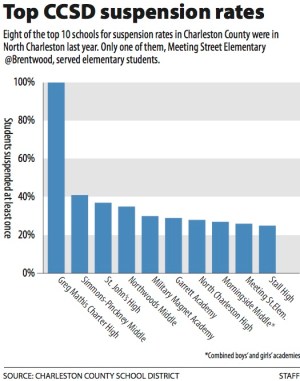
Meeting St suspensions copy

As a public/private venture, as a school choice and reform mechanism, Meeting Street Elementary @Brentwood is trapped in the need to advocate, sell its process. And since South Carolina has not held this experiment to the traditional school report card transparency, we are left only with the claims of school leaders.

However, we have well over a decade of “miracle” school bluster, all of which has been dismantled—suggesting that, I am sorry to say during this holiday season, there are no miracles.

While the school report card based mostly on high-stakes testing data is a significant failure of education reform, South Carolina’s report card system has included a key way to know if schools are in fact outperforming other schools, using the “Schools with Students Like Ours” metric (which I have detailed multiple times exposes that charter schools are no different, and possibly less effective, than traditional public schools in our state):

However, analyses from two years of report cards for charter schools in SC reveal the clear picture that more investment is not justified (see below for complete analysis of both years’ comparisons):

  • Using 2011 SC state repost cards and the metric “Schools with Students Like Ours,” charter schools performed as follows: 3/53 ABOVE Typical, 17/53 Typical, and 33/53 BELOW Typical.
  • Using 2013 SC state repost cards and the metric “Schools with Students Like Ours,” charter schools performed as follows: 2/52 ABOVE Typical, 20/52 Typical, 22/52 BELOW Typical.

And thus, this disturbing suspension data about an elementary school are just the beginning of what I can predict will happen as the evidence grows against the claims of this school somehow is accomplishing what other schools have not, cannot accomplish.

First, the evidence is very clear that “high-flying schools” are extreme outliers, constituting about 1.1% of high-poverty schools. This means two things: (1) if Meeting Street does achieve some sort of high-flying status, it will be in extremely rare company, and thus, (2) outliers prove virtually nothing about what most schools can and should accomplish (outliers often include key elements that cannot be scaled to all schools).

Next, the huge caution about any claims of miracle success on test scores at Meeting Street must be couched in their extended day and academic year. This technique has driven the false but powerful propaganda from KIPP charter schools that conveniently leave out that when you identify learning as months or years of growth, and you extend the learning time, the raw data growth is actually the same growth rate as other schools.

Comparing students with more teaching and learning time to other students with less is just one way advocates of charters and miracle schools mislead the public.

Remaining questions—some linked to suspension and expulsion patterns—include how any school’s test scores are impacted by student attrition (counseling out, expulsion, etc.), the percentage of special needs and English language learners served (when compared to traditional public schools), and the impact of self-selection (which can skew even claims that a school is serving a high-poverty population of students).

Meeting Street Elementary @Brentwood will prove, once again, to be evidence of the inherent problems with education form, and no miracle at all.

Our most vulnerable students—impoverished, black and brown students, English language learners, and special needs students—are disproportionately the targets of educational reform/experiments grounded in test-mania and harsh discipline policies and outcomes (see here, here, and here).

To be blunt, good intentions of administrators and teachers in our traditional public schools have not been enough, and now, those same good intentions among reformers cannot be justification for false claims and failed policies and practices.

Practices and fads such as exit exams, “no excuses” mantras, “grit” and  growth mindset, zero-tolerance discipline, and the larger accountability movement churning through standards and high-stakes testing—these have all increased the existing problems with inequity in our schools and society, and have miserably failed the students who need nurturing and effective schooling the most.

Miracle school claims are that human-sized Easter bunny; but that is just some stranger in a suit pretending to be a bunny, and it isn’t really appealing so much as something we should be very leery of approaching, especially with children.

bunny3

Easter 2017 Reader: Grit, Poetry, Educational Rankings, Poverty

Grit

Forget Grit. Focus on Inequality, Christine Yeh (Education Week)

Grit is an easy concept to fall in love with because it represents hope and perseverance, and conjures up images of working-class individuals living the “American dream.” However, treating grit as an appealing and simple fix detracts attention from the larger structural inequities in schools, while simultaneously romanticizing notions of poverty….

Perhaps this idea of grit resonates with so many people who believe in the popular American adage that if you work hard and pull yourself up by your bootstraps, then you can achieve anything. This belief unfortunately, assumes that individuals have the power, privilege, and access to craft their own futures, regardless of circumstance and systemic barriers.

Statistics on educational access consistently reveal vast differences in resources in affluent versus poor neighborhoods. Predominantly white, middle- and upper-income school districts tend to spend significantly more money per student than the districts with the highest percentages of marginalized students. Our poorest schools also tend to have large class sizes, unsafe school transportation, damaged and outdated facilities, and high staff turnover. All of these conditions directly contribute to low educational outcomes and underscore the link between access to school resources and improvements in students’ success. Schools that focus on grit shouldn’t ignore structural inequities because they assume that regardless of your race, class, or social context you can still triumph.

Telling children ‘hard work gets you to the top’ is simply a lie, Hashi Mohamed (The Guardian)

What I have learned in this short period of time is that the pervasive narrative of “if you work hard you will get on” is a complete myth. It’s not true and we need stop saying it. This is because “working hard, and doing the right thing” barely gets you to the starting line. Furthermore, it means something completely different depending on to which context you’re applying this particular notion. So much more is required.

I have come to understand that the systems that underpin the top professions in Britain are set up to serve only a certain section of society: they’re readily identifiable by privileged backgrounds, particular schools and accents. To some this may seem obvious, so writing it may be superfluous. But it wasn’t obvious to me growing up, and it isn’t obvious to many others. The unwritten rules are rarely shared and “diversity” and “open recruitment” have tried but made little if any difference.

Those inside the system then naturally recruit in their own image. This then entrenches the lack of any potential for upward mobility and means that the vast majority are excluded.

Check out Neoliberalism: A Concept Every Sociologist Should Understand, Peter Kaufman (Everyday Sociology)

The end result of neoliberal ideology, Monbiot continues, is that we are led to believe in the myth of the self-made person:

“The rich persuade themselves that they acquired their wealth through merit, ignoring the advantages – such as education, inheritance and class – that may have helped to secure it. The poor begin to blame themselves for their failures, even when they can do little to change their circumstances. Never mind structural unemployment: if you don’t have a job it’s because you are unenterprising. Never mind the impossible costs of housing: if your credit card is maxed out, you’re feckless and improvident. Never mind that your children no longer have a school playing field: if they get fat, it’s your fault. In a world governed by competition, those who fall behind become defined and self-defined as losers.”

See Also

Failing Still to Address Poverty Directly: Growth Mindset as Deficit Ideology

SchoolED Podcast: Paul Thomas on Grit, Slack, and the Effects of Poverty on Learning

UPDATED (Again): Grit, Education Narratives Veneer for White, Wealth Privilege

“Grit” Takes another Hit (with Caveats)

Rejecting “Grit” While Embracing Effort, Engagement

Poetry/ National Poetry Month 2017

Perspective | Poet: Why I would never tell a student what a poem means, Sara Holbrook (The Answer Sheet/ Washington Post)

A few months ago I wrote an essay, “I Can’t Answer These Texas Standardized Test Questions About My Own Poems,” in which I questioned those of unknown academic distinction who anonymously compose proficiency test questions. Many teachers wrote to tell me that they too are unable to answer these vaguely written test questions being used to evaluate their students. One teacher reported that her kids had to endure 17 days of testing this year. Considering there are only about 20 days of school in a month and that every test requires preparation on the devices and manner of testing, that’s a lot of lost instructional time.

Parents wrote. I did a few television interviews and radio programs. It was my 15 minutes. Additionally, I took some heat from a (very) few academics who jumped to inform me that authors do not own the meaning of a poem, it is up to literary critics to make this determination. Good grief.

It was not my intent to kick off an argument on of the relative merit of learned literary analysis. I’ll leave that to those with letters after their names. But friends, parents, educators, learned folks, please remember, middle-schoolers are not just short college sophomores. They are not lit majors. These are kids like Paul. Kids who are often grappling with a world of unseen and sometimes unspeakable challenges.

See Also

Investigating Poetry Because We Love It (and Our Students)

In Defense of Poetry: “Oh My Heart”

“So We must meet apart”: #NationalPoetryMonth 2017 and My Journey with Emily Dickinson

Educational Rankings

Are South Carolina schools really the worst in the nation?, Cindy Landrum (Greenville Journal)

Furman University education professor Paul Thomas said the education ranking is far less about education than socioeconomics.

“This ranking is a direct reflection of political negligence,” he said. “Our schools don’t legislate. It’s not like our schools are without any fault, but how schools function is a reflection of political leadership. South Carolina is failing our children, not our children are failing school.”

U.S. News & World Report used 11 metrics to measure a state’s education ranking, including college and high school graduation rates and standardized test scores. Three of the six pre-kindergarten-12 categories are test scores (ACT and National Assessment of Educational Progress), while the others are high school graduation rates, pre-K quality, and preschool enrollment. South Carolina ranked high in quality of its public pre-kindergarten program, but ranked low in test scores and college readiness.

“Schools in South Carolina and the U.S. reflect the inequities of communities, the failure of our policies, and as a result, they are ineffective as mechanisms of change,” Thomas said.

At least 60 percent of test scores are correlated with out-of-school factors such as parental education levels, poverty, hunger, mobility, lack of health care, safety, and community resources, he said. Only 10 percent to 15 percent of test scores can be traced to teacher quality.

Thomas said it has been known for decades that poverty and inequity are the greatest hurdles for children learning. But instead of addressing the problems, instead grade-by-grade standards are changed and students tested.

“Our states have social and educational pockets of poverty,” Thomas said. “Food and home insecurity directly contribute to low academic output, and once they get into school, we make horrible decisions. High-poverty children are sitting in larger classes with early-career and uncertified teachers. We do the exact opposite of what we should be doing.”

See Also

South Carolina Ranks First in Political Negligence

Poverty

America’s Shameful Poverty Stats, Sasha Abramsky (The Nation)

But there’s a deeper significance to the numbers: how they compare with the figures from recent decades. The percentage of people in poverty is roughly the same as in 1983, in the middle of the Reagan presidency, as well as in 1993, at the end of twelve years of Reagan/Bush trickle-down economics. A far higher portion of the population lives in poverty than was the case in the mid-1970s, after a decade of investment stemming from Lyndon Johnson’s War on Poverty; and far more live in poverty today than did at the end of Bill Clinton’s eight years in office—years in which the earned-income tax credit was expanded, unemployment was kept to near-historic lows, and poverty rates fell significantly.

That our poverty numbers have risen to such a high level exposes the fact that as a society, we are choosing to ignore the needs of tens of millions of Americans—as we have done for much of the period since the War on Poverty went out of fashion and the harsher politics of Reaganism set in. These ignored Americans include kids like the ones I interviewed in Los Angeles, forced to choose between applying to college or dropping out of school and getting dead-end jobs to support parents who had lost not only their jobs but their homes, too. They include the elderly lady I met outside Dallas, who was too poor to retire but too sick to take the bus to her work at Walmart. Her solution? She paid her neighbors gas money to drive her to a job that paid so little she routinely ate either 88-cent TV dinners or went to bed hungry. They include, too, the residents of New Orleans’s Lower Ninth Ward I met in 2011, who, six years after Hurricane Katrina, were still living in appalling conditions in a largely obliterated community.

See Also

the world


The Tone-Deaf Politics of Denying Racism, Excusing Segregation

Let’s connect the dots, which is challenging because, if those with power had their way, it would be white dots on a field of white.

Rick Hess, whose tagline is “Education policy maven Rick Hess of the American Enterprise Institute [AEI] think tank offers straight talk on matters of policy, politics, research, and reform,” blogging at Education Week makes this claim:

Some deem this a healthy and long-overdue development, believing that social justice demands that education be understood through the prism of race and inequality. They believe that tackling deep racial inequities is the measure of one’s commitment to educational improvement, and view measures like the DREAM Act and affirmative action as inseparable from elements of that work. Thus, they tend to see an inevitable overlap between school reform and the pursuit of progressive policies regarding housing, immigration, policing, health care, and much more.

Others of us think that viewing education primarily through the lens of race is unhealthy and divisive, fueling a destructive hypersensitivity and race-based grievance. We’re concerned that it undermines the unifying possibilities of democratic schooling, especially when foundational virtues like personal responsibility and patriotism get dismissed as culturally oppressive remnants from yesteryear. We fear that it turns schooling, potentially one of our great common endeavors, into something very different, political, and partisan.

Keep in mind the dichotomy of “some” and “we.”

Next, a review of an AEI report on charter schools reveals:

The reviewers find that the report presents charter school de facto segregation as a benign byproduct of parental choice. In fact, the review finds that the original report actually acknowledged that this type of stratification was part and partial of a “properly” functioning charter sector – one in which parents get to choose the type of school their children attend.

“Some” who “[believe] that social justice demands that education be understood through the prism of race and inequality” are being, according to Hess, “political” and “partisan.”

And AEI finds segregation “benign” because it is just what parents choose.

With those dots detected and connected, consider this Tweet from Charles Blow:

What is at play here, and linked by AEI, includes an ends-justify-the-means ideology paired with Social Darwinism (masked as “parental choice”)—all of which is bereft of any sort of ethical grounding, any acknowledgement that “some” (the ellipsis of race, and thus, people of color) are making pleas for being heard to create a more just and equitable education system and country.

The ends justify the means for the winners because they have no personal experience with the devastating impact of the means—think the pyramids of Egypt to the economy of the South and the entire nation during U.S. slavery.

The Masters must keep pointing at the outcomes and must find ways to silence the enslaved, the oppressed.

The Masters must control what is normal, objective, and non-partisan/non-political (their way) while casting everyone else as the “other”—biased, partisan, political, radical.

Hess and AEI are peddling the inexcusable in a time now dominated by the deplorables.

None the less, these are calloused claims, and nothing can justify denying racism or embracing segregation.

Don’t Buy Bluster from Teacher Quality VAM-pires

The responses are predictable online and through social media any time I address teacher quality and policy focusing on teacher evaluation such as my recent commentary on Charleston adopting value-added methods (VAM).

How dare I, some respond, suggest that teacher quality does not matter!

The pattern is exhausting because most responding in indignation first misrepresent what I have claimed and then make the most extreme arguments themselves in order to derail the conversation along their own agenda, usually linked to the charter school movement grounded in teacher bashing and making unobtainable promises.

So let me state here that the central elements of what we know about teacher quality and efforts such as VAM-based teacher evaluation is that teacher quality is not an independent variable (any teacher may be effective for one student and ineffective for another, for example) and, since student high-stakes testing is not designed to measure teacher quality and is more strongly linked to out-of-school factors, VAM is both a horrible technique for identifying teacher quality and, ironically, a guaranteed process for devaluing the importance of teachers.

Teacher quality is unparalleled in importance in terms of student learning, but it is also nearly impossible to measure, quantify—especially through student scores on high-stakes standardized tests.

Teacher quality VAM-pires, then, often have agendas [1] that are masked by their bluster about teacher quality.

Trying to measure and quantify teacher quality is a mistake; linking any evaluation of teacher quality to student test scores lacks validity and reliability—and VAM discourages teachers from teaching the most challenging populations of students (high-poverty, special needs, English language learners).

Focusing on simplistic and inappropriate measures reduces teacher impact to 10-15% of what high-stakes standardized testing measures; in other words, VAM itself devalues teacher quality.

My informed argument, based on 18 years as a public school classroom teacher and 15 years as a teacher educator and scholar, then, is that we must recognize teacher quality is impacted by teacher preparation, teaching/learning conditions, student characteristics, and dozens of other factors inside and outside of schools—many of which are beyond the control of teachers or students.

As well, we must address the teacher quality issues that political and administrative leaders can control: class size, school funding, and most important of all, teacher assignment.

Just as decades of research have revealed that teacher quality accounts for no more than 10-15% of student test scores, decades of research show that affluent and white students are assigned the most experienced and certified teachers while poor and black/brown students are assigned new/inexperienced and un-/under-certified teachers.

The charter school crowd’s bluster about teacher quality is pure hokum because charter schools increase that inequity of teacher assignment by depending on new and uncertified teachers such as candidates from Teach For America.

No one is saying teacher quality does not matter—I clearly am not saying that—but dishonesty about teacher quality does lay at the feet of the edu-reformers and the VAM-pires who wave their collective arms any time we call them on their failed policies and their political agendas.


[1] See the evangelical urge of Broad-trained acolytes, the resume building and cut-and-run patterns of edu-reformers, and the post-truth practices of turn-around and charter advocacy.

Post and Courier (Charleston, SC): CCSD plan for teachers won’t work

Post and Courier (Charleston, SC): CCSD plan for teachers won’t work

[see full submission with hyperlinks below]

Charleston School District Arriving Late to a Very Bad Party

P.L. Thomas, Professor, Furman University

The most telling aspect of Charleston County School District’s announcement about holding teachers accountable for student test scores may be in the second paragraph of Paul Bowers’s coverage: “District leaders say they don’t want to fire anyone — particularly not in the midst of a statewide teacher shortage that’s only getting worse.”

While it appears some are aware of the unintended consequences of new education policy, we must be concerned that such awareness has not helped better inform this recent decision to move forward with using value-added methods (VAM) in teacher evaluations.

Early research warned and current studies confirm that VAM fails to fulfill political promises, but also feeds existing problems. This pattern has been seen with school choice increasing segregation, exit exams causing higher drop-out rates, and high-stakes tests driving teaching to the test, asking far less of students.

First, we should acknowledge the flawed logic driving the use of VAM to increase teacher accountability. The recent concern about teacher quality is grounded in several false assumptions.

One is the “bad” teacher myth strongly associated with the stereotypical unionized teacher as portrayed in Waiting for Superman.

However, across the U.S. teachers in unionized states produce students with higher test scores that teachers in non-union (called right-to-work) states such as South Carolina. The problem with associating teacher quality and low student outcomes with union protection is that student test scores are more powerfully associated with poverty than any other factor.

This leads to the other false assumption that teacher quality is the most or one of the most important causes of student learning. In fact, teacher quality accounts for only about 10-15% of standardized test scores, the basis of VAM, while out-of-school factors remain the greatest influence, at 60%.

A final assumption is that using test data to evaluate teachers is objective and valid, and thus fair. Yet, many teachers are in content areas without standardized tests, and then, ironically, making any set of data high-stakes causes that data to be less credible (see Campbell’s Law).

Student test scores are poor evidence about teacher quality, and making those scores central to evaluating teachers is guaranteed to further erode that evidence’s usefulness and the process.

Matthew Di Carlo, blogging for the Albert Shanker Institute, details the unintended consequences of VAM as implemented in Houston.

While assessing the Houston teacher evaluation system, Julie Berry Cullen, Cory Koedel, and Eric Parsons discovered that teachers identified as weaker by their student test scores were already leaving at high rates before the new system was implemented in order to identify weak teachers.

In other words, Houston adopted a policy without investigating whether or not teacher quality was the key problem, without acknowledging that with high teacher attrition among so-called weaker teachers, schools were not achieving in ways they envisioned.

Here is one powerful lesson of education reform: Do not adopt a policy until you gather evidence of the problems; and assumptions about those problems are not enough.

After Houston adopted VAM-based evaluation of teacher, as Di Carlo explains, teachers identified by test scores as weak were even more likely to leave, but:

On the other hand, all exits increased under the new evaluations — including among teachers who were rated as average and high performers. The extent to which this spike is attributable to the new evaluation system per se is unclear, but it served to “dilute” the impact on student achievement of the increase in exits among low performers. There is also some indication that higher-rated teachers were more likely to switch out of schools with low-performing students after ETI (versus before the policy), which would also attenuate the impact of the policy.

Historically and currently, Charleston has a teacher problem, yet Houston is a powerful example of how VAM is not the solution to those problems.

The remaining challenge is recruiting and maintaining experienced and certified teachers in the schools that serve the most vulnerable students from high-poverty homes and communities.

The new policy linking teacher evaluations with student test scores will not address those challenges, and we can expect it will actually increase challenges to recruit new teachers and stem teacher attrition.

By adopting VAM and investing in critically discredited system, EVAAS, Charleston County School District is late to a very bad party. The students and community would be better served by making sure we know what the teacher quality problems are and then seeking ways to address those instead of choosing political expediency and wasting tax dollars on policies and programs already shown to fail.

6 April 2017 Reader: Segregation and James Baldwin

But it’s also a country where if you’re running and you’re black there is a high chance you’ll be shot in the back. Then there will be a brief and cinematic fuss but no justice. Baldwin’s beautiful and screaming incomprehension sixty years ago at such atrocities still makes too much sense [emphasis added].

Please take the rope from my throat so that I may sing, Talia Marshall


Segregation

Within integrated schools, de facto segregation persists, Erica L. Green

Howard County is the most integrated school district in the region, according to the Maryland Equity Project of the University of Maryland. Children of different races — especially those who are black and white — are more likely to sit next to each other in Howard than almost anywhere else in the state.

But within that diversity, school leaders have uncovered a de facto system of segregation.

Enrollment data obtained by The Baltimore Sun through a public records request shows that the district’s advanced classes — honors, gifted and talented, and AP — are disproportionately white, while the regular and remedial classes are disproportionately black.

How School Choice Is Increasing Racial Segregation in Public Education

Erika Frankenberg, an associate professor of education and an associate of the Population Research Institute at Penn State, was the lead author of the study. She notes that “Black and Latino students tended to move into charter schools that were more racially isolated than the public schools they left.” This is a cause for concern, according to the authors. Dr. Frankenberg states that “minority students in more diverse school settings have higher short-term and long-term academic outcomes than those who attend racially isolated minority schools.

White students in Philadelphia area schools tended to go to charter schools that had a greater percentage of White students than the public school they had attended. But in the rest of the state, White students tended to opt for charter schools that were more diverse than the public schools.


James Baldwin

How James Baldwin’s The Fire Next Time still lights the way towards equality, Steven W Thrasher

His 1962 classic The Fire Next Time was originally a letter, written by Baldwin to his nephew on the 100th anniversary of the so-called emancipation of black America. In the letter’s penultimate paragraph, Baldwin writes: “This is your home, my friend, do not be driven from it; great men have done great things here, and will again, and we can make America what America must become.” It is rhythmically similar to Trump’s red-hatted mantra – but there’s a big difference between trying to make America “great again” and focusing on what it once was, rather than what it “must become”.

More than 50 years on, The Fire Next Time has been reprinted by Taschen in a beautiful new edition that pairs his text with images by the civil rights-era photographer Steve Schapiro. Baldwin was “the scribe of the movement, our illustrious griot, who knew our struggle because he lived it”, as congressman John Lewis writes in the foreword. But before mobile phone videos and Twitter allowed black Americans to directly telegraph their plight to the world, it was up to photojournalism to visualise the message, as Schapiro’s images did in Life magazine.

James Baldwin. The Fire Next Time. Photographs by Steve Schapiro

Against Literary Nationalism, Jan Clausen

In the twenty years since [Adrienne] Rich spoke out, the injustices she pointed to have intensified. Indeed, anyone who thinks that “cynical policies” disappeared under Obama should review his remarks to the nation’s top financial executives in March 2009, when the purveyor of “hope and change” tried to reassure the fat cats: “My administration is the only thing between you and the pitchforks. . . . I’m going to shield you from congressional and public anger.”

Those who value “justice for all” cannot look at the actually existing United States — the barbarous inequalities it fosters at home, the imperial violence it passes off as foreign policy — without concluding that “the American proposition” is bunk. This is not, of course, to give up on fighting for justice; it is merely to eschew the veneration of a history of abuses.

So why don’t today’s writers take a stand like Rich? What happened to the radical dissent embodied in figures like James Baldwin, Grace Paley, and June Jordan — or the United Kingdom’s Harold Pinter, who devoted part of his 2005 Nobel Prize acceptance speech to delivering a scathing rebuke of America’s imperial crimes?

Under the Spell of James Baldwin, Darryl Pinckney

Baldwin said that Martin Luther King Jr., symbol of nonviolence, had done what no black leader had before him, which was “to carry the battle into the individual heart.” But he refused to condemn Malcolm X, King’s supposed violent alternative, because, he said, his bitterness articulated the sufferings of black people. These things could also describe Baldwin himself in his essays on race and US society. He may not have dealt with “this sociology and economics jazz,” as Harold Cruse complained of him in The Crisis of the Negro Intellectual (1967), but the reconstruction of America was for him, even in his bleakest essays, firstly a moral question, a matter of conscience. And at his best he simply didn’t need the backup of statistics and dates. When it came to The Fire Next Time (1963), the evidence of his experience, the truth of American history, he could take perfect flight on his own.

Battling to Save James Baldwin’s Home in the South of France, Rachel Donadio

Baldwin, who had lived in Paris earlier in his life, first came to Saint-Paul-de-Vence in 1970, at the age of 46, after a breakdown. He had been excoriated by fellow members of the civil rights movement — some called the author, who was gay, Martin Luther Queen — and believed he was under surveillance by the United States government. In France, he found the tranquillity and distance to write.

At the time of his death from cancer, he had been buying the house in installments from his landlady, Jeanne Faure, who grew up in Algeria under French colonial rule. Despite her right-wing politics, she and Baldwin had become the best of friends. (When President François Mitterrand of France made Baldwin a commander of the Legion of Honor in 1986, one of the country’s highest honors, the author brought Ms. Faure to the ceremony.)

Please take the rope from my throat so that I may sing, Talia Marshall

I read Baldwin’s gay novel Giovanni’s Room at the same time, but Another Country is my favourite because it had these women in it: white, privileged Cass with her WASP, horse-riding New England girlhood, and Black, imperious and beautiful Ida who was aloof and suspicious of her dead brother’s white friends. Cass and Ida were proof Baldwin paid some attention to the inner world of women even if he imprisoned them in their sex as equally as men.

All his writing toils with the fact and cage of the body. The black body and the white fear of its darkness, and the cultural incomprehension at the heart of American life. His paradoxical and gospel-fed vision was that the only way to solve the ‘negro problem’ was to set white people free from their prejudice, given the subjugating nature of power even for the powerful.

James Baldwin was the double negative: Black and gay, and blessed with a frog-like lovely/unlovely face and boy-preacher airs; the greedy reader who devoured every single book in the Harlem library as a child; the ear for mixing the street talk of Harlem and Brooklyn, and the Beat chatter of the Village with the heady modernism of James and Joyce. Baldwin is often accused by critics of having superfluous amounts of empathy, and at times this compassion for the human condition slips into purple, gushing sentimentality. Like Disney for the bohemian set, Baldwin’s writing can be the literary equivalent of a relentless zoom lens shot of people’s faces and all their wretched, spilling emotions.

VAM, Teacher Bashing, and Unintended Outcomes: “[A]ll [teacher] exits increased under the new evaluations”

Research analysis at Shanker Blog is among the very best available online, notably the work of Matthew Di Carlo.

The posts there are predictably nuanced and careful, dispassionate—to a fault. As a critical educator, I am on edge when I read these careful explications of educational research because they tend to stand so far back from drawing critical conclusions that they leave a great deal of room for forgiving awful and baseless policy.

Teacher Evaluations And Turnover In Houston is an extremely important post as it unpacks new research on the current era of teacher evaluations spawned during the Obama years, notably the increased use of value-added methods (VAM) that link teacher quality to student test scores.

I highly recommend reading the post in full, but here I want to add a few annotations to address both my concerns the analysis tip-toes when it should stomp and to emphasize a few key takeaways well addressed by Di Carlo.

Let me share a few passages, and I will boldface what I want to address; first, the opening:

We are now entering a time period in which we might start to see a lot of studies released about the impact of new teacher evaluations. This incredibly rapid policy shift, perhaps the centerpiece of the Obama Administration’s education efforts, was sold based on illustrations of the importance of teacher quality.

The basic argument was that teacher effectiveness is perhaps the most important factor under schools’ control, and the best way to improve that effectiveness was to identify and remove ineffective teachers via new teacher evaluations. Without question, there was a logic to this approach, but dismissing or compelling the exits of low performing teachers does not occur in a vacuum. Even if a given policy causes more low performers to exit, the effects of this shift can be attenuated by turnover among higher performers, not to mention other important factors, such as the quality of applicants (Adnot et al. 2016).

To address incredibly flawed educational policy, I believe we must be much more careful about distinguishing between political/public claims and then how the research community poses the same issues.

As Adam Bessie has outlined, the “bad” teacher myth was never “sold” in the ways Di Carlo notes above. The film Waiting for Superman is a powerful example of how political and public discourse about “bad” teachers was primarily an argument that teacher quality was the singular or most important factor in student learning, period; politicians and the public almost never added the caveat “most important in-school factor.”

And we must acknowledge that the “bad” teacher movement driving new teacher evaluations including VAM was significantly grounded in anti-union sentiment and union-busting objectives—not about teacher quality or student learning.

The nuanced argument about teacher quality, in fact, was most often expressed among some researchers, while mostly absent from the media or political discourse, such as Di Carlo (from 2010):

But in the big picture, roughly 60 percent of achievement outcomes is explained by student and family background characteristics (most are unobserved, but likely pertain to income/poverty). Observable and unobservable schooling factors explain roughly 20 percent, most of this (10-15 percent) being teacher effects. The rest of the variation (about 20 percent) is unexplained (error). In other words, though precise estimates vary, the preponderance of evidence shows that achievement differences between students are overwhelmingly attributable to factors outside of schools and classrooms (see Hanushek et al. 1998; Rockoff 2003; Goldhaber et al. 1999; Rowan et al. 2002; Nye et al. 2004).

Next, further into the recent post:

Prior to ETI, there was a negative relationship between teacher effectiveness and exits – i.e., less effective teachers were more likely to exit than their more effective colleagues, with effectiveness here defined in terms of validated measures of teachers’ ability to raise students’ test scores (in part because the original value-added scores, unlike the other components of the system, are available both before and after the new evaluations were implemented).

A strong footnote for this important point—so-called weaker teachers were already leaving—is that the real teacher quality problems facing schools, notably high-poverty schools serving vulnerable populations of students, are a lack of equity in terms of teacher assignment (poor students, black/brown students, ELL students, and special needs students disproportionately are assigned year after year to new or inexperienced and un-/under-certified teachers; white and affluent students are gifted the most experienced and certified teachers) and the debilitating grind of high teacher attrition, turnover, in high-poverty and majority-minority schools.

Just as school choices increases educational problems such as segregation, VAM-based teacher evaluation does not address the real problems—equitable access to experienced and qualified teacher, and teacher turnover in high-poverty schools—while also increasing those problems.

And finally:

The big finding of Cullen et al. is that the relationship was stronger after the onset of the new evaluation system, with the estimated effects concentrated among low-performing teachers in schools serving low-performing students, who were more likely to exit the district than they were before ETI.

On the one hand, this suggests that the new evaluations worked as intended. Under a system in which principals were armed with better information about their teachers’ performance (full evaluation results instead of single year value-added scores), teachers who were less effective in raising test scores were more likely to exit the district (or be dismissed) post-ETI than they were prior to ETI, particularly in schools serving lower performing students. On the other hand, all exits increased under the new evaluations — including among teachers who were rated as average and high performers. The extent to which this spike is attributable to the new evaluation system per se is unclear, but it served to “dilute” the impact on student achievement of the increase in exits among low performers. There is also some indication that higher-rated teachers were more likely to switch out of schools with low-performing students after ETI (versus before the policy), which would also attenuate the impact of the policy.

The Big Caveat, of course, is that this evaluation process and concurrent analysis remain trapped in the efficient (read: lazy) use of test scores by students to determine teacher quality and effectiveness. That said, this study seems to show that VAM-type evaluations may actually push out so-called weak teachers—while also pushing out so-called effective and experienced teachers.

This preliminary evidence supports what many of us have been warning about during the Obama era of education reform: The “bad” teacher approach to education reform causes more harm than good because it misrepresents teacher quality and further de-professionalizes teaching, such as eroding the current teacher work force and discouraging the so-called “best and brightest” from choosing education as their career.

Di Carlo continues to offer incredibly important education research analysis, and I highly recommend anyone interested in education reform to return to this blog regularly. There you will find careful and crisp analysis—although I will continue to hope for the sort of analysis that will critically confront what lies beneath the political and public discourse about schools, education, teachers, and students.

The story inside the story of the research analyzed above is that beneath the “bad” teacher approach to education reform is a great deal of bad politics and bad media; and we must stop tip-toeing around those facts.

“So We must meet apart”: #NationalPoetryMonth 2017 and My Journey with Emily Dickinson

So We must meet apart –
You there – I – here –
With just the Door ajar
That Oceans are – and Prayer –
And that White Sustenance –
Despair –

“[I cannot live with You (640)],” Emily Dickinson

I stumbled into college a hyper-student, with greater parts ignorant arrogance than knowledge or awareness.

By traditional schooling metrics, I was a very smart redneck.

Formal education had convinced me I was a math and science person; therefore, I often stated in my first two years attending a local junior college that I intended to major in physics—that wonderful nexus of math and science.

But then college intervened. During my first survey literature course, my professor, Dean Carter, asked me to tutor for all his classes. I was stunned and initially balked at the idea.

Dean Carter was effusive in his praise of my work in the course, and I gave in, mostly, I think, because tutoring was a paying position. This moment, however, is the foundation of my becoming both a teacher and a writer, I believe.

During my first year of college because of a speech class where I discovered e.e. cummings, I also started writing poetry. Yet, making the transition from math/science guy to English guy was still slow in coming.

My junior college experience, as you may be able to tell already, was extremely important in steering me toward who I am as a person and professionally. Those years, though, were not without bumps.

There, I found myself in Mr. Pruitt’s class for the second time, the first being a positive experience in which we covered some standard American literature I had enjoyed in high school—Thoreau and Emerson standing out in my memory.

This second class began by covering what felt like at the time every single poem by Emily Dickinson, who I genuinely did not enjoy.

Mr. Pruitt had a condition causing him to shake, his head always in motion, and he, like my French professor, was a chain smoker. (This was the late 1970s, early 1980s when smoking was common in every situation casual or formal.)

And Mr. Pruitt loved Emily Dickinson.

These were the days of ditto machines, a copying process that involved typing onto paper with a purple ink sheet behind it in order to create a master to run through the ditto machine; the product was a slightly damp stack of papers reeking of chemicals.

Mr. Pruitt’s Dickinson test was on 8.5 x 14 paper with prompts and questions squeezed into every inch of white space, even sideways along the left and right margins as well as crammed against the top and bottom edges.

Let me return for a second here to the hyper-student claim in the opening: throughout high school, I was capable of making As and Bs without much effort, very little studying.

Before Mr. Pruitt’s Dickinson test, I likely spent more time recreational beer drinking than studying or even reading the poems by Dickinson assigned.

I made a 62.

At that point of college, I was already more of an A student than the A/B student of high school so that 62 soured my attitude about Mr. Pruitt and English, but it completely poisoned my view of Dickinson.

After junior college, I declared a secondary education major when I transferred to a local hyphenated campus of the state university, focusing on English certification. I also dedicated myself to taking as many upper-level courses as the so-called “straight” English majors did.

I graduated college very dedicated to a career as a teacher and extremely aware that I was a writer, specifically a poet. For about a decade or more, I must confess, I carried my disdain for Dickinson into my high school English classes.

And then, from 1995 until 1998, I continued to teach high school full time, adjuncting as well at local colleges, and enrolled in my doctoral program, where I wrote a biography of English educator Lou LaBrant for my dissertation.

My doctoral work included my own commitment to read as many biographies of women as possible along with my scholarly examination of feminist theory on biography, education biography, and the history of education in the U.S.

Toward the end of my program, I discovered The Passion of Emily Dickinson by Judith Farr, a literary biography that carefully confronted Dickinson’s life in a way I had never experienced before. Farr anchored her biographical considerations in Dickinson’s poetry and letters, emphasizing poems often not a part of the traditional canon of what we teach, which tells students Dickinson is obsessed with death, and once wrote about a snake [1].

Of course, despite my being a poet and an avid reader/writer, I had simply failed to see Emily Dickinson reflected in the grandeur of her work, her words. And that was traceable back to how she had been taught, misrepresented, in formal English classrooms, including the singular daguerreotype:

Yale University Manuscripts & Archives Digital Images Database

Several things changed for me then.

I pledged to be more intentional about what I taught my students in terms of author biography, and I began to work even more carefully about honoring the sanctity of what I taught over other less important objectives: echoing Dewey [2] from my doctoral work, I began to ask what did it avail me or my students to badger them with canonical poetry and scansion if that experience made them not want to read poetry.

Just as men “edited” Dickinson’s found treasure of poetry to make it publishable, Dickinson has been reduced to a caricature, and the canon of her poems further misrepresents her, glossing over her full humanity, her womanhood, and her richness as an artist/poet.

My journey with Dickinson also included Adrienne Rich’s brilliant and revolutionary examination, “Vesuvius at Home.” My classes already included joyful lessons on Rich, Sylvia Plath, and Anne Sexton, all of whom had been taught wonderfully to me by Dr, Nancy Moore over my junior and senior years of college.

After my conversion, then, I began to include “Wild Nights—Wild Nights! (249)”—yes, Dickinson was sexual, even erotic, and she played with gender expectations of her poem’s personas—and “This World is not Conclusion (373),” my favorite Dickinson because the first line includes a period, creating tension with “not Conclusion” and student expectations of Dickinson’s use of punctuation.

“I cannot live with You – ,” Dickinson’s speaker begins, adding later: “I could not die – with You –.” And then the tension that in many ways defines her life and her poetry:

They’d judge Us – How –
For You – served Heaven – You know,
Or sought to –
I could not –

“So We must meet apart – ,” the speaker concludes, Dickinson ending the poem with the single “Despair – .”

And there we are confronted with poetry—the human compulsion to capture our experience through words, as expression and investigation.


Notes

[1] The traditional canon and formalized ways of teaching women writers often, I think, is at least shaded by the misogynistic “hysterical” marginalizing of women. Male writers return again and again to universal themes or are hard drinkers and womanizers, but women writers are “obsessed” or disproportionately reduced to suicidal and/or psychotic.

[2] John Dewey:

What avail is it to win prescribed amounts of information about geography and history, to win ability to read and write, if in the process the individual loses his own soul: loses his appreciation of things worth while, of the values to which these things are relative; if he loses desire to apply what he has learned and, above all, loses the ability to extract meaning from his future experiences as they occur? (Experience and Education, p. 49)

Understanding Racism as Systemic and about Power

You are an hourly worker in a non-union (euphemistically called “right-work-work”) state. Your immediate boss is abusive and unfair often, but in ways that are nearly impossible to prove.

This is your first real job, and you develop a deep resentment for that boss—eventually coming to despise all bosses and people in authority.

That manager uses tactics that workers believe are abusive and unfair because the manager has decided all workers are lazy and unwilling to work without threats and constant authoritarian oversight.

The worker attitude about bosses and the boss attitude about workers are, however, not the same because of the imbalance of power.

In the beginning, I mention “non-union” because unionization grew out of a recognition that an imbalance of power (owners/bosses/managers versus individual workers) was often conducive to abusive working conditions (think Upton Sinclair’s The Jungle).

Now let’s transfer this workplace dynamic to how people (usually white people) misread racism.

Too often individuals with race or class privilege respond to charges of racism at the individual level: “What about black people who hate white people?” or “What about this white cop shot by a black man? Nobody’s making a fuss about this incident!” or “I am not a racist!”

Decades after his death—and much like the warped legacy of Martin Luther King Jr.—Malcolm X lingers in the white psyche as proof of black racism toward whites because of his “white devil” refrain.

And just as my hypothetical workplace scenario above shows, there exists, in fact, whites who reject all blacks simply for being black and blacks who reject whites for being white.

But, as with bosses and workers, several aspects of these facts expose how they are not the same.

The worker above develops antagonism for all bosses based on actually being mistreated by a boss; now this is possibly an unfair overgeneralization, but it is grounded in real evidence.

Black distrust, black anger—these are expressed in the context of real historical and current inequities that give whites privilege and negatively impact the lives of most if not all blacks.

Both white privilege (advantages not earned) and white animosity to all blacks simply for being black (what most people view as “racism”) are primarily grounded in inequitable systems and stereotypes (not credible evidence).

To make understanding racism even harder, we must try to untangle the recognition that race is not a biological fact (and thus, racial tags cannot be used as valid claims that whites are smarter or blacks are faster, etc.), but a social construct.

And here is where, despite that complexity, racism can be better understood.

Racism cannot be proven or disproven by an individual example. One white person refusing to hire one black person does not prove racism (even when it is clearly a racist act); one black man shooting a white police officer does not prove “reverse racism” or disprove racism.

This individual-gaze has made examining racism and admitting racism a persistent social problem in the U.S. Barack Obama being elected president was never proof of a post-racial society because one event cannot prove (or disprove) a systemic reality.

We are left then with some important elements to understanding—and thus, for many whites, resisting and denying—racism.

Racism is systemic, and while race is not a biological fact, it is a social construction that can be relatively easily managed (we can usually see race, or most people believe they can).

That “believe” is important because racism remains a reality because it, like privilege, works mostly in invisible ways.

Yes, some people remain overt in their oafish racism—the KKK, etc.—but most racism occurs along with privilege without people making conscious decisions to be racist (since virtually everyone is aware that “racism” is a negative behavior) or consciously benefitting from their privilege (a person inherits money or parents secure him a nice profession, after which that person genuinely works hard and is very successful; for that person, the initial privilege is invisible).

So let’s think of another parallel: While men certainly can be raped and physically abused just as women can, virtually all women walk around with a pervasive sense of threat to them physically and sexually because men tend to be physically bigger and stronger but also disproportionately have more power and wealth—while men rarely consider the threats of rape or violent attack.

And this is where understanding racism raises the central element of power.

Systemic racism in the U.S. is exclusively white power over black and brown people—just as sexism is exclusively men’s power over women. When black or brown people hate or demonize whites, this is racial, but not racism because black and brown people lack the systemic power to create the large scale consequences that whites can and do for black and brown people.

Despite being well educated, black women in the U.S. on average earn less than white males because of systemic and inequitable forces, racism and sexism.

Just as we can prove and should be able to see sexism in domestic violence data, rape culture, and inequitable workplace pay and promotion, we can prove and should be able to see racism in access to all sorts of opportunities in the U.S. (education, work), inequitable incarceration rates for blacks and shootings by police, and disproportionate underrepresentation in positions of authority.

Denying racism—as with proving racism—cannot be accomplished at the individual level and and cannot be treated as if race is the singular element in racism.

Racism is systemic and about imbalanced power dynamics that can be correlated with socially constructed racial categories.

Privilege and power are inequitably pooled among white straight men, and thus, a key to eradicating all types of inequity—racism, sexism, homophobia, etc.—is for anyone with privilege to resist denying inequity, especially by focusing on individual examples and by ignoring the central role of power in all types of inequity such as racism.

When confronted with claims of racism, then, “I am not a racist” fails, turning all of the gaze onto the self and thus failing to see—leaving racism both invisible and corrosive.

How to Expose Racists: Simply Mention Racism

I was pleasantly surprised when Education Week published Why Are We Criminalizing Black Students? by Tyrone C. Howard.

Regretfully, this blog is gorged with posts about EdWeek routinely failing the education discussion, but Howard’s commentary confronts well a hard topic in education.

And then came the comments—tone deaf at best, defensive and racist themselves as worst (first three opening rebuttals):

mcruiz

I’m amazed. I truly didn’t know we teachers had that much power, and the propensity to use it for evil deeds. Wow! Imagine that, we have the power to criminalize Black students. Wow, again!

LynnG

This is a ridiculous article and the author’s bias is so heavy handed that he’s made his argument a joke. Talk about confirmation bias.

Paul D. White

One more racist rant from a Black college professor who doesn’t have the courage to tell the truth, and one more worthless posting by Ed Week for what? A desire to show how “tolerant” they are to biased, ignorant positions regarding race and performance in the schools?

The great failure of the U.S. which has brought us to Trumplandia is, as I have pointed out often, James Baldwin’s “this rigid refusal to look at ourselves” that must be aimed with laser focus on white America.

In schools, black and brown children are disproportionately targeted and punished for the same behaviors as white children, and then in society, black and brown people suffer more inequitable treatment by police and the judicial system.

As Thomas Rudd explains about school discipline:

Contrary to the prevailing assumption that African American boys are just getting “what they deserve” when they are disciplined, research shows that these boys do not “act out” in the classroom any more than their White peers.

For example, in a study conducted by the Indiana Education Policy Center, researchers conclude that:

“Although discriminant analysis suggests that disproportionate rates of office referral and suspension for boys are due to increased rates of misbehavior, no support was found for the hypothesis that African American students act out more than other students. Rather, African American students appear to be referred to the office for less serious and more subjective reasons. Coupled with extensive and highly consistent prior data, these results argue that disproportionate representation of African Americans in office referrals, suspension and expulsion is evidence of a pervasive and systematic bias that may well be inherent in the use of exclusionary discipline (Skiba, 2000).”

And the ACLU reports: “Staggering Racial Bias: Marijuana use is roughly equal among Blacks and whites, yet Blacks are 3.73 times as likely to be arrested for marijuana possession.”

Michelle Alexander’s The New Jim Crow details that policing and the judicial system routinely practices inequitable targeting, convicting, and sentencing along racial lines for the same behaviors—blacks disproportionately suffering for acts no different than whites.

This begins in our schools because the white power structure cannot or will not see the bias in order to eradicate it.

The seeds of the wider post-truth U.S. have been sown by the white “rigid refusal” to admit and then confront the racism that continues to fester in the country.

This is old fake news, but as the posts on the EdWeek commentary reveal, racists respond to facts about racism by calling the messenger a racist. That’s the nastiest fake news there is, especially when it is coming in a publication about the education of our children—the first victims of racism, the most powerless victims of racism.


See Also

Racial Disproportionality in School Discipline: Implicit Bias is Heavily Implicated, Thomas Rudd

The War on Marijuana in Black and White (ACLU, 2013)

Education Reform in the New Jim Crow Era