
Truthout: The Inevitable Rise of Trumplandia: Market Ideology Ate Our Democracy
Category Archives: Education
On Lies, Bullying, and America’s Greatness: “the true horror of lost status”
When Nora experiences her existential epiphany and decides to be no longer a doll in Torvald Helmer’s house, it is Torvald’s response that has always fascinated me.
“Oh, you think and talk like a heedless child,” Torvald responds before becoming desperate: “But can’t we live here like brother and sister–?”
A Norwegian playwright dramatizing well over a century ago the sexism and misogyny inherent in social norms such as marriage—what could this possibly have to do with the U.S. in 2016?
Torvald, in fact, is a dramatization of what Toni Morrison recognizes in the rise of Trumplandia; Morrison’s confrontation of racism speaks as well to sexism: “These sacrifices, made by supposedly tough white men, who are prepared to abandon their humanity out of fear of black men and women, suggest the true horror of lost status.”
We see in Torvald the embodiment of “the true horror of lost status.”
Teaching A Doll’s House was challenging in the rural conservative South, but so was asking my students to confront Thomas Jefferson, whose letters reveal a past president of the U.S. who rejected:
The immaculate conception of Jesus, His deification, the creation of the world by Him, His miraculous powers, His resurrection and visible ascension, His corporeal presence in the Eucharist, the Trinity, original sin, atonement, regeneration, election, orders of Hierarchy, etc. (letter to William Short, 31 October 1819) [1]
These central beliefs of Christians, Jefferson labeled “artificial systems,” and my students were usually stunned because their upbringing had mostly idealized the Founding Fathers as traditional Christians who formed the U.S. as a Christian nation.
The general public is often as misinformed about presidential elections, which have historically been nasty. Jefferson was often vilified in his presidential campaigns, but we can imagine that he could have never been elected president if his beliefs noted above had been common knowledge.
The irony, of course, is that few could value Jesus as a mere human as they could as a fabricated son of God—just as the public must believe political leaders are larger and even better than real life.
The rise of Trump revealed many who refused to acknowledge the truth about Trump but readily embraced provably false claims about Hillary Clinton and Barack Obama.
And while tracing from the Founding Fathers to Trump may seem a stretch, we should consider a much more recent harbinger of the U.S. fascination with lies, bullying, and the false narrative of U.S. greatness—Lance Armstrong.
Few examples better represent right-wing mainstream U.S. politics, superficial patriotism, and total bullshit than Bush’s man-crush on Armstrong—one of the most discredited and dishonest athletes in the history of competitive sport.
Armstrong’s success as a professional cyclist—in a European sport—stretched all credulity, but his very long scam worked because he wrapped himself in the flag and became U.S. Greatness, which again ironically once the truth was exposed, like Trump, is the perfect commentary on U.S. Greatness as total bullshit.
But Armstrong as harbinger of Trump is more than the lies; Armstrong was a bully of a magnitude only equaled by Trump himself.
Trump and Armstrong are bullies who are exclusively self-serving, who have destroyed innocent people’s lives and will continue to do if given any opportunity.
Armstrong won as a doper, a fake, just as Trump is a false success, a sham of a business man, a con artist.
And they use every means necessary to maintain their false statuses—Armstrong manipulating his cancer survival and the cancer community in ways that are as disgusting as Trump manipulating poor and working-class whites through nods and winks to racism, xenophobia, and sexism.
The U.S. has a long and troubling history of clinging to lies, but now we seem equally enamored with bullies.
Armstrong and Trump are who we are—all lies and bullying—and it is deplorable.
At the end of Ibsen’s play, Nora confesses, “I don’t believe any longer in wonderful things happening.”
However, we are left with Torvald unwavering, “But I will believe in it.”
And again, this play lays before us the delusion of false belief, comforted by privilege.
Might we be able to do better?
[1] See also Jefferson’s Religious Beliefs and The Religious Opinions of Thomas Jefferson, J. Lesslie Hall.
Edujournalism and the Continuing Adventures in Post-Truth: Technology Edition
Mainstream America appears, as usual, to be a bit behind the times, but in Trumplandia, there is a sort of shallow postmodernism going on (although postmodernism has been supplanted by post-postmodernism and a slew of other -isms since its heyday).
The media is, in fact, nearly consumed with a meta-analysis of itself as almost everyone has now confronted that the U.S. is a post-truth nation.
The handwringing is mostly shallow, mired in the false claims that post-truth is something new (the U.S. has always been post-truth) and that there are some fringe faux-news outlets (spurred by the evils of Social Media) that are spoiling the game for mainstream media (which ignores that mainstream media are just as complicit in post-truth as the extremes).
A subset of the failures of mainstream media is edujournalism, trapped in a both-sides mentality that masks its essential nature as press-release journalism.
Think tanks and entrepreneurs feed edujournalism, and edujournalism simply passes on the propaganda.
In post-truth Trumplandia, then, we now are confronted with what passes as credible edujournalism, an Orwellian formula that defies logic:
Earlier this week, Khan Academy, the College Board, and Turnitin released tools to give all students the chance to practice for the SAT without having to drop hundreds or even thousands of dollars to get the kind of relevant practice required. The companies have combined their technology tools to bring free Official SAT Practice to Khan Academy with added writing instructional tools provided by Turnitin. Read more details about the news here on The Tech Edvocate.
That’s right three discredited organizations—Khan Academy, the College Board/SAT, and Turnitin—have combined, according to Education Week to create equity because:
I’ve long been an outspoken advocate of technology tools for education. Technology can break down barriers, bring new materials and relevancy to instruction. It can excite students with its interactivity. It can help the teacher cut down on busy work and get right to the act of teaching and guiding students. And as in this case, technology–pretty exciting technology– is leveling the playing field for every student willing to invest their time in preparing for the SAT.
The basis for these grand, but false, promises is what can fairly be called post-truth—all belief not grounded in credible evidence.
Technology has been idealized for decades in education and has never fulfilled the educational promises, but has filled the coffers of technology commerce.
Edujournalists as willing propagandists for entrepreneurs fail education and equity, actually.
We would be much better served to listen to experts, such as Audrey Watters, who confronts the conventional wisdom:
And yet the dominant narrative – the gospel, if you will – about education and, increasingly education technology, is that it absolutely is “the fix.”
Education technology will close the achievement gap; education technology will close the opportunity gap. Education technology will revolutionize; education technology will democratize. Or so we are told. That’s the big message at this week’s ASU-GSV Summit, where education technology investors and entrepreneurs and politicians have gathered (registration: $2995) to talk about “equity.” (Equity and civil rights, that is; not equity as investing in exchange for stock options and a seat on the Board of Directors, I should be clear. Although I’m guessing most of the conversations there were actually about the latter.)
Watters, in fact, pulls the curtain back on the grand pronouncements of the Wizard:
Anyon’s work is critical as it highlights how students’ relationship to “the system of ownership of symbolic and physical capital, to authority and control, and to their own productive activity” are developed differently in working class, middle class, and elite schools. Her work helps us to see too how the traditional practices of school might be reinforced, re-inscribed by technology – not, as some like to argue, magically disrupted, with these hierarchies magically flattened. Menial tasks are still menial if done on a computer. To argue otherwise is ed-tech solutionism – dangerous and wrong.
And thus:
Despite all the hype and hope about revolution and access and opportunity that these new technologies are supposed to provide us, they do not negate hierarchy, history, privilege, power. They reflect those. They channel it. They concentrate it, in new ways and in old.
For example, we must ask, how will combining these forces eradicate the current and historical fact that the SAT reflects and perpetuates privilege, that the SAT is the antithesis of equity? (Hint: It will not and cannot):
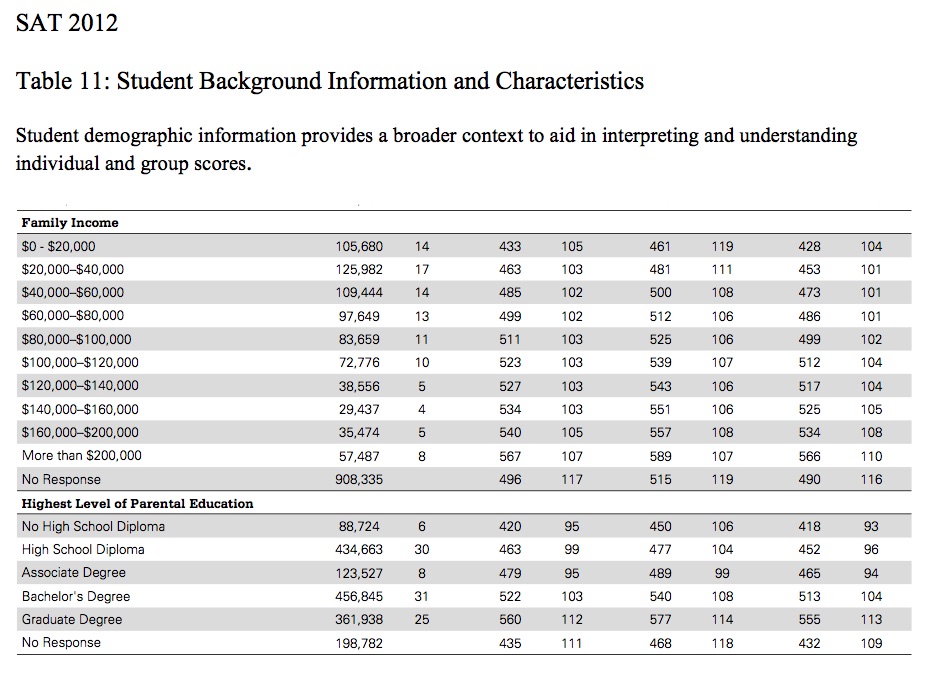
Technology and edupreneurs as mechanisms for equity are post-truth mythologies, and edujournalism remains a willing accomplice in the sham propagated by the combined forces of the Khan Academy, the College Board/SAT, and Turnitin—none of which should be endorsed alone, much less heralded in combination as forces for equity.
Please read in full Ed-Tech’s Inequalities, Audrey Watters
U.S. Officially Trapped in High School
Electing Donald Trump verifies that the U.S. is officially trapped in high school.
The bravado and superficial qualities that made people popular in high school—but for most of us wore thin by early adulthood—are all that Trump has, but it earned him the White House because enough people in the U.S. suffer from arrested development, permanent adolescence.
As a nerdy, self-conscious, and insecure teen, I knew this process well. My brief stinks into the popular came from my bold profanities (stolen mostly from George Carlin and Richard Pryor) and beer guzzling at rates that outdid my friends.
All that cool was idiotic, embarrassing—and effective among my high school peers.
By the time most of us are well into our 20s, that “cool” becomes “adolescent”—in other words, a way of being we put well behind us.
Like my first-year writing students, you may think from the above comments that I dislike adolescence, but that isn’t true.
I loved teaching high school because I love adolescents; however, my affection for teens is that it is a phase, a transition from childhood to adulthood.
Teens live and view the world in a sort of constant hyperbole that is infectious—as long as it eventually evolves into a somewhat tempered joy grounded in reality. Too often, we swing from the wild idealism of youth to the fatalistic cynicism of adulthood without finding a healthy balance.
But the U.S., alas, is stuck in adolescence; we think the biggest and most hollow jerk in the country is cool.
Among the pundits, this adolescent thinking is being framed as post-truth, and it isn’t anything new as evidenced by the ways in which my first-year students write; for example, consider these passages:
Racism is a trending topic in America today. The topic makes many people uncomfortable, so it is not so much spoke about. Racism exists in numerous different type of environments in numerous places. Although there are many different places racism exists, the place that I believe racism should be eliminated the most is the business environment.
Growing up in today’s culture promotes a fascination with being skinny. Today there may be body positive movements and love yourself movements, but back the late 90’s early 2000’s, we, the people of my generation, learned that skinny was beautiful.
American history is filled with examples of pain and suffering as a result of drug usage. Arguments regarding the legalization of habit-forming substances are not new.
Adolescent thinking is often characterized by overstatement, a lack of evidence, and a paradoxical vagueness of thought that renders the ideas meaningless.
The adolescent is supremely egocentric, navel gazing at its extreme: the teen’s worldview consumed by Self as “most” and “only” but also paradoxically representative of everyone.
My high school students often felt deflated when I countered their Madonna with Madelyn Monroe, their Prince with Little Richard—although my point was not to discredit their pop stars but to ground them with a buffer against hyperbole.
The U.S., however, is blinded by an adolescent egocentrism that is mostly bluster and perennially post-truth.
Just as first-year writing students need help with overstatement and seeking out credible support for claims, the U.S. as a nation needs a first-year writing course that confronts how to navigate the world based on evidence and not bravado and nonsense.
For example, we could start here:
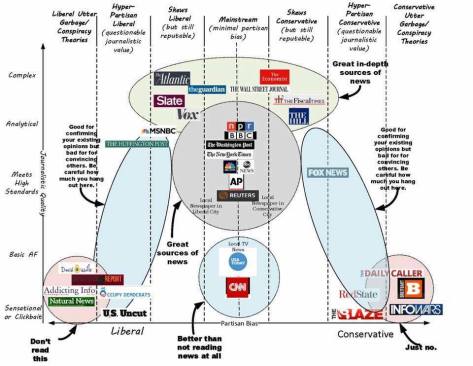
While I don’t want to be a Luddite and blame technology and social media for all of our ills, I do think that the downside to instant access to information is that too many of us are ill-equipped for how to interact with that information.
Hot-take social media feed our basest biases and allow us to remain inside and even to create a bubble of our own ignorance.
For some of us, college is the needle that bursts that bubble of ignorance (it was for me, thank goodness). The great tragedy of the U.S. is that K-12 education is universal but inadequate in terms of critical literacy (too much time on standards and tests, too much focus on building a workforce) and that higher education is out of reach for far too many people.
With only about a month before the biggest jerk in the country becomes the leader of the free world, we have but little time to grow up, to realize the fool is not cool and that we all need to leave high school behind us because:

The Inevitable Rise of Trumplandia: Market Ideology Ate Our Democracy
Writing in 2000 specifically about education reform, Michael Engel [1] acknowledges: “Market ideology has triumphed over democratic values not because of its superiority as a theory of society but in part because in a capitalist system it has an inherent advantage” (p. 9).
Nearly four decades before Engel’s claim, Raymond E. Callahan [2] confronted what he labeled the cult of efficiency in education:
The tragedy itself was fourfold: that educational questions were subordinated to business considerations; that administrators were produced who were not, in any true sense, educators; that a scientific label was put on some very unscientific and dubious methods and practices; and that an anti-intellectual climate, already prevalent, was strengthened. (p. 246)
What is disturbingly clear here is that despite the enduring claims that universal public education—often attributed to the idealistic foresight of Founding Father Thomas Jefferson—serves our democracy, public schooling has in fact worked almost entirely in the service of market ideology: sorting children for the workforce and instilling compliance in those young people become good and compliant workers [3].
And here we have a subset of the entire country.
While many are wringing their hands about the post-truth U.S., our newly minted Trumplandia is not anything new, but the logical outcome of who we have always been—a belief culture skirting by on mythologies and false narratives to mask the ugly facts of our essential commitments to competition, consumerism, and capitalism.
Donald Trump is the best and most accurate personification of who the U.S. currently is, but also the embodiment of who we have always been.
Founded as a revolt against monarchy, the Founding Fathers used the rhetoric of freedom as a veneer for a few privileged men truly wanting the doors to exploitation, not closed, but opened just a tad wider so they could cozy in.
The newly founded free country allowed by law the enslavement of humans and the relegation of women to second-class citizenship.
“Life, liberty, and the pursuit of happiness” was post-truth.
Or at least only the sliver of truth for a select few white men already clutching power.
All you have to do is to listen now or to the record of black voices, women’s voices, the voices of the imprisoned and impoverished: “(America never was America to me.)” [4]
Just as the robber baron era of U.S. history was no blip on the country’s radar, but who we really are, the current ascension of Trumplandia is simply a more full unmasking of our complete failure at democracy and human liberation.
Trump’s apparent cabinet appointments, his claims he doesn’t need daily briefings, and the brash blurring of celebrity and huckster business acumen—these are the U.S. laid bare.
We have always been mostly branding—meritocracy, boot straps, upward mobility as marketing lingo with little basis in fact.
Political leaders have always sold the U.S. public a bill of goods wrapped in the American flag; George W. Bush sold a war on repackaged lies, and there were essentially only consequences for the soldiers, the U.S. public, and the victims of that war.
But the warmongers remain essentially unscathed.
And thus, Trump as Teflon blow hard reality TV star/business huckster is just a few notches past Ronald Reagan as Teflon actor.
The ugliest paradox of all is that in our lust for consumerism we have allowed market ideology to eat our democracy, and as the metaphor requires, the excrement has really hit the fan this time.
[1] Engel, M. (2000). The struggle for control of public education: Market ideology vs. democratic values. Philadelphia, PA: Temple University Press.
[2] Callahan, R. E. (1962). Education and the cult of efficiency: A study of the social forces that have shaped the administration of the public schools. Chicago: The University of Chicago Press.
[3] See Education Technology and the ‘New Economy,’ Audrey Watters:
Although there is some lip service paid to learning computer programming in order to deepen students’ thinking and expand their creativity, much of the conversation about computer science is framed in terms of developing students who are “job ready” – the rationale for teaching computer science President Obama gave in his final State of the Union address in January.
[4] “Let America Be America Again,” Langston Hughes
Emily Dickinson Eternal: “I’m Nobody! Who are you?”
It seems an odd thing to celebrate the birth day of someone long deceased, someone we have immortalized, in a way, as the British Romantic poets desired: “Ah, happy, happy boughs! that cannot shed /Your leaves, nor ever bid the Spring adieu,” John Keats exclaims in celebration of the immutability of art—the recreation of foliage on the urn (art on art, as it were) as superior to actual vegetation doomed to mortality.
Emily Dickinson was born 10 December 1830, and then, after her death—like Jean Grey in the Marvel Universe—Dickinson was reborn again and again through a series of appropriations and reductive mystifications common in a patriarchal culture.
Dickinson’s poetry was edited (read: corrected) and published after her death, and then her legacy was fodder for the careers of scholars who have yet to find an end to recreating Dickinson.
My journey to Dickinson was fraught with stumbles and restarts.
The seminal stumble was a 62 on Mr. Pruitt’s Dickinson exam when I was in junior college. Despite that grade being entirely my own failure as a student (a rare thing, but my fault none the less), I turned that experience into a revolt against Dickinson.
Years later, I found myself a teacher of high school English/ELA, and thus, during poetry units, a teacher of Dickinson’s poetry. Disturbingly aware of my inadequate work as a teacher of Dickinson—although I believed myself a strong teacher of poetry, especially through the music of R.E.M.—I invited my former high school English teacher (then at the district office) to do a lesson for my students on Dickinson.
This was one of many important epiphanies for me about Dickinson as well as teaching. Lynn Harrill, my former teacher, focused on examining Dickinson through whole-to-part strategies, unlike my analytical approach grounded in an uncritical New Criticism.
His joy for Dickinson and his honoring how students naturally responded to her poetry made my lessons seem lifeless and uninspired. Watching Lynn teach also unlocked the door I had shut to Dickinson.
But the most important moments came when I was in my doctoral program working on becoming a biographer. Reading Judith Farr’s biography of Dickinson and teaching Adrienne Rich’s re-examination of Dickinson—these moments were profound for me as a reader of her poetry as well as a teacher and writer.
Rich shook me with her exploration of Dickinson’s “My Life had stood – a Loaded Gun,” and thus began my journey to “This World is not Conclusion,” “I’m Nobody! Who are you?,” and “Wild nights – Wild nights!”
Gone was my reductive lenses into both Dickinson as a person and her poetry.
My poetry unit soon weaved Dickinson and R.E.M., resulting in one of my first scholarly publications—“It Beckons, and It Baffles—”: Resurrecting Emily Dickinson (and Poetry) in the Student-Centered Classroom, English Journal (March 1998).
“This World is not Conclusion.”—begins Dickinson, twisting the reader with both the rare period to end her opening line as a sentence and with the paradox of declaring “not Conclusion” with that end mark concluding the thought.
This poem, for me, displays Dickinson’s incredible sharpness that blurs humor and incisive commentary on both humanity and the society in which she lived.
The slant/half rhyme, the weighty metaphorical layers, and the challenging syntactical journey all drive her wrestling with seeking ways in which we must navigate knowing and not knowing, the observed world laid bare by science and the world “beyond” that she both assures is there but rejects the “Narcotics” of “Much Gesture, from the Pulpit.”
Ultimately, to reduce Dickinson to recluse, to mysterious frailty, this erases that Dickinson was very much of the world, and her world included Ralph Waldo Emerson, Henry David Thoreau, Charles Darwin, and Karl Marx—a world being built by men standing on the privileges denied Dickinson as a woman and countless other people due to race and poverty.
And here we sit in a very disturbing 2016, and we can imagine how Dickinson would view this insanity. No, we have the words already:
I’m Nobody! Who are you?
Are you – Nobody – too?
Then there’s a pair of us!
Don’t tell! they’d advertise – you know!How dreary – to be – Somebody!
How public – like a Frog –
To tell one’s name – the livelong June –
To an admiring Bog!
Below are poetry of mine inspired by Dickinson in those years when the door was opened again to her and I walked through, newly reborn myself:
channeling emily dickinson: a man speaks her voice
I.
tearing out a poem—
line by line—
from your Spine—Industry—
of a kind—Unkind—
I lie here—Fallen—
shallow as a spoon—
Spade for grave digging—Stolen—
encrypted on the headstone—
god strikes down—Nothing—
a silver platter—no head—
tapping out in morse Code—
signals—for the Dead
II.
sometimes there are Pauses—
great Gaps of time, of space
of You not holding me—
you are not there—Eternity—
distance beyond voices—or Reaching—
and I am spilled, scattered
yet christ doesn’t enter—There—
that Inn too is closed—
except to you—Blank—
the scattered Ashes—memory—
blown like snow or dust—
of you not there—Pause
the heaviness of your breasts—
cupped in my hands—Time—
stills me through the Eye—
III.
She grabbed onto the Soul of Me—
the anchored thought inside—to Free
the drowned unKnown—unconsciousness—
like wrestling over emily—
on carpet Red & Gold—undressed—
undone as Silver jewelry—
entwined, her limbs, my limbs—confessed—
in Prayer—to hold Eternity—
we lie—plush pile of pettiness—
so twisted, torn—Enamored—chess—
too sure to treasure Dignity—
soft pearls, cool stones—Profanity—
we Swear—on tablets—white Litanies
for Alters—sacred blessedness—
our sweat—entangled, Poetry—
then We are risen—restlessness—
channeling cummings and Dickinson at Christmas
i. a hedonist’s plea
the syntax of things
e.e. cummings
forgive me my hedonism
& i’ll forgive you your stunning beauty
that leaves me nearly unable to stand
not only upright but myself
for desiring you this way
the curves of an ear, a neck, a thigh
but i am after all merely a man
the lesser part of human & woman
my linguistic slights of hand cannot mask
my mouth’s silent intentions
warm as sheets & pillows beneath us
in the afternoons of my mind
•
ii. if in the Arc of the Night
An imperial affliction
Sent us of the Air –
Emily Dickinson
Daily we turn
our Backs
on the Sun—
just standing
on this Earth
Might the Sun
forgive us
our cyclic Sin—
If in the Arc
of the Night
we hold fast
to the One
we love
—P.L. Thomas
Measuring Proficient Teachers Codifies Bad Teaching
Maja Wilson and Alfie Kohn have found themselves in a problematic minority during the accountability era dedicated to standards, high-stakes testing, and the ever-present rubric.
Rubrics, they argue, ultimately fail complex human behaviors such as writing. While rubrics facilitate statistical aspects of measuring human behaviors (such as teaching and learning), by doing so, they also tend to erode the quality of the very behaviors being measured.
As a writing teacher, I can confirm Wilson’s and Kohn’s critiques that student writing conforming to a rubric and thus deemed “proficient” or “excellent” can be and often is quite bad writing. Rubric-based labels such as “proficient” reflect compliance to the rubric, not writing quality.
Wilson, in fact, has demonstrated this by revising a professional and beautiful piece of writing by Sandra Cisneros so that is conforms to a computer-graded system’s criteria for high-quality writing. The result was more than disturbing with the revised work substantially worse but better correlated with what the Educational Testing Service (ETS) has deemed “good.”
While Wilson’s experiment focuses on computer-graded writing, the basis of that is having a generic rubric to determine writing quality, and thus, here we begin to investigate why rubric-driven evaluation of complex human behavior always fails:
- Rubrics reduce the unpredictable to the prescribed.
- To be practical, rubrics often attempt to be generic enough to cover huge categories—such as writing and teaching—and thus failing the reality that poetry writing is significantly distinct from journalism or that teaching second grade is significantly distinct from teaching high school physics.
- When rubrics use terminology that is broad enough to address those varieties, they are useless due to being too vague; when rubrics use terminology that is specific, they are useless because they are unduly prescriptive. If the learning objective is jumping rope, if proficiency is “students jump well,” we have no idea what “well” means, and if proficiency is “students jump 10 times without missing,” that 10 becomes all that matters. In other words, in both cases, complying to the rubric ultimately supersedes the actual jumping rope.
- Rubrics replace substantive feedback conducive to learning, and in fact, stagnates learning and reduces all assessment as summative.
- As with high-stakes testing, high-stakes rubrics connected to course grades and/or as part of state accountability systems carry the weight of authority—shifting that authority from teachers and students to the rubric itself and the bureaucracy behind it.
So this brings me back to South Carolina teacher evaluation rubric, adapted from the National Institute for Excellence in Teaching (NIET).
SC’s version of the NIET rubric, as I discussed, is marred by being unmanageable due to its length and inadequate due to the inordinate amount of terminology that is too vague (and again, if we address that vagueness, we still have a flawed instrument that is all prescription).
While going through a first session of training in the rubric, I witnessed the greatest problem with using generic rubrics to determine teacher quality: a very bad literacy lesson was pronounced at the high end of “proficient” by how it conformed to the rubric, but the lesson was in fact terribly uninspired, overly teacher-centered, and reductive—as well, it likely eroded significantly the students’ passion for and interest in reading and literacy.
Adopting and implementing a new teacher quality rubric, however, have been committed primarily to training those who will evaluate teachers so that the assessors are familiar with the rubric and the endorsed process; and then, above all else, a central goal is to produce inter-rater reliability with a rubric that NIET and others have already deemed valid.
In other words, this is a statistical enterprise—not an adventure in teaching and learning.
Lost in the technocratic orgy about validity, reliability, and the all-things scientific, we have made the mistake confronted by John Dewey:
What avail is it to win prescribed amounts of information about geography and history, to win ability to read and write, if in the process the individual loses his own soul: loses his appreciation of things worth while, of the values to which these things are relative; if he loses desire to apply what he has learned and, above all, loses the ability to extract meaning from his future experiences as they occur? (Experience and Education, p. 49)
The irony here, of course, is that Dewey is one of the seminal voices for education being scientific; however, I cannot imagine his expecting this reductive outcome.
All aspects of teaching and learning are poisoned by our misguided pursuit of a very narrow version of “scientific” that has been subsumed by the bureaucratic and turned into pseudo-science.
What avail is it to label a teacher proficient, if in the process the teaching is terribly uninspired, overly teacher-centered, and reductive, if in the process the students are rendered lifeless and uninspired as well?
Education Reform and the Eternal Failure of the Unimaginative Bureaucratic Mind
In the 2006 film Idiocracy, the U.S. five centuries into the future is suffering crippling crop shortages due to a dust bowl that the main character (a survivor of suspended animation from the present of the film’s opening, around 2005), Private Joe Bauers, discovers is human-made since the nation of idiots has been irrigating those crops with a Gatorade-like sports drink.
This science fiction satire has experienced a resurgence due to many pundits associating the rise of Trump with the film’s extrapolation about humanity becoming more and more a nation of idiots, but for those of us in education, Idiocracy speaks to the most recent era of education reform driven by accountability, standards, and testing.
The human-made dust bowl is the result of an initial false analogy: If the sports drink, they reasoned, is a powerful fluid for human hydration, then it must be an ideal solution to struggling crops needing hydration.
If we unpack this idiotic logic a bit more, we must add that even the initial idea—sports drinks filled with sugar and salt as powerful hydration fluids—is mostly a false belief based on a great deal of clever marketing and gullibility in the consumers.
Before Bauer forces this future of idiots to reimagine their problem in order to rethink their solution, the status quo of hydrating crops with sports drink continues along with the puzzlement among the idiots about why nothing is improving.
So let’s do a little thought experiment with that film in mind.
First, consider this from Rebecca Smith:
In the late 1800s, the United States was feeling the impact of the industrial revolution. Influenced by Taylorism and the desire for scientific management, statistics and measurement were evolving as objective methods used to evaluate and systematically organize information. Education was swept up in the measurement and statistical movement. Thorndike (1918), relying on his psychological work, believed scientific measurement utilized in educational settings could create efficient systems where ‘knowledge is replacing opinion, and evidence is supplanting guess-work in education as in every other field of human activity’ (p. 15). To Thorndike, the measurement of educational products was the means by which education could become scientific through rigor, reliability, and precision….
To [Thordike], the connection between science, measurement, and human behavior was clear (Cremin, 1964). Lewis Terman published the Binet-Simon IQ Test in 1916; this test provided the context for psychologists to assess abilities, explain differences in students’ performance, and improve schools (Chapman, 1988). Standardized academic tests measure performance in the areas of handwriting, maths, and reading. Data from these tests offered superintendents, teachers, parents, or pupils ‘guidance in many different sorts of decisions and actions’ including ‘the fate of pupils, the value of methods, and the achievement of school systems’ (Thorndike, 1918, pp. 19, 22). Although Thorndike used the term ‘product’ instead of ‘data’, concepts such as rigor, reliability, and precision became part of educational discourse, measuring unseen changes in human beings. Intelligence had become objectified in numbers. The quantification of children’s intelligence, demographic characteristics, and school performance resulted in columns of numbers compared, contrasted, and evaluated in the United States. As the scientific gaze turned towards children, they became classified, compared, and evaluated according to numbers (Cannella, 1997). (pp. 3, 4)
Just a decade after this film and almost a century after Thorndike, in 2016, consider this:
In the latest international comparison of student achievement, public schools in the United States ranked no better than 24th in the world. But the public schools of Massachusetts had few peers.
Perhaps Massachusetts has something to teach the rest of the nation.
Well, unless you listen to Massachusetts, where researchers determined that two-thirds of the state’s effort at education reform has been a failure:
The evidence we have gathered strongly suggests that two of the three major “reforms” launched in the wake of the 1993 law — high-stakes testing and Commonwealth charter schools — have failed to deliver on their promises.
On the other hand, the third major component of the law, providing an influx of more than $2 billion in state funding for our schools, had a powerfully positive impact on our classrooms. But we will show that, after two decades, the formula designed to augment and equalize education funding is no longer up to the task.
So what we have here is an idiocracy of education reform, a failure of imagination to reconsider the problem and then to rethink solutions.
The U.S. need not idealize Finland or Massachusetts—or let’s not forget in 1962, it was the Swiss.
And the relentless commitment to accountability based on ever-new standards and ever-new tests is no different than the idiots continuing to hydrate crops with sports drink.
Like sports drinks, testing is inherently a sham, and our refusal to step away from a paradigm that has never worked despite countless efforts at making it work is our own version of a very real and current Idiocracy.
On Education and Credentialing: “Mak[ing] a Straight-cut Ditch of a Free, Meandering Brook”
“What does education often do?” Henry David Thoreau asked in his journal, answering: “It makes a straight-cut ditch of a free, meandering brook.”
As a former high school English/ELA teacher for 18 years, as I sat in the first of two training sessions yesterday, this from Thoreau came to mind.
Over the past 15 years, I have been a teacher educator, now a full and tenured professor in my university’s Education Department. Yet, from 9-4 yesterday, as representatives from the state department of education trained our full-time and adjunct faculty on the new South Carolina teacher evaluation rubric, adapted from the National Institute for Excellence in Teaching (NIET) standards, I felt more like an elementary student because the so-called training was mostly condescending and entirely unprofessional.
But the unprofessional, I regret to acknowledge, is business as usual for teacher education, as a faux-field in higher education, and for K-12 teaching, a faux-profession.
Some of my doctoral courses for an EdD in curriculum and instruction covered educational leadership. In that work, I was always fascinated by what the research often describes as three types of leaders—authoritarian, authoritarian-light, and collegial.
The most chilling of the three is the authoritarian-light, which is a style that includes finding strategies that manipulate stakeholder buy-in by making it appear the stakeholders are making decisions even though they are actually being coerced to comply with mandates about which they have no real choice.
This is the process I suffered through yesterday as bureaucrats from the state department assured a room of professors and practitioners that the new state rubric for teacher evaluation is backed by research and that we already know and do everything therein.
Again, as a former English/ELA teacher, I am struggling with describing the experience as Orwellian, a Kafkan nightmare of reason, or both.
Training Teacher Educators to Train Teachers to Train Students
Some of the early session dynamics are worth noting upfront.
As part of the authoritarian-light strategies, the facilitators had lots of group work with large sticky paper and markers. Much laughing and chatting included references to the numerous teacher evaluation systems SC has adopted over the past three decades and how everyone in the room knew all this stuff.
We all shared our very E.D. Hirsch moment of knowing all the acronyms for the four or five systems many of us in the room have experienced.
And then the dramatic kicker: But this new rubric and system is different, better, and supported by research!
[Let’s note that no time was taken to acknowledge that this same framing occurred each time all the former systems were introduced.]
In passing, the credibility of the rubric was linked to the fact that the rubric includes footnotes (so do Ann Coulter’s books, by the way) to the incredible work of Danielson and Marzano!
However, as I found the rubric online, I noticed that neither were in the 23 footnotes.
[Let’s note that no time was taken to examine very powerful and credible counter-evidence refuting the credibility of the cult of Danielson and the cult of Marzano. Also, the cult of Hattie is in footnote 7, a hint to the hokum therein.]
Not to belabor the seven-hour training session, but a few additional points:
- This rubric is highly touted, yet when we raised concerns about vague terms such as “most” and “some” to distinguish between “proficient” and “needs improvement,” that conversation was mostly brushed aside, except that we discovered if you look under “Description of Qualifying Measures” on page 8, you learn that “most” means “some” (though “some remains undefined). By any fair evaluation of this rubric, it fails miserably the basic parameters of high-quality rubrics (interestingly something I teach in my methods courses).
- And then there is the rubric’s enormity: 404 bullets over 4 categories and nine pages of small Helvetica font. To navigate these bullets (and we were warned repeatedly to do so “holistically and not as a checklist” as we walked through the bullets as a checklist and not holistically) with any care at all requires nearly three hours for just one lesson, assuming about 2-minutes per bullet. Not only does the rubric fail basic expectations for clearly defined terms (just what the hell are “powerful ideas”?), but also it fails for being incredibly unwieldy and overwhelming.
- Throughout the training, two key points were emphasized: mastery and teacher impact on student learning. As I will discuss below, we were given no opportunity to explore the serious problems with both, and no time was spent highlighting how the training itself practiced faux-science in the context of each.
- As we explored the rubric, as well, the facilitators unpacked key factors that are not expressed in the rubric itself. Even though the language of the rubric under “proficient” references the teacher, the facilitators noted often that to move from “needs improvement” to “proficient” was dependent on students demonstrating mastery (showing “proficient”), not teacher behaviors (merely “needs improvement”).
To clarify how problematic this training proved to be, let me offer briefly the last activity, our viewing a lesson and watching the facilitators model how to use the rubric.
The lesson was a ninth-grade ELA lesson on inference, and the class was a “no excuses” charter school with black and brown children all adorned in matching purple shirts.
Here is the short version: the lesson, we were told, met the upper range of “proficient.”
Yet, what the activity highlighted was quite different than the intent.
The lesson was weak, a reductive attempt to teach inference to mastery that confuses isolated literacy skills with teaching literacy or literature. But this sort of bad lesson is necessary once you reduce teaching to mastery and teacher impact on student learning.
Instead of addressing this substantive problem and ways to conference with the teacher about focusing literacy instruction on rich texts and inviting students to explore those texts with more and more sophistication over a long period of time, the points of emphasis were on transcribing verbatim the lesson (although we could barely hear the audio) so that we could give lots of evidence for the bullet points we were not supposed to view as a checklist.
[Let’s note that no time was allowed to acknowledge that if and when teacher evaluators need detailed evidence of teaching, the video itself is superior to transcribing.]
The Big Point here is that once a rubric is codified by the state as a credentialing instrument, that rubric determines “proficient,” which may also simultaneously be a very bad, uninspiring, and reductive act of teaching.
Within that, as well, we witnessed the faux-science of claiming to embrace concepts while simultaneously contradicting them.
While only a few students out of a class of 20-plus students responded aloud during the lesson (our only potential evidence of learning), that constituted “most” and thus “proficient”—and represents in the Orwellian confines of this rubric “mastery.”
A few students offering one or two comments aloud in no reasonable way constitutes mastery, and there were no efforts to control for anything that justifies claiming this lesson by this teacher was a direct causal agent for the supposed learning. For example, those students willing to share may have come to class already capable of playing the inference game in school.
Teacher education as a bureaucratic mandate has mostly and currently functions as faux-science—adopting the language of being a certain kind of reductive behavioral psychology without taking the care and time to understand or implement the concept with fidelity.
This is a tragic consequence of the low self-esteem of the field—which becomes a vicious cycle of pretending (badly) to be a field deemed more credible (psychology) but unable to become a credible and independent field unfettered by bureaucracy.
Everything Wrong with Teacher Education Is Everything Wrong with Education
“Schools are increasingly caught up in the data/information frenzy,” concludes Rebecca Smith, adding:
Data hold elusive promises of addressing educational concerns, promising real-time personalized instruction, predicting student growth, and closing the achievement gap of marginalized students (Bernhardt, 2006; Earl & Katz, 2006; Spillane, 2012). Today collections of student data are considered a reliable and a scientific way of measuring academic growth, mobilizing school improvement, and creating accountable, qualified teachers. Influenced by policy, pedagogy, and governing school procedures, data collection has become normalized in schools. Instead of asking what we can do with data, the better questions are: How did the accepted practice of quantifying children become normalized in education? How does our interaction with data govern our thoughts, discourses, and actions? (p. 2)
And as Smith details, the historical roots are deep:
Thorndike (1918), relying on his psychological work, believed scientific measurement utilized in educational settings could create efficient systems where “knowledge is replacing opinion, and evidence is supplanting guess-work in education as in every other field of human activity” (p. 15). To Thorndike, the measurement of educational products was the means by which education could become scientific through rigor, reliability, and precision. (p. 3)
As a logical although extreme consequence of this historical pattern, Common Core represents the false allure of accountability and standards as well as the quantification of teaching and learning within the idealized promise of “common.”
Common Core was doomed from the beginning, like the many iterations of standards before because as a consequence of the accountability era the evidence is quite clear:
There is, for example, no evidence that states within the U.S. score higher or lower on the NAEP based on the rigor of their state standards. Similarly, international test data show no pronounced test score advantage on the basis of the presence or absence of national standards. Further, the wave of high-stakes testing associated with No Child Left Behind (NCLB) has resulted in the “dumbing down” and narrowing of the curriculum.
And thus:
As the absence or presence of rigorous or national standards says nothing about equity, educational quality, or the provision of adequate educational services, there is no reason to expect CCSS or any other standards initiative to be an effective educational reform by itself.
For decades and decades—and then to an extreme over the past thirty years—education and teacher preparation have been mired in doing the same thing over and over while expecting different results.
The quality of education, teaching, and learning is not in any reasonable way connected to the presence or quality of standards, to the ways in which we have chosen to measure and then quantify them.
Training education professionals to use a really bad rubric that will determine if candidates are allowed to teach “proficiently” (which I can define for you: “badly”) is insanity because within a few years, another rubric will be heralded as the greatest thing while teaching and learning are no better—and likely worse—for all the bluster, time, and money wasted.
Education and teacher education are trapped in a very long technocratic nightmare bound to a reductive behaviorism and positivism.
These false gods are useful for control and compliance, but are in no way supportive of educating everyone in a free society.
Technocrats and bureaucrats cut straight ditches; teaching and learning are meandering brooks.
Resisting Fatalism in Post-Truth Trumplandia: Charter Schools and the End of Accountability
Bill asks Mike Campbell how Mike goes bankrupt, and Mike answers: “‘Two ways….Gradually and then suddenly.'”
This conversation in Ernest Hemingway’s sparse dramatization of the Lost Generation, The Sun Also Rises, also serves as a chilling characterization of how the U.S. finds itself in post-truth Trumplandia.
The paradoxes multiply for those of us in education because we can not only see but also live the reality that our post-truth U.S. is both a consequence of a country’s negligence of universal public education and the cause of that negligence—notably the uber-corrosive accountability era of the past three decades.
It seems like a distant memory, but just months ago, there appeared to be light at the end of the tunnel, a crumbling of support for charter schools on the heels of rising resistance to standards and high-stakes testing.
And then the election of Donald Trump.
And then Trump’s apparent selection of a Secretary of Education with zero experience in public education and a harsh school choice agenda.
This feels not like passing dark clouds, but a potential permanent eclipse of the sun.
However, we must resist the alluring fatalism of Trumplandia upon us even though truth and evidence have been declared defunct.
In a time of post-truth, truth becomes Kryptonite.
The Crack in Charter School Support Must Be a Harbinger of the End of the Accountability Era
“What exactly is the position of charter school supporters?” ask educators and activists Adrienne Dixson and Andre Perry, writing at The Hechinger Report. For some, the time to question charter school advocates and commitments to charter schools is well past due because the evidence is substantial that charter advocacy fails against miraculous claims and erodes community public schools.
Nearly three decades ago, charter schools began as educational experiments designed to benefit, not compete with, all public schools, but during the Obama administration, charter schools have increasingly turned into an alternative to traditional public schools, especially for black and brown students.
As a softer but misleading and more publicly palpable form of school choice, charter schools represent a microcosm of the larger accountability era of education reform. In many ways, charter schools have been defined by embracing Teach For America (TFA) and rejecting tenure and unionized staffs, focusing on standards and high-stakes testing, promising to close achievement gaps among vulnerable populations of students (black, brown, and poor), and identifying strongly with “no excuses” ideologies and policies such as teaching “grit” and growth mindset, as well as enforcing zero tolerance disciplinary agendas.
The transition from educational experimentation to educational alternative can likely be traced back to 2009, when David Brooks proclaimed the Harlem Children’s Zone (HCZ) the “Harlem Miracle” and introduced Paul Tough and Geoffrey Canada to the education reform landscape.
Tough established himself as a powerful proponent of “grit,” and “miracle” charter schools, while Canada was soon crowned “Superman” in a controversial and biased documentary that promoted TFA and charters while demonizing unionized teachers.
Grounded in both Barack and Michelle Obama’s championing Canada’s HCZ, the education agenda of the last eight years has never really questioned charter schools or their advocates. However, at the end of Obama’s second term and despite this administration’s doubling down on George W. Bush-style accountability education reform, questions about charter school began in some notable places, including by Secretary of Education Arne Duncan penning The Myth of the “Miracle School.”
Ironically, charter schools have now returned to delivering on their original goal: they’re an experiment that has quite possibly produced what education reformers could not have anticipated—evidence that the accountability era has failed. Questioning charter schools prompts, then, another question: Can calls for a moratorium on expanding charter schools sustain a broader end to accountability era education reform?
From “Miracle” to Mirage
Over Obama’s two terms, charter schools went from “miracle” status to the focus of a searing satire by HBO’s John Oliver, prompting, as Valerie Strauss reports at The Answer Sheet: “the Washington-based Center for Education Reform, a nonprofit pro-charter organization, [to offer] $100,000 to the school that creates the best rebuttal video to Oliver’s rant.”
But the challenges and rebuttals to charter schools have also been extremely serious. Both the NAACP and the Black Lives Matter movement issued calls for a moratorium and an end to charter schools serving highly segregated impoverished and black/brown students.
The shift from “miracle” to mirage grew out of the utopian promises linked to charter schools, such as closing the achievement gap, paired with the crisis discourse (failing schools and “bad” teachers) around traditional public schools.
Advocates for charter schools blamed low academic outcomes for impoverished and minority students on “bad” teachers and the “soft bigotry of low expectations,” but claimed that charter schools would close the achievement gap, primarily by implementing the major elements of the accountability education reform movement.
The promises of charter schools gradually began to be central to major reform efforts across the U.S.
Notably, one of the most powerful examples of eradicating traditional public schools and replacing them with charter schools—as well as firing the entire teacher workforce and replacing them with mostly TFA recruits—has been New Orleans post-Katrina, documented by education journalist Sarah Carr. Yet, since New Orleans became an all-charter school district, test scores have remained low and schools have continued to be plagued by segregation—the exact problems charters were supposed to eradicate.
Parental choice, which lies at the heart of support for charters, has failed, as Julian Vasquez Heilig, professor of Educational Leadership and Policy Studies at California State University, has detailed. Broadly, Helig explains:
Despite the trendy popularity of charter schools in some circles, their wholesale replacement of traditional public schools is unnecessary. Not only do decades of data and research show this, but in each city there are plenty of successful public schools on the other side of the tracks or highway or river. The wealthy in the United States, regardless of locality, continue to have access to quality public education.
As an experiment, then, “decades of data” have produced results that charter proponents would like to ignore: on balance, charter schools are mostly indistinguishable in quality from traditional public schools, with both having some strong results while sharing lingering problems related to social class and race.
Since charter schools have become the primary face for the accountability machine of education reform, embracing many of the primary policies and practices of the standards and high-stakes testing era, challenging charter schools must continue as a lever for overturning the entire accountability era.
The Beginning of the End?: Maintaining Hope
As the tide has turned against charter schools, many parents have also begun to reject high-stakes testing and embrace the opt-out movement, and the entire country has witnessed a jumbled but significant challenge to national standards, the Common Core.
In other words, many of the key aspects of major polices designed to reform public education have suffered eroding support from the public in general and parents specifically—even while the larger political environment has embraced an ugly form of right-wing ideology. Questioning charter schools must continue and must also fit into helping create a much different structure for education reform.
Therefore, recent challenges to charter schools and the reform agenda cannot be allowed to be swept away in the post-truth mayhem of Trumplandia.
Even Tough, who made much of his fame by supporting “no excuses” charter schools and “grit” has begun to backpedal, as seen in his latest book and recent public messages. And zero tolerance policies, so prevalent in charter schools, have been challenged by parents, the public, and even the Office of Civil Rights.
Once popular among educators and the media, both “grit” and growth mindset have lost favor as well, particularly as useful approaches to addressing vulnerable populations of students. As Paul Gorski, Associate Professor of Integrative Studies in New Century College at George Mason University and founder of EdChange, warns: “No set of curricular or pedagogical strategies can turn a classroom led by a teacher with a deficit view of families experiencing poverty into an equitable learning space for those families.”
And TFA, strongly linked with charter schools, has experienced multiple years of decline in applications, as well as cities and states dropping partnerships. Since TFA was touted as the quick and easy fix to a failed teacher workforce buoyed by teachers’ unions, this decline signals yet more cracks in both education reforms promises as well as suggests a potential end to the era of accountability.
Challenges to charter schools by national organizations are simply catching up with, for example, Matthew Di Carlo‘s 2011 warning: “there is nothing about ‘charterness’ that leads to strong results.”
Today, with powerful messages from the NAACP and BLM, activists supporting public schools must remain resolved to emphasize the overwhelming evidence that simply creating charter schools and implementing the same ineffective policies—new standards, new high-stakes tests, “grit,” growth mindset, zero tolerance, TFA—has not and cannot create the sort of reform needed that addresses inequity of opportunities for the students who need public schools the most.
As well, activists supporting public schools must be vigilant about the utter failure of school choice, which is a form of zombie politics paralleling the accountability buffet of the past thirty years that has proven to be universally hollow as well.
The remaining hurdles, of course, include a well informed and vocal public as well as political leaders in office (consider Duncan’s turn of attitude came after he left office) willing to question and then change their standard reform practices.
This now seems a Herculean task in post-truth Trumplandia—but hope has to overcome fatalism here. However, the rise of Trumplandia was both gradual and sudden.
As Emily Deruy writes in The Atlantic regarding Black Lives Matter’s K-12 education agenda:
“The education system in this country has never worked for poor people and people of color,” said Rivera. “We’re not calling for the status quo. We don’t want things to continue as they’ve always done.”
Ultimately, questions about charter schools and their advocates must continue and resonate in a way that recognizes an extremely complicated message about historical and current failures of public education—primarily the inequity of opportunity in the lives and schooling of black, brown, and poor students—that has not been and cannot be addressed by high-stakes accountability or through a form of schooling, charter schools, that simply houses failed policies.
Along with questioning charter support, Dixson and Perry call for reformers to change course in a way that serves communities—especially black and brown poor communities—instead of using those children and their education as political theater.
In post-truth Trumplandia, this imperative is even more urgent.
Charter schools like the entirety of the accountability era must be named for what they are: political theater.
Trumplandia as the ultimate and most hollow political theater cannot be allowed to win.
Along with U.S. politics, public education and education reform need a new script, and continuing resolved to stop charter schools and the accountability era can be an important moment in making that happen.
 dr. p.l. (paul) thomas