Category Archives: Education

The Rights and Responsibilities of the Teacher of English Redux (2016)

“All we gotta do is be brave
And be kind”

“Baby, We’ll Be Fine,” The National

…the world is gone daft with this nonsense.

John Proctor, The Crucible, Arthur Miller

In a keynote address at the 1960 National Council of Teachers of English (NCTE) annual convention, former NCTE president Lou LaBrant asserted:

Every teacher of English exercises some rights, no matter how dictatorial the system under which [she/]he works; and every teacher carries out some responsibilities. But today we have a considerable movement in this country to curtail certain freedom—rights—of the classroom teacher, and those rights are the matter of this discussion. (p. 379)

Published as The Rights and Responsibilities of the Teacher of English in the September 1961 English Journal, this characteristic call to action from LaBrant resonates in 2016 as English teachers prepare to gather in Atlanta, Georgia for #NCTE16 with the increasingly important theme of Faces of Advocacy.

Fifty-five years ago, LaBrant advocated for teaching:

Teaching, unlike the making of a car, is primarily a thought process. A [hu]man may work on an assembly line, turning a special kind of bolt day after day, and succeed as a bolt-turner….But the teacher is something quite different from the [hu]man who turns a bolt, because the student is not like a car. Teaching is a matter of changing the mind of the student, of using that magic by which the thinking of one so bears on the thinking of another that new understanding and new mental activity begin. Obviously, the degree to which this is reduced to a mechanical procedure affects the results. (p. 380)

Most practicing teachers today work within and against political and bureaucratic forces that “[reduce teaching] to a mechanical procedure.”

And even more disturbing is LaBrant’s warning:

What I am trying to say here is that the teacher who is not thinking, testing, experimenting, and exploring the world of thought with which [she/]he deals and the very materials with which [she/]he works, that teacher is a robot [her/]himself. But we cannot expect a teacher to continue the attempt to find better means or to invent new approaches unless [she/]he knows [she/]he will have freedom to use [her/]his results. Without this freedom we must expect either a static teacher or a frustrated one. I have seen both: the dull, hopeless, discouraged teacher, and the angry, blocked, unhappy individual. (p. 380)

At mid-twentieth century, LaBrant spoke against the all-too-familiar “bad” teacher myth used in contemporary calls for accountability:

Repeatedly when capable teachers ask for freedom, someone points out that we have many lazy teachers, stupid teachers unable to think and choose, ignorant teachers; in short, bad teachers who need control. We do have some, but we encourage others to be bad. Even the weak teacher does better when [she/]he has to face [her/]his own decisions, and when [she/]he supports that decision. (p. 383)

The de-professionalizing of all teachers, then, is not something new, but a historical fact of being a teacher. However, LaBrant confronted the culpability among educators themselves:

One reason so many of us do not have our rights is that we have not earned them. The teacher who is free to decide when and how to teach language structure has an obligation to master [her/]his grammar, to analyze the problems of writing, and to study their relations to structure….But [her/]his right to choose comes only when [she/]he has read and considered methods other than [her/]his own. [She/]He has no right to choose methods or materials which research has proved ineffective….There is little point in asking for a right without preparation for its use. (p. 390)

“Throughout our country today we have great pressure to improve our schools,” lamented LaBrant. “By far too much of that pressure tends toward a uniformity, a conformity, a lock-step which precludes the very excellence we claim to desire”:

There is little consideration of the teacher as a catalyst, a changing, growing personality. Only a teacher who thinks about [her/]his work can think in class; only a thinking teacher can stimulate as they should be stimulated the minds with which [she/]he works. Freedom of any sort is a precious thing; but freedom to be our best, in the sense of our highest, is not only our right but our moral responsibility. “They”—the public, the administrators, the critics—have no right to take freedom from us, the teachers; but freedom is not something one wins and then possesses; freedom is something we rewin every day, as much a quality of ourselves as it is a concession from others. (pp. 390-391)

The Rights and Responsibilities of the Teacher of English Redux

“Evil settles into everyday life when people are unable or unwilling to recognize it,” writes Teju Cole in the wake of Donald Trump being elected president of the U.S. “It makes its home among us when we are keen to minimize it or describe it as something else.”

LaBrant wrote about the field of teaching English throughout the 1940s and 1950s with the power—both for evil and for good—of language forefront of her concerns:

Misuse of language, as Hitler demonstrated, is a terrible thing; we teachers of English can at the very least teach our students that language is a tool of thought, a tool which can be sharp and keen, but is easily blunted. (“The Individual and His Writing,” 1950, p. 265)

So we teachers of English/ELA—and all educators—sit in 2016 confronted with a “[m]isuse of language” that has given rise to a presidency built on racism, sexism, and xenophobia; therefore, as during LaBrant’s career, we teachers of English/ELA must embrace the most pressing responsibilities.

But driving Trump’s and his supporters’ bigotry has been a powerful corruption of language: blatant lies, denials of those lies, and the ugliest of coded language. In short, bullying has rewarded a political leader with the highest office in a free society.

Parody of Trump’s misuse of language cannot be taken lightly, but that misuse has real consequences on the lives of vulnerable and marginalized people, including children in the classrooms of teachers across the U.S.

Immediately, then, teachers must admit “that every dimension of schooling and every form of educational practice are politically contested spaces” (Kincheloe, 2005).

In other words, although teachers are historically and currently de-professionalized by being told not to be political, as LaBrant argued, educators cannot reinforce that mantra by calling for politics-free zones in our classrooms and in our professional spaces.

Calling for no politics is a political act of silencing that brazenly takes a masked political stand in favor of the status quo.

Teaching and learning are unavoidably “politically contested spaces,” but they are unavoidably ethically contested spaces as well.

Language is a human behavior that allows us to wrestle with and find our moral grounding; and thus, those teaching literacy have a profoundly ethical mission to work toward the Right, Good, and Decent—in the act of teaching but also as a personal model.

As philosopher Aaron Simmons argues:

It matters that we demonstrate critical thinking even while others assume that shouting louder is tantamount to evidential refutation. It matters that we think well when it seems hard to think anything at all. It matters that we care about truth because only then can lies and bullshit still be categories to avoid.

The naive stance of neutrality can no longer be who teachers are because, as I noted above, to be neutral is to support the status quo, and in the U.S., the status quo is a cancer that left untreated promises to kill us all.

As Lucas Jacob argues directly:

Calling a politician out for Islamophobia, xenophobia, racism, and misogyny is not a matter of exerting undue influence by favoring one political party over another; nor is it a matter of disrespecting the presidency. Naming Mr. Trump’s hate speech as such is, rather, a moral imperative for supporting the missions of K-12 schools, in which Islamophobic, xenophobic, racist, and misogynist words and actions are punishable offenses that can (and must) be treated as being beyond the pale.

“It goes without saying, then, that language is also a political instrument, means, and proof of power,” James Baldwin wrote in 1979 on Black English. “It is the most vivid and crucial key to identify: It reveals the private identity, and connects one with, or divorces one from, the larger, public, or communal identity.”

Just as LaBrant linked language and power, Baldwin extended that dynamic to include race—and called for using that power in the name of community instead of divisiveness.

The word “critical,” now, has taken on exponential layers of meaning.

We are in critical times, and thus, as Kincheloe explains about the political and ethical responsibilities of being critical educator who seeks for students critical literacy:

Recognition of these educational politics suggests that teachers take a position and make it understandable to their students. They do not, however, have the right to impose these positions on their students [emphasis in original]….

To refuse to name the forces that produce human suffering and exploitation is to take a position that supports oppression and powers that perpetuate it. The argument that any position opposing the actions of dominant power wielders is problematic. It is tantamount to saying that one who admits her oppositional political sentiments and makes them known to students is guilty of indoctrination, while one who hides her consent to dominant power and the status quo it has produced from her students is operating in an objective and neutral manner. Critical pedagogy wants to know who’s indoctrinating whom. (p. 11)

In its simple form, to call a lie, a lie; to name racism, racism; to reject hate as hate—these are the undeniable responsibilities of teachers, especially teachers of English/ELA.

To say “I’m neutral” in the face of a lie is to lie.

To say “I’m neutral” in the face of racism is racism, in the face of sexism is sexism, in the face of xenophobia is xenophobia.

To divorce the act of teaching from the world within which it resides is to abdicate the greatest potential of teaching and learning: to change the human experience from dark to light.

If we shun our responsibilities as teachers in 2016, we are turning our backs to the ugliest realities faced by Baldwin nearly forty years ago:

The brutal truth is that the bulk of white people in American never had any interest in educating black people, except as this could serve white purposes. It is not the black child’s language that is in question, it is not his language that is despised: It is his experience. A child cannot be taught by anyone who despises him, and a child cannot afford to be fooled. A child cannot be taught by anyone whose demand, essentially, is that the child repudiate his experience, and all that gives him sustenance, and enter a limbo in which he will no longer be black, and in which he knows that he can never become white. Black people have lost too many black children that way.

And, after all, finally, in a country with standards so untrustworthy, a country that makes heroes of so many criminal mediocrities, a country unable to face why so many of the nonwhite are in prison, or on the needle, or standing, futureless, in the streets–it may very well be that both the child, and his elder, have concluded that they have nothing whatever to learn from the people of a country that has managed to learn so little.

Writing two decades before her NCTE keynote examined above, LaBrant made a foundational request: “For these reasons my first request of every American teacher of English is that [she/]he teach in [her/]his classroom this honest use of language and an understanding of its relation to life” (p. 206).

And about “this honest use of language,” there are only two options—although remaining neutral is not one of them.

English Journal November Sneak Preview

English Journal November Sneak Preview

The following post is by Julie Gorlewski and David Gorlewski, NCTE members and editors of the English Journal and guest editors, Sean P. Connors and P.L. Thomas. 

We are delighted to invite you to preview our November 2016 issue of EJ, which—in keeping with the presidential election—is particularly provocative and compelling. In this blog post, we feature the issue editorial, composed by guest editors Sean P. Connors and P. L. Thomas, as well as the introduction to a special section on teaching Adventures of Huckleberry Finn.We hope that the issues highlighted in this month’s EJ will open conversation among English teachers everywhere. —Julie Gorlewski and David Gorlewski

NOTE: In part, this special issue was prompted by the NCTE 2014 National Convention and this blog post resulting from that: Teaching with Our Doors Open: Professional Transparency as Acts of Resistance 

“So what do I do?”

A comment posted on my recent blog, Verboden!: Autonomy and Critical Thinking in Education, deserves a careful reply:

Jill

So what do I do? I want to teach practical skills and meaningful texts. I am instead faced with 50 year old texts in the book room, a list of goals and targets (fewer than 10% failures, increased graduation rates by more than 10%, 40 standards with subets) and the fear of retribution and firing if I stray too far from the mandated curriculum. I just want to teach students to trust the power of their voices when my own voice is silenced by bureaucracy and mandates, meetings and condescending professional development that adds another target (5 phone calls home per week). I read and believe your words, but what do I do? How do I change the world? One student at a time? Another 12 hour day?

Let me offer first some context.

Although I am a tenured full professor, I taught public high school English for 18 years in a right-to-work (non-union) state, and have witnessed the powerlessness of being a teacher in that state through my role in teacher education for these on-going past 15 years.

Yes, K-12 teachers nationally are de-professionalized more and more each day, and throughout the South, where non-union states dominate, teachers are even more silenced and powerless.

However, I do believe there are many ways teachers can claim and expand their professionalism.

Broadly, teachers must resist at all costs fatalism, a call by Paulo Freire I believe is foundational to claiming educators’ professionalism.

Now, then, let me address “So what do I do?”:

  • Take stock of how much of your professional and personal energy is being spent on being a professional and how much is drained by being a martyr—and then stop being a martyr. Especially for K-12 teachers, I advocate the Henry David Thoreau dictum about ours is to do something of value, but never to do everything. Too often, teachers are compelled to martyrdom, which erases all of our energy and is a cancer on our professionalism. Every teacher must take stock of her/his professional practices, and eliminate those that are time and energy draining with little to no positive instructional outcomes. For example, marking extensively on student work, and then not requiring students to respond in some substantive way to those comments is an act of martyrdom—a waste of professional time that produces an artifact of your spending time, but doesn’t benefit either you or your students.
  • Identify and evaluate a very detailed and specific list of those obligations over which you have no control and those aspects of your teaching over which you do have control. This is a useful exercise for individual teachers, but it is even more powerful if conducted as a department or grade-level team. For example, in a graduate course once, when I rejected teachers giving spelling tests, a teacher challenged my stance because, as she explained, “I have to give a spelling grade on the report card!” I asked if any mandates existed for how she determined that grade, exposing that she did have autonomy over the how, and thus, we discussed pulling spelling grades from original student writing. To often, I fear, due to understandable feelings of fatalism, we teachers think we are powerless when we in fact have options. A detailed inventory is an effective way to make these distinctions real.
  • Forefront in your day and planning those aspects over which you have power, and then determine professional strategies for advocating change in those obligations over which you have no current power. Daily, make as your first priority your empowering work as a teacher; do that over which you have control first and give your professional self that positive daily inoculation. Designate brief blocks of time for your compliance to mandates, and stick to that schedule. And then, waste no time fretting about those things over which you have no control.
  • Brainstorm with colleagues more authentic ways to comply with inauthentic mandates. Teachers, I believe, can attack those things about which we have no control—such as standards and high-stakes testing—through stepping back from the mandates and asking if there are alternatives to how to comply. One excellent example is resisting making test-based writing the entire writing curriculum, and instead, making prompt-writing one of the ways in which we teach writing; in other words, embedding prompted, test-based writing late in a more authentic writing program so that we do prepare students for the tests, but also remain true to authentic writing and student voice/autonomy. Also, when mandates are unpacked by a department or grade level team, re-imagined by the department/grade level, and then implemented in ways endorsed by the practitioners, these mandates become tools of professionals instead of de-professionalizing teachers.
  • Cultivate communities of empowerment and advocacy for expanding your professional autonomy. Teachers have historically and are currently often victims of the divide-and-conquer approach to management. The antidote to that is community—and for teachers, even more important is professional community. Start close and move outward: department/grade level professional communities; local, state, and national professional organizations. Now, let me emphasize here that cultivating communities of empowerment must not become an act of martyrdom (see above); I am not suggesting adding on to your professional commitment, but am arguing for re-evaluating your professional time so that you commit segments of time to more professionalism but less overall time to your work day.
  • Create advocacy roles for yourself that suit your own strengths and comfort with advocacy. Many years ago while I was a co-leader for a local chapter of the National Writing Project, I mentored a beginning teacher who struggled with her administration over implementing best practice in teaching writing to her elementary students. These were tense times since the young teacher feared for her job, but believed the school mandates were ineffective and even harmful to her students’ learning. She regularly shared with her principal and colleagues the wealth of professional literature on the practices she chose over the mandates and gradually built a case for what she was doing with her students—even though parents also challenged her practice. No one model works for every teacher, and certainly some aspects of being political pose real dangers for K-12 teachers. Yet, change necessary for greater teacher professionalism and autonomy can result only from teachers who are advocates and political. From blogging and Twitter to participating in professional organizations to implementing practices in your classroom to use as models for change in your school—advocacy and being political are necessary for teacher professionalism.
  • Expand your role as teacher beyond the classroom to parents, the community, and the public. We are teachers, but our power as teachers is not restricted to the classroom. One of the best avenues for helping change our profession is through building greater understanding and support among the parents of our students, the community we serve, and the wider public. Daily conversations outside school; regular newsletters to parents about best practice; letters to the editor or Op-Eds in local, state, and national forums; blogging and other social media dedicated to our work as professional teachers—these are ways in which we can teach beyond the walls of our classrooms.
  • Check your practice and refuse to scapegoat anyone else for your practices. Ultimately, as educators, we must behave professionally, even as we are not treated as or allowed to be professional. Any practice we do is our decision to do. It is neither healthy nor professional to argue that others make us do anything. If any mandate is harmful to children, we cannot comply. Period. If we do comply, we are implying we, in fact, admit it does no harm. While there is no requirement that teachers are perfect, we must adopt the professionalism we want guaranteed us.

Daily teaching and working toward greater teacher autonomy and professionalism are all very hard work—exhausting and stressful.

The path to greater teacher professionalism is build by teachers dedicated to teaching as a professional endeavor. The suggestions above, I believe, are some powerful ways to make this happen while also not sacrificing any teacher along the way.

And so I return to Henry David Thoreau’s “Civil Disobedience” with my small edit: “A [teacher] has not everything to do, but something; and because [she/]he cannot do everything, it is not necessary that [she/]he should do something wrong.”

In my fourth decade as a teacher, I believe the suggestions above help all teachers achieve these wise words.


1 November 2016 Reader: “Matters of power, state violence, extreme poverty, institutional racism”

The rise of Trumpism and how to fight it, Dorian Bon

Even leaving aside the possibility of marauding, right-wing poll-watchers, other questions will have come up for readers of this website: Why is Donald Trump’s bigotry and aggressive chauvinism finding such a large audience? How can so many millions of people who don’t have millions in their bank accounts be planning to vote for him after everything we know?

More generally: Where is the momentum on the far right coming from? Where is it going? And what can be done to stop it?

Trump’s Inconvenient Racial Truth, Nikole Hannah-Jones

To be clear, I am not arguing that the man who called for the execution of the since-exonerated Central Park Five (and who still insists on their guilt) and who seeks nationwide implementation of the stop-and-frisk program ruled unconstitutional in New York City, and who warns that voting in heavily black cities is rigged, is a racial progressive who will enact policies that will help black communities. Nor am I saying black voters should buy what Trump is selling. (And they aren’t: A poll released last week by The New York Times Upshot/Siena College of likely voters in Pennsylvania found that “no black respondent from Philadelphia supported Mr. Trump in the survey.”)

What I am saying is that when Trump claims Democratic governance has failed black people, when he asks “the blacks” what they have to lose, he is asking a poorly stated version of a question that many black Americans have long asked themselves. What dividends, exactly, has their decades-long loyalty to the Democratic ticket paid them? By brushing Trump’s criticism off as merely cynical or clueless rantings, we are missing an opportunity to have a real discussion of the failures of progressivism and Democratic leadership when it comes to black Americans.

Dont Walk That Line! Why Schools Need To Create And Measure Positive Climates, Andre Perry

As researchers on positive school climate note, the “personality” of a school is an expression of how teachers, students, family members and community perceive the milieu.

In other words, a school doesn’t have to be mean to be good. Treating students with care and respect increases academic performance among students from low socioeconomic backgrounds, higher than if a school placed a singular single focus on academics.

Researchers for this study pulled evidence from multiple studies from around the world to understand the relationships between socioeconomic status, school climate, and academic achievement to help academics and practitioners alike understand what a positive climate is and why ultimately it can boost academic achievement.

Why I Have No Sympathy for Angry White Men, Stacey Patton

Why isn’t anyone suggesting that these beleaguered White men respond to their relatively new “hard times” by working hard and pulling themselves up by their bootstraps? Where are the people calling on these beleaguered Whites to develop empathy and compassion for those who have long been suffering, like African-Americans and other people of color? Why do we need to understand this community? Why is the opposite never suggested as a potential option? Is it because White men are simply not willing to emerge from their bubble and acknowledge the humanity of those they deem “other?” Or is it because they are unable to see beyond their own reality?

What we’re witnessing is racist populism all over again. Trump is following a historical pattern by stoking the racism, but especially as a rich White man pitting disenfranchised poor White people against Black people and especially Black people in low-income areas, telling them to intimidate and attack them at his rallies and at the polls, much in the same way poor Whites were pitted against poor Black people by elite White people to ensure there wouldn’t be a class uprising.

“Trump is emancipating unbridled hatred” – Interview: Rina Soloveitchik, Judith Butler

Butler: What Trump is emancipating is unbridled hatred and, as we see recently, forms of sexual action that don’t even care about anybody’s consent. Since when did we have to ask women whether they are okay with being touched, or why? He does not actually say that, but that is exactly what he is indicating. It liberates people, their rage, and their hatred. And these people may be wealthy, they may be poor, they may be in the middle; they feel themselves to have been repressed or censored by the left, by the feminists, by the movement for civil rights and equality, by Obama’s presidency, which allowed a black man to represent the nation.

Unthinkable Politics and the Dead Bodies of Children, Henry A. Giroux

Matters of power, state violence, extreme poverty, institutional racism, a broken criminal justice system, the school to prison pipeline and the existence of the mass incarceration state, among other important matters, rarely if ever enter her discourse and yet these are major issues negatively affecting the lives of millions of children in the United States. And her alleged regard for children falls apart in light of her hawkish policies on global regime change, drone attacks and cyber-warfare, and her unqualified support for the warfare state. Her alleged support for children abroad does not capture the larger reality they face from when their countries are invaded, attacked by drones and subject to contemporary forms of indiscriminate violence. Rather than critique the US as a powerful engine of violence, Clinton expands its imperialist role around the globe. This is a key point in light of her defense of the rights of children, because her warmongering ideology puts children in the path of lethal violence.

Verboden!: Autonomy and Critical Thinking in Education

We don’t need no education
We don’t need no thought control
No dark sarcasm in the classroom
Teachers leave them kids alone

“Another Brick in the Wall – Part 2,” Pink Floyd (Roger Waters)

Those of us who stand outside the circle of this society’s definition of acceptable women; those of us who have been forged in the crucibles of difference — those of us who are poor, who are lesbians, who are Black, who are older — know that survival is not an academic skill. It is learning how to take our differences and make them strengths. For the master’s tools will never dismantle the master’s house. They may allow us temporarily to beat him at his own game, but they will never enable us to bring about genuine change. And this fact is only threatening to those women who still define the master’s house as their only source of support.

“The Master’s Tools Will Never Dismantle the Master’s House,” Audre Lorde

During my 18 years as a public high school English teacher, I taught as an outsider—but for many of those years, I found solace in a colleague, Ed Welchel, who taught history.

Among students, parents, faculty, and administration, Ed and I were considered good, even very good teachers, but we also were viewed with skepticism, particularly the farther up the authority chain you went (parents and administrators, especially).

The high school where we taught, although a rural public school, felt in many ways like a strict private school—very harsh discipline and dress codes, palpable conservative values.

Ed and I were as unlike that environment as two people could be.

After a particularly brutal faculty meeting that stressed the need to control our students, Ed and I began a chant we would share quietly as we passed in the hall: “Beat ’em down, beat ’em down.”

After I completed my doctorate in 1998, Ed soon finished the same program, and then left for another high school before moving on to higher education before I did.

That was fifteen-plus years ago, but it stands as relevant today since many are beginning to fret in earnest about why so many K-12 teachers leave the field.

It’s pretty damn obvious, I hate to say, but many teachers leave the profession because formal schooling is incredibly dehumanizing for students and teachers; in short, in schools, autonomy and critical thinking are verboden.

sample_pic209_14

Dark Sarcasms in the Classroom

Former career music educator and blogger at Education Week/Teacher, Nancy Flanagan asks: “Who is truly afraid of genuine leadership emerging from practitioners?”

Flanagan also confronts a key distinction about what “leadership” means by examining if teacher leaders are, as Audre Lourde would say, using the Master’s tools (implementing policy as required by administration as agents of accountability mandates) or being autonomous professionals.

More optimistically than I would conclude, Flanagan suggests, “Teachers may have lost a vision of reform led by authentic, unvarnished teacher thinking, instead of teacher compliance–but we haven’t relinquished the ideas of autonomy, mastery and self-determined purpose yet.

Educator and activist, Andre Perry turns a similar focus on how school climate impacts students, particularly marginalized populations of students. Perry stresses:

As researchers on positive school climate note, the “personality” of a school is an expression of how teachers, students, family members and community perceive the milieu.

In other words, a school doesn’t have to be mean to be good. Treating students with care and respect increases academic performance among students from low socioeconomic backgrounds, higher than if a school placed a singular single focus on academics.

This rejects, for example, the racist undertones driving the popularity of “no excuses” ideology, notably among charter schools serving poor, black, and brown students. But Perry also speaks to the wider norm of formal schooling.

Historically and especially over the past thirty years of high-stakes accountability, formal education is an Orwellian institution in which “critical thinking” is about completing a worksheet so you can score well on multiple-choice questions assessing critical thinking.

But don’t actually think or act critically if you are a student or a teacher.

Teacher Education and All that Is Wrong

Ed and I left K-12 education because of the harsh environment in schools toward students and because K-12 schools are no places for autonomous professionals.

I literally left after being docked pay for presenting at a professional conference.

However, much to our chagrin, teacher education in higher education is not oasis of professional autonomy, but the most embarrassing desert in higher education.

While colleagues in English often handed out 1-2 page syllabi, mine were 15-20 pages of standards, correlating assignments to those standards, and rubrics—despite my own published stance rejecting rubrics.

The professional life of a teacher educator is mostly about complying with accreditation and certification mandates in order to make sure teacher candidates comply with accreditation and certification mandates.

Again, autonomy and critical thinking are verboden!

For example, in the same foundations course I teach where we confront slut shaming and the inherent sexism of dress codes, within one week of my students being placed in a nearby elementary school to tutor, the principal asked me to remind the female students to dress appropriately.

As well, I always begin that course, and come back to this in most of my classes, with Sandra Cisneros’s “Eleven”—highlighting the dehumanizing norm of schooling that the story captures in the eleven-year-old Rachel’s lament: “Because she’s older and the teacher, she’s right and I’m not.”

But my foundations students are left with observing that reality in their field placements while also being denied the autonomy to do anything to change it.

And while I will not bore you with more examples, the situation above is no outlier; that is what teacher education is—a perpetual state of compliance to bureaucracy that is devoid of opportunities for professional autonomy and critical thinking.

When our candidates do reach the field, they invariably come to use with these observations:

  • “I can’t do anything you taught us in methods.”
  • “This is why people leave the field.”
  • “The administration treats teachers like students.”

All aspects of the field of education, then, are about compliance to the “bureaucratizing of the mind” about which Paulo Freire warned.

#

Formal education remains a desert, and we—teachers and students—wander dutifully forward, toward the wavering mirage that somehow teaching and learning are powerful instruments for change.

2671845245_9ebfd6be7c_b

Education as change remains just that, however—a mirage.

In the halls of schools at every level, student and teacher autonomy and critical thinking are verboden.


Atlanta #NCTE2016 : Confronting Educator Advocacy with Pre­Service and Early Career Teachers

Atlanta NCTE 2016

FEATURED SESSION: Saturday, November 19, 2016 – 8:00 – 9:15 am (A 302)

F.01 Confronting Educator Advocacy with Preservice and Early Career Teachers

  1. “But what does this have to do with me?”: Supporting preservice teachers trying to advocate for culturally responsive curriculum

Dr. Ann D. David

Kaci Boylan

Elyse Helbig-Guevara

Description: Preservice teachers face challenges advocating for culturally responsive curriculum in field placements and during student teaching and teachers educators face challenges in preparing them to be advocates.  Elyse and Kaci will share their experiences advocating for culturally responsive curriculum as student teachers.  Ann will share how she designs her course, Culturally Responsive Teaching, to support preservice teachers in navigating the challenges of being advocates.

  1. Challenging Controversy: Affiliate Support Addressing Censorship Issues

Jennifer Paulsen

Kevin Roberts

Katheryn Benway

Sheila Benson

Has anyone questioned why you teach the texts you’ve chosen? This discussion offers resources and support for teachers selecting controversial materials in order to successfully prepare for and address censorship challenges, particularly The Absolutely True Diary of a Part-Time Indian and All American Boys. 

  1. Teacher Advocacy: A Southern Dilemma

Nicole Amato

Kristen Marakoff

P.L. Thomas

Sean P. Connors

A round table discussion with teacher educators and early career teachers on advocating both for students and for the teaching profession. The discussion will center on the unique challenges of advocacy in conservative Southern schools, including the politics of remaining apolitical and the lack of support for professionalism in teaching.

  1. Culturally Complex Classrooms: Teacher Advocacy for English Language Learners (ELL)

Tracy Butler

Kayci Owen

Bobbi Siefert

Ashley Zimmer

As the number of English Language Learners (ELL) continue to increase in many states across the country, mainstream teachers overwhelmingly report they are not equipped to respond to unique learning needs in culturally complex classrooms. This presentation will focus on advocacy practices with cultural and linguistic diversity at both the classroom level and the larger educational context. Session leaders will lead discussion about instructional strategies to affect learning outcomes for ELL and advocacy approaches to frame professional conversations among colleagues.

  1. Grassroots activism and the right the city: Preservice & early career teachers and social change

Trevor Stewart

George Boggs

We will lead a discussion about teachers’ efforts to enact social change by contributing to education reform debates online. We explore the alternative forms of civic action and teacher leadership as we consider teachers’ use of online tools for protest.

  1. Speech Title: Risk and Reward in Writing for the Public

Christina Berchini

Peter Smagorinsky

What are the risks and rewards in writing for the public? This roundtable engages English teachers in a discussion of the risks involved when educators seek the rewards available from becoming public advocates of education. Risks include job vulnerability, personal attacks, and other forms of hostile blowback.

  1. Building Preservice Teachers’ Racial Literacy to Foster Activism for Justice

Jill Ewing Flynn

Descriptions: Preservice teachers must reflect on how their own racial identity has shaped their education and understand how race shapes schooling outcomes/experiences. After developing this “racial literacy,” they can then form an action plan for how to address racial injustice in their classroom, schools, and/or communities. Come learn about how three professors foster this advocacy so you can adapt it to your own context!

  1. What Does Advocacy Look Like in the Rural and Small Town School

Drs. Rebekah Buchanan

Daneell Moore

Patricia Waters

How does advocacy work in developing collaborative partnerships among students, parents and families, teachers, schools and communities? Three English Education professors, who rely upon rural and small town school districts for teacher training and whose students come from these same constituencies, have to create networks and build relationships founded on trust and mutual respect. This roundtable examines research-based practices and strategies in promoting advocacy founded on trust and mutual respect among all stakeholders in rural settings.

  1. Navigating the labyrinth of first year teaching without a map

Lawrence Baines

Matt Baker

Stacey Hill

Megan Lawson

Anastasia Wickham

Description: In our study of first year teachers, one teacher said, “My job is 10% real teaching; 90% of the rest of my time is spent unrelated to teaching.” We studied the effects of “additional duties as assigned” on teacher autonomy, teacher dispositions, and student interactions. We will have a short video and a one-page handout highlighting our findings.

  1. Writing for the Public: Positive Stories, Critique, or Both

Steve Zemelman

Karen Mitcham

Roundtable topic description: Critique of education policies is important, but particularly in the present era of distrust of government and public programs, people also need to learn what makes schools worth supporting, why their tax dollars should be devoted to public education. So what can early career teachers say? And while we run blogs and education web discussions, how can teacher expertise and knowledge of conditions in schools get shared more widely so that teachers are not just preaching to their own choirs?

  1. Advocating for Disability Access: More Inclusive Approaches to Reading, Writing, and Assessing

Patricia A. Dunn

We’ll discuss ways to address hurdles pre-service and early career teachers face in questioning built-in ableist assumptions about disability. How might we address stereotypical portrayals of disability in canonical texts? How might we expand views of writing that go beyond pens or keyboards, or views of reading that go beyond eyes-on-text? Can we assess students’ knowledge in more than one way?

  1. Up-cycling Teacher Performance Assessments: Preparing Candidates to Advocate for their Practice through Rhetorical Argumentation

Christine M. Dawson

Anny Fritzen Case

Teaching performance assessments (e.g., edTPA), require candidates to document and analyze teaching practices and literally write their way into teaching. This roundtable explores using argumentation as a strategy and a stance, through which teachers practice identifying audience values, making claims, assembling evidence, and crafting arguments to advocate for their practice and students.

The False Cult of Effort, the Gender Gap, and K-12 Teacher-Bashing

While the U.S. presidency is rarified air, the presidential election often reflects the best and worst of the American character.

As the country sits in the cusp of the end of the first black president’s administration and the likelihood of electing the first female president, what does the current election show about the lingering privilege of being white, male, and straight in the U.S.?

Being black, brown, female, gay, or transgender requires perfection while being white, male, and heterosexual allows any transgression to be excused.

Hillary must be perfect (her email controversy is oddly identical to millions of erased emails from private servers under George W. Bush, although that is of no real concern to the public or the media, for example), but Trump’s admitted behavior as a sexual predator is swept aside as just a man being one of the boys.

Yes, the glorious sanctity of the office of president must not be sullied—although the Republican Party has elected Richard Nixon, Ronald Reagan, and W. Bush, a who’s who of unethical personal and political behaviors?

And in this dynamic of privilege we find the cult of effort—the implication that all these powerful white males are in power because of effort, because they deserve the success, earned the success.

Recall that Trump built this off the pittance of an inherited few million. …

On a smaller scale, then, is the K-12 teacher, a profession trapped in the cult of effort and the gender gap.

Having spent my career in part as a K-12 public school teacher and now as a tenured full professor, I have witnessed first-hand a powerful and ugly dynamic.

First, let me work backward.

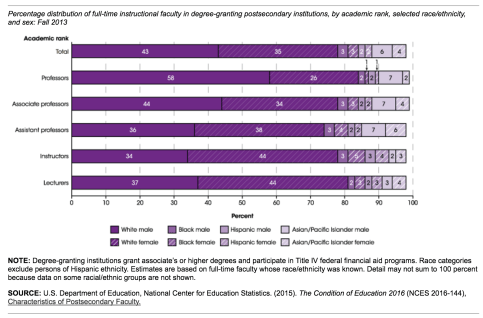
My university has only about 30% female faculty, which reflects a male norm (linked with a white norm) of university professors:

profs-gender

Few professions have greater professional autonomy that being a professor. I can assure you that rarely do people even bother telling a professor what to do—and among those few, virtually none have any real influence.

The profession of being a professor is a white, male world of autonomy and significant prestige.

As above, there is also a false cult of effort among professors—the professorate, so goes the message, is mostly white and male because of the hard work of those white men.

And if you doubt that, listen carefully to the white male response to initiatives for increasing the diversity of professors: We must maintain our rigorous standards for hiring! they shout.

The cult of effort, the cult of rigor—these are codes for maintaining privilege.

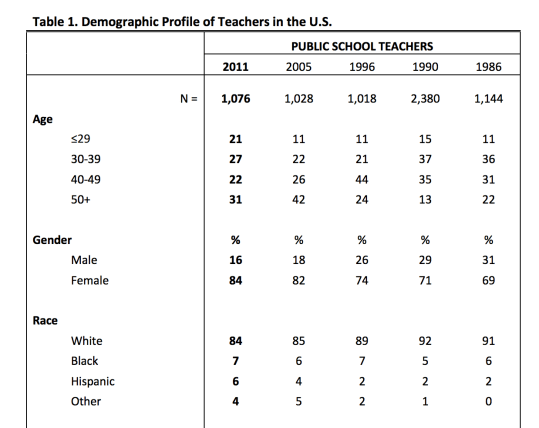
The inverse of this dynamic is at the K-12 level of teaching, a work force still dominated by women:

k-12-teachwrs-gender-2

For K-12 teachers, historically and especially over the past two or three decades, the cult of effort has imposed on the American public that schools are failing primarily because of a slack teacher force (read: a mostly female teacher force), and the way to reform that lazy work force is to raise standard! and demand more!

Let us imagine for a moment that gender divide between the supreme autonomy of mostly male professors and the nearly absent professional autonomy and ridiculous accountability leveled at mostly female K-12 teachers.

The entirely inexcusable “no excuses” model implemented in high-poverty schools serving mostly black and brown students has also become the default environment of being a K-12 teacher: high demand, nearly superhuman demand that erases all professional autonomy and most of the human dignity of teaching.

Yes, teaching K-12 is very hard, but the cult of effort is mostly a lie, and the current high-stakes accountability paradigm is a central cause for driving away teachers.

The accountability era has intensified the historical marginalizing of K-12 teaching as just a woman’s profession; the stakes have been artificially increased while teacher autonomy has been even further eroded.

As a result, K-12 teachers have their work scripted and then are badgered for poor outcomes from the practices they didn’t even choose to implement.

The public and in-school environments for K-12 teachers are toxic—unprofessional and dehumanizing. Administrators who can go to the restroom any time they please demand teachers remain at their doors between classes and never leave a class unattended—relegating basic bodily functions to 20-minute lunch periods (if they are free of students) and planning time.

This reality cannot be disentangled from the gender gap reflected between professors in higher education and K-12 teachers—as well as the current presidential campaign.

K-12 teacher bashing is nested in sexism—assumptions that women are unable and unwilling to make the effort needed to educate children; and thus, K-12 teachers need to be scripted and held to high standards of accountability.

In the political and educational worlds, however, those demanding that accountability and driving the criticism are often far above the standards they espouse.

And that is the ugly truth about women, so-called racial minorities, and gay/transgendered people who must be perfect while white, straight men are forgiven for any and every transgression.

Our democracy suffers under that inequity of privilege and the profession of K-12 teaching is on life support because of the essentially nasty environment surrounding day-to-day teaching.

Democracy and K-12 teaching both require and deserve an atmosphere of patience, compassion, and kindness—traits marginalized by toxic masculinity and white privilege in order to maintain the unearned status of power in the U.S.

At the very least, no one should have to be perfect or everyone should have to be perfect.

Immediately, then, let’s confront how terribly flawed white, straight male leadership has been and is currently—disturbingly personified by Trump himself.

Next, the false cult of effort must end, replaced by the acknowledgement of privilege as central to who has power and why.

With the false cult of effort unmasked, the gender gap can then be erased as well.

From political leadership to the teaching of children in K-12 schools, we will all benefit greatly from the rich diversity of who can and will lead and teach us—especially if that leadership and teaching are rooted in patience and kindness, especially if basic human dignity and autonomy are promised to all.

Free

although you’re older—and white—
and somewhat more free.

“Theme for English B,” Langston Hughes

The iconic aliens of Kurt Vonnegut’s Slaughterhouse-Five marvel at the idealistic delusion of the human race when challenged by Billy Pilgrim about free will:

“If I hadn’t spent so much time studying Earthlings,” said the Tralfamadorian, “I wouldn’t have any idea what was meant by ‘free will.’ I’ve visited thirty-one inhabited planets in the universe, and I have studied reports on one hundred more. Only on Earth is there any talk of free will.” [Vonnegut, Kurt. Slaughterhouse-Five (Kindle Locations 1008-1010). RosettaBooks. Kindle Edition.]

In the American character, “free” remains a powerful and corrupt term and concept.

It is uttered like an incantation, but in fact, the use of “free” has sullied both the role of government (socialism) and the so-called free market (capitalism).

Nothing of the government is free—not highways, public schooling, the military, the judicial system and police force, and certainly not the bare-bones social services so demonized.

All government structures and services are publicly funded, a powerful and important term that highlights that public funding provides a foundation on which a free people can remain free.

Despite the animosity among many Americans about the damn government (who is us), there would be no free market without essential and publicly funded structures and services; think about how any business could exist in the U.S. without the highway system.

But we sully capitalism as well with promises of “free”—free internet with our hotel room, buy one to get one free.

But, alas, there is nothing free in the free market. The truth is that all products and services are paid for by the customers.

Internet may be included with the price of a room, and two products may be included with the usual charge for one product—but nothing is free, including freedom.

*

Writing in 1946 specifically about bigotry, English educator Lou LaBrant asked: “Do the very words we use and our attitudes toward them affect our tendency to accept or reject other human beings?” (p. 323).

LaBrant was confronting the power of words and the need for teachers of language to stress the importance of using words with care; what we say, how we label and name—these human acts define, shape, and create the world.

But to name does not make truth, LaBrant warns:

A basic understanding which needs to be taught in school and home is that the existence of a word does not at all prove the existence of any thing. Children do not understand this; nor do all adults. (p. 324)

As with “free,” LaBrant would argue: “These abstractions tend to become vague and therefore misleading….Frequently the speaker uses them with apparent assurance that they have meaning, and yet could not for his[/her] life explain what he[/she] means” (p. 325).

This carelessness with language, with words, LaBrant calls “word magic”—and with our slipshod use of “free,” it is a black magic that sullies everything it touches.

*

Free will hangs before the human grasp like an apple forbidden by the Creator.

Tempting, yes, but is it delusion?

Nothing’s free, including freedom, and so, “free” can only be cherished if used with the care it deserves.

Feel free to take such care.

Hu(man)s Choose Violence

In season 4 of AMC’s The Walking Dead, I recognized an allusion to John Steinbeck’s Of Mice and Men. Last night, during the first episode of season 7, however, my literary response was much more generalized and visceral—William Golding’s Lord of the Flies and Cormac McCarthy’s The Road.

The series adaptation of the comic book has wondered into George R.R. Martin territory in which the primary reason to watch is to determine which major character dies; and last night, viewers experienced the sort of gratuitous violence pornography that the show seems unable to resist. As  harkened in 2012: “The ubiquitous horror and violence of the zombie genre just makes the violence present in our own lives hypervisible”; although Rick Grimes seems to have chosen the lower road anticipated by Oyola.

Dystopian science fiction, what zombie narratives are, tends to render a future world that has come full circle to the earliest consequences of being human—having both an oversized intellect and the ever-present and never-ending need to survive, even if that survival depended on taking the lives of others, possibly even innocent others.

Primitive humans and humans in dystopian futures grapple with the ethics of survival.

But to be frank, watching two popular and engaging characters have their heads battered into bloody pulps by a barbed-wire-wrapped baseball bat—to have the dark humor of that being called a “vampire bat”—this episode paled in comparison to the anxiety and disappointment I feel about the actual world in which we live here in the U.S.

America has a litany of fatal flaws, one of which is our belief in human choice that has been idealized into a fetish.

Politicians, the media, and the average citizen call for choice as the magic elixir to cure any and all ills.

Despite the numerous lessons of literature and art, despite the daily lessons of being a sentient human.

With our amazing oversized brains, we have created in the U.S. a world in which we mostly do not have to fear a wild animal stalking us or a rival clan set on raping and pillaging our village.

Or at least among the privileged.

The cynical version is that we have the capacity to make this true for everyone—but we choose not to.

But there is an even uglier choice that we make. The choice of violence.

To return to Oyola’s investigation of the comic book, Grimes has repeatedly created the situations in which characters die because of his choices—choices that force him to step into his own quagmire as the White Knight. It is a perverse cycle with which the AMC series seems to have become nearly solely obsessed.

With two heads battered into the dirt and Rick poised to chop off his own son’s arm, the viewer is wrestled once again into Rick’s manufactured hell within a zombie apocalypse hell.

As I tensed wondering how long the camera would be lingering on the hacked off arm, I realized that this episode paled in comparison to Trump’s rise and the unleashed venom of his supporters.

We are a people who still justify violence toward women and children, sexual and psychological violence as well as pure brute force.

We are a people who will shout about being pro life while pretending that our smart bombs don’t erase innocent children, women, and men over there at an alarming rate.

We are a people who are shocked—I mean shocked—that men conditioned to be violent are violent in their daily lives.

The human condition in 2016 is much more upsetting than the slow and nearly cartoonish death of Glenn beside his dear pregnant Maggie.

The cartoonish Trump and the uglier streak of humanity he attracts, emboldens, and represents—that is where there is real terror, real disappointment in who humans are and what humans are willing to endure.

The Waking Dead as a TV series seems, ironically, to be near the opposite of the zombie narrative; it is a thing that cannot long live.

And some other series with promise will fill its void, and soon flounder, sputter, slip through the fingers of popular demand.

But the actual real world—not the reality show version that kept Trump on life support before his turn as clown-politician—is no passing phase of pop culture.

Yes, hu(man)ns have choice, and we have made that choice violence.