Category Archives: Education

“Grit” Takes another Hit (with Caveats)

David Denby’s The Limits of “Grit” in The New Yorker offers further evidence that the “grit” train is slowly but surely being derailed.

Paul Tough, journalist, and Angela Duckworth, scholar, have been central to the rise of “grit” as a silver-bullet in education reform—mostly targeting high-poverty racial minority students in “no excuses” charter schools. Both Tough and Duckworth have recently begun pack pedaling slightly as they release new books, Tough’s second on teaching children in poverty and Duckworth’s first on her highly celebrated “grit,” which was a hit as a TED talk and garnered her a MacAuthur Genius grant.

While the “grit” train was gaining steam among politicians, the media, and edureformers, several educators and scholars raised significant concerns about the essential racist and classist elements of “grit” research, the “grit” narrative, and why both are so politically powerful and popular with the public.

“Grit” is receiving another boost directly from Tough’s and Duckworth’s books—and the PR masked as journalism both have been afforded through their own public writings and numerous interviews at many of the most prestigious news sources.

However, an unintended consequence of Tough and Duckworth boosting the “grit” train through soft back pedaling has been a rise in substantive push back; for example consider:

The quality of Duckworth’s research as well as the essential value of “grit” has been fairly strongly refuted now, even in the mainstream media who love the whole “grit” charade (however, we must note, that nearly no one in that push back or the mainstream media is willing yet to acknowledge the racism and classism driving this train).

So Denby’s challenge to Duckworth and “grit” is very welcomed, but also deeply problematic.

Denby strikes first at the essential choice Duckworth has made:

Other social scientists, looking at the West Point situation and many others that Duckworth considers, might have called grit a “dependent variable”—one possible factor in a given experimental situation affecting many other factors. But Duckworth decided that grit is the single trait in our complex and wavering nature which accounts for success; grit is the strong current of will that flows through genetic inheritance and the existential muddle of temperament, choice, contingency—everything that makes life life.

“Grit,” Denby rightfully argues, is grossly over-exaggerated by Duckworth and the cult of “grit” in “no excuses” education reform. Success comes from a complicated matrix of causes—and we must acknowledge that often those competing for success are all very “gritty” as much as we must acknowledge that a tremendous amount of success in the U.S. is the combination of dumb luck within the larger advantages of privilege: Many less “gritty” privileged folk are more successful than more “gritty”  people burdened by poverty, racism, and sexism.

Denby builds, I think, to a damned fine conclusion: “Duckworth—indifferent to class, race, history, society, culture—strips success of its human reality, and her single-minded theory may explain very little.”

This dynamic is the result of so-called hard science that strips and masks through the false allure of objectivity and quantification combined with social norms and biases that remain invisible to the privileged class.

There are thousands and thousands of examples, but the unwarranted rise of Duckworth’s “grit” is also akin to how the media almost alway get science wrong; consider The Irony of Believing Humans Use Only 10% of Their Brains.

And here is the problem with Denby’s takedown of “grit”; therefore, let’s return to how Denby lays out his critique.

“This snowballing effect among school reformers can’t be understood,” Denby explains, “without recognizing a daunting truth: We don’t know how to educate poor children in this country. (Our prosperous students do fine on international tests.)”

As I have posed already, instead of Duckworth’s “grit,” we should be focusing on the well researched concepts of scarcity and slack. We in fact do know a great deal about the negative consequences of scarcity (poverty, stress) on adults and children, and we also are well aware of the advantages of slack (privilege).

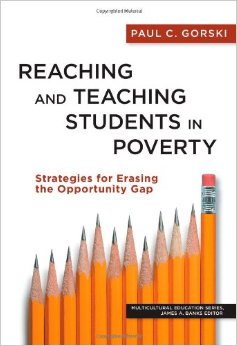
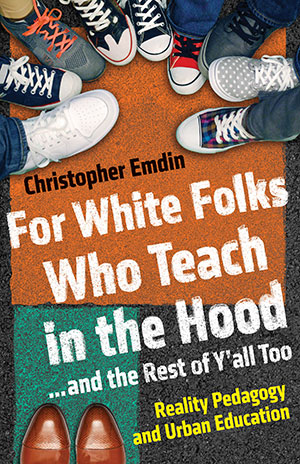
But to Denby’s finer point, we also know how to educate children burdened by poverty. Reaching and Teaching Students in Poverty: Strategies for Erasing the Opportunity Gap by Paul Gorski and For White Folks Who Teach in the Hood…and the Rest of Y’all Too by Christopher Emdin are two recent books that are far more credible than Tough and Duckworth but also represent that educators do in fact know how to educate poor and racial minority children.

Lisa Delpit has been making this case for some years as well: Other People’s Children: Cultural Conflict in the Classroom and “Multiplication Is for White People”: Raising Expectations for Other People’s Children, for example.

And there are now decades of educators and scholarship on culturally relevant pedagogy, often grounded in the work of Gloria Ladson-Billings.

So, yes, Denby, your unpacking of “grit” is on track, but you are way off about what we know about educating poor children.

The truth is, as Dave Powell explains,

We tend to think that everyone has a valid opinion on education, up to and including people who are running for president, but I can’t think of another class of people that is less attuned to the day-to-day challenges of teaching than presidential candidates are.

Political leaders, the public, and the media will not listen to the educators and scholars who know what we must do, and leaders do not have the political will to do what we know we must do.

Period.

Ironically, further on, Denby turns to Tough (easily an equally key figure in making “grit” popular with Duckworth) and Malcolm Gladwell to unmask Duckworth.

Again, Tough is an edujournalist, and his books and so-called expertise are parts of the problem. We should be buying Gorksi’s and Emdin’s books, interviewing them, and then building policy on their work.

Gladwell is cited for his popularizing the 10,000-hour rule. But Denby fails to recognize that Gladwell and others in the media fumbled the 10,000-hour rule in much the same way as Duckworth has “grit.”

The key researcher behind the 10,000-hour rule found in Gladwell’s book and public work has carefully refuted how Gladwell and the media have misrepresented what the research reveals. See The Danger of Delegating Education to Journalists: Why the APS Observer Needs Peer Review When Summarizing New Scientific Developments by K. Anders Ericsson.

In short, Tough and Gladwell are journalists who do not have the expertise on education or poverty that does exist in academia.

So while I appreciate Denby’s often incisive critique of Duckworth and the cult of “grit,” I  must caution that this critique also too often fails for the same reasons that created the “grit” circus to begin with—just as we have seen with people using only 10% of their brains and the 10,000-hour rule.

Ultimately, there are many reasons to reject the cult of “grit,” but let’s hand the stage properly to Sendhil Mullainathan and Eldar Shafir, Gorski, Emdin, Delpit, and Ladson-Billings—along with dozens of educators and scholars who in fact know what must be done and how to serve the most vulnerable students among us.
The Butthurt Right, Or, An Outbreak of the White-Man Vapors

…so feared by a patriarchal world…

Audre Lorde

But their remedies do not cure the disease: they merely prolong it.
Indeed, their remedies are part of the disease.

Oscar Wilde, “The Soul of Man under Socialism”

Let’s start with a fact that few are willing to acknowledge:

Despite endless debates between and about the Right and the Left in the U.S., there is no substantial Left in the U.S.—a country that is solidly right of center and distinctly so when compared to Canada or European countries with a vibrant Left.

The U.S. Left is Obama and the Clintons—neoliberals who nudge at the left edge of capitalism and a country in perpetual war.

The U.S. Left is a sort of polite progressivism of rhetoric that sees almost no fruition in action of any kind.

The U.S. Left is a compromising incrementalism that sustains the disease; it is Tyrion.

The U.S. Left meekly raises it hand and whispers: “Might we consider how we could be a tad bit less sexist, racist, and homophobic—and if that isn’t too much trouble, a little less violent?”—before shrinking away for fear of the response.

And those whispers—or God forbid a direct shout—are met with what we have now in the U.S., a newly butthurt Right, an outbreak (dare I say “epidemic”) of white-man vapors.

Nicholas Kristof—nice-guy, cardboard “progressive”—thinks the nasty Left in the U.S. has excluded the Right from academia (and we all know how powerful academia is in the U.S., right? nudge nudge), and the education reform movement (a bi-partisan assault on public education that is entirely a rightwing enterprise) is all atwitter because of the contentious Left/Right divide (Gosh, they are fuming, if those nasty BLM folk don’t settle down, all the Righties will flee the reform movement!).

All of this butthurt on the Right is very much reflected in both the rise of Trump in the wake of Black Lives Matter and the silliness of Kristof and edureform butthurt.

The white-man vapors are triggered by Michelle Alexander’s relatively moderate confrontation of the New Jim Crow, the polite left-of-center Ta-Nehisi Coates, and the Norman Rockwell Obama family just as they are accelerated by BLM, Cornel West, and Supreme Court Justice Sonia Sotomayor.

And the butthurt messages come from faux-progressives (Kristof) as much as they come from the rabid Right—political leaders, religious leaders, and law enforcement publicly stating that gays slaughtered in Orlando deserved the massacre or calling on gun owners to shoot black protesters at Trump rallies and the Republican convention.

The polite and articulate butthurt punditry on the Right, like Michael Petrilli trying to shame BLM for having the audacity to name racism “racism,” is very little different from the bully racism of Trump; in fact, they are an inseparable part of the U.S.’s conservative nature reflected in the necrophilic South.

In fact, the U.S. once chided the South for its backwardness, its illogical Bible thumping and gun toting, but we stand today in a U.S. where the essence of the entire country is just like that South.

The white-man vapors are upon us, but we must not fall prey to the same-old faux-liberal solution to yelping Rightwingers; we must not shrink against the fears of the most powerful people in the country who see their ill-gained fortunes and power slipping away.

No, the butthurt Right is a sign that women, black and brown people, the LGBT+ community, and people of all faiths and nationalities are demanding to be heard, are standing on the right side of history, which is ironically on the Left.

Higher education does not need a diversity of thought that includes traditional bigotry, misogyny, and a blind faith in disaster capitalism.

And let’s hope the neoliberals (self-identified as both Right and Left) throw up their hands and exit stage right the education reform movement—which has rained terror on the vulnerable populations of students who need our public schools the most.

James Baldwin wrote in The Nation (July 11, 1966), “The law is meant to be my servant and not my master, still less my torturer and my murderer.”

He was naming racism “racism,” both in the acts of specific police officers and as a systemic reality of the U.S. codified in the judicial system.

Baldwin was not being impolite. He was not ostracizing the Right or shaming white male patriarchy.

Baldwin was speaking necessary truth to power—and it resonates to this day because the butthurt Right slips into the vapors every time they are held accountable for the wreck of the ship they built and captained.

The barely audible Left in the U.S. has pushed the door slightly open to the House White Male Privilege built.

The owners are clutching their pearls as they lean against that door chastising the intruders to please simmer down.

We must not step back. We must push the door open, throw out the Masters, and start anew.

Ignoring Poverty in the U.S. Redux: A Reader

We were in Rye, passing the First Church, and the breeze from the ocean was already strong. A man with a great stack of roofing shingles in a wheelbarrow was having difficulty keeping the shingles from blowing away; the ladder, leaning against the vestry roof, was also in danger of being blown over. The man seemed in need of a co-worker—or, at least, of another pair of hands.

“WE SHOULD STOP AND HELP THAT MAN,” Owen observed, but my mother was pursuing a theme and, therefore, she’d noticed nothing unusual out the window….

“WE MISSED DOING A GOOD DEED,” Owen said morosely, “THAT MAN SHINGLING THE CHURCH—HE NEEDED HELP.”

A Prayer for Owen Meany, John Irving

I wrote Ignoring Poverty in the U.S. to reject the decades-long focus on education reform targeted in-school only accountability driven by ever-new standards and high-stakes testing.

But that work also reveals the incredible power of stereotypes about adults and children living in poverty in the U.S. Despite our cultural myths about rugged individualism and boot-straps success, the impoverished in the U.S. are overwhelmingly vulnerable populations.

whoispoor1

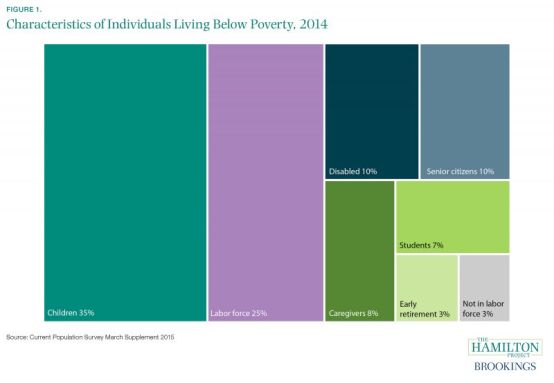
Consider the following sobering statistics, illustrated in the figure above:

  • More than a third of those who live in poverty are children. More than 15.5 million children lived in poverty in 2014.
  • About 13 percent of those living in poverty are senior citizens or retired.
  • A quarter of those who live in poverty are in the labor force—that is, working or seeking employment.
  • A tenth of those in poverty are disabled.
  • Eight percent of those living in poverty are caregivers, meaning that they report caring for children or family.
  • Students, either full- or part-time, make up another seven percent of those living in poverty.
  • Just three percent of those living in poverty are working-age adults who do not fall into one of these categories—that is, they are not in the labor force, not disabled, and not a student, caregiver, or retired.

vulnerableopm

Stereotype 2: Poor People Are Lazy

Another common stereotype about poor people, and particularly poor people of color (Cleaveland, 2008; Seccombe, 2002), is that they are lazy or have weak work ethics (Kelly, 2010). Unfortunately, despite its inaccuracy, the “laziness” image of people in poverty and the stigma attached to it has particularly devastating effects on the morale of poor communities (Cleaveland, 2008).

The truth is, there is no indication that poor people are lazier or have weaker work ethics than people from other socioeconomic groups (Iversen & Farber, 1996; Wilson, 1997). To the contrary, all indications are that poor people work just as hard as, and perhaps harder than, people from higher socioeconomic brackets (Reamer, Waldron, Hatcher, & Hayes, 2008). In fact, poor working adults work, on average, 2,500 hours per year, the rough equivalent of 1.2 full time jobs (Waldron, Roberts, & Reamer, 2004), often patching together several part-time jobs in order to support their families. People living in poverty who are working part-time are more likely than people from other socioeconomic conditions to be doing so involuntarily, despite seeking full-time work (Kim, 1999).

More Questions for The Post and Courier: “Necessary Data” or Press-Release Journalism?

Back-to-back editorials at The Post and Courier (Charleston, SC)—Bolster efforts at rural schools (18 June 2016) and Make literacy No. 1 priority (19 June 2016)—offer important messages about the importance of addressing South Carolina’s historical negligence of high-poverty schools, especially those serving black and brown students, and the folly of cutting funding for literacy initiatives in Charleston.

However, reading these two editorials leaves one well aware that good intentions are not enough and wondering if the P&C editors even read their own editorials.

In the 18 June 2016 editorial, the editors argue: “Acting rashly without necessary data would be misguided. But taking baby steps while one class after another misses out on an adequate education is a continued waste of valuable time.”

And the very next day, we read:

Still, parents should expect their children’s reading skills to improve noticeably.

And it’s fair for parents of the youngest students to expect significant improvement in their children’s reading by the end of the school year — if the new approach works. Of course, parents also can make a difference by reading to their youngsters every day at home.

If Dr. Postlewait’s plan doesn’t succeed, the school board must find a way to pay for programs that do.

Those programs exist. At Meeting Street Academy private school, and now at Meeting Street @ Brentwood, entering students score well below average on literacy tests and quickly catch up to and surpass the average. All Charleston County students deserve the same opportunity.

This praise of “programs [that] exist” is the exact “acting rashly” the P&C rightfully warns about the day before.

So what about “necessary data”?

We have two problems.

First, we do not have a careful analysis of data by those not invested in these schools about the two praised school programs. The fact is that we do not know if successful reading programs exist at these schools.

Second, we do know that “only 1.1 percent of high-poverty schools were identified as ‘high flyers'” (Harris, 2006). In other words, we now have decades of data refuting the political, public, and media fascination with “miracle schools.”

As I have repeatedly warned: “miracle schools” are almost always unmasked as mirages, but even if a rare few are outliers, they cannot serve as models for all schools because they are not replicable or scalable.

Therefore, the P&C editors are right to warn about acting rashly and without the necessary data as we reform public schools and bolster literacy among our students.

But the P&C is wrong to continue press-release journalism that contradicts that mandate.

Arrogance: Service, Not Saviors

Beyond the obvious—that they are all joined by the field of education—what links the National Reading Panel (NRP) and No Child Left Behind, the edureform documentary propaganda Waiting for “Superman,” Teach For America, and edusavior Steve Perry?

Arrogance.

While I count myself among English language arts (ELA) teachers who are skeptical of the Great Books mindset—that we have essential books all children must read—I am moved today to endorse how many of those works remind we puny humans about the folly of pride. Not the “I am proud of you daughter/son” pride, but the arrogance pride.

The “‘My name is Ozymandias, King of Kings;/ Look on my Works, ye Mighty, and despair!'” kind of pride.

What on earth possessed politicians to form the NRP to find out what we know about teaching children to read? Did anyone point out that we have had a vibrant field of literacy in the U.S. for a good century? Isn’t it sort of obvious that we have dozens upon dozens of people across the U.S. who know exactly how to teach children to read (and have known for decades)?

But it isn’t just the teaching of reading.

Naive experts, often journalists, every week roll out yet another book in which she or he researches a field in which real experts in that field have been doing authentic work for decades—the history of teaching!, how to teach poor children!, the glory of 10,000 hours of practice!

Paternalistic, self-important, blowhard politicians daily puff up in front of the public to be that “Superman” at the center of the great lie documentary noted above that ironically serves as a perfect representation of everything that is wrong with education reform.

But one need not go back to that complete failure of film making. Try within the last week.

Educators and activists Andre Perry and Jose Vilson (see also) have assumed the mantle of speaking truth to the cult of personality that is Steve Perry.

I consider myself a student of Andre Perry and Vilson, as I work to navigate my own white male privilege in a way that serves others—specifically those marginalized by race and class.

I am a product of white privilege and colonialism, and therefore, must not serve those corrosive forces.

Here, I urge you to read Andre Perry and Vilson, but also to act upon their messages.

And I want to offer a tentative framing informed by their charges.

First, I am compelled by the new 30 for 30 series on O.J. Simpson to suggest that Simpson himself is a cautionary tale about the dangers of white privilege and the costs of whitewashing blacks in order for them to be allowed into mainstream society.

Next, I find troubling parallels in the work of Steve Perry with powerful blacks (Bill Cosby, Clarence Thomas, and Simpson) who negotiate the whitewashing in their favor at the expense of all other people of color.

The demonizing of dreadlocks, the finger-pointing at sagging pants, the judgmental finger-wagging at black English—yes, these are the tools of white privilege, but they also serve the cult of personality unmasked in Steve Perry, for example, by Andre Perry and Vilson.

Finally, although specific people have to be addressed when confronting the cult of personality, the problem is that those people are serving larger forces that are driving education reform, a movement that uses “civil rights” as a mask to implement policies that are perpetuating colonialism and whitewashing.

“No excuses” charter schools committed to “grit” are about “fixing” black, brown, and poor children.

Zero tolerance policies and grade retention policies disproportionately turn black, brown, and poor children into criminals and drop-outs.

High-stakes testing and accountability produce and perpetuate so-called achievement gaps among race and social class—as well as gate-keep in order to keep “other people’s children” in their place.

Teach For America fuels the historical inequity of access to experienced and certified teachers: White Students Get Experienced Teachers, While Black Students Get Police In School.

Whether the face of education reform is Bill Gates, Michelle Rhee, Arne Duncan, Geoffrey Canada, or Steve Perry (or the long list of celebrities who decide education is their hobby), and while we must necessarily confront each person as we confront what they represent, the ultimate challenge in rejecting edureform while also calling for building public education as a vehicle for equity and liberation is to call colonialism “colonialism,” to just say no to policies and practices designed to erase who children are so that they can be assimilated into society.

There are profound and significant differences in Andre Perry’s work, Vilson’s daily classroom teaching, and Steve Perry’s bloviating (think Donald Trump).

Andre Perry, Vilson, and Chris Emdin, for example, celebrate black students, their humanity as inseparable from their blackness—while Steve Perry celebrates Steve Perry as one who erases the black from children in the service of white privilege.

We are way past time to stop believing in and listening to these false idols, self-proclaimed “Super(wo)men.”

Ozymandias, please recall, was a fool in king’s clothing whose words mocked him:

Nothing beside remains. Round the decay
Of that colossal Wreck, boundless and bare
The lone and level sands stretch far away.

Let’s not form any more panels, let’s not crown any more edusaviors, let’s not print and/or buy any more bestselling books by educelebrities (who have never been teachers), let’s not worship at the altar of hollow Ted Talks.

Just as we didn’t need the NRP to “know how to teach children to read,” we have ample knowledge right now how to eradicate racism and classism in our society and our schools.

Edureformers, edusaviors, and educelebrities are in the service of keeping us from that vital work.

As Andre Perry asserts:

Let’s be clear: Belt wearing isn’t the reason white children are educated in wealthier schools. Haircuts and etiquette classes don’t lead to the technological innovations of Silicon Valley. Lower incarceration rates aren’t because whites use drugs less often. The wage gap isn’t caused by white men’s hard work ethic.

But social and educational inequity is the consequence of white privilege.

So I ask now that you listen to carefully and then act upon Chris Emdin‘s confrontation of edureform as colonialism and what choices lie before teachers:

What I am suggesting is that it is possible for people of all racial and ethnic backgrounds to take on approaches to teaching that hurt youth of color….

I argue that there must be a concerted effort…to challenge the “white folks’ pedagogy” that is being practiced by teachers of all ethnic and racial backgrounds….

The time will always come when teachers must ask themselves if they will follow the mold or blaze a new trail. There are serious risks that come with this decision. It essentially boils down to whether one chooses to do damage to the system or to the student [bold emphasis added]. (pp. viii-ix, 206)

Especially in our schools, and especially among our most vulnerable students, we need service, not saviors.

Call for Manuscripts: Strangers in Academia: Teaching and Scholarship at the Margins

Call for Manuscripts

Strangers in Academia: Teaching and Scholarship at the Margins

Christian Z. Goering, University of Arkansas; Angela Dye, PBS Development, LLC; and P.L. Thomas, Furman University, editors

This volume seeks to collect contributions from authors across the spectrum of academe who, for one reason or another, feel as if they are strangers at their own universities and/or in K-12 education.

In the background of this project, we are confronting the mainstream idea that formal education is somehow revolutionary, for both individuals and the larger society. Therefore, this volume is a testament to how all levels of academia are too often reflect and perpetuate the society the schools/universities serve.

Specifically, we are seeking to include the experience, thinking, and scholarly perspective of those who feel othered, ostracized, pushed out, relegated, or marginalized because of your status (race, class, gender, sexual orientation, etc.) or your professional and/or ideological stances through experiences working in higher education or K-12. While it’s the ideal of the academy to consider all warranted perspectives perhaps there are elements of your status, practice, or philosophy that is being undermined by your administrators and/or colleagues. Insidious attacks, comments in the hall, or cultural norms have left you and/or your work feeling less than welcome.

Contributions should range between 3000 and 4000 words and explore the complex nature of working in K-12 or higher education and feeling less-than-welcome. What was the experience like? How did you address it? What were the consequences? Two-page chapter proposals are due on September 30, 2016, with complete chapters due December 1, 2016.

Submit all proposals as Word attachments to paul.thomas@furman.edu

The blog post below serves as an invitation to begin considering contributing to this volume.

No, there was no way out, and no one can imagine what nights in prison are like.

Meursault, The Stranger, Albert Camus

I left public education after an 18-year career as a high school English teacher and coach. The exit had its symbolism because at that time I was wearing a wrist brace on my right hand from overuse after almost two decades of responding to about 4000 essays and 6000 journal entries per year; in other words, I left public education broken.

A former student of mine on the cusp of becoming a first-year English teacher asked me recently what my first years were like, and I had to confess that from day one, my career as an educator has always been at the margins, a stranger at all levels of formal schooling and academia.

Yes, my hand was exhausted from marking essays, but I was broken as a public school teacher by administrators and in a bit of not so hyperbolic science fiction, The System.

Every single day of my life as a public school teacher, I worked against the system—but I did so with my door open because I believed (and still believe) my defiance was for The Cause.

I was never defiant for my own benefit, but resistant to the structures, policies, and practices that I believed dehumanized teachers and students, that worked against formal education as liberation.

I didn’t punish students for being a few seconds late to class, for asking to go to the restroom. I didn’t stand guard at the doorway or in the hallways as if we were surveilling a criminal population of teens.

We laughed and moved around in my room, played music and even danced during breaks. Students ate candy, food, sneaking in drinks occasionally.

And to a fault, I was friendly with my students—a friend to my students. In the perfect sort of irony or symmetry, many of those students are today my friends on Facebook.

But toward the end, after year upon year of wrestling with administration and finding little collegiality or camaraderie among my colleagues, I found my breaking point when I took off days to present at a national conference—one I was afforded through my doctoral program, which I completed while a full-time high school teachers—and returned to work to discover I was docked pay for those days and even the substitute fee.

Public education, I learned, had no room for teachers who were also scholars.

Because the opportunity presented itself, I begrudgingly applied for, was offered, and then accepted (at a significant reduction in pay) a position in higher education as a teacher educator.

I entered the role as tenure track assistant professor very naive (even in my early 40s) and so deluded by public education that I also idealized higher education: my land of milk and honey where my full self as educator, writer, and scholar would be not only welcomed, but also encouraged.

After 14 years at the university level, making my way through tenure to full professor, let me offer the short version: more delusion.

“Don’t be so political.” “I never published an Op-Ed until I had tenure.” “Dressing awfully casually for a junior faculty member.”

Yes, my university is in many ways a very wonderful place, and my colleagues are brilliant and supportive.

But the old patterns recurred in higher education that had run me out of public education: critical pedagogy isn’t welcomed, scholarly activity creates as much friction as it receives praise, wading into public intellectual work creates even more friction, and even well-educated people can be prejudiced and petty.

Department politics and dynamics have proven to be as frustrating (for me and other professors) as my experiences with administration while I was a public school teacher.

As one example, my university has recently conducted a gender equity study because the playing field isn’t level here. Professors of color and LGBT professors will also note significant inequities as well.

Higher education has revealed itself to be in many ways as flawed as public education because even in our systems of formal education, we are apt to replicate the society we serve instead of being a working model of how things could be, how things should be.

Race, class, gender, sexual identification, and ideology—these all even in higher education create those of us who are strangers in academia; we are forced to teach, conduct scholarship, and write at the margins.

Just making this claim, I know, pushes me further to the margins, boundaries possibly well secured by the statuses I have attained despite being a stranger in academia.

Yet, I am not yet willing to throw up my hands and simply accept that we cannot be otherwise—because if the most well educated cannot set aside our biases, what hope for all of humanity?

In Albert Camus’s The Stranger, the allegory reveals the existential message that we are all prisoners. Meursault, after being literally imprisoned, confesses, “Afterwards my only thoughts were those of a prisoner.”

But readers are cautioned to note that Meursault also makes the case that his new situation in a physical prison is no different than his life as a so-called free man.

As academics, I think, it is ours to resist the same dynamic between the so-called real world and academia in which there is essentially no difference.

Academia need not be the pejorative “Ivory Tower,” suggesting we are above it all, but academia sure as hell could be, should be a model of how to honor and celebrate the human dignity of everyone.

Bigotry, George Carlin, and My Critical Journey

As I have noted many times, George Carlin and Richard Pryor were instrumental in saving me from my redneck past.

As a frail, anxious, and highly insecure teen, I sat in my room alone listening to their comedy albums over and over—memorizing, yes, but listening very carefully because I wanted to understand what these men were saying.

These were revolutionary ideas to a redneck in South Carolina in the 1970s.

With the death of Muhammad Ali, I have been drawn back to my Classic Gold collection of Carlin’s first three albums, anchored for me by his “Muhammad Ali – America the Beautiful” on Class Clown:

But as I have been listening, my recognition that Carlin and Pryor are foundational to my critical journey—especially as an educator—has been shaken by coming back to Carlin as I sit in my mid fifties.

Two routines—”White Harlem” and “Black Consciousness” on Occupation: Foole—have pushed me even further into the tension that exists in pop culture, a tension I have examined regarding Marvel Comics Captain America:

And as I have been contemplating these routines, mostly about race and the politics of race, the Orlando massacre has forced me to highlight what is possibly the most important joke from Carlin for me in terms of everything it represents about why I was drawn to his work, why it still speaks to me, and why I am deeply concerned about both of those.

Carlin was born a couple years before my father and we are separated significantly by regional and religious backgrounds; however, we still share some commonalities that distinguish us from younger generations.

During Carlin’s riff on his old neighborhood—Morningside Heights bounded by Columbia University and Harlem, and labeled as “White Harlem”—he offers his sharp observation about language, noting that in his time, the words “fag” and “queer” meant different things: A fag, Carlin explains, is someone who wouldn’t go down town with you to beat up queers.

The audience roars on the albums—and I am forced to contemplate the ugliness beneath the laughter.

Carlin as social critic and master wordsmith always laid the world before us—and in his routines, characters, and rants, I believed him to be critical of that world he portrayed.

But just as Captain America’s popularity reveals the very worst of mainstream U.S. bigotry (regardless of the creators’ and many writers’ and artists’ since intentions), I see beneath Carlin’s routine that the audience response is about laughing at marginalized people due to sex or sexual identification.

Carlin’s race riffs seem to be as problematic. White Harlem? Really?

Carlin also explains that if you put five really white guys with black dudes for a while, the white guys will start to talk, act, and walk as the black guys do.

I think Carlin genuinely valued his growing up close to and in black culture, but I am not sure he understood appropriation—and I am certain his audience did not.

When a Sport Illustrated article repeated praises a female Olympic swimmer by framing her as “like a man” (at the subtle and seemingly harmless-but-not end of the scale) and when fifty people are slaughtered for being in a gay nightclub just a year after nine people were slaughtered in a church for being black, I have to ask are these routines by Carlin funny? Were they ever funny?

And, for me this is important, how complicit is Carlin in perpetuating the horrors of homophobia, sexism, misogyny, and racism?

It seems a very privileged thing to sit in a theater and laugh at a man, self-proclaimed foole, telling jokes and using dirty words:

I memorized Carlin and Pryor—and I took their routines to school everyday as a shield against getting beat up, probably not against the threat of physical abuse but getting beat up socially and psychologically because I was skinny and insecure—I simply was not man enough, I feared.

In the late 1970s, I was entirely unaware that I was already shielded from those threats in most ways, being white, male, and heterosexual.

I was entirely unaware of how cruel and wrong this world was and is, even though Carlin and Pryor had opened the door for me to discover all that in the coming years of college.

My critical journey has been a tremendously privileged one—one in which I have been afforded the role of witness, informed by James Baldwin and many others who have been passengers.

Just as Kurt Vonnegut taught me the sacred value of kindness, Carlin and Pryor proved to me that words matter—but our critical journey must step beyond words even as we correct them.

In a year, we have placed at our feet the Charleston Massacre and the Orlando Massacre. I find little joy in listening to Carlin because I must ask: What are we going to fucking do?

U.S. Education Reform: A Snapshot

Cycle has happened often, and now poised to happen again.

Common Core

For #3 (where we are now before jumping back to #1), see Common Core isn’t preparing students very well for college or career, new report says.

HINT:

As the absence or presence of rigorous or national standards says nothing about equity, educational quality, or the provision of adequate educational services, there is no reason to expect CCSS or any other standards initiative to be an effective educational reform by itself. (Mathis, 2012)

9 June 2016 Reader: School Choice, GPA v. SAT/ACT

I. School Choice, Charter Choice

Choosing a School for My Daughter in a Segregated City, Nikole Hannah-Jones

When the New York City Public Schools catalog arrived in the mail one day that spring, with information about Mayor Bill de Blasio’s new universal prekindergarten program, I told Faraji that I wanted to enroll Najya in a segregated, low-income school. Faraji’s eyes widened as I explained that if we removed Najya, whose name we chose because it means “liberated” and “free” in Swahili, from the experience of most black and Latino children, we would be part of the problem. Saying my child deserved access to “good” public schools felt like implying that children in “bad” schools deserved the schools they got, too. I understood that so much of school segregation is structural — a result of decades of housing discrimination, of political calculations and the machinations of policy makers, of simple inertia. But I also believed that it is the choices of individual parents that uphold the system, and I was determined not to do what I’d seen so many others do when their values about integration collided with the reality of where to send their own children to school.

One family, or even a few families, cannot transform a segregated school, but if none of us were willing to go into them, nothing would change. Putting our child into a segregated school would not integrate it racially, but we are middle-class and would, at least, help to integrate it economically. As a reporter, I’d witnessed how the presence of even a handful of middle-class families made it less likely that a school would be neglected. I also knew that we would be able to make up for Najya anything the school was lacking.

As I told Faraji my plan, he slowly shook his head no. He wanted to look into parochial schools, or one of the “good” public schools, or even private schools. So we argued, pleading our cases from the living room, up the steps to our office lined with books on slavery and civil rights, and back down, before we came to an impasse and retreated to our respective corners. There is nothing harder than navigating our nation’s racial legacy in this country, and the problem was that we each knew the other was right and wrong at the same time. Faraji couldn’t believe that I was asking him to expose our child to the type of education that the two of us had managed to avoid. He worried that we would be hurting Najya if we put her in a high-poverty, all-black school. “Are we experimenting with our child based on our idealism about public schools?” he asked. “Are we putting her at a disadvantage?”

See Also

Why Sending Your Child to a Charter School Hurts Other Children

Education Reform in the New Jim Crow Era

Just as mass incarceration from the war on drugs continues institutional racism once found in slavery and Jim Crow, education reform, especially the “no excuses” charter school movement, resurrects a separate but equal education system that is separate, but certainly isn’t equal. The masked racism of mass incarceration and education reform share many parallels, including the following:

  • Both depend on “racially sanitized rhetoric,” according to Alexander, that thinly masks racism. “Getting tough on crime” justifies disproportional arrests, convictions and sentencing for African Americans; “no excuses” and “zero tolerance” justify highly authoritarian and punitive schools disproportionally serving high-poverty children of color.
  • Both depend on claims of objective mechanisms – laws for the war on drugs and test scores for education reform – to deflect charges of racism. Alexander recognizes “this system is better designed to create [emphasis in original] crime and a perpetual class of people labeled criminals, rather than to eliminate crime or reduce the number of criminals,” (p. 236) just as test-based education reform creates and does not address the achievement gap.  
  • Both depend on racialized fears among poor and working-class whites, which Alexander identifies in the Reagan drug war agenda: “In his campaign for the presidency, Reagan mastered the ‘excision of the language of race from conservative public discourse’ and thus built on the success of the earlier conservatives who developed a strategy of exploiting racial hostility or resentment for political gain without making explicit reference to race” (p. 48). The charter school movement masks segregation within a progressive-friendly public school choice.  
  • Both depend on either current claims of post-racial America or the goal of a post-racial society: “This system of control depends far more on racial indifference [emphasis in original] . . . than racial hostility,” Alexander notes. (p. 203)
  • Both depend on a bipartisan and popular commitment to seemingly obvious goals of crime eradication and world-class schools.
  • Both depend on the appearance of African American support. Alexander explains about the effectiveness of the war on drugs: “Conservatives could point to black support for highly punitive approaches to dealing with the problems of the urban poor as ‘proof’ that race had nothing to do with their ‘law and order’ agenda” (p. 42).

This last point – that African Americans seem to support both the war on crime and “no excuses” charter schools – presents the most problematic aspect of charges that mass incarceration and education reform are ultimately racist, significant contributions to the New Jim Crow.

For example, Carr reports that African American parents not only choose “no excuses” charter schools in New Orleans, but also actively cheer and encourage the authoritarian policies voiced by the schools’ administrators. But Alexander states, “Given the dilemma facing poor black communities, it is inaccurate to say that black people ‘support’ mass incarceration or ‘get-tough’ policies” because “if the only choice that is offered blacks is rampant crime or more prisons, the predictable (and understandable) answer will be ‘more prisons.’ ” (p. 210)

New Orleans serves as a stark example of how this dynamic works in education reform: Given the choice between segregated, underfunded and deteriorating public schools and “no excuses” charters – and not the choice of the school environments and offerings found in many elite private schools – the predictable answer is “no excuses” charters.

II. GPA v. SAT/ACT

Study: Colleges Put Students Into Remedial Classes Who Don’t Need Them

The Alaska study, conducted by a regional research laboratory funded by the U.S. Department of Education, found that SATs, ACTs and the placement tests used by the University of Alaska were all poor predictors of how a student might do in a college-level math or English class. Many students who did well on these exams bombed their college classes, and vice versa. Instead, the researchers found that if college administrators had simply looked at the students’ high school GPAs, they would have done a much better job at figuring out who needs to relearn high school material and who doesn’t.

“We definitely should be including GPAs when assessing college readiness,” said Michelle Hodara, the lead author of the study and a senior researcher at Education Northwest. “We found the same thing that community college researchers and practitioners are finding, that high school GPA is a really powerful measure of college readiness, even for students who want to earn a four-year degree.”

Developmental education and college readiness at the University of Alaska

This study examines the postsecondary readiness of first-time students who enrolled in the University of Alaska system over a four-year period. The study calculates the proportion of students considered academically underprepared for college and how placement rates for developmental education (that is, non–credit-bearing courses) vary for different groups of students. The study also determines the proportion of students placed in developmental education who eventually enrolled in and passed college English and math. Finally, the analysis looks at whether high school grades, rather than exam performance, are a better predictor of success in college-level courses.

Results show that developmental education rates were higher in math than English for students pursuing any degree type and increased as the gap between high school exit and college entry grew. Among students pursuing a bachelor’s degree, developmental placement rates were highest for Black students from urban areas of the state (in math) and Alaska Native students from rural areas (in English) compared to all other student groups. Almost half (47 percent) of students placed in developmental courses eventually passed college English and almost a quarter (23 percent) passed college math. For students who enrolled directly in college, high school grade point average was a stronger predictor of college-level English and math performance than were SAT, ACT, and ACCUPLACER scores. Secondary and postsecondary stakeholders can use the findings to help identify students in need of support to be college-ready and to consider further conversation and additional research regarding whether and how to use high school grade point average as part of the placement process.

Former College Board Exec: New SAT Hastily Thrown Together; Students: March SAT Recycled in June

Manuel Alfaro is the former executive director of assessment design and development at the College Board.

Beginning on May 15, 2016, Alfaro has published a series of posts on Linkedin in an apparent effort to reveal the haphazard construction of the new SAT, released and first administered in March 2016 and again, in June. (He is also posting info on Twitter: @SATinsider.)

Below are excerpts from Alfaro’s Linkedin posts, all of which provide an enlightening read concerning the sham Coleman has thrown together and labeled the “new SAT.”

Defund the “Grit” Industry: Alternatives to Tough and Duckworth

Once edujournalist Paul Tough and “grit”-genius Angela Duckworth realized their significant contributions to the “grit” industry were gradually being unmasked, they discovered ways to cash in on backpedalling (slightly) to keep the train rolling.

Regretfully, many very good people have praised Tough and Duckworth for their much-too-late and way-too-little—somehow ignoring the incredible damage that has been done to vulnerable populations of students—and even recommend Tough and Duckworth’s “new” books.

Please, I beg of you, do not forgive and forget, and especially do not fund further the “grit” industry.

Let me offer instead a few alternatives:

Scarcity: The New Science of Having Less and How It Defines Our Lives, Sendhil Mullainathan and Eldar Shafir

9781250056115

[See also George Saunders’s Allegory of Scarcity and Slack]

Reaching and Teaching Students in Poverty: Strategies for Erasing the Opportunity Gap, Paul Gorski

51w731ediwl-_sy344_bo1204203200_

[See also Recommended: Reaching and Teaching Students in Poverty, Paul C. Gorski]

For White Folks Who Teach in the Hood…and the Rest of Y’all Too, Christopher Emdin

978-080700640-5

[See also Christopher Emdin Confronts “White Folks’ Pedagogy”: “whether one chooses to do damage to the system or to the student”]