Category Archives: education reform

Time to End the Charter School Distraction

The 21st century charter school movement in the U.S. has been at least a deeply flawed solution for a misunderstood problem. But charter advocacy has also suffered from a serious contradictory pair of arguments aimed simultaneously at traditional public schools (TPS) and charter schools.

As stringent high-stakes accountability gradually ramped up for TPS from the early 1980s and through both the George W. Bush No Child Left Behind (NCLB) era and the even more intense (and volatile) Obama administration, charter school advocacy increased, and those schools expanded across the U.S. driven by the argument that charter schools flourish because of their independence from bureaucratic mandates.

TPS suffered a series of ever-new standards and high-stakes tests, persistent narratives that they were “failing,” and a recalcitrant public and political leadership that refused to acknowledge the nearly crippling impact of social inequity on any school’s ability to effectively teach children.

Yet, at the same time, charter schools were routinely hailed falsely as “miracles” and neither the public nor political leadership seemed to care that research repeatedly revealed that charter schools simply did not outperform TPS (just as private schools do not outperform TPS). In short, charter schools have continued to float on advocacy and magical thinking even when we can clearly show that school type has nearly no impact on student outcomes—since those outcomes are far more significantly driven by out-of-school factors (home and community economic status, parental education levels, home security, access to food, medical care access, etc.).

Just as the Bush/Paige Texas “miracle” that spurred NCLB was soundly debunked, the Harlem “miracle” often cited by Obama/Duncan proved directly and indirectly (the many copy-cat charter “miracles” across the U.S., such as KIPP charter schools) to be mirages.

Like KIPP advocacy, however, the all-charter-school reality that has occurred in New Orleans after Katrina has also flourished on political and media misrepresentations.

An editorial in the Post and Courier (Charleston, SC) has now offered one step in the right direction on charter schools in SC—but it fails to offer the only logical end-game concerning charter funding in this high-poverty state.

Yes, as the editorial notes after citing a Tulane study on charters [1]:

Closing failing charter schools is important because they receive millions of dollars in taxpayer funding that could otherwise be used to improve regular public schools. It’s essential because parents are led to believe that charter schools are superior to public schools, when in some cases they’re taking their kids out of traditional public schools that are better than the charter schools.

As I have detailed dozens of times directly about comparing charter schools and TPS in SC, most charter schools are about the same or worse than TPS that are serving similar populations of students. When charter schools appear to be outperforming, typically those gains are mirages that distract us from the real causal differences—under-serving special needs students, under-serving English language learners, expanded school days and/or years that account for the “growth” being measured, private funding, relief from accountability that comparable TPS must follow.

A simple dictum here is that if we allowed TPS those same caveats, we would see absolutely no surface differences in test scores; a more complicated dictum is that if charter schools had to function under the nearly paralyzing spectrum of obligations that TPS have always addressed, those charter schools would be seen as failures also.

The harsh truth no one wants to confront is that formal schooling, regardless of the type, has a very small measurable impact on student achievement when compared to the relatively larger influence of out-of-school factors. Related to that harsh truth is that once vulnerable students enter formal schooling, they far too often experience even greater inequities because all school models (TPS, charter schools, private schools) both reflect and perpetuate inequities in their policies (teacher assignment, tracking, disciplinary policies, class size and course access inequity, etc.).

As some of us in education have been arguing for decades, education reform must be grounded in equity and in-school reform can succeed only as a companion to significant social and economic reform that addresses food insecurity, work stability, health care, and safety (what I have called social context reform).

Again, the P&C editorial has offered an important charge that “South Carolina was never great at enforcing the responsibility requirement” for charter schools. But simply closing failing charter schools is not enough since we should not be creating charter schools to begin with.

In fact, we should close all charter schools because the charter churn (and all school choice) is a wasteful and politically cowardly indirect approach to reform.

SC is a historically high-poverty state that simultaneously clings to self-defeating conservative politics. Neither social/economic nor education policy in the state serves well the very large vulnerable populations of the state, not the adults or the children.

The political rhetoric and the ideology it spreads are themselves mirages at best, and cruel lies at worst.

New Orleans since 2005 has erased and replaced a TPS system with a charter system, and still the narrative remains about the exact same—schools need reform.

Formal schools regardless of the type reflect the children and communities they serve. Formal schools are rarely change agents.

If SC or any state genuinely wants education reform that serves all students, we will first invest in our entire state in ways that meet the needs of the most vulnerable among us and then we will re-invest in a public school system that fulfills the promise that every child has the greatest opportunity to learn that we can imagine.

Leaving equity in our society and our schools to the Invisible Hand is nothing more than a slap to the faces of the people and children who need us the most.


[1] This Tulane study has been repeatedly misrepresented by charter advocates; please see the following for a fuller and more complex picture of what that study can suggest, and what it does not:

A Reckoning for the Inexcusable?: “No Excuses” and the Collapse of Misguided Educational Reform

Valerie Strauss has offered questions at The Answer Sheet: Some ‘no-excuses’ charter schools say they are changing. Are they? Can they?—including an answer by Mira Debs, Joanne Golann, and Chris Torres.

As a long-time critic of “no excuses” (and the target of harsh backlash for that criticism), I want here to note briefly that this apparent reckoning for “no excuses” practices in the education of mostly black, brown, and poor students is yet another piece of the developing puzzle that will create a clear picture of the predicted failures of educational reform begun under Ronald Reagan and then expanded under George W. Bush and Barack Obama.

Pet elements of that educational reform movement have come and gone (value-added methods for evaluating teachers [VAM], Common Core), but the foundational approaches (accountability grounded in standards and high-stakes testing) seem deeply entrenched and confirmation of the cliche about insanity (doing the same thing over and over but expecting different results).

Just glancing at my public work, I have over 70 posts criticizing “no excuses” as a deficit perspective, as racist and classist, and as a distraction from addressing the larger causes for low achievement by vulnerable populations of students.

A good portion of that scholarship and advocacy led to an edited volume that both critiques “no excuses” and offers an alternative (that was often ignored or rejected with false claims about the ideology behind social context reform): Social Context Reform: A Pedagogy of Equity and Opportunity, edited by Paul Thomas, Brad J. Porfilio, Julie Gorlewski, and Paul R. Carr.

The distinction between the flawed “no excuses” approaches and our alternative focusing on equity and opportunity both outside and inside schools is identified in the Introduction (see also my Chapter 8):

“No Excuses” Reformers insist that the source of success and failure lies in each child and each teacher, requiring only the adequate level of effort to rise out of the circumstances not of [their] making. As well, “No Excuses” Reformers remain committed to addressing poverty solely or primarily through education, viewed as an opportunity offered each child and within which . . . effort will result in success.

Social Context Reformers have concluded that the source of success and failure lies primarily in the social and political forces that govern our lives. By acknowledging social privilege and inequity, Social Context Reformers are calling for education reform within a larger plan to reform social inequity—such as access to health care, food security, higher employment along with better wages and job security. (Thomas, 2011b, emphasis in the original)

While I am once again frustrated with this current concession to the many credible concerns my colleagues and I raised several years ago, I am also skeptical about reforming “no excuses.” The questions raised on The Answer Sheet failed to include “Should they?”

And to that, I would answer, “No.”

The charter movement broadly is flawed, and the “no excuses” subset of that movement is irreparable because it is driven by a corrosive ideology based in a deficit perspective of children, poverty, and teaching and learning.

Just as the accountability movement, VAM, and charter schools have never achieved the promises advocates have made, they have consumed a tremendous amount of resources (funding and time) that would have been better used in the service of equity and opportunity.

Reforming the reform is more distraction, and wasted time and funding.

As I have detailed time and again, if we genuinely want high-quality and effective formal education for all students, and if we genuinely believe universal education is a powerful lever in promoting and maintaining a democracy and a free people, we must set aside the indirect approaches (the totality of the education reform movement) and begin to address directly [1] both out-of-school factors and in-school factors that perpetuate and maintain inequity.

I am also skeptical because I have witnessed in just the last few days on social media that advocates for in-school only and “no excuses” reform continue to double-down on their false claims of “miracle” schools and lash out (still) at critics of “no excuses” with ugly and false characterizations of our beliefs and our goals.

So as I concluded in my debunking of “miracle” schools, I remain committed to this:

[D]ishonest claims of “miracles” have continued to reap tremendous political, person, and financial gains for some. The accountability era has failed. The focus on “miracle” schools has been a distraction from the rising inequity in the lives and education of children in the U.S. This is a distraction we measure in the loss of children’s lives, the opportunities and contributions denied to our society, and a great loss to democracy. These are losses we can no longer afford to tolerate.

The ultimate reckoning for the inexcusable, then, must include setting aside the distractions and facing so that we can address directly the inequities that plague our students and their families both in their communities and the schools that serve them.


[1] The failure of indirect methods and the need for direct methods is drawn from an often ignored argument from Martin Luther King Jr. concerning eradicating poverty in the U.S.:

At no time has a total, coordinated and fully adequate program been conceived. As a consequence, fragmentary and spasmodic reforms have failed to reach down to the profoundest needs of the poor.

In addition to the absence of coordination and sufficiency, the programs of the past all have another common failing — they are indirect [emphasis added]. Each seeks to solve poverty by first solving something else.

I am now convinced that the simplest approach will prove to be the most effective — the solution to poverty is to abolish it directly [emphasis added] by a now widely discussed measure: the guaranteed income.

Teacher Preparation and the Kafkan Nightmare of Accreditation

Over three-plus decades of teaching, I have found that students are far less likely to laugh while reading Franz Kafka than, say, while reading Kurt Vonnegut. But Kafka and Vonnegut are essentially satirists, though both traffic mainly in dark humor.

Black-and-white photograph of Kafka as a young man with dark hair in a formal suit
Franz Kafka 1923 (public domain)

The Metamorphosis is the work most people associate with Kafka, but it isn’t readily recognized, I have found, that the work is filled with slapstick humor—the scene when Gregor is revealed as a bug to his family—while also making a damning commentary on the consequences of the bureaucratic life.

You see, Gregor Samsa’s metamorphosis into a bug is merely a physical manifestation of his life as a salesman, which, Kafka illustrates, is nothing more than a bug’s life.

This, of course, was Kafka’s impression of early twentieth century Prussia as well as the corrosive nature of materialism. As I enter my eighteenth year as as a teacher educator, after eighteen years as a public school English teacher, I can attest that Kafka has pretty much nailed my career on the head as well.

So when I saw Teacher-Preparation Programs Again Have a Choice of Accreditors. But Should They? in Education Week, I immediately recognized that this was the wrong question—or at least incomplete.

Accountability, standards, and assessment have been pervasive my entire career in education, which began in 1984. Over that career, I have heard a consistent refrain about the failures of both K-12 education and teacher education.

As I have recently detailed, teacher education is, in fact, the new scapegoat for all that ails education.

I have worked through about ten combined iterations of standards and assessment expectations, include two different rounds of submitting the teacher preparation program I am solely responsible for now, the first being for NCATE and the for CAEP (mentioned prominently in the article linked above).

Through these experiences, I have witnessed that the same complaints of failure remain while each new round of standards and assessment promise to reform the system and bring great success (often for all students), only to be replaced in a few years under the blanket of the same crisis rhetoric and the same promises that never materialize.

This Kafkan nightmare is perfectly described by Gilles Deleuze, who also turns to Kafka:

In the disciplinary societies one was always starting again (from school to the barracks, from the barracks to the factory), while in the societies of control one is never finished with anything—the corporation, the educational system, the armed services being metastable states coexisting in one and the same modulation, like a universal system of deformation. In The Trial, Kafka, who had already placed himself at the pivotal point between two types of social formation, described the most fearsome of judicial forms. The apparent acquittal of the disciplinary societies (between two incarcerations); and the limitless postponements of the societies of control (in continuous variation) are two very different modes of juridicial life, and if our law is hesitant, itself in crisis, it’s because we are leaving one in order to enter the other.

In my home state of South Carolina, for example, the state adopted Common Core standards, planned to implement the assessment designed for those standards, purchased textbooks and materials aligned with the standards, trained teachers in the standards, and then dropped the standards for new SC versions of standards before Common Core could ever be fully implemented.

My first experience with accreditation of teacher education programs was early in my tenure in higher education. I was baffled both by the process (again, I am solely responsible for an entire program and all the data as well as the report submitted for that accreditation) and my colleagues’ almost complete uncritical obsession with the requirements. In short, the vast majority of my department’s time and attention was devoted to fulfilling the obligations of accreditation—not teaching, not scholarship, but standards, rubrics, and data tables mandated by the accreditation entity.

Just six or seven short years later, the process came back around again—nearly the same, but different. NCATE had been replaced by CAEP and standards were different along with the report itself and the broad expectations being both eerily different and the same.

Accreditation, I suspect, is a process that is perceived as a necessary layer of bureaucracy to insure some sort of consistency and fidelity among all teacher education programs across the U.S. This appears to be the same initial urge driving Common Core, for example.

Political leaders have used accountability, standards, and high-stakes testing for nearly four decades as a way to claim a commitment to higher expectations and better outcomes from the public education system. The public appears incapable over that time to examine closely the argument that schools are failing (the mainstream argument is both false and misleading) or the assertion that accountability, standards, and high-stakes testing will somehow address those problems.

Accreditation of teacher education is essentially a thinly veiled admission that there is no political or public trust of teacher educators, the field of education, or teachers.

Beneath that lack of trust, the accountability era for public education and the allure of accreditation are evidence that political leaders and the public fundamentally misunderstand teaching and learning.

Here is the sobering truth about teaching and learning: To teach is about offering the opportunity to learn; however, there is no way to guarantee that teaching will result in learning regardless of the quality of the teacher or the motivation of the student.

Accountability and accreditation are designed with the assumption that teaching and learning can be prescribed and clearly defined (standards) and then made visible with assessments that are valid and authentic.

Those assumptions are mostly hokum.

The standards and testing movement in K-12 education and the accreditation process for teacher education have proven to be what Oscar Wilde argued about how government addresses poverty: ““But their remedies do not cure the disease: they merely prolong it. Indeed, their remedies are part of the disease.”

Trying to meet the requirements of accreditation has made teacher educators less effective, has reduced the quality of courses and experiences for pre-service teachers, and has consumed an incredible amount of time and financial resources for teacher educators.

It is much ado about nothing.

The EdWeek question, then, is overly simplistic; the rise of AAQEP as an alternative to CAEP is the “illusion of choice” that masks the truly important choice—teacher education and education as a field need to abandon accreditation and seek instead to build a discipline.

Meeting the demands of accreditation is a waste of time and resources that should be dedicated to the things associated with disciplines such as history, psychology, sociology, etc.—reading and thinking deeply about the ideas and practices at the core of the field, conducting a wide range of research on those topics and problems, producing scholarship that informs an ongoing dialogue about teaching and learning, and engaging students in those topics in ways that allow them to become the educators they seek to be.

To reject accreditation is to embrace higher expectations for teacher education, teacher educators, and teachers.

At the end of The Metamorphosis, Gregor’s macabre demise is a distraction for many readers who miss that this is a story about such rejections and not necessarily a tale about Gregor, but his family. After Gregor dies, “Then all three [Gregor’s family] left the apartment together, something they had not done for months now, and took the electric tram into the open air outside the city. The car in which they were sitting by themselves was totally engulfed by the warm sun.”

Careful reading of the final paragraph reveals that the family’s obsession with Gregor, who himself had embraced a toxic bug life dedicated to erasing the family’s debt, has to be abandoned for their eventual happiness: “The greatest improvement in their situation at this moment, of course, had to come from a change of dwelling. Now they wanted to rent an apartment smaller and cheaper but better situated and generally more practical than the present one, which Gregor had found.”

Gregor’s sister becomes the symbol of a new, and better, possibility, a fully human life unfettered by the bug life swept into the dust bin.

See Also

The Metamorphosis at 100, Alexander Billet

The Problem with Balanced Literacy

My summer graduate course, Foundations and Current Trends in Literacy Research and Practice, never fails at being an invigorating course for me and my students because it combines foundational topics in literacy with a never-ending series of current debates and controversies surrounding those enduring elements of teaching and learning literacy.

For several years recently, my home state of South Carolina has provided ample content because of the current reading legislation, Read to Succeed, heavily drawn from Florida’s reading policy and commitment to grade retention as a punitive key element in teaching reading.

This summer, however, even with Read to Succeed firmly entrenched and resulting in grade retention for students, a new wave of controversy has invigorated this course’s topics—the media focus on the “science of reading” driven by advocates for students with dyslexia and the (tired) resurgence of calls for systematic phonics for all students.

The scapegoats in this “science of reading” frenzy are teacher education and balanced literacy (the younger cousin of the similarly maligned whole language).

At the end of class preceding the next day’s focus on balanced literacy, a graduate student asked for a quick definition because since she was new to education and had recently experienced many interviews that asked her to define balanced literacy, she felt quite disoriented and uninformed about what it means.

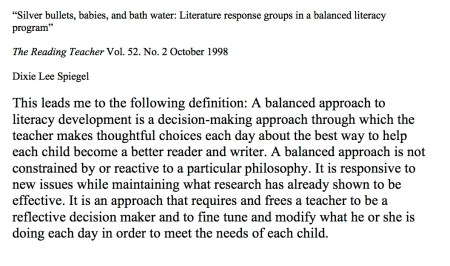
I pulled up my standard paragraph from Dixie Lee Spiegel and immediately heard several other students note this isn’t how they have had the term defined in their schools.

As I read the daily reflections on the readings for balanced literacy, this response, I think, is an important way to address the problem with balanced literacy (edited for some minor formatting):

My school places a huge emphasis on balanced literacy. However, it is presented more in terms of how much time and in what context various components of literacy should be implemented in class daily (we even have it in a pie chart) [emphasis added]. We used to have a great deal of autonomy in the curriculum we chose in reading and writing, but our district recently adopted Lucy Calkins’ Units of Study. Although Calkins desires for teachers to use her units as a framework, it has become a way to make sure all teachers are doing the same thing [emphasis added]. In practice we have a balanced literacy program in terms of we give students choice (although in the early grades very restricted choices), allow time for free reading, a lot of experience with literacy, small, guided reading group instruction, and explicit phonics instruction; we are doing all of this in a systematic, controlled way. I read the article about effective balanced literacy instruction and felt it did a great job in summarizing the qualities that make a teacher highly effective in the implementation of balanced literacy. But the point is…it takes a highly effective teacher, period.

Having only been consistently teaching for five years, I also understand how incredibly challenging it is to be a masterful teacher. I feel I could have seemed that I was implementing balanced literacy proficiently in a class I had two years ago. Most of my class came from literacy rich environments and could discuss books in meaningful ways. The ones that did struggle, were inspired by their peers to take risks in reading (they made me look good). This past year, I did not have a class as a whole that loved reading. For a lot of them, it was a challenge to get them to listen to stories much less engage in meaningful conversations. The majority of them would say they hated to read. Calkins (and my reading coach) would have me go to a first grade unit of study and implement more basic literacy skills to scaffold, but there was no way I would be able to do this alone. The lessons are very in depth and it would have cost me more time than I had available. Also, those mini-lessons would not have appealed to the 6 or 8 students who were ready to have more comprehensive, richer discussions. Reading and literacy implementation was a struggle all year.

I also realize that it is easier within systems to quantify and package things, but you simply cannot do this with teachers and students [emphasis added]. It is easy to show learning in a quantitative way. Although my students achieved higher reading levels this year, which looks great on an SLO [Student Learning Objectives], as a teacher I know that I missed it with them. I also realize that I can say I am doing balanced literacy, but I know it isn’t truly what balanced literacy is intended to be [emphasis added].

To open the discussion, after reading this an other reflections with similar descriptions, I explained to the class that both whole language and balanced literacy are philosophies of teaching and acquiring literacy; they provide evidence-based broad concepts to guide practice, but neither was originally intended to be programs or templates for how teachers teacher or how students learn.

As the response above demonstrates, however, education in practice is often over-reliant on programs and less diligent about addressing philosophy or theory. In short, the problem with balanced literacy is not that teacher education teaches balanced literacy and not the science of reading (note because balanced literacy as a philosophy of literacy embraces that full and complex science of reading) and not that teachers do not know the science of reading but are teaching balanced literacy, but that almost all schools have adopted programs, many of which claim the label of “balanced literacy” while also breaking the foundational elements of that philosophy (see the last sentence of the response above).

And just as the media, dyslexia advocates, and phonics proponents have endorsed, these reading programs (labeled “balanced literacy” or not) are primarily about addressing standards, preparing students for high-stakes tests, and imposing a one-size-fits-all approach to teaching and learning reading; and therein is the essential flaw.

All teachers and all students doing the same things at the same time and being held accountable for doing the mandated program—this is literacy instruction in the U.S., and this is the grand failure no one in the media or in political leadership is willing to address.

All the bluster around calling out “balanced literacy” is nothing more than distraction because it doesn’t really matter what label we assign to how teachers teach reading or how students learn reading; what matters are the expertise of teachers, the needs of students, and the teaching/learning conditions that support or inhibit (see complying with reading programs) effective teaching and learning.

The real problem with balanced literacy is too few people know what it is and as a result are failing it along with the students and teachers caught in that misguided vortex.

Educational Accountability and the Science of Scapegoating the Powerless

Several years ago when I submitted an Op-Ed to the largest newspaper in my home state of South Carolina, the editor rejected the historical timeline I was using for state standards and testing, specifically arguing that accountability had begun in the late 1990s and not in the early 1980s as I noted.

Here’s the interesting part.

I began teaching in South Carolina in the fall of 1984, the first year of major education reform under then-governor Richard Riley. That reform included a significant teacher pay raise, extended days of working for teachers, and the standards-testing regime that would become normal for all public education across the U.S.

In fact, SC’s accountability legislation dates back to the late 1970s (I sent her links to all this).

As a beginning teacher, the only public schooling I ever knew was teaching to standards and high-stakes tests by identifying standards on my lesson plans and implementing benchmark assessments throughout the academic year to document I was teaching what was mandated as a bulwark against low student tests scores. State testing, including punitive exit exams, pervaded everything about being an English teacher.

Yet, an editor, herself a career journalist, was quick to assume my expertise as a classroom practitioner and then college professor of education was mistaken.

This is a snapshot of how mainstream media interact with education as a topic and educators as professionals.

I am reminded of that experience over and over in fact as I read media coverage of education. Take for example this from Education Week, Want Teachers to Motivate Their Students? Teach Them How, which has the thesis:

Most teachers intrinsically understand the need to motivate their students, experts say, but teaching on intuition alone can lead to missteps in student engagement.

A study released in May by the Mindset Scholars Network, a collaborative of researchers who study student motivation, found most teacher education programs nationwide do not include explicit training for teachers on the science of how to motivate students.

Want Teachers to Motivate Their Students? Teach Them How

Two key elements of this article stand out: The new scapegoat in proclaiming education a failure is teacher education and the go-to failure is always about a lack of “science” in teacher education.

This article on motivation is following a media template well worn recently about students in the U.S. can’t read because teachers are not taught the “science of reading,” you guessed it, in their teacher education programs.

As I detailed in a Twitter thread, scapegoating teacher education has many flaws, and my experience and expertise as a teacher educator for almost two decades, following almost two decades as a classroom teacher, inform my understanding of how finding scapegoats for educational failure during the accountability era is fool’s gold.

How has the accountability era gone in terms of where the accountability and locus of power lie, then?

In the 1980s and 1990s, the accountability mechanisms focused on holding students accountable (think exit exams) and schools accountable (student test scores often translated into school rankings or grades, designating schools as “failing,” for example).

Keep in mind that students had no power in that process, and that schools were merely agents of the standards being implemented, again outside the power dynamics of those mandates being determined.

With No Child Left Behind spawned by the false claims of the Texas Miracle, the accountability era was greatly accelerated, including a creeping sense that the process wasn’t improving education but it was punishing students (lower graduation rates due to exit exams) and demonizing schools (most high-poverty and high-racial minority schools were labeled as “failing”).

By the administration of Barak Obama, with education policy under another false narrative (the Chicago Miracle) and false ambassador with no background in education other than appointments (Arne Duncan), the scapegoating took a turn—the problem, went the new message, was “bad” teachers and the solution was not holding students or schools accountable for test scores but those teachers (the era of value-added methods [VAM]).

As some have noted and documented, teacher bashing increased and then prompted a backlash (see magazine covers from Time for a great series of artifacts on this); it seems that VAM proved to be a false metric for accountability and that maybe teachers were not the problem after all.

With the scapegoat role now vacant, the media have discovered a new candidate, teacher education.

Let’s here recognize that once again the power context is way off in who is determining the accountability and who is being held accountable. For the most part, teachers and teacher educators are relatively powerless agents who are mandated to implement standards and assessments that they do not create and often do not endorse as valid.

Now consider another really important reason accountability in education is deeply flawed: The constant misguided scapegoating of powerless agents in formal teaching and learning is a distraction from the actual causal sources for educational challenges.

Fun fact: Decades of research from educators and education scholars have detailed that out-of-school factors overwhelmingly determine measurable student outcomes, some estimates as high as 80+% and most scholars agreeing on 60%. Teacher quality’s impact on measurable student achievement has been identified repeatedly as only about 10-15%.

Yet, the entire accountability era since the early 1980s has focused on in-school reforms only (scapegoating along the way), while tossing up hands and embracing harsh ideologies such as “no excuses” practices that argue teachers fail students with the “soft bigotry of low expectations” and students fail because they lack “grit” or a growth mindset.

Many of us have doggedly argued for social context reform, addressing socio-economic reform first and then reforming education along equity (not accountability) lines next, or concurrently. Many of us have also demonstrated that “grit” and growth mindset have racist and classist groundings that are harmful.

For those positions, we have been demonized and marginalized for decades.

So imagine my surprise when, first, the tide shifted on teacher bashing (I have 34 posts on my blog discrediting VAM and dozens on misunderstanding teacher quality) and then these articles: Better Schools Won’t Fix America (The Atlantic), The Harsh Discipline of No-Excuses Charter Schools: Is It Worth the Promise? (Education Week), and Unchartered territory: 2020 Democrats back away from charter schools (MSN).

My blog posts, however, on social context reform and poverty (157), “no excuses” reform (70), and the mirage of charter schools (80) have either mostly been ignored or are harshly (even angrily) rejected. Like my interaction with the editor discussed in the opening, my experience and expertise as an educator and education scholar have held almost no weight with those in power pr the media.

The media and journalists as generalists seem deeply resistant to learning a lesson they create over and over.

Take for a current example Karin Wulf’s examination of Naomi Wolff and Cokie Roberts; Wulf herself is a historian:

It’s been a tough few weeks for amateur history. First, journalist Naomi Wolf discovered on live radio that she had misinterpreted key historical terms in her new book, “Outrage,” leading her to draw the wrong conclusions. A week later, journalist Cokie Roberts, too, got a quick smackdown when she claimed on NPR that she couldn’t find any incidence of abortion advertised in 19th century newspapers, a claim quickly disproved by historians.

Wolf and Roberts fell victim to a myth widely shared with the American public: that anyone can do history. Whether it’s diving into genealogy or digging thorough the vast troves of digital archives now online, the public has an easy way into the world of the past. And why would they imagine it takes any special training? After all, the best-selling history books are almost always written by non-historians, from conservative commentators like Bill O’Reilly to journalists like Wolf and Roberts.

What Naomi Wolf and Cokie Roberts teach us about the need for historians

Wulf’s confronting “that anyone can do history” immediately prompted in me my experience when I first moved from teaching high school English (and adjuncting at several colleges, including being a lead instructor in a university-based summer institute of the National Writing Project) to higher education. My university was debating a curriculum change that included dropping traditional composition courses (popularly known as English 101 and English 102) for first-year seminars.

One of those first-year seminars was to be writing-intensive, and the argument being posed was that any professor could teach writing.

This change passed, and the English department and professors were relieved of sole responsibility for teaching writing.

Over the next eight years or so, the university learned a really disturbing lesson (one I could have shared in the beginning): “Any professor can teach writing” is false.

As Wulf argues about history, with writing and education, experience and expertise matter.

So here I sit again, writing over and over that the media are getting reading wrong, that scapegoating teacher education is missing the real problem.

How many years will it take until I see articles “discovering” these facts as if no one with experience and expertise ever raised the issue?

Checklist: Media Coverage of the “Science of Reading”

Several years ago while preparing the first edition (2013) of De-testing and De-grading Schools: Authentic Alternatives to Accountability and Standardization, I came to know Peter DeWitt as a highly praised principal who wrote in that volume about no testing week at his school.

His work and career have shifted since then, but I have remained in contact through his public writing. Coinciding with a mostly fruitless Twitter debate about how the media continues to misrepresent the challenges and realities of teaching reading, then, I was strongly drawn to DeWitt’s 3 Reasons I Do Not Engage In Twitter Debates.

Much of his examination of the paradox that is social media is extremely compelling to me; his three reasons, in fact, resonate powerfully: They’re rarely about common understanding, they make you look really crazy to onlookers, and he’s not good at them.

When I find myself crossing (foolishly) DeWitt’s pointed line, I try to justify the effort by this (mostly idealistic and probably misguided) justification: Making a nuanced and detailed case, even through the limitations of Twitter, will likely not persuade the Twitter thread members, but can provide a platform for learning to those observing the discussion.

However, I find DeWitt’s conclusions hold fast, and thus, offering here the details and the nuance has a better, although also limited, potential for changing the dialogue and reaching more understanding.

Instead of providing yet another discrediting of yet another media misrepresentation of the “science of reading” (see some of that work listed below), I want to offer here a checklist for those who want to navigate the media coverage in an informed and critical way.

Mainstream media education journalism is routinely bad because of some broad problems inherent in journalism: journalists tend to be generalists and media assume a journalist can and should cover specialized fields, journalism remains bound to a “both sides” coverage of topics that misrepresents the actual balance of evidence in those specialized fields, and as I outline below, mainstream media tend to be trapped in a sort of presentism that lacks historical context.

Below with additional sources to support and illuminate the problems is a checklist for navigating mainstream media’s coverage of the “science of reading”:

Mainstream media’s errors in science of reading include the following:

[ ] Misrepresenting balanced literacy (BL), whole language (WL) to discredit them. To evaluate media coverage of reading instruction, know that reading ideologies such as balanced literacy and whole language suffer very complex realities. First, as links below detail, even when teachers or schools claim to be implementing BL or WL, there is ample evidence that traditional and more isolated practices are actually in place. Second, and extremely important to the current and historical versions of the reading wars, both BL and WL recognize and endorse a significant place for phonics instruction in early literacy; as Stephen Krashen explains pointedly: “Zero Phonics. This view claims that direct teaching is not necessary or even helpful. I am unaware of any professional who holds this position.”

Resources:

Defending Whole Language: The Limits of Phonics Instruction and the Efficacy of Whole Language Instruction, Stephen Krashen

Whole Language and the Great Plummet of 1987-92, Stephen Krashen

Literacy at the Crossroads: Crucial Talk About Reading, Writing, and Other Teaching Dilemmas, Regie Routman

Facts: On the nature of whole language education

Attack on “Balanced Literacy” Is Attack on Professional Teachers, Research

Silver Bullets, Babies, and Bath Water: Literature Response Groups in a Balanced Literacy Program, Dixie Lee Spiegel

[ ] Misrepresenting the complex role of phonics in reading in order to advocate for phonics programs. Related to the first point above, phonics advocacy tends to suggest falsely that some literacy experts support no phonics instruction and that all children must receive systematic intensive phonics instruction; these extreme polarities distort, ironically, what the broad and complex research base does show about how children learn to read as well as the role of phonics in that process.

Resources:

To read or not to read: decoding Synthetic Phonics, Andrew Davis

Stephen Krashen: Literacy: Phonemic Awareness and Phonics

The Literacy Crisis False Claims Real Solutions, Jeff McQuillan

[ ] Lacking historical context about the recurring “reading wars” and the false narratives of failing to teach children to read. The media, the public, and political leaders have chosen a crisis narrative for teaching reading throughout the twentieth and into the twenty-first century. That framing as crisis has mostly obscured both the problems that do stunt effective reading instruction and the complex nature of teaching reading as well as the current research base on teaching and literacy development.

Resources:

What Shall We Do About Reading Today?: Looking Back to See Now More Clearly

What Shall We Do About Reading Today?: A Symposium

Research in Language (1947), Lou LaBrant

Hooked on Phonics Redux

[ ] Overemphasizing/ misrepresenting National Reading Panel (NRP) value, ignoring it as a narrow and politically skewed report. A central component of No Child Behind was the NRP; however, as a key member of the panel has detailed, that report was neither a comprehensive and valid overview of the then-current state of research on teaching reading nor a foundational tool for guiding reading practices or policy. Yet, media coverage routinely references the NRP as gold-standard research and laments its lack of impact (although the NRP report did spawn a disturbing scandal concerning federal funding and textbook adoptions).

Resources:

Babes in the Woods: The Wanderings of the National Reading Panel, Joanne Yatvin

Did Reading First Work?, Stephen Krashen

My Experiences in Teaching Reading and Being a Member of the National Reading Panel, Joanne Yatvin

I Told You So! The Misinterpretation and Misuse of The National Reading Panel Report, Joanne Yatvin

The Enduring Influence of the National Reading Panel (and the “D” Word)

[ ] Citing bogus reports from discredited think tanks such as NCTQ. Well over a decade ago, Gerald Bracey warned about the growing influence of agenda-driven think tanks aggressively promoting reports before they are peer reviewed; since the mainstream media and most journalists are under-funded and overworked, press-release journalism has become more and more common, especially regarding education and often in terms of how so-called research is framed for the public. With the recent focus on the “science of reading,” the scapegoat of the day is teacher education; the narrative goes that teachers today do not know the science of reading because teacher education programs do not teach the science of reading. Often as proof, the mainstream media resorts to anecdote (they talk to a teacher or two who claims not to have been taught the science of reading) and citing bogus reports masquerading as research—notably the work of NCTQ, a think-tank that has aggressively and falsely attacked teacher education in report after report using slip-shod methods and devious processes to gather the data claim to analyze.

Resources:

NEPC Review: 2018 Teacher Prep Review (National Council on Teacher Quality, April 2018)

Review of Learning about Learning: What Every New Teacher Needs to Know

GUEST POST by Peter Smagorinsky: Response to the new NCTQ Teacher Prep Review

[ ] Scapegoating teacher education while ignoring two greatest influences on reading: poverty and reading programs adopted to comply with standards and high-stakes testing. There is ample room to criticize teacher education, particularly focusing on the problems with credentialing and the flaws inherent in the accreditation process, but the current media urge to blame teacher education for either how reading is taught or the errors in how reading is taught distracts from some hard facts about measurable reading achievement: first, standardized testing of all kinds are more strongly correlated with socio-economic and out-of-school factors than either teacher, teaching, or school quality; and this blame-teacher-education narrative glosses over that almost all reading instruction in U.S. public schools is mandated by standards, high-stakes testing, and adopted reading programs regardless of what teachers learned in their certification program.

Resources:

In Schools, Teacher Quality Matters Most

Teachers Matter, But So Do Words | Shanker Institute

Teaching Reading and Children: Reading Programs as “Costume Parties”

Masquerading (1931), Lou LaBrant

[ ] Conflating needs of students with special needs and needs of general population of students. The genesis of the most recent version of the reading wars that focuses on the “science of reading” appears to be grounded in a growing advocacy for children either not diagnosed or misdiagnosed for issues related to dyslexia. Parents of those children have been very politically active, and while their concerns for children with special needs are valid, the media and politicians have overreacted to that narrow issue and over-generalized the needs of those students to all students. This advocacy has also run roughshod over the actual and more nuanced research base on dyslexia itself. In short, parents advocating for their children should be honored and heard, but parents should not be driving reading instruction or reading policy.

Resource:

Parent Advocacy and the New (But Still Misguided) Phonics Assault on Reading

[ ] Emphasizing voices of cognitive scientists over literacy professionals. Two common patterns in media coverage of education and specifically reading are that journalists perpetuate both a gender and a discipline bias in whose voices are highlighted; notably, mostly men who are cognitive scientists are used to drive the agenda while women who are literacy practitioners and scholars are either ignored, marginalized as “critics,” or scapegoated as misguided advocates of BL or WL.

Resources:

NPR Fails Journalism and Education (Again)

What’s Wrong with Education as a Discipline?: Unpacking the Reading Wars (Again)

[ ] Trusting silver-bullet, one-size-fits-all claims about teaching and learning. Fundamentally, the historical and current flaw in the reading wars, even one framed as the “science of reading,” is that phonics advocacy reaches for “all students must have systematic intensive phonics programs,” buoyed recently by “but intensive phonics programs won’t hurt any students.” However, all teaching and learning proves to be far more complex that these claims. If we return to BL as a reading philosophy, we can emphasize that each child (not all children) should receive the type and amount of direct phonics instruction they need to begin and then grow as readers; that type and amount is difficult to prescribe, and often children are mis-served when systematic phonics programs are adopted because fidelity to the program typically trumps the actual goal of reading instruction, eager and autonomous readers. When a child is mandated to complete a phonics program, regardless of that child’s needs, that time would have been much better spent with the child reading by choice; therefore, systematic phonics do in fact harm students when they are implemented as “all students must.”

Resources:

Navigating the Scylla and Charybdis of Research in Education

Teaching Students, Not Standards or Programs

[ ] Feeding a false narrative blaming teachers and teacher educators both of whom are deprofessionalized /powerless in accountability structures. There are some dirty little secrets about education that discredit much of how media cover teaching and learning: as noted above, measurable teacher impact on student learning is quite small; teachers are mostly complying with mandates, and not making instructional or assessment decisions; and teacher educators have very little impact on how teachers implement teaching once they are in the classroom and required to conform to the mandates linked to standards and high-stakes testing.

Resources:

Pre-Service Teacher Education vs. the World

Verboden!: Autonomy and Critical Thinking in Education

Autonomy Must Precede Accountability

See Also


School Rankings as Racist, Classist Propaganda

On 20 May 2019, the Charleston Post and Courier offered this: Here’s what it takes for a SC school to be the No. 1 public high school in the US. And here is what is newsworthy:

The news was out before the sound of the school announcement system crackled through the halls: Academic Magnet High, long regarded as the top-performing high school in South Carolina, had climbed to No. 1 in a national ranking of public high schools.

Just three days later, The State (Columbia, SC) reported: Richland 1’s elite elementary school is also its whitest and least impoverished. This coverage explains:

Like all parents, Sara McBride just wanted her son to get the best possible education.

That’s why she tried to get her son into Richland 1’s highest-ranked school: Brockman Elementary. A school where class sizes are small and teachers’ advanced degrees and experience nets them a higher average salary.

The South Carolina Department of Education provides for 1270 public schools in the state a Poverty Index; for 2018, Academic Magnet High is the #1 least impoverished school in the entire state, and Brockman Elementary is #57, placing these two celebrated schools in the top 4.5% of all schools in the state in terms of extremely low poverty as well as disproportionate racial imbalances (Brockman is 75% white and AMH has only 3.5% black enrollment).

SC as a state ranks in the bottom ten of high-poverty states (about an 18% poverty rate) and has a relatively high percentage of black citizens (28%) as well as about 5-6% Hispanic/Latinx.

Across the U.S., there are some harsh facts about measurable student outcomes and demographics of students being served. Race, socioeconomic status, first language, and special needs are all highly correlated with those measurable outcomes.

High poverty, majority-minority schools with high percentages of ELL and special needs students have historically low test scores.

Therefore, these rankings and labels such as “elite” are gross misrepresentations of school quality.

Imagine if we had some hospitals that admitted only well patients and then ranked those against the hospitals serving curably sick patients as well as hospitals only admitting the terminally ill.

Can you guess how they would rank if we used health of the patients as the data for ranking?

This is more than just a problem of semantics, but to be blunt, these schools are not elite; they are selective—one overtly (AMHS) and one indirectly (BE).

These rankings and then the media coverage that perpetuates the rankings mask some powerful and essential facts that if confronted could help drive substantial social and educational reform that would serve students in SC much more directly.

First, public schools are primarily a reflection of the communities they serve; high-poverty communities have high-poverty schools, and both the communities and those schools suffer under enormous burdens related to a wide array of inequities linked to racism and poverty.

Second, schools almost never change the burdens of those communities. In fact, formal schooling has structures that tend to perpetuate and even intensify the inequities of high-poverty and racial minority communities—inequitable discipline policies, tracking, inequitable teacher assignment, inability to attract and retain experienced and certified teachers.

Magnet (AMHS) and choice (BE) mechanisms work to increase inequity because affluent and privileged students are over-served while poor students, racial minorities, ELL, and special needs students are systematically excluded through direct and invisible structures (choice, for example, often requires parents who can provide transportation and the time needed for transportation).

Conversely, poor students and racial minorities are over-identified as having special needs while also being under-identified in other sorting structures such as gifted and talented.

In-school inequities also include that wealthy and white student are more often served by experienced and certified teachers while sitting in classes with lower student/teacher ratios (typically correlated with being in Advanced Placement or International Baccalaureate tracks). High-poverty students and racial minority students experience just the opposite—inexperienced and un-/under-certified teachers and high student/teacher ratios as well as more remedial and test-prep courses.

Continuing to rank schools while also maintaining a disproportionate concern for narrow data (test scores) serves only to misrepresent how well students are learning, how well schools are serving their students, and how our policies and practices are in fact guaranteeing success and failure for children born into privilege or disadvantage through no effort or fault of their own.

The real news in the two articles above is that SC has a long history of political malfeasance—a lack of political will—and a compliant media that simply refuse to label racism and classism for what they are.

Education Reform: Warnings Confirmed, But Lessons Learned?

Soon after I began my career as an educator in 1984, I became a serious cyclist. An unexpected hobby sprang from that newfound activity—being my own bicycle mechanic. In fact, over the past three-plus decades, I have built up dozens of road bicycles from the parts for myself and my friends.

In the last 1990s, I bought my first titanium road frameset made by Litespeed. Not long after I began riding it, I noticed an irritating creaking sound and soon learned that the different metals involved in the various parts often created such problems, notably mating aluminum bottom bracket cups with the threaded titanium bottom bracket.

Several times, I rebuilt that bottom bracket fitting, cleaning, changing greases, and even using thread tape. I worked on the bicycle while mounted on my indoor trainer, and each time, when I tested the bicycle there, the noise was gone.

However, once on the open road, the same creaking returned.

Frustrated, I resigned myself to taking the bicycle to a shop mechanic. Like I did, he rebuilt the bottom bracket, multiple time, but each time he went out to test the bicycle, the creaking noise persisted.

After spending an inordinate amount of time fruitlessly working on the bottom bracket, the mechanic called me to report that he eventually discovered the noise was coming from the quick releases on the wheels. In fact, he also shared in exasperation that the mating of aluminum quick releases to titanium dropouts was a common noise problem.

The moral of this story? The mechanic and I were so focusing on a solution that we failed to properly evaluate the problem in the beginning. For the professional mechanic, this was particularly disturbing because he obsession with one solution clouded his ability to properly diagnose the situation.

For me, there is an added lesson: My process also failed because the bicycle was mounted on my trainer, which clamped the quick releases and created a false environment for testing the problem and the solution.

Overlapping my career as an educator and avocation as a cyclist have been nearly four decades of education reform in the U.S.

Recently, an interesting phenomenon has occurred, well reflected in this commentary from Education Week, Education Reform as We Know It Is Over. What Have We Learned?, that proclaims:

The education reform movement as we have known it is over. Top-down federal and state reforms along with big-city reforms have stalled. The political winds for education change have shifted dramatically. Something has ended, and we must learn the lessons of what the movement got right—and wrong.

Contemporary education reform in the U.S. has followed a pattern typified by those driving the reform wearing blinders and ear plugs. Around the early 1980s, with the publication of A Nation at Risk, the accountability era began, grounded in standards, high-stakes testing, and a laser focus on holding students and their schools accountable.

In the 1980s and 1990s, when I was a public school English teacher, that accountability movement marched forward, driven mostly by state political initiatives that seemed more committed to the next-generation standards and tests than to any sort of goals (which changed perpetually also).

Despite the disconnect between the promises and outcomes of accountability-based education reform, there were huge political benefits to accountability, best represented by George W. Bush translating the “Texas miracle” (which was thoroughly debunked as no “miracle”) during his tenure as governor of Texas into No Child Left behind as a signature feature of his two-term presidency.

Education reform shifted from a state initiative to a federal one with NCLB—but the outcomes remained quite underwhelming when compared to the promises associated with ever-new standards and tests as well as market-based solutions such as school choice, charter schools, and teacher evaluations linked to testing.

The presidency of Barack Obama may have best captured the failure that is education reform committed to accountability since Obama and Secretary of Education Arne Duncan embraced and expanded the policies and ideologies begun under Bush—Common Core as the next-generation standards and concurrent next-generation testing, teacher evaluations linked to those tests and the Brave New World of value-added methods to identify the best teachers and remove the worst, and the rampant expansion of charter schools (although research repeatedly shows that type of schools—private, public, or charter—is not correlated with outcomes).

Throughout these four decades, political leaders and the media have pounded the same drum none the less—schools are failing in the U.S., teachers and administrators practice the “soft bigotry of low expectations,” and ratcheting up accountability with better standards and more testing will create schools that are “game changers,” proving finally that “ZIP codes are not destiny” in the U.S.

Education reform in this accountability era became mostly hollow sloganism—”no excuses” and “zero tolerance” as a couple more examples.

Yet, all along the way, educational scholars/researchers and classroom teachers firmly and consistently refuted nearly all of the claims of crisis as well as warned political solutions would not bear fruit.

And we were right.

In 2019, the crisis rhetoric of the Reagan era is no different than the complaints about U.S. public schools today.

Four decades of in-school only reform focusing on accountability have accomplished very little except to insure that children are left behind and to drive away legions of professional educators who can simply no longer labor under false narratives and impossible teaching and learning conditions.

The history of public education combined with the current accountability era of schooling in the U.S. has offered, in fact, some sobering realities about universal public education in the service of democracy.

Those sobering realities are simply so harsh against the myths that many in the U.S. embrace that we refuse to start our education reform by carefully identifying the problems and the causes of those problems—much as the bicycle mechanic and I wasted our time and energy on my bicycle creaking, much as I worked in a false environment to try find a solution.

Here’s one slogan you won’t hear too often: Public education has not failed its promise to U.S. democracy; we have failed public education.

And here’s another slogan you won’t hear, maybe at all: Public schools do not change society; public schools reflect and perpetuate all aspects of the communities and societies they serve.

Tax-funded community schools reflect in almost every way the challenges, flaws, and advantages found the communities they serve. Schools, regardless of the idealistic rhetoric, do not change their communities, or the children who walk their halls.

For just one example, my foundations in education students tutor in a nearby high-poverty majority-minority middle school. As we debriefed today on the last day of class, several students noted that they felt frustrated in the classes they were assigned because those students have had a revolving door of substitute teachers and spend many days without lesson plans or a clear focus on what they are doing.

I noted that high-poverty students often experience a great deal of transience and instability in their lives outside of schools, and were then having the same sort of unstable experiences at school.

That is not a game changer—but a game perpetuator.

In my 35th year as an educator, with over twenty-five as a scholar/researcher, I am deeply skeptical that anyone with the power to reform education or to reform the education reform movement has in fact learn the lessons I lay out above, or the ones addressed by Van Schoales in EdWeek.

The accountability paradigm was destined to fail because the problems with our schools had little to do with a lack of accountability. But this current era of reform has also done immeasurable harm to students, teachers, and public education.

Not only must we finally admit that education problems are a subset of social inequity, but also we must find ways to address that unnecessary harm done during decades of misguided reform—including billions of tax dollars wasted.

Those of us ignored during these times had the problems identified all along—gross inequities grounded in systemic poverty, racism, and sexism.

The education reform needed, then, is a herculean task that involves policies addressing social inequities along with educational inequities, and frankly, I doubt we have the political courage in the U.S. to acknowledge this or to do anything substantive about it.

I envision education reform 2.0 with blinders and ear plugs still firmly in place—and an annoying creaking providing the soundtrack.


See Also

An Alternative to Accountability-Based Education Reform

Thomas, P. L., Porfilio, B.J., Gorlewski, J., & Carr, P.R. (eds.). (2014). Social context reform: A pedagogy of equity and opportunity. New York, NY: Routledge.

Lost in Translation: English Learners, One Study, and the Dangers of Translating Research into Practice

The Academy: Razing the Old to Raise the New

Since I feel skepticism on the verge of antagonism toward tradition, I have struggled with the responses to the fire consuming Notre-Dame.

I certainly find the lost unfortunate, but I wonder how the opulence of the structure and the tremendous social inequity that spawned it remain mostly unacknowledged as the vast majority of people see this as a tragedy and hundreds of millions of dollars have already been donated to rebuild the cathedral.

Grand tragedy moves us, I realize, while gradual and persistent suffering seems to numb us; those hundreds of millions could better serve the destitute and hungry, human beings and not mere material monuments.

Like Shelley’s Ozymandias, many humans remain too often disturbingly un-self-aware: “‘Look on my Works, ye Mighty, and despair!'”

But there is more to consider since this grand fire has occurred in the context of three church fires in Louisiana, arson rooted in racist hatred. The attention and responses are of much different scales because the contexts of each are of much different scales driven by tremendous historical inequities that linger, especially in the U.S.

I am drawn to my conflicted feelings about Notre-Dame as I consider the online responses to Rebecca A. Reid and Todd A. Curry’s The White Man Template and Academic Bias. Reid and Curry build on some of my work:

Higher education’s white male template, as P. L. Thomas, professor of education at Furman University, calls it, insidiously produces barriers for scholars throughout their entire careers, disproportionately affecting women and people of color. This template dictates certain research agendas, epistemologies, and methods as legitimate while discarding or marginalizing those that do not fit neatly within this framework. In essence, Thomas says, it “frames a white male subjectivity as the norm (thus ‘objective’), rendering racialized (nonwhite) and genderized (nonmale) subjectivity as the ‘other,’ as lacking credibility.”

And their central argument concludes: “Scholars who focus on critical theory, race, gender, ethnicity, sexuality and identities, qualitative methods and the like are marginalized because their work is supposedly not ‘objective’ science. Rather, it is political advocacy masquerading as scholarship — attractive only to specialized audiences and self-serving.”

This is ultimately a challenge to the Old Academy [1] and a call for the New Academy, suggesting, I think, that the only way to raise the New Academy is in the ashes of razing the Old Academy—something metaphorical against the very real burning of Notre-Dame.

The comments, as well, are parallel reactions to the hundreds of millions of dollars pouring in the from the cultural elite to rebuild Notre-Dame; many of those responses are vigorous and shallow defenses of the Old Academy, masked as arguments for rigor and high scientific ideals.

One of my responses prompted more ire:

Many of the comments prove the points posed by Reid and Curry even as the anonymous posters believing they are disputing them. This is the exact dynamic this article addresses. A total lack of self-awareness by the white/male elites who want to pretend they are the ones being objective and they are the ones meeting high standards. From educated people, these responses are sadly embarrassing.

I do in fact find these comments embarrassing in the same way Ozymandias’s words echo inside the hollowness of his defunct glory:

“…Round the decay
Of that colossal Wreck, boundless and bare
The lone and level sands stretch far away.”

Academics posting on Inside Higher Ed should know better, but one thing I have learned over the past 17 years is that the so-called Ivory Tower is just as petty and flawed as the general population; we are just people after all—although one would hope many years of learning could spark a soul in a few more people.

Some of the comments make errors in logic and argument that many of us who teach first-year writing wouldn’t allow: misrepresenting Reid and Curry in order to attack the misrepresentation among the worst.

So I have tried to offer a couple clarifying comments of my own:

…The article above calls for both a critical reconsideration of the imbalance of power and authority allowed for so-called objective research and a more equitable understanding and greater space for so-called subjective research BECAUSE the objective is in fact not any less subjective than the so-called subjective; the imbalances of power in the academy are gendered and racial and the current dynamic of what research counts is both a result of those imbalances and a cause of perpetuating them. The rebukes posted here are often myopic, self-serving, and petty, mostly very shallow defenses of the current power imbalance under a thin veneer of defending rigor and scientific standards.

And:

For example, claims of objectivity and being scientific created and perpetuates scientific racism; the introduction of critical race theory, then, provides the platform for unmasking scientific racism and thus racism. This is an argument for allowing a larger space of what counts so that all types of research have greater fidelity and validity. See The Lingering, and Powerful, Legacy of “Scientific Racism” in America.

I function in two contexts that represent the conflict exposed in Reid and Curry’s article. I am the embodiment of the “white male template” and a critical scholar/activist.

As a result, I recognize that I both worked incredibly hard to achieve my academic success, my degrees and ultimately my tenured position as a full professor along with my publishing record, and benefitted from even greater privilege along all of those paths to accomplishment. As well, left mostly invisible, many of my accomplishments necessarily mean that I inhabited spaces denied to people being marginalized—women, people of color among many others.

I didn’t ask for anyone to be denied or erased, but I mostly failed to recognize those denials and erasures in my zeal for personal accomplishment. And I can attest that very few people have the moral fortitude to tumble the structures that benefit them—myself included.

Winners always think the rules of the game are fair and believe they earned their trophies by being better than the vanquished while never even considering those not allowed in the contest.

There is a great irony in the resistance to the New Academy, the clinging to the Old Academy like Emily sleeping each night with the corpse of a murdered lover who betrayed her: The New Academy will be far more demanding because of the influx of diversity and the expansion of what counts as credible research along with whose voice counts.

The Old Academy and lazy narrow conceptions of objective and scientific are ultimately simplistic and inadequate for the human experience and the pursuit of knowledge.

The Old Academy is primarily valuable to those already there; it is a security blanket of confirmation bias for the privileged who think they hit a triple when they were in fact born on third base.

Change is frightening for those made comfortable by the status quo. What Reid and Curry are calling for, the New Academy, deserves not the resistance of the white male template but the wonder and excitement of Miranda:

O, wonder!
How many goodly creatures are there here!
How beauteous mankind is! O brave new world,
That has such people in’t!


[1] The Old Academy, of course, is the current academy:


profs-gender


South Carolina Education Reform: Déjà vu all over again

Imagine for a moment that in the 1970s when Philip John Landrigan, an epidemiologist and pediatrician, conducted research on the negative consequences of lead in paint, political leaders chose to ignore the source of the problem, lead in paint, and had initiated policies aimed at children instead.

Now imagine that children continued to suffer from lead paint poisoning every decade since that decision, and every few years, political leaders offered passionate rhetoric confronting the tragedy of lead poisoning in children, followed by yet new policies once again aimed at children, while ignoring entirely the presence of lead in paint.

If this sounds ridiculous, please consider that beginning in the early 1980s, this exact scenario is how South Carolina political leaders have handled public education.

I have a unique perspective on SC education since I have taught here over four decades since 1983, 18 years as a public high school English teacher and coach followed by an on-going 17 years in higher education as a teacher educator and first-year writing professor. I also bring to this conversation a doctoral program grounded significantly in the history of public education in the U.S. as I wrote an educational biography of Lou LaBrant, who taught from 1906 until 1971.

Over my career in education, I have felt a great deal of compassion for LaBrant as she lamented in her memoir having lived and worked through three back-to-basics movements. As I have, she found herself exasperated by political education reform that proved to be déjà vu all over again.

A few years ago, I advocated strongly against yet more misguided education reform in SC—the Read to Succeed Act which has proven to be as flawed as I predicted since it, as my hypothetical scenario above highlights, failed to identify the evidence-based problems with literacy and reading in SC and then promoted new policy and solutions that not only do not address the problems, but create new and even worse problems.

Read to Succeed represents how SC education policy and reform is almost entirely partisan politics, but it also foreshadowed this newest round of wholesale education reform facing the state now.

Since the early 1980s, political leaders in SC have beaten a steady drum that our public schools are failing, resulting in that the only consistency in our schools has been the same solutions repackaged over and over again.

State standards, state high-stakes testing, school choice proposals, and charter schools—these templates for policies have been reframed over and over, and all we have to show for that today is the same political complaints—failing schools—and decades of research that all of these approaches have failed.

Instead of yet another misguided series of education reform policies beneath misleading political rhetoric, SC could take a different path, one that shifts not only policies and practices but ideologies.

First, again returning to the opening hypothetical response to lead paint, SC must start with clearly identifying what problems exist in our schools and then carefully distinguish between which of those problems are a reflection of social forces and which are the consequences of actual school and teaching practices.

For example, SC’s problems with literacy are a reflection of generational inequities such as poverty and racism magnified by decades of misguided commitments to ever-different standards, tests, and reading programs.

Literacy in our state is a harbinger of how children suffer when parents have low-paying work, face transient lives, and are shut out of robust healthcare and adequate insurance.

Literacy also reflects in our state that once all children enter schools, they receive distinctly different access to education—poor, black, and brown children along with English language learners and students with special needs are significantly cheated by schooling while white and affluent students have access to low class sizes, advanced courses, and the most experienced certified teachers.

Next, SC must recognize that policies and practices based on accountability and market forces have failed our students and our schools. Instead, we need educational policy grounded in equity.

For example, all children should have access to experienced and certified teachers, low class sizes, and challenging classes. Historically and currently, those assurances are for privileged children only.

Further, SC must acknowledge that teaching conditions are learning conditions. Teacher pay, teacher professionalism, teacher autonomy, facilities and materials funding and quality, student/teacher ratios—all of these are policies that indirectly and directly impact whether or not teaching and learning can thrive in our schools. Yet, SC politicians remain determined not to make these choices while remaining committed to expensive and ineffective policies such as standards, testing, and choice models such as charter schools.

As a broad guide, then, SC must set aside political rhetoric and partisan commitments in order to turn instead to a wealth of educational research on both the need for social policy addressing inequity and reforming schools in ways that serve both teachers’ ability to teach and students’ equitable access to learning.

The problem in SC schools has never been about the presence or quality of our standards or what tests students have to navigate in order to survive schooling.

The lead in the paint of our state includes poverty, racism, and a whole host of disadvantages such as the scarcity of high-quality and stable work, healthcare, and affordable housing.

The lead in the paint of our schools is that teaching and learning conditions are hostile to students having equitable access to learning.

SC political leaders refuse none the less to address those problems because they are too enamored with partisan politics as usual in a state tragically embracing the worst aspects of conservative ideology; once again as those myopic political leaders claim bold education reform, it’s déjà vu all over again.


See Also

UPDATED: Beware the “Miracle” School Claim: “Why not tell the whole story?”

Conservative Politics Fails Public Education Redux

Conservative Talking Points Wrong for SC Education

Much Ado about Politics (Not Reading)