Category Archives: education reform

Testing, the Problem Not the Solution

Let’s start with a thought experiment.

Imagine a world where being a runner is held in high regard, well above students’ aptitude in reading, ‘riting, and ‘rithmetic.

Teacher A at XYZ Elementary School takes her third-grade class out to the school track, lining them up to run the 100-meter dash to set a baseline of data for determining the fastest runners in the class.

Across town at ABC Elementary School, Teacher Z ushers her third-graders to the high school to establish her baseline data, sending off these children on 2 laps of the 5K cross country trails.

Mid-year, Student J transfers from XYZ Elementary School, where J had placed 1st in the initial 100-meter dash, to ABC Elementary School just in time for the year-end 10K to assign final grades.

J had excelled all year in the 40-yard dash, but floundered at the 10K, not able to finish the run and receiving an I for third grade, thus was retained.

In this brief allegory, we should confront the realities about high-stakes testing that are often muted by our blind faith in the perennial existence of tests such as IQ testing, state standards-based testing, and college entrance exams such as the SAT and ACT:

  • Regardless of standards, curriculum, textbooks, or even what teachers teach in the classroom, as Gerald Bracey has warned: What you test is what you get (WYTIWYG).
  • The testing format and context (see above the 100-meter dash v. a 10K) have a significant impact on the outcomes; in the thought experiment, which student is labeled a “fast runner” changes because of the type of test, not necessarily the abilities or even effort by the teachers and the students.
  • Pre- and post-testing are not as effective or fair as we tend to assume—notably since the real world includes a great deal of transient students. (Caution: A universal set of standards, curriculum, and tests may solve this problem, but cannot address the first two bullets above.)
  • What is tested and how are always political decisions by some authority in power. This confirms that all testing is political and that no testing is objective or neutral.
  • Testing is always reductive (giving evaluative power to a limited but claimed representative set of acts over behaviors that require more time and greater nuance) and serves mostly goals of efficiency, not goals of authenticity.

Now let’s turn to the soap opera that is education reform, fatally committed to the accountability paradigm (ever-new standards and ever-new high-stakes tests—all promised to be better than those before, even as those before were declared the best ever)

First, let’s visit Chicago, PARCC pushback prompts Illinois to remake controversial test for 3rd-8th graders:

Math and reading exams known as PARCC spawned angst and outright rebellion when the tests launched in 2015, ushering in a new era of state testing in Illinois public schools.

But that new era appears to be short-lived, with this spring’s PARCC exams possibly the last for the state’s third- to eighth-grade students, educators say.

Here is yet one more brick removed from the crumbling wall of Common Core—a standards revolution that guaranteed world-class standards and tests that would usher in a new era of education reform across the U.S.

Next, and related, while the Common Core wall crumbles, and the concurrent rush to hold teachers accountable for student test scores on those Common Core tests flounders, one of the primary advocates and funders of the Common Core disaster has been Bill Gates and his foundation.

Interesting to note, then, that once again, as Nancy Flanagan details, Gates has changed his tune in the wake of his most recent promises failing:

Looks like Bill Gates, having totally solved the common standards problem, mastered the vexing “teacher evaluation using student test data” challenge, and designed right-sized schools, is now moving deeper into the heart of what has traditionally been teachers’ core professional work. Curriculum, that is.

“Our goal is to work with the field to make sure that five years from now, teachers at every level in secondary school have high-quality aligned curriculum in English, math, and science,” Bill Gates said in a speech last fall, describing curriculum as “an area where we feel like we’ve underinvested.”

And third, even internationally, the default urge in education reform is not only new testing, but more: Setting more exams to combat stress among school students is utterly absurd.

As I warned three years ago, Tests don’t improve learning. And PARCC will be no different.

In fact, educators for well over three decades have warned that accountability driven by standards and high-stakes testing has never been the appropriate reform mechanism for the core problems facing universal public education: crippling inequity in both the lives and formal education of the most vulnerable students.

Tests, then, are the problem and not the solution.

Tests are a distraction, keeping our gaze on students and teachers and away from the inherent inequity of the tests themselves—instruments of those in power who decide what matters and how by what is tested and how.

In education, the problem has never been about the quality of tests (or standards, or curriculum, or textbooks) but about the presence of those tests and the power they wield.

We remain trapped in refusing to learn the bitter lessons from chasing better tests.


See Also

Thinking about Tests and Testing: A Short Primer in “Assessment Literacy,” Gerald Bracey

Seventeen reasons why football is better than high school, Herb Childress

When Think Tank Opinion on Policy Is Driven by Advocacy, Refute Them: A Reader

Last night in my new upper-level writing course, Scholarly Reading and Writing in Education, we waded into critical discourse analysis, followed by practicing those moves on a picture book, Click, Clack, Moo: Cows that Type.

Next, we shifted to small groups so students could also practice analyzing media coverage of education—a key component of their assignments that require comparing media narratives about key education topics to the research base on that topic. I provided the small groups with an Op-Ed on teacher recruitment and retention from the local paper and 10 (More) Reasons Why the U.S. Education System Is Failing from Education Week.

One group noticed this EdWeek commentary cited The Brookings Institute, and as I and one of our texts (Bracey, 2006) have stressed, when analyzing media claims about educational research, we must all critically investigate anything coming from think tanks.

So I was primed for my Twitter feed this morning when I noticed Peter Greene’s Still Pushing the Common Core—a sharp and thorough unpacking of The Brookings Institutes’ misguided When public opinion on policy is driven by misconceptions, refute them:

Among the living dead that stumble through the graveyard of failed education ideas, we can still find our old friend, the Common Core State [sic] Standards. Like an undead Tinker Bell, as long as someone’s willing to clap for the damned thing, it will keep coming back.

This time the applause is coming from Brookings, an institution devoted to the notion that economists can be experts in anything. The actual research they’re highlighting was produced by a research grant from the USC Rossier School of Education, and written up by Stephen Aguilar, Morgan Polikoff, and Gale Sinatra, all of the Rossier School. Polikoff is a familiar name in the ed reform world, and he can sometimes be found conducting serious research. This is not one of those times.

Echoing Greene’s last point, I stressed last night that Brookings often produced solid reports, despite Greene’s caution (“economists can be experts in anything”); in fact, I routinely promote the work of Andre Perry, a Brookings Fellow.

After reading Greene’s analysis, I clicked on the Brookings report and immediately scanned the footnotes, noticing that the report includes none of the thorough reports and comprehensive research on two very important issues related to the Common Core debate: (1) the standards movement has shown over more than three decades of constantly creating and implementing new standards that there is almost no clear correlation between the quality or presence of standards and better student outcomes, and (2) careful analyses of Common Core have shown that these standards show no promise of overcoming that clear trend.

Instead of taking the necessary larger step back and away from the cult of accountability, standards, and high-stakes testing, as Greene explains:

The paper purports to be about correcting misperceptions and misunderstandings about public policy, but I think it’s better understood as a study of how to better sculpt PR to market your policy idea. And in this case they’re looking at how to better manage the PR for Common Core.

Yes, as someone who lives in the Tea-Party-turned-Trumplandia Upstate of South Carolina, I witnessed the yard signs protesting the Common Core, a heaping mess of anti-Obama misconceptions.

But what Brookings fails to acknowledge, trapped as they are in the “better standards” delusion, is that Common Core advocates were mostly just as misinformed as the ideologues attacking Common Core as a proxy for the Obama agenda.

Why not conduct some research on that? Maybe: When political opinion on policy is driven by misconceptions, refute them.

Or better yet: Bitter lessons from chasing better standards [1].

(Hint: Think tanks are mostly all-in on education reform for the sake of education reform and too often bereft of critical education scholars.)

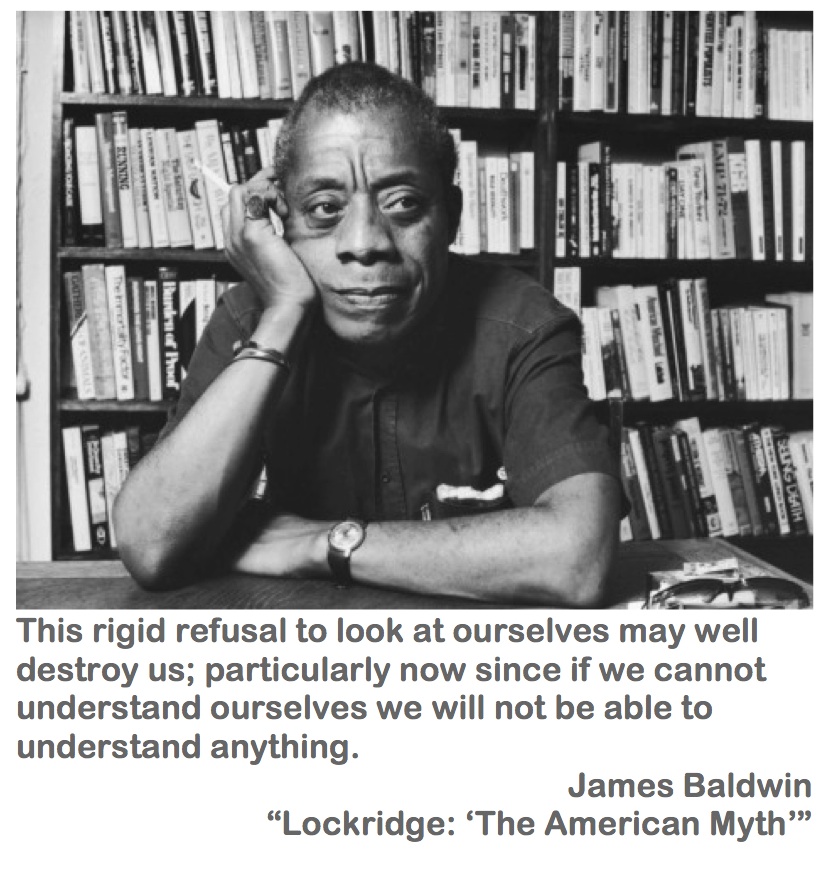
And thus, here is another hint: In this Groundhog Day adventure in standards [2], there has been absolutely no absence of solid evidence-based and critical responses to the Common Core movement. The problem, repeated again by this Brookings report, is the “rigid refusal” to acknowledge the failure of the accountability/standards/high-stakes testing silo approach to education reform.

Along with suggesting you read Greene, then, let me offer a reader, one I am certain will once again be ignored since it makes a case the education reform crowd simply does not want to acknowledge:

Finally, there is a nugget in this Brookings misfire that deserves some attention:

Despite largely falling off the political radar (neither President Trump nor Secretary DeVos has talked much about Common Core in the last year except to say that it is dead),[3] the standards are still an important topic. More than 40 states are still implementing the standards or a very close variant thereof.[4] Billions are still being spent on curriculum materials and professional development.

As I noted in the AlterNet piece linked above, the pursuit of better (and ever-new) standards and better (and ever-new) high-stakes tests is mostly a financial boondoggle for the textbook and testing industries as well as a careless financial drain on educational funding (tax-payers’ money).

Framing any standards debate, then, as simply a PR problem is more than lazy; it is careless and ultimately yet another remedy that is part of the disease.


[1] Bitter Lessons from Chasing Better Tests

[2] I am seeking a second-level metaphor since Greene aptly used the zombie comparison.

The Politics of Education Policy: Even More Beware the Technocrats

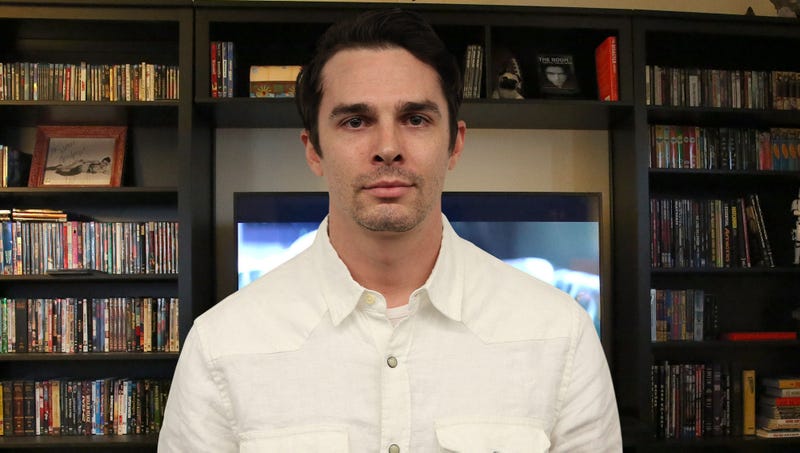
Man Prefers Comic Books That Don’t Insert Politics Into Stories About Government-Engineered Agents Of War (The Onion) includes a simple picture of a 31-year-old white male with the hint of a soon-to-be Van Dyke:

The fictional “man,” Jeremy Land, explains:

“I’m tired of simply trying to enjoy escapist stories in which people are tortured and experimented upon at black sites run by authoritarian governments, only to have the creators cram political messages down my throat,” said Land, 31, who added that Marvel’s recent additions of female, LGBTQ, and racially diverse characters to long-running story arcs about tyrannical regimes turning social outsiders into powerful killing machines felt like PC propaganda run amok. “Look, I get that politics is some people’s thing, but I just want to read good stories about people whose position outside society makes them easy prey for tests run by amoral government scientists—without a heavy-handed allegory for the Tuskegee Study thrown in. Why can’t comics be like they used to and just present worlds where superheroes and villains, who were clearly avatars for the values of capitalism, communism, or fascism, battle each other in narratives that explicitly mirrored the complex geopolitical dynamics of the Cold War?”

The satire here is the whitesplaining/mansplaining inherent in the politics of calling for no politics.

It strains the imagination only slightly to understand how this commentary on comic book fanboys also parallels the persistent combination in education of calling for no politics while using policy and a narrow definition of data and evidence to mask the racial and gender politics of formal schooling.

Let’s imagine, then, instead of the fictional Land an image of David Coleman (who parlayed his Common Core boondoggle into a cushy tenure as the head of the College Board) or John Hattie (he of the “poverty and class size do not matter” cults that provide Hattie with a gravy train as guru-consultant).

A close reading of David Coleman’s mug shot reveals a whole lot of smug.
In his “visible learning” hustle, John Hattie likely prefers to keep his enormous profits invisible.

Coleman and Hattie as technocrats feed the systemic racism, classism, and sexism in formal education policy and practice by striking and perpetuating an objective pose that serves as a veneer for the normalized politics of political and economic elites in the U.S.

As Daniel E. Ferguson examines, Coleman’s Common Core propaganda, the rebranded traditional mis-use of New Criticism into “close reading,” argues:

Close reading, as it appears in the Common Core, requires readers to emphasize “what lies within the four corners of the text” and de-emphasize their own perspective, background, and biases in order to uncover the author’s meaning in the text.

However, Ferguson adds,

Critical reading, in contrast, concerns itself with those very differences between what does and does not appear in the text. Critical reading includes close reading; critical reading is close reading of both what lies within and outside of the text. For Paulo Freire, critical reading means that “reading the world always precedes reading the word, and reading the word implies continually reading the world.”

And thus, close reading serves the cult of efficiency found in the high-stakes standardized testing industry that depends on the allure of believing all texts have singular meanings that can be assessed in multiple-choice formats—a dymanic Ferguson unmasks: “The story beyond the four corners of Coleman’s video is one of a man whose agenda is served by teachers following a curriculum that requires students to read in a way assessable through standardized tests he oversees and profits from.”

Simultaneously, of course, keeping students and teachers laser-focused on text only detracts them from the richer context of Martin Luther King Jr. and the broader implications of racism and classism informed by and informing King’s radical agenda.

Simply stated, close reading is a political agenda embedded in the discourse of objectivity that whitewashes King and denies voice and agency to King, teachers, and students.

Concurrently, Hattie’s catch phrase, “visible learning,” serves the same political agenda: Nothing matters unless we can observe and quantify it (of course, conveniently omitting that this act itself determines what is allowed to be seen—not the impact of poverty or the consequences of inequity, of course).

Hattie’s garbled research and data [1] match the recent efforts in education reform to isolate student learning as the value added (VAM) by individual teachers, yet another off-spring of the cult of efficiency manifested in high-stakes standardized testing.

Just as many have debunked the soundness of Hattie’s data and statistics, the VAM experiment has almost entirely failed to produce the outcomes it promised (see the school choice movement, the charter school movement, the standards movement, etc.).

Coleman and Hattie work to control what counts and what matters—the ultimate in politics—and thus are welcomed resources for those benefitting from inequity and wishing to keep everyone’s gaze on anything except that inequity.

The misogyny and racism among comic book fanboys allows the sort of political ignorance reflected in The Onion‘s satire.  If we remain “within the four corners of the text” of Marvel’s Captain America, for example, we are ignoring that, as I have examined, “Captain America has always been a fascist. … But … Captain America has always been our fascist, and that is all that matters.”

3e281
Captain America: Steve Rogers #1 (c) Marvel

The politics of education policy seeks to point the accusatory finger at other people’s politics, and that politics of policy is served by the technocrats, such as Coleman and Hattie, who feed and are fed by the lie of objectivity, the lie of no politics.


[1] See the following reviews and critiques of Hattie’s work:

The Fourth Lie, and What Hope Truth?

The irony of truth may often be more impressive than truth itself. Consider the pithy truism “There are three kinds of lies: lies, damned lies, and statistics.”

While the snark of this aphorism certainly spurs us toward a kind of truth about the misuse of numbers, ironically, the words themselves are typically associated with Mark Twain, who did popularize the phrasing, but certainly was not the original source; and to make this more complex, it seems no clear source has been identified.

And while it is now in vogue to debate the rise of fake news and how we find ourselves in a post-truth society, the jumbled relationship between mainstream media and truth/fake news reaches well back into the 1800s.

We seem unable even to face the truth about fake news.

As an educator and writer (one who ventures, foolishly, into public discourse), I have a long and frustrating relationship with a fourth kind of lie: Things people just believe, regardless of the evidence otherwise.

Over three decades, for example, I have talked patiently on the phone with education journalists—from The New York Times to state and local newspapers—who responded to evidence-based arguments with equal parts shock (“I have never heard that before”) and disbelief.

Here are some of the public claims I have doggedly shared for decades now:

  • Education is not the great equalizer; in fact, home and community conditions combined with race, gender, and other individual characteristics are far more powerful influences than school or teacher impact on both academic outcomes by students and then their status after formal education.
  • In-school education reform is destined to fail if out-of-school factors remain unaddressed due to a lack of political and public will to confront systemic inequity with public policy reform.
  • Accountability, standards (always changing), high-stakes testing (also, always changing), and grades are all flawed mechanisms for insuring universal public education in the pursuit of democracy, individual agency, and equity.
  • Formal schooling reflects and perpetuates the norms of community it serves; formal schooling almost never proves to be a change agent.
  • The type of schooling—public, charter, private—tends not to determine educational quality; school quality (typically determined by narrow measures such as student test scores) remains mostly bound to the characteristics of the students and communities being served. As a concurrent fact, there are no “miracle” schools.
  • Formal education must remain a commitment to public institutions; market forces are inappropriate for insuring all children have an equitable opportunity to learn.

Repeatedly, however, these claims, all strongly supported by significant bodies of research, elicit, at best, my being discounted as just a “critic,” and at worst, my being framed as some sort of enemy of reform out to protect anyone or anything except children, a cursed “defender of the status quo.”

And there was also too often crass nastiness, anger, and of course, lies.

Since education in practice is the result of state and public policy (driven, typically, by public and political narratives and beliefs—see lie four), here is a larger truism I have repeated for years with responses again running from disbelief to anger: The Obama education policy and discourse were just as misguided and harmful as the W. Bush education policy and discourse.

Toward the end of Obama’s administration, in fact, I had moved past skepticism and solidly into cynicism in terms of whether any journalists or politicians would set aside their beliefs (the fourth lie) and confront the truth about education and education reform.

However, in the fall of 2016, I noticed what I felt at the time was a crack in charter school support and began drafting a proposal that this was a harbinger of the end of the accountability era.

Before that piece was published, Trump was elected president, and my spark of hope soon looked like fool’s gold. In fact, I was embarrassed to have momentarily felt a glimmer of hope.

A year into Trumplandia, with a Department of Education and Secretary of Education that make the dumpster fires that were the DOE and SOE under W. Bush and Obama look like “the good ol’ days,” the irony has reached a new level.

Despite the market-based agenda under Trump/DeVos, the crack in charter school support has now been joined by mainstream pushback against testing and even grades; as well, recent arguments against the “tyranny of metrics” seem to match the case I and other educators/scholars have posed since the early 1980s when Reagan ushered in the accountability era for education reform.

Irony, in fact, seems to be trumped by the absurd—this from Trump-supporting South Carolina conservative (and Foghorn Leghorn impersonator) Governor Henry McMaster, as reported by Cindi Scoppe at The State:

So it was no surprise that the best part of [McMaster’s] first State of the State address was the way he framed public education. He could have been channeling so many teachers when he talked about the role poverty and parents play in how well children do in school. “Poverty,” he said, “is the enemy of education; some of our children, through no fault of their own, live in circumstances so bleak that intellectual stimulation and learning are but fleeting experiences. Ultimately, gainful employment of the parents or adults in the home offers the surest deliverance of the child into educated society.”

But he didn’t use that as an excuse for failure, noting instead that: “Good teachers and good principals clearly are the key to success. There is rarely a child who will not or cannot be taught. The key is not trying to pour knowledge in, but rather opening eyes and imaginations and letting eagerness and fascination out. A good teacher can do this.”

Unlike Scoppe, I am shocked, damned shocked.

Poverty, McMaster seems to concede, is an essential and powerful force determining the education of children in SC. But let’s also unpack that he still idealizes “[g]ood teachers and good principals” as “key[s] to success.”

Yes, teachers and principals matter, but as I have argued and as the evidence shows, they rarely have causal impact that can be measured because of out of school factors and other systemic forces such as racism and sexism.

And let’s not ignore that McMaster remains trapped in the fourth lie because he believes in market forces and fails to put his rhetoric into practice with actual policy (embracing instead tax cuts that certainly will erode any hopes of effective education policy).

Creeping into 2018, I am trying to regain my skepticism, a first step toward hope that truth can rise through all this muck, decades of muck.

Lies, I recognize, have the upper hand—lies, damned lies, statistics, and what people just stubbornly and blindly believe—but truth seems to be resilient.

At least it seems pretty to think so.

Research and Miscellaneous Roundup

Selective Exposure to Misinformation: Evidence from the consumption of fake news during the 2016 U.S. presidential campaign, Andrew Guess, Brendan Nyhan, and Jason Reifler

Abstract

Though some warnings about online “echo chambers” have been hyperbolic, tendencies toward selective exposure to politically congenial content are likely to extend to misinformation and to be exacerbated by social media platforms. We test this prediction using data on the factually dubious articles known as “fake news.” Using unique data combining survey responses with individual-level web traffic histories, we estimate that approximately 1 in 4 Americans visited a fake news website from October 7-November 14, 2016. Trump supporters visited the most fake news websites, which were overwhelmingly pro-Trump. However, fake news consumption was heavily concentrated among a small group — almost 6 in 10 visits to fake news websites came from the 10% of people with the most conservative online information diets. We also find that Facebook was a key vector of exposure to fake news and that fact-checks of fake news almost never reached its consumers.

Educational opportunity in early and middle childhood: Variation by place and age, Sean F. Reardon

Abstract

I use standardized test scores from roughly 45 million students to describe the temporal structure of educational opportunity in over 11,000 school districts—almost every district in the US. For each school district, I construct two measures: the average academic performance of students in grade 3 and the within-cohort growth in test scores from grade 3 to 8. I argue that third grade average test scores can be thought of as measures of the average extent of educational opportunities available to students in a community prior to age 9. Growth rates in average scores from grade 3 to 8 can be thought of as reflecting educational opportunities available to children in a school district between the ages of 9 and 14.

I document considerable variation among school districts in both average third grade scores and test score growth rates. Importantly, the two measures are uncorrelated, indicating that the characteristics of communities that provide high levels of early childhood educational opportunity are not the same as those that provide high opportunities for growth from third to eighth grade. This suggests that the role of schools in shaping educational opportunity varies across school districts. Moreover, the variation among districts in the two temporal opportunity dimensions implies that strategies to improve educational opportunity may need to target different age groups in different places. One additional implication of the low correlation between growth rates and average third grade scores is that measures of average test scores are likely very poor measures of school effectiveness. The growth measure I construct does not isolate the contribution of schools to children’s academic skills, but is likely closer to a measure of school effectiveness than are measures of average test scores.

Tax Bill Would Increase Abuse of Charitable Giving Deduction, with Private K-12 Schools as the Biggest Winners, Carl Davis

From Executive Summary

In its rush to pass a major rewrite of the tax code before year’s end, Congress appears likely to enact a “tax reform” that creates, or expands, a significant number of tax loopholes. One such loophole would reward some of the nation’s wealthiest individuals with a strategy for padding their own bank accounts by “donating” to support private K-12 schools. While a similar loophole exists under current law, its size and scope would be dramatically expanded by the legislation working its way through Congress.2 This report details how, as an indirect result of capping the deduction for state income taxes paid, the bill expected to emerge from the House-Senate Conference Committee would enlarge a loophole being abused by taxpayers who steer money into private K-12 school voucher funds. This loophole is available in 10 states: Alabama, Arizona, Georgia, Kansas, Montana, Oklahoma, Pennsylvania, Rhode Island, South Carolina, and Virginia.

The Sound of White Silence, @michaelharriot

White is a blank space.

It is the unwritten adjective that filled the infinite and simultaneously minuscule void between “all” and “men” when our founding fathers so eloquently declared their independence. The word “white” is not included in the Constitution, but it is understood by all to be the unmentioned modifier in “we the people.” It is our national equivalent to the aphonic letter “e.” We could always see it, but as a country we agreed to adhere to the first rule of American phonetics:

The “white” is silent.

The Nature and Aim of Fiction, Flannery O’Connor

People have a habit of saying, “What is the theme of your story?” and they expect you to give them a statement: “The theme of my story is the economic pressure of the machine on the middle class”—or some such absurdity. And when they’ve got a statement like that, they go off happy and feel it is no longer necessary to read the story.

Some people have the notion that you read the story and then climb out of it into the meaning, but for the fiction writer himself the whole story is the meaning, because it is an experience, not an abstraction.


Scholarship, “Lived Reality,” and “the Validity of a Thing”

In the beginning of my experiment as a public intellectual, I was a lowly high school English teacher who on occasion had a letter to the editor in the Herald-Journal (Spartanburg, SC).

These brief efforts at speaking to a general public as an informed voice taught me some valuable and enduring lessons—one of which included feedback from that general public.

My letters to the editor prompted long, rambling messages on my phone answering machine and incoherent typed letters mailed to my home and the high school where I taught.

Many of the phone messages were irate retired people who proved beyond a shadow of a doubt that they had no real understanding of Social Security or the workings of government and the free market. The typed letters (some on manual typewriters) were often single-spaced with almost no margins and punctuated with slurs and threats.

One frequent letter writer opened his diatribe with “Dear African American Homosexual”—all meant as slurs, and none accurately identifying me.

These early experiences with being misunderstood and ineffective were mostly interactions with anonymous and angry readers.

Eventually, mostly because I moved to higher education after earning my doctorate (although only a lowly EdD), I have been afforded a larger stage—Op-Eds in local, state, and national publications as well as a well-read personal blog, invited public and university-based talks, and a substantial collection of published work.

Responses to my public claims, now, are typically not as often public, but those responses continue to teach me valuable lessons—mostly how often and how easily words and claims can be misunderstood and even work in ways that are the opposite of my intent.

Here I want to examine two experiences, one from 2014 and another recent, that help shape who I seek to be as a person, a writer, a teacher, and a scholar.

First, some context.

As a redneck from rural South Carolina who had working-class parents, attended state universities, and has embraced critical pedagogy as my scholarly self, I am regularly marginalized in scholarly and academic contexts because of those identities; my writing is brushed aside as “polemics,” and my Southern drawl is noted with passive-aggressive disdain.

In personal spaces with family and friends as well as in my public writing and speaking, I am there marginalized as “just a scholar”—another pointed-headed intellectual with no real-world experience.

Let me stress here that as a white man with an advanced degree and a prestigious position at a universities, I am acknowledging these experiences but in no way suggesting they are nearly as consequential as simply being a woman, a person of color, or gay (for example). This is not a whine-fest, but I am trying to discuss the challenges of navigating public spaces as a perceived scholar.

Several years ago, I was invited to speak at the University of Arkansas by good friends who are professors there; I had written a book on poverty, and they were kind enough to ask me to speak at a week-long focus on poverty and education.

The University of Arkansas happens also to be home to a Walton-funded graduate department that is staffed by faculty who universally reject my scholarly perspective, and in some cases, me specifically.

Based on that talk, some of those antagonistic professors mentioned me in a piece for Education Next. In their defense of “no excuses” ideologies (specifically KIPP charter schools, both of which I reject), they openly mischaracterized me in order to discredit me:

Like all charter schools, KIPP schools are chosen by parents, but critics fear that disadvantaged parents do not know enough to choose wisely, or else do not have their children’s best interest at heart. Leaving aside whether the critics patronize the people of color KIPP schools serve, we propose that KIPP and similar schools are not nearly as militaristic as critics, who may have never been inside them, fear.

Recently, Andre Perry has confronted that charter advocates tend to smear critics of charter schools as “against parental choice,” something I have examined critically as well.

Even though I am skeptical of most charter and choice advocates, I learned an important lesson, and was confronted with a real dilemma: How do I challenge charter schools and “no excuses” ideologies in the context of black, brown, and poor families voluntarily choosing them?

Michelle Alexander offered me a solution in her confronting of The New Jim Crow:

This last point – that African Americans seem to support both the war on crime and “no excuses” charter schools – presents the most problematic aspect of charges that mass incarceration and education reform are ultimately racist, significant contributions to the New Jim Crow.

For example, Carr reports that African American parents not only choose “no excuses” charter schools in New Orleans, but also actively cheer and encourage the authoritarian policies voiced by the schools’ administrators. But Alexander states, “Given the dilemma facing poor black communities, it is inaccurate to say that black people ‘support’ mass incarceration or ‘get-tough’ policies” because “if the only choice that is offered blacks is rampant crime or more prisons, the predictable (and understandable) answer will be ‘more prisons.’ ” (p. 210)

New Orleans serves as a stark example of how this dynamic works in education reform: Given the choice between segregated, underfunded and deteriorating public schools and “no excuses” charters – and not the choice of the school environments and offerings found in many elite private schools – the predictable answer is “no excuses” charters. (Education Reform in the New Jim Crow Era)

As a result, I now try to frame my rejecting of charter schools and “no excuses” by clarifying that all parents regardless of social class or race deserve high-quality schools without need to choose or compete; I also confront directly how choice advocates tend to embrace a false choice (as exposed by Alexander).

My second example happened just yesterday on Twitter when Angela Dye and I interacted about the “word gap,” which I have often rejected.

I consider Dye a comrade, virtual colleague, and someone whose public voice informs my own; in those ways, this experience was not like the one above, but it forced me once again to confront how good intentions are not enough, especially when that intent is perceived as silencing or ignoring the exact people I seek to support.

Several of Dye’s comments are powerful checks on how I have examined the “word gap”:

You’re talking as a scholar. I respect that. I’m talking as a person living in a specific community with a specific lived reality. I’m hoping the respect can be mutual.

— Angela Dye, PhD (@ejuc8or) December 25, 2017

It pains me when we limit the validity of a thing to research–silencing or debating the voices of those living it.

— Angela Dye, PhD (@ejuc8or) December 25, 2017

So you have to excuse me if I am unwilling to invalidate an experience because “research” doesn’t prove it.

— Angela Dye, PhD (@ejuc8or) December 25, 2017

This Twitter moment also serves to prove John Warner’s point about the value of social media.

Dye’s challenges asked me to reconsider how my work perpetuated the voice of a scholar that uses research to “invalidate” “lived reality”—especially since I in no way sought to have that impact.

Just as I have afforded a fuller context to my rejecting charter schools and “no excuses,” I must seek ways to examine the “word gap” with Dye’s powerful concerns in mind.

Rejecting the “word gap,” I must clarify, is not rejecting the lived reality of significant and consequential differences among the social classes in terms of literacy. Yes, people living in poverty are denied access to and marginalized by privileged language.

Too often formal education works to perpetuate that equity gap resulting in the so-called “word gap” that works as a term and in reality similar to the “achievement gap.”

This lived reality in which some people due to race and social class are excluded from life, liberty, and the pursuit of happiness through formal gatekeeping of who has access to privileged language and who does not, I think, is what Dye is speaking for and through.

So as I navigate still how to express more clearly why I reject the “word gap” as a term and how it works against marginalized and vulnerable populations, I offer two contexts for what I am rejecting.

First, Virginia Eubanks confronts in The Digital Poorhouse:

The most marginalized in our society face higher levels of data collection when they access public benefits, walk through heavily policed neighborhoods, enter the health care system, or cross national borders. That data reinforces their marginality when it is used to target them for extra scrutiny. Groups seen as undeserving of social support and political inclusion are singled out for punitive public policy and more intense surveillance, and the cycle begins again. It is a feedback loop of injustice.

And, Annette Lareau unpacks in Unequal Childhoods: Class, Race, and Family Life (see online)

The differences are striking….

Neither the approach of concerted cultivation or the accomplishment of natural growth is without flaws. Both have strengths and weaknesses [emphasis added]. Middle-class children, for example, are often exhausted, have vicious fights with siblings, and do not have as much contact with their extended families as working-class and poor children. But when children enter institutions such as schools and health care settings, the strategy of middle-class child rearing of concerted cultivation is far more in compliance with the current standards of professionals than is the approach of the accomplishment of natural growth. There are signs that middle-class children gain advantages, including potentially in the world of work, from the experience of concerted cultivation. Working-class and poor children do not gain this benefit.

Therefore, I argue that the “word gap” fails for the following reasons:

  • Literacy is reduced and distorted to quantifying vocabulary (data collecting) as the sole proxy for literacy. Literacy is far more complex.
  • That use of data serves to frame poor children and their parents as having incomplete or inadequate literacy and idealizes middle-class and affluent literacy without acknowledging that this imbalance is an issue of power.
  • The “word gap” keeps the evaluative gaze on children and their parents (how to give the children more vocabulary and how to blame poor parents for literacy-deficient homes) and allows education and education reform to remain focused on “fixing” children and their parents and in-school reform only while ignoring the larger and more powerful social inequities reflected in schools and homes.
  • Research confirming the “word gap,” notably by Hart and Risley, is compelling not because of the quality of the research but because it confirms race and class biases in both conservative and liberal narratives. Media/journalists, pundits, and the public rush to cite Hart and Risley for reasons that must be unpacked—even as we acknowledge the inequities of literacy correlated with social class.

Because of an uncritical embracing of the “word gap” as a concept (not the acknowledging of the inequity of literacy among social classes), vulnerable populations of students have been mis-served through reductive vocabulary drill-and-kill, narrow high-stakes testing, and the lack of political will to address their access to rich literacy in their homes, communities, and schools (experiences afforded middle-class and affluent children that results in their identifiable vocabulary differences).

Because of an uncritical embracing of the “word gap” as a concept (not the acknowledging of the inequity of literacy among social classes), poor children and families are characterized primarily through deficit lenses that ignore their literacy strengths that simply do not match privileged literacy.

Because of an uncritical embracing of the “word gap” as a concept (not the acknowledging of the inequity of literacy among social classes), the barriers to literacy, academic, economic, and judicial equity remain mostly unexamined—out of sight, out of mind.

By confronting scholarly debates about the “word gap,” Dye has exposed the problematic relationship among scholarship, “lived reality,” and “the validity of a thing.”

I must do a better job with that dynamic if I want to be the sort of voice for social equity and justice that I seek to be.

UPDATE

Angela Dye has taken the exchange above and examined how our Twitter interaction confronts a tension around public discourse and elements of power and privilege; see Pissing on My Pee.


For Further Reading

What These Children Are Like, Ralph Ellison

If Black English Isn’t a Language, Then Tell Me, What Is?, James Baldwin

“Minimally Adequate” in SC: Funding and Understanding Public Education

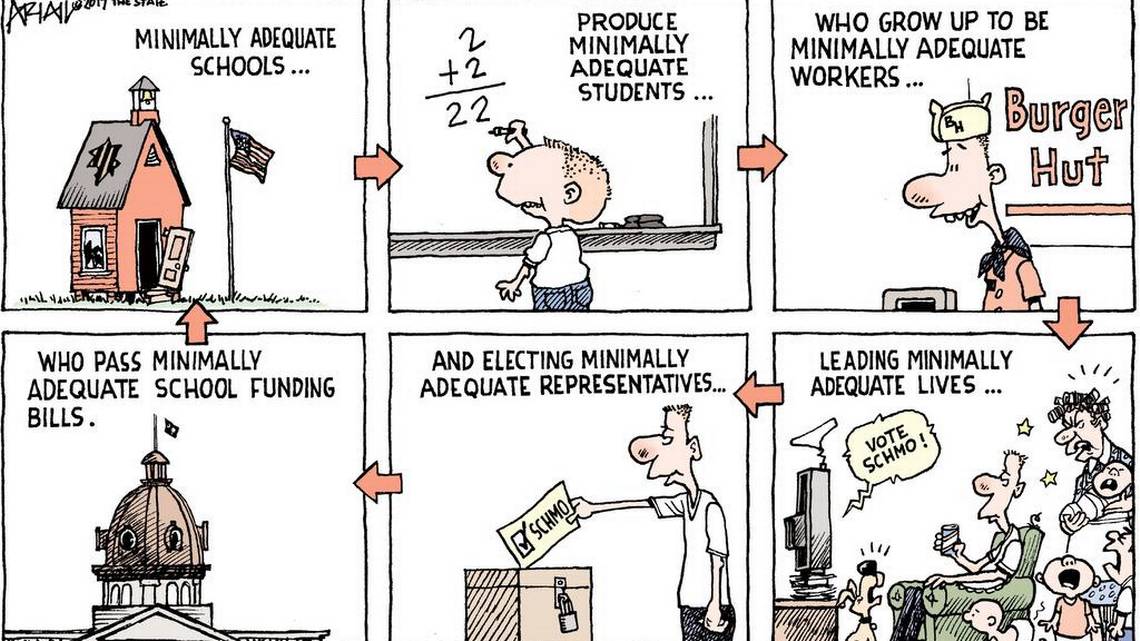
At first blush, Robert Ariail’s political cartoon in The State (15 December 2017) warrants praise for unpacking South Carolina’s historical political and judicial negligence in terms of public education:

aria171215_cmykx

Taken at the most basic level, a case for equitably funding all public schools in the state so that all students receive what has become the bar—”minimally adequate”—seems beyond reproach.

However, looking panel-by-panel at the implications and assumptions in Ariail’s cartoon exposes that too often the media and public argument for public school funding are also “minimally adequate.”

First, I want to acknowledge that the political cartoon as a form is a challenge that depends on concision, like poetry and Op-Eds. That concision in visual form works through representation and symbolism.

My concerns here are not with Ariail’s skills as a political cartoonist or his broad intentions (advocacy for equitable school funding), but my recurring criticism is that even the best and most ardent in the media have fundamental misunderstandings about education that mars their efforts to support public education, reform, and funding.

The first panel captures the essential flaw with “minimally adequate” through showing a school house in disrepair. This triggers another sincere but deeply flawed effort to support public schools in SC—The Corridor of Shame documentary that proves to be mostly emotional pandering and itself a vehicle for perpetuating horrible stereotypes and misinformation about public education, children and families in poverty, and the role of teachers in high-quality education.

None the less, panel 1 confronts the current and historical problems with “minimally adequate” funding as that approach remains inequitable across the state, primarily for children of color and the poor. But while fully funding school buildings is neglected in the state, the greatest funding issues remain hiring and retaining high-quality teachers and then insuring that all students have access to small class sizes as well as veteran certified teachers.

Panels 2, 3, and 4 offer a much more complicated and flawed case for funding schools.

First, panel 2 suggests that schools alone produce student quality. The truth is far more complicated since measurable student quality is driven mostly (60%) by out-of-school (OOS) factors—the home and community—with teacher (10-15%) and school quality (20%) constituting a much smaller role that cannot counter the greater OOS influences.

Panel 3 is a popular, but misguided belief that formal schooling and worker quality are directly and causally related; they are not. Gerald Bracey and others have documented for years the myth that so-called educational quality, workforce quality, and the economy are strongly inter-related. Here, the problem is seeing formal education as mostly about preparing workers (instead of the larger call for schools contributing to our democracy) and failing to recognize that worker quality and the economy are much more influenced by public policy than schools.

While SC is negligent about equitable funding of schools, the state is horribly negligent about workers’ rights, creating high-quality and stable jobs, and sustaining a stable economy for all levels of workers—regardless of the education they receive in the first 18-22 years of their lives.

So by panel 4, our entire gaze is on the impact of schools on the lives of everyone; the myth of education as the “great equalizer” is perpetuated by the cartoon—a belief that is fully discredited by the evidence that being white and relatively affluent trump effort (educational attainment) and that the US remains significantly inequitable by race, social class, and gender (again, regardless of education attained).

Ariail is being clever in panels 5 and 6, and the cyclic message of the entire cartoon. I am, however, ultimately troubled by how often even sincere advocates for public education and equitable funding of our schools tend to depend on false and misleading arguments in their advocacy.

The media, especially edujournalism, in fact, are too often both willing and unaware accomplices in the political and judicial negligence in SC and across the US in terms of failing to acknowledge the foundational purpose of universal public education (to create and preserve the democracy) and to advocate for human agency and the broader need for social equity in the state and the country.

It is simultaneously true that states and the country as a whole have failed public education (it has not failed us) and that education will never be the great equalizer or a silver bullet for the entrenched social and political failures of America.

The time is far past due to focus on equitable funding and support for all schools as a social contract with every family and child in every state of the US. But with that, we must also begin to be honest and clear with our advocacy—schools are not now and have never been an institution we can treat as separate from all of society or one that drives the entire society.

Our schools both reflect and perpetuate what matters to the political leadership of the state, but formal education is rarely revolutionary or a change agent since it is a mechanism of the political system.

Schools are being neglected, and then some children are being neglected in SC as they have been for decades; those children and their families are the most vulnerable among us because of racism and extreme poverty, and it is unconscionable that we persist in that negligence.

Sentiment without accuracy ultimately is part of the problem and not a path to the solution.

Segregation Surprise?: How Public and Charter Schools Have (Always) Failed

On social media, I witnessed charter advocates try to justify the exact failures Andre Perry unmasks in his Charter school leaders are complicit with segregation, and it’s hurting their movement, where he concludes:

Make no mistake, segregated schools of the past and present are a result of horrible policy choices that most people are willing to accept. There is a reason that after more than 20 years, the research is mixed on charter schools. Schools in black and brown communities were built on broken foundations — i.e., segregation. By not addressing segregation, reformers are turning off the stove when the house is going up in flames.

Perry was having none of it, the apologists’ dissembling, but was far more patient and willing to engage this nonsense than I.

I also have no energy left to revisit this again, except to point out that finding it surprising that both traditional public schools and charter schools are failing the most vulnerable populations of students—often black, brown, poor, speakers of home languages other than English, and having special needs—requires being willfully ignorant of decades of evidence.

And thus, what the rabid edureformers have willfully ignored for quite some time:

Made in America: Segregation by Design

Segregation and Charter Schools: A Reader

Public School, Charter Choice: More Segregation by Design

Endgame: Disaster Capitalism, New Orleans, and the Charter Scam

Racial segregation returns to US schools, 60 years after the Supreme Court banned it

Education Reform in the New Jim Crow Era

As Perry confronts, edureformers are embodiments of one of the most powerful warnings from James Baldwin:

28 November 2017 Education Reader

I am the teacher South Carolina wants to retain, and I am barely hanging on, Rachel Caulder

Teachers need autonomy. Thankfully, I teach in a school that does not use curriculum alignment documents or strict pacing guides, and my administration values the judgment of teachers within our classrooms. Teachers in districts that are solely focused on numbers are restricted, and students suffer because no allowance is made for differentiation or reteaching for content-mastery. In districts with strict pacing guides, teachers are left with no option but to stay the course — even when they know they are failing their students.

Why do schools use grades that teach nothing? Jonathan Lash

At the college where I serve as president, we do evaluate student work; we just use a higher-quality method. Our students receive written evaluations not only on every assignment, but also for every course and learning activity. These evaluations are designed to be formative teaching tools.

For similar reasons, we completely stopped accepting SAT and ACT for admissions two years ago, after an internal study revealed standardized test scores are poor predictors of student success at Hampshire. We also recognized the bias of standardized tests against low-income students, and the negative influence of standardized testing on education.

A North Carolina Teacher’s Guest Post on His/Her EVAAS Scores

NEPC Review: Tackling Gaps in Access to Strong Teachers: What State Leaders Can Do (The Education Trust, October 2017)

The Every Students Succeeds Act (ESSA) directs states and districts to identify equity gaps in students’ access to excellent educators and transformative school leaders. States are encouraged to use Title II funds strategically in order to identify and remedy these gaps. A new report from The Education Trust draws on ESSA documents and state teacher equity plans to provide guidance to state leaders, including some sound advice—but with significant omissions. The report does not engage with thorny issues around alternative pathways into teaching, and it largely skirts issues around incentives for supporting teacher recruitment and retention in hard-to-staff schools. The report also does not consider what attracts teachers into the profession and into particular school environments. Likewise, the report fails to draw on the explicit remedies sought by ESSA to link high-quality leadership with strong teacher recruitment and retention. Instead, the report casts the teacher equity problem primarily in terms of labor supply shortages and treats teachers like interchangeable widgets. Relying heavily on advocacy sources, it misses an opportunity to unpack the root causes of the teacher retention problem, particularly the corrosive impact of past federal and state policies on the teaching profession. The report does not help state leaders understand how they might build incentives and cultures that draw strong teachers into high-need schools, and they will thus be left with an incomplete and insufficient set of tools for ensuring that all students have equitable access to excellent educators.

Go public and perish? Supporting the engaged scholar, Jennifer Ditchburn

Despite the fact that university presidents and the people who run university communication departments are only too happy to have their scholars out building a profile, the academic system is not set up to help them connect with the public. Writing a piece for Maclean’s or appearing on CBC’s The National doesn’t count toward tenure or get you a promotion: publish or perish is about peer-reviewed journals and books.

Time for public engagement is not often budgeted into a professor’s employment – scholars do this on top of their personal and academic responsibilities (I always feel a bit sheepish when I approach a busy prof to write something for me). The challenges are arguably tougher for some women in academia, whose pursuit of tenure or awards is already interrupted by maternity leave or childcare responsibilities.

The Missing Link In Student Writing

Judicial Negligence Compounds Political Negligence in South Carolina

Conservative politics as a very thin veneer for racism and class warfare has long characterized the South, including South Carolina, regardless of party affiliation—once Democratic and now the same sort of recalcitrant Republican.

Strom Thurmond personified this ugly fact of my home state—him a brash racist and among the now seemingly endless line of powerful white men who also viewed and treated women as subhuman as well. The current disaster of Roy Moore stands as yet more of that same, embodying a crass blend of political, judicial, and morally bankrupt popular in the South, the Bible Belt.

The twenty-first century, regretfully, has not exorcised these ghosts in the machine, as SC remains nearly a cartoon version of Southern stereotypes.

SC public schools (and public universities, in fact) exist in 2017 as a bold middle finger to everything promised by a democratic nation. But despite the political rhetoric, SC has failed its public schools; public schools have not failed our state, whose political leaders care none at all about poor, black, or brown children being currently (and historically) mis-served by K-12 education.

Political negligence of public schools—or more accurately, negligence of public schools that serve the most vulnerable children and communities in the state—is one of the perverse traditions that defines SC.

That tradition has a willing accomplice in the judicial negligence of the state as well. Cindi Scoppe explains:

In the three years since the S.C. Supreme Court ruled that the Legislature had to provide a decent education to all children, one justice wrote in this month’s final chapter of the quarter-century-old school adequacy case, “we have had the benefit of seeing the defendants make steady progress toward remedying their failure to provide our state’s children with a minimally adequate education.”

Particularly encouraging, he wrote, is the fact that the state has “recently come to realize that merely pouring more money into an outmoded system will not lead to success.”

Popularized as the Corridor of Shame, political and judicial negligence actually thrives in pockets all over SC, not just along the I-95 corridor that does in many ways bisect the more affluent midlands and upper state from the crippling rural poverty dominating much of the lower state except for pockets of affluence in coastal havens for the wealthy and the riches of tourism.

The conservative ideology driving political negligence has withstood the slow drag of the courts in SC, which has now fallen lockstep into that same sterile argument about “pouring more money into an outmoded system”—as if SC has even flooded public institutions with money.

Political and judicial negligence in SC—a microcosm of the same negligence nationally—remains entrenched in commitments to ideology over evidence, hard truths neither political leadership nor judicial pronouncements will admit.

First, and foremost, one hard truth is that public schools in SC are mostly labeled failures or successes based on the coincidence of what communities and students those schools serve. Schools serving affluent (and mostly white) communities and students are framed as “good” schools while schools serving poor (and often black and brown while also over-serving English language learners and students with special needs) communities and students are framed as “bad” or “failing.”

This political lie is grounded in the three-decades political charade called education reform—a bureaucratic nightmare committed to accountability, standards, and testing as well as a false promise that in-school only reform could somehow overcome the negative consequences of social inequity driven by systemic racism, classism, and sexism.

The ironic and cruel lesson of education reform has been that education is not the great equalizer.

Education reform is nothing more than a conservative political fetish, a gross good-ol’-boy system of lies and deception.

Second, and in most ways secondary, another hard truth is that while education is not the great equalizer, public schooling tends to reflect and then perpetuate the inequities that burden the lives of vulnerable children.

In-school only reform driven by accountability, standards, and testing fails by being both in-school only (no education reform will rise about an absence of social/policy reform that addresses racism and poverty) and mechanisms of inequity themselves.

Affluent and white students are apt to experience a higher quality of formal schooling than black, brown, and poor students, who tend to be tracked early and often into reduced conditions that include test-prep, “basic” courses, and teachers who are early career and often un-/under-certified.

Nested in this hard truth is that much of accountability-based education reform depends on high-stakes standardized testing, which is itself a deeply flawed and biased instrument. Tests allow political negligence since data appear to be objective and scientific; in fact, standardized testing remains race, class, and gender biased.

Like school quality, test scores are mostly a reflection of non-academic factors.

Ultimately, SC’s children and then the state itself are being cheated by a failure to admit hard truths. I agree, then, with the big picture conclusion drawn by Scoppe:

It was never clear to me whether our constitution requires the state to provide a good education to all children, or simply to operate public schools. What was always more than clear was that it is the job of the Legislature to provide an education to every child in this state. And that it is insane — and morally indefensible — not to provide a decent education to all children. What was always more than clear was that it is up to the Legislature not only to provide the funding but also, as Justices Beatty and Toal and Kay Hearn always emphasized, to make sure the districts are organized appropriately and school officials have the right powers and duties and we have the right laws about what is taught and how it is taught and that the problems are corrected when the schools don’t deliver.

This is a moral imperative about children, about human dignity and agency.

Let me end with the ignored but obvious hard truth: Education funding matters, but doing the same thing over and over while expecting different results is insanity.

Millions and millions of tax dollars in SC have been squandered on ever-new standards and ever-new tests; where is the political and judicial rhetoric about that? SC for decades now has spent hundreds of thousands of dollars on school report card that have accomplished nothing except demonizing schools that happen to serve poor and black/brown children.

SC must seek instead the political will to implement first social policy that addresses the scar of poverty and racism in our state. Concurrent with that, education reform must end its affair with accountability and begin a journey committed to education equity.

Our children deserve more than the accidents of their births, and then, as a people, we owe every child an equitable and challenging education that invites them into an honest attempt at democracy and freedom.

Political and judicial negligence is inexcusable, but remains a SC tradition.