Category Archives: education reform

Rethinking Literacy (and All) Assessment

To whatever degree I have been an effective teacher over a 33-year (and counting) career directly and indirectly connected to teaching literacy has been grounded in my inclination to assess constantly my practices against my instructional goals.

Teaching is some combination of curriculum (content, the what of teaching), instruction (pedagogy, the how of teaching), and assessment (testing, the monitoring of learning). When I was in teacher education as a candidate, the world of teaching was laser-focused on instruction—our learning objectives scrutinized and driving everything.

Over the three decades of accountability grounded in standards and high-stakes testing, however, and the rise of backward design, both how students are tested (test formats) and what tests address have become the primary focus of K-12 teaching.

Accountability’s state and national impact has increased the importance of standardized testing—the amount of tests students are required to take but also the format of in-class assessments teachers use to prepare students for those tests.

High-stakes and large-scale testing is governed in many ways by efficiency—formats such as multiple choice that can be marked by computer; and therefore, many K-12 teachers model their assessment content and formats on what students will face in these high-stakes environments.

Over my career, then, I have watched teaching to the test move from a practice shunned by best practice to the default norm of K-12 education.

As a committed practitioner of de-grading and de-testing the classroom, I offer below some big picture concepts that I believe every teacher should consider in order to improve the quality of grading and testing practices, in terms of if and how our assessments match our instructional goals instead of how efficient our tests are or how well our classroom assessments prepare students for (really awful) large-scale high-stakes tests.

The principles and practices below are imperative for literacy instruction and learning, but apply equally well to all learning goals and content.

Holistic v. skills (standardized tests). Let’s imagine for a moment that you wish to learn to play the piano, and you are given lessons on scales, proper fingering, etc., using worksheets. After a unit on playing the piano, you are given a multiple-choice test on that material, scoring an A. 

Having never played the piano or practiced at the piano, what do you think of that A?

To be proficient in the context of efficient skills-based tests is not the same as being proficient in holistic behaviors. While the testing industry has sold us on the idea that efficient skills-based tests (usually multiple choice) correlate strongly with the authentic goals for learning we seek, we should be far more skeptical of that claim.

Along with the problem of efficiency in standardized tests and selected-response tests in class-based assessment is the historical and current purposes of large-scale testing—for example, IQ and college entrance exams such as the SAT and ACT.

IQ testing has its roots in identifying low academic ability (identifying people who were expendable) and has never overcome problems with race, class, and gender bias.

College entrance exams began as a process for distinguishing among top students; therefore, test items that create spread are “good,” regardless of how well the question achieves our instructional goals.

For classroom teachers who seek assessments that support better teaching and learning, then, we should be seeking to assess in holistic ways first, and then to expose students to the formats and expectations of high-stakes testing.

One goal for rethinking assessment is to emphasize allowing and requiring students to practice whole behaviors (composing original texts, reading full texts by choice, etc.) and then to assess students’ levels of proficiency by asking them to repeat whole behaviors in testing situations.

Accomplishment v. deficit perspective. I am certain we have all experienced and many of us have practiced this standard approach to grading a student’s test: Marking with an “X” the missed items and then totaling the grade somewhere on the sheet, such as 100 – 35 = 65.

Let’s consider for a moment the assumptions and implications (as well as negative consequences) of this process.

First, this implies that students begin tests with 100 points—for doing nothing. Further, that creates an environment in which students are trying not to lose something they did not earn to begin with.

Now, a much more honest and healthy process for all assessments is that students begin with zero, nothing, and then the teacher evaluates the test for what the student accomplishes, not looking for and marking errors (something Connie Weaver calls, and rejects, as the “error hunt”).

By avoiding a deficit perspective (starting with 100 and marking errors) and embracing an accomplishment perspective (starting with zero and giving credit for achievement), we are highlighting what our students know and helping them to overcome risk aversion fostered by traditional (behavioral) practices in school.

Moving toward an accomplishment perspective is particularly vital for literacy development since taking risks is essential for growth. It is particularly powerful when giving feedback on and grading student writing (I learned this method during Advanced Placement training on scoring written responses to the exam).

Collaboration v. isolation. “[T]he knowledge we use resides in the community,” explains Gareth Cook, examining Steven Sloman and Philip Fernbach’s The Knowledge Illusion: Why We Never Think Alone, adding, “We participate in a community of knowledge. Thinking isn’t done by individuals; it is done by communities.”

However, traditional approaches to assessment are nearly always done in isolation; collaboration in testing situations is deemed cheating, in fact.

Consider for a moment your own lives as readers and writers. What do we love to do when reading a new novel? Talk with a trusted friend about the book, right? Community and collaboration fuel a better understanding of the work.

When writing, feedback is essential, another eye on our ideas, an uninvested editor to catch our mistakes.

While many of us have embraced community and collaboration in our instruction—implementing workshops or elements of workshops—we rarely allow collaboration in assessment.

See this post for an example of collaborative assessment in my introductory education course.

Feedback v. grades. One of the most frustrating aspects of practicing a de-graded classroom is that my students often identify on their opinion surveys of my courses that I do not provide adequate feedback—because they conflate grades (which I do not give throughout the semester) with actual feedback on their assignments (which I do offer, abundantly and quickly).

Most teachers, I believe, spend far too much time grading and then students receive insufficient feedback that requires them to interact with and learn from that help.

One element of my concern is that when teachers provide extensive feedback on graded work, most students check the grade and do not engage at all with the feedback; this is a waste of the teacher’s time and not contributing to student learning.

Ideally, we should be providing ample and manageable feedback on work that requires students to address that feedback, either in some response or through revision (see below).

For literacy instruction, fore-fronting feedback, requiring and allowing revision, and then delaying grades all support a much more effective process than traditional grading.

Revision v. summative assessment. That process above embraces revision over summative grading.

Whole literacy experiences, low-stakes environments that encourage risk, high-proficiency modeling and mentoring, and then opportunities to try again, to revise—these are the tenets of powerful and effective literacy instruction and assessment.

When students experience reading and writing as one-shot events mainly produced to be graded, they are cheated out of the awareness that literacy is cyclical, and recursive—to read and then to read again, to write and then to write again.

For Paulo Freire, literacy is agency, empowerment; we must read the world and re-read the world, write and re-write the world.

At the very least, we should decrease summative assessments and grading while increasing how often we require and allow revision.

Many argue that reducing grading also removes necessary accountability for student engagement, and while I find these arguments less compelling, I do replace my use of grades with minimum requirements for credit in any class or course. And I use those minimum requirements to emphasize the aspects of learning experiences I believe are most important.

Therefore, drafting of essays and revision are required, just as conferencing is.

Ultimately, our assessment and grading policies and practices send very strong messages about what matters in our classes; we must be diligent we are sending the messages we truly embrace.

Recalibrating grade scales (with a caveat) and no more averaging grades. Debates and policies about what numerical grades constitute each letter grade—such as whether a 90, a 93, or a 94 is the lower end of the A-range—are little more, to me, than rearranging chairs on the deck of the Titanic.

Instituting uniform grade scales in schools, districts, or entire states is unlikely to produce the results proponents claim; however, some policy moves concerning grades are both warranted and highly controversial—such as creating a floor score (such as a 50 or 62) for an F.

Rick Wormeli and others have very effectively demonstrated the inequity of traditional grading scales that have about 10 points per letter grade until the F, which may have 50-70 points.

Low numerical summative grades and the flawed practice of averaging grades have very negative consequences for students—the worst of which is creating a statistical death penalty for students early in a course that may encourage those students to stop trying.

Creating a floor grade on F’s is instructionally and statistically sound, then, but only if combined with the minimum requirement concept discussed above. In other words, converting a zero to 50 or 62 when a student does poorly on an assignment is not the same thing as converting a zero to 50 or 62 when a student submits no work at all.

The latter must not be allowed since students can game the system by doing no work until late in the grading period and depending on averages to produce a passing grade for the course.

Therein lies the failure of averaging grades.

Averages skew the weight of grades earned while learning instead of honoring the assessment or assessments after students have had ample time to learn, practice, and create a showcase artifact of learning.

As well, averages are not as representative of reality as modes, for example. Consider the following grades earned by a student: 10, 10, 85, 85, 85, 85, 85, 85, 100, 100.

The average for these grades is 73, but the mode is 85, and if these grades are earned in this order (10 early and the 100 last) on cumulative assessments, the 100 is also a potentially fair grade.

Grade and grade scales, then, are incredibly flawed in their traditional uses. Combining a revised, equitable numerical/letter grade structure (with minimum requirements of participation included) and choosing modes over averaging or portfolio assessment instead of averaging is recommended if de-grading is not an option.

The concepts above about rethinking assessment are effective ways to interrogate current assessment practices, and they are urgent for improving literacy instruction.

I do urge seeking ways to de-grade and de-test the classroom regardless of what is being taught, but in the real world, I recognize that goal may seem impossible.

The ways I offer above to rethink assessment, I believe, are quite practical and certainly are justifiable once we consider if and how our assessment practices do or don’t reflect our teaching and learning goals.

And thus: “A critical pedagogy asks us to reconsider grading entirely,” argues Sean Morris, “and if we can’t abandon it whole-hog, then we must revise how and why we grade.”

Our Gladiator Culture: On “Grit,” Competition, and Saving Future Generations

my father moved through griefs of joy;…
his shoulders marched against the dark

“my father moved through dooms of love,” e.e. cummings

This place could be beautiful,
right? You could make this place beautiful.

“Good Bones,” Maggie Smith

While sitting in the ER with my father a few nights ago before he was admitted into the hospitals’ heart center—a few days after my mother’s stroke sending her to another, larger hospital 40-minutes away—I was reminded of Alice Walker’s The Color Purple, a novel, among other things, about the abusive power imbalance between men and women.

Late in the novel, Celie explains to her sister Nettie: “Take off they pants, I say, and men look like frogs to me. No matter how you kiss ’em, as far as I’m concern, frogs is what they stay.”

The most powerful and imposing man in my life, my father, sat in the ER—stooped, shrunken, pot-bellied, tongue hanging out of his mouth and bowed head like an aged human-sized toad somehow in a wheelchair. My father has always been my physical and athletic superior, despite my being in my mid-50s and quite successful in my career and my athletic hobby; he has always cast a shadow, darkening my lingering insecurities and anxieties.

This morning, Father’s Day 2017, I visited my father still in the heart center after spending almost all my time at my mother’s side as the number of family members able to help has dwindled as the day-count grows. Although improved, frog-like and frail, my father declared to me: “Nothing is wrong with me. I need to go home.”

For some time now, his heart has been working at only about 33%, wearing him and his pacemaker out at an accelerated rate.

In times of great medical stress, when families are brought together, stories spring forth to stabilize the chaos and restore our delusion that we have some sort of control.

One of the many myths of my father: In high school, because of fights and sports (my father was a four-sport letterman and captain of his high school’s first state championship football team in the 1950s), by age 18, my father had a full set of false teeth. So many teeth had been knocked out, his dentist eventually pulled the remaining 10 or 12 one day.

After the procedure, my father played in a baseball game, prompting his father to track him down, trying to make him come home to rest.

Like him, my mother is a gendered twin of the fanatic 1950s template for self-sacrifice, rugged individualism, and blind faith in the whitewashed American Dream—the racialized lie about hard work paying off and good guys winning.

I believe I am not being hyperbolic to recognize that my parents lie now in hospitals, broken and frail, because they bought the hokum, the hard-work hokum that makes people define their dignity in how fervently they sacrifice themselves, in how they work moment by moment to prove they are not lazy, soft, or in any way dependent on others.

My parents passed onto me a neurotic work ethic; my father instilled in me an incredibly unhealthy obsession with being athletic as proof of my manhood.

Although I have been trying to ween myself off sports fandom, I remain often connected to the sports fanaticism of the U.S.—one most solidly grounded in college and pro football, the perfect metaphor for the gladiator culture that defines us.

Dragged kicking and screaming, college football and the NFL have begun paying lip-service to acknowledging that [gasp!] the sport is cruelly violent, that football players are turning their brains into mush because of the relentless concussions that are simply part of the game.

The stories linked to the concussion debate in football are powerful and disturbing because they reveal a subtext that also came to mind as I sat with each of my parents: pro football players, many retired, admit that they have and would continue to lie about concussion symptoms to remain on the field.

The gladiator culture of the U.S. is replicated exponentially in the NFL [1]—toxic and hyper-masculinity, anything necessary including sacrificing health and even life.

And while the NFL and football mania of the U.S. are disturbing, the most troubling reality is that our neo-work-ethic of the twenty-first century targets children, specifically black and brown children from impoverished backgrounds.

The “grit” and growth mindset movements have become (mainstream) socially acceptable ways to wink-wink-nod-nod that black, brown, and poor people are simply too lazy, unwilling to work themselves, like my dad and mom, into decrepitude for the 1%.

Frantic—we are a nation with a ruling class snowblinded by their own privilege and terrified they won’t have a servant class—the whitewashed American Dream for black, brown, and poor children.

The U.S. has devolved into a perverse and inverted gladiator culture with the 1% in the stands and the rest of us reduced to a dog-eat-dog existence, an artificial and unnecessary dog-eat-dog existence.

Visit the elderly of this country, worn down by the demands that they work hard and depend on no one.

Look into their faces and if you can their eyes.

This is the future we are demanding of “other people’s children.”

But it is also a future we can reject, choosing instead an ethic of community and compassion.

As I look at my parents—discardable white working class Americans—I think that they deserved better, despite their own culpability in our whitewashed American Dream.

On this awful Father’s Day 2017, I would prefer above all else to be on the couch with my granddaughter, who yesterday kept imploring me “Wake up, Papa!” as I tried to doze between sessions with my mother, as she snuggled against me, her futon.

I know she deserves better—as does every single child having come to this planet and country by no choice of their own.

“This place could be beautiful,/right? You could make this place beautiful”—a haunting image of everything that I wish for this world in a poem by Maggie Smith that confesses:

The world is at least
fifty percent terrible, and that’s a conservative
estimate, though I keep this from my children.

On this awful Father’s Day 2017, I have kept much from my father and my mother in ways substantial and indirect.

But there is no way to justify the lies we tell children—that they fail to work hard enough, that they are somehow not good enough unless they act as if they do not matter, that they should shut up and suck it up.

Few things are worth fighting for, but one is to keep every child from the gladiator’s ring, to promise every child if not a beautiful world, at least the possibility of one.


[1] In the same way the NFL promotes the great lie that the U.S. is a meritocracy:

Despite this, NFL Commissioner Roger Goodell rejected on Friday the idea that any kind of blackballing was taking place. He called the NFL “a meritocracy,” saying, “If they see an opportunity to get better as a football team, they’re going to do it. They’re going to do whatever it takes to make their football team better. So, those are football decisions. They’re made all the time. I believe that if a football team feels that Colin Kaepernick, or any other player, is going to improve that team, they’re going to do it.”

Reader 22 May 2017 [UPDATED]: Connecting Dots

Why people are rich and poor: Republicans and Democrats have very different views

See: UPDATE 21 (20 May 2017): Grit, Education Narratives Veneer for White, Wealth Privilege

Minorities Who ‘Whiten’ Résumés More Likely to Get Interview, Michael Harriot

“Whitening” is an all-encompassing term for when prospective employees scrub their résumés of anything that might indicate their race. Applicants with cultural names will sometimes use their initials. Community or professional work with African-American fraternities, sororities or other organizations are deleted. One student omitted a prestigious scholarship he was awarded because he feared it might reveal his race.

Although the practice sounds demeaning and reductive in the year 2017, apparently it works. In one study, researchers sent out whitened résumés and nonwhitened résumés to 1,600 employers. Twenty-five percent of black applicants received callbacks when their résumés were whitened, compared with 10 percent of the job seekers who left their ethnic details on the same résumés.

The results were the same for employers who advertised themselves as “equal opportunity employers” or said that “minorities are strongly encouraged to apply.”

Whitened Résumés: Race and Self-Presentation in the Labor Market, Sonia Kang, Katy DeCelles, András Tilcsik, and Sora Jun

Abstract

Racial discrimination in labor markets is a critical process through which organizations produce economic inequality in society. Though scholars have extensively examined the discriminatory decisions and practices of employers, the question of how job seekers try to adapt to anticipated discrimination is often overlooked. Using interviews, a laboratory experiment, and a résumé audit study, we examine racial minorities’ attempts to avoid discrimination by concealing or downplaying racial cues in job applications, a practice known as “résumé whitening.” While some minority job seekers reject this practice, others view it as essential and use a variety of whitening techniques. When targeting an employer that presents itself as valuing diversity, however, minority job applicants engage in relatively little résumé whitening and thus submit more racially transparent résumés. Yet, our audit study shows that organizational diversity statements are not actually associated with reduced discrimination against unwhitened résumés. Taken together, these findings suggest a paradox: Minorities may be particularly likely to experience disadvantage when they apply to ostensibly pro-diversity employers. These findings illuminate the role of racial concealment and transparency in modern labor markets and point to an important interplay between the self-presentation of employers and the self-presentation of job seekers in shaping economic inequality.


Experts: Conflicts over Confederate names and symbols likely to continue, Paul Hyde

But Thomas said school administrators should encourage student debate over historical figures such as Wade Hampton — as an important lesson in democracy.

“If we really think that public education is to prepare people to live in a democracy, children need to have experiences with democratic processes,” Thomas said. “I think this specific protest should be seen as an opportunity for students to see what the democratic process looks like, with everybody’s voice mattering. Principals and superintendents of public schools — they have incredibly hard jobs — but they are the people who have to show students what moral courage is. If administrators and teachers can’t show moral courage, how do we expect our children to?”

See: Dismantling Monuments: History as a Living Document


When Standardized Tests Don’t Count | Just Visiting, John  Warner

And yet, when it comes to marginalized and vulnerable populations within Charleston County Schools, these standardized assessments provide a rational for top-down oversight and control.

This is entirely common and predictable. “Accountability” is often weaponized against those without the means to defend themselves.

I have no wish to upend the academic culture of the Citadel over their terrible CLA scores, but maybe some of those who are willing to give our elite storied places a pass can extend the same spirit to those who have no such protections.

See Are America’s top schools ‘elite’ or merely ‘selective?’

Why The New Sat Is Not The Answer, Akil Bello and James Murphy

If anything, the discord between them is likely to grow as the College Board pursues an equitable society using a test that is designed to mark and promote distinctions.

For all the positive changes the College Board has made, the new SAT shouldn’t be counted among them. It is a test, not a solution.

Every attempt to manage academia makes it worse, Mike Taylor

The problem is a well-known one, and indeed one we have discussed here before: as soon as you try to measure how well people are doing, they will switch to optimising for whatever you’re measuring, rather than putting their best efforts into actually doing good work.

In fact, this phenomenon is so very well known and understood that it’s been given at least three different names by different people:

  • Goodhart’s Law is most succinct: “When a measure becomes a target, it ceases to be a good measure.”
  • Campbell’s Law is the most explicit: “The more any quantitative social indicator is used for social decision-making, the more subject it will be to corruption pressures and the more apt it will be to distort and corrupt the social processes it is intended to monitor.”
  • The Cobra Effect refers to the way that measures taken to improve a situation can directly make it worse.

America has locked up so many black people it has warped our sense of reality, Jeff Guo

According to a Wonkblog analysis of government statistics, about 1.6 percent of prime-age white men (25 to 54 years old) are institutionalized. If all those 590,000 people were recognized as unemployed, the unemployment rate for prime-age white men would increase from about 5 percent to 6.4 percent.

For prime-age black men, though, the unemployment rate would jump from 11 percent to 19 percent. That’s because a far higher fraction of black men — 7.7 percent, or 580,000 people — are institutionalized.

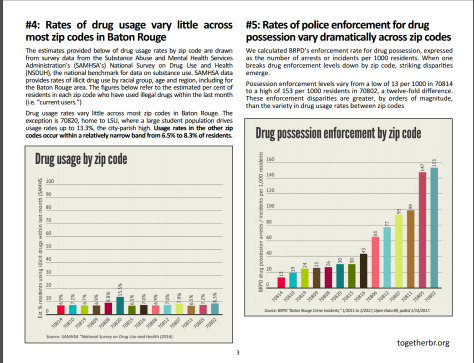
UNEQUAL ENFORCEMENT: How policing of drug possession differs by neighborhood in Baton Rouge

BR inequity

Reformed to Death: Discipline and Control Eclipse Education

An enduring gift of being a student and a teacher is that these experiences often create lifelong and powerful personal and professional relationships. Reminiscing about these experiences, however, is often bittersweet because we are simultaneously reminded of the great promise of education as well as how too often we are completely failing that promise.

After writing about my two years as as a co-lead instructor for a local Writing Project summer institute, the former student I discussed called me, and we found ourselves wading deeply into the bittersweet.

She has in the intervening years been a co-facilitator in the same workshop where I taught her now more than 15 years ago; she also has worked in many capacities providing teachers professional development and serving as a mentor to pre-service teachers completing education programs and certification requirements.

As we talked, the pattern that emerged is extremely disturbing: the most authentic and enriching opportunities for teachers are routinely crowded out by bureaucratic and administrative mandates, often those that are far less valid as instructional practice.

In my chapter on de-grading the writing classroom, I outlined how the imposition of accountability ran roughshod over the rise of the National Writing Project (NWP), which embodied both the best of how to teach writing and a gold standard approach to professional development.

What is best for teachers and what is best for students, however, are mostly irrelevant in the ongoing high-stakes accountability approach to education reform, a process in which discipline and control eclipse education.

Local sites of the NWP are crucibles of how the reform movement is a death spiral for authentic and high-quality teaching and learning as well as teacher professionalism.

At the core of the NWP model is a charge that teachers must experience and become expert in that which they teach; therefore, to guide students through a writing workshop experience, teachers participate in extended summer writing workshop institutes.

While NWP site-based institutes and other programs thrived against the weight of the accountability era, that appears to be waning under the weight of accountability-based mandates that are in a constant state of reform; teachers are routinely required to seek new certification while they and their students must adapt to a perpetually different set of standards and high-stakes tests.

That bureaucracy is often Orwellian since “best practice” and “evidence-based”—terminology birthed in authentic contexts such as the NWP—have become markers for programs and practices that are aligned with standards and testing, not with the research base of the field. The logic is cripplingly circular and disturbingly misleading.

This erosion and erasing of teaching writing well and effectively is paralleled all across the disciplines in K-12 education, in fact—although how writing is particularly ruined in standards- and testing-based programs and practices remains our best marker of accountability as discipline and control, not as education.

I want to end here by staying with writing, but shifting to the sacred cow of the reform movement: evidence.

High-stakes testing of writing has been a part of state accountability and national testing (NAEP and, briefly, the SAT) for more than 30 years since A Nation at Risk ushered in (deceptively) the accountability era of K-12 public education in the U.S.

What do we know about high-stakes testing as well as the accountability paradigm driven by standards and tests?

George Hillocks has documented [1] that high-stakes testing of writing reduces instruction to training students to conform to anchor papers, template writing, and prescriptive rubrics. In other words, as I noted above, “best practice” and “evidence-based” became whether or not teaching and learning about writing conformed to the way students were tested—not if students had become in any way authentic or autonomous writers, and thinkers.

My own analysis of NAEP tests of writing [2] details that standardized data touted as measuring writing proficiency are strongly skewed by student reading abilities and significant problems with the alignment of the assessment’s prompts and scoring guides.

And now, we have yet more proof that education reform is fundamentally flawed, as Jill Barshay reports:

“(T)he use of the computer may have widened the writing achievement gap,” concluded the working paper, “Performance of fourth-grade students in the 2012 NAEP computer-based writing pilot assessment.”  If so, that has big implications as test makers, with the support of the Department of Education, move forward with their goal of moving almost all students to computerized assessments, which are more efficient and cheaper to grade.

Not only does high-stakes testing of writing fail the research base on how best to teach composition [3], but also the pursuit of efficiency [4] continues to drive all aspects of teaching and learning, effectively contradicting the central claims of reformers to be pursuing seemingly lofty goals such as closing the achievement gap.

Writing instruction and assessment are prisoners of the cult of proficiency that is K-12 education reform, and are just one example of the larger accountability machine that has chosen discipline and control over education.

Reform has become both the means and the ends to keeping students and teachers always “starting again,” “never [to be] finished with anything,” as Gilles Deleuze observed [5].

Barshay ends her coverage of the IES study on computer-based writing assessment with a haunting fear about how evidence drives practice in a high-stakes accountability environment, a fear I guarantee will inevitably become reality:

My fear is that some educators will respond by drilling poor kids in the QWERTY keyboard, when the time would be better spent reading great works of literature and writing essays and creative stories.

As long as reforming and accountability are the masters, we will continue to make the wrong instructional decisions, we will continue to be compelled to make the wrong decisions.


[1] See Hillocks’s “FightingBack: Assessing theAssessments” and The Testing Trap: How State Writing Assessments Control Learning.

[2] See 21st Century Literacy: If We Are Scripted, Are We Literate?, co-authored with Renita Schmidt.

[3] See The Impact of the SAT and ACT Timed Writing Tests – NCTE.

[4] See NCTE Position Statement on Machine Scoring.

[5] See Gilles Deleuze, Postscript on the Societies of Control:

The administrations in charge never cease announcing supposedly necessary reforms: to reform schools, to reform industries, hospitals, the armed forces, prisons….In the disciplinary societies one was always starting again (from school to barracks, from barracks to the factory), while in the societies of control one is never finished with anything—the corporation, the educational system, the armed services being metastable states coexisting in one and the same modulation, like a universal system of deformation….In the disciplinary societies one was always starting again (from school to the barracks, from the barracks to the factory), while in the societies of control one is never finished with anything.

Elite or Selective?: Reconsidering Who We Educate and How

Sharde Miller’s California teen describes his road from Compton to Harvard University offers a powerful subtext about the American Dream as well as the enduring belief in education as the “great equalizer,” embodied by Elijah Devaughn Jr.:

Devaughn grew up in a single-parent household in Compton, California, a city that has been plagued by gun violence and gang activity for decades….

“Getting accepted into a prestigious university like Harvard, I think it means the world,” Devaughn said. “It means God is able. It means that hard work pays off. It means that, you know, struggles end.”

What if we unpack the label of “prestigious” by making an important caveat: Is Harvard University elite or selective?

As a point of reference, over the past three decades of high-stakes accountability in public education, schools have been annually labeled as excelling and failing; however, once we look beneath the A-F rankings, a strong and consistent correlation persists between schools identified as excelling or failing and the socio-economic status of the students [1] (as well as the racial and language demographics).

Consider also that for every year of the SAT being administered, average scores have fallen perfectly in correlation with parental income and parental years of education [2].

My university has begun gathering data to analyze our impact on students. The university is selective, having high standards for the academic backgrounds and achievements of students.

Some initial data are telling. When students with high preparation are compared to students with low preparation, extrapolating over four years of college, high preparation students are more successful and the gap with low preparation students widens during years 2 and 3 and then never closes by year 4 (year 1 and year 4 gaps are about the same).

If we persist in suggesting that education is the great equalizer (despite ample evidence education does not, in fact, equalize) and a foundational mechanism of the American Dream, we must reconsider how and why we identify any schools as “prestigious.”

Alexander W. Astin’s Are You Smart Enough? seeks to examine if our prestigious and excelling schools are elite or merely selective. Astin exposes part of the problem with labeling colleges, for example, as “prestigious”:

The “quality” or “excellence” of a college or university is thus judged on the basis of the average test score of its entering students, rather than on how well it educates them once they enroll.

What is lost in the rush to ascribe success and failure to schools is, as Astin argues, the essential charge of any formal schooling:

On the contrary, the quality of our national talent pool depends heavily on how well colleges and university develops the students’ capacities during the college years. And this mean all students.

And thus, Astin asserts: “More parents need to be asking, ‘Why should an educational system invest the least in the students who may need the most in higher education?'”

Here, then, is the dirty little secret: “Prestigious school” (K-12 as well as colleges/universities) is a veneer for “selective,” not “elite” in terms of the educational impact but in terms of the conditions at those schools.

Public universities are less selective than private liberal arts colleges, and the former experience is distinct from the latter in, for example, faculty/student ratios, class size.

In other words, more academically successful students tend to be from more affluent and well educated parents, and then are afforded higher education experiences that are identifiably superior to relatively less successful students from lower levels of affluence and education.

Reconsidering how we label schools, the “selective” versus “elite” divide, is a first step in seeking ways to turn a tarnished myth (“education is the great equalizer”) into a reality.

Too often “prestigious” and “elite” are code for “selective,” praising a college/university for gatekeeping, and not educating; too often “excellent” and “failing” are code for student demographics, ranking K-12 schools for proximity, and not educating.

Testing, ranking, and accountability in the U.S. have entrenched social and educational inequity because, as Astin confronts, “there are two very different uses for educational assessment: (a) to rank, rate, compare, and judge the performance of different learners and (b) to enhance the learning process.”

We have chosen the former, pretending as well that those metrics reflect mostly merit although they are overwhelming markers of privilege.

Let’s return to Devaughn as a rags-to-riches story.

Late in the article we learn Devaughn attended private school before his acceptance to Harvard—again bringing us back to the issue of opportunity and what we are learning at my university about well prepared students versus less prepared students.

Devaughn’s story should not be trivialized, but carefully unpacked, it does not prove what I think it intended to show. The American Dream and claims education is the great equalizer are, in fact, deforming myths.

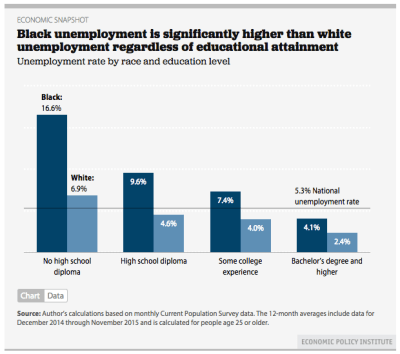
Race, gender, and the socioeconomic factors of homes and communities remain resilient causal factors in any person’s opportunities and success:

Access to good jobs
Black unemployment is significantly higher than white unemployment regardless of educational attainment | Economic Policy Institute

All schools at any level must re-evaluate who has access to the institution, and why, and then focus on what impact the educational experience has on those students. Therein must be the evidence for determining excellence and prestige.


[1] See here and here for examples in South Carolina.

[2] See The Conversation: Tests don’t improve learning. And PARCC will be no different.

Accreditation: “‘relatively superficial, extremely time-consuming and doesn’t lead us to a goal of significant improvement'”

For well over three decades, I have been both a full-time educator (high school English teacher for 18 years and currently a college professor, going on 16 years) and a writer. As a high school teacher, I also taught journalism and was the faculty sponsor for the school newspaper and literary magazine over about 10-11 years.

Therefore, I have a great deal of experience in the fields of education and journalism, experience that has revealed to me a rather damning fact: One can be well trained in educational pedagogy or the craft and conventions of journalism, but without nuanced and deep knowledge of the content of that teaching and writing, the outcome can and often is quite awful.

In journalism, for example, the vaunted New York Times publishes and fails to recognize blindly awful articles about poverty. And Education Week regularly features the worst of edujournalism.

And let me emphasize here, these criticisms are about the very best of the field.

The rise of Trumplandia has also birthed a renewed concern about the media and journalism—much gnashing of teeth about fake news and post-truth—so this announcement from Northwestern University may seem ill-suited in the context of those concerns:

In a nontraditional move, officials at Northwestern University‘s prestigious journalism and communications school have decided not to renew the program’s accreditation, letting the designation lapse.

The dean of the Medill School of Journalism, Media, Integrated Marketing Communications said Monday that school officials chose not to pursue renewed accreditation, which provides outside approval of academic programs, because the process is “flawed” and not useful.

More pointedly, the dean explains:

“Our goal is always to be the best in the world, and this process doesn’t get us there,” Hamm said in an interview Monday afternoon. “We just don’t find that the review provides us with anything beyond what we already know today. It’s relatively superficial, extremely time-consuming and doesn’t lead us to a goal of significant improvement. It’s sort of a low bar.”

The current hyper-focus on media and journalism has been a parallel reality in the field of education over the last three decades-plus; therefore, there is much to unpack about the parallels in the two fields.

As a lifelong educator, I had to seek certification during my formal college education, I worked as a classroom teacher in public schools under standards and testing, and I now must conform to the mandates of teacher certification and program accreditation as a teacher educator.

In all of those contexts, I am a witness to that accreditation (like certification) is, in fact, “’relatively superficial, extremely time-consuming and doesn’t lead us to a goal of significant improvement. It’s sort of a low bar.’”

All types of bureaucratic accountability—such as the thirty years of standards and high stakes testing in public education reform—are ultimately reductive by shifting the focus toward meeting standards and requirements that are secondary and tertiary approximations of authentic goals (holistic goals that have been cannibalized into discrete elements for the sake of efficiency).

Why, we should be asking, do disciplines such as journalism and education feel the need to add the layer(s) of accreditation (and certification) onto their degrees—when other disciplines trust that the degrees themselves are enough?

Two reasons are practitioners in both disciplines suffer from the low self-esteem of the fields and the twin-tyrannies of the market place and bureaucrats.

Since I focused on journalism above, let me shift here to education.

No discipline or profession has suffered more under the weight of political and public marginalizing and de-professionalization than education—in part as a consequence of sexism (teaching long associated with being a woman’s job) and in part due to the burden of K-12 and many college teachers/professors being agents of the state, working in tax-funded public institutions.

Education currently labors under a nearly unmanageable matrix of mandates related to degrees, certification, and accreditation; and these requirements are in constant flux—standards and mandates for proving those standards have been met shifting every 3-5 years.

Over the accountability era, then, many teacher certification programs have dropped educational philosophy courses, foundations courses, and what many people would consider the more academically challenging knowledge base of education degrees (degrees, by the way, that have historically been slandered as “too easy”).

Education programs are in constant flux, changing courses and programs to meet state certification mandates and accreditation mandates—neither of which are being driven by scholars or practitioners but by bureaucrats.

The most perverse of ironies has occurred, then, in education because those who claimed education degrees are flimsy have successfully made them a maze of nothingness through certification and accreditation mandates.

Ultimately, we must face these realities:

  • Increasing an emphasis on the technical aspects of education and journalism distorts the importance of both and has created practitioners who may perform with proficiency while failing miserably at the larger responsibility to what is being taught and what is being expressed as well as who is being taught and who is being informed.
  • No generic teaching or journalism skills exist absent the content of what is being taught or written about, and therefore, reducing teaching or journalism to discrete skills necessarily dilutes holistic professions to simplistic bureaucracy.
  • There is no option for objectivity in education or journalism; both are political acts that require moral and ethical distinctions as well as seeking out the Truth/truth.
  • Accreditation (and certification) is more about power and political grandstanding than about the integrity of any discipline. In fact, accreditation is necessarily counter to the integrity of any discipline.

Reaching back to Franz Kafka and then recurring throughout pop culture (mainly satire such as Dilbert and Office Space), the folly of bureaucracy has been exposed time and again; yet, it remains entrenched in some of the foundational disciplines in our democracy—education and journalism.

Northwestern University has taken a bold but necessary step that should be a beacon for all of journalism and education; we are well past time to end accreditation (certification) as the process that strangles the vibrancy out of any discipline.

School Choice Advocacy Exposes Political Cowardice

It has become fashionable for pundits to argue that fake news has created a post-truth America; however, mainstream media, in fact, carry the brunt of the responsibility because too often journalists are trapped in press-release journalism and traditional expectations of objectivity.

Evidence of this can be found in how the media routinely cover education and education reform—even when good journalists with good intentions seek to be objective and fair by covering a topic.

Paul Hyde’s Advocates tout the benefits of school choice (25 January 2017) represents the ultimate failure of covering what advocates claim instead of confronting whether or not those claims are credible.

Regularly, the public is bombarded with school choice advocacy and proposals that school choice can somehow address the historical and persistent problems we rightfully recognize in South Carolina’s public schools. These arguments are compelling for a public in the U.S. that believes in choice and idealizes parental choice.

But here is the problem: The evidence rejects that market forces (through vouchers, tuition tax credits, charter schools, and even public school choice, which is in place in South Carolina’s Greenville county) are effective but indirect methods for education reform.

School choice is an ideological argument that exposes political cowardice (let the Invisible Hand do what political leaders refuse to do), and it ignores that public institutions should make choice unnecessary (think about why we do not privatize the judicial system, the police force, roads and highways).

First, the problems with our public schools are primarily strongly connected to large gaps in outcomes among identifiable groups of students by race, social class, special needs, and home languages.

All across South Carolina, for example, and notably along its Corridor of Shame, schools serving low-poverty populations have strong outcomes while schools burdened with high poverty and high percentages of students with special needs and English language learners have weak outcomes.

What we must acknowledge is first that struggling schools and students are not struggling because of a lack of choice, and then, all choice models for reform are indirect ways to make the changes that should be accomplished by public policy directly.

Here is the fact that political leaders are avoiding by abdicating their responsibilities to address inequity: Between 60-80% of measurable student outcomes are connected to students’ lives outside of school—home income, access to medical care, food and living security, and stable and well-paying jobs for the parents.

If public policy were to address these social inequities directly, student outcomes would improve with no in-school reform at all.

But our current schools also require direct reform, some of which could correct the negative consequences of choice—increasing segregation, creating unnecessary shuffling of student populations, diverting funds from public schools for charter and private schools that do not have better outcomes.

Too often, public school practices reflect and perpetuate the exact inequities in society that are overburdening our schools.

Instead of hoping that market forces create equity (and they will not), new direct policy should confront the following: vulnerable populations of students are assigned disproportionately new and un-/under-certified teachers, tracking and selective programs (Advanced Placement, International Baccalaureate) benefit advantaged students while vulnerable students are often barred, discipline practices and consequences perpetuate inequity, and too often school facilities and materials reflect the socioeconomic status of the community.

Ultimately, mainstream media failing to provide a critical response to school choice advocates allows yet more political cowardice.

School choice—from vouchers to charter schools to public school choice—over the past 20-30 years has never produced the miracles advocates promise. Despite public perception, charter schools and public schools do not have higher outcomes than public schools when adjusted for the characteristics of students served.

Types of schooling simply do not make a difference, but practices do—although no in-school practices have yet to overcome the influence of out-of-school influences beyond the scope of teachers and schools to control.

Allowing powerful people with vested interests to advocate for failed policy without any media, political, or public challenges is cheating our schools, our students, and our democracy.

The weight of evidence does not validate school choice advocacy, but more important than that, we know what needs to be reformed to insure better opportunities for all students.

We need politicians themselves to embrace choice, choosing direct action instead of continuing to hide behind the political cowardice of hoping parents-as-customers can force schools to accomplish the impossible.

Think Tank Advocacy Reports Not Credible for Education Policy: SC Edition

The Palmetto Promise Institute‘s report authored by Adam CrainMoney doesn’t translate into student results, is a follow-up to their 2013 report also comparing South Carolina education to Florida education reform.

Although this report offers several charts detailing an analysis of SC and FL National Assessment of Educational Progress (NAEP) tests data (some of which is aggregated by race, disabilities, and poverty, but focusing on 4th grade reading), the report proves to be overly simplistic and an incomplete picture of student achievement in both states—with the ham-fisted data analysis serving as a thin veneer for advocacy unsupported by valid research and a more nuanced analysis of data.

In short, this report proves to be significantly inadequate evidence to support the ideologically-driven recommendations offered at the end—recommendations this conservative think tank would make regardless of the evidence (mostly a mishmash of school choice policy). There simply is no credible link between the shallow analysis of SC/FL NAEP scores and the call for policy as solutions to the manufactured problems.

Let me outline here both the flaws of the data analysis and then the folly of the recommendations.

The foundational flaw of both reports is suggesting some sort of value in comparing SC to FL and the persistent but discredited claim that FL has successful education reform. In fact, the so-called Florida “miracle” has been strongly refuted, notably its grade-retention policy based on high-stakes test scores.

By comparison, SC is slightly more impoverished than FL, and SC (27%) has a higher percentage than FL (16%) of blacks (both metrics used in the report analysis). However, this report from PPI makes no effort to show how their raw comparisons are actually apples-to-apples, or valid.

Another analysis of NAEP data that adjusts for factors impacting test scores reveals a much more nuanced and important picture, one that exposes a huge flaw with the FL model of reform [1] and depending on test data.

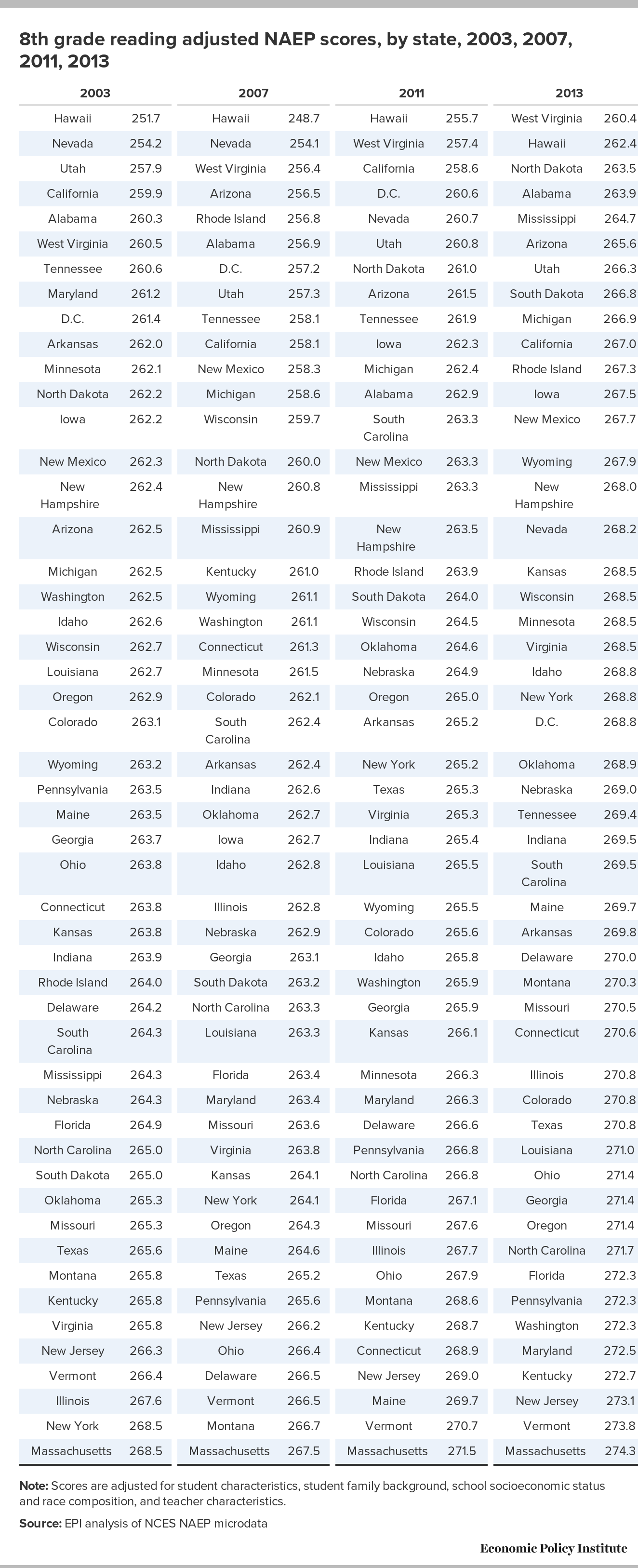
While adjusted trend data on NAEP continues to show 4th grade FL reading scores better than SC scores, by 8th grade (see Table 6B1, 2013 data) SC (269.5) and FL (272.3) have nearly identical adjusted scores.

Here is a key point about FL’s retention policy: Retaining students can inflate short-term test data, but those gains erode over time. Further, grade retention [2] maintains a strong correlation with students dropping out of school and an inverse correlation with students receiving a diploma (see Jasper, 2016 [3]).

Ultimately, the data analysis and charts in this report are overly simplistic on purpose because PPI has an agenda: argue against increased school funding and promote school choice.

The report uses bold face, lazy math, and insufficient statistical methods to dramatize a baseless claim: “Simple funding comparisons indicate quite the opposite. Over the twelve year period between 1999 and 2011, South Carolina spent a total of $6,920 more per student, or an average of $692 per year.

Without proper statistical analysis, using controls and making causal claims, this raw data approach, like the NAEP analysis, means almost nothing.

The body of educational research, in fact, shows that funding does matter (see Baker, 2016) [4].

Both, then, the NAEP analysis and the related argument that SC school funding is somehow excessive/wasteful are statistically inadequate and useless for making the recommendations at the end of the report.

Those recommendations fall into two broad categories: accountability and school choice.

SC and FL jumped on the accountability bandwagon early, about three decades ago, and remain completely unsatisfied with their educational outcomes, despite huge amounts of tax dollars and immeasurable time spent on ever-new standards and ever-new high-stakes tests.

Calling for accountability ignores the research base that shows accountability based on standards and testing has failed, will continue to fail:

There is, for example, no evidence that states within the U.S. score higher or lower on the NAEP based on the rigor of their state standards. Similarly, international test data show no pronounced tests core advantage on the basis of the presence or absence of national standards. Further, the wave of high-stakes testing associated with No Child Left Behind (NCLB) has resulted in the “dumbing down” and narrowing of the curriculum….

As the absence or presence of rigorous or national standards says nothing about equity, educational quality, or the provision of adequate educational services, there is no reason to expect CCSS or any other standards initiative to be an effective educational reform by itself. (Mathis, 2012)

The evidence on school choice also contradicts the report because choice fails to increase student achievement, but it is strongly associated with increasing segregation and inequity (see here and here).

Let’s summarize the major points of the report:

  • The report claims SC lags FL in academic achievement and education reform while spending more per pupil. However, the analysis offered here is an incomplete picture and statistically flawed. None of the claims made in the report are proven, and more nuanced and longitudinal analyses of NAEP greatly erode the premise of PPI’s report (grounded also in the debunked Florida “miracle” claim).
  • The report’s major recommendations about school funding, accountability, and school choice are all strongly contradicted by the research base, which the report fails to acknowledge.

Ultimately, as a colleague responded when I shared this report, PPI has published “a five page Op-Ed with bar graphs,” and I would add, not a very good one at that.

SC should in no way be influenced by this report when making education policy.

However, SC should heed a kernel the report’s conclusion: “The disparity between the stewardship of resources in Florida and our struggling education system in South Carolina is apparent.”

As I have detailed, while most educational rankings and comparisons prove to be hokum, what evidence from our schools and reform policies shows is that SC ranks first in political negligence.

Ironically, this report is calling for more negligence in the pursuit of market ideology.


[1] See evidence discrediting Florida “miracle” and FL’s reading policyhow SC could benefit from looking at Oklahoma, not FL; and why FL reform is harmful for students and literacy.

[2] See the National Council of Teachers of English’s Resolution on Mandatory Grade Retention and High-Stakes Testing:

Grade retention, the practice of holding students back to repeat a grade, does more harm than good:

  • retaining students who have not met proficiency levels with the intent of repeating instruction is punitive, socially inappropriate, and educationally ineffective;
  • basing retention on high-stakes tests will disproportionately and negatively impact children of color, impoverished children, English Language Learners, and special needs students; and
  • retaining students is strongly correlated with behavior problems and increased drop-out rates.

[3] Jasper’s abstract captures the ultimate failure of FL’s reform:

In 2003-2004 approximately 23,000 third graders were retained in Florida under the third grade retention mandate outlined in the A+ Plan. Researchers in previous studies found students who were retained faced difficulty in catching up to their peers, achieving academically, and obtaining a high school diploma (Anderson, Jimerson, & Whipple, 2005; Andrew, 2014; Fine & Davis, 2003; Jimerson, 1999; Moser, West & Hughes, 2012; Nagaoka, 2005; and Ou & Reynolds, 2010). In this study I examined educational outcomes of students retained in a large southwest Florida school district under the A+ Plan in 2003-2004. I used a match control group, consisting of similarly nonretained students, who scored at level one on the Grade 3 Reading FCAT. I then compared the control group to the retained group. I also compared achievement levels on the Grade 10 Reading FCAT of the retained and non-retained group. I evaluated longitudinal data, for both the retained and non-retained students, and found 93% of the retained students continued to score below proficiency (below a level 3) seven years after retention on the Grade 10 Reading FCAT as compared with the 85.8% of the non-retained students. I also compared standard diploma acquisition of the retained and non-retained group. The non-retained group was 14.7% more likely to obtain a standard high school diploma than the retained group. Finally, I used data from previous studies to extrapolate economic outcomes.

[4] Baker’s analysis has key points detailed in the Executive Summary (p. i):

baker funding 2016.png

Edujournalism and Eduresearch Too Often Lack Merit

What do Marta W. Aldrich’s Teacher merit pay has merit when it comes to student scores, analysis shows and Matthew G. Springer’s Teacher Merit Pay and Student Test Scores: A Meta-Analysis have in common?

Irony, in that they both lack merit.

Let’s be brief but focus on the nonsense.

Well, as Aldrich reports about Springer’s research, a meta-analysis (this is research-speak that is supposed to strike fear into everyone since it is an analysis of much if not all of the existing research on a topic; thus, research about research), we now have discovered that merit pay in fact works! You see, it causes [insert throat clearing] “academic increase … roughly equivalent to adding three weeks of learning to the school year, based on studies conducted in U.S. schools, and four weeks based on studies across the globe.”

Wow! Three to four weeks of learning. That is … nonsense.

So here are the problems with our obsession with the hokum that is merit pay.

First, to make the process of giving teachers merit pay in order to create greater student learning, we have to have a metric for student learning that is quantifiable and thus manageable. Herein is the foundational problem since all of these studies use high-stakes test scores as proof of student learning.

This is a problem since standardized testing is at best reductive—asking very little of students and far more efficient than credible.

Next, very few people ever question this whole “weeks (or months) of learning” hokum—which is a cult-of-proficiency cousin of the reading grade level charade.

Researchers should explain to everyone that “weeks of learning” can often be a question or two difference on any test. In short, it is something that can be done statistically, but means almost nothing in reality. Three to four weeks out of a 36-week academic year.

Finally, and this is hugely important, merit pay linked to standardized test scores codified as proof of student learning necessarily reduces all teaching and learning to test prep and fails due to Campbell’s Law:

The more any quantitative social indicator is used for social decision-making, the more subject it will be to corruption pressures and the more apt it will be to distort and corrupt the social processes it is intended to monitor.

Notice here “corruption” and “corrupt.” Merit pay is guaranteed to corrupt the evidence and the entire teaching/learning process.

Similar to the obsession with choice and competition, the media and research fetish for merit pay is mostly about ideology—some believe outcomes are mostly about effort (thus, teachers are lazy) and are committed to merit pay regardless of the evidence or the unintended consequences.

As Mark Weber Tweeted about the claims of the study:

“Absurd” seems here to be an understatement, but, yes, this reporting and meta-analysis are themselves without merit and yet another example of the folly that is edujournalism and edureform in the U.S.

UPDATED: Beware the “Miracle” School Claim: “Why not tell the whole story?”

UPDATE 19 February 2019

With Seanna Adcox’s Bill seeks to expand successes of Charleston’s Meeting Street Schools (Post and Courier) and the release of SC state report cards, it is time to completely unmask how Meeting Street (and other charter schemes) float on claims absent evidence.

Just consider a few report card comparisons among elementary schools with similar poverty indexes (PI) in Charleston:

If Meeting Street is a miracle school (it isn’t) then so are these schools, but the cold hard truth is charter schools are mostly advocacy absent evidence.

The media and politicians must stop promoting the propaganda at the expense of students and the public.

UPDATE 19 April 2017

Since my post below, Benjamin Navarro, founder of Meeting Street Schools, submitted a Lady Macbeth-esque protest about the article linked below.

Navarro, I believe unintentionally, poses a very important question while challenging how the Post and Courier reported the excessive suspensions at Meeting Street Elementary @Brentwood: “Why not tell the whole story?”

While Navarro bristles at the suspension data, he is quick to offer a partial story about data he prefers, test scores:

And most important of all [emphasis added], why not talk about the enormous impact that Brentwood’s higher test scores have on the likely outcomes for these children? Why not report the fact that our students scored in the 71st percentile in reading and 73rd percentile in math (almost eliminating the bottom quartile), while other North Charleston Title One schools scored on average in the 42nd and 39th percentile respectively in 2016?

So let’s have a shot at the whole story because that is the problem with Meeting Street Elementary @Brentwood, with all so-called alternative approaches to public schools such as charter schools.

Currently, South Carolina is not holding schools accountable by the usual school report card until fall 2018. But the media, in fact, has been reporting glowing depictions of Brentwood, depending almost entirely on the school’s founder and leaders who are incentivized to paint the best picture possible of their experiment while concurrently (and dishonestly) falsely trashing Charleston public schools (see Navarro’s letter).

Navarro’s reference to test scores looks impressive; yet, he fails to provide the whole story about that data—and as I detail below, virtually every time the whole story comes out about miracle schools, that whole story proves there are no miracles.

Here, then, is what we need to know:

  • What test data are being cited? It is likely he is citing practice test data (such as MAP and ACT testing). We must confront if we truly believe that intensive test-prep and test scores are what any child deserves from formal schooling, if these claimed higher scores are from test prep, and why we allow this reduced form of education for poor and black/brown students while affluent and white students receive advanced courses, gifted programs, and all sorts of enrichment.
  • What is the attrition rate for Brentwood—the number of students originally enrolled compared to the number of students tested? Are suspension/expulsions and counseling out creating skewed test score data?
  • What percentage of English language learners (ELLs) and students with special needs are being tested, and then, are data from Brentwood being compared to other schools with similar demographics (and not just all Title One schools)?
  • Has Brentwood controlled for the extended school day/year to account for these claimed higher test scores, or are we being asked to compare student data under different conditions of learning? More teaching and learning time should produce higher scores; thus, Brentwood may have higher scores while not being able to claim that anything other than more time created that difference.
  • If, as advocates and Navarro claim, some unique practices by Meeting Street are causing greater student achievement, how can they prove those practices are causal and then that they are scalable? For example, what is the per-pupil expenditure, what are class sizes and student/teacher ratios, and what can Brentwood do that traditional public schools cannot (such as refuse to serve ELLs or special needs students)?
  • What race and social class biases are driving our willingness to create schools for high poverty and black/brown students that are committed to “no excuses” and zero tolerance discipline practices?

Advocates for Brentwood, including Navarro, are trafficking in partial stories by failing to be transparent about their claims of miracles while refusing to accept data that tarnishes those claims.

Until all of the questions above are answered by making that data transparent to independent analysis (not by those invested in the success of Brentwood), we are forced to suffer under partial stories that serve no one well.


Original Post: Beware the “Miracle” School Claim

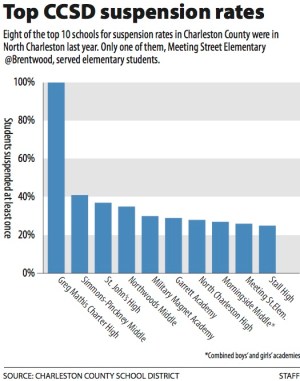
Published on Easter Sunday 2017 in the Post and Courier, Paul Bowers offered what I suspect will be a slow and painful series of unfortunate evidence that will discredit claims of educational miracles at Meeting Street Elementary @Brentwood; in this case, the public/private partnership elementary school has a unique and extreme suspension problem:

Meeting St suspensions copy

As a public/private venture, as a school choice and reform mechanism, Meeting Street Elementary @Brentwood is trapped in the need to advocate, sell its process. And since South Carolina has not held this experiment to the traditional school report card transparency, we are left only with the claims of school leaders.

However, we have well over a decade of “miracle” school bluster, all of which has been dismantled—suggesting that, I am sorry to say during this holiday season, there are no miracles.

While the school report card based mostly on high-stakes testing data is a significant failure of education reform, South Carolina’s report card system has included a key way to know if schools are in fact outperforming other schools, using the “Schools with Students Like Ours” metric (which I have detailed multiple times exposes that charter schools are no different, and possibly less effective, than traditional public schools in our state):

However, analyses from two years of report cards for charter schools in SC reveal the clear picture that more investment is not justified (see below for complete analysis of both years’ comparisons):

  • Using 2011 SC state repost cards and the metric “Schools with Students Like Ours,” charter schools performed as follows: 3/53 ABOVE Typical, 17/53 Typical, and 33/53 BELOW Typical.
  • Using 2013 SC state repost cards and the metric “Schools with Students Like Ours,” charter schools performed as follows: 2/52 ABOVE Typical, 20/52 Typical, 22/52 BELOW Typical.

And thus, this disturbing suspension data about an elementary school are just the beginning of what I can predict will happen as the evidence grows against the claims of this school somehow is accomplishing what other schools have not, cannot accomplish.

First, the evidence is very clear that “high-flying schools” are extreme outliers, constituting about 1.1% of high-poverty schools. This means two things: (1) if Meeting Street does achieve some sort of high-flying status, it will be in extremely rare company, and thus, (2) outliers prove virtually nothing about what most schools can and should accomplish (outliers often include key elements that cannot be scaled to all schools).

Next, the huge caution about any claims of miracle success on test scores at Meeting Street must be couched in their extended day and academic year. This technique has driven the false but powerful propaganda from KIPP charter schools that conveniently leave out that when you identify learning as months or years of growth, and you extend the learning time, the raw data growth is actually the same growth rate as other schools.

Comparing students with more teaching and learning time to other students with less is just one way advocates of charters and miracle schools mislead the public.

Remaining questions—some linked to suspension and expulsion patterns—include how any school’s test scores are impacted by student attrition (counseling out, expulsion, etc.), the percentage of special needs and English language learners served (when compared to traditional public schools), and the impact of self-selection (which can skew even claims that a school is serving a high-poverty population of students).

Meeting Street Elementary @Brentwood will prove, once again, to be evidence of the inherent problems with education form, and no miracle at all.

Our most vulnerable students—impoverished, black and brown students, English language learners, and special needs students—are disproportionately the targets of educational reform/experiments grounded in test-mania and harsh discipline policies and outcomes (see here, here, and here).

To be blunt, good intentions of administrators and teachers in our traditional public schools have not been enough, and now, those same good intentions among reformers cannot be justification for false claims and failed policies and practices.

Practices and fads such as exit exams, “no excuses” mantras, “grit” and  growth mindset, zero-tolerance discipline, and the larger accountability movement churning through standards and high-stakes testing—these have all increased the existing problems with inequity in our schools and society, and have miserably failed the students who need nurturing and effective schooling the most.

Miracle school claims are that human-sized Easter bunny; but that is just some stranger in a suit pretending to be a bunny, and it isn’t really appealing so much as something we should be very leery of approaching, especially with children.

bunny3