Category Archives: education reform

The Tone-Deaf Politics of Denying Racism, Excusing Segregation

Let’s connect the dots, which is challenging because, if those with power had their way, it would be white dots on a field of white.

Rick Hess, whose tagline is “Education policy maven Rick Hess of the American Enterprise Institute [AEI] think tank offers straight talk on matters of policy, politics, research, and reform,” blogging at Education Week makes this claim:

Some deem this a healthy and long-overdue development, believing that social justice demands that education be understood through the prism of race and inequality. They believe that tackling deep racial inequities is the measure of one’s commitment to educational improvement, and view measures like the DREAM Act and affirmative action as inseparable from elements of that work. Thus, they tend to see an inevitable overlap between school reform and the pursuit of progressive policies regarding housing, immigration, policing, health care, and much more.

Others of us think that viewing education primarily through the lens of race is unhealthy and divisive, fueling a destructive hypersensitivity and race-based grievance. We’re concerned that it undermines the unifying possibilities of democratic schooling, especially when foundational virtues like personal responsibility and patriotism get dismissed as culturally oppressive remnants from yesteryear. We fear that it turns schooling, potentially one of our great common endeavors, into something very different, political, and partisan.

Keep in mind the dichotomy of “some” and “we.”

Next, a review of an AEI report on charter schools reveals:

The reviewers find that the report presents charter school de facto segregation as a benign byproduct of parental choice. In fact, the review finds that the original report actually acknowledged that this type of stratification was part and partial of a “properly” functioning charter sector – one in which parents get to choose the type of school their children attend.

“Some” who “[believe] that social justice demands that education be understood through the prism of race and inequality” are being, according to Hess, “political” and “partisan.”

And AEI finds segregation “benign” because it is just what parents choose.

With those dots detected and connected, consider this Tweet from Charles Blow:

What is at play here, and linked by AEI, includes an ends-justify-the-means ideology paired with Social Darwinism (masked as “parental choice”)—all of which is bereft of any sort of ethical grounding, any acknowledgement that “some” (the ellipsis of race, and thus, people of color) are making pleas for being heard to create a more just and equitable education system and country.

The ends justify the means for the winners because they have no personal experience with the devastating impact of the means—think the pyramids of Egypt to the economy of the South and the entire nation during U.S. slavery.

The Masters must keep pointing at the outcomes and must find ways to silence the enslaved, the oppressed.

The Masters must control what is normal, objective, and non-partisan/non-political (their way) while casting everyone else as the “other”—biased, partisan, political, radical.

Hess and AEI are peddling the inexcusable in a time now dominated by the deplorables.

None the less, these are calloused claims, and nothing can justify denying racism or embracing segregation.

Don’t Buy Bluster from Teacher Quality VAM-pires

The responses are predictable online and through social media any time I address teacher quality and policy focusing on teacher evaluation such as my recent commentary on Charleston adopting value-added methods (VAM).

How dare I, some respond, suggest that teacher quality does not matter!

The pattern is exhausting because most responding in indignation first misrepresent what I have claimed and then make the most extreme arguments themselves in order to derail the conversation along their own agenda, usually linked to the charter school movement grounded in teacher bashing and making unobtainable promises.

So let me state here that the central elements of what we know about teacher quality and efforts such as VAM-based teacher evaluation is that teacher quality is not an independent variable (any teacher may be effective for one student and ineffective for another, for example) and, since student high-stakes testing is not designed to measure teacher quality and is more strongly linked to out-of-school factors, VAM is both a horrible technique for identifying teacher quality and, ironically, a guaranteed process for devaluing the importance of teachers.

Teacher quality is unparalleled in importance in terms of student learning, but it is also nearly impossible to measure, quantify—especially through student scores on high-stakes standardized tests.

Teacher quality VAM-pires, then, often have agendas [1] that are masked by their bluster about teacher quality.

Trying to measure and quantify teacher quality is a mistake; linking any evaluation of teacher quality to student test scores lacks validity and reliability—and VAM discourages teachers from teaching the most challenging populations of students (high-poverty, special needs, English language learners).

Focusing on simplistic and inappropriate measures reduces teacher impact to 10-15% of what high-stakes standardized testing measures; in other words, VAM itself devalues teacher quality.

My informed argument, based on 18 years as a public school classroom teacher and 15 years as a teacher educator and scholar, then, is that we must recognize teacher quality is impacted by teacher preparation, teaching/learning conditions, student characteristics, and dozens of other factors inside and outside of schools—many of which are beyond the control of teachers or students.

As well, we must address the teacher quality issues that political and administrative leaders can control: class size, school funding, and most important of all, teacher assignment.

Just as decades of research have revealed that teacher quality accounts for no more than 10-15% of student test scores, decades of research show that affluent and white students are assigned the most experienced and certified teachers while poor and black/brown students are assigned new/inexperienced and un-/under-certified teachers.

The charter school crowd’s bluster about teacher quality is pure hokum because charter schools increase that inequity of teacher assignment by depending on new and uncertified teachers such as candidates from Teach For America.

No one is saying teacher quality does not matter—I clearly am not saying that—but dishonesty about teacher quality does lay at the feet of the edu-reformers and the VAM-pires who wave their collective arms any time we call them on their failed policies and their political agendas.


[1] See the evangelical urge of Broad-trained acolytes, the resume building and cut-and-run patterns of edu-reformers, and the post-truth practices of turn-around and charter advocacy.

Post and Courier (Charleston, SC): CCSD plan for teachers won’t work

Post and Courier (Charleston, SC): CCSD plan for teachers won’t work

[see full submission with hyperlinks below]

Charleston School District Arriving Late to a Very Bad Party

P.L. Thomas, Professor, Furman University

The most telling aspect of Charleston County School District’s announcement about holding teachers accountable for student test scores may be in the second paragraph of Paul Bowers’s coverage: “District leaders say they don’t want to fire anyone — particularly not in the midst of a statewide teacher shortage that’s only getting worse.”

While it appears some are aware of the unintended consequences of new education policy, we must be concerned that such awareness has not helped better inform this recent decision to move forward with using value-added methods (VAM) in teacher evaluations.

Early research warned and current studies confirm that VAM fails to fulfill political promises, but also feeds existing problems. This pattern has been seen with school choice increasing segregation, exit exams causing higher drop-out rates, and high-stakes tests driving teaching to the test, asking far less of students.

First, we should acknowledge the flawed logic driving the use of VAM to increase teacher accountability. The recent concern about teacher quality is grounded in several false assumptions.

One is the “bad” teacher myth strongly associated with the stereotypical unionized teacher as portrayed in Waiting for Superman.

However, across the U.S. teachers in unionized states produce students with higher test scores that teachers in non-union (called right-to-work) states such as South Carolina. The problem with associating teacher quality and low student outcomes with union protection is that student test scores are more powerfully associated with poverty than any other factor.

This leads to the other false assumption that teacher quality is the most or one of the most important causes of student learning. In fact, teacher quality accounts for only about 10-15% of standardized test scores, the basis of VAM, while out-of-school factors remain the greatest influence, at 60%.

A final assumption is that using test data to evaluate teachers is objective and valid, and thus fair. Yet, many teachers are in content areas without standardized tests, and then, ironically, making any set of data high-stakes causes that data to be less credible (see Campbell’s Law).

Student test scores are poor evidence about teacher quality, and making those scores central to evaluating teachers is guaranteed to further erode that evidence’s usefulness and the process.

Matthew Di Carlo, blogging for the Albert Shanker Institute, details the unintended consequences of VAM as implemented in Houston.

While assessing the Houston teacher evaluation system, Julie Berry Cullen, Cory Koedel, and Eric Parsons discovered that teachers identified as weaker by their student test scores were already leaving at high rates before the new system was implemented in order to identify weak teachers.

In other words, Houston adopted a policy without investigating whether or not teacher quality was the key problem, without acknowledging that with high teacher attrition among so-called weaker teachers, schools were not achieving in ways they envisioned.

Here is one powerful lesson of education reform: Do not adopt a policy until you gather evidence of the problems; and assumptions about those problems are not enough.

After Houston adopted VAM-based evaluation of teacher, as Di Carlo explains, teachers identified by test scores as weak were even more likely to leave, but:

On the other hand, all exits increased under the new evaluations — including among teachers who were rated as average and high performers. The extent to which this spike is attributable to the new evaluation system per se is unclear, but it served to “dilute” the impact on student achievement of the increase in exits among low performers. There is also some indication that higher-rated teachers were more likely to switch out of schools with low-performing students after ETI (versus before the policy), which would also attenuate the impact of the policy.

Historically and currently, Charleston has a teacher problem, yet Houston is a powerful example of how VAM is not the solution to those problems.

The remaining challenge is recruiting and maintaining experienced and certified teachers in the schools that serve the most vulnerable students from high-poverty homes and communities.

The new policy linking teacher evaluations with student test scores will not address those challenges, and we can expect it will actually increase challenges to recruit new teachers and stem teacher attrition.

By adopting VAM and investing in critically discredited system, EVAAS, Charleston County School District is late to a very bad party. The students and community would be better served by making sure we know what the teacher quality problems are and then seeking ways to address those instead of choosing political expediency and wasting tax dollars on policies and programs already shown to fail.

How to Expose Racists: Simply Mention Racism

I was pleasantly surprised when Education Week published Why Are We Criminalizing Black Students? by Tyrone C. Howard.

Regretfully, this blog is gorged with posts about EdWeek routinely failing the education discussion, but Howard’s commentary confronts well a hard topic in education.

And then came the comments—tone deaf at best, defensive and racist themselves as worst (first three opening rebuttals):

mcruiz

I’m amazed. I truly didn’t know we teachers had that much power, and the propensity to use it for evil deeds. Wow! Imagine that, we have the power to criminalize Black students. Wow, again!

LynnG

This is a ridiculous article and the author’s bias is so heavy handed that he’s made his argument a joke. Talk about confirmation bias.

Paul D. White

One more racist rant from a Black college professor who doesn’t have the courage to tell the truth, and one more worthless posting by Ed Week for what? A desire to show how “tolerant” they are to biased, ignorant positions regarding race and performance in the schools?

The great failure of the U.S. which has brought us to Trumplandia is, as I have pointed out often, James Baldwin’s “this rigid refusal to look at ourselves” that must be aimed with laser focus on white America.

In schools, black and brown children are disproportionately targeted and punished for the same behaviors as white children, and then in society, black and brown people suffer more inequitable treatment by police and the judicial system.

As Thomas Rudd explains about school discipline:

Contrary to the prevailing assumption that African American boys are just getting “what they deserve” when they are disciplined, research shows that these boys do not “act out” in the classroom any more than their White peers.

For example, in a study conducted by the Indiana Education Policy Center, researchers conclude that:

“Although discriminant analysis suggests that disproportionate rates of office referral and suspension for boys are due to increased rates of misbehavior, no support was found for the hypothesis that African American students act out more than other students. Rather, African American students appear to be referred to the office for less serious and more subjective reasons. Coupled with extensive and highly consistent prior data, these results argue that disproportionate representation of African Americans in office referrals, suspension and expulsion is evidence of a pervasive and systematic bias that may well be inherent in the use of exclusionary discipline (Skiba, 2000).”

And the ACLU reports: “Staggering Racial Bias: Marijuana use is roughly equal among Blacks and whites, yet Blacks are 3.73 times as likely to be arrested for marijuana possession.”

Michelle Alexander’s The New Jim Crow details that policing and the judicial system routinely practices inequitable targeting, convicting, and sentencing along racial lines for the same behaviors—blacks disproportionately suffering for acts no different than whites.

This begins in our schools because the white power structure cannot or will not see the bias in order to eradicate it.

The seeds of the wider post-truth U.S. have been sown by the white “rigid refusal” to admit and then confront the racism that continues to fester in the country.

This is old fake news, but as the posts on the EdWeek commentary reveal, racists respond to facts about racism by calling the messenger a racist. That’s the nastiest fake news there is, especially when it is coming in a publication about the education of our children—the first victims of racism, the most powerless victims of racism.


See Also

Racial Disproportionality in School Discipline: Implicit Bias is Heavily Implicated, Thomas Rudd

The War on Marijuana in Black and White (ACLU, 2013)

Education Reform in the New Jim Crow Era

Navigating the Scylla and Charybdis of Research in Education

Teaching children according to their individual ‘learning style’ does not achieve better results,” reports Sally Weale, “and should be ditched by schools in favour of evidence-based practice, according to leading scientists.”

Narrowly about learning styles, but more broadly about the decade’s long tension over what research counts, this argument plays out incessantly in education. Notably in the U.S., calls for scientific teaching, research-based practices, and evidence-based policy have their roots in John Dewey’s progressivism, and then have been intensified throughout the accountability era begun in the 1980s and codified in No Child Left Behind (NCLB) in 2001.

For about a century, education has simultaneously claimed to be driven by science and research while also being criticized for failing to use our research base and being trapped in fads.

This debunking of learning styles, then, is old hat; consider Lou LaBrant lamenting in 1947: “A brief consideration will indicate reasons for the considerable gap between the research currently available and the utilization of that research in school programs and methods.”

And the problem rests with the Scylla and Charybdis of research: on one side, educators must resist the tyranny of a narrow definition of what counts as evidence (the so-called hard view grounded in experimental and quasi-experimental studies), and on the other, educators must resist the trendy and often reductive (lazy) extrapolations of research (within which we may place learning styles).

Let me offer here two powerful examples that I believe address this tension: the poverty materials of Ruby Payne and the “word gap” narrative.

In the wake of federal mandates in NCLB that required public schools to identify and then address the so-called achievement gap, Ruby Payne capitalized on an opportunity to provide schools with manageable workbooks and workshops.

However, after many schools and districts across the U.S. purchased Payne’s materials and seminars, scholars on social class and race began to unmask that Payne was peddling stereotypes, not providing evidence-based claims about children and families in poverty (scholarship debunking Payne as well as the Teachers College Record exchange can be found here).

The Payne phenomenon (one that continues despite her poverty characterizations being thoroughly discredited) reveals several problems with calling for education to be research-based.

First, and possibly most significantly, educational practices are far too influenced by the marketing of materials and the incessant training and re-training of teachers in the field. That market influence and dynamic is made robust since K-12 education is far more bureaucratic than scholarly.

The market influence necessarily creates the need for “new” and manageable, characteristics that often supersede the validity of those materials.

Payne’s success has been built on her self-promotion, not her expertise in poverty. Please note that when critics called her out for lacking research in her work, she immediately began building a case for how student test scores were affected when faculty were trained in her materials—a bait-and-switch of types of evidence; Payne was unable or unwilling to confront that her materials are classist and racist, refuted by the best scholarship on class and race.

Like Payne’s framework of poverty, the “word gap” has remained a robust narrative in the media and education; the claim argues literacy is quantifiable (more words equal greater literacy, and then social classes are correlated strongly with vocabulary; thus, affluent/more words with greater literacy than impoverished/fewer words).

Both Payne’s stereotypes about people in poverty and the “word gap” argument share an essential problem: they are compelling because they feed into popular beliefs that are contradicted by scholarship.

The “word gap” phenomenon, however, is interesting since it relies on essentially one study (by Hart and Risley) that everyone cites (citing research is a powerful appeal)—while ignoring, as with Payne, that a significant body of scholars have debunked the study.

Educators and education, then, are confronted with a real dilemma. Yes, scientific evidence and research are essential to the field of teaching and learning, but what science and research count is fraught with land mines.

From learning styles to Payne’s framework and the “word gap,” advocates and critics both march out evidence, research.

And, for more examples, the current popularity of “grit” and growth mindset research fall into the exact same traps. “Grit” comes with the label of “MacArthur Genius,” and both are all the rage (as has been Payne) in teacher training—despite ample evidence that “grit” and growth mindset are deeply flawed by racist and classist assumptions, and then horribly misapplied in a wide range of educational setting.

In short, education has been a victim for a century of the TED Talk-ification of science and research.

That means education often embraces faulty research (compelling because it matches beliefs/stereotypes/myths, is well marketed, and/or is easily implemented) and routinely oversimplifies and overgeneralizes (the silver-bullet approach) credible research to the point that it too becomes flawed.

By contrast, scholars work slowly and are moored in peer-review—all of which helps resist the corrosive allure of the market as well as the need to be accessible to lay people.

This, I believe, is at the root of LaBrant’s lament about the gap between what science and research reveal and what educators practice.

As a critical educator also committed to evidence-based practices, I can offer some suggestions that allow policy makers and classroom practitioners a way to navigate between the Scylla and Charybdis of research in education:

  • Resist choosing between hard and soft definitions of research. Quantitative and qualitative data have value because in education we should be aware of valid generalizations while also anticipating and being able to address outliers. “Never” and “always” tend to fail us, then. Teaching is about both addressing classrooms of students and each student in that class.
  • Beware heavily marketed programs. Simply put, any research conveniently reduced to a packaged program is either questionable or over-simplified research; our classrooms should not use either.
  • Simultaneously trust your instincts as a practitioner (what has worked, what has failed) while being vigilant to back away from your personal assumptions in order to interrogate your prejudices and beliefs.
  • Do your own literature reviews. The first response by educators to top-down mandates and adopted programs or required workshops is to investigate. The Internet makes this process quite manageable, and healthy skepticism is a powerful tool of any professional.
  • Remain grounded in how messy and unpredictable teaching and learning are as human endeavors. There are no silver bullets, and there likely is nothing new (educational research in the U.S. is a solid century old and much of what we claim to know now—as “new”—we knew many decades ago as well).
  • Reject the mantras of business that invade education such as “innovation.” For education to be evidence-based, we must work from a foundation of experience and expertise (the idealizing of the outsider perspective is bogus) as well as clearly and accurately describing and identifying problems so that we may match appropriate solutions to those complex problems.

So what do we do, then, with learning styles (or “grit” and growth mindset)?

We must admit that education has likely oversold and misapplied the concept, but those of us who teach daily are probably not compelled by hard science’s argument it has no value.

If we are practicing learning styles to meet some mandate about learning styles, we have made a huge bureaucratic mistake. If we ignore the evidence of our students that learning occurs along a spectrum, that some practices match better certain students, then we are making a human error.

As teachers, we must captain our own ships, navigating carefully not to crash into either the rock or the hard place. Ultimately, this is about professionalism—knowing the evidence because we have done the work, not because it is a mandate or an adopted program.

We must remain vigilant in our sacred trust to teach students, and in doing so, resist distracting allegiances to “scientific,” “research,” “evidence,” and especially “programs” to the exclusion of those students.

See Also

Progressivism and Whole Language: A Reader

Teacher Quality: A Reader in 2017

Let me start with a full disclosure: Lawrence Baines is a colleague and friend with whom I have collaborated on several book projects and presentations. So I want to offer some friendly concerns about his thoughtful When ‘Highly Qualified’ Teachers Aren’t in Education Week.

Baines open with: “Recent research confirms that America’s most vulnerable children are being taught by the least-qualified teachers.”

This is incredibly important, but let’s clarify a few points. Vulnerable students include black and brown students, high-poverty students, English language learners, and special needs students. And Baines is highlighting a truly ugly fact about unwritten policies in education: these vulnerable populations of students are assigned disproportionately new and early-career teachers as well as un-/under-certified teachers.

Dozens of studies for many years have confirmed that administrations commonly “reward” veteran teachers by assigning them “good” students and advanced courses such as AP and IB.

Add to that dynamic that the rise of charter schools linked strongly with TFA has increased the likelihood that vulnerable students will be assured a continual stream of uncertified and new teachers.

Confronting the increased bureaucratization of teacher preparation and alternative certification programs, Baines makes his central case: “The continual dumbing-down of the preparation of teachers is not without consequences.”

I would argue that the “dumbing-down” is about the false attack on “bad” teachers as the primary or even single cause of low student achievement among, specifically, vulnerable students.

And the ugly consequence of that assault has been increasing accountability over teacher certification and teacher evaluation (such as using value-added methods) and thus demonizing teachers without improving teaching or learning.

Another repeated fact of education is that measurable student learning (usually test scores) is most strongly correlated with the socioeconomic status of students’ home; see this about Arkansas, which is typical across the U.S.

So here is the teacher quality dilemma: If we demand that teacher quality is the primary mechanism for improving student achievement, and if that is a false claim (which it is), we are doomed to both destroying the profession and discouraging anyone from entering that profession.

And Baines concludes: “All of the highest-performing countries in the world require teachers to obtain advanced degrees, demonstrate pedagogical and subject-matter expertise, accumulate significant teaching experience, and show an aptitude for working with children before stepping into the classroom as full-time teachers.”

Herein we are confronted with what it means to prepare well people to teach. And how do we disentangle teacher preparation and teacher evaluation from corrosive and ill-informed bureaucracy (certification and accreditation) while also providing the context within which we can create robust and challenging teacher education as well as ongoing professional development for teachers?

My short answer is that standards, certification, and accreditation are all the problems, not the solutions. Teacher education needs to be re-envisioned as the other disciplines, which are often self-regulating and robust because of professionalism and fidelity to the discipline among members of that discipline.

Since I have written on these issues often, I offer here a reader to help confront the issues raised by Baines:

Teacher Quality, Wiggins and Hattie: More Doing the Wrong Things the Right Ways

Addressing Teacher Quality Post-NCLB

What We Tolerate (and for Whom) v. What the Rich Demand: On Teacher Quality

Teacher Quality: On Hyperbole and Anecdotes

The Fatal Flaw of Teacher Education: “We have met the enemy and he is us.”

What’s Wrong with Teacher Education?

The Self-Fulfilling Prophesy: Failing Public Schools

Everything you need to know about the post-truth demonizing of public schools and false promises of charter schools is in these two paragraphs from Education Week, the queen of misinforming edujournalism:

At their best, the most innovative charter schools provide convincing evidence that there are better ways to educate students (especially disadvantaged ones) than now prevail in most traditional district schools. In fact, these pioneering schools bring together most of the innovative policies and practices needed to transform the nation’s traditional schools into the most successful in the world.

And yet, most traditional school districts either ignore or actively resist innovation. And their processes are so ingrained that one significant alteration would inevitably lead to systemic change or even a total redesign. Few public educators can imagine, let alone undertake, such dramatic change.

Edujournalism has been for decades a harbinger of the current threats to democracy posed by, not fake news, but post-truth journalism, the sort of enduring but false claims that drive mainstream media and remain unchecked by the public.

I recently detailed eight post-truth claims about public education that have fueled over three decades of baseless and harmful education reform; we are now poised for a resurgence of school choice schemes as the next wave of more unwarranted policies unsupported by research and not grounded in credible analyses of education failures.

The paragraphs above traffic in very predictable nonsense—”innovative charter schools” and public schools and educators who actively resist change—that resonates only with those who have no real experience in public education.

This nonsense is driven by the self-proclaimed innovators, few of whom are actual educators, and embraced by the public, most of whom have been students in public schools, and thus, believe they know the system.

Let’s here, then, unpack the nonsense.

First, I can offer a perspective that includes gaining my teaching certificate in a traditional program in the early 1980s before teaching public high school English for 18 years in the rural South, a small-town high school in a moderately impoverished areas.

Significant also is that my teaching career began the same year that South Carolina’s accountability system kicked into high gear; SC was an early and eager adopter of the standards and high-stakes testing movement that has driven K-12 public schools for over three decades.

I also have now taught in higher education for the past 15 years, as a teacher educator having one foot still in public schools (and the bureaucracy that controls it) and another in a much more autonomous profession as a tenured professor.

The Great Lie about charter schools versus public schools is very complex. The lie begins with the hollow use of “innovation,” a term that means nothing except in the sort of pyramid-scheme reality now promoted by Trump and newly minted Secretary of Education DeVos.

The lie then falls apart when you unpack the claim that innovative charter schools will save public education; we must ask, if bureaucracy and mandates are crippling public schools, and freedom to be innovative is the key to charter schools, why not just release public schools from the bureaucracy and mandates so that all schools are free to innovate?

The answer reveals the circular and misleading logic of the Great Lie that is charter innovation: For decades, school choice advocates have struggled against the public remaining mostly against school choice, mostly in favor of their local public schools (even when the public holds a negative view of public schools in general). How, then, could the public be turned against public schools?

The solution has been relentless and ever-increasing mandates that guarantee the self-fulfilling prophesy of public schools.

From SOE DeVos to the EdWeek narrative above, relentless education reform has resulted in creating public schools and teachers trapped in mandates and then criticizing them for not being innovative.

If innovation is really the solution to the problem facing public schools (and I suspect it isn’t), teachers need autonomy.

Yet, education reform has systematically de-professionalized teaching, systematically made teaching and learning less effective, and systematically overwhelmed schools with impossible demands so that the public sees only a failing system, one that the innovator-propagandists can smear as resisting change, refusing to innovate, and doomed to failure—with only innovative charter schools to save the day.

When we peel back the post-truth rhetoric, evidence fails to support claims of charter school success, and five minutes in a public school reveal that schools and teachers are not incapable of “imagin[ing] dramatic change,” but are blocked from practicing their professional autonomy by the exact forces accusing them of being against reform.

Public school teachers have never had professional autonomy, and most cannot even go to the restroom when they need to.

Spitting in the face of public school teachers as the paragraphs above do is the worst of post-truth journalism.

I have now spent about the same amount of time as an educator in K-12 public schools and higher education.

The professional autonomy gulf between the two is stunning.

K-12 public schools and teachers are scapegoats in a ridiculous political charade that depends on post-truth journalism and a gullible public.

There is nothing innovative about that.

South Carolina Ranks First in Political Negligence

Based on a U.S. News & World Report ranking, The Post and Courier (Charleston, SC) announced South Carolina ranks last in education.

South Carolina also ranks first in women being murdered by men.

Rankings are popular in the U.S., but more often than not, terrible ways to understand what is being ranked as well as distracting fodder for both the media and politicians.

Ranking itself is problematic since the act itself requires finding data that supports that ranking, and then by ranking we are ascribing both a range of quality as well as some degree of blame for the relative status.

When saying SC is last in education and first in violence toward women, we must take greater care in clarifying what these rankings mean and where the accountability lies for both outcomes and the causes for those outcomes.

I suspect many would fault SC public schools for the education ranking, but almost no one would blame heterosexual domestic relationships for the inordinate rate of men’s violence toward women in the state.

But even more important here is that both of these rankings reveal something in common nearly entirely ignored: political negligence in SC.

The U.S. News ranking of education is far less about education, in fact, than about socio-economics.

Three of the six data categories to rank states by education are test scores (ACT and NAEP math and reading), and the other three are graduation rates as well as Pre-K quality and preschool enrollment.

At least 60% of test scores prove time and again to be correlated with out-of-school factors. In short, what we routinely label as “education” is in fact more significantly a reflection of poverty and wealth.

And thus, if we are compelled to say SC is last in education, we are actually saying that SC’s social and education policy are utter failures. The key here is that this ranking is about policy, a direct reflection of political will, political negligence.

And SC is easily in competition for elite status in political negligence of education as shown in the twenty years it took for the courts to address the Corridor of Shame, finally admitting that high-poverty schools serving high-poverty communities result in students being doubly disadvantaged by their lives and their school opportunities.

For comparison, consider SC’s violence toward women ranking and the state being one of 13 states that treat marital rape differently than rape of a non-spouse:

Men or women raped by a spouse have just 30 days to report the incident to authorities. For the rape to count, it must have involved “the use or the threat to use a weapon … or physical violence of a high and aggravated nature.” The offense is treated as a felony but has a maximum sentence of 10 years, whereas rape of a non-spouse has a maximum sentence of 30 years.

In both rankings, then, we must ask how policy creates the environments reflected in measurable outcomes—such as test scores and graduation rates or incidences of violence toward women.

There is a political advantage to keep media and public focus on schools with educational rankings; that focus, however, is akin to blaming hospitals for housing the sick.

Schools in SC and across the U.S. reflect the inequities of our communities, the failures of our policies, and as a result, they are ineffective as mechanisms of change.

While we have known for decades that poverty and inequity are the greatest hurdles for children learning, we have committed to decades of changing standards and testing students—and we appear poised to waste time and funding next on school choice scheme.

None of this addresses the root causes of the outcomes we continue to use to rank educational quality, a process that masks, misinforms, and guarantees to maintain the status quo.

Ranking invariably proves to be much ado about nothing because it tends to misrepresent and misinform, especially in terms of why conditions exist and what reforms would improve those conditions.

Policy is at the core of both any state’s educational outcomes and what threatens the safety of women.

Policy reflects what truly matters, and in SC, our rankings in terms of education and violence toward women are commentaries on who we are as a people, who we are willing to ignore and who we are willing to protect.

Ultimately, both of these rankings expose that SC ranks first in political negligence, negligence of equity in the lives and education of children, negligence in the safety of women.

“Something Like Scales”

Immediately, something like scales fell from Saul’s eyes, and he could see again.

Acts 9:18 (NIV)

The existential crisis of my youth was my embarrassment and shame for having been raised in ignorance. My redneck past erupted from my mouth in the first weeks of college, and I exposed myself an arrogant fool.

Racist, sexist, brash, and incredibly insensitive to human dignity—I had no sense of community, no humility, little compassion, and no room for anything to replace the incredible callousness that filled my mind, my heart, and my soul.

Many years later in my doctoral program, I discovered Lou LaBrant and was immediately drawn to her warnings about word magic and provincialism, and her faith in progressive education as a path out of ignorance and bigotry:

The English class does not differ from other classes in responsibility for social situations which militate against prejudice and intolerance. Classifications which result in racial or cultural segregation, encouragement of small cliques, avoidance of crucial issues-all of these may be evils in the English classes as in others. Indeed, many of our classifications, built on results of reading tests, tend to promote rather than to destroy the kind of antisocial situation just mentioned….The question is briefly: Do the very words we use and our attitudes toward them affect our tendency to accept or reject other human beings? (p. 323)

In my mid-30s, I had already made significant strides along the journey captured by LaBrant, a journey that was deeply indebted to my reading black and women writers who shook the scales from my eyes and pointed me to the light leading away from the provincialism of my youth.

Concurrent to my passion for fiction and literature was my self-taught commitment to reading existential philosophy, which also resonated with me as I had become aware that every human is a prisoner of her/his own Being.

It was not that I came to know the world through my being white, male, heterosexual, and a non-believer; it was that I made the error of not recognizing those lenses, falling into the trap expressed by Claudia Rankine and James Baldwin.

That trap was to ignore my whiteness and to fail to understand that anything that defines any individual is inseparable from the world around that individual; as Baldwin explains:

White Americans find it as difficult as white people elsewhere do to divest themselves of the notion that they are in possession of some intrinsic value that black people need, or want. And this assumption—which, for example, makes the solution to the Negro problem depend on the speed with which Negroes accept and adopt white standards—is revealed in all kinds of striking ways, from Bobby Kennedy’s assurance that a Negro can become President in forty years to the unfortunate tone of warm congratulation with which so many liberals address their Negro equals. It is the Negro, of course, who is presumed to have become equal—an achievement that not only proves the comforting fact that perseverance has no color but also overwhelmingly corroborates the white man’s sense of his own value.

The existential crisis of my first three years of college did not bring me to some miraculous enlightenment. Neither did my doctoral experience in my mid-30s.

As I stumble toward 60, the crisis remains, and the journey continues.

My most recent leg of that journey has been grounded in social media, where I have gathered (especially on Twitter) connections that allow me to listen beyond myself about race, social class, gender, sexuality, ablism, and a whole host of contexts that, as LaBrant confronted, address “our tendency to accept or reject other human beings.”

Over the past few years when I have increased my public writing as well as my presence on social media, I have learned two important lessons.

First—although it has taken me decades to recognize and come to understand better my own struggles with anxiety and introversion—I am a lifelong outsider, a non-joiner.

However, I have experienced a few vicious (and unfounded) attacks directed at me either through a virtual connection only or about my role as a public intellectual.

In these cases, the conflict was grounded entirely (again as LaBrant noted) in how the other person was naming me, especially in terms of how that naming associated me with allegiances I do not have (to organizations, to known personalities, to acquiring financial benefits).

My non-joiner Self has always been rooted in my fidelity to ideas and ideals, not people or organizations. I am perpetually checking if people and organizations share that fidelity, but I cannot pledge allegiance to anyone or any organization.

These conflicts happened, it is important to stress, with both people I consider allies and those who are clearly in different camps than I am.

Just as a broad example, I have felt tension from union members and advocates because, I think, I hold an odd stance of never having been in a union (living my entire life in a right-to-work state) and of criticizing strongly both of the major teachers’ unions and their leaders—all the while being an unapologetic advocate for unionization.

I have also been discounted and discredited among my narrow field of teaching ELA because many within the field misunderstand blogging and academic publishing (neither of which is about making money, by the way).

This first lesson, then, is about how we label each other through association, and as a result, create fractures, angry divisions—much of which is inaccurate, or at least misleading.

Commitments to people and organizations to the exclusion of the ideals those people and organizations claim to be working toward are ultimately counterproductive.

But my second lesson moves beyond the personal and to the wider chasms of the U.S. as a people.

As a perpetual stranger, I am a critical observer, and I have witnessed a powerful and corrosive dynamic captured by the story of Saul’s conversion: “something like scales fell from Saul’s eyes, and he could see again.”

What I have witnessed is about power and privilege as the scales that blind the powerful and privileged.

From the Bernie Sander’s campaign to Hillary Clinton’s campaign to the accountability education reform resistance—and many other contexts—I have watched as white people with some degree of privilege and power have squandered their good intentions, alienating marginalized people by not listening.

The worst of which has been the tone deaf All Lives Matter (and Blue Lives Matter) response to Black Lives Matter.

In a recent post about rescuing education reform from post-truth, I highlighted that both the reform mindset that public education is a failure and the counter-resistance (that often says public education is not the problem because poverty is) are equally flawed—the latter because it spits in the face of the vulnerable students (black, brown, English language learners, special needs students) who are in fact being cheated by an inadequate K-12 public school system.

I think ultimately the second lesson is about missionary zeal, the bleeding-heart liberal urge to save the world, an urge that ignores (as Baldwin challenges) the arrogance of privilege, the condescension of privilege.

And thus, even as I have framed this with a sight metaphor, when the scales drop from our eyes—when we resist viewing the world through our provincialism, through our necessarily personal biases (and bigotry)—we are freed to listen and to hear with compassion and awareness so that our worlds expand.

Freedom and equity no longer appear to be a zero-sum game.

Ending racism is the responsibility of whites. Ending sexism is the responsibility of men. Ending economic inequity is the responsibility of the wealthy.

Privilege and power control how the U.S. works, for whom it works as well as over whom it plows.

Our country is in desperate need of a conversion such as Saul’s, the scales dropping from our eyes so that we may listen, understand, and act in the service of those we have too long failed to see or hear.

Rescuing Education Reform from Decades of Post-Truth

The presidential campaign and administration of Donald Trump have spurred a focus on the role of mainstream media as well as the influence of fake news and post-truth discourse on political and public debate.

For those of us involved in education and the education reform movement, however, the negative consequences of post-truth discourse have been around for more than a century—and during the past three decades, a harbinger of what the Trump phenomenon has brought to the U.S.

While fake news is a specific term about using click-bait headlines and purposefully false “news” to generate revenue, the concept of post-truth is more complex, and adjacent to that is the much less often addressed issue of how media and politicians often mislead through ignorance and bias grounded in common-sense beliefs that are not supported by evidence.

In those latter gray areas rest the problems associated with claims about education and education reform.

Now that we are admitting and confronting post-truth discourse and the role of media as well as the credibility of political leaders, the path to improved education must include rescuing education reform from decades of post-truth debate.

Here, then, I want to highlight the most common but false claims about education and education reform, false claims found throughout the media and at all levels of political leadership regardless of party affiliation:

(1) Public schools are a failure. This is one of the oldest and most enduring claims about K-12 education in the U.S. It is a standard punch line that is false by oversimplification. Before explaining this one, let’s add the second and related false claim.

(2) When we adjust for poverty, U.S. public schools are not failing. This is the standard rebuttal to the first bullet point, and while statistically true, this is false by omission. To understand both these first two points, we have to make a really difficult admission that almost no one is willing to make: Public schools in the U.S. have historically reflected and perpetuated social advantages and inequity—and continue to do so today.

The more blunt version is that public schools have virtually no impact on the narrow data we use to judge school quality, mainly test scores. Standardized measures of academic achievement are most powerfully linked to out-of-school (OOS) factors.

Therefore, neither of the first two claims are fully true; the first is the same as blaming hospitals for housing sick patients, and the second is a glossing over that public schools do far too often fail racial subgroups (black and brown students), impoverished students, English language learners, and special needs students (vulnerable populations of students).

(3) Teachers are the most important part of children’s education. Again, this is a lazy but effective claim, repeated often by political leaders. In fact, teacher quality accounts for only about 10-15% of measurable student achievement, dwarfed by OOS factors (accounting for at least 60%) and typically about the same or less than school quality.

If we connect the first three claims, we can begin to see a better and more honest appraisal since teacher assignment reflects privilege and disadvantage: privileged students (white and affluent) are mostly assigned to experienced and certified teachers while vulnerable populations of students are assigned new and un-/under-certified teachers.

(4) Private and/or charter schools outperform public schools. Evidence overwhelmingly shows that, if we return to the second claim (false by omission, but statistically accurate), the type of school is not the key to quality, but demographics of student populations tend to correlate strongly with measurable outcomes. Thus, since many people focus on elite and selective private schools, the political and public claims about private schools are, again, lazy. When adjusted for student populations, private, charter, and public schools are about the same; however, private and charter schools benefit from misleading advocacy while public schools suffer under claim 1 above.

(5) Measurable student outcomes are driven by either low expectations or “rigor”—both of which can be traced to school climate and the quality of standards. Two of the most popular claims during the most recent thirty years of education reform have been targeting the “soft bigotry of low expectations” and periodically calling for more “rigorous” standards. Both of these are at least problematic since as long as we focus on standardized test scores, these claims mask the elephant in the room about the strong correlations between race/class and test scores.

The “soft bigotry of low expectations” fails as a way to blame the victims (both poor and minority children in schools as well as the disproportionately inexperienced and un-/under-qualified teachers charged to teach them). And three decades of ever-new standards and ever-new high-stakes tests have shown that neither the presence nor quality of standards correlates with greater student achievement or a closing of the so-called achievement gap.

(6) A world-class education system is needed to be internationally competitive. Disproven repeatedly, how any country ranks in educational quality (usually test scores again) does not correlate with economic power internationally. This claim sound good, and obvious, but has no basis in fact.

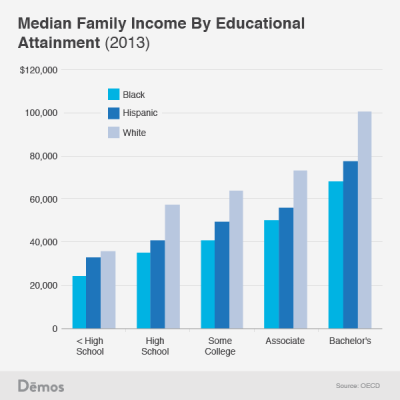
(7) Education is the great equalizer, or a game changer. Simply put, no it isn’t. At every level of educational attainment—from not completing high school to advanced degrees—income is still deeply inequitable within each level by both race and gender: with undereducated white males still earning more than better educated black and white men and all women:

access-to-good-jobs-race-gender

fig_2

(8) K-12 teachers and university professors are indoctrinating students with leftwing politics. A favorite and renewed form of fear-mongering from the right is to paint all levels of education as liberal indoctrination. This claim is false as oversimplification and from misreading that K-12 education and universities are mostly reflections of social norms and not radical or revolutionary institutions.

Part of this false claim comes from associating tradition and dogma with the right and questioning tradition and dogma with the left. In that sense, then, yes, all education is leftwing, but these characterizations also frame the right as inherently indoctrination.

Also, this misconception is grounded in misunderstanding the political nature of education and that many people view anything outside of their beliefs as politically threatening. For conservative people, teaching patriotism in U.S. history seems neutral—although that is political and potentially indoctrinating.

Ultimately, how we talk about and view education impacts powerfully what policies we embrace. Education policy has been ineffective and even harmful over the past three to four decades because of a post-truth dynamic just now being acknowledged in our wider political discourse.

The truth is that we have mostly failed education and our students—not that K-12 or higher education have failed us.

Accountability based on standards and high-stakes tests, school choice (from vouchers to charter schools), intensified teacher evaluation—all of these and more have failed repeatedly because they are solutions grounded in post-truth claims about schools.

Education should be about the pursuit of the truth, but that pursuit is fraught with complications. We have for many decades tarnished that pursuit of truth by making enduring and compelling claims about education that simply are not accurate.

If we are genuinely committed to the truth, let’s start with an honest discussion about our schools so that we can begin to build the education our children and democracy deserve.