Category Archives: education reform

The Rights and Responsibilities of the Teacher of English Redux (2016)

“All we gotta do is be brave
And be kind”

“Baby, We’ll Be Fine,” The National

…the world is gone daft with this nonsense.

John Proctor, The Crucible, Arthur Miller

In a keynote address at the 1960 National Council of Teachers of English (NCTE) annual convention, former NCTE president Lou LaBrant asserted:

Every teacher of English exercises some rights, no matter how dictatorial the system under which [she/]he works; and every teacher carries out some responsibilities. But today we have a considerable movement in this country to curtail certain freedom—rights—of the classroom teacher, and those rights are the matter of this discussion. (p. 379)

Published as The Rights and Responsibilities of the Teacher of English in the September 1961 English Journal, this characteristic call to action from LaBrant resonates in 2016 as English teachers prepare to gather in Atlanta, Georgia for #NCTE16 with the increasingly important theme of Faces of Advocacy.

Fifty-five years ago, LaBrant advocated for teaching:

Teaching, unlike the making of a car, is primarily a thought process. A [hu]man may work on an assembly line, turning a special kind of bolt day after day, and succeed as a bolt-turner….But the teacher is something quite different from the [hu]man who turns a bolt, because the student is not like a car. Teaching is a matter of changing the mind of the student, of using that magic by which the thinking of one so bears on the thinking of another that new understanding and new mental activity begin. Obviously, the degree to which this is reduced to a mechanical procedure affects the results. (p. 380)

Most practicing teachers today work within and against political and bureaucratic forces that “[reduce teaching] to a mechanical procedure.”

And even more disturbing is LaBrant’s warning:

What I am trying to say here is that the teacher who is not thinking, testing, experimenting, and exploring the world of thought with which [she/]he deals and the very materials with which [she/]he works, that teacher is a robot [her/]himself. But we cannot expect a teacher to continue the attempt to find better means or to invent new approaches unless [she/]he knows [she/]he will have freedom to use [her/]his results. Without this freedom we must expect either a static teacher or a frustrated one. I have seen both: the dull, hopeless, discouraged teacher, and the angry, blocked, unhappy individual. (p. 380)

At mid-twentieth century, LaBrant spoke against the all-too-familiar “bad” teacher myth used in contemporary calls for accountability:

Repeatedly when capable teachers ask for freedom, someone points out that we have many lazy teachers, stupid teachers unable to think and choose, ignorant teachers; in short, bad teachers who need control. We do have some, but we encourage others to be bad. Even the weak teacher does better when [she/]he has to face [her/]his own decisions, and when [she/]he supports that decision. (p. 383)

The de-professionalizing of all teachers, then, is not something new, but a historical fact of being a teacher. However, LaBrant confronted the culpability among educators themselves:

One reason so many of us do not have our rights is that we have not earned them. The teacher who is free to decide when and how to teach language structure has an obligation to master [her/]his grammar, to analyze the problems of writing, and to study their relations to structure….But [her/]his right to choose comes only when [she/]he has read and considered methods other than [her/]his own. [She/]He has no right to choose methods or materials which research has proved ineffective….There is little point in asking for a right without preparation for its use. (p. 390)

“Throughout our country today we have great pressure to improve our schools,” lamented LaBrant. “By far too much of that pressure tends toward a uniformity, a conformity, a lock-step which precludes the very excellence we claim to desire”:

There is little consideration of the teacher as a catalyst, a changing, growing personality. Only a teacher who thinks about [her/]his work can think in class; only a thinking teacher can stimulate as they should be stimulated the minds with which [she/]he works. Freedom of any sort is a precious thing; but freedom to be our best, in the sense of our highest, is not only our right but our moral responsibility. “They”—the public, the administrators, the critics—have no right to take freedom from us, the teachers; but freedom is not something one wins and then possesses; freedom is something we rewin every day, as much a quality of ourselves as it is a concession from others. (pp. 390-391)

The Rights and Responsibilities of the Teacher of English Redux

“Evil settles into everyday life when people are unable or unwilling to recognize it,” writes Teju Cole in the wake of Donald Trump being elected president of the U.S. “It makes its home among us when we are keen to minimize it or describe it as something else.”

LaBrant wrote about the field of teaching English throughout the 1940s and 1950s with the power—both for evil and for good—of language forefront of her concerns:

Misuse of language, as Hitler demonstrated, is a terrible thing; we teachers of English can at the very least teach our students that language is a tool of thought, a tool which can be sharp and keen, but is easily blunted. (“The Individual and His Writing,” 1950, p. 265)

So we teachers of English/ELA—and all educators—sit in 2016 confronted with a “[m]isuse of language” that has given rise to a presidency built on racism, sexism, and xenophobia; therefore, as during LaBrant’s career, we teachers of English/ELA must embrace the most pressing responsibilities.

But driving Trump’s and his supporters’ bigotry has been a powerful corruption of language: blatant lies, denials of those lies, and the ugliest of coded language. In short, bullying has rewarded a political leader with the highest office in a free society.

Parody of Trump’s misuse of language cannot be taken lightly, but that misuse has real consequences on the lives of vulnerable and marginalized people, including children in the classrooms of teachers across the U.S.

Immediately, then, teachers must admit “that every dimension of schooling and every form of educational practice are politically contested spaces” (Kincheloe, 2005).

In other words, although teachers are historically and currently de-professionalized by being told not to be political, as LaBrant argued, educators cannot reinforce that mantra by calling for politics-free zones in our classrooms and in our professional spaces.

Calling for no politics is a political act of silencing that brazenly takes a masked political stand in favor of the status quo.

Teaching and learning are unavoidably “politically contested spaces,” but they are unavoidably ethically contested spaces as well.

Language is a human behavior that allows us to wrestle with and find our moral grounding; and thus, those teaching literacy have a profoundly ethical mission to work toward the Right, Good, and Decent—in the act of teaching but also as a personal model.

As philosopher Aaron Simmons argues:

It matters that we demonstrate critical thinking even while others assume that shouting louder is tantamount to evidential refutation. It matters that we think well when it seems hard to think anything at all. It matters that we care about truth because only then can lies and bullshit still be categories to avoid.

The naive stance of neutrality can no longer be who teachers are because, as I noted above, to be neutral is to support the status quo, and in the U.S., the status quo is a cancer that left untreated promises to kill us all.

As Lucas Jacob argues directly:

Calling a politician out for Islamophobia, xenophobia, racism, and misogyny is not a matter of exerting undue influence by favoring one political party over another; nor is it a matter of disrespecting the presidency. Naming Mr. Trump’s hate speech as such is, rather, a moral imperative for supporting the missions of K-12 schools, in which Islamophobic, xenophobic, racist, and misogynist words and actions are punishable offenses that can (and must) be treated as being beyond the pale.

“It goes without saying, then, that language is also a political instrument, means, and proof of power,” James Baldwin wrote in 1979 on Black English. “It is the most vivid and crucial key to identify: It reveals the private identity, and connects one with, or divorces one from, the larger, public, or communal identity.”

Just as LaBrant linked language and power, Baldwin extended that dynamic to include race—and called for using that power in the name of community instead of divisiveness.

The word “critical,” now, has taken on exponential layers of meaning.

We are in critical times, and thus, as Kincheloe explains about the political and ethical responsibilities of being critical educator who seeks for students critical literacy:

Recognition of these educational politics suggests that teachers take a position and make it understandable to their students. They do not, however, have the right to impose these positions on their students [emphasis in original]….

To refuse to name the forces that produce human suffering and exploitation is to take a position that supports oppression and powers that perpetuate it. The argument that any position opposing the actions of dominant power wielders is problematic. It is tantamount to saying that one who admits her oppositional political sentiments and makes them known to students is guilty of indoctrination, while one who hides her consent to dominant power and the status quo it has produced from her students is operating in an objective and neutral manner. Critical pedagogy wants to know who’s indoctrinating whom. (p. 11)

In its simple form, to call a lie, a lie; to name racism, racism; to reject hate as hate—these are the undeniable responsibilities of teachers, especially teachers of English/ELA.

To say “I’m neutral” in the face of a lie is to lie.

To say “I’m neutral” in the face of racism is racism, in the face of sexism is sexism, in the face of xenophobia is xenophobia.

To divorce the act of teaching from the world within which it resides is to abdicate the greatest potential of teaching and learning: to change the human experience from dark to light.

If we shun our responsibilities as teachers in 2016, we are turning our backs to the ugliest realities faced by Baldwin nearly forty years ago:

The brutal truth is that the bulk of white people in American never had any interest in educating black people, except as this could serve white purposes. It is not the black child’s language that is in question, it is not his language that is despised: It is his experience. A child cannot be taught by anyone who despises him, and a child cannot afford to be fooled. A child cannot be taught by anyone whose demand, essentially, is that the child repudiate his experience, and all that gives him sustenance, and enter a limbo in which he will no longer be black, and in which he knows that he can never become white. Black people have lost too many black children that way.

And, after all, finally, in a country with standards so untrustworthy, a country that makes heroes of so many criminal mediocrities, a country unable to face why so many of the nonwhite are in prison, or on the needle, or standing, futureless, in the streets–it may very well be that both the child, and his elder, have concluded that they have nothing whatever to learn from the people of a country that has managed to learn so little.

Writing two decades before her NCTE keynote examined above, LaBrant made a foundational request: “For these reasons my first request of every American teacher of English is that [she/]he teach in [her/]his classroom this honest use of language and an understanding of its relation to life” (p. 206).

And about “this honest use of language,” there are only two options—although remaining neutral is not one of them.

“So what do I do?”

A comment posted on my recent blog, Verboden!: Autonomy and Critical Thinking in Education, deserves a careful reply:

Jill

So what do I do? I want to teach practical skills and meaningful texts. I am instead faced with 50 year old texts in the book room, a list of goals and targets (fewer than 10% failures, increased graduation rates by more than 10%, 40 standards with subets) and the fear of retribution and firing if I stray too far from the mandated curriculum. I just want to teach students to trust the power of their voices when my own voice is silenced by bureaucracy and mandates, meetings and condescending professional development that adds another target (5 phone calls home per week). I read and believe your words, but what do I do? How do I change the world? One student at a time? Another 12 hour day?

Let me offer first some context.

Although I am a tenured full professor, I taught public high school English for 18 years in a right-to-work (non-union) state, and have witnessed the powerlessness of being a teacher in that state through my role in teacher education for these on-going past 15 years.

Yes, K-12 teachers nationally are de-professionalized more and more each day, and throughout the South, where non-union states dominate, teachers are even more silenced and powerless.

However, I do believe there are many ways teachers can claim and expand their professionalism.

Broadly, teachers must resist at all costs fatalism, a call by Paulo Freire I believe is foundational to claiming educators’ professionalism.

Now, then, let me address “So what do I do?”:

  • Take stock of how much of your professional and personal energy is being spent on being a professional and how much is drained by being a martyr—and then stop being a martyr. Especially for K-12 teachers, I advocate the Henry David Thoreau dictum about ours is to do something of value, but never to do everything. Too often, teachers are compelled to martyrdom, which erases all of our energy and is a cancer on our professionalism. Every teacher must take stock of her/his professional practices, and eliminate those that are time and energy draining with little to no positive instructional outcomes. For example, marking extensively on student work, and then not requiring students to respond in some substantive way to those comments is an act of martyrdom—a waste of professional time that produces an artifact of your spending time, but doesn’t benefit either you or your students.
  • Identify and evaluate a very detailed and specific list of those obligations over which you have no control and those aspects of your teaching over which you do have control. This is a useful exercise for individual teachers, but it is even more powerful if conducted as a department or grade-level team. For example, in a graduate course once, when I rejected teachers giving spelling tests, a teacher challenged my stance because, as she explained, “I have to give a spelling grade on the report card!” I asked if any mandates existed for how she determined that grade, exposing that she did have autonomy over the how, and thus, we discussed pulling spelling grades from original student writing. To often, I fear, due to understandable feelings of fatalism, we teachers think we are powerless when we in fact have options. A detailed inventory is an effective way to make these distinctions real.
  • Forefront in your day and planning those aspects over which you have power, and then determine professional strategies for advocating change in those obligations over which you have no current power. Daily, make as your first priority your empowering work as a teacher; do that over which you have control first and give your professional self that positive daily inoculation. Designate brief blocks of time for your compliance to mandates, and stick to that schedule. And then, waste no time fretting about those things over which you have no control.
  • Brainstorm with colleagues more authentic ways to comply with inauthentic mandates. Teachers, I believe, can attack those things about which we have no control—such as standards and high-stakes testing—through stepping back from the mandates and asking if there are alternatives to how to comply. One excellent example is resisting making test-based writing the entire writing curriculum, and instead, making prompt-writing one of the ways in which we teach writing; in other words, embedding prompted, test-based writing late in a more authentic writing program so that we do prepare students for the tests, but also remain true to authentic writing and student voice/autonomy. Also, when mandates are unpacked by a department or grade level team, re-imagined by the department/grade level, and then implemented in ways endorsed by the practitioners, these mandates become tools of professionals instead of de-professionalizing teachers.
  • Cultivate communities of empowerment and advocacy for expanding your professional autonomy. Teachers have historically and are currently often victims of the divide-and-conquer approach to management. The antidote to that is community—and for teachers, even more important is professional community. Start close and move outward: department/grade level professional communities; local, state, and national professional organizations. Now, let me emphasize here that cultivating communities of empowerment must not become an act of martyrdom (see above); I am not suggesting adding on to your professional commitment, but am arguing for re-evaluating your professional time so that you commit segments of time to more professionalism but less overall time to your work day.
  • Create advocacy roles for yourself that suit your own strengths and comfort with advocacy. Many years ago while I was a co-leader for a local chapter of the National Writing Project, I mentored a beginning teacher who struggled with her administration over implementing best practice in teaching writing to her elementary students. These were tense times since the young teacher feared for her job, but believed the school mandates were ineffective and even harmful to her students’ learning. She regularly shared with her principal and colleagues the wealth of professional literature on the practices she chose over the mandates and gradually built a case for what she was doing with her students—even though parents also challenged her practice. No one model works for every teacher, and certainly some aspects of being political pose real dangers for K-12 teachers. Yet, change necessary for greater teacher professionalism and autonomy can result only from teachers who are advocates and political. From blogging and Twitter to participating in professional organizations to implementing practices in your classroom to use as models for change in your school—advocacy and being political are necessary for teacher professionalism.
  • Expand your role as teacher beyond the classroom to parents, the community, and the public. We are teachers, but our power as teachers is not restricted to the classroom. One of the best avenues for helping change our profession is through building greater understanding and support among the parents of our students, the community we serve, and the wider public. Daily conversations outside school; regular newsletters to parents about best practice; letters to the editor or Op-Eds in local, state, and national forums; blogging and other social media dedicated to our work as professional teachers—these are ways in which we can teach beyond the walls of our classrooms.
  • Check your practice and refuse to scapegoat anyone else for your practices. Ultimately, as educators, we must behave professionally, even as we are not treated as or allowed to be professional. Any practice we do is our decision to do. It is neither healthy nor professional to argue that others make us do anything. If any mandate is harmful to children, we cannot comply. Period. If we do comply, we are implying we, in fact, admit it does no harm. While there is no requirement that teachers are perfect, we must adopt the professionalism we want guaranteed us.

Daily teaching and working toward greater teacher autonomy and professionalism are all very hard work—exhausting and stressful.

The path to greater teacher professionalism is build by teachers dedicated to teaching as a professional endeavor. The suggestions above, I believe, are some powerful ways to make this happen while also not sacrificing any teacher along the way.

And so I return to Henry David Thoreau’s “Civil Disobedience” with my small edit: “A [teacher] has not everything to do, but something; and because [she/]he cannot do everything, it is not necessary that [she/]he should do something wrong.”

In my fourth decade as a teacher, I believe the suggestions above help all teachers achieve these wise words.


1 November 2016 Reader: “Matters of power, state violence, extreme poverty, institutional racism”

The rise of Trumpism and how to fight it, Dorian Bon

Even leaving aside the possibility of marauding, right-wing poll-watchers, other questions will have come up for readers of this website: Why is Donald Trump’s bigotry and aggressive chauvinism finding such a large audience? How can so many millions of people who don’t have millions in their bank accounts be planning to vote for him after everything we know?

More generally: Where is the momentum on the far right coming from? Where is it going? And what can be done to stop it?

Trump’s Inconvenient Racial Truth, Nikole Hannah-Jones

To be clear, I am not arguing that the man who called for the execution of the since-exonerated Central Park Five (and who still insists on their guilt) and who seeks nationwide implementation of the stop-and-frisk program ruled unconstitutional in New York City, and who warns that voting in heavily black cities is rigged, is a racial progressive who will enact policies that will help black communities. Nor am I saying black voters should buy what Trump is selling. (And they aren’t: A poll released last week by The New York Times Upshot/Siena College of likely voters in Pennsylvania found that “no black respondent from Philadelphia supported Mr. Trump in the survey.”)

What I am saying is that when Trump claims Democratic governance has failed black people, when he asks “the blacks” what they have to lose, he is asking a poorly stated version of a question that many black Americans have long asked themselves. What dividends, exactly, has their decades-long loyalty to the Democratic ticket paid them? By brushing Trump’s criticism off as merely cynical or clueless rantings, we are missing an opportunity to have a real discussion of the failures of progressivism and Democratic leadership when it comes to black Americans.

Dont Walk That Line! Why Schools Need To Create And Measure Positive Climates, Andre Perry

As researchers on positive school climate note, the “personality” of a school is an expression of how teachers, students, family members and community perceive the milieu.

In other words, a school doesn’t have to be mean to be good. Treating students with care and respect increases academic performance among students from low socioeconomic backgrounds, higher than if a school placed a singular single focus on academics.

Researchers for this study pulled evidence from multiple studies from around the world to understand the relationships between socioeconomic status, school climate, and academic achievement to help academics and practitioners alike understand what a positive climate is and why ultimately it can boost academic achievement.

Why I Have No Sympathy for Angry White Men, Stacey Patton

Why isn’t anyone suggesting that these beleaguered White men respond to their relatively new “hard times” by working hard and pulling themselves up by their bootstraps? Where are the people calling on these beleaguered Whites to develop empathy and compassion for those who have long been suffering, like African-Americans and other people of color? Why do we need to understand this community? Why is the opposite never suggested as a potential option? Is it because White men are simply not willing to emerge from their bubble and acknowledge the humanity of those they deem “other?” Or is it because they are unable to see beyond their own reality?

What we’re witnessing is racist populism all over again. Trump is following a historical pattern by stoking the racism, but especially as a rich White man pitting disenfranchised poor White people against Black people and especially Black people in low-income areas, telling them to intimidate and attack them at his rallies and at the polls, much in the same way poor Whites were pitted against poor Black people by elite White people to ensure there wouldn’t be a class uprising.

“Trump is emancipating unbridled hatred” – Interview: Rina Soloveitchik, Judith Butler

Butler: What Trump is emancipating is unbridled hatred and, as we see recently, forms of sexual action that don’t even care about anybody’s consent. Since when did we have to ask women whether they are okay with being touched, or why? He does not actually say that, but that is exactly what he is indicating. It liberates people, their rage, and their hatred. And these people may be wealthy, they may be poor, they may be in the middle; they feel themselves to have been repressed or censored by the left, by the feminists, by the movement for civil rights and equality, by Obama’s presidency, which allowed a black man to represent the nation.

Unthinkable Politics and the Dead Bodies of Children, Henry A. Giroux

Matters of power, state violence, extreme poverty, institutional racism, a broken criminal justice system, the school to prison pipeline and the existence of the mass incarceration state, among other important matters, rarely if ever enter her discourse and yet these are major issues negatively affecting the lives of millions of children in the United States. And her alleged regard for children falls apart in light of her hawkish policies on global regime change, drone attacks and cyber-warfare, and her unqualified support for the warfare state. Her alleged support for children abroad does not capture the larger reality they face from when their countries are invaded, attacked by drones and subject to contemporary forms of indiscriminate violence. Rather than critique the US as a powerful engine of violence, Clinton expands its imperialist role around the globe. This is a key point in light of her defense of the rights of children, because her warmongering ideology puts children in the path of lethal violence.

Verboden!: Autonomy and Critical Thinking in Education

We don’t need no education
We don’t need no thought control
No dark sarcasm in the classroom
Teachers leave them kids alone

“Another Brick in the Wall – Part 2,” Pink Floyd (Roger Waters)

Those of us who stand outside the circle of this society’s definition of acceptable women; those of us who have been forged in the crucibles of difference — those of us who are poor, who are lesbians, who are Black, who are older — know that survival is not an academic skill. It is learning how to take our differences and make them strengths. For the master’s tools will never dismantle the master’s house. They may allow us temporarily to beat him at his own game, but they will never enable us to bring about genuine change. And this fact is only threatening to those women who still define the master’s house as their only source of support.

“The Master’s Tools Will Never Dismantle the Master’s House,” Audre Lorde

During my 18 years as a public high school English teacher, I taught as an outsider—but for many of those years, I found solace in a colleague, Ed Welchel, who taught history.

Among students, parents, faculty, and administration, Ed and I were considered good, even very good teachers, but we also were viewed with skepticism, particularly the farther up the authority chain you went (parents and administrators, especially).

The high school where we taught, although a rural public school, felt in many ways like a strict private school—very harsh discipline and dress codes, palpable conservative values.

Ed and I were as unlike that environment as two people could be.

After a particularly brutal faculty meeting that stressed the need to control our students, Ed and I began a chant we would share quietly as we passed in the hall: “Beat ’em down, beat ’em down.”

After I completed my doctorate in 1998, Ed soon finished the same program, and then left for another high school before moving on to higher education before I did.

That was fifteen-plus years ago, but it stands as relevant today since many are beginning to fret in earnest about why so many K-12 teachers leave the field.

It’s pretty damn obvious, I hate to say, but many teachers leave the profession because formal schooling is incredibly dehumanizing for students and teachers; in short, in schools, autonomy and critical thinking are verboden.

sample_pic209_14

Dark Sarcasms in the Classroom

Former career music educator and blogger at Education Week/Teacher, Nancy Flanagan asks: “Who is truly afraid of genuine leadership emerging from practitioners?”

Flanagan also confronts a key distinction about what “leadership” means by examining if teacher leaders are, as Audre Lourde would say, using the Master’s tools (implementing policy as required by administration as agents of accountability mandates) or being autonomous professionals.

More optimistically than I would conclude, Flanagan suggests, “Teachers may have lost a vision of reform led by authentic, unvarnished teacher thinking, instead of teacher compliance–but we haven’t relinquished the ideas of autonomy, mastery and self-determined purpose yet.

Educator and activist, Andre Perry turns a similar focus on how school climate impacts students, particularly marginalized populations of students. Perry stresses:

As researchers on positive school climate note, the “personality” of a school is an expression of how teachers, students, family members and community perceive the milieu.

In other words, a school doesn’t have to be mean to be good. Treating students with care and respect increases academic performance among students from low socioeconomic backgrounds, higher than if a school placed a singular single focus on academics.

This rejects, for example, the racist undertones driving the popularity of “no excuses” ideology, notably among charter schools serving poor, black, and brown students. But Perry also speaks to the wider norm of formal schooling.

Historically and especially over the past thirty years of high-stakes accountability, formal education is an Orwellian institution in which “critical thinking” is about completing a worksheet so you can score well on multiple-choice questions assessing critical thinking.

But don’t actually think or act critically if you are a student or a teacher.

Teacher Education and All that Is Wrong

Ed and I left K-12 education because of the harsh environment in schools toward students and because K-12 schools are no places for autonomous professionals.

I literally left after being docked pay for presenting at a professional conference.

However, much to our chagrin, teacher education in higher education is not oasis of professional autonomy, but the most embarrassing desert in higher education.

While colleagues in English often handed out 1-2 page syllabi, mine were 15-20 pages of standards, correlating assignments to those standards, and rubrics—despite my own published stance rejecting rubrics.

The professional life of a teacher educator is mostly about complying with accreditation and certification mandates in order to make sure teacher candidates comply with accreditation and certification mandates.

Again, autonomy and critical thinking are verboden!

For example, in the same foundations course I teach where we confront slut shaming and the inherent sexism of dress codes, within one week of my students being placed in a nearby elementary school to tutor, the principal asked me to remind the female students to dress appropriately.

As well, I always begin that course, and come back to this in most of my classes, with Sandra Cisneros’s “Eleven”—highlighting the dehumanizing norm of schooling that the story captures in the eleven-year-old Rachel’s lament: “Because she’s older and the teacher, she’s right and I’m not.”

But my foundations students are left with observing that reality in their field placements while also being denied the autonomy to do anything to change it.

And while I will not bore you with more examples, the situation above is no outlier; that is what teacher education is—a perpetual state of compliance to bureaucracy that is devoid of opportunities for professional autonomy and critical thinking.

When our candidates do reach the field, they invariably come to use with these observations:

  • “I can’t do anything you taught us in methods.”
  • “This is why people leave the field.”
  • “The administration treats teachers like students.”

All aspects of the field of education, then, are about compliance to the “bureaucratizing of the mind” about which Paulo Freire warned.

#

Formal education remains a desert, and we—teachers and students—wander dutifully forward, toward the wavering mirage that somehow teaching and learning are powerful instruments for change.

2671845245_9ebfd6be7c_b

Education as change remains just that, however—a mirage.

In the halls of schools at every level, student and teacher autonomy and critical thinking are verboden.


The False Cult of Effort, the Gender Gap, and K-12 Teacher-Bashing

While the U.S. presidency is rarified air, the presidential election often reflects the best and worst of the American character.

As the country sits in the cusp of the end of the first black president’s administration and the likelihood of electing the first female president, what does the current election show about the lingering privilege of being white, male, and straight in the U.S.?

Being black, brown, female, gay, or transgender requires perfection while being white, male, and heterosexual allows any transgression to be excused.

Hillary must be perfect (her email controversy is oddly identical to millions of erased emails from private servers under George W. Bush, although that is of no real concern to the public or the media, for example), but Trump’s admitted behavior as a sexual predator is swept aside as just a man being one of the boys.

Yes, the glorious sanctity of the office of president must not be sullied—although the Republican Party has elected Richard Nixon, Ronald Reagan, and W. Bush, a who’s who of unethical personal and political behaviors?

And in this dynamic of privilege we find the cult of effort—the implication that all these powerful white males are in power because of effort, because they deserve the success, earned the success.

Recall that Trump built this off the pittance of an inherited few million. …

On a smaller scale, then, is the K-12 teacher, a profession trapped in the cult of effort and the gender gap.

Having spent my career in part as a K-12 public school teacher and now as a tenured full professor, I have witnessed first-hand a powerful and ugly dynamic.

First, let me work backward.

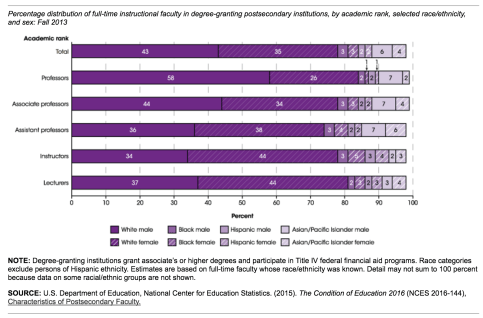
My university has only about 30% female faculty, which reflects a male norm (linked with a white norm) of university professors:

profs-gender

Few professions have greater professional autonomy that being a professor. I can assure you that rarely do people even bother telling a professor what to do—and among those few, virtually none have any real influence.

The profession of being a professor is a white, male world of autonomy and significant prestige.

As above, there is also a false cult of effort among professors—the professorate, so goes the message, is mostly white and male because of the hard work of those white men.

And if you doubt that, listen carefully to the white male response to initiatives for increasing the diversity of professors: We must maintain our rigorous standards for hiring! they shout.

The cult of effort, the cult of rigor—these are codes for maintaining privilege.

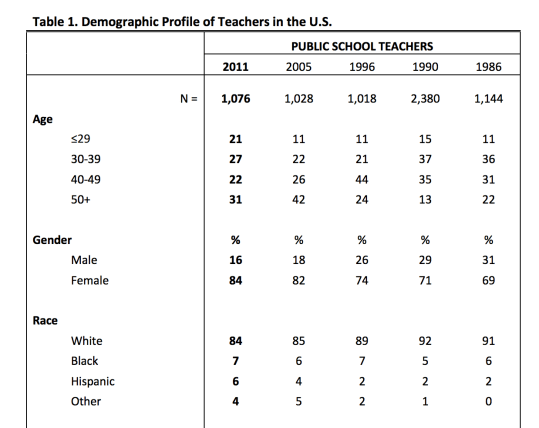
The inverse of this dynamic is at the K-12 level of teaching, a work force still dominated by women:

k-12-teachwrs-gender-2

For K-12 teachers, historically and especially over the past two or three decades, the cult of effort has imposed on the American public that schools are failing primarily because of a slack teacher force (read: a mostly female teacher force), and the way to reform that lazy work force is to raise standard! and demand more!

Let us imagine for a moment that gender divide between the supreme autonomy of mostly male professors and the nearly absent professional autonomy and ridiculous accountability leveled at mostly female K-12 teachers.

The entirely inexcusable “no excuses” model implemented in high-poverty schools serving mostly black and brown students has also become the default environment of being a K-12 teacher: high demand, nearly superhuman demand that erases all professional autonomy and most of the human dignity of teaching.

Yes, teaching K-12 is very hard, but the cult of effort is mostly a lie, and the current high-stakes accountability paradigm is a central cause for driving away teachers.

The accountability era has intensified the historical marginalizing of K-12 teaching as just a woman’s profession; the stakes have been artificially increased while teacher autonomy has been even further eroded.

As a result, K-12 teachers have their work scripted and then are badgered for poor outcomes from the practices they didn’t even choose to implement.

The public and in-school environments for K-12 teachers are toxic—unprofessional and dehumanizing. Administrators who can go to the restroom any time they please demand teachers remain at their doors between classes and never leave a class unattended—relegating basic bodily functions to 20-minute lunch periods (if they are free of students) and planning time.

This reality cannot be disentangled from the gender gap reflected between professors in higher education and K-12 teachers—as well as the current presidential campaign.

K-12 teacher bashing is nested in sexism—assumptions that women are unable and unwilling to make the effort needed to educate children; and thus, K-12 teachers need to be scripted and held to high standards of accountability.

In the political and educational worlds, however, those demanding that accountability and driving the criticism are often far above the standards they espouse.

And that is the ugly truth about women, so-called racial minorities, and gay/transgendered people who must be perfect while white, straight men are forgiven for any and every transgression.

Our democracy suffers under that inequity of privilege and the profession of K-12 teaching is on life support because of the essentially nasty environment surrounding day-to-day teaching.

Democracy and K-12 teaching both require and deserve an atmosphere of patience, compassion, and kindness—traits marginalized by toxic masculinity and white privilege in order to maintain the unearned status of power in the U.S.

At the very least, no one should have to be perfect or everyone should have to be perfect.

Immediately, then, let’s confront how terribly flawed white, straight male leadership has been and is currently—disturbingly personified by Trump himself.

Next, the false cult of effort must end, replaced by the acknowledgement of privilege as central to who has power and why.

With the false cult of effort unmasked, the gender gap can then be erased as well.

From political leadership to the teaching of children in K-12 schools, we will all benefit greatly from the rich diversity of who can and will lead and teach us—especially if that leadership and teaching are rooted in patience and kindness, especially if basic human dignity and autonomy are promised to all.

Rejecting Cultural Literacy for Culturally Relevant: From Baldwin to Cole, “the custodian of a black body”

…to cease fleeing from reality and begin to change it.

James Baldwin, The Fire Next Time

Haunting the American character still is a fact confronted early in Teju Cole’s Black Body: Rereading James Baldwin’s “Stranger in the Village” (originally published in The New Yorker 19 August 2014 but also opening Cole’s Known and Strange Things): that Baldwin, Martin Luther King Jr., and John Coltrane are all “people who could still be with us.”

Living, Cole means—because, of course, they remain with us in ways that are both beautiful and disturbing.

Retracing Baldwin’s time in Switzerland and his essay spawned from that visit, Cole recognizes Baldwin was “depressed and distracted” during his trip in the 1950s—in part due to the “absurdity” of being a stranger during his travels as well as alienated in his home city of New York through the fact of the manufactured concept of race.

Cole experiences a “body-double moment” that emphasizes a physical self-consciousness of being black and male; being “like [Baldwin],” Cole catalogues insecurities of the flesh, building to:

and feel myself in all places, from New York City to rural Switzerland, the custodian of a black body, and have to find the language for all of what that means to me and to the people who look at me.

This racialized and genderized self-consciousness, Cole details, is cultivated in being surveilled; “glances,” in Cole’s diction, but commonly identified as the “gaze,” whether the white gaze or the male gaze.

“To be a stranger is to be looked at,” Cole explains, “but to be black is to be looked at especially.” Hard, Cole means, as in the perpetual policing of the black body.

Cole’s “custodian” echoes Baldwin’s witnessing—bound as the two men are by what Baldwin captures in “‘People are trapped in history, and history is trapped in them.'”

The black body and the American character—both Baldwin and Cole demand—are inextricable. But for Baldwin, Western culture forced him to conclude: “‘I was an interloper; this was not my heritage.'”

However, Cole, shifting to Ralph Ellison, embraces Western art despite the lingering weight he shares with Baldwin: “I have experienced in my own body the undimmed fury he felt about pervasive, limiting racism.”

Continuing the scarred mosaic of history, Cole’s contemporary reality will not allow him to escape “the news online”:

There I found an unending sequence of crises: in the Middle East, in Africa, in Russia, and everywhere else, really. Pain was general. But within that larger distress was a set of linked stories, and thinking about “Stranger in the Village,” thinking with its help, was like injecting a contrast dye into my encounter with the news. The American police continued shooting unarmed black men, or killing them in other ways. The protests that followed, in black communities, were countered with violence by a police force that is becoming indistinguishable from an invading army. People began to see a connection between the various events: the shootings, the fatal choke hold, the stories of who was not given life-saving medication. And black communities were flooded with outrage and grief.

Like Baldwin in 1966, Cole cannot escape the policing of the black body, the political “obsession with cleaning, with cleansing,” that “policymakers believe that going after misdemeanors is a way of preëmpting major crimes.”

Dropped like a stone too heavy to carry any further, Cole concludes:

But the black body comes pre-judged, and as a result it is placed in needless jeopardy. To be black is to bear the brunt of selective enforcement of the law, and to inhabit a psychic unsteadiness in which there is no guarantee of personal safety. You are a black body first, before you are a kid walking down the street or a Harvard professor who has misplaced his keys.

Endless surveilling, constant policing the black body are fed by the “fantasy about the disposability of black life [that] is a constant in American history.”

Cole as custodian witnesses that “American racism has many moving parts, and has had enough centuries in which to evolve an impressive camouflage….Like misogyny, it is atmospheric. You don’t see it at first. But understanding comes.”

But there remains one more damning stone to drop: “black American life is disposable from the point of view of policing, sentencing, economic policy, and countless terrifying forms of disregard”—one of which, left unnamed by Cole, is formal education.

#

An educational dinosaur who refuses extinction, E.D. Hirsch yet again offers a plea for cultural literacy, folded into the decades-old standards debate.

There is a disturbing irony about a torch bearer of the dominant culture lobbying for that culture to remain dominant—specifically through the codified curriculum of the formal education system.

Hirsch cloaks his message in an unaddressed assumption that knowledge can be somehow politically neutral; it’s all about the role of knowledge in teaching students how to read, you see.

But official curriculum and the current state of high-stakes accountability can never be disentangled from power—who can and does decide what knowledge matters.

Just as Cole above confronts how art, culture, and race intersect—among Cole, Baldwin, and Ellison—when the knowledge that matters is the province of some people (read “white,” “male,” and “affluent”), other people become the Other, marginalized by their identified lack of the knowledge that matters.

Cultural literacy/knowledge as that which is objective, easily identified, and then easily dispensed is the fertile soil within which the status quo of society and formal education thrive. Like the literal policing of the black body in the streets, education becomes an act of “cleansing” the Other of their heritage to make room for cultural literacy/knowledge writ large.

And the status quo of the streets and the hallways must not be allowed to remain: where black girls are policed for their hair, the same hair that is fetishized, rendered exotic; where black boys are seen as older than their biological ages; where the black body has been so demonized that blacks themselves embrace the punishing, cleansing, of their own flesh.

If we pretend knowledge is politically neutral, that whoever is in power has the right to decide what knowledge matters, and if we define reading in a way that depends on that cultural knowledge for anyone to be considered literate, then we are failing to read and re-read the world as it is in order to make a new world.

Not the world as it was during Baldwin’s life. Not the world as it is during Cole’s life.

The “obscene American forms of white supremacy” are the parents of cultural literacy/knowledge.

And this white gaze has also created “no excuses” charter schools that “fix” black, brown, and poor students.

White privilege and its cognate racism, as Cole notes, are invisible: “You don’t see it at first.”

The “at first,” however, must not be undervalued.

To see privilege and racism requires not cultural literacy, but critical literacy—reading and re-reading the world, writing and re-writing the world—fostered in a context of culturally relevant pedagogy.

From Baldwin as witness to Cole as “custodian of the black body,” the message about how our society and our schools must change is not absent but “preferably unheard.”

Change must happen, but it must not “shame or defame black people and [black] organizations,” Adrienne Dixson and Andre Perry argue, concluding with a stone of their own: “Be accountable to black people.”

Cultural literacy is stasis, not change. It is accountable to white privilege.

Haunting the American character still is Baldwin demanding that we must “cease fleeing from reality and begin to change it.”

Traditional Assessment Isolates Learning, Devalues Community and Collaboration

I attended junior high well before the rise of the middle school; therefore, I did not enter high school until 10th grade.

But the greatest shift for me as a student was my sophomore English class taught by Lynn Harrill. Throughout junior high, English class has been a never-ending Sisyphean hell of grammar textbook exercises and a sentence-diagramming marathon throughout 9th grade.

I entered high school a devoted math and science student—but more importantly, I had written essentially nothing of consequence as a student, ever.

Until Mr. Harrill’s class, in which we wrote two essays that sophomore year.

My close friends were a somewhat smaller subset of the so-called “top” students who were tracked in the honors classes. We were both socially and academically close.

By my senior year, we had begun to peer-edit our essays—which we feared was cheating because the workshop approach to teaching writing was not in practice yet and we had as “good students” learned all the unspoken lessons of schooling.

From “Cover your papers” during tests to “Don’t copy your friend’s homework,” we knew that collaboration was cheating—but my close circle of friends also knew something very important: when we were collaborative, we learned, and we learned in ways that surpassed traditional teacher-centered learning.

We were each other’s spell checkers, grammar editors, and unofficial peer-teachers.

Despite the rise of the National Writing Project and the mostly widespread awareness of process writing (although it remains too often misunderstood and mischaracterized), students throughout K-12 and university education experience traditional assessment in isolation—significantly one of the least authentic aspects of traditional assessment.

Throughout my 30-plus-year career, I have advocated for and practiced de-testing and de-grading, but during the more recent 14-plus years at the university level, I have been able to experiment more fully with how this looks in the classroom.

One element of authentic assessment and feedback for students that I have explored is moving away from assessment that isolates and toward collaborative assessment, assessment opportunities that require and emphasize community.

While university professors benefit from much greater professional autonomy than K-12 teachers, university’s still require grades and mid-term/final exams; notably, these exam sessions are pretty strictly regulated in that professors need to show some use of the exam times/days for assessment.

Since I give no tests (a practice I started while a public school English teacher), I have developed mid-term sessions that are collaborative and discussion-based.

For example, each fall my first-year writing seminars and foundations of education class have assignments that build toward spending the actual mid-term exam time in small and whole group discussions.

Class discussions as mid-term exams pose several significant problems in the context of traditional schooling. First, every teacher has experienced the resistance by students and their parents to grades on group work—especially when “good” students get nicked on grades because the group had a member who didn’t pull her/his weight.

Discussion also privileges extroverted students and, just as most of traditional class structures do, disadvantages introverted students.

And as with any form of alternative assessment, students are often uncomfortable with and may fail to perform well because of different contexts for motivation and accountability.

The classroom discussion as mid-term exam originated with a foundations of education class several years ago—as we confronted the problems with traditional grades and tests, I encouraged the class to brainstorm with me how to create a more authentic mid-term experience.

Last week, I implemented the discussion as mid-term exam in both courses I am teaching.

First-year writing students choose, contact, and interview a professor in a department students are considering for a major. Each student records the interview as an artifact to prove she/he fulfilled that requirement, but then, students come to class with several key take-aways from the interview, which focuses on the professor as a scholar and writer.

The class begins with small-group (3-4 students) discussions that I casually monitor, and then we move to a whole group discussion.

I list the departments/disciplines on the board, and I help structure the discussion to focus on what scholars do and how academics write and submit work for publication (and how some disciplines do not conform to that norm, such as artists and musicians who create and perform).

In the foundations of education course, students read Paul Gorski’s Reaching and Teaching Students in Poverty: Strategies for Erasing the Opportunity Gap throughout the first half of the course, including a few class sessions for discussions of their reading.

Before the mid-term date, students submit talking points for the class discussions. I encourage those notes to be as specific as possible (quotes, page numbers).

The class session also starts with small-group discussion and then moves to whole group, but in this class, I remain entirely outside the discussions and require the students to navigate everything.

Briefly, at the end, I have a debrief about the experience.

These assessments have a few key elements in common: requiring artifacts of participation, creating small spaces for students to share if whole-group dynamics are uncomfortable, and shifting as much ownership of the learning to the students as possible.

I have been doing this for several years now, and every single one has been impressive. The actual mid-term sessions have always impressed me in a way that no traditional tests have.

In the debrief with my foundations of education class last week, I pointedly asked them to compare the mid-term discussion of a textbook reading to a standard test or individual essay.

Students were eager to argue that the discussion was far more powerful in terms of their understanding and engaging with Gorksi’s work; in fact, the whole-class discussion became extremely animated, and I witnessed students negotiating with both Gorski’s ideas on poverty and their classmates evolving awareness about poverty.

In short, the assessment was not a mere recording of learning, but a learning experience itself.

And what I learned, what the experience reinforced for me? Learning is collaborative, knowledge is the result of a community, and traditional assessment fails miserably since it isolates learners from each other and the teacher while reducing knowledge to a commodity.

As a critical educator, I continue on a journey to practice Paulo Freire’s vision of the teacher-student charged with educating students-teachers.

Assessment as collaboration and community is both something we can all practice in traditional settings and something we must do if we honor education as an act of liberation and the classroom as a space that honors human autonomy and dignity.

Arne Duncan: Just Stop It

It’s a hollow fantasy, but one I was clinging to like a victim of relentless identity theft.

Arne Duncan leaves the U.S. Department of Education and his role as Secretary of Education, joining instead a celebrity basketball league that keeps him too busy to hold forth anymore on education.

An alternate fantasy envisions Duncan sitting daily in his home, calming staring at himself in the mirror while listening to one of his speeches on a loop.

Instead, there is reality: An open letter to America’s college presidents and education school deans: Arne Duncan.

So I am compelled to offer this plea in the psuedo-sport lingo that may appeal to this career-long political appointee: Arne Duncan, just stop it.

Political bromides and jumping on the embarrassingly inept NCTQ bandwagon in order to build a middle-school argument about the grades students receive as education majors—this is the sort of nonsense that has fueled my fantasies that Duncan would simply slip off into the celebrity basketball sunset.

Since that isn’t the case, and Duncan, like Jeb! Bush, has found the I-know-nothing-about-education-but-use-it-in-my-political-career train to remain lucrative, I am willing to make a deal here.

Arne, you have never taught, have never been a teacher educator, have no formal degree in education, and have never conducted or written education scholarship; therefore, since your entire education background is built on political appointments and Ivey-league connections, I respectfully beg you to just stop it. Enough is enough.

As a consequence, since I have no experience as a narcissist, a political appointee, a celebrity basketball player, or the demonstrably worse SOE than either Rod Paige or Margaret Spellings (and that is saying something), I will not hold forth myself on any of your areas of expertise.

Deal?

I somehow doubt it because privilege has its privileges.

The Duncan phenomenon suffers from the same sort of white man privilege/delusion confronted by Deborah Lipstadt, who is being portrayed in film for standing up to Holocaust deniers:

She said she hopes the movie also demonstrates the difference between facts, opinions and lies.

“If you take a lie and say it very strongly and say lots of us believe the earth is flat. Doesn’t make it true. It’s still a lie.”

Duncan needs to just stop it because his lies are lies no matter how often he repeats them.

So my new fantasy is Duncan sitting daily in his home, calming staring at himself in the mirror while listening not to one of his speeches on a loop, but to an audio book version of The Phenomenon of Obama and the Agenda for Education – 2nd Edition: Can Hope (Still) Audaciously Trump Neoliberalism?

Maybe, just maybe, if Duncan is quiet, and listens to others who have real expertise, he may learn something.

Well, having a dream is better than nothing.


Disciplinary Bias by Race and Gender Begins in Preschool

As reported by Cory Turner for NPR:

“What we found was exactly what we expected based on the rates at which children are expelled from preschool programs,” Gilliam says. “Teachers looked more at the black children than the white children, and they looked specifically more at the African-American boy.”

Indeed, according to recent data from the U.S. Department of Education, black children are 3.6 times more likely to be suspended from preschool than white children. Put another way, black children account for roughly 19 percent of all preschoolers, but nearly half of preschoolers who get suspended.

One reason that number is so high, Gilliam suggests, is that teachers spend more time focused on their black students, expecting bad behavior. “If you look for something in one place, that’s the only place you can typically find it.”

Further Turner notes:

It’s impossible to separate these findings from today’s broader, cultural context — of disproportionately high suspension rates for black boys and young men throughout the school years, of America’s school-to-prison pipeline, and, most immediately, of the drumbeat of stories about black men being killed by police.

These findings parallel Michelle Alexander’s claims about racial inequity in policing and the criminal justice system—a dynamic disturbingly grounded in education and education reform.

The study itself finds:

Preschool expulsions and the disproportionate expulsion of Black boys have gained attention in recent years, but little has been done to understand the underlying causes behind this issue. This study examined the potential role of preschool educators’ implicit biases as a viable partial explanation behind disparities in preschool expulsions. Participants were recruited at a large conference of early educators and completed two tasks. In Task 1, participants were primed to expect challenging behaviors (although none were present) while watching a video of preschoolers, balanced by sex and race, engaging in typical activities, as the participants’ eye gazes were tracked. In Task 2, participants read a standardized vignette of a preschooler with challenging behavior and were randomized to receive the vignette with the child’s name implying either a Black boy, Black girl, White boy, or White girl, as well as randomized to receive the vignette with or without background information on the child’s family environment. Findings revealed that when expecting challenging behaviors teachers gazed longer at Black children, especially Black boys. Findings also suggested that implicit biases may differ depending on teacher race. Providing family background information resulted in lowered severity ratings when teacher and child race matched, but resulted in increased severity ratings when their race did not match. No differences were found based on recommendations regarding suspension or expulsion, except that Black teachers in general recommended longer periods of disciplinary exclusion regardless of child gender/race. Recommendations for future research and policy regarding teacher training are offered. (abstract)

The State: ACT scores expose state’s unwillingness to act

ACT scores expose state’s unwillingness to act

[original submission posted below before edits]

Education reform in South Carolina suffers from a tragic lack of imagination: New standards and new tests, but the outcomes remain disappointing.

Now, recently released ACT scores serve as the newest reason to panic. As reported in The State: “The latest scores from the ACT college entrance exam suggest that many of this year’s high school graduates aren’t ready for college-level course work.”

SC’s data are troubling: 14% of test-takers not ready for college and the race gap even more alarming (2% of black students met standard on the four sections of the ACT).

SC also appears to compare poorly to the other 20 states requiring all students to take the ACT—notably Tennessee has a similar poverty rate as SC but a higher average ACT score.

However, I urge caution about interpreting ACT scores from one year of data since SC has recently adopted Common Core standards and tests, dropped Common Core, adopted yet new standards, and then chosen the ACT for annual testing.

Thus, my concerns about shouting that the sky is falling based on the new ACT scores include the following:

  • Scores are depressed due to standards shuffling across the state over the past 3-4 years.
  • ACT tests, like all standardized tests, remain more strongly correlated with race, social class, and gender than the quality of the schools or teachers.
  • One year of data when a new test is adopted is inadequate for drawing hard conclusions.

ACT results are nothing new since SC has a long history of having low, if not the lowest, test scores in the U.S. (notably our residency in the basement of the discredited practice of journalists ranking states by SAT scores), but the most important lesson from this data is that SC has yet to address the equity gap in the lives and education of vulnerable children.

To persist with labels such as the “achievement gap” is to keep our eyes on the outcomes while ignoring the root causes of those outcomes.

SC has spent three decades changing standards, tests, and accountability, but refuses to address directly the race and class inequities facing our state and those same inequities reflected in our schools (both traditional and charter).

Ultimately, I am not trivializing SC’s ACT scores—especially as that relates to black, brown, and poor students—but I must stress we did not need more data from a different test to tell us what we have known and ignored for decades: social and educational inequity cheats those black, brown, and poor students, and our obsession with changing standards and tests fails to address the root equity problems reflected in low test scores.

The real failure in education reform lies in the inability of education reformers to do something different beyond accountability, school choice, and charter schools—none of which addresses problems directly and all of which increases those problems.

Hand wringing over results of the recent ACT is not a new revelation. Therefore, admitting that weighing a pig doesn’t make a pig fatter is crucial in our debates about low test scores. Instead we need to feed the pig, a metaphor for addressing root causes.

While problematic, recent research suggests that even when schools can raise test scores, those higher scores do not translate into benefits once students enter the real world. In other words, if education is to have real life-long positive consequences, we must confront a wide range of complex root causes and school practices in order to insure equity of opportunity—which unlike raising test scores is more likely to produce life-long benefits.

Instead of changing tests and increasing test-prep, which disproportionately impact negatively our vulnerable student populations, we need to erase food, health, and work insecurity, and we need to addresses equity of opportunity (access to experienced and certified teachers as well as access to challenging courses and then affordable college)—and not more accountability driven by ever-new standards and tests.

No one needed the recent ACT scores to confront that our schools, like our society, is negligent with black, brown, and poor students. Now, the real question is, who is willing to do something different and directly about the inequity those test scores represent?