Category Archives: education reform

Readers, Writers, Teachers, and Students: “the pointlessness of so much of it”

I wonder who I would have been, without those shelves, without those people and those places, without books.

I would have been lonely, I think, and empty, needing something for which I did not have words.

“Four Bookshops,” The View from the Cheap Seats: Selected Nonfiction, Neil Gaiman

After 18 years as a public high school English teacher and then 14 years and counting as a university professor (many years of which teaching first-year writing along with teacher education), I was sitting a couple weeks ago in our second workshop designed to help university professors teach writing, and I had an epiphany about teaching writing that I believe has helped me understand better why the teaching of writing remains so contentious.

Both the formal teaching of reading and writing—notably at the secondary and undergraduate levels—is conducted by one of two essential groundings: teaching literacy as a reader and/or writer versus teaching literacy as a hyper-student/teacher [1].

While my teaching and advocacy for teaching rests solidly in the former, I am not here suggesting one is better than the other, but that these two perspectives are at the core why discussing and confronting so-called “best practices” often comes off as a heated debate instead of a productive conversation.

I have noted often that many English majors, including those certifying to teach secondary English and those who attain doctorates to teach at the university level, are prepared to teach a very narrow version of literary criticism—mostly addressing fiction and poetry, and mostly through analysis of literary technique and writer’s craft. (See this interesting argument for close reading of multicultural texts that, I believe, recommending close reading by rejecting close reading.)

During the accountability era when what we teach and what students learn have been reduced to how students are tested, reading and writing have been reduced to artificial (as in how we address them in school and how we test them) forms: reading snippets of text to answer multiple choice questions (no real-world readers do this), writing from a prompt in order to be assessed by a rubric and/or against an anchor paper (at best a bastardization of real-world writing, but honestly, again, no real-world writers do this).

I will not explore this fully here, but we cannot ignore as well how the commodification of education has eroded the authenticity of reading and writing. Textbooks and teaching materials feed the accountability dynamic narrowly but also speak to viewing reading and writing as students and teachers, not as readers and writers.

A Case for Readers and Writers in Formal Schooling

I am currently reading Neil Gaiman’s The View from the Cheap Seats: Selected Nonfiction, and this adventure in a writer’s-writer offering essay after essay about his love affair with books, writers, libraries, and genre is both a pure joy for me as reader and writer as well as yet another journey into trying to understand better the teaching of reading and writing.

Gaiman is an incredibly successful writer who cannot resist constantly reminding his readers how his life as a writer grew from his love affair with books and writers, how bookstores and libraries were his sanctuaries.

His is also a testament to the power of a wide variety of genres and media in the life of avid readers and writers.

“The Pornography of Genre, or the Genre of Pornography” and “What the [Very Bad Swearword] Is a Children’s Book, Anyway? The Zena Sutherland Lecture” are powerful essays about the importance of teaching literacy as readers and writers (and thus at least tempering teaching literacy as hyper-students/teachers) but also about how literacy is a journey, not something to be acquired or mastered.

To focus on the second essay noted above, Gaiman shares a story of his telling a joke to a fellow eight-year-old, a joke including the word “fuck”; the controversy that followed, including the friend’s parents removing that child from the private school, taught Gaiman “two very important lessons”:

The first was that you must be extremely selective when it comes to your audience.

And the second is that words have power.

This essay on children’s literature is also about children, as Gaiman explains:

Children are a relatively powerless minority, and, like all oppressed people, they know more about their oppressors than their oppressors know about them.

And then, Gaiman confronts formal schooling—reinforcing something I have found to be a pattern among some of the most well regarded writers (I have written and edited a number of books on writers, focusing often on Kurt Vonnegut):

For the record, I don’t think I have ever disliked anything as long or as well as I disliked school: the arbitrary violence, the lack of power, the pointlessness of so much of it….

My defense against the adult world was to read everything I could. I read whatever was in front of me, whether I understood it or not.

I was escaping. Of course I was—C.S. Lewis wisely pointed out that the only people who inveigh against escape tend to be the jailers. [1]

And here is where I believe the tension I noted earlier comes into play.

Again, I am not arguing here that teaching literacy as a reader/writer is necessarily better than teaching literacy as a hyper-student/teacher, but I am extremely concerned that the latter dominates formal schooling to an extreme that is harmful to both literacy and basic human dignity and agency.

Gaiman’s essays, however, shout to those of us who teach literacy that formal schooling and teaching literacy as hyper-students/teachers stood between Gaiman and works such as his wonderful The Ocean at the End of the Lane, that Gaiman has become a gifted and treasured writer in spite of his formal education (like Louise DeSalvo, Gaiman honors the coincidental lessons of libraries and bookstores).

I am fairly certain now that lumping all sorts of literacy instruction into a course called “English” is a really bad idea—teaching literary analysis is often at odds with fostering a love of reading, but being a teacher of reading and/or literature is simply not the same thing as teaching writing.

So much of my antagonism about how we teach literacy isn’t at us teachers so much as at the system itself—how formal schooling too often is rightly analogized as prison, how many of us have excelled in many ways in spite of our education.

As a lover of books, libraries, and bookstores; as a writer who views nearly every moment of this life through writer’s eyes; as someone who, like Gaiman, remains moment by moment aware of the “powerlessness” and “helplessness” of being a child or teen, of being a student—I make the case often that the teaching of literacy—reading and writing—needs less school- and test-only versions of reading and writing, but much more authentic reading and writing.

At the end of his contemplation on what makes a book for children (or adults), Gaiman returns to a point he makes early in the talk: “But then, you do not come to authors for answers. You come to us for questions. We’re really good at questions”

And it is here that I think we have a better way for formal schooling—the pursuit of questions with the joy and wonder of a child.

And I’ll thus end with a question: What value is there in rules, tests, templates, and requirements if in the end our classrooms have resulted in children seeking ways to escape “the pointlessness of so much of it”?


[1] Many if not most teachers and professors are hyper-students, having excelled at and achieved within formal schooling where literacy is reduced to tests, templates, and narrow views of what counts as “good” and “bad” language and texts. Once anyone has excelled in that culture, it is difficult to view it critically or to reject it for what avid readers and writers would call “authentic” literacy.

[2] On Science Fiction, C.S. Lewis:

They are as refreshing as that passage in E. M. Forster where the man, looking at the monkeys, realizes that most of the inhabitants of India do not care how India is governed. Hence the uneasiness which they arouse in those who, for whatever reason, wish to keep us wholly imprisoned in the immediate conflict. That perhaps is why people are so ready with the charge of ‘escape’. I never fully understood it till my friend Professor Tolkien asked me the very simple question, ‘What class of men would you expect to be most preoccupied with, and most hostile to, the idea of escape?’ and gave the obvious answer: jailers. The charge of Fascism is, to be sure, mere mud-flinging. Fascists, as well as Communists, are jailers; both would assure us that the proper study of prisoners is prison. But there is perhaps this truth behind it: that those who brood much on the remote past or future, or stare long at the night sky, are less likely than others to be ardent or orthodox partisans.
Adventures in Nonsense: Teaching Writing in the Accountability Era

No, it’s all nonsense, believe me.  I had no idea how much nonsense it was, but nonsense it all is.

Anna Scott, Notting Hill

Everything that is wrong with edujournalism and the teaching of writing in the accountability era can be found in Education Week: the anemic examination of the five-paragraph essay (or when edujournalists discover a field in the same way Columbus discovered America) and Lucy Calkin’s interview about the state of teaching writing (or when edugurus package and promote educommerce).

Both of these pieces frame how the teaching of writing now faces greater demands from (you guessed it) the Common Core. But neither piece admits that the Common Core is at best on life support or that this puts the cart before the horse.

You see, the teaching of writing should be driven by the field of composition—the decades of expertise that can be found in the scholarship of writers and teachers of writing as well as foundational and powerful organizations such as the National Writing Project and the National Council of Teachers of English.

The Common Core is no more than bureaucratic nonsense; these standards serve the needs of educommerce, but do not reflect the field of literacy, do not meet the needs of teachers or students.

And thus, these standards, the high-stakes tests inevitably linked to all standards, and the coverage of writing in EdWeek, as Anna Scott opined, it’s all nonsense.

A little history here: Zip back to 2005 when Thomas Newkirk detailed in English Journal that the “new” SAT writing section had already resulted in “students [being] coached to invent evidence if they were stuck.”

In other words, writing was reduced to conforming to the 25-minute, one-draft prompted assessment in one high-stakes test.

Newkirk confirmed what George Hillocks found about the accountability movement’s negative impact on writing:

[W]hen students have been subjected to this instruction for eight to ten years, they come to see the five paragraph theme and the shoddy thinking that goes with it as the solution to any writing problem. Directors of freshman English at three Illinois state universities have complained about the extent of the problem. The English department at Illinois State University publishes a manual advising their incoming freshmen that while the five para- graph essay may have been appropriate in high school, it is not appropriate in college and should be studiously avoided. It shuts down thinking.

This is a crucial time in American democracy. We are faced with problems that demand critical thinking of all citizens. We need to help students examine specious arguments and know them for what they are. Our tests encourage the opposite. They encourage blurry thinking and obfuscation. As a society, we cannot afford to spend valuable classroom time on vacuous thinking and writing. (p. 70)

So let’s consider the state of writing instruction in K-12 public schools—and let’s try looking at the overwhelming evidence as detailed by Applebee and Langer’s 2013 Writing Instruction That Works: Proven Methods for Middle and High School Classrooms.

In my review of this research, I detail both what we know about the state of teaching writing and what the roadblocks are to effective writing pedagogy:

In Chapter Two (Writing Instruction in Schools Today), Applebee and Langer (2013) lay the foundation for what becomes the refrain of the book:

“Overall, in comparison to the 1979–80 study, students in our study were writing more in all subjects, but that writing tended to be short and often did not provide students with opportunities to use composing as a way to think through the issues, to show the depth or breadth of their knowledge, or to make new connections or raise new issues…. The responses make it clear that relatively little writing was required even in English…. [W]riting on average mattered less than multiple-choice or short-answer questions in assessing performance in English…. Some teachers and administrators, in fact, were quite explicit about aligning their own testing with the high-stakes exams their students would face” (pp. 15-17)….

And those concerned about or in charge of education reform policy should use this study and analysis as a cautionary tale about the unintended and negative consequences of the current thirty-year accountability era that has failed No Child Left Behind (NCLB) and its call for scientifically based education policy (Thomas, 2013). Since the central message about the gap between best practice and the day-to-day reality of writing in U.S. middle and high schools is consistent in Applebee and Langer’s work, I want to highlight several key points and then conclude with a couple caveats that help inform teachers and policy makers:

  • Across disciplines, students are being asked to write briefly and rarely, with most writing falling within narrow templates that are unlike discipline-based or real-world writing.
  • Teachers tend to know about and embrace the value of writing to learn content, but rarely implement writing to achieve rich and complex examinations of prior or new learning.
  • Student technology savvy is high (notably related to social media), while teacher technology savvy remains low. Technology’s role in teaching and learning is detailed as, again, narrowed by high-stakes testing demands and “primarily…used to reinforce a presentational mode of teaching” (Applebee & Langer, 2013, p. 116). These findings call into question advocacy for greater investments in technology absent concern for how it is implemented as well as raising yet another caution about ignoring research showing that technology (especially word processing) has the potential to impact writing positively if implemented well.
  • While English language learners (ELLs) tend to be one category of students targeted by education reform and efforts to close achievement gaps, high-stakes testing and accountability stand between those students and the potential effectiveness of extended process writing in writing workshop experiences.
  • Like ELL students, students in poverty suffer the same fate of disproportionately experiencing narrow learning experiences that focus on test-prep and not best practice in writing instruction:

“By far the greatest difference between the high poverty and lower poverty schools we studied stemmed from the importance that teachers placed and administrators placed on high-stakes tests that students faced. In the higher poverty schools, fully 83% of teachers across subject areas reported state exams were important in shaping curriculum and instruction, compared with 64% of their colleagues in lower poverty schools” (Applebee & Langer, 2013, p. 149).

  • One important counter-narrative to the education reform focus on identifying top teachers is that Applebee and Langer (2013) note that when teachers have autonomy and implement best practice, high-poverty students outperform comparable high-poverty students in classrooms “with more traditional approaches to curriculum and instruction,” driven by test-prep (p. 148).

The problem with teaching writing is not that teachers lack knowledge of good writing pedagogy (although that certainly is a concern), but that accountability and high-stakes testing (read: Common Core and whatever the next wave is) have supplanted teacher autonomy and the expertise in the field of teaching writing.

The five-paragraph essay was never good writing pedagogy, and abdicating the field of composition to Common Core, any set of standards, any high-stakes testing, and the concurrent educommerce all that nonsense feeds is the problem with teaching writing.

Period.

What Is the Agenda?: More Propaganda without Evidence

Yet more public relations propaganda about Meeting Street Elementary @Brentwood from the Post and Courier—this time with a little extra ugliness not-so-subtly framing the article.

The “no excuses” charter school playbook is in full force as the article opens by focusing on the school’s selection process for teachers: you see, the real problem with schools is teachers who don’t care, who don’t try, and who embody the soft bigotry of low expectations:

“You’d think that those would be pretty simple questions,” Campbell said. “If you’re in education, you should assume that all kids can learn. But there’s a lot of implicit bias in teachers that we’ve found (toward) kids in poverty, kids of color.”

Trigger: “bad” teacher myth.

And then, while suggesting teachers are too often racists, the racism inherent in these sorts of takeover strategies is slipped in; you see, the other problem is poor black children need to be trained:

Brentwood’s high standards start with behavior. Campbell said teachers instruct students in how to walk in the halls, how to act in the cafeteria and even how to sharpen a pencil.

“They get four lessons on the playground before they’re allowed to touch any equipment,” Campbell said.

Trigger: “grit” narrative.

But all this is old hat—the nasty “grit” and “no excuses” model—and the real ugliness is saved for the end:

Founder and CEO of Meeting Street Schools Ben Navarro also addressed some concerns raised by education activists, who have been unsuccessfully filing Freedom of Information Act requests with the district to see all of the funding sources at Brentwood. They have also objected to the school’s special waivers from South Carolina’s teacher employment protection laws. He said his school had more oversight than most others, as Postlewait sits on Brentwood’s executive committee.

“What is the agenda of people doing the attacking? Is it about adults?” Navarro said.

That’s right, lazy bigoted teachers, poor black children in need of character training, and education activists with agendas—that’s what wrong with public education and serving high-poverty minority children.

Actually, methinks he doth protest too much.

If there is an agenda, we should suspect it is with those who haven’t provided the data.

The article gives a hint that Meeting Street Elementary @Brentwood is making its grand claims of unusual success based on MAP scores—but there is no way to confirm if those claims and that data are really about anything exceptional.

The real story here is buried in the middle of the article:

Meeting Street Elementary @Brentwood also offers what Campbell calls “wraparound services,” including a full-time speech therapist and a behavior interventionist. To maintain a racially diverse teaching staff, Meeting Street recruits teachers at historically black colleges and universities.

Part of the Meeting Street strategy also has to do with money. At Brentwood, Meeting Street Schools currently pitches in about $4,000 per student on top of the district’s $9,900 in per-pupil funding. The district’s partnership with Meeting Street Schools will reach a “sunset” after Burns and Brentwood have both expanded to the fifth grade, at which point the district will have to figure out how to fund the programs itself.

As I have been documenting [1], we know that money makes a difference when addressing high-poverty populations of students, we know that “miracle” schools almost always prove to be mirages, we know that charter schools who claim success usually benefit from student attrition and underserving high-needs populations (ELL and special needs students), and we know that small-scale success may be impossible to scale to all public schools.

What we don’t know is how or if any of this is relevant about Meeting Street Elementary @Brentwood.

What we do know is that a lot of press release propaganda continues to roll out while the data that would settle the issue do not.

If “What is the agenda?” is good for educational advocates, it is certainly essential for those positioned to benefit from big claims and hedging on allowing third-party examinations of the full body of evidence.


[1] Don’t Trust Invested Advocates in Edureform WarsQuestions for the P&C about School Closure, TakeoverMore Questions for The Post and Courier: “Necessary Data” or Press-Release Journalism?

Why No Accountability for the Accountability Hawks?

It is a disturbingly easy list to make: police officers shooting/killing defenseless black males and females, Rush Limbaugh, OJ Simpson, Karl Rove, Hillary Clinton, Michelle Rhee, Bill Gates, ad infinitum.

Those shielded by privilege (wealth, race, celebrity, status) from the consequences of being held accountable for their actions.

And what is most disturbing is that among accountability hawks, those are the people least likely to be held accountable.

In the accountability era of education reform, the accountability hawks have been left unscathed even as they work to create school choice (public funds sent to private schools outside the accountability paradigm), more charter schools (relieved of accountability), and uncertified teachers (Teach For America).

Those accountability hawks, the politicians and the billionaire education hobbyists, are never held accountable as each policy and reform-of-the-day fails before s/he moves on to the next Great Reform.

Complicit in this failure to hold accountability hawks accountable have been spineless edujournalism and edupresses that have abdicated their role to press release journalism in the service of the edureformers.

And thus, as Audrey Amrein-Beardsley details:

Just this week, in Education Week — the field’s leading national newspaper covering K–12 education — a blogger by the name of Matthew Lynch published a piece explaining his “Five Indisputable [emphasis added] Reasons Why You Should Be Implementing Value-Added Assessment.”

I’m going to try to stay aboveboard with my critique of this piece, as best I can, as by the title alone you all can infer there are certainly pieces (mainly five) to be seriously criticized about the author’s indisputable take on value-added (and by default value-added models (VAMs)). I examine each of these assertions below, but I will say overall and before we begin, that pretty much everything that is included in this piece is hardly palatable, and tolerable considering that Education Week published it, and by publishing it they quasi-endorsed it, even if in an independent blog post that they likely at minimum reviewed, then made public.

Shame on Lynch, shame on EdWeek, but this is hardly anything out of the ordinary.

This is edujournalism as we have known it for decades now.

All hail the accountability hawks, and let neither evidence nor accountability deter their march!

To High School English Teachers (and All Teachers)

All teachers are incredibly important, but high school English teachers will always have a special place in my heart.

I am in my fourth decade as an educator, spending almost two decades as a public high school English teacher (many years coaching and teaching/advising journalism/newspaper as well) and now in my second decade as a teacher educator (primarily working with future secondary ELA teachers) and a first year writing instructor.

Significant in my teaching journey are being in my area National Writing Project (Spartanburg Writing Project) and then serving as a lead co-instructor in that same project for a couple years.

Concurrent with my career as an educator, I have been a serious and published writer for about thirty years. And of course I have been madly in love with books of all kinds since before memory.

I write this specifically to my colleagues who are high school English teachers, but all teachers really, out of my greatest respect for teacher professionalism, importance, and autonomy—as well as my deepest commitment, the sacredness of every single student who enters any teacher’s classroom.

While at times this may read as scolding, preaching, or prescribing, I am seeking here to invite every teacher to do what I have done my entire career—stepping back from practice as often as possible, checking practice against my most authentic and critical goals, and then changing that practice if those do not match.

I am fortunate that my students often contact me, email or Facebook are common, and generally they are too kind. Typically, they reach out to thank me for preparing them as writers, and few things could make me prouder to be a teacher.

But these moments are tempered at times because they are speaking from decades ago—during years when I now know my practice was off, sincere but flawed.

So I come to teachers with this invitation from many years thinking hard about teaching literacy, focusing on writing, and being a serious writer myself. These thoughts are informed by years teaching English, years teaching young people to be teachers, and years teaching other teachers as well as observing practicing teachers in the field.

I have been fortunate recently to teach four young women who have secured their first teaching jobs as English teachers. Working with them has impacted me profoundly because they are wonderful additions to our field, but also they have encountered a field and practicing teachers who have routinely discouraged them and me about who teaches and how we teach English.

Michelle Kenney’s The Politics of the Paragraph coming in the wake of two separate debates about the use of “they” as a singular gender-free pronoun (see my The Politics of Teaching Grammar) along with my current literacy graduate course has all spurred me to the thoughts below—this rising concern about how English teachers impact our students as free people and as literate people.

My lessons also are strongly shaded by the history of the field of education broadly and English teaching narrowly as I have come to understand both through the lens of Lou LaBrant. Teaching and teachers have been profoundly and negatively impacted by eternal forces for a century at least, and those corrosive forces have been intensified during the recent thirty-plus years of accountability driven by standards and high-stakes testing.

Now, then, I offer this invitation to consider lessons I have learned about teaching English:

  • Begin with and remain true to authentic literacy, and then comply with standards and testing mandates within that greater commitment. Our planning and practice must start with our students’ literacy being sacred—seeking ways to foster eager readers and writers who still must often demonstrate literacy proficiency in the worst possible settings. This is not a call to be negligent, but to be dedicated to the power of literacy first and bureaucracy second.
  • Forefront your expertise and professionalism 24/7. Teachers have never received the professional respect we deserve, and during the accountability era, our professionalism has been even further eroded by shifting all the authority for how and what we teach to standards and high-stakes test. Our expertise and professionalism are our only weapons for demanding the authority for teaching be with us—not bureaucratic mandates, or commercial programs. Every moment of our lives we are teachers, and every moment we are representing our profession.
  • Teach students—not programs, standards, test-prep, or your discipline. Especially at the high school level, and particularly during the accountability era, we are apt to lose sight of our central purpose in teaching English—our students.
  • Resist teaching so that students acquire fixed content and instead foster students as ongoing learners. Recently one of my teacher candidates attended a course in which fellow English teachers were adamant they needed students to learn to cite using MLA by memory. My former student resisted this, suggesting that students should understand citation broadly and then be equipped to follow the ever-changing and different citation guides they will encounter as college students and beyond. This exemplifies a central flaw in teaching English that views learning as acquiring fixed content. Read Lou LaBrant’s New Bottles for New Wine (1952), in which she implores: “Do our students know that our language is changing, that it is the product of all the people, each trying to tell what is in his mind? Do they understand their own share in its making and re-creation?” (p. 342).
  • Become and remain a student of language. What is your background in the history of the English language? How much linguistics have you studied? For me, a key shift in teaching English was embracing a descriptive grammarian stance informed by linguistics and the history of the language. This allows me to view student language use as part of that history, and helps me focus on teaching students to play with language and then to edit and revise their writing, instead of focusing on “correcting.” This is central to having a low-stakes classroom that sees language as investigation.
  • Reject deficit views of language and students. The prescriptive grammarian comes from a history that linked language use with people’s character—a false link. While ideas such as the “word gap” is compelling, it is both false (based on one flawed study) and counter to what we know about literacy and power. Language changes, and claims about “correctness” are always more about power than either language development or literacy. Please read James Baldwin’s If Black English Isn’t a Language, Then Tell Me, What Is? and Ralph Ellison’s What These Children Are Like.
  • Foster genre awareness in students while interrogating authentic texts (and rejecting artificial writing templates). As Kenney details, writing templates may prepare students for artificial demonstrations of literacy (high-stakes tests), but they ultimately fail authentic writing and literacy goals. Published writing nearly never follows the 5-paragraph essay template, and the whole thesis idea is equally rare in published writing. Students as writers need to be eager readers who are encouraged to mine that reading constantly for greater genre awareness about how any writer makes a piece what the writer is seeking to accomplish. What is an Op-Ed? A memoir? Investigative journalism? A feature story on an Olympic athlete? The essay form, even in academia, is a question, not a template. Please read Ann John’s Genre awareness for the novice academic student: An ongoing quest and Neil Gaiman’s “The Pornography of Genre, or the Genre of Pornography” (it is clean, I promise, and from his collection, The View from the Cheap Seats).
  • Be a dedicated reader and writer yourself. While I argue above for being a professional educator 24/7, I caution here about allowing our teacher Selves to erase our literate Selves. My voracious reading life and my co-career as a writer are invaluable and inseparable from my being an effective teacher. Our reading and writing lives keep us grounded in our authentic goals eroded by accountability.
  • Choice, joy, and kindness. Writing in 1949, LaBrant warned: “On the other hand, we should not, under the guise of developing literary standards, merely pass along adult weariness” (p. 276). How often have we allowed prescription and standards-based, test-prep instruction to instill in our students a distaste for reading and writing? If we demand all students read Shakespeare or The Scarlet Letter, and then most of them come to hate reading, if we hammer the five-paragraph essay into students who wish never to write again, what have we accomplished?

And to offer an umbrella under which my invitation to my lessons rest, I believe we must heed John Dewey:

What avail is it to win prescribed amounts of information about geography and history, to win ability to read and write, if in the process the individual loses his own soul: loses his appreciation of things worth while, of the values to which these things are relative; if he loses desire to apply what he has learned and, above all, loses the ability to extract meaning from his future experiences as they occur? (Experience and Education, p. 49)

Weekend Quick Takes June 25-26

Read Julian Vasquez Heilig’s What other universities should learn from UT, and note especially this:

Not discussed in the current ruling, but I believe relevant, is that Fisher did not fall below a bright line by which whites were rejected and minorities admitted. As reported in The Nation, UT-Austin offered admission “to some students with lower test scores and grades than Fisher. Five of those students were Black or Latino. Forty-two were white.” Additionally, “168 black and Latino students with grades as good as or better than Fisher’s who were also denied entry into the university that year.”

It is unfortunate that Fisher believed wrongly, in spite of factual evidence and data to the contrary, that she was discriminated against because she was white. In fact, by pursuing a case where the data was very clear on this point, she continued the insecurity and insidiousness of racial prejudice that has unfortunately permeated our society for centuries.

Also see his co-authored Actuating equity?: Historical and contemporary analyses of African American access to selective higher education from Sweatt to the Top 10% Law


There may be many cracks in Maintaining the Charter Mirage: Progressive Racism, including Paul Hewitt’s A modest proposal for charter schools; consider this:

Now that I have established myself as an opponent of charter schools I have a proposal for the Walton family and charter school proponents everywhere. I propose that you go against my friend’s admonition that we need public schools for charters to succeed. If charter schools are so good, let’s make every school in the current school district a charter school. Let’s dissolve the traditional school board and have them become trustees of school facilities. Let’s take all the existing school facilities and have charter school groups nationwide bid through proposals to take over and run that school. State law may need to be altered a little for this grand experiment. For example, no student living in the current school boundaries could transfer to a school in another neighboring school district. This would ensure that the charters serve all students in the community including the special education, English language learners, and at-risk children to ensure that no child could be “pushed out.”

Just imagine, every school would be a charter school and parents could have their choice of schools for their child. The traditional lottery system would be used at each school, and if the parent wasn’t lucky enough to get their first choice they could go to their second or third. Because the population of the entire school district would be involved there could be no discrimination and all students, even the at-risk, would be served. The traditional creaming of top students that is the major criticism of charters would be eliminated. This would be a completely free-market school choice system.

The double irony to this confrontation as (mostly) satire is that transforming all public schools into charter schools has already occurred—in New Orleans; see Endgame: Disaster Capitalism, New Orleans, and the Charter Scam.

And while edureformers continue to mislead political leaders and the public about such turnover/turnarounds, New Orleans is but one example of how these market-based reforms have proven to be utter failures.


In 1949, former NCTE president and English teacher/educator Lou LaBrant argued: “Our language programs have been set up as costume parties and not anything more basic than that” (p. 16).

In 2016, former NCTE president and esteemed educator and activist Joanne Yatvin confronts the same disturbing dynamic in her Too Little and Too Late.

Regretfully, Yatvin’s powerful refuting of the National Reading Panel, at the base of No Child Left Behind, was mostly ignored by political leaders and the public. Yet, she is once again ringing a bell that must be heard:

To the Editor:

As a retired educator, still deeply involved with the teaching of reading and writing, I was dismayed to read that the Portland Public schools are still tied to one-size-fit all commercial materials for teaching reading and considering combining pieces from several of them to make a new program. By this time experienced teachers should have learned that each child learns to read in his own time frame and in his own way, and that real literature and non-fiction are far better tools than anything concocted by commercial publishers.

Learning to read is not all that difficult when children are given interesting and well-written books for group activities and allowed to choose books that appeal to them to read on their own. It also helps when adults read aloud interesting books with illustrations on a regular basis. That is how children learn vocabulary and begin to understand the world outside their own homes and neighborhoods. Reading poetry helps too, because of the repeated word sounds and lines.

Over all, we should remember that reading and writing have been around for many centuries, and that the people who wanted and needed to use those skills found them easy to learn– often without a teacher, and certainly without any breakdown into separate skills, workbook exercises, or tests.

Sincerely yours,
Joanne Yatvin

The entire accountability reform movement driven by ever-new standards and ever-new high-stakes tests benefits mostly the education market—not students, not teachers.

In fact, as my current graduate literacy course has revealed to me, teachers both recognize the negative impact of required reading programs and materials and feel powerless to set those materials aside in order to implement what their children actually need.


I entered the field of education fueled by the belief that traditional schooling needed to be reformed. I am a public school advocate, but I also recognize that traditional public schools have served white middle-class and affluent children well (even though, as I can attest, that population often excels in spite of traditional schooling) while mostly failing vulnerable populations of students, specifically black, brown, and poor children.

My fellow pro-public school friends have been proudly sharing Jack Schneider’s America’s Not-So-Broken Education System.

While both Schneider and those sharing his piece are, I am certain, driven by good intentions, I must caution that such defenses of public schools suffer from whitewashing—a not-so-subtle middle-class lens that fails to adequately emphasize the racist and classist policies entrenched in public schools.

Public education as a social reform mechanism has not happened; public schools more often than not reflect and perpetuate the very worst aspects of our society.

If I may, I believe those of us who are adamant about supporting public education are committed to the potential, the promise that public education could be or should be something better, at the very least a model of equity if not a lever for equity.


Related to the above concern, access to experienced and certified teachers is a key aspect of both how our public schools have failed and how we are currently committed to the very worst aspects of education reform (for example, Teach For America and value-added methods for teacher evaluation).

Derek Black has compiled a powerful and important examination of Taking Teacher Quality Seriously.

See the abstract:

Although access to quality teachers is one of the most important aspects of a quality education, explicit concern with teacher quality has been conspicuously absent from past litigation over the right to education. Instead, past litigation has focused almost exclusively on funding. Though that litigation has narrowed gross funding gaps between schools in many states, it has not changed what matters most: access to quality teachers.

This Article proposes a break from the traditional approach to litigating the constitutional right to education. Rather than constitutionalizing adequate or equal funding, courts should constitutionalize quality teaching. The recent success of the constitutional challenge to tenure offers the first step in this direction. But the focus on teacher tenure alone is misplaced. Eliminating tenure, without addressing more important fundamental challenges for the teaching profession, may just make matters worse. Thus, this Article argues for a broader intervention strategy. When evaluating claims that students have been deprived of their constitutional right to education, courts should first ensure that states equally distribute existing quality teachers, regardless of the supply. Courts should then address state policies that affect the supply of teachers, which include far more than just salaries. When those remedies still prove insufficient to ensure access to quality teachers, courts must ensure that the removal of ineffective teachers is possible.


And a perfect companion for your weekend reading comes from 1969: “Bullshit and the Art of Crap -Detection” by Neil Postman.

Here’s just a taste:

Thus, my main purpose this afternoon is to introduce the subject of bullshit to the NCTE. It is a subject, one might say, that needs no introduction to the NCTE, but I want to do it in a way that would allow bullshit to take its place alongside our literary heritage, grammatical theory, the topic sentence, and correct usage as part of the content of English instruction. For this reason, I will have to use 15 minutes or so of your time to discuss the taxonomy of bullshit. It is important for you to pay close attention to this, since I am going to give a quiz at the conclusion.

“Grit” Takes another Hit (with Caveats)

David Denby’s The Limits of “Grit” in The New Yorker offers further evidence that the “grit” train is slowly but surely being derailed.

Paul Tough, journalist, and Angela Duckworth, scholar, have been central to the rise of “grit” as a silver-bullet in education reform—mostly targeting high-poverty racial minority students in “no excuses” charter schools. Both Tough and Duckworth have recently begun pack pedaling slightly as they release new books, Tough’s second on teaching children in poverty and Duckworth’s first on her highly celebrated “grit,” which was a hit as a TED talk and garnered her a MacAuthur Genius grant.

While the “grit” train was gaining steam among politicians, the media, and edureformers, several educators and scholars raised significant concerns about the essential racist and classist elements of “grit” research, the “grit” narrative, and why both are so politically powerful and popular with the public.

“Grit” is receiving another boost directly from Tough’s and Duckworth’s books—and the PR masked as journalism both have been afforded through their own public writings and numerous interviews at many of the most prestigious news sources.

However, an unintended consequence of Tough and Duckworth boosting the “grit” train through soft back pedaling has been a rise in substantive push back; for example consider:

The quality of Duckworth’s research as well as the essential value of “grit” has been fairly strongly refuted now, even in the mainstream media who love the whole “grit” charade (however, we must note, that nearly no one in that push back or the mainstream media is willing yet to acknowledge the racism and classism driving this train).

So Denby’s challenge to Duckworth and “grit” is very welcomed, but also deeply problematic.

Denby strikes first at the essential choice Duckworth has made:

Other social scientists, looking at the West Point situation and many others that Duckworth considers, might have called grit a “dependent variable”—one possible factor in a given experimental situation affecting many other factors. But Duckworth decided that grit is the single trait in our complex and wavering nature which accounts for success; grit is the strong current of will that flows through genetic inheritance and the existential muddle of temperament, choice, contingency—everything that makes life life.

“Grit,” Denby rightfully argues, is grossly over-exaggerated by Duckworth and the cult of “grit” in “no excuses” education reform. Success comes from a complicated matrix of causes—and we must acknowledge that often those competing for success are all very “gritty” as much as we must acknowledge that a tremendous amount of success in the U.S. is the combination of dumb luck within the larger advantages of privilege: Many less “gritty” privileged folk are more successful than more “gritty”  people burdened by poverty, racism, and sexism.

Denby builds, I think, to a damned fine conclusion: “Duckworth—indifferent to class, race, history, society, culture—strips success of its human reality, and her single-minded theory may explain very little.”

This dynamic is the result of so-called hard science that strips and masks through the false allure of objectivity and quantification combined with social norms and biases that remain invisible to the privileged class.

There are thousands and thousands of examples, but the unwarranted rise of Duckworth’s “grit” is also akin to how the media almost alway get science wrong; consider The Irony of Believing Humans Use Only 10% of Their Brains.

And here is the problem with Denby’s takedown of “grit”; therefore, let’s return to how Denby lays out his critique.

“This snowballing effect among school reformers can’t be understood,” Denby explains, “without recognizing a daunting truth: We don’t know how to educate poor children in this country. (Our prosperous students do fine on international tests.)”

As I have posed already, instead of Duckworth’s “grit,” we should be focusing on the well researched concepts of scarcity and slack. We in fact do know a great deal about the negative consequences of scarcity (poverty, stress) on adults and children, and we also are well aware of the advantages of slack (privilege).

But to Denby’s finer point, we also know how to educate children burdened by poverty. Reaching and Teaching Students in Poverty: Strategies for Erasing the Opportunity Gap by Paul Gorski and For White Folks Who Teach in the Hood…and the Rest of Y’all Too by Christopher Emdin are two recent books that are far more credible than Tough and Duckworth but also represent that educators do in fact know how to educate poor and racial minority children.

Lisa Delpit has been making this case for some years as well: Other People’s Children: Cultural Conflict in the Classroom and “Multiplication Is for White People”: Raising Expectations for Other People’s Children, for example.

And there are now decades of educators and scholarship on culturally relevant pedagogy, often grounded in the work of Gloria Ladson-Billings.

So, yes, Denby, your unpacking of “grit” is on track, but you are way off about what we know about educating poor children.

The truth is, as Dave Powell explains,

We tend to think that everyone has a valid opinion on education, up to and including people who are running for president, but I can’t think of another class of people that is less attuned to the day-to-day challenges of teaching than presidential candidates are.

Political leaders, the public, and the media will not listen to the educators and scholars who know what we must do, and leaders do not have the political will to do what we know we must do.

Period.

Ironically, further on, Denby turns to Tough (easily an equally key figure in making “grit” popular with Duckworth) and Malcolm Gladwell to unmask Duckworth.

Again, Tough is an edujournalist, and his books and so-called expertise are parts of the problem. We should be buying Gorksi’s and Emdin’s books, interviewing them, and then building policy on their work.

Gladwell is cited for his popularizing the 10,000-hour rule. But Denby fails to recognize that Gladwell and others in the media fumbled the 10,000-hour rule in much the same way as Duckworth has “grit.”

The key researcher behind the 10,000-hour rule found in Gladwell’s book and public work has carefully refuted how Gladwell and the media have misrepresented what the research reveals. See The Danger of Delegating Education to Journalists: Why the APS Observer Needs Peer Review When Summarizing New Scientific Developments by K. Anders Ericsson.

In short, Tough and Gladwell are journalists who do not have the expertise on education or poverty that does exist in academia.

So while I appreciate Denby’s often incisive critique of Duckworth and the cult of “grit,” I  must caution that this critique also too often fails for the same reasons that created the “grit” circus to begin with—just as we have seen with people using only 10% of their brains and the 10,000-hour rule.

Ultimately, there are many reasons to reject the cult of “grit,” but let’s hand the stage properly to Sendhil Mullainathan and Eldar Shafir, Gorski, Emdin, Delpit, and Ladson-Billings—along with dozens of educators and scholars who in fact know what must be done and how to serve the most vulnerable students among us.

The Butthurt Right, Or, An Outbreak of the White-Man Vapors

…so feared by a patriarchal world…

Audre Lorde

But their remedies do not cure the disease: they merely prolong it.
Indeed, their remedies are part of the disease.

Oscar Wilde, “The Soul of Man under Socialism”

Let’s start with a fact that few are willing to acknowledge:

Despite endless debates between and about the Right and the Left in the U.S., there is no substantial Left in the U.S.—a country that is solidly right of center and distinctly so when compared to Canada or European countries with a vibrant Left.

The U.S. Left is Obama and the Clintons—neoliberals who nudge at the left edge of capitalism and a country in perpetual war.

The U.S. Left is a sort of polite progressivism of rhetoric that sees almost no fruition in action of any kind.

The U.S. Left is a compromising incrementalism that sustains the disease; it is Tyrion.

The U.S. Left meekly raises it hand and whispers: “Might we consider how we could be a tad bit less sexist, racist, and homophobic—and if that isn’t too much trouble, a little less violent?”—before shrinking away for fear of the response.

And those whispers—or God forbid a direct shout—are met with what we have now in the U.S., a newly butthurt Right, an outbreak (dare I say “epidemic”) of white-man vapors.

Nicholas Kristof—nice-guy, cardboard “progressive”—thinks the nasty Left in the U.S. has excluded the Right from academia (and we all know how powerful academia is in the U.S., right? nudge nudge), and the education reform movement (a bi-partisan assault on public education that is entirely a rightwing enterprise) is all atwitter because of the contentious Left/Right divide (Gosh, they are fuming, if those nasty BLM folk don’t settle down, all the Righties will flee the reform movement!).

All of this butthurt on the Right is very much reflected in both the rise of Trump in the wake of Black Lives Matter and the silliness of Kristof and edureform butthurt.

The white-man vapors are triggered by Michelle Alexander’s relatively moderate confrontation of the New Jim Crow, the polite left-of-center Ta-Nehisi Coates, and the Norman Rockwell Obama family just as they are accelerated by BLM, Cornel West, and Supreme Court Justice Sonia Sotomayor.

And the butthurt messages come from faux-progressives (Kristof) as much as they come from the rabid Right—political leaders, religious leaders, and law enforcement publicly stating that gays slaughtered in Orlando deserved the massacre or calling on gun owners to shoot black protesters at Trump rallies and the Republican convention.

The polite and articulate butthurt punditry on the Right, like Michael Petrilli trying to shame BLM for having the audacity to name racism “racism,” is very little different from the bully racism of Trump; in fact, they are an inseparable part of the U.S.’s conservative nature reflected in the necrophilic South.

In fact, the U.S. once chided the South for its backwardness, its illogical Bible thumping and gun toting, but we stand today in a U.S. where the essence of the entire country is just like that South.

The white-man vapors are upon us, but we must not fall prey to the same-old faux-liberal solution to yelping Rightwingers; we must not shrink against the fears of the most powerful people in the country who see their ill-gained fortunes and power slipping away.

No, the butthurt Right is a sign that women, black and brown people, the LGBT+ community, and people of all faiths and nationalities are demanding to be heard, are standing on the right side of history, which is ironically on the Left.

Higher education does not need a diversity of thought that includes traditional bigotry, misogyny, and a blind faith in disaster capitalism.

And let’s hope the neoliberals (self-identified as both Right and Left) throw up their hands and exit stage right the education reform movement—which has rained terror on the vulnerable populations of students who need our public schools the most.

James Baldwin wrote in The Nation (July 11, 1966), “The law is meant to be my servant and not my master, still less my torturer and my murderer.”

He was naming racism “racism,” both in the acts of specific police officers and as a systemic reality of the U.S. codified in the judicial system.

Baldwin was not being impolite. He was not ostracizing the Right or shaming white male patriarchy.

Baldwin was speaking necessary truth to power—and it resonates to this day because the butthurt Right slips into the vapors every time they are held accountable for the wreck of the ship they built and captained.

The barely audible Left in the U.S. has pushed the door slightly open to the House White Male Privilege built.

The owners are clutching their pearls as they lean against that door chastising the intruders to please simmer down.

We must not step back. We must push the door open, throw out the Masters, and start anew.

Ignoring Poverty in the U.S. Redux: A Reader

We were in Rye, passing the First Church, and the breeze from the ocean was already strong. A man with a great stack of roofing shingles in a wheelbarrow was having difficulty keeping the shingles from blowing away; the ladder, leaning against the vestry roof, was also in danger of being blown over. The man seemed in need of a co-worker—or, at least, of another pair of hands.

“WE SHOULD STOP AND HELP THAT MAN,” Owen observed, but my mother was pursuing a theme and, therefore, she’d noticed nothing unusual out the window….

“WE MISSED DOING A GOOD DEED,” Owen said morosely, “THAT MAN SHINGLING THE CHURCH—HE NEEDED HELP.”

A Prayer for Owen Meany, John Irving

I wrote Ignoring Poverty in the U.S. to reject the decades-long focus on education reform targeted in-school only accountability driven by ever-new standards and high-stakes testing.

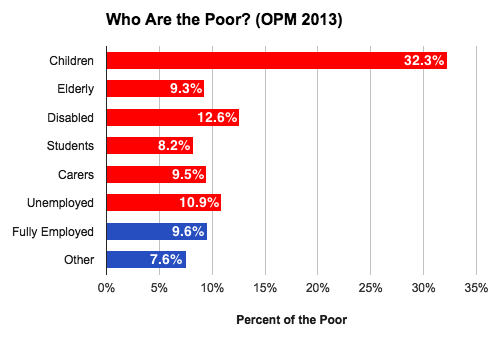
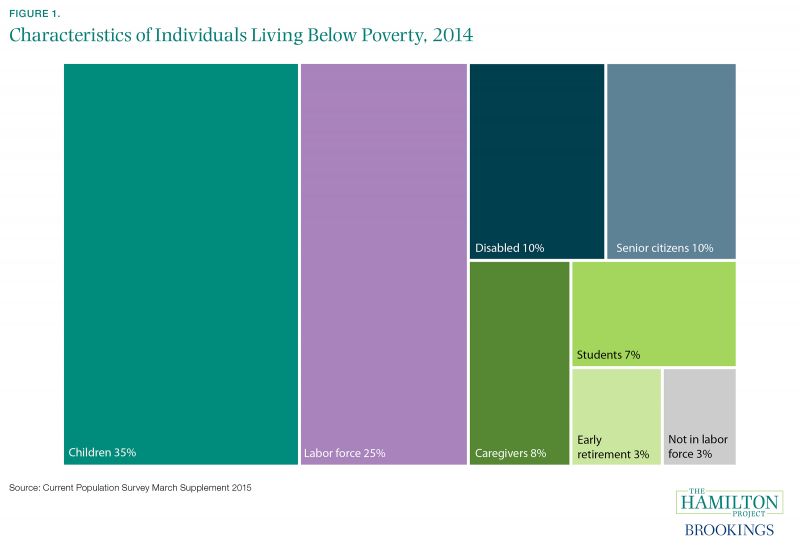
But that work also reveals the incredible power of stereotypes about adults and children living in poverty in the U.S. Despite our cultural myths about rugged individualism and boot-straps success, the impoverished in the U.S. are overwhelmingly vulnerable populations.

whoispoor1

Consider the following sobering statistics, illustrated in the figure above:

  • More than a third of those who live in poverty are children. More than 15.5 million children lived in poverty in 2014.
  • About 13 percent of those living in poverty are senior citizens or retired.
  • A quarter of those who live in poverty are in the labor force—that is, working or seeking employment.
  • A tenth of those in poverty are disabled.
  • Eight percent of those living in poverty are caregivers, meaning that they report caring for children or family.
  • Students, either full- or part-time, make up another seven percent of those living in poverty.
  • Just three percent of those living in poverty are working-age adults who do not fall into one of these categories—that is, they are not in the labor force, not disabled, and not a student, caregiver, or retired.

vulnerableopm

Stereotype 2: Poor People Are Lazy

Another common stereotype about poor people, and particularly poor people of color (Cleaveland, 2008; Seccombe, 2002), is that they are lazy or have weak work ethics (Kelly, 2010). Unfortunately, despite its inaccuracy, the “laziness” image of people in poverty and the stigma attached to it has particularly devastating effects on the morale of poor communities (Cleaveland, 2008).

The truth is, there is no indication that poor people are lazier or have weaker work ethics than people from other socioeconomic groups (Iversen & Farber, 1996; Wilson, 1997). To the contrary, all indications are that poor people work just as hard as, and perhaps harder than, people from higher socioeconomic brackets (Reamer, Waldron, Hatcher, & Hayes, 2008). In fact, poor working adults work, on average, 2,500 hours per year, the rough equivalent of 1.2 full time jobs (Waldron, Roberts, & Reamer, 2004), often patching together several part-time jobs in order to support their families. People living in poverty who are working part-time are more likely than people from other socioeconomic conditions to be doing so involuntarily, despite seeking full-time work (Kim, 1999).

More Questions for The Post and Courier: “Necessary Data” or Press-Release Journalism?

Back-to-back editorials at The Post and Courier (Charleston, SC)—Bolster efforts at rural schools (18 June 2016) and Make literacy No. 1 priority (19 June 2016)—offer important messages about the importance of addressing South Carolina’s historical negligence of high-poverty schools, especially those serving black and brown students, and the folly of cutting funding for literacy initiatives in Charleston.

However, reading these two editorials leaves one well aware that good intentions are not enough and wondering if the P&C editors even read their own editorials.

In the 18 June 2016 editorial, the editors argue: “Acting rashly without necessary data would be misguided. But taking baby steps while one class after another misses out on an adequate education is a continued waste of valuable time.”

And the very next day, we read:

Still, parents should expect their children’s reading skills to improve noticeably.

And it’s fair for parents of the youngest students to expect significant improvement in their children’s reading by the end of the school year — if the new approach works. Of course, parents also can make a difference by reading to their youngsters every day at home.

If Dr. Postlewait’s plan doesn’t succeed, the school board must find a way to pay for programs that do.

Those programs exist. At Meeting Street Academy private school, and now at Meeting Street @ Brentwood, entering students score well below average on literacy tests and quickly catch up to and surpass the average. All Charleston County students deserve the same opportunity.

This praise of “programs [that] exist” is the exact “acting rashly” the P&C rightfully warns about the day before.

So what about “necessary data”?

We have two problems.

First, we do not have a careful analysis of data by those not invested in these schools about the two praised school programs. The fact is that we do not know if successful reading programs exist at these schools.

Second, we do know that “only 1.1 percent of high-poverty schools were identified as ‘high flyers'” (Harris, 2006). In other words, we now have decades of data refuting the political, public, and media fascination with “miracle schools.”

As I have repeatedly warned: “miracle schools” are almost always unmasked as mirages, but even if a rare few are outliers, they cannot serve as models for all schools because they are not replicable or scalable.

Therefore, the P&C editors are right to warn about acting rashly and without the necessary data as we reform public schools and bolster literacy among our students.

But the P&C is wrong to continue press-release journalism that contradicts that mandate.