Category Archives: education reform

Arrogance: Service, Not Saviors

Beyond the obvious—that they are all joined by the field of education—what links the National Reading Panel (NRP) and No Child Left Behind, the edureform documentary propaganda Waiting for “Superman,” Teach For America, and edusavior Steve Perry?

Arrogance.

While I count myself among English language arts (ELA) teachers who are skeptical of the Great Books mindset—that we have essential books all children must read—I am moved today to endorse how many of those works remind we puny humans about the folly of pride. Not the “I am proud of you daughter/son” pride, but the arrogance pride.

The “‘My name is Ozymandias, King of Kings;/ Look on my Works, ye Mighty, and despair!'” kind of pride.

What on earth possessed politicians to form the NRP to find out what we know about teaching children to read? Did anyone point out that we have had a vibrant field of literacy in the U.S. for a good century? Isn’t it sort of obvious that we have dozens upon dozens of people across the U.S. who know exactly how to teach children to read (and have known for decades)?

But it isn’t just the teaching of reading.

Naive experts, often journalists, every week roll out yet another book in which she or he researches a field in which real experts in that field have been doing authentic work for decades—the history of teaching!, how to teach poor children!, the glory of 10,000 hours of practice!

Paternalistic, self-important, blowhard politicians daily puff up in front of the public to be that “Superman” at the center of the great lie documentary noted above that ironically serves as a perfect representation of everything that is wrong with education reform.

But one need not go back to that complete failure of film making. Try within the last week.

Educators and activists Andre Perry and Jose Vilson (see also) have assumed the mantle of speaking truth to the cult of personality that is Steve Perry.

I consider myself a student of Andre Perry and Vilson, as I work to navigate my own white male privilege in a way that serves others—specifically those marginalized by race and class.

I am a product of white privilege and colonialism, and therefore, must not serve those corrosive forces.

Here, I urge you to read Andre Perry and Vilson, but also to act upon their messages.

And I want to offer a tentative framing informed by their charges.

First, I am compelled by the new 30 for 30 series on O.J. Simpson to suggest that Simpson himself is a cautionary tale about the dangers of white privilege and the costs of whitewashing blacks in order for them to be allowed into mainstream society.

Next, I find troubling parallels in the work of Steve Perry with powerful blacks (Bill Cosby, Clarence Thomas, and Simpson) who negotiate the whitewashing in their favor at the expense of all other people of color.

The demonizing of dreadlocks, the finger-pointing at sagging pants, the judgmental finger-wagging at black English—yes, these are the tools of white privilege, but they also serve the cult of personality unmasked in Steve Perry, for example, by Andre Perry and Vilson.

Finally, although specific people have to be addressed when confronting the cult of personality, the problem is that those people are serving larger forces that are driving education reform, a movement that uses “civil rights” as a mask to implement policies that are perpetuating colonialism and whitewashing.

“No excuses” charter schools committed to “grit” are about “fixing” black, brown, and poor children.

Zero tolerance policies and grade retention policies disproportionately turn black, brown, and poor children into criminals and drop-outs.

High-stakes testing and accountability produce and perpetuate so-called achievement gaps among race and social class—as well as gate-keep in order to keep “other people’s children” in their place.

Teach For America fuels the historical inequity of access to experienced and certified teachers: White Students Get Experienced Teachers, While Black Students Get Police In School.

Whether the face of education reform is Bill Gates, Michelle Rhee, Arne Duncan, Geoffrey Canada, or Steve Perry (or the long list of celebrities who decide education is their hobby), and while we must necessarily confront each person as we confront what they represent, the ultimate challenge in rejecting edureform while also calling for building public education as a vehicle for equity and liberation is to call colonialism “colonialism,” to just say no to policies and practices designed to erase who children are so that they can be assimilated into society.

There are profound and significant differences in Andre Perry’s work, Vilson’s daily classroom teaching, and Steve Perry’s bloviating (think Donald Trump).

Andre Perry, Vilson, and Chris Emdin, for example, celebrate black students, their humanity as inseparable from their blackness—while Steve Perry celebrates Steve Perry as one who erases the black from children in the service of white privilege.

We are way past time to stop believing in and listening to these false idols, self-proclaimed “Super(wo)men.”

Ozymandias, please recall, was a fool in king’s clothing whose words mocked him:

Nothing beside remains. Round the decay
Of that colossal Wreck, boundless and bare
The lone and level sands stretch far away.

Let’s not form any more panels, let’s not crown any more edusaviors, let’s not print and/or buy any more bestselling books by educelebrities (who have never been teachers), let’s not worship at the altar of hollow Ted Talks.

Just as we didn’t need the NRP to “know how to teach children to read,” we have ample knowledge right now how to eradicate racism and classism in our society and our schools.

Edureformers, edusaviors, and educelebrities are in the service of keeping us from that vital work.

As Andre Perry asserts:

Let’s be clear: Belt wearing isn’t the reason white children are educated in wealthier schools. Haircuts and etiquette classes don’t lead to the technological innovations of Silicon Valley. Lower incarceration rates aren’t because whites use drugs less often. The wage gap isn’t caused by white men’s hard work ethic.

But social and educational inequity is the consequence of white privilege.

So I ask now that you listen to carefully and then act upon Chris Emdin‘s confrontation of edureform as colonialism and what choices lie before teachers:

What I am suggesting is that it is possible for people of all racial and ethnic backgrounds to take on approaches to teaching that hurt youth of color….

I argue that there must be a concerted effort…to challenge the “white folks’ pedagogy” that is being practiced by teachers of all ethnic and racial backgrounds….

The time will always come when teachers must ask themselves if they will follow the mold or blaze a new trail. There are serious risks that come with this decision. It essentially boils down to whether one chooses to do damage to the system or to the student [bold emphasis added]. (pp. viii-ix, 206)

Especially in our schools, and especially among our most vulnerable students, we need service, not saviors.
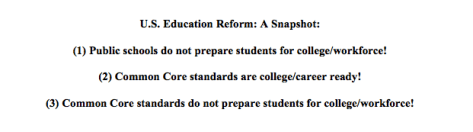
U.S. Education Reform: A Snapshot

Cycle has happened often, and now poised to happen again.

Common Core

For #3 (where we are now before jumping back to #1), see Common Core isn’t preparing students very well for college or career, new report says.

HINT:

As the absence or presence of rigorous or national standards says nothing about equity, educational quality, or the provision of adequate educational services, there is no reason to expect CCSS or any other standards initiative to be an effective educational reform by itself. (Mathis, 2012)

9 June 2016 Reader: School Choice, GPA v. SAT/ACT

I. School Choice, Charter Choice

Choosing a School for My Daughter in a Segregated City, Nikole Hannah-Jones

When the New York City Public Schools catalog arrived in the mail one day that spring, with information about Mayor Bill de Blasio’s new universal prekindergarten program, I told Faraji that I wanted to enroll Najya in a segregated, low-income school. Faraji’s eyes widened as I explained that if we removed Najya, whose name we chose because it means “liberated” and “free” in Swahili, from the experience of most black and Latino children, we would be part of the problem. Saying my child deserved access to “good” public schools felt like implying that children in “bad” schools deserved the schools they got, too. I understood that so much of school segregation is structural — a result of decades of housing discrimination, of political calculations and the machinations of policy makers, of simple inertia. But I also believed that it is the choices of individual parents that uphold the system, and I was determined not to do what I’d seen so many others do when their values about integration collided with the reality of where to send their own children to school.

One family, or even a few families, cannot transform a segregated school, but if none of us were willing to go into them, nothing would change. Putting our child into a segregated school would not integrate it racially, but we are middle-class and would, at least, help to integrate it economically. As a reporter, I’d witnessed how the presence of even a handful of middle-class families made it less likely that a school would be neglected. I also knew that we would be able to make up for Najya anything the school was lacking.

As I told Faraji my plan, he slowly shook his head no. He wanted to look into parochial schools, or one of the “good” public schools, or even private schools. So we argued, pleading our cases from the living room, up the steps to our office lined with books on slavery and civil rights, and back down, before we came to an impasse and retreated to our respective corners. There is nothing harder than navigating our nation’s racial legacy in this country, and the problem was that we each knew the other was right and wrong at the same time. Faraji couldn’t believe that I was asking him to expose our child to the type of education that the two of us had managed to avoid. He worried that we would be hurting Najya if we put her in a high-poverty, all-black school. “Are we experimenting with our child based on our idealism about public schools?” he asked. “Are we putting her at a disadvantage?”

See Also

Why Sending Your Child to a Charter School Hurts Other Children

Education Reform in the New Jim Crow Era

Just as mass incarceration from the war on drugs continues institutional racism once found in slavery and Jim Crow, education reform, especially the “no excuses” charter school movement, resurrects a separate but equal education system that is separate, but certainly isn’t equal. The masked racism of mass incarceration and education reform share many parallels, including the following:

  • Both depend on “racially sanitized rhetoric,” according to Alexander, that thinly masks racism. “Getting tough on crime” justifies disproportional arrests, convictions and sentencing for African Americans; “no excuses” and “zero tolerance” justify highly authoritarian and punitive schools disproportionally serving high-poverty children of color.
  • Both depend on claims of objective mechanisms – laws for the war on drugs and test scores for education reform – to deflect charges of racism. Alexander recognizes “this system is better designed to create [emphasis in original] crime and a perpetual class of people labeled criminals, rather than to eliminate crime or reduce the number of criminals,” (p. 236) just as test-based education reform creates and does not address the achievement gap.  
  • Both depend on racialized fears among poor and working-class whites, which Alexander identifies in the Reagan drug war agenda: “In his campaign for the presidency, Reagan mastered the ‘excision of the language of race from conservative public discourse’ and thus built on the success of the earlier conservatives who developed a strategy of exploiting racial hostility or resentment for political gain without making explicit reference to race” (p. 48). The charter school movement masks segregation within a progressive-friendly public school choice.  
  • Both depend on either current claims of post-racial America or the goal of a post-racial society: “This system of control depends far more on racial indifference [emphasis in original] . . . than racial hostility,” Alexander notes. (p. 203)
  • Both depend on a bipartisan and popular commitment to seemingly obvious goals of crime eradication and world-class schools.
  • Both depend on the appearance of African American support. Alexander explains about the effectiveness of the war on drugs: “Conservatives could point to black support for highly punitive approaches to dealing with the problems of the urban poor as ‘proof’ that race had nothing to do with their ‘law and order’ agenda” (p. 42).

This last point – that African Americans seem to support both the war on crime and “no excuses” charter schools – presents the most problematic aspect of charges that mass incarceration and education reform are ultimately racist, significant contributions to the New Jim Crow.

For example, Carr reports that African American parents not only choose “no excuses” charter schools in New Orleans, but also actively cheer and encourage the authoritarian policies voiced by the schools’ administrators. But Alexander states, “Given the dilemma facing poor black communities, it is inaccurate to say that black people ‘support’ mass incarceration or ‘get-tough’ policies” because “if the only choice that is offered blacks is rampant crime or more prisons, the predictable (and understandable) answer will be ‘more prisons.’ ” (p. 210)

New Orleans serves as a stark example of how this dynamic works in education reform: Given the choice between segregated, underfunded and deteriorating public schools and “no excuses” charters – and not the choice of the school environments and offerings found in many elite private schools – the predictable answer is “no excuses” charters.

II. GPA v. SAT/ACT

Study: Colleges Put Students Into Remedial Classes Who Don’t Need Them

The Alaska study, conducted by a regional research laboratory funded by the U.S. Department of Education, found that SATs, ACTs and the placement tests used by the University of Alaska were all poor predictors of how a student might do in a college-level math or English class. Many students who did well on these exams bombed their college classes, and vice versa. Instead, the researchers found that if college administrators had simply looked at the students’ high school GPAs, they would have done a much better job at figuring out who needs to relearn high school material and who doesn’t.

“We definitely should be including GPAs when assessing college readiness,” said Michelle Hodara, the lead author of the study and a senior researcher at Education Northwest. “We found the same thing that community college researchers and practitioners are finding, that high school GPA is a really powerful measure of college readiness, even for students who want to earn a four-year degree.”

Developmental education and college readiness at the University of Alaska

This study examines the postsecondary readiness of first-time students who enrolled in the University of Alaska system over a four-year period. The study calculates the proportion of students considered academically underprepared for college and how placement rates for developmental education (that is, non–credit-bearing courses) vary for different groups of students. The study also determines the proportion of students placed in developmental education who eventually enrolled in and passed college English and math. Finally, the analysis looks at whether high school grades, rather than exam performance, are a better predictor of success in college-level courses.

Results show that developmental education rates were higher in math than English for students pursuing any degree type and increased as the gap between high school exit and college entry grew. Among students pursuing a bachelor’s degree, developmental placement rates were highest for Black students from urban areas of the state (in math) and Alaska Native students from rural areas (in English) compared to all other student groups. Almost half (47 percent) of students placed in developmental courses eventually passed college English and almost a quarter (23 percent) passed college math. For students who enrolled directly in college, high school grade point average was a stronger predictor of college-level English and math performance than were SAT, ACT, and ACCUPLACER scores. Secondary and postsecondary stakeholders can use the findings to help identify students in need of support to be college-ready and to consider further conversation and additional research regarding whether and how to use high school grade point average as part of the placement process.

Former College Board Exec: New SAT Hastily Thrown Together; Students: March SAT Recycled in June

Manuel Alfaro is the former executive director of assessment design and development at the College Board.

Beginning on May 15, 2016, Alfaro has published a series of posts on Linkedin in an apparent effort to reveal the haphazard construction of the new SAT, released and first administered in March 2016 and again, in June. (He is also posting info on Twitter: @SATinsider.)

Below are excerpts from Alfaro’s Linkedin posts, all of which provide an enlightening read concerning the sham Coleman has thrown together and labeled the “new SAT.”

Defund the “Grit” Industry: Alternatives to Tough and Duckworth

Once edujournalist Paul Tough and “grit”-genius Angela Duckworth realized their significant contributions to the “grit” industry were gradually being unmasked, they discovered ways to cash in on backpedalling (slightly) to keep the train rolling.

Regretfully, many very good people have praised Tough and Duckworth for their much-too-late and way-too-little—somehow ignoring the incredible damage that has been done to vulnerable populations of students—and even recommend Tough and Duckworth’s “new” books.

Please, I beg of you, do not forgive and forget, and especially do not fund further the “grit” industry.

Let me offer instead a few alternatives:

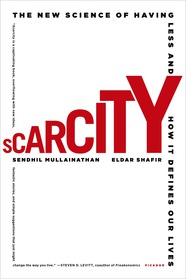
Scarcity: The New Science of Having Less and How It Defines Our Lives, Sendhil Mullainathan and Eldar Shafir

9781250056115

[See also George Saunders’s Allegory of Scarcity and Slack]

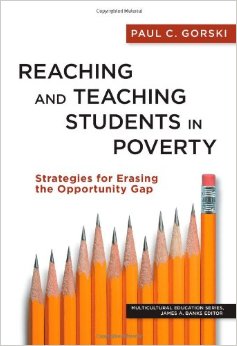
Reaching and Teaching Students in Poverty: Strategies for Erasing the Opportunity Gap, Paul Gorski

51w731ediwl-_sy344_bo1204203200_

[See also Recommended: Reaching and Teaching Students in Poverty, Paul C. Gorski]

For White Folks Who Teach in the Hood…and the Rest of Y’all Too, Christopher Emdin

978-080700640-5

[See also Christopher Emdin Confronts “White Folks’ Pedagogy”: “whether one chooses to do damage to the system or to the student”]

6 June 2016 Reader: Mythbuster Edition

In the spirit that feels appropriate in the wake of the death of Muhammad Ali—and the concurrent failure of mainstream reflections ignoring or whitewashing the real history of his life—I offer below a collection of education-related links that can serve as powerful mythbusters for the ongoing false claims common in the mainstream media and among political leaders as well as edureformers.

Charter Schools

Failing The Test Series

Regardless of motives, the charter initiatives in Oakland and Los Angeles together signal a significant watershed in the growth of a statewide movement that was birthed by California’s Charter Schools Act of 1992 to create classroom laboratories that might develop the dynamic new curricula and teaching methods needed to reinvigorate schools that were failing the state’s most underserved and disadvantaged children.

How that modest experiment in fixing neighborhood public schools could morph in less than 25 years into the replacement of public schools with an unproven parallel system of privately run, taxpayer-funded academies is only half the story of California’s education wars that will be examined in this series, much of which is based on conversations with both sides of the charter school debate. Over the next few days Capital & Main will also look at:

  • The influence wielded by libertarian philanthropists who bankroll the 50-50 takeovers.
  • How charter schools spend less time and money on students with learning disabilities.
  • The lack of charter school transparency and accountability.
  • How charter expansion is pushing Oakland’s public school district toward a fateful tipping point.
  • The success of less radical yet more effective reforms that get scant media coverage.
  • Nine solution takeaways for struggling schools.

(from Failing the Test: A New Series Examines Charter Schools, Bill Raden)

Charters and Access: Here is Evidence, Julian Vasquez Helig

No, Eva, You Can’t Do Whatever You Want, Jersey Jazzman

Teacher Effectiveness/Experience

Does Teaching Experience Increase Teacher Effectiveness?: A Review of the Research, Tara Kini and Anne Podolsky

Based on our review of 30 studies published within the last 15 years that analyze the effect of teaching experience on student outcomes in the United States and met our methodological criteria, we find that:

  1. Teaching experience is positively associated with student achievement gains throughout a teacher’s career. Gains in teacher effectiveness associated with experience are most steep in teachers’ initial years, but continue to be significant as teachers reach the second, and often third, decades of their careers.
  2. As teachers gain experience, their students not only learn more, as measured by standardized tests, they are also more likely to do better on other measures of success, such as school attendance.
  3. Teachers’ effectiveness increases at a greater rate when they teach in a supportive and collegial working environment, and when they accumulate experience in the same grade level, subject, or district.
  4. More experienced teachers support greater student learning for their colleagues and the school as a whole, as well as for their own students.

Vouchers

On negative effects of vouchers, Mark Dynarski

Recent research on statewide voucher programs in Louisiana and Indiana has found that public school students that received vouchers to attend private schools subsequently scored lower on reading and math tests compared to similar students that remained in public schools. The magnitudes of the negative impacts were large. These studies used rigorous research designs that allow for strong causal conclusions. And they showed that the results were not explained by the particular tests that were used or the possibility that students receiving vouchers transferred out of above-average public schools.

Another explanation is that our historical understanding of the superior performance of private schools is no longer accurate. Since the nineties, public schools have been under heavy pressure to improve test scores. Private schools were exempt from these accountability requirements. A recent study showed that public schools closed the score gap with private schools. That study did not look specifically at Louisiana and Indiana, but trends in scores on the National Assessment of Educational Progress for public school students in those states are similar to national trends.

In education as in medicine, ‘first, do no harm’ is a powerful guiding principle. A case to use taxpayer funds to send children of low-income parents to private schools is based on an expectation that the outcome will be positive. These recent findings point in the other direction. More needs to be known about long-term outcomes from these recently implemented voucher programs to make the case that they are a good investment of public funds. As well, we need to know if private schools would up their game in a scenario in which their performance with voucher students is reported publicly and subject to both regulatory and market accountability.

School Discipline, Race, and Gender

Black Girls and School Discipline: Four Researchers Unpack K-12’s Racial Bias

* Please note the disturbing series of comments at the end.

Most of the discussion around the disproportionality of black students’ suspension or expulsion from K-12 schools has focused on boys. Only more recently have researchers begun to surface the numbers of black girls who are subject to severe disciplinary measures in schools, including by school resource officers.

According to federal data, black girls are suspended from school at a rate that is six times higher than that of their white female peers. In New York City and Boston, black girls represented 56 percent and 61 percent, respectively, of all girls disciplined in those cities’ K-12 schools, even as incidents of discipline against black girls go underreported. Black girls receive harsher criminal sentences than their white female peers do in the juvenile-justice system, and they also represent its fastest-growing population.

For this special Commentary package, Education Week Commentary sat down with researchers Adrienne D. Dixson, Shaun R. Harper, Bettina L. Love, and Terri N. Watson at this spring’s American Educational Research Association conference to discuss their perspectives on this crisis.

School Funding

New Study Connects the Dots Between School Funding Choices and Student Achievement, Highlighting the Dangers of Retrenchment in Courts, Derek Black

Mind the Gap: 20 Years of Progress and Retrenchment in School Funding and Achievement Gaps, Bruce D. BakerDanielle Farrie, and David G. Sciarra

Although there has been significant progress in the long term, achievement gaps among the nation’s students persist. Many factors have contributed to the disparities in outcomes, and societal changes can explain progress, or lack thereof, over the past few decades. This is well documented in the 2010 Educational Testing Service (ETS) report Black–White Achievement Gaps: When Progress Stopped, which explored achievement gap trends and identified the changing conditions that may have influenced those trends. In this report, we extend that work by focusing on the relationship between school funding, resource allocation, and achievement among students from low-income families. We tackle the assumption that greater resources, delivered through fair and equitable school funding systems, could help raise academic outcomes and reduce the achievement gap. The goal is to provide convincing evidence that state finance policies have consequences in terms of the level and distribution of resources, here limited to staffing characteristics, and that the resulting allocation of resources is also associated with changes in both the level of academic achievement and achievement gaps between low-income children and their peers. Using more than 20 years of revenue and expenditure data for schools, we empirically test the idea that increasing investments in schools generally is associated with greater access to resources as measured by staffing ratios, class sizes, and the competitiveness of teacher wages. When the findings presented here are considered with the strong body of academic literature on the positive relationship between substantive and sustained state school finance reforms and improved student outcomes, a strong case can be made that state and federal policy focused on improving state finance systems to ensure equitable funding and improving access to resources for children from low-income families is a key strategy to improve outcomes and close achievement gaps.

Portfolio/Takeover Districts

The “Portfolio” Approach to School District Governance, William J. Mathis and Kevin G. Welner

Beneath the abundant and vigorous advocacy lies a very limited body of generally accepted research. Understanding the effects of “portfolio district reform” is hampered by messy reform contexts, where portfolios are only one of several major ongoing reforms, thus weakening causal inferences. Understanding these effects is also hampered by definitional problems—elastic labels with different components and different names being applied in different places.12 Further, the school cultural changes are often massive, interactions are complex, and politicization generates a great deal of noise. This renders the isolation of specific facets enormously difficult.13 Yet amidst the claims and counterclaims,14 several findings are clear:

  1. Charter schools do not appear to have much impact on test scores, but they do have some negative unintended consequences.15
  2. Similarly, school closures may have some positive or negative impact, but they certainly result in instability.16
  3. School turnaround approaches have, in general, been very disappointing, in large part because of the problems with closures and charter schools.17 The churn in the system, loss of institutional knowledge and loss of culture results in community and school disturbance and instability. Closing even low-performing schools can prove disruptive as community support dissipates, particularly if higher performing schools are not readily available.
  4. Research on mayoral control shows mixed evidence concerning effects on test scores.18

We would not be surprised to see some “portfolio districts” see some benefits, while others will see primarily detriments. Governance changes—particularly those aimed at decentralization and deregulation—tend to involve complex trade-offs. Opponents will be able to point to failures; advocates will be able to point to successes. In the end, though, student outcomes in under-resourced urban districts will continue to be driven by larger societal inequities.


Education May Never Be “Great Equalizer,” But Must Model Equity

Model and actress, Emily Ratajkowski gained fame from a misogynistic and exploitive music video, but has since emerged as a complicated and important feminist voice confronting the sexualizing of women and body shaming.

Ratajkowski’s Instagram account mainly offers personal and professional photographs of Ratajkowski in various states of undress, but she is also prone to using that platform for the occasional political message.

Recently, she posted a grainy photo of crudely taped note challenging dress codes in schools for discriminating against females; as the note states, “INSTEAD OF SHAMING GIRLS FOR THEIR BODIES, TEACH BOYS THAT GIRLS ARE NOT SEXUAL OBJECTS.”

I shared this on social media myself, and encountered a number of not surprising responses—many of which where the typical “but” offered by men when sexism is exposed.

The central message of the note posted by Ratajkowski is both well documented [1] and urgent in terms of the essential inequity found in many traditional school policies such as dress codes and disciplinary guidelines and outcomes: Dress codes are sexist and school discipline (notably suspension and expulsion) is racist—paralleling the same inequities in U.S. society.

School dress codes and discipline policies, then, represent the tragic failure of claiming that formal education in the U.S. is the “great equalizer.”

Not only is that claim untrue, but also the reality of how formal education reflects and perpetuate social inequities is even more damning.

And while a strong case can be made for reforming traditional public education so that school can be the “great equalizer,” I remain skeptical that school reform alone will ever reach this ideal.

In short, we need public policy that directly confronts the cancers of racism, classism, and sexism—the great inequities that thrive in the U.S.

But my skepticism doesn’t justify ignoring the equally great failures of public education. At the very least, we must create a public education system that is a model for the sort of equity we envision in our so-called free nation.

Dress codes that place burdens disproportionately on females are entrenching sexism, body shaming, and rape culture (for an extreme version, consider the lack of institutional care at Baylor University), school discipline practices that initiate and parallel the racially inequitable criminal justice system—these are but two, although significant, examples of how public schooling remains trapped in an accountability paradigm that neither recognizes nor corrects inequity because standards and high-stakes testing are themselves inequitable, teacher assignment is inequitable, tracking and gate-keeping of advanced courses are inequitable, charter schools and school choice are inequitable, and grade-retention is inequitable.

Dress codes may seem to be a somewhat insignificant but necessary part of formal education, but, in fact, dress codes are ugly reminders that we have failed to create schools that model the type of fair and just world to which we aspire.

For Ratajkowski, her own feminism may have ironically begun because of the exact failures of these attitude:

In eighth grade, a vice principal snapped my bra strap in front of an entire room of my classmates and other teachers. She did it because the strap was falling out from my tank top and that broke the school’s dress code.

The institutional shaming of young girls is the seed of misogyny and rape culture just as the disproportionate criminalizing of young black males and females in school discipline codes is the seed of mass incarceration.

If our education system cannot be the “great equalizer,” it must at least be a model of a fair and just way of being.


See Also

Dress Codes in Schools: Spaghetti Straps, Midriffs; Adults’ Need for Control, Steve Nelson

[1] See The Sexism of School Dress Codes, Li Zhou; The Anatomy Of A Dress Code, Juana Summers; How School Dress Codes Shame Girls and Perpetuate Rape Culture, Laura Bates; Girls Fight Back Against Gender Bias in School Dress Codes, Brenda Alvarez. Also, the research:

“Tank Tops Are Ok but I Don’t Want to See Her Thong”: Girls’ Engagements With Secondary School Dress Codes, Rebecca Raby

Cleavage in a Tank Top: Bodily Prohibition and the Discourses of School Dress Codes, Shauna Pomerantz

Polite, Well-dressed and on Time: Secondary School Conduct Codes and the Production of Docile Citizens, Rebecca Raby

Class‐Room Discipline: power, resistance and gender. A look at teacher perspectives, Kerry H. Robinson

Headscarves and Porno-Chic: Disciplining Girls’ Bodies in the European Multicultural Society, Linda Duits

Maintaining the Charter Mirage: Progressive Racism

As a former (and humbled) recipient of the National Council of Teachers of English’s George Orwell Award, and devoted reader of Franz Kafka, I am prone to recognizing when a Twitter debate seems surreal—and yesterday’s pushed me to suspect I was a victim of a parody account (but I wasn’t).

Spurred by my posts confronting the Post and Courier (Charleston, SC) embracing both takeovers of traditional public schools and “miracle” claims from a privatized charter chain, I foolishly waded into a charter debate with a self-professed “libertarian” edujournalist who writes for a publication that advocates for school choice and is a research fellow for The Friedman Foundation for Educational Choice as well as the superintendent of South Carolina’s Charter School District (if charter schools are public schools why do we have a separate school district for them?).

My Orwellian/Kafkan moments included the edujournalist calling me an “ideologue” and the superintendent bristling at my questioning the value of one year of data on the “miracle” charter school—seems there is no time for accountability for those knee-deep in the pet projects of the accountability movement.

But it became even more ridiculous (the feeling of a parody account even more intense) when the edujournalist began to Tweet horror stories about public schools, suggesting (“come on” was his refrain) that these cherry pickings somehow justified continuing to support the charter school mirage. (You see, the charter/school choice crowd cannot maintain multiple facts in mind at once—that we can challenge the very real failures of traditional public schools and recognize that the charter school alternative has been an equally negative failure.)

Because charter schools are without a single controversy—students of color walking out due to a lack of diversity and lack of racial sensitivity, children wetting their pants under the intense focus on testing.

Nope. Nothing to see here in the rosy land of the charter mirage.

The charter mirage is a scam, similar to the entire buffet of education policies embraced during the past thirty years of accountability.

This political scam can be traced to two facts: (1) politically and socially in the U.S. we refuse to identify and confront directly the race, class, and gender inequities that scar our nation and all our public and private institutions, and (2) education policy is driven by ideology and not attention to research, which makes even more disturbing that a superintendent would argue that we don’t have time to evaluate data about whether or not any school’s claim of success is real.

If we can address both of these, however, we can recognize the key elements in the charter mirage*:

  • Charter schools are reinforced by a non-critical media enamored by “miracle” school stories that are nearly universally discredited by careful consideration of the claims. Exceptional charter schools are either false claims or outliers that offer absolutely no evidence needed for how to reform all schools.
  • Charter schools are essentially indistinguishable from public or private schools. The evidence base reveals that school types remain insignificant when we consider populations of students. Some school practices have better and worse outcomes—but none of these are somehow linked to school type (what Matthew Di Carlo has labeled, for example, as “charterness”).
  • Charter schools share with traditional public schools a pattern of re-segregating students by race and social class.
  • Charter schools are prone to skimming (choosing preferred students), attrition (sometimes purposeful counseling out), and serving populations of students unlike those traditional public schools must serve (charter schools may include racial minorities and poor students, but ELL and special needs populations are underserved). All of these dynamics shade any effort to claim a charter school is more effective than a traditional public school.
  • Charter schools increase the problem of black/brown and poor students being taught by inexperienced and un-/under-certified teachers—notably by the close association between charter schools and Teach For America.
  • Charter schools tend to embrace racially insensitive “no excuses” policies that exacerbate inequitable discipline policies also common in traditional public schools.
  • Charter schools may appear to serve better poor and minority students, but media and political praise for KIPP and KIPP-like charter schools often ignore that claims of greater “months of learning” attributed to the charter school (and somehow the “charterness”) is directly proportional to simply extending the school day and school year. In other words, if charter schools extend the day and year while not increasing “months of learning” that would be a news-worthy story.
  • Charter schools and all school choice create student, teacher, and funding churn that negatively impact the possibilities of needed and effective reform.

Advocacy for the charter mirage is almost always by people invested in charter schools or school choice regardless of the consequences. Charter mirage advocacy is also driven by the missionary zeal of progressive racism.

The “miracle” school mantra is directly linked to that missionary zeal that comes from thinking “I” know what is best for others and “I” can do what others cannot (because “I” am exceptional).

If New Orleans’s education debacle has taught us anything, we must admit both that the historical and political negligence of poor people of color—their children and their communities—is inexcusable and that disaster capitalism in the form of doing to that same community with charter schools and a TFA teacher force is equally inexcusable.

And this brings me back to the Orwellian nature of all this: the charter “miracle” is a charter mirage—a mirage propped up by those invested politically and personally in the mirage as well as by those edujournalists who are unable to step back and consider evidence over ideology.

To suggest that we have only two choices—the historically negligent traditional public school system or the charter mirage—is a nightmare from which we need to wake.


See Also

Failing The Test Series

Failing the Test: A New Series Examines Charter Schools, Bill Raden

Failing the Test: Measuring Charter School Performance, Julian Vasquez Heilig

*Charters and Access: Here is Evidence, Julian Vasquez Heilig

Questions for the P&C about School Closure, Takeover

The Post and Courier (Charleston, SC) has taken an editorial stand in favor of closing a high-poverty, majority-minority school and a private takeover of public schools in Charleston (see a history of the debate here).

Now, a P&C editorial asks more questions:

How many classes of children should come up through the school’s failing system before the district makes some big changes?

Another question: Don’t those children deserve to try an educational approach that has proven to be far more successful?

Since turn about is fair play, let’s investigate those questions and ask a few in return.

At the very least, these questions are loaded, and as a result, misleading.

Burns Elementary (to be closed) is framed again as “failing,” and the Meeting Street Academy, “successful.”

As I have documented, many problems exist with the “good”/”bad” school labeling.

But in this case, we must be extra skeptical because all of the praise for the “successful” and the promises of even more success in “closing the achievement gap” for poor and mostly black students rest on the claims of the private entities invested in this process.

So there are actually some very important questions that the editors at the P&C are failing to ask:

  • Why have some students been allowed ever to languish in school conditions that are subpar when compared to vibrant schools and opportunities for other students in the same city? Burns Elementary with a poverty index of 96 is but one school that represents a long history in SC of how negligent we have been as a state in terms of providing anything close to equity in the opportunities poor and racial minority children are afforded.
  • Why does any public school board need a private partnership to do what is needed to offer these students the sort of school all children deserve? If what is needed is so obvious, and so easy to do (which is a subtext of the editorial), the truth is that the school board simply does not have the political will to do what is right for some children.
  • And this is very important: What third party, not invested in the Meeting Street Academy, has examined the claims of academic success in the so-called “successful” schools that are being promised as fixes for Burns? I cannot find any data on test scores (setting aside that test scores aren’t even that good for making these claims), but I have analyzed claims of “miracle” charter schools in SC—finding that these claims are always false. Always. I do not trust that Meeting Street is going to prove to be the first actual miracle school in a long line of those that have been unmasked before.

This last question cannot be overemphasized because the political process has proven time and again that political leadership can be easily bamboozled by glitzy claims but routinely fail to examine the evidence that would guide well our educational policy, as Christopher Lubienski, Elizabeth Debray, and Janelle Scott have revealed:

But what was perhaps most interesting was the degree to which research played virtually no part in decision making for policymakers, despite their frequent rhetorical embrace of the value of research. While many interviewees spoke of the importance of research evidence, nearly all were unable to point to an instance where research evidence shaped their position on an instrumentalist issue.

SC political leaders have pushed for school choice, charter schools, VAM evaluations of teachers, ever-new standards and high-stakes testing, exit exams, third-grade retention, and now takeover policies for so-called “failing schools”—yet all of these have no basis for policy in the body of research refuting the effectiveness of each one.

For the editors of the P&C, as well as our political leaders and the public, the real questions are why do we persist in ignoring the stark realities of our inequitable society, why do we then continue to play politics with our schools that are just as inequitable as our society, and then why do we refuse to consider the evidence about addressing social and educational inequity directly in our policies?

Again, as I have stated many times, the answer is that the people with the power to change things simply do not really care about change because any change can threaten their perches of power.

Closing schools, renaming schools, shuffling students—these are the practices of those who are invested in the status quo regardless of the consequences for “other people’s children.”

Dear Edujournalists: Listen, Learn

The media and educational love affair with “grit” has at least two sources for the frenzy: Paul Tough, journalist, making “grit” popular and accessible and Angela Duckworth, scholar and “genius,” giving “grit” the allure of research and science.

And now, both Tough and Duckworth have released books continuing the “grit” train—and interestingly, both are doing so with some light backpedalling about their initial claims that have mostly been embraced by the privileged and used on vulnerable populations of students (black/brown, poor, ELL).

Concurrent with that backpedalling comes as well a significant challenge to Duckworth’s research on “grit”: Much Ado about Grit: A Meta-Analytic Synthesis of the Grit Literature, Marcus Credé, Michael C. Tynan, and Peter D. Harms.

As reported by NPR:

Here are the key claims in Crede’s paper:

  1. Effect sizes in one of Duckworth’s major papers on grit were described incorrectly to sound misleadingly large.
  2. The impact of grit is exaggerated, especially when looking at broader populations of people — not just the high achievers in Duckworth’s initial studies.
  3. Grit is nearly identical to conscientiousness, which has been known to psychologists for decades as a major dimension of personality. It is not something that’s necessarily open to change, especially in adults, whereas Duckworth in her writings suggests that grit is.

In other words, this analysis of research on “grit” suggests that the science as well as Duckworth’s representation of that research is significantly overstated.

So why did “grit,” and Duckworth, garner so much media and educational momentum?

One reason is the utter failure of edujournalism; another reason is that the “grit” narrative speaks to and perpetuates racist and classist beliefs among the U.S. public; and a final reason is that Duckworth’s “genius” grant as well as her TedX talk provided financial and celebrity cover for her shoddy work.

But this pattern of media/educational overreaction followed by an unmasking by more careful scholarly analysis is not by any stretch new.

Take as just one example how Malcolm Gladwell (fellow “good” journalist to Tough) made the 10,000-hour rule popular—so much so that the number is mentioned over and over to this day throughout all sorts of mainstream media.

Yet, the scholar whose work is the foundation for the popularized and misleading 10,000-hour rule, K. Anders Ericsson—unlike Duckworth [1]—directly refuted how the media has distorted his work: The Danger of Delegating Education to Journalists: Why the APS Observer Needs Peer Review When Summarizing New Scientific Developments.

The 10,000-hour rule pattern—bad media coverage of scholarship—is the same as the “grit” mess—and this pattern happens weekly because mainstream edujournalists will not listen (they argue edujournalism is the best it has ever been), and will not learn.

Just as Duckworth has been afforded in major media outlets, Tough is peddling his new book, and his very bad journalism, through opinion pieces masking promotional material.

And day after day, education bloggers are forced to confront the horrible consequences of negligent and inexpert edujournalism (see for example, Campbell Brown’s Bizarre NAEP Response in the Washington Post).

Here, then, I want to offer edujournalists a series of ways in which edujournalism persists to fail:

  1. Seeking outlier schools in order to write “miracle” school feel-good stories. First, outliers schools are often proven to be false stories, but even if they are somehow exceptional, outliers never provide any evidence of what should be normal in education (or any human behavior). At their core, “miracle” school stories are shaming stories that cast “other schools” as negligent, just not trying hard enough.
  2. Presenting education research and science in simplistic terms and failing to couch any one study in the context of the broader body of research or against unbiased reviews of that study. Especially since mainstream media are contracting, edujournalism is even more susceptible to press-release journalism—simply restating what aggressive researchers and think tanks send to the media without regard for whether or not that research is credible (thus, above, the overstating by both Duckworth and media coverage).
  3. Remaining trapped in rankings and state-to-state or international comparisons. Not only are rankings and comparisons mostly misleading, in many cases, the rankings are fabricated (seeking ways to force a ranking instead of admitting that the objects ranked are essentially the same), and comparisons are made at superficial levels that ignore significant differences in what is being compared (see HERE).
  4. Uncritically embracing crisis discourse about education that ignores historical patterns involving education, poverty, and racism. Current “crisis” education stories about “bad” schools, “bad” teachers, and “kids today” have been recycled in the U.S. since at least the mid-1800s. The “crisis” label allows edujournalists, politicians, and the public to ignore social and policy causes for the consequences being identified as the “crisis.”
  5. Perpetuating false claims about the power of formal education: education as the “great equalizer,” education as the key to individual and societal economic success. Facts are not always what we want to be true, but educational attainment in the U.S. remains less important than race, gender, or the social class of any child’s family. Education is not the great equalizer. As well, as Gerald Bracey and many others have shown, there simply is no clear positive correlation between the so-called quality of education and any state’s or country’s economic success.
  6. Over-stating the impact of so-called teacher quality, and under-stating the impact of social influences on measurable student outcomes. The most conservative research shows that measurable student outcomes (test scores) are primarily (about 60%) a reflection of out-of-school factors; teacher quality and even school quality impact those scores at much lower percentages, about 10-15%.
  7. Giving lip-service to the impact of poverty, racism, and sexism on formal schooling, and suggesting that focusing on poverty, racism, and sexism is simply as “excuse.” The mainstream media speak to and perpetuate the rugged individualism myth in the U.S. Edujournalists uncritically accept and preach that myth by giving passing nods to poverty, racism, and sexism, but nearly always moving immediately to focusing on individuals—teachers need to try harder, students need to try harder.
  8. Bumbling both what statistics show and how statistics are presented to the public. Edujournalists are victims of blurring cause and correlation, overstating “significance,” and failing to address false comparisons (consider the routinely awful charter/public school comparisons).
  9. Perpetuating a long list of go-to educational facts that are actually false: the word gap, third-grade reading proficiency, school funding does not matter, Teach For America, charter schools and private schools trump public schools, for example. Edujournalists, like the public, uncritically accept claims that sound true, but as journalists, should be interrogating these claims exactly because they sound too pat.
  10. Giving non-educators both primary and exclusive voices in education debate. Edujournalists love economists, psychologists, and think tank advocates—but avoid educators and educational scholars, except occasionally to allow them space as “critics” (see as one example NPR Whitewashes “Grit” Narrative).
  11. Seeing all educational topics as a “both sides” debate with each side given nearly equal status. Edujournalists refrain from considering and/or explaining that some stances in education are significantly more credible than others. As do most journalists who fear being activists and worship at the alter of “objective,” edujournalists fail the Oliver Rule.
  12. Thinking without an ounce of imagination. Accountability, standardized testing, grades, grade levels—these and dozens of “normal” and “traditional” practices are never realistically challenged in edujournalism; no consideration is given to things could be otherwise. A failure of imagination is seeking out and believing in new tests and new standards; imagination allows us to rethink a better school system without tests and without standards.

I remain a vigilant critic of edujorunalists/edujournalism, but I have been a career-long critic of educators/education as well.

This criticism of, and plea to, edujournalists is grounded in my belief that the U.S. needs a critical free press as much as we need a critical education system.

Edujournalists, like educators, need to listen, and to learn.


UPDATED: Please Read

TFA’s Latest PR Stunt, Gary Rubinstein

[1] Note that Ericsson’s research has been conducted in conjunction with Duckworth on occasion.

Rejecting IQ and All Labeling of Students

“When any adult, let alone a teacher, hands a child a label such as ‘seriously learning disabled,'” explains Jessica Lahey in her The Perils of Giving Kids IQ Tests, “they tip the first domino in a cascade of events that will determine the course of an entire life.”

But there is a larger message to her piece focusing on IQ: all measuring of students and all labeling of students have serious negative consequences.

Whether labeled “disabled” or “gifted,” a student then becomes a hostage to that label and to the inequity of the entire standardized testing process.

Lahey, however, is not treading on new ground. We have known for a very long time that IQ testing is biased by social class, race, and gender.

Possibly the definitive, although not without flaws, unmasking of intelligence measurement is Stephen Jay Gould’s The Mismeasure of Man, which was first published over three decades ago but was resurrected as a refuting of Hernnstein and Murray’s The Bell Curve.

Lahey offers a solid explanation for the efficiency allure of IQ and other measurements used to label students, but fails to highlight sufficiently the racist, classist, and sexist roots of those so-called objective processes.

In fact, Lahey argues, “Labels are not bad in and of themselves. Labels, like grades, are tools.” But labels are inherently bad because it is impossible to separate the tools from the intent of those tools.

Lahey even suggests, “Maybe it’s time to try a new system of labeling.”

This line of reasoning sounds too much like the pro-gun argument that acknowledges the horrors of excessive gun violence in the U.S. but suggests the problem is not guns, or gun access.

To argue that we have simply failed to find the right tests and the right labels is a supreme failure of the imagination.

Writer Neil Gaiman, speaking on the value of libraries, has proclaimed, “The world doesn’t have to be like this. Things can be different.”

And Gaiman is speaking from a lived experience he addressed in 2012:

I never really expected to find myself giving advice to people graduating from an establishment of higher education.  I never graduated from any such establishment. I never even started at one. I escaped from school as soon as I could [emphasis added], when the prospect of four more years of enforced learning before I’d become the writer I wanted to be was stifling.

Gaiman had to “escape” a formal schooling system trapped in “labels are not bad” and “[let’s] try a new system of labeling.”

Testing, labeling, and ranking are inherently antithetical to teaching and learning, counter to the basic human dignity of children and humans.

Schools don’t have to be like this. Schools can be different.

Without simplistic and dehumanizing standardized tests, without labels of any kind.

“Do the stuff that only you can do,” Gaiman urged graduates of an arts university.

But his message is not simply valuable in the so-called impractical world of the arts.

Gaiman’s message is about human autonomy and dignity—which are always sacrificed at the alter of tests and labels.

There simply is no right way to do those.


See Also

University of Georgia professor explains his ‘Asperger’s Advantage’ and disabling assumption of disorder, Peter Smagorinsky

Everyone is born creative, but it is educated out of us at school, Tham Khai Meng

Social Justice: The New American Dream, Kurt Vonnegut

“Eager to Recreate the Same Old Nightmare”: Revisiting Vonnegut’s Player Piano