
Category Archives: education reform

Day on Diversity at the University of South Carolina

I am participating as a discussion leader and speaker for a day on diversity at the University of South Carolina 14 April 2016. Below are my notes which may be of value to some addressing race and class in both social and educational contexts.

University of South Carolina

April 14 1:30 pm

Svec. M., & Thomas, P.L. (2016). The classroom crucible: Preparing teachers from privilege for students of poverty. In A.L. Hurst & S.K. Nenga (Eds.), Working in class: recognizing how social class shapes our academic work. Landham, MD: Rowman & Littlefield Publishers.

http://www.heinemann.com/blog/wp-content/uploads/2015/12/Confronting-Privilege-to-Teach-About-Privilege.pdf

https://radicalscholarship.wordpress.com/2014/11/13/my-redneck-past-a-brief-memoir-of-twos/

https://radicalscholarship.wordpress.com/2015/12/20/i-dont-belong-heremy-otherness-my-privilege/

April 14 6 pm

“How do we look at systemic issues of equity in institutional settings?”

20 minutes

Scarcity: The New Science of Having Less and How It Defines Our Lives, Sendhil Mullainathan and Eldar Shafir

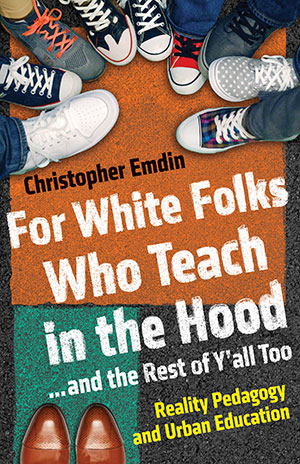
For White Folks Who Teach in the Hood… and the Rest of Y’all Too: Reality Pedagogy and Urban Education, Chris Emdin

Police in the Hallways: Discipline in an Urban High School, Kathleen Nolan

Hope Against Hope, Sarah Carr

Reaching and Teaching Students in Poverty: Strategies for Erasing the Opportunity Gap, Paul Gorski

No Caste Here? Toward a Structural Critique of American Education, Daniel Kiel

Abstract:

In his famous dissent in Plessy v. Ferguson, Justice John Marshall Harlan argued that in the United States, there was “no caste here.” Justice Harlan was rejecting the idea that American society operated to assign preordained outcomes to individuals based upon classifications, including racial classifications. This Article questions whether Justice Harlan’s aspirational assertion accurately reflects contemporary American education. Identifying: (1) multiple classification mechanisms, all of which have disproportionate racial effects, and (2) structural legal, political, and practical impediments to reform, the Article argues that the American education system does more to maintain the nation’s historical racial hierarchy than to disrupt it. This is so, the Article suggests, despite popular agreement with the casteless ideal and popular belief that education can provide the opportunity to transcend social class. By building the framework for a broad structural critique, the Article suggests that a failure to acknowledge and address structural flaws will preclude successful comprehensive reform with more equitable outcomes.

Privilege

Racism, classism

deficit perspectives (word gap, achievement gap, grit)

Paternalism

Accountability v. equity — academics and discipline policies

https://radicalscholarship.wordpress.com/2014/12/04/grit-education-narratives-veneer-for-white-wealth-privilege/

https://radicalscholarship.wordpress.com/2016/04/06/are-racially-inequitable-outcomes-racist/

https://radicalscholarship.wordpress.com/2016/03/29/race-and-education-a-reader/

https://radicalscholarship.wordpress.com/2014/02/11/what-these-children-are-like-rejecting-deficit-views-of-poverty-and-language/

https://radicalscholarship.wordpress.com/2014/05/01/revisiting-james-baldwins-black-english/

https://radicalscholarship.wordpress.com/2016/03/29/race-and-education-a-reader/

https://radicalscholarship.wordpress.com/2015/06/12/recommended-reaching-and-teaching-students-in-poverty-paul-c-gorski/

https://radicalscholarship.wordpress.com/2016/03/22/a-crack-in-the-dam-of-disaster-capitalism-education-reform/

https://radicalscholarship.wordpress.com/2016/01/23/understanding-poverty-racism-and-privilege-again-for-the-first-time/

https://radicalscholarship.wordpress.com/2014/12/30/bearing-witness-hypocrisy-not-ideology/

https://radicalscholarship.wordpress.com/2014/12/31/responsibilities-of-privilege-bearing-witness-pt-2/

http://www.heinemann.com/blog/wp-content/uploads/2015/12/Confronting-Privilege-to-Teach-About-Privilege.pdf

https://radicalscholarship.wordpress.com/2014/11/20/thomas-race-matters-in-school-discipline-and-incarceration-opinion-columns-the-state/

https://radicalscholarship.wordpress.com/2015/09/03/criminalizing-black-children-begins-in-our-schools/

https://radicalscholarship.wordpress.com/2014/11/30/creating-crime-criminals-to-justify-deadly-force/

http://cedar.wwu.edu/cgi/viewcontent.cgi?article=1184&context=jec
Confronting the “Soft Bigotry of Low Expectations”

A a political refrain and mantra from the “no excuses” reform movement, the “soft bigotry of low expectations” has resonated among many stakeholders in education.

As Education Week has reported, a new report seems to confirm that among vulnerable populations there is a significant concern about low expectations for black and brown children (and likely among poor, English language learner, and special needs children as well).

The problem with the “low expectations” claim, however, is that the political and education reform use of the slogan is dishonest and misleading, while the new report offers an excellent reframing of how significant and important the concern is.

The “no excuses” movement has positioned the public against schools and teachers serving vulnerable populations as simply not trying hard enough, thus “low expectations.” Concurrently, vulnerable students themselves have been characterized as lacking “grit,” not trying hard enough.

In that vacuum created by politicians and reformers, education policy has increasingly demanded less and less of schools, teachers, and those vulnerable students by increasing the standards and testing focus of education.

The great and disturbing irony of the “no excuses” and “low expectations” movement is that test-prep is cheating black/brown students, poor students, ELL students, and special needs students of challenging educations—while mischaracterizing the ways in which traditional schooling has failed those students historically.

Is there a problem among progressives and white, middle-class teachers who view black/brown and poor students through paternalistic and reductive/deficit lenses?

Yes, there absolutely remains a failure among too many educators who lack a culturally responsive view of teaching, who remain trapped in deficit ideologies such as the “word gap” and a need for “other people’s children” to have basic skills (see the work of Lisa Delpit).

And even more troubling is that among many educators, there is a problem with distorted “high expectations” about discipline, resulting in the criminalization of black and brown children in our schools.

Therefore, I am in no way discounting that there exists a “soft bigotry of low expectations,” but I am rejecting the use of that slogan among “no excuses” reformers who push for racist and classist high-stakes testing as gate keepers and for the expansion of segregating charter schools that increase harsh and racist discipline policies also found in traditional public schools.

New Education Majority: Attitudes and Aspirations of Parents and Families of Color offers a chance for education advocates to reconsider the sloganification of education reform, and to listen to the exact vulnerable populations many “Superman” and “miracle school” saviors (most of whom have no education background, but so have paternalistic missionary zeal) claim to be serving.

The reality of low expectations for vulnerable populations of students include the following:

  • Underfunding and inequitably funding schools serving vulnerable populations of students.
  • Failing to address teacher certification and years of experience for schools and courses serving vulnerable populations of students.
  • Continuing to allow gatekeeping to track “other people’s children” into test-prep while white and affluent students have inequitable access to Advanced Placement, International Baccalaureate, and gifted programs.
  • Masking student/teacher class ratios behind school averages while vulnerable populations of students sit in large classes in the same schools where white and affluent students benefit from low ratios (typically in those AP, IB, and gifted courses).

The problems we continue to ignore in society and education are anchored in race and class inequity: being white and affluent continues to heap tremendous benefits while being of color and poor is a stunning and often inescapable burden.

Those inequities, as well, cannot be overcome by school-only reform policies, particularly when the most popular reforms are themselves perpetuating race and class inequity.

If parental choice and the market place matter (more refrains you hear among the “no excuses” crowd), why do we ignore that the most affluent parents in the U.S. tend to choose private schools with rich curricular options (including a wide array of the arts), low student/teacher ratios, and a glaring absence of test-prep, standards-based coursework?

The answer isn’t pretty: the “no excuses” reform movement is not about the best interests of vulnerable populations of students or vulnerable communities, but about their own investments in education reform.

As I have noted before, we must not trust advocates invested in education reform at the expense of the children and communities those reforms claim to serve.

We must, instead, begin to listen to vulnerable populations who are suffering the negative consequences of race and class inequity, advocates of children and communities.

It is among the “we” who are privileged to listen and then act to create both social and educational policy from an equity of opportunity perspective and not an accountability perspective that further marginalizes children and communities who need our public institutions the most.

Are Racially Inequitable Outcomes Racist?

Among what may seem to be marginally related policies and conditions, these all have one startling thing in common—grade retention, school discipline, NCAA athletics, incarceration, “grit,” “no excuses,” zero-tolerance, high-stakes testing (such as the SAT and ACT), charter schools and school choice—and that commonality is observable racially inequitable outcomes that are significantly negative for blacks.

My own experiences with exploring and confronting race and racism through my public writing has shown that many people vigorously resist acknowledging racism and will contort themselves in unbelievable ways to avoid accepting facts and data that show racism exists.

Common responses include “I am not a racist,” “I am sure the people who started X didn’t intend to be racist,” “White people experience racism too,” and “Everyone has the same opportunities in this country.”

And while I continue to compile a stunning list of ways in which racial inequity and racism profoundly impact negatively black people, resistance to terms such as “white privilege” and “racism” remain robust.

In the wake of the NCAA Final Four, Patrick Hruby has attempted a similar tactic I have used in order to unmask the racial inequity in college athletics by carefully working readers through the evidence in order to come to an uncomfortable conclusion about the financial exploitation of college athletes (money-making sports being disproportionately black) by the NCAA and colleges/universities (leadership and those profiting being overwhelmingly white) along racial lines:

Understand this: there’s nothing inherently racist about amateurism itself. And there’s no reason to believe that its defenders and proponents—including current NCAA president Mark Emmert—are motivated by racial animus….

And yet, while the NCAA’s intent is color-blind, the impact of amateurism is anything but. In American law, there is a concept called adverse impact, in which, essentially, some facially neutral rules that have an unjustified adverse impact on a particular group can be challenged as discriminatory….Similarly, sociologists speak of structural racism when analyzing public policies that have a disproportionately negative impact on minority individuals, families, and communities. State lottery systems that essentially move money from predominantly lower-class African-American ticket buyers to predominantly middle-and-upper-class white school districts fit the bill; so does a War on Drugs that disproportionately incarcerates young black men; so does a recent decision by officials in Maricopa County, Arizona, to drastically cut the number of presidential primary polling stations in and around Phoenix, which unnecessarily made voting far more difficult for the residents of a non-white majority city.

Big-time college sports fall under the same conceptual umbrella. Amateurism rules restrain campus athletes—and only campus athletes, not campus musicians or campus writers—from earning a free-market income, accepting whatever money, goods, or services someone else wants to give them. And guess what? In the revenue sports of Division I football and men’s basketball, where most of the fan interest and television dollars are, the athletes are disproportionately black.

And herein lies the problem with refusing to equate racially inequitable outcomes with racism.

Hruby’s detailed unmasking of the NCAA comes also during the troubling rise of Trump in presidential politics—another marker for how many scramble to find any cause other than racism.

Trump’s rise is not exclusively the result of overt and unexamined racism, but a significant amount of his success is easily traced to a wide spectrum of racism.

However, from the rise of Trump to the so-called popularity of charter schools to the school-to-prison pipeline and to the spread of third-grade retention policies, all of these and more are fueled by racism because racism, we must acknowledge, is most insidious when it isn’t overt, when the racist person or the racist act is unconscious, unacknowledged.

The impact of racism in NCAA sports, as Hruby details, is the elegant racism Ta-Nahisi Coates unpacked when Donald Sterling became the NBA’s face for oafish racism (along with Clive Bundy in popular culture).

What has occurred in the U.S. since the mid-1960s is an end to placard racism, the end of “White Only” signs on bathroom and restaurant doors.

What has not occurred in the U.S. yet is an end to seeing black boys as significantly older than their biological ages, an end to tracking black children into segregated schools and reductive courses, an end to incarcerating black men—and this is a list that could go on for several pages.

Racial (and class) equity will never occur in the U.S. until the white power structure admits that racially inequitable outcomes are in fact racist.

White privilege is a powerful narcotic that numbs white elites to the harm that privilege causes black and brown people, but it is also a powerful narcotic that pits poor whites against black and brown people because poor whites believe their whiteness gives them the chance at great wealth held by only a few.

That the NCAA maintains a structure within which black athletes produce wealth enjoyed almost exclusively by white elites is an undeniable fact and a startling example of the elegant racism eroding the soul of a free people—an elegant racism eating at the roots of public education, the judicial system, the economic system, and nearly ever aspect of the country.

Racially inequitable outcomes are racist, and this must be admitted in order to be confronted and then to be eliminated.

Reclaiming “Direct Instruction”

After I posted two blogs on authentic literacy instruction (see here and here), several readers tripped over my use of the term “direct instruction.”

Before examining the value in that term (and what it means), let me offer a couple of anecdotes.

While I was teaching high school English, a colleague teaching math had a classroom directly across from my room, separated by a court yard. With, I think, equal parts joking and judgment, that teacher used to say often, “I wish I could teach while sitting at my desk.”

Not unimportant here is the distinct pedagogical differences among math and English teachers—one that I believe we can fairly say is a tension between math teachers being teacher-centered and sequential while English teachers can lean more often toward student-centered and workshop approaches (although my caveat here is that English teachers can be some of the most traditional teachers I have ever met).

In my story above, the math teacher’s comment is an excellent example of the confusion over “direct instruction.” Yes, many people see direct instruction as lecture—thus, mostly if not exclusively teacher-centered with students relatively passive.

For this colleague, my students working in a writing workshop with me responding to drafts, conferencing, and the other purposeful elements of workshopping did not meet her definition of “teaching.”

Another illustrative story involves my daughter.

Her second grade teacher was a colleague of my wife, who teaches PE at the primary school. One day in passing my daughter’s second grade teacher told my wife that my daughter had been doing extremely well on her spelling tests until she began intensive and direct phonics instruction. Since then, she noted, my daughter’s spelling grades had suffered significantly.

This second example represents the ultimate failure of a narrow view of teaching having to be a certain limited type of direct instruction.

Now, when I use the term “direct instruction,” as one person perfectly commented about my blog post, I am addressing purposeful and structured or organized instruction, but I am not using the term as only teacher-centered practices.

To be direct, or purposeful, then, I see teaching as an act with several goals: curricular (including standards and high-stakes tests addressing those standards), disciplinary, and student-centered.

In any given class, teachers must address all three, but pedagogically, teachers often have some degree of autonomy over how to address these goals.

As I champion “direct instruction,” I am cautioning against placing curriculum and discipline above student, but I am also calling for building all instruction on some evidence of need.

Curriculum guides and standards justify a need; the discipline (ELA as literacy, literature, and composition) justifies a need; and students come to all courses with needs.

“Direct instruction,” then, is purposeful and organized teaching targeting one or all of these needs.

As a critical constructivist, I maintain that we must start with allowing students to produce artifacts demonstrating what they know, what they don’t know, and what they are confused about in the context of our curricular and disciplinary obligations.

Direct instruction is simply teaching with purpose to address those needs.

A failed view of direct instruction is grounded in covering the curriculum or the obligations of the discipline regardless of the students in the course.

Teaching algebra sequentially, likely with the textbook determining the structure, in order to document that you taught algebra; teaching a phonics program, again, in order to document that you taught reading—this is the failure of a narrow view of “direct instruction” that supplants the needs of the students with the needs of curriculum and the discipline.

If and when a child is spelling and decoding well, to go over phonics is a waste of time, but also very likely harmful—just as many studies of isolated grammar instruction show students becoming more apt to make “errors” after the instruction.

So here we can begin to unpack that the problem is not with “direct,” but with “isolated.”

The problem is with teaching the discipline, teaching a program, teaching to the standards and/or high-stakes tests instead of teaching students.

I am advocating for direct instruction built primarily on student needs—purposeful and structured lessons designed after gathering evidence of student strengths, weaknesses, and confusions.

And I must stress that my argument here is wonderfully confronted and unpacked by Lisa Delpit, who came to this debate because she recognized the other side of the coin I haven’t addressed yet: so-called student-centered practices that cheat students (mostly our vulnerable populations of students) by misunderstanding the role of direct instruction, by misreading progressive and critical practices as “naturalistic” or unstructured.

Writing and reading workshop are not about giving students free time to read and write; workshops are about time, ownership, and response that is purposeful and structured.

Student-centered practices are not about letting children do whatever the hell they want.

As Delpit has addressed, that isn’t teaching, and it certainly cheats students in similar ways that bullheaded and narrow uses of teacher-centered practices harm students.

If a teacher isn’t guided by needs and grounding class time in purpose, that teacher isn’t teaching.

But until you have a real breathing student in front of you, you cannot predict what that direct (purposeful) instruction will (should) look like.

Ultimately, I believe narrow uses of the term “direct instruction” are designed to shame student-centered and critical educators.

I refuse to play that game because I am directly (purposefully) teaching when I place the needs of my students before but not exclusive of the needs of the curriculum and the discipline.

And, yes, while I also hope someday more teachers can teach while sitting at their desks, I am more concerned about how we can come to embrace teaching as purposeful and structured without reducing it to a technocratic nightmare for both teachers and students.

Don’t Trust Invested Advocates in Edureform Wars

South Carolina remains a disturbing subset of the larger education reform movement effectively dismantling but not improving pubic schools, institutions that have historically and are currently failing vulnerable student populations who need public opportunities more than anyone.

Charleston is now the battle ground over expanding charter schools and embracing the already failed turnaround or takeover models that many early adopters in other states are ending.

The public version of the debate has included the following:

Beyond the specifics of the issues of this debate about takeover policies and charter school expansion (and the implications of privatizing public schools therein), this debate highlights a very important issue for SC and the nation: Don’t trust invested advocates of education reform.

The current charter school debate, we must acknowledge, is just the latest version of the much older school choice debate. Notable about the school choice debate is that choice advocates have constantly shifted their promises, ignored when they fail to come through, and then moved on to the next carnival scam.

The debate over charter schools and takeovers in Charleston, then, is another time we must heed Why Advocacy and Market Forces Fail Education Reform.

Advocates for Meeting Street Schools are driving with vested interest expanding their model, and making dramatic claims without providing the data and evidence for disinterested parties to analyze.

Part of school choice advocacy, including the current charter push, includes making grand claims before the data are available for unmasking those claims.

SC has a large pro-charter movement that routinely falls ways short of any sort of competition model: 4 or 5 charters out of over 50 producing data better than comparable public schools, and most charters are no better and many are worse (see analysis of two years here).

These “miracle” school narratives fail on logic (outliers are irrelevant for determining typical), but as Harris has show, disinterested analysis of “miracle” schools has shown that “only 1.1 percent of high-poverty schools were identified as ‘high flyers.'”

School choice is a shell game, one resting its promises on indirect action that is necessarily no positive action at all.

The only direct action is investing fully in public education that starts with the interests of our most vulnerable students and not the promises of adults invested in their own interests.

Everyone Learns to Read from Direct Instruction

Once Diane Ravitch posted my blog about the harm third-grade retention based on high-stakes tests of reading and reading levels do to literacy, I received some of the typical feedback I expect about reading instruction from those mired in the cult of phonics and a misguided obsession with direct instruction.

First, online and social media comments are often problematic because some (maybe many) people are simply seeking an opportunity to say what they want regardless of what is being addressed in the original blog post or Tweet. Setting up a straw man to hold forth on a pet peeve wasn’t created by social media, but it sure is fertile ground for that approach.

Next, let me be clear that when I shared my opening personal narrative of how I was raised in a supportive home that taught me my literacy skills I was in no way endorsing or suggesting that I am the beneficiary of a naturalistic approach to learning reading.

And let me go further: Speaking and listening are natural human behaviors, unless there are biological or other traumas or barriers; however, reading and writing are artificial, human created. And thus, everyone learns to read from direct instruction.

Just for effect, let’s do that again: everyone learns to read from direct instruction.

My mother did read alouds, sight words, and guided reading—just to name some strategies—and, yes, she was teaching me directly reading, even though she was a layperson.

For those of us raised in privilege, direct instruction can often appear to be naturalistic, and acquiring the most essential aspects of learning to read can also appear to be spontaneous. But none of that is true, and we all require direct instruction of reading (and writing) for many years of our lives as both literacy skills can never be finished.

The debate is not about if we offer all children direct instruction in reading, then, but how and why.

Isolated, intensive phonics direct instruction, we know, can be detrimental to reading growth for many children, yet some children find it very helpful.

The same can be said of isolated, intensive grammar direct instruction.

That is the beauty and calling of whole language—not to banish or idealize any approaches to literacy direct instruction, but to honor literacy acquisition over any set approach or program.

In other words, we must seek for each student the array of direct instruction in reading that best suits her/his needs and insure that she/he develops into not only a proficient reader, but an eager reader.

When direct instruction of reading is drudgery (such as completing a program or worksheet), as I and others have noted, it does far more harm than good.

Certainly, children coming from poverty, children living in homes with primary languages other than English, special needs students—these are populations that will challenge teachers more than children living in privilege. But not because some children (read “privileged”) acquire reading naturally and “other people’s children” need reading programs and isolated intensive direct instruction.

The human capacity for language is amazing, but it is not shielded from Maslow’s hierarchy of needs. The scarcity in the lives of many children inhibits the luxury of learning to read and write in homes that have survival needs or disturbances that genuinely trump their ability to gain formal language skills.

We must stop mistaking the advantages of privilege for “smart” and for “natural acquisition of language skills.” And we must stop predicting that all vulnerable populations of students need the very worst types of inauthentic direct instruction in the name of basic skills.

To be honest, there are no basic or foundational skills in whole performances such as reading and writing—although reducing reading and writing to technocratic parts facilitates efficient but often counter-effective instruction.

The reading wars are trivialized by creating the straw man argument that some of us are against direct instruction while others are for it—especially when the nasty implication that some are against direct instruction are doing so knowingly cheating some students of needed reading instruction.

I am for direct instruction of reading because there is no other option for teaching reading. However, I am fully committed to direct instruction only in the service of student needs and honoring the sanctity of reading as a full and wonderful human behavior.

I don’t teach reading programs. I don’t teach phonics.

I do teach students to read, and to love that reading in the service of their own lives and not to excel on a test.

NOTE: Since this post has spurred even more comments, many about “my child learned to read without direct instruction,” I must add that reading is not merely decoding. Yes, some children quite easily seem to be able to read aloud, and I suspect many parents believe they just learned it on their own. But simple decoding is not reading, and as I note above, reading is a complex process that we continue to learn and develop for years of formal schooling. The path to critical literacy is shaped by a wide range of strategies and we all receive direct instruction on that journey.

Race and Education: A Reader

What ‘white folks who teach in the hood’ get wrong about education, Kenya Downs

I think framing this hero teacher narrative, particularly for folks who are not from these communities, is problematic. The model of a hero going to save this savage other is a piece of a narrative that we can trace back to colonialism; it isn’t just relegated to teaching and learning. It’s a historical narrative and that’s why it still exists because, in many ways, it is part of the bones of America. It is part of the structure of this country. And unless we come to grips with the fact that even in our collective American history that’s problematic, we’re going to keep reinforcing it. Not only are we setting the kids up to fail and the educators up to fail, but most importantly, we are creating a societal model that positions young people as unable to be saved.

For White Folks Who Teach in the Hood…and the Rest of Y’all Too, Chris Emdin

978-080700640-5

Black boys know too well what it feels like to be a problem — let’s channel that knowledge into innovation, Andre Perry

In some states, fewer than 90 percent of black boys are reading at grade level and dropout rates for males of color continue to be much higher than for other groups. We certainly need solutions, but we don’t need any more “gap closing” measures.

Gap closing implies a white male standard, which actually is the source of institutional racism that needs to be fixed. In this regard, the achievement gap is a process and product that we need to smash up in tiny little pieces.

No one should be surprised that while black males achieve in schools and colleges a gap remains or has even grown. Success won’t be declared when black men and boys catch up to white men; organizations need to catch up with justice.

The overwhelming whiteness of U.S. private schools, in six maps and charts, Emma Brown

“The fact is that, over the years, African American families and non-white families have come to understand that these private schools are not schools that are open to them, especially in light of their traditional role and history related to desegregation of public schools,” he said.

The report recalls how private-school enrollment grew a half-century ago as courts were ordering public schools to integrate. The pattern was particularly pronounced in the South, where massive resistance to integration led to rapid private-school enrollment growth. Even as private-school enrollment has fallen across much of the country in recent decades, it has continued to grow in the South.

Changing Grade Scales: Much Ado about Nothing (It Just Doesn’t Matter)

South Carolina’s new superintendent of education has proposed that the state change (again, as last time it was about state-wide uniformity) to a 10-point grade scale to put our students in line with neighboring states.

This plan has mostly been met with a sky-is-falling response, for example: “The last thing South Carolina schools need to do is water down academic requirements for students.”

While I already realize from my continuing effort to explain that in the standards debate, notably the most recent Common Core debacle, almost no one will acknowledge that the quality of standards or even the presence or not of standards has proven to have no impact on measurable student outcomes (and thus, the standards debate is much ado about nothing), I must stress here that whatever our grade scale is or however we change it is also much ado about nothing.

The grade scale is pretty functional, just as our monetary systems are across countries. When we travel from the U.S. to Europe, the money scales change, but it does not impact in any way the inherent value of anything.

The relative costs of things, yes, are affected slightly, but the money system is an abstraction.

So is a grade scale. If an A is 90-100 or 93-100, it is still a relative and subjective thing to assign an artifact of learning or a student during a grading period that A.

Efforts to unify grade scales within or among states is folly—just as the whole Common Core debacle was.

These are pointless wastes of time and energy in pursuit of standardization without regard for that goal being of almost no value to anyone.

Changing the grade scale in one state to create something like fairness among students from different states is probably futile, but it is practical enough that it is fine to do.

To shout that changing a grade scale is either lower or raising expectations, however, is just plain silly.

Stop it.

This grade scale is much ado about nothing—and it just doesn’t matter.

Yet More “Don’t Believe It”: The “Grit” Edition

Among educators on my social media feeds, many were all atwitter about “grit” guru Angela Duckworth penning Don’t Grade Schools on Grit in the New York Times Sunday Review.

However, I must warn: Don’t believe it.

Duckworth’s apparent backpedaling on how most people embracing “grit” in education are applying her research—notably a new move to test for “grit”—has two fundamental problems.

First, please note that Duckworth’s Op-Ed in the NYT conveniently coincides with yet another book of hers on, you guessed it, “grit.”

Excuse my skepticism, but this Op-Ed is also PR for her incredibly lucrative career as a “grit” guru.

Second, and far more importantly, Duckworth’s concession that “grit” is being misapplied (her version) falls well short of acknowledging that her “grit” research itself is both steeped in and perpetuating racism and classism.

In other words, Duckworth and her “grit” cult cannot shake off the essential flaws in “grit” narratives by blaming how people are misusing it; fact is “grit” research and practices cannot be implemented in any ways that are absent the foundational flaws.

As I have detailed often, “grit” narratives, research, and practices must be rejected for the following reasons:

  • In an excellent examination of Duckworth’s recent Op-Ed, John Warner confronts why good intentions are not enough: “Duckworth says these consequences are ‘inadvertent,’ which is no doubt true. But just as a certain Dr. Frankenstein learned, that doesn’t mean these negative consequences, inadvertent as they may be, were unforeseeable.” Warner’s analogy is apt, but let me add two more: dynamite and IQ. While dynamite had initial good purposes, the carnage that resulted certainly stains those intentions. But IQ is even more illustrative here. Like “grit,” IQ has always had the veneer of “science” and “objective” to mask the inherent racism, classism, and sexism beneath the metrics (see Gould). Both IQ and “grit” are harmful because of the failure to investigate how both confuse privilege and bias for intelligence and effort—as well as the so-called strong correlations between IQ/”grit” and achievement.
  • Another problem can be unpacked by noting that most educators who uncritically embrace “grit” reject the teacher quality narrative. This is key since both the “grit” narrative and the teacher quality narrative share the same flaw: Someone with authority has chosen to overemphasize a minor aspect of the very complex acts of learning, achievement, and teaching. Just as teacher quality is a mere 10-15% of measurable student outcomes, student effort is an isolatable but minor element of student success—or more importantly, human success after formal education. Again, if we use educational attainment and/or wealth as proxies for “effort” (which I think is valid), in the U.S., blacks with some college have the same work opportunities as white high school drop-outs, and affluent blacks are more likely to go to jail than poor whites (see evidence of these and more here); therefore, while “grit” as perseverance or effort may be important, it pails against the weight of race, class, and gender bias.
  • That overemphasis, then, disproportionately focuses on the victims of bias, placing the weight of blaming the victim on top of the weight of racism, classism, and sexism. “Grit” fails in this regard by creating and reinforcing a deficit ideology that misrepresents privilege as effort and failure as a lack of effort. “Grit” narratives and practices normalize as fact that those who success do so primarily through hard work, and those who fail deserve that failure because they lack “grit,” are lazy. Yet, both claims are demonstrably false (success and failure more strongly correlated to conditions of scarcity and slack), and depend on the worst aspects of racist and classist bigotry.

Duckworth’s backpedaling?

Don’t believe it—because the Op-Ed is PR for yet more “grit” for everyone to buy, uncritically, and because “grit” advocates, including Duckworth, have yet to admit, confront, and reject the essential racist and classist underpinnings of “grit” research, narratives, and practices.

See Also

The Plans of Policymakers and Professors Oft Go Awry, Jose Vilson

We Have an Engagement Crisis, not a “Grit” Deficit, John Warner


Education Does Not Need Business Hokum

The United States has now “progressed” in its fascination with wealth to the point that Trump (a serial failed billionaire, born with, but not earning, a giant silver spoon) is benefitting from the Teflon of his wealth, possibly all the way to the White House.

Despite everything we claim, folks in the U.S. think getting rich justifies just about everything, and is willing to turn a blind eye to virtually anything rich and famous people do—while destroying middle class and especially poor folk for the same behaviors.

An equally disturbing and illogical obsession is one with business—especially as a counter to the often damned “government.”

One of our most important public institutions has always and continues to be cheated because it is a public institution and by our fetish for business models at all cost.

It is a regular refrain by good people with good intentions that education just needs the savior that is the business model: business leaders (not educators) tossing out those hokum promises of competitiveness, leadership, and innovation.

Let me be clear, I am not being sarcastic about these arguments and proposals being from good people with good intentions. But that cannot justify the emptiness and inappropriateness of the terms or concepts behind them.

Despite our love affair in the U.S. with competition, a solid body of research shows that collaboration and cooperation are far more effective than competition. That fact is even more pronounced in education where within and among states, schools, and teachers, we must be working together—not against each other—in order to bring equity to the lives and schooling of children, and their families, and to everyone.

Competition creates some winners, and many losers.

“Leadership” and “innovation,” however, are simply the very worst of the business world, the empty-suit mantras best captured in the comic strip Dilbert.

In business and education, a key failure of both includes bureaucracy and the professionalization of the workforce—seminars, certification, retraining to create leaders and innovators.

It is all hokum—profound wasting of time, energy, and funding; benefitting only the marketers of “leadership” and “innovation.”

“Leadership” is the last refuge of someone who has nothing real to offer. “Innovation” is a market promise only slightly less misleading than the stock market or the lottery (and really, there is no difference between those).

“Leadership” is “Let me tell you what to do (because I am better than you, which is obvious by my success and your failure, which is your own fault).” Service, however, is “How can I use my privilege in the service of your needs?”

There is a paternalism and missionary zeal among business leaders and models that claim be a fix for any or every thing. Just look at how this has manifested itself in education already with the rise and apparent impending fall of Teach For America, a leadership organization masquerading as an education organization.

No, education does not need business leaders or a business model. In fact, business needs to step away from its own ridiculous model.

Yes, education needs to be reimagined, but by educators in the service of all students, families, and ultimately the democracy our schools serve.