Category Archives: education reform

Formal Schooling and the Death of Literacy

My privilege is easily identified in my being white and male, but it is the story of my life that better reveals my enormous privilege established by my mother when I was a child.

I entered formal schooling with such a relatively high level of literacy and numeracy that from those first days I was labeled “smart”—a misnomer for that privilege.

From Green Eggs and Ham to Hop on Pop, from canasta to spades, from Chinese checkers to Scrabble—games with my mother and often my father were my schooling until I entered first grade. And none of that ever seemed to be a chore, and none of that involved worksheets, reading levels, or tests.

Formal schooling was always easy for me because of those roots, but formal schooling was also often tedious and so much that had to be tolerated to do the things I truly enjoyed—such as collecting, reading, and drawing from thousands of comic books throughout my middle and late teens. I was also voraciously reading science fiction and never once highlighting the literary techniques or identifying the themes or tone.

During my spring semester, I spend a great deal of time observing pre-service English/ELA teachers, and recently I had an exchange on Twitter about the dangers of grade retention, notably connected to third-grade high-stakes testing.

And from those, I have been musing more than usual about how formal school—how English/ELA teachers specifically—destroy literacy, even when we have the best of intentions.

From the first years of K-3 until the last years of high school, students have their experiences of literacy murdered by a blind faith in and complete abdication to labeling text by grade levels and narrow approaches to literary analysis grounded in New Criticism and what I call the “literary technique hunt.”

Misreading the Importance of Third-Grade Reading

As I have addressed often, reading legislation across the U.S. is trapped in a simplistic crisis mode connected to research identifying the strong correlation between so-called third-grade reading proficiency and later academic success.

Let’s unpack that by addressing the embedded claims that rarely see the light of day.

The first claim is that labeling a text as a grade level is as valid as assigning a number appears. While it is quite easy to identify a text by grade level (most simply calculate measurables such as syllables per word and words per sentence), those calculations entirely gloss over the relationship between counting word/ sentence elements and how a human draws meaning from text—key issues such as prior knowledge and literal versus figurative language.

A key question, then, is asking in whose interest is this cult of measuring reading levels—and the answer is definitely not the student.

This technocratic approach to literacy can facilitate a certain level of efficiency and veneer of objectivity for the work of a teacher; it is certainly less messy.

But the real reason the cult of measuring reading levels exists is the needs of textbook companies who both create and perpetuate the need for measuring students’ reading levels and matching that to the products they sell.

Reading levels are a market metric that are harmful to both students and teaching/learning. And they aren’t even very good metrics in terms of how well the levels match any semblance of reading or learning to read.

The fact is that all humans are at some level of literacy and can benefit from structured purposeful instruction to develop that level of literacy. In that respect, everyone is remedial and no one is proficient.

Those facts, however, do not match well the teaching and learning industry that is the textbook scam that drains our formal schools of funding better used elsewhere—almost anywhere else.

Remaining shackled to measuring and labeling text and students murders literacy among our students; it is inexcusable, and is a root cause of the punitive reading policies grounded in high-stakes testing and grade retention.

The Literary Technique Hunt

By middle and high school—although we continue to focus on whether or not students are reading at grade level—we gradually shift our approach to text away from labeling students/ texts and toward training students in the subtle allure of literary analysis: mining text for technique.

Like reading levels, New Criticism’s focus on text in isolation and authoritative meaning culled from calculating how techniques produce a fixed meaning benefits from the veneer of objectivity, lending itself to selected-response testing.

And thus, the great technique hunt, again, benefits not students, but teachers and the inseparable textbook and testing industries.

The literary technique hunt, however, slices the throat of everything that matters about text—best represented by Flannery O’Connor:

I prefer to talk about the meaning in a story rather than the theme of a story. People talk about the theme of a story as if the theme were like the string that a sack of chicken feed is tied with. They think that if you can pick out the theme, the way you pick the right thread in the chicken-feed sack, you can rip the story open and feed the chickens. But this is not the way meaning works in fiction.

When you can state the theme of a story, when you can separate it from the story itself, then you can be sure the story is not a very good one. The meaning of a story has to be embodied in it, has to be made concrete in it. A story is a way to say something that can’t be said any other way, and it takes every word in the story to say what the meaning is. You tell a story because a statement would be inadequate. When anybody asks what a story is about, the only proper thing is to tell him to read the story. The meaning of fiction is not abstract meaning but experienced meaning, and the purpose of making statements about the meaning of a story is only to help you experience that meaning more fully.

In other words, “A poem should not mean/But be,” as Archibald MacLeish explains.

Texts of all genres and forms are about human expression, about the aesthetic possibilities of creativity.

No writer, like no visual artist, writes in order to have the words or artwork replaced by the reductive act of a technocratic calculating of meaning through the algebra of New Criticism.

To continue the hokum that is “reading level” and to continue mining text for techniques—these are murderous practices that leave literacy moribund and students uninspired and verbally bankrupt.

The very best and most effective literacy instruction requires no textbooks, no programs, and no punitive reading policies.

Literacy is an ever-evolving human facility; it grows from reading, being read to, and writing—all by choice, with passion, and in the presence of others more dexterous than you are.

Access to authentic text, a community or readers and writers, and a literacy mentor—these are where our time and funds should be spent instead of the cult of efficiency being sold by textbook and testing companies.

Today in “Don’t Believe It”

More often than not, mainstream media and think tanks produce claims about education that are without credibility.

Sometimes the source is also lacking credibility, but many times, the source has good intentions.

Today in “Don’t Believe It,” let’s consider both types.

First, NCTQ—a think tank entirely lacking in credibilityissued a report claiming that teacher education is lousy, basing their claims on a fumbled review of textbooks assigned and course syllabi.

Don’t believe it because NCTQ bases the claims on one weak study about what every teacher should know, and then did a review of textbooks and syllabi that wouldn’t be allowed in undergraduate research courses.

See the full review here.

Next, despite genuinely good intentions, Kecio Greenho, regional executive director of Reading Partners Charleston, claims in an Op-Ed for The Post and Courier (Charleston, SC) that South Carolina’s Read to Succeed, which includes provision for third-grade retention based on high-stakes test scores, “is a strong piece of legislation that gives support to struggling readers by identifying them as early as possible.”

Don’t believe it because Read to Succeed is a copy-cat of similar policies across the U.S. that remain trapped in high-stakes testing and grade retention, although decades of research have shown retention to be very harmful to children.

See this analysis of Read to Succeed, the research base on grade retention, and the National Council of Teachers of English’s resolution on grade retention and high-stakes testing.

When you are confronted with claims about education, too often the source and the claim are without merit, but you have to be aware that those with good intentions can make false claims as well.

A Crack in the Dam of Disaster Capitalism Education Reform?

“Disaster capitalism” may at first blush appear to be hyperbole, ideological manipulation, or so much academic jargon; however, after Hurricane Katrina devastated New Orleans, the education reform that disaster unintentionally created now represents the various components of how those market-based policies both reflect and perpetuate the very educational problems reformers claim to be addressing.

For this post, I am targeted as elements of disaster capitalism education reform the following: dismantling teachers’ unions/tenure, hiring Teach For America (TFA) cadets, converting traditional public schools to charter schools, and creating takeover districts (often called “achievement” or “opportunity” districts).

Before addressing how these disaster capitalism reforms are failing, I want to emphasize that very real and clear problems exist in traditional public schools (TPS), for example:

  • TPS are increasingly segregated by race and social class.
  • Vulnerable student populations (poor, black/brown, English Language Learners [ELL], special needs students) are disproportionately attending underfunded schools and school buildings in disrepair; they are funneled into low-tracked courses that are test-prep and/or unchallenging (basic); they are assigned inexperienced and un-/under-certified teachers while also sitting in high teacher-student ratios courses; and they are disproportionately subjected to inequitable disciplinary policies and outcomes.

When the education reform movement kicked into high gear, the promises were grand and the evidence was thin, but now we are beginning to have evidence of how the grand claims have wilted on the vine, and the fruit is rotting all around us.

The blunt truth is disaster capitalism reform commitments failed to admit the real problems facing our TPS (societal inequity as well as in-school inequity), offered market-based solutions that could only address problems indirectly (the Invisible Hand), and have refused to admit the growing research base showing that these so-called reforms create and perpetuate the problems reformers ignored at the outset (the whole “no excuses” charade that trivialized addressing societal inequity as making excuses).

Charter schools are not raising test scores, but they are segregating children by race and class. Charter schools are also intensifying the already inequitable disciplinary practices vulnerable students face in formal schooling (notably for black and brown children).

Takeover school districts (such as the Recovery School District in New orleans) have been unmasked as failures.

But possibly the best example of how disaster capitalism education reform is failing is now being exposed by former TFA participants, specifically the research of Terrenda C. White.

White’s analysis reveals that while TFA makes big claims about addressing diversity (and may have done so within TFA), the consequences of districts and states committing to TFA have had the opposite effect. In an interview, White strikes at this paradox:

What happened in New Orleans, for example, is a microcosm of this larger issue where you have a blunt policy that we know resulted in the displacement of teachers of color, followed by TFA’s expansion in that region. I’ve never heard TFA talk about or address that issue. Or take Chicago, where the number of Black teachers has been cut in half as schools have been closed or turned around. In the lawsuits that teachers filed against the Chicago Board of Education, they used a lot of social science research and tracked that if a school was low performing and was located on the north or the west side and had a higher percentage of white teachers, that school was less likely to be closed. As the teachers pointed out, this wasn’t just about closing low-performing schools, but closing low-performing schools in communities of color, and particularly those schools that had a higher percentage of teachers of color. What bothers me is that we have a national rhetoric about wanting diversity when at the same time we’re actually manufacturing the lack of diversity in the way in which we craft our policies. And we mete them out in a racially discriminatory way. So in many ways we’re creating the problem we say we want to fix (emphasis added).

The evidence is clear, across the elements of disaster capitalism education reform, that these policies are suffering from the same inequities that are at the root of TPS failures.

I have been making this plea for some time now, but the evidence has grown in my favor, and even those from within the disaster capitalism education reform movement, such as White, have begun to admit the crack:

Accordingly, with admirable, though misdirected intentions, they very seriously and very sentimentally set themselves to the task of remedying the evils that they see. But their remedies do not cure the disease: they merely prolong it. Indeed, their remedies are part of the disease (emphasis added). (Oscar Wilde [1891], The Soul of Man under Socialism)

Let us now admit the larger problems, confront the failures of TPS, and then create policies that address directly and openly the problems, many of which are related to race and social class inequity.

Sunday 20 March 2016 Reader: in Just-/spring?

In many regions of this planet, humans are gifted the changing seasons, including the drift into hibernation and then the rebirth of spring.

One of my favorite poems has always been [in Just-] by e.e. cummings—in part because I read the “Just” as both “only” and the root of “justice,” wondering if in fact spring is just in the human sense of that justice or more so in the less ethics-grounded justice of natural dynamics.

As we slip into spring, then, I offer a smattering of varied readings, many of which should help in meditating on our human sense of justice.

Confronting and Rejecting Jargon and Practices Reinforcing Racism/Classism in Education

Doreen Massey recounts her experience with a “customer liaison” at an art exhibition, leading her to note:

This is a crucial part of the way that neoliberalism has become part of our commonsense understanding of life. The vocabulary we use to talk about the economy is in fact a political construction, as Stuart Hall, Michael Rustin and I have argued in our Soundings manifesto.

In other words, the words we use reflect and reinforce the dominant ideologies of a society, a culture, an organization, or a field.

What is troubling about the power of the language we use—often unconsciously and uncritically—is that we are in a constant state of maintaining the status quo, including bigotry and inequity.

If we shift our attention to formal education, what would you consider the primary differences between struggling or failing students (mostly poor and black or brown) and successful or excelling students (mostly financially secure or affluent and white)?

Despite the current jargon of the day and the bombardment of programs, materials, and experts being sold to educators and schools, those primary differences are not a lack of grit, the absence of a growth mindset, a failure of rigor in the curriculum and the teachers’ expectations, or some combination of these.

“Grit,” “growth mindset,” and “rigor”—to name a few—are veneer, marketable veneer, for the truth about what students succeed/excel and what students struggle/fail. These terms force all the attention of educators and education on the student, creating in those students who struggle and fail (and the teachers who teach them, the schools who serve them) a deficit identity—they lack rigor, they lack a growth mindset, they aren’t being exposed to rigorous curriculum or expectations. In short, these terms and practices are about fixing broken children.

The problem with these terms and practices is that veneer masks the existing racism and classism at the root of who fails and who succeeds in our schools and in our society.

The primary reasons some people flourish and some people flounder are not in those people but in the conditions of their lives—often conditions not of their making.

Wealthy white students flourish in the slack provided them because of their privilege, and poor children of color flounder in the scarcity of living under the weight of racism and classism.

As I have noted often, if we use level of educational attainment as a marker of effort (more education equals greater effort), why do two people with the same education, one black and one white, result in the black person earning less?

The evidence is overwhelming that class and race (as well as gender) trump significantly manufactured silver bullets such as grit, a growth mindset, or rigor.

To claim that academic success dominated by white and wealthy students is mostly from their effort is a nasty lie, and to suggest that struggling and failing among student populations dominated by poor and black/brown students is mostly from their lack of effort, their lack of vision for success, and a failure to demand enough of them is even nastier.

“Grit,” “growth mindset,” and “rigor” are coded words for classist and racist ideologies and practices. They work to make the victims of bigotry and inequity turn all their attention and effort inward so that they are too distracted, too frantic to see the unearned fruits of privilege.

“Grit,” “growth mindset,” and “rigor” are about embracing and perpetuating “you must work twice as hard to have half as much.”

If we believe in education that is liberatory and a source of change, we must confront the language, stop using it, and then totally reject the practices that mislabel privilege as achievement and impose deficit identities on our most vulnerable students.

Massey ends her examination of the words we use with a call relevant to education:

Above all, we need to bring economic vocabulary back into political contention, and to question the very way we think about the economy in the first place. For something new to be imagined, let alone to be born, our current economic “common sense” needs to be challenged root and branch.

We must question the very way we think about, talk about, and practice education. To fail in that regard is to maintain an education system that reflects and reinforces on the backs of other people’s children the bigotry and inequity that still plagues us as a people.

The Post and Courier: Beware of ‘turnaround’ school districts

The Post and Courier: Beware of ‘turnaround’ school districts

[see original submission with hyperlinks embedded below]

South Carolina has a shameful history regarding vulnerable populations of students being served in our high-poverty, racial minority areas of the state, notably our Corridor of Shame along I-95.

That neglect eventually prompted a court battle in SC over adequately funding high-poverty schools. That case has finally been settled, and now SC political leaders are faced with how to address school funding; low achievement among impoverished students, racial minorities, English language learners, and special needs students; and teacher recruitment and retention in those high-needs schools.

In the Post and Courier, Paul Bowers has reported that some are advocating for charter takeover of these struggling districts, strategies made politically appealing from New Orleans to Tennessee to Michigan. Nearby Georgia and North Carolina are also considering takeover plans.

However, these so-called “opportunity” or “achievement” districts have two serious problems that warrant SC not making such commitments. First, advocacy for takeovers is mostly political cheerleading, and second, a growing body of research has revealed that takeovers have not achieved what advocates claim and often have replicated or even increased the exact problems they were designed to solve, such as race and class segregation and inequitable educational opportunities.

Three important reports on takeovers include the following:

Although media and political claims about the recovery of education in New Orleans post-Katrina have promoted success, Adamson, Cook-Harvey, and Darling-Hammond have concluded:

Based on respondents’ experiences and district data, as well as a review of existing research, policies, and documents, we find that the New Orleans reforms have created a set of schools that are highly stratified by race, class, and educational advantage, operating in a hierarchy that provides very different types of schools serving different “types” of children.

In other words, the Recovery School District (RSD) in New Orleans created by firing the entire public school teacher workforce and forming an all-charter school system has continued to suffer low test scores, while the new school system remains deeply segregated and inequitable.

Further, in Education Week, Kent McGuire, Katherine Dunn, Kate Shaw, and Adam Schott argue:

Imitation may be a sincere form of flattery, but it’s not an appropriate prescription for the challenging work of providing individualized support to schools that need it.

[B]oth Georgia and Pennsylvania are poised to implement sweeping school turnaround plans in the form of state takeovers. These plans draw inspiration from systems operating in very different contexts elsewhere in the country and are based on a fundamental misreading of the evidence on effectiveness of these models. Just as concerning, the proposals double down on unproven governance strategies that reduce community voice in education and apply a cookie-cutter approach to the specific challenges confronting individual schools.

Takeovers in several states—similar to embracing charter schools and Teach For America—have simply shuffled funding, wasted time, and failed to address the root causes of struggling schools: concentrated poverty and social inequity.

Yes, SC must reform our public schools, and we should shift gears to address our vulnerable populations of students first. But charter takeover approaches are yet more political faddism that our state and children cannot afford.

Continuing to double-down on accountability based on standards and high-stakes testing as well as rushing to join the political reform-of-the-moment with clever names is inexcusable since we have decades of evidence about what works, and what hasn’t.

SC must embrace a new way—one committed to social policies addressing food security for the poor, stable work throughout the state, and healthcare for all, and then a new vision for education reform built on equity.

All SC students deserve experienced and certified teachers, access to challenging courses, low class sizes, fully funded schools, safe school buildings and cultures, and equitable disciplinary policies and practices. These are reforms that must be guarantees for every public school student regardless of zip code, and they need not be part of complex but cleverly named programs.

It is well past time for SC to reject falling prey to political advocacy disguised as education reform. Adopting the takeover experiment already discredited across the U.S. would be a calloused choice to continue to neglect our vulnerable students and the schools that serve them.

See this reader of research and analyses of that advocacy and evidence:

See also the Quality Education Project.

Mainstream “Both Sides” Journalism Continues to Ignore Critical Third Way

In Beyond the viral video: Inside educators’ emotional debate about ‘no excuses’ discipline, Elizabeth Green asserts about the controversy around a viral Success Academy video: “It’s complicated, more so than you might think,” adding:

Coming to any personal conclusion requires understanding a deep and very active debate about discipline, race, and the conditions that brought Charlotte Dial, the teacher in the video, to the moment that was caught on camera. Chief among those conditions: an educational philosophy known as “no excuses” that advocates for strict discipline as a critical foundation for learning.

What follows is a long and detailed examination of “no excuses” approaches to education reform, but Green’s analysis is also yet another example of how mainstream “both sides” journalism continues to ignore a critical third way.

Before examining Green’s challenge to “no excuses,” let me offer some context.

Because of high-profile incidences connected with NFL players, public debates about domestic violence toward women and corporal punishment have played out in the mainstream media.

While both topics are important, here I want to stress how mainstream media covered the two topics.

Domestic violence toward women was universally condemned without creating panels or “both sides” debates—although some in the U.S. and throughout the world still hold to men using physical force against women, often citing religious texts to justify their behaviors.

However, corporal punishment received the “both sides treatment”; those advocating for corporal punishment were treated as credible and allowed to argue, again often on religious grounds, for spanking children.

What is key about these differences is that the medical profession is solid in its rejecting corporal punishment. In short, advocating for corporal punishment is not in any way a credible stance—yet the mainstream press treated it as such.

The media took an informed stance against domestic violence, but deferred to “both sides” journalism for corporal punishment. We need far more of the former, and far less of the latter.

I have participated in a similar situation with mainstream media coverage of education policy concerning grade retention. Even though the research is strongly against grade retention, the media tends to lead with advocates of grade retention, directly and indirectly making that stance credible, and then giving a slight nod to “critics” of grade retention—marginalizing the only warranted position.

So let me return here to Green’s very well developed and ambitious work on “no excuses.” And let me emphasize once again—without any snark here—that Green’s work is high-quality mainstream journalism, and she is a very good journalist with good intentions—but that is the problem.

First, what constitutes “complicated” in mainstream journalism?

Green reduces the controversy over discipline and “no excuses” practices to two sides (which really isn’t even complicated as it is the standard approach to nearly all topics in journalism [see corporal punishment]), and then builds to three reasons to abandon and three reasons not to abandon “no excuses.”

This template and her premise about “complicated” highlight why mainstream journalism is doomed to reinforcing social inequity because of the practices that are embraced for the pursuit of objectivity and balance.

The great irony is that the “both sides” approach is a veneer of objectivity, but isn’t objective or informed at all.

Green follows a similar pattern I have examined about NPR’s coverage of “grit”: start with a perspective that is not credible, but by opening with it, making it the default “right” position; and then framing the more credible position as the “critics.”

Even as a confrontation of many of the problems with “no excuses,” Green maintains “no excuses” approaches can be reformed, and then by grounding her polar three reasons to abandon/not to abandon in “no excuses,” she effectively builds to an endorsement of “no excuses.”

This “both sides” tactic of very professional journalism always fails a third critical way; in this case, what is ignored is that both traditional public schools (TPS) and “no excuses” charter schools (NECS) mistreat and shortchange high-poverty children of color—TPS have done this historically and NECS have simply intensified the very worst of those TPS failures.

In short, “no excuses” practices are essentially inexcusable, and cannot be reformed. But that doesn’t mean tossing up our hands and simply ignoring the failures of traditional public schools.

“No excuses” practices and narratives must be entirely rejected for the following reasons:

  • The slogan itself is nasty and misleading since it implies anyone who highlights the impact of poverty on school/teacher quality and measurable student achievement is making an “excuse.” While those people may exist, the vast majority of education activists concerned with poverty are calling for alleviating the impact of poverty on the lives of children so that education reform can work.
  • “No excuses” focuses all the “blame” for learning on the child—directly stating that children must simply set aside their lives when they walk in the doors of schools and suck it up. This is a calloused and ugly thing to say to a child—and something that most adults themselves do not do. Many who advocate for “grit” in children are living in privilege and casting their privilege as “grit.” “No excuses” speaks to and reinforces the rugged individualism ideology in the U.S. that refuses to acknowledge or address systemic inequity (an ideology voiced by the privileged and one that benefits mostly those in privilege).
  • “No excuses” practices all are grounded in deficit views of children and education: The children from poverty or so-called minority races and the teachers/schools dealing with those children are deficient and must be “fixed.” However, a strong body of research suggests that individual behavior is often a reflection of the context; people living in scarcity behave differently than people living in slack. Affluent children have high test scores as a result of their lives in slack; impoverished children have low test scores as a result of their lives in scarcity. The problem is how to insure all children the slack they deserve—not how to harden children doomed to scarcity. TPS and NECS are both complicit in failing that directive.
  • “No excuses” feeds and builds on racism and classism—the exact racism and classism that have plagued traditional public schools and the U.S. for decades. Segregated schools, tracked class assignments, inequitable teacher assignments, inequitable and harsh discipline policies, and a misguided emphasis on high-stakes testing (itself race/class/gender biased)—these are the failures of both traditional public schools and “no excuses” charter schools.

The critical third way is about admitting social inequity in the U.S.—inequity grounded in racism, classism, sexism, homophobia, etc.—and admitting as well that our institutions mostly reflect that inequity, including out public schools and the so-called reform approaches such as “no excuses” charters.

“No excuses” practices cannot be reformed because they are essentially exaggerated versions of the greatest failures of the public school system they are designed to reform.

The critical third way is about social and educational equity, seeking schools that serve the most vulnerable students first with the opportunities that affluent children have (small classes, experienced teachers, challenging curriculum, supportive discipline, safe and well funded facilities).

The critical third way is about admitting we have broken systems, not broken children.

Rejecting Charter Takeover of Public Schools: A Reader

The Post and Courier (Charleston, SC) has been documenting the rise of advocacy for charter takeover of public schools in South Carolina, paralleling a similar pattern in nearby states such as Georgia and North Carolina.

See March 13 rally to oppose private takeovers of public schools and Push for charter takeover of failing schools comes to South Carolina, both by Paul Bowers.

The problem with takeover models is that advocacy for the model is being strongly refuted by a growing research base showing that takeovers have not achieved the claims of success voiced by advocates and have often replicated the exact problems faced by traditional public schools, such as segregation and inequitable access to high-quality opportunities.

See this reader of research and analyses of that advocacy and evidence:

See also the Quality Education Project.

Questioning the Questions Asked about Education

Considering all the things I like about Twitter, having discussions or debates by Tweeting is not one of them because I often get lost and the character count works against elaboration and nuance.

Yesterday, I was added to a debate that appears to be about the impact of poverty on student achievement—and a central question about why some high-poverty students excel although most do not. One person seems to be seeking research that focuses on comparing high-poverty students against each other to tease out the reasons for why some achieve higher than most.

First, let’s consider that when we talk about student achievement we are almost always defaulting to high-stakes test scores. In that context, we must frame all questions about success, excelling, and/or achievement within some solid facts about what standardized tests reveal (and what they don’t).

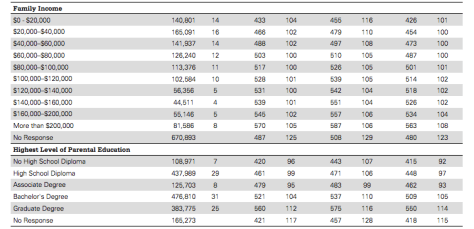
The SAT remains a fair representation of how all student scores on high-stakes standardized testing remain strongly correlated with race, social class, parental education levels, and gender. See for example from the 2015 SAT:

2015 SAT ethnicity

2015 SAT fam income lev edu

Therefore, in virtually all high-stakes standardized data sets, we find that being affluent, white, and male correlate strongly with high scores while being poor, of color, and female correlate with low scores.

Therefore, when we ask why do some (a few) high-poverty students excel while most do not, we could just as easily ask why do some (a few) wealthy students score low when most do not. And these are in fact the same question for a couple of reasons:

  • Poor students with high test scores and affluent students with low test scores are statistical outliers, and thus, provide little descriptive power for making decisions about the general populations of students. [As I cannot stress this enough, please reread that sentence until you get it.]
  • The question about why do some low-income students excel is a loaded question (and that we do not ask the parallel question about the few affluent students who score low is telling) because the real intent of that question is to suggest that student achievement is mostly controlled by the student, her/his teacher, and her/his school. Therefore, by isolating why some low-income students excel, we would be able to “fix” the majority of low income students, their teachers, and their schools.

This second point is huge, and complex, because it is deeply flawed in its essential implication. Student achievement remains in the U.S. a stronger indicator of social realities than student effort/ability, teacher quality, or school effectiveness.

That stated, could student achievement be positively impacted by addressing individual student qualities, teacher quality, or school effectiveness? Of course, and what education reform is attempting in these areas continues to be more harmful than helpful.

For example, charter schools and Teach For America are increasing educational inequity for the vulnerable populations of students (greater segregation and assigning low-income students of color beginning teachers without adequate training).

Now, if I return to the Twitter debate, yes, there are high-quality researchers looking at why low-income students struggle and achieve (see Sean Reardon here, here, and here), but the fundamental question about comparing success and failure within low-income student populations is an inherently flawed process that focuses our gaze almost exclusively on individuals while giving systemic forces a pass—the exact systemic forces that account for the greatest percentage of the scores we use to claim success or failure.

That social class, race, and gender are predictive of student scores on high-stakes standardized testing is not fatalism (using those characteristics as an excuse to do nothing), but a call to shift proportionately our questions to both systemic and individual sources for why some students excel and some struggle in formal schooling.

Race, class, and gender inequity in our society drive low test scores for many students—students who are then too often mis-served by inequitable school practices and policies such as tracking, teacher assignments, and discipline codes.

Why do some high-poverty students excel academically while most do not is one hell of a complicated question. But in most cases, it is the wrong question because of the misguided implications at its root (discussed above) and we remain unwilling to address social inequity and continue to use inequitable tools (high-stakes standardized tests) that create the very gaps we claim we want to close.

We need to prioritize questions about our broken systems before we can even begin to assess why individual students compare differently than their peers—and even then, outliers will never serve as valid gauges for all students.

Revised and Available: De-testing and De-grading Schools (Peter Lang USA, 2016)

Co-edited with Bower, J. (2016). De-testing and de-grading schools: Authentic alternatives to accountability and standardization. Revised ed. New York, NY: Peter Lang USA.

313058_cover RIP Joe

Book synopsis

A century of education and education reform, along with more than three decades of high-stakes testing and accountability, reveals a disturbing paradox: education has a steadfast commitment to testing and grading. This commitment persists despite ample research, theory, and philosophy revealing the corrosive consequences of both testing and grading in an education system designed to support human agency and democratic principles. This revised edited volume brings together a collection of updated and new essays that confronts the failure of testing and grading. The book explores the historical failure of testing and grading; the theoretical and philosophical arguments against testing and grading; the negative influence of tests and grades on social justice, race, class, and gender; and the role that they play in perpetuating a deficit perspective of children. The chapters fall under two broad sections. Part I, Degrading Learning, Detesting Education: The Failure of High-Stake Accountability in Education, includes essays on the historical, theoretical, and philosophical arguments against testing and grading. Part II, De-Grading and De-Testing in a Time of High-Stakes Education Reform, presents practical experiments in de-testing and de-grading classrooms for authentic learning experiences.

Contents: Rick Wormeli: An Unexamined Pedagogy Harms – Lisa Guisbond/Monty Neill/Bob Schaeffer: NCLB’s Lost Decade for Educational Progress: What Can We Learn from This Policy Failure? – Fernando F. Padró/ Michael F. Hawke/Laurie M. Hawke: Assessment and Quality: Policy-Steering and the Making of a Deus ex Machina – Anthony Cody: Technocratic Groupthink Inflates the Testing Bubble – Lawrence Baines/Rhonda Goolsby-Smith: America’s Obsessive-Assessment Disorder – Julie A. Gorlewski/David A. Gorlewski: Solidarity and Critical Dialogue: Interrupting the Degradation of Teacher Preparation – Morna McDermott: Feeding the World = Reading the World: Let Them Eat Tests – Richard Mora: Bubble in B for Boredom – Brian R. Beabout/Andre M. Perry: Reconciling Student Outcomes and Community Self-Reliance in Modern School Reform Contexts – David L. Bolton/John M. Elmore: The Role of Assessment in Empowering/Disempowering Students in the Critical Pedagogy Classroom – Christian Z. Goering: «How Long Does This Have to Be?»: Confronting the Standardization of Writing Instruction with Teachers in National Writing Project Invitational Summer Institutes – Joe Bower: Telling Time with a Broken Clock: Moving Beyond Standardized Testing – John L. Hoben: The Grading Mousetrap: Narcissism, Abjection, and the Politics of Self-Harm – Arnold Dodge/Ruth Powers Silverberg/Katie Zahedi: Leadership Denied: Principal as Compliance Officer – Hadley J. Ferguson: Journey into Ungrading – Jennifer Magee/Mark Dziedzic: An Oath to Stop Degrading Students: A Story of De-grading an Elementary Classroom – P. L. Thomas: De-grading Writing Instruction: Closing the «Considerable Gap» – Brian Rhode: One Week, Many Thoughts – Lisa William-White: Striving Toward Authentic Teaching for Social Justice: Additional Considerations – P. L. Thomas: Yes, to Be Clear, I Am Anti-testing, Anti-grading.