Category Archives: education reform

On Children and Kindness: A Principled Rejection of “No Excuses”

In matters of style, swim with the current; in matters of principle, stand like a rock.

—Thomas Jefferson

The Furman University spring commencement in 2008 was mostly overshadowed by two events—the speech presented by President George W. Bush and the protest and controversy surrounding that speech in the weeks leading up to and during the speech.

A concurrent controversy to Bush’s commencement address centered on the large number of faculty at the center of the protest, a protest named “We Object.” South Carolina is a traditional and deeply conservative state, and Furman tends to have a distinct contrast between the relatively conservative student body and the moderate/leaning left faculty. The Bush protest of 2008 exaggerated that divide—notably in the reaction of the Conservative Students for a Better Tomorrow (CSTB) organization and an Op-Ed in The Greenville News by two Furman professors opposing the protesting faculty.

The conservative faculty view expressed in the Op-Ed is important because it characterized the protesting faculty as post-modern, the implication being that protesting faculty held liberal/left views that were grounded in relativism (a common use of “post-modern” in public discourse). In other words, the implication was that protesting faculty were motivated by an absence of principle, or at least only relative principle.

The irony here is that the protesting faculty (among whom I was one, despite my having not yet achieved tenure) tended to reject both the post-modern label and post-modernism; in fact, our protests were deeply principled.

Having been born and raised in SC and having now lived my entire life and taught for over thirty years in my home state, I am an anomaly in both my broad ideology (I lean Marxist—although it is more complicated than that) and my principles (I am deeply principled in ways that contrast with the dogma and tradition of my treasured South).

My focal point during the Bush debate and protest (my name was frequently in news accounts and in rebuttals from CSTB) was an exaggerated but representative example of the tension that my ideology and principles create in my daily work at Furman, particularly in the classroom.

For example, I often teach an introductory education course, and one topic we address in that course very much parallels the more publicized conflicts surrounding Bush’s appearance at the 2008 graduation—corporal punishment.

When the topic comes up, students tend to support corporal punishment, reflecting the general embracing of the practice throughout the South. Many students are quick to qualify their support for corporal punishment with the “spare the rod, spoil the child” justification of their Christian faith.

I often explain to my students that I was spanked as a child in the 1960s, but that I had not spanked my daughter (who often announced to her friends that I didn’t spank, including a story of the one time I did when she ran away from us in the mall as a small child). I then add that a considerable body of research [1]  has shown that corporal punishment has overwhelming negative consequences and only one so-called positive outcome (immediate compliance).

My principled stance against corporal punishment creates noticeable tension with students’ dogmatic faith in corporal punishment. This same dynamic occurs when I confront the public and political support for grade retention, which I regularly refute—again based on a substantial body of evidence (which parallels in many ways the research on corporal punishment in that both practices have some quick and apparently positive outcomes but many long-term negative consequences).

As the Jefferson quote implores, in my positions on corporal punishment and grade retention, I stand like a rock.

And this helps explain my principled stance rejecting “no excuses” ideologies and practices as well as deficit views of children, race, and class.

Some Issues Beyond Debate

Three ideologies are powerful and foundational in both traditional educational practices and recent education reform agendas over the past thirty years—paternalism, “no excuses” ideology, and deficit perspectives (of children and impoverished people).

Traditional schooling is typified by behaviorism: in the grading, in the classroom management. Punishing and rewarding are types of paternalism and are justified by the belief that children are lacking something that some authority must provide.

Ironically, education reform committed to accountability driven by standards and high-stakes testing is really no reform at all since many of the reform policies are simply exaggerated versions of traditional practices—both of which are grounded in paternalism, “no excuses” ideology, and deficit perspectives.

“No excuses” practices (represented by KIPP charter schools, but certainly not exclusive to that chain or charter schools since the ideology permeates almost all schooling to some degree) match social norms in the U.S., and in fact, aren’t very controversial. Yet, since “no excuses” policies are part of the dominant reform agenda, advocates feel compelled to justify those policies and practices.

To be honest, critics of “no excuses” ideology are in the minority and tend to be powerless. Nonetheless, Alexandra Boyd, Robert Maranto and Caleb Rose have published an article in Education Next designed to refute “no excuses” critics and to justify KIPP charters narrowly and “no excuses” ideology more broadly.

While I will not elaborate here on this, advocates of deficit-based strategies aimed at children in poverty and popularized by Ruby Payne tend to make parallel arguments as those endorsing “no excuses” schools and practices.

Corporal punishment, grade retention, paternalism, “no excuses” ideologies, and deficit perspectives of children, class, and race—all of these ideologies and concurrent practices conform to social norms of the U.S. (politicians and the public support them overwhelmingly) and tend to be discredited by large and robust research bases. All of these ideologies and practices also produce the appearance of effectiveness in the short term but create many long-term negative outcomes.

Paternalism, “no excuses” ideologies, and deficit perspectives reflect and perpetuate racism, classism, and sexism—even though many of the people who are and would be negatively impacted by these beliefs are often actively participating in and supporting institutions, policies, and practices driven by all three.

History has revealed numerous examples of people in reduced circumstances behaving in ways that were counter to their and other people’s freedom and equity. Margaret Atwood’s The Handmaid’s Tale remains to me one of the best literary cautionary tales of that disturbing and complicated reality; Atwood dramatizes the historical reality of women contributing to the oppression of women. As a powerful work of scholarship, Michelle Alexander’s The New Jim Crow details well that a culture of mass incarceration (an era paralleling the accountability era in education) has reduced the lives of many minorities living in poverty to the point that they appear to support practices that, in fact, as Alexander describes, constitute the new Jim Crow—as I have explained while connecting mass incarceration with education reform:

This last point – that African Americans seem to support both the war on crime and “no excuses” charter schools – presents the most problematic aspect of charges that mass incarceration and education reform are ultimately racist, significant contributions to the New Jim Crow.

For example, Carr reports that African American parents not only choose “no excuses” charter schools in New Orleans, but also actively cheer and encourage the authoritarian policies voiced by the schools’ administrators. But Alexander states, “Given the dilemma facing poor black communities, it is inaccurate to say that black people ‘support’ mass incarceration or ‘get-tough’ policies” because “if the only choice that is offered blacks is rampant crime or more prisons, the predictable (and understandable) answer will be ‘more prisons’” (p. 210).

New Orleans serves as a stark example of how this dynamic works in education reform: Given the choice between segregated, underfunded and deteriorating public schools and “no excuses” charters – and not the choice of the school environments and offerings found in many elite private schools – the predictable answer is “no excuses” charters.

And all of this, I suppose, may have been more than many people wanted to read for me to reach my big point, which is this:

There is no evidence that will convince me to reverse my stance against “no excuses” practices.

There is no evidence that will convince me to reverse my stance against deficit perspectives.

There is no evidence that will convince me to reverse my stance against paternalism.

There is no evidence that will convince me to reverse my stance against corporal punishment.

There is no evidence that will convince me to reverse my stance against grade retention.

Period.

Especially when it concerns children, the ends can never justify the means so I couldn’t care less about test scores at KIPP schools.

Can we debate these? Sure, but if you want to debate me in order to change my mind, you would be wasting your time.

I am approaching 53, and I remain a work in progress. There is much I do not know, and there remains much that I am deeply conflicted about. But there is one thing that I know deep into my bones—children are wonderful and precious.

Children are wonderful and precious and there isn’t a damned thing you can show me or argue that can justify anything that is unkind to a child.

Not one damn thing.

For the adults who disagree with me and believe I am wrong or fool-headed, I love you too. But if you force me to choose, you lose.

Few things fill me with confidence in my principles like the novels of Kurt Vonnegut. Vonnegut and I see the same world, have the same regrets about that would, but also share the same idealistic hope. In the beginning of his Slaughterhouse-Five, Vonnegut blends confessional memoir with his fiction as he explains how the novel came to have the full title Slaughterhouse-Five, or The Children’s Crusade: A Duty-Dance with Death.

While visiting a fellow veteran of WWII and his friend Bernard V. O’Hare, Vonnegut is confronted by O’Hare’s wife Mary, who is angry about Vonnegut’s considering writing a novel about his experience at the firebombing of Dresden:

“You were just babies then!” [Mary] said.

“What?” I said.

“You were just babies in the war—like the ones upstairs!”

I nodded that this was true. We had been foolish virgins in the war, right at the end of childhood. (p. 14)

And from this Vonnegut promised Mary not to glorify war and to add the extended title.

There is something sacred about childhood, about innocence. Something sacred that deserves and should inspire all humans toward kindness.

I see little evidence we are inspired, but I remain committed to the possibility of the kindness school—and even a kind society populated by kind people.

Nothing there to debate.

For Further Reading

anyone lived in a pretty how town, e. e. cummings

[1] See Is Corporal Punishment an Effective Means of Discipline? (APA); and Spanking and Child Development Across the First Decade of Life.
The U.S. Formula for Children and the Choices We Refuse to Make

The formula for children in the U.S. can be summed up in one word, I think: “harsh.” And the response we should have to this formula is “inexcusable.”

Let’s consider the U.S. formula for children:

If children in the U.S. can survive the gauntlet that is the national formula for children, as young adults they can look forward to crushing debt to attend college so that they can enter a nearly non-existent workforce.

But there is a caveat to this formula: The U.S. formula for children above is for “other people’s children,” that new majority in U.S. public schools and those children living in homes of the working poor, the working class, and the dwindling middle class.

Children of the privileged are exempt.

And what are the choices we refuse to make?

The Joseph Rowntree Foundation (UK) has released “Does money affect children’s outcomes?”—based in part on “many studies…from the US.” The key points include:

  • This review identified 34 studies with strong evidence about whether money affects children’s outcomes. Children in lower-income families have worse cognitive, social-behavioural and health outcomes in part because they are poorer, not just because low income is correlated with other household and parental characteristics.
  • The evidence was strongest for cognitive development and school achievement, followed by social-behavioural development. Income also affects outcomes indirectly impacting on children, including maternal mental health, parenting and home environment.
  • The impact of increases in income on cognitive development appears roughly comparable with that of spending similar amounts on school or early education programmes. Increasing household income could substantially reduce differences in schooling outcomes, while also improving wider aspects of children’s well-being.
  • A given sum of money makes significantly more difference to children in low-income than better-off households (but still helps better-off children).
  • Money in early childhood makes most difference to cognitive outcomes, while in later childhood and adolescence it makes more difference to social and behavioural outcomes.
  • Longer-term poverty affects children’s outcomes more severely than short-term poverty. Although many studies were from the US, the mechanisms through which money appears to affect children’s outcomes, including parental stress, anxiety and material deprivation, are equally relevant in the UK.

The third bullet point should not be ignored: The key to eradicating poverty and the negative consequences of poverty for children is to address poverty directly in the lives of children—money—and to address inequity directly in the education of children.

There is no either/or, then, in the education reform debate. It is imperative that we do both.

Ultimately, the U.S. formula for children is based on flawed assumptions. Before we can change that formula, we must change our views of poverty as well as people and children trapped in poverty.

Scarcity and abundance are powerful forces; in the U.S., both are allowed to exist as an ugly game of chance.

The choice of abundance for all is there to be embraced, however, if compassion and community are genuinely a part of the American character.

Gaiman, Prisons, Literacy, and the Problems with Satire

Regarding my recent blog about Neil Gaiman for Secretary of Education (and the edited version at The Answer Sheet), Ken Libby took me to task on Twitter for, among other things, Gaiman’s comment about prisons and literacy:

I was once in New York, and I listened to a talk about the building of private prisons – a huge growth industry in America. The prison industry needs to plan its future growth – how many cells are they going to need? How many prisoners are there going to be, 15 years from now? And they found they could predict it very easily, using a pretty simple algorithm, based on asking what percentage of 10 and 11-year-olds couldn’t read. And certainly couldn’t read for pleasure.

It’s not one to one: you can’t say that a literate society has no criminality. But there are very real correlations.

My immediate point after quoting Gaiman was: “Gaiman even understands the difference between causation and correlation—a dramatic advantage over Secretaries of Education in the past two administrations.”

I have also received a friendly and much appreciated email from Chris Boynick addressing the same issue, noting that it is an urban legend that prisons use child literacy to predict prison needs. See “Prisons don’t use reading scores to predict future inmate populations” and “Kathleen Ford says private prisons use third-grade data to plan for prison beds.”

Boynick sent that same information to Neil Gaiman who responded on Twitter with: “@CBoynick Interesting. The person who told me that was head of education for New York city.”

So let me make a few clarifications addressing all this:

  1. My Gaiman piece is satire (and to be honest, that should put all this to rest). I don’t really endorse or want Gaiman as Secretary of Education, although I think Gaiman is brilliant (as one Gaiman fan noted, we don’t want to detract from his life as a writer!). My real point is the calamity that is those who have served at Secretaries of Education—especially in the George W. Bush and Barack Obama administrations.
  2. Nonetheless, Gaiman only relays a fact: He did hear this stated as a truth. So maybe we can level some blame at his believing this, but apparently a person with some authority who should have known the truth did state this in front of Gaiman.
  3. Has Gaiman, then, been a victim (like many of us) of an urban legend? It appears so.
  4. But, does Gaiman then make some outlandish or flawed claim based on misinformation? Not at all. In fact, I highlighted that Gaiman immediately made a nuanced claim: “It’s not one to one: you can’t say that a literate society has no criminality. But there are very real correlations.” And that claim helps him move into a series of powerful and valid points. I should emphasize that most politicians and political appointees start with misinformation and then make ridiculous and flawed proposals. On that comparison, Gaiman wins.

And for good measure, I suggest “Do prisons use third grade reading scores to predict the number of prison beds they’ll need?” by Joe Ventura, which addresses the urban legend, concluding with an important point relevant to this non-issue about Gaiman’s speech and my blog:

Perhaps it’s best to call this a distortion of the truth. While there isn’t evidence of State Departments of Corrections using third- (or second- or fourth-) grade reading scores to predict the number of prison beds they’ll need in the next decade (one spokesperson called the claim “crap”), there is an undeniable connection between literacy skills and incarceration rates.

You see, a student not reading at his or her grade level by the end of the third grade is four times less likely to graduate high school on time–six times less likely for students from low-income families. Take that and add to it a 2009 study by researchers at Northwestern University that found that high school dropouts were 63 times (!) more likely to be incarcerated than high school grads and you can start to see how many arrive at this conclusion.

But once incarcerated, not all hope is lost. In fact, literacy instruction can help on both ends of the correctional system; studies have shown that inmates enrolled in literacy and other education programs can substantially reduce recidivism rates. One study of 3,000 inmates in Virginia found that 20% of those receiving support in an education program were reincarcerated, while 49% not receiving additional support returned to prison after being released.

So, while prison planners do not use third grade reading scores to determine the number of prison beds they’ll need in the decade to come, there is a connection between literacy rates, high school dropout rates, and crime. While we should file this claim as an urban legend, let’s recognize why it resonates with us: it speaks to the important ways that poor reading skills are connected with unfavorable life outcomes [his emphasis].

With that, I rest my case: Gaiman’s speech is overwhelming on target, moving, and brilliant, and he deserves a bit of space for a small error of fact, and the current Secretary of Education is incompetent.

This leads me to wonder why so much concern about one detail in an author’s speech and my satirical blog, but so little concern for the incompetence of the Secretary of Education and the entire education agenda at the USDOE.

Medicating ADHD in the Brave New World of High-Stakes Accountability

Miranda: O wonder!
How many goodly creatures are there here!
How beauteous mankind is! O brave new world,
That has such people in’t.

—William Shakespeare, The Tempest, Act V, Scene I, ll. 203–206

—–

Utopias seem much more attainable than one may have previously thought. And we are now faced with a much more frightening thought: how do we prevent their permanent fulfillment?…Utopias are attainable. The way of life points towards them. But perhaps a new century will begin, a century in which intellectuals and the educated class will find means of preventing utopias, and we will return to a non-utopian society, which may be less perfect, but will offer more freedom.

—Nicolas Berdiaeff

My love of science fiction (SF) has its roots firmly in Marvel comic books from the 1970s and the SF novels of Arthur C. Clarke and Niven/Pournelle. When I became acquainted with what teachers called “good” and “real” literature, I was immediately drawn to George Orwell and Aldous Huxley as anointed SF writers.

As an adult, I am the sort of SF reader who treasures Kurt Vonnegut and Margaret Atwood, and if I am pushed, I have to admit I value Orwell more as an essayist than novelist and always enjoyed Huxley’s Brave New World over 1984—believing both works are brilliant, but preferring BNW as a reader.

The opening passages are two foundational quotes behind the message of BNW, the Shakespeare the source of the title and the Berdiaeff a nod to Huxley’s parody of utopian fiction.

In his Foreword to the Perennial Classic edition of BNW, Huxley explains:

But Brave New World is a book about the future and, whatever its artistic or philosophical qualities, a book about the future can interest us only if its prophesies look as though they might conceivably come true….The theme of Brave New World is not the advancement of science as such; it is the advancement of science as it affects human individuals. (p. ix)

Beyond purpose, Huxley continues, speculating about “A really efficient totalitarian state”

would be one in which the all-powerful executive of political bosses and their army of managers control a population of slaves who do not have to be coerced, because they love their servitude. To make them love it is the task assigned, in present-day totalitarian states, to ministries of propaganda, newspaper editors and schoolteachers….The great triumphs of of propaganda have been accomplished, not by doing something, but by refraining from doing. Great is truth, but still greater, from a practical point of view, is silence about the truth. (p. xii)

SF, at its best, however, is not predictive, but cautionary; as Neil Gaiman has reminded us, “The world doesn’t have to be like this. Things can be different.” Thus, Huxley warns:

Round pegs in square holes tend to have dangerous thoughts about the social system and to infect others with their discontents….In conjunction with the freedom to daydream under the influence of dope and movies and the radio, it will help to reconcile his subjects to the servitude which is their fate….Indeed, unless we choose to decentralize and to use applied science [1], not as the end to which human beings are to be made the means, but as the means to producing a race of free individuals, we have only two alternatives to choose from: either a number of national, militarized totalitarianisms…or else one supra-national totalitarian. (pp. xiii, xiv)

And then, Huxley conclude: “You pays your money and you takes you choice” (p. xiv).

The speculative and cautionary possibilities found in SF rarely come to fruition in the real world in the dramatic ways of novels or films (or in the somewhat looney ways political factions rant and rave in public discourse). So it seems likely that we are apt never to listen or to act in ways that we should and could.

Huxley, I think, was in many ways speaking to this—“The Not-So-Hidden Cause Behind the A.D.H.D. Epidemic”:

Between the fall of 2011 and the spring of 2012, people across the United States suddenly found themselves unable to get their hands on A.D.H.D. medication. Low-dose generics were particularly in short supply. There were several factors contributing to the shortage, but the main cause was that supply was suddenly being outpaced by demand.

The number of diagnoses of Attention Deficit Hyperactivity Disorder has ballooned over the past few decades. Before the early 1990s, fewer than 5 percent of school-age kids were thought to have A.D.H.D. Earlier this year, data from the Centers for Disease Control and Prevention showed that 11 percent of children ages 4 to 17 had at some point received the diagnosis — and that doesn’t even include first-time diagnoses in adults. (Full disclosure: I’m one of them.)

That amounts to millions of extra people receiving regular doses of stimulant drugs to keep neurological symptoms in check. For a lot of us, the diagnosis and subsequent treatments — both behavioral and pharmaceutical — have proved helpful. But still: Where did we all come from? Were that many Americans always pathologically hyperactive and unable to focus, and only now are getting the treatment they need?

Probably not. Of the 6.4 million kids who have been given diagnoses of A.D.H.D., a large percentage are unlikely to have any kind of physiological difference that would make them more distractible than the average non-A.D.H.D. kid. It’s also doubtful that biological or environmental changes are making physiological differences more prevalent. Instead, the rapid increase in people with A.D.H.D. probably has more to do with sociological factors — changes in the way we school our children, in the way we interact with doctors and in what we expect from our kids.

As disturbing as this is, the final paragraph of this article may be the most significant:

Today many sociologists and neuroscientists believe that regardless of A.D.H.D.’s biological basis, the explosion in rates of diagnosis is caused by sociological factors — especially ones related to education and the changing expectations we have for kids. During the same 30 years when A.D.H.D. diagnoses increased, American childhood drastically changed. Even at the grade-school level, kids now have more homework, less recess and a lot less unstructured free time to relax and play [emphasis added]. It’s easy to look at that situation and speculate how “A.D.H.D.” might have become a convenient societal catchall for what happens when kids are expected to be miniature adults. High-stakes standardized testing, increased competition for slots in top colleges [emphasis added], a less-and-less accommodating economy for those who don’t get into colleges but can no longer depend on the existence of blue-collar jobs — all of these are expressed through policy changes and cultural expectations, but they may also manifest themselves in more troubling ways — in the rising number of kids whose behavior has become pathologized.

The rise of ADHD diagnoses and medications has run concurrent to the accountability era in education, sharing the same thirty-year history. O brave new world of high-stakes accountability and the ADHD medication needed to make the students love their servitude to the tests…

[1] Paul Boyle, “A U.K. View on the U.S. Attack on Social Sciences,” Science, 341 (August 16, 2013), p. 719.

Ignoring the New Majority: Education Reform behind Blinders

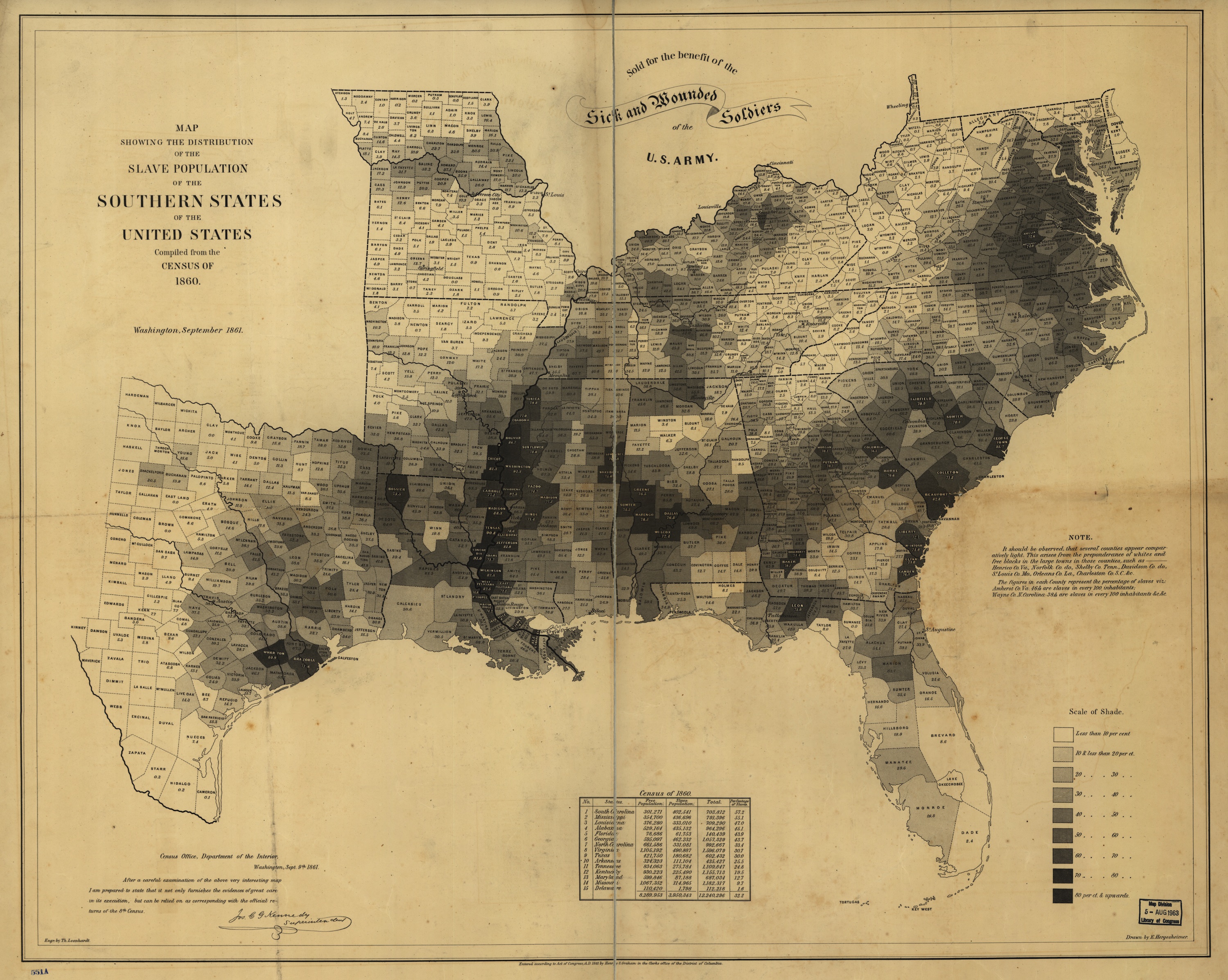
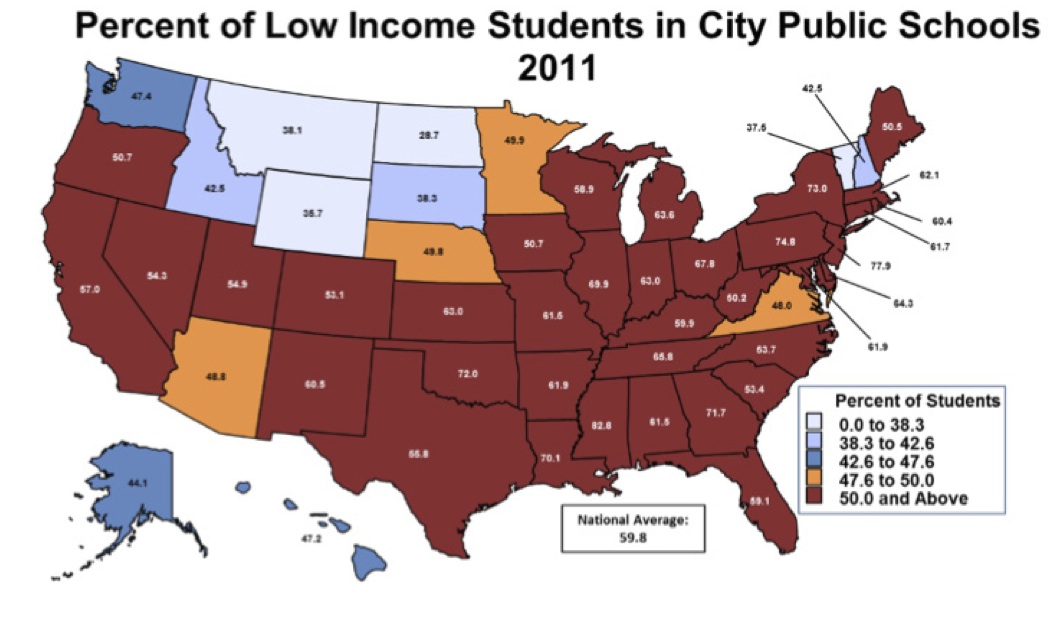
Consider three maps—one using data from the 1860 Census, one focusing on public schools in 2011, and one detailing the remaining states allowing corporal punishment in schools:

BigSlaveryMap

[1860; click to enlarge]

Perc of low income students public schools copy

[2011; click to enlarge]

[2005-2006; click to enlarge]

“A majority of students in public schools throughout the American South and West are low-income for the first time in at least four decades, according to a new study that details a demographic shift with broad implications for the country,” explains Lyndsey Layton, based on the report from the Southern Education Foundation (SEF).

The data in the SEF report parallel in many ways the documenting of in-school segregation lingering in the South as portrayed in the HBO film Little Rock Central: Fifty Years Later and reported by Felicia Lee:

On a recent visit to Central High, Ms. Trickey spoke to a self-segregated classroom: whites on one side, blacks on the other. An African-American student apparently dozed as she spoke. Students and teachers alike spoke blithely or painfully of the low educational aspirations and achievements of too many black students. Central, many said, is now two schools in one: a poor, demoralized black majority and a high achieving, affluent white minority.

And five years after the documentary, The Civil Rights Project detailed the extent of re-segregated schools across the South:

  • Since 1991, black students in the South have become increasingly concentrated in intensely segregated minority schools (defined as 90-100% minority students). This represents a significant setback. Though for decades Southern black students were more integrated than their peers in other parts of the country, by 2009-10 the share of Southern black students enrolled in intensely segregated minority schools (33.4%) was fast closing in on the national figure (38.1%).  By comparison, in 1980, just 23% of black students in the South attended intensely segregated schools.
  • For the last four decades, contact between black and white students has declined in virtually all Southern states.  In schools across the region, white students make up 30% or less of the enrollment in the school of the typical black student for the first time since racial statistics pertaining to schools were collected by the federal government.
  • Most of the largest Southern metro areas also report declining black-white exposure. The Raleigh, NC metro had the highest black-white contact although this too has fallen in recent years.  In 2009, the typical black student in the metro went to a school where whites accounted for about 45% of their peers, compared to about 54% in 2002).
  • In 2009, black-white exposure in the metropolitan area of Raleigh was relatively similar to the overall white percentage in the metro (54%)–indicating fairly stable levels of desegregation.  Future enrollment data for the Raleigh metro should be closely monitored to ascertain the impact of recent policy changes to the district’s voluntary integration policy.
  • Two metros, Memphis, TN and Miami, FL, had the lowest exposure of black students to white students in 2009, under 15%. (Siegel-Hawley & Frankenberg2012, September 19)

In Western states with high Latino/a populations, race and poverty patterns constitute double segregation:

  • The typical black or Latino today attends school with almost double the share of low-income students in their schools than the typical white or Asian student.
  • In the early 1990s, the average Latino and black student attended a school where roughly a third of students were low income (as measured by free and reduced price lunch eligibility), but now attend schools where low income students account for nearly two-thirds of their classmates.
  • There is a very strong relationship between the percent of Latino students in a school and the percent of low income students. On a scale in which 1.0 would be a perfect relationship, the correlation is a high .71.  The same figure is lower, but still high, for black students (.53).  Many minority-segregated schools serve both black and Latino students.  The correlation between the combined percentages of these underserved two groups and the percent of poor children is a dismaying .85. (Orfield, Kucsera, & Siegel-Hawley, 2012, September 19)

Combined with the growing trends in the U.S. related to increased inequity, rising child poverty, and re-segregating of schools by class and race, the 2013 SEF report on low-income students being the new majority in public schools should be a wake-up call to the current in-school only focus of education reform. While race and class segregation has proven to be entrenched in U.S. society, education reformers must admit that social institutions such as public schools do not lift children out of poverty but play two roles reformers prefer to ignore—they reflect social inequity and they tend to perpetuate that inequity:

A majority of public school children in 17 states, one-third of the 50 states across the nation, were low income students – eligible for free or reduced lunches – in the school year that ended in 2011. Thirteen of the 17 states were in the South, and the remaining four were in the West. Since 2005, half or more of the South’s children in public schools have been from low income households. During the last two school years, 2010 and public schools. (SEF 2013)

Also hard hit by these social and academic realities are urban public schools:

city public schools

[click to enlarge]

In other words, while the South and West are crucibles for historical and current negative consequences associated with racial and class inequity and segregation, urban areas of the U.S. show that these same problems infect essentially the entire country:

In each of the nation’s four regions, a majority of students attending public schools in the cities were eligible for free or reduced lunch last year. The Northeast had the highest rates for low income school children in cities: 71 percent. The next highest rate, 62 percent, was found in Midwestern cities. The South had the third highest percentage of low income students in the cities – 59 percent.

The SEF report ends with the dilemma facing education reformers who promote a “no excuses” ideology grounded in market-based policies:

There is no real evidence that any scheme or policy of transferring large numbers of low income students from public schools to private schools will have a positive impact on this problem. The trends of the last decade strongly suggest that little or nothing will change for the better if schools and communities continue to postpone addressing the primary question of education in America today: what does it take and what will be done to provide low income students with a good chance to succeed in public schools? It is a question of how, not where, to improve the education of a new majority of students.

The lingering legacy of segregation as well as the rise of impoverished students constituting the new majority in public schools is evidence that ignoring poverty does not make it go away.

Arguing that in-school reform alone can eradicate the scars of slavery that remain vivid in the two maps included above is beyond idealism and approaches inexcusable irresponsibility of a type that is exposed by the data presented by SEF’s report.

With impoverished students now the new majority in public schools, a new era of education reform is unavoidable—one that begins with social reform addressing racial and class inequity and then continues by redesigning a public school system that itself is dedicated to equity of opportunity.

Neil Gaiman Should Be U.S. Secretary of Education: “Things can be different”

Some people view the world differently than others.

Some people view education and schools differently than others.

Some people view children, books, and libraries differently than others.

And then there is Neil Gaiman.

I have been a staunch defender of public education, writing often against the negative consequences of Common Core (especially as related to literacy instruction) and doggedly resisting non-educators as leaders of the education reform movement.

Despite my resistance to what I consider misguided reform as well as my skepticism about innovation and market forces, I have conceded a compromise on Common Core, along with a clarification about that compromise. The response to that compromise has been underwhelming.

However, I am now willing to offer another compromise; this time about the qualifications for who should be our leaders in education reform. While I still call for the removal of Arne Duncan as Secretary of Education, I am offering Neil Gaiman as the next Secretary of Education in the U.S.—and suggesting that this office be his for life.

I am basing this new compromise on a speech presented by Gaiman for the Reading Agency in London.

First, I must admit that it isn’t entirely fair to judge Gaiman on a speech he wrote himself as that compares to the speeches written for him Duncan delivers. It also isn’t quite fair to judge the positions of a beloved author against the panderings of a life-long political appointee. Certainly, Duncan is beholden to different constituencies than Gaiman.

But judge I have, and here are my conclusions.

Gaiman’s qualifications for Secretary of Education must begin with what his speech does not include: no discussion of “grit,” no chants of “no excuses,” no praising of innovation or bowing to the brave new world of technology, no calls for new standards, no urgency about new high-stakes tests.

Instead, Gaiman offers a genuine and compelling argument for the essential value in books, the power of fiction, and the sacred nature of libraries.

Unlike typical political discourse, Gaiman confesses upfront his prejudices:

And I am biased, obviously and enormously: I’m an author, often an author of fiction. I write for children and for adults. For about 30 years I have been earning my living though my words, mostly by making things up and writing them down. It is obviously in my interest for people to read, for them to read fiction, for libraries and librarians to exist and help foster a love of reading and places in which reading can occur.

So I’m biased as a writer. But I am much, much more biased as a reader. And I am even more biased as a British citizen*.

Immediately, Gaiman shows his political acuity by noting the importance of investing in literacy as one strategy for decreasing the rise in prisons in the U.S.:

I was once in New York, and I listened to a talk about the building of private prisons – a huge growth industry in America. The prison industry needs to plan its future growth – how many cells are they going to need? How many prisoners are there going to be, 15 years from now? And they found they could predict it very easily, using a pretty simple algorithm, based on asking what percentage of 10 and 11-year-olds couldn’t read. [1] And certainly couldn’t read for pleasure.

It’s not one to one: you can’t say that a literate society has no criminality. But there are very real correlations.

Gaiman even understands the difference between causation and correlation—a dramatic advantage over Secretaries of Education in the past two administrations.

But Gaiman shines best when he speaks about and to the essential value in reading, recognizing what the field of literacy has know for a century, at least—children are drawn to reading by being offered an abundance of books and allowed to read by choice:

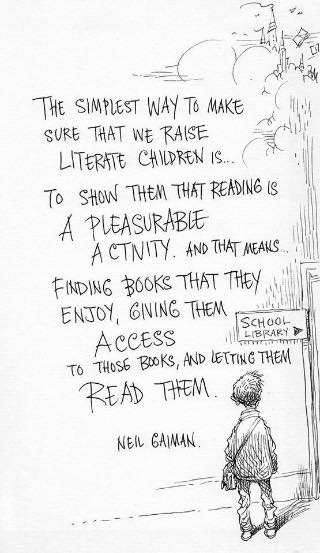
The simplest way to make sure that we raise literate children is to teach them to read, and to show them that reading is a pleasurable activity. And that means, at its simplest, finding books that they enjoy, giving them access to those books, and letting them read them.

I don’t think there is such a thing as a bad book for children. Every now and again it becomes fashionable among some adults to point at a subset of children’s books, a genre, perhaps, or an author, and to declare them bad books, books that children should be stopped from reading. I’ve seen it happen over and over; Enid Blyton was declared a bad author, so was RL Stine, so were dozens of others. Comics have been decried as fostering illiteracy.

It’s tosh**. It’s snobbery and it’s foolishness. There are no bad authors for children, that children like and want to read and seek out, because every child is different.

We may be able to imagine, also, how Gaiman would react to Common Core and their “architect,” David Coleman:

And not everyone has the same taste as you.

Well-meaning adults can easily destroy a child’s love of reading: stop them reading what they enjoy, or give them worthy-but-dull books that you like, the 21st-century equivalents of Victorian “improving” literature. You’ll wind up with a generation convinced that reading is uncool and worse, unpleasant.

After an impassioned and thoughtful argument about science fiction (SF)—even China is on board with SF!—Gaiman turns to the power of libraries:

Another way to destroy a child’s love of reading, of course, is to make sure there are no books of any kind around. And to give them nowhere to read those books. I was lucky….

They were good librarians. They liked books and they liked the books being read. They taught me how to order books from other libraries on inter-library loans. They had no snobbery about anything I read. They just seemed to like that there was this wide-eyed little boy who loved to read, and would talk to me about the books I was reading, they would find me other books in a series, they would help. They treated me as another reader – nothing less or more – which meant they treated me with respect. I was not used to being treated with respect as an eight-year-old.

But libraries are about freedom. Freedom to read, freedom of ideas, freedom of communication. They are about education (which is not a process that finishes the day we leave school or university), about entertainment, about making safe spaces, and about access to information.

No, it seems, education reform should not be about new standards or new high-stakes tests—but about preserving and expanding children’s access to books. Education reform, it seems, isn’t buried inside the promise of new technology either:

I do not believe that all books will or should migrate onto screens: as Douglas Adams once pointed out to me, more than 20 years before the Kindle turned up, a physical book is like a shark. Sharks are old: there were sharks in the ocean before the dinosaurs. And the reason there are still sharks around is that sharks are better at being sharks than anything else is. Physical books are tough, hard to destroy, bath-resistant, solar-operated, feel good in your hand: they are good at being books, and there will always be a place for them. They belong in libraries, just as libraries have already become places you can go to get access to ebooks, and audiobooks and DVDs and web content.

Gaiman, we must note, is not being merely fanciful; he acknowledges the role of literacy in the world economy and the value in preparing younger generations for that world economy. But his commitments are distinct from the current calls for market forces and innovation.

In fact, Gaiman celebrates a different “I” word:

We all – adults and children, writers and readers – have an obligation to daydream. We have an obligation to imagine. It is easy to pretend that nobody can change anything, that we are in a world in which society is huge and the individual is less than nothing: an atom in a wall, a grain of rice in a rice field. But the truth is, individuals change their world over and over, individuals make the future, and they do it by imagining that things can be different.

Look around you: I mean it. Pause, for a moment and look around the room that you are in. I’m going to point out something so obvious that it tends to be forgotten. It’s this: that everything you can see, including the walls, was, at some point, imagined. Someone decided it was easier to sit on a chair than on the ground and imagined the chair. Someone had to imagine a way that I could talk to you in London right now without us all getting rained on.This room and the things in it, and all the other things in this building, this city, exist because, over and over and over, people imagined things.

Along with “imagination,” Gaiman also speaks about our commitment to beauty and our shared democratic responsibilities. Fostering literacy in our children, he argues, is an obligation: “This is not a matter of party politics. This is a matter of common humanity.”

Ultimately, Gaiman’s speech has inspired me to move outside my previous commitments to demanding that education reform be led by educators only. He has inspired me to imagine, and now I can join him in this belief:

You’re also finding out something as you read vitally important for making your way in the world. And it’s this:

The world doesn’t have to be like this. Things can be different.

* Keep in mind, Gaiman lives in Minnesota and one of his best novels is American Gods. I think we could expect Gaiman to be as passionate about the good ol’ U.S. of A. if given the opportunity.

** As a side note, the U.S. would benefit greatly from having an appointed official who would occasionally say “tosh.”

[1] Please see this clarification of Gaiman’s claim and the point of this blog.

Recommended: Whose Knowledge Counts in Government Literacy Policies?

Especially in the context of President Barack Obama’s education agenda—one that builds on the failed No Child Left Behind template begun under President George W. Bush—and against claims that teachers must earn their place at the education reform agenda,  Whose Knowledge Counts in Government Literacy Policies? (Routledge, 2014)—edited by Kenneth S. Goodman, Robert C. Calfee, and Yetta M. Goodman—is both a powerful and needed collection that confronts “the political determination of school knowledge in the field of literacy instruction” (p. xv).

Calfee’s introduction subtitle gets right to the issue: “How the Federal Government Used Science to Take Over Public Schools.” But the entire collection offers a solid case for rejecting thirty-plus years of inexpert accountability and seeking instead the voices and expertise of the field of literacy to drive education policy.

I highly recommend reading and sharing this volume widely.

Table of Contents

Foreword: Joel Spring

Acknowledgments

Chapter 1: Introduction: Knowledge, Evidence, and Faith: How the Federal Government Used Science to Take Over Public Schools, Robert Calfee

Part 1: The Political Realties

Chapter 2: Whose Knowledge Counts? The Pedagogy of the Absurd, Kenneth S. Goodman

Chapter 3: Re-reading Poverty; Reorienting Educational Policy, Patrick Shannon

Chapter 4: Neoliberal and Neoconservative Literacy Education Policies in Contemporary France, Jacques Fijalkow

Chapter 5: Flying Blind: Government Policy on the Teaching of Reading in England and Research on Effective Literacy Education, Henrietta Dombey

Chapter 6: Whose Knowledge Counts, For Whom, In What Circumstances?: The Ethical Constraints on Who Decides, Sue Ellis

Chapter 7: About the Dubious Role of Phonological Awareness in the Discussion of Literacy Policies, Renate Valtin

Part 2: Aspects of Literacy: The Knowledge Base

Chapter 8: The Role of Story and Literature in a World of Tests and Standards, Kathy G. Short

Chapter 9: The Staircase Curriculum: Whole-School Collaboration to Improve Literacy Achievement, Kathryn H. Au and Taffy E. Raphael

Chapter 10: Diversity in Children’s Literature: What Does It Matter in Today’s Educational Climate? Rudine Sims Bishop

Chapter 11: Examining Three Assumptions about Text Complexity: Standard 10 of the Common Core State Standards, Elfrieda H. Hiebert and Katie Van Sluys

Chapter 12: The Role of Literature and Literary Reasoning in English Language Arts and English Classrooms, Judith A. Langer

Chapter 13: Writing Teachers: The Roles Exploration, Evaluation, and Time Play in Their Lives, Jane Hansen

Chapter 14: What Do Children Need to Succeed in Early Literacy—And Beyond? William H. Teale, Jessica L. Hoffman, and Kathleen A. Paciga

Chapter 15: The Impact of Changing Conceptions of Language on Curriculum and Instruction of Literacy and the Language Arts, David Bloome and Melissa Wilson,

Comments: Nu!…. So!… Where do We Go from Here? Yetta M. Goodman

List of Contributors

U.S. Needs Moratorium on (Privileged) White Men Pontificating on Race, Class, Gender

Most  (privileged) white men are wrong about race, class, and gender—and while Mike Petrilli isn’t unique, he does represent how and why:

Second, the reason the overwhelming majority of children are born poor is that they are born to young single mothers without much education or many job prospects. These mothers will struggle mightily to provide the kind of home environment that is necessary to help children get off to a good start in life and in school. To put it bluntly, they tend to be bad parents. (Not “bad” in a moral sense but “bad” as in “ineffective”; with their brains literally maxed out with basic survival, it’s easy to understand why.)

While it is embarrassing enough that Petrilli thinks putting “bad” in quote marks and offering a parenthetical qualification are enough to counter the essential condescension and marginalization in his mischaracterization of people who happen to be trapped in poverty, the larger problem is that Petrilli represents, speaks for, and speaks to a cultural attitude toward the poor (and the affluent/privileged) that guarantees the U.S. remain inequitable, and likely will continue to grow more inequitable: people in poverty are lazy and deserve their poverty while the affluent are hard-working and deserve their achievements.

Before I continue, let me clarify that my calling for a moratorium on white men pontificating on race, class, and gender would include me. And if I am successful in this call, I am eager to comply.

The president/governor Bush clan in the U.S. has rightfully been accused of including several men born on third base who all believe they hit triples. If that characterization is accurate, and I think it is, then I am privileged by being white and male, but compared to the Bushes, my working-class background probably put me solidly at first.

Along with race and gender, I happen to have the sort of mathematical and verbal intelligence that schools and society honor—as well as a sort of Type-A work ethic that tends to be rewarded as well.

In fact, I have worked extremely hard at being a teacher and writer for about 30 years now, achieving a fairly high level of success.

I have earned that success, but let me be very clear that I do not deserve it.

I do not deserve the relative affluence and all the advantages of that while other people are being denied access that I was afforded through no effort on my part. Yes, I have worked hard, but the foundation of my success was pure and simply dumb luck.

Consider Shaquille O’Neal, LeBron James, George W. Bush, Bill Gates, and Mike Krzyzewski. What if these five men had lived in the early to mid 1800s? How would their lives have manifested themselves in that era?

It is without a doubt that two of these men would have had quite different lives—and not because of their talents, character, or determination.

Social norms are powerful and are primary when considering the individual talents of people.

And that leads us back to my call for a moratorium and my claim that most white men are typically wrong about race, class, and gender.

White men have built Western culture (often on the backs of others) and the exact privilege that appears transparent to them.

“Normal” to the privileged constitutes all the forces that assure their privilege and in turn create the poverty and disadvantage of others.

As a result, Petrilli can and does classify single, poor mothers as “bad parents”—and does so while believing himself and hearing from others that Mike is an essentially nice guy.

Yes, Petrilli is a nice guy—in the rarified air of privileged white men in the U.S.

His blogs appear civil and almost reasonable in fact.

But there is nothing civil or reasonable about a privileged class speaking about and for people in disadvantage, as long as that holding forth refuses to acknowledge privilege and the social dynamics that create poverty.

The powerful in the U.S. either create or tolerate whatever conditions exist in the U.S.

The powerless cannot and do not create or tolerate those conditions.

The U.S. is experiencing some of the highest child poverty rates and levels of inequity ever seen in contemporary times. White men still reap the benefits of those inequities while also being primarily the ones with the power and money to control this country.

It isn’t working—except for them.

I suspect the imbalances of inequity will remain for a while, but in the mean time, wouldn’t it be wonderful that where we currently have white-mansplaining, we could have for at least a while just silence that could be filled by those who have been spoken about and for?

The Doable We Refuse to Do: End Poverty, Confront Privilege

Since I have recently challenged the word magic behind claims that education is the one true path out of poverty and that the free market can ever address poverty and inequity, I want to highlight that the unwillingness of political leaders and the public to acknowledge the importance and potential of the Commons results in a refusal to end directly poverty and confront privilege.

Austin Nichols offers a powerful argument that We can end child poverty. Or, at least, do more:

We could effectively end child poverty now, at least in the short run. The question is whether we’re willing to do that.

If the United States offered cash benefits to children in poor families, we could cut child poverty by more than half. According to calculations using the 2012 Current Population Survey, poor children need $4,800 each, on average, to escape poverty. That’s $400 a month for each child.

If we issued a $400 monthly payment to each child, and cut tax subsidies for children in  higher-income families, we would cut child poverty from 22 percent to below 10 percent. If we further guaranteed one worker per family a job paying $15,000 a year, and each family participated, child poverty would drop to under 1 percent.

A child benefit is now common across developed countries, with amounts of about $140 a month in the UK, $190 in Ireland, $130 in Japan, $160 in Sweden, and $250 in Germany.  A smaller child benefit of $150 per month would chop child poverty from 22 percent to below 17 percent. Adding the job guarantee would lower child poverty to 8 percent.

As important as the need and ability to end poverty directly is the need to face the power of privilege, as detailed by Richard Fry’s The growing economic clout of the college educated. Note specifically the following data displays:

Fry explains the growing disparity:

For the first time on record, households headed by someone with at least a bachelor’s degree received nearly a majority (49.7%) of aggregate U.S. household income; nearly one out of every two dollars went to the college educated.  In 2012 one-in-three households was college educated, so, put another way, half of the aggregate U.S. income goes to one third of the households.

Buried in the strong correlation between level of education attained and household income is the very real causational relationship between privilege and access to that education (both the quality and attainment). While it remains statistically true that higher earning is associated with higher educational attainment, it is also likely that higher educational attainment is simply a marker for the privilege that led to that attainment.

In other words, identifying any person’s educational attainment may be more about that person’s relative privilege or poverty and not that person’s effort, ability, or genuine achievement. (Please note Bruenig’s recognition that birth-wealth without college still has higher income potential than birth-poverty and college attainment.)

The evidence is overwhelming that poverty and affluence are destiny, that inequity is growing in the U.S., and that the best and most effective methods for ending poverty and closing the equity gap is through direct action by our publicly funded institutions (and not waiting on the magic of the Invisible Hand).

Disaster Capitalism and Charter Schools: Revisiting New Orleans Post-Katrina

Andrea Gabor examines the rise of charter schools in post-Katrina New Orleans, raising an important question in the subhead: “Are New Orleans’s schools a model for the nation—or a cautionary tale?”

Gabor ends the piece suggesting caution:

But even for students who don’t fall through the cracks or get expelled, it bears asking: have the pressures and incentive systems surrounding charter schools taken public education in the direction we want it to go? Anthony Recasner, a partner in founding New Orleans Charter Middle School and FirstLine, is visibly torn between his hopes for the New Orleans charter experiment and his disappointment in the distance that remains between today’s no-excuses charter-school culture and the movement’s progressive roots. “Education should be a higher-order exploration,” says Recasner, a child psychologist who left FirstLine in 2011 to become CEO of Agenda for Children, a children’s advocacy organization. The typical charter school in New Orleans “is not sustainable for the adults, not fun for kids,” says Recasner, who is one of the few African-American charter leaders in New Orleans; his own experience as a poor child raised by a single parent mirrors that of most students in the charter schools. “Is that really,” he asks, “what we want for the nation’s poor children?”

In my review of Sarah Carr’s Hope Against Hope for The Wilson Quarterly, I found Carr’s work to suggest, also, that New Orleans was yet more evidence of the failures of charter schools, “no excuses” ideology, and Teach for America. Below is my expanded review:

Sarah Carr’s Hope Against Hope: Three Schools, One City, and the Struggle to Educate America’s Children is a story of place.

Readers see first a map of eastern New Orleans, the 9th and 7th Wards, Treme, French Quarter, and Algiers—situating the three schools at the center of the story, Knowledge Is Power Program (KIPP) Renaissance, SciAcademy, and O. Perry Walker.

As a Southerner, I thought of Yoknapatawpha County maps in William Faulkner’s novels. That connection predicted accurately the narrative Carr shapes about the intersection of place, race, class, education, and America’s pervasive market ideology. New Orleans public schools have a long history of failure connected to the city’s high poverty rates and racial diversity, but post-Katrina New Orleans has experienced a second flood, a school reform surge characterized by charter schools, Teach for America (TFA), and education reformers from outside the city and the South:

But in 2007…Paul Vallas, the new superintendent of the state-run Recovery School District [RSD], helped bring hundreds of young educators to the region. Vallas arrived in New Orleans in 2007 after a decade spent leading the Chicago and Philadelphia schools….Vallas brought the mind-set of a frenetic businessman to the New Orleans superintendency.

An education journalist for over a decade (The Chronicle of Higher EducationNew Orleans Times-Picayune), Carr weaves a vivid story of twenty-first century education reform, examining the influx of charter schools in New Orleans as options designed to address high-poverty and minority students. The stories are drawn from principal Mary Laurie, student Geraldlynn Stewart, and TFA recruit and Harvard graduate Aidan Kelly in the wake of Katrina recovery efforts from 2010 through 2012.

The place, New Orleans, is Carr’s touchstone for six parts, each divided among The Family (Geraldlyn’s family), The Teacher (Kelly), and The Principal (Laurie). Geraldlyn expresses ambivalent attitudes about her KIPP education as it contrasts with her mother’s efforts to provide Geraldlyn a better life. Kelly personifies the “missionary zeal” of TFA recruits, but also offers insight into those ideals as they clash with the reality of day-to-day schooling. Dedicated to her city, Laurie was a successful public school educator before Katrina, but after the hurricane, the RSD laid off public school teachers and dissolved the teachers unions; charter schools gave Laurie a new start, but not without complications.

Carr crafts some of the best education reform journalism to date, presenting a critical eye on charter schools (specifically KIPP), TFA, and a market-based model supported by both Republicans and Democrats. Charter schools and TFA represent reform policies that view public school traditions, teacher certification and teachers unions, as root causes of poor academic outcomes. To eradicate those in-school problems, choice and competition are embraced as the primary tools for reform. Carr’s examination, however, calls these claims and solutions into question.

Education journalism often offers slogans such as “miracle schools” and “grit” (Paul Tough’s How Children Succeed and Whatever It Takes, David Kirp’s Improbable Scholars, and Jay Matthews’s Work Hard. Be Nice.). But Carr allows KIPP and TFA advocates to speak for themselves. For example, Kelly reveals his unwavering idealism as it intersects the no-excuses ideology of TFA and KIPP, organizations that attract and encourage privileged young people who believe they can change the world through their own determination.

Instead of silver bullets, Carr presents a nuanced analysis: “A trap confronted schools: If they took the students with the most intense needs, their numbers might suffer. But the state would shut them down if their numbers suffered too much and for too long. Then who would take the neediest?” That analysis is driven by stories. At the end of Part II, Rebirth, Carr quotes Laurie, principal of O. Perry Walker High School:

There are so many stories, she said one afternoon, sitting on a bench under Walker’s breezeway. “I worry that they will get lost, that there’s no one to tell them. My big fear is that all folks will remember is that when Katrina hit, people had to ride in on their white horses and save the children of New Orleans.” She shuddered at the thought.

Yet, stories are often ignored in twenty-first century education after the implementation of No Child Left Behind (NCLB). Since NCLB, school and teacher accountability has increased, based primarily on high-stakes tests and judged against data such as the achievement gap. Later, a comment from Laurie stands at the center of the education reform movement that Carr’s narrative confronts, unmasks, and exposes powerfully:

“I think we’ve done good work, but I don’t know that the numbers (test scores, attendance and graduation rates) will always reflect our good work because of the kids we take on,” said Laurie, referring to the fact that the school accepts some of the city’s most challenged and challenging students….“Walker’s a twenty-four-seven school. We believe we’ve got to find a way to give kids a safe place to be,” Laurie said. “And that’s not spoken for in these numbers.”

To this, we might add that Laurie’s concern about her charter school in the crucible of New Orleans education reform parallels the often-ignored problem at the center of universal public education in the U.S., a system designed to serve any and all students with equity regardless of background.

While Carr challenges education reform and the limits of good intentions among KIPP and TFA advocates, she also grounds her confrontations in a larger commitment: “At times, both KIPP’s staunchest supporters and its fiercest critics insult and demean the very families they purpose to protect by assuming they, and they alone, know what is best for other people’s children.”

Furthermore, by echoing educator Lisa Delpit’s recognition that many reforms ask less of “other people’s children” by narrowing their learning to worksheets and test-prep, Carr forces critics of KIPP and TFA to examine why many low-income minority parents not only choose no-excuses schools but also enthusiastically encourage no-excuses practices. No-excuses ideologies place an emphasis on authoritarian discipline and a culture of intense personal responsibility that includes teachers and students being held accountable for outcomes that critics warn are beyond the control of either. No-excuses advocates, including parents, embrace the exact paternalism critics challenge.

Carr offers a skeptical voice against education reform mirroring “disaster capitalism” in New Orleans, when markets generate profit from the “blank slate” of disasters (see The Shock Doctrine: The Rise of Disaster Capitalismby Naomi Klein). Yet, she offers nuanced praise when reformers succeed. For example, students are told at KIPP orientation a Cherokee legend about everyone embodying a good and bad wolf. That lesson gains a life of its own among students: “The fable’s power over their actions seemed to suggest that appealing to a person’s high self, no matter whether they are young teenagers or adults, carries more influence than rules or demerits ever could.”

In the middle of the book, Carr discusses Woodson Middle School, supplanted by a KIPP campus after FEMA declared the building irreparable because of Katrina. Woodson Middle had been named for Carter G. Woodson, author of The Mis-Education of the Negro in the 1930s. Woodson “represented an evolution, and radicalization, of W.E.B. Du Bois’s philosophy, which emphasized black empowerment through political rights and educational attainment”—a “philosophy…[that] stood in stark contrast to the view of contemporary school reformers” such as Michelle Rhee (TFA recruit, former chancellor of education in Washington DC, and founder of Students First), KIPP advocates, and TFA supporters.

Hope Against Hope is a cautionary tale about ideology—reformers honoring market forces over democratic values by stressing indirect reform through choice and competition instead of reforming directly public institutions when they fail to achieve equity—and the muted and ignored agency of people in their own lives.

As Carr acknowledges in the Prologue, her narrative details “competing visions for how to combat racial inequality in America,” but anyone seeking silver bullets, trite slogans, or popular assumptions will find “inside the schools, the war over education no longer seems so stark and clearly defined. Edges blur, shades of gray abound, and simple solutions prove elusive.” Like Kathleen Nolan confronting zero-tolerance policies in Police in the Hallways (University of Minnesota Press, 2011), Carr shows that simple solutions cannot remedy complex problems.

Where claims of “miracle” schools and no-excuses mantras stumble, Hope against Hope soars in its bittersweet humanity, the rich and uncomfortable tapestry of living and learning in poverty in twenty-first century America.

Carr’s Epilogue offers advice for reforming education reform: “If the schools want to succeed in the long run, the education they offer must become an extension of the will of the community—not as a result of its submission.”

To understand U.S. education and education reform, then, Carr’s story of New Orleans is an essential place to start.