
Category Archives: education
Schools Matter: Who Controls the Table Wins
Schools Matter: Who Controls the Table Wins
Our Dystopia Is Now: The Circle (Eggers) and Feed (Anderson)
For twenty-first century readers and students, George Orwell’s dystopian novel 1984 poses, I think, a temporal paradox.

Orwell’s “other world” appears simultaneously a horrifying totalitarian future possibility for humanity as well as a technological mutt of what someone in the past speculated about the future (consider the pneumatic tubes).
As I read The Circle by Dave Eggers, I began to imagine that my experience with this novel published and read in 2013 was repeating what readers during the late 1940s and early 1950s (especially British readers) may have felt turning the pages of Orwell’s Big Brother nightmare, a Kafkan dark satire of their lived England.

My reading experience with The Circle has at least two problematic elements.
First, I read about a third of the novel before I lost interest and picked up Feed by M.T. Anderson, which I read completely before returning to and finishing The Circle.

And second, I never felt fully engaged with The Circle because I couldn’t shake the feeling that the novel details that our dystopia is now.
Both The Circle and Feed provide readers with a genre carnival of sorts—dystopia fiction, young adult fiction, science fiction, and speculative fiction. But I struggled with The Circle in ways that I did not with Feed, despite my usual measured disappointment with many young adult novels.
Since Adam Bessie has explored the importance of Feed, especially as it informs education reform, I want to examine more closely The Circle in the context of Feed as well as my struggles to engage fully with Eggers’s important novel.
Just past the middle of The Circle, I began to see that Eggers’s dystopia is a contemporary 1984. When the main character, Mae, serves the will of the Circle by producing three slogan (Secrets Are Lies, Sharing Is Caring, Privacy Is Theft), Orwell’s “War Is Peace, Freedom Is Slavery, Ignorance Is Strength” echoed in my mind’s ear.
I feel compelled to place The Circle, then, within a dystopian tradition including 1984 and Margaret Atwood’s The Handmaid’s Tale—speculative works that weave contemporary social satire (albeit very dark satire) with imaginative logical extensions of what if that holds up one possible future for humankind. [1]

While The Circle reminds me of 1984 and The Handmaid’s Tale [2]—including the slogans above alluding to 1984 and elements of zealotry along with totalitarianism’s dependency on currency manipulation (Atwood’s prescience about debit cards) shared with The Handmaid’s Tale—Eggers’s other world is not removed nearly as far from the reader as in Orwell’s and Atwood’s novels.
Since I use and know a great deal about google, Twitter, and Facebook, the Circle as a speculative logical extension of our real-world social media feels less speculative than our dystopia is now.
For the privileged in 2013—and those on the edge of privilege wanting in—smartphones, tablets, and computers connected through the Internet have blurred almost every aspect of the human condition—social with professional, entertainment with commerce, etc.
We don’t flinch when google completes our typing as we search the web or when gmail reads our emails in order to push product banners. We reduce our conversations to 140 letters with glee and among hundreds, even thousands of people we have never met in person. We retweet, favorite, and like (verbing all the way) while double posting on Twitter and Facebook—even clicking “like” under a Facebook post about the death of a dog, or a grandmother.
So when Eggers introduces the more fantastical elements of the novel, and there are some, I remained fixated on my lack of compassion for Mae and my inability to shake the feeling that Eggers is simply cataloguing the world the privileged have created, the lived world of the privileged in 2013. (I must add that The Circle and Feed focus on main characters who are compliant “insiders” of the dystopia, and both have sacrificial radical characters. I found Mae in The Circle really hard to embrace, but did feel compelled by Titus in Feed. I had the same bland response to the radical in The Circle, while caring deeply for Feed‘s Violet, my favorite character of the two novels.)
So far, I suspect, my view of The Circle may feel like less than a ringing endorsement; however, I do believe The Circle is a 1984 for our time, an important and insightful work. Let me, then, offer a few reasons why.
At its essence, The Circle is the fictionalizing of concepts explored in Michel Foucault and Gilles Deleuze: surveillance, “infinite examination,” “societies of control.” While Foucault and Deleuze are inaccessible in many ways for the general public, Eggers’s other world, even as close as it is to now, is stark in its clarity. At times, The Circle reads with the same sort of dispassionate camera feel that Ernest Hemingway uses in “Hills Like White Elephants.” In both works, there lies the danger that readers will fail to confront what has been placed before them—that the dispassion will read as endorsement or at least could be embraced by the readers.
While true of any artwork, Eggers allows readers to close The Circle in much the same mindset as Mae (Book III is a mere three-pages long in its twist-style ending).
As with Feed, The Circle also speaks directly to education reform, particularly as that overlaps with our current era of mass incarceration (see Education Reform in the New Jim Crow Era):
- With fervor, the possibility of the Circle’s role in education is championed—and the discussion sounds eerily close to home:
“That’s the idea,” Jackie said. “…[S]oon we’ll be able to know at any given moment where our sons and daughters stand against the rest of American students, and then against the world’s students.”
“That sounds very helpful,” Mae said. “And would eliminate a lot of doubt and stress out there.”… “And it’ll be updated how often?”
“Oh, daily. Once we get full participation from all schools and districts, we’ll be able to keep daily rankings, with every test, every pop quiz incorporated instantly. And of course these can be broken up between public and private, regional, and the rankings can be merged, weighted, and analyzed to see trends among various other factors—socioeconomic, race, ethnicity, everything.” (p. 341)
- In possibly the most disturbing section of the novel, the Circle is characterized as a potential law enforcement tool that can erase crime and racial profiling, by color-coding everyone on the ubiquitous monitors invented by the Circle: “The three men you see in orange and red are repeat offenders” (p. 418). This plan, however, works under the assumption that previous arrests are fair, themselves not the result of race or class bias.
In the end, The Circle is a warning shot about the end of privacy, universal surveillance. If readers feel uncomfortable while reading with their smartphone dinging nearby, it is likely because our dystopia is now, and The Circle is a nearly 500-page pamphlet saying, Welcome to the Machine:
[1] I highly recommend Atwood’s essays—”Writing Utopia” and “George Orwell: Some Personal Connections”—in Writing with Intent and In Other Worlds for Atwood’s brilliant confrontations of science fiction and speculative fiction genre(s). See also Science Fiction and Speculative Fiction: Challenging Genres.
[2] I wonder what the fascination is with red covers and dystopian literature…

Two-Headed Dragon of Education Policy
Recently, I posted a chart highlighting that current “No Excuses” Reform (NER) claims and policies are no different than traditional problems and policies in public education.*
The great ironies of NER include that NER perpetuates the inequities of society and the current education system and that NER does not seek a reformed and revolutionary public education system but a dismantling of public schools for private interests (See Ravitch, Flanagan, and Cody).
The problem in education reform parallels the problem in our two-party system: While the competing ideologies and policies have successfully masked their being different sides of the same corporate coin, the many and varied alternatives outside the either/or norm remain hidden and silenced.
Part of the success of NER, historically (before such a phrase as “no excuses” was in vogue) and currently, lies in falsely positioning progressive education as widely implemented and failed (see Kohn) and falsely positioning status quo policies as “reform.”
So let me offer another chart I use with my introductory education course that builds on the parallels (and minor differences) between traditional and progressive agendas** while including a critical alternative to the two-party education reform agenda. This chart examines the need to change theoretical and philosophical assumptions about a wide range of aspects in teaching, learning, and public education if our reform agendas seek to revitalize a public good (universal public education) for goals that include democracy, equity, and agency:
|
|
[Traditional Practices]
|
[Progressive Suggestions]
|
[Critical Lens]
|
|
|
Behaviorism
|
Constructivism
|
Critical Pedagogy
|
|
Role of TEACHER
|
Authoritarian
|
Facilitator/ Mentor (Coach)
|
Authoritative (teacher-student)
|
|
Role of STUDENT
|
Receptive (passive)
|
Active
|
Empowered (student-teacher)
|
|
Role of CONTENT (ends v. means)
|
Ends (goal)
|
Means
|
Means
|
|
Nature of REASONING (inductive v. deductive)
|
Instructional decisions = Deductive
|
Instructional decisions = Inductive
|
Not primary over affect;
Instructional decisions = Inductive
|
|
Assumptions about student thinking/ learning
|
Analytical (part to whole)
|
Global (whole to part)
|
To be monitored by teacher and learner
|
|
Responsibility for learning
|
Primarily the teacher
|
Primarily the student
|
Teacher-student/ Student-teacher
|
|
Central source of CURRICULUM
|
Traditions of the field
|
Student needs and interests
|
Discovered and defined during process
|
|
Nature of ASSESSMENT
|
Selected response/ serves to label and sort
|
Created response/ performances
|
Authentic/ integral part of learning
|
|
Nature of learning conditions (individual v. social)
|
Individual
|
Social
|
Social
|
|
Nature of QUESTIONS (open-ended v. closed)
|
Closed
|
Open-ended
|
Open-ended (confrontational)
|
|
Attitude toward ERROR
|
Must be avoided
|
Natural and even necessary element of learning
|
Sees “error” label as dehumanizing and oppressive; function of normalization
|
|
Assumptions about MOTIVATION (intrinsic v. extrinsic)
|
Extrinsic
|
Intrinsic
|
To be monitored by teacher and learner
|
|
Role of psychology (behavioral v. cognitive)
|
Behavioral
|
Cognitive
|
Postformalism (Kincheloe)
|
|
Names associated with theory
|
Pavlov, Skinner, Thorndike, Watson
|
Piaget, Dewey, Vygotsky
|
Freire, hooks, Vygotsky, Giroux, Kincheloe, Apple
|
|
Attitude toward standardization
|
Appropriate goal
|
Flawed expectation
|
Dehumanizing
|
|
Goal of instruction (answers v. questions)
|
Answers (correctness)
|
Questions (possibilities)
|
Questions that confront norms, assumptions
|
|
Perception of the nature of the mind
|
Blank slate
|
Jungian (Collective Unconscious)
|
Cognitive and affective both valued, evolving
|
|
Nature of Truth/truth
|
Truth (absolute)
|
truth (relative)
|
Truths as normalized assumptions (oppressive)
|
NER narratives argue that school-based reform alone can somehow revolutionize U.S. society, that social inequity can be overcome by the force of public education.
That narrative is false on two fronts: (1) We have no evidence public schools have ever been revolutionary (see Traub), (2) because public schools traditionally and currently have reflected and perpetuated the inequitable norms of the society they serve.
The privileged will never lead the revolution because the privileged benefit from the status quo.
*Originally published at Daily Kos (November 4, 2012) as Two-Headed Dragon of Education Policy.
**See the problem that traditional/progressive posturing creates—ignoring a truly critical pose: Who’s the Real Progressive?
2014 Educators’ Agenda
2014 Educators’ Agenda
remnant 44: “I make my own announcements. Into the garbage can, so it echoes.”
Faith-Based Education Reform: Common Core as Standards-and-Testing Redux
Let’s start with irony:
Compelling research suggests that the public in the U.S. is unique in its commitment to belief, often at the expense of evidence—leading me to identify the U.S. as a belief culture.
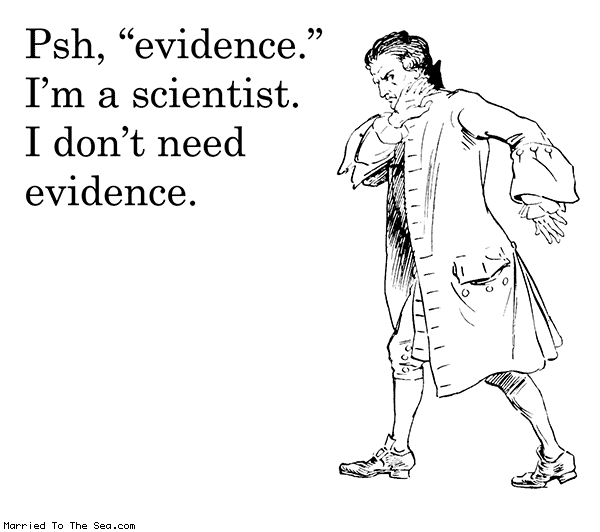
Additionally, while I remain convinced that the U.S. is a belief culture, I also argue that, below, the political cartoon posted at Truthout captures another important dynamic: Many committed to their own beliefs both do not recognize that they are committed to belief and belittle others for being committed to their beliefs:

And this brings me to advocacy for Common Core standards, with one additional point: Along with embracing belief over evidence, the public (along with political leadership) in the U.S. tends to lack historical context.
Placed in the century-plus commitment to pursuing new and supposedly higher standards for public schools, then, Common Core advocacy falls into only two possible characterizations:
- Common Core is a response to the historical failure of all the many standards movements that have come before, and thus, the success of CC depends on CC being somehow a different and better implementation of an accountability/standards/testing paradigm.
- CC advocacy is yet another example of finding oneself in a hole and persisting with digging despite evidence to the contrary. In other words, CC may well be yet another commitment to a reform paradigm that isn’t appropriate regardless of how it is implemented, as John Thompson details in his review of The Allure of Order:
Jal Mehta’s masterpiece, The Allure of Order, answers the question, “Why have American [school] reformers repeatedly invested such high hopes in these instruments of control despite their track record of mixed results?” He starts with the review of how the bloom fell off the NCLB rose, explaining why its results in the toughest schools have been “miserable.” In the highest poverty schools the predictable result has been “rampant teaching to the test” which has robbed children of the opportunity to be taught in an engaging manner.
Mehta explains that this “outcome might have been surprising if it were the first time policymakers tried to use standards, tests, and accountability to remake schooling from above.” The contemporary test-driven reform movement is the third time that reformers have used the “alluring but ultimately failing brew” of top down accountability to “rationalize” schools and, again, they failed [emphasis added].
These two claims are themselves evidence-based (and it will be interesting to watch as others respond, as they have to my previous work on CC, by either ignoring evidence or garbling evidence to support what proves to be faith-based commitments to CC), and thus should provide a foundation upon which to continue the debate about CC.
CC advocacy and criticism are often based on false narratives and baseless claims (see Anthony Cody for one example of this problem and Ken Libby‘s [@kenmlibby] cataloguing on Twitter #corespiracy)—again reinforcing the pervasive and corrosive consequences of faith-based, but not evidence-based debates.
Instead, we should start with an evidence-based recognition about standards-driven education reform.
For example, the existence and/or quality of standards are not positively correlated with NAEP or international benchmark test data—leading Mathis (2012) to conclude about CC: “As the absence or presence of rigorous or national standards says nothing about equity, educational quality, or the provision of adequate educational services, there is no reason to expect CCSS or any other standards initiative to be an effective educational reform by itself [emphasis in original]” (p. 2 of 5).
Therefore, CC advocacy has some principles within which it should continue if that advocacy is to be credible and thus effective:
- Claims that CC advocacy is separate (and can be separated) from high-stakes testing must show evidence of when standards have been implemented without high-stakes tests (and how that was effective) or evidence of some state implementing CC without high-stakes tests connected. Otherwise, this is a faith-based claim.
- Claims that accountability built on standards and high-stakes testing is an effective education reform strategy must show evidence of how that has worked in the previous state-based accountability era and then explain why those examples of success must now be replaced by the new CC set of standards. Otherwise, this is a faith-based claim.
- CC advocacy has been endorsed as a logical next step built on the call in NCLB for scientifically based education reform; thus, CC advocates must either comply with the two points above or concede that the CC era is a break from evidence-based reform.
I am no advocate for remaining only within rational, evidence-based, and quantifiable norms for decision making, by the way, but I am convinced we must make clear distinctions between evidence and belief—and I am equally convinced that many education reformers enjoy a flawed freedom to call for evidence from their detractors while practicing faith-based reform themselves.
It is the hypocrisy that bothers me, the hypocrisy of power:
Let’s acknowledge that teachers currently work under the demand of measurable evidence of their impact on students while CC advocates impose faith-based policies such as CC, new generation high-stakes testing, merit pay, charter schools, value-added methods of teacher evaluation, and a growing list of commitments to education reform at least challenged if not refuted by evidence.
CC advocates now bear the burden of either offering the evidence identified above or admitting they are practicing faith-based education reform.
NCTQ’s Free Pass in an Era of Press-Release Journalism
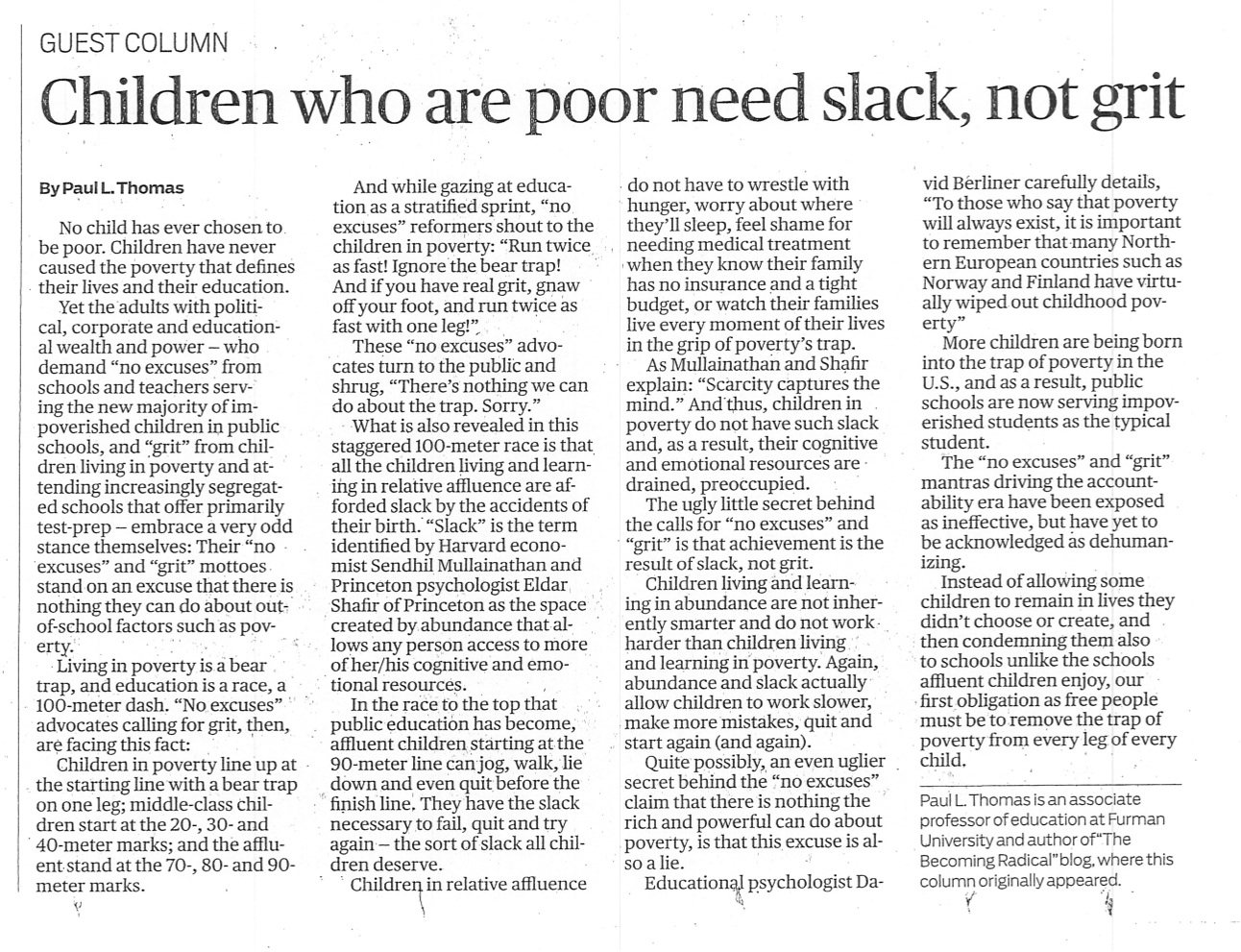
AJC Guest Column: Children who are poor need slack, not grit (December 2, 2013)
AJC Guest Column: Children who are poor need slack, not grit (December 2, 2013)
CALL FOR PROPOSALS: Pedagogies of Kindness and Respect: On the Lives and Education of Children
CALL FOR PROPOSALS
Pedagogies of Kindness and Respect: On the Lives and Education of Children
Edited by P. L. Thomas, Paul R. Carr, Julie Gorlewski, and Brad Porfilio
Rethinking Childhood Series, Gaile Cannella, series editor
Call and Submission Requirements
Submit a proposal of about 300 words by February 28, 2014, to paul.thomas@furman.edu.
Chapter initial drafts due July 15, 2014, should be in APA citation/style format (see citation proofing guidelines below) and 5,500-6,500 words. Authors are urged to submit clean and carefully edited drafts to enhance the editing process. Please take great care with block quotes (do not set off with returns and tabs) and hanging indents in the references list (do not create hanging indents with return/tab, but use the ruler or Menu>Format>Paragraph>Special>Hanging Indent). (Please read carefully below the background underpinning informing this volume.) Also, it is important to have complete bibliographic information with up-to-date references. (See the end of this document for more information on APA).
Topics, problems, and practices addressing the following will be included:
- How are “no excuses” ideologies dominant in child rearing and schooling in the U.S. and elsewhere? How are these practices harmful to children?
- Why are the Commons essential to a thriving democracy, and how does a cultural attitude toward children impact that culture’s commitment to the Commons (notably public schools)?
- What constitutes pedagogies of kindness and respect?
- What practices in child rearing and schooling reflect pedagogies of kindness and respect?
- How are attitudes and practices related to children connected to democratic values?
- How are current educational structures reflecting and perpetuating stratified opportunities for children, and what education reform alternatives address those structures?
- How does kindness play into the conceptualization of educational curricula, pedagogy, policy and evaluation?
Submission of Chapter Proposals
To be included in the 300 words are:
- Name(s) and affiliation(s) of author(s)
- Proposed title
- A detailed abstract on the focus of the proposed chapter, including conceptual, theoretical and methodological frameworks as well as the central research question.
- A list of 8 keywords.
- Also attach the CV(s) for the proposed author(s).
Points of Emphasis
Because we are living in times of historical amnesia, the chapters themselves should be critical, illustrate multiplicity and nuance, and demonstrate an awareness of historical and critical constructions of childhood (and the past work done related to these areas). The following are examples of expectations for the work:
- The fields of education, and especially early childhood education, have included some histories and perspectives that view/treat those who are younger with kindness and respect. Examples include the works of Nel Noddings (1992), The Challenge to Care in Schools, and Lisa Goldstein (1998), Teaching with Love (in Peter Lang’s Rethinking Series) as well as various scholarly and educational models practiced or put forward by multiple educators and scholars. Chapters in the work should demonstrate an informed awareness of this history and the ways that both old and new ideas can counter current conditions that are harmful to both those who are younger and older.
- The chapters should avoid reconstitution of the romantic, innocent child to be saved by more advanced adults; this has been addressed by many. The issue is the context in which we are all being placed (not that we should protect the “innocent” child) that is harmful to those who are younger, as well as everyone else.
- The notion of two interpretations of childhood: (a) those who are poor who are also often labeled as not knowing how to raise their children so needing help, and (b) those who are privileged and know how to raise their children, has been discussed and problematized over the past 30 years. Rather than treating this circumstance as a new revelation, the issue is “why has this circumstance continued and even worsened?” The gap between the rich and poor has certainly increased (why?); testing and standards based education has been critiqued as problematic, but the practices are more accepted than ever (why?); why has past work been ignored and what can be done to change our current circumstances?
Timeline
- Call, proposals due: February 28, 2014
- Accepted chapters: March 15, 2014
- Chapters due: July 15, 2014
- Revised/final chapters due: September 30, 2014
- Manuscript delivered: October 15, 2014
Background
Eliot Rosewater in Kurt Vonnegut’s God Bless You, Mr. Rosewater implores:
“Go over to her shack, I guess. Sprinkles some water on the babies, say, ‘Hello, babies. Welcome to Earth. It’s hot in the summer and cold in the winter. It’s round and wet and crowded. At the outside, babies, you’ve got about a hundred years here. There’s only one rule that I know of, babies—:
“‘God damn it, you’ve got to be kind.’” (p. 129)
In Sandra Cisneros’s short story “Eleven,” Rachel sits in class on her eleventh birthday, a day in which she is confronted by her teacher about a found red sweater that the teacher is certain belongs to Rachel:
“Of course it’s yours,” Mrs. Price says. “I remember you wearing it once.” Because she’s older and the teacher, she’s right and I’m not. (Cisneros, 2004, p. 42)
While these are fictional representations, children live in a state of powerlessness, silenced by the hierarchy of authority. The sweater in Cisneros’s story is, in fact, not Rachel’s, but as the narration reveals, facts are secondary to hierarchy.
In the U.S. and throughout the world, children tend to experience not only silencing but also a level of harshness not found in other cultures.
The twenty-first century remains a harsh place for children in their lives and their schools, even in the U.S. where childhood poverty is over 20% and the new majority of public schools involve children in poverty (A new majority, 2013).
But more than the conditions of children’s lives and schools in 2013 is worth addressing. As Barbara Kingsolver (1995) details in “Somebody’s Baby”:
What I discovered in Spain was a culture that held children to be meringues and éclairs. My own culture, it seemed to me in retrospect, tended to regard children as a sort of toxic-waste product: a necessary evil, maybe, but if it’s not our own we don’t want to see it or hear it or, God help us, smell it. (p. 100)
A sort of cultural antagonism and authoritarian control of children pervades the U.S., and during the current thirty-year cycle of accountability, children tend to face this formula[i]:
- Corporal punishment—persists in 19 states in the U.S.
- Medication—ADHD diagnoses and medications have risen in the U.S. during the same 30-year period as the current accountability era in education.
- Grade retention—one of the most popular forms of reading policy in the U.S. is retaining children in 3rd grade based on one high-stakes testing, despite 40 years of research about the overwhelming negative impact of grade retention.
- Testing, more testing, and even more testing—over the past thirty years, U.S. schools have increased dramatically both the time spent testing, the time spent on test-prep, the funding spent on testing, the funding spent on test-prep materials, and the consequences of high-stakes testing.
- Segregation by race and class—both public schools and charter schools can be accurately described as reflecting and perpetuating the return of segregation in the U.S.
- “No excuses” schools and demands for “grit”—especially children who live in poverty are segregated in schools where their days are characterized by “no excuses” policies that include authoritarian demands on their behavior.
- Children must prove they are deserving—childhood is Social Darwinism in the U.S.
If children in the U.S. can survive the gauntlet that is the national formula for children, as young adults they can look forward to crushing debt to attend college so that they can enter a nearly non-existent workforce.
But there is a caveat to this formula: The U.S. formula for children above is for “other people’s children,” that new majority in U.S. public schools and those children living in homes of the working poor, the working class, and the dwindling middle class.
Children of the privileged are exempt.
This volume will collect a wide variety of accessible chapters from scholars and practitioners to explore pedagogies of kindness, an alternative to the “no excuses” ideology now dominating how children are raised and educated in the U.S. The genesis of this volume cane be linked to two poems by P.L. Thomas: “the archeology of white people” and “the kindness school (beyond the archeology of white people, pt. 2),” the second of which reads in full:
it simply happened one day
when the teachers decided
enough was enoughall the boys with OCD
spent the day playing drums
or riding their bicyclesand the introverts sat quietly
smiling periodically in the corners
while the extroverts laughed and laughedand soon the pleasures became many
as varied as the children themselves
until one day a child stood to proclaimafter reading Hamlet all on her own
“I say, we will have no more tests”
to which there was thunderous cheeringyes it seemed simple and obvious enough
the founding of the kindness school
with open doors and children singing
References
Cisneros, S. (2004). Vintage Cisneros. New York, NY: Vintage Books.
Kingsolver, B. (1995). High tide in Tucson: Essays from now and never. New York, NY: Perennial.
A new majority: Low income students in the South and nation. (2013, October). Atlanta, GA: Southern Education Foundation. Retrieved from http://www.southerneducation.org/getattachment/0bc70ce1-d375-4ff6-8340-f9b3452ee088/A-New-Majority-Low-Income-Students-in-the-South-an.aspx
Vonnegut, K. (1965). God bless you, Mr. Rosewater or pearls before swine. New York, NY: Delta.
See also:
http://www.alternet.org/education/why-sending-your-child-charter-school-hurts-other-children
http://www.alternet.org/education/theyre-all-our-children
Citation Proofreading Guidelines
APA — Please copyedit submissions carefully to be sure you have cited following the APA style sheet; below are key points of emphasis that still need addressing in many chapters (also see for guidance https://owl.english.purdue.edu/owl/resource/560/01/):
Copyedit carefully references, noting APA format for titles of books and article (CAP first letter of title, first letter of subtitle and proper nouns ONLY [for example The handmaid’s tale]; journal titles use standard CAP conventions [for example: English Journal]). Essay and chapter titles do NOT require QMs, but book and journal titles remain in ITAL. Also be careful to ensure that each reference conforms to the type of work you are citing; the OWL link has a wide range of samples on the left menus, and it is crucial that you match the type of work being cited to the format. The initial information in each reference bibliography MUST match your in-text citations. For example:
in-text example
James Baldwin (1998), in “A Report from Occupied Territory” (originally published in The Nation, July 11, 1966), confronted an “arrogant autonomy, which is guaranteed the police, not only in New York, by the most powerful forces in American life” (p. 737) and the corrosive deficit view of race it is built upon.
reference
Baldwin, J. (1998). James Baldwin: Collected essays. New York, NY: The Library of America.
In-text guidelines include the following key elements:
First paraphrased reference to a source in EACH new paragraph must include either Author (year) or (Author, year). PLEASE keep Author (year) or (Author, year) in conjunction; do NOT place the year isolated from the author name. All subsequent uses in that paragraph require only either Author or (Author). Please note that parenthetical cites in the flow of your sentences require that the period come AFTER the ( ). ; for block quotes, the period comes BEFORE .( )
example
America the Beautiful created a minority class out of a race of people who are as rich, vibrant, and beautiful as any race of people. America the Beautiful has also created a criminal class out of African American men, building a new Jim Crow system (Alexander, 2012) with mass incarceration masked as a war on drugs. America the Beautiful created a dropout class and future criminal class out of African American young men, as Alexander details, building school-to-prison pipelines and schools-as-prisons as zero-tolerance schools imprisoning urban communities (Nolan, 2011).
In-text citing of print sources, required page numbers:
First quoted reference to a print source in EACH new paragraph must include either Author (year, p. #) or (Author, year, p. #). All subsequent uses require only either Author (p. #) or (Author, p. #). Note that a comma must separate Author, year, p. # and that a SPACE must be placed after the p. preceding the page number. For a quote from a single page use “p.” and for a quote spanning multiple pages, use “pp.” Please note that parenthetical cites in the flow of your sentences require that the period come AFTER the ( ). ; for block quotes, the period comes BEFORE .( )
example
In 1963, Ellison (2003) spoke to teachers:
At this point it might be useful for us to ask ourselves a few questions: what is this act, what is this scene in which the action is taking place, what is this agency and what is its purpose? The act is to discuss “these children,” the difficult thirty percent. We know this very well; it has been hammered out again and again. But the matter of scene seems to get us into trouble. (p. 546)
Ellison recognized the stigma placed on African American students, a deficit view of both an entire race and their potential intelligence (marginalized because of non-standard language skills). But Ellison rejected this deficit perspective: “Thus we must recognize that the children in question are not so much ‘culturally deprived’ as products of a different cultural complex” (p. 549). Ultimately, Ellison demanded that the human dignity of all children be honored.
Citing literary sources with APA:
APA is somewhat cumbersome for citing extended literary analysis, but you must first create an accurate bibliography of the cited works (such as novels) you will cite, and then maintain the above formatting principles when citing from and offering an extended analysis of that work. APA uses Author (year) or (Author, year) and not abbreviations of titles. If you are citing multiple works from an author published in the same year, you must alphabetize them in your bibliography by the titles, and then add sequential alphabet denotes that then MUST be used in the in-text citations.
example
Typical of contemporary education reform, CCSS began as a political process driven by business interests—not as an educational process designed by classroom teachers or educational researchers (Ohanian, 2012a, 2012b, 2012c, 2011a, 2011b, n.d). In the 1980s during the first wave of accountability, state governors became the primary voice for educational reform. Those governors often used their educational bully pulpit to pursue economic and business goals—improving the workforce or attracting new companies.
[note that proper hanging indent does not show in blog format]
Ohanian, S. (2012a, November 19). Common Core reality check: Here’s how Common Core assessments plan to certify workers for the global economy (with pix)…Let’s make sure the children read ALL of Ovid while we’re at it! Substance News. Retrieved from http://www.substancenews.net/articles.php?page=3778
Ohanian, S. (2012b, October 28). Snookered by Bill Gates and the U.S. Department of Education. The Daily Censored. Retrieved from http://www.dailycensored.com/snookered-by-bill-gates-and-the-u-s-department-of-education/
Ohanian, S. (2012c, February 4). NCTE allegiance to the Common Core is burying us. SusanOhanian.org. Retrieved from http://susanohanian.org/outrage_fetch.php?id=1183
Ohanian, S. (2011a, December 7). We’re being steamrolled into one-size-fits-all. Learning Matters. Retrieved from http://learningmatters.tv/blog/web-series/discuss-are-common-core-standards-good-or-bad-for-education/8280/
Ohanian, S. (2011b, October 19). The crocodile in the Common Core Standards. Substance News. Retrieved from http://www.substancenews.net/articles.php?page=2716
 dr. p.l. (paul) thomas