Category Archives: education

Kids Count on Public Education, Not Grit or “No Excuses”

Secretary of Education Arne Duncan has often stated that “education [is] the one true path out of poverty—the great equalizer that overcomes differences in background, culture and privilege. It’s the only way to secure our common future in a competitive global economy.” While this claim appears obvious, when Matt Bruenig asked “What’s more important: a college degree or being born rich?” and examined the data, he concluded:

So, you are 2.5x more likely to be a rich adult if you were born rich and never bothered to go to college than if you were born poor and, against all odds, went to college and graduated. The disparity in the outcomes of rich and poor kids persists, not only when you control for college attainment, but even when you compare non-degreed rich kids to degreed poor kids!

Therefore, the answer to the question in the title is that you are better off being born rich regardless of whether you go to college than being born poor and getting a college degree.

In South Carolina, for example, this sobering reality is made more troubling by the 2013 Kids Count report from the Annie E. Casey Foundation, which examines child well-being in the nation and each state.

Nationally, SC ranks 45th, down from 43rd in the foundation’s previous report. Only Louisiana, Arizona, Nevada, Mississippi, and New Mexico sit lower than SC in child well-being. The ranking consists of four broad categories that reflect significant social and educational challenges for SC:

  • Economic Well-Being (2011 data): SC children in poverty, 28% (worse than 2005, 23%); children whose parents lack secure employment, 35% (worse than 2008, 30%); children living in households with a high housing cost burden, 36% (worse than 2005, 32%); teens not in school and not working, 11% (worse than 2008, 8%).
  • Education: SC children not attending preschool (2009-11), 55% (better than 2005-2007, 59%); 4th graders not proficient in reading (2011), 72% (better than 2005, 74%); 8th graders not proficient in math (2011), 68% (better than 2005, 70%); high school students not graduating on time (2009/2010), 32%.
  • Health: SC low-birthweight babies (2010), 9.9% (better than 2005, 10.2%); children without health insurance (2011), 8% (better than 2008, 13%); child and teen deaths per 100,000 (2010), 32% (better than 2005, 41%); teens who abuse alcohol and drugs (2012-11), 7% (better than 2005-2006, 8%).
  • Family and Community: SC children in single-parent families (2011), 42% (worse than 2005, 38%); children in families where the household head lacks a high school diploma (2011), 13% (better than 2005, 15%); children living in high-poverty areas (2007-2011), 13% (worse than 2000, 6%); teen births per 1000 (2010), 43 (better than 2005, 51).

SC represents states that remain heavily burdened by the negative consequences of poverty and social inequity, complicated factors often reflected in the measurable outcomes of public schools. This report offers SC, the nation, and political leaders an opportunity to change the discourse about school reform and take bold action that addresses the wide range of social and economic challenges facing our state.

While the report data show that social and education reform should remain priorities for SC, that same data also suggest that social reform is far more pressing than expensive and historically ineffective commitments to new standards and tests being promoted for education reform.

Children in SC deserve better schools, and children in poverty remain the exact students most underserved in those schools. No one is suggesting that education reform be set aside or ignored. But many current school reform policies are simply wastes of taxpayers’ money and educators’ time that would be better spent on education reform that addresses the conditions of teaching and learning, and not just more of the same standards-and-testing mandates tried for thirty years now.

More pressing is social reform because without addressing childhood poverty, workforce stability and quality, the costs of living, single-parent homes, and concentrated high-poverty communities, most education reform measures are doomed to be fruitless.

As The Economic Mobility Project reveals, children in SC and across the US are likely to have bright futures if they are born into relative affluence, and those children, even without attending college, are apt to succeed over impoverished children who rise above the challenges of their homes and communities by graduating college. “Grit” and “no excuses” are simply slogans, hollow and cruel in the bright light of the evidence.

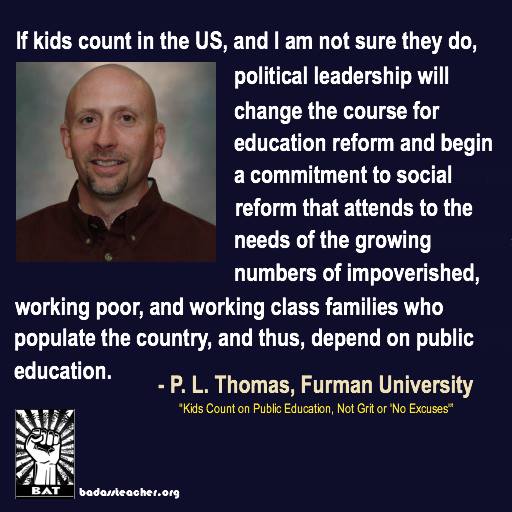
If kids count in the US, and I am not sure they do, political leadership will change the course for education reform and begin a commitment to social reform that attends to the needs of the growing numbers of impoverished, working poor, and working class families who populate the country, and thus, depend on public education.

meme

Gaiman’s Mythical Folding of Childhood into Adulthood

I stumbled into the novels (invariably identified with “for adults” by reviewers and critics) of Neil Gaiman in a way that, upon looking back, the intersection now seems inevitable, not stumbling at all.

Browsing as I often do along the center aisle of Barnes and Noble, over several visits I picked up American Gods, a hefty novel labeled by the publisher as the tenth anniversary edition. I have always tended to shun enormous novels, in part as a result of my teacher self recognizing how often students struggled with big books, but I also found myself both avoiding Gaiman’s most celebrated work and always taking it into my hands each time I saw it. In the way that books can, American Gods kept calling out to me (as the author’s preferred text did more recently).

The day I acquiesced to Gaiman the novelist (I had always known him as a comic book/graphic novel creator), I  experienced a second disorientation: The publisher labels American Gods “science fiction.” Not long after slipping with glee into Gaiman’s other worlds, I had a similar experience with Haruki Murakami, whose 1Q84 is also marked “science fiction.”

Before Gaiman and Murakami, I counted myself among those dedicated to science fiction but stubbornly opposed to fantasy. No Hobbits for me! And Harry Potter? No way.

Gaiman represents my crisis of genre that would carry through into Murakami’s universe(s). I could not find a thing in American Gods I would call science fiction, but I also felt “fantasy” failed the work. The best I could ever do was think of Gaiman’s narrative as “contemporary mythology”—not Leda and the swan, but the gods right now in my time of existence.

Regardless, of course, all that mattered for me was that I loved Gaiman’s novels “for adults” and joined millions awaiting his most recent, The Ocean at the End of the Lane.

Gaiman’s Mythical Folding of Childhood into Adulthood

The best works of fiction reach into my chest, grab my heart, and squeeze until I cry because I love the characters in ways that I often fail to satisfy in this real world.

In Sandra Cisneros’s “Eleven,” I experience that feeling every time I read it aloud to my students, and the central moment when I love eleven-year-old Rachel the deepest is also the most harrowing: “Because she’s older and the teacher, she’s right and I’m not.”

“Eleven” is a sad and wonderful narrative of school and childhood crashing into adulthood. And that story, especially that passage, lept to mind as I reached the middle of Gaiman’s Ocean:

Ursula Monkton smiled, and the lightnings wreathed and writhed about her. She was power incarnate, standing in the crackling air. She was the storm, she was the lightning, she was the adult world with all its power and all its secrets and all its foolish casual cruelty….

Ursula Monkton was an adult. It did not matter, at that moment, that she was every monster, every witch, every nightmare made flesh. She was also an adult, and when adults fight children, adults always win. (pp. 86-87)

Gaiman’s slight of hand, his gift of contemporary mythology, achieves the sort of folding over into itself expressed by Kurt Vonnegut’s Tralfamadorian view of time:

The Tralfamadorians can look at all the different moments just the we way we can look at a stretch of the Rocky Mountains, for instance. They can see how permanent all the moments are, and they can look at any moment that interests them. It is just an illusion we have here on Earth that one moment follows another, like beads on a strong, and that once a moment is gone it is gone forever. (p. 34)

Ocean explores many things, but for me, Gaiman folds childhood into adulthood with a craft and care that makes the short novel speak to the collective, and far too often closed, heart of being fully human.

Ursula Monkton as adulthood’s “foolish casual cruelty” chills me to the bone in the way that the insensitivity of the teacher in Cisneros’s story leaves me angry at adults.

The magic of Gaiman’s Ocean is the seamless alchemy of turning adulthood into childhood by creating a narrative in which an adult approaching middle age recalls (and narrates for the reader like an Ancient Mariner or Marlow’s journey into the heart of darkness or Harold Crick listening to his life as narration) his own childhood confrontation with adulthood.

Ocean is often adult as only a seven-year-old can express it: His father’s adultery signalled by his lifting Ursula’s skirt from behind is both essentially innocent and stunningly graphic: “I was not sure what I was looking at….He was hugging her from behind. Her midi skirt was hiked up around her waist” (p. 79).

There are many assorted terrors in this novel, ones that remain with me in a vividness unlike any terrors I have experienced in real life. But the most disturbing message Gaiman offers is about this real world.

Ursula Monkton is a twist on the Evil Stepmother or Wicked Witch archetype, and the Hempstock family—three females like generational Muses or fairies (Russian nesting dolls, of sorts, personified)—offer a triumphant message of the possibilities of kindness and other-world guardian angels.

While Gaiman doesn’t stoop to simplistic idealizing of females, men haunt the world of childhood throughout the novel—although I think more as the embodiment of a belittling human compulsion toward harshness aimed at children than any direct indictment of men (Ursula, the father, and the opal miner share the specter of “adulthood,” not gender).

Why, I am compelled to ask, are adults so angry and unforgiving with children, with childhood?

Like the teacher in “Eleven” and the adult world in Ocean, the assistant principal  in Uncle Buck represents not only adult antagonism for children, for childhood, but how that drives the schooling of children:

While Cisneros’s math teacher’s insensitivity to Rachel, John Hughs’s warted assistant principal, and Gaiman’s Ursula Monkton speak as vivid creations of the imagination, the terrors of childhood remain quite real—and too often those terrors are connected with adults, and far too often those terrors are connected with schools.

When I set down Ocean after finishing this wonderful journey that reached into my chest, grabbed my heart, and squeezed until I cried because I love the characters in ways that I often fail to satisfy in this real world, I found myself thinking of the political, media, and public fascination with a very real-world Evil Stepmother, Wicked Witch, Assistant Principal Anita Hogarth:

No child asks to be brought into this world, and there remains no excuse for adults looming in quick and relentless judgment and anger over children.

Why must a child look to the other world for a hand held in unwavering kindness? Shouldn’t the very real home, parents, and schools where children also never choose to be offer always a hand gesturing comfort and safety?

Gaiman knows the answer and offers Lettie, an eternal eleven-year-old embodying the kindness of strangers:

I said, “I’m sorry I let go of your hand, Lettie.”

“Oh, hush,” she said. “It’s always too late for sorries, but I appreciate the sentiment. And next time, you’ll keep hold of my hand no matter what she throws at us.”

I nodded. The ice chip in my heart seemed to warm then, and melt, and I began to feel whole and safe once more. (p. 103)

Thank you, Neil Gaiman, for bringing Lettie to my world because I now love her as I do eleven-year-old Rachel and Uncle Buck. As I love childhood as the one true thing we must cling to as humans:

children guessed(but only a few/and down they forgot as up they grew

Here’s to never forgetting that we all are children—and, thus, they are all out children.

Charter Schools, the Invisible Hand, and Gutless Political Leadership

Billy Pilgrim becomes unstuck in time in Kurt Vonnegut‘s Slaughterhouse-Five. Billy’s experience introduces readers to Tralfamadorians:

The creatures were friendly, and they could see in four dimensions. They pitied Earthlings for being able to see only three. They had many wonderful things to teach Earthlings, especially about time….

The Tralfamadorians can look at all the different moments just the we way we can look at a stretch of the Rocky Mountains, for instance. They can see how permanent all the moments are, and they can look at any moment that interests them. It is just an illusion we have here on Earth that one moment follows another, like beads on a strong, and that once a moment is gone it is gone forever. (pp. 33, 34)

One of the most memorable moments of Billy becoming unstuck in time is his watching a war movie backward. Viewed in reverse, the film becomes a narrative of renewal, of peace, as fighter planes “sucked bullets and shell fragments from some of the planes and crewmen,” and “[t]he bombers opened their bomb bay doors, exerted a miraculous magnetism which shrunk fires, gathered them into cylindrical steel containers, and lifted the containers into the bellies of the planes” (pp. 93, 94).

In the spirit of folding time back onto itself to give us clarity of sight, let’s become unstuck in time while viewing American Indian Charter Schools.

Spitting in the Eye of Mainstream Education?

Like Billy watching a war film, we start now and move backward.

Jill Tucker reports (June 26, 2013) that American Indian Charter Schools have had their charter revoked by Oakland Unified school district:

The American Indian charter schools, which enroll 1,200 students in grades K-12, are among the highest-scoring in the state on standardized tests.

Yet Oakland district officials said they had a duty to the public to close the schools given the inability of the schools’ management to rein in the misuse of taxpayer money.

A 2012 state audit of the charter organization found several instances of financial impropriety, including $3.8 million in payments to the school’s former director, Ben Chavis, and his wife through real estate deals, consulting agreements and other services, raising ethical questions and conflict-of-interest concerns.

The decision was supported by the state’s leading charter school advocates.

“In this situation, it is clear that academic performance is not enough to either overlook or excuse the mismanagement of public funds and the unwillingness from the board of directors to respond in ways that would satisfactorily address the legitimate concerns raised by OUSD,” said Jed Wallace, president and CEO of the California Charter Schools Association, in a letter to the board in support of the revocation.

Mitchell Landsberg explains—in a provocatively titled “Spitting in the Eye of Mainstream Education” (May 31, 2009)—about American Indian Charter Schools:

Conservatives, including columnist George Will, adore the American Indian schools, which they see as models of a “new paternalism” that could close the gap between the haves and have-nots in American education. Not surprisingly, many Bay Area liberals have a hard time embracing an educational philosophy that proudly proclaims that it “does not preach or subscribe to the demagoguery of tolerance.”

It would be easy to dismiss American Indian as one of the nuttier offshoots of the fast-growing charter school movement, which allows schools to receive public funding but operate outside of day-to-day district oversight. But the schools command attention for one very simple reason: By standard measures, they are among the very best in California….

“What we’re doing is so easy,” said Ben Chavis, the man who created the school’s success and personifies its ethos, especially in its more outrageous manifestations. (One example: He tends to call all nonwhite students, including African Americans, “darkies.”) Although he retired in 2007, Chavis remains a presence at the school.

Focusing on American Indian Charter Schools among five other “no excuses” schools adopting a new paternalism,  David Whitman (2008, Fall) praises the accomplishments and possibilities of these schools:

Yet above all, these schools share a trait that has been largely ignored by education researchers: They arepaternalistic institutions. By paternalistic I mean that each of the six schools is a highly prescriptive institution that teaches students not just how to think, but also how to act according to what are commonly termed traditional, middle-class values. These paternalistic schools go beyond just teaching values as abstractions: the schools tell students exactly how they are expected to behave, and their behavior is closely monitored, with real rewards for compliance and penalties for noncompliance. Unlike the often-forbidding paternalistic institutions of the past, these schools are prescriptive yet warm; teachers and principals, who sometimes serve in loco parentis, are both authoritative and caring figures. Teachers laugh with and cajole students, in addition to frequently directing them to stay on task.

The new breed of paternalistic schools appears to be the single most effective way of closing the achievement gap. No other school model or policy reform in urban secondary schools seems to come close to having such a dramatic impact on the performance of inner-city students. Done right, paternalistic schooling provides a novel way to remake inner-city education in the years ahead….

Still, these entrepreneurial school founders battle on, slowly replicating their institutions across the country. It is too soon to say that all of the copycat schools will succeed. But the early results are extremely encouraging. It is possible that these schools, so radically different from traditional public schools, could one day educate not just several thousand inner-city youngsters but tens or even hundreds of thousands of students in cities across the nation. Done well, paternalistic schooling would constitute a major stride toward reducing the achievement gap and the lingering disgrace of racial inequality in urban America.

The Invisible Hand and Gutless Political Leadership

Backward or forward, this story is ugly. “No excuses” and the new paternalism themselves are classist and racist—ways in which the middle class and affluent allow “other people’s children” to be treated, but not their own—yet the larger faith in the Invisible Hand is the ugliest part of the narrative.

Idealizing parental choice narrowly and choice broadly is the foundation upon which both political parties stand. Why is the Invisible Hand of the Free Market so appealing to political leaders?

The answer is simple: Abdicating political leadership to the market absolves our leaders from making any real (or ethical) decisions, absolves them from doing anything except sitting back and watching the cards fall where they may.

And thus the charter school movement, with its school-choice light that allows progressives to tap into their closeted libertarian. Experimenting with impoverished children, African American children, Latino/a children, English Language Learners, and special needs children—this is the acceptable playground for the Invisible Hand.

Political leaders bask in the glory of Capitalism because the free market requires no moral conviction, no ethical stands, no genuine decision making based on careful consideration of foundational commitments to democracy and human dignity and agency. Capitalism allows Nero to sit and fiddle while Rome burns. If the fire needs putting out, and someone can monetize that, the market will take care of it, right?

Political leadership has ignored and marginalized children in poverty for decades, notably in the schools we provide high-poverty, majority-minority communities. The school-choice light commitment to charter schools is a coward’s way out of facing that reality and doing anything about it.

So it goes.

Kids Count?

The Annie E. Casey Foundation has released their 2013 Kids Count report, cataloging child well-being in the U.S. and individual states.

Let’s place the Kids Count report first in the context of Matt Bruenig’s What’s more important: a college degree or being born rich?, and his conclusion:

So, you are 2.5x more likely to be a rich adult if you were born rich and never bothered to go to college than if you were born poor and, against all odds, went to college and graduated. The disparity in the outcomes of rich and poor kids persists, not only when you control for college attainment, but even when you compare non-degreed rich kids to degreed poor kids!

Therefore, the answer to the question in the title is that you are better off being born rich regardless of whether you go to college than if you are born poor and do go to college.

Next, I want to highlight my home state of SC:

  • 45th (down from 43rd) in national ranking of child well-being
  • From 2007-2011, childhood poverty rose steadily from 21% to 28%
  • Children in homes with parents lacking secure employment, 35%
  • Increases in children in single-parent homes, children living in high-poverty communities

A couple of quick thoughts.

Evidence is undeniable that social equity and opportunity are deeply connected with educational equity and opportunity. This report simply confirms that it is irresponsible to continue to suggest that schools alone are failing impoverished children and their families. Social and educational inequity of opportunity are cancers on a free people who claim to be just and kind.

Second, where are the “no excuses” advocates when it comes to social inequity? Why aren’t they peddling their “no excuses” mantra about childhood poverty, job insecurity, high-poverty neighborhoods, low birth weights, lack of health care, child and teen deaths?

The silence and inaction are inexcusable.

Post-Katrina New Orleans: Disatser Capitalism Feeds on Poverty and Racism

Drawing from her Hope Against Hope, Sarah Carr asks, Can school reform hurt communities?—focusing on New Orleans:

New Orleans may be the extreme test case, but reforms like these are reshaping public education across the country. The movement is rooted in the notion that “fixing” schools is the strongest lever for lifting communities out of poverty. The criminal justice and health care systems may be broken, living-wage jobs in short supply, and families forced to live in unstable or unsafe conditions. But the buck supposedly stops in the classroom. Thus teachers can find themselves charged with remedying an impossibly broad set of challenges that go far beyond reading at grade level.

Post-Katrina New Orleans represents a crucible for both disaster capitalism and the neoliberal (privatization) agenda driving education reform. After the hurricane devastated New Orleans, the city was swept clean of its teacher workforce (overwhelmingly African Americans constituting a significant percentage of the black middle class), its public schools, and its teachers union so that Paul Vallas could rebuild the school system with charter schools and Teach for American recruits, inexperienced and uncertified teachers who are often white, affluent, and transplants to New Orleans from all across the US. Carr highlights the tensions in this human-made flood of the city:

But most explanations have focused on the radical overhaul of the city’s education system: the expansion of independent charter schools (which more than 80 percent of New Orleans public school children now attend); a greater reliance on alternative teacher training programs like Teach for America; and the increased use of test scores to determine whether educators should keep their jobs and schools should stay open….

This mentality has attracted ambitious, talented young teachers from across the country. But it has also risked turning teaching into a missionary pursuit. At a few of the charter schools I have reported on over the last six years, less than 10 percent of the teachers came from New Orleans or were older than 35. “I think a lot of people who come to New Orleans want to change New Orleanians,” said Mary Laurie, a veteran school administrator and principal of O. Perry Walker High School….

This disconnect can manifest itself in ways both small (as when a teacher fails to recognize a popular New Orleans term, like “beaucoup” for “a lot”) and large (as when a teacher can’t grasp what students are going through at home).

Yet, while New Orleans has become a feast for disaster capitalism (see Archer and Bessie’s graphic journalism here, here, and here), political and public concern for the city and for the greater assault on public education, children and families living in poverty, and teachers remains essentially absent.

In her critical analysis of education reform in New Orleans, Kristen Buras concludes: “Critical research and ongoing activism in multiple spaces are crucial. What is currently happening in New Orleans is not socially conscious capitalism. It is simply unconscionable” (p. 324).

That New Orleans, public schools across the US, teachers, teachers unions, and families in poverty remain under assault while political leadership, advocacy representatives, and the public remain focused on baseless calls for Common Core and next generation testing as well as equally baseless attacks of teacher education exposes some harsh realities about the US: profit and the privilege of wealth matter, but workers, children, and the impoverished do not.

There is simply no other lesson one can draw from New Orleans today.

Education Done To, For, or With Students?

Teachers caution student writers to avoid cliches like the plague, but many cliches harbor enduring truths.

Rearranging the deck chairs on the Titanic is an apt characterization of the rush to adopt and implement Common Core and next-generation assessments—particularly if we ignore the conditions of teaching and learning.

What happens in the classroom and which populations of students have rich learning opportunities are essential factors contributing to student academic growth, regardless of the prescribed standards (new or not) and regardless of which generation spawns the tests.

One way to consider the conditions of teaching and learning in the classroom is to examine the prepositions of teaching: (1) Education done to students, (2) education done for students, and (3) education done with students.

Education done to students. Traditional approaches to teaching and learning as well as the more recent “no excuses” model for schooling are driven by essentially paternalistic assumptions: Learning is reduced to a discrete body of knowledge to be imparted by the teacher and deposited in the student (Freire labeled this the “banking” concept). School becomes a place, then, where teaching is done to students.

Traditionally, education done to students has been common for the youngest students, couched inside an assumption that new learning is acquired best analytically (it isn’t because about 80% of people are global, not analytical thinkers) and in linear/sequential instruction. Direct and isolated grammar and phonics instruction, for example, represent well education done to students in traditional practices. More recently, during the rise of “no excuses” ideology, younger students and students confronting new learning continue to receive an education done to them, but high-poverty and minority students have also joined their ranks as “no excuses” schools tend to serve these populations by reducing schooling to highly structures test-preparation: work sheets, programmatic textbooks, computer-based diagnostic testing, benchmark testing.

As well, increasingly, standards- and test-based accountability has driven education toward static and reduced curriculum, teachers as mere agents of dispensing that fixed curriculum, and students as passive recipients of what is tested is what is taught. In short, education done to students fails everyone.

Education done for students. The progressive yin to the traditional yang* is education done for students. While the practices that characterize education done for students may be rooted in a kind of maternalism, those practices remain distorted by similar goals found in teaching done to students. A key example of the rise of teaching done for students is the work of Wiggins and McTighe, marketed as understanding by design. Central to this concept are some compelling ideas such as teachers being transparent with students about what learning outcomes are expected, lending credibility to the rubric as a mechanism for guiding student work and promoting the appearance of greater validity and reliability to assigning grades to a wide range of assessments (particularly created responses, performances, and products).

With the end chosen by the teacher in mind (the assessment), lesson planning remains focused on what the students must acquire in order to perform. Rubric-driven instruction and assessment do avoid the “gotcha” problem inherent in traditional teaching, but the rubric fails authentic learning because it, again, reduces learning to compliance.

Within a culture of teaching done for students, teachers are encouraged to take great care, for example, in designing writing prompts, with the argument that a well crafted prompt and carefully constructed rubric insure students will write the essays teachers seek. In that context, however, student agency is ignored and student voice is reduced to an observable and identified (for the student) set of criteria on the scoring rubric.

While teaching done for students again disproportionately impacts negatively young and new learners, impoverished students, English language learners, and minority students (in other words, those students most often marginalized by society and schools), a stark example of the failure of teaching done for students lies with the so-called top students, identified as the good-student trap by Scheele:

We come to college with the unspoken anticipation of all that will be done for us. We expect to be made acceptable, valuable, knowledgeable, and finally professional and employable. By graduation, we presume everything will be dazzlingly clear: We will find our calling, brilliantly catapulting us to a guaranteed successful career. This wish, seldom even conscious, lies deep in our hearts. Yet we believe it will happen….

Most of us learned as early as junior high that we would pass, even excel if we did the work assigned to us by our teachers. We learned to ask whether the test covered all of chapter five or only a part of it, whether the assigned paper should be ten pages long or thirty, whether “extra credit” was two book reports on two books by the same author or two books written in the same period. Remember?

We were learning the Formula.

• Find out what’s expected.
• Do it.
• Wait for a response.

And it worked. We always made the grade. Here’s what that process means: You took tests and wrote papers, got passing grades, and then were automatically promoted from one year to the next. That is not only in elementary, junior, and senior high school, but even in undergraduate and graduate school. You never had to compete for promotions, write résumés, or rehearse yourself or even know anyone for this promotion. It happened automatically. And we got used to it….

So what’s the problem? The problem is the danger. The danger lies in thinking about life as a test that we’ll pass or fail, one or the other, tested and branded by an Authority. So, we slide into feeling afraid we’ll fail even before we do-if we do. Mostly we don’t even fail; we’re just mortally afraid that we’re going to. We get used to labeling ourselves failures even when we’re not failing. If we don’t do as well as we wish, we don’t get a second chance to improve ourselves, or raise our grades. If we do perform well, we think that we got away with something this time. But wait until next time, we think; then they’ll find out what frauds we are. We let this fear ruin our lives. And it does. When we’re afraid, we lose our curiosity and originality, our spirit and our talent-our life.

In the end, education done to students and education done for students fail those students since they both ignore the agency of the learner (and the teacher) and allow outcomes that are arbitrary and symbolic to replace authentic demonstrations of understanding grounded in the wants and needs of the learner.

Education done with students. Historically and currently what remains rare is education done with students, a teaching and learning environment for the teacher-student to guide and support the student-teacher (as Freire argues). Education done with students is couched within democratic and liberatory goals, but also is well supported by decades of educational research.

Education done with students shifts the teaching and learning focus away from outcomes (tests), standards, content, and the teacher by honoring each learner as the primary source for teaching and learning.

Briefly, the diverse and student-based research base on best practice shows that education done with students proves to be effective, but incredibly complex, resisting pre-packaged programs and highly efficient testing formats. In fact, stating that best practice, broadly, means that teachers must be expert at adapting instruction to the demonstrated needs of each student sounds simple, if not simplistic.

A clear example of the power of teaching done with students as well as the essentially complex nature of best practice is to examine the charts provided by Zemelman, Daniels, and Hyde at the end of each content-based chapter. Significantly, best practice tends not to discount entirely or solely endorse any practice (the charts contain two columns, headed “increase” and “decrease”); instead, best practice is a collaboration between teacher and student in which the teacher seeks those strategies that the student has demonstrated a need to acquire.

Another powerful aspect of best practice that highlights the need for teaching done with students is the gradual release of responsibility, as Zemelman, Daniels, and Hyde explain: “The idea of gradual release is quite simple: in the most effective lessons, there is a stepwise transfer of responsibility from the teacher to the student” (p. 39). In other words, there is nothing whimsical (letting students do whatever they want, whenever) or haphazard about teaching done with students. In fact, it is quite purposeful, simple in its essence, and incredibly complex, messy, and unpredictable in its application (thus, it remains rare in the classroom).

In the late 1970s and early 1980s, just as the current accountability era consumed public education, education done with students gained momentum through the rise of the National Writing Project and workshop-based writing instruction, made popular by Nancie Atwell and others. Atwell’s workshop approach was controversial then, and remains rare in classrooms today. But the essence of the workshop (which Atwell attributed to Giacobbe)—time, ownership, and response—redefined the roles and agency of the teacher and the students, the nature of the curriculum (student choice within teacher guidance), and what assessments were honored (increased focus on authentic projects, such as original essays by students).

For all its promise, however, much of those initial right steps have been co-opted and consumed by traditional (teaching done to students) and progressive (teaching done for students) practices as education remains entirely focused on raising test scores based on standards.

The rush to adopt new standards and the hyperbole about next generation assessments are, then, rearranging the deck chairs on the Titanic.

Once again, our gaze is poised on the wrong things, a myopic and trivial concern for moving around the same old furniture without regard to the people involved or the iceberg (poverty and social inequity) right there before us certain to prompt yet more cries of crisis.

* Yin and yang are complimentary, not opposites; thus, I use this comparison to support my argument that traditional and progressive approaches to education are essentially the same flawed ideology because they remain trapped inside a single mechanistic paradigm; progressive education appears a bit more child-centered, a bit more kind-hearted, but it isn’t.

Detesting and Degrading or De-Testing and De-Grading?

It began with an idea, a play on words: Children (and increasingly, teachers) detest school because the current test-and-grade paradigm is degrading so why not de-test and de-grade the schools?

With that idea in mind, I contacted Joe Bower, whose stance against grades and tests I followed on Twitter, and we began discussing an idea of an edited volume addressing de-testing and de-grading our schools, a direct confrontation of the current high-stakes accountability movement. We were fortunate to invite Alfie Kohn on board for the introduction and a chapter. From there the book was developed—although we struggled through a few hiccups with publishers, landing at Peter Lang USA.

Since the volume doesn’t preview each chapter, I want to offer below some snippets from each chapter, and invite you to join the authors of this volume in our tribute to the teachers at Garfield High (Seattle, WA) for their courageous stance against MAP testing (to whom the volume is dedicated):

De-Testing and De-Grading Schools: Authentic Alternatives to Accountability and Standardization

Joe Bower and P. L. Thomas, editors

Table of Contents

Introduction: The Roots of Grades-and-Tests, Alfie Kohn:

Most of the contributions to this book focus on problems with either grades or tests. In an article about college admissions published more than a decade ago, however, I suggested that we might as well talk about “grades-and-tests” (G&T) as a single hyphenated entity (Kohn, 2001). There are certainly differences between the two components, but the most striking research finding on the subject is that students’ G&T primarily predicts their future G&T — and little else. It doesn’t tell us much at all about their future creativity, curiosity, happiness, career success, or anything else of consequence.

In fact, the case for the fundamental similarity of grades and tests runs deeper than their limited predictive power. Both are “by their nature reductive,” as P. L. Thomas, co-editor of this volume, observes in his chapter. I would add that both emerge from — and, in turn, contribute to — our predilection for three things: quantifying, controlling, and competing. All of these are defining characteristics of our educational system but also permeate our culture more generally.

Part I: Degrading Learning, Detesting Education: The Failure of High-Stake Accountability in Education

Chapter One: NCLB’s Lost Decade for Educational Progress: What Can We Learn from this Policy Failure?, Lisa Guisbond, Monty Neill, and Bob Schaeffer (FairTest.org):

It is not too late to revisit the lessons of the past ten years and construct a federal law that provides support for equity and progress in all public schools. With that goal in mind, this report first provides an overview of the evidence on NCLB’s track record. Second, it looks at recent efforts at NCLB “reform” and what past evidence says about their likely outcomes. Finally, it points to alternative strategies that could form the basis for a reauthorized federal law that would improve all schools, particularly those serving our most needy students.

Chapter Two: High-stakes Testing Assessment: The Deus Ex Machina of Quality in Education, Fernando F. Padró:

From here on forward the discussion reflects how assessment and quality are used as proxies for each other. The discussion comes more from a higher education viewpoint than a P-12 one, but one reason for this is that higher education is facing many of the same issues and pressures; therefore, the concerns at the macro level are more similar than dissimilar. In other words, it is another way at looking at those external influences impacting education and all aspects of educational activity from early childhood until the brink of formally entering the workforce. While the focus is not always on testing and assessment, the discussion is always about testing and assessment because that is the stock in trade within the quality model that is strongly impacting education.

Chapter Three: Technocratic Groupthink Inflates the Testing Bubble, Anthony Cody:

The sooner this groupthink bubble bursts, the better off we will be. In our classrooms, we must do our best to give our students meaningful opportunities to learn, in spite of the intense pressure to raise test scores. In the public arena, we can help burst the bubble by focusing on the big picture data that shows that in spite of a decade of obsessing over data, there is no evidence that better learning results (Hout & Elliott, 2011). We can help burst the bubble by calling out the self-appointed umpires like NCTQ, the Media Bullpen, and dozens of other test-obsessed advocacy groups that are attempting to overwhelm critical discussion of these issues. And we can support efforts to give voice to other points of view, through organizations that allow parents, teachers and students to raise their voices, without the filtering effect of foundation funding.

Chapter Four: Mean Scores in a Mean World, Lawrence Baines and Rhonda Goolsby:

Today, personnel from state departments of education are about as welcome in public schools as vultures. A wake of vultures seldom attacks healthy animals, but prey upon the wounded or sick. So, when student achievement levels wane, the state sees its role not as helper, but as disciplinarian—to punish a school for allowing its students to post achievement scores below the mean. If a school is contacted by the state, the news inevitably is bad— at best, a public humiliation and at worst, a tumult of teacher and administrator firings in a takeover. Firing people, while enjoyable for select politicians, is a tactic that helps neither student nor teacher.

Chapter Five: Degrading Literacy: How New York State Tests Knowledge, Culture, and Critical Thinking, Julie Gorlewski and David Gorlewski:

In June 1999, New York State anticipated the political and pedagogical movement that has engulfed public schools through the federal legislation entitled No Child Left Behind (USDE, 2003). The state’s education department implemented learning standards meant to drive local district curricula. In addition, the state unveiled a plan to attach the standards to mandatory assessments for students in grades 4, 8, and 11, beginning in the area of English language arts (ELA). Consequences for students and educators were significant and comprehensive. In addition to gauging individual student performance, tests at all levels were designed to measure schools’ progress towards meeting the learning standards and to rank schools according to student achievement. Scores and rankings were to be published and distributed by districts, the state education department, and media outlets; and schools with consistently inadequate scores and unacceptable levels of improvement were threatened with the designation “School Under Regents Review (SURR).” So-called SURR schools would be required to show rapid, significant improvement on standardized assessments or face state takeover (NYSED, 1999). Tests were equally high-stakes for students. In June 1999, passing the commencement level ELA examination (intended for students in grade 11) became a graduation requirement for the high school graduating class of 2000.

Chapter Six: The Aesthetics of Social Engineering: How High Stakes Testing Dehumanizes/Desensitizes Education, Morna McDermott:

Schools in America, at least since the industrial age, have been vehicles of social control. Factory model schools, designed during the industrial era, and guided by the industrial paradigm served that framework through economic, ideological, and political means. Now, just as decades ago, high-stakes testing (HST) is the weapon of choice used by education reformers to manipulate the educational system in ways that benefit their agenda to privatize public; pushing a standardized and highly regulated curriculum (to match with the required tests), increased social engineering (using and tracking student data via the HST for other purposes), and corporate profit (through the development, implementation and evaluation of the HST). One cannot deeply understand the origins or purposes of today’s high stakes tests without examining the social, political, and economic climate in which they exist. High stakes testing is the thread that ties together a larger picture of reform that includes: privatization of public education, replacing public schools with charter schools, enforcing a curriculum which “force feeds” meaningless data to already disempowered and disenfranchised communities, and uses “accountability” to turn data into big profits. Each of these issues, as they interface with testing policies and effects, will be explored in this chapter.

Chapter Seven: Standardized Testing and Boredom at an Urban Middle School, Richard Mora:

While conducting a multi-year, gender study at an urban K-8 school, I witnessed and documented the ground-level impact the push toward greater accountability in public education had on the group of 33 working-class, Latina/o students that I followed. At Romero, as I call the school, standardized test scores served as the ultimate measure of the school’s performance. As a result, entire class periods, hours at time, were dedicated to both district and statewide assessments, with teachers teaching to the test, to the practice tests, and to pre-practice tests. During these tests and the various quizzes and exams their teachers administered, the students had to sit quietly at their desks for long stretches of time, an expectation that proven difficult for most.

Additionally, during the sixth grade, the majority of students I observed had a double math period meant to prepare them for the upcoming state exam. Students found these experiences excruciatingly frustrating and repeatedly summed up their feelings with some variant of the statement, “School is so boring.”

Chapter Eight: Reconciling Student Outcomes and Community Self-Reliance in Modern School Reform Contexts, Brian Beabout and Andre Perry:

Education for African-Americans has historically been linked to the broad movement to improve their lot in life. Ceaselessly, from slavery and Jim Crow, towards full membership in American society, schooling was as much about academic learning as it was for ensuring the sustainability of the community in which the school was situated. Due to both de jure and de facto racial segregation of their communities and public schools, there have historically been high levels of self-determination in schooling for African-Americans (Anderson, 1988). The boundaries of the racial community were often undistinguishable from the geographic communities in which African-Americans lived. Racial uplift became the raison d’être in all sectors of Black society, but education offered a pragmatic focus for community development, political empowerment, and economic enfranchisement. This has meant black teachers, the visible presence of the African-American experience in the curriculum, and significant local decision-making power….

This current pervasiveness of market approaches is reflected in the reform language of state takeover, school turnaround, and reconstitution. As a consequence, since 2001, administrative control of many schools serving students of color has shifted from local educators and elected school boards to the states and the federal government who set the accountability policies and determine student and school accountability rules based on test scores. The following chapter interrogates this facially benign policy of raising student achievement with respect to the potential impact on the legacy self-determination of African-American schooling.

Chapter Nine: The Role of Assessment in Empowering/ Disempowering Students in the Critical Pedagogy Classroom, David Bolton and John Elmore:

Since the focus of teacher education at West Chester University has shifted toward teacher training, Democracy and Education, the one foundations course that students take is often where they learn critical perspectives on education. In this class, students define and examine their own philosophies and beliefs about the purpose of education in democratic society and compare, contrast, reject, and borrow from the philosophies of others. Since one of the stated goals of education at West Chester University is to create public intellectuals, it is critical that that foundations course be as empowering as possible.

Learning to think critically about assessment should be a vital part of this foundations course. If students are critically examining the purpose and content of education, i.e., instruction, then students also must learn to become critical assessors of their students. They must be given the intellectual tools to refocus the debate about assessment, so that assessment is not their master, but is a tool that will empower them as they teach their own students.

Part II: De-Grading and De-Testing in a Time of High-Stakes Education Reform

Chapter TenThe Case Against Grades, Alfie Kohn

Chapter Eleven: Reduced to Numbers: From Concealing to Revealing Learning, Joe Bower:

Since 2006, I have worked to identify and remove things like grading that traditional school has done for so long. And when I share this with others, I receive mixed responses. Some listen intently, nodding their heads in agreement, as if deep down they have always sensed something wrong with what Seymour Papert (1988) described as School with a capital ‘S’ — which is a place that he explains as having a bureaucracy that has its own interests and is not open to what is in the best interest of the children. Unfortunately, when most people close their eyes and think of their Schooling, many have experienced no other kind of School than the one with a capital “S.” Some listen in shock and awe at how school could even function without such things as grading. The people who have a hard time comprehending how children could learn without extrinsic manipulators concern me the most. They are so invested into traditional schooling that they have never questioned its foundation. Unfortunately, some have a distrustful view of the nature of children. Meaning that they believe that without grading there would be nothing to stop children from running amok.

Chapter Twelve: Assessment Technologies as Wounding Machines: Abjection, the Imagination and Grading, John Hoben:

For me the questions surrounding grading are incessant: Do I subtract marks for improper citation style in a paper where a young teacher talks about the death of her father with remarkable insight, wisdom and grace? What grade do I give a teacher who has the courage to write and share her struggles with breast cancer and her fears about leaving her young daughter? Or to a young man who writes about his mother’s struggles with the late stages of multiple sclerosis? Conventional grading gives no consideration to the marks these students should receive for having taught me about grace under fire, about humility and a quiet kind of perseverance instead of “sorting students like so many potatoes” (Kohn, 1994, p. 38). As a quantifying technology which presents teachers with a set of bureaucratic practices for the management of human subjects, grading is a machinery of abjection: a set of technical and administrative practices which works by “casting out” since schooling needs the threat of the wound to maintain its own internal boundaries and hierarchies. More than a simple means of disciplining students and teachers (Foucault, 1995), grading is a mode of schooling the imagination rather than allowing the imagination to radically transform schools. It does this by excluding those who do not fit prescribed models of excellence and teaching us to revile those who do not conform to dominant ways of thinking and being.

Chapter Thirteen: No Testing Week: Focusing on Creativity in the Classroom, Peter DeWitt:

When I entered college, a friend’s parents, who were both teachers, tried to persuade me from entering the field of education, which I found very sad. They were both excellent teachers but they said the profession was changing, and not for the better. I politely smiled and listened to their concerns but I continued down the same path despite their warnings. After working in an after-school program, I knew that I wanted to be an educator. I never forgot the disappointment I felt when those two retired teachers tried to talk me out of entering the profession that they spent so much time in. After seventeen years in education, first as a teacher and then a principal, I understand why they felt the way they did so long ago. However, I still maintain hope that things will get better and strongly believe it is my job as the school leader to help teachers find that love again.

I have come to a crossroads in my career. According to the movie Under the Tuscan Sun, that sounds very Oprah of me. When I began teaching I remember more seasoned teachers stating that if you stay in education long enough you will see the pendulum swing from one side to the other. It is my hope that the pendulum has swung to one very dysfunctional side long enough and will make its way to a side that is based in common sense and sound educational practices before many of us end our careers.

It seems as though policymakers in education want educators to pay attention to research, data and accountability, but they feel that they do not have to play by the same rules. Apparently research, data and accountability only matter when it tells policymakers what they want to hear. Unfortunately, the direction they have been leading education is not good for kids. It is bordering on educational malpractice. Just like the present economic issues in the U.S., education will continue to benefit only the top percentage of kids who can afford it.

Chapter Fourteen: Creating an Ungraded Classroom, Hadley Ferguson:

It is often easy to identify the beginning of an adventure; but where that journey will take you is usually a mystery. That was certainly the case with my adventure into ungrading and using portfolios for assessment. There have been many unexpected twists and turns in the road, unanticipated challenges as well as significant and rewarding successes. When I asked my administration if I could teach an ungraded class, I knew that I was stepping away from the security of my established practice and into a place where all of my skills and knowledge would have to be applied in fresh ways. A new adventure was truly starting. I asked for and was given permission to teach the only ungraded class in an otherwise school with grades. The school was in a time of transition, and teachers had been challenged to experiment with the best strategies for meeting the changing needs of 21st century students. My class, 7th grade history, became a place where learning took place within a new set of standards and expectations. While there were a wide variety of assignments and assessments, none of them was going to end in a grade.

Chapter Fifteen: “Parents Just Want to Know the Grade”: Or Do They?, Jim Webber and Maja Wilson:

Occasionally, someone has the nerve to suggest that grades are overrated, that a focus on them is detrimental, and that everyone might be happier and learn more if we de-emphasized or got rid of them completely. A widely discussed article on Inside Higher Education (Jaschik, 2010) described Cathy Davidson’s efforts to “get out of the grading business.” In her English classes at Duke University, students held regular meetings to decide if their work was acceptable or needed revision. Davidson gave no grades—only descriptive feedback. At the end of the experiment, Davidson declared, “It was spectacular….It would take a lot to get me back to a conventional form of grading ever again.” …

Still, the research accumulates: a study (Pulfrey, Buchs, & Butera, 2011) demonstrated that when students anticipate grades on papers (with or without comments), they become more likely to avoid difficult work than when they anticipate teacher comments without grades. This finding complements Ruth Butler’s (1987) study showing that grades (with or without comments) lead to lower levels of intrinsic motivation and creativity. But suggest that we act on this research—by de-emphasizing or replacing grades in the classroom—and even sympathetic teachers conjure up parent protests: “I’d be the first to get rid of grades and just do writing conferences and narrative feedback! But parents just want to see the grade!”

Chapter Sixteen: De-grading Writing Instruction in a Time of High-stakes Testing: The Power of Feedback in Workshop, P. L. Thomas:

It is now 2012, and I am at the end of my first decade as a college professor of education. After 18 years teaching high school English, a career that was deep in my heart and bones as a teacher of writing, I moved to the university in part as an act of professional and scholarly autonomy. Teaching in education courses, however, has proven to be far less fulfilling and off-kilter to my central concerns with directly addressing human literacy—fostering writers.

After being allowed to teach one section of the university’s introductory English course, I was fortunate that my university re-imagined its curriculum, replacing the two required freshman English courses with two freshman seminars designed to inspire and fuel student engagement in learning. One of the freshman seminars must be writing intensive, and the seminars are taught by professors across departments—not just the English faculty.

This curriculum change has afforded me a unique opportunity to teach a writing-intensive freshman seminar each fall at the university level, where I have the autonomy to implement writing workshop and, most significantly, to de-grade the feedback process of my students crafting their essays. In that context, this chapter opens with a brief discussion of how the writing curriculum has suffered a failed history in K-12 education—almost completely disconnected from the research and craft of composition as a field. Then, I detail my own evolution as a teacher of writing from my high school years as a teacher and into my recent experiences with de-grading the writing classroom for freshmen. I also examine how K-12 teachers of writing are both inhibited in best practices for composition because of the accountability era as well as how those teacher should and can reclaim the teaching of writing for all children.

Chapter Seventeen: One Week, Many Thoughts, Brian Rhode:

Have you ever had the pleasure of watching a school bloom? I have. I watched the walls around me burst into color, like flower petals extending themselves to the great warmth of the spring sun. Splashes of primary shades crawled throughout the school thoroughfares in which I spend my days as a professional. The entrances to classrooms became bustling hives of activity and the productivity was evidenced in the variety of posters, pictures and projects that emerged. Suddenly my small elementary school in upstate NY resembled a field of flowers in the full throws of its spring awakening!

I am certain many of you are asking what possibly ignited such a school-wide explosion of creativity. Quite simply, it was the result of a week without testing. My principal, Dr. Peter DeWitt, had the idea back in the fall of 2011 to give us, as a staff, a much-needed break from the relentless drive of standardized assessment based instruction. As a veteran of the classroom himself, he recognized a way to re-invigorate his teachers by endorsing a respite from the type of instruction that seems to stand in a starkly antagonistic position to the attitudes and beliefs that typically bring people into teaching.

Conclusion: Striving Towards Authentic Teaching for Social Justice, Lisa William-White:

What does it mean to prepare emergent teachers in an era where we bear witness to anti-immigrant discourses and policies; where we see (or even know) scores of people who live in poverty (Measuring Child Poverty, 2012); or where there is widespread bullying of children and youth in schools and communities (From Teasing to Torment, 2005)? What does preparation mean in a country where we have championed education reform since the 1950s; where we extol the importance of literacy and critical thinking; and yet, we further prescribe what constitutes appropriate knowledge, including what content teachers must teach (Common Core State Standards Initiative n.d.)? And, what does this all mean in an era of education deform (Pinar, 2012) – a time of shrinking state budgets, eroding of educational enrichment opportunities for children and youth, rising tuition costs in universities, and where democratic learning spaces in higher education are further undermined by business models for educational decision making?

The Politics of Calling for No Politics

[Header Photo by Hansjörg Keller on Unsplash]

Pussy Riot: A Punk Prayer (HBO Documentaries, 2013) offers a window into the intersections of music, religion, and politics in the context of Vladimir Putin’s Russia:

On Feb. 21, 2012, members of the feminist art collective Pussy Riot, donning their colorful trademark balaclavas, or ski masks, participated in a 40-second “punk prayer protest” on the altar of Moscow’s Christ the Savior Cathedral before being detained. Arrested and tried for trespassing, wearing “inappropriate” sleeveless dresses and disrupting social order, Nadia, Masha and Katia were accused of religious hatred in a trial that reverberated around the world and transformed the face of Russian society.

The film ends with two of the three band members still in prison, their unwavering ethical statements expressed in court haunting viewers along with the sometimes shocking and always confrontational performance art detailed in the backgrounds of these young women.

As I have written before, the expression of political commitments is often denied in certain contexts, notably for educators. The ongoing narrative around Pussy Riot triggers, I suspect, thoughts of the Dixie Chicks, an American country/pop group who watched their fame turn to infamy by a single political comment:

It was 10 years ago this week — as the country was barreling toward war with Iraq — that Natalie Maines, lead singer of the Dixie Chicks, stood in front of a packed house in London and said:

“Just so you know, we’re on the good side with y’all. We do not want this war, this violence. And we’re ashamed the president of the United States is from Texas.”

Especially since the politically charged counter-culture 1960s when US popular music merged with making social and political commentary, musicians and musical groups have capitalized on and suffered under their choices about being political or not. Athens alternative group R.E.M. and California-based CAKE are but two groups who have often worn their politics on their sleeves, both garnering and alienating their fans.

For musicians, the argument runs toward a purist view of entertainment: Just entertain, detractors exclaim. This purist view, ironically, is a political statement, one that determines for all musicians, all artists the singular role of art, a sort of art for art’s sake. A long tradition supports this view, one confronted by John Keats in “Ode on a Grecian Urn”: “‘Beauty is truth, truth beauty,—that is all/Ye know on earth, and all ye need to know.'”

The British Romantics argued for the immutability of art in its pursuit of beauty, even over this life. But other poets have seen quite a different world, and quite a different view of poetry. Andrew Marvell urges his coy mistress: “The grave’s a fine and private place,/But none, I think, do there embrace.”

From Keats to Marvell there is a sexual politics at play, underneath competing views of the roles and purposes of art. A parallel debate exists about the rightful place of politics in the classroom.

Stanley Fish and the Politics of “Academicizing”

Stanley Fish plays the same note over and over in Save the World on Your Own Time, a purist view of being academic: “That’s what intellectual work is all about, the evaluation, not the celebration, of interests, beliefs, and identities” (p. 11). Fish’s view of academics is “simple” (his word) as it entails only bodies of knowledge and analysis of those bodies of knowledge.

Fish also claims his argument that educators must be apolitical in the classroom is a minority view, an assertion that has some credibility at the university level (although not much), but is completely off-base when applied to K-12 teachers. Traditional and current expectations for teachers remain inside a belief that teaching can and should be objective—the teacher persona entirely divested from the politics of the person assuming that role.

In essence, Fish is embracing and even celebrating the phrase “merely academic” as he sees academic pursuits in their purest sense disassociated from the real world.

While I do not want to revisit Fish’s discounting the argument that everything is political (which he deals with multiple times and in a somewhat uneven way), I want to confront two problems I see with continuing to argue that teachers should avoid being political in the classroom.

My first concern lies with Fish’s framing of the purposes of education. His definition of academics is certainly compelling and shared by many, but equally credible educators embrace a different view of education, one couched squarely in and of the world. The social reconstructionists of the early 20th century embraced education as a lever for changing the world. Social justice and critical educators also start with the premise that education is historically bound and inherently political, as Kincheloe (2005) explains:

Thus, proponents of critical pedagogy understand that every dimension of schooling and every form of educational practice are politically contested spaces. Shaped by history and challenged by a wide range of interest groups, educational practice is a fuzzy concept as it takes place in numerous settings, is shaped by a plethora of often-invisible forces, and can operate even in the name of democracy and justice to be totalitarian and oppressive. (p. 2)

To take Fish’s apolitical academic pose in the classroom becomes a political act of maintaining the status quo, the norms, regardless of any instances of injustice. Within Fish’s parameters of fields of knowledge and analysis, the politics of who decides is left unchecked, unacknowledged.

For critical educators, there is a moral imperative to move beyond fixed bodies of knowledge and technical analysis, thus moving toward raising student awareness that some agent(s) of power drive(s) a consensus within a field as an initial step to providing that student opportunities to develop her agency either within that consensus or against it.

In its simplest form, Fish appears comfortable with the disassociated academic environment in which acquisition of content (Freire’s “banking” concept) and analysis are all that a teacher should approach. This appears valid only if Fish’s definition of what academics should be is also embraced.

Thus, my first concern is that Fish has every right to his definition of academics and the role of the teacher within that, but he doesn’t have the right to define academics for me or anyone else.

My argument about the role of the teacher is also couched in a tradition that embraces education as social reconstruction and critical pedagogy, seeking social justice; thus, the role of the teacher is necessarily political.

That brings me to my second concern—Fish’s extended discusion of postmodernism and his dualistic, and distorted, representation of social justice, critical educators.

Fish uses Mark Bracher to represent educators who embrace “everything is political,” and builds to a powerful and somewhat appropriate comment: “In [Bracher’s] view teaching is indoctrination and the only question is, will it be our indoctrination or theirs?” (p. 176).

And it is here I both agree with Fish and have to take exception to him. If his characterization of Bracher is accurate (I’m not going to argue about that), then I agree with Fish and share his concern about anyone who sees teaching as necessarily indoctrination. To conflate “all teaching is political” with “all teaching is indoctrination,” however, is falling into a false and misleading dualistic trap.

I also agree with Fish that the classroom should never be partisan. I have made this argument before, but calling for political teaching is not calling for partisan politics in the classroom:

I will concede and even argue that classrooms, teachers, and education in general should avoid being partisan—in that teachers and their classrooms should not be reduced to mere campaigning for a specific political party or candidate. And this, in fact, is what I believe most people mean (especially teachers) when they argue for education not to be political.

But, especially now, we must stop conflating partisan and political, and come to terms with both the inherent political and oppressive call for teachers not to be political and the inevitable fact that being human and being a teacher are by their nature political.

That said, critical educators reject Fish’s “academicizing” and education as indoctrination; as Kincheloe (2005) clarifies:

Recognition of these educational politics suggests that teachers take a position and make it understandable to their students. They do not, however, have the right to impose these positions on their students [emphasis in original]….

In this context it is not the advocates of critical pedagogy who are most often guilty of impositional teaching but many of the mainstream critics themselves. When mainstream opponents of critical pedagogy promote the notion that all language and political behavior that oppose the dominant ideology are forms of indoctrination, they forget how experience is shaped by unequal forms of power. To refuse to name the forces that produce human suffering and exploitation is to take a position that supports oppression and powers that perpetuate it. The argument that any position opposing the actions of dominant power wielders is problematic. It is tantamount to saying that one who admits her oppositional political sentiments and makes them known to students is guilty of indoctrination, while one who hides her consent to dominant power and the status quo it has produced from her students is operating in an objective and neutral manner. Critical pedagogy wants to know who’s indoctrinating whom. (p. 11)

Embracing political transparency as an educator is rejecting both apolitical posturing and indoctrination.

Ultimately, I do support Fish’s right to his view of education and the role of the teacher, just as I support those musicians and artists who seek entertainment and art for the sake of entertainment and art.

But I remain in solidarity with the Pussy Riots, R.E.M.s, CAKEs, and critical educators who see education as integral to not just life, but a better life—as complicated an endeavor as that is fraught with the possibility that we make in our sincere efforts mistakes.

Being fully human is embracing our essential political nature, and as a teacher, I must be fully human.

ANNOUNCEMENT: An Education Declaration to Rebuild America

I strongly urge everyone interested in US public education to view and endorse the following:

An Education Declaration to Rebuild America

As the declaration states:

Over the past three decades, however, we have witnessed a betrayal of those ideals. Following the 1983 report, A Nation at Risk, policymakers on all sides have pursued an education agenda that imposes top-down standards and punitive high-stakes testing while ignoring the supports students need to thrive and achieve. This approach – along with years of drastic financial cutbacks — are turning public schools into uncreative, joyless institutions. Educators are being stripped of their dignity and autonomy, leading many to leave the profession. Neighborhood schools are being closed for arbitrary reasons. Parent and community voices are being shut out of the debate. And children, most importantly, are being systemically deprived of opportunities to learn.


Imagine 2013

I am no John Lennon, but I think it is appropriate to imagine an education system and an education reform movement that create teaching and learning experiences for all students based on evidence and the experiences and expertise of educators, scholars, and researchers.

So let’s imagine that system, and consider just a few possibilities.

First, what about gathering student feedback on teachers or attempting to evaluate teachers based on pre- and post- test data within a high-stakes accountability environment? Kornell explains about some recent research:

The authors speculate that the more experienced professors tend to “broaden the curriculum and produce students with a deeper understanding of the material.” (p. 430) That is, because they don’t teach directly to the test, they do worse in the short run but better in the long run.

To summarize the findings: because they didn’t teach to the test, the professors who instilled the deepest learning in their students came out looking the worst in terms of student evaluations and initial exam performance. To me, these results were staggering, and I don’t say that lightly.

Next, let’s imagine a reform movement not built on false claims of standards-driven reform for international competitiveness. As Mathis explains:

Standards advocates argue that common standards are necessary for keeping the nation competitive in a global economy. But this brief points out that research does not support this oft-expressed rationale. No studies support a true causal relationship between national standards and economic competitiveness, and at the most superficial level we know that nations with centralized standards generally tend to perform no better (or worse) on international tests than those without. Further, research shows that national economic competitiveness is influenced far more by economic decisions than by test scores.

Let’s imagine reform that seeks to address equity in the lives and schooling of all children, as Holzman clarifies:

Most people, particularly most African-Americans, are familiar with this situation. The question is, then, what is to be done to end disproportionate black poverty?

The common response to the question is a resort to the American doctrine of individual responsibility. Issues of culture, community and psychology are, no doubt, important contributors to differing levels of achievement in education as well as to the disparities in incarceration rates. We are told that young black men should pull up their socks (and their trousers) and simply do better in school and act better in the community. Examples of “beating the odds” and “resiliency” are featured by the media, foundations, community groups and inspirational speakers. These responses are ways of blaming the victims of racism and each in their own manner is a way of maintaining the system of racism. On the other hand, institutional policy decisions are clearly causal, definable and quantifiable and, possibly, given the public will, amenable to change.

The goal, after all, is not for individuals to beat the odds. The goal is to change the odds, or, rather, to change the game.

And let’s imagine a culture of compassion and opportunity, not a “no excuses” mantra that calls for more and tougher, recognizing the harsh realities discovered by Aguero and Beleche:

Estimating the impact of changing school inputs on student performance is often difficult because these inputs are endogenously determined. We investigate a quasi-experiment that altered the number of instructional days prior to a nationwide test in Mexico. Our exogenous source of variation comes from across states and over time changes in the date when the school year started and the date when the test was administered. We find that having more days of instruction prior to examination slightly improves student performance but exhibits diminishing marginal returns. The effects vary along the distribution of resources as determined by a poverty index, with lower improvements in poorer schools. These findings imply a weaker net benefit of policies expanding the length of the school year as they could widen the achievement gap by socioeconomic status.

Is it too much to imagine a reform strategy that doesn’t trap us in a false dichotomy of doing nothing versus doing the wrong thing—such as the false choice of punitive retention of 3rd graders versus just passing them along?:

SC political leadership must not follow Florida’s lead in reading policy or grade retention policy for several reasons, including the following: the “Florida Miracle” has been thoroughly discredited, grade retention has no support in the research that shows retention has no positive outcomes but many negative consequences for children and tax payers, and initiatives such as Just Read, Florida ignore and replace credible literacy policy desperately needed in high-poverty states such as SC.

And finally let’s imagine a public that comes to respect the experience and expertise of educators, life-long public servants, and recognizes the dishonesty and self-serving motives of Rhee, Kopp, Gates, Duncan, et al., who collectively have neither expertise or experience—but most stunning of all, their claims and reform agendas lack evidence, as Camins carefully details:

There are two pillars of Department of Education policy:  increased numbers of charter schools and consequential use of standards-based assessment for promotion and employment decisions. Rather than citing evidence of causal connections to substantive changes in educational inequity, supporters claim state and local adoption of these reforms as progress and accuse critics of defending the status quo.

Education Secretary Arne Duncan has declared many times that he believes in using data. I do too. Several features of that status quo are unarguable. Evidence suggests two conditions that contribute to lower average levels of achievement of poor and lower-middle class students.  First, on average the conditions of their lives mean that compared to their more well off peers, they enter and continue through school with fewer supports for learning and greater stress that impedes learning.  Parents’ socioeconomic status and educational attainment level — in other words poverty — explain a very substantial portion of the variation in students’ level of achievement and predicts future employment and income. Second, teacher experience and expertise are not equally distributed across schools.

I will argue that the pillars of current education reform are more likely to preserve rather than change the status quo. Further, there are alternative policies that are more likely to mediate educational inequity, creating real rather than illusory movement. None of the pillars of reform will address either of these conditions at scale.  Instead, they merely give some students a competitive advantage.   Even if reforms redistribute these benefits or slightly alter the size of the advantaged group, they are still essentially maintaining the status quo, creating the illusion of movement, without fundamental change.

“You, you may say/ I’m a dreamer, but I’m not the only one…”