Category Archives: education

Expanding the Writing Process: Drafting Edition

To be a scholar is to be a writer—often a writer seeking publication. Part of my career-long journey to teach writing well, or at least always trying to teach writing better, has been to bring the necessarily reduced experience of writing as a student closer to the authentic experiences of writers in situations, for lack of the better phrase, in the real world.

Recently on Twitter, scholars (notably Tressie McMillan Cottom and Jess Calarco) discussed choices scholars/writers make when working through the revise-and-resubmit phase common in almost all submissions for scholarly publication:

Encouraging and facilitating drafting by students has always been a struggle for me. Some students resist drafting at all (I have students who fear sharing drafts with me until they are “perfect” and many students simply do not have the tools to revise and edit in ways that make the process seem valuable), but I also recognize that an authentic writing process and the many ways we draft are often more complicated than we allow in classrooms.

Two problems at the root of working with students and fostering an effective writing process is, first, helping students who have been taught directly and indirectly to write only one draft from prescriptive prompts and rubrics (an unintended but negative consequence of the Advanced Placement programs and assessments in English, for example), and, second, re-teaching students that have come through a highly regimented writing process sequence (pre-writing, drafting, revising, and publishing).

That second problem often shifts most of the writer’s work to the teacher and leaves students mostly being compliant; however, effective writing pedagogy seeks to provide students support while they navigate an authentic writing process that is anchored in making writer’s decisions along the way.

One way I have tried to foster drafting better is to move away from “the” writing process to “a” writing process, one that students explore and create for themselves by considering the many ways that writers navigate moving from a writing idea to a final piece (often published).

Building a writer’s toolbox is incredibly important for students-as-writers because moving from first draft to final draft is about having purpose and strategies. I encourage and build that toolbox by providing feedback that prompts an action, something specific to do to the draft.

But drafting involves many different aspects of a text to be addressed, aspects that are not necessarily of equal weight in terms of creating meaning for the reader.

I have used these categories for years with students: content and organization (highest level to be addressed), diction and style (the next and important level to be addressed), and grammar, mechanics, and usage (the final level that is essentially editing).

Although students often resist the necessity of several drafts for a single essay, I tend to respond to first and second levels more aggressively in early submissions, stressing that we have no reason to edit a piece that isn’t working to begin with, as LaBrant (1946) argues:

[A teacher] may be content if the writing is composed of sentences with correct structure, with periods neatly placed, verbs correctly ended, pronouns in the right case, and all attractively placed on the page. I have heard teachers say that if their pupils do all this, and spell with reasonable correctness, they (the teachers) are content. I am willing to admit that a conventional paper, such as is just described, tempts one to be satisfied; but I am not willing to admit that it represents a worth-while aim. As a teacher of English, I am not willing to teach the polishing and adornment of irresponsible, unimportant writing [emphasis added]….I would place as the first aim of teaching students to write the development of full responsibility for what they say. (p. 123)

Knowing what aspects of a draft to attack first is incredibly important for students, but as the exchange above by scholars shows, students also need to have a range of options for moving from one draft to the next.

Too often, students have been allowed simply to “fix” the areas marked for them by the teacher. This is probably one of the worst unintended consequences of writer’s workshop.

I constantly have to prompt students to work on their drafts from the comments I have offered, but moving through the entire draft, not just where I have commented.

To expand student drafting options, I have shifted a great deal of my feedback from marking drafts to conferencing. In those conferences we focus on what students should do next.

I offer several options: abandonment (starting the essay over and completely abandoning the first submission), revising/editing the draft I have commented on and that we are conferencing about (still the most common next step), or starting a new Word document and rethinking organization, sentence and paragraph formation, and likely significant aspects of the content (adding or changing sources, changing and/or elaborating on examples, reorganizing the development of that content, etc.).

Final drafts are greatly improved, I find, when students are allowed a wide range of drafting options and given ample support for making writer’s decisions based on their goals for the writing project.

In our conference, I typically start by asking students to say aloud what they were trying to accomplish with their essay; then we discuss if and how the submitted draft accomplishes those goals.

After that framing, we address what moves and strategies students should follow next, keeping that next step manageable and not necessarily exhaustive. I usually ask what are two or three next things to do with this draft while also stressing that the full drafting process for the essay may take three or four (or more) drafts to reach a satisfying final version.

Drafting must be purposeful, goal oriented, and grounded in actionable strategies for the student/writer. But drafting should never be reduced to simply following a set sequence or “fixing” what the student initially submitted regardless of the quality of that submission.

As LaBrant adds:

All writing that is worth putting on paper is creative in that it is made by the writer and is his own product… . Again there may be those who will infer that I am advocating no correction, no emphasis on form. The opposite is really true. The reason for clarity, for approved usage, for attractive form, for organization, lies in the fact that these are means to the communication of something important. (p. 126)

For scholars as writers, that “something important” is often about publishing as part of academic and scholarly careers, and while revise and resubmit can be tedious and frustrating, how to move through several drafts has an authentic purpose that is too often missing in traditional classrooms for students as writers.

That said, we as teachers of writing can foster something much closer to authentic than a lockstep writing process and reducing drafting to “fix what the teacher marks.”

One way to teach writing better is to expand the what and how of drafting for our students, in ways that look more like drafting among writers in that so-called real world.

 

The Writing Models Dilemma: On Authentic Writing and Avoiding the Tyranny of Rubrics

While my journey to the fields of English and teaching started with science fiction and comic books, a love of reading that was steered to so-called “literature” by my high school English teacher, Lynn Harrill, I walked into my first high school classroom as a teacher of English primarily committed to teaching young people to write.

My goal was not simply to have my students write well, but to write authentically, to write in ways that existed outside traditional classroom essay writing.

Teacher preparation for teaching high school English was for me (and remains mostly so) grounded significantly in teaching literature. As a result, I spent the first 5-10 years as a teacher teaching myself how to be a writing instructor.

Far too many of my practices were quite bad, even harmful. However, one thing kept my writing curriculum afloat—volume. I somehow recognized very early that people learn to write by writing (see LaBrant, 1953).

But I also began my career as a teacher of writing by embracing two contradictory commitments: (1) I was always anti-five-paragraph essay; however, (2) I tended to remain grounded in a (ridiculous) commitment to using an authentic-template approach.

It took me several years to recognize that teaching writing wasn’t about finding the right template, but about rejecting the tyranny of the rubric/template approach.

Without rubrics/templates, however, teaching writing to a relatively large number of students, most of whom are not genuinely motivated to become writers, is incredibly challenging. None the less, rubrics/templates are conducive to managing the teaching of writing, but they are essentially the enemy of authentic writing.

A watershed moment for me in teaching writing came with helping writers who wanted to write poetry. Writing poetry and teaching people to write poetry are very similar to writing and teaching students to write essays in that both can be accomplished in some superficial way with rubrics/templates, but that those outcomes are only pale imitations of the forms being attempted.

Most of us have participated in the clunky 5-7-5 approach to writing a haiku poem for class just as most of us have performed the five-paragraph essay.

The watershed moment in understanding how to approach the teaching of poetry included a direct move away from templates and mechanical structures (haiku, sonnets, etc.) and toward the conceptual elements that define a form or genre.

While prose is driven by the formation of sentences and paragraphs (both concepts that are not as easily defined as many think), poetry is most often characterized by lines and stanzas (even prose poetry is anchored to the norms it resists).

Without using syllable count, then, line formation and line breaks are something many poets intuit or feel—stanza formation as well.

When I work one-on-one with an emerging poet, I attack lination (line formation and breaks) and stanzas by asking the poet to be aware of the “why” in those formations and whether or not there is any pattern guiding that “why.”

It is about having a purpose, not that one purpose is correct.

This work is very complex, but it is at a conceptual level, not the mechanical framing of rubrics/templates.

Teaching writing at the conceptual level, however, can seem abstract to students (who lack the rich experiences with text as writers for those concepts to be concrete); therefore, I soon began seeking ways to merge concepts to the concrete.

Here I also began to blend more intentionally my responsibility for literature and reading instruction with my writing curriculum by presenting our text readings as models for our journey as writers.

To be authentic in our pursuit as writers, I eventually realized, ours was not to reject rubrics but to reimagine our paths to rubrics. I knew that handing students stilted rubrics/templates was mostly about compliance and did not foster the sort of conceptual understanding my students needed.

The teacher-created rubric makes most of the writer decisions for students that they need experiences with in order to be authentic and autonomous writers.

However, I needed to help students develop their own toolbox of rubrics drawn from a wide and rich reading of texts that model the many ways that writers produce any form or genre.

Poets create poetry always in conversation with forming lines and stanzas just as essayists are aware of beginnings, middles, and ends as they navigate sentences and paragraphs.

For at least thirty years, then, I have been providing my students compelling models of the sorts of essays they are invited to write and walking them through reading-like-a-writer activities (see here and here).

And for the past two decades, where I teach undergraduate and graduate students, I have worked diligently to provide my students detailed models with my comments embedded to walk them through some of the more mundane elements of writing in formal situations (college essays, scholarly writing, public commentary)—citation, document formatting, etc.

Two of those models (linked above) are for cited scholarly essays using APA and public commentaries. Periodically, I create new models and revise my embedded comments, seeking always to refine the effectiveness of using models for teaching writing.

Now here is the dilemma.

Many years ago I had to accept the sobering fact that research shows that teaching writing by models is only modestly effective, far less so than something as clunky and inauthentic as sentence combining (sigh).

But I also live the reality that models often fall short of why I use them and how they should support students writing authentically.

This spring, in fact, I have implemented two new models with embedded notes, and I have been increasingly frustrated by the jumbled efforts at public commentary in my upper-level writing/research course.

That frustration, however, has led to a new understanding, coming 36+ years into teaching writing.

My models with notes are primarily generic examples to walk students through some of the structures and formatting expected in formal cited essays or when submitting a public work for publication. While I am frustrated always with students failing to format as required with these models right there in front of them, I have resolved myself to this process taking several rounds for students to “get” these (trivial) elements of submitting original writing.

My ah-ha! moment this semester has been to recognize that students have repeatedly ignored the public commentary assignment and have clung instead too directly to the model by creating a backward rubric/template for their public commentary submissions.

I soon realized that many of the students simply mimicked exactly my number of and types of paragraphs provided in the model (much of which wasn’t appropriate for this specific assignment).

Of the two major writing assignments, of course, writing a public commentary is the one more foreign to my students, the one about which they have the least expertise. In desperation, they have reverted to the inauthentic process most of them have experienced as writing instruction—prescriptive prompts and conforming to rubrics.

I have been long aware that my writing instruction is mostly unlike what students have experienced. What I ask students to do is extremely hard, often frustrating, but something they genuinely can just suffer through briefly and return to the normal ways of writing essays in college.

There is little I can do about this outlier aspect of my classes and practices, but I am now better equipped to have the rubric/template urge conversation earlier and more directly with students.

Using models and models with embedded notes can be more effective with greater intentionality and my diligence in responding to students who resist working toward conceptual levels of understanding by defaulting to rubric/template mode.

The dilemma with using models to teach writing is a subset of the larger problem with nudging students away from performing as students and toward performing as writers (or whatever role we are trying to achieve—pianist, scientist, historian, etc,).

This newest round of better understanding how to teach writing is yet another adventure in teacher humility—confirming that I must always be diligent about what I am doing and how they guides (or misleads) my students in pursuits we share.

Teaching and learning are different sides of the same complicated coin.

Worker’s Dilemma

A former first-year student of mine, about to graduate during the Covid-19 pandemic, emailed me recently since we will miss the chance to talk face-to-face before graduation. This student was incredibly kind about the role I played in their undergraduate journey, offering this as well: “I came to you with concerns over a major sophomore year, and instead of lecturing me you asked me what my dream job was.”

This student made some dramatic changes to their life and college career then, and now, I think is on a path that will be far more fulfilling. But this situation plays out over and over, and quite differently, at my selective, small liberal arts university.

The students at my university are often socially and economically conservative, or at least come from homes that are socially and economically conservative. These students are keenly aware of viewing a college education in terms of return on investment.

In other words, is there major going to lead to a career that justifies the price tag of those four years (and often the additional years of graduate school that follow)?

More often than not, I interact with students who want to follow their bliss, but their parents want them to respect their investment—by preparing for a high-paying career.

My journey to and through college was quite different in most ways than the students I teach. I grew up in a white Southern working-class home, where my parents’ generation was just beginning to tip-toe into college but had firmly accepted that college was an essential goal for their children.

My mother completed only one year of junior college, where my father finished both years. But four-year college was rare throughout both sides of their families, although college was part of the aspirational narrative that all of my family voiced and instilled in me.

I had no knowledge of concepts such as return on investment, but my academic journey was a given that included going to college and turning that degree into a stable career.

Although I fumbled with deciding on a major throughout my first two years (also attending the junior college my parents had)—from physics to pre-law to architecture—by the time I transferred to a satellite campus of the state university, I was staring at needing to commit fully to the sort of major and career that justified my parents paying for my college experience.

I am not entirely sure why, but I always felt deeply obligated to my parents and their funding my college (although I did earn several academic scholarships along the way and also tutored for additional income). I had grown up in a home where school was first, athletics second, and as long as I attended to these commitments, then I was not asked to work or “pay my way” in much of anything (although I did hold jobs throughout the summers and into college).

As I entered my junior year, although I wanted to major in English, I was acutely aware that this sort of major wasn’t practical (no one expressed that to me, not even my parents) so I chose to be a secondary (English) education major to become a high school teacher.

This meant that I sat in English courses (taking far more than was required to certify) where the professors routinely identified me as education, not a real English major. Because I graduated in December, I immediately entered an MEd program (more practicality since that insured a pay raise) that spring before becoming a full-time high school English teacher that coming fall.

A bit over a decade later, I continued that trend by entering an EdD program, earning my doctorate in 1998. That entire journey consisted of academic choices made at the margins of bliss, grounded always solidly in being practical.

You see, I had not lived the comment that I made years ago to my student.

I am very fortunate and happy to have had a career as a teacher; it has been a fulfilling dream career. But I consider myself a teacher and a writer, with the latter always lurking in shadows and being tended only secondarily and gradually as my life became more and more conducive to that dream deferred (moving to higher education was a huge boost to being a writer, but greater and greater financial stability has been significant as well).

My student I reference above has been on my mind as I have witnessed the disturbing reality of being a worker in the U.S.—emphasized by the pandemic that has stressed our medical system, exposed the failures of private work-based health insurance, and tossed people out of their jobs and careers.

In the U.S. (to the bafflement of much of the rest of the world), most people have their health insurance and retirement anchored to their jobs—being a worker is a necessity to have what many would consider essential elements of being fully human in 2020.

The pandemic has not only unmasked how inhumane these practices are, but even when stimulus legislation was passed, much of the money to help people remained grounded in the people who were (or had been) workers.

Even as the stimulus money is dripping out to individuals through the lump-sum check and funds added to unemployment, many conservatives on social media are lamenting that these “handouts” are proving that government money just makes people lazy. The mainstream media are playing right along by posting several stories in which small business owners are complaining that their workers are making more unemployed than when they were working.

Here is something I think many are missing about the $600 per week addition to unemployment: Political leaders of both parties were so eager not to send large lump payments to all citizens ($2400 stimulus checks not linked to unemployment, doubling the current stimulus amount) that they chose a process that has had unintended and negative consequences.

The bad policy and bad politics coming out of the Covid-19 crisis is not driven by good economic policy or even concern for the common good; the bad policy and bad politics are the consequence of a bad and paradoxical mythology.

The first part of that mythology is that to be fully human in the U.S., you must be a worker. The big lie in that myth being debunked during the pandemic is that we are witnessing that the lowest paid, hardest working, and most exposed working conditions—hourly workers and the service industry, for example—are genuinely essential and the workers who are building and maintaining the U.S.—not the CEOs, billionaires, or political leaders.

Along with service workers, health care providers and teachers now sit far more prominently in the minds of people about what sort of workers matter, what sort of workers have the kinds of work conditions and obligations that many people would prefer to avoid.

The second part of the mythology is a paradox, a cruel and ugly paradox: Workers’ lives don’t matter, actually, but being a worker is dangled before the public as a possible way to become what does really matter—being rich and powerful.

The cruel and ugly part is almost no one will ascend to rich and powerful because almost everyone who is rich and powerful had most of that gifted, not earned.

The rugged individual who built his empire completely on his own is a bald-faced lie, a saccharine libertarian fantasy.

We should not be rushing to get back to normal once we find some handle on the Covid-19 crisis because normal in the U.S. means that everyone must be a worker to even have a shot at being fully human.

Our normal democracy has been held hostage by a false truth we hold as self-evident. We deserve a new normal in which basic human dignity is the given and our lives as workers are a part of that but a part that is properly supported by our government and our economic system.

It should not be normal that wait staff must depend on tips.

It should not be normal that you have to work to have health care and retirement.

It should not be normal that minimum wage means that you cannot afford housing, food, and essentials.

It should not be normal that you have to choose between your health and keeping your job.

It should not be normal that a billionaire class continues to feed on the labor of the masses who are systematically being denied their humanity.

I am happy that my former student feels connected to a life and career in part because we talked and he thought differently about who he was and who he wants to be.

I am nervous about the possibility that after Covid-19 we will in fact return to normal where workers’ lives don’t matter.

Teaching Writing Remotely in a Time of Crisis

My students and I are in our last couple weeks of remote learning and teaching due to the Covid-19 pandemic. As I have examined, the transition for me was facilitated by many of my philosophical/theoretical commitments and practices—most of which are non-traditional and tend to cause tension in traditional circumstances.

At the root of these commitments, I think, is that I am essentially a teacher of writing. Therefore, I am prone to creating classroom experiences around workshop formats, open-ended discussions, and text-based examinations that are seeking goals beyond simply summarizing or analyzing the texts for meaning.

Most of my teaching career—almost two decades each at the high school and higher education levels—has involved teaching writing to students who are not trying to become writers. My writing instruction is primarily grounded in fostering the power of writing as that is valued within academic and scholarly contexts.

Photo by hannah grace on Unsplash

One of my best assignments, I think, is that I ask my first-year writing students to interview faculty at my university about how they conduct scholarship and research as well as about their lives as writers. Much to their surprise, students discover that most faculty are begrudging writers if not openly antagonistic to writing.

I work much of the time to balance my commitment to the field (and career) of writing with the reality that the vast majority of my students are attempting to navigate academia well, but may be as resistant to being and becoming writers as many of those professors.

My university now has only two writing-intensive courses for students—the first-year writing seminar and an upper-level writing/research course (intended to be taken in a student’s major department if offered).

I teach the upper-level writing/research course for my department, and we are currently navigating that remotely.

This is my third time through the course; therefore, I have continued to revise and better focus my goals for the course and the assignments. Teaching this course remotely has been another, and unexpected, way to rethink what works when teaching writing.

First, a fortunate accident of the move to remote learning/teaching is that it occurred in the middle of the course, which I have designed to be text-based and direct-instruction focused in the first half and workshop oriented in the second half (see the schedule). As a result of the shift to remote, all of the major assignments in the course have been submitted without our having traditional face-to-face class sessions.

The assignments have included annotated bibliographies, a cited scholarly essay, and a public commentary. Students have been invited to choose a topic in education that is being covered significantly in the media, conducting scholarly searches for what the research base shows about that topic, and conducting an informed analysis of how well the media is covering the topic.

I have now received at least the first submissions of all of these assignments, prompting me to email my students about the public commentaries this morning (since it was due yesterday). A key point I made was that the course is designed so that they are experimenting with how different writing purposes have different submission formats, different standards for citations, and different stylistic concerns.

Students are provided several documents to support producing and submitting the assignments. Those materials include a sample scholarly essay with notes and a sample public commentary with notes.

The challenges students face include preparing separate writing assignments and documents with those differences—APA format v. submitting a work of journalism, in-text scholarly citation v. hyperlinking, writing for a scholarly audience v. writing for the general public.

This writing-intensive course, I think, is both quite challenging for students (and the teacher) and a perfect model for helping students move beyond a rules-based or template-driven approaches to writing in academic, scholarly, and public contexts.

The scholarly essay and public commentary force students to see that writing is grounded in purpose and audience—not a simple set of rules demanded by the teacher.

Since workshopping the assignments remotely is not fundamentally different than when we have in-class sessions, I am recognizing another layer of stress because the remote is occurring during a health crisis and the unusual experiences of isolation many of my students are experiencing.

When I have been charged with providing faculty development for faculty teaching writing (as disciplinary professors without backgrounds in composition beyond their own experiences as writers), especially first-year writing, I have highlighted the problem with cognitive overload—asking students to write about new or challenging content while also focusing on being better writers.

If students are overwhelmed intellectually, they often do the multiple expectations poorly (or at least less well than if they could focus on only one) or prioritize by doing one thing well at the exclusion of the other(s), typically choosing to address content and fumble the writing itself.

One of my refrains is that when we are primarily teaching a class addressing writing instruction, we must be careful not to detract from that focus on writing well (or better) by engaging students in new or challenging course content (such as reading a highly technical, complex text to write about).

However, as we move into upper-level writing course, that problem is essentially impossible to avoid. Even in so-called normal circumstances, students have struggled with this upper-level writing/research course because, to be blunt, it is asking a great deal of undergraduate students.

I am accustomed to responding to initial drafts with “Did you look at the sample?” and “You are not doing the assignment.” But during this remote experience compounded by a pandemic, I am giving these responses far more often, nearly to the point of frustration on my part.

As I continue to interrogate my own role as a teacher of writing and a writer/scholar, I have a few key elements of my teaching that need careful consideration:

  • Increasing the tenuous value of providing students with models of writing in academic and public writing.
  • Fairly balancing writing assignments with supporting students making autonomous decisions as writers/scholars.
  • Providing feedback that supports effective and efficient revision (and learning).
  • Disrupting student misconceptions about drafting, written products, and performing as a student instead of as a writer or scholar.

I am not certain that a course shifted mid-semester into remote learning/teaching because of a pandemic can be anything other than a pale version of the original course, but I have witnessed that my courses are providing many if not most of my students quite valuable learning experiences.

The negative consequences of teaching remote during this pandemic are not quite clear yet, but I am certain the added stress of the situation has worked against many of my course goals.

I worry that many of us teaching fail to consider the demands of writing and writing well while students are simultaneously learning and navigating new content. It ultimately may be far too much to ask of students forced to remain in their homes and rooms for weeks on end with a newly uncertain world around them.

My Transition to Emergency Remote Teaching

Across my undergraduate and graduate courses in education, I stress the importance that all educators have a detailed understanding of the educational philosophies and theories that they claim to embrace as well as if their practices match those claims.

Teachers, however, are a practical lot, and most pre-service and in-service teachers resist my argument.

The somewhat abrupt move to remote teaching that has occurred during the Covid-19 pandemic has emphasized for me, again, that the value in educational philosophy/theory and how that matches practice cannot be overemphasized.

While my philosophy/theory and practice are well outside the norms of mainstream, traditional schooling—and that causes stress and anxiety for many of my students, at least temporarily—I was incredibly well prepared to shift my courses to remote and individualized structures within an hour of addressing my schedules (see foundations of education and scholarly reading and writing).

The entire transition is now being handled by email, smart phones (text, Facetime, phone calls), and the blogs linked above. I prepared no Zoom meetings and no video lectures.

In fact, the scholarly reading and writing course is not much different than it would have been without the shift except that we no longer sit together in the same room every Monday evening.

Here are the ways in which my educational philosophy/theory and practice have provided the foundation for moving quite easily to remote asynchronous learning:

  • While I am just noticing the online terminology (asynchronous v. synchronous), I have practiced individualized instruction (asynchronous) for the vast majority of my 36 years of teaching. Throughout my 18 years teaching high school English, I experimented with and refined workshop methods with both writing and literature instruction; therefore, my courses are often designed around students working on holistic and authentic products of learning that are developed over drafts.
  • Individualized instruction that focuses on authentic artifacts of learning is nested inside my larger commitment to student-centered teaching. I start with each student and genuinely place content and so-called skills secondary. I try to begin with student reactions (reflections on readings, drafts of assignments) and then drive instruction with what students know, what students do not yet know, and student misconceptions.
  • As a writing/composition instructor, I tend to function as a teacher by responding to student work as submitted; being “on” for students throughout the day and responding to student work as it is submitted may be stressful for some teachers, but I already function that way, which lends itself well to the necessary asynchronous nature of remote teaching.
  • My courses are supported by checklists, models, and support material that I always prompt students to use before they rely on my help; I see my overarching goal as a teacher as making myself unneeded, fostering intellectual autonomy in my students. “Take your time. You can do this on your own” is essentially the soft message I am whisper behind all that I do.
  • All of my courses are managed by a low-technology commitment; I am neither a no-tech Luddite, nor a technology evangelist. My courses are all on WordPress platforms, easily and freely accessible to anyone, not just students. My students and I already interact by email and through a fairly sophisticated use of Word (comments, track changes, etc.). This low-technology approach allowed me to shift remotely in minutes, sacrificing only a few elements of my teaching (which I discuss below).
  • I teach by inviting students to have shared experiences, but I do not suffer the illusion that those experiences can or will guarantee the same outcomes. I feel far more concerned about fostering ways of learning than covering and asking students to perform to a set of disciplinary knowledge. Thus, I have no standard lectures to video for students to view, although I often ask students to read shared texts that give us some foundation for thinking deeply or at least harder about topics.
  • Throughout my career I have been anti-grades/tests, but in the reality of traditional schooling, my approach is best described as delaying grades—although I do not give any sorts of tests. While many teachers are struggling with assessment (implementing tests, assigning grades on assignments) when moving to remote teaching, my portfolio approach (course grade assigned based on a final portfolio submitted of all work) hasn’t needed to be adjusted for my shift to remote teaching.

Yes, I have made the transition to remote teaching fairly easily; however, I am not suggesting that there haven’t been costs, things lost in the shift. Those losses and concerns include the following:

  • A key aspect of my educational philosophy/theory is that I am solidly anti-online courses; I remain a strong advocate for the traditional classroom structures in which teachers and students interact face-to-face. I am not convinced that the amount of face-to-face class time traditionally practiced is necessary, and I certainly practice a great deal of one-on-one conferencing. However, remote instruction can never match the power of in-person classroom dynamics.
  • Class sessions for me include two major structures: workshop or discussion. Workshop has transitioned remotely quite well, but I have abandoned the discussion element, recognizing that is a major sacrifice. Here, I must distinguish between remote teaching in a crisis and creating a course online (in which synchronous sessions over some App would allow discussion). In the Covid-19 crisis, I have elected not to add the stress of designated days/times to meet as a class. However, I genuinely cannot imagine that online discussions can meet the level of in-person class dynamics create, when we all can make eye contact and be “in the moment” together of discussions.

In one way, the sudden shift to remote teaching also fit well into my educational philosophy/theory that requires me to be vigilant about critical reflection on my role as a teacher, and a human being. I never see any of my practices as “fixed,” always in reflective flux.

The Covid-19 pandemic forced me to reconsider a course mid-stream, but I am prone to doing that most of the time any way.

My teacher personae is a contradictory mix of external self-assurance tempered by a pervasive fear that I am failing my students. As I worked diligently to transform my classes, I monitored my own practices against my educational philosophy/theory (checking what I had planned as well as what I revised and expected of students).

I remain, then, resolute in this belief: Our day-to-day teaching in so-called normal times always benefits from recognizing what our educational philosophy/theory is and how well our practices remain grounded in those commitments.

What the Covid-19 Pandemic Should Teach Us about “Science”

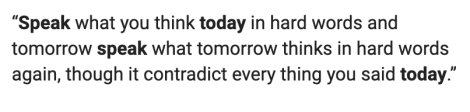
RWE speak today

Ralph Waldo Emerson, “Self-Reliance”

For nearly twenty years now, I have been examining misconceptions about and misrepresentations of “scientific” as it relates to what evidence supports teaching practices and school policy. The problem that I confront over and over is complicated since scientific evidence absolutely does matter in making large and small educational decisions, and educators and policy-makers must remain vigilant in monitoring who determines what “science” matters in those processes.

For example in the early 2000s, the National Reading Panel as a major component of No Child Left Behind was charged with examining the scientific evidence behind how to teach reading. Along with the problems exposed after NRP released their findings, I raised red flags about handing over what science matters from disciplinary structures to bureaucratic/political mandates.

At least one concern raised about the conclusions of NRP is that this bureaucratic body made a contested decision about which studies met the bar of “scientific,” a debate that has existed for some time in academia and research broadly as well as in each discipline.

For the most part, NRP’s decision does reflect a traditional bias for quantitative research and experimental/quasi-experimental methods, but that decision effectively erased a huge body of evidence about how to teach reading.

However, from NCLB and NRP to the failed implementation of Common Core standards and the concurrent high-stakes tests, the irony is that bureaucratically determined and mandated “science” tends to work in significantly unscientific ways—and also tends to fail.

More recently, I have confronted a similar dynamic in the “science of reading” movement. With the release of a policy statement attempting to call for resisting the problems with both the media narrative and the state-level reading policies that narrative is driving, many of the challenges to the policy reflect why debates around “science” are doomed regardless of anyone’s intent.

First, “science” is a term used in many different ways, particularly important is to recognize that scholars and scientists often mean something quite different than the general public, the media, or political leaders.

I show students the documentary Flock of Dodos, a rambling film that explores the incessant debate over teaching evolution in public schools that does an excellent job exposing the really jumbled communication among evolutionary scientists, the media, and the public.

For students, I ask them to consider people who say they do not “believe” in evolution because it is “just a theory.” We unpack both the inappropriate verb (“believe” is incompatible with science; faith v. empirical evidence) but also that the general public confuses “theory” with “hypothesis,” which is an important distinction for scientists (similar to the correlation/cause confusion).

In the documentary, in fact, the scientists admit that “fact” is a better word than “theory” for discussing evolution with the lay public because a scientific theory is the conclusion made from the scientific process and the accumulation of evidence, proof.

Next, however, much that humans know about the world and human experience is still being examined; therefore, most scientists see “facts” as ways to guide us in any moment while also leaving the door open for more evidence, some supporting what we know or some that may change our knowledge base in small or even significant ways.

Evolutionary science and climate change science are extremely compelling bodies of science, but neither is likely finished, or settled. Science, in fact, is buoyed in great part by those who are willing to continue to test and replicate the science most of them are comfortable with extolling as “fact.”

This nuance is typically too complicated for the lay public, resulting in some who see science as the fist of God and some who think “you can make research mean anything.” Both extremes are harmful for science and humanity.

My concerns about the “science of reading” narrative and the resulting reading policy being considered and adopted by states are that the narrative itself makes a case for a far too narrow view of “science” (similar to NRP, which advocates and the media routinely cite) and wield “settled” in ways that remind me of how people in the South reference God and the Bible to shut down anyone challenging authority.

One aspect of the current Covid-19 pandemic, then, that I have been following is how the media, political leaders, and the public have interacted with the science of medicine during the U.S.’s response to this health crisis.

Not insignificant, as one example, in this situation is the governor of Georgia two months into the spread of the pandemic in the U.S. saying that he just learned in the last 24 hours that people who are asymptomatic can spread Covid-19, something that has been widely reported in media.

Here are some ways that the Covid-19 pandemic offers lessons on “science”:

  • The evolving official messages (WHO, CDC) on people wearing face masks reflect that science is often complicated, but that the media and political leaders rush to oversimplify. With face masks in short supply in the U.S., the initial message suggesting that healthy people not wear masks reflected making decisions based on the relationship between supply and demand—not that masks made no difference for healthy people (although if you read carefully, the evidence about face mask effectiveness is far from settled and often contradictory). As WHO and the CDC change their recommendations, people, I think, will see “science” as arbitrary, missing the context for the initial and revised recommendations.
  • State and international comparisons of data have been a powerful lesson about how data are gathered, how any statistic is calculated and defined, and how data are displayed on charts and graphs. Rates and percentages have been tossed around in ways that are mind boggling and disorienting. I highly recommend this tutorial for navigating statistics and graphic representations of that data. I also suggest taking a critical view of the recent cell phone data used to identify which states are complying with social distancing. Pappas warns “the numbers should be taken with a grain of salt,” after sharing: “‘Travel distance is one aspect, but of course people can travel far without meeting a soul or travel 50 feet and end up in a crowd — so we know that the real world picture can be quite complex,'” Waller noted.”
  • How Covid-19 is spread, how vaccines and tests to detect viruses are created and implemented, how different viruses can or cannot be compared, and how any virus remains active on surfaces and in changing weather have all been very complex and much debated topics in the media—reflecting the importance of how the media report complicated scientific information. Science is often held hostage to the quality of the reporting, and journalists tend to be ill equipped to understand any and all complex fields of specialization.
  • Nothing new, of course, but the Covid-19 pandemic emphasizes the importance of relying on credible sources and information outlets and also the problem with social media and meme culture that allows the spread of easily disputed false information. With the rise of Trump and this health crisis, however, at least there are far more opportunities for people accessing fact-checking web sites.

In real time, we are witnessing where compelling science intersects with science that is in-process, nowhere close to settled. The Covid-19 pandemic should teach us that science is incredibly important while also being imperfect and often inadequate. Nothing, not tests or vaccines, is 100% despite some wanting science to be black-and-white in its conclusions.

Another lesson is that the relationship between experts (academics, scientists, doctors) and the lay public as that is facilitated by the media often works in ways that detract from the potential for science to serve us all well.

Covid-19 is a life-or-death matter, yet even with that urgency, ultimately we must acknowledge that science is not a hammer, but given the skeptical respect and space it deserves, science could be our best opportunity for a better world.

The Things Schools Ruin: Poetry Edition

[Header Photo by Kristin O Karlsen on Unsplash]

When I posted two of my favorite lines of poetry to highlight our human failures, I received a poetic reply:

funny, I posted the Wasteland today.
You know, ‘April is the cruelest month’ and all that.

— oTTo & Nairb (@NairbOtto) April 2, 2020

While this poetry exchange remains anchored to the dead-white-man problem with the canon many of us have experienced in formal schooling, I think it also speaks to, when allowed, that poetry is a genuinely powerful and relevant human form of expression that is more often than not harmed by traditional teaching.

National Poetry Month, April 2020, falls in the midst of a world-wide pandemic that has disrupted almost all formal schooling across the U.S. and much of the world, but social media suggests that poetry not only persists, it thrives.

Poet Tara Skurtu, for example, launched the International Poetry Circle through her Twitter account, and the response from poets video recording poetry readings has accelerated beyond her capacity to manage them.

When given the opportunity, poetry is its own best teacher, and when readers are allowed, poetry matters.

Even though I came to recognize my own calling and journey as a poet during my first year of college, I was during that same period having a terrible experience with Emily Dickinson, who I loathed because of formal schooling but came to love many years later as a teacher while exploring her life and work on my own.

By my junior year of college, I had made the transition from considering a major in physics or architecture to committing to English education. It was a hard and long journey for me to find my life in words because schooling was often in my way.

I entered teaching high school English determined to teach well, but also determined to open the door to literature and writing for my students in ways that weren’t often allowed for me (except for the occasional teacher who was working against the traditions of schooling).

The two seemingly endless challenges I faced, however, were that my own early efforts at teaching well proved to be as counter-productive to fostering a love of reading and writing as so-called traditional methods and that students hated, for example, writing and poetry so deeply because of their experiences over nine or ten years I was facing the most uphill of uphill battles.

I taught Albert Camus’s “The Myth of Sisyphus” for many years in conjunction with his The Stranger; I also had a poster of Sisyphus hanging on my classroom wall.

Like Sisyphus I taught poetry each year with good intentions and great care, only to have the students remain stoically anti-poetry.

Teaching poetry was my rock, but I was not happy.

Then on Twitter this morning, I was reminded of when my teaching poetry turned a corner:

— Paul Thomas (@plthomasEdD) April 2, 2020

Eventually, I shifted my entire poetry unit, spanning a quarter of the academic year, to a series of lessons grounded in the lyrics and music of the Athens, Georgia based alternative band R.E.M. And I discovered that my students were drawn to the poetry of James Dickey, who at the time taught at the University of South Carolina.

In the late 1980s, our high school was destroyed by arson, and once the school was rebuilt, we made a large print of Dickey’s “For the Last Wolverine,” had Dickey sign it, and hung it prominently in the entrance of our new library.

Dickey himself was from Georgia, and I think students found his rural poetry set in nature and dealing with animals concrete and accessible. He was very readable and students tended to feel a sense of comfort with their understanding of these poems.

Although Dickey, like many white men of the twentieth century, poses problems as a flawed man, I will always have a warm place in my teacher heart for how my students embraced these poems; we had many good days reading and discussing these poems by Dickey (along with “Deer among Cattle” and “For the Last Wolverine”):

There is a complicated paradox to formal schooling since the structure is an ideal way to bring young people into the beauty and wonder of language, but the demands of mass education for structured outcomes tend to ruin those experiences with beauty and wonder.

Poetry worked with my students when we allowed ourselves to experience poetry for poetry’s sake, when we set aside the insidious urge to analyze and reduce any poem to a neat theme.

And despite having similar problems as the dead-white-man tradition of schooling, social media shows us that poetry links us, poetry can stabilize and soothe us when the world is too much with us.

If and when we return to some brave new world on the other side of the Covid-19 pandemic, something we will then call “normal,” I hope those of us who are charged with teaching language and poetry will be able to hold onto the beauty and wonder of poetry in ways that guide us as we invite students to join in.

No literary technique hunt. No multiple-choice questions.

I think that when I read Dickey’s poems aloud—”I wave, like a man catching fire”—just as when I read Faulkner aloud, there was something about my deeply Southern voice and Dickey’s very Southern poetry that resonated with my Southern students.

Poetry as us, us as poetry.

I miss those days, and regret it took me several years to allow those times that now sit in my heart fondly.


If You’re Going to Write About Science of Reading, Get Your Reading Right

The release of the joint statement (National Education Policy Center and Education Deans for Justice and Equity) on the “science of reading” version of the current Reading War held, I hoped, great promise for at least slowing a very harmful process. I also briefly crossed my fingers that the statement could ease some of the discord and help key figures in the debate find that there is more common ground than disagreement.

However, social media has provided evidence that neither of these outcomes is likely. The advocates of the “science of reading” doubled down on their condescension and general nastiness (a feature of Twitter), and there is this blog post from Daniel Willingham: If You’re Going to Write About Science of Reading, Get Your Science Right.

I commented several times on the post and even offered a discussion by email. Willingham did respond to my comments and the exchange was civil, but alas, fruitless.

The crux of Willingham’s concerns about the statement seems to be:

I think the statement is pretty confused, as it conflates issues that ought to be considered separately. This statement is meant to be about the science of reading, so much of the confusion arises from a failure to understand or appreciate the nature of science, how basic science applies to applied science, and the scientific literature on reading.

This is a misreading of the policy; I think that misreading is in part prompted by Diane Ravitch’s framing of the statement with “There is no Science of Reading,” which Willingham references in his first paragraph.

To clarify, Ravitch’s framing is misleading, and Willingham has failed to grasp the purpose of the statement, directly identified by NEPC:

All students deserve equitable access to high-quality literacy and reading instruction and opportunities in their schools. This will only be accomplished when policymakers pay heed to an overall body of high-quality research evidence and then make available the resources necessary for schools to provide our children with the needed supports and opportunities to learn. This joint statement from NEPC and the Education Deans for Justice and Equity provides guiding principles for what any federal or state legislation directly or indirectly impacting reading should and should not do.

This statement is a policy statement that raises a long-overdue red flag about a complicated process: Mainstream media have created a narrative that teachers have failed to use the “science of reading” because teacher education has failed to teach that, preferring balanced literacy instead. This narrative also claims the “science of reading” is settled and that the research base justifies systematic intensive phonics instruction for all students, a claim being used to endorse and implement misguided reading legislation across the U.S. [1]

Willingham has missed that nuanced and complex focus of the statement and spends the blog post mostly challenging issues that simply do not exist in the statement itself, primarily complaining that the statement has a fundamental misunderstanding of “science” (“The distinction between basic and applied science ought to be fundamental to any discussion of the science of reading”).

Since a key element of the statement raises that exact issue, this extended complaint is itself, to use Willingham’s language, “confused.”

A couple of important points lie beneath the unfortunate consequence of the topic of teaching reading continuing to be a fruitless debate (what the statement is explicitly seeking to end).

First, the teaching of reading as a subset of the field of education has historically and now currently been over-run with epistemic trespassing; psychology, economics, and political science routinely encroach on education as if the discipline itself has no scholarship or scholars.

Some of this trespassing has to do with disciplinary hierarchies linked to distinctions between quantitative and qualitative research (often veneers for academic sexism), but some of the trespassing is simply disciplinary bullying.

While I completely agree with Willingham that anyone making claims about the “science of reading” should understand “science,” he has failed to acknowledge an equally important requirement—understanding reading and literacy.

As Nathan Ballantyne examines carefully, having robust and critical skills in one field, psychology, does not necessarily equip a scholar for transferring those skills to another field, especially (as Willingham notes himself) into a field grounded in real-world practice such as education, teaching children to read.

Willingham and Mark Seidenberg, both psychologists, are two of the main scientists cited in the “science of reading” narrative in mainstream media, and two of its defenders (although as scholars, they both tend to offer far more caveats and nuance than advocates who are journalists).

They, however, lack a background in teaching literacy, and while their research is quite valuable, as the statement notes, narrow types of “scientific” are ultimately incomplete evidence for day-to-day teaching.

No one is arguing there is no “science of reading,” but the ham-fisted claims about “settled” science and the misuse of “science” to support flawed reading policy are inexcusable.

But here is a much more problematic part of this continued debate. Willingham represents not only epistemic trespassing, but also has explicitly discredited all educational researchers, suggesting journalists as more credible:

Believing something because someone else believes it rather than demanding and evaluating evidence makes you sound either lazy or gullible. But we yield to the authority of others all the time. When I see my doctor I don’t ask for evidence that the treatments he prescribes are effective, and when an architect designed a new deck for my house I didn’t ask for proof that it could support the weight of my grill and outdoor furniture. I believed what they told me because of their authority.

I think education researchers don’t speak with that kind of authority and (apparently unlike Sanden) I don’t think we deserve it. I can point to two key differences between a doctor (or architect, or accountant, or electrician, etc) and education researchers.

He adds later, “Anyone can take the title ‘education researcher.’”

As someone with an EdD and who straddles two different fields, education and English, I can assure you that this sort of disciplinary bullying is still common in the academy. Education is routinely dismissed as mere occupational preparation, and English is framed as one of the impractical fields in the impractical humanities.

This sort of disrespectful finger pointing, I think, must be unmasked since any time someone points a finger, several are pointing back as well.

“The replication of findings is one of the defining hallmarks of science,” note Diener and Biswas-Diener, adding:

In modern times, the science of psychology is facing a crisis. It turns out that many studies in psychology—including many highly cited studies—do not replicate. In an era where news is instantaneous, the failure to replicate research raises important questions about the scientific process in general and psychology specifically. People have the right to know if they can trust research evidence. For our part, psychologists also have a vested interest in ensuring that our methods and findings are as trustworthy as possible.

Psychology, then, like economics feels justified trespassing on other fields, possibly to deflect from the needed critical inspection of their own field. It seems one reason psychology has a crisis in the quality of their science is a pattern of defensiveness:

When findings do not replicate, the original scientists sometimes become indignant and defensive, offering reasons or excuses for non-replication of their findings—including, at times, attacking those attempting the replication. They sometimes claim that the scientists attempting the replication are unskilled or unsophisticated, or do not have sufficient experience to replicate the findings. This, of course, might be true, and it is one possible reason for non-replication.

I have been in the field of literacy for 36 years, and in academia for 18 years. I am quite certain there are no pure fields and no fields that can be discounted as cavalierly as Willingham does about “education scholars” and education research (I recommend Bracey on the problems with educational research and how it is interpreted, by the way).

I also have directly admitted that epistemic trespassing is always problematic, but many topics may in fact necessitate such trespassing. Understanding and teaching reading does in fact benefit from a wide range of disciplinary evidence (as the statement asserts).

But no topic benefits from academia’s most petty traditions, including disciplinary hierarchies and bullying.

If expertise in science deserves respect (and it certainly does), then expertise in literacy and teaching reading also deserve respect—and neither should be handed over to journalism as the arbiter of those fields or to politicians who have the power of policy.

Those of us in the academy who often are discounted for being in an Ivory Tower should have higher standards for our own behavior, but there is much work yet to be done to eradicate hierarchies and pettiness even among the so-called well educated.

Let’s keep in  mind that although getting the science right is certainly important, we are in this to get the reading right, and that is the focus of the statement that some are misreading.


[1] See the following to help construct the narrative:

Gewertz, C. (2020, February, 20). States to schools: Teach reading the right way. Education Week. Retrieved from https://www.edweek.org/ew/articles/2020/02/20/states-to-schools-teach-reading-the-right.html

Loewus, L. (2019, December 3). Data: How reading is really being taught. Education Week. Retrieved from https://www.edweek.org/ew/articles/2019/12/04/data-how-reading-is-really-being-taught.html

Russo, A. (2018, November 14). Hard reporting: Why reading went under the radar for so long – and what one reporter is aiming to do about it. Phi Delta Kappan. Retrieved from https://kappanonline.org/russo-hard-reporting-why-reading-went-under-the-radar-for-so-long-and-what-one-reporter-is-aiming-to-do-about-it/

Schwartz, S. (2019, December 3). The most popular reading programs aren’t backed by science. Education Week. Retrieved from  https://www.edweek.org/ew/articles/2019/12/04/the-most-popular-reading-programs-arent-backed.html

Stukey, M.R., & Fugnitto, G. (2020). The settled science of teaching reading—part I. Collaborative Circle Blog. Retrieved from https://www.collaborativeclassroom.org/blog/the-settled-science-of-teaching-reading-part-1/

Will, M. (2020, January 22). Preservice teachers are getting mixed messages on how to teach reading. Education Week. Retrieved from https://www.edweek.org/ew/articles/2020/01/22/preservice-teachers-are-getting-mixed-messages-on.html

Will, M. (2018, October 24). Teachers criticize their colleges of ed. for not preparing them to teach reading. Education Week. Retrieved from http://blogs.edweek.org/edweek/teacherbeat/2018/10/teacher_prep_programs_reading.html

Will, M. (2019, December 3). Will the science of reading catch on in teacher prep? Education Week. Retrieved from https://www.edweek.org/ew/articles/2019/12/04/most-ed-professors-favor-balanced-literacy.html

Misreading the Main Idea about Reading

About a decade ago, I accepted an invitation from the ACT to review a set of new test questions for their reading section. As a career-long anti-standardized test advocate, after talking with several colleagues, I accepted that an inside view of the process would help me better confront the problems with tests such as the ACT and the SAT.

The process included receiving the test section, taking the test myself (and taking notes), and then being flown to Iowa City to attend a workshop where we walked through each question to help the test designers revise and edit so this section could be added to the implementation of the test.

Some important take aways included discovering that the test designers were almost exclusively experts in test design (not reading or literacy) and confirming that “good test questions” were mostly about if the question creates “spread” (a range of correct and incorrect) in the data and not if the question is a valid assessment of reading ability (whatever that is).

This experience came to mind when I ran across this on Twitter:

A well-educated adult struggling with a kindergartner’s worksheet also reminds me of “Sara Holbrook, the writer who couldn’t answer test questions about her own work,” covered by Peter Greene.

While I think we may need to extend some grace to the teacher who sent this work home during a pandemic, I also think we should confront that this is a quite common way to approach reading and teaching reading—common ways that are deeply flawed.

Both the kindergarten homework and the author puzzled by standardized test questions reflect reading instruction and assessment that are skills-driven—framing the holistic act of reading as a collection of identifiable reading skills such as “main idea.”

A skills approach to teaching and testing reading tends to focus on decoding (phonics), vocabulary, prior knowledge (content), and an array of reading strategies (identifying main idea, predicting, context clues, etc.).

While literacy teachers and scholars tend to agree that these all are valid elements of reading, the debate lies in whether or not teaching and testing them in isolation are valid reflections of the whole act of reading.

The skills approach has some practical advantages in whole-class formal schooling, especially when classes include 25-35 students and when thousands of students are being tested.

In other words, a skills approach is efficient (easy to manage as instruction, and quick and cost-effective as assessment) and it also lends itself to a teacher-centered, authoritative mode of teaching (someone in authority determines the answers, and by their authority, those answers are “correct”).

The skills approach during early literacy development also feeds well into the New Criticism norm of text analysis that is common in middle and high school (re-branded under the Common Core as “close reading”). Reading assessment in standardized testing requires that “right” answers exist neatly in any text and that a systematic form of analysis lends itself to identifying that “right” answer.

But, as the kindergarten and published author examples above demonstrate, the skills approach and the “right” answer view of texts are deeply flawed, and likely work against fostering students as eager, independent, and critical readers.

No sophisticated adult readers sit down to answer a set of multiple-choice questions about a text they have read once they are finished. Those of us who pleasure read are likely to do almost nothing once we have read, or we eagerly find other people who have read the text so we can discuss the experience.

And those conversations are rarely punctuated with “main idea” or “theme,” but mostly about how we felt about the text and all the connections we noticed with our lives or other experiences we have had with all sorts of art—other texts, movies, music, etc.

Here, then, are a few ways we should change how we teach and assess reading, especially with young students.

First, in kindergarten, our focus should be far less on skills and mostly on fostering eager readers. Frankly, there is no urgent need for children this young to correctly interpret any text.

Reading to beginning readers and inviting them to have a wide range of emotional and text-based responses (mostly free of evaluating them for being right or wrong) should replace a skills approach in kindergarten (and likely through the first three or four years of school).

Gradually, we should move toward helping students navigate text in ways that improve their ability to gain valid conclusions from that text, keeping in mind that “meaning” isn’t necessarily fixed and in many cases may be more about contested meaning, not one right answer.

Skills approaches to reading can mostly be justified as efficient, but seeing reading as a set of discrete skills and strategies is, none the less, not reading since it is a holistic act.

As I have noted before, for example, people have large vocabularies from reading extensively, but learning a bunch of isolated vocabulary doesn’t necessarily make a person highly literate. We too often flip the value and consequences of the whole act of reading and identifiable reading skills and strategies.

Next, we must be careful not to teach or test skills for the sake of those skills, but to always keep our focus on the whole text and the reader’s reading experience while acknowledging that skills and strategies are working together in the process of making meaning and reaching critical conclusions about the text.

For example, the kindergarten worksheet is having children find “main idea” as if that is a reasonable or authentic goal (it isn’t) instead of helping students come to understand that text has large meaning (such as main idea and theme) that can be justified through smaller elements in the text (supporting ideas, literary and rhetorical techniques).

Asking students “What do you think is important about this text?” (Or “What did you enjoy in this text?”) is a much better approach that can be followed by “Why do you think that?” (moving them to offer textual support). Here, we are starting with the student (not some skill or predetermined “right” answer) and still fostering careful and purposeful approaches to text.

Finally, the big picture problem with these examples, and why a skills approach is common in the teaching and testing of reading, is that we have created teaching and learning conditions that are counter-educational for literacy growth.

We have chosen efficiency over authentic literacy in the U.S. because we refuse to invest in teaching and learning conditions (low student/teacher ratios, fully funded classrooms and materials) that would support effective teaching and rich learning by our students.

Skills approaches to reading are efficient and manageable, but as the kindergarten example above shows, they simply are not reasonable or authentic.

While I question the periodic cries that the U.S. has a reading crisis, I can attest from 36 years of teaching that we do far too often make young people hate to read—and there are tragic consequences to misreading the main idea about reading in schools.


See Also

Negotiating Meaning from Text: “readers are welcome to it if they wish”

LaBrant, L. (1937, February 17). The content of a free reading programEducational Research Bulletin, 16(2), 29–34.


Did Balance Literacy Fail to Teach Your Child to Read?

For 36 years now, I have been teaching people to write; that journey is a large subset of my own being and becoming a writer, an experience that is captured well in an old Nike poster I used to hang on the wall of my high school classroom, proclaiming “There is no finish line.”

there is no finish line

For the last decade-plus, I have taught first-year college students to write. While I am teaching writing, however, I also am teaching young people how to do college, how to make the important transition from being a student to being a scholar.

Part of that work is unlearning bad habits from high school embedded in traditional approaches to writing essays.

Here is one of the worst: Many students come to college having followed a narrow writing process in which teachers require students to submit a one-paragraph introduction with a direct thesis statement. Once approved, the student is then released to write an essay that fulfills that approved essay thesis.

This instills in students two incredibly misguided practices. One is writing with a level of certainty that an 18-year-old has yet to reach (particularly on topics about which they have only second-hand knowledge); and another is failing to see drafting and writing as an act of discovery, as a journey to understanding ideas better.

Neither of these lessons from high school serve young people well in their quest of becoming more educated, being a scholar. Scholarship and deep understanding of a field or discipline comes mostly from interrogating ideas, not from grand pronouncements.

Knowledge is living forest; dogma is a rigid stone slowly wearing away to nothing in its resistance to the elements.

This also comes into play when anyone is trying to understand a situation outside their own areas of expertise. As Ballantyne explains about epistemic trespassing:

First, the intellectual characters of trespassers often look unsavoury. Out of their league but highly confident nonetheless, trespassers appear to be immodest, dogmatic, or arrogant [emphasis added]. Trespassers easily fail to manifest the trait of intellectual humility and demonstrate one or another epistemic vice (Whitcomb et al. 2017, Cassam 2016). Second, it’s useful to distinguish between trespassers holding confident opinions and investigating questions in another field [emphasis in original]. I assume it can be epistemically appropriate for people to look into questions beyond their competence, even when it would be inappropriate for them to hold confident opinions.

This is a key distinction (arrogance v. modesty) for an enduring question in the U.S., one that has remained at the forefront of public and political debate since at least the 1940s: Why are students not learning to read?

If we are going to focus on asking questions and not making grand pronouncements, we probably should first interrogate the question, and confirm whether or not students are learning to read in reasonable ways and when they genuinely need to read independently.

Here we have a serious problem because at no period in the U.S. has anyone pronounced reading achievement to be satisfactory; thus, the somewhat bell-shaped curve of reading achievement among school-age students could very likely simply be normal.

Yet, most of us view education as a 100% attainable venture—all students can and should learn to read by X age. This is a valuable ideal, but it certainly isn’t a reasonable measure for any sort of accountability (see the disaster that was No Child Left Behind).

We are left then with an enduring question that I think is valid and worth considering: Why do some students not become eager and critical readers at the same rate as most of their biological peers?

Data for many decades have shown that all sorts of achievement gaps, reading included, are strongly correlated with the socioeconomic status of any student’s parents, home, and community as well as the educational attainment of the parents (notably the mother). [Every administration of the SAT reflects those patterns, for example.]

Especially over the past forty or so years, however, emphasizing the correlation between inequity and academic achievement has been discounted with making “excuses.” Public and political concern for any problem seeks to find individual causes to blame, but Americans tend to balk at systemic explanations for negative outcomes.

When the U.S. declared a reading crisis in the 1940s during WWII, many immediately blamed progressive education, then strongly associated with John Dewey. But there were three practical problems with that blame.

First, as Alfie Kohn has explained, Dewey’s progressive education has never been implemented on any wide scale in the U.S. Despite mainstream arguments to the contrary, formal education in the U.S. has almost always been primarily conservative and traditional.

Second, as Lou LaBrant carefully detailed in 1942:

1. Not many men in the army now have been taught by these newer methods [emphasis in original]. Those few come for the most part from private or highly privileged schools, are among those who have completed high school or college, and have no difficulty with reading.

2. While so-called “progressive” schools may have their limitations, and certainly do allow their pupils to progress at varied rates, above the second grade their pupils consistently show superior ability in reading. Indeed, the most eager critics have complained that these children read everything they can find, and consequently do not concentrate on a few facts. Abundant data now testify to the superior results of purposeful, individualized reading programs [emphasis in original].

3. The reading skills required by the military leaders are relatively simple, and cause no problem for normal persons who have remained in school until they are fourteen or fifteen. Unfortunately the large group of non-readers are drop-outs, who have not completed elementary school, come from poorly taught and poorly equipped schools, and actually represent the most conservative and backward teaching in the United States [emphasis in original]. (pp. 240-241)

Third, and this is possibly the most important point for understanding our current reading crisis, many students were unsuccessful in situations where educators claimed to be practicing progressive education, but in fact, were not.

Let me offer an example—Dewey’s project method.

First, Dewey tended to offer philosophical and theoretical parameters for teaching, but refused to offer models and never templates or programs. This made, ironically, a practitioner of pragmatism (Dewey’s philosophical roots shared with William James) quite impractical for day-to-day teaching and the running of schools.

William Heard Kilpatrick, however, seized the moment and packaged the project method, which did find its way into schools, often ones that claimed to be progressive.

Here comes the real but complicated problem.

In 1931, LaBrant (the subject of my dissertation and a devout Deweyan progressive) launched into the use of the project method in classes where students are supposed to be learning reading and writing:

The cause for my wrath is not new or single. It is of slow growth and has many characteristics. It is known to many as a variation of the project method; to me, as the soap performance. With the project, neatly defined by theorizing educators as “a purposeful activity carried to a successful conclusion,” I know better than to be at war. With what passes for purposeful activity and is unfortunately carried to a conclusion because it will kill time, I have much to complain. To be, for a moment, coherent: I am disturbed by the practice, much more common than our publications would indicate, of using the carving of little toy boats and castles, the dressing of quaint dolls, the pasting of advertising pictures, and the manipulation of clay and soap as the teaching of English literature. (p. 245)

Let’s imagine that some students did not grow as readers or writers if they were crafting, and not reading or writing (as LaBrant argued for over six decades), and let’s also imagine that if there was poor reading growth in these classrooms, people certainly associated that with progressive practices since it was explicitly using the project method.

To untangle this, we need to recognize that as LaBrant admonished, using the project method to craft instead of having students read and write was a misuse and misunderstanding of progressive philosophy.

Neither the project method nor progressivism failed these students, but the misuse of both certainly did.

This pattern has repeated itself at both small and large levels for decades.

The 1980s-1990s reading crisis was blamed on whole language, but almost no one was implementing whole language and the drop in test scores were easily connected to systemic factors such as reduced funding and an influx of English language learners (Emergent Bilinguals).

It is also interesting to investigate the many misuses of the term “best practice” and the instructional strategy literature circles, both important aspects of Harvey “Smokey” Daniels educational work and regrets he has explained in detail about too many people misunderstanding and misapplying the terms and practices.

At a state-level ELA teacher conference many years ago, I listened to Daniels explain that he wishes he could distance himself from the term “best practice” because nothing stopped publishers from slapping the term on any book because publishers knew the concept was in vogue. In short, like Dewey, Daniels was aware that he had no control over whether or not anything labeled “best practice” was in fact best practice (supported by evidence and research).

So this all leads to the blog post’s title: Did balance literacy fail to teach your child to read?

I suspect if you have made it this far and if you have fully interrogated the information I have provided, you can expect that the answer is very unlikely.

Are too many students not acquiring reading at rates we would prefer in the U.S.? Absolutely.

Are identifiable subgroups particularly mis-served in reading in our public schools—students with dyslexia, poor students, students of color, English language learners (Emergent Bilinguals)? Absolutely and inexcusably so.

Have these students who have experienced educational inequity sat in classrooms and schools that have adopted and implement reading programs labeled “balanced literacy”? There is no question this has happened, and continues to happen.

The paradox about blaming balanced literacy is that as a guiding reading philosophy and theory, balanced literacy supports that every student should receive whatever reading instruction the student needs (systematic intensive phonics, reading authentic texts, read alouds, special needs intervention, etc.); therefore, if a student isn’t receiving what they need, then the fault doesn’t lie with balanced literacy—just as Kilpatrick’s project method was being misused in the 1930s.

This may seem like a trivial distinction, but I think it is important because the current “science of reading” movement is laser-focused on blaming balanced literacy and offering a silver-bullet solution, systematic intensive phonics for all students.

This bodes poorly for students because with a false diagnosis, you are likely endorsing a flawed cure.

It is compelling to identify one thing to blame and to embrace a structured single solution, but that is a historically failed strategy.

Over the last few decades, we have no evidence that reading has ever been taught in any sort of uniform way, even in the same school (although analyses from the 1990s showed a positive correlation between whole language classes and higher NAEP reading scores). The causes for low reading achievement are incredibly complex, linked to out-of-school factors as well as teaching and learning conditions in schools.

We should focus more directly on out-of-school factors, but if we insist on in-school only reform to increase reading achievement, we would do better to start with teaching and learning conditions (low student/teacher ratios for struggling students, better funding) and then to abandon lock-step implementation of any reading program (not ones labeled “balance literacy” or ones prescribing systematic intensive phonics for all students).

And the one real reform we refuse to acknowledge or address is making sure every child and young person in the U.S. has access to reading in their homes, communities, and schools. When people wield “science of reading” like a hammer, they fail to acknowledge the enormous research base showing access to texts as the strongest indicator of students acquiring literacy.

In fact, the more things change, the more they stay the same. We are about 80 years late on listening to LaBrant:

An easy way to evade the question of improved living and better schools for our underprivileged is to say the whole trouble is lack of drill. Lack of drill! Let’s be honest. Lack of good food; lack of well-lighted homes with books and papers; lack of attractive, well equipped schools, where reading is interesting and meaningful; lack of economic security permitting the use of free schools—lack of a good chance, the kind of chance these unlettered boys are now fighting to give to others. Surround children with books, give them healthful surroundings and an opportunity to read freely. They will be able to read military directions—and much more. (p. 241)