Category Archives: education

Recommended: Ending Zero Tolerance The Crisis of Absolute School Discipline, Derek W. Black

Ending Zero Tolerance The Crisis of Absolute School Discipline, Derek W. Black

From publisher’s web site:

In the era of zero tolerance, we are flooded with stories about schools issuing draconian punishments for relatively innocent behavior. One student was suspended for chewing a Pop-Tart into the shape of a gun. Another was expelled for cursing on social media from home. Suspension and expulsion rates have doubled over the past three decades as zero tolerance policies have become the normal response to a host of minor infractions that extend well beyond just drugs and weapons. Students from all demographic groups have suffered, but minority and special needs students have suffered the most. On average, middle and high schools suspend one out of four African American students at least once a year.

The effects of these policies are devastating.  Just one suspension in the ninth grade doubles the likelihood that a student will drop out. Fifty percent of students who drop out are subsequently unemployed. Eighty percent of prisoners are high school drop outs. The risks associated with suspension and expulsion are so high that, as a practical matter, they amount to educational death penalties, not behavioral correction tools. Most important, punitive discipline policies undermine the quality of education that innocent bystanders receive as well—the exact opposite of what schools intend.

Ending Zero Tolerance answers the calls of grassroots communities pressing for integration and increased education funding with a complete rethinking of school discipline. Derek Black, a former attorney with the Lawyers’ Committee for Civil Rights Under Law, weaves stories about individual students, lessons from social science, and the outcomes of courts cases to unearth a shockingly irrational system of punishment. While schools and legislatures have proven unable and unwilling to amend their failing policies, Ending Zero Tolerance argues for constitutional protections to check abuses in school discipline and lays out theories by which courts should re-engage to enforce students’ rights and support broader reforms.

REVIEWS

  • “Zero-tolerance policies fuel the school-to-prison pipeline and disproportionately deny educational opportunities to already disadvantaged student populations. In this volume, Derek Black not only describes the problem but proposes a solution—intervention by state and federal courts.  In an era when many are losing faith in courts to protect students, Black makes a persuasive case that courts can and should play a productive role in safeguarding the basic rights of students.  This book is a cogent, comprehensive, and creative resource for all those who seek to dismantle one of the most pervasive contributors to educational inequality in this country.”

    —James E. Ryan, Charles William Eliot Professor, Harvard Graduate School of Education

  • “Black’s book is necessary reading for educators and those who work with youth, whether during classroom hours or in an after-school setting.”

    Youth Today

  • “With the intent to address the toxic environment that zero tolerance perpetuates, Black outlines a convincing argument that the courts must step in to speed reform and ensure that all students are cared for equally.”

    Library Journal

  • “In Ending Zero Tolerance, Professor Derek Black sheds light on how both law and policy are inviting schools to harshly punish students in ways that greatly harm the disciplined student, his or her peers, academic outcomes and our national commitment to equal educational opportunity. He also proposes insightful and attainable legal reforms that could end this crisis.Ending Zero Tolerance is a must-read for all who are committed to fair discipline policies.”

    —Kimberly Jenkins Robinson, Professor, University of Richmond School of Law

  • “Derek Black has written a magnificent book that shows how the current approach to disciplining children in schools undermines education, discriminates against children of color, and violates the most basic notions of due process.  He makes a compelling case that courts must be involved in reforming school discipline.  This book is must reading for all involved in education and all who care about the American educational system.”

    —Erwin Chemerinsky, Dean, University of California, Irvine School of Law

  • “Now is the time to revisit much of the legal thinking about the constitutional rights of public school students, because so many of them were originally pronounced during the Civil Rights Era… There is no question that Ending Zero Tolerance will be of great interest to a diverse audience of people interested in public education.”

    —Kevin Brown, Richard S. Melvin Professor of Law Indiana University Maurer School of Law-Bloomington

  • “Black convincingly explains how the nation’s inflexible, exclusionary and counterproductive approach to school discipline has swung far out of balance. This extraordinarily important book carefully outlines the legal and policy thinking that should serve as a cornerstone for the lawyers, policymakers and judges who must re-balance this destructive system.”

    —Kevin Welner, co-editor, Closing the Opportunity Gap: What America Must Do to Give All Children an Even Chance

The State: ACT scores expose state’s unwillingness to act

ACT scores expose state’s unwillingness to act

[original submission posted below before edits]

Education reform in South Carolina suffers from a tragic lack of imagination: New standards and new tests, but the outcomes remain disappointing.

Now, recently released ACT scores serve as the newest reason to panic. As reported in The State: “The latest scores from the ACT college entrance exam suggest that many of this year’s high school graduates aren’t ready for college-level course work.”

SC’s data are troubling: 14% of test-takers not ready for college and the race gap even more alarming (2% of black students met standard on the four sections of the ACT).

SC also appears to compare poorly to the other 20 states requiring all students to take the ACT—notably Tennessee has a similar poverty rate as SC but a higher average ACT score.

However, I urge caution about interpreting ACT scores from one year of data since SC has recently adopted Common Core standards and tests, dropped Common Core, adopted yet new standards, and then chosen the ACT for annual testing.

Thus, my concerns about shouting that the sky is falling based on the new ACT scores include the following:

  • Scores are depressed due to standards shuffling across the state over the past 3-4 years.
  • ACT tests, like all standardized tests, remain more strongly correlated with race, social class, and gender than the quality of the schools or teachers.
  • One year of data when a new test is adopted is inadequate for drawing hard conclusions.

ACT results are nothing new since SC has a long history of having low, if not the lowest, test scores in the U.S. (notably our residency in the basement of the discredited practice of journalists ranking states by SAT scores), but the most important lesson from this data is that SC has yet to address the equity gap in the lives and education of vulnerable children.

To persist with labels such as the “achievement gap” is to keep our eyes on the outcomes while ignoring the root causes of those outcomes.

SC has spent three decades changing standards, tests, and accountability, but refuses to address directly the race and class inequities facing our state and those same inequities reflected in our schools (both traditional and charter).

Ultimately, I am not trivializing SC’s ACT scores—especially as that relates to black, brown, and poor students—but I must stress we did not need more data from a different test to tell us what we have known and ignored for decades: social and educational inequity cheats those black, brown, and poor students, and our obsession with changing standards and tests fails to address the root equity problems reflected in low test scores.

The real failure in education reform lies in the inability of education reformers to do something different beyond accountability, school choice, and charter schools—none of which addresses problems directly and all of which increases those problems.

Hand wringing over results of the recent ACT is not a new revelation. Therefore, admitting that weighing a pig doesn’t make a pig fatter is crucial in our debates about low test scores. Instead we need to feed the pig, a metaphor for addressing root causes.

While problematic, recent research suggests that even when schools can raise test scores, those higher scores do not translate into benefits once students enter the real world. In other words, if education is to have real life-long positive consequences, we must confront a wide range of complex root causes and school practices in order to insure equity of opportunity—which unlike raising test scores is more likely to produce life-long benefits.

Instead of changing tests and increasing test-prep, which disproportionately impact negatively our vulnerable student populations, we need to erase food, health, and work insecurity, and we need to addresses equity of opportunity (access to experienced and certified teachers as well as access to challenging courses and then affordable college)—and not more accountability driven by ever-new standards and tests.

No one needed the recent ACT scores to confront that our schools, like our society, is negligent with black, brown, and poor students. Now, the real question is, who is willing to do something different and directly about the inequity those test scores represent?

How the 5-Paragraph Essay Fails as Warranted Practice

[Header Photo by Joanna Kosinska on Unsplash]

At the core of John Dewey’s pragmatism and progressivism is Dewey’s contrarian view of “scientific”—the warranted assertion [1]. For Dewey, and in the context of teaching and learning, a warranted practice would be based on a substantial, diverse, and appropriate body of evidence, including how theory looks in the unpredictable real world.

Although the term “best practice” is much sullied, the rightful use of that term certainly approaches Dewey’s vision for education—how we practice in daily teaching what we are able to know from a range of evidence from experimental/quasi-experimental quantitative research to classroom-based action research.

However, Dewey’s faith in scientific education as warranted practice suffered from his own skepticism about prescriptions, templates, and mandates; Dewey viewed education as a perpetual experiment and refused to dictate for any classroom what he discovered as warranted for his classroom.

As a result, in the early twentieth century and throughout the history of universal public education, progressivism has been rarely practiced but often vilified and misunderstood.

Even during the accountability era when prescriptions and mandates have become the norm, some have sought ways to promote “best practice” in the Dewey tradition of warranted practices—offering what teachers should increase and decrease in their practice.

But probably the best example of Dewey’s warranted practice emerged in the 1970s and 1980s with the rise of the National Writing Project (NWP) and the call to teach writing authentically, to merge the practical experiences of writing with writing instruction.

#

Former NCTE president Lou LaBrant wrote:

By the term “creative writing” we are, however, emphasizing the degree to which an individual has contributed his personal feeling or thinking to the sentence or paragraph. This emphasis has been necessary because too frequently the school has set up a series of directions, to this extent limiting what we may think of as the creative contribution: the teacher names the topic, determines the length of the paper, and even sometimes assigns the form. For the purposes of this paper I shall, perhaps arbitrarily, use the term “creative writing” to include only that written composition for which the writer has determined his own subject, the form in which he presents it, and the length of the product. (p. 293)

As a true progressive, LaBrant made this argument in 1936—about four decades before the rise of the NWP and workshop approaches to writing instruction.

Not to be hyperbolic, but no one listened to LaBrant, and despite a brief bit of momentum by the NWP, the accountability era effectively killed authentic writing instruction.

Thus, the 5-paragraph essay, writing templates, prompted writing, and scoring rubrics have mostly dominated writing instruction in the U.S. for about a century.

Throughout, however, a substantial body of evidence from researchers, scholars, and practitioners has concluded that the 5-paragraph essay approach to teaching writing remains efficient but corrosive to writing goals in the following two ways:

  1. The 5-paragraph essay approach to teaching writing produces bad writing and (even worse) bad (and lazy) thinking—the entire world of expression and thought reduced to making grand claims supported by three points.
  2. And despite advocates’ claims that the 5-paragraph essay is an entry point or foundation for authentic writing, the evidence shows most students never make the transition.

Ironically, Dewey’s resistance to templates and prescriptions resulted in his being mostly ignored but also was a harbinger for the enduring allure and negative consequences of templates and prescriptions.

Many English teachers are not writers themselves, and have had little or no experiences as students in writing workshops or authentic writing experiences.

The 5-paragraph essay approach to teaching writing, then, is efficient and lends itself well to assigning writing, responding to writing, and grading writing—all of which have supplanted both authentic writing goals and Dewey’s call for warranted practice.

During the accountability era, teachers are under enormous and ridiculous pressure to have students score well on very bad tests, and are increasingly placed in classroom environments that do not allow authentic practice. Often, when teachers embrace efficiency over authentic, warranted practice, we should not blame the teachers as much as the larger contexts within which they work with little to no professional autonomy.

As a public school teacher throughout the 1980s and 1990s in South Carolina where we embraced accountability, standards, and tests early and with missionary zeal, I taught in and struggled under these reduced circumstances.

But I also contend that we can commit to warranted practice, we must commit to warranted practice—and the consequences will be positive for students and likely even within the reductive world of standardized test scores.

Instead of templates and prompts, I invite students to investigate and interrogate a wide variety of texts, to read like writers.

With each text, we try to determine the type of writing, developing genre awareness and building a toolbox of names for types of writing. Next, we identify the conventions that define that type of writing before asking how the writer both conforms to and also writes against those conventions.

We stress that writing is about purposeful decisions—not rules, or templates.

We also begin to highlight what modes (narration, description, exposition, persuasion) the writer incorporates, where and why.

We also identify the focus of the piece (I do not use “thesis”) and explore how the writer’s craft accomplishes that.

Instead of introduction, body, and conclusion, we analyze openings and closings as well as claimsevidence, elaboration (explanation, synthesis/connection, transition).

And again, we are building the students’ writer’s toolbox—but I do not do the writer’s work for the student in the reductive ways the 5-paragraph essay does.

Ultimately, the 5-paragraph essay fails as warranted practice because templates eradicate all the decisions writer make, and students are simply practicing how to be compliant—not to be writers.

The practitioner’s voice calling for authentic writing instruction reaches back a century, and we remain in a contentious battle between traditional and efficient practice versus authentic and warranted practice.

Today, those of us calling for the long overdue end to the 5-paragraph essay and arguing instead for warranted practice are echoing LaBrant from 1947, lamenting:

A brief consideration will indicate reasons for the considerable gap between the research currently available and the utilization of that research in school programs and methods. (p. 87)

This is not the time for the teacher of any language to follow the line of least resistance, to teach without the fullest possible knowledge of the implications of his medium. …[L]et us spend some time with the best scholars in the various fields of language study to discover what they know, what they believe uncertain and in need of study. Let us go to the best sources, and study the answers thoughtfully. (p. 94)


[1] See from Dewey’s Epistemology: An Argument for Warranted Assertions, Knowing, and Meaningful Classroom Practice, Deron R. Boyles:

In place of such a traditional account, Dewey crafts a new version of epistemology—one that has as a key element the notion of warranted assertibility.22

Warranted assertions replace justification in the traditional syllogism while at the same time imploding the syllogism itself. Where justification served a correspondence theory of truth in the traditional account of knowledge, warranted assertions merge truth and inquiry together in such a way that correspondence to an external world is no longer the point. The point, instead, is the interdependency of truths and the processes of inquiry: the temporal satisfaction of solved problems in a world that is not set apart from the knower’s use(s) of the world or place(s) in that world. In this way, idealists and realists are misguided when they describe epistemology as way of determining knowledge.23 “Knowledge” is not the focal point of epistemology for Dewey: “knowing” is. “Knowledge” represents the end of inquiry but, according to Dewey, it is also often supposed to have a meaning of its own—disconnected from inquiry. The result is that inquiry is subordinated to the fixed end called “knowledge.”24 By “knowing” Dewey means inquiry in a world that is not static. He means inquiry into things “lived” by people. He means experimenting with solving problems such that the action entailed in the solving of problems is inquiry itself and warranted in the assertions made about the solved problem when it is solved (where “solved” is understood as temporal and a portal to further inquiry). Accordingly, in the “living” of life, problems will be faced and solved—often in serendipitous ways—such that achieving “justified true belief” (as traditional epistemology expects) is not useful. As Dewey put it:

“[Warranted assertion] is preferred to the terms belief and knowledge [because] it is free from the ambiguity of these latter terms, and it involves reference to inquiry as that which warrants assertion. When knowledge is taken as a general abstract term related to inquiry in the abstract, it means ‘warranted assertibility.’ The use of a term that designates potentiality rather than an actuality involves recognition that all special conclusions of special inquiries are parts of enterprise that is continually renewed, or is a going concern.”25

Social Media: The Good, the Bad, and the Ugly

I would like to call Chenjerai Kumanyika my friend and colleague, but when I shared his excellent open letter to Dabo Swinney with my students, I stumbled over exactly how to describe our connection, which is entirely through Facebook and Twitter.

In fact, a significant amount of my professional and personal connections are now virtual. I have met Diane Ravitch and Paul Gorski in person once each, but my contact with them remains an electronic venture.

I would be hard pressed to list all the people I count as friends and professional colleagues who I have never met in person.

And just this morning, I shared an article with a former student, current friend who asked how I found so many good articles—to which I replied, social media.

My mornings are filled, in fact, with my Twitter and Facebook feeds—treasures of commentary and research that fuel my teaching and writing in ways that I could never accomplish on my own.

The incredible “good” of social media is that it is my daily education among the smartest and most diverse teachers possible. As much as I love and value my formal education and all my teachers and professors in the real world, it pales to my virtual daily education.

But, of course, there is the “bad”—and the “ugly.”

That often is blurred, but it certainly is a range.

When I post a blog or comment on social media, I often receive, even from “good” people, smart people, responses that reveal how social media lends itself to careless and lazy conversations.

People respond without reading the posts, or if they do read, their responses are about what they want to say, not what the post is about.

People respond to their assumptions about me—and, again, not to the content of the post.

Often, people responding assume that since I teach at a selective liberal arts college, my expertise or voice is anchored in that privilege—only.

My 18 years as a high school English teacher and coach—responding to 4000 essays and an additional 6000 journals per year—rendered invisible. My working class background, my redneck past, also invisible.

The really “ugly” comes from those who project—casting their own weaknesses and biases onto my work, and me. It is here that there is no dialogue, there is no hope of anyone learning anything.

The good, the bad, and the ugly of social media may be the inevitable given of the media—and I think on balance I am willing to tolerate that range.

Social media is very accessible, and very fast, as a way to interact with people, research, commentary, and information.

I suppose we cannot be angry that responses are equally fast, and thus, sloppy, careless, and just plain lazy as well as mean and belligerent.

It may benefit us all to slow down, and also step back, as we navigate the virtual world. Because even the virtual world cannot assuage the dangers of “assume”—making an ass out of you and me.

On Citation and the Research Paper

Like its cousin the five-paragraph essay, the research paper [1] shares a serious flaw: they are both artificial forms found mostly in formal schooling (and primarily in K-12) that teach more about compliance than about writing.

A related problem with the middle and high school research paper assignment is “teaching MLA.” Last fall, after several weeks of investigating how my first-year students had been taught to write and cite, one student fumed uncontrollably in class that her high school teacher had demanded they learn MLA “because everyone uses MLA in college.”

If, then, we begin to view the teaching of writing throughout K-12, into undergraduate and graduate school, and then into the so-called real world, we as teachers of writing must embrace more authentic concepts of writing as well as citation—while also providing students with writing experiences that prepare them for both disciplinary writing throughout college and any writing as scholars or writers they may choose beyond their formal schooling.

Therefore, just as we must set aside the five-paragraph essay (a false template that does not translate into authentic forms or inspire students to write), we must stop assigning the research paper and demanding that students memorize MLA citation format.

Instead, students need numerous experiences as writers over years in which they investigate how writers write in many different situations and for many different purposes (including academic and scholarly writing that is discipline-specific). And as teachers, we should focus on authentic forms as well as on the concepts that guide writing.

Consider the following guiding concerns for the shift:

  • Just as teachers too often teach writing modes (narration, persuasion, description, exposition) as if they are types of essays (they are not), to suggest that anyone writes “research papers” is flipping the role of research. For example, in my first-year writing seminar I assign four essays and then require that one includes both a formal style for citation (APA) and a sophisticated used of a wide range of high-quality sources (a requirement of all our first-year writing seminars). However, my students discover after submitting and conferencing with me about their essays that as they rewrite, sources and citation become essential to virtually all their writing. To write well and credibly, then, is to study, to research; and to be a credible and ethical writer is to give proper credit to the sources of new-found knowledge.
  • “Research” also becomes jumbled in how “research papers” are traditionally taught. Students need to gain a better and more nuanced understanding of what original research is as compared to young and established scholars seeking out and then both studying and synthesizing other people’s work (research). Conducting an original study and then writing about that process and findings is a quite different and important thing versus generating a literature review and/or seeking out substantial evidence to give an essay greater credibility in the academic/scholarly world.
  • Citation and its evil twin plagiarism are also greatly cheated by focusing on students acquiring a specific citation format. Students must understand powerful and complex aspects of finding, evaluating, and then incorporating other people’s ideas and works into their own original writing. Citation, however, like essay writing, is discipline- and context-specific. For example, before I ask first-year students to write an essay using a scholarly citation format, I have them write an online piece (modeled on blog posts or online journalism) that depends on hyperlinks for citations. This process forces students to step back from MLA and consider the ethics of citation—finding and using only credible sources, thinking about the aesthetics of citation (how many words and where to place the hyperlink), and investigating how the threshold for proper citation and plagiarism shifts for different disciplines and different types of essays writing (journalism versus high school literary essays using MLA, for example).
  • Even more broadly, students must be exposed to the big picture reality that writing is an ethical endeavor—and the parameters of what is or is not ethical shifts subtly as writers navigate different writing environments and purposes.

When and how students incorporate primary and secondary sources into their own original essays must be a continual experiment contextualized by the students’ purposes. Therefore, citation and citation styles must be within the teaching of disciplinary conventions.

An early and important lesson for students is that multiple formal citation styles exist because of legitimate demands of the disciplines—not because teachers have rules and enjoy torturing students.

Early in my first-year seminar, we discuss the differences in English and history when compared to the social and hard sciences as disciplines.

Literary and historical analysis are often grounded in individual text analysis; therefore, quoting is often necessary in that analysis. But the social and hard sciences tend to incorporate original research, requiring students and scholars to represent accurately a body of research (not one study); thus, writing in those disciplines typically shun quoting and expect synthesis (not rote paraphrasing of individual studies, but accurate representations of patterns found in the body of research).

Literary and historical writing forefronts titles of works and recognizable names of those producing written artifacts; but the social and hard sciences are more concerned with findings and conclusions along with the when of those students so parenthetical dates and footnote/endnotes support highlighting what matters in those disciplines.

As a consequence of disciplinary needs—the purposes of writing—many in the humanities embrace MLA or Chicago Manual of Style while the social sciences may prefer APA or a variety of footnote/endnote formats.

Further, students must be introduced to the ultimate purpose of citation formats—publication.

While school-based writing seems to suggest MLA, APA, et al, are created for students, these formats are publication manuals—leading to the authentic skill we should be teaching: how to follow a format regardless of the format and navigating the conventions of any discipline.

Students need to understand disciplinary conventions and then the why’s and how’s of following whatever conventions are appropriate for any writing purpose.

The “research paper” and “teaching MLA” at the middle and high school levels fail our students in the same ways that the five-paragraph essay fails them.

The teaching of writing needs a renaissance that honors both the authentic nature of writing and writing forms as well as the goal of fostering writers, not students who comply to assignments.


[1] For this post, when I refer to the “research paper,” I am confronting the traditional research paper assignment found in most high school English classes in which students are walked through a highly structured process in order to produce a prompted essay using MLA format. Grades are often highly affected by students complying with (or not) the process and conforming to MLA. Instead, I am suggesting authentic writing assignments that include students participating in and then implementing research because that is necessary for the type of essay written or the disciplinary expectations of the writing; I also believe we need to move toward larger concepts of citation and encouraging students to understand how to navigate any citation form as required by different writing purposes. As with the “5-paragraph essay” and confusing modes (narration, description, exposition, and argumentation) for types of essays, calling a writing assignment a “research paper” is overly reductive and inauthentic.


Resources

Citation Style Chart (OWL)

Why Are there Different Citation Styles? (Yale University)

Why are there so many Different Citation Styles? (Mercer University)

Writing for Specific Fields [far right column] (University of North Carolina)

Building a Nuanced and Authentic Understanding of the Essay 

The Five-Paragraph Essay and the Deficit Model of Education, UNC Charlotte Writing Project Collaborative

The Five-Paragraph Theme – National Writing Project

The Five-Paragraph Theme Redux – National Writing Project

The Ill Effects of the Five Paragraph Theme, Kimberly Wesley

Kill the 5-Paragraph Essay, John Warner

Five Paragraphs: Unloved and Unnecessary, Susan Knoppow

See this FOLDER for the following scholarship on the 5-paragraph essay/templates:

  • What Works in Teaching Composition: A Meta-Analysis of Experimental Treatment, George Hillocks, Jr.
  • What Inquiring Writers Need to Know, Michael W. Smith and George Hillocks, Jr.
  • The Popularity of Formulaic Writing (and Why We Need to Resist), Mark Wiley
  • The Struggle Itself: Teaching Writing as We Know We Should, P.L. Thomas
  • Fighting Back: Assessing the Assessments, George Hillocks, Jr.
  • Teaching Argument for Critical inking and Writing: An Introduction, George Hillocks, Jr.
  • Slay the Monster! Replacing Form-First Pedagogy with Effective Writing Instruction, Kathleen Dudden Rowlands

And for historical context, see Lou LaBrant’s work reaching back into the 1930s.

Kaeptain America?: On Respectability Politics

NFL quarterback of the Carolina Panthers Cam Newton has taken his already otherworldly existence and added an even more marvelous layer, his Superman persona.

In the Marvel comic book universe, where film adaptations have created a market boom in the industry, another superhero has risen to prominence—Captain America. The Avengers franchise along with Cap’s own films have bolstered the superpower Marvel holds in Hollywood over DC and Superman as well as Batman (who had been the shining dark star).

But in the comic book graphic universe, Captain America lost his youth and powers and was replaced by The Falcon, Sam Wilson—prompting me to ask Should We Marvel at a Black Captain America?  [1]

The essence of my question addresses using race superficially in that the new black Captain America simply becomes the jingoistic flag waving militant originally conceived in Eugenics who just happens to be black.

In the not-so-real world of the NFL, Newton still suffers under a parallel burden of the quarterback position being a white position, but Newton also represents another powerful and disturbing lesson about respectability politics, speaking as he has in the wake of Colin Kaepernick’s protests against racial inequity and racism.

Respectability Politics in the Era of #BlackLivesMatter

Before Kaepernick’s protests, Newton had already established himself among high-profile black race deniers and carriers of the respectability politics banner—Bill Cosby, O.J. Simpson, Clarence Thomas, Ben Carson.

And while Kaepernick’s kneeling during the national anthem targets racial inequity, many have spent a great deal of energy policing how Kaepernick has chosen to protest, not what he is protesting. As a result, Kaepernick has unintentional exposed Newton, Shaquille O’Neal, Ray Lewis, and Rodney Harrison—all of whom have dutifully played the respect card.

Throughout the race equity struggles of the U.S., consider Booker T. Washington and Martin Luther King Jr. [2], respectability politics has been employed as a tool for maintaining the status quo of white male privilege.

Blacks kept in their place; women kept in their place.

Respectability politics is a strategy to infantilize—to render childlike entire categories of people. I was raised in a working class home in the South where respectability politics was writ small: my father invoking “Do as I say, not as I do” and hitting me if I failed to respond always with “yes, sir” or “no sir.”

Margaret Atwood’s The Handmaid’s Tale dramatizes how the dominant group uses some members of the oppressed group to maintain inequity. The Commander’s wife, Serena Joy, and the Aunts are women who control women:

There is more than one kind of freedom, said Aunt Lydia. Freedom to and freedom from, In the days of anarchy, it was freedom to. Now you are being given freedom from. Don’t underrate it….

We were a society dying, said Aunt Lydia, of too much choice. (pp. 24-25)

The voice is that of a woman, but the words and ideas are pure paternalism: “you are being given.”

Quentin Tarantino’s Django Unchained also dramatizes how power uses some of the oppressed against the majority of the oppressed—although (as tainted as the film may be) reflecting a very real aspect of U.S. history that included the house slave (Stephen/Samuel L. Jackson of the film) tension with the field slave.

Newton, O’Neal, Lewis, and Harrison are convenient shields—like Captain America employs—for white privilege, and just as Atwood’s Aunts put female faces on male beliefs, they put black faces on a white message: free speech is protected unless it offends white fragility.

The Irony of the NFL’s Kaeptain America

The 2016 NFL season kicked off with a rematch of the previous season’s Super Bowl. Announcers during the game skirted around the Bronco’s Brandon Marshall kneeling in solidarity with Kaepernick, but even with his brave act, Marshall had to hedge:

“I’m not against the military,” Marshall said after the Broncos’ 21-20 win against the Carolina Panthers. “I’m not against the police or America. I’m against social injustice.”

However, the game offered a surprising irony: NFL referees taught Newton the very real fact and consequences of the systemic bias:

Cam Newton absorbed helmet hits several times in Thursday night’s season-opening loss to the Denver Broncos, including on a third-quarter sack that left him hurting on the sideline….

“It’s not my job to question the officials,” Newton told reporters. “I really like this officiating crew, so it wasn’t something I know they did intentionally, but it’s not fun getting hit in the head.”

Systemic racism—the kind Newton denies—is exactly that, often unintentional, subtle to the point of being easily ignored (by the privileged especially), but producing real and negative consequences nonetheless.

Newton, the sports talking heads are debating nonstop now, suffers unpunished blows to the head the NFL has explicitly announced are not to be tolerated, but he also benefits (a very loaded word here) from being allowed to remain on the field when he may be suffering from the concussions the NFL also claims to be policing rigorously.

It may be worth Newton’s time to acknowledge the large body of research showing that black males are viewed older than their biological ages—notably by police and teachers—and that the implicit bias that frames blacks as stronger and tougher is literally jeopardizing his career and life.

The NFL has a Tom Brady Rule—he who shall not be touched—but Newton, reigning league MVP, is repeatedly slammed on national TV.

But Golden Boy Brady is not the only Golden Boy worth mentioning here, especially in the context of the perverse relationship between the NFL and the military: recall Pat Tillman.

Pat Tillman, the NFL’s original Captain America, abandoned a dynamic NFL career to enter the military—but then that experience turned on itself.

Tillman was killed by friendly fire and then became the focus of a disturbing campaign to use the NFL star to trump up patriotism despite the overwhelming evidence that Tillman was not who he was often portrayed to be just as his death was falsely characterized in the beginning by the government.

The Tillman Story (2010) and ESPN’ Outside the Lines special Pat Tillman: 10 Years Later an Enduring Tragedy shatter the respectability myth now being used in an effort to police Kaepernick, the new Kaeptain America.

As the NFL’s Seattle Seahawks tiptoe toward protest, we can be certain of a few things throughout the season: Newton will continue to be the focal point of debate as proof of the exact bias he refuses to acknowledge, the exact bias the media shields themselves from behind the respectability politics of Newton, O’Neal, Lewis, and the backpedaling Harrison; and the NFL will continue to wrap its self in the flag while simultaneously claiming to protect the players and reaping huge profits on violence and, disproportionately, the backs of black men, who will be required to know their place.

We can also be certain that the NFL, the media, politicians, and the public will remain firmly entrenched in respectability politics because that is where the status quo of power and profit resides.

Now I am compelled to ask, Should we marvel at a black Kaeptain America if we police how he uses his free speech instead of listening to and then addressing what he is protesting?

See Also

Colin Kaepernick, Jackie Robinson and the ‘Appropriate Posture for a Black Man,’ Chuck Modiano


[1] See an expanded version here: Should We Marvel at a Black Captain America?

[2] MLK’s legacy has been tarnished with the passive radical myth, masking his true radical self in order to reinforce respectability politics.

Building a Nuanced and Authentic Understanding of the Essay

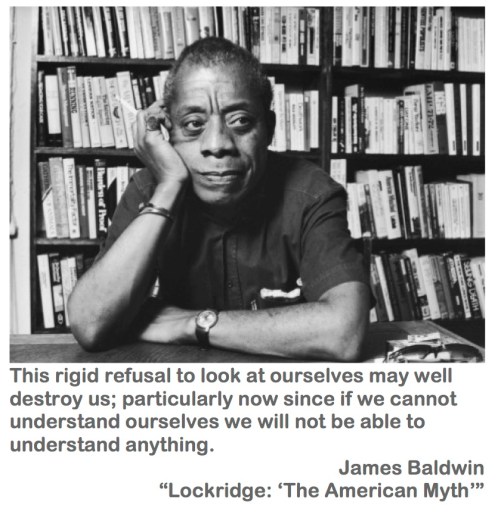
plthomasedd's avatarReconsidering James Baldwin in the Era of #BlackLivesMatter

First-year students face a tremendous challenge and learning curve related to the essay.

High school has too often left students with an inauthentic and narrow view of the essay as a template; mechanical and scripted—the introduction, the thesis sentence, the body paragraphs, and the conclusion.

College writing and ultimately academic/scholarly writing as well as essay writing beyond the walls of academia are all far more nuanced and complex than the template essay, which is practiced almost nowhere by writers and which almost never serves as a transition or foundation for authentic writing.

James Baldwin offers a powerful model for essay writing since he was primarily a literary writer, a writer of fiction, who also wrote compelling and highly crafted essays and non-fiction—often blurring modes and genres as he worked in the field of journalism.

Essays often share some aspects of mode (narration, description, exposition, argument), citation and use of sources and research…

View original post 173 more words

The Irony and the Dishonesty: Revisiting 1999

First, let’s do the irony: Think outside box inside S.C. classrooms by SC’s executive director of StudentsFirstSC (a political journeyman, and never an educator) is the least outside the box commentary you can read.

The least.

Propaganda and baseless claims from a deceptive organization—this is what we face in SC:

  • “The key is developing real-world solutions to help students learn, regardless of the hurdles they face outside of the classroom.” No. This is a harmful and failed approach. We need to address inequity in children’s lives and in their schools. Asking children to pretend their real lives don’t exit while they happen to be in school is cruel.
  • “Quality teachers should have the freedom to fully use their passion to fuel innovation within their classrooms.” Hint at this sham Op-Ed: “innovation.” A hollow “business” term that means nothing.
  • “A great example of innovation is happening right here in Charleston. As recently highlighted in The Post and Courier last week, Meeting Street Elementary at Brentwood is a local, public-private partnership. In a short time, this school has achieved remarkable results—setting challenging goals for students and working to help them achieve more.” There remains no proof of these claims except by MSE advocates and those who benefit from such claims.
  • “South Carolina’s embrace of educators from Teach for America is a step in the right direction for our state.” TFA is de-professionalizing teaching, has failed as a sham organization, and has seen its popularity significantly decline because of the harm the program does to its recruits and the students they teach.
  • “Bradford Swann is executive director of StudentsFirstSC, a non-profit, membership- based organization working to ensure all students have access to great teachers and a quality education, regardless of the ZIP code in which they live.” This is a pollitical propaganda organization that has no credibility—begun by the thoroughly discredited Michelle Rhee and run by political want-to-be’s.

StudentsFirst churns out the same Op-Eds all over the U.S.—piling on lie after lie in the seemingly never-ending parade of dishonesty in education reform.

Quite disturbing, however, is that this sort of dishonesty has been refuted for decades. For example, I published a piece in 1999, predicting and addressing this exact phenomenon.

A New Honesty in Education—Positivist Measures in a Post-Modern World addressed virtually every element of the recurring Op-Eds by StudentsFirst minions and other edureform robots.

Let me catalog a few here, and, again, this is from 1999 (all directly quoted from the article, with some emphasis added):

  • The debates swirling around education never stray too far from the fore-front of key concerns for Americans. In South Carolina, for example, education grew to be a central issue of the 1998 governor’s race—the arguments centering on the lottery and video poker versus vouchers and high standards for teachers and students. Concurrent with the political season, The Atlantic ran a feature article on education—Nicholas Lemann’s “‘Ready Read!'” applauding Robert E. Slavin’s Success for All reading program. Both the South Carolina governor’s race and the Lemann article epitomize a central aspect of the current educational debate—dishonesty. That dishonesty runs through almost all the educational discourse within political arenas; such dishonesty grows from the clash inherent in the power of positivist measurements—primarily through standardized testing—within a culture that is concurrently influenced by post-modern perspectives.
  • Since the rise of Taylorism at the turn of the century, education has been driven by a belief in empirical data, the belief that we can objectively generate data from standardized tests to assess both individual students and entire educational systems (Kliebard, 1995, pp. 81-82).
  • We must be honest about textbooks and curriculum programs, we must be honest about standardized testing, we must be honest about the nature of educating, and we must be honest with our students in the classroom.
  • Gerald W. Bracey (1997) and Herbert M. Kliebard (1995), among others, have noted that throughout the 20th century, the American educational debate has been rife with dishonesty when it benefited both politicians and educators.
  • They touted higher standards for teachers (including a new testing format that would reward existing teachers with a bonus if they would take the test and would raise the score needed to gain initial certification); higher standards and a stricter, more scope-and-sequenced curriculum; and choice in education driven by vouchers.
  • Lemann clearly embraces a belief in empirical data, a belief that schools should produce workers, and a belief that teachers should get out of the way of a content-rich prescribed curriculum.
  • Soon politicians will realize (some already have) that if a test is designed first, and if that test dictates a prescribed curriculum that can be scripted, and if teachers can be forced to train students along that and only that curricular course, tests scores will increase, the public will be pleased (though horribly fooled), and the politicians’ careers will have been boosted.
  • Educators must acknowledge that we are increasingly overwhelming students, primarily because too many factions contribute to the educational mix—parents through school boards, politicians through legislation, publishers through textbooks, and educators as practitioners. Prescribed curriculum guides, statewide standards, and textbooks often create a monster too large for either teachers or students to handle.
  • A second area for educators to attack vigorously and honestly is the standardized test.
  • We must assert honestly that education is still not good enough; it never will be.
  • Students leaving third or fourth grade as independent and willing readers will benefit more from their educational experience than our current focus on third graders taking a wide range of standardized tests that do not force the students to produce anything, except merely to bubble.
  • Clinging to that which is easily transferred to the student, that which is most manageable to assess, is the most morally and educationally bankrupt behavior existing in education.

Sound familiar? These warning from almost two decades ago?

The StudentsFirst playbook is predictable, but it is also tired and thoroughly disproven.

I begged for a new honesty in education as I taught in public schools throughout the 1980s and 1990s.

When will political leaders, the media, and the public choose to listen to educators and not con artists out for their own political gain? [1]


[1] Yes, I know, a very hollow questions in the 2016 presidential election.

How We Live, How We Die: On Touch, Intimacy, and Loneliness

“One day in April—” begins John Gardner’s tour-deforce short story, “Redemption,” “a clear, blue day when there were crocuses in bloom—Jack Hawthorne ran over and killed his brother, David.”

A farming accident comes to define Jack, who at 12 decides he is evil and, as a result, removes himself from all of humanity, especially his remaining family—the parents being particularly devastated by the death of the seven-year-old David.

Gardner’s story guides the reader through Jack’s hell, which is not the accidental killing of his brother but ostracizing himself from human contact, human interaction, the intimacy of others.

And as powerfully as he crafts the first sentence, Gardner ends the story symbolically: “Then the crowd opened for him and, with the horn cradled under his right arm, his music under his left, he plunged in, starting home.”

Beautifully and tenderly, but without sentimentality, the story ends with “home,” and marks Jack’s redemption as his return to necessary community of other people, notably his family, in order to be fully human, in order to live.

#

As a high school English teacher, I was fortunate to teach advanced students American literature during their sophomore year and then have the same students again in Advanced Placement Literature their senior year. We read and studied Gardner’s “Redemption” in 10th grade, and it laid important groundwork—the power of craft as well as the central themes—for investigating Margaret Atwood’s The Handmaid’s Tale.

Atwood’s speculative fiction, a dystopian novel, focuses on Offred (June) as the titular handmaid of the tale about a not-so-distant future in which a theocracy arises out of the militant overthrow of the U.S.

Offred (June) is forced into isolation as a handmaid: fertile women assigned to Commanders and designated to repopulate the theocracy, the Republic of Gilead.

Without her husband and daughter, and sequestered in the Commander’s home until each Ceremony (intercourse with the Commander while lying back between the legs of the Commander’s wife) intended to impregnate her, Offred (June) confesses:

Or I would help Rita make the bread, sinking my hands into that soft resistant warmth which is so much like flesh. I hunger to touch something, other than cloth or wood. I hunger to commit the act of touch. (p. 11)

Her loneliness gnaws at her throughout the novel, which includes a recurring motif of touch:

I wanted to feel Luke [her husband] lying beside me. I have them, these attacks of the past, like faintness, a wave sweeping over my head. Sometimes it can hardly be borne. What is to be done, what is to be done, I thought. There is nothing to be done. They also serve who only stand and wait. Or lie down and wait. I know why the glass in the window is shatterproof, and why they took down the chandelier. I wanted to feel Luke lying beside me, but there wasn’t room. (p. 52)

For Offred (June), to touch is to live, and to be denied touch is to die—drawn as she is to suicide.

Later, she admits while recalling “[l]ying in bed, with Luke, his hand on my round belly”:

If I thought this would never happen again I would die.

But this is wrong, nobody dies from lack of sex. It’s a lack of love we die from. There’s nobody here I can love, all the people I could love are dead or elsewhere. Who knows where they are or what their names are now? They might as well be nowhere, as I am for them. I too am a missing person. (p. 103)

Touch, intimacy, love—these are essential for being fully human, to live.

Ultimately, this lack of touch, intimacy, drives Offred (June) past her own humanity to a violent inhumanity as she fantasizes:

I think about how I could approach the Commander, to kiss him, here alone, and take off his jacket, as if to allow or invite something further, some approach to true love, and put my arms around him and slip the lever out from the sleeve and drive the sharp end into him suddenly, between his ribs. I think about the blood coming out of him, hot as soup, sexual, over my hands. (pp. 139-140)

An inverse of Jack’s killing his brother driving him to believe himself evil and to isolate himself from others, Offred (June) suffers a forced seclusion that breeds at least disturbing urges toward murder.

And as she confronts, becoming a “missing person.”

#

“American men,” writes Mark Greene, “in an attempt to avoid any possible hint of committing unwanted sexual touch, are foregoing gentle platonic touch in their lives. I’ll call it touch isolation.” [1]

Greene offers a historical perspective on the culturally shifting attitudes toward platonic touching between men that has been rendered taboo due to the rise of homophobia in the twentieth century. Greene also notes how touch is common between adults and babies, but for boys, that intimacy is gradually replaced “with the introduction of [a] ‘get tough’ narrative.”

Addressing the taboo of touch in schools, Jessica Lahey asks, Should Teachers Be Allowed to Touch Students?:

The sensory experience of touch can’t be divorced from the emotional experience, [David J. Linden] explained, because the way humans perceive touch depends on its social context. An arm thrown over your shoulders by a domineering boss is perceived very differently than an arm thrown around your shoulders by a trusted friend, for example. “The sensation is perceived differently because the emotional touch centers in the brain are receiving signals about social nuances, even if the touching is identical,” and these nuances, Linden explained, are one of the reasons it’s so hard for schools to create rules governing touch.

And then, my colleague, Melinda Menzer, English professor and avid swimmer, blogged about searching the “swim” category in the menu of Sports Illustrated:

When I see the word “swim” on a sports website, I expect to find coverage of the sport of swimming. I’m crazy like that. But if you know anything about Sports Illustrated or their annual swimsuit edition, you can guess what I found: photos of models in bikinis, sitting on beaches and lounging in meadows and perching in groups on convertibles, but none of them actually swimming.

Further, she muses about her experiences with people talking about being hesitant to swim:

The whole matter wouldn’t be worth mentioning except that I know people — many people — who tell me that they don’t swim or that they feel uncomfortable swimming because they don’t want to be looked at.

It makes me very sad. I love swimming. I would like other people to love swimming. But these people don’t swim. And they are not unusual; Body Positive Athletes reports, “93% of people have identified a fear of judgement about their size, shape, or level of fitness as a barrier to starting physical activity.”…

I don’t know how to make uncomfortable people feel comfortable about putting on a swimsuit, how to combat our obsession about how we look and how other people look.

From touch taboos to paralyzing body image phobias—is this not the tyranny of the Puritanical James Baldwin deplored?

Are there not messages here about the power of radical love (self-love, love of others) that Baldwin dramatizes in Tell Me How Long the Train’s Been Gone?:

[S]ome moments teach one the price of the human condition: if one can live with one’s pain, then one respects the pain of others, and so, briefly, but transcendentally, we can release each other from pain.

There is a sadness to these questions, ones that remain with Baldwin’s words echoing in the background—words that seem not to touch us.

In his All Those Strangers: The Art and Lives of James BaldwinDouglas Field turns to Baldwin’s “Nothing Personal,” where Baldwin too seems resigned: “I have always felt that a human being could only be saved by another human being. I am aware that we do not save each other very often” (p. 98).

In “Freaks and the American Ideal of Manhood,” Baldwin acknowledges, “This rage for order can result in chaos, and in this country chaos connects with color” (p. 827). And then:

Freaks are called freaks and are treated as they are treated—in the main, abominably—because they are human beings who cause to echo, deep within us, our most powerful terrors and desires.

Most of us, however, do not appear to be freaks—though we are rarely what we appear to be….

We are part of each other. (p. 828)

“[O]ur most powerful terrors and desires,” then, found in all we do not touch, cannot touch, and thus, loneliness.

#

Being Single Is Hard, writes Emma Lindsay.

In her confession about the challenges of being single, Lindsay is eventually drawn to touch:

But anyway, the part I actually find hard about being single is that I never get touched, and this is always overlooked and undervalued. This is where the myth of self sufficiency breaks down.

And here she begins to interrogate both language and the Puritanical roots of the U.S. Like Offred (June), Lindsay challenges the simplistic blurring of sex and intimacy, grounded in touch:

In fact, some of my friends started complaining that I was too independent (I swear, I can’t win) but, at the end of the day, I can’t touch myself. Or, I can touch myself, but it doesn’t have the same impact as when someone else touches me.

Did you chuckle to yourself when you read that because it sounded like I was talking about masturbation? That’s not a coincidence. That is part of the problem.

We don’t even value platonic touch enough for it to exist in our lexicon without a sexual overtone.

“I’m talking about affectionate touch,” Lindsay emphasizes. “And, it is completely reasonable to be afraid of not getting that.” And then she concludes: “Touch matters so much. Why do we keep acting like it doesn’t?”

#

Lindsay’s essay brought me to Baldwin and back to my high school students.

As we discussed The Handmaid’s Tales, one of the topics was the connection between words and the act of making ideas or actions taboo.

I would ask students what word(s) we used for men with many sexual partners, and usually “stud” or similar words were mentioned—and that these words connoted something positive, an accomplishment, a “score.”

I followed with what word(s) we use for women with many sexual partners, and we had many—”slut,” whore,” “tramp.” These, of course, are all negative, about the act of sex defiling the woman, ruining her (by implication “for other men”).

“i like my body when it is with your/body,” writes e.e. cummings in one of his many explicit and beautiful poems that celebrate love, sex, and intimacy without the taboos that render us unable to live, to be fully human. This is a celebration of the flesh otherwise demonized and shunned by social norms and religious dogma:

i like your body. i like what it does,
i like its hows. i like to feel the spine
of your body and its bones, and the trembling
-firm-smooth ness and which I will
again and again and again
kiss, i like kissing this and that of you

To touch, to be touched—gifts offered between and among, whether sexual, platonic, or unidentifiable intimacy.

We mortals in the flesh are only fully human in the flesh, pressed against the one we love so that we both may live.


[1] Adapted from an earlier blog post On Touch, Loneliness, and James Baldwin’s Radical Love 

Educators, Be Neither Martyrs, Nor Missionaries

While discussing with a colleague strategies for responding to first-year students’ essays, I stressed the importance of giving students feedback, but only when students are required to respond to that feedback in some way—such as revising essays.

My standard line on this is: “Don’t be a martyr.”

In other words, too often educators work long and hard just to work long and hard—without monitoring if and how that work translates into student learning.

Teaching writing and handling the paper-load are incredibly demanding teaching tasks even when done efficiently.

Earlier that same day in my foundations class, a student raised a question about Teach For America—leading to my pointed criticisms and rejection of TFA. Much of my concerns about TFA are grounded in the program’s attracting young, smart, and idealistic college graduates and then using their “missionary zeal” in dehumanizing ways that negatively impact TFA recruits and their students.

Just this morning, I noticed Walt Gardner treading on the same topics, asking Is Martyrdom Necessary to Improve Schools?

Historically and currently, teaching cannot be separated from the broader sexism and misogyny in the U.S. Most K-12 teachers continue to be women, and in many subtle and blunt ways, teaching is burdened by sexist stereotypes and expectations.

While women labor under social pressures to be subservient wives and sacrificial mothers, teachers also feel compelled—and often perpetuate themselves—the twin burdens of martyrdom and missionary zeal.

Paradoxically, TFA as a non-traditional source of teachers is the most extreme example of why all educators must resist being martyrs or missionaries.

Two excellent works of scholarship—one by Sarah Matsui and one edited by T. Jameson Brewer and Kathleen deMarrais—investigate how TFA exploits the idealism of recruits (often framed positively by TFA as “missionary zeal”) and then demands martyrdom from these young and idealistic candidates, made even more disturbing since the program depends on only 2 years of service, thus creating an expendable revolving door of teachers in the field.

Despite the warranted criticisms of TFA by traditional teacher education and critical scholars, we must not ignore that these demands of TFA core members are disturbingly common among traditional teachers as well—some from the norms of teaching, and some among teachers themselves. And demands that teachers be martyrs and missionaries have been intensified over the past thirty years of accountability as political and public discourse has increasingly blamed teachers for low test scores among impoverished and minority students.

Let’s consider, then, why both martyrdom and missionary zeal are the wrong poses of any educators.

Broadly, crisis discourse about school and teacher quality that marginalizes and ignores social factors—such as poverty—driving measurable learning outcomes works to justify extreme and impossible expectations for teachers. However, education is not in crisis, but is an incremental process over a long period of time.

Yes, ER doctors often work in crisis conditions, and having extreme expectations for their profession may be appropriate, but education requires patience and the fostering of relationship over time.

Impoverished and minority students are being mis-served far more significantly from cumulative neglect—limited access to challenge courses and experienced/certified teachers—than from urgent harm (although, regretfully, some students still are exposed to such harms).

That cumulative neglect does not need martyrdom nor missionary zeal—both of which, ultimately, are damaging, psychologically and physically, for teachers directly and then their students indirectly (see Matsui).

While many with professions identify themselves strongly with their professions, especially teachers, allowing your profession to consume you (martyrdom) is self-defeating—just as missionary zeal as extreme idealism will ultimately be deflating.

Having idealism and lofty goals are powerful. And while fatalism is corrosive, having unattainable and unrealistic goals-as-demands is just as destructive.

Both martyrdom and missionary zeal are often grounded in good intentions, but as Paul Gorski explains, good intentions cannot justify harmful and misguided practices.

And finally, missionary zeal like colonialism ultimately fails students because, Gorski argues, “despite overwhelmingly good intentions, most of what passes for intercultural education practice, particularly in the US, accentuates rather than undermines existing social and political hierarchies.”

As I offer my beginning and early teachers, teaching is an evolving practice—it is about baby steps.

Ultimately, educators must resist martyrdom—working long and hard just to show we are working long and hard—and must reject missionary zeal, particularly in our work with vulnerable populations of students.

Our profession and our students will be better served if we are fully and richly human, diverse in who we are and how we be. To teach is to more forward carefully, with purpose, and intentionally.

Let us leave martyrdom to the mythologies and missionary zeal to a history we have learned to rise above.