Category Archives: grade retention

Think Tank Advocacy Reports Not Credible for Education Policy: SC Edition

The Palmetto Promise Institute‘s report authored by Adam CrainMoney doesn’t translate into student results, is a follow-up to their 2013 report also comparing South Carolina education to Florida education reform.

Although this report offers several charts detailing an analysis of SC and FL National Assessment of Educational Progress (NAEP) tests data (some of which is aggregated by race, disabilities, and poverty, but focusing on 4th grade reading), the report proves to be overly simplistic and an incomplete picture of student achievement in both states—with the ham-fisted data analysis serving as a thin veneer for advocacy unsupported by valid research and a more nuanced analysis of data.

In short, this report proves to be significantly inadequate evidence to support the ideologically-driven recommendations offered at the end—recommendations this conservative think tank would make regardless of the evidence (mostly a mishmash of school choice policy). There simply is no credible link between the shallow analysis of SC/FL NAEP scores and the call for policy as solutions to the manufactured problems.

Let me outline here both the flaws of the data analysis and then the folly of the recommendations.

The foundational flaw of both reports is suggesting some sort of value in comparing SC to FL and the persistent but discredited claim that FL has successful education reform. In fact, the so-called Florida “miracle” has been strongly refuted, notably its grade-retention policy based on high-stakes test scores.

By comparison, SC is slightly more impoverished than FL, and SC (27%) has a higher percentage than FL (16%) of blacks (both metrics used in the report analysis). However, this report from PPI makes no effort to show how their raw comparisons are actually apples-to-apples, or valid.

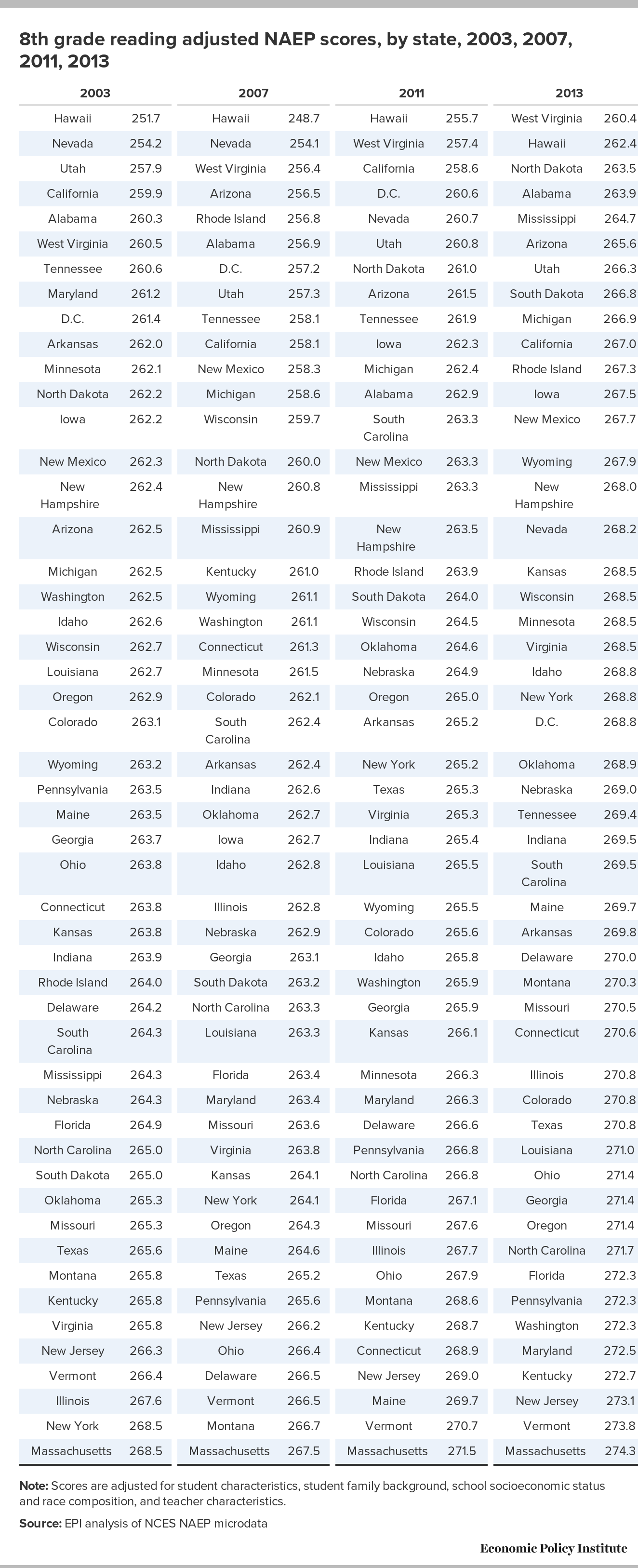
Another analysis of NAEP data that adjusts for factors impacting test scores reveals a much more nuanced and important picture, one that exposes a huge flaw with the FL model of reform [1] and depending on test data.

While adjusted trend data on NAEP continues to show 4th grade FL reading scores better than SC scores, by 8th grade (see Table 6B1, 2013 data) SC (269.5) and FL (272.3) have nearly identical adjusted scores.

Here is a key point about FL’s retention policy: Retaining students can inflate short-term test data, but those gains erode over time. Further, grade retention [2] maintains a strong correlation with students dropping out of school and an inverse correlation with students receiving a diploma (see Jasper, 2016 [3]).

Ultimately, the data analysis and charts in this report are overly simplistic on purpose because PPI has an agenda: argue against increased school funding and promote school choice.

The report uses bold face, lazy math, and insufficient statistical methods to dramatize a baseless claim: “Simple funding comparisons indicate quite the opposite. Over the twelve year period between 1999 and 2011, South Carolina spent a total of $6,920 more per student, or an average of $692 per year.

Without proper statistical analysis, using controls and making causal claims, this raw data approach, like the NAEP analysis, means almost nothing.

The body of educational research, in fact, shows that funding does matter (see Baker, 2016) [4].

Both, then, the NAEP analysis and the related argument that SC school funding is somehow excessive/wasteful are statistically inadequate and useless for making the recommendations at the end of the report.

Those recommendations fall into two broad categories: accountability and school choice.

SC and FL jumped on the accountability bandwagon early, about three decades ago, and remain completely unsatisfied with their educational outcomes, despite huge amounts of tax dollars and immeasurable time spent on ever-new standards and ever-new high-stakes tests.

Calling for accountability ignores the research base that shows accountability based on standards and testing has failed, will continue to fail:

There is, for example, no evidence that states within the U.S. score higher or lower on the NAEP based on the rigor of their state standards. Similarly, international test data show no pronounced tests core advantage on the basis of the presence or absence of national standards. Further, the wave of high-stakes testing associated with No Child Left Behind (NCLB) has resulted in the “dumbing down” and narrowing of the curriculum….

As the absence or presence of rigorous or national standards says nothing about equity, educational quality, or the provision of adequate educational services, there is no reason to expect CCSS or any other standards initiative to be an effective educational reform by itself. (Mathis, 2012)

The evidence on school choice also contradicts the report because choice fails to increase student achievement, but it is strongly associated with increasing segregation and inequity (see here and here).

Let’s summarize the major points of the report:

  • The report claims SC lags FL in academic achievement and education reform while spending more per pupil. However, the analysis offered here is an incomplete picture and statistically flawed. None of the claims made in the report are proven, and more nuanced and longitudinal analyses of NAEP greatly erode the premise of PPI’s report (grounded also in the debunked Florida “miracle” claim).
  • The report’s major recommendations about school funding, accountability, and school choice are all strongly contradicted by the research base, which the report fails to acknowledge.

Ultimately, as a colleague responded when I shared this report, PPI has published “a five page Op-Ed with bar graphs,” and I would add, not a very good one at that.

SC should in no way be influenced by this report when making education policy.

However, SC should heed a kernel the report’s conclusion: “The disparity between the stewardship of resources in Florida and our struggling education system in South Carolina is apparent.”

As I have detailed, while most educational rankings and comparisons prove to be hokum, what evidence from our schools and reform policies shows is that SC ranks first in political negligence.

Ironically, this report is calling for more negligence in the pursuit of market ideology.


[1] See evidence discrediting Florida “miracle” and FL’s reading policyhow SC could benefit from looking at Oklahoma, not FL; and why FL reform is harmful for students and literacy.

[2] See the National Council of Teachers of English’s Resolution on Mandatory Grade Retention and High-Stakes Testing:

Grade retention, the practice of holding students back to repeat a grade, does more harm than good:

  • retaining students who have not met proficiency levels with the intent of repeating instruction is punitive, socially inappropriate, and educationally ineffective;
  • basing retention on high-stakes tests will disproportionately and negatively impact children of color, impoverished children, English Language Learners, and special needs students; and
  • retaining students is strongly correlated with behavior problems and increased drop-out rates.

[3] Jasper’s abstract captures the ultimate failure of FL’s reform:

In 2003-2004 approximately 23,000 third graders were retained in Florida under the third grade retention mandate outlined in the A+ Plan. Researchers in previous studies found students who were retained faced difficulty in catching up to their peers, achieving academically, and obtaining a high school diploma (Anderson, Jimerson, & Whipple, 2005; Andrew, 2014; Fine & Davis, 2003; Jimerson, 1999; Moser, West & Hughes, 2012; Nagaoka, 2005; and Ou & Reynolds, 2010). In this study I examined educational outcomes of students retained in a large southwest Florida school district under the A+ Plan in 2003-2004. I used a match control group, consisting of similarly nonretained students, who scored at level one on the Grade 3 Reading FCAT. I then compared the control group to the retained group. I also compared achievement levels on the Grade 10 Reading FCAT of the retained and non-retained group. I evaluated longitudinal data, for both the retained and non-retained students, and found 93% of the retained students continued to score below proficiency (below a level 3) seven years after retention on the Grade 10 Reading FCAT as compared with the 85.8% of the non-retained students. I also compared standard diploma acquisition of the retained and non-retained group. The non-retained group was 14.7% more likely to obtain a standard high school diploma than the retained group. Finally, I used data from previous studies to extrapolate economic outcomes.

[4] Baker’s analysis has key points detailed in the Executive Summary (p. i):

baker funding 2016.png

Questions for the P&C about School Closure, Takeover

The Post and Courier (Charleston, SC) has taken an editorial stand in favor of closing a high-poverty, majority-minority school and a private takeover of public schools in Charleston (see a history of the debate here).

Now, a P&C editorial asks more questions:

How many classes of children should come up through the school’s failing system before the district makes some big changes?

Another question: Don’t those children deserve to try an educational approach that has proven to be far more successful?

Since turn about is fair play, let’s investigate those questions and ask a few in return.

At the very least, these questions are loaded, and as a result, misleading.

Burns Elementary (to be closed) is framed again as “failing,” and the Meeting Street Academy, “successful.”

As I have documented, many problems exist with the “good”/”bad” school labeling.

But in this case, we must be extra skeptical because all of the praise for the “successful” and the promises of even more success in “closing the achievement gap” for poor and mostly black students rest on the claims of the private entities invested in this process.

So there are actually some very important questions that the editors at the P&C are failing to ask:

  • Why have some students been allowed ever to languish in school conditions that are subpar when compared to vibrant schools and opportunities for other students in the same city? Burns Elementary with a poverty index of 96 is but one school that represents a long history in SC of how negligent we have been as a state in terms of providing anything close to equity in the opportunities poor and racial minority children are afforded.
  • Why does any public school board need a private partnership to do what is needed to offer these students the sort of school all children deserve? If what is needed is so obvious, and so easy to do (which is a subtext of the editorial), the truth is that the school board simply does not have the political will to do what is right for some children.
  • And this is very important: What third party, not invested in the Meeting Street Academy, has examined the claims of academic success in the so-called “successful” schools that are being promised as fixes for Burns? I cannot find any data on test scores (setting aside that test scores aren’t even that good for making these claims), but I have analyzed claims of “miracle” charter schools in SC—finding that these claims are always false. Always. I do not trust that Meeting Street is going to prove to be the first actual miracle school in a long line of those that have been unmasked before.

This last question cannot be overemphasized because the political process has proven time and again that political leadership can be easily bamboozled by glitzy claims but routinely fail to examine the evidence that would guide well our educational policy, as Christopher Lubienski, Elizabeth Debray, and Janelle Scott have revealed:

But what was perhaps most interesting was the degree to which research played virtually no part in decision making for policymakers, despite their frequent rhetorical embrace of the value of research. While many interviewees spoke of the importance of research evidence, nearly all were unable to point to an instance where research evidence shaped their position on an instrumentalist issue.

SC political leaders have pushed for school choice, charter schools, VAM evaluations of teachers, ever-new standards and high-stakes testing, exit exams, third-grade retention, and now takeover policies for so-called “failing schools”—yet all of these have no basis for policy in the body of research refuting the effectiveness of each one.

For the editors of the P&C, as well as our political leaders and the public, the real questions are why do we persist in ignoring the stark realities of our inequitable society, why do we then continue to play politics with our schools that are just as inequitable as our society, and then why do we refuse to consider the evidence about addressing social and educational inequity directly in our policies?

Again, as I have stated many times, the answer is that the people with the power to change things simply do not really care about change because any change can threaten their perches of power.

Closing schools, renaming schools, shuffling students—these are the practices of those who are invested in the status quo regardless of the consequences for “other people’s children.”

Outliers Never Evidence of Normal in Education

In Money, Race and Success: How Your School District Compares, the NYT, like most of mainstream media, is begrudgingly coming to admit that race and class inequity in the U.S. has a profound impact on the education of children—and that simply tinkering (badly) with school policy is not enough to change that reality:

We’ve long known of the persistent and troublesome academic gap between white students and their black and Hispanic peers in public schools.

We’ve long understood the primary reason, too: A higher proportion of black and Hispanic children come from poor families. A new analysis of reading and math test score data from across the country confirms just how much socioeconomic conditions matter.

Children in the school districts with the highest concentrations of poverty score an average of more than four grade levels below children in the richest districts.

But then there is this:

The data was [sic] not uniformly grim. A few poor districts — like Bremen City, Ga. and Union City, N.J. — posted higher-than-average scores. They suggest the possibility that strong schools could help children from low-income families succeed.

“There are some outliers, and trying to figure out what’s making them more successful is worth looking at,” said Mr. Reardon, a professor of education and lead author of the analysis.

Well, no, if we find outliers—and virtually all data have outliers in research—we should not waste our time trying to figure out how we can make outliers the norm.

The norm is where we should put our efforts in order to confront what is, in fact, not “puzzling” (used earlier in the article) at all; the data are very clear:

What emerges clearly in the data is the extent to which race and class are inextricably linked, and how that connection is exacerbated in school settings.

Not only are black and Hispanic children more likely to grow up in poor families, but middle-class black and Hispanic children are also much more likely than poor white children to live in neighborhoods and attend schools with high concentrations of poor students.

Our great education reform failure is one of failing to rethink our questions and our goals.

Let’s stop trying to find the “miracle” in a rare few schools where vulnerable students appear to succeed despite the odds against them. With time and careful consideration, we must admit, those appearances almost always are mirages.

Let’s instead put our energy in eradicating the poverty, racism, and sexism that disadvantages some students, vulnerable populations easily identified by race and social class, so that we can educate all students well.

And while we are making efforts at social policy, let’s end the in-school policies that we know “exacerbate” inequity: tracking, teacher assignments (and TFA), high-stakes testing, grade retention, discipline policies grounded in zero tolerance and “no excuses,” and segregation through school choice (including charter schools).

Education reform, as was highlighted in the original court case examined in the South Carolina documentary The Corridor of Shame, is obsessed with playing the hero by seeing who can pull the most babies out of the river.

And then examining the ones who survive the potential drowning in order to “make” all babies survive the trauma of being cast down stream.

But no one seems interested in walking upstream to stop babies being thrown in.

Life and learning do not need to be something children survive—and we must confront that we have decided that this is exactly what we are willing to accept for “other people’s children.”

It would not be so if we believed and acted upon that “they’re all our children.”


The Allegory of the River

How Good Is the Best Edujournalism?

A recurring theme running through my blog posts—one that could be addressed daily—is that education journalism is almost always significantly misleading and way too often completely inaccurate.

Mainstream media and journalists are trapped in false but compelling narratives about schools, learning and teaching, children, poverty, and race. Journalism itself fails education as a field because of a simplistic “both sides” to a rather cartoonish “objective” journalism.

As I have detailed too often, media coverage of education includes primarily voices and perspectives of people with no or very little experience or expertise in education, but when a few contrary perspectives are offered, those are typically framed as “some critics”—with no effort to establish which claims are credible or not.

Sadly, the best unmasking of the essential failure of the media has been by one of our faux-media comedians, John Oliver, who highlighted that even if there are two sides to an issue, one can be overwhelmingly credible while the other is mostly baseless; therefore, placing them as one-versus-one misleads the public on the weight of the arguments.

So when I received yet another email from the Education Writers Association (EWA)—who is extremely proud of itself—announcing their top award for education reporting, I wondered: How good is the best edujournalism?

The EWA Fred M. Hechinger Grand Prize for Distinguished Education Reporting was awarded for Failure Factories (The Tampa Bay Times), written by Cara Fitzpatrick, Lisa Gartner and Michael LaForgia. The series includes the following:

Without question, this series is comprehensive and it confronts some incredibly important issues about public schooling: the significant relationship between race/poverty and student achievement; the plague of segregation and resegregation in public institutions such as schools; and the huge inequities of education faced by racial minorities and impoverished students such as teacher assignments, school safety, funding, and discipline practices.

And while the series does a solid job of raising these issues, my first response is that these are all old news—I mean very old news.

That our public schools have failed poor and black/brown students is a recurring message over the last century—little different before or after the Civil Rights movement.

Therein lies a real problem with even the so-called best edujournalim—journalists without a historical lens afforded those with expertise in a field are ripe to fall prey to the lens of a novice.

One such failure of this series and then how the EWA praised the series can be found in the quoted judge’s comment:

Bravo to this team and the paper for taking an all-too-common story (low achievement in a high-poverty area) and digging past the excuses to reveal a shameful history of indifference and, most troubling, willful neglect. I was awed by the dogged reporting, the sheer volume of interviews and data-crunching, and the courageous analysis that put the blame exactly where it needed to be. But the true brilliance of this work is found in the stories of the children who were robbed of an education they deserved. How many other school districts in America might have the same story to tell?

The series title “Failure Factories” is but one of many triggers for the pervasive and ugly “no excuses” narrative that is all the rage in the U.S.

You see, once again, this series oversimplifies the story of educating vulnerable populations of students: racism and classism are merely excuses for the schools charged with high concentrations of vulnerable students.

And as the judge notes above, this is all about “blame”—and keeping the focus on those damn failing schools.

The shame is that without this corrosive and ugly framing, there is an incredible amount of work in this series that does deserve praise. We should be asking: Why do we need yet anther round of test scores to admit and confront race and class inequity—especially when high-stakes standardized testing itself is racist and classist?

The truth is that schools in the U.S. have never been, are not now, and never will be anything other than reflections of our society—unless we do things different in both our social and educational policy.

Yes, public schools almost entirely reflect and perpetuate the race, class, and gender inequities that remain powerful in our wider society, and much of that is embedded in the very reforms being championed in the media and among political leaders: accountability, standards, high-stakes testing, grade retention, zero tolerance policies, “no excuses” practices, charter schools, school choice, Teach For America, school report cards, value-added methods of teacher evaluation, and the worst of the worst—”grit.”

That is not simply a fact of the schools targeted by this series. That is a fact about public education across the entire country.

And many educators as well as education scholars have been yelling that for decades; that’s right—decades.

Possibly the most telling problem with the series is the end, where the condemnations of Arne Duncan and John King are treated as if they are somehow credible.

If this weren’t so tragic, it would be laughable—nearly rising to the level of an article in The Onion.

Therefore, here is a little message about the best of edujournalism.

Dear EWA:

Public schools have been reflecting and perpetuating the worst aspects of our society for over 100 years. People in power really don’t care, and politicians in the last three to four decades have learned that education policy is a powerful political football.

Since the Reagan administration, public schools have failed students even more significantly because of inane obsessions with accountability, standards, and tests.

Duncan and King are the personifications of all that is wrong with education policy: lots of soaring rhetoric masking policy cures that are part of the disease; thus, the accountability movement is intensifying race, class, and gender inequity—not overcoming it.

Racism, classism, sexism, and homophobia are never excuses, but facts, and these burdens are more than micromanaged and technocratic in-school only policies can address.

Yes, we need much more equitable school practices and polices—but none of what politicians are doing now meets those standards—and those alone will never accomplish what we seem to want without concurrent changes to public policy that also addresses equity.

Edujournalism, as well, is part of the problem because it remains trapped in false narratives, committed to simplistic “both sides” frames of issues, and unwilling to listen to the voices of the practitioners and scholars in the field of education.

Nearly everything addressed in “Failure Factories” was raised by novelist Ralph Ellison in a 1963 speech to teachers. Your best journalism is old news wrapped in a false frame and too often fumbled badly with good intentions.

I remain concerned that education-bashing journalism has become so lucrative for your flailing field that it is in fact as pressing that we address the journalism crisis as we do the need to significantly reform our public schools.

As agents of the public good, journalists and educators have a great deal in common that is being squandered; neither can afford as a field or in the name of that public good to remain the tools of those who have interests other than the public good.

We both can and should do better.

Are Racially Inequitable Outcomes Racist?

Among what may seem to be marginally related policies and conditions, these all have one startling thing in common—grade retention, school discipline, NCAA athletics, incarceration, “grit,” “no excuses,” zero-tolerance, high-stakes testing (such as the SAT and ACT), charter schools and school choice—and that commonality is observable racially inequitable outcomes that are significantly negative for blacks.

My own experiences with exploring and confronting race and racism through my public writing has shown that many people vigorously resist acknowledging racism and will contort themselves in unbelievable ways to avoid accepting facts and data that show racism exists.

Common responses include “I am not a racist,” “I am sure the people who started X didn’t intend to be racist,” “White people experience racism too,” and “Everyone has the same opportunities in this country.”

And while I continue to compile a stunning list of ways in which racial inequity and racism profoundly impact negatively black people, resistance to terms such as “white privilege” and “racism” remain robust.

In the wake of the NCAA Final Four, Patrick Hruby has attempted a similar tactic I have used in order to unmask the racial inequity in college athletics by carefully working readers through the evidence in order to come to an uncomfortable conclusion about the financial exploitation of college athletes (money-making sports being disproportionately black) by the NCAA and colleges/universities (leadership and those profiting being overwhelmingly white) along racial lines:

Understand this: there’s nothing inherently racist about amateurism itself. And there’s no reason to believe that its defenders and proponents—including current NCAA president Mark Emmert—are motivated by racial animus….

And yet, while the NCAA’s intent is color-blind, the impact of amateurism is anything but. In American law, there is a concept called adverse impact, in which, essentially, some facially neutral rules that have an unjustified adverse impact on a particular group can be challenged as discriminatory….Similarly, sociologists speak of structural racism when analyzing public policies that have a disproportionately negative impact on minority individuals, families, and communities. State lottery systems that essentially move money from predominantly lower-class African-American ticket buyers to predominantly middle-and-upper-class white school districts fit the bill; so does a War on Drugs that disproportionately incarcerates young black men; so does a recent decision by officials in Maricopa County, Arizona, to drastically cut the number of presidential primary polling stations in and around Phoenix, which unnecessarily made voting far more difficult for the residents of a non-white majority city.

Big-time college sports fall under the same conceptual umbrella. Amateurism rules restrain campus athletes—and only campus athletes, not campus musicians or campus writers—from earning a free-market income, accepting whatever money, goods, or services someone else wants to give them. And guess what? In the revenue sports of Division I football and men’s basketball, where most of the fan interest and television dollars are, the athletes are disproportionately black.

And herein lies the problem with refusing to equate racially inequitable outcomes with racism.

Hruby’s detailed unmasking of the NCAA comes also during the troubling rise of Trump in presidential politics—another marker for how many scramble to find any cause other than racism.

Trump’s rise is not exclusively the result of overt and unexamined racism, but a significant amount of his success is easily traced to a wide spectrum of racism.

However, from the rise of Trump to the so-called popularity of charter schools to the school-to-prison pipeline and to the spread of third-grade retention policies, all of these and more are fueled by racism because racism, we must acknowledge, is most insidious when it isn’t overt, when the racist person or the racist act is unconscious, unacknowledged.

The impact of racism in NCAA sports, as Hruby details, is the elegant racism Ta-Nahisi Coates unpacked when Donald Sterling became the NBA’s face for oafish racism (along with Clive Bundy in popular culture).

What has occurred in the U.S. since the mid-1960s is an end to placard racism, the end of “White Only” signs on bathroom and restaurant doors.

What has not occurred in the U.S. yet is an end to seeing black boys as significantly older than their biological ages, an end to tracking black children into segregated schools and reductive courses, an end to incarcerating black men—and this is a list that could go on for several pages.

Racial (and class) equity will never occur in the U.S. until the white power structure admits that racially inequitable outcomes are in fact racist.

White privilege is a powerful narcotic that numbs white elites to the harm that privilege causes black and brown people, but it is also a powerful narcotic that pits poor whites against black and brown people because poor whites believe their whiteness gives them the chance at great wealth held by only a few.

That the NCAA maintains a structure within which black athletes produce wealth enjoyed almost exclusively by white elites is an undeniable fact and a startling example of the elegant racism eroding the soul of a free people—an elegant racism eating at the roots of public education, the judicial system, the economic system, and nearly ever aspect of the country.

Racially inequitable outcomes are racist, and this must be admitted in order to be confronted and then to be eliminated.

Today in “Don’t Believe It”

More often than not, mainstream media and think tanks produce claims about education that are without credibility.

Sometimes the source is also lacking credibility, but many times, the source has good intentions.

Today in “Don’t Believe It,” let’s consider both types.

First, NCTQ—a think tank entirely lacking in credibilityissued a report claiming that teacher education is lousy, basing their claims on a fumbled review of textbooks assigned and course syllabi.

Don’t believe it because NCTQ bases the claims on one weak study about what every teacher should know, and then did a review of textbooks and syllabi that wouldn’t be allowed in undergraduate research courses.

See the full review here.

Next, despite genuinely good intentions, Kecio Greenho, regional executive director of Reading Partners Charleston, claims in an Op-Ed for The Post and Courier (Charleston, SC) that South Carolina’s Read to Succeed, which includes provision for third-grade retention based on high-stakes test scores, “is a strong piece of legislation that gives support to struggling readers by identifying them as early as possible.”

Don’t believe it because Read to Succeed is a copy-cat of similar policies across the U.S. that remain trapped in high-stakes testing and grade retention, although decades of research have shown retention to be very harmful to children.

See this analysis of Read to Succeed, the research base on grade retention, and the National Council of Teachers of English’s resolution on grade retention and high-stakes testing.

When you are confronted with claims about education, too often the source and the claim are without merit, but you have to be aware that those with good intentions can make false claims as well.

Dear Florida: Mean People Suck

Dear Florida:

I know it is impolite to use harsh language and teachers often discourage students from resorting to cliches, but I am hard-pressed to find anything better suited to my concern about education policy in Florida (and Mississippi, and South Carolina, along with another 10+ states) than reminding political leaders and the public in your state: Mean people suck.

And as disturbing as it is when adults are mean to adults, there simply is no way to justify adults being mean to children—or in the case of misguided and uninformed education policy in Florida (and Mississippi, and South Carolina), adults being mean to some children (mostly black, brown, and poor).

I take this opportunity to reach out to you, Florida, because there is a way out of this mean streak: Fewer 3rd-graders could be held back this year.

First, let me note that the avenue to a kind and equitable education system is not examining whether or not your (yet again) new high-stakes tests are valid, but recognizing that grade retention is discredited by a large body of research and grade retention is not a credible form of literacy policy.

Notably, the National Council of Teachers of English, the largest organization of English teachers in the U.S., has a clear position statement against grade retention based on high-stakes testing:

Resolved, that the National Council of Teachers of English strongly oppose legislation mandating that children, in any grade level, who do not meet criteria in reading be retained.

And be it further resolved that NCTE strongly oppose the use of high-stakes test performance in reading as the criterion for student retention.

As well, education policies such as grade retention linked to high-stakes testing disproportionately and negatively impact black, brown, and poor children.

Simply put, grade retention as a policy must be acknowledged as punishing children for the sake of punishing children.

None the less, Florida has become a flawed model for educational accountability across the U.S.

So, as a life-long educator in SC, where that model is now turning my home state into yet another place where mean people suck, I ask that Florida end grade retention and use your ill-got influence to start a new trend in education reform—one that rejects punitive education policy and chooses instead to treat all children with dignity, to provide all children an equitable opportunity to learn.

Confirmed: SC Implementing Retain to Impede

Residents of South Carolina have yet more evidence of the state’s inept history with education reform: The rush to model SC’s reading legislation on Florida’s failed policies has begun to fulfill my warning that Read to Succeed is better labeled Retain to Impede.

Nathaniel Clary, reporting for The Greenville News, has detailed, Read to Succeed fails its 1st test. What are the failures?

Clary ticks off the list:

And while communication lapses, missing training programs and a flubbed statewide test marked the first few months of the statewide Read to Succeed program championed by Gov. Nikki Haley last year, the threat still looms that third-graders could be held back starting in the 2017-2018 school year if they don’t measure up to the state’s reading standards.

These first failures include flawed implementation on top of the essential failures of replicating the discredited Florida model as well as ignoring a powerful body of research refuting grade retention.

Since SC passed reading legislation built on grade retention, the National Council of Teachers of English (NCTE), the largest organization of English teachers in the U.S., has taken a strong policy stand against the use of retention and high-stake testing in reading legislation:

Resolved, that the National Council of Teachers of English strongly oppose legislation mandating that children, in any grade level, who do not meet criteria in reading be retained.

And be it further resolved that NCTE strongly oppose the use of high-stakes test performance in reading as the criterion for student retention.

The evidence, then, is mounting that Read to Succeed is being implemented badly, but that does not justify this nod to optimism about the intent of the legislation and the election of a new state superintendent of education, Molly Spearman:

The intent of Read to Succeed is good, said Burke Royster, Greenville County Schools superintendent.

The tenor of Read to Succeed has changed significantly since Molly Spearman replaced Mick Zais as state superintendent of education, Royster said.

“I feel very positive that they’re going to address many of those issues,” he said.

We should all know the wise warning about good intentions, and at best, Spearman can oversee doing the wrong thing the right way—and that does not serve students or the state well.

Here, we are facing watershed moments, lessons that must be heeded if we are to shift directions in education policy. Those lessons include:

  • Education policy must be divorced from political compromise (a compromise between partisan political ideology and evidence-based policy is corrupted policy). Reading legislation built on grade retention and high-stakes tests is a testament to the failure of partisan politics in forming education policy, but SC’s legislation (as well as Florida’s) is also a story of how compromise cannot work since many sincerely supporting good literacy practice in the state simply relinquished on the grade retention element in order to secure more funding for reading. We must ask: How many children’s lives are we willing to ruin to gain more state funding of programs?
  • Intent behind education policy and even the details of education policy are irrelevant when that policy is actually implemented. This debacle with Read to Succeed is just a small version of the larger Common Core train wreck. To ask Superintendent Spearmen to right the implementation ship of this policy is falling well short of the need to scrap it, and then draft genuinely effective and credible reading policy for the state of SC.
  • Professional educators must stop sitting on the sidelines, stop hiding behind resisting being political, and then start flexing our professional muscle. There is no excuse for professionals to implement harmful policy that is not supported by research. Literacy educators need to stand up for best practice in literacy and their students.

Retaining children impedes their possibilities.

Decades of research on literacy and grade retention have shown us that fact, but partisan politics trumps evidence in education policy.

With these facts before us, what will we do?

What Are Evidence-Based Practices and Policies in Education?

The best laid schemes o’ Mice an’ Men
Gang aft agley,
An’ lea’e us nought but grief an’ pain,
For promis’d joy!

“To a Mouse,” Robert Burns

If John Steinbeck’s Of Mice and Men offers a fictional dramatization of Scottish poet Robert Burn’s dire warning in poetry, above, then the mangled federal education policy popularly known as No Child Left Behind (NCLB) may be a top candidate for real-world proof of Burns continuing to be right 230 years later.

Heralded as bi-partisan and bold, NCLB has been unable to manage its central directive: scientifically based policy and practice in education.

The wider accountability paradigm of education reform driven by standards and high-stakes tests and NCLB have proven to be failures, but with the reauthorization of ESEA (NCLB) now on the table, those failures provide ample evidence for how to move forward with education reform and policy.

A policy memo from NEPC now stresses the importance of making evidence-based decisions during reauthorization:

Kevin Welner and William Mathis discuss the broad research consensus that standardized tests are ineffective and even counterproductive when used to drive educational reform. Yet the debates in Washington over the reauthorization of the Elementary and Secondary Education Act largely ignore the harm and misdirection of these test-focused reforms. As a result, the proposals now on the table simply gild a demonstrably ineffective strategy, while crowding out policies with proven effectiveness. Deep-rooted trends of ever-increasing social and educational needs, as well as fewer or stagnant resources, will inevitably lead to larger opportunity gaps and achievement gaps. Testing will document this, but it will do nothing to change it. Instead, the gaps will only close with sustained investment and improvement based on proven strategies that directly increase children’s opportunities to learn.

First, to heal the damage done, we must admit those clear failures. Next, we must change course away from accountability, standards, and high-stakes tests. Finally, we must clearly identify the reasons for educational struggles and failures in order to embrace the best policies and practices to prompt genuine and effective reform.

That reauthorization process, the new reform agenda, and then the daily practice of running schools and teaching students must re-embrace evidence-based policies and practices, but not without clarifying exactly what that means.

Two powerful lessons about creating evidence-based policy and practice can be drawn from the NCLB era: (1) simply codifying and mandating policy and practice must be evidence-based do not make that occur, and (2) the National Reading Panel’s procedures and outcomes highlight that “evidenced-based” when politicized is just as subject to human whims and corruption as anything else.

The inevitable train wreck of the Common Core (doing the same thing over and over while expecting different results) can be avoided now if we learn from NCLB; otherwise, we continue a long history identified by Lou LaBrant, former president of NCTE, in 1947: “A brief consideration will indicate reasons for the considerable gap between the research currently available and the utilization of that research in school programs and methods.”

What Are Evidence-Based Practices and Policies in Education?

What counts as evidence has been the basis of stringent debate within the disciplines throughout the history of organized disciplines. In fact, that tension is how disciplines continue to seek knowledge, define themselves, and thus crawl closer and closer to the ultimate goal of Truth.

The two lessons noted above, however, show that once partisan politics are the process for mandating what counts as evidence, the credibility of that evidence is essentially destroyed.

Along with the National Reading Panel (NRP), A Nation at Risk demonstrated as a process how partisan political goals corrupt evidenced-based conclusions. The panel creating A Nation at Risk and the NRP had conclusions dictated first and then selected the evidence to reach those conclusions. Codifying what counts as evidence through a political process corrupts knowledge (and thus policy and practice) while forcing disciplinary debate about what counts as evidence to remain on the sidelines (and thus ineffective).

Briefly (and at the risk of oversimplification), the debates within fields over what counts as evidence tend to be between those embracing quantification and generalizability and those who who embrace qualitative data in order to raise and pursue essential questions.

In most disciplines, experimental and quasi-experimental (and thus quantitative) research has historically (and still currently) dominated those debates. The rise of qualitative research, however, has both expanded the disciplines and forced quantitative analysis of the world to address that reducing phenomena to numbers is both limited and limiting.

So the first problem with codifying what counts as evidence through the political process is that mandates (through legislation and funding) narrow and render static a process that must remain vibrant and organic in order to be effective.

For education as a discipline, then, the added political layer (again, think A Nation at Risk, NRP, or the USDOE) is the problem that mutes the already existing and rich professional organizations that have the needed knowledge base and guidelines for both how to teach students the disciplines and what to teach students within the disciplines.

Since it is difficult to clearly separate policy and practice in education, let me end with some concrete examples in order to give the bones of the question what counts as evidence flesh: corporal punishment, grade retention, and teaching reading.

Corporal punishment remains relatively common in parenting in the U.S., but it also lingers in schools in about a third of states. The American Psychological Association (APA), however, has a clear stand against corporal punishment based on over 60 years of evidence.

This represents one level of the needed relationship between government mandates and the disciplines as that informs education: When a professional field has a clear understanding of an issue, policy should reflect that stance. In other words, corporal punishment should be banned in public schools—not because some partisan political committee has studied the issue, but because the APA has done so and over a long period of time, while taking into consideration a wide and varied body of evidence.

A second level of the needed relationship between government mandates and the disciplines as that informs education is grade retention. Like corporal punishment research, grade retention research is robust and suggests that grade retention is mostly harmful. But at this second level, how the political process fails is strongly highlighted. Currently, states are mandating the opposite of what the research reveals (embracing high-stakes testing as a trigger for grade retention).

At this second level, based on the disciplinary evidence over a long period of time and built on a wide and varied body of evidence, grade retention must not be mandated, but not banned either. In cases such as grade retention, policy should caution against the practice, but allow that, as the research shows, some children may benefit from the practice, but professionals closest to those case are best for making that decision.

A third level involves daily classroom teaching of the disciplines; I’ll focus here on reading by highlighting whole language and balanced literacy.

Reading policy and practice are possibly the most debated areas of partisan political agendas. Everyone believes children need to learn to read—and almost everyone thinks s/he knows how that should happen.

Whole language has been codified (see California) and banned (see NRP), and balanced literacy has also been codified (see New York).

Complicating this third level is that politicians, the media, parents and the public, and even practitioners often misunderstand practices such as whole language and balanced literacy. In the cases of California and New York, whole language and balanced literacy did not fail; the political and implementation processes failed them.

Whole language commercialized (textbooks, programs), tested in high-stakes contexts, and prescribed (standards, curriculum and pacing guides) ultimately is not whole language (or best practice).

The lesson at this third level is that political policy always corrupts classroom practice because classroom practice is never as simplistic as policy. Even the gold standard of experimental research fails the teacher in her day-to-day work because her classroom is not a random sampling of students, because her work is mostly with outliers.

At this third level, the political mandate must address only that teachers are provided the opportunity to decide for each student and during each teaching moment what counts as evidence. And in the teaching moment, what counts as evidence becomes that teacher’s experience couched in that teacher’s content and teaching knowledge as all of that happens against the on-going evidence of the act of teaching—which is exactly what balanced literacy is:

Spiegel 3

The third level, then, is the arena of professionalism. A reading teacher must come to class equipped with the knowledge of her field of literacy (one powerfully informed by whole language and balanced literacy, for example, but also a field in constant tension due to the debates about what literacy is and how to teach it), and then, capable of providing different students different approaches in order to provide the learning needed in the pursuit of each child’s literacy.

The evidenced-based real world of teaching reading is messy, chaotic, and cumulative over a period of time that cannot be predicted for any individual child.

Simply put, no politician or political committee in DC or any state house has any business or ability to mandate the daily teaching of children. The political job is to ensure professionals have the opportunity to be professionals—and to create a process of transparency so that tax payers know that professionals are provided for children and doing their work as experts in the disciplines.

Federal and state policies are misguided when they are prescriptions that supersede the complex and on-going knowledge of the disciplines.

As the NEPC memo above notes, what counts as evidence now in education reform is the political disaster that is NCLB. The grand lesson of that evidence is that political mandates in education—detailed in three levels above—are creating problems, not solving them—and at tremendous expense.

In education reform, we need political humility and a new era of recognizing both the existing power of the disciplines and the the professional possibilities of teaching.

We do not need a commission of a wide range of stakeholders to fumble badly again what, for example, the field of literacy has been carefully examining for decades, what the field of literacy could easily and quickly provide every teacher in the U.S.—the wide range of strategies for ensuring each child becomes an eager and empowered reader.

If our goal is truly evidence-based practices and policies in education, the evidence suggests we must first have partisan politics step aside.

The Real Education Crisis?

For Education Week‘s Quality Counts 2015, Christina A. Samuels opens a piece on early reading with the following:

Children who are not reading proficiently by 3rd grade are widely seen as being in academic crisis. Educators are increasingly looking for actions they can take in the younger grades—even as early as preschool—to head off failure later in a child’s school career.

Framing 3rd-grade reading proficiency as a crisis is about as enduring (and suspect) as the uncritical belief in the literacy deficit among children raised in poverty.

Later in the article, Samuels notes that many states have implemented grade retention policies based on high-stakes tests in 3rd grade, adding:

Student retention as a part of a strategy to support early literacy has vocal critics as well as supporters. But no one is arguing against the importance of ensuring that children are reaching reading milestones throughout the early grades.

Modeling once again the central flaw of education journalism, Samuels represents grade retention as nothing more than a tug-of-war between “vocal critics” and “supporters”—with word choices that clearly skew the reader toward the more reasonable “supporters.”

Despite the intentions of this piece about the importance of early literacy in children, we must acknowledge that the real crisis in education is both how the media covers education and how politicians design and implement policy.

First, “crisis” is the worst possible description of any educational condition since a state of crisis forces urgency when deliberation and patience are warranted. Think about the differences between emergency rooms and doctors’ offices. (See a discussion of crisis here also.)

Impoverished children have overwhelming life conditions that inhibit their ability to learn at the same rates and in the same ways as their more affluent peers. Children in poverty do not need harsh and intense educational experiences (harsh and intense often characterize their lives, and are thus the conditions muting their learning); they do not need high-stakes tests and punitive consequences.

And that leads to the ultimate education crisis: Confusing grade retention with reading policy.

That is not only a crisis, but inexcusable since there is no debate about grade retention, despite the breezy framing above.

Decades of research show that grade retention is often harmful and other strategies are always more effective (Note: the evidence-based alternative to grade retention is not “social promotion,” the great ugliness tossed out by all who embrace grade retention).

I suppose the great irony here is that it appears many in the media and most political leaders are not capable of reading the research and have a really limited vocabulary themselves.

So let me make this simple: There is no crisis in reading, and grade retention hurts children.

Now let’s address and fully fund rich and evidence-based reading for all children throughout their formal education in our public schools and make genuine commitments to the lives of all children so those policies can work.

For Further Reading

NCTE: Resolution on Mandatory Grade Retention and High-Stakes Testing

Florida Retention Policy a Blight on Literacy, Children across US

Grade Retention Research

Retain to Impede: When Reading Legislation Fails (Again)

First, Do No Harm: That Includes the Media

Just Say No to Just Read, Florida, South Carolina

Keeping children back a year doesn’t help them read better