“Write a nonfiction book, and be prepared for the legion of readers who are going to doubt your facts,” explains Barbara Kingsolver in her High Tide in Tucson. “But write a novel, and get ready for the world to assume every word is true.”
As I flipped through my cable movie options last night, knowing that the beginning of each month brings new films to watch, after watching Birdman, I noticed Lucy airing. I recalled that the film had mixed reviews at best, but I am a science fiction fan so I decided to give it a try.
Lucy relies heavily on the claim that humans use only 10% of their brains, and the film weaves together the main character Lucy with a neuroscientist who studies and speculates on humans using more of their brains—a good bit of “hypothesis” and “theory” language tossed around there—as well as what many may view as a documentary approach that includes cuts to not just realistic but real-world scenes.
For good measure, the film also plays with evolution—Lucy as the first human.
Viewers, then, are faced with a few challenges. First, is Lucy a good film? And related, is Lucy good science fiction?
But if we pull back from simply examining medium and genre (which I find to be very compelling discussions, by the way), we must consider Kingsolver’s dilemma as a writer.
Before scientists had even viewed Lucy, the drumbeat began pretty heavily:
Now I suppose a perfectly good response to this is, “Come on! It’s only a movie.” And I think that is what Kingsolver was pushing against: when is fact, fact, and when is fiction merely fiction.
Yet, as Christian Jarrett explains, the film speaks to a powerful misunderstanding widely embraced by people today:
Does anyone really believe this myth anymore?
Apparently so. For example, in 2012, a survey of school teachers in Britain and The Netherlands found that 48 per cent and 46 per cent, respectively, endorsed the myth. Last year, a US survey by the Michael J Fox Foundation for Parkinson’s Research found that 65 percent of people believed in the myth.
The larger problem beyond Lucy as good or bad film/science fiction is that, ironically, despite the 10% myth being completely refuted by scientists, humans have a powerful capacity for choosing what we believe to be true while almost entirely ignoring evidence to the contrary—and often in ways that are detrimental to us all.
Lucy‘s nod to evolution is no small matter here as the U.S. is unlike most of the so-called advanced world in rejecting and misunderstanding evolution. This is a subset of the fact that the public in the U.S. resists a tremendous amount of science and knowledge while clinging to ideology and mythology.
The consequences of the belief culture have been waved before us and the world recently as the Charleston shooting has resurrected “Heritage, Not Hate” among those unable to see the facts of history behind hollow sloganism.
Journalism and education policy remain crippled by flawed approaches to science: the 10,000 hour rule, “grit” narratives and research, and the “word gap”—all of which are uncritically embraced and as misguided as thinking humans use only 10% of their brains.
In 1995, the researchers Betty Hart and Todd R. Risley published the results of their groundbreaking study that found 4-year-olds from working-class families and families on welfare had considerably smaller vocabularies than their age-mates from professional families. This difference has been called “the 30-million-wordgap.”
Not true, however, this study that will not die because it claims something people want to believe, something that seems true.
There is a democracy to belief that builds a wall against our idealized trust that human knowledge is progress, that to commit to universal education, for example, can lift us all above human misery.
Lucy as a film sputters, but when Lucy explains her expanding mind to Professor Norman, this moment about the essential nature of being human, fully human, confronts the tension between knowledge and knowing the self and others. I think the film has some small nods to empathy and compassion beyond the reductive view of science as quantifying, science as certainty.
How much of our brains we use seems pointless if we remain a species characterized by closed minds, unable or unwilling to build on evidence to form new ideas, unable or unwilling to check our existing ideas against evidence.
As Lucy’s mind expands, she recognizes and demonstrates for the viewer a cold, robotic thing, drained of desire and passion.
I am left, then, leaning toward Vonnegut’s view that the human brain is our problem, not our solution.
“[M]ost of what poor people have in common has nothing to do with their culture or dispositions [laziness]. Instead, it has to do with what they experience, such as the bias and lack of access to basic needs” (p. 26).
Throughout the first several years as a high school English teacher in rural Upstate South Carolina (in my hometown high school, in fact), I believe I learned far more lessons than I taught.
In those first couple years, I had different ability levels of classes (yes, we tracked every grade with low, average, honors, and Advanced Placement) and multiple grade levels as well—resulting in my juggling as a beginning teacher 13 textbooks among my five courses. Several of the so-called “general” classes were at maximum capacity, 35 students, as well.
One of the most vivid and troubling lessons recurred year after year in my general senior English course: Students, in a burst of maturity accompanied by the realization that adulthood loomed, approached me about taking the SAT and applying to college.
General track students, typically, had been in courses for years specifically designed for students not applying for college; therefore, these students were destined to do poorly on the SAT (because of a combination of their inadequate coursework for many years and their socioeconomic status, mostly working-poor and working-class households) and have their belated motivation squashed.
Although not a popular response, I often replied with: “Well, first go back in time. And then, read, read, read.”
If possible, of course, that solution was and remains quite accurate, but my larger point was addressing the cumulative impact of life and educational experiences that students either have or miss—and that the quality and amount of those experiences are more strongly correlated with the coincidences of those students’ births than with the content of their character.
My university is a small selective liberal arts environment, and we have a relatively privileged and white student body—despite efforts shared by many universities to increase diversity. One of the unintended consequences of our May X program has been that athletes typically take these courses, and since our student-athletes are more racially diverse than our larger student body, my May X classes have usually been more racially and gender diverse than courses during the main semesters.
This May, my class was about 1/3 students of color and included more males than usual as well.
One day we were discussing Advanced Placement and International Baccalaureate courses in high schools, and when I asked students to raise their hands if they had taken A.P. or I.B., I immediately noticed on the one side of the room where several black student-athletes sat, the students had not raised their hands.
Possibly as a result of this discussion, one black male student-athlete wrote his public piece (they were asked to write a public piece addressing misconceptions about education) on his own background in high school, his recognition that students given access to A.P. had a significant advantage over students not allowed in or offered A.P. courses.
This young man noted that his college experience has highlighted for him his own disadvantage among students who had different backgrounds that he was afforded.
Despite his “work[ing] extremely hard to get [to college],” Robinson makes a powerful admission:
But after arriving on campus before the school year, with a full scholarship, I quickly felt unprepared and outmatched — and it’s taken an entire year of playing catch-up in the classroom to feel like I belong. I know that ultimately I’m responsible for my education, but I can’t help blaming the schools and teachers I had in my early years for my struggles today.
Robinson’s story is disturbing and important—and one that must be read carefully so that we turn our eyes away from Robinson himself and to the larger context he is ultimately condemning.
First, Robinson is the embodiment of the racial and class inequities suffered by students, but as he details very well, Robinson also is caught in the “good student trap”—as highlighted by his recognition of how his writing instruction failed him:
I first noticed the gap between me and my classmates after my first writing assignment at Georgetown. In an English class to help prepare incoming freshmen, we were asked to analyze the main character’s development in “Persepolis,” a graphic memoir about growing up in Tehran during the Iranian revolution. I thought it was an easy assignment. Everyone’s papers were distributed to the class, and it was immediately obvious how mine fell short: I merely summarized the plot of the book without making any real argument. I got a D-minus.
I did what I’d been taught growing up in school: memorize and regurgitate information. Other Georgetown freshmen from better schools had been trained to form original, concise thoughts within a breath, to focus less on remembering every piece of information, word for word, and more on forming independent ideas. I was not. I could memorize and recite facts and figures, but I didn’t know how to think for myself. Now, in an attempt to think deeper, I sometimes overthink myself into silence.
Without this first-person account from Robinson, many who claim that success in school and life in the U.S. is mostly a consequence of effort and resilience may continue to point the accusatory finger at the tip of the iceberg and draw their distorted conclusions about outcomes—without regard to the tremendous weight of the opportunities (and lack thereof) below the surface. As Robinson notes about his first experiences with A.P. classes:
It dawned on me that this was what college would be like. But with less than two years left in high school, would I be ready? Before that class, all the papers I had written were hardly analytical, simply retelling the plot of a book. I felt cheated.
Robinson’s story is possibly dangerous since he has somehow found himself at Georgetown University despite great odds against him and despite his realization that he remains behind his classmates for reasons not of his doing.
Robinson is an outlier in many respects, and it is alluring in the U.S. to read him as a model of the power of resilience without asking why some children are condemned to a real-life Hunger Games while some children are praised as smart and “gritty” without recognizing their privilege.
And then, stories, ironically, of the typical child of color growing up in poverty remains ignored—like the great majority of the iceberg below the surface.
As it turns out, the conditions that attend poverty—what a National Scientific Council report summarized as “overcrowding, noise, substandard housing, separation from parent(s), exposure to violence, family turmoil,” and other forms of extreme stress—can be toxic to the developing brain, just like drug or alcohol abuse. These conditions provoke the body to release hormones such as cortisol, which is produced in the adrenal cortex. Brief bursts of cortisol can help a person manage difficult situations, but high stress over the long term can be disastrous. In a pregnant woman, the hormone can “get through the placenta into the fetus,” Levitt told me, potentially influencing her baby’s brain and tampering with its circuitry. Later, as the same child grows up, cortisol from his own body may continue to sabotage the development of his brain.
•
Basing our demands of schools, teachers, and students on accountability for outcomes is judging an iceberg by the tip only.
That narrow and misguided view of teaching, learning, and humans is misreading success and failure (attributing them disproportionately to effort and resilience) while also ignoring the cumulative impact of access to rich and sustained opportunities (privilege) versus being denied those rich opportunities while also suffering inordinate and sustained stress (poverty and racism).
And the greatest failure of all in this call for accountability and education reform is that instead of trying to create for children in poverty the sorts of life and school experiences afforded the wealthy, children of color and impoverished children are being diagnosed as deficient (the word gap, lack “grit”) and then being subjected to the worst possible educational experiences: increased stressful environments (academic and disciplinary), reduced academic experiences (test-prep), narrowed curriculum (so-called core disciplines with no P.E. or fine arts), and an anemic teacher workforce (inexperienced, scripted, un-/under-qualified).
We do not need to raise our students test scores. We do not need to gather data on the “grit” of our students so we can teach them “grit.” We do not need slogans about “no excuses” that trivialize the realities of children’s lives as if they should walk through the doors of schools and magically ignore the weight of their lives—lives they did not create.
We do need to admit that outcomes and behaviors reflect an entire life, and that many we label “successful” have had the opportunities that those we label “failing” or “at risk” have been denied.
As a society, we are starving some children, weighing them, labeling them underweight, and then accusing them of not working as hard as their well-nourished peers.
So let me return to my current students at a selective university.
These students are in fact very bright and capable. I love them dearly. But they are not successful primarily because they have some qualities other students do not have.
My students represent the consequences of rich and diverse experiences over many years of mostly privileged lives.
This is how nearly all children could be if we genuinely had the resilience ourselves to make that happen.
If anyone is truly interested in confronting the “soft bigotry” (not of “low expectations”) that is veiled racism/classism, please consider that an increasing number of black, brown, and poor students are being marched through the school day to “Work hard. Be nice.”
Telling children without boots to pull themselves up by their bootstraps is heinous.
Claiming “a rising tide lifts all boats” is cruel if we ignore those with leaking boats and those without boats.
—
The race and class bigotry of “no excuses” and “grit” approaches to educational practices and policies can be understood as yet more evidence of a long history of “blaming the victim” (Ryan, 1971, Blaming the victim. New York: Vintage Books).
In other words, to use an education example, we deny people in poverty access to equal educational opportunity, access to healthcare, and even access to air unspoiled by environmental hazards. We do this for generations and then, when some low-income youth don’t do well on standardized tests or drop out of school or seem disengaged in class, we forget about these iequities and blame it on their “culture.” (p. 54)
My parents taught me that if you swear, it’s a sign of a poor vocabulary.
If I expect my players to be disciplined, then I have to be, too. Dean Smith
Few things have been more important to me than discovering George Carlin during my teens years in the 1970s. Soon to follow was Richard Pryor.
Profanity and the art of crafting humor are easily the foundations for my life of words as avid reader and writer.
And yes, I swear.
But in both Carlin and Pryor I learned something far more important than how to swear in ways that gained me credibility among my peers (despite my frail nerdom); I had the curtain pulled back on adult authority—the hypocrisy of the “do as I say, not as I do” adult world.
Carlin and Pryor were my first critical teachers.
I grew up in a rural Southern town and school system where adults demanded children respect authority and tradition while behaving in ways that were inexcusable—racial slurs, profanity, drinking, smoking, you name it.
This was particularly pronounced among the coaches in the public schools.
Years after I graduated, I returned to that school to teach. A sophomore came into my class one day, stunned that the head football coach/athletic director/assistant principal had just given the student demerits for swearing—and had yelled profanities at the student during the issuing of those demerits.
So as I have noted before about Coach K and my fandom for Duke University basketball, I have a great deal of trouble with the berating, profane coach demanding character and discipline from his/her players—often children, teens, and young adults.
But let’s be clear that Smith’s convictions are about not just talking the talk, but walking the walk: “If I expect my players to be disciplined, then I have to be, too.”
So when I came across a profile of Angela Duckworth, who is the central person in the “grit” phenomenon mostly aimed at impoverished and minority children, I had the same reaction to some details as I have when Coach K screams profanities on the sidelines, when the Vanderbilt coach lost it, and when the privileged make moral demands of the impoverished—and as I noted above, my problem is not the profanity, but the hypocrisy.
Early in the profile of Duckworth, we learn:
Assistant Professor of Psychology Angela Duckworth Gr’06 has another explanation. Before she entered graduate school at Penn in 2002 she spent five years teaching math and science in poor urban neighborhoods across the United States. In that time she concluded that the failure of students to acquire basic skills was not attributable to the difficulty of the material, or to a lack of intelligence, or indeed to any of the factors mentioned above. Her intuition told her that the real problem was character [emphasis added].
“Grit” research claims that some people are successful and others are not because of something like resiliency, which is a subset of the larger character issue.
However, later in the profile, we also discover:
Duckworth jokes that the job-hopping she did in her twenties was a case study in “how not to be gritty,” but it seems more a function of the intensity and dynamism of her personality. In the course of reporting this article I heard colleagues call Duckworth the most extroverted person, the quickest learner, and the fastest thinker (and talker) they’d ever met.
On the day I visited she had a half-dozen bubble gum containers on her desk, suggesting an atmosphere of restless activity and a need to replenish the saliva that’s lost through such rapid-fire speech. She also uses expletives in a way that might impress even high-powered cursers like Rahm Emanuel. In the course of a 90-minute conversation she called a principal she knew “an asshole,” described the opinion of a leading education foundation as “fucking idiotic,” and did a spot-on impression of a teenager with attitude when explaining the challenge of conducting experiments with adolescents: “When you pay adults they always work harder but sometimes in schools when I’ve done experiments with monetary incentives there’s this like adolescent ‘fuck you’ response. They’ll be like ‘Oh, you really want me to do well on this test? Fuck you, I’m going to do exactly the opposite.’”
So when I Tweeted this, I found out that others immediately assumed I was concerned about Duckworth’s profanity.
Our system of elite education manufactures young people who are smart and talented and driven, yes, but also anxious, timid, and lost, with little intellectual curiosity and a stunted sense of purpose: trapped in a bubble of privilege [emphasis added], heading meekly in the same direction, great at what they’re doing but with no idea why they’re doing it.
Privilege and success are dangerous combinations:
Elite schools like to boast that they teach their students how to think, but all they mean is that they train them in the analytic and rhetorical skills that are necessary for success in business and the professions. Everything is technocratic—the development of expertise—and everything is ultimately justified in technocratic terms [emphasis added].
Such as identifying, measuring, and labeling children by their “grit”? A technocratic view of the world that ignores inequity, privilege?
And thus, I fear that the “grit” narrative as a veneer for privilege is part of the problem noted by Deresiewicz: “This system is exacerbating inequality, retarding social mobility, perpetuating privilege, and creating an elite that is isolated from the society that it’s supposed to lead.”
To be pointed, I am deeply concerned about the racism and classism beneath those embracing and endorsing “grit”—and Duckworth’s mockery of adolescents suggests a lack of awareness that reinforces my concern.
The formula: I worked hard and succeeded. You are struggling so it must be you aren’t working hard enough!
So the missionary zeal bothers me:
For Duckworth, however, the challenge of her research question is part of its appeal. She spent the first decade of her professional life unsure of how to apply her abundant talent. Now she no longer has any doubts. “I have complete conviction that this is an incredibly important scientific question,” she says. “If we can figure out the science of behavior and behavior change, if we can figure out what is motivation and how to motivate people, what is frustration and how do we manage it, what is temptation and why do people succumb to it—that to me would be akin to the semiconductor.”
If we accept that “grit” includes “perseverance and passion for long-term goals” (such as achieving more education), I find the above details about Duckworth more evidence of the adult hypocrisy I experienced while growing up. Is her cavalier attitude and profanity any different than the attitude she is condemning among teens?
So my concerns are not personal, or personal attacks—because Duckworth is certainly not alone in her good intentions behind “grit” research or practices.
And my concerns are grounded in Paul Gorski’s scholarship in which he shares his own self-reflection, as have I, as I continue to do. Gorski explains:
Unfortunately, my experience and a growing body of scholarship on intercultural education and related fields (such as multicultural education, intercultural communication, anti-bias education, and so on) reveal a troubling trend: despite overwhelmingly good intentions, most of what passes for intercultural education practice, particularly in the US, accentuates rather than undermines existing social and political hierarchies (Aikman 1997; Diaz-Rico 1998; Gorski 2006; Hidalgo, Chávez-Chávez, and Ramage 1996; Jackson 2003; Lustig 1997; Nieto 2000, 1995; Schick and St. Denis 2005; Sleeter 1991; Ulichny 1996). (p. 516)
Further, I remain guided in my criticism of “grit” by Gorski’s questions:
The questions are plenty: do we advocate and practice intercultural education so long as it does not disturb the existing sociopolitical order?; so long as it does not require us to problematize our own privilege?; so long as we can celebrate diversity, meanwhile excusing ourselves from the messy work of social reconstruction?
Can we practice an intercultural education that does not insist first and foremost on social reconstruction for equity and justice without rendering ourselves complicit to existing inequity and injustice? In other words, if we are not battling explicitly against the prevailing social order with intercultural education, are we not, by inaction, supporting it?
Such questions cannot be answered through a simple review of teaching and learning theory or an assessment of educational programs. Instead, they oblige all of us who would call ourselves intercultural educators to re-examine the philosophies, motivations, and world views that underlie our consciousnesses and work. Because the most destructive thing we can do is to disenfranchise people in the name of intercultural education. (p. 516)
I am not, then, being a petty prude. (Want to listen to my CAKE or Ben Folds/Five mix CDs?)
I am not stooping to ad hominem, and this has nothing to do with who I like or dislike (as I don’t know Duckworth, and the other key “grit” advocates). I suspect, actually, they are good and decent people dedicated to doing the right thing.
This is about the hypocrisy of adult demands aided by the technocratic use of “grit” as a veneer for privilege.
I remain convinced that the appeal of the “grit” narrative is mostly a failure to do what Gorski notes above: “Such questions…oblige all of us who would call ourselves intercultural educators to re-examine the philosophies, motivations, and world views that underlie our consciousnesses and work.”
So when an award-winning researcher tells me poor and minority children simply lack “grit” or a New York Times pundit explains the moral shortcomings of the poor, I hear Ben Folds singing, “Let me tell y’all what it’s like/ Being male, middle class and white/ It’s a bitch”—except Folds in his profanity is being satirical and his work is mostly harmless entertainment.
Political leaders and the mainstream media feed two enduring claims to the public, who nearly universally embraces both: Doing well in school and attaining advanced education are essential to overcoming any obstacles, and the key to succeeding in school is grit, effort and perseverance.
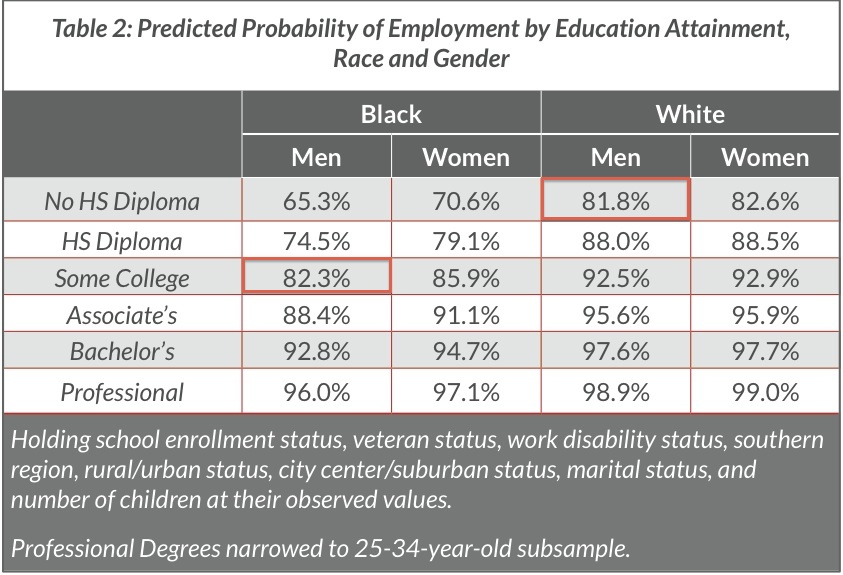
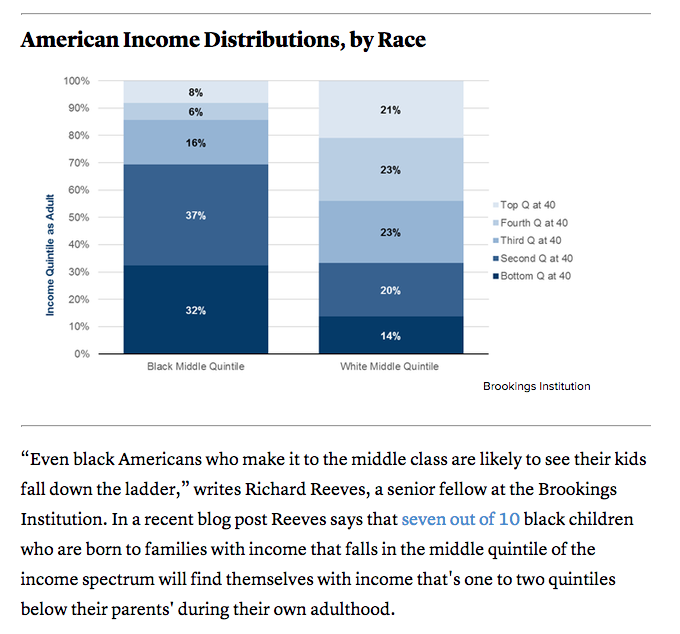
Education appears significant within race, but not the avenue to overcoming racism. Well educated blacks earn more than less educated blacks, but blacks and whites with the same education reflect significant race disparities favoring whites (Bruenig, 24 October 2014):
Rarely do we admit stunning data on race/education inequity. Blacks with some college have similar employment opportunities as whites with no high school diploma (Closing the Race Gap):
But certainly effort (grit and perseverance) matters more than simple accidents of a person’s birth? Actually, no (Bruenig, 13 June 2013):
We are left, then, with having to admit that the evidence is overwhelming that these are baseless cultural myths (possibly ideals we should aspire to, but certainly not the state of our society): Doing well in school and attaining advanced education are essential to overcoming any obstacles, and the key to succeeding in school is grit, effort and perseverance.
Grit and education narratives serve as veneer for white and wealth privilege.
Anthony Cody has now confronted the relentless and uncritical mainstream media fascination with grit in his The Resilience of Eugenics, linking claims about the importance of grit, the ability to identify students with grit, and the push to instill grit in certain students (brown, black, and impoverished, mainly) with Eugenics.
Cody’s argument has deep roots among many of us who have argued for quite some time that charter movements such as KIPP and grit arguments are not sound educationally, scientifically, or ethically. In fact, we have demonstrated that this entire package of narratives and policies is essentially racist and classist.
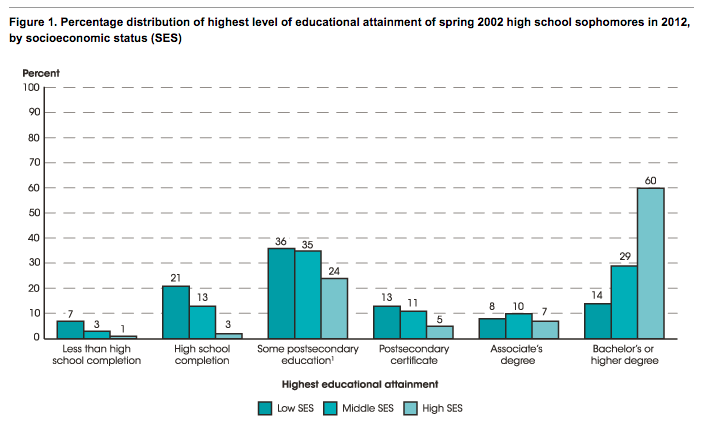
It is indeed the case that social mobility in the US is very low. This is easiest to see by looking at class-based education disparities, given that education is meant to be the thing that leads to social mobility.*
College attendance rates map directly on to parental income, with only 20% of the poorest children in college at age 19 compared to 90% for the richest children.
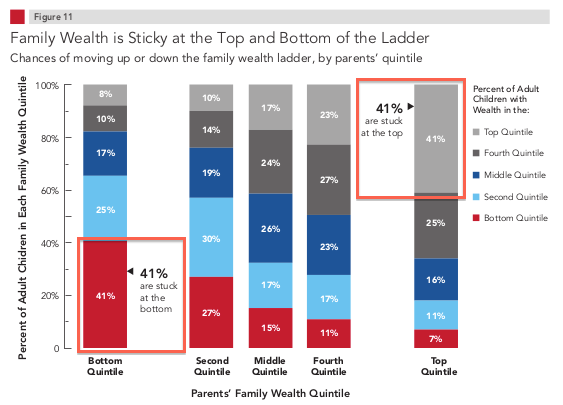
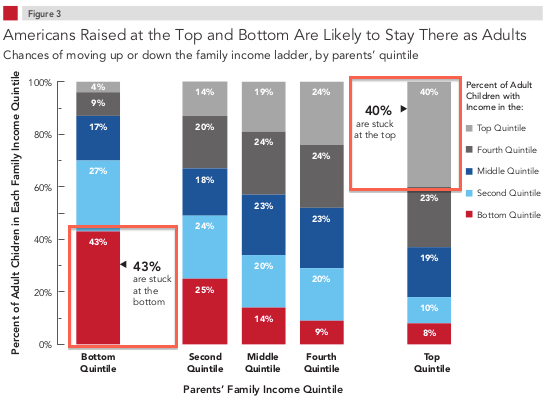
But the formula that Bruenig reveals, especially in chart form, is central to clarifying that accident of birth tends to trump significantly effort; life status of adults is built on access, opportunity, and privilege (or disadvantage): Home status leads to educational access and thus ultimately to adult status. [*My argument is that instead of crediting educational attainment as the key to adult success, educational attainment is a marker for home privilege, the valid source of adult success.]
Consider then the evidence:
Bruenig concludes: “Quite naturally then, even for reasons beyond these, a child’s eventual position in the social structure is heavily linked to that of their parents.”
Update 2: U.S. as “self-perpetuating class system”
As you can see, white families are much wealthier than black and hispanic families at every education level. More than that, all white families, even those at the lowest education level, have a higher median wealth than all black and hispanic families, even those at the highest education level. The median white family with an education level below high school has a net worth of $51.3k, while the median black and hispanic family with a college degree has a net worth of $25.9k and $41k respectively.
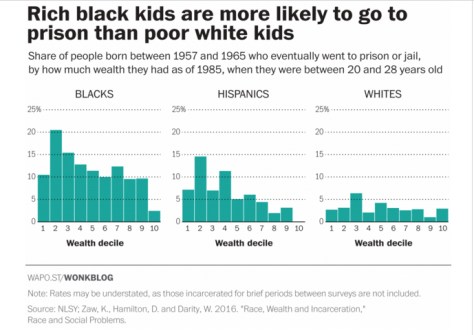
Although there were negligible differences among the racial groups in how frequently boys committed crimes, white boys were less likely to spend time in a facility than black and Hispanic boys who said they’d committed crimes just as frequently, as shown in the chart above. A black boy who told pollsters he had committed just five crimes in the past year was as likely to have been placed in a facility as a white boy who said he’d committed 40.
More recent statistics from the Department of Justice show that the juvenile justice system has continued to treat black boys more harshly. Although the overall number of cases in juvenile court has declined sharply since 2008, blacks still account for a third of cases in juvenile court, far more than their share of the population.
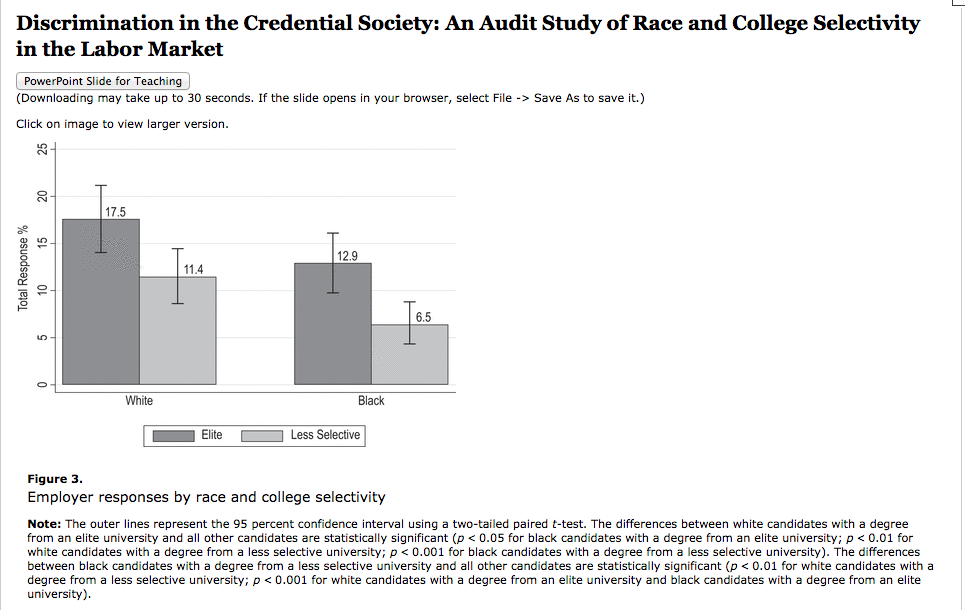
Racial inequality in economic outcomes, particularly among the college educated, persists throughout US society. Scholars debate whether this inequality stems from racial differences in human capital (e.g., college selectivity, GPA, college major) or employer discrimination against black job candidates. However, limited measures of human capital and the inherent difficulties in measuring discrimination using observational data make determining the cause of racial differences in labor-market outcomes a difficult endeavor. In this research, I examine employment opportunities for white and black graduates of elite top-ranked universities versus high-ranked but less selective institutions. Using an audit design, I create matched candidate pairs and apply for 1,008 jobs on a national job-search website. I also exploit existing birth-record data in selecting names to control for differences across social class within racialized names. The results show that although a credential from an elite university results in more employer responses for all candidates, black candidates from elite universities only do as well as white candidates from less selective universities. Moreover, race results in a double penalty: When employers respond to black candidates, it is for jobs with lower starting salaries and lower prestige than those of white peers. These racial differences suggest that a bachelor’s degree, even one from an elite institution, cannot fully counteract the importance of race in the labor market. Thus, both discrimination and differences in human capital contribute to racial economic inequality.
Key point:
Overall, these results suggest that employers strongly value a degree from an elite university but also discriminate against candidates with black names. An additional area of inquiry is how these variables work together. For instance, can black candidates close the gap with white candidates when they have a degree from an elite university compared to a degree from a less selective university?
In figure 3, I examine total employer responses across race and college selectivity. These results suggest a tiered pattern of responses: White candidates with a degree from an elite university have the highest response rate (17.5 percent), followed by black candidates with a degree from an elite university (12.9 percent) and white candidates with a degree from a less selective university (11.4 percent),11 and finally black candidates with a degree from a less selective university have the lowest response rate (6.5 percent).12 Thus, a white candidate with a degree from an elite university can expect an employer response for every six résumés submitted, while an equally qualified black candidate must submit eight résumés to receive a response; white candidates with a degree from a less selective university need to submit nine résumés to expect a response, while a similar black candidate needs to submit 15 résumés to receive a response.
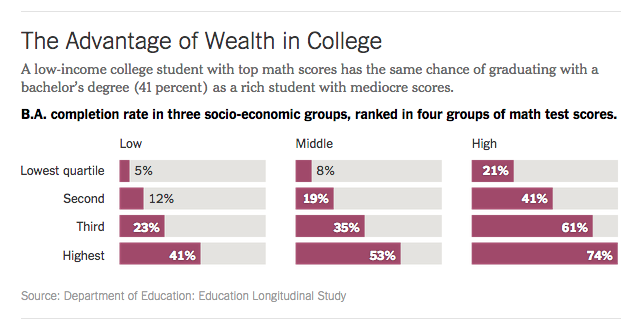
Rich and poor students don’t merely enroll in college at different rates; they also complete it at different rates. The graduation gap is even wider than the enrollment gap.
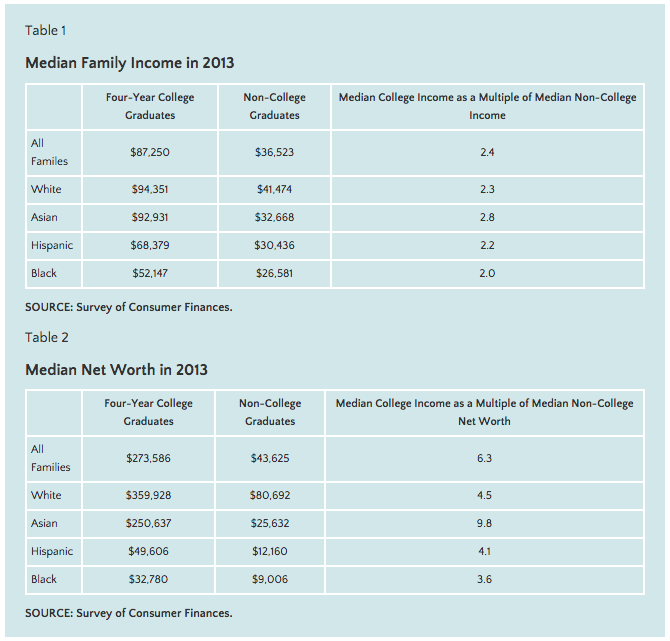
College-educated families usually earn significantly higher incomes and accumulate more wealth than families headed by someone who does not have a four-year college degree. The income- and wealth-boosting effects of education apply within all racial and ethnic groups. Higher education may also help “protect” wealth, buffering families against major economic and financial shocks and mitigating adverse long-term trends. Based on two decades of detailed wealth data, we conclude that education does not, however, protect the wealth of all racial and ethnic groups equally.
Compared to their less-educated counterparts, typical white and Asian families with four-year college degrees withstood the recent recession much better and have accumulated much more wealth over the longer term. Hispanic and black families headed by someone with a four-year college degree, on the other hand, typically fared significantly worse than Hispanic and black families without college degrees. This was true both during the recent turbulent period (2007-2013) as well as during a two-decade span ending in 2013 (the most recent data available).
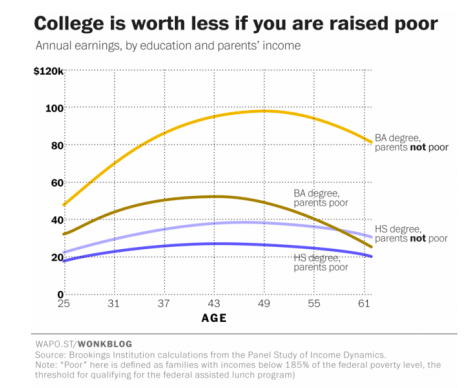
Not only that, but the earnings gap between poor and rich college-educated kids is huge, and it grows over the course of a career. Right after college, poor kids earn about two-thirds as much as rich kids, on average. But by mid-career, the typical college grad from a rich family is earning close to $100,000, while the grad from a poor family is making around $50,000.
For both the races tested, there was a difference of about 6 percentage points between the response rates for graduates of state schools and those of elite schools. But that gap widens to 11 percentage points when you compare white elite college graduates to black graduates from the state schools. And it narrows to just 1.5 percentage points, within the margin of error, between white state school graduates and black graduates of prestigious schools.
University of Michigan sociologist S. Michael Gaddis, who conducted the study, expected a gap between elite and state colleges, he tells Quartz, and he expected a gap between black and white applicants overall. He did not expect, however, to see that even among elite schools’ graduates, there was a big gap between whites and blacks.
“If we really think that education is the great equalizer, then someone who reaches the pinnacle of that system…should be rewarded pretty equally,” Gaddis says. “I would have been surprised, to be honest with you, to see no gap at all. But to see that the gap for Harvard and the other elite applicants was basically the same was very discouraging.”
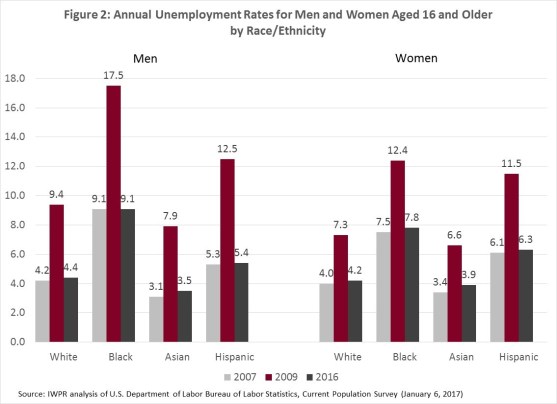
Current Unemployment Rates for Black Men and Women Comparable to Unemployment Rates for White Men and Women at the Bottom of the Recession
Figure 2 shows the annual average unemployment rates for men and women aged 16 and older by race and ethnicity at the start of the recession, at the end of the recession, and for 2016. Black and Hispanic women and men have higher unemployment rates than White women and men in each period. Unemployment rates remain higher in 2016 than in 2007 for most groups. Only Black men have an unemployment rate in 2016 comparable to 2007, but the unemployment rate in 2016 remains more than twice as high for Black men (9.1 percent) compared to White men (4.4 percent). After seven years of recovery, Black men’s unemployment rate is comparable to White men’s unemployment rate (9.4 percent) at the official business cycle trough. Similarly, Black women’s unemployment rate in 2016 (7.8 percent) is comparable to the unemployment for White women (7.3 percent) at the low point in the current business cycle.
Racial inequality in wealth is rooted in historic discrimination and perpetuated by policy: our analyses show that individual behavior is not the driving force behind racial wealth disparities. Typical black and Latino households that attend college and live in two-parent households still have much less wealth than similarly situated white households. Black and Latino households that include a full-time worker have much less wealth than white households with a full-time worker, and only slightly more wealth at the median than white households where the only person employed works part time. Differences in spending habits also fail to explain wealth disparities between black and white households.
Racial discrimination in labor markets is a critical process through which organizations produce economic inequality in society. Though scholars have extensively examined the discriminatory decisions and practices of employers, the question of how job seekers try to adapt to anticipated discrimination is often overlooked. Using interviews, a laboratory experiment, and a résumé audit study, we examine racial minorities’ attempts to avoid discrimination by concealing or downplaying racial cues in job applications, a practice known as “résumé whitening.” While some minority job seekers reject this practice, others view it as essential and use a variety of whitening techniques. When targeting an employer that presents itself as valuing diversity, however, minority job applicants engage in relatively little résumé whitening and thus submit more racially transparent résumés. Yet, our audit study shows that organizational diversity statements are not actually associated with reduced discrimination against unwhitened résumés. Taken together, these findings suggest a paradox: Minorities may be particularly likely to experience disadvantage when they apply to ostensibly pro-diversity employers. These findings illuminate the role of racial concealment and transparency in modern labor markets and point to an important interplay between the self-presentation of employers and the self-presentation of job seekers in shaping economic inequality.
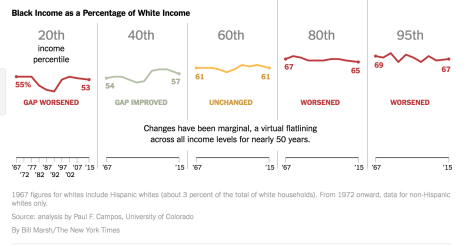
Is the white working class losing economic ground because of policies intended to improve the lives of black people? Anxiety and resentment among some white voters about those policies certainly seemed to benefit Donald Trump’s campaign last year, with its populist, ethno-nationalist message.
The problem with this belief is that it is false. The income gap between black and white working-class Americans, like the gap between black and white Americans at every income level, remains every bit as extreme as it was five decades ago. (This is also true of the income gap between Hispanic and white Americans.)…
Conservatives like Charles Murray tend to blame either social welfare programs for sapping initiative and keeping black people poor, or black people themselves for being less intelligent than whites, or a “pathological” culture that now manifests itself in the white working class as well.
But the historical pervasiveness and contemporary persistence of racism in America offer more than adequate explanations for what should be considered a scandalous state of affairs in regard to race-based economic inequality.
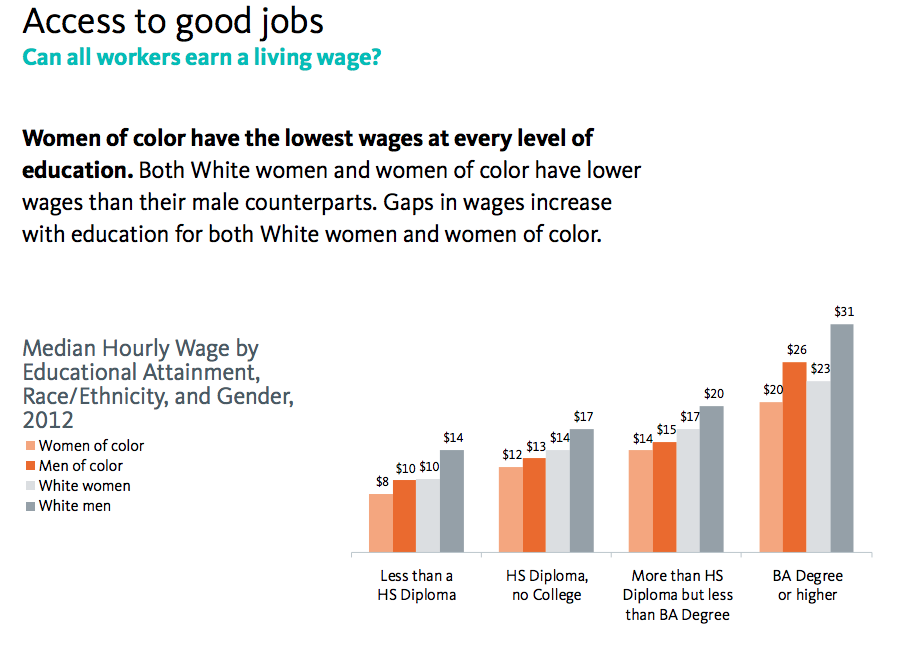
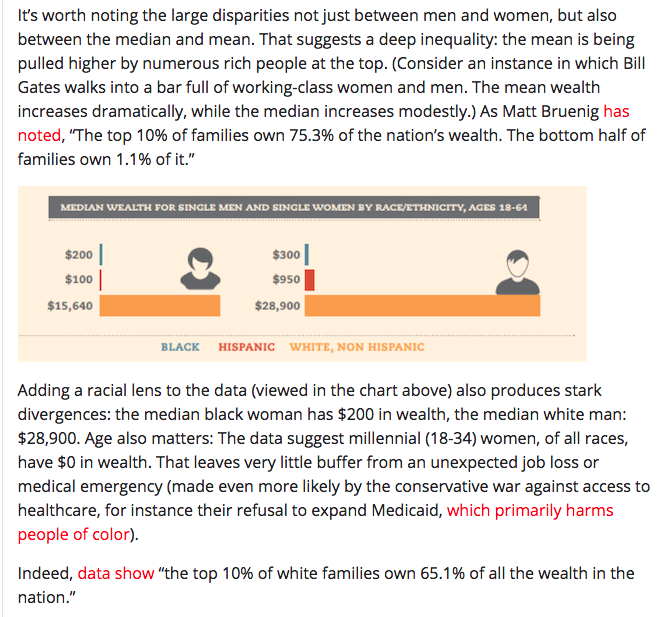
Education levels don’t make much of an impact on the high wage gap between Black women and non-Hispanic white men. While more education corresponds with higher wages for both Black women and white men, Black women still make between 61 and 66 cents on the dollar compared to their counterparts at every education level. African-American women have to have at least a Bachelor’s degree to make as much as white men who didn’t finish college.
What this report finds: Black-white wage gaps are larger today than they were in 1979, but the increase has not occurred along a straight line. During the early 1980s, rising unemployment, declining unionization, and policies such as the failure to raise the minimum wage and lax enforcement of anti-discrimination laws contributed to the growing black-white wage gap. During the late 1990s, the gap shrank due in part to tighter labor markets, which made discrimination more costly, and increases in the minimum wage. Since 2000 the gap has grown again. As of 2015, relative to the average hourly wages of white men with the same education, experience, metro status, and region of residence, black men make 22.0 percent less, and black women make 34.2 percent less. Black women earn 11.7 percent less than their white female counterparts. The widening gap has not affected everyone equally. Young black women (those with 0 to 10 years of experience) have been hardest hit since 2000.
In this report, we address ten commonly held myths about the racial wealth gap in the United States. We contend that a number of ideas frequently touted as “solutions” will not make headway in reducing black-white wealth disparities. These conventional ideas include greater educational attainment, harder work, better financial decisions, and other changes in habits and practices on the part of blacks. While these steps are not necessarily undesirable, they are wholly inadequate to bridge the racial chasm in wealth.
In the United States, attending a selective liberal arts college is often a sign of success. Human capital theory assumes graduates from these colleges share similar outcomes, in terms of employment and further education. This article reports, findings from a national (US) survey of liberal arts college students who graduated between 2012 and 2014. It finds significant differences in the immediate post-graduation outcomes of students based on family background. Using a Bourdieusian lens of capitals and habitus, the article links these different outcomes to differential experiences while in college, expectations, and parental resources. As in the public sector, classed pathways operate to produce differential outcomes for students of small liberal arts colleges. The article also demonstrates the continuing role of family-based material resources after graduation, and how these are used to differentiate students even when holding similar amounts of social and cultural capital.
This article demonstrates how class origin shapes earnings in higher professional and managerial employment. Taking advantage of newly released data in Britain’s Labour Force Survey, we examine the relative openness of different high-status occupations and the earnings of the upwardly mobile within them. In terms of access, we find a distinction between traditional professions, such as law, medicine, and finance, which are dominated by the children of higher managers and professionals, and more technical occupations, such as engineering and IT, that recruit more widely. Moreover, even when people who are from working-class backgrounds are successful in entering high-status occupations, they earn 17 percent less, on average, than individuals from privileged backgrounds. This class-origin pay gap translates to up to £7,350 ($11,000) lower annual earnings. This difference is partly explained by the upwardly mobile being employed in smaller firms and working outside London, but it remains substantial even net of a variety of important predictors of earnings. These findings underline the value of investigating differences in mobility rates between individual occupations as well as illustrating how, beyond entry, the mobile population often faces an earnings “class ceiling” within high-status occupations.
The persistence of racial disparities in employment outcomes across levels of education is troubling. While a tighter labor market has helped to reduce the black unemployment rate, even that has not been enough to eliminate multiple layers of racial inequality in the labor market, as we have shown here and as we summarize in Figure C. In particular, the fact that the country’s most highly educated black workers are still less likely to be employed than their white counterparts, and when they are employed, are less likely to be employed in a job that is consistent with their level of education, strongly suggests that racial discrimination remains a major failure of an otherwise tight labor market.
While Blacks and Latinos have made progress in educational attainment, their odds of having a good job are not as good as those of White workers with the same level of education, reflecting persistent racial disparities in the workforce. In fact, White workers are more likely than Black or Latino workers to have a good job at every level of educational attainment.
Although I accept that the process of writing an engaging popular article requires considerable simplification, I think it is essential that the article does not contain incorrect statements and misinformation. My primary goal with this review is to describe several claims in Jaffe’s article that were simply false or clearly misleading and then discuss how APS might successfully develop successful methods for providing research summaries for non-specialists that are informative and accurately presents the major views of APS members and Fellows. At the very least they should not contain factually incorrect statements and avoid reinforcing existing misconceptions in the popular media.
Through the Gladwell/10,000 hour rule example, Ericsson provides an important argument relevant to the current (and historical) public debate about school quality, teaching and learning, and education reform.
Much in the same way Gladwell has misrepresented research (which is typical within the media), and how that has been uncritically embraced by the media and public (as well as many if not most practitioners), a wide array of issues have received the same fate: learning styles, “grit,” collaborative learning, progressive education, charter schools, school choice, language gap, and so on.
Even when a claim or practice has a kernel of research at its source, popular oversimplification (often by journalists, but practitioners as well) and then commercialization/politicizing (creating programs and policies through publishers, “star” advocates, and legislation) significantly distort that research.
Education Has Failed Research, Historically
John Dewey represents an odd paradox in that he is possibly the most mentioned educator in the U.S. (either as the source of all that is wrong in education or idealistically cited as all that is right about how school could be), despite the reality that Dewey is mostly misunderstood and misrepresented; and thus his philosophy, progressivism, remains mostly absent in U.S. public schools.
Dewey can be blamed, in part, for this reality because he refused on principle to allow his experiments in education to be carefully catalogued because he believed no educational practice should be come a template for others.
Throughout much of the twentieth century, Lou LaBrant, a vigilant progressive educator, spent much of her career practicing and advocating for progressive literacy instruction, but LaBrant also confronted the many instances of how progressivism was misrepresented.
Broadly, and early, LaBrant recognized the public confusion about progressivism:
Two adults speak of “progressive education.” One means a school where responsibility, critical thinking, and honest expression are emphasized; the other thinks of license, lack of plans, irresponsibility. They argue fruitlessly about being “for” or “against” progressive education. (LaBrant, 1944, pp. 477-478)
But she also confronted how progressivism was mostly distorted in its application. LaBrant’s criticisms still reflect why education has failed research, and why research has not failed education.
Credible educational research-based philosophy, theory, and pedagogy are often corrupted by oversimplification.
In 1931, LaBrant published a scathing criticism of the popularity of the project method, an oversimplification of Dewey that resulted in students doing crafts in English class instead of reading or writing:
The cause for my wrath is not new or single. It is of slow growth and has many characteristics. It is known to many as a variation of the project method; to me, as the soap performance. With the project, neatly defined by theorizing educators as “a purposeful activity carried to a successful conclusion,” I know better than to be at war. With what passes for purposeful activity and is unfortunately carried to a conclusion because it will kill time, I have much to complain. To be, for a moment, coherent: I am disturbed by the practice, much more common than our publications would indicate, of using the carving of little toy boats and castles, the dressing of quaint dolls, the pasting of advertising pictures, and the manipulation of clay and soap as the teaching of English literature. (p. 245)
Credible educational research is often corrupted by commercialization/politicizing, reducing that research to misguided programs/legislation.
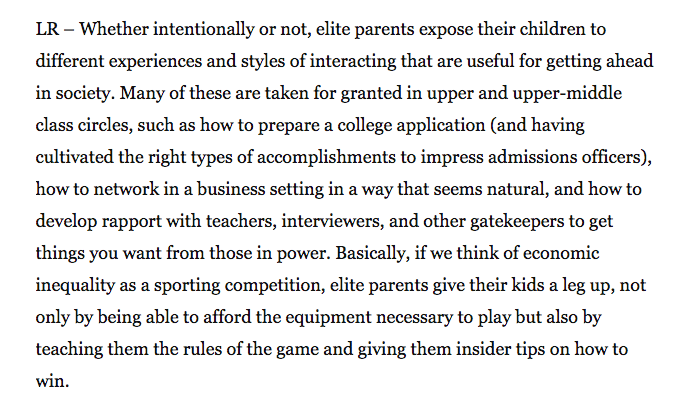
“[L]anguage behavior can not be reduced to formula,” LaBrant (1947) argued (p. 20)—emphasizing that literacy growth was complicated but flourished when it was child-centered and practical (for example, in the ways many privileged children experience in their homes because one or more of the parents are afforded the conditions within which to foster their children’s literacy).
By mid-twentieth century, LaBrant (1949) had identified the central failure of teaching reading: “Our language programs have been set up as costume parties and not anything more basic than that” (p. 16).
For at least 80-plus years since LaBrant fought this fight, the same patterns of media, political, public, and practitioners failing educational research have continued
Oversimplification, Commercialization/Politicizing: Recovering the Evidence
The list is incredibly long, too long to be exhaustive here, but consider the following: sloganism (“Work hard. Be nice.”), silver-bullet ideologies (“grit,” 10,000-hour rule), miracle schools (KIPP), evidence-based programs (Dibbles, 4-block, 6-traits), common sense claims and policy absent evidence (Common Core), and trendy legislation (3rd-grade retention policies as reading policy, merit pay) as well as politicized government reports (National Reading Panel).
Each of these can be traced to some kernel of research (sometimes robust bodies of research, and sometimes cherry-picked research), but all of these represent a current and historical fact: Education has failed research, but research has not failed education.
When educational research is reduced to scripts or programs/legislation, that knowledge base is invariably distorted, corrupted—as Ericsson details well above.
Journalists, politicians, and commercial education entities have all played a fundamental and crippling role in this reality; thus, as Ericsson argues, educators, scholars and researchers must not allow the fate of educational research to remain primarily in the wrong hands.
We have a public and professional obligation to confront these oversimplifications as well as the commercialization/politicizing of educational research. And we must do this through our public work that speaks to those failures and the public simultaneously.
As LaBrant and Ericsson reveal, unless we take that call seriously, we too are part of the reason education continues to fail research.
References
LaBrant, L. (1949). A genetic approach to language. Unpublished manuscript, Institute of General Semantics, Lakeville, CT.
LaBrant, L. (1947). Um-brel-la has syllables three. The Packet, 2(1), 20-25.
LaBrant, L. (1944, November). The words they know. The English Journal, 33(9), 475-480.
LaBrant, L. (1931, March). Masquerading. The English Journal, 20(3), pp. 244-246.
Although the foundational approach to education reform has remained the same (as has the structure of and instruction in public schools) for about a century—one grounded in revising or updating in-school-only elements such as standards/curriculum, technology, and testing—the past thirty years have seen education reform increase accountability based on standards and high-stakes testing (despite that approach never working) while rushing to experiment with charter schools and value-added methods of evaluating teachers (despite neither working as well).
And thus the “R” word that has remained ignored in education reform is not “reform,” but “race”—or more directly “racism.”
Throughout our current three decades of education reform, poverty has been a significant part of the discourse and equation—often framed as “not an excuse” or misrepresented as the “achievement gap.” Poverty, then, has been allowed in the conversation, included in the policies, and identified as a significant barrier to learning, but only as something we must overcome through racketing up the same old approaches to education reform noted above.
Just as one example, every year SAT data are released, the strongest correlations with scores remain the socioeconomic status of students’ homes and the academic attainment of those students’ parents. Yet, these historic and current patterns remain for the education reformers evidence not of systemic social inequity and not evidence of failed education reform or systemic school inequity, but proof that teachers and students simply are not trying hard enough.
Education reform not only ignores inequity bred from racism, classism, and sexism, but also actively perpetuates and even increases that inequity (most significantly reflected in high-stakes standardized testing).
The political, media, and public narratives in the U.S. focus only on the individual, and in the relationship among effort, talent, and opportunity, those narratives address only effort.
We must ask: Who benefits from cultural narratives that claim success comes from effort and failure from sloth? Who benefits when those cultural narratives begin by claiming everyone has the same opportunity in the U.S., by erasing the evidence of the power of privilege and disadvantage, most often grounded in race?
Sloganism and the Racist Politics of Education Reform
The ugly answer to those questions is that white and affluent privilege benefits from these cultural narratives that are in fact false and racist.
But we aren’t allowed to utter “lie” or “racism” in polite company in the U.S.—and such decorum, of course, may have sprung from those privileged few who are the ones most likely to have their sensibility bruised by both the directness and accuracy of those claims.
In a land where “racism” is not allowed in the conversation, racism does not disappear, but remains corrosive, powerfully so; as poet Adrienne Rich notes, “what is missing, desaparecido, [is] rendered unspeakable, thus unthinkable.” If we cannot say it, if we cannot think it, we certainly will not act to eradicate it.
And to demand individuals simply try harder in a context where effort is not the problem, and not the solution, is a harsher and more damning racism than in those days not too far in the U.S. past where racial slurs were public, frequent, and normal. “Work hard. Be nice” is the twenty-first century masked racial slur:
Currently, the grotesque reality we have created includes shunning direct and public racist language in the same ways we deflect credible acknowledgements of racism.
Just as book censorship is an effective and masked act of racism and sexism (authors or color and female writers are disproportionately impacted, silenced), just as mass incarceration is an effective and masked act of racism (white males outnumber black males 6-1 in society while black males outnumber white males 6-1 in prison), “no excuses” education reform focused on in-school policy and driven by accountability, standards, and high-stakes testing is an effective and masked act of racism.
The primary sloganism used for effort is “grit,” and the anecdotal proof remains the Great White Male (Steve Jobs, for example)—with the exceptional outlier of color tossed in for good measure (the election of Barack Obama proves U.S. is a post-racial society, goes the claim).
Calling out racism is ignored, is shunned because the “grit” narrative and the Great White Male fall apart in the light of such calls—like a vampire reduced to dust by the risen sun.
Arguing that poor black people are not “holding up their end of the bargain,” or that they are in need of moral instruction is an old and dubious tradition in America….
The “structural conditions” Chait outlines above can be summed up under the phrase “white supremacy.” I have spent the past two days searching for an era when black culture could be said to be “independent” of white supremacy. I have not found one.
And then it is Coates’s conclusion that exposes the essential racism in education reform—demanding exceptional effort by those marginalized exclusively for their race:
There is no evidence that black people are less responsible, less moral, or less upstanding in their dealings with America nor with themselves. But there is overwhelming evidence that America is irresponsible, immoral, and unconscionable in its dealings with black people and with itself. Urging African-Americans to become superhuman is great advice if you are concerned with creating extraordinary individuals. It is terrible advice if you are concerned with creating an equitable society. The black freedom struggle is not about raising a race of hyper-moral super-humans. It is about all people garnering the right to live like the normal humans they are.
Gay has been brought to the place where she is confronting her ambition as a black Haitian because she is riding a wave of success for her novel, An Untamed States, and a collection of essays, Bad Feminist. “I began to understand the shape and ferocity of my ambition when I was in kindergarten,” Gay admits, adding a haunting event:
Each student had been given a piece of paper in class, bearing an illustration of two water glasses. We were instructed to color in one-half of the illustration. I suspect we were learning about fractions. I diligently shaded in one half of one of the glasses and smugly turned my work in to the teacher. If it had been the parlance of the day, I would have thought, Nailed it. I had not, of course, “nailed it.” I was supposed to color in an entire glass. Instead of the praise I anticipated, I received an F, which, in retrospect, seems a bit harsh for kindergarten. I couldn’t bring such a grade home to my parents. I had already begun demanding excellence of myself and couldn’t face falling short.
On the bus ride home, I stuffed my shame between the dry, cracked leather of the seat and assumed the matter had been dealt with. The driver, a zealous sort, found my crumpled failure and handed it to my mother when he dropped me off the next day. She was not pleased. I was not pleased with her displeasure. I never wanted to experience that feeling again. I vowed to be better. I vowed to be the best. As a black girl in these United States—I was the daughter of Haitian immigrants—I had no choice but to work toward being the best.
Like Coates, Gay recognizes her experience is not only hers:
Many people of color living in this country can likely relate to the onset of outsized ambition at too young an age, an ambition fueled by the sense, often confirmed by ignorance, of being a second-class citizen and needing to claw your way toward equal consideration and some semblance of respect. Many people of color, like me, remember the moment that first began to shape their ambition and what that moment felt like.
Coates’s “superhuman” and Gay’s “outsized ambition” reverberate inside the walls built in the U.S. to keep such voices quiet because the truth is harsh, and ugly—as Gay explains:
I am thinking about success, ambition, and blackness and how breaking through while black is tempered by so much burden. Nothing exemplifies black success and ambition like Black History Month, a celebratory month I’ve come to dread as a time when people take an uncanny interest in sharing black-history facts with me to show how they are not racist. It’s the month where we segregate some of history’s most significant contributors into black history instead of fully integrating them into American history. Each February, we hold up civil-rights heroes and the black innovators and writers and artists who have made so much possible for this generation. We say, look at what the best of us have achieved. We conjure W. E. B. Du Bois, who once wrote, “The Negro race, like all races, is going to be saved by its exceptional men.” We ask much of our exceptional men and women. We must be exceptional if we are to be anything at all.
While Gay as a black Haitian woman and I as a privileged white male have experienced much different lives, I can strongly identify with the allure she feels for the myth of the rugged individual:
I have come to realize how much I have, throughout my life, bought into the narrative of this alluring myth of personal responsibility and excellence. I realize how much I believe that all good things will come if I—if we—just work hard enough. This attitude leaves me always relentless, always working hard enough and then harder still. I am ashamed that sometimes a part of me believes we, as a people, will be saved by those among us who are exceptional without considering who might pay the price for such salvation or who would be left behind.
Further, in the way that we should be confronting education reform, Gay unpacks President Obama’s My Brother’s Keeper, exposing the essential failure of the policy (an essential failure identified by Martin Luther King Jr. as addressing social inequity indirectly, instead of directly):
The initiative is certainly well-intentioned, but it also speaks to the idea that black Americans must make themselves more respectable in order to matter. In its initial incarnation, it also gave the impression that only boys and men matter. On its surface, My Brother’s Keeper is a program that does nothing to address the systemic and structural issues young men of color will face, no matter how well prepared or respectable or personally responsible they are.
Gay warns us about the dangers of exceptionality: “We forget that we should not only measure black progress by the most visibly successful among us, but also by those who continue to be left behind.” And then, after wrestling with the tensions created by her advantages shaded by burdens of her race and gender, Gay concludes:
I have achieved a modicum of success, but I never stop working. I never stop. I don’t even feel the flush of pleasure I once did when I achieve a new milestone. I am having a moment, but I only want more. I need more. I cannot merely be good enough because I am chased by the pernicious whispers that I might only be “good enough for a black woman.” There is the shame of sometimes believing they might be right because that’s how profound racism in this country can break any woman down. I know I am one of the lucky ones because unlike far too many people of color, I had far more than “half as much” to work with, the whole of my life. It is often unbearable to consider what half as much to work with means for those who are doing their damndest to make do. I call this ambition, but it’s something much worse because it cannot ever be satisfied.
What I Have Learned from Sports
In my introductory education course and two first year seminars this fall, I have shared Gay’s wonderful and complicated essay. That education course has begun to confront the uncomfortable facts of privilege and race, and those first year students (since I teach at a selective university which results in a student population disproportionately white and affluent) echo Gay’s experiences with ambition and guilt. Gay’s kindergarten memory reflects something quite wrong about how all children are raised in the U.S. as well as revealing the scar of racism.
With those first-year students, we confronted the public and adult messages they have been sent about effort, talent, and opportunity. That discussion was sobering.
I shared with them my own journey—again one resting on significant privilege since I am white and male, but tinged slightly by my working-class background—to rejecting the “grit” propaganda—a journey traced through my efforts to be a successful athlete.
In high school, I worked doggedly to be a good basketball player; I made very little effort in school. I was usually the last player selected on the basketball team each year (primarily because the coaches knew my father) and then rode the bench, but I made mostly As and a few Bs in my classes.
At basketball practice, I often tried harder than anyone, something noted by the coaches even. But on game day, the better athletes (some who made almost no effort in practice) played. I had been raised in a “Word hard. Be nice” household, a vestige of 1950s idealism in the U.S. But the world of sport showed me the truth: Talent trumps effort when given the opportunity.
In other words, the “grit” honoring of effort first (and even exclusively) is a warped version of the real order of things: Opportunity, talent, and then effort.
The “grit” narrative, then, and the sloganism of “Work hard. Be nice”—regardless of good intentions—are the racial slurs of our time.
To end that racism, it first must be named, and then directly, we must attend to the opportunities denied so that talent and effort can matter. And the first opportunity every child, every person deserves is the basic human dignity that is destroyed when, as Gay stated, anyone feels that “[w]e must be exceptional if we are to be anything at all.”
Optimism, seeing the light at the end of the tunnel—these are not my proclivities.
And while I wallow in the self-delusion that I am a Skeptic, the truth is that I have long ago slipped over into the abyss of cynicism.
There are moments, however, when I hope.
One such moment was during the Sandy Hook school shooting tragedy—when I wanted desperately to believe that President Obama’s call for seeing every child as “all our children” would resonate against the recurring din of gunfire killing children—but not only the uniquely American slaying of school children but the daily loss of mostly black and brown children and young adults to gunfire in the homes and streets of U.S. inner cities.
But that has not happened. Michael Brown was shot and killed by a police officer, Brown’s body left callously in the street—adding to the seemingly endless cataloguing of similar tragedies. And those tragedies are daily magnified by our collective refusal to see each death in the same way we would see the death of our own children, our collective refusal to see how “other people’s children” live, learn, and die is just as precious as if they were “all our children.”
So my cynicism is driven by the stark realization that if we cannot come together as a community over the shooting of “other people’s children,” how will we ever come together about the less dramatic but just as tragic conditions such as what we allow for the education of “other people’s children”?
The powerful phrase “other people’s children” comes from the work of Lisa Delpit, who confronts the inequity of educational opportunities for minority and impoverished children. Delpit highlights that marginalized students receive disproportionately test-prep and worksheet-driven instruction, unlike their white and affluent peers. While some have claimed her as a champion of traditional practice because her criticisms have included failures by progressives, Delpit counters:
I do not advocate a simplistic “basic skills” approach for children outside of the culture of power. It would be (and has been) tragic to operate as if these children were incapable of critical and higher-order thinking and reasoning. Rather, I suggest that schools must provide these children the content that other families from a different cultural orientation provide at home. This does not mean separating children according to family background [emphasis added], but instead, ensuring that each classroom incorporate strategies appropriate for all the children in its confines.
And I do not advocate that it is the school’s job to attempt to change the homes of poor and nonwhite children to match the homes of those in the culture of power [emphasis added]. That may indeed be a form of cultural genocide. I have frequently heard schools call poor parents “uncaring” when parents respond to the school’s urging, saying, “But that’s the school’s job.” What the school personnel fail to understand is that if the parents were members of the culture of power and lived by its rules and codes, then they would transmit those codes to their children. In fact, they transmit another culture that children must learn at home in order to survive in their communities.
At first glance, this seems to be the message conveyed by Payne: poor students of color need to be explicitly taught the hidden rules or codes of the middle/upper class in order to be successful in school, work, etc. When examined more closely, this could not be further from the truth. Both terms, the “culture of poverty” (Payne) and the “culture of power” (Delpit) locate the problem in culture—but in different ways/places [emphasis added]. Although Payne and other “culture of poverty” advocates see the problem as residing with the cultural attributes of those living in poverty, the “culture of power” perspective suggests that the middle/upper class hold the power and key to institutional success, partly through their monopolization of educational skills, and that they do all they can to make sure that they and their offspring maintain that power.
When Delpit began her work on “other people’s children” she predicted that her purpose would be misunderstood. People criticized her for “vindicating” teachers who subjected students of color to isolated, meaningless, sub-skills day after day. However, what she was actually advocating when she referred to “skills-based instruction” was the “useful and usable knowledge that contributes to a student’s ability to communicate effectively in standard, generally acceptable literary forms” and she proposed that this was best learned in meaningful contexts. In other words, Delpit argued that both technical skills and critical thinking are essential: a person of color who has no critical thinking skills becomes the “trainable, low-level functionary of the dominant society, simply the grease that keeps the institutions which orchestrate his or her oppression running smoothly.” At the same time, those who lack the technical skills demanded by colleges, universities, and employers will be denied entry into these institutions. Consequently, they will attain financial and social success only within the “disenfranchised underworld.”
The key distinction between Delpit and Payne is the reason why [emphasis added] they believe students should be taught the “hidden rules.” Payne argues that their educational and economic success depend on their being able to conform to the rules of the middle/upper class. While Delpit, too, makes this argument, she does not believe that students should passively adopt an alternate code simply because it is the “way things are,” especially if they want to achieve a particular economic status. Instead, Delpit asserts that students need to know and understand the power realities of this country with the purpose of changing these realities.
We are confronted, then, with the continuing rise in programs funded by the government and supported by a wide range of political, public, and media ideologies and interests that submit only “other people’s children” to teachers produced by alternative pathways (such as Teach For America, but also copycats) and to school structures (usually charter schools, labeled “public” but functioning within a market dynamic) and policies driven by “no excuses” ideologies (such as KIPP, but also numerous copycats) demanding “grit.”
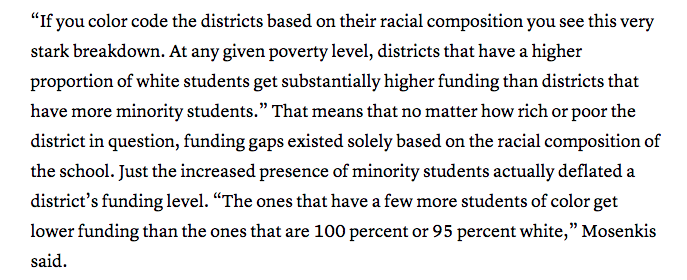
Yet, affluent children, mostly white, find themselves in classrooms with low class size, experienced and qualified/certified teachers, and rich curricula often not linked to the standards-of-the-moment or high-stakes testing—and do not find themselves disproportionately retained, suspended, expelled, or shot while unarmed walking down the street.
Our education dilemma is a subset of our greater cultural dilemma—one that pits our traditional commitments to the rugged individual, Social Darwinism, and consumerism against our potential moral grounding in community and cooperation.
No child should need to depend on the choices her/his parents make, and no parents should be faced with making choices about those foundational things that all humans deserve—one of which is access to the exact same conditions for learning and living that the privileged among us have before them.
Today, the U.S. remains a dog-eat-dog culture that perpetuates and allows one world for “other people’s children” that would never be tolerated for “my child.” A great moral lapse of our time is that we refuse to act in ways that prove “they’re all our children.”
educator, public scholar, poet&writer – academic freedom isn't free












 dr. p.l. (paul) thomas